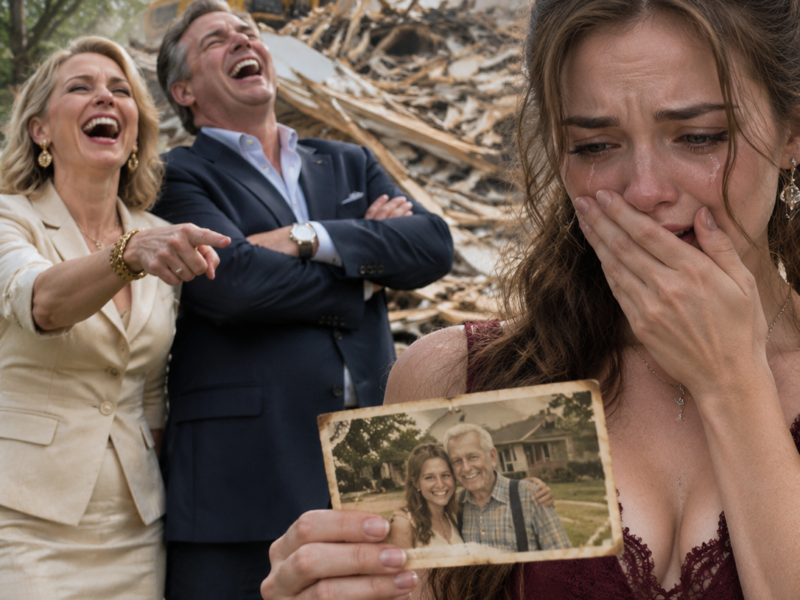
I Spent 13 Months Restoring My Grandfather’s Old Creek House, Investing $31,600 to Give My Younger Brother the Home He Was Promised—But While I Was 600 Miles Away on a Work Trip, My Father and Brother Bulldozed It and Called Me Laughing: “Now You Have Nothing to Protect.” I Thought They Had Destroyed Everything Until I Found a 2019 Letter in Grandpa’s Old Farm Records, and What Was Written at the Bottom Changed Everything I Thought I Knew About My Family…
I Spent 13 Months Restoring My Grandfather’s Old Creek House, Investing $31,600 to Give My Younger Brother the Home He Was Promised—But While I Was 600 Miles Away on a Work Trip, My Father and Brother Bulldozed It and Called Me Laughing: “Now You Have Nothing to Protect.” I Thought They Had Destroyed Everything Until I Found a 2019 Letter in Grandpa’s Old Farm Records, and What Was Written at the Bottom Changed Everything I Thought I Knew About My Family…
Part 1
I was six hundred miles from home when my father called, laughing. “Now you have nothing to protect, Diane.” My brother leaned toward the phone. “We saved you the trouble.” Then they sent a photograph: a yellow excavator, a crushed green roof, and the creek behind a heap of timber. I stared at it and whispered, “Wrong house.”
They laughed harder. They had no idea what Grandpa had asked me to do.
My name is Diane Stein. I was thirty-nine, and my grandfather had left me ninety-six acres in rural Ohio, including two houses. The Creek House stood beside a sycamore; the Hill House, built by Grandpa Gus, stood half a mile uphill.
Kyle was being groomed to inherit Dad’s excavation business; I was expected to be useful in quieter ways. I typed invoices while Kyle rode in the trucks. At sixteen, Dad took my $2,300 car savings to repair a dump truck. When I protested, he called me useless.
That night, I walked two miles to Grandpa’s house. He let me in without questions, and I lived with him for two years. He taught me to measure lumber and keep careful accounts. “A house ought to know who built it,” he said, writing names on the framing before walls were covered.
I left for college and built a life in Columbus, but kept paying family bills, including $4,180 in overdue taxes. I thought silence kept the peace.
When Grandpa died in 2024, his will left me the farm and both houses. Dad received $20,000; Kyle got Grandpa’s tools and an old pickup. Dad was furious. “Ninety-six acres to a girl who lives in an apartment?” he said. “This isn’t finished.”
In Grandpa’s desk, I found an envelope marked “After.” Inside was a brass key and a note asking me to finish the Creek House. He had been restoring it for years. The house was not meant for me, but for Kyle—a place of his own, beyond Dad’s control. Grandpa wanted me to complete it before revealing the gift.
For thirteen months, I worked every weekend, hiring specialists for wiring and plumbing and doing the rest myself. I photographed each stage and saved every receipt. It cost $31,600. On a kitchen stud, I found Grandpa’s note: “KS Kitchen, May 2021.”
Dad pushed me to sell the farm to Halverson Sand and Gravel for over a million dollars and a five-year hauling contract for his business. I refused. When he let them survey without permission, I removed the stakes and told the buyer only I could authorize access.
Dad gave me until spring.
The Creek House was finished in April 2026: a small white farmhouse with a green roof, two bedrooms, and a kitchen smelling of fresh pine. I hung Grandpa’s key beside the door. Kyle’s thirty-fifth birthday was weeks away. His card read, “Grandpa built the bones. I just finished it. It’s yours.”
Then I flew to Kansas City for work. On Wednesday, Dad called, laughing. He and Kyle had taken an excavator to the farm while I was away. The photograph showed the Creek House crushed beneath the bucket. The Hill House was untouched, but the home I had spent thirteen months restoring was gone.
Our neighbor Russ had witnessed it: Kyle operated the machine while Dad pointed, and my mother waited in her Buick. She had asked for my travel dates weeks earlier.
I flew home the next morning. In the rubble, I found the brass hook with the key still hanging from it. When Dad and Kyle returned for the excavator, I handed my brother Grandpa’s letter. Kyle read that the Creek House was meant for him. His face crumpled. Dad dismissed the letter as something I had conveniently produced after the demolition.
Kyle asked why I had never told him. I said Grandpa had asked me to wait until it was a house. “It was a house on Sunday,” he replied. He was right. I had waited too long.
Part 2
Dad tried to make the demolition my fault. He sent me an $8,400 invoice for “unsafe structure removal,” then added a handwritten note: sign with Halverson and the bill disappears. The sheriff referred it to civil court, and the gravel company suspended its offer. Prosecutors declined charges, citing disputed permission. My mother came to Columbus and admitted she had sat in the car during the demolition because she “didn’t want to watch from the house.”
For a while, I considered selling most of the farm to pay Kyle’s loans. Then I overheard Dad telling someone, “She’ll fold. She always pays.” I realized the sale would not free my brother; it would only give Dad another reason to keep him tied to the business. I searched Grandpa’s records, looking for proof that the gift had been planned before his death.
In a 2019 farm ledger, I found a letter addressed to Dad. Grandpa had written that he was fixing the Creek House for Kyle. Beneath it, in Dad’s unmistakable block capitals, was the reply: “He doesn’t need a house. He needs to stay where he’s useful.” Dad had known for seven years, and had sent Kyle to destroy the very home Grandpa meant for him.
Part 3
I built a binder with the letter, Grandpa’s construction notebook, receipts, photographs, Russ’s signed statement, and Dad’s own demolition invoice. At a family meeting, Dad laid out the gravel contract and expected me to sign. Kyle arrived carrying a copy of the 2019 letter. In front of our aunt, he asked Dad whose handwriting was at the bottom.
Dad finally admitted he had kept Kyle working because the business needed him. Kyle put the company keys on the table and refused to sign another loan extension. I told Dad the land was not for sale and that my lawyer would demand payment for the house. For once, nobody rescued Dad from the silence.
Halverson walked away. Dad eventually agreed to pay $85,000 toward rebuilding. Kyle and I began again, this time with three acres transferred into his name before construction started. One evening, he wrote “KS, September 2026” on a new kitchen stud beneath Grandpa’s and my marks. I placed the brass key in his palm.
There was nothing for it to open yet, but he closed his fingers around it. Grandpa’s promise was finally becoming real, built by the two people Dad had tried to keep apart.








