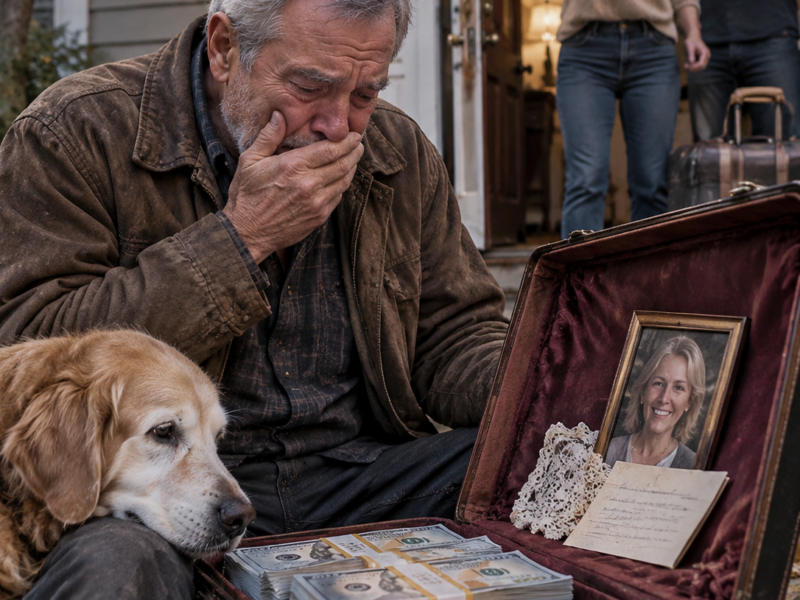
At 70, My Own Daughter Pointed at the Door and Said, “I’m Tired of Taking Care of an Old Man Like You,” While Her Husband Threw My Late Wife’s Suitcase at My Feet and Ordered Me to Leave With My Dog. I Walked Away Without Arguing, But That Night, I Opened the Suitcase and Found a Letter Revealing My Wife Had Secretly Left Me $1.4 Million—and Her Final Warning Made Me Realize Something Terrifying About My Daughter.
At 70, My Own Daughter Pointed at the Door and Said, “I’m Tired of Taking Care of an Old Man Like You,” While Her Husband Threw My Late Wife’s Suitcase at My Feet and Ordered Me to Leave With My Dog. I Walked Away Without Arguing, But That Night, I Opened the Suitcase and Found a Letter Revealing My Wife Had Secretly Left Me $1.4 Million—and Her Final Warning Made Me Realize Something Terrifying About My Daughter.
Part 1
“Get out, Dad.”
My daughter, Lauren, pointed at the front door of the house I had owned for thirty-one years. She did not shout. Her voice was flat, almost bored, as if she were asking me to take out the trash.
“I’m tired of taking care of an old man like you,” she said.
Her husband, Derek, stood beside the kitchen island, arms crossed. Then he picked up my late wife Dorothy’s battered brown suitcase and dropped it at my feet.
“Take your useless junk and that old dog. Get out.”
Buddy, my eight-year-old golden retriever, pressed against my leg. He sensed the cruelty in the room before I could fully understand it. I looked at Lauren, hoping to find some trace of the little girl who used to race down this hallway in her socks. Instead, I saw a stranger.
I was seventy. I had repaired the roof, replaced the windows, painted every room, and rebuilt the backyard fence twice. Dorothy and I had filled that house with thirty-one years of ordinary memories: birthdays, arguments, laughter, and quiet evenings. After Dorothy died, Lauren and Derek moved in, supposedly to help me. At first, it felt good to have family around. Then Dorothy’s photographs disappeared from the hallway, her belongings were moved into the basement, and Buddy was pushed into the back of the house because Derek suddenly claimed to be allergic to him. Lauren began managing the bills and added herself to my bank account “just in case.” Soon she called my home “our place.”
I had ignored every warning because I wanted to believe that family meant patience.
I had even overlooked my seventieth birthday, when Lauren and Derek went out to dinner and forgot to call. I told myself they were busy. I told myself the same thing when Lauren sold my green reading chair and when she stopped asking about my day. Dorothy would have noticed. She always noticed the small things that revealed the truth.
That night, I did not argue. I picked up the suitcase, clipped Buddy’s leash to his collar, and walked out. The cold Los Angeles air followed us to my car. I counted eleven steps from the front door to the curb. No one came after me.
At eleven that night, I found a cheap motel room on Sepulveda Boulevard. Buddy climbed onto the bed, breaking Dorothy’s old rule about dogs on furniture. I let him stay. For a while, I sat beside him remembering the woman who used to leave the kitchen light on so I would never come home to darkness.
Then I opened the suitcase.
There were no clothes inside. On top of folded towels lay an envelope with my name written in Dorothy’s unmistakable handwriting. Inside were a small brass key, financial documents, a prepaid card, and a three-page letter.
Dorothy apologized for keeping a secret. She explained that she had placed $1.4 million in a revocable living trust, naming me as its sole beneficiary. The money came from farmland her family had owned in Georgia, sold years earlier, and investments she had quietly managed for eighteen years. She had kept it separate to protect it—and me.
“You have a generous heart,” she wrote, “but your generosity has a blind spot. Every time Lauren called in trouble, you emptied yourself to fill the hole.”
The words hurt because they were true. Dorothy had also arranged for a lawyer, Jason Barrett, to hold the original trust papers and had asked her friend Carol to keep the suitcase until Lauren did something that could no longer be excused.
I read the letter twice, then held Buddy close. My wife had seen what I refused to see. And she had left me a way to stand on my own.
At the bottom, Dorothy had written one final instruction: “When you are ready, find Carol.”
Part 2
Carol answered my call just after six the next morning. She told me Lauren had contacted her days before throwing me out, asking whether I seemed confused and needed another place to live. Carol had also seen Lauren throwing away our wedding photograph. The eviction, she said, had been planned.
My old friend Wayne arrived at the motel with coffee and listened. Together, we visited Jason Barrett. He confirmed that the $1.4 million trust belonged to me alone and that the house was still legally mine. Lauren had no authority to sell it.
At a storage unit, Wayne and I found Dorothy’s filing cabinet. Inside was a notebook documenting twenty-two years of money Lauren had borrowed—$220,000 in all—and emails showing that she and Derek had hidden debts and counted on inheriting everything after Dorothy and I were gone.
One message chilled me: Lauren had written that they should move quickly when something happened to me, before I could speak to anyone I trusted.
I finally understood. They had not simply grown impatient with an aging father. They had treated my life, my home, and my savings as things they were entitled to collect.
Part 3
I gave Lauren the letter Dorothy had written for her. At a coffee shop, she read three pages about my sacrifices, then calmly tore it into pieces. She said we had made our choices and she would not feel guilty for hers.
Jason stopped their attempt to list my house. Derek later contacted me, blamed Lauren, and offered to manage the money. I refused. Then came consequences: Derek’s Range Rover was repossessed, and Lauren lost her job after misusing a company card.
I bought a house in Glendale with a yard. Months later, Lauren visited and asked who would inherit the money when I died.
I looked at Buddy resting at my feet.
“For the first time in my life,” I told her, “I don’t need that answer yet. I’m still here. That’s enough for today.”
She left. I stayed on the porch, thinking of Dorothy. Her money was not a weapon or reward. It gave me time—to live without being used, to love without surrendering everything, and to understand that a good father can set boundaries.
I had spent seventy years believing I had to give until nothing remained. Dorothy left me one last lesson: I was worth protecting, too.








