The SEAL Captain Found His Baby Sleeping in the Nurse’s Arms Then He Did the Unthinkable
The SEAL Captain Found His Baby Sleeping in the Nurse’s Arms Then He Did the Unthinkable
Sarah Mitchell had been off the clock for two hours and eleven minutes, but she hadn’t moved from the chair in the third-floor family lounge.
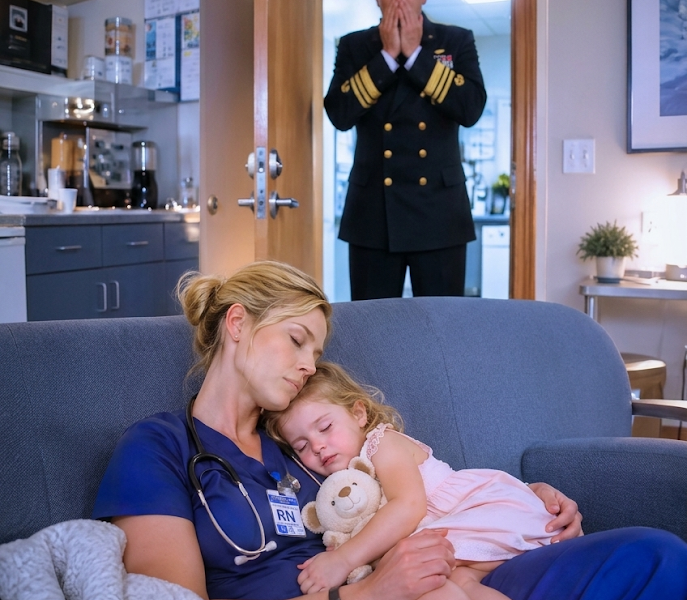
The little girl sleeping against her chest weighed no more than thirty-five pounds. Her name was Lily Reyes, she was four years old, and her small fingers were wrapped tightly around the collar of Sarah’s bright cobalt-blue scrubs as though letting go might somehow make the world disappear again.
Sarah had learned that children rarely explained their fears in the same way adults did. They didn’t always have the words to describe loneliness, grief, or the terrible uncertainty of not knowing whether someone they loved would come back. Sometimes, they simply held on. Sometimes, they cried until exhaustion finally carried them into sleep. And sometimes, as Lily had done that evening, they asked the same question over and over again.
“Are you going to leave me, too?”
Sarah had heard those words twenty minutes earlier, just before Lily’s exhausted little body finally surrendered to sleep. She hadn’t offered a complicated answer. She hadn’t promised things she couldn’t control. She had simply pulled the girl closer, brushed the tangled hair away from her forehead, and whispered, “I’m right here, sweetheart. You can sleep.”
And now she was still there.
The coffee maker in the corner had gone cold almost an hour earlier. A muted nature documentary played on the television mounted above the vending machines, showing a herd of elephants crossing a river somewhere in Africa. Nobody was watching. Outside the window, the distant lights of Norfolk’s naval harbor flickered against the darkness.
Sarah looked down at Lily and gently adjusted the teddy bear tucked beneath the child’s arm.
The little girl had arrived at Meridian Regional Medical Center nine days earlier with pneumonia so severe that every breath sounded like a struggle. Her tiny chest had rattled with each inhalation, and the pediatric intensive care team had spent the first forty-eight hours fighting to stabilize her.
Fortunately, Lily had responded to treatment.
Three days earlier, her condition had improved enough for her to be transferred out of intensive care and onto the general pediatric floor. Her breathing had become more comfortable, her fever had disappeared, and the doctors were beginning to discuss discharge.
But getting better physically hadn’t made her circumstances any easier.
Her mother, Marissa Reyes, had died two years and four months earlier after suffering a sudden cardiac event in a grocery store parking lot. Lily had been too young to understand what death meant. She had only understood that her mother had gone somewhere and never returned.
Her grandmother, Ruth, had become her primary caregiver. But Ruth had recently suffered a serious cardiac episode while caring for Lily alone, leaving both of them hospitalized at the same time.
And Lily’s father was somewhere overseas.
He was a Navy captain serving on a classified deployment. His exact location and operational circumstances were information the hospital was not authorized to receive. The only information available to the medical staff was that he had been unreachable for six weeks and that there was no confirmed date for his return.
For a four-year-old, six weeks was an eternity.
For Sarah, it was a situation she understood more deeply than anyone on the floor could have imagined.
“You’re not on shift anymore.”
The voice came from the doorway.
Sarah lifted her eyes.
Dr. Preston Hail, the pediatric attending physician responsible for the floor, stood with his arms crossed. He was a capable doctor, intelligent and hardworking, but he had a habit of approaching every problem through policies, procedures, and carefully documented rules.
It was nearly midnight, and he looked as tired as everyone else.
“The charge nurse logged you out at seven,” he continued quietly. “You’ve been here for more than two hours.”
“I know.”
“Then you understand that you’re not covered. Not from a liability standpoint, not from an insurance standpoint, and certainly not from an administrative standpoint.”
Sarah returned her attention to Lily.
“Her grandmother is in room 412. She’s connected to a cardiac monitor and can’t get out of bed without assistance. Her father is unreachable. There isn’t anyone else.”
“There’s an on-call social worker.”
“Who’s working on the placement arrangements.”
“Then let the social worker handle it.”
Sarah’s hand continued moving slowly across Lily’s back.
“She woke up screaming twenty minutes ago because she thought everyone she loved had disappeared.”
Preston sighed.
“Sarah, I understand that you’re trying to help, but you can’t make yourself responsible for every difficult situation in this hospital.”
She finally looked at him.
There was nothing confrontational in her expression. No anger. No visible irritation. Just a quiet certainty that seemed to make his argument lose its strength before he had finished making it.
“I’m not making myself responsible for everything,” she said. “I’m making sure this little girl doesn’t have to wake up alone.”
Preston opened his mouth, then closed it.
“You’re going to get yourself written up.”
“Then write me up.”
He stood there for another moment, apparently searching for something else to say. Finally, he shook his head and walked away.
Sarah didn’t watch him leave.
She simply lowered her face and pressed a gentle kiss against the crown of Lily’s head.
“I’ve got you,” she whispered. “I’m not going anywhere.”
Nobody at Meridian Regional knew that Sarah Mitchell had once spent eight years in the United States Coast Guard as an Aviation Survival Technician.
Nobody knew that before she became a pediatric nurse, she had jumped out of helicopters into freezing oceans, fought through violent currents, and pulled injured sailors from sinking vessels.
They knew she was unusually calm during medical emergencies. They knew her hands never seemed to shake when alarms began sounding. They knew she could recognize trouble before the monitors confirmed it, and that she had an uncanny ability to organize a chaotic room in seconds.
They knew she was good at her job.
What they didn’t know was that she had spent years learning how to keep people alive in circumstances where hesitation could mean the difference between another heartbeat and an empty rescue basket.
She had traded her flight suit for blue scrubs, helicopter rotor wash for fluorescent lights, and the open ocean for hospital corridors.
At first, she had convinced herself that the two professions had almost nothing in common.
It had taken nearly a year for her to understand that she hadn’t really left rescue work behind. She had simply found a different place to do it.
The ocean could drown someone in a matter of minutes. A hospital could lose someone just as quickly, sometimes while surrounded by people who never realized how close the danger had come.
And children, Sarah had learned, could drown in loneliness just as easily as adults could drown in water.
That was why she stayed.
It was why she had once spent three nights beside a seven-year-old boy named Marcus while his mother underwent treatment in a locked medical unit. It was why she had sat with twin girls whose father worked overseas after their mother was rushed into emergency surgery.
And it was why she was sitting in that vinyl chair now, holding a sleeping four-year-old who had already lost more than any child should have to understand.
Sarah didn’t do it for recognition.
She rarely mentioned those nights to anyone.
Somewhere along the way, staying had become the only apology she knew how to offer for something she had never managed to forgive herself for.
She glanced toward the two exits and automatically assessed the room. The window was non-operable. The hallway was clear. The nearest emergency equipment was within reach.
It was a habit she had never been able to switch off.
Six years earlier, another child had been in her arms. Another small hand had been wrapped around her clothing.
Sarah closed her eyes for a moment.
Then she pushed the memory away.
Not tonight.
Tonight, Lily was breathing comfortably, and that was enough.
Three miles away, a black SUV was passing through the security gates at Naval Station Norfolk.
Inside sat a man who had not slept properly in more than thirty hours.
Captain Daniel Reyes kept one hand on the armrest and the other near the photograph clipped to the sun visor.
The picture showed his wife, Marissa, laughing at something outside the frame. Their daughter, Lily, was sitting on her hip, barely two years old, with a ridiculous amount of chocolate smeared across her cheeks.
The photograph had become worn around the edges from years of handling.
Daniel had looked at it countless times during the previous six weeks.
He had missed birthdays before. He had missed anniversaries, family gatherings, and ordinary afternoons that other fathers took for granted. Military service had taught him that duty sometimes demanded sacrifices that couldn’t be explained to the people waiting at home.
But nothing had prepared him for the day his wife died.
Marissa had suffered a sudden cardiac event in a grocery store parking lot while Daniel was stationed overseas. There had been no warning, no opportunity for a final conversation, and no chance for him to say goodbye.
By the time his phone finally worked again, everything had already happened.
He had stood beside her grave in his dress uniform with a little girl holding his hand, trying to explain something that even he couldn’t understand.
Afterward, he had made himself a promise.
He would never again allow distance to become the reason his daughter needed him and couldn’t reach him.
Six weeks earlier, that promise had been tested.
A classified naval operation had extended far beyond its original schedule. Communication restrictions had been imposed, and the expected return date had been pushed back repeatedly.
Daniel had no opportunity to explain anything to his family.
Three days earlier, a satellite communication channel had finally opened long enough for his executive officer to deliver a message.
His daughter had developed severe pneumonia.
His mother-in-law had suffered a cardiac episode while trying to care for her.
And Lily had been asking for him.
Daniel had listened without interrupting.
He had received intelligence briefings under fire, made decisions involving hundreds of personnel, and commanded operations where a single mistake could cost multiple lives.
But none of those experiences had prepared him for hearing that his four-year-old daughter was sick and frightened while he was thousands of miles away.
He had barely breathed properly since.
Now, as the SUV approached the hospital, he checked the time again.
11:52 p.m.
He was still wearing his dress uniform. His jacket was immaculate, his shoes polished, and his identification badge was tucked into his pocket. He hadn’t bothered changing after returning to base.
There hadn’t been time.
Or perhaps there was another reason.
As long as he kept moving, he didn’t have to think about what might happen when he finally saw his daughter.
He entered the hospital carrying a small overnight bag and walked directly toward the information desk.
A volunteer pointed him toward the elevators.
“Third floor, room 340,” she said.
Daniel nodded.
When he reached the pediatric nurses’ station, a night nurse looked up.
“Captain Reyes?”
“Yes.”
Her expression softened immediately.
“She’s been asking about you every hour.”
Daniel swallowed.
“How is she?”
“Stable. Much better than when she arrived. Her grandmother is also doing better. You should find her in the family lounge.”
“Why isn’t she in her room?”
The nurse hesitated.
“She woke up frightened earlier. One of our nurses stayed with her.”
Daniel looked down the hallway.
“She stayed?”
The nurse nodded.
“She hasn’t left her side.”
He didn’t say anything else.
He simply started walking.
His boots made almost no sound against the polished floor. Nineteen years of military training had taught him how to move quietly, how to observe his surroundings, and how to remain alert even when exhausted.
But when he reached the family lounge, none of those skills helped him.
He stopped in the doorway.
For several seconds, he couldn’t move.
Under the dim lighting, a woman in bright blue scrubs sat in a vinyl chair near the window. Her head was slightly tilted, her eyes tired, and her arm was wrapped protectively around a little girl sleeping against her chest.
Lily.
His Lily.
Her hair was tousled from sleep. Her teddy bear was tucked beneath one arm, and her cheek rested against the nurse’s shoulder.
One small hand was gripping the fabric of the woman’s scrubs.
Daniel felt something inside him collapse.
He had faced gunfire without hesitation. He had commanded men through dangerous operations and watched aircraft return with battle damage.
Yet standing in that doorway, looking at his daughter asleep in the arms of a stranger, he felt his knees weaken.
His hands rose instinctively toward his mouth.
For six weeks, he had imagined this moment.
He had imagined Lily running toward him, crying, laughing, perhaps asking why he had been gone so long.
He hadn’t imagined finding her asleep in someone else’s arms.
And he hadn’t imagined how grateful that sight would make him feel.
The nurse looked up.
Their eyes met.
“Captain Reyes,” she whispered.
Daniel tried to speak, but his voice failed.
“She’s been waiting for you,” Sarah said.
He swallowed hard.
“Thank you.”
The words sounded inadequate even to him.
“I don’t… I don’t know what to say.”
“You don’t need to say anything.”
Sarah shifted carefully, making sure Lily’s head remained supported.
“Come sit down. She’ll want to see your face when she wakes up.”
Daniel crossed the room and lowered himself into the chair opposite her.
For a moment, he simply watched his daughter breathe.
Then he looked at Sarah.
There were faint shadows beneath her eyes. Her hands showed small calluses that seemed unusual for someone whose work consisted mostly of handling medical equipment and paperwork.
But what struck him most was the way she held Lily.
It wasn’t the careful, slightly awkward hold of someone afraid of dropping a child.
It was practiced.
Protective.
The kind of hold that suggested she had spent countless hours carrying frightened people through difficult moments.
“She was scared,” Sarah said quietly.
Daniel looked at her.
“Nine days in a hospital bed. Her grandmother in another room with wires attached to her chest. Her father on the other side of the world.”
His jaw tightened.
“She kept asking whether everyone she loved was going to disappear.”
Daniel lowered his eyes.
“I should have been here.”
Sarah didn’t immediately respond.
Then she said, “You’re here now.”
He looked up.
“That’s what she’s going to remember. Not the six weeks. The moment you walked through that door.”
As if she had heard her father’s voice through sleep, Lily stirred.
Her eyelids fluttered.
She shifted against Sarah’s chest and slowly looked toward the unfamiliar shape sitting opposite her.
For one brief second, confusion crossed her face.
Then she recognized him.
“Daddy?”
Daniel’s expression broke.
“Hey, baby girl.”
His voice cracked.
“I’m here.”
Lily stared at him, almost afraid to believe what she was seeing.
“Daddy!”
She scrambled upright, dropped her teddy bear, and launched herself out of Sarah’s arms.
Daniel caught her against his chest.
He wrapped both arms around her and held her so tightly that he had to remind himself to loosen his grip.
Lily began sobbing.
Not the quiet crying of a child trying to be brave, but the overwhelming, uncontrolled sobbing of someone who had finally reached the end of a frightening journey.
“Daddy, you came back!”
Daniel closed his eyes.
“I’m here, sweetheart. I’m right here.”
“I missed you!”
“I missed you, too.”
“Don’t go!”
He pressed his face into her hair.
“I won’t leave you alone again, baby. I promise I’ll do everything I can.”
Sarah quietly rose from the chair.
She gathered Lily’s teddy bear and placed it beside them.
Then she started toward the door.
“Wait.”
Daniel looked up.
“What’s your name?”
“Sarah Mitchell.”
He repeated it slowly.
“Sarah Mitchell.”
Then he nodded.
“Thank you, Sarah. I mean that in a way I don’t think I can ever explain.”
She offered him a small, tired smile.
“You don’t have to explain anything. Just spend some time with your daughter.”
And with that, she left them alone.
She had no idea that before the following morning was over, she would once again be fighting to keep a child alive.
Morning arrived over Norfolk beneath a gray, overcast sky.
Sarah clocked in at seven o’clock.
Technically, she wasn’t scheduled to work that particular shift. But Lily’s discharge paperwork was still pending final pediatric clearance, and Sarah had found herself unable to stay away.
She told herself it was professional diligence.
She had stopped believing her own excuses about things like that years earlier.
When she entered room 340, Daniel was sitting beside Lily’s bed.
He hadn’t changed out of his uniform. His jacket was draped over the back of the chair, and his sleeves were rolled to his elbows.
His daughter was asleep with one small hand resting on top of his.
“You didn’t sleep,” Sarah observed.
Daniel looked up.
“Neither did you, judging by those circles under your eyes.”
“Occupational hazard.”
“So is this?”
He gestured toward himself.
“Nineteen years of learning to function without sleep,” he said. “You get used to it.”
Sarah checked Lily’s chart.
“That’s not something I’d recommend.”
Daniel smiled faintly.
He watched her for a moment.
Then his attention shifted to the way she moved around the room.
She checked the equipment without looking at it. Her eyes briefly swept the corners before settling on the monitor. When she adjusted Lily’s blanket, she instinctively checked that the child’s airway remained unobstructed.
It was all remarkably familiar.
“You were prior service,” he said.
Sarah’s pen stopped for half a second.
“I’m a civilian nurse, Captain.”
“I didn’t ask what you are now.”
She looked at him.
He wasn’t being confrontational.
“I asked what you were.”
Sarah closed the chart.
“Everybody has a past.”
“True.”
“Doesn’t mean it belongs in a hospital room.”
Daniel raised both hands slightly.
“Fair enough.”
He let the subject rest.
But he had spent nineteen years learning to read people who didn’t want to be read. He had recognized something in Sarah the previous night, and the events of that morning only strengthened his suspicion.
Eventually, Sarah asked about his service.
“Nineteen years,” Daniel answered. “Twelve deployments, depending on how you count the ones that don’t officially exist.”
She glanced at Lily.
“That’s a long time.”
“It is.”
He looked at his daughter.
“I missed more of her childhood than I ever wanted to.”
Sarah didn’t answer immediately.
Then he asked, “How long were you in?”
The question surprised her.
She looked down at her hands.
“Eight years.”
“What branch?”
“Coast Guard.”
Daniel’s expression changed slightly.
“What did you do?”
Sarah hesitated.
“Aviation Survival Technician.”
Daniel studied her.
“Rescue swimmer?”
She nodded.
“First class.”
For the first time, his expression showed genuine recognition.
He had worked alongside Coast Guard rescue teams during joint operations. He knew what those people did. He knew what it meant to descend from a helicopter into thirty-foot waves, with the aircraft struggling to maintain position above you and the ocean waiting to swallow anyone who made a mistake.
“That’s not an ordinary career,” he said.
“No.”
“What made you leave?”
Sarah looked toward the window.
“Several reasons. Burnout. Wanting something steadier. Eventually, I realized I couldn’t go back into a helicopter without thinking about a rescue I had been part of.”
Daniel waited.
She finally looked at him.
“I decided to find a different kind of rescue. Somewhere I could keep both feet on solid ground and still help people who needed someone.”
Daniel nodded slowly.
“For what it’s worth, I don’t think you ever left the job.”
Sarah raised an eyebrow.
“I think you just changed uniforms.”
She didn’t respond.
Instead, she reached over and adjusted Lily’s blanket.
Daniel understood that the small gesture was probably the closest thing to an answer he would receive.
Neither of them knew that the quiet morning was about to change.
At 9:40 a.m., Sarah was standing near the supply cart, replacing several items that had been used overnight.
Lily was awake.
Daniel was beside her bed, helping her color a picture of a pink butterfly.
Everything appeared normal.
Then Sarah heard something.
It was subtle.
A slight change in the rhythm of Lily’s breathing.
A small pause between inhalations.
A faint sound that didn’t belong.
Sarah turned before the monitor alarm sounded.
She had learned long ago that machines could be useful, but they could never replace a trained human being paying attention.
“Lily?”
The little girl looked up.
Sarah crossed the room.
Something was wrong.
Lily’s chest was working too hard. The skin beneath her ribs pulled inward with every breath, and her shoulders lifted as she struggled to draw air into her lungs.
Her lips were beginning to lose their color.
A thin wheezing sound escaped her mouth.
Daniel stood immediately.
“What’s happening?”
Sarah was already moving.
“Captain, step back for me.”
She raised the head of the bed and positioned Lily upright, leaning slightly forward to make breathing easier.
“Lily, sweetheart, look at me.”
The little girl stared at her with frightened eyes.
“I know it’s hard, honey. I need you to try to breathe slowly.”
Sarah turned toward the hallway.
“Get Dr. Hail in here immediately! We need emergency respiratory support!”
A nursing assistant rushed away.
Sarah checked Lily’s breathing again.
The wheezing had become quieter.
Too quiet.
Dr. Preston Hail arrived moments later with his stethoscope in hand.
He listened to Lily’s chest.
His expression changed.
He moved the stethoscope to another area and listened again.
“Air movement is severely diminished,” he said.
Sarah looked at him.
“Silent chest.”
Two words.
But everyone in the room understood what they meant.
A wheezing sound indicated that air was still moving through narrowed airways. When the sound disappeared in a patient who was struggling to breathe, it could mean the airways had become so constricted that almost no air was passing through.
It was one of the most dangerous signs of severe respiratory distress.
The monitor began sounding.
“Her oxygen saturation is dropping!” someone called.
The room changed instantly.
A crash cart rolled through the doorway. Another nurse began preparing respiratory medications. Someone contacted the rapid response team and requested anesthesia support.
Sarah remained at Lily’s bedside.
“Start continuous nebulized treatment. We need emergency medication prepared, and I want respiratory support here immediately.”
Preston looked toward the equipment.
For half a second, he hesitated.
He was an experienced physician, but the speed at which Lily’s condition had deteriorated had caught him off guard.
Sarah noticed.
“Preston.”
He looked at her.
“She’s running out of time. We need to act.”
There was no anger in her voice.
Only urgency.
Preston nodded and moved.
The team began working.
Daniel stood against the wall, watching everything happen around him.
He had spent nearly two decades commanding people through emergencies. He had learned how to remain calm when alarms sounded and when the situation became dangerous.
But this was different.
This was his little girl.
He looked at her small body beneath the hospital blanket, her face frightened and her chest struggling to rise.
His hands began shaking.
For the first time in fifteen years, he found himself unable to control the physical response to fear.
“Talk to me,” he said to Sarah.
She didn’t look away from Lily.
“What’s happening?”
“Her airways are swelling and constricting. The pneumonia she just recovered from may have left her respiratory system extremely vulnerable. This is a severe asthma-like crisis, and we’re working to open those airways before she becomes too exhausted to breathe.”
Daniel swallowed.
“Is she going to be okay?”
Sarah understood the question beneath the words.
He wasn’t asking for a medical explanation.
He was asking whether his daughter was going to survive.
“We’re doing everything we can.”
She turned toward him.
“Captain, I need you to do something for me.”
“What?”
“Get down beside her. Let her see your face.”
Daniel looked confused.
“She needs to see that you’re here. Children can recognize fear even when nobody says a word. Don’t let her see you falling apart.”
He wiped his palms against his uniform trousers and moved toward the bed.
Then he knelt beside Lily.
“Hey, sweetheart.”
Her eyes found him.
“Daddy…”
“I’m right here.”
“I can’t…”
“I know, baby. I know.”
He gently took her hand.
“You’re doing so well. Just keep looking at me.”
Sarah continued directing the response.
The nebulizer hissed beside the bed. Medication was administered, and the team prepared additional treatment while monitoring Lily’s oxygen levels and heart rate.
Seconds passed.
The numbers barely changed.
Daniel could hear his own heartbeat.
He had once spent hours in hostile territory waiting for an extraction helicopter, knowing that every passing minute increased the danger to his team.
But this was worse.
There was no enemy to locate.
No tactical advantage to gain.
No decision he could make that would guarantee the outcome.
All he could do was hold his daughter’s hand and trust the people working around her.
Preston watched Sarah carefully.
He had spent years studying medicine, learning protocols, memorizing symptoms, and understanding how to respond to emergencies.
Yet something about Sarah’s movements was different.
She didn’t waste time.
She didn’t panic.
She didn’t look around for reassurance.
She simply recognized what was happening and acted.
The anesthesia team was still on its way.
Sarah glanced toward the crash cart and made sure the necessary airway equipment was ready.
She was preparing for the possibility that the medications might not work quickly enough.
Her sleeve slipped back as she reached across the bed.
A faded leather bracelet appeared around her wrist.
It was old, worn smooth by years of handling, and marked by the unmistakable effects of saltwater and sunlight.
Daniel noticed it.
At its center was a small engraved medallion depicting a pair of wings crossed over a life ring.
Beneath the symbol were four words.
SO OTHERS MAY LIVE.
Daniel’s eyes widened.
For a moment, the hospital room disappeared.
He was no longer simply a father watching a medical emergency.
He was remembering a story from years earlier.
A Coast Guard rescue swimmer.
A terrible storm.
A fishing vessel that had capsized off the coast of North Carolina.
He remembered hearing about the operation during a joint briefing. He remembered the extraordinary courage required to descend into those seas.
And he remembered that one of the swimmers had made repeated trips into the water, refusing to stop while there were still people missing.
“You’re a swimmer,” he whispered.
Sarah didn’t answer.
She was focused entirely on Lily.
The child’s breathing remained dangerously labored.
Then, slowly, something changed.
A faint wheeze returned.
Sarah immediately listened.
There was air movement again.
“Movement on the left lower side,” Preston said, checking with his stethoscope.
“Keep the treatment going,” Sarah instructed.
The oxygen saturation rose by a point.
Then another.
The room remained tense.
Nobody celebrated too early.
But the numbers continued climbing.
Eighty-eight.
Ninety.
Ninety-two.
Lily’s breathing was still difficult, but the terrifying silence had disappeared.
Her little fingers tightened around Daniel’s hand.
He bent forward and pressed his forehead against hers.
“That’s it, baby. That’s it.”
Sarah adjusted the oxygen support and continued monitoring her condition.
The anesthesia team arrived, assessed the situation, and remained available in case further intervention became necessary.
But Lily was responding.
The immediate danger had begun to pass.
For the first time in several minutes, Sarah allowed herself to exhale fully.
She stepped back from the bed and looked at Preston.
“Let’s keep monitoring her closely.”
Preston nodded.
Then he looked at Sarah.
“How did you recognize it so quickly?”
She glanced toward Lily.
“Because I was listening.”
“But before the monitor alarmed?”
Sarah gave him a tired look.
“Sometimes the patient tells you something is wrong before the equipment does.”
Preston shook his head slowly.
“I’ve never seen anyone move that quickly during a silent chest.”
Sarah’s expression remained quiet.
“Sometimes you learn not to wait for an alarm.”
Daniel slowly stood.
His eyes were still fixed on the bracelet around her wrist.
“Aviation Survival Technician,” he said.
Sarah looked at him.
“First class?”
She nodded.
“AST1. Retired.”
Daniel took a breath.
“I’ve worked with Coast Guard rescue swimmers more times than I can count. Joint operations, storm rescues, maritime emergencies.”
Sarah said nothing.
He looked at her bracelet again.
“I remember a rescue off Cape Hatteras. A fishing trawler capsized during a nor’easter. Nine people in the water. The helicopter couldn’t maintain a stable position for long.”
Sarah’s shoulders tightened.
Daniel continued.
“One swimmer went down six times. Six separate descents. They pulled eight people out alive.”
The room became quiet.
“Was that you?”
Sarah looked at Lily.
The little girl was breathing more comfortably now, her small hand still wrapped around her father’s finger.
For several seconds, Sarah said nothing.
Then she nodded.
“Yes.”
Daniel lowered his voice.
“I remember reading the operational summary. It was one of the most extraordinary rescue efforts I’d ever heard about.”
“It was a long time ago.”
“What happened on the sixth descent?”
Sarah looked toward the window.
Her hands, which had remained perfectly steady during Lily’s emergency, trembled faintly.
“There was a little girl.”
Daniel waited.
“Six years old. Her mother had managed to get a life vest around her before the boat went under. She tied the child to part of the wheelhouse structure, hoping it would keep her above the water until we arrived.”
Sarah paused.
“The water was forty-two degrees. The storm had turned much faster than anyone expected. There were nine people in the water, and we were trying to get everyone out before the weather made the operation impossible.”
She swallowed.
“When I reached the girl, she had already been in the water for almost twenty minutes.”
Daniel’s expression softened.
“I got her into the rescue basket,” Sarah continued. “I went up with her. I started CPR during the ascent.”
She stopped.
For a moment, the only sound in the room was the steady rhythm of Lily’s monitor.
“I didn’t stop until the flight surgeon told me there was nothing more we could do.”
Daniel lowered his eyes.
“What was her name?”
“Emma.”
Sarah’s voice was barely audible.
“Her name was Emma.”
She looked down at the bracelet.
“I never heard her speak. By the time I reached her, she wasn’t making any sound.”
Daniel felt something tighten in his chest.
Sarah continued.
“I remember holding her on the flight deck. The helicopter was still running, the crew was moving around us, and everyone was doing what they were supposed to do. But I couldn’t stop thinking about how small she was.”
Her eyes filled slightly.
“I had pulled eight people out of that water. Eight families got to see their loved ones again because we kept going. But all I could think about was the little girl I couldn’t bring back.”
She looked at Lily.
“After that, I couldn’t imagine returning to the helicopter and pretending the memory wasn’t there.”
Daniel remained silent.
“I left the service four years later. I told myself I wanted something different. Something quieter. But I also made a promise.”
“What promise?”
Sarah took a slow breath.
“That if I ever left rescue work, I would spend the rest of my life making sure no child had to wait alone for someone to come.”
She looked at the little girl in the hospital bed.
“Not for one minute, if I could help it.”
Daniel looked toward Lily.
Then he looked back at Sarah.
“That’s why you stayed with her last night.”
Sarah nodded.
“That’s why I stay.”
“It’s not because you’re required to.”
“No.”
“Or because someone is watching.”
“No.”
Sarah’s expression became distant.
“It’s because I know what it feels like to reach someone too late. And I know what it feels like to hold someone you couldn’t save.”
She paused.
“Emma taught me that there are things I will never be able to change. But she also taught me that I can still choose what I do with the time I have left.”
Preston stood near the doorway, listening.
Twelve hours earlier, he had been ready to write Sarah up for staying beyond her scheduled shift.
Now he looked at her differently.
He understood that what he had mistaken for an inability to respect professional boundaries was something far more complicated.
It was a promise.
A promise made in the aftermath of a tragedy, carried through years of difficult work, and renewed every time a frightened child needed someone to stay.
Preston slowly lowered his stethoscope.
He didn’t say anything.
There was nothing he could say that would be adequate.
Word of what had happened in room 340 spread through Meridian Regional during the following hours.
Hospitals have their own way of sharing stories.
Sometimes it happens through official reports. Sometimes through quiet conversations at the nurses’ station. Sometimes through a single sentence exchanged between two exhausted colleagues over a cup of coffee.
By the following afternoon, nearly everyone on the pediatric floor had heard about the little girl who had suddenly stopped moving enough air, the retired Coast Guard rescue swimmer who had recognized the emergency, and the father who had stood beside his daughter while the woman who had once fought the ocean fought to save her again.
But Sarah didn’t enjoy being the center of attention.
She returned to her regular duties as soon as Lily was stable enough to be closely monitored by the rest of the team.
She checked medication schedules, helped another child with breakfast, and assisted a colleague with a difficult IV placement.
She behaved as though nothing unusual had happened.
Preston found her at the nurses’ station later that evening.
He was carrying two cups of coffee.
He placed one in front of her.
“I owe you an apology.”
Sarah looked up.
“For what?”
“For last night.”
He pulled out a chair.
“The liability discussion. The way I spoke to you about staying after your shift.”
Sarah looked at the coffee.
“Preston, you were doing your job.”
“Maybe. But I was so focused on protecting myself and following the rules that I nearly forgot why those rules exist in the first place.”
She listened.
“I’ve spent years learning medicine. I know the protocols. I know the numbers. But watching you with Lily this morning made me realize something.”
“What?”
“Sometimes we become so focused on the chart that we forget there’s a frightened child attached to the numbers.”
Sarah smiled faintly.
“That’s a good thing to remember.”
“I want to become better at recognizing things before they become emergencies.”
“Then stop reading the chart before you read the patient.”
Preston nodded.
“The numbers will still be there thirty seconds later. Sometimes the child in front of you won’t wait that long to tell you something is wrong.”
He looked down at his coffee.
“I’ll remember that.”
And he did.
In the years that followed, Preston would become one of the most trusted pediatric physicians at Meridian Regional. He would teach residents that experience mattered, but so did observation, humility, and the willingness to listen.
Whenever a young doctor hesitated because a patient didn’t quite fit the expected pattern, he would tell them about a four-year-old girl in room 340 and the nurse who recognized a silent chest before the monitor sounded.
He never told the story as though he had been the hero.
He told it as a reminder that medicine was not simply about knowing what to do.
It was also about recognizing when to do it.
Two days later, Lily was cleared for discharge.
Her grandmother, Ruth, had also stabilized and was recovering well enough to leave the hospital.
The family had endured a difficult week, but they were finally preparing to return home together.
On the afternoon of their discharge, the third-floor family lounge looked very different from the night Daniel had first entered it.
There were balloons tied to the backs of the chairs. A nursing assistant had somehow managed to obtain a small collection of colorful decorations from the hospital gift shop.
Ruth sat in one of the chairs, looking considerably stronger than she had several days earlier.
Lily was beside her, holding a new coloring book.
Daniel stood near the window, talking to the discharge coordinator.
Sarah came in during her lunch break.
She was still wearing her cobalt-blue scrubs, and her identification badge swung gently against her chest.
Lily spotted her immediately.
“Sarah!”
The little girl jumped off her grandmother’s lap and ran across the room.
Sarah crouched just in time to catch her.
Lily wrapped both arms around her legs, pressing her teddy bear between them.
“You’re going home today,” Sarah said.
Lily nodded.
“With Daddy and Grandma.”
“That’s wonderful.”
The girl looked up at her.
“Are you coming?”
Sarah smiled.
“I have to stay here and take care of the other children.”
Lily’s expression changed.
“Will you forget me?”
The question struck Sarah harder than she expected.
For a moment, she couldn’t speak.
She remembered the first night in the lounge, when Lily had asked whether everyone she loved was going to disappear.
She remembered the small hand gripping her scrubs.
She remembered the frightened eyes, the hospital bed, the terrible silence of that morning, and the moment Lily’s breathing had finally begun to improve.
Sarah lowered herself until they were at eye level.
“I could never forget you, sweetheart.”
“Not even when I’m big?”
“Not even then.”
“Not even when I’m five?”
Sarah laughed softly.
“Especially when you’re five.”
Lily seemed satisfied with that answer.
She hugged Sarah again, then returned to her grandmother.
Daniel approached a few moments later.
He was no longer wearing his dress uniform. Instead, he had on a simple button-down shirt and dark trousers.
The exhaustion of the previous week was still visible on his face, but there was something different about him now.
He seemed lighter.
More present.
He looked at Sarah.
“I wanted to tell you something.”
She nodded.
“I did some reading about that rescue operation off Cape Hatteras.”
Sarah’s expression tightened slightly.
“You didn’t have to do that.”
“I know.”
He paused.
“Nine people were aboard that trawler. Eight of them are alive today.”
Sarah lowered her eyes.
“I remember.”
“Eight families got to bring someone home because you kept going down into that water.”
She looked at him.
“I only remember the one I lost.”
“I know.”
His voice was gentle.
“And I understand that more than you might think.”
He glanced toward Lily, who was showing her grandmother a picture in the coloring book.
“But I need you to hear something. And I need you to actually hear it, instead of letting it pass by the way I suspect you let every kind word pass you by.”
Sarah said nothing.
“You didn’t just save my daughter’s life two days ago.”
She looked at him.
“You’ve been helping her every night since her mother died. In a hundred little ways nobody ever gave you credit for.”
He continued.
“You stayed past your shift because she was frightened. You held her when she needed someone. You listened when she couldn’t explain what was wrong. And when her breathing changed, you recognized it before anyone else in that room understood what was happening.”
His voice became quieter.
“That’s more than a job description, Sarah.”
She felt her throat tighten.
“That’s a calling.”
Daniel took a breath.
“And I don’t think that calling started when Lily got sick. I think it started the night you lost Emma.”
Sarah’s eyes filled.
“But here’s what I think matters most. You could have allowed that loss to make you bitter. You could have walked away from anything that reminded you of children, emergencies, or the possibility of losing someone.”
He paused.
“Instead, you decided to become the person who stays.”
For the first time in six years, Sarah allowed tears to fall in front of her colleagues.
She didn’t try to hide them.
She didn’t turn away.
Daniel straightened his shoulders.
Then something happened that nobody in the room had expected.
He stepped backward, brought his heels together, and came to attention.
He raised his right hand in a slow, deliberate military salute.
The movement was precise and formal.
It was the kind of salute a service member offered when words alone were not enough.
The room became quiet.
A nurse near the doorway stopped speaking. Preston, who had just entered the lounge, stood still. Ruth looked up from her chair.
Daniel’s voice carried clearly through the corridor.
“Aviation Survival Technician First Class Sarah Mitchell, retired.”
He held the salute.
“On behalf of every family who will never know your name, and on behalf of the one who does, thank you for your service. Thank you for what you did then, what you do now, and every single day in between.”
Sarah stood motionless.
For six years, she had carefully separated her former life from the one she had built at Meridian Regional.
She had put away her flight suit, stored her old photographs, and stopped talking about the ocean.
She had believed that leaving the service meant leaving that part of herself behind.
But standing in that hospital lounge, surrounded by people who had witnessed what she had done, she realized that the uniform had never been the most important part of her service.
The promise had survived.
Slowly, she raised her own hand.
She returned the salute.
Her fingers were trembling.
And for a few seconds, neither of them moved.
Then Lily ran forward.
She had no idea what the formal gesture meant. She didn’t understand military tradition, ranks, or the significance of the moment.
She only knew that her father and Sarah were standing together, looking at each other with serious expressions.
So she did what four-year-olds do when they decide something important is happening.
She wrapped both arms around them.
The moment dissolved into laughter and tears.
Lily looked up at Sarah.
“Does this mean you’re part of our family now?”
Sarah glanced at Daniel.
He looked back at her.
There was no pressure in his expression, only an invitation.
“If Sarah wants to be,” he said.
Sarah looked down at Lily.
Then she smiled.
“I’d like that very much.”
Three months passed.
Autumn settled over Norfolk, bringing cooler mornings and golden sunlight through the hospital windows.
Sarah returned to her regular schedule.
She continued working on the pediatric floor, helping frightened children, comforting exhausted parents, and occasionally staying beyond her shift when a child needed someone.
But something had changed.
She no longer felt quite so alone in the life she had built.
Daniel called every Sunday.
Sometimes he talked about work. Sometimes he asked about the hospital. Sometimes Lily simply took the phone and told Sarah everything that had happened during the week.
There were birthday party invitations, occasional family dinners, and photographs sent from home.
Ruth recovered well and gradually returned to her usual routine.
Daniel, meanwhile, began making a few changes to his own life.
He had spent years believing that being a good father meant providing security, maintaining discipline, and ensuring that his daughter never lacked anything important.
But Lily had taught him that presence mattered in ways no military career could measure.
He became more intentional about the time he spent with her.
He arranged his responsibilities differently when possible. He made sure she knew when he would be away and when he expected to return. He learned that a four-year-old needed more than explanations about operational schedules.
She needed reassurance.
She needed consistency.
And she needed someone who would sit beside her when the world felt too big.
Sarah became part of that world.
One bright autumn morning, three months after Lily’s discharge, she was working at the nurses’ station when the hospital receptionist called.
“Sarah Mitchell?”
“Yes?”
“There’s a group of people here asking for you.”
“Who?”
“They say they’re with the United States Coast Guard.”
Sarah frowned.
“Are they looking for someone else?”
The receptionist laughed softly.
“I don’t think so. They specifically asked for AST1 Sarah Mitchell, retired.”
Sarah stared at the phone.
For a moment, she thought she had misunderstood.
Then the receptionist added, “They’re waiting in the lobby.”
Sarah glanced at her watch.
She was halfway through her shift.
She checked with her colleague, explained that she needed a few minutes, and walked toward the elevators.
She had absolutely no idea what was waiting downstairs.
When the doors opened, she saw several Coast Guard members standing near the reception desk in their dress uniforms.
At the center of the group was a senior chief petty officer with gray hair at his temples.
Daniel was standing nearby.
So was Lily, holding her father’s hand.
Ruth stood beside them.
Sarah stopped.
“What is this?”
Daniel smiled.
“Something I thought you deserved.”
The senior chief stepped forward.
“Petty Officer Mitchell?”
Sarah automatically straightened.
“Senior Chief.”
He nodded.
“We’ve been trying to locate you through the proper channels for some time.”
Sarah looked confused.
“Why?”
The senior chief held a small case in his hands.
“We reviewed the records associated with the Cape Hatteras rescue operation. Your commendation was never finalized.”
Sarah blinked.
“What?”
“Your actions during that operation were formally recommended for recognition. Unfortunately, the paperwork was lost during a command transition. It was never completed, and the award was never delivered.”
She stared at the case.
“I didn’t know.”
“Most people wouldn’t.”
The senior chief opened it.
Inside, resting on faded velvet, was a commendation she had never received.
Sarah recognized the style immediately.
She had watched other rescue swimmers receive similar recognition during her years in the service.
She had never imagined that one day she would be standing in front of a small delegation receiving one herself.
The senior chief spoke.
“Eight people came home because you refused to stop going down that rescue line. Eight people survived because you continued working in conditions that would have forced most people to retreat.”
He paused.
“The Coast Guard doesn’t forget that kind of courage, even when the paperwork does.”
Sarah’s hands began to tremble.
The same hands that had remained steady during Lily’s emergency now struggled to accept the small case.
She looked at Daniel.
“You did this?”
He nodded.
“It took a few phone calls.”
“A few?”
He smiled.
“More than a few.”
Sarah looked back at the commendation.
For years, she had remembered the rescue only through the one life she couldn’t save.
She remembered the freezing water, the dark sky, the helicopter above her, and the little girl named Emma.
She remembered the flight deck.
She remembered the silence.
But now, standing in the hospital lobby, she was being reminded of something she had spent years refusing to acknowledge.
Eight people had survived.
Eight people had gone home.
Eight families had been given another morning together.
And she had been part of the reason.
“This isn’t for the one I lost,” Sarah whispered.
The senior chief nodded.
“No, ma’am.”
He looked at the commendation.
“This is for every single one you brought home.”
Sarah’s eyes filled.
“Emma taught you what it costs to fail,” he said gently. “But this is a reminder that the loss didn’t erase everything you accomplished.”
Sarah held the case against her chest.
For the first time in many years, she allowed herself to think about that storm without remembering only the ending.
She thought about the people who survived.
The sailors who returned to their families.
The eight lives that continued because she had refused to give up.
And somewhere inside that memory, the pain became a little easier to carry.
Lily tugged gently at her sleeve.
“Sarah?”
Sarah looked down.
“Yes, sweetheart?”
“Are you happy?”
Sarah laughed through her tears.
“Yes, baby. I think I am.”
Lily reached up and hugged her.
Daniel watched them quietly.
He had arranged the ceremony because he believed Sarah deserved recognition. But as he stood there, he realized that the commendation was only one small part of what had happened.
He had wanted to thank a woman who had saved his daughter.
Instead, he had helped restore something she had believed was lost forever.
The recognition wasn’t going to erase Emma.
It wasn’t going to undo the years Sarah had spent wondering whether she could have done something differently.
But perhaps it could help her remember that one tragedy did not define the whole of her service.
And perhaps that was enough.
Life continued after that morning.
Daniel, Lily, and Ruth became a regular part of Sarah’s life.
There were Sunday phone calls, birthday celebrations, holiday dinners, and ordinary afternoons spent together.
A framed photograph eventually appeared on the wall of Sarah’s apartment.
It showed Lily in a pink dress, asleep against Sarah’s shoulder in the hospital family lounge.
The photograph had been taken quietly by a nursing assistant on the night Daniel first arrived.
He had never forgotten it.
Beside that photograph, Sarah placed the small velvet case containing her long-delayed commendation.
She kept the old leather bracelet on her wrist.
The medallion had become worn almost smooth, but the words remained visible.
SO OTHERS MAY LIVE.
Sarah still worked at Meridian Regional.
She still wore bright cobalt-blue scrubs.
She still moved quickly when alarms sounded, checked the details other people overlooked, and noticed when a child was frightened even before the child found the courage to say so.
She still stayed beyond her scheduled shift more often than the hospital administration preferred.
But nobody threatened to write her up anymore.
Preston, especially, had learned his lesson.
He became a better physician, not because he abandoned protocols, but because he learned to understand the people those protocols were meant to protect.
He trusted Sarah’s instincts.
He listened when she raised concerns.
And whenever a new resident questioned why an experienced nurse was so insistent about a patient’s seemingly minor change in behavior, Preston told them about room 340.
He told them about the four-year-old girl who had suddenly struggled to breathe.
He told them about the silent chest.
And he told them about the woman who had recognized the danger before anyone else understood what was happening.
But he always ended the story the same way.
“Never assume the quietest person in the room has the least experience.”
Sarah never forgot Emma.
She carried that little girl’s memory with her every day.
But she no longer allowed the memory to be only a wound.
It had become something else.
A reminder of how fragile life could be.
A reminder that even the most skilled rescuers could not save everyone.
And a reminder that the inability to change one terrible ending did not mean someone should stop trying to create better beginnings.
Sometimes, late at night, Sarah still found herself sitting in the third-floor family lounge.
The television still played its muted documentaries. The coffee maker still went cold. The lights outside the window still reflected across Norfolk’s distant harbor.
And sometimes, there was another frightened child.
Another family waiting for news.
Another small hand reaching for someone who might not be there.
Whenever that happened, Sarah would pull a chair closer, sit beside the child, and make sure the little one knew they weren’t alone.
She didn’t need a medal to do it.
She didn’t need a uniform.
She didn’t need anyone to know what she had done before becoming a nurse.
Because the most important part of her service had never been the aircraft she flew in, the missions she completed, or the commendation she finally received.
It was the promise she had made on a cold flight deck years earlier.
No child would have to wait alone if she could help it.
And she intended to keep that promise.
One evening, several months after Lily had gone home, Sarah was finishing another long shift when her phone vibrated.
A message from Daniel appeared.
It contained a photograph.
Lily was sitting at the kitchen table, wearing a bright yellow dress, with a birthday cake in front of her. Her hair was tied into two uneven ponytails, and she was grinning at the camera with the same expression her mother had worn in the old photograph Daniel kept in his car.
Beneath the picture were six simple words.
She wanted you to be here.
Sarah stared at the message.
Then another arrived.
We saved you a piece of cake.
She smiled.
For years, she had believed that her life after the Coast Guard would be defined by the things she had lost.
She had believed that leaving the service meant accepting a quieter existence, one where the most important moments would happen far from the ocean and without the sound of helicopters overhead.
She had believed that the memory of Emma would always be something she had to carry alone.
But she had been wrong.
Some promises didn’t end when the circumstances that created them disappeared.
Some forms of courage simply changed shape.
And sometimes, the people who entered our lives at the worst possible moments became the people who helped us understand that there was still room for happiness afterward.
Sarah picked up her bag and walked toward the elevators.
Outside, Norfolk was settling into another evening.
Somewhere across town, a little girl was waiting for her to arrive.
And for the first time in a long while, Sarah wasn’t thinking about the rescue she had failed to complete.
She was thinking about the people who were still here.
The children she had comforted.
The patients she had helped.
The families who had been reunited.
And the little girl who had once asked whether Sarah would forget her.
She never would.
Because heroes were not always the people standing in front of cameras or receiving applause beneath bright lights.
Sometimes they were the people who stayed after everyone else had gone home.
Sometimes they were the ones who noticed a frightened child sitting alone and chose to pull up a chair.
Sometimes they were the people who had experienced the worst moments imaginable and still found a way to make someone else’s world a little less frightening.
Sarah Mitchell had once descended into freezing water to save strangers.
Years later, she had found herself in a hospital room, holding a little girl while her father was still somewhere across the world.
And when that little girl’s breathing failed, she had done what she had always done.
She had listened.
She had acted.
She had refused to give up.
The world might never know how many lives she touched during those quiet hospital nights. Most of the children she comforted would eventually forget her name. Most of their parents would never understand how much it had meant to have someone stay when they couldn’t.
But Sarah didn’t need them to remember.
She only needed to know that, when someone needed help, she had been there.
And every night, somewhere on the third floor of Meridian Regional Medical Center, beneath the soft glow of fluorescent lights, Sarah Mitchell continued keeping the promise she had made years earlier.
No child would wait alone.
Not on her watch.
Not ever, if she could help it.









