The K9 Refused to Let Anyone Near the Sergeant Major’s Son — But the Floor Nurse’s Two Words Chan…
The K9 Refused to Let Anyone Near the Sergeant Major’s Son — But the Floor Nurse’s Two Words Chan…
The first thing everyone noticed was the barking.
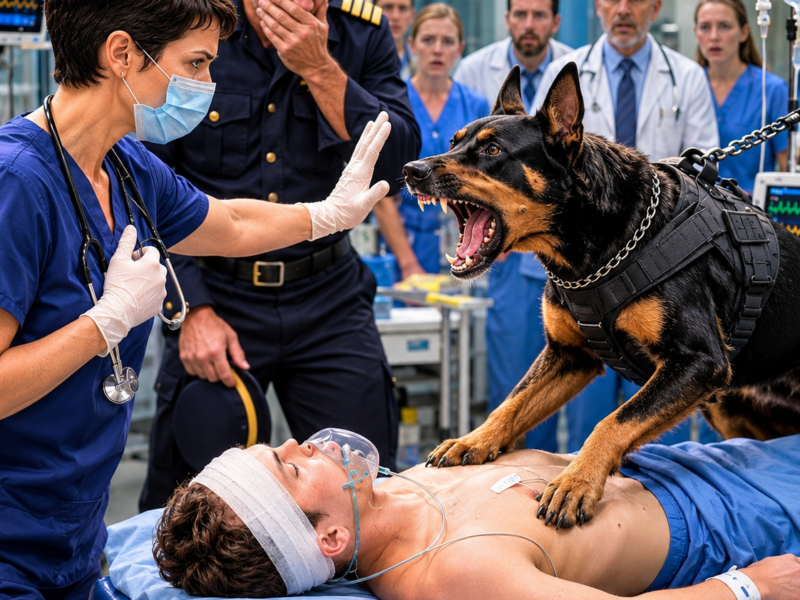
It was not the ordinary barking of a frightened dog or the restless noise of an animal that had been brought somewhere unfamiliar. It was a deep, powerful warning that seemed to vibrate through the walls of the trauma unit at St. Brendan’s Regional Hospital in Halifax, Nova Scotia. Every time someone approached the stretcher, the Belgian Malinois lowered his head, exposed his teeth, and released another threatening growl.
Nobody could get close to the little boy lying on the stretcher.
Three nurses had already backed away. An intern had dropped an entire tray of medical instruments. One security officer was attempting to reach for his radio while keeping his eyes fixed on the animal. And Dr. Robert Fisher, the senior physician supervising the trauma department, had reached the end of his patience.
“Get that dog out of here!” he shouted. “This is a level-one trauma unit, not a veterinary clinic!”
The dog did not move.
His name was Kodak. He was four years old, weighed approximately forty-three kilograms, and had spent much of his life working alongside military personnel. He had completed two operational deployments, received two service decorations, and developed an extraordinary ability to distinguish between people who posed a threat and those who could be trusted.
A previous injury to his left hind paw had ended his military career. After his medical discharge, he had been transferred to the family of Sergeant Major Eric Wright, a Canadian Armed Forces serviceman who understood that an animal like Kodak needed more than an ordinary household.
The dog had become particularly attached to Wright’s eight-year-old son, Carter.
And now Carter was lying motionless on a hospital stretcher, covered in dust and blood, with a serious abdominal injury caused by a piece of collapsing scaffolding.
Kodak had been beside him when the accident happened. He had remained at the boy’s side throughout the rescue operation, refusing to leave even when emergency workers attempted to move him. During the ambulance journey, he had kept his head close to Carter’s arm, occasionally lifting it whenever the child made a sound.
But when they reached the hospital, everything changed.
The paramedics had barely opened the ambulance doors before unfamiliar hands began reaching toward Carter. The medical staff were moving quickly, trying to transfer him to the trauma team, and Kodak interpreted their movements as a threat.
He planted himself between the boy and everyone else.
Nobody could persuade him to move.
“Sedate the animal if necessary,” Fisher ordered.
An officer started forward, but another growl stopped him immediately.
That was when Jennifer Green entered the room.
She had been working on the second floor, caring for two postoperative patients, when the hospital announced that additional nurses were urgently needed in the trauma department. She had hurried downstairs without knowing what awaited her.
Jennifer was thirty-six years old, had worked at St. Brendan’s for four years, and was generally considered one of the quieter members of the nursing staff.
She rarely participated in workplace conversations. She never complained about difficult shifts, never sought recognition, and usually wore a medical uniform that seemed slightly too large for her. Her colleagues sometimes joked that she had mastered the art of disappearing into the background.
Dr. Fisher, in particular, rarely missed an opportunity to remind her of her position.
He questioned her decisions in front of interns, interrupted her explanations, and treated her as though her primary responsibility was to follow instructions rather than exercise professional judgment.
Jennifer never argued.
She simply continued working.
But there was something about her that most people had failed to notice. Her hands never shook during emergencies.
Not when a patient’s heart stopped. Not when blood covered the floor. Not when an entire medical team struggled to control a situation that was rapidly deteriorating.
She possessed a kind of composure that seemed strangely out of place in an ordinary hospital.
And the moment she entered the trauma room, she understood that the dog was not behaving like an aggressive animal.
She looked at Kodak’s ears, his shoulders, the position of his legs, and the way his body remained angled toward Carter.
He was frightened.
More precisely, he was protecting someone he believed was in immediate danger.
Jennifer did not approach him quickly. She did not shout. She did not attempt to overpower him.
She simply walked forward, slowly and deliberately.
Fisher turned toward her.
“Green, don’t come any closer!”
She ignored him.
Jennifer stopped a few feet from Kodak, lowered her hand, and held out her open palm. Her posture remained relaxed, but her eyes never left the animal.
Then she spoke quietly.
“Kodak, sit down.”
It was only a brief command, delivered in a calm, unmistakable voice.
For a moment, nothing happened.
Then the barking stopped.
The enormous Belgian Malinois lowered his head, shifted his weight backward, and sat directly beside the stretcher.
The entire room fell silent.
Kodak looked at Jennifer for a second before leaning forward and gently pressing his head against her gloved hand.
Nobody moved.
It was as though the hospital had suddenly forgotten how to breathe.
Jennifer rested her hand against the dog’s neck.
“Good boy,” she whispered.
Then she looked toward the medical team.
“Move the stretcher. I’ll walk beside him.”
Dr. Fisher stepped forward, visibly irritated.
“You don’t have the authority to make that decision.”
Jennifer finally looked at him.
“He’s dying,” she replied. “We can discuss your protocol after we stabilize him.”
There was something in her voice that made even the most experienced members of the trauma team pause.
It was not disrespectful. It was not emotional.
It was the voice of someone accustomed to making decisions when hesitation could cost a life.
Fisher opened his mouth, but before he could respond, Jennifer was already walking alongside the stretcher, one hand resting lightly on Kodak’s back.
The dog followed her without resistance.
As they disappeared down the corridor, Carter’s father stood near the entrance.
Sergeant Major Eric Wright had spent seventeen years in military service. He had worked in dangerous environments, witnessed terrible injuries, and learned to control his emotions in situations where panic could endanger everyone around him.
He was wearing his Canadian Armed Forces tactical jacket. His right hand remained pressed against his mouth, and his eyes were fixed on the woman walking beside his son’s stretcher.
He recognized something.
Not her face. Not her name.
Something about the way she moved.
He watched her maintain the same pace as the medical team while keeping Kodak calm with almost no visible effort. He noticed how she positioned herself between the dog and the people approaching the stretcher, not as someone afraid of the animal but as someone who understood exactly what he needed.
Eric had seen that kind of confidence before.
It was the confidence of people who had learned to function in environments where a single mistake could mean the difference between life and death.
And he had not expected to see it in an ordinary hospital nurse.
The medical emergency was far from over.
Carter’s blood pressure had already fallen twice during the ambulance journey. The initial assessment suggested that the piece of scaffolding had penetrated the muscles on his right side without directly striking a major blood vessel.
But Jennifer was not convinced.
As she examined the injury, she noticed subtle changes in the boy’s condition. His skin was becoming paler. His pulse was weakening, and the monitor was beginning to show a pattern that worried her far more than the visible wound.
She had seen this kind of injury before.
It was the deceptive nature of internal bleeding that made it particularly dangerous. A patient could appear relatively stable while blood continued collecting where nobody could immediately see it.
Then, without sufficient warning, the body could begin shutting down.
Jennifer looked at the monitor, then at Carter.
“The pressure is going to drop again within sixty seconds,” she said.
An intern standing opposite her looked up.
“Are you sure?”
“Call vascular surgery. Now.”
The intern glanced toward Fisher.
Dr. Fisher shook his head.
“We wait for the imaging results. There is no reason to involve vascular surgery before we have confirmation.”
Jennifer did not raise her voice.
“We don’t have time to wait for confirmation.”
“That’s not your decision.”
The monitor sounded.
Carter’s systolic blood pressure dropped eight points in less than forty seconds.
The intern immediately reached for the telephone.
For a brief moment, Fisher stood motionless, staring at the numbers.
The nurse he had repeatedly dismissed had predicted the deterioration before the equipment confirmed it.
Jennifer, meanwhile, had already moved to the patient’s side. She applied pressure at precisely the correct location, adjusting her hand position with extraordinary sensitivity.
Dr. Anita Sharma, the senior resident, noticed what was happening.
She had worked at St. Brendan’s for two years and had spent countless shifts alongside Jennifer. Until that moment, she had considered her a reliable but relatively ordinary nurse.
Now she was watching something entirely different.
Jennifer’s technique was remarkably precise. She understood the angle of compression, the resistance of the tissue, and the amount of pressure required to control the bleeding without creating additional damage.
It was not the kind of skill that could be acquired simply by working four years in an emergency department.
Sharma watched for several seconds before asking quietly, “Where did you learn to manage trauma like that?”
Jennifer did not look up.
“Private contracts. Overseas work, a long time ago.”
The answer was polite, brief, and technically accurate.
But it explained almost nothing.
Six minutes later, Dr. Karen Morse, the hospital’s senior vascular surgeon, arrived.
She examined Carter’s injury, reviewed the available information, and immediately understood how close the boy had come to a catastrophic outcome.
Then she looked at Jennifer.
“You maintained the correct pressure and angle,” Morse said.
Jennifer stepped aside slightly.
Morse examined the affected area again.
“Half a centimeter in the wrong direction, and we might be having a very different conversation.”
Jennifer said nothing.
The surgeon turned toward the head nurse.
“I want her assisting me in the operating room.”
Fisher immediately objected.
“Dr. Morse, she’s a floor nurse. We have established surgical personnel for this procedure.”
Morse looked at him with an expression that suggested she had no intention of discussing the matter further.
“Then they can learn something from her. She is coming with us.”
It was not a request.
For the next ninety minutes, Carter underwent emergency vascular surgery.
The fragment was successfully removed, the damaged area was repaired, and the bleeding was brought under control.
By the time the boy was transferred to recovery, his vital signs had stabilized.
Kodak had waited outside the operating room throughout the entire procedure.
He lay flat on the corridor floor, his head resting between his paws. Occasionally, he lifted his ears when someone passed, but he never attempted to leave.
Eric Wright stood nearby, his back against the wall.
He had not eaten. He had barely spoken.
He simply waited.
When the operating room doors finally opened, Jennifer emerged wearing her surgical gown and mask. She removed the mask as she approached him.
“He’s stable,” she said. “The procedure went well. Dr. Morse will explain everything in a few minutes.”
Eric closed his eyes briefly.
For the first time that afternoon, his shoulders relaxed.
“Thank you.”
Jennifer nodded.
But before she could return to the department, Kodak stood up.
The dog walked directly toward her and sat beside her leg.
Eric watched him carefully.
“That’s interesting.”
Jennifer glanced down.
“What is?”
“Kodak doesn’t do that with strangers.”
“He seems like a good dog.”
“He is. But he’s selective.”
Eric paused, studying the animal.
“He doesn’t just obey people because they tell him what to do. He decides whether someone is safe. Once he makes that decision, he rarely changes his mind.”
Jennifer gently touched Kodak’s head.
“Then he made a good decision.”
Eric almost smiled.
“I watched what you did in there. The way you approached him. The way you handled the medical emergency. Those aren’t ordinary skills.”
Jennifer’s expression remained neutral.
“What would you like to know?”
“What exactly did you say to him?”
“Nothing unusual.”
“No,” Eric replied. “You used a specific command. I was close enough to see your lips move, but I couldn’t hear everything.”
Jennifer looked at him for several seconds.
Then she said, “I was just trying to keep things calm.”
Eric nodded slowly.
He understood that she was avoiding the question.
But he was not interested in forcing an answer out of someone who had just saved his son’s life.
Instead, he said something that made Jennifer’s expression change almost imperceptibly.
“I’ve served with military working dogs in several programs. I’ve seen handlers, trainers, and combat medics work with animals under extreme pressure. What you did today reminded me of people I’ve known in that world.”
Jennifer looked toward the operating room.
“Thank the dog,” she said.
“He made the first decision.”
Then she walked away.
Kodak remained seated for a few seconds, watching her disappear down the corridor.
Eric followed her with his eyes.
He knew there was more to Jennifer Green than the hospital staff understood.
And he intended to find out why.
The following morning, the trouble began.
Dr. Robert Fisher arrived at the hospital earlier than usual. He went directly to the administrative office and submitted a formal complaint against Jennifer.
According to his account, she had interfered with established trauma procedures, issued unauthorized instructions to the medical team, and created an unacceptable security risk by allowing a military working dog to remain in a clinical environment.
He also questioned her judgment and suggested that her behavior demonstrated a serious misunderstanding of professional boundaries.
By the time Jennifer arrived for her shift, the complaint was already circulating.
She was restocking a medicine cart near Ward 3 when Gloria Dixon approached her.
Gloria had been supervising the nursing unit for eleven years. She was experienced, direct, and generally unwilling to tolerate unnecessary workplace drama.
But that morning, she looked concerned.
“Jennifer, I need to tell you something.”
Jennifer continued organizing the supplies.
“What happened?”
“Fisher has filed a complaint with the administration.”
Jennifer placed a box of sterile dressings into the cabinet.
“About yesterday?”
“Yes. He’s claiming that you interfered with triage procedures, gave instructions beyond your authority, and allowed an unauthorized animal into the trauma area.”
Jennifer closed the cabinet.
“And what did you tell him?”
“That Dr. Morse’s surgical notes and the testimony of the interns might be worth reviewing before anyone reaches a conclusion.”
Gloria lowered her voice.
“But he has connections with the chief medical officer. You know how these things work. If we don’t document what happened, his version could become the official record.”
Jennifer looked at the cabinet door for a moment.
“I know how it works.”
Gloria studied her.
There was something about that answer she could not quite explain.
“Jennifer, can I ask you something?”
“Of course.”
“Why are you always so calm when things go wrong?”
Jennifer looked up.
Gloria continued.
“I’ve watched you work with Fisher for years. He questions you, interrupts you, and sometimes speaks to you in ways I wouldn’t tolerate from anyone. You never react. But yesterday, when that little boy was in danger, you suddenly seemed like an entirely different person.”
Jennifer gave her familiar polite smile.
“I just try to focus on the patients.”
“Yes,” Gloria said quietly. “I suppose you do.”
She left the matter there, although she was beginning to suspect that Jennifer’s silence concealed something much larger than a difficult employment history.
The morning continued.
Shortly before nine, the hospital’s public-address system interrupted the usual routine.
“Attention, security personnel. All available officers to the third level. Police liaison requested at the east entrance.”
A second announcement followed moments later.
“Attempted unauthorized access to the intensive care unit. Security response required on level four.”
Jennifer was standing near the elevator.
The moment she heard the announcement, she turned toward the stairwell.
She did not wait for the elevator.
By the time she reached the fourth floor, two hospital security officers were holding a man against the wall near Carter Wright’s room.
The man was wearing contractor’s overalls and carrying a tool bag. His identification badge appeared to belong to an outside maintenance company.
He was speaking quickly, insisting that he had been assigned to inspect an electrical fault.
But something about the situation was wrong.
Eric Wright stood near his son’s room, watching the confrontation.
Kodak was beside him.
The dog’s entire body was tense.
His ears were forward, his eyes fixed on the stranger, and his weight shifted slightly toward his front legs.
The man in the overalls looked down the corridor.
Then he saw Jennifer.
For a fraction of a second, his expression changed.
It was subtle, but Jennifer noticed.
His eyes narrowed. His mouth tightened, and his posture shifted as though he had suddenly recognized something he had not expected to encounter.
Jennifer continued walking.
She approached the security officers and stopped a few feet away.
“Check his contractor badge against today’s vendor access log.”
The senior security officer, Donald Spencer, turned toward her.
Spencer was a retired Royal Canadian Mounted Police constable who had spent years dealing with security incidents before joining the hospital.
He looked at the man, then at Jennifer.
“Why today’s log?”
“Because if the badge was copied, yesterday’s schedule won’t tell you whether anyone was actually assigned to this floor today.”
Spencer considered her suggestion.
Then he picked up his radio.
“Control, confirm all contractor appointments for level four today. Check the badge number against the active access list.”
The answer came back less than ninety seconds later.
There were no contractors scheduled to work on the fourth floor.
Worse, the badge belonged to an employee who had reported his identification card missing three days earlier and was currently on medical leave.
The man stopped explaining himself.
Spencer immediately called for police assistance.
Eric stepped away from his son’s door and positioned himself beside Jennifer.
Kodak remained close to both of them, his attention never leaving the stranger.
Within minutes, the corridor had been secured.
Halifax Regional Police arrived six minutes later.
The man was taken into custody, and officers began examining his identification, equipment, and reasons for attempting to access the intensive care unit.
What they discovered over the following hours was far more disturbing than a simple unauthorized entry.
The scaffolding accident that had injured Carter Wright had not been accidental.
Three months earlier, Sergeant Major Eric Wright had submitted a formal complaint regarding suspected procurement fraud involving contractors responsible for federal infrastructure projects.
The investigation involved multiple provinces and allegations that certain companies had been cutting costs by using inferior construction materials while submitting invoices for higher-quality products.
The financial consequences were substantial.
And someone within that network had apparently decided that threatening Wright’s family might persuade him to abandon his involvement.
They had chosen his eight-year-old son as the most vulnerable target.
The scaffolding collapse had been intended to look like an accident.
The attempted hospital intrusion suggested that the people responsible were not finished.
The police began investigating the contractor network, and additional security measures were immediately put in place around Carter’s room.
But one detail continued to bother Eric.
When the intruder saw Jennifer Green, he had reacted as though he recognized her.
Not with the confusion of someone meeting an unfamiliar nurse.
With the unmistakable expression of someone who had just discovered that a person he believed to be absent was standing directly in front of him.
Later that afternoon, Eric found Jennifer in the staff lounge.
She was sitting alone at a corner table with a cup of tea. Her hands rested on either side of the cup, but she had not taken a single sip.
Kodak settled beneath the table.
Eric pulled out the chair opposite her.
“May I?”
Jennifer nodded.
He sat down.
“The police are treating the incident as an attempted intimidation operation connected to the fraud investigation.”
“I heard.”
“They’re looking into several other people. We may have more arrests.”
Jennifer remained silent.
Eric studied her for a moment.
“But that’s not why I came here.”
She looked up.
“I noticed the man yesterday. His expression changed when he saw you. I don’t think that was coincidence.”
Jennifer lowered her eyes toward her tea.
Eric continued.
“I also made a few calls last night.”
She did not move.
“I spoke to someone I know through a joint military contact. I mentioned a nurse named Jennifer Green who had calmed a military working dog and identified a counterfeit contractor badge almost immediately.”
Jennifer’s fingers tightened slightly around the cup.
Eric noticed.
“My contact asked me whether I was referring to someone with the callsign Waypoint.”
The lounge seemed suddenly quieter.
Jennifer did not answer.
Eric continued carefully.
“Waypoint was a combat medic attached to a joint search-and-rescue unit. Served in two operational zones. Honorably discharged five years ago.”
He paused.
“Apparently, the official records mention a medic who saved four soldiers and a military working dog during a mountain operation in conditions that the incident report described as incompatible with survival under standard assessments.”
Jennifer stared at the table.
Eric waited.
Finally, she spoke.
“The dog’s name was Ranger.”
Her voice was quiet.
“He was a yellow Labrador. Terrible at fighting. Wonderful at finding people.”
Eric said nothing.
“He found all four soldiers before I arrived. I just kept them alive until the helicopter could reach us.”
There was no pride in her voice.
No attempt to make the story sound heroic.
She spoke as though describing an ordinary day at work.
But Eric understood enough about military operations to recognize what she was leaving unsaid.
“Waypoint was your callsign?”
Jennifer nodded once.
“I don’t use that name anymore.”
“You don’t have to.”
Eric leaned back slightly.
“But someone else did.”
He explained that his contact had confirmed the existence of a classified operational record matching her description. The information was limited, but the details were unmistakable.
A combat medic.
A rescue operation in mountainous terrain.
Four injured servicemen.
One working dog.
An extraction completed under extraordinary circumstances.
And a medic who had subsequently disappeared from the operational world.
Eric looked at her.
“Jennifer, whoever tried to reach Carter was not simply looking for a random patient. Their access to the hospital was too precise. They knew where he was, which floor he occupied, and when the security arrangements might be easiest to bypass.”
He paused.
“I think they may have been looking for you as well.”
Jennifer remained silent.
Kodak lifted his head beneath the table.
After a moment, he rested his chin against her knee.
She looked down at him.
Then, for the first time that afternoon, the carefully controlled expression she had worn for years began to soften.
“I came to Halifax because it was quiet,” she said.
Eric waited.
“I chose a hospital where nobody knew me. I wanted a job that would allow me to help people without having to return to the environment I had left behind.”
She glanced toward the window.
“After everything that happened, I didn’t want to be Waypoint anymore. I didn’t want people asking about the operation, the soldiers, or the decisions I had made.”
Her voice remained steady, but Eric could hear the effort required to keep it that way.
“I had spent years learning how to save people in places where there was no hospital, no blood bank, no operating room, and sometimes no possibility of getting help in time. When I left, I thought perhaps I could use those skills somewhere peaceful.”
She paused.
“So I became a nurse.”
Eric looked at her with quiet understanding.
“And you thought that would make you invisible?”
Jennifer gave a faint, almost humorless smile.
“I thought it might make me safe.”
Eric did not challenge her.
He understood that some people left military service because they had completed their work. Others left because continuing had become impossible.
Jennifer belonged to the second group.
She had not forgotten what happened overseas. She had simply learned to carry it without allowing it to become the only thing people could see when they looked at her.
For five years, she had built a quieter life.
She had learned patients’ names, remembered their families, and spent long nights beside hospital beds.
She had allowed Dr. Fisher to underestimate her because correcting him had never seemed important enough to risk the fragile peace she had created.
But now the past had found her.
And it had found her through a little boy who had done nothing wrong.
Eric looked down at Kodak.
The dog was still resting against Jennifer’s knee.
“There’s something else,” he said.
Jennifer looked up.
“The people who arranged the scaffolding collapse may have believed they were targeting me. But they have now discovered that you are here too.”
She nodded slowly.
“I know.”
“Are you afraid?”
Jennifer looked at the dog.
For a moment, she seemed to be searching for an answer that was both honest and simple.
“Yes,” she finally said. “But not for myself.”
Eric understood.
He had spent seventeen years in uniform and had learned that courage was not the absence of fear.
It was the decision to act despite it.
The conversation ended without any dramatic promises.
Eric did not ask her to return to military service. Jennifer did not offer to become involved in his investigation.
But something had changed between them.
He no longer saw her as simply the nurse who had saved his son.
He saw someone who had spent years carrying responsibilities most people would never understand.
And Jennifer, perhaps for the first time in a long while, realized that someone had recognized her without demanding that she become her former self again.
Meanwhile, the complaint against her had reached the office of the hospital’s chief physician.
Dr. Barbara Rogers was a woman in her sixties who had spent decades managing medical departments, supervising difficult physicians, and dealing with the complicated politics of hospital administration.
She had read Fisher’s complaint.
She had also received Dr. Morse’s surgical notes, the statements of the interns who had witnessed Carter’s treatment, and a report from hospital security detailing Jennifer’s role in identifying the unauthorized contractor.
The documents told a very different story from the one Fisher had presented.
Rather than accepting his account, Dr. Rogers requested an independent review of the incident.
She also spoke with Gloria Dixon, Dr. Morse, and Donald Spencer.
By the end of the afternoon, the facts were clear.
Jennifer had correctly identified a life-threatening complication before the monitor confirmed it. Her actions had helped preserve Carter’s condition until vascular surgery could intervene. She had successfully managed a highly distressed military working dog without creating additional danger.
And her suggestion to check the contractor’s badge against the current access log had directly contributed to identifying an intruder who had no legitimate reason to be on the floor.
Fisher’s complaint was dismissed.
He was informed that his clinical supervisory methods would undergo a mandatory review, particularly his treatment of nursing staff and his repeated attempts to undermine professional colleagues.
Dr. Rogers used a phrase that Fisher found particularly difficult to accept.
“An intentionally hostile working environment.”
He had spent years believing that his position made his behavior acceptable.
Now someone had finally documented the consequences.
An hour after receiving the decision, Fisher found Jennifer at the nurses’ station.
He approached with a carefully arranged expression.
“Green, I understand there may have been some misunderstandings yesterday.”
Jennifer continued entering information into a patient’s chart.
Fisher cleared his throat.
“We all have responsibilities. Sometimes, in a difficult situation, people become emotional. I think it’s important that we maintain professionalism.”
Jennifer finished writing before looking up.
“I don’t need an apology.”
He seemed surprised.
She continued.
“I’m not interested in your explanations, your version of what happened, or your opinion of my professional abilities.”
Fisher’s expression tightened.
“That’s not a particularly constructive attitude.”
Jennifer looked at him calmly.
“I’m going back to my work.”
She turned toward the computer.
For several seconds, Fisher remained standing there.
The three interns who had witnessed the confrontation were watching from nearby.
He eventually walked away.
Nobody laughed.
Nobody applauded.
But the silence that followed was different from the silence that had surrounded Jennifer for the previous four years.
This time, it was not the silence of people afraid to challenge authority.
It was the silence of people who had finally understood how much they had failed to notice.
That evening, Gloria brought Jennifer a cup of coffee.
She placed it beside the keyboard.
“You know,” Gloria said, “people are looking at you differently today.”
Jennifer glanced up.
“Because of the complaint?”
“Not exactly. Because of what they saw yesterday.”
Gloria pulled a chair closer.
“Some of us have worked beside you for years. We knew you were competent. We knew you were dependable. But I don’t think we ever really understood what you were capable of.”
Jennifer wrapped both hands around the coffee cup.
“I never hid anything to deceive anyone.”
“I know.”
“I just wanted a normal life.”
Gloria nodded.
“There’s nothing wrong with that.”
Jennifer looked down.
“I didn’t want to be the person everyone called when something terrible happened. I wanted to come to work, help my patients, go home, and have a quiet evening.”
Gloria smiled gently.
“Perhaps you still can.”
Jennifer considered that.
For years, she had believed that being recognized meant being pulled back into a world she had deliberately left.
But Gloria was offering something different.
She was not asking for a heroic story. She was not asking about the operation in the mountains or the people Jennifer had lost.
She was simply acknowledging that the nurse standing beside her deserved respect.
And perhaps that was enough.
The following morning, Eric returned to the hospital with Carter.
The boy was sitting comfortably in his bed, looking at something on a tablet. His face had regained its color, and although he was still tired, he was clearly recovering.
Kodak walked beside his father.
When they reached the nurses’ station, Eric found Jennifer organizing medical supplies near Ward 3.
She looked up.
“How is he?”
“Much better. Dr. Morse says the recovery is progressing exactly as expected.”
Jennifer smiled.
“That’s good news.”
Eric stood beside the supply cart.
“I spoke to my contact again.”
Jennifer waited.
“The investigation has moved forward. Three additional arrests were made this morning, including the person connected to the false contractor badge.”
He continued.
“They’re looking into the entire network now. The people who arranged the scaffolding collapse, the ones who provided information about the hospital, and anyone who had access to the details of your former service record.”
Jennifer nodded.
“And the leak?”
“They’re investigating that too.”
She placed a packet of supplies into the cart.
Eric paused.
“There’s something else I wanted to ask.”
Jennifer looked at him.
“What happens now?”
For a moment, she did not answer.
At the far end of the corridor, Carter was sitting upright in bed. He was laughing at something on his tablet, looking exactly like the little boy he was supposed to be.
A child who had almost died.
A child who had survived.
A child who would probably remember very little about the day his father had stood helplessly beside a hospital stretcher while a frightened dog protected him from everyone around him.
Jennifer looked at Kodak.
The dog was watching her.
She remembered another animal.
Ranger.
She remembered the mountains, the freezing air, the blood on her gloves, and the long wait for the helicopter.
She remembered the four soldiers who had survived.
She also remembered the ones who had not.
For five years, she had tried to convince herself that leaving the field meant leaving that part of her life behind.
But perhaps she had misunderstood what she was trying to escape.
She had not stopped being someone who saved lives.
She had simply found a different place to do it.
“I’m staying,” she said.
Eric nodded.
“Here?”
“Right here.”
He understood.
He did not offer her a position in a military unit or suggest that she should return to operational work. He simply accepted her decision.
“Then I think that’s exactly where you should be.”
Kodak gave a small sound and moved closer to Jennifer.
She reached down and scratched behind his ears.
For a moment, the corridor felt almost peaceful.
The investigation continued over the following days.
The contractor network became the subject of a much larger inquiry involving fraudulent procurement records, compromised safety inspections, and the deliberate use of substandard materials in several infrastructure projects.
The hospital incident also exposed a serious weakness in the way patient security information had been handled.
Additional arrests followed.
The people involved in the attempt to intimidate Eric Wright and his family were identified, and investigators began tracing the connections between the original scaffolding collapse and the unauthorized hospital access.
As for Jennifer, the hospital’s mandatory review produced changes that had been necessary for a long time.
Dr. Fisher retained his position, but his supervisory authority was restructured. He no longer had sole control over shift assignments or performance documentation for the nursing staff.
His conduct toward employees would now be subject to independent oversight.
The change did not transform the hospital overnight.
It would have been unrealistic to expect everyone to become different simply because one incident had exposed the truth.
But the atmosphere began to shift.
The interns who had previously watched Fisher criticize Jennifer without saying anything started paying closer attention to her clinical decisions.
Dr. Sharma began consulting her more frequently, particularly when difficult trauma cases arrived.
Dr. Morse made it clear that Jennifer’s experience should be recognized rather than ignored.
And Gloria Dixon no longer allowed anyone to treat her as though she were merely another nurse filling a position on the schedule.
Jennifer did not make a speech.
She did not demand recognition.
She simply continued arriving early, checking her patients, organizing supplies, and working the way she always had.
The difference was that people now understood what they were seeing.
A few days later, Eric brought Carter back to the hospital for a follow-up examination.
The boy was walking more comfortably, although he still needed time to recover.
Kodak accompanied them.
As soon as the dog entered the department, he walked directly toward the instrument cart near Bay 3, sat down, and waited.
Jennifer noticed him from across the room.
She smiled.
“Hello, soldier.”
Kodak’s tail moved once against the floor.
Eric laughed quietly.
“I think he’s decided this is his second home.”
“Maybe he just likes the people here.”
“He likes you.”
Jennifer approached and crouched beside him.
Kodak leaned his head against her shoulder.
It was a simple moment.
No dramatic announcements. No applause. No one asking for an explanation.
Just a military dog recognizing someone he trusted.
And Jennifer, who had spent years trying not to be noticed, allowed herself to enjoy it.
Later that month, on a quiet afternoon in late October, she stood near the windows on the second floor.
The sunlight was falling across the hospital corridor in long golden strips. Beyond the glass, Halifax Harbour stretched beneath a pale sky, its surface catching the light in small, shimmering patches.
She had chosen Halifax because it was unfamiliar.
She had chosen St. Brendan’s because it was quiet enough to disappear into.
For five years, she had believed that invisibility was the same thing as peace.
But now, looking out toward the water, she began to understand that the two were not necessarily the same.
She could remain Jennifer Green.
She did not have to become Waypoint again.
She did not have to return to the mountains, the helicopters, or the operations that had followed her into her dreams for years.
She could simply be a nurse who knew how to recognize danger, who understood frightened people and animals, and who had learned that sometimes the most important thing a person could do was remain calm when everyone else was losing control.
The hospital was still noisy.
Monitors continued beeping. Nurses hurried between rooms. Doctors argued over treatment decisions, and patients waited for news that could change their lives.
It was not the quiet life she had originally imagined.
But perhaps it was the life she had needed.
And somewhere on the fourth floor, an eight-year-old boy was recovering because a woman who had once saved four soldiers on a remote mountainside had chosen to walk into a hospital instead of disappearing completely.
A few days later, Carter returned home.
His father thanked the medical team, and Kodak accompanied them through the hospital entrance.
Before leaving, Carter asked whether he could see Jennifer one more time.
She came down from the second floor and found him standing beside his father.
“Thank you for helping me,” he said.
Jennifer smiled.
“You did most of the hard work.”
Carter looked at Kodak.
“He likes you.”
“I like him too.”
The boy thought for a moment.
“Will you come and visit us?”
Jennifer glanced at Eric.
“If your father says it’s all right.”
Eric nodded.
“You’re always welcome.”
Jennifer reached out and gently touched Carter’s shoulder.
“Take care of yourself. And listen to your doctors.”
“I will.”
Kodak gave a soft bark.
Jennifer looked down.
“And you,” she said, “keep looking after your boy.”
The dog sat.
Not because she had ordered him to.
Because he wanted to.
Eric watched the exchange with a quiet smile.
Then the three of them walked toward the hospital doors.
Jennifer remained standing for a moment after they disappeared outside.
She could see them through the glass: a father, a recovering child, and a dog who had refused to abandon the person he loved.
She thought about the day they had arrived.
She remembered the barking, the panic, Fisher’s orders, and the stretcher moving through the trauma department.
She remembered how quickly everything had changed when she had spoken.
Two simple words.
Sit down.
It had not been magic.
It had been years of training, experience, discipline, and the ability to recognize fear without allowing it to control a situation.
But perhaps the most important thing was not what those words had done to Kodak.
It was what they had reminded Jennifer about herself.
She had spent five years believing that her most meaningful work belonged to the past.
She had been wrong.
The woman who had saved lives on a distant mountainside was still there. The woman who had held pressure on a wounded soldier until help arrived was still there. The woman who had learned to make decisions under impossible circumstances had never disappeared.
She had simply been waiting for a reason to stop hiding.
And now she had one.
Jennifer turned away from the window and returned to her department.
There were patients waiting.
There was work to do.
And for the first time in a very long time, she no longer felt that she needed to become invisible to be safe.
She had found a place where her past did not have to define her future.
She could keep the lessons, keep the skills, and leave the pain where it belonged.
Because being a hero did not always mean returning to the battlefield.
Sometimes it meant walking into an ordinary hospital, wearing an oversized nursing uniform, and quietly saving the life of a little boy.
Sometimes it meant standing beside a frightened animal and understanding that he was not the enemy.
And sometimes it meant recognizing that the person everyone had underestimated was the very person they needed most.
As Jennifer reached the nurses’ station, she noticed that the late afternoon light had begun to fade.
Gloria was reviewing patient records. Dr. Sharma was discussing a case with another resident. Somewhere down the corridor, a monitor began sounding an alert.
Jennifer put down her coffee.
She listened for a second, then stood.
“Room six,” she said calmly. “Let’s check on that patient.”
And just like that, she was back where she belonged.
Not as Waypoint.
Not as the person whose name appeared in classified military records.
Not as the woman who had once survived an operation that others considered impossible.
Just Jennifer Green.
A nurse.
A woman who knew how to save lives.
And that was enough.
THE END









