The K9 Let No One Near the Unconscious SEAL — Until the Nurse Revealed His Unit Tattoo
The K9 Let No One Near the Unconscious SEAL — Until the Nurse Revealed His Unit Tattoo
The first person who tried to reach the unconscious Navy SEAL never got close enough to touch him.
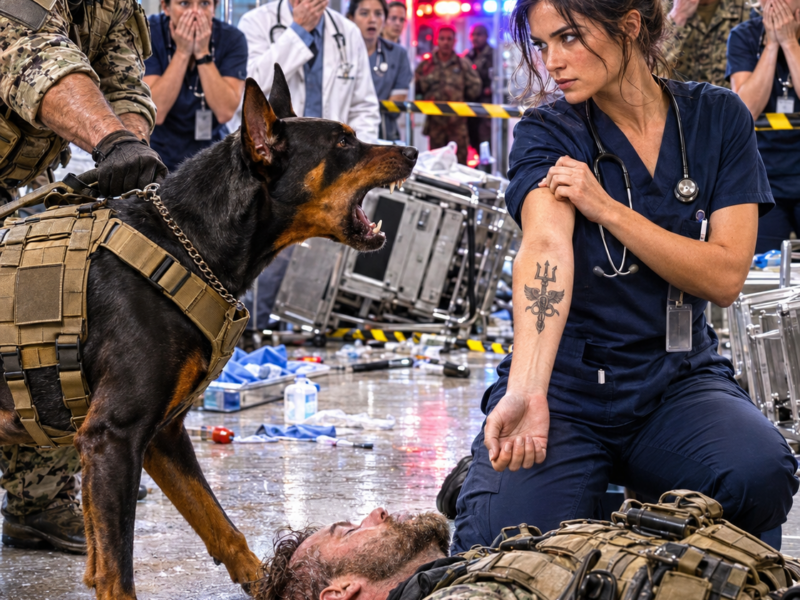
A massive black working dog launched itself between the fallen man and the medical team, its paws striking the polished hospital floor with such force that a metal instrument tray rattled beside the nearest examination bed. Its lips curled back, exposing powerful teeth, and a deep, threatening growl rolled through the trauma room.
Nobody moved.
The dog stood over the unconscious man like a living wall, its muscular body positioned protectively across his chest. A dark tactical harness hugged its shoulders, and a small military K9 patch was fastened securely to the side.
“Get that animal out of my trauma bay!” Dr. Preston Albright shouted.
The senior physician took an involuntary step backward as the dog turned its head toward him. Its amber eyes were fixed on the doctor, and the warning in its posture was unmistakable.
Petty Officer Garrett Doyle, one of the Navy personnel who had accompanied the injured man, struggled to maintain control of the heavy chain attached to the dog’s harness.
“I can’t, sir,” he said, tightening his grip until the metal links dug into his gloved palms. “He won’t take my command.”
“Then get security in here! I don’t care what it takes. That animal cannot remain in this room!”
But nobody seemed eager to approach.
Not with the dog behaving like that.
Not with the unconscious man lying motionless beneath its shadow.
And certainly not with the strange expression appearing on the face of a nurse standing near the supply cart.
Her name was Iris Callahan.
She was thirty-three years old, had worked at Sebrook Regional Medical Center in Port Alder, Virginia, for five years, and had built a reputation as one of the quietest, most dependable trauma nurses in the hospital.
She never argued with physicians. She never raised her voice. She arrived early, completed her responsibilities carefully, and left without attracting attention.
Her dark hair was usually pinned into a loose bun, and her navy-blue scrubs were always neat. Even on the hottest days, she wore long sleeves beneath her uniform.
Nobody had ever seen her forearms.
Nobody had ever asked why.
And nobody in that hospital knew that before becoming a nurse, Iris Callahan had served as a combat medic with a specialized military medical unit.
That part of her life had ended eight years earlier.
Or at least, she had spent every day since then convincing herself that it had.
Now, standing in Trauma One, she was staring at a dog she recognized immediately.
The small notch in its left ear.
The way its weight shifted toward its front legs whenever the person it guarded was in danger.
The slight movement of its head as it evaluated everyone approaching.
She remembered all of it.
She remembered the dog’s name, too.
Atlas.
And the moment that recognition settled inside her, something she had spent eight years trying to bury began rising to the surface.
Ten minutes earlier, the ambulance bay doors had burst open, allowing four men in military camouflage to rush through the entrance.
They were carrying a man who had apparently insisted on walking into the hospital himself.
He had made it as far as the reception desk before his knees gave way.
The receptionist later told the charge nurse that he had looked strangely pale, almost gray beneath his beard. His uniform was damp with sweat, and one hand had remained pressed against his left side.
He had asked a single question.
“Is there a doctor here?”
Then he had collapsed.
The four servicemen had rushed forward, catching him before his head struck the floor. The dog had followed them, barking once before positioning itself beside the fallen man.
By the time they reached Trauma One, the patient’s condition had become a frightening puzzle.
His name was Senior Chief Mason Trent.
His uniform still carried the insignia of the United States Navy, and his tactical vest remained strapped tightly across his chest.
The cardiac monitor showed a heart rate of seventy-two, oxygen saturation of ninety-eight percent, and a respiratory rate of sixteen.
On paper, those numbers looked reassuring.
In reality, the people who had brought him in knew something was terribly wrong.
Doyle had tried explaining that his commanding officer had been struggling to remain conscious during the drive.
“He kept telling us he was fine,” the petty officer explained. “But he was barely able to stand. He kept holding his left side. Then he started asking for someone.”
“Who?” Monica Tvaris, the charge nurse, asked.
Doyle shook his head.
“He didn’t give us a name.”
Now, while Dr. Albright demanded that the dog be removed, Iris remained almost completely still.
She was not watching the physician.
She was watching Mason Trent.
His lips had a faint grayish tint. Sweat covered his forehead, but his skin looked unusually cool. His breathing was shallow, and there was a subtle tension around his jaw that suggested his body was fighting something it could no longer control.
The monitor was telling one story.
The patient was telling another.
And Atlas seemed to understand the difference.
The dog repeatedly pushed its nose toward the left side of Trent’s abdomen, then looked around the room as if trying to communicate something nobody understood.
Iris had seen that behavior before.
She had seen it in another place, under another sky, in circumstances she had spent years refusing to remember.
A dry riverbed.
A burning military vehicle.
A wounded soldier insisting he was fine.
And a dog refusing to leave his side.
Her fingers tightened around the gloves she was holding.
Eight years.
For eight years, she had worked hard to become someone who no longer remembered those things.
She had studied, earned her nursing qualifications, and accepted a position in a hospital where nobody knew her military history.
She had learned to speak softly, keep her head down, and avoid questions about her past.
It had been a lonely existence, but loneliness was preferable to remembering.
Then Lieutenant Commander Wes Alcott appeared near the entrance.
He wore Navy camouflage and carried himself with the quiet authority of someone accustomed to making decisions under pressure.
Unlike the other people in the room, he was not looking at the dog with fear.
He was looking at Iris.
Security arrived seconds later, carrying a catchpole and a tranquilizer kit.
“Stand back!” one of the guards ordered. “We need to restrain the animal.”
Alcott immediately stepped into their path.
“Nobody touches that dog.”
“Sir, the animal is creating a serious safety hazard.”
“He’s doing exactly what he was trained to do.”
The lieutenant commander’s voice was calm, but there was something in it that made the guards hesitate.
Atlas turned his head slightly.
His ears moved.
For a brief moment, the growling stopped.
His eyes traveled across the room and settled directly on Iris.
Then the growl returned, lower and deeper than before.
Iris felt the hair rise on her arms.
Dr. Albright threw his hands into the air.
“This is a hospital, not a military training facility! We have a critically injured patient, and I cannot perform an examination while that animal is standing over him.”
“His vitals are normal,” one resident whispered.
“Exactly!” Albright snapped. “His heart rate is seventy-two. His oxygen saturation is ninety-eight. There is no reason to waste valuable time negotiating with a dog.”
Garrett Doyle shook his head.
“Sir, with respect, he’s not stable.”
Albright turned toward him.
“Are you a physician?”
“No, sir.”
“Then allow the medical professionals to do their jobs.”
Doyle swallowed.
“He was gray in the face before he collapsed. He could barely breathe. Something is wrong.”
Albright waved him away.
“Operators are trained to conceal pain. I understand that. But I cannot treat someone I cannot touch.”
Iris finally moved.
It was only one step.
Monica Tvaris immediately caught her sleeve.
“Iris, don’t.”
The warning was barely audible.
“That dog will take your hand off.”
Iris gave a small nod.
She understood the danger.
She also understood something everyone else in the room had missed.
Atlas was not guarding an ordinary patient.
He was guarding someone he believed was in immediate danger.
And the way he was behaving reminded her of a very particular moment eight years earlier, when another man had been bleeding in a place where help was almost impossible to find.
“Atlas,” she whispered.
The dog snapped his head toward her.
Garrett Doyle stared at her.
“What did you just say?”
“Loosen the chain.”
Doyle looked at her as if she had lost her mind.
“What?”
“One link at a time. Slowly.”
“Iris,” Monica whispered again, “please don’t.”
Iris did not look away from the animal.
“He’s waiting for me.”
The lieutenant commander heard her words.
His expression changed.
“Doctor,” he said quietly to Albright, “let her approach.”
“Absolutely not.”
“You don’t understand what is happening.”
“I understand that we have an aggressive military working dog in the middle of my trauma bay.”
Alcott looked directly at the physician.
“And I understand that the man on that floor may have traveled a very long way to find this nurse.”
The room fell silent.
Iris felt her heartbeat accelerating.
“How do you know?” she asked.
Alcott did not answer immediately.
Instead, he glanced toward Mason Trent.
“Because the senior chief gave us specific instructions before he collapsed.”
“What instructions?”
“He said that if he went down, nobody was to work on him until we found the medic who wore the mark.”
Iris felt her stomach tighten.
The mark.
For a moment, she could not hear the monitor, the footsteps, or the conversations happening around her.
She could only hear the wind moving across a dry riverbed.
“What mark?” Monica asked.
Doyle looked at the floor.
“He never gave us a name. Only a description. He told us to find the medic with the tattoo.”
Iris slowly lowered the gloves in her hands.
Beneath her sleeve, the old ink seemed to burn.
Atlas let out a short whine.
The monitor beeped.
Then Iris noticed the heart rate changing.
Seventy-two.
Eighty-eight.
The blood pressure had begun to fall.
Nobody else seemed concerned.
But Iris knew that a patient with significant internal bleeding could maintain apparently acceptable vital signs for a dangerous period of time.
The body compensated.
It redirected blood.
It worked desperately to protect the brain and heart.
Then, when those mechanisms failed, everything could collapse in a matter of minutes.
She had seen it happen before.
She would not allow it to happen again.
“Loosen the chain,” she repeated.
This time, her voice was different.
There was no hesitation.
Doyle glanced at Alcott.
The lieutenant commander gave the smallest nod.
The chain slipped several inches.
Atlas shifted his weight but did not move toward the guards.
Iris slowly raised both hands, palms facing downward.
“Easy, old boy.”
The dog watched her.
“Nobody is going to hurt him.”
She took another step.
Then another.
Until she was standing approximately three feet away.
Albright moved forward.
“Callahan, step back immediately!”
Iris ignored him.
She looked down at the unconscious man and then back at the dog.
For eight years, she had hidden the one thing that connected her to the most painful chapter of her life.
She had worn long sleeves through every season.
She had avoided swimming pools, beaches, and any situation where someone might accidentally notice her skin.
She had even turned down a promotion once because the position required her to participate in military medical training demonstrations.
She had convinced herself that the tattoo was nothing more than an old reminder.
But it was never just a tattoo.
It was a promise.
And now, she understood why Mason Trent had come looking for her.
Her fingers trembled as she reached for the cuff of her left sleeve.
“I never wanted to show this again,” she whispered.
Then she rolled the fabric back.
The faded black ink became visible beneath the bright trauma lights.
A trident wrapped around a winged serpent staff.
Below the emblem, two small words remained legible despite the years.
HARROW MEDICAL.
A nurse gasped.
One of the residents took a step backward.
Wes Alcott lowered his head.
For several seconds, nobody spoke.
Then the lieutenant commander whispered, almost unbelievingly, “Harrow Medical.”
Iris looked at him.
“One person still wears it.”
The reaction from Atlas was immediate.
The dog’s growl stopped.
His shoulders relaxed.
His ears lowered slightly, and the tension that had held his entire body rigid began to disappear.
He took one cautious step toward her.
Then another.
Iris remained still.
Atlas lowered his head and pressed his forehead against her exposed forearm, directly over the faded tattoo.
A long, trembling sigh escaped his chest.
His tail moved once.
Iris closed her eyes.
A tear slipped down her cheek and landed on the dog’s dark fur.
“Hey, old boy,” she whispered.
Her voice broke.
“I’m here.”
She gently placed her hand against the side of his face.
“I’m so sorry it took me this long.”
Monica Tvaris covered her mouth.
She had worked beside Iris for years and had never seen her cry.
She had never even heard her speak about anything personal.
Yet here she was, kneeling on a wet hospital floor, holding the head of a military working dog as though she had just been reunited with a member of her family.
Alcott slowly lowered himself beside her.
“Doc,” he whispered.
Iris opened her eyes.
“Your Doc. The corpsman from Harrow.”
She swallowed.
“Where is Danny?”
The lieutenant commander looked away.
“Tell me he made it.”
His jaw tightened.
“Danny is gone, Iris.”
She stared at him.
“I know.”
Her voice was almost inaudible.
“I know exactly where I left him.”
Alcott shook his head.
“No, ma’am. That’s not what the senior chief has been trying to tell you.”
Iris looked confused.
“What do you mean?”
“He’s spent eight years looking for you. He didn’t come here to blame you.”
Before she could ask another question, Atlas moved.
The dog lifted his head from her arm, turned toward Mason Trent, and pressed his nose against the left side of the man’s vest.
He remained there, perfectly still.
Iris immediately understood.
She leaned forward and reached toward Trent’s neck.
Two fingers against the carotid artery.
Then his wrist.
The pulse was fast, weak, and difficult to maintain beneath her fingertips.
She carefully lifted the edge of his tactical vest.
His abdomen was unusually firm.
When she pressed gently against the left upper quadrant, the muscles tightened beneath her hand.
Her expression changed.
“He’s compensating.”
Albright frowned.
“What?”
“He’s bleeding internally.”
The physician glanced at the monitor.
“His vital signs are not consistent with that assessment.”
Iris looked up.
“His vital signs are about to change.”
She returned her attention to Trent.
“His abdomen is rigid. His pulse is becoming progressively weaker. His skin is cool, and his breathing is shallow. He’s losing blood, and his body is hiding it.”
Albright crossed his arms.
“You’re a nurse, Callahan. I’m the attending physician.”
“Yes, doctor.”
Her voice remained calm.
“Then please bring the bedside ultrasound.”
Something in her expression made him pause.
“Why?”
“Because I believe he has a significant internal hemorrhage, most likely involving the spleen.”
Albright stared at her.
For a moment, he seemed ready to argue again.
Then he looked at Mason Trent.
He looked at the dog.
And finally, he looked at the tattoo.
“Bring the ultrasound,” he ordered.
Brandon Ellis, the ultrasound technician, rushed forward with the portable machine.
Atlas allowed him to pass.
The dog remained beside Trent’s left flank, his nose hovering near the injured area.
Albright placed the probe against the patient’s abdomen.
The screen filled with gray shapes.
Everyone leaned closer.
Ten seconds passed.
Then the physician stopped moving.
A dark collection of fluid appeared beneath the spleen.
He adjusted the probe.
The image became clearer.
His expression changed completely.
“Free fluid,” he murmured.
He looked again.
“There’s a lot of it.”
“Left upper side,” Iris said. “Near the old fragment.”
Albright turned toward her.
“What old fragment?”
Iris did not answer immediately.
She was staring at the ultrasound screen, but her thoughts had already traveled backward.
Eight years earlier, she had been kneeling in a dry riverbed.
The sun was disappearing behind the mountains, and the air smelled of burning fuel, dust, and blood.
Two men were down.
Senior Chief Mason Trent had suffered a wound to his left side. The visible injury had appeared relatively small, but Iris had known there could be more damage beneath the surface.
Twenty yards away, Petty Officer Danny Quinn was lying beside a damaged military vehicle.
Atlas had been stretched across his chest.
The dog had refused to move.
The evacuation helicopter was approaching, but there was room for only one stretcher.
One minute.
One decision.
Mason Trent had looked at her through pain-filled eyes.
“Take Trent, Doc.”
She had shaken her head.
“We can get both of you.”
Danny had smiled.
It was a terrible smile, the kind soldiers sometimes offered when they knew the truth but wanted everyone else to believe there was still hope.
“That’s an order.”
“You’re coming with us.”
“Iris.”
He had reached for her wrist.
“Listen to me.”
She remembered the blood on his fingers.
She remembered the way Atlas had pressed his head against Danny’s chest.
She remembered trying to calculate how much time each man had left.
And she remembered Danny’s final words to her.
“Go. Get him out.”
She had made the decision.
She had loaded Mason Trent onto the helicopter.
She had left Danny Quinn behind.
Before departing, she had written a brief medical note documenting a retained fragment near Trent’s left flank and the need for continued monitoring.
The evacuation had been chaotic.
The aircraft had lifted.
The radio connection had disappeared.
And Danny had never returned.
Iris had spent years believing that her decision had cost him his life.
The military review had been closed quickly.
She had received no meaningful explanation, no personal reassurance, and no opportunity to understand what happened after the helicopter departed.
Eventually, she had left the service.
She had changed careers, changed cities, and built a life in which nobody knew the name Danny Quinn.
But she had never truly escaped that riverbed.
Now, standing in Trauma One, she finally understood why Mason Trent had found her.
“Doctor?” Monica said gently.
Iris blinked.
The hospital lights returned.
“Where is the surgeon?”
“Dr. Priya Nandakumar is in Operating Room Three,” Monica answered. “She’s handling a cardiac case.”
“How long?”
“Fifteen minutes. Maybe twenty.”
Iris looked at Trent.
“He doesn’t have fifteen.”
As if confirming her words, the monitor suddenly began sounding an alarm.
The heart rate climbed to 120.
The blood pressure dropped.
Ninety over fifty.
Then seventy over forty.
The numbers that had appeared reassuring only minutes earlier were disappearing.
The room erupted into movement.
“Activate the massive transfusion protocol!” Iris ordered.
“Two large-bore IV lines. Warm the blood. Prepare him for the operating room!”
A resident looked toward Albright.
The attending physician did not hesitate.
“Do what she says.”
Monica immediately ran for the blood cooler.
Brandon prepared the second intravenous line.
Another nurse began cutting away Trent’s tactical vest.
Iris positioned herself beside the patient and pressed both hands against the left side of his abdomen.
She applied firm, steady pressure while keeping her attention on the monitor.
“Atlas, stay.”
The dog lowered himself onto the floor beside her.
His massive body settled against the tiles.
He did not move again.
Blood bags were connected.
The warming equipment began humming.
The trauma team moved with renewed purpose.
Nobody was looking at the tattoo anymore.
Nobody was questioning why the dog had trusted her.
There was only one priority.
Keeping Mason Trent alive.
Albright stood beside Iris.
His expression had changed from irritation to concentration.
“Tell me what you need.”
“Keep his head low. Maintain the transfusion. Watch his pressure closely. We need the surgical team immediately.”
Albright nodded.
Then he made a phone call.
Iris continued applying pressure.
Her arms were beginning to ache, but she refused to move them.
Across the patient, Wes Alcott crouched beside her.
He had been watching her work.
Now, his face carried an expression that made her nervous.
“Doc,” he said quietly.
“Not now, Commander.”
“I need you to hear something.”
“He’s bleeding.”
“I know.”
“Then let me work.”
Alcott glanced toward the door.
“The senior chief has been telling this story for eight years.”
Iris did not look at him.
“Commander, please.”
“Everyone thought he was mistaken. Some people thought the story was simply something he had created to cope with what happened.”
Her hands remained firmly in place.
“But last month, he finally got the Navy to release the final radio transmission from that operation.”
Iris stopped breathing for a second.
The final radio transmission.
For eight years, she had believed the official record was all that existed.
She had never known another message had been recorded.
“What did you say?”
“Danny called in again after the helicopter lifted off.”
Her eyes filled with tears.
Alcott reached into his pocket and pulled out his phone.
“I have the recording.”
Iris shook her head.
“Not now.”
“You need to know what he said.”
“Not while this man is dying.”
Alcott leaned closer.
“He said, ‘Tell Doc she made the right call. Tell her I gave the order. Tell her not to carry it.'”
For a moment, Iris could not feel her hands.
The words seemed to pass through the room without making a sound.
She stared at Mason Trent.
The man she had saved eight years earlier was lying beneath her hands, bleeding from an injury connected to that same mission.
And the man she had left behind had apparently spent his final moments trying to protect her from a guilt she had carried across an entire lifetime.
“Why?” she whispered.
Alcott continued.
“The military review board examined the recording. They confirmed that you followed a lawful order from a wounded senior operator. There was no finding of negligence. No misconduct. No fault assigned to you.”
Iris swallowed.
“I never received that information.”
“They couldn’t find you.”
She looked at him.
“What?”
“You left the service. Your contact information changed. You moved, and eventually your records became difficult to trace. Mason spent years trying to locate you.”
Alcott glanced toward the unconscious senior chief.
“He never stopped.”
Iris shook her head slowly.
“I thought they blamed me.”
“Nobody blamed you.”
“I thought I abandoned him.”
“You followed his order.”
“I left Danny.”
Alcott’s voice softened.
“Danny knew exactly what he was doing. He chose to save Mason. And he made sure you knew it, even when he no longer had the strength to do anything else.”
Iris lowered her eyes.
A tear rolled down her cheek.
She wanted to listen to the recording immediately.
She wanted to hear Danny’s voice.
But Mason Trent’s pulse was weakening beneath her hands.
There would be time for grief later.
If she did her job correctly, there would be time for everything else.
“Not now, Senior Chief,” she whispered.
Her voice was barely audible.
“Not on my watch. Not again.”
Atlas lifted his head.
The dog looked at her for a moment, then gently rested his chin against her boot.
It was such a familiar gesture that Iris almost lost her composure.
She remembered Danny sitting beside the helicopter one afternoon, scratching Atlas behind the ears while complaining that the animal preferred Iris to everyone else.
“You’ve got a problem, Doc,” Danny had joked. “That dog thinks you’re the only person in the world who knows what you’re doing.”
She had laughed.
It was one of the last ordinary moments they had shared.
A voice suddenly cut through the noise.
“Where is the patient?”
Dr. Priya Nandakumar entered the trauma bay at a run, followed by two surgical nurses and an anesthesiologist.
Her scrubs were still marked with blood from the previous procedure.
“Left upper abdominal bleed,” Iris reported immediately. “Possible retained fragment from an old penetrating injury. Ultrasound confirms significant free fluid. He’s decompensating despite transfusion.”
Nandakumar examined the monitor.
Then she looked at the patient.
“Who made the assessment?”
“I did.”
The surgeon looked toward Albright.
“Did you confirm it?”
“Yes,” he answered. “The scan is consistent with her findings.”
Nandakumar looked back at Iris.
“How long has he been unstable?”
“Approximately ten minutes.”
“Blood products?”
“Already running.”
The surgeon nodded.
“Good. We are not waiting any longer.”
She looked at the team.
“Prepare him for immediate surgery.”
The nurses moved.
The anesthesiologist checked the airway equipment.
The surgical team prepared the transfer.
Before the patient was moved, Iris looked at Atlas.
The dog stood up.
His ears lifted.
He glanced at Mason Trent, then back at her.
“It’s all right,” she whispered. “They know what they’re doing.”
Atlas hesitated.
Iris placed her hand against his head.
“Go with him, old boy.”
The dog moved alongside the stretcher.
For the first time since entering the hospital, he did not resist anyone.
The surgical doors opened.
Mason Trent disappeared behind them.
And then they closed.
Iris remained standing in the hallway.
Her knees felt weak.
Her arms were trembling.
Her sleeves were rolled up to her elbows, exposing the tattoo she had hidden for eight years.
Atlas stood beside her.
His shoulder pressed against her leg.
For several seconds, neither of them moved.
Then Monica approached with a cup of water.
She handed it to Iris without saying anything.
Iris accepted it with shaking fingers.
Around them, the trauma team gradually gathered.
Some had witnessed the entire confrontation.
Others had arrived only after the patient’s condition deteriorated.
Nobody seemed to know what to say.
Finally, Dr. Albright stepped out of Trauma One.
He looked older than he had an hour earlier.
His silver hair was slightly disheveled, and his expression had lost the confidence that had accompanied his earlier commands.
“Nurse Callahan.”
Iris turned.
He stood a few feet away.
“I owe you an apology.”
She said nothing.
“I saw the monitor, and I believed what it was telling me. I dismissed the concerns of the people who brought him here. I nearly allowed my frustration with that dog to prevent me from recognizing what was happening to my patient.”
He paused.
“You were right.”
Iris looked at him.
“You made the decision to listen.”
Albright lowered his eyes.
“Not quickly enough.”
“But you listened.”
He nodded.
“I will not make that mistake again.”
Then he walked away.
Monica sat beside Iris on the hallway bench.
“Five years,” she said quietly.
Iris looked at her.
“Five years of working beside you, and I never knew.”
Iris stared at the tattoo.
“I wanted it that way.”
“Why?”
The question was gentle.
Not demanding.
Just honest.
Iris looked toward the surgical doors.
“Because sometimes it’s easier to become someone new than to explain why the person you used to be disappeared.”
Monica did not ask anything else.
She simply rested a hand against Iris’s shoulder.
The minutes passed slowly.
Twenty minutes.
Forty minutes.
An hour.
Atlas remained beside her.
He occasionally lifted his head when footsteps approached, but he never wandered far.
Wes Alcott sat across from them, his phone resting in his hands.
Iris knew what was on it.
She knew that somewhere inside that device was a voice she had spent eight years believing she would never hear again.
But she was not ready.
Not yet.
She was afraid that hearing Danny might make everything real.
She was afraid that the recording might contain something she could not bear.
Most of all, she was afraid that she would discover he had suffered during those final moments, and that her absence had somehow made his last hours worse.
Two hours after the operation began, the surgical doors finally opened.
Dr. Nandakumar stepped into the hallway.
Her mask was lowered beneath her chin, and exhaustion showed in her eyes.
Everyone stood.
“He’s alive,” she said.
Iris closed her eyes.
A breath escaped her chest.
For the first time in eight years, she felt something inside her loosen.
Nandakumar continued.
“He had a serious splenic injury, complicated by a retained metallic fragment that had migrated from its original position. There was substantial internal bleeding. We repaired the damaged tissue, removed the fragment, and controlled the hemorrhage.”
She glanced toward Iris.
“He lost a considerable amount of blood. Another ten minutes, and the outcome could have been very different.”
Iris pressed her hand against her mouth.
“Will he recover?”
“He’s stable now. The next twenty-four hours will be important, but I am cautiously optimistic.”
Then the surgeon looked at the dog.
“And I assume this is the animal who refused to let anyone near him?”
Atlas stood up.
Nandakumar gave a tired smile.
“Well, he certainly made our work more difficult.”
Alcott nodded.
“He was protecting his partner.”
The surgeon looked at Iris.
“And apparently, he knew exactly which person to trust.”
Iris lowered her eyes.
For once, she did not know how to respond.
The following morning, Mason Trent woke in the recovery unit.
His face was pale, and his movements were slow. A collection of monitoring equipment surrounded his bed, and a bandage covered the left side of his abdomen.
Atlas was lying across the foot of the bed.
The dog had finally relaxed.
When the door opened, his ears lifted.
Iris entered quietly.
She was still wearing her navy scrubs, but this time her sleeves were rolled up.
The tattoo was visible.
Atlas’s tail struck the mattress twice.
Iris smiled.
“Good morning, old boy.”
She approached the bed.
Mason Trent turned his head.
His gray eyes took a moment to focus.
Then he recognized her.
“Doc.”
Iris stopped.
The familiar word hit her harder than she expected.
“Senior Chief.”
He tried to smile.
“I got a little careless.”
His voice was rough.
“You nearly died.”
“Well, I was hoping to avoid that.”
She shook her head, fighting a smile.
“You’re not funny.”
“I’ve been told that before.”
For a moment, the room felt strangely ordinary.
A patient.
A nurse.
A dog resting at the foot of the bed.
But neither of them could pretend that this was an ordinary reunion.
Mason looked at her forearm.
“You still have it.”
Iris glanced down.
“I never took it off.”
“Good.”
She pulled a chair beside the bed.
“Why did you come looking for me?”
Mason studied her for a long moment.
“Because I promised Danny.”
Iris lowered her eyes.
“About what?”
“About finding you.”
She remained silent.
Mason shifted slightly, wincing at the movement.
“Danny made me promise that if I ever got the chance, I’d find you and tell you something.”
“What?”
“That he never blamed you.”
Iris’s eyes filled.
“I know what you said yesterday.”
“Then you know only part of it.”
Mason looked toward Atlas.
The dog raised his head.
“That animal hasn’t been the same since Danny died. He trusted him more than anyone. After the mission, he wouldn’t leave my side. Not even when I tried to send him away.”
Iris gently scratched Atlas behind the ears.
“He always liked you.”
Mason smiled faintly.
“He liked you more.”
“That hasn’t changed.”
“No,” he said. “It hasn’t.”
He looked back at her.
“Danny drew that tattoo himself, you know.”
Iris touched the faded emblem.
“I remember.”
“He said the unit needed something that reminded us why we were there. Not the medals. Not the orders. Not the missions. The people.”
Her throat tightened.
“He designed it before the operation?”
“Yes. He said every medic in Harrow Medical should wear it as a promise that nobody would be left without someone fighting for them.”
Iris looked down at the ink.
She remembered Danny sitting across from her, sketching the design on a scrap of paper.
She remembered telling him that the serpent staff looked too complicated.
He had laughed and told her that she was welcome to design something better.
She never had.
Mason watched her.
“He told me you were the best medic he’d ever served with.”
Iris shook her head.
“I wasn’t.”
“You were.”
“I left him.”
“You obeyed him.”
“I could have tried harder.”
“You did everything you could.”
She looked at him.
“You don’t know that.”
Mason’s expression became serious.
“I was there, Doc.”
He paused to catch his breath.
“I remember that riverbed. I remember you checking my wound. I remember telling you to take Danny. I remember you refusing because you thought you could save both of us.”
Iris stared at him.
“And I remember Danny grabbing your arm and telling you to go.”
His voice softened.
“He knew the situation. He knew what would happen if you stayed. He made the choice because he trusted you to carry out his final order.”
Iris looked away.
Mason continued.
“You didn’t abandon him. You carried out the one thing he asked you to do.”
The room became quiet.
Then Wes Alcott appeared in the doorway.
He held his phone.
Iris immediately recognized it.
Mason looked toward him.
“Did you bring it?”
Alcott nodded.
“Yes, Senior Chief.”
Iris slowly stood.
“What’s that?”
Mason looked at her.
“The last message.”
Her heart began beating faster.
“I don’t know if I can.”
“You don’t have to,” he said gently. “But Danny wanted you to hear it.”
Alcott approached the bed.
He glanced at Iris before pressing the screen.
A faint burst of static came through the phone.
Then a familiar voice filled the room.
It was quieter than she remembered.
A little tired.
But unmistakably Danny.
“Command, this is Quinn. Final status…”
There was a brief pause.
A distant sound.
Then Danny continued.
“Trent is gone with the bird. Doc made the right call. I gave her the order, and she followed it.”
Iris covered her mouth.
The recording continued.
“Tell her she did exactly what she was supposed to do. Tell her not to carry this. She’ll try. I know she will.”
A small laugh came through the static.
“Tell her Atlas is going to be trouble without me. Make sure she checks his left ear. He keeps getting that little tear caught on everything.”
Iris let out a broken sound.
She remembered the notch.
The small injury on Atlas’s ear.
Danny had once joked that the dog was too stubborn to stay away from trouble.
The recording continued.
“She’s a good medic. Better than she knows. If she ever hears this, tell her I was glad she was the one who made it out with Trent.”
A pause followed.
Then his voice became quieter.
“And tell her she still owes me a cup of coffee.”
The transmission ended with a burst of static.
Nobody spoke.
Iris stood completely still.
For eight years, she had imagined hundreds of different versions of Danny’s final moments.
She had pictured him angry.
She had pictured him afraid.
She had pictured him wondering why she had not returned.
She had pictured him dying with the belief that she had chosen someone else over him.
But the truth was different.
Danny had known.
He had understood.
And even in his final moments, he had been thinking about her.
He had wanted her to live without the burden she had placed on herself.
Iris slowly sat down.
She did not cry immediately.
Instead, she listened to the silence after the recording ended.
Then she exhaled.
It was a long, trembling breath.
Almost like a woman finally setting down something she had carried across an entire continent.
“I should have known,” she whispered.
Mason shook his head.
“You couldn’t have.”
“I should have trusted him.”
“You trusted him enough to obey.”
She looked toward Atlas.
The dog had raised his head and was watching her.
Iris reached out.
Atlas stood, walked around the bed, and placed his head in her lap.
She wrapped both arms around him.
For the first time in eight years, she allowed herself to remember Danny without immediately feeling responsible for his death.
She remembered his jokes.
His terrible singing.
His habit of stealing the last cup of coffee.
The way he talked to Atlas as if the dog understood every word.
She remembered the man, not just the battlefield.
And somewhere in the middle of those memories, she began to understand that grief did not have to mean punishment.
The days that followed brought both relief and difficult news.
Mason Trent continued recovering, but the surgeons explained that the injury had caused lasting damage. His time serving in the field was over.
After several evaluations, the Navy began preparing the paperwork for his medical retirement.
Atlas would also be retired from active duty.
The dog had spent years working beside military personnel, but his age and the circumstances surrounding his partner’s retirement meant that his next chapter would be different.
He would need a permanent home.
A quiet environment.
Someone he trusted.
Mason had already considered the possibility.
But when Iris visited his room one afternoon, he made his decision clear.
“I want you to take him.”
Iris looked at him.
“What?”
“Atlas.”
She glanced toward the dog, who was sleeping beside the window.
“He’s your partner.”
“Not anymore.”
“He’s been with you for years.”
“And he has chosen someone else.”
Iris shook her head.
“Mason, I can’t just take him.”
“You can.”
“He’s a military working dog. There are procedures.”
“Already being handled.”
She looked at Alcott, who stood near the doorway.
He nodded.
“His retirement arrangements are underway. The adoption recommendation has been submitted. The senior chief has made his preference clear.”
Iris looked back at Mason.
“Why me?”
Mason gave a tired smile.
“Because he recognized you before any of us did.”
He glanced at Atlas.
“And because I think Danny would have wanted it.”
Iris felt tears returning.
She approached the dog and knelt.
Atlas immediately lifted his head.
His tail began moving.
“Are you sure, old boy?” she whispered.
He leaned forward and placed his forehead against her chest.
She closed her eyes.
For eight years, she had believed that every connection to her old life had ended in that riverbed.
She had thought the tattoo was the last remaining piece of a story she could never revisit.
But now she understood that the story had never truly ended.
It had simply been waiting for her to stop running from it.
“All right,” she whispered.
She gently held Atlas’s face between her hands.
“We’ll both stay.”
Months passed.
Mason Trent completed his rehabilitation and began adjusting to life outside active military service.
The process was not easy.
He had spent most of his adult life following orders, training with his team, and measuring time through deployments and missions.
Now he had to learn how to live without a uniform being the center of every day.
But he was not alone.
Wes Alcott visited regularly.
The Navy arranged support for his transition into civilian life, and he gradually began considering opportunities that would allow him to remain connected to the military community without returning to operational duty.
He also visited Iris and Atlas.
Sometimes he brought coffee.
Sometimes he brought stories about people they had all known.
And sometimes, he simply sat quietly while Atlas rested his head against his knee.
Iris continued working at Sebrook Regional Medical Center.
She remained the same calm, dependable nurse her colleagues had known for years.
She still spoke softly.
She still arrived early.
She still treated every patient with the same careful attention.
But something had changed.
She no longer pulled her sleeves down to her wrists.
The tattoo was visible now.
Not because she wanted attention.
Not because she needed anyone to recognize her military history.
She simply no longer felt the need to hide it.
One afternoon, a newly hired nurse noticed the emblem while Iris was preparing medical supplies.
“That’s an interesting tattoo,” the young woman said.
Iris looked down.
For a moment, she considered giving the usual brief answer.
Something simple.
Something that would end the conversation.
Instead, she smiled.
“It belonged to a unit I served with a long time ago.”
The nurse leaned closer.
“Is there a story behind it?”
Iris glanced toward the hospital entrance, where Atlas was waiting beside Mason Trent.
There was always a story behind it.
A story about a soldier who gave an order that saved two lives.
A story about a medic who spent eight years believing she had failed someone.
A story about a dog who remembered the person who had once protected his family.
And a story about a man who refused to let the truth disappear, even after everyone else had moved on.
“Yes,” Iris answered.
“There is.”
She looked at the faded ink.
“It reminds me that sometimes saving someone means making a choice you will spend the rest of your life trying to understand.”
The young nurse nodded.
“Was it a difficult mission?”
Iris smiled sadly.
“The hardest one of my life.”
She did not explain further.
She did not need to.
That evening, after her shift ended, Iris walked outside with Atlas.
The sky above Port Alder was turning gold, and the air carried the familiar smell of the ocean.
Atlas moved beside her, his steps slower than they had been years earlier, but his eyes remained alert.
They stopped near a bench overlooking the hospital parking area.
Iris sat.
The dog settled beside her.
She reached into her pocket and took out a small photograph.
It was an old picture she had recently recovered from a box of belongings she had kept hidden for years.
Three people stood together in military clothing.
Mason Trent.
Danny Quinn.
And Iris.
Atlas was sitting in front of them, his tongue hanging out, looking far too pleased with himself.
Danny had one arm around Mason’s shoulder and the other raised in a ridiculous salute.
Iris stared at the photograph.
For years, she had avoided looking at it because she believed the picture represented everything she had lost.
Now she saw something different.
She saw three people who had trusted one another.
Three people who had stood together when circumstances were difficult.
Three people who had made choices that could never be completely undone.
And she finally understood that Danny’s sacrifice was not something she needed to repay by suffering forever.
It was something she could honor by living.
She ran her thumb gently across the photograph.
“You still owe me that coffee, Quinn,” she whispered.
Atlas lifted his head.
Iris laughed softly.
“Don’t look at me like that. You know he did.”
The dog wagged his tail.
She placed the photograph back in her pocket and rested one hand against the tattoo on her forearm.
The mark was faded.
The memories were not.
But for the first time, neither felt like a wound.
When Iris eventually returned to work the following morning, she wore short sleeves again.
She walked into Trauma One with Atlas waiting outside the staff entrance, and the familiar sounds of the hospital surrounded her.
A monitor beeped.
A nurse called for assistance.
A patient needed attention.
Life continued, just as it always did.
Dr. Albright passed her near the supply room.
“Good morning, Nurse Callahan.”
“Good morning, Doctor.”
He glanced at her exposed forearm.
His eyes paused briefly on the Harrow Medical emblem.
Then he nodded respectfully.
“I hope you know how much your judgment that night meant to this hospital.”
Iris smiled.
“Thank you.”
He continued down the hallway.
Monica Tvaris approached carrying a stack of patient charts.
“Your dog is becoming more popular than you are.”
Iris laughed.
“He’s always been like that.”
“Someone from security brought him a treat.”
“Then I suppose I’ll have to remind him who his favorite person is.”
Monica smiled.
They continued toward the nurses’ station.
And just beyond the hospital doors, Atlas waited patiently.
He had guarded Danny Quinn.
He had protected Mason Trent.
He had spent years carrying memories of a battlefield that most people would never understand.
But somehow, through all those years, he had remembered one particular woman.
The woman who had worn the Harrow Medical emblem.
The woman who had knelt beside him in the dust.
The woman who had once helped save his family.
And when the moment came, he had recognized her.
He had refused to let anyone else take her place.
Some people believed that Atlas had simply been following his training.
Others believed he had recognized the familiar scent of an old teammate.
But Iris knew there was something more to it.
The dog remembered loyalty.
He remembered trust.
He remembered the people who had stood beside him when everything else was falling apart.
And perhaps that was why he had never stopped looking for her.
Years later, whenever someone asked Iris about the faded tattoo on her arm, she would smile and tell them the same thing.
“It reminds me of a team I once served with.”
Sometimes she would explain the emblem.
Sometimes she would tell them about Danny Quinn.
And sometimes, when she was ready, she would tell them about the night in the riverbed when she had to choose between two wounded men.
But she never described herself as the woman who had left someone behind.
She had finally learned to tell the story differently.
“I didn’t abandon him,” she would say quietly. “I carried the one I could save. And the people I left behind carried me through the rest of my life.”
Then she would glance toward Atlas, who was usually resting nearby.
“Some promises don’t end when a mission is over.”
And in the quiet moments, when the hospital lights dimmed and the world outside became still, Iris sometimes played Danny’s final recording one more time.
Not because she needed to hear that she had been forgiven.
She finally believed that.
She listened because she wanted to remember his voice.
She wanted to remember the laughter beneath his words, the confidence in his final order, and the simple humanity of a man who had thought about his friends until the very end.
The last words of that recording had once felt like an unbearable weight.
Now they sounded like a gift.
Tell her she made the right call.
Tell her not to carry it.
And Iris finally did exactly what Danny had asked.
She stopped carrying the blame.
She kept the memory.
She kept the promise.
And she never hid the mark again.
THE END









