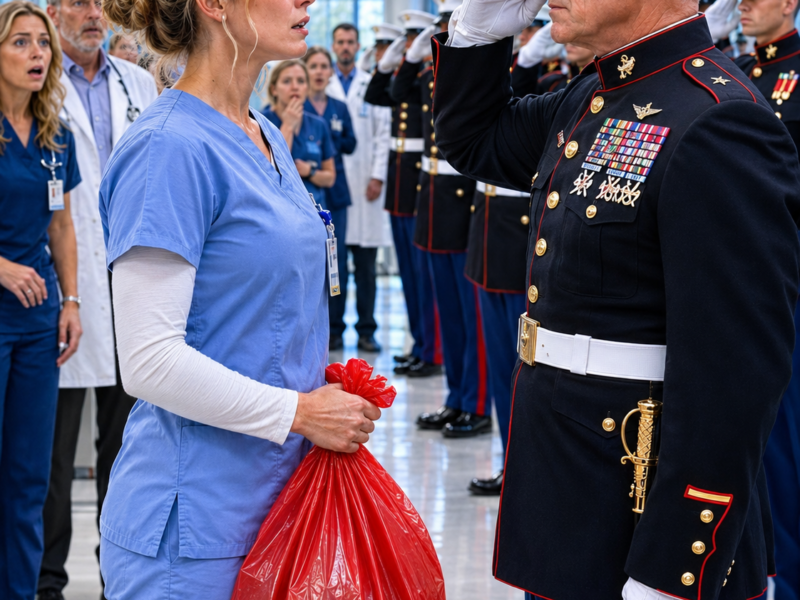
The ICU Nurse Who Mopped Floors for 5 Years — Until Marines Marched In and Saluted ‘Petty Officer…
The ICU Nurse Who Mopped Floors for 5 Years — Until Marines Marched In and Saluted ‘Petty Officer…
For five years, the nurses on the fourth floor of Harbor Point Regional Medical Center had known Megan Riley as the woman who did the jobs nobody else wanted.
She was thirty-six years old, with mouse-brown hair that she twisted into a tight bun every morning, a tired face that rarely showed emotion, and a habit of wearing medical scrubs at least two sizes too large. She walked quietly through the hospital corridors, spoke only when necessary, and seemed almost determined to make herself invisible.
If a patient became aggressive, Megan was sent into the room. If someone vomited across the floor, Megan cleaned it. If a confused elderly man refused to take his medication, Megan somehow found a way to persuade him. If a family complained that nobody had brought them coffee, Megan was the person who appeared with a cup in her hand.
She worked Christmas mornings, Thanksgiving evenings, and practically every Independence Day without requesting time off. She accepted extra shifts, covered for absent colleagues, and never complained when her assignments became increasingly unreasonable.
Most of the nurses considered her harmless.
Some thought she was simply desperate to keep her job. Others assumed she lacked ambition. A few openly treated her as though she were part of the hospital’s cleaning staff rather than a qualified member of the medical team.
Nobody knew that beneath the loose fabric of her uniform, a network of old scars stretched across her left shoulder and down her back.
Nobody knew that she sometimes woke in the middle of the night with the smell of burning diesel in her nose, hearing distant explosions that had happened thousands of miles away.
And nobody knew that, before coming to Harbor Point, Megan Riley had once been the most respected Navy corpsman in a Marine rifle company.
Six years earlier, she had worked in a place where hesitation could mean the difference between life and death.
She had stopped arterial bleeding with her bare hands while mortars exploded nearby. She had performed emergency airway procedures with nothing but a flashlight attached to her helmet. She had carried wounded Marines through fields filled with dust and smoke, knowing that another explosion could arrive before she reached cover.
Eleven men had entered that terrible afternoon wounded.
All eleven had survived.
Four of them still carried the memory of the young corpsman who refused to leave anyone behind.
But that woman had disappeared.
Megan had spent years trying to bury her military identity beneath hospital laundry, medication carts, and quiet conversations with frightened patients. She wanted an ordinary life. She wanted to sleep through the night without hearing phantom explosions. She wanted to walk into a room without wondering whether somebody inside was about to die.
Most importantly, she wanted to stop being remembered as the person who had survived when others had not.
At Harbor Point, nobody asked about her past.
And Megan preferred it that way.
Her immediate supervisor, Kayla Parker, made that preference particularly convenient.
Kayla was twenty-nine, ambitious, fashionable, and extremely conscious of her professional image. Her hair was always perfectly styled, her rose-gold stethoscope seemed to have been purchased specifically to complement her manicure, and she had a remarkable talent for mentioning her master’s degree in healthcare administration during conversations that had absolutely nothing to do with administration.
She liked being in charge.
She liked being photographed.
And she especially liked receiving recognition for work that other people had performed.
When Kayla led a resuscitation, she moved around the room as though she were directing a theatrical production. She issued instructions loudly, positioned herself where everyone could see her, and made certain that the attending physicians noticed her presence.
Megan, meanwhile, was usually standing somewhere near the door, holding equipment or quietly correcting something that nobody else had noticed.
On a gray Tuesday morning in late October, Megan was already responsible for three critically ill patients when Kayla approached the central nursing station.
Kayla was looking at her phone.
“Megan.”
Megan turned.
“Yes?”
“Bed six has pulled out his feeding tube again. There’s formula all over the sheets. Clean him up, change everything, and make sure the bed is disinfected.”
Megan glanced toward the corridor.
“All right.”
“And after that, I need you to restock the emergency carts on the third floor before Dr. Sullivan makes his rounds.”
Megan waited.
“Also, the family in bed nine keeps asking for coffee. Could you bring them something? They seem to think I’m personally responsible for their comfort, and I have several administrative matters to finish.”
Kayla placed her iced latte on top of a stack of unsigned patient documents.
A small circle of condensation began spreading across the paper.
Megan looked at the coffee, then at the documents.
She said nothing.
“Did you hear me?”
“Yes, Kayla.”
“Good. And please try to move quickly today. We’re already behind.”
Megan nodded and collected the supplies.
She did not remind Kayla that two of the patients assigned to her were unstable. She did not mention that she had been awake since the previous afternoon. She did not point out that restocking emergency equipment was not a substitute for adequate staffing.
She simply went to work.
That was what she always did.
The head of the intensive care unit, Dr. Richard Sullivan, was even less interested in Megan than Kayla was.
He had worked at Harbor Point for nearly thirty years and considered himself one of the most experienced physicians in the region. His office displayed framed certificates, professional awards, and photographs of himself standing beside prominent hospital administrators.
He spoke confidently, disliked being questioned, and had developed the habit of treating younger medical professionals as though their opinions were interruptions.
Megan learned early that he considered her an inconvenience.
The previous spring, a postoperative patient had begun deteriorating during an overnight shift.
His blood pressure was falling rapidly. His skin had turned red across his chest and neck, and his breathing had become increasingly labored.
Megan noticed the symptoms while checking the medication record.
The patient had received a new antibiotic approximately forty minutes earlier.
She approached Sullivan, who was reviewing a chart.
“Doctor, I think he may be having an anaphylactic reaction.”
Sullivan barely looked up.
“What makes you think that?”
“His blood pressure is dropping, his skin is flushing, and his breathing is changing. The reaction began shortly after the antibiotic.”
Sullivan sighed.
“When I need a pharmacist’s opinion, Nurse Riley, I’ll contact the pharmacy.”
Megan looked through the glass toward the patient’s bed.
The man’s condition was deteriorating.
She knew what was happening. She also knew that waiting could be fatal.
Without arguing, she prepared the emergency medications and placed them where they could be reached immediately.
Two hours later, the patient’s airway began closing.
Sullivan rushed into the room, suddenly shouting for epinephrine and diphenhydramine.
Kayla handed him the medications.
He administered them, stabilized the patient, and later praised Kayla in front of the entire department for her excellent attention to detail.
Megan stood near the doorway holding a collection container.
Nobody mentioned her warning.
Nobody mentioned the medications she had prepared.
And Megan did not correct them.
Being invisible had become her protection.
There was a fireproof box in her apartment closet, hidden beneath several winter sweaters.
Inside it lay a Silver Star, a Purple Heart, and an official letter from the Secretary of the Navy.
There were also photographs.
In one, Megan stood beside eleven Marines in a dusty military compound. She looked younger, thinner, and almost impossibly confident. Her uniform was stained, her hair was tucked beneath a helmet, and her smile was the kind that appeared only when somebody had finally made it through a difficult day.
She rarely opened the box.
When she did, she never looked at the photographs for long.
She had received letters from the Navy and from former members of her unit. Some had been forwarded through veterans’ organizations. Others had been returned because she had moved without leaving a forwarding address.
She had never answered.
Silence was the only thing that sometimes allowed her to sleep.
And she had worked very hard to build it.
Then, on a Thursday in early November, at 2:06 in the morning, everything changed.
The hospital was understaffed.
Two nurses had called in sick, and Kayla had announced that she needed time to complete paperwork in the break room.
That meant she was sitting cross-legged in a chair, listening to music through expensive headphones while the rest of the department struggled to manage the night.
Megan was working alongside Connor Mills, a twenty-six-year-old first-year resident who still looked as though he had graduated from medical school yesterday.
Connor was intelligent, hardworking, and genuinely concerned about his patients.
He was also inexperienced.
He often second-guessed himself, apologized too much, and became visibly nervous whenever Dr. Sullivan entered a room.
Megan had noticed his potential during their first few weeks working together.
She had also noticed that he was terrified of making mistakes.
That night, the red emergency telephone at the central nursing station began ringing.
Megan answered immediately.
“Intensive care. Riley speaking.”
A frantic voice came through the receiver.
“Trauma department. Dr. Alvarez speaking. We have a Marine coming in from Highway 17. Vehicle rollover. He was riding in the back of a truck without a seat belt.”
Megan straightened.
“What’s his condition?”
“Twenty-one years old. Severe facial trauma, bilateral facial fractures, unstable pelvis, suspected internal bleeding. His blood pressure is eighty over fifty and dropping.”
Megan reached for a pen.
“Airway?”
“Compromised. We’ve attempted intubation twice. Facial swelling is making it impossible. Oxygen saturation is falling.”
“How long?”
“Two minutes. You need to be ready.”
“We’ll be ready.”
She replaced the receiver and pressed the emergency alarm.
The corridor immediately filled with bright lights and movement.
Connor appeared beside her, already pulling on his gloves.
“What do we need?”
Megan looked directly at him.
“Open the surgical airway kit. Prepare two large-bore IV lines, a pelvic binder, and the rapid infusion equipment. Get emergency blood ready. Call Dr. Sullivan and tell him he needs to come to the department immediately.”
Connor nodded, trying to remember everything.
Megan touched his arm.
“Connor. Look at me.”
He raised his eyes.
“Everything is going to be fine. Breathe.”
Something about her voice made him pause.
It was calm, steady, and completely free of uncertainty.
Connor took a breath.
“Okay.”
“Good. Now move.”
The emergency doors burst open moments later.
Two paramedics pushed a stretcher into the department at a run.
The young Marine lying on it was barely recognizable.
His face was swollen and discolored. Blood covered his lips and chin. His chest moved in short, ineffective attempts to breathe, and every few seconds his body seemed to struggle harder against the obstruction in his throat.
“Patient is Devon Harris,” one paramedic shouted. “Twenty-one years old. Found in the vehicle after rollover. Blood pressure seventy over forty and falling.”
They transferred him to the first bed.
Megan immediately began cutting away his clothing.
When she exposed his right forearm, she saw the tattoo.
An eagle.
A globe.
An anchor.
The Marine Corps emblem.
For a fraction of a second, the hospital disappeared.
The white ceiling became a pale desert sky.
The antiseptic smell was replaced by burning diesel and hot dust.
She heard mortars in the distance.
She heard someone shouting for a medic.
And beneath those sounds came a voice she had not forgotten.
A nineteen-year-old Marine lying on a stretcher, blood soaking through his uniform, begging her not to let him die.
Megan’s fingers stopped moving.
“Miss Riley?”
Connor’s voice pulled her back.
“His saturation is sixty-one and dropping.”
She looked at the monitor.
The number was falling.
“Bag him.”
Connor began ventilating the patient.
Nothing improved.
The young Marine’s airway was almost completely obstructed by swelling and facial trauma.
His lips turned gray.
His eyes rolled backward.
“Fifty-two,” Connor whispered. “Megan, I can’t see the airway. I can’t get anything through.”
Megan stepped closer.
“Try again.”
Connor repositioned the equipment.
Nothing.
“His heart rate is dropping.”
He looked at her.
“Should we wait for Dr. Sullivan?”
Megan glanced at the monitor.
There was no time.
“No.”
She opened the surgical airway kit.
Connor stared at her.
“Megan, what are you doing?”
“Preparing an emergency airway.”
“You can’t perform that. It’s a surgical procedure. You’re a nurse.”
She looked at him.
“If we wait, he dies.”
“But—”
“Connor, hold his head. Do not let go.”
Her voice was no longer the quiet voice of the woman who carried laundry through the corridors.
It was a command.
Connor moved immediately.
Megan positioned herself, identified the anatomical landmarks through the swelling, and made the necessary incision.
Blood appeared.
She worked with extraordinary precision, creating access to the airway, inserting the guide, and securing the tube.
The entire procedure took less than forty seconds.
Her hands did not shake.
They had not shaken in Helmand, either.
“Bag him.”
Connor squeezed the ventilation bag.
The patient’s chest rose.
Then fell.
Then rose again.
For one terrifying second, nothing changed.
Megan watched the monitor.
The oxygen saturation remained low.
“Again.”
Connor squeezed.
The patient’s chest expanded.
A faint sound came from the monitor.
Then the numbers began climbing.
Fifty-eight.
Sixty-four.
Seventy.
Eighty.
Eighty-eight.
Connor stared at the screen.
“Oh my God.”
“Pelvic binder. Two units of O-negative blood. Full speed.”
He moved immediately.
“Blood pressure is eighty over forty-five.”
“Again.”
“Eighty-five over fifty.”
Megan stepped back slightly.
Only then did she realize she had been holding her breath.
The young Marine was alive.
His airway was secured, and the bleeding was being addressed.
For a moment, she looked at his face.
She remembered another young man with a similar tattoo, another frightened Marine whose mother had probably been waiting at home for him.
She wanted to tell Devon that he was going to make it.
Instead, she turned back toward the equipment.
There was still work to do.
Dr. Sullivan arrived four minutes later.
His shirt was tucked in hastily, and his expression suggested that he had been deeply inconvenienced by the emergency.
Kayla followed him, her hair disheveled and her lipstick partially smeared.
Sullivan glanced at the monitor, then at the surgical airway.
He studied the neat incision and the secured tube.
“Well,” he said, looking at Connor. “That’s impressive.”
Connor turned toward him.
Sullivan patted the young resident on the shoulder.
“Excellent work, Mills. Surgical airway access under those circumstances. Very impressive. That’s the kind of initiative I expect from a future attending.”
Connor opened his mouth.
His eyes moved toward Megan.
Megan gave him the smallest shake of her head.
Not now.
“Thank you, doctor,” Connor said quietly.
Sullivan nodded, apparently satisfied.
Then he noticed blood on the floor.
His expression changed.
“Riley!”
Megan turned.
“Yes, doctor?”
“What happened here? There’s blood everywhere.”
“Emergency procedure, doctor.”
“I can see that. Take care of the floor.”
He gestured toward the mess.
“Get the mop.”
Megan looked once at Devon, whose oxygen saturation was now stable.
Then she walked to the supply closet.
She brought back the mop.
And she cleaned the floor.
For four days, Devon Harris remained in the intensive care unit.
His condition was critical at first, but the emergency airway had saved his life. Once his internal injuries were stabilized, the surgeons transferred him to a specialized trauma unit.
The hospital quickly became fascinated with his story.
A young Marine had nearly died in a terrible highway accident, and Harbor Point had managed to save him.
Rumors spread that his battalion commander intended to visit.
Somebody in administration mentioned that Evans Health, the corporation that owned Harbor Point, held a multimillion-dollar medical services contract with the military base.
The contract was due for renewal in January.
To Stephen Hawkins, the hospital director, Devon’s recovery represented an extraordinary public relations opportunity.
He ordered a photographer to be present during the military delegation’s visit.
He instructed the department to prepare a formal reception.
And Kayla Parker immediately began making sure she would be at the center of it.
She changed the nursing schedule so that she would be Devon’s primary nurse on the day of the ceremony.
She arranged a professional appointment for her hair, purchased a new blouse, and repeatedly mentioned that she had been involved in the emergency response.
She even began telling people that the young Marine’s recovery was a testament to her department’s leadership.
Megan said nothing.
The morning before the ceremony, Kayla found her in the utility room.
Megan was checking the inventory of medical supplies.
Kayla leaned against the doorway.
“Listen, Megan. We need to talk about tomorrow.”
Megan turned.
“All right.”
“There will be cameras, administrators, and several important military officials. Management wants the department looking absolutely perfect.”
Megan nodded.
“Of course.”
“So I need you to handle a few things.”
Kayla approached and touched the sleeve of Megan’s uniform.
Then she withdrew her hand almost immediately.
“I want you to take the biohazard waste downstairs, count the laundry in the basement, and make sure the supply room is organized. You can stay away from the reception area for the afternoon.”
Megan looked at her.
“Is there a particular reason?”
Kayla gave her a thin smile.
“You’re looking a little tired lately, dear. And honestly, nobody wants to see someone carrying garbage in the background of an important photograph.”
Megan remained silent.
Kayla continued.
“Don’t take it personally. You know how these events work. We need to present a professional image.”
“Understood.”
“Good. I knew you’d understand.”
Kayla returned to the corridor.
Megan picked up the heavy red biohazard bag.
It was warm from the soiled materials inside.
She carried it toward the elevator.
She had no idea that, within the next few hours, the entire hospital would learn exactly who she was.
At precisely two o’clock, the double doors to the fourth-floor intensive care unit opened.
The nurses at the central station stopped talking.
A delegation of Marines entered the corridor in formal dress uniforms.
They moved with the precision of men who had spent years learning how to move together.
White gloves.
Polished shoes.
Dark blue uniforms.
Gold buttons catching the overhead lights.
At the front walked a slender, gray-haired colonel with an unmistakable presence.
Colonel Wayne Anderson had four rows of ribbons across his chest and the posture of a man who had spent most of his adult life carrying responsibility for other people’s lives.
Behind him walked two captains, a senior sergeant, and several Marines.
The hospital director practically ran toward them.
“Colonel Anderson! Welcome to Harbor Point Regional Medical Center.”
Stephen Hawkins extended his hand.
“We’re honored to have you here. We are extremely proud of the care we’ve provided your Marine.”
Anderson did not immediately take his hand.
Hawkins continued, apparently unaware of the awkwardness.
“Let me introduce Kayla Parker, our senior nurse. She has been closely involved in Devon’s care.”
Kayla stepped forward.
Her smile was perfectly practiced.
“Colonel. It’s an honor.”
The colonel barely acknowledged her.
His eyes were moving across the department.
He looked at the doctors, the flowers, the photographer, and the reception table.
Then his gaze reached the far end of the corridor.
A woman was turning the corner from the elevator.
She wore oversized medical scrubs and carried a red biohazard bag.
Her head was lowered.
She appeared tired.
Ordinary.
Then she looked up.
Colonel Anderson stopped walking.
His face lost its color.
For a moment, he seemed unable to believe what he was seeing.
Then he whispered two words.
“My God.”
He walked past Hawkins.
He passed Dr. Sullivan, who had stepped forward to greet him.
He ignored Kayla’s outstretched hand.
The two captains followed.
The senior sergeant moved behind them.
Every Marine in the delegation began walking toward the woman at the end of the corridor.
Megan froze.
The red bag slipped from her fingers and struck the tiled floor.
She stared at the approaching colonel.
She knew that face.
She had seen it beneath a military helmet, covered in dust and blood, shouting orders while explosions shook the ground around them.
She remembered his voice.
She remembered the day he had tried to drag a wounded Marine toward cover while she worked on another man’s shattered leg.
And she remembered the moment he had looked at her and said, “Doc, don’t you dare give up on him.”
Now Colonel Wayne Anderson was standing two steps away.
He clicked his heels together.
The sound echoed through the corridor.
Then he raised his right hand in a crisp military salute.
Behind him, the captains saluted.
The sergeant saluted.
Every Marine in the delegation raised a gloved hand at precisely the same moment.
Eight men stood before a hospital nurse carrying a bag of garbage.
“Petty Officer Riley, ma’am,” Anderson said.
His voice trembled.
“Doc. It’s an honor to see you again.”
Nobody moved.
The photographer lowered his camera slightly.
Stephen Hawkins stood with his mouth open.
Kayla’s smile disappeared.
Dr. Sullivan stared at Megan as though he had suddenly discovered that the person he had been ordering around for five years was someone entirely different.
Megan looked at the colonel.
For a moment, she seemed unable to find her voice.
Then something changed.
Her shoulders straightened.
Her chin lifted.
The apologetic posture she had worn for five years disappeared.
She was no longer the woman who quietly accepted every insult.
She was once again the corpsman who had stood in the middle of a battlefield and refused to abandon her men.
“At ease, Colonel,” she said.
Her voice was quiet, but it carried.
The Marines lowered their hands.
Anderson stepped closer.
“Ma’am, I’ve written to you eleven times.”
Megan lowered her eyes briefly.
“I know, sir.”
“Letters from the Navy. Letters about your Silver Star. Communications from veterans’ organizations. Most of them came back undelivered.”
He shook his head.
“We’ve been looking for you for six years.”
Megan looked at him.
“I needed some peace.”
“Half my battalion thought you’d gone somewhere into the mountains. Sergeant Cooper here has been calling every veterans’ organization he could find.”
The senior sergeant made a small sound.
He turned his face away for a moment.
Megan recognized him, too.
“Cooper.”
He nodded.
“Doc.”
His voice broke slightly.
She looked from one face to another.
There were men in front of her whom she had once treated in a ditch while enemy fire landed nearby.
Some had scars.
Some walked with slight stiffness.
But they were alive.
Every one of them.
And they remembered.
Colonel Anderson finally glanced toward Hawkins.
“Mr. Hawkins, do you know who this woman is?”
Hawkins forced a nervous smile.
“Well, Colonel, I believe there may be some confusion. Megan is one of our nursing staff. She helps with supplies, laundry, and general department duties.”
The colonel slowly turned his head.
“She helps with laundry?”
“Yes. She’s a member of our support team.”
Anderson stared at him.
Then he spoke clearly enough for everyone in the corridor to hear.
“On June ninth, during an operation in Helmand Province, the Marine rifle company I commanded was ambushed.”
The corridor became completely silent.
“Mortars struck our position. Machine-gun fire came from multiple directions. An improvised explosive device destroyed one of our vehicles.”
He paused.
“Our battalion surgeon was miles away. We had eleven wounded Marines trapped in an irrigation ditch, and one Navy corpsman working among them.”
He looked at Megan.
“Petty Officer Megan Riley.”
Megan’s eyes remained fixed on the floor for a moment.
Anderson continued.
“She was barely out of her early twenties. She was exhausted, wounded, and surrounded by men who needed immediate medical attention.”
He took a breath.
“She worked for three hours under enemy fire.”
Nobody interrupted.
“She used her own shoelaces to control arterial bleeding. She treated fractures, chest injuries, and severe blood loss. She performed an emergency airway procedure on a Marine whose jaw had been almost completely destroyed.”
His voice became rougher.
“When a bullet struck her shoulder, she dressed the wound and continued working.”
The colonel looked toward the men standing behind him.
“Eleven Marines entered that ditch wounded.”
He gestured toward the delegation.
“Eleven came out alive.”
Two of the Marines behind him lowered their eyes.
One captain blinked repeatedly, trying to control his emotions.
Anderson looked back at Megan.
“Four of the men standing behind me today are alive because she refused to let go.”
He turned toward Kayla.
“And you made her take out the trash.”
Kayla’s face went pale.
“I… I didn’t know.”
“No,” Megan said quietly. “You didn’t.”
Kayla looked at her.
“You never told anyone.”
Megan did not answer.
Dr. Sullivan finally found his voice.
“Colonel, with all due respect, this is a civilian hospital. We have established clinical procedures and professional boundaries.”
Anderson turned toward him.
Sullivan continued.
“Corporal Harris’s airway was secured during the emergency response by my resident. Nurse Riley was assisting. If she performed an invasive procedure outside her scope of practice, that is a serious matter.”
The colonel did not respond immediately.
Instead, he looked toward Connor Mills.
The young resident stood beside the monitor station.
His face was pale.
He knew what was coming.
“Doctor Mills,” Anderson said. “I would like to hear what happened.”
Connor glanced at Sullivan.
Then at Kayla.
Finally, he looked at Megan.
For five years, people had made decisions for him.
He had learned that disagreeing with senior physicians could damage his career. He had watched colleagues remain silent when something was wrong because speaking up was inconvenient.
He had almost done the same thing that night.
But he remembered Devon Harris’s face.
He remembered the monitor showing an oxygen saturation of fifty-two.
He remembered his own hands refusing to move.
And he remembered Megan’s voice.
No panic.
No hesitation.
Just a clear instruction telling him exactly what to do.
Connor swallowed.
“No, sir. I didn’t perform the procedure.”
Sullivan’s expression changed.
“Connor—”
“Please let me finish.”
It was the first time Connor had ever interrupted him.
“I tried to intubate the patient. I couldn’t establish an airway. His oxygen saturation kept dropping. I was frightened, and I didn’t know what to do.”
He looked toward Megan.
“Nurse Riley performed the emergency cricothyrotomy. She did it in less than forty seconds. She secured the airway, directed the resuscitation, and told me exactly what equipment to prepare.”
Connor’s voice trembled.
“I was standing beside her. I watched the entire thing.”
He looked at Sullivan.
“And afterward, you thanked me for doing it.”
The silence that followed was almost unbearable.
Connor lowered his head.
“I accepted your praise. I knew it wasn’t true, and I didn’t correct you.”
He looked back at Megan.
“I’m sorry.”
Megan did not smile.
She simply nodded once.
Connor continued.
“She saved that Marine’s life. I was there. I know what happened.”
Sullivan’s face turned dark red.
“You are a first-year resident. You have no idea what you’re talking about.”
“I know what I saw.”
“Dr. Mills, you are making a serious professional mistake.”
“No, doctor. I already made one.”
A small crowd of nurses and medical staff had gathered at the far end of the corridor.
Several were openly crying.
The photographer accompanying the delegation had raised his camera again.
Sullivan turned toward Hawkins.
“This is unacceptable. Nurse Riley performed an unauthorized invasive procedure. I want her removed from the department immediately.”
Anderson stepped forward.
“Doctor, the young man upstairs is alive because she acted when you were not there.”
“That does not excuse violating hospital policy.”
“Policy?”
The colonel’s voice became colder.
“You should think carefully before using that word to defend what happened here.”
Kayla, apparently desperate to regain some control, stepped forward.
“She also constantly ignores instructions. She does things without informing me. I’ve had problems with her attitude for months.”
Megan turned toward her.
For the first time that day, she spoke without being prompted.
“Kayla, do you remember the heparin infusion on the seventh floor three weeks ago?”
Kayla frowned.
“What?”
“You signed the order with a dosage ten times higher than the prescribed amount.”
Kayla’s mouth opened.
“I corrected it before it reached the patient.”
“That was a calculation issue.”
Megan continued.
“And last month, you entered patient observations at four in the morning for someone who had been in radiology since two.”
Kayla stared at her.
“That’s not—”
“I kept the records.”
Megan turned toward Sullivan.
“In March, you prescribed enoxaparin to a patient with a documented clotting disorder without reviewing his coagulation results.”
Sullivan took a step backward.
“That’s an outrageous accusation.”
“I kept those records, too.”
Hawkins looked increasingly uncomfortable.
Megan spoke in the same calm voice she had used when instructing Connor during the emergency.
“Every medication chart. Every infusion pump log. Every altered observation. Every time somebody reported a concern and nothing happened afterward.”
She touched the side of her head.
“I spent twelve years in the Navy learning how to document mistakes made by people who outranked me. I learned because the consequences were always paid by the people lying in the beds.”
She looked at Sullivan.
“Did you really think I would stop keeping records just because I changed uniforms?”
Nobody answered.
Anderson placed a hand gently on Megan’s uninjured shoulder.
Then he turned toward the hospital director.
“Mr. Hawkins, the Naval medical community is establishing a trauma training program at Camp Lejeune. They need someone to teach young medical personnel how to work when everything is falling apart.”
He looked back at Megan.
“I was hoping you might consider directing that program.”
Megan remained silent.
“The position would give you the authority to train the next generation of corpsmen and emergency responders. You would be teaching people how to save lives when there is no time to wait for someone else.”
Anderson paused.
“Name your conditions. I’ll make the call tonight.”
For a moment, Megan looked around the department.
She saw the central nursing station where she had spent countless nights preparing emergency equipment.
She saw the utility closet where she had eaten lunch standing up because nobody had bothered to arrange a proper break.
She saw the floors she had mopped.
The carts she had restocked.
The patients whose names she remembered even when their families had forgotten hers.
She looked at Connor.
He was still standing beside the monitor, looking as though he had just done something that might cost him everything.
Then she glanced toward the first room.
Devon Harris was lying there, recovering from the accident that had nearly taken his life.
His mother sat beside him.
Megan watched her gently adjust the blanket around her son’s shoulders.
A faint smile touched Megan’s face.
It was the first genuine smile anyone on the fourth floor had seen from her in years.
“You’re very kind, Colonel.”
Anderson waited.
“But I think I need to stay here.”
The colonel raised an eyebrow.
“Are you certain?”
“Yes, sir.”
Megan turned toward Hawkins.
“Mr. Hawkins, I have a few conditions of my own.”
The director straightened.
“Of course.”
“By the end of today, Dr. Connor Mills will be appointed senior resident of the intensive care unit.”
Connor looked up in surprise.
“Me?”
Megan continued.
“He has something this department desperately needs. He knows when he doesn’t know something, and he has the courage to admit when he makes a mistake.”
Sullivan opened his mouth.
Megan raised one hand slightly.
“Dr. Sullivan will immediately step down from his leadership position pending an independent review of his prescribing history and patient care decisions.”
Sullivan’s face tightened.
“You cannot possibly—”
“I have copies of the records. If the hospital refuses an external audit, I will submit them to the state medical board.”
She turned toward Kayla.
“Kayla Parker will be suspended from her supervisory position pending a full investigation into her medication records and documentation practices.”
Kayla shook her head.
“You can’t do this to me.”
Megan looked at her.
“You were right about one thing, Kayla. This department does need better leadership.”
She paused.
“It just doesn’t need the kind you’ve been providing.”
The colonel turned toward Hawkins.
“Mr. Hawkins, I believe we understand each other.”
Hawkins nodded rapidly.
“Absolutely, Colonel.”
“Evans Health has a multimillion-dollar contract with our military base. It comes up for renewal in January.”
“Yes, sir.”
“If Petty Officer Riley is not offered the clinical director position in this department by the end of the business day, I will have no difficulty recommending that our contract be moved elsewhere.”
Hawkins swallowed.
“Of course. We’ll make the necessary arrangements.”
Anderson turned back toward Megan.
For the first time since entering the hospital, his expression softened.
“Doc, there’s something I’ve wanted to say for six years.”
Megan looked at him.
“I never got the chance to thank you properly.”
He raised his right hand again.
This time, Megan slowly returned the salute.
Her movement was not as sharp as it had been during her military years. Six years had passed. Her shoulder still hurt, and the old scars pulled when she raised her arm.
But it was accurate enough.
“Thank you, sir.”
She lowered her hand.
Then, after a brief pause, she added something that made the colonel smile.
“It’s nice to hear someone call me Doc again.”
The Marines stood for another moment.
Then they turned and marched back toward the elevators.
The corridor remained silent long after they disappeared.
A nurse at the central station was openly crying.
Another covered her mouth.
Connor stood completely still.
Hawkins looked as though someone had suddenly removed the floor beneath his feet.
Kayla stared at the spot where the colonel had been standing.
Dr. Sullivan said nothing.
Megan bent down, picked up the red biohazard bag, and carried it to the disposal area.
She returned to the nursing station.
Kayla was still holding the department tablet.
Megan gently took it from her.
Then she began reviewing the patient assignments.
For the moment, the work still needed to be done.
And she intended to make certain it was done properly.
By Friday, the story had spread beyond Harbor Point.
A local newspaper published an article about the former Navy corpsman who had saved a young Marine’s life before being publicly recognized by his commanding officer.
A veterans’ forum with tens of thousands of members shared the story.
Photographs of the military delegation standing before Megan appeared online.
The image of the red biohazard bag lying on the hospital floor became particularly popular.
People wanted to know how a decorated Navy corpsman had spent five years being treated as though she were little more than an assistant.
Some praised her humility.
Others questioned the hospital’s management.
Evans Health, suddenly worried about public attention and the military contract, launched a full investigation.
What they found was considerably worse than the administrators had expected.
Megan had kept records for years.
She had copies of medication charts, infusion logs, patient observations, and written reports.
Everything was organized.
Everything was dated.
Everything had been recorded in her small, precise handwriting.
She had not kept the information to punish anyone.
She had kept it because she had seen what happened when people in authority refused to acknowledge their mistakes.
And she had no intention of allowing another patient to suffer because somebody was too proud to admit they were wrong.
The audit took eleven days.
On the twelfth morning, Megan received a message asking her to report to a conference room on the sixth floor.
When she entered, she found nearly every important person in the hospital administration sitting around a long table.
Stephen Hawkins was at the head.
Beside him sat the hospital’s legal representative and a woman from the state nursing board.
A district investigator had placed a thick folder in front of himself.
Across the table sat Dr. Sullivan and Kayla Parker.
They were seated several feet apart.
Neither looked at the other.
Kayla wore a plain cardigan instead of her usual polished uniform.
Her hair was no longer professionally styled, and the rose-gold stethoscope that had once seemed permanently attached to her neck was gone.
Sullivan looked older.
His shoulders were slightly hunched, and the confidence he usually carried into every meeting had disappeared.
Megan took the empty chair near the end of the table.
The hospital lawyer began.
“Ms. Riley, thank you for attending. The investigation has been completed, and we believe you should hear the findings directly.”
The district investigator opened his folder.
“Dr. Sullivan, the audit identified fourteen medication orders that failed to meet accepted standards of care.”
Sullivan lifted his chin.
“Those orders were clinically justified.”
“Two of them resulted in documented patient harm.”
“That’s debatable.”
“Both families have retained legal counsel.”
Sullivan leaned back.
“I have worked in this department for thirty years.”
The woman from the nursing board finally spoke.
“And apparently, you have spent a considerable portion of those thirty years without adequate oversight.”
Sullivan looked at her.
“The board is prepared to initiate proceedings concerning your medical license. You may voluntarily surrender it today, or you may proceed to a formal hearing with all of these records made available.”
For several seconds, Sullivan did not move.
Then he looked toward Megan.
It was perhaps the first time in five years that he truly saw her.
Not the woman carrying a mop.
Not the person he could dismiss with a careless gesture.
A decorated military medical professional who had recognized his mistakes and documented them while he continued to ignore her.
He lowered his voice.
“Clothes hanger.”
Megan heard him.
She looked back at him.
She did not smile.
She did not respond.
The lawyer pushed a document across the table.
Sullivan stared at it for a long moment before finally signing.
His signature was uneven.
He pushed the paper away as though it had burned his fingers.
The investigator turned toward Kayla.
“Ms. Parker.”
Kayla shifted in her chair.
“I made one mistake with the heparin pump.”
The investigator looked down at his notes.
“We found nineteen instances of inaccurate patient documentation.”
Kayla’s face tightened.
“People round numbers all the time. The readings were close enough.”
“Some of these readings were entered while patients were physically located in radiology.”
“I was busy.”
“One patient was not even on the floor at the time you recorded the observations.”
Kayla looked toward Sullivan.
“Dr. Sullivan told me everything would be fine.”
He stared at the table.
She turned back to the investigator.
“He said I was going to be in charge of this department by spring.”
Nobody answered.
The investigator continued.
“The state medical board has been notified. Your nursing license will be subject to revocation proceedings, and the district attorney’s office has been provided with the documentation concerning falsified records.”
Kayla’s eyes filled with tears.
She turned toward Megan.
“Megan, please.”
Megan remained still.
“I was scared,” Kayla whispered. “You know how things are here. You know how much pressure there is. You could have helped me.”
Megan looked at her.
“I did help you.”
Kayla shook her head.
“You never said anything.”
“I corrected the medication error before the patient received the wrong dose.”
Kayla wiped her cheek.
“You could have told them it was just a stressful period.”
Megan’s expression did not change.
“I told them what happened.”
She paused.
“Every record I kept describes something that actually happened. I wrote down what you did, Kayla. Nothing more.”
Kayla lowered her head.
Two security officers were waiting outside the conference room.
When she was dismissed, she collected her personal belongings and placed them in a cardboard box.
The nurses who had once followed her instructions stood in the hallway.
Nobody said anything.
Sullivan left separately.
He did not look back.
By the following spring, his wife had filed for divorce, and two patient families were pursuing legal action against him.
The hospital’s board had also learned how long administrators had ignored complaints about the intensive care unit.
Stephen Hawkins resigned in February.
The hospital’s reputation suffered, but the military contract remained under review rather than being immediately transferred.
And Megan Riley was finally offered the position she had deserved for years.
Clinical director of the intensive care department.
She accepted.
Not because she wanted an impressive office or a larger salary, although the position provided both.
She accepted because she believed the department could become something better.
She introduced mandatory medication safety reviews.
She established a reporting system that protected junior staff from retaliation when they raised concerns.
She required emergency response training for every member of the department.
She also changed one rule that seemed small but meant more than anyone realized.
Nobody was permitted to assign a colleague humiliating or unnecessary work simply because of their position.
Every person in the department, from the newest resident to the most senior physician, was expected to treat the others with professional respect.
Connor Mills became senior resident in December.
His first weeks were difficult.
He had to learn how to lead people who were older and more experienced than he was.
He made mistakes.
He asked questions.
He sometimes stayed late reviewing cases because he was afraid of overlooking something important.
But he never again pretended to know something he did not know.
Megan encouraged that.
She taught him that a good physician did not need to be the loudest person in the room.
A good physician needed to recognize danger, listen carefully, and act when action was required.
One night, shortly after three in the morning, Connor found Megan alone at the central station.
She was checking the emergency cart and replacing several supplies.
The department was quiet.
The monitors beeped softly behind closed doors.
Connor leaned against the counter.
“You know, you should have accepted Colonel Anderson’s offer.”
Megan closed a drawer.
“Perhaps.”
“You could have been directing an entire trauma training program.”
“Maybe someday.”
Connor looked at her.
“Why stay here?”
Megan glanced toward the patient rooms.
Through the glass of the first room, she could see Devon Harris.
He was awake, thinner than before, and still recovering from the extensive injuries he had suffered in the accident.
A tracheostomy tube remained in his throat.
His mother was asleep beside him, one hand wrapped around his wrist.
Megan watched them for a moment.
Then she looked at Connor.
“Because somebody has to be standing here at two in the morning.”
Connor waited.
“Someone has to be ready when the phone rings. Someone has to recognize the warning signs when everybody else is tired. Someone has to know what to do when a patient has six minutes left and the person who is supposed to help isn’t in the room.”
She closed the emergency cart.
“I would rather that person be someone who knows what to do.”
Connor nodded slowly.
He finally understood.
Megan had not stayed because she was afraid of change.
She had stayed because she knew exactly what happened when a department lacked competent leadership.
And she knew that the people who paid the highest price were never the administrators sitting in comfortable offices.
They were the patients.
The people lying in beds.
The families waiting in corridors.
The frightened young men and women who had no idea whether the person standing beside them knew how to save their lives.
In January, Devon Harris finally walked out of Harbor Point Regional Medical Center.
His recovery had taken months.
He had undergone multiple surgeries, endured painful rehabilitation, and spent long weeks learning how to breathe and swallow properly again.
His voice was still weak.
He could not speak for very long.
But he could walk.
On the morning of his discharge, the entire Marine squad was waiting in the hospital lobby.
They stood in a line near the entrance.
Their uniforms were immaculate.
Their shoes were polished.
When the elevator doors opened, Devon appeared beside his mother, moving slowly with the assistance of a walking frame.
His mother was crying.
One of the Marines stepped forward and helped her steady her son.
Then Devon saw Megan.
She was standing near the reception desk in her usual medical uniform.
For a moment, he simply looked at her.
He recognized her from the days when he had first awakened after the accident.
He remembered a quiet voice telling him to keep breathing, even when he could barely understand what was happening.
He remembered seeing her beside his bed during the long nights when pain and fear made sleep impossible.
He remembered his mother telling him that the nurse had refused to leave until his condition stabilized.
Devon could not speak properly yet.
So he did something else.
He stopped in front of Megan.
Slowly, carefully, he raised his right hand to his forehead.
It was not a perfect military salute.
His arm trembled slightly.
His recovery was not complete.
But the gesture was unmistakable.
The lobby fell silent.
Megan looked at him.
For a moment, she saw another Marine.
A young man lying in a ditch.
A wounded boy whose blood had covered her hands.
A soldier who had begged her not to let him die.
She remembered the eleven men she had treated that day in Helmand.
She remembered the four who had returned to thank her.
And she understood that sometimes the people you saved carried your memory much longer than you carried theirs.
Megan raised her hand.
She returned Devon’s salute.
This time, she did not look away.
Devon’s mother began crying harder.
The Marines stood at attention.
Connor, watching from the side of the lobby, lowered his eyes and smiled.
And for the first time in six years, Megan felt something inside her finally settle.
The past had not disappeared.
The scars remained.
The nightmares would probably never vanish completely.
There would still be nights when a sudden noise made her heart race, and mornings when her shoulder ached beneath her uniform.
But she no longer felt the need to bury the person she had once been.
She had spent five years trying to convince herself that the woman who had served in Helmand belonged to another life.
Now she understood that she had never needed to choose between the corpsman and the nurse.
They were the same person.
One had learned how to save lives under enemy fire.
The other had learned how to save lives in a hospital where people sometimes forgot why they had chosen medicine in the first place.
Both had the same responsibility.
Both understood that the person lying in the bed mattered more than the person standing beside it.
And perhaps that was why Megan had never cared about being recognized.
She had never needed a photograph, a title, or a standing ovation.
She had needed to know that when someone called for help, somebody would answer.
That night, after the hospital had quieted down, Megan returned to her apartment.
She opened the closet and moved the winter sweaters aside.
The fireproof box was still there.
For years, she had avoided looking inside it.
Now she lifted the lid.
The Silver Star rested beside the Purple Heart.
The official letter from the Secretary of the Navy was still folded beneath them.
She picked up the photograph of herself with the eleven Marines.
She studied their faces.
Then she noticed something she had never really considered before.
In the photograph, she was not smiling because she had received a medal.
She was smiling because all the men standing beside her were alive.
She placed the photograph carefully back inside the box.
Then she took out her phone.
There were still unanswered messages from former members of her unit.
One was from Sergeant Cooper.
It had arrived several months earlier.
“Doc, we still talk about you. If you ever feel ready, we’d like to hear from you.”
Megan stared at the screen for a long time.
Then she typed a reply.
“Still here, Sergeant. Working nights. Some things never change.”
She hesitated before sending another message.
“And I’m doing all right.”
She pressed send.
It was not a long conversation.
It was not an explanation of everything she had endured.
But it was a beginning.
The following morning, Megan arrived at Harbor Point before sunrise.
She walked through the familiar corridors, past the reception desk, and into the intensive care unit.
Connor was already there, reviewing the overnight reports.
“Morning, Director,” he said with a smile.
Megan gave him a look.
“Don’t start.”
He laughed.
She collected her tablet and began reviewing the patient assignments.
Outside, the sky was slowly turning pale.
Inside, the monitors continued their steady rhythm.
Somewhere on the fourth floor, a patient pressed the call button.
Megan looked up.
“Coming,” she said.
And she walked toward the room.
She had once been a hero in a battlefield ditch, surrounded by smoke, blood, and men who believed they were about to die.
Now she was a nurse in an ordinary hospital corridor, surrounded by people who would probably never know the full story of the woman caring for them.
She no longer needed them to know.
Because the greatest part of her service had never been the medals, the recognition, or the salutes.
It had always been the same simple promise.
When somebody needed help, she would be there.
And when the world became too loud, too frightening, or too uncertain for someone to face alone, Megan Riley would stand beside them and remind them to breathe.
That was what she had done in Helmand.
That was what she had done for Devon Harris.
And that was what she intended to keep doing for as long as she could.
Because some people wear their courage on their sleeves.
Others hide it beneath oversized uniforms, carry it quietly through hospital corridors, and spend their lives doing the work nobody notices.
Until one day, the people who remember everything walk through the doors, stand before them, and remind the world what true service looks like.
THE END









