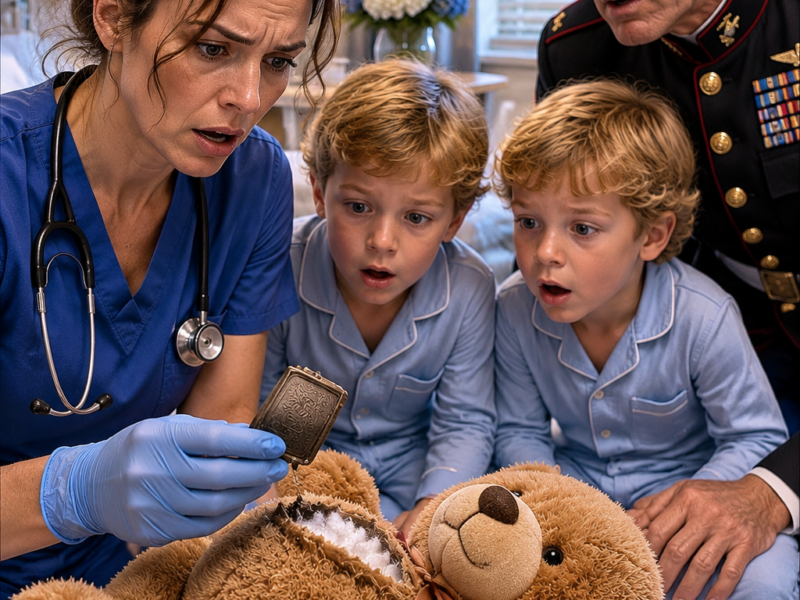
The Admiral’s Twins Wouldn’t Stop Screaming—Then a Nurse Opened Their Teddy Bear and Froze
The Admiral’s Twins Wouldn’t Stop Screaming—Then a Nurse Opened Their Teddy Bear and Froze
“She’s just a nurse. Get her out of my way.”
Dr. Preston Klein delivered the words without even bothering to look at the woman standing beside the hospital bed. His attention was fixed on the medical chart in his hands, and his expression carried the familiar irritation of someone who believed that everyone around him existed to follow instructions rather than question them.
Elena Cross lowered her eyes and stepped backward.
“Yes, doctor.”
The words came naturally. Too naturally, perhaps. She had repeated them hundreds of times during the fourteen months she had worked at Bethesda Regional Medical Center. Fourteen months of swallowing questions, hiding her instincts, and allowing people to underestimate her. Fourteen months of wearing bright blue scrubs, carrying a stethoscope, and pretending that the most complicated decisions she ever made involved adjusting an intravenous line or checking a patient’s temperature.
Nobody in the hospital knew who Elena Cross had been before she became a nurse.
Nobody knew that she had spent nine years working in situations where a wrong decision could cost an entire team their lives. Nobody knew that she had once traveled through hostile territories under assumed identities, investigated covert intelligence networks, and learned to recognize danger in the smallest details of an ordinary room.
And nobody knew why she had walked away from that world.
To the doctors and nurses at Bethesda Regional, she was simply Elena, the quiet night-shift nurse who rarely complained, never argued, and always volunteered for the difficult assignments.
That was precisely how she wanted it.
At least, it had been until tonight.
Room 412 was one of the quieter rooms in the pediatric wing. Colorful drawings covered the walls, cheerful get-well cards had been arranged near the windows, and two small hospital cribs stood side by side beneath a pair of miniature American flags. Someone from the local Navy League had delivered the decorations earlier that morning.
Inside those cribs were four-year-old twins, Lily and Jack Hayes.
Their father, Rear Admiral Robert Hayes, stood near the foot of their beds wearing his formal Navy uniform. His shoulders were squared, his shoes polished, and the silver insignia on his chest reflected the fluorescent lighting.
Yet none of those familiar symbols of authority could help him now.
He looked exhausted.
The shadows beneath his eyes suggested that he had barely slept in forty-eight hours. His normally disciplined expression had become strained, and every few seconds his attention moved from one child to the other as if he were afraid that looking away might somehow make something terrible happen.
“They’re stable,” Dr. Klein announced, closing the chart. “Low-grade fever, some gastrointestinal discomfort, probably a virus picked up at daycare. Nothing particularly unusual.”
The admiral nodded, although the answer did little to ease his concern.
“How long before they recover?”
“Hard to say. A few days, perhaps. Children can be unpredictable.”
Klein adjusted his coat and turned toward the door.
“I don’t think we need an additional nurse hovering over routine pediatric cases. We have everything under control.”
Elena remained silent.
“Of course, doctor.”
Klein walked out without another word, already looking at his phone and speaking to someone in the hallway.
He was a physician with an impressive reputation, especially among influential families and public figures. He had appeared in television interviews, attended medical conferences, and developed a professional image that made hospital administrators particularly reluctant to challenge him.
He was confident in his abilities.
Sometimes, Elena suspected, far more confident than his actual judgment justified.
She approached Jack’s crib and checked the intravenous line. The little boy was sleeping on his side, his dark hair damp against his forehead. His breathing seemed slightly faster than it should have been, but not dramatically so.
Then she noticed his fingers.
They were moving.
Not the random movement of a child dreaming. Not the occasional twitch that sometimes accompanied ordinary sleep.
It was a fine, rhythmic tremor.
Elena watched carefully.
The movement traveled from his fingertips toward his wrist, repeating at almost identical intervals. She gently touched his hand, and the tremor continued.
A cold sensation moved through her chest.
She had seen that particular pattern before.
Not in a pediatric hospital. Not in a peaceful American city. Not in a place where the walls were decorated with cartoon animals and colorful balloons.
She had seen it thousands of miles away, in a farmhouse outside a city that had never appeared in any of her official reports.
A man had been sitting against a wooden wall, sweating heavily, his muscles twitching beneath his skin. His companions had believed he was suffering from exhaustion.
He had died before anyone understood what was happening.
Elena withdrew her hand.
No.
She had to be certain.
She checked Jack’s pulse, examined his pupils, and reviewed the latest observations in his chart. His temperature was normal. His heart rate was elevated. His pupils appeared slightly constricted.
The combination did not fit the diagnosis Klein had given.
She moved to Lily’s crib.
The little girl was sleeping with one arm wrapped around a small brown teddy bear. A bright red ribbon was tied around its neck, and its soft fabric had become slightly flattened from being hugged repeatedly.
Elena remembered seeing the bear earlier that evening.
It had been delivered by a gift shop vendor who regularly visited the pediatric wing, offering toys, flowers, and small gifts to patients.
Something about it bothered her.
She leaned closer.
There was a faint chemical odor coming from the fabric. It was subtle, almost hidden beneath the familiar smell of new toys and hospital disinfectant.
She took another breath.
Her instincts sharpened.
Then she noticed the stitching along the bear’s back.
Most of the seams were neat and uniform, clearly made by a machine. But one section looked different. The thread was slightly darker, the stitches uneven, and the fabric around it appeared to have been handled recently.
Someone had opened the bear.
And someone had sewn it shut again.
“Ma’am?”
Admiral Hayes’s voice interrupted her thoughts.
Elena turned.
“Yes, sir?”
“Is my son all right?”
There was something in his voice that made the question sound heavier than its words. He was a man accustomed to commanding ships, coordinating operations, and making decisions that affected hundreds of people.
But he could not command a fever away.
He could not order his children to recover.
And he could not protect them from something he could not see.
“He’s resting, sir,” Elena replied carefully. “I’m monitoring both children.”
The admiral studied her for a moment.
His eyes briefly moved toward her hands. They were steady, precise, and unusually controlled as she adjusted the corner of Jack’s blanket.
“How long have you worked here?”
“Fourteen months.”
“Do you have children?”
“No, sir.”
He nodded slowly and looked back at his son.
Elena returned to her observations.
She wrote down the unusual tremor, the elevated heart rate, and the constricted pupils. She also recorded the teddy bear’s condition and the name of the vendor who had delivered it.
His name was Aldrich Voss.
He had visited the pediatric wing twice that week.
Both visits had occurred around the overnight shift change.
Both times, he had signed in using a temporary visitor badge rather than the vendor identification he normally carried.
Elena stared at the name.
It was a small inconsistency, the kind that would mean absolutely nothing to most people.
But she had spent nine years learning that dangerous situations rarely announced themselves with obvious warnings.
They began with small things.
An unfamiliar face appearing in the wrong place. A routine schedule changing for no apparent reason. Someone behaving slightly differently from what their supposed profession required.
She remembered the last time she had ignored a small inconsistency.
She remembered a source named in a report from a town called Sievo.
She remembered the hurried communication, the failed extraction, and the silence that followed.
That memory had never left her.
For fourteen months, she had tried to convince herself that the person she had been before no longer existed.
But as she stood beside the twins’ beds, watching Jack’s fingers twitch, she understood that some instincts could not be buried.
At 2:47 a.m., everything changed.
Jack’s body suddenly stiffened.
His small back arched, his arms jerked upward, and a terrible sound escaped his throat. The heart monitor began screaming.
Almost simultaneously, Lily began convulsing in the crib beside him.
For one brief moment, Elena could hardly believe what she was seeing.
Two children.
Two separate beds.
The exact same sudden reaction.
Then her training took over.
“Doctor! I need a doctor in here immediately!”
Her voice cut through the room with an authority that startled even her.
Admiral Hayes rushed toward his son.
“Jack!”
He reached for the child, but Elena caught his forearm.
“Don’t touch the lines, sir. Please step back and let us work.”
The admiral looked at her in disbelief, but something in her expression stopped him.
Within seconds, Dr. Klein entered the room, followed by two nurses and a resident.
“What happened?”
“Both children are seizing,” Elena answered.
Klein moved toward Jack.
“Febrile seizure. Probably the fever.”
“They don’t have a fever,” Elena replied.
“Children can develop seizures very quickly.”
“Not like this.”
Klein turned sharply.
“Excuse me?”
Elena pointed toward the monitors.
“Their temperatures were normal ten minutes ago. Their symptoms appeared simultaneously. Look at their pupils and respiratory patterns.”
“I’ll determine what the symptoms mean.”
He began issuing orders.
The team moved quickly, preparing medication and checking the children’s airways. Klein instructed the resident to administer treatment for suspected seizures.
Elena stepped aside to make room, but her eyes never left the children.
Something was wrong.
Very wrong.
The medication was administered, but neither child improved.
Jack’s breathing became increasingly labored. His lips began taking on a frightening bluish color, and his body continued to jerk uncontrollably.
Elena leaned closer.
His pupils were now almost impossibly small.
There was excessive saliva around his mouth. His muscles continued to twitch, and his heart rate was dropping even as his body convulsed.
The signs assembled themselves in her mind with terrible clarity.
She had seen this before.
She remembered the farmhouse.
The sweating man.
The strange secretions.
The muscle movements.
The rapidly deteriorating pulse.
She remembered the medication that had been missing and the desperate minutes spent trying to save someone who could no longer speak.
It was not epilepsy.
It was not a fever.
It was a toxic exposure.
“Stop.”
Klein barely acknowledged her.
“Doctor, listen to me. This isn’t a seizure disorder.”
“We’re treating the seizure.”
“No. You’re treating the symptom. You’re missing the cause.”
“Cross, step away.”
Elena looked at Jack.
His breathing was becoming weaker.
She could almost feel those lost minutes accumulating around them.
“These children are showing signs of organophosphate poisoning.”
The room fell silent.
Klein stared at her.
“What did you just say?”
“Organophosphate exposure. The pupil constriction, excessive secretions, muscle fasciculations, and falling heart rate. It matches a cholinergic toxidrome.”
“That’s an extraordinary accusation.”
“It’s a medical emergency.”
“You are a nurse.”
“I know exactly what I am.”
“Then act like one and let the physicians handle the diagnosis.”
Elena looked directly at him.
For the first time in fourteen months, she felt no desire to lower her eyes.
“Prepare atropine and pralidoxime. We need emergency toxicology support. Now.”
Klein’s expression hardened.
“Are you attempting to give me medical orders?”
“No. I’m telling you what these children need before they stop breathing.”
The resident looked between them.
Elena pointed toward the monitor.
“Look at his heart rate. Look at the secretions. You can disagree with me after they’re alive.”
Klein opened his mouth to respond, but another voice interrupted.
“Do what she says.”
Everyone turned.
Admiral Hayes stood near the doorway.
His face was pale, and his hands were clenched so tightly that his knuckles had turned white.
“Sir, I’m the attending physician,” Klein protested.
“I understand that.”
“Then you should understand that I cannot simply—”
“Doctor, I said do what she says.”
The admiral’s voice was quiet, but it carried the weight of thirty years of command.
Klein hesitated.
Then he reached for the telephone.
“Get pharmacy on the line. Emergency toxicology medications. Immediately.”
Elena did not waste another second.
She moved toward Jack, helped maintain his airway, and instructed the resident to prepare for the treatment under the attending team’s emergency protocol.
The pharmacy response seemed to take forever.
Four minutes.
Four minutes during which every monitor appeared louder, every breath more precious, and every movement painfully slow.
Elena kept looking at Jack.
She remembered another room, another patient, and another four minutes that had ended in tragedy.
Not again.
She had made herself that promise fourteen months earlier.
Not again.
When the medication finally arrived, Elena helped verify the preparations and administration. The first treatment was given, followed by the appropriate antidote infusion under the emergency team’s supervision.
“Watch his secretions,” she told the resident. “We need to see whether the response is improving.”
The resident nodded.
For several seconds, nothing seemed to happen.
Then Jack’s breathing began to change.
The terrible rattling sound became less pronounced.
His chest rose more evenly.
Elena watched the monitor.
The numbers began moving in the right direction.
“Come on, little man,” she whispered.
Across the room, Lily’s treatment was progressing in parallel.
Two nurses worked at her bedside while Elena continued monitoring both children.
The little girl’s rigid hands slowly began to relax.
Her breathing steadied.
The monitors no longer seemed to be counting down toward disaster.
Admiral Hayes stood against the wall, unable to look away.
He had watched ships disappear beneath stormy seas. He had seen aircraft return with damaged wings and sailors carried away on stretchers.
But nothing had prepared him for watching his four-year-old children fight for their lives.
And now he was watching a nurse do something none of the physicians had thought to consider.
“Where did you learn to recognize that?” he asked.
Elena did not immediately answer.
She checked Jack’s oxygen saturation and then looked at Lily’s pupils.
Only when she was satisfied that both children were responding did she turn toward him.
“I’ve seen it before.”
“Where?”
“Somewhere I hope never to see again.”
Klein was standing near the foot of Jack’s bed.
His face had lost its earlier confidence.
He looked at the monitors, then at Elena.
“How did you recognize it so quickly?”
She met his eyes.
“Because I’ve seen someone die from it.”
Nobody spoke.
The children were now breathing independently, and their vital signs were gradually stabilizing.
But Elena was not finished.
Her gaze moved toward Lily’s teddy bear.
It was still lying beneath the blanket.
The uneven stitching seemed almost impossible to ignore now.
She approached the crib and carefully lifted the toy.
“What are you doing?” Klein asked.
Elena turned it over.
“Look at the seam.”
“Put that down.”
“Someone has opened this bear and resewn it.”
“That’s a child’s toy. We have more important things to worry about.”
Elena looked at him.
“This may be the reason they’re alive and the reason they nearly died.”
The admiral stepped forward.
“What does that mean?”
“It means I need this room cleared.”
Klein frowned.
“You cannot start cutting open hospital property.”
“Then consider it evidence.”
“You’re making assumptions.”
“I’m identifying a potential source of contamination. If this object is responsible, nobody should touch it without appropriate precautions.”
She requested protective equipment and asked the team to preserve the object for proper examination.
The admiral immediately supported her.
“Do whatever you need to do.”
Elena carefully examined the back of the teddy bear.
The seam was unmistakably different from the original stitching. She worked along the altered section, taking care not to disturb whatever might be inside.
Her fingers encountered something hard beneath the stuffing.
She stopped.
There was something inside the bear that did not belong there.
Slowly, she opened the altered seam.
A small plastic capsule appeared between the fibers.
It was flat, roughly the size of a coin, and unlike any ordinary component that might be used in a commercial toy.
Elena stared at it.
For a moment, the hospital room disappeared.
She was no longer standing beneath fluorescent lights in Bethesda Regional.
She was back in the world she had spent fourteen months trying to forget.
The design was familiar.
Not identical to something she had handled personally, but close enough to make her blood run cold.
It was a covert delivery mechanism.
A device designed to release a toxic substance gradually through contact, allowing the resulting symptoms to resemble an ordinary illness.
Elena looked at the admiral.
“Someone deliberately exposed your children.”
His face went completely still.
“What?”
“This was hidden inside the teddy bear. It appears to be designed to release a toxic compound gradually. The children have been in contact with it repeatedly.”
Klein stepped closer, studying the object from a distance.
“That’s impossible.”
Elena did not look at him.
“No. It’s deliberate.”
She instructed the staff to preserve the bear, the capsule, and any related materials for specialist examination. Nothing else in the room was to be handled unnecessarily.
The resident looked horrified.
“Who would do something like this to two children?”
Elena’s eyes moved toward Admiral Hayes.
“Someone who wanted to hurt their father.”
The admiral’s jaw tightened.
“What are you talking about?”
Elena hesitated.
She had suspected something from the moment she heard his name. But suspicion was not proof, and she had not wanted to make an accusation without understanding the circumstances.
Now, with the device sitting inside a specimen container, the pieces were beginning to fit together.
“You’re scheduled to testify soon, aren’t you?”
Hayes looked at her.
“How do you know that?”
“Three days from now?”
The admiral did not answer immediately.
Then he gave a small nod.
“Yes.”
“About the signals intelligence program?”
His expression changed.
It was subtle, but Elena noticed it.
Klein looked between them.
“What does any of this have to do with his testimony?”
Elena ignored the question.
“Your testimony concerns a foreign intelligence network operating inside defense contractors. You’ve identified individuals who have remained protected for years.”
The admiral’s face had become almost expressionless.
“How could you possibly know that?”
“I understand the kind of people who would be threatened by what you’re preparing to disclose.”
Hayes stared at her.
“Who are you?”
Elena looked down at the specimen container.
“Someone who has encountered their methods before.”
“You’re telling me this is connected to my testimony?”
“I’m telling you that your children were exposed to a sophisticated toxic agent three days before you’re scheduled to identify people connected to an intelligence operation. I don’t believe that’s a coincidence.”
The admiral took a slow breath.
For the first time that night, the full weight of the situation seemed to reach him.
He had spent weeks preparing his testimony. He had expected professional pressure, legal challenges, perhaps attempts to discredit his findings.
He had not imagined that someone would target Lily and Jack.
“Why?” he whispered.
“Because hurting your children may be the most effective way to make you withdraw.”
Hayes looked toward the two cribs.
Lily was sleeping peacefully now. Jack’s breathing had settled, and the color was returning to his cheeks.
The sight seemed to break something inside the admiral.
“Those people wanted me to choose,” he said.
Elena’s expression softened.
“That’s what they wanted.”
He looked at her.
“And what happens now?”
“Now we make sure they don’t get another opportunity.”
Elena turned toward the hospital security chief, who had arrived after the emergency call.
“I need every camera recording from the pediatric wing and the gift shop cart for the last two weeks. I also need every visitor log, temporary badge record, and contractor access entry.”
The security chief nodded.
“Understood.”
“And nobody leaves this floor without being identified.”
“Should we contact local police?”
“Yes. But preserve the evidence first. I also want a federal liaison notified.”
Klein stood silently near the door.
He had heard the words, but he seemed to be struggling to understand the woman delivering them.
“You’re talking about handlers and intelligence operations,” he finally said. “How does a hospital nurse know anything about that?”
Elena glanced at him.
“Because nursing isn’t the only thing I’ve done.”
It was the closest she intended to come to an explanation.
Within twenty minutes, the security footage had been retrieved.
Elena stood inside a small security office near the main lobby. The room was cramped, filled with monitors, old office furniture, and the constant hum of computer equipment.
On one screen, a man in a gray vendor’s polo shirt pushed a rolling gift shop cart through the pediatric wing.
Aldrich Voss.
He appeared to be in his mid-forties. Average height. Ordinary features. Nothing about his appearance would have attracted attention.
He had the kind of face people forgot almost immediately.
Elena leaned toward the screen.
“Pause it.”
The security chief stopped the footage.
“That’s him?”
“Yes.”
“He’s been working here for eleven months.”
“That’s what his records say.”
The chief frowned.
“His background check came back clean.”
“Then the background was prepared to look clean.”
The chief looked uncomfortable.
“You’re saying he used a false identity?”
“I’m saying we shouldn’t assume the information is genuine.”
She asked the chief to play the footage again.
Voss moved through the corridor at an unhurried pace. He stopped near the nurses’ station, adjusted the cart, and checked his watch.
Then he approached room 412.
Elena watched his hands.
“Go back.”
The chief rewound the footage.
“Look at how he handles the products.”
Voss adjusted the cart and selected an item from the display.
But he never touched the merchandise directly.
He used the cart’s protective liner as a barrier between his skin and the products.
“That’s unusual,” the security chief said.
“Very.”
“Could it be some kind of hygiene precaution?”
“Possibly. But look at the sequence.”
She pointed toward the screen.
“He checks the time, adjusts his position, and handles the items only through that barrier. He also keeps his attention on the corridor rather than the merchandise.”
The chief watched more closely.
“You’re right.”
“He isn’t behaving like someone selling toys. He’s behaving like someone trying to avoid leaving evidence.”
The security chief slowly turned toward her.
“How do you recognize that?”
“Training.”
“Military?”
Elena did not answer.
At the back of the office, Klein stood with his arms crossed.
He had followed them after the children were stabilized. He had spent the last hour watching the quiet nurse he had dismissed dismantle every assumption he had made about her.
He seemed almost unable to reconcile the two versions of the same person.
“You keep using words like handler, asset, and tradecraft,” he said. “Where did you learn all of this?”
Elena was studying the visitor logs.
“From people who didn’t have the luxury of getting things wrong.”
Before Klein could respond, Admiral Hayes entered the office.
His phone was in his hand.
He had already contacted the appropriate authorities, and his expression suggested that he had received information he did not like.
Elena turned toward him.
“Sir, before the federal team arrives, I need to know something.”
“What?”
“Has anyone contacted you recently about withdrawing your testimony?”
Hayes considered the question.
“Two weeks ago, I received a message through an intermediary. It suggested that postponing the hearing would be in everyone’s interest.”
“Did you respond?”
“I declined.”
“Any threats?”
“Nothing direct.”
“Anyone approaching your family?”
The admiral looked away.
“Not that I knew of.”
Elena nodded.
“Then they may have decided to make their position clearer.”
Hayes looked at the frozen image of Voss.
“How long has he been working here?”
“Eleven months, according to the hospital records,” the security chief answered.
“Eleven months?”
Elena looked at him.
“Someone may have been building access long before the attack.”
The admiral’s expression hardened.
“Then we need to know who he’s working for.”
“We will.”
She returned her attention to the monitor.
Voss had visited the hospital twice during the week. Both times, he had gone directly to room 412 before completing his regular route.
That meant he had not been checking stock.
He had been checking the children.
Or more specifically, checking the device he had placed near them.
Elena studied the footage again.
“If the device was designed to release the substance gradually, he would need to confirm that it remained undisturbed. The seizures happened earlier than whoever planned this expected.”
“Why?” Hayes asked.
“Because we found the exposure before it reached the intended stage.”
“Do you think he’ll come back?”
Elena looked at the security chief.
“He’s already come back twice this week. If the device activated earlier than expected, he won’t know whether the operation succeeded. He’ll want confirmation.”
The chief checked the current time.
“It’s almost shift change.”
“Exactly.”
She asked for every badge scan from the previous ninety minutes.
The chief entered the request.
A few seconds later, a new entry appeared on the screen.
Aldrich Voss.
His temporary card had been used four minutes earlier.
Location: Pediatric supply closet.
Elena stared at the entry.
“He hasn’t left.”
The security chief immediately reached for his radio.
“Security team, we have a possible suspect in the pediatric supply corridor. I need two officers at the location.”
Elena stood.
“Where exactly?”
“At the end of the service corridor.”
“Show me.”
They moved quickly through the hospital.
The service corridor was narrower than the main hallways, lined with storage rooms, equipment carts, and shelves containing medical supplies.
The pediatric supply closet was at the far end.
Elena stopped several meters before the door.
She raised one hand.
The security guards halted.
“What’s the plan?” the chief whispered.
“We don’t know what he has with him. We don’t know whether he’s armed or whether he’s carrying another device.”
“We should wait for the police.”
“If we wait and he realizes we’ve identified him, he may destroy whatever evidence he’s carrying.”
“We cannot let you enter alone.”
Elena looked at the door.
“I need two minutes.”
“That’s not happening.”
She turned toward him.
“It already is.”
The chief looked ready to argue, but something in her expression made him hesitate.
Admiral Hayes appeared at the far end of the corridor.
He had followed them despite Elena’s instructions to remain near his children.
“Admiral, stay back,” she said.
“I won’t let you do this alone.”
“Your children need their father. That’s where you should be.”
“I’m not leaving until I know they’re safe.”
For a moment, Elena considered arguing.
Then she nodded.
“Stay behind the security team.”
She approached the door.
Her heartbeat was steady.
Her hands were steady.
For fourteen months, she had hidden every instinct that had once defined her. She had deliberately walked slowly, spoken softly, and allowed people to believe she was less capable than she was.
But now the old readiness had returned.
She noticed the position of the door handle, the narrow gap beneath the frame, and the faint movement of a shadow inside.
She reached for the handle.
Unlocked.
Elena pushed the door open carefully.
The closet smelled of cardboard, antiseptic, and industrial cleaning products.
Shelves filled the room, and several boxes of disposable gloves had been stacked against the back wall.
Aldrich Voss stood beside them.
He was holding a small electronic transmitter.
His thumb hovered near one of its controls.
For a moment, neither spoke.
Then Voss looked at Elena.
His expression changed.
Not with surprise.
With recognition.
“You’re not supposed to be here,” he said.
Elena remained near the doorway.
“Put it down.”
He studied her face.
Something in his eyes suggested that he had finally recognized the person standing in front of him.
“You’re not hospital staff.”
“No.”
“Who are you?”
“Someone who knows what you’ve done.”
Voss looked at the transmitter.
Then back at her.
“The children?”
“They’re alive.”
His expression tightened.
“That wasn’t supposed to happen.”
“No. It wasn’t.”
He seemed to be calculating something.
“The device was designed to work gradually.”
Elena did not respond.
“Someone found it too early,” he continued.
“I did.”
For the first time, Voss appeared genuinely interested.
He examined her posture, her hands, and the way she stood between him and the door.
“Military intelligence?”
Elena said nothing.
“Defense Intelligence Agency, perhaps?”
“Put the transmitter down.”
He smiled faintly.
“You’re good.”
“I’ve heard that before.”
Voss looked toward the corridor.
“You don’t understand what you’ve interrupted.”
“Then explain it.”
“It’s already moving.”
“What is?”
He raised the transmitter slightly.
“This is a confirmation signal. If I don’t send it, my handler will assume the operation has been compromised.”
Elena’s mind moved rapidly.
A confirmation signal.
A handler.
A secondary operation.
He had not come back simply to inspect the teddy bear.
He had come to report the result.
And if he failed to report, someone else might act.
“How long?” she asked.
Voss smiled again.
“Ninety seconds.”
Elena kept her eyes on his thumb.
“Who is waiting for your signal?”
“People you don’t want to meet.”
“That’s not an answer.”
“It’s the only one you’re getting.”
She understood the implication.
If the signal was not received, the people behind the operation might assume the device had been discovered. They could initiate a contingency plan.
That might mean an attempt to destroy evidence.
It might mean someone coming to the hospital.
Or it might mean a second attack.
Elena had no intention of letting him decide what happened next.
“Then we’re going to make sure the signal gets sent.”
Voss frowned.
“What?”
“Just not the message you think.”
She moved.
It happened so quickly that Voss barely had time to react.
Elena closed the distance, caught his wrist, and redirected his hand before his thumb could reach the control.
The transmitter slipped from his grasp.
He attempted to pull away, but she had already shifted her position and used his momentum against him.
His shoulder struck the shelving.
Boxes of medical gloves fell around them.
Voss struggled.
He was stronger than he looked, and he clearly had some training of his own. But Elena had spent nine years learning how to deal with people who were dangerous even when they appeared unarmed.
She forced him away from the transmitter and called out.
“Security!”
The two guards entered immediately.
One secured Voss’s arm while the other recovered the device.
Within seconds, Voss was restrained against the shelving.
Elena stepped back, breathing hard.
The security chief approached her.
“Are you injured?”
“No.”
She pointed toward the transmitter.
“Don’t activate it. Preserve it exactly as it is.”
The chief nodded.
“Understood.”
Voss looked up at her.
There was no panic in his expression.
Only a strange mixture of frustration and admiration.
“You should have stayed a nurse.”
Elena looked down at him.
“Why?”
“You had a quiet life. Nobody knew who you were. You could have kept it that way.”
She crouched slightly so that they were at eye level.
“Fourteen months of hiding, and you think I would let you hurt two children just to preserve my cover?”
Voss said nothing.
“They’re not yours,” Elena continued. “They never were. And they’re going to grow up. That’s the part you didn’t plan for.”
For the first time, his expression changed.
The security chief called for local police and federal authorities.
The corridor filled with movement as additional officers arrived.
Admiral Hayes appeared in the doorway.
He looked at Voss, then at Elena.
For several seconds, he seemed unable to find the words.
“Nurse Cross.”
Elena stood.
“Admiral.”
He looked at the transmitter.
“Is it over?”
“Not yet. But he’s in custody, and we have the evidence. We need to find out who he was communicating with.”
Hayes nodded.
Then he looked at her differently.
Not as a nurse.
Not as a stranger.
As someone whose actions had just saved his children.
“Thank you.”
Elena glanced down at her scrubs. A few boxes had spilled across the floor, and dust had settled on her sleeves.
“Let’s get back to the children, sir.”
By seven in the morning, the pediatric wing had begun to resemble an ordinary hospital again.
Sunlight slipped through the blinds, casting pale golden shapes across the floor.
A nurse brought fresh juice for Lily, who was sitting upright in her crib and asking repeatedly when she could go home.
Jack was sleeping peacefully.
His breathing was steady, and the frightening discoloration around his lips had disappeared.
A new stuffed animal rested beside him.
This one had been inspected by hospital security before anyone allowed it near the children.
Admiral Hayes stood between the two beds.
He had removed his formal jacket and loosened his collar. His face still showed the exhaustion of the previous night, but something had changed.
He was looking at his children as though he were seeing them for the first time.
They were alive.
They were going to recover.
And that was all that mattered.
At five in the morning, a federal team had arrived.
Five individuals in plain business suits entered the hospital without attracting attention. They carried identification, spoke quietly with hospital administrators, and immediately requested access to the evidence.
The teddy bear, capsule, and transmitter were transferred into federal custody.
Aldrich Voss was escorted away under heavy supervision.
The investigators asked Elena to participate in a debriefing.
She spent forty minutes answering questions about the device, the suspect, and the events leading to the children’s collapse.
She explained what she could.
She deliberately avoided what she could not.
When the meeting ended, an older woman with silver hair approached her.
The woman had tired eyes and a composed expression.
She extended her hand.
“Officer Cross.”
Elena looked at her.
“Ma’am.”
The woman shook her hand firmly.
“Command sends its regards. It’s been a long fourteen months.”
Elena looked away.
“I was doing my job.”
“You were doing more than that.”
The woman glanced toward the pediatric wing.
“You kept your cover intact until the situation required you to act. That’s not easy.”
Elena gave a faint smile.
“I didn’t exactly have much choice.”
“You always had a choice. You chose the children.”
For a moment, Elena did not know what to say.
Then she asked the question that had been bothering her.
“How did you know where I was posted?”
The older woman smiled slightly.
“We always know where our people are. Even when they think nobody is watching.”
The words stayed with Elena long after the woman left.
For fourteen months, she had believed that she had disappeared completely.
She had thought that leaving her old position meant leaving the people behind it.
Perhaps she had never been as alone as she imagined.
Later that morning, Elena went to the breakroom.
She poured herself a cup of coffee and sat near the window.
She had barely taken a sip when someone appeared in the doorway.
Dr. Preston Klein.
He looked different.
His usual polished appearance had disappeared. His hair was untidy, his coat was unbuttoned, and his face carried the unmistakable exhaustion of someone who had spent the night confronting an uncomfortable truth.
He stood there for several seconds.
Then he spoke.
“Elena.”
She looked up.
“Doctor?”
He stepped inside.
“I owe you an apology.”
She waited.
“I dismissed you last night. I spoke to you as though you had no right to question me. I refused to consider what you were telling me because I believed you were overstepping your position.”
Elena said nothing.
Klein lowered his eyes.
“If you hadn’t recognized the poisoning, those children might have died.”
“Yes.”
“I’ve been thinking about what happened.”
“That seems appropriate.”
He nodded.
“I built my career on being the physician people trusted. I learned how to sound confident, how to reassure families, and how to make difficult decisions. Somewhere along the way, I started believing that confidence was the same thing as being right.”
Elena took a small sip of coffee.
Klein continued.
“Last night, I watched a nurse identify something I hadn’t even considered. I watched you recognize a life-threatening condition while I was busy defending my authority.”
He swallowed.
“I don’t know how to make that right.”
“You can’t change what happened.”
“I know.”
“But you can decide what happens next time.”
He looked at her.
“How?”
“Listen.”
The word was simple.
It was also the one he most needed to hear.
“Listen to the nurses. Listen to the residents. Listen to the people who notice things you don’t. A title doesn’t make someone incapable of being wrong.”
Klein nodded slowly.
“I’ll remember that.”
“Good.”
He stood for another moment before leaving.
Elena watched him disappear into the corridor.
She did not feel victorious.
She did not need him to feel humiliated.
What mattered was that the next time a nurse raised a concern, he might actually stop and listen.
That alone could save someone.
An hour later, Admiral Hayes came to find her.
His children were finally asleep again, this time naturally.
He stood in the doorway of the breakroom, holding his formal jacket over one arm.
“May I?”
Elena nodded toward the chair.
“Of course, sir.”
He sat opposite her.
For a few seconds, neither spoke.
Then he looked at her.
“I owe you more than a thank-you.”
Elena shook her head.
“You don’t owe me anything.”
“I do.”
He leaned forward.
“Last night, I watched you give orders in a room full of people who were supposed to be more qualified than you. I didn’t understand why you were so certain. I didn’t know what you had seen or where you had learned it.”
He paused.
“And part of me wondered whether I should trust you.”
Elena looked at him.
“But you did.”
“Because I had no other choice.”
He looked down at his hands.
“That is not the answer I wanted to give you.”
She remained quiet.
“I should have recognized that someone was speaking with the urgency of a person who knew exactly what was happening. Instead, I hesitated because you were wearing scrubs and standing in a hospital room.”
Elena gave him a thoughtful look.
“Most people do.”
“That doesn’t make it right.”
“No, it doesn’t.”
Hayes looked toward the window.
“What happens now?”
Elena understood what he was asking.
Not about the children.
Not about the investigation.
About her.
“Does this all go into a report somewhere? Do you disappear again? Another hospital, another name, another fourteen months?”
Elena looked down at her coffee.
The question affected her more than she expected.
For fourteen months, she had built her life around remaining unnoticed. She had deliberately avoided making close friendships, kept her personal history vague, and resisted every opportunity to become more visible.
She had told herself that the quiet life was temporary.
But somewhere along the way, temporary had begun to feel permanent.
She had grown accustomed to the routine.
The early morning rounds.
The sound of monitors.
The familiar smell of disinfectant.
The small conversations with frightened parents.
And, unexpectedly, she had begun to care about the work.
Not because it reminded her of her previous life, but because it was different.
In her former world, success often meant preventing something terrible from happening.
In this one, success meant helping someone recover after something terrible had already happened.
She had found a kind of peace in that.
But the previous night had reminded her that the world did not always allow people to remain in the places where they felt safe.
“I’ve been offered a new posting,” she said.
Hayes looked at her.
“What kind of posting?”
“An internal response position. Building a specialized unit focused on protecting families connected to sensitive investigations and testimony.”
“Inside the agency?”
“Yes. The idea is to establish a network of trained medical response personnel in selected hospitals. People who can recognize unusual threats early, coordinate with specialists, and prevent situations like this from becoming tragedies.”
Hayes considered the idea.
“That sounds important.”
“It is.”
“Will you take it?”
Elena looked at him.
“I already accepted this morning.”
He nodded.
“Then I suppose congratulations are in order.”
She smiled faintly.
“Thank you.”
“The Navy could use officers who think the way you do.”
“I’m not going back to the Navy, Admiral.”
He raised an eyebrow.
“Why not?”
“Because I’m not trying to return to who I was.”
She paused.
“I’m trying to build something better from what I’ve learned.”
Hayes studied her for a moment.
Then he extended his hand.
Elena shook it.
“Whatever you do next, Officer Cross, I hope you understand that you have made a difference.”
She looked toward the pediatric wing.
“Those two children made the difference.”
“They’re alive because you refused to look away.”
Elena did not answer.
She watched the sunlight move across the floor.
For fourteen months, she had believed that her old life was something she needed to escape. She had treated her memories as burdens, her skills as dangerous reminders, and her past as something that had to remain buried.
But perhaps she had been wrong.
Perhaps the things she had learned were not meant to disappear.
Perhaps the experiences that had once hurt her could still be used to protect someone else.
She thought about the farmhouse.
She thought about Sievo.
She thought about the people she had failed to save and the decisions she had replayed in her mind for years.
For the first time, those memories did not feel quite as heavy.
She could not change what had happened.
She could not bring back the people she had lost.
But she could make sure that the next person facing an impossible situation did not have to face it alone.
Across the hospital, Lily woke and called for her father.
Hayes immediately stood.
“That’s my cue.”
Elena smiled.
“Go on, sir.”
He paused at the doorway.
“Thank you, Elena.”
This time, he used her first name.
Not Nurse Cross.
Not Officer Cross.
Just Elena.
And somehow, that meant more than all the formal recognition he could have offered.
After he left, Elena remained in the breakroom for another few minutes.
Her coffee had gone cold.
She picked up the cup and took one final sip.
Then she stood, straightened her blue scrubs, and walked back toward the pediatric wing.
The hospital was beginning another ordinary day.
Doctors were reviewing charts. Nurses were preparing medication. Parents were comforting frightened children. Somewhere, a monitor beeped steadily beside a patient who would soon be ready to go home.
Nobody looking at Elena would have guessed what she had done during the night.
They would have seen an ordinary nurse walking down an ordinary hallway.
And perhaps that was exactly what made the previous night so extraordinary.
She had not needed a uniform covered in medals.
She had not needed a rank displayed on her shoulders.
She had not needed anyone to recognize her name.
She had needed only the knowledge she had spent years acquiring, the courage to speak when others refused to listen, and the determination to act when two innocent children had no one else who understood the danger.
People had underestimated her because she had allowed them to.
They had mistaken her silence for weakness, her humility for ignorance, and her willingness to follow instructions for an inability to lead.
But the truth had always been different.
Elena Cross had not forgotten how to recognize danger.
She had not forgotten how to make decisions under pressure.
And she had certainly not forgotten how to save lives.
Fourteen months earlier, she had entered Bethesda Regional hoping to disappear into a quieter existence.
Instead, one impossible night had reminded her that the world still needed what she knew.
It had also taught an entire hospital something that no medical degree, professional title, or prestigious position could guarantee.
The person standing quietly in the corner might be the one who understands the situation best.
The person everyone overlooks might be the person who sees what nobody else can see.
And sometimes, the difference between life and death is not a matter of authority.
It is a matter of whether someone is willing to listen.
Dr. Klein would remember that lesson for the rest of his career.
Admiral Hayes would remember it every time he watched his children grow.
Lily and Jack would probably never remember the night their lives had nearly ended. They would remember the hospital only as a place where kind people gave them medicine, brought them juice, and helped them feel better.
They would grow older, celebrate birthdays, attend school, make friends, and eventually discover the world beyond their father’s naval career.
They would never know how close they had come to becoming the victims of a plan designed to look like an ordinary childhood illness.
And perhaps that was the greatest victory of all.
They would have the opportunity to live ordinary lives.
As for Elena, she walked into room 412 just before the morning shift officially began.
Lily was awake.
“Miss Elena?”
Elena approached the crib.
“Good morning, sweetheart.”
“Can I have juice?”
Elena laughed softly.
“I think we can arrange that.”
Jack stirred beneath his blanket.
His little hand reached toward the teddy bear that had been removed the previous night.
For a moment, Elena felt her chest tighten.
Then she looked at the new stuffed animal beside him.
“How about this one instead?”
Jack opened his eyes and smiled sleepily.
“Okay.”
Elena adjusted his blanket.
“Good choice.”
She checked his monitor, listened to his breathing, and made a note in the chart.
Everything was normal.
Everything was exactly as it should have been.
Outside, the morning sunlight illuminated the hospital windows.
The worst of the night was behind them.
And for the first time in fourteen months, Elena Cross did not feel as though she was hiding from her past.
She felt as though she had finally found a way to use it.
Because courage was not always loud.
Sometimes it looked like a woman in blue scrubs standing beside a hospital bed, quietly noticing something everyone else had missed.
Sometimes it meant speaking up even when the person in authority told you to be silent.
Sometimes it meant risking the life you had carefully rebuilt because two children needed someone to act.
And sometimes, the greatest measure of a person’s strength was not how much power they possessed, how impressive their title sounded, or how many people followed their orders.
It was what they did when nobody believed them.
Elena had spent fourteen months being underestimated.
It had taken one night to show everyone who she really was.
But she had not saved Lily and Jack to prove something to Dr. Klein.
She had not exposed Aldrich Voss to earn the admiral’s respect.
And she had not accepted her new assignment to receive recognition from the people who had once commanded her.
She had done it because, when the monitors began screaming and two small children started fighting for their lives, she knew exactly what needed to be done.
And she refused to let history repeat itself.
Somewhere beyond the hospital walls, investigators were beginning to uncover the network behind Aldrich Voss. His arrest would lead to difficult questions, unexpected discoveries, and consequences that reached far beyond the pediatric wing.
The investigation would take months.
There would be hearings, classified reports, and people who would prefer that the truth remain buried.
But Admiral Hayes would testify.
His children would recover.
And Elena Cross would begin building the response unit that might one day prevent another family from experiencing the same nightmare.
She had once believed that leaving her former life behind was the only way to find peace.
Now she understood something different.
Peace did not always come from forgetting who you had been.
Sometimes it came from finally understanding why you had survived everything that made you who you were.
And sometimes, the quietest person in the room was the one who had spent years learning exactly how to keep everyone else alive.









