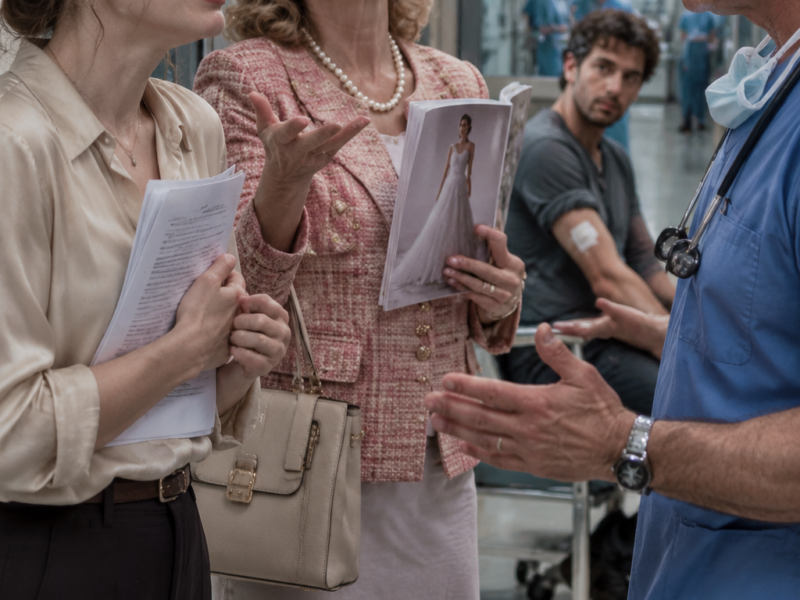
Surgeon: “She May Not Survive Surgery!” Mom: “Sophie Still Has A Fitting!” Brenda.. Who Gave Blood?
Surgeon: “She May Not Survive Surgery!” Mom: “Sophie Still Has A Fitting!” Brenda.. Who Gave Blood?
The surgeon had not even waited for Eliza Vance to be transferred onto the operating table before reaching for his phone. Blood was pooling inside her abdomen faster than the medical team could replace it, her blood pressure was dropping, and the ultrasound had revealed injuries severe enough to make even experienced emergency physicians exchange worried glances. There was no time for reassuring explanations or carefully chosen words. He needed her family to understand that their daughter was fighting for her life.
At 11:41 p.m., he dialed the number listed under Mom.
Brenda Vance answered on the fourth ring.
“Mrs. Vance? This is Dr. Harrison from Regional Medical Center. Your daughter, Eliza, has been brought in following a serious automobile accident. She has severe internal bleeding. We are taking her into emergency surgery immediately, and I need to prepare you for the possibility that she may not survive.”
There was a brief silence.
“Is she conscious?” Brenda asked.
“No. She is unconscious, and we are doing everything we can. Her blood type is O-negative, which makes finding compatible blood particularly difficult. We may need relatives to come in and donate as soon as possible.”
Brenda sighed, not with fear, but with the unmistakable irritation of someone whose evening had been interrupted.
“That workhorse has worked herself into the ground again. Call me when she wakes up. Sophie has a dress fitting tomorrow.”
The surgeon stared at the phone for a moment, making sure he had heard correctly.
“Mrs. Vance, I need you to understand that your daughter could die tonight.”
“I heard you. I have already explained what I can do. Please don’t call again unless she wakes up.”
Then she hung up.
Dr. Harrison stood motionless for several seconds before entering the conversation into Eliza’s medical chart. In twenty years of emergency medicine, he had occasionally encountered relatives who were frightened, confused, or overwhelmed. He had encountered people who could not stop crying, people who argued with doctors, and people who demanded that every possible treatment be attempted.
But he had rarely encountered someone who could hear that her daughter might die and respond by discussing a wedding dress.
He recorded Brenda’s words exactly as spoken, including the reference to the dress fitting, and added a note stating that the patient’s mother had refused to come to the hospital and that arrangements for additional donors remained unresolved.
He did not know that this small act of documentation would eventually become one of the most important pieces of evidence in a family scandal that would destroy a wedding, expose years of manipulation, and finally force a father to confront the silence he had mistaken for peace.
He also did not know that the woman who had just hung up on him had no intention of telling her husband that their eldest daughter was dying.
For that story to make sense, it was necessary to go back twenty-five years, to a rural cabin where a twelve-year-old girl had learned that hard work could make her useful to almost everyone but valuable to almost no one.
Eliza was twelve when her parents took her four-year-old sister, Sophie, to a children’s beauty pageant in the city. Eliza had been left behind with her paternal grandmother, Agnes, at a modest wooden cabin surrounded by farmland, tall grass, and an old potato patch that seemed to stretch forever.
Grandma Agnes was not particularly interested in pageants. She thought little girls should spend more time playing outside and less time being sprayed with hairspray.
Eliza, however, was excited.
She had decided to surprise her parents by digging up the entire potato patch before they returned. Her grandmother had mentioned that the harvest needed to be finished soon, and Eliza believed that completing the work alone would make everyone proud.
She started shortly after breakfast.
The soil was hard in places, and the sun grew increasingly hot as the morning passed. Her hands blistered, her back ached, and dirt worked its way beneath her fingernails. Still, she kept going.
By late afternoon, nine enormous burlap sacks stood beside the barn.
The tenth sack was nearly full when the fabric suddenly tore along one side. Potatoes rolled across the ground and disappeared into a muddy drainage ditch.
Eliza stared at the mess.
She had worked all day. She had almost finished everything. She was exhausted, but she could still retrieve the potatoes if she hurried.
Unfortunately, her mother arrived before she could do so.
Brenda stepped out of the car wearing a carefully chosen dress, her hair perfectly arranged, and a blue ribbon certificate in her hand. Sophie followed her, carrying a small gift bag.
Brenda’s eyes moved across the yard.
They passed the nine sacks lined up beside the barn and stopped at the ditch.
“A dumb workhorse,” she said, looking toward Grandma Agnes rather than addressing her daughter directly. “All brawn and no brains.”
Grandma Agnes wiped her hands on her apron.
“There are nine full sacks standing by the barn, Brenda. The tenth one tore. That’s all.”
Brenda barely acknowledged her.
“Sophie, come here. Show Grandma what you won.”
Sophie proudly displayed her certificate, and everyone admired it. Grandma Agnes congratulated her, asked about the pageant, and then turned toward Eliza.
“Come on, sweetheart. Let’s get those hands washed.”
She led the girl into the mudroom and worked soap between her dirty fingers.
“You remember something, Eliza,” she said quietly. “The one who takes on everything is the one who eventually stumbles. The one who sits on the bench never gets dirty.”
Eliza nodded.
But she remembered something else much more clearly.
Her mother had seen nine successful sacks of potatoes and one damaged one. Somehow, the damaged sack had erased everything else.
The word workhorse followed her into adulthood.
Sometimes Brenda used it almost affectionately, when Eliza repaired something, carried heavy groceries, drove someone somewhere, or worked late to help the family.
Other times she pronounced it with contempt.
Eliza never became particularly good at distinguishing between the two.
Her grandmother was different.
At Agnes’s cabin, Eliza never had to earn her place. She could spend an afternoon reading beneath an apple tree, ride an old bicycle around the property, or simply sit on the porch without being asked to justify her existence.
Brenda was openly jealous of the relationship.
She occasionally complained that Agnes spoiled Eliza and encouraged her to become independent. She disliked how often the older woman invited her granddaughter to visit and how naturally Eliza gravitated toward the cabin whenever she had a free weekend.
Agnes ignored the complaints.
More than twenty years later, when she died, she left the cabin to Eliza. The will included a handwritten note that the lawyer read aloud during the estate meeting.
“You were the only one who visited me here.”
Brenda called it unfair.
She continued referring to the cabin as family property and spoke about it as though Eliza had merely been appointed its temporary caretaker.
Eliza never argued.
She had already learned that some conversations were impossible to win.
By the time she reached adulthood, she had become the kind of person other people depended on.
She was appointed quality assurance director at a pharmaceutical manufacturing plant in Columbus, Ohio. Her signature was required before any batch of medication could leave the factory. Suppliers knew that she would not overlook missing documentation, incomplete testing, or unexplained deviations simply because someone wanted to meet a deadline.
Her favorite sentence was simple.
“If it is not documented, it did not happen.”
She was respected, sometimes feared, and consistently relied upon.
She lived alone in a modest one-bedroom apartment downtown. Her furniture was practical, her kitchen was organized, and her savings account contained exactly $124,000.
She had spent eight years putting that money aside.
Her dream was to purchase a small farmhouse with enough land to keep horses.
That dream had begun when she was nineteen.
At the time, Eliza had met Mia at a local equestrian center. Mia worked as a stable hand, and Eliza, who had grown up surrounded by concrete and office buildings, had never ridden a horse.
Her first attempt was disastrous.
She managed to get one foot into the stirrup, grabbed the horse’s mane, and froze halfway up.
Mia laughed gently.
“Don’t be afraid. I’ll give you a leg up.”
She placed her hands together to form a step, and Eliza finally managed to climb into the saddle.
Something about those four words stayed with her.
Over the years, they became a private expression between the two women.
When Eliza moved apartments, Mia gave her a leg up. When Mia faced a difficult family situation, Eliza showed up with coffee and offered the same words. When either encountered a disaster, the other appeared.
In Eliza’s phone, Mia was saved as “Mia, Leg Up.”
It was a small joke, but it represented something much larger.
For years, Eliza had been the person who showed up for everyone else. Mia was the person who reminded her that she did not always have to manage everything alone.
There was one detail Eliza had never bothered to change, however.
Her emergency contact still listed Brenda Vance.
Her mother had insisted on being the primary contact when Eliza was younger, explaining that it was simply the responsible thing to do.
Even the PIN for Eliza’s phone and banking application was still Brenda’s birthday.
When Eliza was fourteen, her mother had entered the four-digit code herself.
“Use my birthday,” she had said. “At least you’ll never forget your own mother’s birthday.”
Eliza had intended to change it countless times.
First, she forgot. Later, it became an irritating little task she kept postponing. Eventually, it became something stranger: a thin, almost invisible thread connecting her to the family she had spent most of her adult life trying to please.
She knew it was ridiculous.
She simply never got around to cutting it.
A year before the accident, that thread had already begun to fray.
Her parents were celebrating their thirty-eighth wedding anniversary, and Eliza arrived at their house after thirty hours without sleep.
The pharmaceutical plant was undergoing an enormous federal audit. Every department was under pressure, and Eliza had spent the previous night reviewing production records and answering questions from inspectors.
She barely had enough energy to walk through the front door.
Brenda was waiting in the kitchen wearing an apron.
“Finally. I cannot manage everything by myself. The turkey needs to come out of the oven.”
Eliza looked at the roasting pan.
It was heavy, and her arms were trembling, but she did not complain.
She lifted it carefully and carried it toward the dining room.
Halfway there, her knees gave way.
She managed to twist the pan just enough that the turkey landed intact on the rug rather than scattering across the floor.
The pain came a second later.
Her elbow had struck the ground with tremendous force.
For several seconds, she could not move.
Brenda looked down at the turkey, picked it up, and called toward the dining room.
“The workhorse has decided to lie down. She always needs everyone running around her.”
A few guests laughed awkwardly.
Eliza’s father, Arthur, helped her stand. He brought her a glass of water and guided her to a stool in the hallway.
Then he returned to the dining room.
Eliza spent the next hour sitting alone with a wet towel pressed against her injured elbow.
The fracture took a month to heal.
But something else changed that evening.
For the first time, she did not feel embarrassed about falling.
She felt cold.
She had spent years interpreting her father’s silence as kindness. He never insulted her. He never openly criticized her. Occasionally, he brought her a glass of water or quietly helped her carry something heavy.
She had considered those small gestures proof that he understood.
But sitting in the hallway, listening to the laughter from the dining room, she realized something uncomfortable.
His silence was not kindness.
It was cowardice.
Nine days before the accident, the family gathered for Sunday dinner.
Sophie and her fiancé, Derek Stanton, announced that their wedding would take place in a month. They were excited, dressed beautifully, and full of plans.
Sophie had always been the center of Brenda’s attention. As a child, she had been the little girl in pageants, the one whose photographs filled the family albums, the one whose achievements were displayed prominently in the living room.
Eliza had grown accustomed to being the person behind the camera.
That evening, Sophie opened a real estate listing on her phone.
It was a two-bedroom condominium with beautiful bay windows overlooking the river. A retired judge named Eleanor Wright was selling the property because she planned to move closer to her son.
The asking price was $400,000.
“We love it,” Sophie said. “The closing is in two and a half weeks, and the seller wants cash.”
Derek explained that they had $276,000 between them.
They needed another $124,000.
Sophie immediately turned her phone toward Eliza.
“Ellie, look at this kitchen. Isn’t it gorgeous? You have money just sitting dead in your account for that farmhouse.”
Eliza examined the listing.
Then she looked at her sister.
“You want me to give you my savings?”
“Just lend it to us,” Derek interrupted. “I’ll get promoted soon, and we’ll pay you back.”
Eliza put down her fork.
“No.”
She said it calmly and clearly.
Her mother stopped cutting the apple pie.
“You won’t even help your own sister?”
“I have been saving that money for eight years.”
“And what exactly do you need a farmhouse for? To breed horses?”
“I want a place of my own.”
Brenda shook her head.
“Honestly, I don’t know who I raised.”
Then she changed the subject as if the matter had already been settled.
“The second day after the wedding, we’ll celebrate at the cabin. Derek’s relatives are coming, and the property will be perfect for a barbecue.”
Eliza looked directly at her.
“The cabin belonged to Grandma Agnes. She left it to me.”
Brenda waved her hand dismissively.
“Oh, don’t start with that again. It’s family property.”
“It is legally mine.”
Sophie lowered her eyes toward her plate.
Derek glanced at Eliza. Beneath his polished smile, something unpleasant flickered.
Arthur continued chewing.
Eliza left before dessert.
On the drive home, she remembered the PIN code.
She told herself she would change it in a few days, when work became less stressful.
Protecting herself from her own mother still felt strangely shameful.
She did not realize that she had just given Brenda and Derek the opportunity they needed.
The last Tuesday of September was cold and rainy.
Eliza had spent the entire day inspecting a raw material supplier in a rural county several hours outside Columbus. The inspection had been exhausting, but she had completed the report and was finally heading home.
At 10:31 p.m., she recorded a voice message for Mia.
“The deer out here are walking around like they own the place. I’ll call you when I get back.”
Mia replied with a photograph of a six-month-old foal.
The little animal had enormous ears, a shaggy coat, and an expression that made Eliza smile despite her exhaustion.
She was still looking at the photograph when a deer stepped out of the darkness.
It happened in less than a second.
The impact shattered the windshield and crushed part of the roof. The airbag exploded in front of her face. Metal twisted around the driver’s compartment, and the car spun toward the edge of the road.
Eliza remembered the taste of blood.
She remembered a stranger shouting her name.
She remembered the sound of rescue workers cutting through the wreckage.
And then the world began disappearing in fragments.
Her final coherent thought was not about her job, her apartment, or the farmhouse she hoped to buy.
It was about the potatoes.
That old childhood memory surfaced with such unexpected clarity that she almost laughed.
Alone again. Doing too much again. Being foolishly heroic again.
And nobody knew where she was.
At the regional hospital, Dr. Harrison looked at the ultrasound screen and immediately understood the severity of her condition.
“Her abdomen is full of blood. Get the operating room ready.”
Nurses moved rapidly.
Eliza’s belongings were placed inside a plastic bag. Her phone began ringing repeatedly.
The nurse assigned to the belongings initially ignored it, but when the calls continued, she finally looked at the screen.
“Mia, Leg Up.”
She answered.
Mia heard the nurse explain that Eliza had been involved in a serious accident.
There was a moment of silence.
Then Mia said two words.
“I’m driving.”
She pulled on her boots over her sweatpants, grabbed her keys, and rushed outside. She dropped her keys twice before managing to start the car.
She did not even stop to change her clothes.
The weather was terrible, and visibility was deteriorating by the minute.
But Eliza was in the hospital, and Mia was going.
On the other side of town, Brenda had just gone to bed.
She had heard Dr. Harrison’s explanation. She knew Eliza was unconscious. She knew there was internal bleeding and that the doctors were uncertain whether she would survive.
She also knew something else.
Arthur had O-negative blood.
He had been donating blood to strangers for forty years. He proudly wore an honorary donor pin on his Sunday suit jacket, and Brenda had personally attached it to his lapel.
But the thought of calling him made her hesitate.
He would insist on going to the hospital. He would become emotional. He might even demand that she accompany him.
Sophie had a dress fitting at nine in the morning.
The wedding was approaching.
Brenda switched off her bedside lamp.
Arthur was already asleep.
She said nothing.
At the hospital, Dr. Harrison entered the operating room while Mia fought her way through the storm.
A thick fog had settled over the bridge crossing the river. Headlights revealed almost nothing beyond a white wall of mist.
Then Mia saw the obstruction.
A semi-truck had jackknifed across several lanes.
She slammed on the brakes and stopped behind the line of vehicles. For a moment, she sat gripping the steering wheel, staring into the fog.
Her hands were shaking.
She thought about turning around.
The conditions were dangerous, and she was terrified.
Then she remembered the first time Eliza had climbed onto a horse.
The young woman had been frozen halfway up, desperately clutching the mane, convinced she was going to fall.
Mia had stood beneath her and said, “Leg up, Ellie.”
Now Mia whispered the same words to herself.
“Leg up. Leg up.”
She pulled onto the shoulder and carefully maneuvered around the stopped vehicles.
At 1:40 a.m., she burst through the hospital entrance with mud on her boots and a jacket thrown over her pajamas.
The operation had already been underway for more than an hour.
It lasted over three hours.
The surgeons removed Eliza’s spleen, repaired her damaged liver, and stabilized several internal injuries. Her broken ribs and wrists would have to wait until she was strong enough for additional treatment.
She received nine units of blood and plasma.
The hospital’s entire available reserve of O-negative blood was nearly depleted.
Mia waited in a nearly empty corridor beneath a television playing an advertisement for miracle frying pans.
After three hours, she had memorized every promise made by the cheerful presenter.
Nothing stuck to those pans.
Not eggs.
Not cheese.
Not even melted sugar.
She hated the advertisement.
She hated the silence.
And she hated the thought that Eliza might die while she sat there doing nothing.
At 3:40 a.m., Dr. Harrison finally emerged.
He looked down the corridor and saw exactly one person.
“Are you a relative?”
Mia stood.
“No. But I’m everyone she has tonight.”
The surgeon studied her for a moment.
“She is alive. We’re moving her to intensive care, but the next twenty-four hours are critical. We need more O-negative blood by morning. A lot more.”
Mia nodded.
She understood what needed to happen.
Action first.
Crying later.
She spent the rest of the night in her car calling everyone she knew.
By eleven in the morning, seven people had arrived at the hospital’s blood bank.
There was Danny, a six-foot-tall stable hand who fainted almost immediately upon seeing the needle. There was Chloe, the riding instructor, two parents whose children attended the equestrian center, and three strangers who had responded to an online appeal.
The nurse had to bring an ammonia inhaler beneath Danny’s nose.
When he finally opened his eyes, he looked around in confusion.
“Where am I?”
“Still at the hospital,” Chloe replied. “You passed out.”
Danny blinked.
“Did I donate?”
“You did.”
“Good. Then I can pass out again.”
Mia laughed.
It was the first time she had laughed in nearly twenty-four hours.
Then she felt guilty for doing so.
Around noon, Brenda posted a photograph on Facebook.
Sophie was wearing a bridal veil, smiling beneath the soft lights of a salon.
Three heart emojis followed the caption.
“Our princess.”
Mia stared at the photograph for a long time.
Then she turned her phone facedown.
At that exact moment, Arthur was standing inside the bridal salon holding Sophie’s handbag while Brenda discussed alterations to the dress.
He had no idea that his daughter was in intensive care.
By evening, Brenda called the hospital.
She introduced herself as Eliza’s mother and expressed concern that someone might steal her daughter’s belongings.
She explained that Derek would come to collect them.
At 8:01 p.m., Derek signed the hospital’s belongings logbook and left carrying a plastic bag containing Eliza’s purse, phone, keys, and bank cards.
He did not visit her.
He did not ask the nurse whether she was conscious.
He simply collected the bag and left.
Mia initially felt relieved when she learned that a family member had collected the belongings.
At least, she thought, someone was finally doing something.
She did not know what Derek intended to do with the phone.
That night, his own phone battery died.
He needed to contact Brenda, and Eliza’s phone offered a convenient solution.
The speed dial to Mom worked even from the locked screen.
At 1:51 a.m., he called her.
Arthur got up to get a glass of water and heard his wife speaking quietly in the kitchen.
He paused outside the doorway.
Brenda was whispering four digits.
“Derek, the code is my birthday. Zero seven zero three. She has used it her whole life. Put it in quickly before she wakes up.”
Arthur frowned.
Brenda noticed him and immediately ended the call.
“What are you doing?” he asked.
“Nothing. Just helping Derek with something.”
She walked past him.
Arthur stood in the kitchen for a moment, feeling vaguely uncomfortable.
Then he returned to bed.
At 1:58 a.m., a transfer of $60,000 left Eliza’s savings account.
Five minutes later, another transfer of $64,000 followed.
Both payments went directly to Brenda’s debit card.
Derek entered the verification codes sent to Eliza’s registered device.
Eliza was unconscious in intensive care, breathing through a mechanical ventilator.
The following morning, Brenda requested a large cash withdrawal from her bank.
By Friday, she had withdrawn the entire amount.
She concealed the money inside the inner pocket of the garment bag holding Sophie’s wedding dress.
She believed she had solved the family’s financial problem.
On Thursday morning, Eliza was finally taken off the ventilator.
At 10:40 a.m., she opened her eyes.
Her body felt as though it had been crushed beneath a building. Tubes and bandages covered her, and every breath produced a painful sensation beneath her ribs.
The first thing she asked was about her car.
Then she asked whether the audit report had been completed.
Mia, who had been permitted to visit for two minutes, gently stroked her uninjured arm.
“The car isn’t going anywhere. Neither is the audit report. You can worry about both later.”
By evening, Eliza had been transferred to a step-down unit.
She was conscious enough to speak, although every sentence required effort.
Mia was allowed to stay with her as a caregiver.
When the room finally became quiet, Eliza looked at her friend.
“Tell me.”
Mia hesitated.
“Facts first,” Eliza added. “Then conclusions.”
It was the language they both understood.
Mia explained the accident, the surgery, the blood shortage, and the people who had arrived to donate.
She told her about Danny fainting.
She told her about the fog, the bridge, and the three hours she had spent watching the frying-pan advertisement.
Then she explained that Derek had collected Eliza’s belongings.
Finally, she told her about Brenda’s phone call with Dr. Harrison.
She repeated the surgeon’s account as accurately as she could.
The critical condition.
The possibility that Eliza might not survive.
The request for O-negative donors.
And Brenda’s response.
“The workhorse has worked herself into the ground again. Call me when she wakes up. Sophie has a dress fitting.”
Eliza stared at the ceiling.
“What time?”
“Eleven forty-one.”
Mia nodded.
Eliza closed her eyes.
A few minutes later, Mia went to get hot water for her mint tea.
That was when Eliza began to cry.
She pressed a pillow against her surgical incision and tried to breathe as quietly as possible. Even crying hurt.
For thirty-seven years, she had believed that her family would eventually show up when it truly mattered.
She had imagined that there were limits to how much disappointment a person could endure before someone finally noticed.
Now she understood.
Family was not necessarily the people whose numbers appeared under emergency contacts.
Sometimes, it was the person who drove through a storm because a friend needed help.
The following morning, Eliza asked for Mia’s phone.
She dialed Brenda.
Her mother answered almost immediately.
“Oh, you’re awake! I told everyone you’d bounce back.”
Eliza waited.
“Do you know Sophie had to delay her dress fitting by an hour because of your stunts? You have no idea how much stress you’ve caused me.”
“Mom, why didn’t anyone come?”
“What do you mean?”
“The hospital called you. They told you I might not survive.”
Brenda sighed.
“I had my blood pressure to worry about, and Sophie’s wedding is coming up. Besides, you had Mia. You always find somebody.”
Eliza listened.
She did not interrupt.
Out of a conversation lasting one minute and fifty seconds, nearly half was devoted to Sophie and her dress fitting.
Her mother never asked whether she was in pain.
She never asked what the doctors had done.
She never asked whether Eliza could walk.
When the call ended, Eliza felt something inside her become strangely quiet.
It was like standing in the pharmaceutical plant after the massive ventilation systems had been switched off.
She had spent years waiting for her mother to say that she loved her.
Now she realized she could survive without hearing those words.
She handed the phone back to Mia.
Then she reached for it again.
“I need to check my bank account.”
The banking application rejected her login attempt.
She tried again.
The verification code was being sent to her registered device, which was still in Derek’s possession.
Eliza asked Mia to call the bank’s customer service department.
After verifying her identity, she spoke with an operator.
“Please state your security word.”
“Blizzard.”
Blizzard was the name of the gray gelding Mia had helped her mount when she was nineteen.
The operator typed something.
“Ms. Vance, I’m seeing two transfers from your savings account. One for sixty thousand dollars and another for sixty-four thousand dollars. Both were made at 1:58 and 2:03 a.m. on Thursday morning. They went to a card belonging to Brenda Vance.”
Eliza became completely still.
“Who authorized them?”
“They were confirmed using verification codes sent to your registered device. We cannot simply reverse authenticated transfers. I recommend contacting the police immediately.”
Eliza asked the operator to freeze her cards and disable the banking application.
Then she called her mother again.
“Mom, someone accessed my account. One hundred and twenty-four thousand dollars is missing. Did you receive the money?”
Brenda did not hesitate.
“Are the painkillers making you forget things? I don’t know what you’re talking about.”
Eliza ended the call.
For the first time, she contacted the police.
That evening, Rachel, her deputy quality assurance manager, arrived carrying a bag of tangerines and a new smartphone.
The factory’s IT department had reissued Eliza’s SIM card because the number was registered under the company’s corporate account.
Rachel also brought some information.
“The old SIM stopped working yesterday evening at 6:10. But the messaging applications had already synchronized. There were recordings in the account.”
Eliza opened one of them.
Brenda’s voice filled the room.
“Derek, the code is my birthday, zero seven zero three. She has used it her whole life. Put it in quickly before she wakes up.”
Eliza played it again.
And again.
Until that moment, she had allowed herself to believe that her mother might have misunderstood something.
Perhaps Brenda thought the money was a loan.
Perhaps Derek had manipulated her.
Perhaps there was some explanation.
But there was no explanation for the final sentence.
Before she wakes up.
Eliza placed the phone facedown on the blanket.
She knew what had happened.
She also knew that she needed to preserve every piece of evidence.
The next night, Mia went to her car to retrieve a phone charger.
Derek entered the hospital through the emergency department.
He slipped a twenty-dollar bill to a security guard and claimed he was delivering urgent medication from Eliza’s mother.
At 1:52 a.m., he was standing beside her bed.
Eliza was heavily medicated and drifting in and out of consciousness.
She opened her eyes and saw the blue light of a phone screen.
Derek leaned toward her.
“Listen carefully. I need you to say that you transferred the money yourself.”
Eliza tried to move.
She could barely lift her hand.
“Come on,” Derek whispered. “Just repeat after me. I sent it myself. To Mom.”
Eliza attempted to speak, but only a weak sound emerged.
He brought the phone closer to her face.
“Say it.”
At that moment, Mia appeared in the doorway.
“What the hell are you doing?”
Derek straightened.
“Her mother asked me to check on her.”
Mia moved toward him.
“Get away from her.”
She reached for his phone, but Derek shoved her hard against a metal intravenous pole.
The pole crashed to the floor.
The catheter tore out of Eliza’s hand, and blood spread across the white bedsheet.
A medical pump began shrieking.
Mia grabbed Derek’s sleeve.
He wrenched himself free, and the sharp edge of his phone struck her above the eyebrow, opening a deep cut.
He ran.
Mia glanced toward the door, instinctively considering whether to chase him.
Then she saw Eliza’s bleeding hand.
She turned back immediately.
“I am here. Ellie, I’m right here.”
She pressed her palm against the wound.
Blood from her own eyebrow dripped onto the blanket.
She did not even notice.
The security guard recorded the incident.
At 1:58 a.m., a male visitor was seen fleeing toward the stairwell.
At 2:20 a.m., Mia received four stitches in the hospital’s trauma unit.
The hospital notified the police.
On Saturday morning, Eliza woke at seven.
Mia was asleep in a chair beside the bed, still wearing her jacket. A bandage covered her eyebrow, and one hand rested against the edge of Eliza’s blanket.
Eliza looked at her for a long time.
“Do you know what my mother calls me?”
Mia opened one eye.
“What?”
“A workhorse.”
Mia snorted.
“I’d recognize a workhorse anywhere. I own fourteen of them, and every single one is smarter than your mother.”
Eliza laughed.
The movement hurt her stomach so badly that she immediately regretted it.
But it was the first genuine laugh she had managed since the accident.
For thirty-seven years, she had been the person who drove across town, carried heavy things, solved problems, and stayed awake through other people’s emergencies.
Now one person had come for her.
And that person had been injured because she refused to leave Eliza alone.
The sadness was still there, but something colder was beginning to replace it.
Anger.
Not the explosive kind.
The focused kind.
The kind that made a person stop asking why and start asking what could be proved.
That afternoon, a young detective named Davis visited.
Eliza insisted that the police report distinguish between her phone being misplaced and her phone being taken from hospital storage by Derek.
She also asked that every relevant time be recorded.
Davis listened carefully.
“The money went to your mother’s card. She may claim you gave her permission. That investigation could take time. But the incident last night is more straightforward. We have a security report, an injured witness, and medical documentation.”
Eliza nodded.
She knew how investigations worked.
She knew that statements could be disputed and that evidence had to be preserved.
She also knew that her family would not accept the truth quietly.
Her mother proved that within hours.
Brenda called the hospital department head.
She claimed Eliza was suffering from confusion caused by anesthesia and that Mia was manipulating her for financial reasons.
She requested a psychiatric evaluation.
Then she went to Facebook.
“Please pray for our dear Ellie. She isn’t in her right mind. This has been incredibly difficult for me as her mother.”
Within minutes, members of the neighborhood women’s group began posting hearts and sympathetic comments.
Brenda had struck first.
At the bank, she claimed Eliza had authorized the transfers.
At the hospital, she claimed Eliza was delirious.
In public, she portrayed herself as a suffering mother whose unstable daughter had been turned against her by a manipulative friend.
It was an organized defense, even if Brenda had never thought of it that way.
Eliza understood something about systems.
If one part of a system failed, it was important to examine the entire process.
And she had no intention of allowing her mother to write the final report.
The psychiatric evaluation was scheduled for Monday.
That night, Eliza considered giving up.
She could leave the hospital against medical advice, hire a lawyer, and disappear.
She could sell everything, change her name, and never speak to any of them again.
But one question kept returning.
If she had died in the operating room, what story would her family have told?
Would Brenda have cried at the funeral?
Would she have said that Eliza had worked too hard?
Would Sophie have worn the dress?
Would Derek have kept the money?
And who would have been allowed to explain why the daughter who had saved for eight years to buy a farmhouse had died without a single relative beside her?
“Mia,” she whispered.
Her friend looked up.
“If I hadn’t woken up, who would I have been to them?”
Mia was quiet for a long time.
“The crazy one,” she finally answered.
Eliza looked away.
It was no longer only about the money.
It was about who had the right to tell the story of her life.
On Sunday, Mia had an important youth writing competition. She had spent six months preparing for it, and Eliza refused to let her cancel.
Before leaving, Mia took a thick marker and wrote across Eliza’s arm cast.
LEG UP.
Below the words, she added her phone number.
Eliza stared at the writing.
For the first time in days, she felt that she could breathe.
She was transferred to a four-patient room, where she met Martha Higgins, a retired dairy farmer recovering from a broken hip.
Martha snored so loudly that the water pitcher on her bedside table rattled.
She also possessed a sharp tongue and absolutely no patience for people who mistreated others.
Eliza liked her immediately.
At three in the afternoon, Derek appeared.
He carried white chrysanthemums wrapped in cellophane.
He smiled politely at the nurses, then walked to Eliza’s bedside.
Martha looked at him.
“Are you heading to a funeral, kid?”
Derek ignored her.
He placed a printed document on Eliza’s nightstand.
It was a statement declaring that Eliza had voluntarily transferred the money to her mother as a gift for Sophie’s apartment. It also stated that she had no complaints and requested that the investigation be terminated.
“Sign it,” he said.
Eliza looked at the paper.
“Two weeks ago, you called it a loan.”
Derek’s expression hardened.
“It’s a formality. The police will back off. Sophie can’t handle the stress right now.”
He pushed a pen into Eliza’s right hand.
Then he wrapped his fingers around hers and tried to guide her hand toward the signature line.
Eliza deliberately relaxed her grip.
The pen rolled off the bed.
Derek’s patience disappeared.
He grabbed her left arm above the cast and squeezed.
The broken bones shifted against each other.
Pain flashed through her body so violently that her vision turned white.
“Are you going to sign it?” he hissed. “Or is your mother going to tell everyone you belong in a psychiatric hospital? The doctor has already been called. Who do you think they’re going to believe? You or your stable-hand friend?”
He had moved her phone toward the windowsill, out of reach.
Eliza understood that she could not physically overpower him.
Her ribs were broken.
Her wrists were fractured.
Her abdomen had been opened and repaired only days earlier.
She was helpless.
But perhaps, she thought, her helplessness could become useful.
She swung her legs over the edge of the bed and threw herself toward the door.
Her knees buckled immediately.
She crashed onto the floor, dragging the intravenous pole down with her.
Something inside her abdomen pulled sharply.
Warmth spread beneath her hospital gown.
Martha woke at the sound.
She saw Eliza on the floor, Derek standing over her, and the unsigned document on the bed.
She reached for her heavy wooden cane.
“Murder! Clara! They’re killing the girl!”
The cane came down hard against Derek’s knee.
He shouted and stumbled backward.
Nurse Clara rushed into the room with another nurse and an orderly.
Derek immediately stepped away.
“I was just helping her.”
Eliza raised her left arm.
Five distinct bruises were already forming around the cast.
“Write it down,” she whispered. “Write down the time.”
Clara photographed the bruises and called security.
Two surgical staples had torn open.
Dr. Harrison returned to repair the wound. He warned Eliza that, without a spleen, infections could become especially dangerous. Her recovery would take longer, and discharge would be delayed.
Derek was escorted from the building and permanently added to the hospital’s banned visitor list.
The unsigned statement remained on the nightstand.
Eliza asked Clara to turn it over.
On the back, she requested that the nurse write the date, time, and circumstances under which Derek had left it behind.
Martha insisted on adding her own signature.
“I saw the whole thing,” she declared. “And my eyes work better than that boy’s brain.”
She signed with an enormous flourish.
Mia returned at six on Monday morning.
She found Eliza sitting upright with a notepad resting on her lap.
“What are you doing?”
“Making an incident report.”
Mia pulled a chair closer.
Eliza explained that for five days, other people had been making decisions about her life. They had taken her belongings, transferred her money, lied about her condition, and tried to force her to sign a statement.
She had spent too long simply reacting.
That was over.
Rachel arrived later with detailed phone records from the company’s IT department.
The first entry showed an outgoing call from Eliza’s number to Brenda’s at 1:51 a.m.
Duration: two minutes.
Eliza labeled it Exhibit A.
The same woman who had once audited every page of the equestrian center’s safety documentation after a state inspection was now auditing the events surrounding her own attempted financial exploitation.
Mia watched her work and recognized the familiar expression.
The careful concentration.
The insistence on exact times.
The refusal to accept an explanation without supporting evidence.
Eliza was finding her footing again.
That afternoon, Dr. Sterling, the psychiatrist requested by Brenda, arrived to conduct the evaluation.
He asked the usual questions.
The date.
The location.
The reason for hospitalization.
Eliza answered everything accurately.
Then she gave him the exact room number, the time of her last painkiller injection, the names of the nurses on duty, and the sequence of events surrounding the previous night’s incident.
Dr. Sterling looked at her.
“You’re better oriented than I am. I can’t even remember what time I had lunch.”
Martha laughed so loudly that a nurse came running.
The final medical entry stated that Eliza was fully conscious, correctly oriented, and showing no signs of delusional thinking.
Brenda had requested an examination that ultimately became evidence against her own claims.
Eliza then requested a copy of her complete medical chart.
She read it while eating cereal.
The records documented mechanical ventilation, deep sedation, nine units of O-negative blood, emergency surgery, and the removal of her spleen.
Then she found Dr. Harrison’s note from 11:41 p.m.
Mother informed of critical condition and possible fatal outcome. Requested to organize donors.
Beneath it were Brenda’s exact words.
Eliza read the sentence four times.
Then she found the donor information.
Her father had O-negative blood.
He had been donating it to strangers for forty years.
He wore an honorary donor pin, and Brenda had personally attached it to his suit.
She had known.
She had known exactly who could have been called.
And she had chosen not to tell him.
Eliza sat quietly for several minutes.
Then she called Mia.
“It’s in the medical record,” she said. “Dad probably knew absolutely nothing.”
Mia did not immediately answer.
Neither woman needed to say more.
Later that evening, Brenda called from a new number.
Her voice was gentle at first.
“Derek was thrown out of the hospital because of you. Sophie is crying. Her wedding is being ruined. His relatives are flying in, and they’re supposed to stay at the cabin.”
Eliza listened.
“Your father and I are coming to your apartment on Tuesday to collect the spare keys. I still have my own key, so don’t make this difficult.”
“The money was transferred while I was unconscious,” Eliza replied. “I was breathing through a tube.”
Brenda’s voice hardened.
“You always loved counting every minute. I don’t remember agreeing to anything like that.”
Then she hung up.
The comment about Arthur hurt more than the others.
Brenda had said that he agreed with her.
But after reading the medical chart, Eliza suspected her father had been told a heavily edited version of events.
She decided not to argue.
She had another problem to solve.
Her parents were coming to her apartment the following Tuesday.
They had spare keys.
And Eliza had no intention of returning to a place where her mother could walk through the door whenever she pleased.
On Monday evening, Mia arrived with Danny, Chloe, and two parents from the riding center.
In less than three hours, they emptied Eliza’s one-bedroom apartment.
They packed her clothes, furniture, documents, kitchenware, and personal belongings. They made sure the important papers and the cabin keys were secured.
They had no large moving truck available.
So they used the equestrian center’s horse trailer.
Neighbors came out onto their balconies to watch as the living room sofa was carefully loaded into a vehicle designed to transport horses.
Danny sent Eliza a video.
“Your sofa is behaving better than a show pony,” he announced. “Hasn’t kicked once.”
Eliza watched from her hospital bed.
She felt strangely sad.
It was not the furniture she mourned. It was the apartment itself, the place where she had imagined beginning a new life after buying the farmhouse.
But perhaps that life was beginning somewhere else.
Mia mentioned casually that the room above the equestrian center’s office was empty.
Eliza understood.
She did not answer immediately.
Then she said, “I know.”
They did not discuss it further.
That night, Eliza wrote a letter to her father.
She used her right hand, which still carried the dark bruise left by the torn intravenous line.
Twice she began a sentence with the word why.
Twice she tore the paper apart.
She already knew all the answers her mother would give.
So she chose a different approach.
A report.
She wrote down the events in chronological order.
Tuesday, 10:31 p.m. Voice message to Mia about the deer.
11:20 p.m. Arrival at the hospital.
11:41 p.m. Dr. Harrison informed Brenda that Eliza might not survive surgery and that O-negative blood was urgently required.
Brenda replied, “That workhorse has worked herself into the ground again. Call me when she wakes up. Sophie has a dress fitting.”
1:40 a.m. Mia arrived after driving through a storm.
Nine units of blood were administered.
Seven people donated blood the following morning.
Thursday, 1:51 a.m. An outgoing call from Eliza’s phone to Brenda.
1:53 a.m. Brenda dictated her birthday as the banking PIN.
1:58 a.m. and 2:03 a.m. Exactly $124,000 left Eliza’s account.
At that time, Eliza was on a ventilator.
Then she wrote a final paragraph.
Dad, you and I have the same rare blood type. You have donated blood to strangers for forty years. On the night I needed it to survive, nobody told you.
She paused.
Then she added:
The emergency contact on my phone has been permanently changed. If anyone from a hospital ever calls you about me again, it will be a mistake. There is no need to come. You never did anyway.
She signed her name.
The letter was not dramatic.
It contained no insults, no demands, and no emotional pleas.
It was simply the truth, arranged in the order in which it had happened.
On Tuesday morning, Mia took the folded letter to Eliza’s empty apartment.
She placed it on the clean windowsill, where sunlight fell across the paper.
Then she left.
At approximately eleven, Brenda Vance unlocked the apartment using her spare key.
She stepped inside expecting to find her daughter’s furniture and belongings.
Instead, she found bare walls.
The living room was empty.
The kitchen counters had been wiped clean.
The bedroom contained nothing but the faint outline where the bed had once stood.
For several seconds, Brenda could not move.
Arthur entered behind her.
He looked around.
Then he noticed the paper on the windowsill.
He picked it up and began reading.
At first, his lips moved silently.
Then his expression changed.
He read the page again.
By the time he reached the paragraph about the blood donations, he slowly sank to the floor.
“Brenda,” he said.
His voice was barely audible.
“Who donated blood for her?”
Brenda stood in the doorway.
“What?”
“Who gave her blood?”
“They found it at the hospital. They have a blood bank.”
Arthur looked at her.
“I have O-negative blood.”
Brenda stiffened.
“I know.”
“You pinned the donor medal to my jacket yourself.”
“You would have driven out there. You would have gotten yourself all worked up, and Sophie had her dress fitting.”
Arthur stared at her.
“You knew?”
Brenda straightened her coat.
“I figured they would find it. They always find it.”
For forty years, Arthur had donated blood to strangers because he knew that his blood type was rare and that someone might need it.
He had never imagined that his own daughter might be dying while he sat in a bridal salon holding his younger daughter’s handbag.
He had never imagined that his wife would deliberately keep him from knowing.
He could not stand up for a long time.
Eventually, he carefully folded the letter and placed it inside the breast pocket of his suit jacket, next to his donor identification card.
It was the first independent action he had taken in years.
Brenda insisted that the money belonged to the family.
She complained that Eliza was creating unnecessary trouble and that Sophie still needed the condominium.
But Arthur barely heard her.
The cabin keys were nowhere in the empty apartment.
That evening, Sophie posted a photograph of the condominium’s bay windows.
“Thursday. This is our home.”
Brenda commented that she was proud of her daughter.
Eliza saw the post and called Sophie.
Her sister answered after several rings.
“Mom said you gave us the money yourself,” Sophie began. “She said you changed your mind because of the medication.”
Eliza remained quiet.
“Did you really give it to us?”
It sounded less like an accusation than a desperate request.
Sophie needed the answer to be yes.
“Please say I had nothing to do with this. I was breathing through a plastic tube at that time, Soph.”
Sophie said nothing.
Then she hung up.
The following day, Detective Rollins took over the financial investigation.
She explained that the case would take time. Derek would be brought in for questioning the following week, and the money had already been withdrawn as cash.
Once it reached the seller, the investigation would become more complicated.
Eliza understood.
She also understood that waiting for the police alone would not be enough.
She opened the original real estate listing and found the seller’s phone number.
Eleanor Wright, the retired judge, answered.
Eliza explained that the $124,000 being used in the proposed purchase had come from her account without her consent.
There was a pause.
Then Eleanor replied dryly.
“Come by at ten-thirty tomorrow morning. At my age, it takes a lot to surprise me, but I absolutely refuse to let anyone make a fool of me.”
That night, Mia printed every document they had collected.
Eliza assembled a thick binder.
She labeled each exhibit, arranged the records chronologically, and placed the medical chart beside the banking statements.
The next morning, Dr. Harrison inspected her surgical wounds and finally signed her discharge papers.
He gave her strict instructions.
She could not stand for more than four minutes at a time.
She could not lift anything heavier than a carton of milk.
She needed to rest and return immediately if she developed a fever.
Martha crossed herself when she heard that Eliza was leaving.
“Don’t let that man near you again. If he tries anything, hit him with a cane.”
Eliza smiled.
Mia rented a wheelchair from a medical supply store.
The building where Eleanor lived was old, and its elevator was so narrow that the wheelchair barely fit sideways. Mia eventually gave up trying to maneuver it and carried the necessary bags up seven flights of stairs, cursing at every landing.
When they reached the apartment door, she leaned down.
“Don’t look at her. Look at me. I’m right behind you.”
Eliza nodded.
Inside, everyone was waiting.
Eleanor Wright sat at the kitchen table.
The real estate agent, Ashley, stood nearby.
Derek wore a blue dress shirt Eliza had bought him for his birthday.
Sophie sat beside him.
Arthur wore his Sunday suit.
And Brenda stood with the enormous wedding dress garment bag draped over her arm.
She had planned to go directly from the closing to the final fitting.
When she saw Eliza, her hands moved slightly, as though she might step forward.
Then they dropped.
“She isn’t allowed to be here,” Brenda announced. “She’s on heavy medication. She doesn’t know what she’s doing. Could you not have given us one day of peace?”
Derek muttered something under his breath.
Arthur stared at Eliza’s cast.
Sophie looked down.
Judge Wright adjusted her reading glasses.
“Ten minutes,” she said. “I will hear her out before anyone starts counting money in my kitchen. But understand something. A seller is under no legal obligation to investigate the origin of a buyer’s funds.”
Eliza placed the binder on the table.
She began with her bank statements.
Eight years of deposits.
Nothing unusual.
No unexplained transfers.
No large withdrawals.
Then she showed the two transactions.
Sixty thousand dollars.
Sixty-four thousand dollars.
Both sent to Brenda’s card at 1:58 and 2:03 a.m.
Next came the medical records.
The judge examined the dates.
“At 1:58 a.m., you were heavily sedated?”
“Yes.”
“And you were on a mechanical ventilator?”
“Yes. I had a breathing tube down my throat.”
Eliza turned to the next exhibit.
The telephone records showed the call from her device to Brenda’s number at 1:51 a.m.
Then she pressed play.
Brenda’s voice filled the kitchen.
“Derek, the code is my birthday. Zero seven zero three. She has used it her whole life. Put it in quickly before she wakes up.”
The room became silent.
Judge Wright looked directly at Brenda.
“Is that your voice?”
Brenda’s face tightened.
“I was helping her. She had bills to pay.”
Sophie stared at her mother.
Arthur closed his eyes.
Derek suddenly placed his own phone on the table.
“Enough of this circus. Here’s the proof.”
He played a recording.
Eliza’s weak, slurred voice could be heard.
“I sent it myself.”
“To Mom.”
Derek smiled triumphantly.
Eliza did not look at him.
“Would you please read the timestamp?”
The judge opened the file information.
“Saturday, 1:52 a.m.”
Eliza turned to Exhibit Six.
The hospital’s medication record showed that she had received a powerful painkiller injection at 1:30 a.m.
The security report recorded a male visitor leaving the hospital at 1:58.
The medical report documented Mia’s facial injury and four stitches at 2:20.
Eliza spoke calmly.
“You are presenting a recording of me speaking at 1:52 in the morning, approximately twenty minutes after a heavy narcotic injection. You were holding a phone to my mouth. Three minutes before you injured my friend.”
Sophie slowly turned toward Derek.
Judge Wright removed her glasses.
She placed one hand flat against the binder.
“The sale is canceled.”
Derek stood abruptly.
“What?”
“I will not proceed with a transaction involving money that appears to have been taken from someone who was unconscious in a hospital.”
Ashley, the real estate agent, apologized quietly and slipped out of the kitchen.
Derek grabbed the binder.
Mia immediately caught the other side.
The metal rings snapped open, and papers scattered across the floor.
The medical chart slid beneath Derek’s arm.
Eliza forgot her restrictions.
She pushed herself up from the wheelchair and reached for it.
Derek shoved her in the chest.
She fell backward against the bookcase.
Her broken ribs struck the wooden edge, and she could not draw a breath.
The wheelchair rolled away.
Heavy legal volumes crashed onto the floor.
For a moment, nobody moved.
Then Arthur stood.
He walked around the table, seized Derek by both elbows, and hauled him backward.
He forced him into a wooden chair and held him there by the shoulders.
“Sit.”
Derek struggled.
Arthur tightened his grip.
“I said sit down.”
Brenda lunged, not toward Eliza, but toward the overturned wheelchair.
“Look what you’re doing! Sophie’s wedding is coming. Look what you’ve done to him!”
Eliza pressed one hand against her ribs.
With the other, she held the crumpled medical chart.
She looked at Brenda.
“You did this on the night of my surgery.”
Brenda opened her mouth.
Nothing came out.
Eliza turned toward the judge.
“Please call the police.”
Her voice shook, but her words were clear.
“He assaulted me in front of witnesses. I want it documented.”
It took more strength to make that request than it had taken to climb out of the hospital bed.
Judge Wright immediately called for assistance.
The officers arrived nine minutes later.
Nobody in the kitchen claimed that nothing had happened.
Derek was placed in handcuffs.
Eliza then informed the officers that Brenda was carrying the cash taken from her bank account.
Brenda clutched her handbag.
“I don’t have anything!”
Arthur spoke quietly.
“It’s in the garment bag.”
Brenda turned toward him.
He looked at the wedding dress.
“Inside the dress.”
An officer unzipped the thick plastic cover.
Between layers of white lace and tulle were several tightly packed stacks of hundred-dollar bills.
Judge Wright looked at the money.
“Well,” she remarked, “this is the first time I’ve seen a wedding fund hidden inside a wedding dress quite so literally.”
The officers seized the cash as evidence.
Sophie sank onto a stool.
She slowly removed her engagement ring.
Arthur helped Eliza down to the car.
He held the door open while Mia helped her into the passenger seat.
For several seconds, he stood beside the vehicle.
He opened his mouth, closed it, and tried again.
No words came.
Finally, he raised one hand in a stiff little wave.
He remained on the curb until the car disappeared around the corner.
At the emergency department, doctors discovered that one of Eliza’s fractured ribs had shifted slightly.
Fortunately, the internal stitches had held.
The young physician examining her looked at the cast, the surgical scars, and the new bruising.
“Ms. Vance, you really need to stop letting people drop you on the floor.”
Mia laughed.
It was an inappropriate, exhausted laugh, and she quickly covered her face.
Then she began crying.
She had held herself together through the storm, the surgery, the blood donations, the theft, the hospital assault, and the confrontation at Eleanor’s apartment.
Now that Eliza was alive and the immediate danger had passed, the tears finally came.
Eliza reached toward her with her uninjured hand.
Mia took it.
They did not need to say anything.
For five weeks, Eliza recovered at the equestrian center in Indiana.
Mia arranged for her to stay in a small room above the office, with a wide window overlooking the paddocks.
Every morning, horses were led out to pasture.
The sound of hooves against the ground became part of her routine.
Mia’s mother, Sarah, visited every other day with warm oatmeal, pecans, and maple syrup.
“You’re practically see-through,” she grumbled. “Blood doesn’t magically replace itself.”
Chloe installed heavy grab bars in the bathroom.
Danny drove Eliza to every medical appointment and proudly informed the nurses that he had donated blood for her.
“Yes, I fainted,” he explained. “But I still donated.”
Eliza gradually learned to accept help.
It was more difficult than she expected.
For most of her life, she had been the one traveling to other people’s houses, fixing their problems, and carrying their burdens.
Now she had to learn how to sit still while someone else prepared her meals.
She had to accept that she could not carry a box, climb a staircase quickly, or even stand for long without resting.
Some mornings, she became frustrated.
Other mornings, she watched the horses moving through the pasture and felt grateful simply to be alive.
Meanwhile, Detective Rollins questioned Derek.
For forty minutes, he denied everything.
He claimed that Brenda had given him permission to use the banking application. He said Eliza had agreed to the transfers and that the money was intended for Sophie.
Then Rollins showed him the evidence.
His own recording.
The hospital security timeline.
Brenda’s voice memo.
The medical records.
The evidence of Mia’s injuries.
Derek lowered his head.
Eventually, he confessed.
Brenda had given him the PIN.
She had rushed him to transfer the money before Eliza regained consciousness.
She had repeatedly told him that Eliza would never file a police report because she always swallowed everything.
Arthur also gave a statement.
He confirmed that he had heard Brenda dictate the PIN during the night but had failed to ask questions.
Brenda maintained that she genuinely believed Eliza had authorized the transfers.
The authorities could not establish her criminal intent beyond a reasonable doubt, so she remained classified as a witness.
Derek, however, was formally charged with felony wire fraud and assault.
Eliza considered pursuing the harshest possible penalties.
Eventually, she decided that she had enough.
She wanted the money returned.
She wanted the attacks documented.
She wanted the truth preserved.
She did not want to spend the rest of her life fighting people who had already taken too much from her.
For three weeks, Brenda sent messages.
“I will never call you again.”
“Sophie has called off the wedding. Are you satisfied?”
“From now on, the cabin is yours. Forget our house.”
“I rewrote the will.”
Then:
“Write a letter to the detective saying you authorized the transfer. We can make all of this go away.”
And finally:
“You are the one who always fixes everything for us.”
Eliza read that last sentence dozens of times.
She remembered the potatoes.
The turkey.
The broken elbow.
The family dinners.
The years of driving, helping, paying, and apologizing.
Her mother had always assumed that Eliza would eventually fix whatever went wrong.
And for the first time in her life, Eliza allowed herself to leave something broken.
She did not answer.
She saved every message.
On the following Saturday, Danny, Chloe, and two of the original blood donors stood near the equestrian center’s iron gates.
They knew Brenda and Arthur had threatened to visit.
But the family car never appeared.
Arthur had refused to drive them.
Several weeks later, Brenda resigned from the neighborhood women’s committee, citing personal reasons.
A month after that, Eliza received a voice message from her father.
It was the first voice message he had ever sent her.
He spoke slowly, with long pauses between sentences.
“I donated blood today. Forty-first time.”
There was a moment of silence.
“This donation was in your name. The first one that was actually yours.”
He told her that he had spoken to Detective Rollins and given her the complete truth before Brenda could prepare another version.
He admitted that he had spent thirty-seven years sitting quietly at the dinner table while life happened around him.
He had believed that avoiding arguments was the same as keeping a family together.
Now he understood that his silence had protected the wrong person.
He did not ask to visit.
He did not ask for forgiveness.
He simply wanted Eliza to know that he had watched the hospital footage and that her letter was still in his breast pocket, next to his donor card.
Eliza listened twice.
Then she sent him a message.
“Thank you for holding him down.”
A few minutes later, she sent another.
“Mia has the keys to Grandma’s cabin. If you want them, come get them yourself.”
Arthur arrived alone the following week.
They stood beside the wooden fence surrounding one of the paddocks.
For a long time, neither spoke.
Arthur watched the horses moving through the grass.
Then he said, almost to himself, “Grandma Agnes would be so happy.”
Eliza looked toward the pasture.
“I think so.”
He took the cabin keys.
There was no dramatic embrace.
No tearful apology.
No promise that everything would become normal again.
Arthur simply drove away.
And Eliza discovered that this was enough.
He was going to the cabin now.
He was going alone.
In the spring, Derek accepted a plea agreement.
He received three years of probation, was ordered to make restitution to Mia, and had to cover Eliza’s legal fees.
The confiscated cash was returned to Eliza’s bank account in April.
Sophie sent a message.
“I am so sorry. I didn’t know about the blood.”
Eliza did not answer immediately.
She spent a full month thinking about it.
Eventually, she sent Sophie a photograph of a new foal born at the equestrian center.
There was no caption.
She did not know what words would be appropriate.
She was not ready to forgive her sister, but she was no longer interested in arguing with her.
Brenda sent two voice messages.
The first was a complaint about how unfortunate it was that Eliza had interpreted everything so negatively.
Eliza deleted the second without opening it.
There was no glorious victory.
No sudden feeling that all the suffering had been worthwhile.
Recovery was quieter than that.
It felt like the aftermath of a serious fever: physical weakness, exhaustion, and an emptiness that seemed to occupy every corner of the day.
But there was also clarity.
Eliza no longer had a spleen, which meant she needed additional vaccinations and had to take even minor infections seriously. A slight fever required immediate medical attention.
A thick scar ran from her sternum to her navel, ending in a raised ridge where the surgical staples had once torn open.
Her left wrist ached whenever rain approached.
Eventually, the stable workers began calling her the barometer because she could predict a storm more accurately than the local weather forecast.
She transferred to a smaller pharmaceutical branch in Indianapolis.
The new position carried a slightly lower title, although her salary remained approximately the same.
She did not regret the change.
For the first time in years, she wanted a life that did not revolve entirely around work.
In August, she used the savings she had carefully rebuilt to purchase a small farmhouse bordering the equestrian center.
It had two bedrooms, a kitchen sink beneath a bright window, and an old wooden stall in the backyard.
It was not a grand property.
The roof needed repairs, the paint was peeling, and the driveway became muddy whenever it rained.
But it was hers.
She signed every closing document herself.
Nobody held her hand.
Nobody dictated what she should write.
Nobody stood over her shoulder telling her what her money belonged to.
A week later, she visited a livestock dealer who specialized in selling horses for meat.
She found an elderly chestnut draft horse with a badly damaged back.
The animal was thin, frightened, and suspicious of anyone who approached.
It flinched whenever a person raised a hand.
The dealer explained that it was difficult to work with and that very few buyers would want it.
Eliza looked at the horse.
She recognized something familiar in its expression.
She bought it.
She named it Cherry.
The name seemed cheerful enough for an animal that had experienced very little kindness.
Cherry did not trust her.
She pinned her ears back whenever Eliza entered the stall and sometimes moved toward the far wall.
Eliza never forced her.
Every evening, she walked into the stall and stood quietly beside the horse.
She did not demand affection.
She did not insist that Cherry allow herself to be touched.
She simply stayed.
Sometimes she spoke softly.
Sometimes she said nothing.
It took weeks before Cherry stopped flinching when she approached.
Then, one evening, the horse lowered its head and allowed Eliza to rest a hand against its neck.
Eliza stood there for a long time.
She understood that trust could not be demanded.
It had to be built through repeated acts of patience.
Nearly a year after the accident, on a stormy September night, Eliza’s phone rang at 11:40 p.m.
It was Mia.
The horse trailer had broken down on the interstate while returning from a show.
Rain was pouring so heavily that the road was almost invisible, and the mare inside the trailer had begun panicking and kicking at the walls.
Mia’s phone battery was down to six percent.
“Ellie, I need help.”
Eliza was already reaching for her keys.
“Leg up,” she said.
She pulled on her jacket, grabbed a flashlight, and drove out.
The storm was almost identical to the one that had surrounded her car the night of the accident.
The rain struck her windshield in thick sheets. Passing trucks threw enormous waves of water across the road.
She drove at fifty miles per hour.
Twice, she nearly lost sight of the lane markers.
Her wrist throbbed with such intensity that she had to adjust her grip on the steering wheel.
Every time she passed a dark section of forest, her eyes searched the roadside for deer.
The memory was still there.
It might always be there.
But she kept driving.
When she reached the location, Mia was standing beneath the awning of an abandoned gas station.
She was soaked to the bone.
The pale scar above her eyebrow was visible beneath the flickering amber light.
Behind her, the trailer rocked as the frightened mare kicked against its walls.
Eliza parked and climbed out.
“Are you all right?”
Mia laughed weakly.
“I’ve been better.”
They worked together to calm the horse.
Eliza held the lead rope while Mia spoke softly to the animal. They moved slowly, allowing the mare to hear their voices and become accustomed to their presence.
It took nearly an hour for the heavy-duty tow truck to arrive.
During that time, Eliza stood in the rain holding the lead rope.
She spoke to the horse in the same calm voice Mia had once used when Eliza was terrified of climbing into the saddle.
“It’s all right. Nobody is going to hurt you. We’re going to get you home.”
Mia watched her.
Then she said quietly, “I’m sorry I dragged you out of bed in the middle of the night.”
“Don’t even dare.”
Mia smiled.
They waited beside the truck until the trailer was secured.
On the ride home, Mia fell asleep sitting upright in her soaked jacket.
Her hand slipped from her lap and came to rest on the center console beside Eliza’s.
She was not holding it.
Her palm simply rested there, the same way someone might place a hand against a horse’s neck to let it know they were nearby.
Eliza glanced at her.
Then she returned her eyes to the road.
In her phone, the emergency contact was now permanently set to Mia.
Mia had already shown her that she had done exactly the same thing.
Neither woman had needed to discuss it.
They finally reached the farmhouse shortly after three in the morning.
The porch light was still burning.
Eliza had deliberately left it on before leaving because she knew she would be coming back.
For years, she had thought of home as a place where people were supposed to love one another simply because they shared a name.
She had thought that family meant obligation, loyalty, forgiveness, and the endless willingness to carry burdens that other people refused to lift.
She had believed that if she worked hard enough, helped enough, and endured enough, someone would eventually recognize how much she deserved to be loved.
She was wrong.
The people who shared her blood had not come when she was dying.
The people who barely knew her had driven through storms, donated their blood, moved her furniture, prepared her meals, and stood beside her when she could not stand alone.
Her grandmother had left her a cabin because Eliza had been the only one who visited.
Mia had crossed a dangerous bridge because Eliza needed her.
Arthur had finally learned that silence was not innocence, even if the lesson had come too late.
And Cherry, the frightened old workhorse, had slowly discovered that not every human being approached with the intention of taking something.
Eliza shifted the truck into park.
Mia stirred beside her.
“Home?” she mumbled.
Eliza looked through the windshield at the yellow porch light.
“Home.”
She helped Mia out of the truck, and together they walked toward the farmhouse.
The mare was safe.
The trailer would be repaired.
The morning would bring more work, more appointments, and probably another argument with Danny about who had forgotten to close the feed-storage door.
There would still be difficult days.
Eliza would still carry scars.
Her wrist would still ache before the rain.
And some nights, when the house was quiet, she would remember the telephone call at 11:41 p.m. and the words her mother had spoken while her daughter was fighting for her life.
But those memories no longer decided what she was worth.
She had finally changed the emergency contact on her phone.
She had bought the farmhouse.
She had kept the horses.
And she had stopped trying to earn a place in a family that had never understood what it meant to make room for her.
As she opened the front door, warm light spilled across the wooden floor.
Mia walked inside first, still half asleep.
Eliza followed and closed the door behind them.
For the first time in her life, she did not have to wonder who would come if she needed help.
She knew.
Because family was never simply the people whose names appeared on a birth certificate.
It was not the people who shared your blood, demanded your money, or expected you to sacrifice your dreams for their convenience.
Family was the person who heard that you were in danger and started driving.
It was the stranger who rolled up a sleeve to donate blood.
It was the friend who stayed beside your hospital bed with a stitched eyebrow and a hand resting against your blanket.
It was the person who gave you a leg up when you could not climb on your own.
And sometimes, family was simply the person who left the porch light burning because they knew you would be coming home.
Eliza looked once more at the warm yellow light.
Then she stepped inside.
She was home.
And this time, she knew exactly who would be there when morning came.









