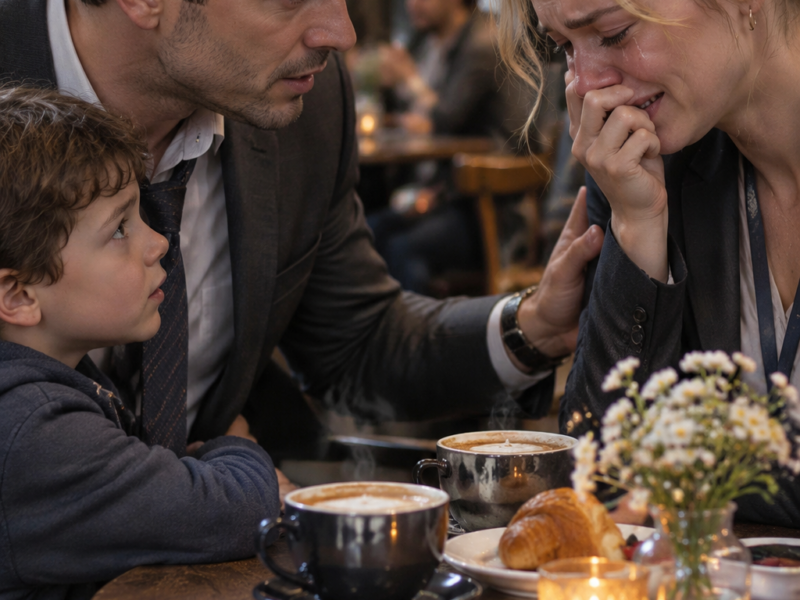
Single dad meets his coworker crying at a café— what he said changed both their lives forever…
Single dad meets his coworker crying at a café— what he said changed both their lives forever…
On a Saturday morning in late October, Evan Harper was sitting in his usual corner booth at Magnolia Café in Omaha, Nebraska, trying to make sense of a spreadsheet that had already ruined most of his weekend. His boss had sent him a complicated inventory report late Friday afternoon, complete with several discrepancies that needed to be investigated before Monday morning. Evan had promised himself he would spend no more than an hour working on it, but he had been staring at the same numbers for nearly forty minutes, wondering how a company could manage to lose track of so many boxes without anyone noticing.
Beside him sat his eight-year-old son, Mason, who was completely absorbed in a game on his tablet. Every few minutes, Mason made an explosion sound or announced that he had defeated another imaginary enemy. Evan had long ago learned that trying to work while his son played video games was an exercise in patience, but Magnolia Café offered two things that made the arrangement worthwhile: excellent chocolate chip pancakes and enough space for Mason to entertain himself without feeling trapped inside their small apartment.
The café was one of those neighborhood establishments that seemed to have resisted every attempt at modernization. The vinyl booths had probably been there since the 1980s, the coffee came in heavy ceramic mugs, and the waitress knew most regular customers by name. There were no fashionable decorations or expensive espresso machines, just the smell of freshly brewed coffee, buttered toast, and pancakes coming straight off the griddle.
Evan liked that about the place. Life had become complicated enough without needing another complicated thing.
He was leaning over his laptop, trying to identify the third inventory error, when Mason suddenly tugged at his sleeve.
“Dad.”
“What’s up, buddy?”
Mason lowered his tablet slightly and glanced toward the other side of the café.
“That lady from your work is over there.”
Evan barely looked up.
“Which lady?”
“The one who works with all the numbers. The one who always says hello to you.”
Evan followed his son’s gaze.
Then he recognized her.
Tessa Nguyen.
She worked in inventory analysis at the warehouse where Evan was employed. Their departments occasionally overlapped, and he usually saw her two or three times a week. She was thirty-four, exceptionally good at her job, and one of the few people in the building who seemed capable of explaining complicated inventory problems without making everyone else feel stupid.
She always greeted people in the breakroom, remembered small details from previous conversations, and seemed to have a natural ability to make even an ordinary Monday morning feel a little less miserable.
Evan wouldn’t have described them as friends. They were friendly coworkers who occasionally exchanged a few words about the weather, weekend plans, or whatever disaster their manager had created that week.
But something about seeing her sitting alone in a booth made him stop.
Her shoulders were hunched forward. One hand covered most of her face, while the other rested beside an untouched cup of coffee. Even from across the room, Evan could see that she was crying.
“She’s sad,” Mason whispered.
Evan closed his laptop halfway.
“Looks like it.”
“Shouldn’t we ask if she’s okay?”
Evan hesitated.
He had spent five years learning to navigate the delicate boundaries of single parenthood, work, and other people’s personal lives. Approaching a crying coworker in a public café could easily become uncomfortable. Perhaps Tessa wanted privacy. Perhaps she had received terrible news and didn’t want anyone from work to know about it.
But Mason was still looking at him.
“You always tell me that when someone looks sad, we should ask if they need help,” the boy reminded him.
Evan stared at his son for a moment.
He had apparently been listening to more of his father’s little lectures than Evan realized.
“You’re right,” Evan finally said. “Stay here for a minute. I’ll go check on her.”
He stood, straightened his jacket, and walked across the café.
As he approached Tessa’s booth, he cleared his throat softly so he wouldn’t startle her.
“Hey, Tessa.”
She looked up.
For a moment, she seemed almost embarrassed to recognize him. Her eyes were red, her mascara had smudged slightly beneath them, and she quickly reached for a napkin.
“Oh my God. Evan.”
She attempted a smile, but it disappeared almost immediately.
“Hi. Sorry. I didn’t realize anyone from work came here.”
“Small world, apparently.”
He glanced at the empty seat across from her.
“Everything okay?”
Tessa gave a short, humorless laugh.
“That’s a complicated question.”
Evan nodded.
“Fair enough.”
He paused before asking, “Mind if I sit for a minute? Mason’s over there, and he’s pretty committed to saving whatever imaginary world he’s currently destroying.”
Tessa looked past him and noticed the little boy sitting in the booth.
Something softened in her expression.
“Sure. Of course.”
Evan slid into the seat opposite her.
For a while, neither of them spoke.
He didn’t immediately ask what had happened. He had learned that sometimes people needed a few seconds to decide whether they wanted to explain their pain or simply sit beside someone who wasn’t demanding an explanation.
Tessa stared at her coffee.
Then she released a shaky breath.
“I just got a call from the adoption agency.”
Evan waited.
“They rejected my application again.”
He felt his expression change.
“Again?”
She nodded, pressing the napkin between her fingers.
“Third time. Three years of paperwork, interviews, home visits, background checks, financial statements, references. Three years of convincing myself that if I did everything they asked, eventually someone would look at my application and say yes.”
Her voice cracked.
“And today they told me I still don’t meet their requirements.”
Evan didn’t know what to say.
He hadn’t known she was trying to adopt. In fact, he realized he knew remarkably little about her life outside the warehouse.
Tessa looked down at the table.
“They said being single is a concern. Apparently, my income is considered unstable, even though I’ve worked at the same company for six years. They also mentioned my age. I’m thirty-four, Evan. Thirty-four. You’d think I was asking them to place a child with someone who had one foot in the grave.”
She laughed again, but this time the sound broke halfway through.
“I have a stable apartment. I have savings. I have a clean background check. I have people willing to provide references. I’ve done everything I could possibly think of. And somehow, it’s still not enough.”
She wiped her cheek.
“I’ve wanted to be a mother for as long as I can remember. When I was little, I used to imagine what my house would look like. I imagined birthday parties, school mornings, reading bedtime stories, all those ordinary things people probably complain about when they’re tired.”
Her eyes filled again.
“And now I’m sitting here wondering whether I’ll ever get any of them.”
Evan looked at her for a long moment.
He could have said something comforting. He could have told her not to give up, that the right child would eventually come into her life, or that everything happened for a reason.
But something about the way she was speaking made those familiar expressions feel almost insulting.
Instead, he decided to tell her something he rarely discussed.
“Five years ago, my wife left me and Mason.”
Tessa slowly raised her eyes.
“She just walked out one day. Mason was three.”
Evan leaned back slightly.
“She told me being a mother made her feel like she was drowning. She said she’d lost herself, that she couldn’t remember who she had been before becoming a parent. She said she couldn’t breathe anymore.”
He looked toward his son.
“She moved to Arizona. Didn’t fight for custody. Didn’t ask for weekends or holidays. She just left.”
Tessa listened without interrupting.
“For a long time, I was furious with her. I thought she had chosen herself over her own child. I couldn’t understand how anyone could walk away from a little boy who still needed someone to tuck him into bed.”
He rubbed his forehead.
“I built my entire identity around being the parent who stayed. The father who sacrificed everything. The man who would never abandon his son.”
He paused.
“But last year, Mason asked me something that changed the way I looked at my life.”
“What did he ask?”
Evan smiled faintly, although there was sadness behind it.
“He asked why I never smiled in our pictures.”
Tessa’s expression changed.
“I remember looking through my phone afterward. There were hundreds of photographs. Birthday parties, school events, trips to the park, Christmas mornings. Mason was smiling in almost every picture. And I looked angry, exhausted, or completely disconnected.”
He swallowed.
“I had been so busy proving that I was better than his mother that I forgot to enjoy being his father.”
The words hung between them.
“I was physically present. I made breakfast, packed lunches, checked homework, paid bills, went to parent-teacher meetings. But emotionally? I wasn’t always there. I had let anger consume so much of my life that I didn’t have much room left for happiness.”
Tessa stared at him.
Evan continued.
“And now I’m sitting here looking at you, listening to you cry because you want to give a child the kind of love you have been preparing to give for years. Meanwhile, I have a son who already has someone who loves him, and I’ve spent too much time forgetting to enjoy that gift.”
He leaned forward slightly.
“I don’t know whether you’ll become a mother someday. I can’t promise you that adoption will work out or that life will give you exactly what you want. But I know something.”
Tessa looked at him.
“You’re already showing up. You’re caring about a child who isn’t even in your life yet. You’re preparing to make sacrifices for someone you haven’t met. That says something about the kind of person you are.”
He paused.
“Wanting something doesn’t automatically make us ready for it. But showing up, caring, listening, and being willing to give someone your time and love? Those things matter. And from what I’ve seen, you’re already capable of them.”
Tessa’s tears continued falling, but she wasn’t trying to hide them anymore.
“What if it never happens?” she whispered.
Evan didn’t look away.
“Then I hope you find a way to build a meaningful life anyway. Not because you should stop wanting to be a mother, but because you deserve to be happy while you’re waiting for something you can’t control.”
For several seconds, the only sound between them was the soft clatter of dishes coming from the kitchen.
Then Mason appeared beside the booth, holding a blueberry muffin on a napkin.
“Dad, you said I could get one.”
“I did.”
Mason looked at Tessa.
“Do you want to share it with me, Miss Tessa?”
She blinked.
“Are you sure?”
Mason nodded seriously.
“Dad says sharing makes people feel better. And you looked like you needed a muffin.”
Evan almost laughed.
Tessa’s expression changed completely. She looked at the boy as if he had just offered her something much more valuable than a pastry.
“That’s very sweet of you, Mason. I’d love to share.”
Mason climbed into the booth beside his father and broke the muffin into two pieces.
For the next ten minutes, he explained the complicated rules of his favorite tablet game. Tessa listened with genuine interest, asking questions and occasionally laughing at his descriptions.
Evan watched her.
There was no performance in the way she spoke to Mason. She didn’t try to impress him or behave like someone auditioning for a role. She simply listened.
When they finally left the café, Tessa reached out and gently touched Evan’s arm.
“Thank you.”
“For what?”
“For not walking past me. And for telling me the truth about your family. I know that couldn’t have been easy.”
Evan shrugged.
“Sometimes people need something real more than they need something comforting.”
Tessa nodded.
“Well, I think I needed both.”
They exchanged a slightly awkward smile.
“See you Monday?” she asked.
“Yeah. See you Monday.”
Evan walked back to his car with Mason, but the conversation stayed with him all the way home.
He had just told a coworker things he had barely admitted to himself. And strangely, he felt lighter.
For the first time in a long time, he wondered whether perhaps the life he had built after his wife left didn’t have to remain exactly the same forever.
Monday morning arrived with the usual warehouse noise, the smell of cardboard, and the familiar sound of forklifts moving between inventory aisles.
Evan spotted Tessa near the breakroom.
She noticed him at almost the same moment.
“Hey,” she said.
“Hey.”
She gave him a tight smile before practically disappearing around the corner.
Evan watched her go.
Apparently, they were both still trying to figure out how to behave after having an unexpectedly emotional conversation over coffee and a muffin.
He decided to give her space.
Unfortunately, his boss had other plans.
On Wednesday, Evan was assigned to a new inventory reconciliation project. The work required him to examine several reports generated by Tessa’s department, which meant they would have to spend considerable time together.
Their first meeting took place in a small conference room.
For the first thirty minutes, both behaved as though they were attending a particularly uncomfortable business seminar.
Tessa discussed discrepancies.
Evan discussed shipment records.
They avoided eye contact whenever possible.
Then Tessa glanced at her laptop and sighed.
“Our manager sent another email at two in the morning.”
Evan looked up.
“Does he think the rest of us are nocturnal warehouse animals?”
Tessa laughed.
Not a polite little laugh.
A real one.
Evan found himself laughing too.
And just like that, something loosened.
They returned to the spreadsheets, but the tension was gone. By the end of the meeting, they were talking normally again.
The following afternoon, Evan walked into the breakroom to heat up his leftover pasta.
Tessa was already sitting at one of the tables.
She looked up.
“You can sit here if you want.”
Evan raised an eyebrow.
“Are you sure? I don’t want to disrupt your extremely important lunch meeting.”
She smiled.
“I’ll try to survive.”
He sat down.
They talked about work, Thanksgiving plans, traffic on Interstate 80, and Tessa’s increasingly suspicious car engine.
Nothing particularly important happened.
And somehow, that was exactly what made the conversation enjoyable.
By Friday, they had fallen into a routine.
They ate lunch together whenever their schedules allowed it.
At first, the conversations remained comfortably superficial. They discussed weekend errands, office gossip, grocery prices, and the strange habit their manager had of scheduling meetings that could easily have been emails.
But gradually, the conversations became more personal.
One afternoon, Tessa asked how Mason was doing.
“He’s good,” Evan almost answered automatically.
Then he stopped.
“Actually, he’s been asking why we don’t do anything fun anymore.”
Tessa looked up from her salad.
“What do you mean?”
“He said all we do is school, homework, grocery shopping, and errands. And honestly, he’s right.”
Evan pushed his fork through his food.
“I used to take him to the park every Saturday. We’d go bowling sometimes. We’d have these ridiculous pancake breakfasts where I’d let him put chocolate chips in everything. Lately, though, weekends have become a list of responsibilities.”
“When did that start?”
“Probably after his mother left.”
Evan considered his words.
“I got so focused on making sure he was okay that I stopped thinking about anything else. I convinced myself that if I kept the household running, paid the bills, and made sure he never felt abandoned, I was doing enough.”
“And are you?”
The question caught him off guard.
“I think so.”
Tessa tilted her head.
“Do you?”
Evan looked down.
He knew what she was getting at.
“I don’t know.”
She rested her elbows on the table.
“Evan, when was the last time you did something fun?”
“I do things with Mason.”
“That’s not what I asked.”
He looked at her.
“When was the last time you did something just because you wanted to? Something that made you happy, without being connected to your job or your responsibilities as a father?”
Evan opened his mouth.
Then closed it.
He couldn’t think of an answer.
Not one.
He couldn’t remember the last time he had gone somewhere simply because he enjoyed it, pursued a hobby, or spent an evening with friends without feeling guilty about the time he wasn’t spending at home.
He had slowly turned his entire existence into a checklist.
And he had mistaken that for maturity.
Tessa noticed his expression.
“That bad?”
“Apparently.”
She smiled gently.
“Well, maybe you should start thinking about it.”
Meanwhile, Tessa was beginning to change too.
A week after their conversation, she told Evan that she had signed up to volunteer at a Boys and Girls Club on the other side of Omaha.
He looked up from his lunch.
“Really?”
“Yeah.”
“What made you decide to do that?”
She shrugged.
“I was sitting at home after another rejection letter, feeling sorry for myself. Then I remembered what you said.”
Evan waited.
“About showing up.”
She looked down at her hands.
“I realized that if I couldn’t become someone’s official mother right now, I could still be someone a child could count on. There are plenty of kids who need adults willing to listen to them. I thought maybe I could start there.”
Evan smiled.
“I think that’s a wonderful idea.”
Tessa looked slightly nervous.
“I don’t know what I’m doing, though. What if I’m terrible at it?”
“Then you’ll learn.”
“What if the kids don’t like me?”
“Then you’ll have to find better jokes.”
She laughed.
“You’re assuming your jokes are good.”
“They’re excellent. My son is just a difficult audience.”
The following week, Tessa began telling him stories about the children she met.
There was a fourteen-year-old boy who loved basketball but struggled with math. There was a quiet girl who spent most afternoons drawing in the corner. There were siblings who argued constantly but refused to let anyone else criticize each other.
And then there was Kennedy.
Kennedy was an eighth grader with excellent grades and a remarkable ability to convince herself that she wasn’t capable of doing anything important.
“She’s incredibly smart,” Tessa explained one afternoon. “But she’s convinced college isn’t for people like her because nobody in her family has ever gone.”
“What are you doing to help?”
“Scholarship applications. Essay writing. Researching universities. Mostly listening to her tell me all the reasons she thinks she can’t do it.”
“Sounds familiar.”
Tessa laughed.
“Don’t start.”
A few days later, she arrived at lunch practically glowing.
“Kennedy got accepted.”
Evan looked up.
“Accepted where?”
“UNO. With a partial scholarship.”
He smiled broadly.
“That’s amazing!”
“It is!”
Tessa shook her head, still excited.
“Yesterday she hugged me. A real hug. And she told me I was the first person who made her believe she could actually go to college.”
Evan felt a surprising amount of pride.
“You’re changing that girl’s life.”
Tessa shook her head.
“I’m just showing up.”
She paused.
“That’s what I finally understand. These kids don’t care whether I’m officially their parent. They care whether I remember their names. Whether I notice when they’re having a bad day. Whether I ask how their test went.”
Her eyes softened.
“And apparently, that matters more than I realized.”
Over the next three weeks, Evan watched her become lighter.
The woman who had cried into a napkin at Magnolia Café was still the same thoughtful person, but something had changed in the way she carried herself.
She no longer seemed to be measuring her worth against an adoption agency’s decision.
One afternoon, he told her so.
“You seem happier.”
Tessa smiled.
“I think I am.”
“Good.”
“I finally realized I can be enough without the thing I thought would complete me.”
Evan listened.
“I spent three years believing that becoming a mother would make my life whole. And maybe someday it will be part of my life. I still want that. But I forgot that I could matter to people before it happened.”
She took a sip of water.
“Kennedy matters to me. The other kids matter to me. And apparently, I matter to them too.”
Evan nodded.
“Sounds like a pretty good realization.”
“It is.”
They sat quietly for a moment.
Evan realized that a month earlier, he had barely known this woman beyond her job title. Now, hearing about her happiness made his own day better.
That realization made him slightly uncomfortable.
Because he was beginning to feel something he hadn’t expected.
Something that went beyond friendship.
Their conversations continued, and Tessa began asking him questions that made him examine parts of himself he had long ignored.
One afternoon, she asked, “What did you used to enjoy doing?”
Evan thought for a moment.
“Basketball.”
“Really?”
“Yeah. I used to play at the rec center every Tuesday night. Same group of guys. We had a regular pickup game.”
“That sounds fun.”
“It was. I loved it. The competition, the trash talk, the feeling of being good at something that had nothing to do with work.”
“When did you stop?”
Evan shrugged.
“When Mason’s mom left. Tuesday nights became bedtime routines. Dinner, bath, stories, getting him ready for the next day. I figured I’d get back to basketball eventually.”
“How long ago was that?”
“Five years.”
Tessa slowly put down her fork.
“Evan.”
He looked up.
“You’re going to say something, aren’t you?”
“Probably.”
He smiled.
She leaned forward.
“You didn’t stop playing because you didn’t have time. You stopped because you convinced yourself that being a father meant giving up everything that made you an individual.”
Evan’s expression tightened.
“I’m a single parent. Sacrifice is part of the job.”
“Of course it is. But sacrifice doesn’t mean erasing yourself.”
He didn’t respond.
Tessa continued.
“You can’t teach Mason how to live a full, happy life if you’re showing him that becoming a parent means giving up everything you enjoy.”
Evan looked at his lunch.
“That’s not exactly what I’m trying to teach him.”
“Maybe not intentionally. But children learn from what we do, not just what we tell them.”
Her words stayed with him.
He thought about all the times Mason had asked him to play basketball in the driveway, only for Evan to say he was too tired.
All the Saturdays when they had stayed inside because Evan needed to catch up on chores.
All the photographs in which Mason was smiling while his father looked as though he was simply enduring another day.
That Tuesday evening, Evan made a decision.
Mason was spending the night at his maternal grandmother’s house, something they had arranged weeks earlier.
Instead of going home and working on his usual list of household tasks, Evan drove to the recreation center.
He sat in the parking lot for several minutes before getting out.
He felt ridiculous.
It had been five years.
He was older, heavier, and probably much slower than he remembered being.
But when he walked into the gym, he recognized several familiar faces.
One of the men looked up from tying his shoes.
“Well, I’ll be damned. Harper?”
Evan laughed.
“Hey, Mike.”
“Where the hell have you been?”
“Busy.”
Mike shook his head.
“Five years busy?”
“Apparently.”
The men welcomed him back without asking too many questions.
Someone tossed him a basketball.
Within minutes, Evan was running across the court, sweating, laughing, and arguing about whether a shot had counted.
He missed more baskets than he made.
He was completely exhausted by the end.
But driving home that night, he felt happier than he had in months.
The following day, Tessa noticed immediately.
“You look different.”
“Different how?”
“Like you actually slept.”
“I played basketball last night.”
Her eyes widened.
“You did?”
“Two hours.”
She grinned.
“See? You’re allowed to be a person. Wild concept, I know.”
Evan threw a napkin at her.
She laughed.
And for the first time in a long time, he found himself looking forward to the next Tuesday.
He began attending the weekly games regularly. It became something he protected on his calendar rather than something he postponed whenever life became inconvenient.
He reconnected with old friends and discovered that he could still enjoy things outside his responsibilities.
Mason noticed the change almost immediately.
One Tuesday evening, Evan was preparing dinner and humming along to the radio when his son looked up from the kitchen table.
“Dad?”
“Yeah, buddy?”
“Why are you so happy today?”
Evan smiled.
“Am I not allowed to be happy?”
“You are. You’re just singing.”
“Is that a problem?”
Mason considered it.
“No. I just noticed.”
Evan laughed.
He explained that sometimes adults needed to do things they enjoyed so they could feel better and have more energy for the people they loved.
Mason listened carefully.
Then he asked, “Can we get pizza instead of chicken?”
Evan shook his head.
“That’s not exactly what I meant.”
But he ordered pizza anyway.
Somewhere during those weeks, something else began to happen.
Evan started falling for Tessa.
At first, he tried to convince himself it was simply friendship. He enjoyed talking to her. He admired the way she treated people. He appreciated that she challenged him without making him feel inadequate.
But then he began noticing smaller things.
The way she tucked a loose strand of hair behind her ear when concentrating on a spreadsheet.
The way she laughed at his terrible jokes even when she pretended they weren’t funny.
The way she remembered details from conversations they had weeks earlier.
He started looking forward to their lunch breaks more than he wanted to admit.
Their conversations also moved beyond the workplace.
They began exchanging text messages in the evenings.
Sometimes Tessa would send him a photograph of something ridiculous she had seen at the grocery store. Sometimes Evan would tell her about something Mason had said at dinner.
They discussed movies, childhood memories, favorite restaurants, and the little things that made ordinary days better.
Occasionally, their conversations continued long after they should have gone to sleep.
There were moments when their hands brushed while reaching for the same napkin, or when they caught each other looking across the breakroom.
Neither mentioned it.
Evan wanted to ask her on a date.
He thought about it several times.
But he was afraid of ruining the friendship.
More importantly, he wasn’t entirely certain whether he understood his own feelings.
Tessa had been through a painful experience with adoption. He had been through a painful marriage. They had helped each other through difficult periods.
What if their connection was simply the result of two lonely people finding comfort in one another?
What if he was mistaking gratitude for love?
The question became more important than ever on a Wednesday afternoon in early December.
They were eating lunch in the breakroom when Evan made an offhand comment about how much he enjoyed their conversations.
“You’ve become one of my favorite parts of the week,” he said.
He expected her to smile.
Instead, Tessa became very quiet.
She set down her fork.
“Evan, I need to tell you something.”
He felt his stomach tighten.
“Okay.”
“It’s probably going to sound harsh, but I need you to understand.”
She took a breath.
“I can’t be someone’s consolation prize.”
Evan stared at her.
“What?”
“I’ve spent three years being told by adoption agencies that I’m not enough. That my circumstances aren’t right. That I don’t fit their idea of what a suitable parent should look like.”
Her voice trembled.
“I’m not going to put myself in another situation where I have to wonder whether I’m enough for someone.”
“Tessa, I don’t understand.”
She looked directly at him.
“You’re an incredible father. You’re kind, responsible, and you clearly love Mason. And I’m good with children. We both know that.”
Evan didn’t interrupt.
“It would be incredibly easy for you to fall for me because I fit into your life. Because I understand children. Because Mason likes me. Because I could make things easier for you.”
Her eyes became wet.
“But I don’t want to be chosen because I’m convenient.”
Evan felt as though someone had suddenly poured cold water over him.
“That’s not how I see you.”
“Maybe not consciously. But I need to know that.”
She looked down at her lunch container.
“I want someone to choose me because he wants me. Not because I’m good at filling a role he needs filled.”
She stood up.
“I think we should keep things professional for a while.”
“Tessa, wait.”
But she was already gathering her things.
“This friendship was becoming something else, and I need some distance before I get hurt.”
Then she walked out.
Evan remained seated.
He replayed her words repeatedly.
And the more he thought about them, the more he realized that he couldn’t simply dismiss her concerns.
He had spent years defining himself through fatherhood. He had spent months rebuilding his life with Tessa’s encouragement.
Perhaps he hadn’t fully considered what he was asking of her.
Perhaps she was right to demand something more than being appreciated for how naturally she fit into his world.
The following two weeks were miserable.
They returned to being polite coworkers.
They exchanged greetings in the hallway and discussed work when necessary, but the lunch conversations stopped.
Evan ate alone.
The breakroom felt strangely empty.
He missed hearing about Kennedy’s progress. He missed Tessa’s observations about their manager. He missed the way she laughed when he made a terrible joke.
He also noticed that she wasn’t doing much better.
Occasionally, he caught her looking in his direction before quickly turning away.
Neither seemed happy with the distance, but Tessa had made her position clear.
Evan respected it.
Mason, however, noticed.
One evening, while Evan was preparing dinner, the boy asked, “Dad, why doesn’t Miss Tessa eat lunch with you anymore?”
Evan paused.
“She’s just busy, buddy.”
“Did something happen?”
“Not really. Sometimes grown-ups need a little space.”
Mason looked at him.
“Are you sad?”
Evan forced a smile.
“I’m okay.”
His son studied his face.
“You’re doing that thing again.”
“What thing?”
“Where you smile, but your eyes don’t.”
Evan felt his throat tighten.
It was the same observation Mason had made about their photographs.
The boy had noticed something his father was trying very hard to hide.
That night, after putting Mason to bed, Evan sat alone at the kitchen table.
He thought about everything Tessa had said.
He realized that he needed to speak to her, not to convince her that she was wrong, but to explain honestly what she meant to him.
He spent the next several days thinking about the words.
He wanted to be clear.
He didn’t want to promise something he couldn’t deliver or make her responsible for his happiness.
Most importantly, he didn’t want to ask her to become someone she wasn’t.
Finally, on a Friday evening in mid-December, he saw her walking toward her car after work.
“Tessa.”
She turned.
“Hey.”
“Can we talk?”
Her expression immediately became cautious.
“About what?”
“About us. About what happened.”
She looked away.
“I don’t think that’s a good idea.”
“Please. Just twenty minutes.”
Tessa studied him.
“Where?”
“Miller Park. Somewhere quiet.”
She hesitated.
Then she nodded.
“Okay. I’ll meet you there in ten minutes.”
Evan drove to the park feeling as though the distance between the warehouse and the parking lot had somehow become several miles.
When he arrived, Tessa was already sitting on a bench near the empty playground.
The December air was cold enough to make their breath visible. The trees were bare, and the last traces of daylight were disappearing behind the buildings.
Evan parked and walked toward her.
He sat down, leaving a little space between them.
For a moment, neither spoke.
Then Evan took a deep breath.
“You said you didn’t want to be my consolation prize.”
Tessa turned slightly.
“And you were right to say that.”
She looked at him.
“I was?”
“Yes. You were right to protect yourself. You deserved to ask whether I actually wanted you or whether I was simply looking for someone who could fit into my life.”
He rubbed his hands together.
“But I need you to understand something.”
She waited.
“I’m not looking for a mother for Mason. He has a father. He has me. We’re figuring things out, and we’re doing okay.”
Tessa remained silent.
“What I’m looking for is someone who makes me want to show up for my own life again.”
Her expression changed.
Evan continued.
“For five years, I hid behind being a dad. I convinced myself that having responsibilities meant I didn’t need friends, hobbies, or anything else. I thought giving up everything for Mason made me a good father.”
He looked toward the playground.
“But really, I was scared. My ex-wife left because she said motherhood had made her lose herself. I hated her for that. I spent years trying to prove I was different.”
He swallowed.
“And somewhere along the way, I did the same thing. I lost myself completely.”
Tessa’s eyes began to glisten.
“Then you showed up at that café, crying, and I told you things I had never admitted to anyone. You didn’t just listen. You challenged me afterward. You asked questions I didn’t want to answer. You made me realize I was allowed to have a life outside of being someone’s father.”
He turned toward her.
“You got me back on a basketball court. You made me reconnect with friends. You made me realize Mason deserves a father who enjoys being alive, not just someone who fulfills his responsibilities.”
Tessa looked down.
“And none of that has anything to do with you being good with children. It has everything to do with who you are.”
He paused.
“I’m falling for you because you’re funny. Because you’re thoughtful. Because you remember little things that other people forget. Because you challenge me when I’m being stubborn. Because I look forward to seeing you even when I know we’re only going to discuss spreadsheets.”
A small smile appeared on her face.
“Your spreadsheets are terrible.”
“I know. It’s part of my charm.”
She laughed softly.
Then her expression became serious again.
“But how do you know this isn’t just trauma bonding?”
Evan nodded.
“That’s a fair question.”
“We’ve both been through difficult things. We helped each other. But that doesn’t automatically mean we’re supposed to be together.”
“You’re right.”
He leaned forward.
“I can’t prove what the future will look like. I can’t promise we’ll never hurt each other or that everything will be easy. But I know I want to spend time with you even when neither of us needs rescuing.”
Tessa looked at him.
“And what about Mason?”
“He’s part of my life. I won’t pretend otherwise. But you don’t have to become his mother. You don’t have to take responsibility for things that belong to me. You just have to be yourself.”
“What if he gets attached?”
“Then we handle it carefully. We don’t rush him into anything. We don’t make promises we can’t keep.”
Evan paused.
“And if things don’t work out, we make sure he’s okay. That’s my responsibility as his father.”
Tessa looked down at their hands.
“You make it sound so simple.”
“It isn’t. It’s probably going to be complicated.”
He smiled faintly.
“But I’d rather try something honest than spend the rest of my life wondering what might have happened if I’d been brave enough to tell you how I felt.”
For a moment, the park was silent.
Then Tessa took a deep breath.
“I need to tell you something too.”
Evan waited.
“For three years, I thought becoming a mother would complete me. I thought that if I could just adopt a child, everything in my life would finally make sense.”
She looked toward the playground.
“I built my identity around something that hadn’t even happened yet. And every rejection felt like proof that I wasn’t good enough as a person.”
She wiped her eyes.
“Then you sat down with me at that café and told me something I didn’t want to hear.”
Evan smiled gently.
“That showing up matters?”
She nodded.
“I started volunteering. I met Kennedy. I met all those kids. And I discovered that I could matter to people without having an official title.”
She looked at him.
“I found out that I’m already enough.”
Evan listened carefully.
“But then something else happened. I started getting close to you. And it scared me.”
“Why?”
“Because I didn’t know whether I was falling for you or whether I was trying to get close to the family life I’d always imagined.”
Her voice trembled.
“I was afraid I might be using you and Mason to fill the space left by those adoption rejections. I didn’t want to do that to either of you.”
She took another breath.
“I didn’t know how to separate my desire to nurture a child from my feelings for you.”
Evan gently turned toward her.
“And now?”
Tessa looked at him for a long moment.
“Now I think I don’t need Mason to feel whole.”
Her voice became quieter.
“I want you.”
Evan felt his chest tighten.
“I like how you make terrible jokes when you’re nervous. I like how you listen when I’m talking. I like how you remember what I tell you. I like the way you talk about Mason, even when you’re exhausted.”
She smiled through her tears.
“And I like who I am when I’m around you. I don’t feel like I’m auditioning for something. I don’t feel like I have to prove I’m worthy of being loved.”
She reached for his hand.
“That’s not about filling a void. That’s about wanting to be with someone who sees me.”
Evan gently closed his fingers around hers.
“So, what are you saying?”
Tessa laughed through her tears.
“I’m saying I’m scared. But I want to try.”
He smiled.
“That’s enough for me.”
She looked at him.
“Really?”
“Really.”
Then Evan leaned toward her, slowly enough that she had time to change her mind.
She didn’t.
Their first kiss was soft and careful, filled with the uncertainty of two people who had spent so long protecting themselves that allowing something good to happen felt almost frightening.
When they pulled apart, Tessa laughed.
“Wow.”
Evan grinned.
“Good wow or bad wow?”
“Definitely good wow.”
“Excellent. I was hoping for that.”
She shook her head.
“You’re impossible.”
“Probably.”
They remained on the bench until the park lights came on.
They discussed what they wanted, what they were afraid of, and how they would approach the relationship without rushing into anything.
They agreed to have an actual date.
A real dinner at a restaurant.
No warehouse discussions. No spreadsheets. No interruptions from Mason.
Just the two of them, choosing to spend time together because they wanted to.
Three months later, Evan and Tessa had become one of those couples their coworkers either genuinely adored or found mildly irritating.
They had learned to navigate the complicated parts of dating when one person was a single parent.
They communicated constantly.
They discussed boundaries before problems arose, and they never assumed that affection meant either person had to surrender their independence.
Tessa continued volunteering at the Boys and Girls Club.
Her relationship with Kennedy had grown stronger, and she was now helping several other students with their school applications.
She still hoped to become an adoptive parent someday, but she no longer treated that possibility as the condition for having a meaningful life.
Evan continued playing basketball every Tuesday evening.
He reconnected with old friends and started making more time for activities with Mason.
They went bowling again. They returned to the park on Saturday mornings. They started having their ridiculous pancake breakfasts.
And Mason seemed happier too.
Tessa was gradually becoming part of his life, but neither she nor Evan tried to force a particular relationship between them.
She wasn’t introduced as a replacement mother.
She was simply Tessa.
The woman who taught him card tricks, listened to his stories about video games, and occasionally let him win at board games because she claimed he had a suspicious amount of beginner’s luck.
One Saturday, Mason asked whether Tessa could come with them to the science museum.
Evan looked at her.
She smiled.
“Only if you promise not to make me read every single information board.”
Mason grinned.
“I can’t promise that.”
They went together.
And for Evan, those ordinary moments were more meaningful than any grand romantic gesture could have been.
On a Saturday morning in late March, Evan and Tessa returned to Magnolia Café.
It was the same café where everything had started.
The same vinyl booths. The same ceramic mugs. The same smell of coffee and freshly cooked pancakes.
Mason was spending the weekend at his grandmother’s house, so for once, it was just the two of them.
Tessa sat across from Evan, stirring her coffee while scrolling through something on her phone.
Evan watched her for a moment.
Then he smiled.
“Do you remember what you told me the first time we sat here?”
Tessa looked up.
“I told you a lot of things. Most of them while crying into a napkin.”
He laughed.
“You told me you were never going to be someone’s mother.”
Her smile faded slightly.
“Yeah. I remember.”
“And I told you that wanting something didn’t automatically make you worthy of it, but showing up mattered.”
Tessa nodded.
“Why are you bringing that up?”
Evan leaned forward.
“Because I’ve been thinking about it.”
He reached across the table and took her hand.
“You’ve been showing up, Tessa. For those kids at the club. For Kennedy. For Mason, when the opportunity naturally comes. And for me.”
He smiled.
“And I think I finally understand something.”
She waited.
“Titles don’t create the things that matter most. Showing up does. You don’t have to wait for someone to officially call you something before your presence can make a difference in their life.”
Tessa’s eyes filled.
“Evan…”
“You’ve already made a difference. Those kids know they can count on you. Kennedy knows someone believes in her. Mason knows you’re someone he can laugh with.”
He squeezed her hand.
“And I know you’re someone who has changed my life.”
Tessa wiped the corner of her eye.
“Thank you.”
“But there’s something else I want you to understand.”
She looked at him.
“I’m not with you because you’re good with Mason. I’m not with you because you’re good with children or because you happen to fit into my schedule.”
He paused.
“I’m with you because you make me want to be better at being myself.”
Her fingers tightened around his.
“You gave me permission to be a whole person again.”
Tessa smiled.
“You did the same thing for me.”
She looked down at their joined hands.
“You told me the truth when I needed to hear it, even though it wasn’t what I wanted to hear. You reminded me that my life wasn’t on hold just because one dream hadn’t happened yet.”
She looked back at him.
“I spent so long waiting for someone to tell me I was worthy of being a mother that I forgot I was already worthy of being loved.”
Evan felt his throat tighten.
For a moment, neither spoke.
The café was gradually filling with Saturday morning customers. A young couple entered with a toddler. An elderly man sat near the window and unfolded his newspaper. Somewhere behind the counter, a waitress called out an order.
Life continued around them.
And Evan realized how extraordinary it was that something so important had begun in such an ordinary place.
Five months earlier, he had walked into Magnolia Café intending to finish a spreadsheet.
Tessa had walked in carrying the weight of another rejection.
Neither had expected anything unusual to happen.
Yet one conversation had changed the way both of them saw themselves.
Tessa smiled suddenly.
“You know what’s strange?”
“What?”
“If the adoption agency had approved my application that morning, I probably wouldn’t have been sitting here crying.”
Evan nodded.
“Probably not.”
“And you wouldn’t have come over.”
“Maybe Mason would have found another reason to send me across the café.”
She laughed.
“But seriously. None of this might have happened.”
Evan thought about it.
“You’re saying that rejection brought us together?”
“I’m saying that sometimes what feels like the end of something is actually the beginning of something else.”
She looked out the window.
“I hated that phone call. I hated every rejection. I thought those decisions meant my life wasn’t going to become what I’d imagined.”
She turned back toward him.
“But maybe I was so focused on the door that wouldn’t open that I forgot there were other ways to live.”
Evan nodded slowly.
“I spent five years being angry at someone who left. I thought my job was to prove I could survive without her.”
He smiled faintly.
“But I wasn’t really living. I was just making sure everything kept working.”
“And now?”
“Now I think I’m finally living again.”
Tessa squeezed his hand.
They remained at the table for a while, talking about their plans for the coming week.
There were still uncertainties ahead.
Tessa hadn’t abandoned her hope of adopting a child. She still planned to explore other agencies and understand what options might be available to her.
Evan still had responsibilities as a single father, and there would undoubtedly be difficult conversations as their relationship developed.
They weren’t pretending that love would solve every problem.
They had simply learned that neither person needed to be rescued in order to deserve companionship.
And that was perhaps the most important thing they had discovered.
Evan hadn’t approached Tessa that morning because he wanted a new relationship. He had approached her because his eight-year-old son reminded him that people sometimes need someone to notice when they’re hurting.
Tessa hadn’t been looking for a man to complete her life. She had been grieving a dream she believed she might never achieve.
But somewhere between a shared muffin, awkward workplace lunches, difficult questions, basketball games, and honest conversations in a cold December park, they had discovered something neither had been searching for.
They had found someone who encouraged them to become more fully themselves.
And perhaps that was a better beginning than either could have imagined.
Sometimes, the person who changes your life isn’t the person who arrives with all the answers.
Sometimes, it’s the person who sits across from you when you’re falling apart and refuses to offer an easy lie.
Sometimes, the greatest act of kindness isn’t telling someone that everything will work out exactly as they hope.
It’s reminding them that their worth doesn’t depend on whether it does.
Tessa had spent years believing she needed to become a mother before she could feel complete. Evan had spent years believing he needed to sacrifice everything before he could call himself a good father.
They had both been wrong in ways they couldn’t see until someone else helped them look.
Tessa discovered that she could make a difference in a child’s life without waiting for an official title.
Evan discovered that being a devoted father didn’t require him to abandon the person he had been before becoming one.
And together, they learned that a healthy relationship wasn’t about two incomplete people trying to fill each other’s emptiness.
It was about two people who understood that they were already whole, choosing to share their lives anyway.
As they finally stood to leave Magnolia Café, Evan held the door open for Tessa.
She stepped outside into the bright spring morning and slipped her hand into his.
“Ready?” she asked.
“Always.”
They walked toward their cars, laughing about something neither would probably remember by the following week.
And Evan thought about the photographs on his phone.
He thought about the old pictures where Mason smiled at the camera while his father looked exhausted and distant.
He thought about the more recent ones: Mason laughing with a basketball tucked under his arm, Tessa smiling beside them at the science museum, and the three of them standing together after a particularly disastrous attempt at making homemade pizza.
In those pictures, Evan was smiling too.
Not because everything in his life had become perfect.
Not because the past had disappeared.
But because he had finally stopped treating happiness as something he needed to earn through endless sacrifice.
He had learned that showing up mattered.
But showing up meant more than simply being physically present.
It meant listening. It meant laughing. It meant allowing yourself to enjoy the people you loved while they were still beside you.
And sometimes, it meant noticing the person sitting alone in a café, gathering enough courage to ask whether they were okay.
A simple question.
A shared muffin.
A conversation that neither person had planned.
And two lives that would never be quite the same again.
THE END









