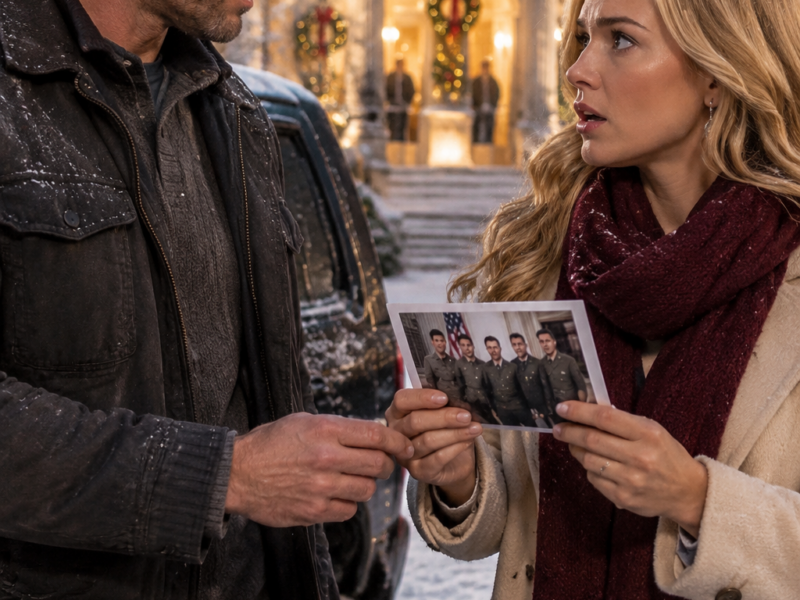
Single Dad Drove a Billionaire s Daughter Home on Christmas Then His SEAL Past Stunned Her
Single Dad Drove a Billionaire s Daughter Home on Christmas Then His SEAL Past Stunned Her
Christmas morning was supposed to be about the little things. The smell of cinnamon pancakes, the excitement in a child’s voice, the warmth of a small house filled with memories, and the promise that, no matter how difficult the year had been, one day could still feel special.
But I never imagined that a forty-mile drive through the Colorado mountains would change my life, save my home, bring an old battlefield sacrifice back into the light, and introduce me to a woman who would eventually become part of my family’s future.
I certainly never expected that the billionaire sitting behind the gates of a magnificent mountain estate would be the same man I had carried out of a burning industrial compound eleven years earlier.
My name is Callum Mercer. I was thirty-nine years old, a former Navy SEAL, and a single father raising my eight-year-old son, Finn, in a modest house just outside Aspen, Colorado.
If you had met me eleven years earlier, you probably wouldn’t have recognized the man I had become.
Back then, I was stronger, faster, and far more reckless. I believed that courage meant running toward danger without hesitation. I believed that if someone needed help, you went, regardless of the consequences. I believed that the men beside you were more than teammates. They were brothers, and you did whatever it took to bring them home.
I still believed those things, but life had taught me that courage wasn’t always measured in explosions, gunfire, or impossible decisions.
Sometimes courage was waking up at five thirty in the morning after barely sleeping, making breakfast for a child who had lost his mother, and pretending that everything was going to be all right.
Sometimes it was standing in the kitchen, looking at an empty chair, and reminding yourself that your son needed you more than you needed another hour to grieve.
My wife, Maren, had died three years earlier after a long battle with cancer.
She had been the kind of woman who could make an ordinary afternoon feel like a holiday. She sang while washing dishes, laughed at her own terrible jokes, and had an extraordinary ability to find beauty in places where everyone else saw nothing special.
When she was diagnosed, I thought we would fight our way through it. I had survived military deployments, dangerous extractions, and situations that should have ended my life. I believed that determination could overcome almost anything.
But cancer didn’t care about determination.
It didn’t care that we had a young son. It didn’t care that Maren still had plans for the garden, books she wanted to read, and places she wanted to take Finn.
Eventually, she was gone.
And I was left trying to figure out how to be both parents to a little boy who still expected his mother to walk through the front door.
For a long time, I barely recognized myself. I left the Navy after the mission that had taken my closest friend, Rafe Calder, and losing Maren years later only deepened the silence I had carried inside me.
I eventually found work as a mechanic at a small garage in town. On weekends, I drove passengers whenever I could get a ride request. It wasn’t glamorous, but it kept food on the table.
My life had become a carefully managed collection of responsibilities.
The mortgage came first. Then electricity, groceries, school supplies, fuel, and whatever Finn needed.
There was never much left over.
Still, I tried to make our home feel warm. Our house wasn’t large. It had three bedrooms, an aging wooden porch, a small kitchen, and a backyard where Maren had once planted flowers.
The paint was peeling in places, and the heating system made an unpleasant noise whenever the temperature dropped below freezing.
But it was home.
Every corner held something that belonged to our family. A framed photograph from our wedding sat on the mantel. Finn’s drawings covered the refrigerator. Maren’s favorite blue mug remained on the kitchen shelf because I couldn’t bring myself to put it away.
It was where Finn had learned to walk, where Maren had sung him to sleep, and where I had spent countless nights holding my son after nightmares.
Unfortunately, it was also a place that someone else had decided was worth more without the people living in it.
A few months earlier, an investment company connected to billionaire industrialist Alistair Vale had purchased several properties in our neighborhood.
The company planned to demolish the existing homes and replace them with luxury vacation residences.
The official documents described the project as a major improvement to the area. They mentioned increased property values, tourism, economic opportunities, and a new standard of mountain living.
What they didn’t mention were the families.
They didn’t mention Mrs. Henderson, a seventy-four-year-old widow who had lived across the street for almost forty years. They didn’t mention the young couple raising three children two houses down. They didn’t mention the retired schoolteacher who still volunteered at the local library.
And they certainly didn’t mention what it meant for an eight-year-old boy to lose the only home he could remember.
We had received notices informing us that the properties were scheduled for redevelopment. The deadline to vacate was January 2.
I had tried speaking with the representatives, but every conversation ended with the same carefully rehearsed explanation.
The company had acquired the land legally.
The project had been approved.
The residents had been notified.
There was nothing more they could do.
I wasn’t sure what made me angrier: the fact that they were taking our homes or the way they spoke about our lives as if we were inconvenient paperwork.
That Christmas morning, however, I had more immediate concerns.
Finn wanted a bicycle.
Not an expensive one. Not one with special equipment or electronic features. Just a blue bicycle with a bell, a basket, and training wheels that he insisted he didn’t need, even though he had never ridden a bicycle without them.
He had shown me pictures in a store catalog weeks earlier.
“Dad, do you think Santa knows which one I want?”
I had smiled while stirring oatmeal.
“I think Santa has a pretty good idea.”
“Because I circled it three times.”
“That probably helps.”
He had laughed.
I had laughed too, although I knew there was a problem.
My bank account contained exactly eighty-seven dollars.
The garage had been slow that month, and several unexpected bills had taken what little savings I had managed to accumulate.
I had spent the previous evening calculating how much money I could save if I delayed paying one bill, but the numbers never worked.
I didn’t want Finn to know.
Children shouldn’t have to worry about whether their fathers can afford Christmas presents.
So I promised myself that I would find a way.
At around ten that morning, while sunlight sparkled across the fresh snow, my phone vibrated on the kitchen counter.
A ride request had come through.
The passenger needed transportation from a mountain lodge to a private estate approximately forty miles away.
The payment was unusually generous.
I looked at Finn, who was sitting on the living room carpet building a tower from his collection of toy airplanes.
“Buddy, Dad has to take a quick job.”
He looked up.
“On Christmas?”
“Just one ride. I’ll be back before you know it.”
“Will you still have time to make hot chocolate?”
I smiled.
“That’s a promise.”
He ran over and hugged my waist.
“Drive carefully.”
I kissed the top of his head, grabbed my keys, and headed outside.
The cold air hit my face immediately.
My old SUV started after a couple of attempts, its engine complaining in the way it always did during winter.
There was a faded photograph tucked beside the dashboard, partially hidden behind a small wooden frame.
It showed six men standing beside a helicopter at a dusty military compound.
We were younger then.
We looked exhausted, sunburned, and impossibly confident.
I kept that photograph because I didn’t want to forget the men who had once stood beside me.
Especially Rafe.
I drove toward the mountain lodge, unaware that the woman waiting there would recognize something in that photograph that I had spent eleven years trying to forget.
When I arrived, a young woman was standing near the entrance with a large suitcase.
She wore an elegant cream-colored coat, dark winter boots, and a pale scarf wrapped loosely around her neck.
Her auburn hair moved gently in the mountain breeze.
She looked about thirty, with striking green eyes and a face that was beautiful in a way that expensive clothing couldn’t explain.
But what caught my attention wasn’t her appearance.
It was the expression on her face.
She looked as though she had been crying for hours.
I stepped out and opened the rear door.
“Serafina Vale?”
She nodded.
“Yes. Thank you for coming.”
Her voice was polite but distant.
I loaded her suitcase into the back and returned to the driver’s seat.
She settled into the passenger area behind me, fastening her seat belt.
For several minutes, neither of us said much.
The road wound through snow-covered pine forests, past beautiful mountain houses and frozen streams.
Christmas decorations appeared on porches and along the roadside. Some homes had elaborate displays, while others simply had a wreath hanging from the front door.
Eventually, Serafina broke the silence.
“Do you mind if I ask you something?”
“Of course.”
“Do you drive this route often?”
“Sometimes. Most of my work is around Aspen.”
She nodded and looked out the window.
“It’s beautiful here.”
“It is.”
“Even when everything else feels complicated.”
I glanced at her in the rearview mirror.
“Sounds like you’ve had a difficult morning.”
She gave a faint smile.
“That’s one way to describe it.”
After another few minutes, she began explaining what had happened.
She had flown home for Christmas hoping to spend time with her father.
But their relationship had become increasingly strained.
Her father wanted her to take an executive position in his corporation. He believed that she should eventually become involved in managing the family business.
Serafina, however, had other plans.
She wanted to establish a rehabilitation center for injured veterans.
Not a small charitable office that existed primarily for photographs and annual fundraising dinners, but a genuine facility where former service members could receive physical rehabilitation, psychological support, occupational training, and opportunities to rebuild their lives.
She had spent years researching the subject.
She had spoken with veterans, medical professionals, rehabilitation specialists, and military families.
She wanted to create a place where people who had returned from war could discover that their lives were not over simply because their service had ended.
Her father considered the idea financially irresponsible.
He believed she was throwing away an opportunity to join one of the most successful corporations in the country.
“He says I don’t understand business,” she told me.
I kept my eyes on the road.
“Maybe he doesn’t understand why the business matters to you.”
She was quiet for a moment.
Then she laughed softly.
“That’s almost exactly what I told him.”
“Did he listen?”
“No.”
I nodded.
“Some people are better at building things than listening.”
She looked at me through the rearview mirror.
“Do you have children?”
“One. My son, Finn. He’s eight.”
Her expression softened.
“Are you spending Christmas together?”
“That’s the plan.”
“What does he want for Christmas?”
I hesitated.
“A bicycle.”
“That sounds wonderful.”
“He has very specific requirements. Blue frame, a bell, a basket, and apparently training wheels that he claims he doesn’t need.”
She laughed.
It was the first genuine smile I had seen from her.
“Sounds like a determined young man.”
“He definitely gets that from his mother.”
The words came out naturally, but they carried a sadness I hadn’t intended to share.
Serafina noticed.
“I’m sorry.”
“My wife passed away three years ago.”
She lowered her eyes.
“I didn’t know. I’m sorry for your loss.”
“Thank you.”
I told her a little about Maren. About how she loved Christmas, how she used to decorate the house before Thanksgiving, and how Finn still remembered the songs she sang.
Serafina listened without interrupting.
Then she asked whether I had always lived in Colorado.
I told her about my military service, although I didn’t go into much detail.
“I was a Navy SEAL,” I said.
Her expression changed slightly.
“Really?”
“That was a long time ago.”
“What made you leave?”
I considered the question.
“Life happened.”
She seemed to understand that there was more behind the answer, so she didn’t press.
For a while, we drove in comfortable silence.
Then she leaned forward.
“Excuse me. What’s that photograph beside your dashboard?”
My hands remained on the steering wheel.
“An old photograph from my service.”
“Could I see it?”
I adjusted the rearview mirror slightly so she could get a better look.
She leaned forward, studying the six men standing beside the helicopter.
Her gaze moved slowly from one face to another.
Then she stopped.
Her expression changed so dramatically that I immediately looked back at her.
She had gone pale.
“Is something wrong?”
She didn’t answer.
Instead, she pointed toward the man standing on the far right.
“That’s you, isn’t it?”
I glanced at the photograph.
“Yes.”
“You were younger.”
“Eleven years younger.”
She continued staring.
Then she whispered a name.
“Rafe Calder.”
My entire body went still.
I hadn’t heard anyone outside the military mention that name in years.
I looked at her in the mirror.
“How do you know Rafe?”
Her eyes were already filling with tears.
“Because my father has been searching for you.”
I felt my stomach tighten.
“Your father?”
She nodded.
“Alistair Vale.”
The road suddenly seemed much narrower.
I knew that name.
Everyone in the region knew it.
Alistair Vale was one of the wealthiest industrialists in Colorado. His company owned commercial developments, luxury resorts, private estates, and several major investment firms.
He was also the owner of the corporation whose subsidiary had recently purchased the land beneath my neighborhood.
But that wasn’t the reason I remembered him.
Eleven years earlier, during an overseas deployment, my team had been assigned to rescue several American contractors who had been kidnapped and held inside a damaged industrial compound.
The operation had gone wrong almost immediately.
Intelligence suggested that the hostages were being held in a relatively secure section of the facility.
When we arrived, however, the building was already partially destroyed.
Smoke filled the corridors.
The main entrance had been blocked by collapsed concrete, and our communications equipment was experiencing intermittent interference.
We found two contractors badly injured in an interior room.
A third man was trapped farther inside.
His leg had been crushed beneath a heavy metal structure.
We had orders to evacuate once the extraction route became compromised.
But I could hear the man calling for help.
I still remember the sound.
It wasn’t a heroic speech or a dramatic plea.
It was simply the desperate voice of someone who knew he might not make it out alive.
Rafe was standing beside me.
He looked at the damaged corridor, then at me.
“You’re thinking about going back, aren’t you?”
I nodded.
He shook his head.
“Then I guess I’m going with you.”
We returned inside.
We managed to carry the first two injured contractors toward the extraction point.
But when we reached the third man, another explosion tore through the structure.
The ceiling partially collapsed.
Dust and debris filled the air.
Rafe was struck by falling material, but he kept moving.
Together, we managed to lift the injured businessman through a narrow opening in the collapsed doorway.
His leg was shattered.
He was barely conscious.
I remember telling him to keep his eyes open.
I remember promising him that he would see his daughter again.
I remember hearing Rafe shout something behind me.
Then another explosion struck.
I turned.
The corridor was disappearing beneath another wave of debris.
Rafe had been trying to clear the way for us.
He had placed himself between the injured civilian and the collapsing structure.
By the time I reached him, it was too late.
I tried to pull him free.
I screamed his name.
I fought against the debris until my hands were bleeding.
But the structure was unstable, and the remaining team members eventually dragged me away before I became another casualty.
Rafe never made it out.
The businessman survived.
I received a commendation for the rescue.
The military recognized my actions.
There were official photographs, paperwork, and a ceremony.
But none of that mattered when I returned home and realized that the man who had saved three civilians was never coming back.
I left the service eventually.
I never forgot Rafe.
And I never learned the name of the businessman whose life he had helped save.
Until that moment.
“Your father was the third contractor,” I said quietly.
Serafina nodded.
“Yes.”
She reached into her handbag and removed an old photograph.
It showed a hospital room.
A middle-aged man lay in a bed with his leg elevated and bandaged.
Beside him stood a young woman holding his hand.
She looked about nineteen.
Serafina.
“I was nineteen when it happened,” she explained. “My father had been missing for days. We didn’t know whether he was alive. When the military finally informed us that he had been rescued, I flew overseas as soon as I could.”
She looked down at the photograph.
“He told me about the soldiers who carried him out. He remembered one of them particularly well. A young man with a scar above his eyebrow.”
I touched the small scar above my right eyebrow without thinking.
“He remembered that?”
“Every detail.”
She continued.
“He said that when he was losing consciousness, you told him he would see his daughter again. He said you refused medical treatment until everyone had been accounted for.”
I looked back at the road.
“I remember him.”
“My father spent years trying to find you. He only knew your first name and what you looked like. Eventually, he learned that the operation had involved several classified military details, and the search became difficult.”
I didn’t know what to say.
“He never stopped looking?”
“Every Christmas, he talks about that day. He donates money to veterans’ charities because he believes his life was given back to him by men whose names he never learned.”
I swallowed.
“What about Rafe?”
Serafina looked at me.
“Father never knew what happened to the other soldier.”
I stared at the snowy road.
“Rafe didn’t survive.”
Her eyes filled completely.
“Oh, Callum.”
I tightened my grip on the steering wheel.
“He got your father out. He helped me lift him through the doorway. Then he stayed behind to make sure we could escape.”
For several seconds, the only sound was the engine and the tires moving over packed snow.
“Your father lived because of him too,” I said.
Serafina began crying quietly.
I had spent eleven years carrying the memory of that mission.
I had never expected to discuss it with the daughter of the man we rescued.
And I certainly hadn’t expected that man to be the person whose corporation was about to take away my home.
The irony became almost unbearable when I pulled into a scenic overlook.
I needed a moment.
I parked beside a wooden railing overlooking the valley.
Below us, the mountains stretched beneath a brilliant winter sky.
I reached into the glove compartment and removed the folded redevelopment notice.
Serafina watched as I handed it to her.
She unfolded the document.
Her eyes moved across the page.
At first, she appeared confused.
Then her expression changed.
“What is this?”
“An eviction notice.”
She read the first paragraph again.
“This is connected to my father’s company?”
“One of its subsidiaries purchased the properties in our neighborhood. We’re supposed to leave by January second.”
She continued reading.
“How many families?”
“Several. Six elderly residents, three families with children, and a number of people who’ve lived there for decades.”
Her hands trembled slightly.
“Did you try contacting the company?”
“Several times.”
“What did they say?”
“That the acquisition was legal and the redevelopment was approved.”
She looked up.
“Callum, I had no idea.”
I believed her.
There was something genuine in her expression that made it impossible to think she was pretending.
She read the document again.
Then she looked toward the mountains.
“My father doesn’t know about this.”
I gave a tired laugh.
“Well, I imagine someone in his corporation knows.”
“No. I mean he personally doesn’t know what this project is doing to the residents.”
I shrugged.
“Maybe. But that doesn’t change anything for us.”
She folded the notice carefully.
“Would you take me straight to his estate?”
I looked at her.
“That’s where we’re going.”
“No. I mean I want to speak with him immediately.”
I hesitated.
“Serafina, I don’t think I should be involved in a family argument.”
“This isn’t just a family argument anymore.”
She held up the eviction notice.
“Please. I need him to see this.”
I started the SUV again.
Forty minutes later, we arrived at the Vale estate.
The mansion stood on an enormous property overlooking the mountains.
Its stone exterior was immaculate. Tall windows reflected the winter sunlight, and decorated evergreens lined the driveway.
Luxury vehicles were parked near the entrance.
A large wreath hung on the front doors, surrounded by carefully arranged Christmas decorations.
I suddenly felt very conscious of my old SUV.
My mechanic’s jacket.
My worn boots.
The fact that I had eighty-seven dollars in my bank account.
I pulled up near the entrance.
“I’ll let you get inside,” I told Serafina.
She opened the door, then turned back.
“No. You’re coming with me.”
“That’s not necessary.”
“It is.”
I looked toward the mansion.
“Your father probably has no idea who I am.”
“He’s about to find out.”
She stepped out, and I followed her.
A housekeeper opened the door.
She greeted Serafina warmly, then looked at me with polite curiosity.
“Your father is in the library,” she said.
We followed her through a large hallway decorated with paintings and expensive furniture.
The house smelled of pine, polished wood, and something warm baking in the kitchen.
A huge Christmas tree stood near the staircase.
I wondered whether Finn would have liked it.
He loved Christmas trees.
I wondered whether he would ever see one like this.
The thought made me uncomfortable.
The housekeeper opened a set of double doors.
Inside, a distinguished older man sat beside a fireplace reviewing several documents.
His silver hair was neatly combed.
A walking cane rested against his chair.
He looked to be in his late sixties or early seventies.
Alistair Vale.
I recognized him immediately.
His face was older than it had been in the hospital photograph, but his eyes were unmistakable.
He looked up as we entered.
“Serafina. I thought you were going to spend Christmas with your friends.”
“I changed my mind.”
He placed his papers on the desk.
“Is everything all right?”
She stepped forward.
“I brought someone I want you to meet.”
He glanced at me.
For a moment, I was simply another stranger standing in his library.
Then Serafina said something that changed everything.
“Father, this is Callum Mercer.”
The papers slipped from his hands.
His eyes moved toward my face.
Then they stopped above my right eyebrow.
He slowly pushed himself out of his chair.
“Callum?”
I nodded.
He took one step forward.
Then another.
His hand tightened around his cane.
“You’re the soldier.”
I didn’t answer immediately.
He looked at me as though he were seeing someone who had been missing for more than a decade.
“You’re the one who carried me out.”
“Yes, sir.”
He shook his head.
“No. No, this can’t be.”
He approached me carefully.
“I remember your voice.”
His eyes began to fill.
“I remember being inside that helicopter. I remember waking up and hearing you tell someone that the other men hadn’t been accounted for yet.”
I looked down.
He continued.
“You were bleeding. You refused to let the medic treat you until they confirmed that every civilian was safe.”
I nodded.
“That was the job.”
Alistair stared at me.
Then he reached out and took my hand.
“I’ve been looking for you for eleven years.”
His voice broke.
“Eleven Christmases. Every year, I wondered whether you were alive. Whether you had a family. Whether you knew how much your actions meant to us.”
I couldn’t maintain eye contact.
“Your daughter found the photograph in my vehicle.”
He turned toward Serafina.
She was already crying.
“Father, there’s something else you need to know.”
She told him about Rafe.
She explained that the man who had helped carry him out had died during the extraction.
Alistair slowly lowered himself into his chair.
For several moments, he said nothing.
Then he covered his face with both hands.
I watched an enormously wealthy man sit beside his fireplace and cry like someone who had just discovered the true cost of his survival.
“I never knew,” he whispered.
I pulled out a chair and sat across from him.
“Rafe was a good man.”
Alistair looked up.
“What was his full name?”
“Petty Officer Rafe Calder.”
He repeated the name quietly.
“Rafe Calder.”
I told him about Rafe.
About the way he could make an entire team laugh during the worst moments.
About his habit of keeping a photograph of his younger sister in his equipment bag.
About the ridiculous jokes he made whenever things became dangerous.
About the promise he had once made that he would retire somewhere warm and spend the rest of his life fishing.
Alistair listened to every word.
Then he asked a question that caught me off guard.
“Did he have a family?”
“He had a younger sister. I believe her name was Emily.”
“Did she know?”
I looked down.
“I don’t know what she was told. We lost contact with several families after leaving the service.”
Alistair nodded slowly.
“Then I would like to learn more about him. I would like to honor his sacrifice properly.”
I appreciated the sentiment.
But I hadn’t come there for recognition.
I hadn’t even intended to enter the mansion.
And I certainly hadn’t expected anything from Alistair Vale.
However, when Serafina placed the redevelopment notice on his desk, the conversation changed.
“Father, Callum’s neighborhood is being demolished.”
Alistair looked at the document.
“What?”
“The company is forcing families out of their homes. His family is among them.”
Alistair began reading.
His expression hardened.
“Which subsidiary?”
Serafina pointed to the company name.
He picked up the phone.
“Get me the legal director. Now.”
A few minutes later, a woman named Margaret appeared on the line.
Alistair placed the call on speaker.
“Margaret, I need information about the residential redevelopment project outside Aspen. The acquisition involving the neighborhood near the old county road.”
There was a pause.
“Yes, Mr. Vale. The project is progressing according to schedule.”
“How many occupied residential properties are involved?”
“I believe the final number is twelve.”
“Have the residents been offered alternative housing?”
“Compensation and relocation arrangements are included in the standard acquisition process.”
Alistair looked at me.
I shook my head.
“Some of us haven’t received anything that would allow us to buy another home in this area,” I said.
Margaret paused.
“Who is speaking?”
“Callum Mercer. One of the residents.”
Alistair leaned forward.
“Margaret, I want the entire project suspended immediately.”
“Sir?”
“Every demolition authorization. Every property clearance. Everything.”
“Mr. Vale, we have already committed significant capital to this development. There are contractual obligations—”
“I understand our contractual obligations. I am instructing you to suspend the project while an independent review is conducted.”
“But the deadline is January second.”
“Then the deadline will not be enforced.”
He ended the call.
The room fell silent.
I wasn’t sure what to make of what had just happened.
I had spent months trying to get someone to listen.
And now the man whose company was responsible for the situation had stopped the project with a single phone call.
Alistair turned toward me.
“I am sorry.”
I shook my head.
“An apology doesn’t fix everything.”
“No,” he said. “But it is where I should begin.”
I looked at him.
“The people living in that neighborhood aren’t obstacles on a development map. They’re not empty properties waiting to become luxury vacation homes.”
He nodded.
“They are people who have spent their lives building something. Mrs. Henderson has lived across from me for years. She lost her husband, but she stayed because that house was where they raised their children.”
I continued.
“There are families with children who go to the same school. There are elderly people who depend on their neighbors. We look after each other. When someone’s heating breaks, someone else comes over. When a family has a medical emergency, we help with transportation.”
I took a breath.
“You saved your life through the actions of men who understood what it meant to protect someone they had never met. I hope you can understand why I can’t simply watch my neighbors lose everything without speaking up.”
Alistair looked at the notice again.
Then he looked at me.
“You’re right.”
He picked up the phone once more.
This time, he requested a meeting with the executives responsible for the project.
He instructed his legal director to arrange an independent review of every property acquisition.
He also gave specific instructions.
No demolition.
No forced relocation.
No additional deadlines.
The company would explore permanent ownership opportunities for existing residents at affordable terms, with transparent agreements and independent legal assistance.
He wanted the residents to have a genuine choice.
Not another complicated document that appeared generous but left them with nowhere affordable to go.
I listened carefully.
For the first time in months, I felt something that had become unfamiliar.
Hope.
Not certainty.
Not a guarantee that everything would work out.
Just the possibility that someone was finally paying attention.
But that wasn’t the end of the afternoon.
As the conversation continued, Serafina returned to the subject that had started the entire argument between her and her father.
The veterans’ rehabilitation center.
“Father, there’s something else I want to discuss.”
Alistair leaned back.
“Go ahead.”
“I still want to build the rehabilitation center.”
He looked at her for several seconds.
Then he glanced at me.
“I imagine you have already discussed this with Callum.”
“Yes.”
“What do you think?”
The question surprised me.
I considered my answer carefully.
“I think veterans need more than a building with expensive equipment and a large sign outside.”
Serafina nodded.
“They need people who understand what they’re going through,” I continued. “They need professionals who know how to help them. They need opportunities to rebuild their lives without being treated like broken equipment.”
Alistair listened.
“I’ve known men who came home physically injured. I’ve known others who looked perfectly healthy but couldn’t sleep through the night. Some lost their marriages. Some lost their jobs. Some couldn’t walk into a crowded restaurant without feeling trapped.”
I paused.
“Some simply needed someone to sit beside them without asking them to explain everything.”
Serafina looked at me.
“That’s exactly what I want to create.”
She explained that she envisioned a mountain rehabilitation facility where veterans could receive physical therapy, counseling, adaptive outdoor training, and practical support.
There would be hiking programs, woodworking workshops, gardening, occupational training, and opportunities to develop new skills.
She wanted veterans involved in the decisions.
She wanted their families to have access to support.
Most importantly, she wanted the center to be somewhere people could arrive without feeling ashamed of needing help.
Alistair remained quiet for a long time.
Then he looked toward the windows.
“I spent most of my life building companies,” he said. “I believed that success meant creating something large enough that nobody could ignore it.”
He glanced at his daughter.
“Perhaps I forgot to ask whether what I was building actually mattered.”
Serafina reached for his hand.
He continued.
“I have an unused property in the mountains. It was originally purchased for a private resort project that never moved forward.”
He looked at her.
“I would like to give it to the rehabilitation center.”
Serafina stared at him.
“What?”
“The property is already accessible, and there is an existing building that could be renovated.”
He turned toward me.
“I will also provide the funding required for the first three years of operation.”
Serafina covered her mouth.
For the first time since I had met her, she looked completely speechless.
“Father, are you serious?”
“Yes.”
She stood and hugged him.
Alistair embraced his daughter, and I quietly looked away.
It was a private moment between two people who had clearly spent too many years misunderstanding each other.
Eventually, Serafina turned toward me.
“Would you help us?”
I wasn’t sure what to say.
“Help you do what?”
“Build the program. Help us understand what veterans actually need. I don’t want to make decisions about people whose experiences I don’t understand.”
I thought about Rafe.
I thought about the men I had served with.
I thought about the years I had spent trying to move beyond the things I couldn’t change.
And I thought about how many veterans were still struggling alone.
“I’ll help,” I said. “But I have one condition.”
Serafina nodded.
“Anything.”
“The veterans themselves must have a voice in every major decision. Not just as guests or participants. They need to help shape the place.”
She smiled.
“Agreed.”
Alistair extended his hand.
“Then we have a deal.”
For the first time in a very long time, I felt as though something good might grow from the worst memories of my life.
Then I remembered something.
I looked at the clock.
It was already well into the afternoon.
“Finn.”
Serafina tilted her head.
“Your son?”
I nodded.
“I promised him I’d be home.”
Alistair smiled.
“Then we shouldn’t keep him waiting.”
I thanked them both and prepared to leave.
But before I reached the door, Serafina stopped me.
“Callum, would you mind if we invited Finn here?”
I looked at her.
“What for?”
She smiled.
“I think there may be someone who wants to meet him.”
I didn’t understand until she turned toward her father.
Alistair was already smiling.
“Please,” he said. “It would mean a great deal to me.”
I hesitated.
Finn was spending Christmas with our neighbor, Mrs. Henderson, who had kindly offered to keep an eye on him while I worked.
I called her.
She laughed when I explained where I was.
“Well, that sounds like quite an adventure,” she said. “I’ll bring him over.”
About an hour later, the front doors opened.
Finn walked into the mansion wearing his favorite red sweater, dark jeans, and slightly oversized winter boots.
He carried a handmade Christmas card.
His cheeks were red from the cold.
The moment he saw me, he ran across the enormous hallway.
“Dad!”
I dropped to one knee and caught him in my arms.
“Hey, buddy.”
He hugged me tightly.
Then he pulled back and looked at my face.
“Did you eat lunch?”
I laughed.
“Not yet.”
Finn frowned.
“Dad!”
“I know. I know.”
“You always tell me to eat.”
Serafina laughed through her tears.
Alistair approached slowly, leaning on his cane.
“Well, hello there. You must be Finn.”
Finn looked at him.
“Are you Mr. Vale?”
Alistair smiled.
“I am.”
Finn held out his handmade card.
“Merry Christmas.”
Alistair accepted it carefully.
“Thank you. That’s very kind of you.”
Finn glanced around the enormous room.
His eyes widened at the Christmas tree.
“That’s the biggest tree I’ve ever seen.”
Alistair chuckled.
“We had a little help decorating it.”
Finn looked toward Serafina.
“Are you the lady Dad drove here?”
She smiled.
“Yes. I’m Serafina.”
Finn nodded.
“Nice to meet you.”
Then he returned his attention to the Christmas tree.
He didn’t seem particularly impressed by the mansion’s expensive furniture, the artwork, or the enormous windows.
He was simply a little boy enjoying Christmas.
And then he noticed something through the glass doors leading to the courtyard.
A brand-new blue bicycle stood beside the fountain.
It had a bright blue frame, a small front basket, a silver bell, and training wheels.
Exactly the bicycle he had shown me in the catalog.
He stared at it.
Then he looked at me.
“Dad?”
I followed his gaze.
I didn’t know what to say.
Alistair approached him.
“I heard that you wanted a bicycle for Christmas.”
Finn looked at the bicycle again.
“That one?”
“That one.”
Finn’s mouth fell open.
“For me?”
“If you would like it.”
He ran toward the doors, then stopped and turned back.
“Can I really?”
Alistair smiled.
“Of course.”
Finn screamed with excitement.
It was a sound I would remember for the rest of my life.
He rushed outside, and I followed him.
He touched the handlebars, examined the bell, and ran his fingers over the blue frame.
“Dad! It has a basket!”
I laughed.
“I can see that, buddy.”
“And the wheels!”
“Those too.”
He climbed onto the seat, although his feet barely reached the pedals.
Serafina stood beside me, smiling.
Alistair watched from the doorway.
There was something different about his expression.
He looked less like a billionaire and more like a man who had just discovered the joy of giving something to someone without expecting anything in return.
Finn rang the bell.
The sound echoed across the courtyard.
Then he turned toward me.
“Can we take it home?”
I smiled.
“Absolutely.”
He hugged me again.
And for the first time that Christmas, I didn’t feel guilty about what I couldn’t afford.
Because my son was happy.
And that was enough.
Before leaving, Alistair asked whether we could return the following week to discuss the neighborhood review and the rehabilitation project.
I agreed.
Serafina walked us to the entrance.
“Thank you for bringing me here today,” she said.
I smiled.
“I was just doing my job.”
She shook her head.
“Sometimes that’s exactly how important things begin.”
I looked at her for a moment.
Then I thanked her.
On the drive home, Finn talked almost nonstop.
He told me about the bicycle, the enormous Christmas tree, the fireplace, and the nice man who had given him the present.
He also asked whether Serafina would visit us.
I laughed.
“Maybe.”
“She’s nice.”
“She is.”
“She smiled at you a lot.”
I glanced at him in the rearview mirror.
“Did she?”
Finn nodded seriously.
“More than at me.”
I couldn’t help laughing.
“You’re paying attention to the wrong things, buddy.”
He leaned back, satisfied with his observations.
Then he asked whether we could visit the new rehabilitation center.
I told him that it wasn’t built yet, but we might be able to visit the property.
“Will there be people there?”
“Yes. Veterans.”
“Like you?”
I nodded.
“Like me.”
Finn looked down at his hands.
“Will they be sad?”
“Some might be.”
“Can we make them happy?”
I reached over and squeezed his shoulder.
“We can certainly try.”
When we arrived home, the bicycle went straight into the living room.
Finn insisted that it needed to be near the Christmas tree.
I didn’t argue.
That night, after he had fallen asleep, I sat alone in the kitchen.
Maren’s blue mug was still on the shelf.
The Christmas lights outside reflected against the window.
I thought about Rafe.
For eleven years, I had wondered whether the sacrifice had been worth it.
I knew we had saved lives. I knew we had done our duty.
But there were nights when I remembered the explosion, the collapsed doorway, and the last time I saw my friend.
I wondered whether I could have done something differently.
Whether I should have stayed.
Whether I should have reached him sooner.
Those questions had followed me home.
They had followed me into my marriage, into fatherhood, and into the quiet years after Maren died.
But now I knew something I hadn’t known before.
The man Rafe had helped save had spent eleven years trying to find us.
His daughter wanted to build something that could help the very people we had once served beside.
And perhaps the life Rafe had saved was about to help hundreds of others.
For the first time, I felt that his sacrifice might become something more than a painful memory.
The weeks that followed were not magically perfect.
There were meetings, legal reviews, financial discussions, and difficult conversations with residents who had every reason to distrust the company.
Some people were angry.
Others were afraid that the suspension was temporary and that the redevelopment would eventually continue.
I understood their concerns.
A promise from a billionaire wasn’t enough.
We needed written agreements, independent oversight, and real protections.
Alistair seemed to understand that too.
He arranged for outside legal counsel to examine the acquisitions and review the terms offered to every household.
The company eventually confirmed that the demolition plan would not proceed.
Residents were given the opportunity to remain in their homes under affordable long-term ownership arrangements.
For those who wanted to stay, there were clear paths toward permanent ownership.
Nobody would be pressured into signing an agreement they didn’t understand.
Mrs. Henderson cried when she received the news.
She came over to my house one afternoon carrying a plate of homemade cookies.
“I thought I’d have to leave,” she said.
I hugged her.
“Not anymore.”
She looked toward Finn, who was drawing pictures of his new bicycle.
“Your wife would be proud of you, Callum.”
I couldn’t speak for a moment.
Then I smiled.
“I hope so.”
Meanwhile, the rehabilitation center began taking shape.
The mountain property was beautiful.
It sat among tall pine trees, with a wide view of the surrounding peaks.
There was an existing lodge-style building that needed significant renovation, but the structure was sound.
Serafina became deeply involved in the project.
She attended planning meetings, met with veterans’ organizations, and spoke with rehabilitation specialists.
She also made sure that the project wasn’t built around her father’s name or the company’s reputation.
She wanted the center to belong to the people it was intended to serve.
I helped develop the outdoor recovery programs.
We designed hiking routes for different physical abilities.
We created plans for adaptive outdoor activities and woodworking workshops.
We consulted veterans who had experienced life after service and understood the challenges better than any executive or architect could.
One of the first things we agreed on was that nobody would be forced to talk about their experiences.
Some people needed to tell their stories.
Others needed silence.
Both deserved respect.
Serafina understood that.
She never treated veterans as charity cases.
She listened.
She asked questions.
And when someone told her that an idea wouldn’t work, she didn’t defend herself.
She asked what would work instead.
I began to admire her more than I expected.
Our relationship developed slowly.
There were no dramatic declarations or sudden promises.
We simply spent more time together.
Sometimes we worked late reviewing plans.
Sometimes we shared coffee after meetings.
Sometimes she came to our house and helped Finn with his school projects.
She learned that he loved airplanes and could identify dozens of different models.
He learned that she enjoyed painting and had once wanted to become an artist before her father persuaded her to study business.
One afternoon, I found them sitting at the kitchen table drawing pictures of the rehabilitation center.
Finn had drawn a large building surrounded by mountains.
There were little figures walking outside.
At the top, he had written the words:
“Rafe’s Place.”
I stopped in the doorway.
Serafina looked up.
“He came up with the name.”
I approached the table.
Finn smiled proudly.
“Because Dad told me about his friend.”
I looked at the drawing for a long time.
Then I crouched beside him.
“I think Rafe would have liked that.”
Finn nodded.
“I hope he would.”
Serafina placed a hand gently on my shoulder.
I didn’t move away.
There were moments when I caught myself comparing the warmth I felt with her to the memories I carried of Maren.
For a while, that made me uncomfortable.
I wondered whether allowing someone new into my life meant I was somehow leaving my wife behind.
But Serafina never asked me to forget.
She never tried to replace Maren.
She understood that the love I had shared with my wife would always be part of who I was.
One evening, while we were sitting on the porch after Finn had gone to bed, I finally told her what I had been thinking.
“I don’t know whether I’m ready to start something new.”
She looked toward the mountains.
“I don’t think anyone should have to rush into something like that.”
“I still miss her.”
“I know.”
“Some days are harder than others.”
Serafina turned toward me.
“Callum, loving someone who is gone doesn’t mean you have to stop living.”
I looked at her.
She continued.
“I would never ask you to forget Maren. I wouldn’t want you to. The person you loved helped make you who you are today.”
I lowered my eyes.
“And I don’t want to be someone you feel obligated to care about because I happened to enter your life at a difficult moment.”
She smiled gently.
“I want to be here because I choose to be. That’s all.”
I didn’t answer immediately.
But something inside me became lighter.
Months passed.
The rehabilitation center slowly transformed from an old mountain lodge into a place filled with activity.
The main building received new therapy rooms, accessible facilities, and comfortable common areas.
A large workshop was created for woodworking and practical skills.
The grounds were adapted for outdoor rehabilitation, with walking trails and spaces for group activities.
Serafina insisted that the center be named after Rafe.
At first, I resisted.
I thought the honor belonged to his family.
But she explained that Rafe’s name would represent something larger than the man himself.
It would remind everyone who entered the building that one person’s sacrifice could change countless lives.
Eventually, I agreed.
The Rafe Calder Veterans Rehabilitation Center opened later that year.
The opening ceremony was simple.
There were no extravagant decorations or expensive performances.
Veterans, families, local residents, medical professionals, and volunteers gathered beneath a clear mountain sky.
Alistair stood beside Serafina.
I stood near the entrance, looking at the name engraved above the doors.
Rafe Calder.
For a long time, I couldn’t bring myself to walk inside.
Serafina noticed.
She approached quietly.
“Are you all right?”
I nodded.
“I just wish he could see this.”
She looked at the name.
“I think he would be proud.”
I swallowed.
“Yeah. I think so too.”
The center began welcoming veterans shortly afterward.
Some arrived using wheelchairs.
Others walked with canes.
Some looked strong and confident but carried burdens nobody could see.
We never expected everyone to recover in the same way.
There were no promises that a few weeks of therapy would solve years of pain.
Instead, we focused on helping people rediscover what they could do.
One veteran who had lost confidence after a serious injury began participating in adaptive hiking.
Another found a new purpose through woodworking.
A former medic volunteered to help new arrivals adjust to civilian life.
A young father who had struggled to leave his house for months began attending group sessions with his family.
Every small victory mattered.
I managed the outdoor recovery programs and veteran outreach.
Serafina became the center’s director.
She was good at it.
Not because she had inherited money or connections, but because she genuinely cared about the people who came through the doors.
Alistair visited frequently.
He no longer spent every moment discussing expansion plans and financial projections.
Sometimes he sat with veterans in the common room and listened to their stories.
He learned their names.
He asked about their families.
He began supporting additional programs for military spouses and children.
I also discovered that he had started searching for Rafe’s sister.
It took several months, but eventually, through military records and old family contacts, he located her.
Her name was Emily Calder.
She lived in another state and had spent years believing that her brother’s sacrifice had been remembered only by the military.
Alistair contacted her personally.
He told her about the rehabilitation center and explained why it carried her brother’s name.
When she visited, I met her at the entrance.
She looked at the sign and immediately began crying.
I introduced myself.
She hugged me before I could finish speaking.
“You’re Callum,” she whispered.
I nodded.
“I served with your brother.”
She held my arms.
“He used to talk about you.”
I couldn’t believe it.
“He did?”
“All the time. He said you were the most stubborn man he’d ever met.”
I laughed through my tears.
“That sounds about right.”
She smiled.
Then she looked toward the building.
“Thank you for remembering him.”
I shook my head.
“There’s no way I could ever forget.”
She spent several days at the center, meeting the veterans and learning about the programs.
Before leaving, she donated one of Rafe’s old photographs to the facility.
It was placed in the main common room.
Six men stood beside a helicopter in a dusty military compound.
Rafe was smiling.
I was standing beside him.
And for the first time in eleven years, looking at that photograph didn’t feel like reopening a wound.
It felt like remembering a brother.
As the months passed, my life changed in ways I hadn’t anticipated.
The house remained ours.
The neighborhood stayed intact.
Finn continued riding his blue bicycle around the backyard, occasionally ringing the bell so loudly that the neighbors complained.
He grew more confident every week.
Serafina became a familiar presence in our lives.
She attended his school events when invited.
She helped him build model airplanes.
She listened patiently when he explained the difference between military aircraft and commercial planes.
She never tried to take Maren’s place.
Instead, she allowed Finn to love his mother openly.
Sometimes he showed her old photographs.
Sometimes he told her stories about things Maren used to say.
Serafina listened to every one.
One evening, Finn asked whether she would like to help him plant flowers in the backyard.
She agreed immediately.
They spent an entire Saturday afternoon working in the garden.
The following spring, small flowers began appearing where Maren had once planted hers.
I stood by the kitchen window watching them.
For a moment, I imagined Maren standing beside me.
I could almost hear her laughing at the dirt on Finn’s face.
And I realized that the garden wasn’t replacing anything.
It was growing.
Just like we were.
Eventually, Serafina and I acknowledged that what had developed between us was more than friendship.
We didn’t rush.
We didn’t make promises we weren’t ready to keep.
We simply allowed ourselves to enjoy the possibility of a future.
And for the first time since Maren’s death, I began to understand that loving the past didn’t mean closing the door on everything that came afterward.
The following Christmas arrived faster than I expected.
The mountains were covered in fresh snow.
Our neighborhood was decorated with lights, and Mrs. Henderson had already started baking enough cookies to feed half the town.
Finn was nine now.
His blue bicycle was no longer quite as new, but he still loved it.
He had learned to ride without training wheels and proudly announced that he could now ride faster than most adults.
On Christmas morning, I took him to the rehabilitation center.
Serafina was already there, handing warm drinks to several veterans who had arrived early.
The building was filled with laughter.
Some families had brought food.
Others had prepared small gifts.
A group of veterans were sitting near the fireplace, telling stories about their first Christmas after returning home.
Finn rode his bicycle across the snowy courtyard, carefully navigating the cleared paths.
Every few moments, he rang the bell.
I stood near the entrance watching him.
Alistair approached and stood beside me.
He looked older than he had the previous year, but there was a warmth in his expression that I hadn’t seen when I first entered his mansion.
He looked toward the building.
Then he looked at me.
“I’ve been thinking about that day in the helicopter.”
I nodded.
“Me too.”
He rested both hands on his cane.
“For eleven years, I believed that the most important thing I could do was find the man who saved my life.”
I looked toward the photograph displayed inside the common room.
“But when I finally found you, I discovered something I hadn’t expected.”
“What was that?”
He smiled sadly.
“That the man who saved me had spent years struggling to save himself.”
I didn’t know what to say.
He continued.
“I thought I owed you a debt. I thought I could repay it through donations, recognition, or financial support.”
He paused.
“But you showed me that the most important thing I could do was remember the people whose lives were being affected by my decisions.”
He looked at the rehabilitation center.
“And then you helped me understand what Rafe Calder’s sacrifice really meant.”
I watched Finn riding toward Serafina.
Alistair continued.
“You saved my life once when you carried me out of that building. But you saved something else when you came into my home and refused to remain silent about those families.”
I shook my head.
“I didn’t save anything.”
He smiled.
“Perhaps not in the way you think.”
Then he looked toward the building bearing Rafe’s name.
“I spent years believing that my survival was a gift. Now I understand that it was also a responsibility.”
For a moment, neither of us spoke.
Finn rode past us again, laughing.
Serafina handed him a warm drink and adjusted his scarf.
He looked up at her, said something that made her laugh, and then ran back toward his bicycle.
I watched them.
I thought about Maren.
I thought about Rafe.
I thought about the years I had spent believing that the best parts of my life were already behind me.
And I realized how wrong I had been.
I had once believed that my greatest act of courage belonged to a distant battlefield.
I had believed that my life had been divided into two parts: the years when I served, and the years when I simply tried to survive.
But the truth was more complicated.
The courage required to carry a wounded man through a collapsing building was different from the courage required to raise a child alone.
And the courage required to face grief was different from the courage required to allow yourself to love again.
None of those things made the others less important.
Rafe had given his life to save someone he didn’t know.
That man had spent eleven years searching for the people responsible.
His daughter had turned her dream into a place where wounded veterans could rediscover their purpose.
And a little boy who had once worried whether Santa could afford a bicycle was now helping bring joy to people who needed it.
I looked at the building.
I looked at the people inside.
Then I looked at Finn.
He was laughing as Serafina helped him adjust his gloves.
For the first time in years, I wasn’t thinking about what I had lost.
I was thinking about what remained.
And what was still possible.
That Christmas taught me something I wish I had understood much earlier.
Sometimes the people we save end up changing our lives in ways we could never imagine.
Sometimes the sacrifices we carry become the foundations for something beautiful.
And sometimes the greatest gift isn’t money, recognition, or even a second chance.
Sometimes it’s simply discovering that you still have a place in the world.
I had spent eleven years believing that Rafe’s final mission was the end of a story.
But standing outside the rehabilitation center, watching Finn ride his blue bicycle through the snow while Serafina handed warm drinks to veterans, I finally understood that it had never been the end.
It had been the beginning of something neither of us could have imagined.
Alistair placed a hand on my shoulder.
“Thank you, Callum.”
I looked at him.
“For what?”
He smiled.
“For bringing me home.”
I glanced toward the photograph inside the building.
Then I looked at my son.
And I finally understood.
Sometimes heroes don’t need another mission.
Sometimes they don’t need another medal, another deployment, or another opportunity to prove how much they can endure.
Sometimes they simply need a reason to believe that life can still be beautiful.
Sometimes they need a little boy who rings a bicycle bell too loudly.
Sometimes they need someone who understands that grief doesn’t disappear just because happiness returns.
And sometimes, after years of carrying the weight of the past, they simply need a place to call home.
THE END









