“She’s Not My Child!” My Husband Shouted at Her Birthday, Then I Showed Everyone What He Signed
“She’s Not My Child!” My Husband Shouted at Her Birthday, Then I Showed Everyone What He Signed
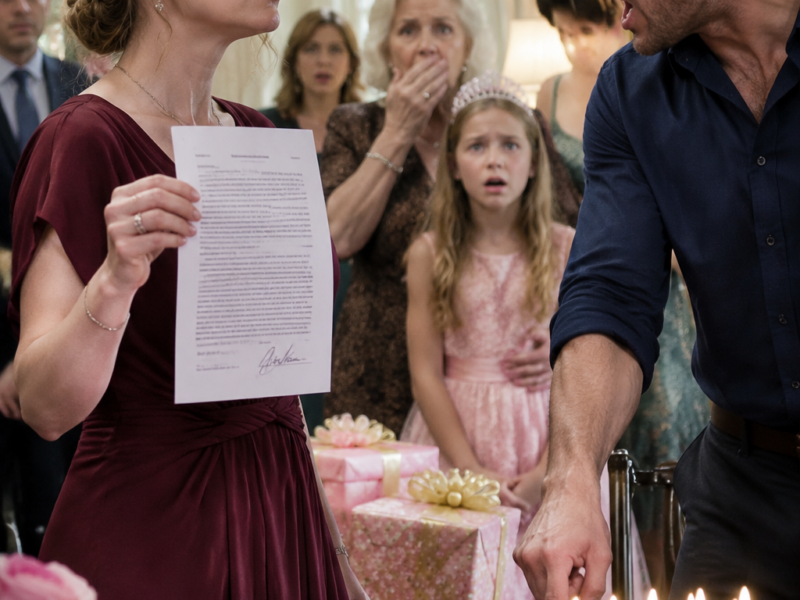
On Saturday, April 12, 2025, my husband stood in front of fifteen members of our family, raised a DNA test result into the air, and announced that our two-year-old daughter wasn’t his child.
He waited until everyone had gathered around the birthday cake. He waited until our little girl was wearing her favorite white dress, until the candles were ready to be lit, and until her grandparents, aunts, uncles, and cousins had filled our living room.
Then he destroyed everything.
What he didn’t know was that I had been carrying a document in my purse for four days. It was a document bearing his signature, and it would prove that his accusation was not only cruel but deliberately dishonest.
What I didn’t understand at the time was that the DNA test was only the beginning. My husband and his mother had been planning something much bigger than a public humiliation. They had already packed our daughter’s belongings, contacted a real estate agent, and prepared paperwork they expected me to sign without asking questions.
They believed I would be too embarrassed, too frightened, and too overwhelmed to fight back.
They were wrong.
My name is Claire Marsh. I was forty-four years old when all of this happened, and Daniel and I had been married for nine years. We had a comfortable house in Westerville, Ohio, a respectable marriage by most people’s standards, and a beautiful little girl named Sophie.
At least, that’s what I believed we had.
Sophie was standing beside a butterfly-shaped birthday cake that afternoon, holding a stuffed rabbit named Buttons beneath one arm. My mother, Helen, had bought her the little white dress she was wearing. It had delicate embroidered flowers around the collar, and Sophie had already managed to get a small spot of frosting on one sleeve.
She was two years old, full of energy, and completely unaware that the adults around her were about to turn her birthday into something she would never understand.
Daniel was standing near the coffee table with a glass of lemonade.
He suddenly cleared his throat.
“I need everyone’s attention.”
I remember looking at the cake and thinking that perhaps he wanted to say a few words before we sang Happy Birthday.
I had spent the entire morning decorating the living room with pink and yellow butterflies. There were balloons tied to the dining chairs, presents arranged beneath a paper banner, and a little table filled with sandwiches, fruit, and cupcakes.
Fifteen people had come to celebrate.
My mother and two cousins were there. Daniel’s older sister, Margaret, had arrived with her husband. His mother, Patricia, stood near the hallway, looking unusually composed.
I smiled at Daniel.
“Can we do the cake first?”
He ignored me.
Instead, he reached into his pocket and unfolded a piece of paper.
“I got the results back.”
My smile disappeared.
Four days earlier, Daniel had told me that he had arranged a DNA test.
He had been unusually secretive about it, refusing to explain why he suddenly needed one. When I asked what he was trying to prove, he simply said that he needed answers.
I had been confused, but I hadn’t panicked.
There was a reason I hadn’t panicked.
Daniel and I both knew exactly how Sophie had been conceived. Her birth was the result of a fertility treatment we had discussed, researched, and agreed to together.
There had never been an affair. There had never been another man secretly involved in our marriage.
But Daniel had insisted that he wanted a DNA test, and I had hoped he was experiencing some kind of personal crisis that he would eventually explain.
Now, standing in front of our families, he lifted the paper.
“The test says I’m not Sophie’s biological father.”
For several seconds, nobody moved.
Then Daniel looked directly at me.
“Two years, Claire. Two years I’ve been raising another man’s child.”
I felt the room tilt around me.
My mother was the first to react. She stepped toward Sophie, instinctively placing herself between our daughter and the growing tension.
But Patricia moved in a different direction.
She walked to the hallway and pushed two suitcases into the living room.
One was a large gray suitcase.
The other was pink.
“Take your things,” she said coldly. “And take that girl. This family has done enough for you.”
I stared at the pink suitcase.
Sophie’s spare blue sweater was hanging from the zipper.
Someone had packed my daughter’s clothes before her birthday guests arrived.
Someone had taken the time to decide which belongings she would need when she was suddenly removed from the home she had lived in since birth.
I looked at Patricia, then at Daniel.
Neither seemed surprised by the suitcases.
Sophie tugged at my dress.
“Mommy?”
I bent down and picked her up.
“You’re okay, sweetheart.”
She rested her head against my shoulder, still holding Buttons.
Daniel pointed at the paper.
“Are you going to explain this?”
I looked around the room.
His cousin David was staring at his shoes. Margaret had one hand covering her mouth. My mother looked as though she was considering using the cake server for something other than cutting cake.
I handed Sophie to Helen.
“Mom, could you take her into the kitchen for a minute?”
Helen looked at me, then at Daniel.
“Are you sure?”
“Please.”
She took Sophie without another word.
Once they were gone, I turned toward my husband.
“Daniel, are you absolutely sure you want to do this here?”
“They deserve to know the truth.”
“And you understand what you’re accusing me of?”
“Don’t play games, Claire.”
I reached into my purse.
For four days, I had carried an envelope with me. After Daniel mentioned the DNA test, I had contacted the fertility clinic and requested a copy of the original consent acknowledgment.
I had hoped I would never need it.
Now I placed it on the coffee table.
“Then tell me why you signed this.”
Daniel glanced down.
His expression changed immediately.
Patricia leaned forward.
“What’s that?”
“The consent form from our fertility clinic.”
I opened the document and turned it toward the people standing closest to us.
“Daniel and I went through fertility counseling together. We discussed donor sperm. We reviewed the treatment, understood the medical implications, and signed the paperwork before Sophie was conceived.”
I pointed to the signature near the bottom.
“That’s Daniel’s signature.”
Nobody spoke.
David finally broke the silence.
“Wait. You two used a donor?”
“Yes,” I answered. “We did.”
Daniel rubbed his forehead.
“Claire, I didn’t have a choice.”
I stared at him.
“You chose the clinic. You attended the appointments. You sat beside me during counseling. You helped select the treatment. You even chose Sophie’s name before she was born.”
“That’s not the point.”
“Then what is the point, Daniel?”
He didn’t answer.
My mother returned to the doorway. Sophie was sitting in her high chair, eating crackers and occasionally dropping one onto the floor.
Helen looked at the DNA report.
“So you paid for a test to prove something you already knew?”
Nobody laughed, but one of Daniel’s cousins made an uncomfortable noise into his napkin.
My mother continued.
“That’s an expensive way to avoid an honest conversation.”
Patricia stepped between Daniel and me.
“Put that medical paperwork away. It’s disgusting to discuss private family matters in front of everyone.”
I looked at her.
“Your son just accused me of cheating in front of everyone.”
“He was upset.”
“He brought a DNA report to his daughter’s birthday party.”
“Because you’ve put him through enough!”
I was about to respond when Patricia said something that made my stomach tighten.
“Daniel signed those papers because I kept telling you two to have a baby. I was the one who convinced him.”
I stared at her.
“You knew?”
“Of course I knew.”
“You knew we used a donor?”
She looked irritated by my question.
“Yes, Claire. I knew.”
Margaret stepped forward.
“Mom, then why are you acting like this is news?”
Patricia ignored her.
“I wanted my son to have a family. I wanted a grandchild. But when Daniel finally decided he wanted a real family, I wasn’t going to stand in his way.”
A real family.
I thought about Sophie sitting in the kitchen, wearing the little white dress my mother had bought her.
I remembered Patricia holding her in the hospital. I remembered the blankets she had knitted, the photographs she had taken, and the way she used to tell everyone that Sophie was the greatest blessing her family had ever received.
“Patricia,” I said quietly, “you held that little girl when she was born.”
“Things change.”
Daniel finally spoke.
“Can we not make this worse?”
I looked at him.
“You brought fifteen people here to accuse me of something you knew I hadn’t done.”
He looked away.
I picked up my purse and walked toward the kitchen.
Patricia called after me.
“Don’t think those suitcases are the only arrangements we’ve made.”
I stopped.
“What arrangements?”
She glanced at Daniel.
He immediately gave her a warning look.
“Mom. Enough.”
That was the moment I understood that this wasn’t simply a husband losing his temper.
It wasn’t even just a marriage falling apart in public.
They had planned something.
And whatever they had planned went much further than two suitcases.
I didn’t leave immediately.
I went into the kitchen and found Sophie holding a cracker in each hand.
She smiled when she saw me.
“Cake?”
I almost cried.
“Not yet, sweetheart.”
My mother stood beside the refrigerator.
“Do you want me to call someone?”
“No. I’m taking Sophie to your place tonight.”
“Good.”
She lowered her voice.
“And Claire, I’ve got about three minutes of patience left. Your mother-in-law is using all of them.”
I kissed Sophie’s forehead and went upstairs to collect her medication, pajamas, toothbrush, and a few things she actually needed.
The pink suitcase Patricia had packed contained mostly clothes she had chosen herself. There were party shoes, two dresses, and a sweater Sophie had barely worn.
There were no diapers.
No medication.
No toothbrush.
Apparently, throwing a toddler out of a house was easier than remembering what a toddler actually required.
Margaret appeared in the bedroom doorway.
“Claire, I’m sorry.”
I continued folding Sophie’s pajamas.
“Did you know?”
She hesitated.
“Mom told me Daniel was going to talk about the marriage.”
“Did she mention the suitcases?”
Margaret looked down.
“Yes.”
I stopped folding.
“Then you knew something was happening.”
“I thought you two had already decided to separate.”
I stared at her.
“Did I look like a woman who knew she was separating? I spent yesterday picking up butterfly decorations.”
Margaret rubbed her hands together.
“Mom said you’d probably want to leave once Daniel explained everything.”
“That’s convenient.”
She looked miserable, but I wasn’t interested in making her feel better.
Downstairs, Daniel was waiting.
“I think it’s best if you stay with your mother for a while.”
I looked at him.
“Have you filed for divorce?”
“Not yet.”
“Do you have a court order telling me to leave?”
“Claire, it’s my house.”
He had purchased the Westerville property before we married. I had never disputed that. But for nine years, I had paid household bills, contributed to repairs, purchased furniture, and helped transform the property into a home.
I wasn’t going to resolve the legal questions in his hallway.
“I’m leaving tonight because Sophie needs somewhere peaceful to sleep. That doesn’t mean I agree with anything you’ve done.”
Daniel crossed his arms.
“You always make things complicated.”
I glanced toward the living room.
The unopened birthday presents were still sitting beneath the paper banner. The butterfly decorations were still hanging from the walls.
“No, Daniel. I think you managed that yourself.”
Then I asked him something I had been trying not to ask all afternoon.
“When did you stop loving her?”
His face tightened.
“Don’t make this about Sophie.”
“You started it at her birthday party. Who else is it about?”
He didn’t answer.
I carried our daughter to the car while my mother followed with the bags.
As we drove away, Sophie looked out the window.
“Where Daddy?”
“He’s staying home tonight, sweetheart.”
She thought about that for a moment.
“Buttons stay, Mommy.”
“Buttons stays with you.”
She seemed satisfied.
I wished I could say the same for myself.
My mother lived in a small ranch house outside Columbus. She had retired from the postal service six years earlier and had developed a particular philosophy about family emergencies.
Every problem, in her opinion, could be improved with clean towels, a decent breakfast, and a little less talking.
That first night, she made up the spare bedroom for Sophie and me.
Around two in the morning, Sophie woke up.
“Daddy?”
I pulled her close.
“He’s not here, sweetheart.”
She rubbed her eyes.
“Daddy home?”
I kissed the top of her head.
“Not tonight.”
She fell asleep again with Buttons pressed against her chest.
I stayed awake for another hour.
The following morning, I found Mom making scrambled eggs.
I hadn’t eaten much since the birthday party.
She put a plate in front of me.
“You need something in your stomach.”
“I’m not hungry.”
“Then eat for spite.”
I looked at her.
She shrugged.
“It’s a perfectly respectable reason.”
I managed half the eggs.
Then my phone rang.
The caller introduced himself as Kevin Miller, a local real estate agent.
He said he was confirming an appointment to discuss listing our Westerville house.
I stared at the phone.
“I’m sorry. What appointment?”
He paused.
“Your husband said you were both aware of the plan.”
“He hasn’t discussed selling the house with me.”
Kevin sounded uncomfortable.
He apologized and offered to email me the preliminary property information form.
When the email arrived, I read it twice.
Daniel was listed as the property owner. That part wasn’t surprising.
But there was a question asking whether his spouse was aware of the proposed sale.
The answer had been marked yes.
Beside my name was a phone number.
Patricia’s phone number.
I knew it by heart.
She had called me often enough over the years.
I phoned Kevin back.
“That’s not my number.”
He apologized again and said he would postpone the appointment until the situation was clarified. He also suggested that Daniel and I consult our respective attorneys regarding any disputed interests in the property.
I thanked him and ended the call.
Then I opened our household banking application.
For the first time in years, I started examining every transaction.
There were several transfers I didn’t recognize. Daniel had moved thousands of dollars out of accounts containing our household earnings over the preceding months.
At first, I had assumed some of them were work-related expenses.
Now I wasn’t sure.
The next afternoon, I stopped at a grocery store after work.
The household credit card was declined.
I tried it again.
The same thing happened.
I used my own debit card and sat in the parking lot afterward, checking my balance.
I began calculating daycare, gas, groceries, rent, legal fees, and every other expense I could think of.
I had been working part-time as a bookkeeper since Sophie was born. Daniel earned considerably more than I did, so we had arranged our household finances around his income.
I had thought it was practical.
Now I felt foolish.
That evening, I told Mom that I might need to move back permanently until I could afford my own place.
She put down her coffee.
“To Daniel, to the house, or to your old life?”
I looked at her.
“Those are three different things.”
“I know.”
“I can’t stay here forever.”
“No one’s asking you to.”
I stared at my hands.
“What if Sophie would be better off if we stayed together?”
Mom didn’t answer immediately.
Then she said something I would remember for the rest of my life.
“Claire, being married doesn’t automatically make a house safe.”
Later that evening, Kevin forwarded an email Daniel had sent him.
It read:
“My wife will cooperate once she understands her options.”
Below it was a reply from Patricia.
“Leave that to me. I know how to handle Claire.”
I sat at my mother’s kitchen table looking at those words.
For nine years, I had thought Patricia was controlling because she liked things done her way.
Now I understood that she had been helping Daniel plan my departure.
And she had expected me to cooperate.
I contacted a divorce attorney named Rebecca Shaw.
Her office was on the second floor of a small brick building in Columbus. The waiting room had three mismatched chairs, a coffee machine, and a framed photograph of Lake Erie on the wall.
I liked her immediately.
She listened without interrupting. She examined the fertility consent form, reviewed the preliminary property documents, and studied the bank statements I had brought.
She didn’t promise that everything would be fine.
That alone made her different from half the people I had spoken to.
“Was the procedure performed at the clinic?” she asked.
“Yes.”
“Did Daniel sign this voluntarily?”
“We went through counseling together. He signed everything.”
She nodded.
“Then his private DNA test does not automatically remove his legal responsibilities.”
I let myself breathe.
“So he can’t just announce that Sophie isn’t his?”
“He can say whatever he wants. That doesn’t mean the law agrees. Ohio has specific rules concerning consent to donor insemination.”
She explained that we would need to establish the relevant facts and pursue the matter through the appropriate legal process.
Then she examined the house documents.
“Your husband purchased the house before the marriage, but that doesn’t automatically settle every question about marital contributions or financial claims. We’ll need complete records.”
I asked whether Daniel might have to contribute toward my legal fees.
“Possibly, depending on the circumstances and what the court decides. But I won’t promise you an award we haven’t established.”
I appreciated her honesty.
I also hated it.
I had spent the previous week imagining that one appointment would somehow solve everything.
Instead, Rebecca explained that we needed to file for divorce, request appropriate temporary arrangements, obtain financial information, and work toward a reasonable settlement.
“How long?”
“Months, most likely.”
I looked at the papers on her desk.
“And how much?”
She gave me an estimate.
For a moment, I considered asking whether she offered payment plans for emotional disasters.
Instead, I wrote the numbers down.
Driving home, I remembered the first time Daniel and I sat together in a medical office discussing infertility.
It had been years earlier.
We had spent almost two years trying to have a baby. When the doctor explained that Daniel had severe male-factor infertility, he barely spoke for days.
One evening, I found him sitting on the back porch long after sunset.
I brought him a blanket.
He stared out into the yard.
“I guess I can’t give you a family.”
I sat beside him.
“You are my family.”
He shook his head.
“You know what I mean.”
We spent months discussing our options.
Adoption. Donor insemination. Living without children.
There were arguments, tears, and long periods when neither of us wanted to discuss the subject.
Patricia was actually the person who initially encouraged us to consider donor conception.
During one Sunday dinner, she had said something that stayed with me.
“A baby doesn’t need your blood to belong to your family. She just needs your love.”
I remembered feeling grateful.
Eventually, Daniel decided he wanted to try.
We attended counseling, reviewed the clinic paperwork, and signed the consent forms together.
When I became pregnant, Daniel cried.
He chose Sophie’s name.
He assembled her crib twice because he somehow ended up with three screws left over after the first attempt.
I asked whether we should be concerned about the structural integrity of our family.
He laughed.
“Only if she starts climbing before she’s eighteen.”
For Sophie’s first year, he was a wonderful father.
He stayed awake when she was sick. He sang ridiculous songs while changing diapers. He recorded her first steps and played the video for everyone at Thanksgiving.
I hadn’t imagined those things.
They happened.
That was what made the birthday party so difficult to understand.
A man can stop loving his wife. I knew that.
But how does someone stop being a father to a little girl he once held through the night?
Life didn’t give me much time to think about it.
My supervisor couldn’t offer full-time hours until another employee left later that summer. Daycare cost more than I remembered, and the legal process was already consuming money I hadn’t planned to spend.
Sophie cried almost every morning when I dropped her off.
One afternoon, she spotted a man in a navy work jacket outside the grocery store.
“Daddy!”
She started waving excitedly.
The stranger turned around, confused.
I picked her up and carried her to the car.
I sat there for several minutes while she played with the zipper on my coat.
Then my phone buzzed.
An unfamiliar number had sent me a message.
“My name is Melissa Grant. I work with Daniel. I think he’s been lying to both of us.”
I nearly deleted it.
Instead, I forwarded it to Rebecca.
She advised me not to argue with Melissa and to preserve anything relevant she voluntarily shared.
Two days later, I met her at a café near Polaris.
She was younger than me, neatly dressed, and looked as though she hadn’t slept properly in weeks.
She started with an apology.
I wasn’t ready to accept it.
“You knew he had a daughter?”
“Yes.”
“And you knew he was married?”
She lowered her eyes.
“He told me you were legally separated.”
“We weren’t.”
“He said you’d been living separate lives for months.”
“We were sleeping in the same bedroom.”
Melissa didn’t argue.
She explained that Daniel had told her Sophie was the result of an affair I had confessed to. According to him, he had spent two years raising a child who wasn’t biologically his while trying to save a marriage that had already ended.
He had portrayed himself as a man who had been betrayed.
I asked why she was contacting me now.
“Because his stories keep changing.”
She opened her phone and showed me their messages.
Daniel had promised that they would move into a new apartment after selling our house. He had asked her to contribute toward furniture because he claimed his money was temporarily tied up.
Then she opened another conversation.
“Claire will leave once Mom handles the party,” Daniel had written.
I read the sentence twice.
Melissa scrolled further.
“He said you wouldn’t want anybody knowing about the fertility treatment.”
My stomach tightened.
He had counted on my silence.
For years, I had protected his medical privacy. I had never discussed his infertility with friends, relatives, or coworkers without his permission.
He had mistaken that consideration for weakness.
Melissa continued scrolling.
At one point, she had asked Daniel whether he would miss Sophie.
His answer was dated several weeks before the birthday.
“After her birthday, I’ll finally be free of both of them.”
I couldn’t speak.
Melissa looked away.
“I didn’t know he meant it like that.”
I put her phone down.
Daniel hadn’t simply wanted a divorce.
He had wanted Sophie removed from his new life along with the woman he had married.
Melissa hesitated before showing me one final message.
“There’s something else.”
It was a conversation between Daniel and Patricia.
“Mom has the paperwork once Claire signs. We’re done.”
I looked up.
“What paperwork?”
Melissa shook her head.
“I don’t know.”
That evening, I sent the screenshots to Rebecca.
She called me a few minutes later.
“Keep the originals if Melissa is willing to preserve them. Don’t confront Daniel.”
“Do you think there’s something else?”
“I think we need to find out exactly what his mother prepared for you.”
I looked across the living room.
Sophie was sitting on the carpet, trying to put Buttons’ little blue sweater on the wrong way.
I wondered how much more of my marriage had already happened without me knowing.
Patricia called me eleven times over the following three days.
I let every call go to voicemail.
Her first messages were polite.
“Claire, we need to talk like adults.”
By the fourth one, she had abandoned politeness.
“You can’t keep dragging this family through your personal problems.”
The final message was different.
She said she had a solution.
I called Rebecca.
“Let her send whatever she’s proposing to my office,” Rebecca advised. “Don’t negotiate on her doorstep.”
That was good advice.
Patricia came to my mother’s doorstep anyway.
It was a Thursday afternoon in June.
Mom answered the door and found Patricia standing outside with a large envelope.
She was wearing pearls.
She always wore pearls when she intended to be unreasonable.
“I’m here to help Daniel resolve this unfortunate situation,” she announced.
Mom looked at the envelope.
“That’s a shame. I was hoping you were here to apologize.”
Patricia tried to step inside.
Mom remained in the doorway.
I came out of the kitchen.
“What do you want, Patricia?”
She held out the envelope.
“Daniel is willing to be generous, but you need to stop fighting him.”
“I have an attorney.”
“Attorneys only make things worse.”
“Then you’ll be relieved to know mine has a very good reputation.”
Patricia tightened her grip on the envelope.
“Your husband doesn’t want to spend the next year arguing about money.”
“Neither do I.”
“Then sign this.”
I took the envelope.
“I’ll have Rebecca review it.”
Her mouth flattened.
“Claire, there comes a point when you need to be reasonable.”
“That’s exactly why I’m having it reviewed.”
She left without saying goodbye.
At Rebecca’s office, we opened the envelope together.
Inside was a proposed separation agreement prepared on Daniel’s behalf.
The terms were heavily weighted in his favor.
He would retain the house and most of the assets under his control. I would receive a fixed payment in exchange for releasing certain property claims.
The proposed parenting and support arrangements also favored Daniel.
Rebecca read through everything carefully.
“Signing a private agreement doesn’t simply erase his legal parenthood or Sophie’s rights. But agreeing to unfavorable terms could create serious problems.”
Then she noticed a yellow sticky note attached to the front page.
Patricia had written:
“This is the cleanest way for everyone. Sign before Daniel changes his mind.”
Rebecca stared at it.
“They seem to think urgency is a substitute for fairness.”
I felt embarrassed because, for one brief moment, standing in my mother’s kitchen, I had considered signing anything that would make the phone calls stop.
Rebecca must have noticed my expression.
“Claire, people make poor decisions when they’re exhausted. That’s why we review documents before anybody signs them.”
We went through the terms carefully.
I left with more questions than answers, but at least I understood what Daniel was asking me to surrender.
Over the following weeks, financial disclosures began arriving.
The records showed that Daniel had transferred approximately fourteen thousand dollars from an account containing marital earnings into an individual account.
Some of the money had paid for his apartment.
Some had gone toward furniture and personal expenses.
Daniel argued that he had earned most of the money and had a right to spend it.
Rebecca explained that the source and use of the funds mattered, especially during the breakdown of a marriage.
She didn’t automatically classify every transfer as improper.
She simply asked for documentation.
Daniel’s attorney supplied some receipts. Others required further explanation.
I learned more about our household finances during those weeks than I had learned in nine years of marriage.
It wasn’t flattering.
I had been capable of balancing other people’s books at work while trusting my husband to handle nearly everything at home.
One evening, I admitted that to Mom.
She was folding Sophie’s little socks.
“Claire, trusting somebody isn’t the same as being stupid.”
“Maybe not, but I should have paid more attention.”
“Then pay attention now.”
That became my rule.
I read every statement.
I kept copies of every email.
I asked questions when I didn’t understand something.
And I stopped apologizing for needing time to think.
In July, Margaret came to my mother’s house.
She brought a gift bag containing a children’s book.
“I bought this for Sophie’s birthday,” she said. “It never got opened.”
I let her inside.
We sat at the kitchen table while Sophie colored in the next room.
Margaret looked uncomfortable.
“I should have said something at the party.”
“Yes,” I answered. “You should have.”
She nodded.
“Mom told me Daniel had discovered something about the marriage. She said you’d probably leave.”
“Did she tell you she’d packed Sophie’s suitcase?”
Margaret looked down.
“Yes.”
I waited.
“I thought they were helping you pack.”
“Helping me?”
“I know how it sounds.”
“Margaret, they packed my daughter’s favorite rabbit before they told me I was being thrown out.”
She covered her face.
“I know.”
I didn’t rescue her from the discomfort.
After a moment, she explained that Patricia had controlled family disagreements for as long as she could remember.
When Daniel was younger, Patricia had interfered in his engagement to another woman. Margaret had learned that disagreeing with their mother could make family holidays miserable for months.
“I learned to stay quiet,” she admitted.
“It was easier for you,” I said.
She looked at me.
“It wasn’t easier for Sophie.”
She accepted that.
Then she told me something else.
Patricia had been talking at church.
She had told several people that I had cheated on Daniel and forced him to raise another man’s child.
I was furious.
That night, I wrote a long social media post.
I explained the fertility treatment, Daniel’s consent, the birthday party, the suitcases, and Patricia’s lies.
I wanted everyone to know the truth.
I wanted to stop feeling as though I had to defend myself every time someone whispered behind my back.
But then I looked at Sophie asleep beside Buttons.
One day, she would be old enough to understand all of this.
I didn’t want strangers discussing her conception because I needed to win an argument.
So I deleted the post.
Instead, I spoke with Rebecca and then contacted Pastor James.
He already knew there were rumors. He was concerned that Patricia was using church acquaintances to spread accusations he couldn’t verify.
He offered to arrange a voluntary meeting with the immediate family.
I refused at first.
The last family gathering hadn’t gone particularly well.
Then Margaret sent me a photograph.
It showed Patricia in the hospital, holding newborn Sophie.
She was smiling so widely that her eyes had nearly disappeared.
On the back, in Patricia’s handwriting, were the words:
“No matter how you came into this family, you will always belong to us.”
I stared at that photograph for a long time.
Margaret called.
“Mom still has her old family binder,” she said. “She keeps photographs and letters in it. She’s bringing it to the meeting.”
“Why?”
“She says it’ll prove you never belonged.”
I looked at the photograph again.
I’d spent months trying to explain what Patricia had done.
Maybe I didn’t need to explain it anymore.
Maybe she needed to hear what she had once believed herself.
I agreed to attend the meeting with clear boundaries.
Sophie would stay with my mother.
For once, I wasn’t going to let Patricia tell the only version of the story.
The meeting took place on a Sunday afternoon in July.
Pastor James had reserved a small room at the church. There was a long folding table, a water pitcher, and a basket of wrapped peppermints.
Patricia arrived carrying a binder thick enough to qualify as office equipment.
My mother leaned toward me.
“If that thing gets any bigger, she’ll need a building permit.”
I almost laughed.
Daniel came in behind his mother.
He looked tired.
I’d heard through Margaret that things with Melissa weren’t going particularly well, but I hadn’t asked for details.
I was there for one reason.
To stop the lies about Sophie and me.
Pastor James opened the meeting.
“We’re not here to decide anyone’s divorce. Nobody is being asked to sign anything. We’re here because serious accusations have been repeated among family members and people in this church.”
Patricia folded her hands.
“I’m glad we’re finally addressing the damage Claire has caused.”
Margaret sighed.
“Mom.”
Patricia ignored her.
“My son has suffered terribly. He was led to believe he had a daughter, and now we’re supposed to pretend nothing happened.”
I looked at Daniel.
“Did you agree to use donor sperm?”
He stared at the table.
Patricia answered for him.
“He was under pressure.”
I turned toward Daniel.
“Did you agree?”
A long silence followed.
Finally, he said, “Yes.”
“Did you know before the treatment that Sophie wouldn’t be genetically related to you?”
“Yes.”
“Did you sign the consent?”
“Yes, Claire.”
“Then why did you tell everyone I cheated?”
He rubbed his forehead.
“I was angry. I wanted out.”
It was the first time he had admitted that plainly.
I nodded.
“You wanted to leave the marriage.”
“Yes.”
“Then you could have told me that.”
Patricia interrupted.
“You don’t understand how difficult this has been for him.”
I turned toward her.
“I understand that he wanted a divorce. I don’t understand why that required humiliating a two-year-old.”
Patricia opened her binder.
“Because this family has spent years supporting you, Claire. I’ve kept records.”
She began flipping through photographs, greeting cards, and handwritten notes about family gatherings.
Apparently, she had brought a scrapbook to prove ownership of other people’s gratitude.
Margaret leaned forward.
“Mom, is that the picture from the hospital?”
Patricia stopped turning pages.
“What picture?”
“The one where you’re holding Sophie.”
Patricia glanced down.
“That has nothing to do with this.”
Margaret took a copy from her purse.
“I think it does.”
She placed the photograph on the table.
Everyone could see Patricia smiling down at a newborn baby.
Margaret turned it over.
“Mom, did you write this?”
Patricia looked at the handwriting.
“Yes.”
Margaret read aloud.
“No matter how you came into this family, you will always belong to us.”
The room went quiet.
Margaret looked directly at her mother.
“When exactly did Sophie stop being your miracle?”
Patricia’s face hardened.
“Things changed.”
“DNA didn’t,” Margaret replied.
Patricia began explaining that she had only wanted what was best for her son.
Margaret didn’t let her finish.
“You encouraged them to use a donor. You went to the baby shower. You called Sophie your little miracle. Then you packed her suitcase and told her mother to take her away.”
“I was helping Daniel.”
“Helping him do what?”
Patricia had no answer that sounded good in front of other people.
I looked at the photograph.
For a moment, I remembered that woman.
The one who had called every morning during my pregnancy.
The one who had knitted Sophie a blanket.
The one who had cried at the hospital because she finally had a granddaughter.
I had loved her once.
That was another loss nobody had talked about.
Patricia turned toward me.
“Claire, you have no idea what it’s like to watch your child suffer.”
I almost said something cruel.
Instead, I asked a question.
“Then why were you willing to make mine suffer?”
She looked away.
I took a copy of the realtor’s preliminary form from my folder.
“Patricia, why did you give the realtor your phone number and tell him it was mine?”
She straightened.
“Daniel asked me to help.”
“Did he ask you to tell the realtor I knew about the sale?”
“I assumed you did.”
“Then why didn’t you call me?”
She didn’t answer.
I placed the yellow sticky note from the proposed agreement beside it.
“And why did you tell me to sign this before Daniel changed his mind?”
“Because lawyers make everything complicated.”
My mother spoke from the other end of the table.
“Apparently, they’re also very good at reading.”
A few people laughed.
Patricia looked furious.
Then Daniel made his mistake.
“Mom took things too far,” he said. “I never wanted it to become this ugly.”
I turned toward him.
“Your mother didn’t order that DNA test.”
He looked up.
“Claire—”
“She didn’t stand in front of our families and accuse me of cheating.”
“I was upset.”
“She didn’t tell Melissa that we were already separated.”
Daniel went completely still.
Patricia looked at him sharply.
“Who is Melissa?”
For once, I wasn’t the person with the uncomfortable question.
Daniel stared at me.
“She’s been talking to you?”
“She wanted to know why you told her Sophie was the result of an affair.”
He looked toward the door.
Patricia began demanding explanations.
Pastor James asked everyone to lower their voices.
I waited until the room was quiet.
Then I said, “Your mother packed the bags. Daniel, you rejected our daughter. Those were two separate decisions.”
Daniel leaned back.
“I didn’t think it would turn into this.”
I looked at him for a long moment.
“You made our daughter’s birthday into a trial. What exactly did you think would happen?”
Nobody defended him.
Not even Patricia.
Pastor James finally spoke.
He told Patricia that he could not allow church activities to become another place where accusations known to be false were repeated.
He asked her to step back temporarily from coordinating the family outreach program while the matter was addressed.
Patricia was outraged.
“I’ve served this church for twenty years!”
James nodded.
“Then you understand how important trust is.”
Margaret told her mother she would no longer allow her to control every family gathering.
Several relatives who had attended the birthday party apologized to me.
One cousin admitted that he knew Daniel had discussed donor conception years earlier but had been too uncomfortable to speak.
I thanked him for saying so.
I didn’t tell him it was all right.
It hadn’t been.
After the meeting, Daniel followed me into the hallway.
“Claire.”
I stopped.
“Can we just settle this divorce without more people getting involved?”
“Rebecca has been trying to do that for weeks.”
He looked exhausted.
“I was a good father before all this.”
That hurt more than anything else he had said that day.
Because it was true.
“I know,” I answered.
He looked surprised.
“I remember you sitting up with her when she had a fever. I remember you teaching her to stack blocks. I remember you crying when she said ‘Daddy’ for the first time.”
He swallowed.
“Then you know I love her.”
“I know you did, Daniel.”
He looked at me.
“I don’t know what you feel now. You spent months telling people she wasn’t yours. That’s something you’ll have to live with.”
He stared at the floor.
I walked outside.
Margaret was waiting by my car.
“I’m sorry I stayed silent,” she said.
“You should have stopped them.”
“I know.”
We stood there for a moment.
Then she said, “If you ever need help with Sophie, I’d like to be there.”
I didn’t promise anything.
But I thanked her.
That night, after Sophie was asleep, my phone buzzed.
It was Daniel.
“I want to see Sophie. I know I don’t deserve to ask, but I want to try.”
I sat on my mother’s couch reading the message.
For months, I had wanted him to understand what he had done.
Now that he might, I wasn’t relieved.
I was terrified he would break her heart again.
The divorce wasn’t finalized the week after that meeting.
I wish I could tell you the whole thing ended with Daniel signing a check, Patricia admitting she was wrong, and me riding into the sunset with a new haircut.
It didn’t.
There were financial statements. Lots of them.
There were attorney meetings, childcare arrangements, property discussions, and evenings when I sat at my mother’s kitchen table calculating whether I could afford an apartment closer to Sophie’s daycare.
Daniel’s attorney eventually provided the missing records concerning the money he had transferred.
Some expenses were ordinary.
Others were connected to his new apartment and the life he had planned with Melissa.
The attorneys negotiated how those transfers would be accounted for when dividing the marital assets.
Daniel didn’t get to keep everything he had quietly moved.
I didn’t get every dollar I initially wanted.
The agreement took time, compromise, and more money in legal fees than I liked.
But it was based on records, not threats.
The house was eventually sold under our negotiated settlement, and our respective interests were addressed.
Daniel remained Sophie’s legal father, with child support and parenting arrangements established through the divorce process.
My full-time position at the bookkeeping office finally became available in late summer.
The benefits were decent.
The hours were long.
I was grateful for both the paycheck and the health insurance.
By early fall, Sophie and I had moved into a two-bedroom apartment.
It had a small balcony, an old refrigerator, and a kitchen drawer that refused to stay shut.
On moving day, Mom brought a box labeled KITCHEN.
Inside were two mugs, a roll of packing tape, and Buttons.
I held up the rabbit.
“Why is he in the kitchen box?”
Mom shrugged.
“Because apparently he’s the only one in this family who knows where everything belongs.”
For the first time in months, I laughed without feeling guilty afterward.
Around that time, Melissa contacted me once more.
She told me she had ended things with Daniel.
He had continued changing his story, particularly about the house and the money. He had also given her a small promise ring, which she had returned.
“I’m sorry,” she wrote.
“I should have asked more questions,” I answered honestly.
“You should have.”
Then I added, “I appreciate you telling me the truth when you did.”
That was the end of our communication.
I didn’t need to become friends with Melissa.
I also didn’t need to spend the rest of my life hating her.
Daniel’s choices belonged to Daniel.
The hardest part wasn’t the financial settlement.
It was Sophie.
Rebecca helped ensure that Daniel’s request for parenting time was handled through the proper arrangements, with attention to Sophie’s age and the long separation.
I wanted to say no.
I wanted to protect her from every disappointment.
But I also knew that my anger at Daniel couldn’t be the only thing deciding her future.
The first visit was arranged in a familiar setting, with a gradual schedule intended to help Sophie become comfortable.
Daniel arrived early.
He had brought a picture book and a new stuffed rabbit.
Sophie stood beside me, holding Buttons.
Daniel knelt.
“Hey, sweetheart. Remember me?”
She looked at him.
Then she turned toward me.
“Mommy, can we go home?”
Daniel’s expression changed.
He tried to start a little game they used to play.
She didn’t respond.
He offered her the new rabbit.
She shook her head.
“No, thank you.”
Then she tucked Buttons under her arm and leaned against my leg.
I watched Daniel sit on the carpet.
He looked older than he had at the birthday party.
There was no audience this time.
No relatives to persuade.
No mother standing behind him telling him what to say.
Just his daughter, who no longer knew what to expect from him.
After several minutes, he opened the book and began reading.
Sophie listened.
Eventually, she moved a little closer.
She didn’t sit on his lap, but she pointed to a picture of a dog.
Daniel smiled.
“That’s right. A puppy.”
It was a tiny beginning.
I didn’t make more of it than it was.
Afterward, Daniel sent me a message.
“I didn’t realize how much she’d changed.”
I wrote three angry replies and deleted them.
Then I sent:
“She didn’t stop growing while you were deciding whether you wanted to be her father.”
He didn’t answer.
Over the following months, he began attending visits more consistently.
He missed one early appointment and arrived late for another.
I documented those things and dealt with scheduling concerns through the agreed process.
I stopped making excuses for him.
When Sophie asked why Daddy wasn’t there, I gave her a simple answer.
“He couldn’t make it today.”
I didn’t tell her he was wonderful.
I didn’t tell her he was terrible.
I told her what had happened.
Eventually, Daniel started asking useful questions.
What books did she like now?
Was she still afraid of loud vacuum cleaners?
Did she prefer apples or strawberries?
One afternoon, he arrived without a present.
He simply sat with her and helped her build a tower out of wooden blocks.
Sophie knocked it down.
He laughed.
For a moment, I remembered the father he had once been.
I hoped he would keep showing up.
But hoping wasn’t the same as trusting.
Thanksgiving came in November.
For years, Patricia had hosted the family meal.
This time, Margaret invited several relatives to her house.
She made it clear that she wasn’t willing to have children sit through another discussion about whether Sophie belonged in the family.
Patricia refused to attend unless she hosted.
Margaret didn’t argue.
She simply went ahead with her plans.
Later, I heard Patricia had cooked enough turkey for twelve people and ended up with four guests.
I felt a small, uncharitable satisfaction.
Then I went back to peeling potatoes.
Mom asked whether I had heard from Patricia.
“Only through Margaret.”
“How’s she taking it?”
“Apparently, she thinks everyone’s being unfair.”
Mom nodded.
“Well, at least she’s consistent.”
Patricia eventually sent me a letter.
It was three pages long.
Most of it explained why she had been trying to protect Daniel.
Near the end, she wrote that she missed Sophie and wanted to give her the blanket she had knitted before she was born.
I didn’t agree to an unplanned visit.
Margaret helped arrange for the blanket to be delivered.
It was white with pale yellow trim.
Across one corner were the words:
“Grandma’s little miracle.”
I folded it carefully and put it in Sophie’s closet.
I didn’t throw it away.
Patricia had loved her once.
I wasn’t going to pretend otherwise.
But I wasn’t going to confuse a gift with an apology, either.
The months passed.
There were bills, daycare colds, laundry, and mornings when I couldn’t find matching socks.
I was busy.
Not the kind of busy that makes a good movie.
The kind where you buy milk, forget laundry detergent, and spend twenty minutes looking for your car keys.
Little by little, our apartment began to feel like home.
Then April came around again.
Sunday, April 12, 2026.
Sophie’s third birthday.
This time, we had eight guests.
Mom brought cupcakes.
Margaret brought a picture book.
I ordered pizza and forgot to buy paper plates.
We used napkins.
Nobody complained.
Sophie wore a pink paper crown and carried Buttons everywhere.
When Mom put the cake on the table, Sophie climbed onto my lap.
Everyone started singing.
She blew out her candle before we reached the last line.
We laughed.
“Again!” she demanded.
Mom relit the candle.
Sophie blew it out.
Then she wanted another turn.
“How many times are we doing this?” Margaret asked.
“As many as she wants,” I answered.
Mom reached for the lighter.
“At this rate, she’ll be old enough to drive before we get dessert.”
We laughed again.
And for a moment, I remembered the previous birthday.
The suitcases.
The DNA report.
Daniel standing in front of our families.
Patricia telling us to leave.
I remembered the cake nobody finished and the candles Sophie never got to blow out.
Then Sophie tugged at my sleeve.
“Mommy, look!”
She held up three sticky fingers.
“I’m three!”
“You certainly are.”
She grinned.
Helen took a picture of us.
Later that night, after everyone had gone home, I found the photograph on my phone.
Sophie was sitting on my lap.
Her crown was crooked.
There was frosting on her chin.
And I was laughing.
Not smiling for the camera.
Actually laughing.
I printed the picture and put it in a frame beside her bed.
That evening, Daniel sent a birthday message.
He had celebrated with Sophie during his scheduled visit and wanted to know whether she had enjoyed her party.
I told him she had.
He replied:
“I’m glad.”
For once, I believed he meant it.
Whether he would become the father Sophie deserved remained to be seen.
I couldn’t do that work for him.
And I couldn’t make his mother become the grandmother she had once promised to be.
Those were their choices.
For a long time, I thought my greatest mistake had been trusting Daniel.
But I don’t believe that anymore.
We made the decision to have Sophie together.
We wanted her.
We loved her.
I wasn’t foolish for believing that love would last.
Daniel’s failure didn’t make those years a lie.
It meant he had broken a promise that mattered.
I used to think protecting my family meant keeping private things private, even when that meant swallowing my own hurt.
Now I understand that there is a difference between protecting someone’s dignity and protecting their dishonesty.
I didn’t get the marriage I imagined when Daniel and I first walked into that fertility clinic.
I got a smaller home, a tighter budget, and more responsibility than I ever expected.
But I also got peace.
I got mornings without wondering what someone was planning behind my back.
I got a daughter who could laugh in her own living room without being told she didn’t belong.
I learned that family isn’t established by a signature on a medical document, a shared surname, or even a biological connection.
It’s established by the people who continue showing up when life becomes difficult.
Daniel had signed the fertility consent form because he wanted to become a father.
He had known exactly what that decision meant.
He had held Sophie when she was born, chosen her name, celebrated her first steps, and spent countless nights caring for her.
A DNA test could never erase those memories.
But neither could those memories excuse what he had done.
Perhaps one day he would understand that being a father wasn’t something he could accept only when it suited his life.
Perhaps Patricia would eventually recognize that the little girl she once called her miracle was still the same little girl she had helped send away.
I didn’t know.
And for the first time, I understood that I didn’t have to spend my life waiting for either of them to change.
On Sophie’s third birthday, I watched her blow out her candle three times.
Nobody interrupted.
Nobody made a speech.
Nobody brought suitcases.
We simply ate the cake.
And when she fell asleep that night, Buttons tucked beneath her arm, I sat beside her bed and looked at the framed photograph of us laughing.
I thought about the woman I had been one year earlier.
She had stood in a living room full of relatives, holding a document that proved her husband had lied.
She had believed that if she could just make everyone understand the truth, everything might somehow return to normal.
But some things don’t return to normal.
Sometimes they end.
Sometimes the people you trusted become strangers.
Sometimes you have to build a new life from whatever remains.
And sometimes, the most important thing you can do is refuse to let someone else’s shame become your child’s identity.
Sophie would grow up knowing she was wanted.
She would know that her mother had chosen her, loved her, and fought to give her a peaceful home.
She would never have to earn her place in my family.
She already belonged.
And that was the one truth nobody could take away from us.









