“She’s Just a Placeholder,” the Charge Nurse Said — Until Special Ops Stormed In and Called Her G…
“She’s Just a Placeholder,” the Charge Nurse Said — Until Special Ops Stormed In and Called Her G…
Riverside Community Hospital was not the kind of place where anyone expected a miracle.
It was a modest Level II trauma center serving several surrounding counties, a hospital where the equipment was reliable enough, the doctors were reasonably competent, and the coffee tasted as though someone had brewed it using an old pair of socks. It handled car accidents, agricultural injuries, strokes, respiratory emergencies, and the endless stream of ordinary tragedies that arrived through its emergency department doors every day.
Nothing about the building suggested that it might one day become the center of a military operation.
And certainly nothing about the quiet woman working there suggested that she had once been one of the most valuable medical specialists in an elite special operations unit.
Her name was Kiera Malone.
At thirty-four, Kiera had learned that the easiest way to survive almost any workplace was to become invisible. She arrived early, completed her assignments, spoke only when necessary, and never volunteered information about herself. She didn’t complain when someone gave her the least desirable tasks, and she never corrected people who underestimated her.
Six months earlier, she had accepted a temporary nursing contract through a staffing agency. Before that, she had spent nearly two years in a rented room in Spokane, Washington, doing almost nothing except watching television, ordering cheap groceries, and trying to convince herself that the person she used to be no longer existed.
Her savings had been disappearing.
Eventually, even isolation became expensive.
So she found work.
On her first morning at Riverside, she had barely finished signing the employment paperwork when the head nurse, a sharp-tongued woman named Dietrick, looked at her file and announced to another nurse that they had hired a substitute.
Not a replacement.
Not an additional member of the team.
A substitute.
A temporary body to fill whatever gaps appeared in the schedule until someone more permanent could be found.
“She’s just a placeholder,” Dietrick had said, without bothering to lower her voice.
Kiera had heard her.
Of course she had.
She simply continued organizing the medical supplies in front of her.
Dietrick wore authority as though it were protective armor. She had been at Riverside for years, knew every hospital procedure by heart, and seemed to believe that seniority gave her the right to decide whose contributions mattered.
From the beginning, she made it clear that Kiera would remain at the bottom of the department’s informal hierarchy.
The less desirable assignments went to her. The less experienced nurses received the better opportunities. Whenever an interesting case arrived, Dietrick found a reason to keep Kiera away from it.
Kiera never argued.
She had spent years learning that not every battle deserved her attention.
Besides, she wasn’t at Riverside to build a career. She wasn’t interested in promotions, recognition, or professional friendships.
She wanted something much simpler.
A routine.
A quiet place where nobody asked about her past.
A place where the most dangerous thing she encountered might be an elderly patient with dangerously low oxygen levels or a man who had driven his pickup truck into a ditch after drinking too much.
She wanted ordinary problems.
She wanted ordinary days.
And most importantly, she wanted to remain Kiera Malone.
Because there had been another name once.
Ghost.
It was a call sign given to her by people who understood exactly what she could do. A name associated with missions in places where the difference between a successful evacuation and a funeral could be measured in seconds.
There had been a time when men twice her size followed her instructions without hesitation.
A time when she could recognize a life-threatening injury from across a room, when she could work under gunfire without allowing her hands to shake, and when she had learned to make decisions that most people would struggle to make even in their worst nightmares.
She had served in a specialized military medical unit attached to an elite special operations team.
She had two medals locked inside a shoebox in her closet.
She also had a small fragment of 7.62-millimeter steel embedded near her left shoulder. A surgeon in Landstuhl had eventually removed most of it, but the injury had left her with a persistent ache whenever the weather changed.
She rarely mentioned it.
She rarely mentioned anything.
The last time she had responded to the call sign Ghost had been three years earlier.
Three years since she had watched the desert swallow the last pieces of the life she once understood.
Three years since she had decided that whatever happened next, she would never return to that world.
On a Thursday morning, Kiera was checking the emergency cart in the second trauma bay when Dr. Ingram approached her with a patient chart.
He was a middle-aged emergency physician with fifteen years of experience, a generally decent man who had become accustomed to working around Dietrick’s personality.
He didn’t look particularly concerned.
“In the sixth bay,” he said, glancing at the chart. “Elderly woman. Seventy-one. End-stage COPD. She’s been having trouble breathing since admission.”
Kiera stopped checking the airway equipment.
“What’s her oxygen saturation?”
“Eighty-four on two liters.”
“When was that recorded?”
“About twenty minutes ago.”
“Has she had an arterial blood gas?”
“Not yet. Dietrick is occupied with a sepsis patient in the fourth bay, and her assigned nurse is on break.”
Ingram hesitated.
Then he handed Kiera the chart.
“Could you check her respiratory status and get the blood gas process started? Just handle the basics until the assigned nurse returns.”
“Of course.”
Kiera took the chart and walked toward the sixth bay.
The patient was lying almost flat on her back, gripping the metal bed rails with both hands.
Her name was Paulette Shearer.
She was a small woman with silver hair, delicate features, and the faint smell of talcum powder that reminded Kiera of her grandmother. A thin hospital blanket covered her body, and a portable oxygen line ran beneath her nose.
The woman looked frightened.
Not simply uncomfortable.
Frightened.
Kiera pulled the curtain closed.
“Good morning, Mrs. Shearer. I’m Kiera. I’m going to check on you for a moment.”
Paulette nodded weakly.
“Am I getting worse?”
The question was quiet, almost apologetic.
Kiera had heard similar questions from frightened patients in far less comfortable places.
She pulled a stool closer to the bed.
“Let’s take a look first. You don’t have to worry about answering anything quickly.”
She checked the monitor, observed the patient’s breathing pattern, and examined her respiratory effort.
Something wasn’t right.
The monitor showed an oxygen saturation of seventy-nine percent, not eighty-four.
Paulette’s breathing had become increasingly labored. Her neck muscles were contracting with every breath, and the movement of her chest suggested that she was working much harder than the monitor alone indicated.
Kiera leaned closer.
“Mrs. Shearer, can you tell me whether breathing feels harder when you’re lying down?”
The woman nodded.
“Like someone is sitting on my chest.”
Kiera adjusted the patient’s position, raising the head of the bed and supporting her shoulders. She checked the oxygen delivery system, confirmed the tubing was functioning properly, and adjusted the flow within the appropriate prescribed range while arranging for an immediate reassessment.
She also requested an arterial blood gas analysis.
“Your breathing is doing more work than it should,” she explained. “We’re going to make you more comfortable while the doctor checks what’s happening.”
Paulette’s fingers slowly loosened around the bed rails.
For the next forty minutes, Kiera remained nearby, observing her respiratory effort and monitoring the changes.
She didn’t rush.
She didn’t overwhelm the frightened woman with medical terminology.
She simply stayed.
By the time the assigned nurse returned, Paulette’s oxygen saturation had improved to ninety percent, and her breathing was noticeably less distressed.
The nurse, a young woman named Tompkins, stopped beside the monitor.
“What happened?”
Kiera looked up from the chart.
“I repositioned her and adjusted the oxygen delivery. Her respiratory status was worse than the previous reading suggested. She needs an arterial blood gas as soon as possible.”
Tompkins frowned.
“I can handle her myself.”
“Of course.”
“I don’t need someone else changing things without telling me.”
Kiera glanced at her.
“I’ve documented everything.”
Tompkins took the chart with a slightly irritated expression.
Kiera stepped away.
She didn’t argue, explain herself, or remind the younger nurse that the patient’s condition had improved.
She returned to the utility room and continued checking the emergency supplies.
That was what she did now.
She noticed problems.
She corrected what she could.
And then she moved on.
At 11:47 a.m., something changed.
Kiera was sitting in the cramped staff break room, eating a peanut butter sandwich she had brought from home.
The cafeteria food was overpriced and consistently disappointing, and she had stopped wasting money on it.
She was halfway through the sandwich when she felt a vibration beneath her shoes.
At first, she assumed it was a delivery truck passing outside.
Then it happened again.
A low, rhythmic vibration.
Deep enough to travel through the floor and into the bones of her feet.
Kiera stopped chewing.
Her right hand slowly lowered the sandwich.
She listened.
The refrigerator hummed.
Somewhere in the hallway, a telephone rang.
A cleaner pushed a cart past the break room door.
Everything appeared normal.
But Kiera’s body had already recognized the sound.
Rotors.
Heavy helicopters.
Several of them.
Her breathing changed almost imperceptibly.
She placed the sandwich on the table.
For three years, she had trained herself not to respond to certain sounds. She had learned to ignore distant aircraft, sudden metallic impacts, and the particular vibration of military vehicles.
She had told herself that those reactions belonged to another life.
But the sound coming through the walls of Riverside was unmistakable.
Her mind said no.
Her body said otherwise.
Kiera stood, walked to the break room doorway, and looked down the corridor.
A visitor was carrying flowers toward the elevators.
A cleaner was collecting discarded gloves.
The public-address system announced a routine message about patient registration.
Then the red telephone at the nurses’ station began ringing.
Dietrick picked it up.
“Emergency department, this is Nurse Dietrick.”
Kiera watched her expression change.
First irritation.
Then confusion.
Then something approaching disbelief.
Dietrick listened without speaking.
“This is a civilian Level II facility,” she said finally. “We don’t have a dedicated military receiving unit. You can’t just—”
She stopped.
Listened again.
Her fingers tightened around the telephone.
“Do you have a military medical coordinator who can confirm—”
Another pause.
“Understood.”
She hung up.
For several seconds, she stood motionless.
Then she pressed the department-wide announcement button.
“Code Yellow. All available emergency personnel report to the emergency department immediately. We have an incoming military airlift with a critical casualty being transported directly from the parking structure.”
She swallowed.
“Clear the main trauma bay. I repeat, clear the main trauma bay.”
The department erupted into movement.
Nurses hurried between treatment areas.
Someone dropped a clipboard.
A medical assistant nearly collided with a technician carrying a portable monitor.
Dr. Ingram emerged from an examination room, already pulling on gloves.
Dietrick began assigning personnel.
“Tompkins, prepare the airway equipment. Miller, get the blood warmer. Someone contact radiology. I need the trauma cart checked immediately.”
Kiera moved with the others for several seconds.
Then she stopped.
She knew the sound outside.
She knew the urgency in the announcement.
And she knew that something about this situation was wrong.
She stepped against the wall near the trauma bay and folded her arms across her chest.
She wasn’t refusing to help.
She was waiting.
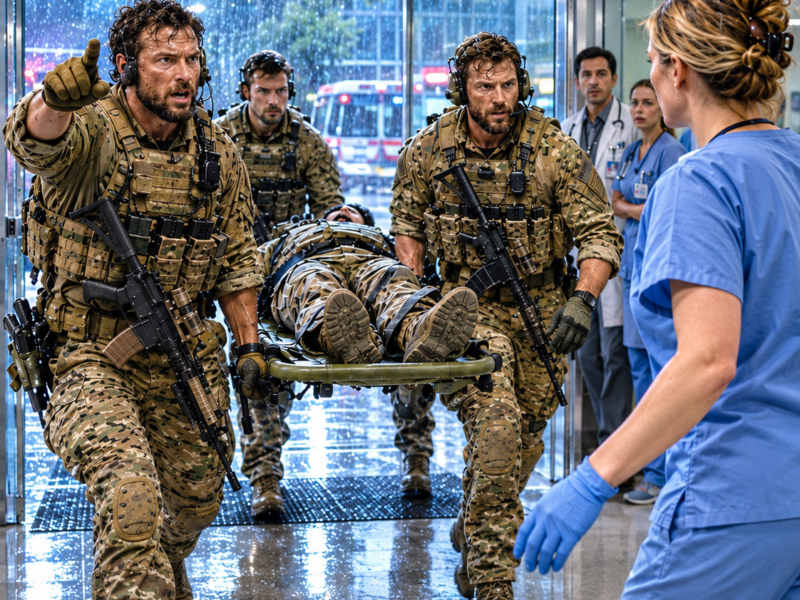
The first sign of the arriving aircraft was the violent movement of the glass doors at the emergency entrance.
The wind came before the men.
It rushed through the parking structure, rattling metal fixtures and sending loose papers skittering across the floor. The windows vibrated in their frames.
Then came the unmistakable roar of heavy rotors.
Rain began striking the glass.
Twenty minutes earlier, the sky had been clear.
Now the weather seemed to have arrived with the aircraft.
The emergency department doors opened.
Four men entered carrying a stretcher.
They wore tactical plate carriers over dark combat shirts. Their clothing was soaked with rain and sweat, and their boots left wet footprints across the polished hospital floor.
They moved quickly, but not frantically.
There was a particular kind of discipline in their movements, the kind that came from years of operating under pressure.
The man at the front was broad-shouldered, with a square jaw and blood running down the side of his neck.
He raised one hand.
“Clear the way.”
His voice wasn’t especially loud.
It didn’t need to be.
The hospital staff moved aside.
The stretcher passed through the emergency entrance and into the trauma bay.
Dr. Ingram and two nurses were waiting.
“Transfer him here,” Ingram instructed.
The men lowered the patient onto the bed with coordinated precision.
Kiera remained against the wall.
She looked at the casualty.
He was young.
Twenty-four, perhaps twenty-five.
His tactical clothing had been cut open, exposing his upper body. His right forearm was missing below the elbow, and a tourniquet had been secured above the injury.
The bleeding appeared controlled.
But the chest was another matter.
His breathing was shallow and irregular. The right side of his chest moved abnormally with each attempted breath.
His lips had developed a bluish color.
Kiera recognized the signs immediately.
A serious chest injury.
Possibly a tension pneumothorax.
The young man’s body was running out of time.
Dr. Ingram stepped forward.
“We need bilateral access, blood typing, and emergency transfusion preparation. Get me a rapid infuser and—”
The broad-shouldered operator raised his hand.
He didn’t shove the doctor.
He simply placed his palm against Ingram’s chest, stopping him.
“I need to know who I’m handing him over to.”
Ingram looked at him.
“I’m the attending emergency physician. Fifteen years in emergency medicine.”
The operator studied him.
“Where did you do your combat rotation?”
Ingram paused.
“I have extensive trauma experience.”
“That’s not what I asked.”
The room became quieter.
The operator looked around.
His gaze moved from Dietrick to Tompkins, then to the other nurses.
He assessed their posture, their hands, the way they approached the patient.
He wasn’t looking for the person with the most impressive title.
He was looking for someone who had seen this kind of injury before.
Someone who wouldn’t freeze when the situation became difficult.
His eyes finally settled on Kiera.
For two seconds, neither of them moved.
Then his expression changed.
Not dramatically.
Just enough.
Recognition.
The kind that happens when someone sees a face they thought they might never see again.
“You.”
Kiera didn’t respond.
The operator turned toward the rest of the room.
“Everyone who hasn’t worked in a combat medical environment, step back against the wall.”
Nobody moved.
Dr. Ingram frowned.
“Excuse me?”
The man ignored him.
His attention remained on Kiera.
“Where did you do your trauma training?”
Kiera kept her arms crossed.
“I didn’t do an internship.”
“That’s not what I asked.”
She looked at him.
The young man on the bed made a wet, strained sound.
Kiera could hear the diminishing strength of each breath.
She looked back at the operator.
“My name is Kiera Malone.”
The man didn’t blink.
A younger operator standing near the foot of the stretcher suddenly straightened.
He had a scar cutting through his left eyebrow.
His face had been pale with exhaustion since entering the hospital, but now something changed in his expression.
He looked at Kiera as though he had just found someone he had been searching for.
“Ghost?”
The word landed in the middle of the trauma room.
Kiera closed her eyes for half a second.
The young operator took one step forward.
“That’s Ghost. Kiera Malone. It’s her.”
The broad-shouldered man slowly turned toward his teammate.
“Are you certain?”
The younger man nodded.
“I’d recognize her anywhere.”
Nobody in the room spoke.
Dietrick stared at Kiera.
Tompkins looked from the young operator to the woman she had dismissed only hours earlier.
Dr. Ingram appeared to be trying to reconcile the person standing in front of him with the temporary nursing contract he had seen that morning.
Ghost.
The name meant nothing to most of the civilian staff.
But it meant something to the four men who had carried the stretcher through the doors.
It meant someone who had once kept soldiers alive when evacuation was impossible.
Someone who could turn a handful of medical supplies into a functioning trauma station.
Someone whose calmness under pressure had become almost legendary within the unit.
Kiera slowly unfolded her arms.
The operator stepped aside.
She walked toward the bed.
There was no dramatic announcement.
No explanation.
No attempt to reclaim the authority she had once possessed.
She simply reached for a pair of gloves.
“What’s his name?”
“Callum,” the young operator with the scar replied.
“Callum what?”
“Callum Hayes.”
“Age?”
“Twenty-four.”
“What happened?”
“Building collapse. Fragmentation injury. The right side took most of the impact.”
Kiera examined the patient’s chest.
“When did his breathing deteriorate?”
“Thirty minutes ago. Maybe thirty-five.”
“Who treated him?”
“Our medic. She did everything she could. We performed needle decompression during extraction.”
Kiera examined the existing dressing.
It was well placed.
The field medic had done a good job under difficult circumstances.
But the temporary procedure was no longer sufficient.
“Where was the initial decompression?”
“Right midclavicular line.”
Kiera looked at the patient’s chest again.
“He’s accumulating air again.”
The young operator nodded.
“We suspected that.”
“He’s developing a recurrent tension pneumothorax. He needs a chest tube immediately.”
She looked at Dr. Ingram.
“I need a thoracostomy set, a thirty-two French chest tube, a drainage system, lidocaine if available, and someone to assist with positioning.”
Ingram stared at her.
“You’re a temporary nurse.”
“I’m aware.”
“You can’t simply take over a procedure like that.”
Kiera didn’t raise her voice.
“Doctor, he has approximately four minutes before we lose the opportunity to stabilize him.”
Ingram looked at the patient.
Callum’s lips were blue.
His breathing was deteriorating.
The monitor showed a worsening oxygen saturation.
Kiera continued.
“You can supervise the procedure and document it as appropriate. But we need to move now.”
For a moment, Ingram appeared torn between his professional responsibilities and the reality unfolding in front of him.
Then he turned.
“Get the equipment.”
A nurse hurried away.
Another opened the sterile package.
Tompkins moved closer, her earlier suspicion replaced by concentration.
Kiera took her position beside the bed.
The world narrowed.
The fluorescent lights.
The monitor.
The instruments.
The patient’s chest.
She no longer heard the rain striking the windows or the distant announcements echoing through the hospital.
She heard only Callum’s breathing.
She checked his condition, confirmed the necessary landmarks, and prepared the site while Ingram remained beside her.
Her movements were controlled.
There was no wasted motion.
No unnecessary conversation.
The procedure was performed under the appropriate clinical supervision and with the equipment available.
Kiera identified the fifth intercostal space and proceeded with the chest drainage intervention.
She worked carefully, but without hesitation.
There was no room for theatrical delicacy.
Callum needed air out of his chest.
He needed his lung to expand.
He needed time.
When the tube entered the pleural space, dark blood and trapped air moved through the drainage system.
For one brief moment, the entire room seemed to hold its breath.
Then the monitor changed.
Seventy-four.
Seventy-eight.
Eighty-three.
The oxygen saturation began climbing.
Callum’s breathing became deeper.
The bluish color around his lips slowly receded.
Dr. Ingram leaned closer to the monitor.
“His blood pressure is coming up.”
Kiera secured the tubing and checked the drainage system.
“Connect the pleural drainage unit.”
Tompkins immediately assisted.
The physician watched the patient’s condition stabilize.
A few seconds passed.
Then he looked at Kiera.
“That was clean.”
She didn’t answer.
She was already examining the remaining injuries.
The missing forearm was a separate emergency.
The tourniquet had controlled the bleeding, but Callum needed urgent vascular and orthopedic surgical assessment.
She looked toward the nurses.
“Get vascular surgery on the phone. We need an operating room prepared. The tourniquet stays in place until the surgical team evaluates him. Has trauma surgery been notified?”
“Yes,” Tompkins answered.
Her voice was different now.
Not suspicious.
Not defensive.
Respectful.
“Good.”
Kiera finally stepped away from the bed.
Her gloves were wet.
The front of her medical gown was stained.
She looked at Callum.
He was still unconscious, but his monitor now showed a more stable rhythm.
He was alive.
He would need surgery.
He would need rehabilitation.
He would have to learn how to live without his right forearm.
There would be difficult days ahead, and there would be moments when the physical recovery seemed easier than the emotional one.
But he would have those days.
That was enough for now.
Kiera removed her gloves.
When she turned around, the broad-shouldered operator was standing a few feet away.
His name was Rourke.
She remembered him.
Not immediately as the man standing in front of her, older and carrying the weight of years of operations.
She remembered his voice.
His posture.
The way he used to stand at the edge of a medical tent, waiting for her assessment before making a decision.
Time had changed him.
It had changed all of them.
“Malone,” he said.
Kiera looked at him.
“Don’t.”
“I’m not going to lecture you.”
“Good.”
For several seconds, neither spoke.
The hospital staff continued working around them.
A nurse checked the intravenous lines.
Dr. Ingram began documenting the procedure.
Someone prepared additional blood products.
The ordinary machinery of emergency medicine continued to function, even though something extraordinary had just happened.
Rourke glanced toward the patient.
“Callum is going to survive?”
“Yes.”
“You’re certain?”
“He’s stabilized. He’ll need surgery for the arm, and the next twenty-four hours will be important. His recovery will be difficult, but I believe he’ll make it.”
Rourke exhaled.
It was the first time since entering the hospital that his shoulders seemed to relax.
“I knew he would.”
Kiera looked at him.
“How?”
“Because I saw you walk toward that bed.”
She looked down at her hands.
They were completely still.
Not a tremor.
Not even a slight movement.
That was the part she found most disturbing.
Her hands had behaved as though they had never spent three years away from the world where she had learned those skills.
She had spent so long trying to become someone else.
Someone peaceful.
Someone ordinary.
Someone who could go through an entire shift without remembering the faces of people she hadn’t been able to save.
And yet, the moment the situation demanded it, her body had returned to the old rhythm.
The old precision.
The old instinct.
“How did you find me?” she asked.
Rourke watched her for a moment.
“We’ve known where you’ve been for eighteen months.”
Kiera’s expression barely changed.
But something inside her tightened.
“Eighteen months?”
“Yes.”
“Why didn’t you contact me?”
“Because you needed time.”
She looked away.
Rourke continued.
“We knew what happened after Kandahar. We knew you left. We knew you weren’t answering calls, and we knew you weren’t interested in returning.”
“Then why are you here?”
“Because Callum didn’t have time to wait until you felt ready.”
The answer was simple.
No apology.
No attempt to soften it.
Kiera looked at him again.
“How long did it take you to get here?”
“Eleven minutes.”
She frowned.
“From where?”
“I’m not going to tell you.”
“Eleven minutes is impossible.”
“We managed.”
She studied his face.
There were things she wanted to ask.
How many people had been injured?
What had happened during the mission?
Why had Callum been the one on the stretcher?
Who had sent the aircraft?
And why had Rourke thought that she, of all people, would agree to become part of this again?
But the trauma bay wasn’t the place.
There were too many people listening.
Too many unanswered questions.
Instead, she looked toward Callum.
“Tell him I said he’s going to be fine.”
Rourke nodded.
“I will.”
Kiera turned away.
That was when Dietrick appeared at the edge of the trauma bay.
Her face had changed dramatically.
The woman who had spent the morning treating Kiera as an inconvenience now looked as though she had been handed a problem she couldn’t solve with a staff schedule or a disciplinary form.
“The hospital administrator is on the telephone,” she said.
Nobody answered.
Dietrick cleared her throat.
“They’re asking about the procedure. Several departments want clarification regarding who authorized the intervention.”
Kiera looked at her.
“Dr. Ingram was present and supervised the procedure. I assisted with the patient’s stabilization. Everything has been documented.”
Ingram glanced up.
For a moment, his eyes met hers.
Then he gave a small nod.
It was a simple gesture.
But it carried something important.
He wasn’t going to let her take responsibility for a decision that had been made with him standing beside her.
Dietrick opened her mouth.
Closed it.
Then looked at the physician.
“Doctor?”
Ingram answered calmly.
“I’ll handle the documentation and speak with administration.”
Kiera didn’t wait for further discussion.
“The trauma carts need to be restocked. I’ll take care of the supplies before the end of my shift.”
She walked out.
Behind her, the emergency department continued moving.
The men in tactical gear remained near the operating room entrance.
Callum was being prepared for surgery.
And the people who had spent the morning overlooking Kiera were now struggling to understand who she really was.
But Kiera wasn’t thinking about them.
She walked into the women’s locker room, entered the first shower stall, and turned on the water.
She didn’t remove her clothes.
She simply stood beneath the stream.
For forty seconds, she allowed the water to run over her head and shoulders.
It was something she had done before.
In other places.
After particularly difficult operations.
After moments when her mind needed somewhere to put the things her body had just experienced.
She stood with her eyes closed.
She thought about Callum.
Twenty-four years old.
A young man who had probably believed that his biggest problems were difficult missions, bad food, and the endless teasing of his teammates.
Now he would wake up in a hospital bed without his right forearm.
He would have to learn how to dress himself differently, hold objects differently, and approach ordinary tasks in ways he had never imagined.
He would probably become angry.
He might blame himself.
He might wonder why he had survived when someone else hadn’t.
Kiera knew those questions.
She had heard them from men and women who had returned from places that changed them forever.
She had asked some of those questions herself.
She thought about Rourke.
Eighteen months.
He had known where she was for eighteen months.
He had watched from a distance and waited.
Why?
She didn’t know.
Then she remembered the shoebox in her closet.
Inside it were two medals and a pair of handwritten thank-you notes.
She had never thrown them away.
The first note had been written by the mother of a young soldier she had helped save during an evacuation.
The second had come from a man who had survived an injury that should have killed him.
Both notes were short.
Both were deeply personal.
And neither had ever made her feel that she had done enough.
She remembered the word Dietrick had used that morning.
Placeholder.
A temporary body.
Someone who could fill an empty space until a real nurse came along.
Kiera almost laughed.
Not because it was funny.
Because the world had a strange way of placing people in situations where the smallest words could expose the largest misunderstandings.
She turned off the shower.
The locker room became quiet again.
She stood for a moment, looking at the tiled wall.
Then she removed her wet clothing, changed into a clean medical uniform, and dried her hair with paper towels.
She looked at herself in the mirror.
The woman staring back at her looked tired.
There were faint lines beneath her eyes.
Her hair was slightly disheveled.
Her face carried the kind of exhaustion that sleep alone couldn’t always repair.
She looked like an ordinary nurse.
And perhaps that was what she had wanted all along.
But the reflection didn’t seem quite as unfamiliar as it had that morning.
Kiera took a breath and opened the locker room door.
Rourke was standing in the hallway.
He held his helmet beneath one arm.
Through the glass doors of the emergency department, she could see the rest of his team gathered near the parking structure.
They stood together in silence.
Their tactical clothing was still wet.
Some had removed their helmets.
Others were speaking quietly into communication devices.
They looked like men who had spent the last several hours holding themselves together through sheer determination.
Rourke glanced at her clean uniform.
“Feeling better?”
“Not particularly.”
He nodded.
“Fair enough.”
Kiera leaned against the wall.
“Are you leaving?”
“Not until Callum comes out of surgery.”
“Then you may be here for several hours.”
“We know.”
She looked toward the glass.
One of the operators was sitting on a bench with his head bowed. Another stood near the entrance, watching every person who walked through the doors.
“They’re worried,” she said.
“They’re his family.”
“Not by blood.”
Rourke looked at her.
“Doesn’t matter.”
Kiera understood.
She had once known what it meant to trust people with her life.
She had once believed that a team was something more than a collection of individuals assigned to the same mission.
It was a family built through shared danger.
The kind of family that sometimes remained long after everything else had disappeared.
Rourke adjusted his grip on the helmet.
“You should know something.”
Kiera waited.
“When Callum wakes up, the first thing he’s going to ask is who treated his chest.”
“Tell him the emergency department staff did their job.”
“He’ll want to know your name.”
“Then tell him it’s Kiera Malone.”
Rourke smiled faintly.
“That’s not the name he’ll remember.”
She didn’t respond.
He studied her face.
“You haven’t changed as much as you think.”
Kiera’s expression hardened slightly.
“People change.”
“Yes.”
“Some things don’t.”
Rourke nodded.
“That’s true, too.”
For a moment, the two stood in silence.
Then Rourke put on his helmet.
“We’ll be here.”
“I know.”
He turned toward the emergency department.
Just before he reached the doors, he paused.
“Malone?”
She looked up.
“Thank you.”
Kiera didn’t answer.
He pushed through the doors, and a brief rush of cold air entered the hallway before they closed behind him.
She remained where she was.
The monitor alarms continued in the distance.
The hospital announcement system called for a technician.
Somewhere, a patient was asking for a glass of water.
Life continued.
And Kiera still had four hours left in her shift.
She returned to the nurses’ station.
Tompkins was sitting behind the desk, reviewing the results of a blood gas analysis.
She looked up when Kiera approached.
For several seconds, she seemed uncertain about what to say.
Then she cleared her throat.
“Paulette Shearer.”
Kiera stopped.
“What about her?”
“Her blood gas results came back.”
“And?”
Tompkins looked at the report.
“Her carbon dioxide level is seventy-eight.”
Kiera nodded.
“That’s high.”
“Dr. Ingram is discussing BiPAP with respiratory therapy.”
“Good.”
Tompkins hesitated.
Then she looked at Kiera again.
“You noticed something was wrong before the monitor showed how bad it was.”
Kiera picked up a supply checklist.
“She was working too hard to breathe.”
“I know, but I mean… you noticed it immediately.”
Kiera shrugged.
“That’s why we assess patients instead of just reading numbers.”
Tompkins lowered her eyes.
There was an awkward silence.
Then she said something Kiera hadn’t expected.
“She asked about you.”
Kiera looked up.
“Who?”
“Paulette. She wants to thank the nurse who stayed with her earlier.”
Kiera glanced toward the sixth bay.
For a moment, she remembered the elderly woman gripping the bed rails.
The smell of talcum powder.
The frightened eyes.
The quiet question about whether she was getting worse.
She remembered how different the emergency department had felt before the helicopters arrived.
Before the tactical equipment.
Before the young man with the missing forearm.
Before someone had spoken the name Ghost.
It had been a different kind of emergency.
A quieter one.
But no less real.
“Tell her I’ll come by when I’m finished restocking the trauma carts.”
Tompkins nodded.
Kiera picked up a fresh box of gloves and placed it beneath her arm.
Then she started down the corridor.
Her shoes squeaked softly against the clean linoleum.
She passed the second trauma bay, where a technician was preparing new supplies.
She passed the fourth bay, where Dietrick was checking on the sepsis patient.
She passed the main nurses’ station, where conversations had become noticeably quieter whenever she approached.
People were watching her.
Some with curiosity.
Some with embarrassment.
Some with a newfound respect that hadn’t existed a few hours earlier.
Kiera noticed.
But she didn’t react.
She had no desire to explain the medals, the shoulder injury, the desert, or the call sign.
She didn’t need the staff to understand what she had done before coming to Riverside.
She didn’t need Dietrick to apologize.
She didn’t need anyone to treat her differently.
At least, that was what she told herself.
She reached the supply room and began replacing the missing items.
Gauze.
Sterile dressings.
Syringes.
Intravenous equipment.
Airway supplies.
She checked every package, every expiration date, every compartment.
It was familiar work.
Quiet work.
The kind of work that allowed her mind to settle.
A few minutes later, the telephone rang.
Tompkins answered.
“Emergency department.”
A pause.
Then her expression changed.
She looked toward Kiera.
“He’s out of surgery.”
Kiera stopped organizing the supplies.
“Callum?”
Tompkins nodded.
“The surgical team says he’s stable. They repaired what they could, and he’s being transferred to intensive care.”
Kiera exhaled.
“Good.”
“Rourke is asking whether you can come down.”
Kiera looked at the box in her hands.
For a moment, she considered refusing.
Not because she didn’t care.
Because she was afraid of what seeing those men again might bring back.
But then she remembered the young man on the stretcher.
His blue lips.
His shallow breathing.
The way his chest had moved before the tube was placed.
And the way the monitor had climbed when he finally received the treatment he needed.
“Tell him I’ll come.”
She placed the supplies on the shelf and walked toward intensive care.
The corridor was quieter now.
The noise of the helicopter had long since disappeared, leaving behind only the ordinary sounds of hospital machinery.
When she reached the intensive care unit, Rourke was standing outside the room.
The scarred young operator was beside him.
His name was Daniel, Kiera remembered now.
He had once been the youngest member of the team.
Now he looked considerably older.
“He’s stable,” Rourke said.
“I heard.”
“The surgeons managed to control the damage. The arm couldn’t be saved, obviously, but the bleeding is controlled.”
Kiera nodded.
“That’s good news.”
Daniel looked at her.
“He made it because of you.”
“He made it because the whole team got him here alive, the medic stabilized him, and the surgical team took over.”
Daniel shook his head.
“You know what I mean.”
Kiera didn’t answer.
Rourke opened the door slightly.
“He’s awake.”
She looked inside.
Callum lay beneath a white hospital blanket, surrounded by monitoring equipment.
His face was pale.
His right arm was heavily bandaged.
His eyes were open, although he appeared exhausted and disoriented.
For several seconds, he looked around the room without speaking.
Then his eyes settled on Rourke.
“Where are we?”
“Hospital.”
Callum swallowed.
“Which one?”
“Riverside.”
He frowned.
“How far?”
“Far enough.”
Callum attempted to move, then stopped when discomfort crossed his face.
“Where’s my arm?”
Rourke’s expression changed.
He stepped closer to the bed.
“Callum…”
The young man looked down.
He understood before anyone said another word.
For several seconds, he remained silent.
Then he closed his eyes.
Nobody spoke.
There were no easy words for that moment.
No explanation that could make the loss less real.
Kiera stood near the doorway.
Callum eventually opened his eyes again.
“Who fixed my chest?”
Rourke looked toward her.
“Someone you should thank.”
Callum followed his gaze.
Kiera stepped forward.
“Hello, Callum.”
He stared at her.
For a moment, he seemed confused.
Then he noticed the expression on Daniel’s face.
“Ghost?”
Kiera’s jaw tightened slightly.
“That’s an old name.”
Callum attempted a weak smile.
“Not to us.”
She moved closer to the bed.
“How are you feeling?”
“Like I got hit by a building.”
Despite herself, Kiera almost smiled.
“That’s a fairly accurate description.”
He looked down at his bandaged arm again.
“Is it really gone?”
“Yes.”
He swallowed.
“Can I still work?”
“Not today.”
He let out a weak breath that might have been a laugh.
“That’s not what I meant.”
“I know.”
She pulled a chair closer.
“You have a long recovery ahead. There will be rehabilitation, pain management, and a lot of adjustments. But losing your forearm doesn’t mean losing your entire future.”
Callum looked at her.
“Doesn’t feel that way.”
“It won’t feel that way every day. Some days will be difficult. Some will be worse than others. But you’ll learn things you can’t imagine right now.”
He stared at the ceiling.
“I don’t know how to do this.”
Kiera leaned forward slightly.
“You don’t have to figure it out today.”
For a moment, Callum said nothing.
Then he looked at her again.
“Rourke said you saved me.”
“I helped stabilize you.”
“That’s not what he said.”
“Rourke has always been dramatic.”
A faint smile appeared on Callum’s face.
Then he became serious again.
“Thank you.”
Kiera nodded.
“You’re welcome.”
She stood.
“Get some rest. We’ll let the doctors handle the rest of the work.”
Callum watched her as she reached the door.
“Ghost?”
She turned.
“Yes?”
“Are you coming back?”
The question caught her off guard.
She looked at Rourke.
Then at Daniel.
Finally, she looked at Callum.
“I work here.”
It wasn’t a promise.
It wasn’t a refusal.
It was simply the truth.
She left the room.
Rourke followed her into the corridor.
For a moment, he said nothing.
Then he spoke quietly.
“He’ll be all right.”
“I hope so.”
“He’ll need time.”
“Everyone does.”
Rourke nodded.
They stood beside the intensive care unit doors, listening to the steady rhythm of the monitors.
Then he reached into a pocket of his tactical vest and removed a small folded piece of paper.
Kiera looked at it.
“What is that?”
“Something I thought you should have.”
She hesitated before accepting it.
The paper was old.
The edges were worn, and one corner had been folded several times.
She opened it.
Inside was a handwritten message.
The writing was familiar.
She recognized it immediately.
It belonged to a young soldier she had helped evacuate years earlier.
A soldier who had survived a devastating injury during an operation in the desert.
The note had been written months after his recovery.
It contained only a few lines.
He had thanked her for refusing to give up on him.
He had thanked her for staying beside him when he believed he was going to die.
And he had written something she had never forgotten.
You didn’t just save my life. You gave me the chance to find out what I could do with it.
Kiera stared at the paper.
“Where did you get this?”
“He sent it to the unit.”
“I thought I had the original.”
“You do. This is a copy.”
She looked at Rourke.
“Why are you showing me this?”
“Because you seem to have forgotten something.”
“What?”
He glanced toward Callum’s room.
“That what you do matters even when nobody knows your name.”
Kiera folded the paper again.
For a moment, she couldn’t speak.
Rourke didn’t press her.
He had known her long enough to understand that some things needed time.
Eventually, she placed the note in her pocket.
“I have to get back to work.”
“I know.”
She started walking.
Then Rourke called after her.
“Malone.”
She stopped.
“You were never a placeholder.”
Kiera turned slightly.
He looked at her with the same quiet certainty he had shown when he first entered the trauma bay.
“Not then. Not now.”
She didn’t answer.
But this time, she didn’t walk away immediately.
She stood there for another moment, allowing the words to settle.
Then she continued down the corridor.
When she returned to the emergency department, Dietrick was standing near the nurses’ station.
The head nurse looked at her.
“Kiera.”
She stopped.
“Yes?”
Dietrick glanced toward the other nurses before speaking.
“I’ve reviewed the documentation from the trauma case.”
Kiera waited.
“The procedure was performed under Dr. Ingram’s supervision. Administration has been informed.”
“All right.”
Dietrick shifted her weight.
“And I understand that you have… previous experience.”
Kiera said nothing.
Dietrick seemed uncomfortable.
“I didn’t know.”
“No.”
“I made some assumptions.”
Kiera looked at her.
“Yes.”
The answer was so direct that Dietrick appeared briefly uncertain how to respond.
Then she lowered her voice.
“I shouldn’t have called you a placeholder.”
Kiera studied her face.
For the first time since they had met, Dietrick seemed genuinely unsure of herself.
Kiera could have reminded her of every insult.
She could have explained that a person’s value wasn’t determined by how long their employment contract lasted.
She could have told her that temporary workers were still responsible for real patients, real emergencies, and real lives.
Instead, she said something much simpler.
“There’s a patient in the sixth bay who needs monitoring. Her blood gas results are concerning. Make sure respiratory therapy follows up.”
Dietrick nodded.
“I will.”
Kiera picked up the supply checklist.
“And the trauma cart needs restocking.”
“I’ll have someone handle it.”
“I can do it.”
Dietrick looked at her.
For a second, she seemed about to insist that someone else take over.
Then she stepped aside.
“All right.”
Kiera returned to the supply room.
The afternoon passed.
There were no more helicopters.
No military convoys.
No men in tactical gear demanding to know who was qualified to treat their injured teammate.
There was a teenager with a broken wrist.
A farmer with a deep laceration.
An elderly man who had fallen in his bathroom.
And Paulette Shearer, who was breathing more comfortably and asking when she could go home.
When Kiera finally entered the sixth bay, the older woman smiled.
“There you are.”
Kiera pulled the curtain closed.
“How are you feeling?”
“Better. Much better.”
“That’s good.”
Paulette looked at her for a moment.
“Someone told me you helped me this morning.”
Kiera checked the monitor.
“We made some adjustments and got your breathing reassessed.”
“Well, I wanted to thank you.”
Kiera looked at her.
Paulette’s eyes were slightly watery.
“I was frightened,” the older woman admitted. “I thought something terrible was happening, and everyone seemed so busy. Then you came in and talked to me as though I wasn’t just another patient.”
Kiera felt something tighten in her chest.
She adjusted the blanket around Paulette’s shoulders.
“You were never just another patient.”
The woman smiled.
“Thank you.”
Kiera nodded.
She checked the oxygen line, reviewed the patient’s latest observations, and made sure the call button was within reach.
Then she prepared to leave.
“Miss Malone?”
She turned.
“Yes?”
Paulette looked at her.
“I hope someone takes care of you, too.”
For a moment, Kiera couldn’t find an answer.
She had heard similar words before.
Usually from people who had no idea what she had experienced.
But there was something different about the way Paulette said them.
There was no expectation.
No demand.
Just kindness.
“Thank you,” Kiera replied.
She stepped into the corridor.
The afternoon light was beginning to fade beyond the hospital windows.
Her shift was almost over.
She still had paperwork to finish, supplies to replace, and a few patient charts to review.
The temporary contract would continue tomorrow.
Dietrick would probably return to her usual routine.
The coffee would still be terrible.
The hospital would still be a Level II trauma center with an imperfect emergency department and more patients than available beds.
And Kiera would still be Kiera Malone.
But something had changed.
For three years, she had believed that the only way to move forward was to bury the person she had once been.
She had treated her memories like dangerous objects, keeping them locked away where nobody could touch them.
She had convinced herself that becoming ordinary meant becoming someone who no longer remembered the desert, the helicopters, the blood, or the men who had trusted her with their lives.
But perhaps she had misunderstood what it meant to leave that world behind.
Perhaps healing wasn’t about pretending that the past had never happened.
Perhaps it was about learning that the past didn’t have to control every moment of the future.
She thought about Callum.
He would face difficult months.
He would have to rebuild parts of his life.
But he would wake up tomorrow.
He would have the chance to be angry, frustrated, hopeful, and eventually happy again.
He would have the chance to discover a future he hadn’t planned.
And Kiera had helped make that possible.
She reached the nurses’ station and placed the completed inventory sheet on the desk.
Tompkins looked up.
“Everything finished?”
“Almost.”
Tompkins hesitated.
Then she said, “I’m glad you were here today.”
Kiera looked at her.
“Me too.”
It was the first time she had said something like that since arriving at Riverside.
She collected her belongings from the locker room when the shift finally ended.
The two medals remained in the shoebox at home.
The old notes remained beside them.
The scar in her shoulder would still ache when the weather changed.
And somewhere beyond the hospital walls, a group of special operations soldiers would be waiting for their teammate to begin a long recovery.
Kiera stepped outside.
The rain had stopped.
The parking structure was almost empty, and the evening air carried the faint smell of wet pavement.
She stood for a moment beneath the hospital entrance canopy.
Her phone vibrated.
An unfamiliar number appeared on the screen.
She answered.
“Malone.”
A familiar voice came through.
“Still answering like a professional, I see.”
Kiera recognized Rourke immediately.
“What do you want?”
“Just letting you know Callum is resting. The surgeons are optimistic.”
“Good.”
“Daniel says he owes you a coffee.”
“Tell him not to waste his money. Hospital coffee is terrible.”
Rourke laughed.
It was a quiet, tired laugh.
Then his voice became more serious.
“There’s something else.”
Kiera looked toward the darkening sky.
“What?”
“We’re leaving tonight. But I wanted you to know that the team remembers.”
She said nothing.
“Not just what happened today. Everything.”
“Rourke…”
“You don’t have to come back. Nobody is asking you to sign anything or report for duty. I just wanted you to know that if you ever need us, we’re here.”
Kiera closed her eyes briefly.
For three years, she had avoided those words.
Because needing someone meant admitting that she couldn’t carry everything alone.
And she had become very good at carrying things alone.
“I know,” she said finally.
Rourke waited.
Then he added, “Take care of yourself, Ghost.”
Kiera looked down at the phone.
“Goodbye, Rourke.”
She ended the call.
For a while, she remained beneath the canopy.
Then she walked toward her car.
Tomorrow, she would return to Riverside.
She would check the emergency carts, review patient charts, and help whoever needed help.
She would probably be assigned the less desirable tasks again.
Perhaps Dietrick would remember what had happened.
Perhaps she would forget.
It didn’t matter as much as it had that morning.
Because Kiera had finally begun to understand something she had spent three years trying not to remember.
The woman who had once answered to Ghost had not disappeared.
She was still there.
Not waiting for another battlefield.
Not waiting for another helicopter.
Not waiting for someone to call her name.
She was simply part of the woman who had stayed with a frightened elderly patient for forty minutes, who had noticed a dangerous change before the monitor fully revealed it, and who had stepped forward when a young soldier’s life depended on someone recognizing what was happening.
She didn’t need a battlefield to prove her worth.
She didn’t need medals.
She didn’t need an elite team to remind her who she was.
And she certainly didn’t need a head nurse’s approval.
Some people spent their lives believing that only the most visible acts of courage mattered.
But Kiera knew better.
Sometimes courage looked like walking toward a stretcher while everyone else hesitated.
Sometimes it looked like making a difficult decision when seconds mattered.
And sometimes it looked like sitting beside a frightened seventy-one-year-old woman, adjusting a pillow, checking her breathing, and quietly telling her that she wasn’t alone.
That evening, Kiera drove home through the wet streets of Riverside.
When she entered her apartment, she placed her keys on the kitchen counter and removed her jacket.
The shoebox was still in the closet.
She stood in front of it for a long time.
Then she opened the lid.
Inside were two medals, a few old photographs, and the handwritten notes she had kept for years.
She picked up the first medal.
Its surface caught the light.
For a long time, she had considered it evidence of a life she wanted to forget.
Now she saw something else.
It was evidence that she had survived.
That she had helped people survive.
That even in the worst places, human beings could still find reasons to keep going.
She placed the medal back in the box.
Then she added the folded copy of the note Rourke had given her.
She closed the lid.
For the first time in three years, she didn’t feel the need to hide it.
The next morning, Kiera would return to the hospital.
She would walk through the same doors.
She would hear the same announcements.
She would see the same people.
And somewhere in intensive care, Callum Hayes would begin the difficult process of learning how to live with the injuries he had sustained.
He would have a long road ahead.
So would she.
But neither of them would have to walk it alone.
Because the truth was that Kiera Malone had never really been a placeholder.
She had never been an empty space waiting for someone more important to arrive.
She was a woman who had carried extraordinary responsibility, survived extraordinary loss, and chosen to begin again in the most ordinary place she could find.
And perhaps that was the most remarkable thing about her.
Not that she had once been called Ghost.
Not that an elite special operations team had crossed eleven minutes of impossible distance to find her.
Not even that she had helped save a young soldier’s life when an entire emergency department was struggling to understand what was happening.
It was that, after everything she had endured, she had still chosen to care.
And the next time someone in Riverside needed help, Kiera would be there.
Not as a legend.
Not as a soldier.
Not as the ghost of someone she used to be.
Just as Kiera Malone.
A nurse.
A healer.
And a woman who had finally begun to understand that she didn’t have to erase her past to deserve a peaceful future.
THE END









