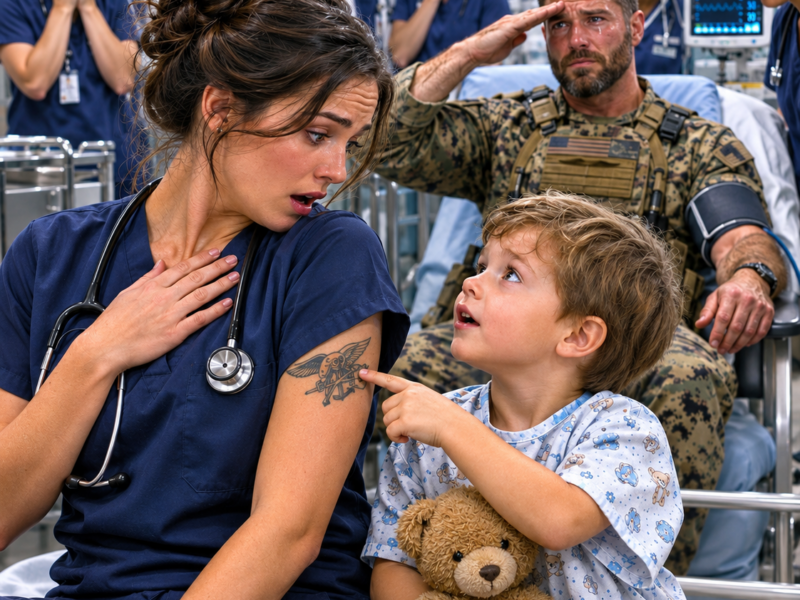
She Hid Her Tattoo for Years — Until a Navy SEAL’s Little Son Recognized It!
She Hid Her Tattoo for Years — Until a Navy SEAL’s Little Son Recognized It!
The first thing Dr. Philip Ashford did every morning was remind everyone at Riverbend Heritage Medical Center who mattered and who did not.
On Monday morning, in front of forty nurses, doctors, technicians, and medical assistants gathered inside the hospital’s main trauma bay, he made sure nobody forgot.
“Nurse Abigail Sloan.”
He paused after reading her name from the clipboard, allowing the room to settle into an uncomfortable silence.
Abby stood against the back wall, her hands clasped behind her, her eyes fixed on the polished floor. At five feet four inches tall, she was easy to overlook. Her bright blue scrubs hung loosely around her narrow shoulders, and her dirty-blonde hair was tied into a low ponytail that seemed determined to fall apart. She wore a thin, long-sleeved shirt beneath her uniform, even though the Texas summer had already made the hospital’s parking lot feel like an oven.
She tugged at the cuffs of her sleeves.
It was something she did whenever she felt uncomfortable.
Dr. Ashford noticed.
“Four months,” he announced, looking around the room with an exaggerated smile. “Four months since Nurse Sloan joined our emergency department, and she still needs a checklist to find a package of gauze.”
A few people laughed.
Not everyone found it funny, but nobody challenged him.
“Tell me, Sloan. Did you bring your little checklist today?”
Abby swallowed.
“Yes, Doctor.”
“Wonderful. Perhaps tomorrow we’ll teach you where the bandages are kept without having to draw you a map.”
More laughter followed.
The charge nurse, Brenda Klein, stood beside a supply cabinet with her arms folded. She didn’t laugh loudly, but she didn’t defend Abby either. Her silence had become so familiar that Abby barely noticed it anymore.
Dr. Ashford approached her.
He was a tall, handsome man in his early fifties, with carefully styled dark hair, an expensive watch, and the kind of confidence that came from spending nineteen years being addressed as Doctor. He enjoyed being respected, but he enjoyed being feared even more.
He stopped directly in front of Abby.
“Let me explain something, Nurse Sloan. When a patient comes through those doors, doctors make decisions. Experienced nurses assist them. People who understand their limitations make themselves useful elsewhere.”
He pointed toward the hallway.
“Your place is the supply closet. Keep it stocked, keep the equipment organized, and please don’t touch a patient unless somebody specifically tells you to.”
Abby nodded.
“Yes, Doctor.”
“Good. At least we understand each other.”
The morning meeting ended, and the staff scattered toward their departments.
Abby collected her clipboard and pushed a metal supply cart toward the east hallway.
Nobody noticed that she stopped briefly beside the trauma bay entrance.
Her eyes moved from one doorway to another, then toward the emergency exits, the stairwell, and the service corridor. She had memorized every passage in the hospital during her first week of employment.
She knew which elevators were working, which doors opened automatically, and which hallways became crowded during shift changes.
She knew the quickest route from the emergency entrance to the imaging department.
She also knew where to stand if she needed to see every entrance to a room without being noticed.
It wasn’t something a nursing school instructor had taught her.
It was an old habit, one that had followed her from another life.
As she pushed the cart farther down the hallway, she noticed an elderly man lying on a stretcher near the examination rooms. His name was Gus Alvarez, and he had been waiting for a bed for nearly forty minutes.
His face was pale, and both hands were gripping the metal railing.
Abby stopped.
“Good morning, Mr. Alvarez.”
The old man turned his head.
“Morning, sweetheart.”
“Are you comfortable?”
He shook his head slightly.
“I’m just a little worried.”
Abby glanced at the monitor beside him. His blood pressure was elevated, and his breathing was shallow.
She knew fear could make those numbers worse.
She crouched beside the stretcher, keeping her voice low.
“I know hospitals can be frightening. Especially when you’re waiting and nobody seems to have time to explain what’s happening.”
Gus looked at her.
“My wife died in a hospital like this,” he whispered. “I don’t like being alone in places like this.”
Abby’s expression softened.
“I’m sorry about your wife.”
“She used to tell me I worried too much.”
“She sounds like she knew you very well.”
The old man managed a faint smile.
Abby gently encouraged him to breathe slowly while she alerted the appropriate nurse to his distress. She remained beside him until the tension in his shoulders began to ease.
Within minutes, his breathing settled, and the monitor showed an improvement.
“Thank you,” Gus murmured.
Abby smiled.
“You’re welcome. Someone will be with you shortly.”
She stood, reached for her cart, and turned.
Dr. Ashford was watching her from the opposite end of the hallway.
“Interesting,” he said.
Abby froze.
“Doctor?”
“Are we providing counseling services now?”
“I was only checking on him.”
“Your assignment is to restock the east hallway. Not to practice medicine.”
“I understand.”
“Then demonstrate that understanding. Move.”
Abby lowered her eyes and pushed the cart away.
She didn’t argue.
She rarely argued anymore.
But beneath the long sleeve of her uniform, a thin, pale scar crossed her right forearm. Higher up, hidden beneath the fabric, was a small tattoo.
It showed a trident with two folded wings and three tiny stars.
She had carried that tattoo for years.
She had also spent the last three years making sure nobody saw it.
At 9:14 a.m., the radio mounted on the wall crackled.
“Trauma alert. Adult male, approximately thirty-six years old. Fall from a training tower, estimated thirty feet. Neck pain, weakness in both hands, numbness in lower extremities. Navy special warfare operator. Arrival in four minutes.”
The atmosphere changed instantly.
Dr. Ashford straightened his jacket.
“Finally. Trauma Bay One. Everybody move.”
Nurses hurried toward the treatment area. A technician prepared monitoring equipment, another checked the airway cart, and Brenda Klein began coordinating the incoming team.
Abby parked her supply cart against the wall.
For some reason, the announcement had made her unusually still.
She knew that kind of injury.
She knew the language used in emergency reports.
And she knew what could happen when people moved too quickly because they were more concerned with appearing decisive than being careful.
Four minutes later, the ambulance doors opened.
Paramedics rushed a stretcher through the entrance.
The injured man lying on it was broad-shouldered and heavily built, dressed in tan military training clothes. His face was gray beneath a layer of sweat, and his head was secured inside a cervical collar with protective blocks holding it in place.
His name was Chief Nathan Wells.
Among the men who served alongside him, he was known as Nomad.
He had spent more than a decade in the Navy, much of it operating in places most Americans would never see.
Now he lay motionless, staring at the ceiling.
Behind the stretcher walked two men in military uniforms.
The first was Lieutenant Commander Ben Stone, a broad-shouldered officer in his late forties whose short hair was beginning to turn gray.
The second was a younger SEAL known as Havoc.
He was holding the hand of a little boy.
The child was perhaps five years old. He wore a hospital gown decorated with tiny cartoon bears, and he clutched a worn brown teddy bear against his chest.
His name was Eli.
He didn’t cry.
He simply stared at the man on the stretcher.
“Fall from approximately thirty feet,” the lead paramedic reported. “Patient was conscious throughout transport. Complained of severe neck pain. Reports numbness in both legs and progressive weakness in his hands. We maintained spinal precautions throughout.”
“Good,” Ashford said, barely looking at the paramedic.
He approached the stretcher.
“Chief Wells, I’m Dr. Ashford. Can you hear me?”
Nathan blinked.
“Yeah.”
“Good. We’re going to get you examined and moved over for imaging.”
Ashford examined the patient’s face, then reached toward the straps securing the cervical collar.
“Let’s open this up a little. I want a better look at his airway, and we’ll get him sitting up enough to transfer him.”
From the doorway, Abby felt something cold move through her chest.
She stared at the doctor’s hand.
Then she looked at Nathan’s face.
His fingers were barely moving. His breathing was shallow, and his eyes seemed unable to settle on one point.
She knew those signs.
She knew what an unstable cervical injury could mean.
She knew that the wrong movement could turn a survivable injury into a permanent catastrophe.
The memory came without warning.
A mountainside.
Cold rain.
The smell of wet earth.
A man breathing through clenched teeth while she held his head between her hands.
A voice in the darkness telling her he couldn’t feel his legs.
And someone screaming for help farther up the ridge.
Abby’s clipboard slipped from her fingers.
It struck the floor.
“Stop.”
The word wasn’t loud.
But something in her voice made the entire room turn.
Dr. Ashford looked over his shoulder.
“What?”
“Don’t move his neck.”
For a moment, nobody moved.
Ashford stared at her as if he couldn’t believe she had spoken.
“I’m sorry?”
Abby stepped toward the stretcher.
“Doctor, his symptoms suggest a possible unstable cervical spine injury. A fall from that height, neck pain, numbness in his legs, and weakness in both hands. Please don’t loosen the collar or change his position until we’ve assessed him properly.”
Ashford’s face tightened.
“Have you suddenly become a neurosurgeon, Sloan?”
“No, Doctor.”
“Then I suggest you remember your position.”
Abby looked at the patient.
His head was beginning to shift slightly as Ashford worked with the collar.
She took another step.
“Please take your hand off the strap.”
The room became painfully quiet.
Ashford turned red.
“I have practiced emergency medicine for nineteen years. You have spent four months carrying boxes around this hospital.”
Abby’s fingers trembled.
But her voice didn’t.
“And his spinal cord doesn’t care how many years you’ve practiced, Doctor.”
Someone near the medication cabinet stopped moving.
Brenda’s eyes widened.
Ashford stepped closer.
“Get out of my trauma bay.”
Abby didn’t move.
Instead, she pushed both sleeves up to her shoulders.
The small tattoo appeared beneath the fluorescent lights.
Then she moved to the head of the stretcher and carefully positioned herself beside Nathan. She placed her hands gently against the sides of his head, maintaining his alignment without pulling or twisting.
Her fingers settled into place.
The trembling disappeared.
“I have the head,” she said.
Her voice had changed completely.
It was no longer the uncertain voice of the nurse who apologized whenever somebody bumped into her.
It was calm, precise, and unmistakably authoritative.
“Nobody moves this patient without coordinating with me.”
Dr. Ashford stared.
“Security!”
Nobody answered immediately.
“Did you hear me? Get security in here!”
Abby didn’t look at him.
“Chief Wells, I need you to listen carefully. Keep your eyes on the ceiling. Don’t try to turn your head. You’re safe. We’re going to take care of you.”
Nathan swallowed.
“Who…?”
“I’m holding your head, sir.”
“Who are you?”
“Someone who isn’t going to let you fall again.”
His breathing remained uneven, but his eyes stopped moving so frantically.
Lieutenant Commander Stone had been watching the entire exchange.
At first, he seemed prepared to intervene.
Then he noticed Abby’s hands.
He looked at the position of her fingers, the way she supported Nathan’s head, and the way she kept her own shoulders steady despite the chaos around her.
His expression changed.
He stepped between Ashford and the stretcher.
“Doctor, step back from the collar.”
Ashford turned.
“Commander, this is a civilian hospital. I decide how my patients are treated.”
Stone didn’t raise his voice.
“Then you should understand when someone is protecting one.”
He glanced toward Abby again.
“Look at her hands.”
Ashford scoffed.
“What about them?”
Stone’s jaw tightened.
“Those aren’t the hands of somebody learning this for the first time.”
He paused.
“Those hands learned this in the dark.”
Before Ashford could answer, Eli slipped free of Havoc’s hand.
The little boy walked toward the stretcher, his teddy bear tucked beneath one arm.
“Careful, buddy,” Havoc whispered.
Eli ignored him.
He stopped beside Abby and looked up at her exposed arm.
His eyes moved to the tattoo.
Then he looked down at his teddy bear.
A tiny patch had been stitched onto the bear’s chest with crooked red thread. The design showed a trident, two folded wings, and three little stars.
It was almost identical to the tattoo on Abby’s arm.
Eli lifted one finger.
“That’s Sergeant Buttons’ sign.”
Abby looked down.
For the first time since entering the trauma bay, her expression faltered.
“What did you say, sweetheart?”
The boy held up his teddy bear.
“Look. He has the same one.”
Abby stared at the patch.
Eli studied her face with the seriousness only a five-year-old could manage.
“Daddy says it’s the sign of the lady who doesn’t leave.”
Nobody spoke.
The little boy continued.
“He says she held his head all night in the mountains. And she told him nobody drowns in the harbor.”
The words struck Abby harder than any accusation Dr. Ashford could have made.
Her breath caught.
For three years, she had buried those memories so deeply that she had almost convinced herself they belonged to somebody else.
But a child holding an old teddy bear had brought them back with a single sentence.
Nathan’s eyes widened.
He couldn’t turn his head, but he tried to move his gaze toward her.
“Harbor?”
Abby closed her eyes briefly.
Then she leaned closer.
“Eyes on the ceiling, Chief. Don’t move.”
“Is that…?”
“One breath at a time, Nomad.”
His eyes filled with tears.
“Harbor?”
Abby swallowed.
“I’m here.”
Nathan’s lower lip trembled.
“You’re alive.”
“So are you. And you’re going to stay that way.”
Behind her, Havoc released a shaky breath.
He turned toward Stone.
“Boss,” he whispered. “It’s her.”
Stone nodded slowly.
“Yes.”
“Harbor.”
The name seemed to travel through the room.
Three years.
Three years of unanswered questions.
Three years of searching through military records, old contacts, medical facilities, and personnel files.
And there she was.
Standing in the middle of a Texas trauma bay, wearing inexpensive blue scrubs and holding the head of a wounded man.
Abby wanted to look at Stone.
She wanted to ask about the others.
She wanted to ask whether they had ever found Miles.
But Nathan’s life was still in her hands.
She pushed the memories aside.
“Listen carefully,” she said. “We need a coordinated transfer to imaging. I need six trained people, a suitable transfer device, and everyone following one set of instructions.”
Brenda stepped closer.
“What do you need?”
Abby glanced at her.
“Help me maintain his alignment. We need the head, shoulders, hips, and legs supported together. No independent movement. No twisting.”
Brenda nodded immediately.
“Understood.”
Ashford tried to recover his authority.
“The radiology elevator is out of service. We’ll have to take the stairs.”
“No,” Abby answered.
“Excuse me?”
“We won’t take him down the stairs. We need a safer route that avoids unnecessary movement.”
Ashford folded his arms.
“That’s the only available route.”
“There’s a service corridor behind the ambulance bay. The freight elevator connects directly to radiology.”
Stone looked at her.
“How do you know that?”
“I walked it during my first week.”
“Why?”
Abby kept her eyes on Nathan.
“Because I always know the way out.”
Nobody answered.
Before the team could begin moving, the trauma bay doors opened again.
A silver-haired man in an expensive gray suit entered, followed by Brenda’s administrative assistant.
Martin Lowell was the hospital’s vice president of operations. He was responsible for budgets, staffing, contracts, and the hospital’s relationship with the nearby military training facility.
He had a reputation for caring more about institutional risk than individual people.
He surveyed the scene.
“What is happening?”
Ashford immediately stepped toward him.
“Martin, this is completely unacceptable. Nurse Sloan has taken control of a trauma patient and directly disobeyed my instructions.”
Lowell looked toward Abby.
She was kneeling beside the stretcher, her sleeves rolled up, both hands supporting the head of the patient.
“Who authorized this?”
Nobody answered.
Lowell’s expression hardened.
“Nurse Sloan, step away from the patient.”
Abby didn’t move.
“Sir, I cannot release him until another qualified person takes over.”
“You’re suspended, effective immediately.”
Stone turned his head.
Lowell continued.
“Security will escort you out of the building.”
Two guards entered the room.
They approached the stretcher.
Havoc stepped forward.
He didn’t threaten them or raise his voice.
He simply placed himself between the guards and Abby.
His broad shoulders filled the space.
“Don’t.”
The guards stopped.
Stone moved beside him.
“Mr. Lowell, if anyone interferes with this patient’s care or physically removes the person maintaining his stabilization, you’ll be explaining that decision to the base commander, the Navy, and every journalist who asks why a hospital dismissed a trained military corpsman during an emergency.”
Lowell blinked.
He looked at the uniforms.
Then at the patient.
Then at the tattoo on Abby’s arm.
He understood that this was no longer a routine disagreement between a doctor and a junior nurse.
“Fine,” he said stiffly. “But somebody is going to answer for this.”
Abby didn’t acknowledge him.
Nathan coughed.
His breathing changed.
The monitor began sounding more urgently.
“I can’t feel my hands,” he whispered.
Abby’s heart tightened.
“Chief, I need you to stay with me.”
“I’m trying.”
“Look at the ceiling. Listen to my voice.”
“My hands…”
“I know. We’re taking care of you.”
Brenda looked at the monitor and immediately turned toward Abby.
“Sloan, what do you need?”
The question was so unexpected that Abby almost looked up.
For four months, Brenda had barely spoken to her unless it was to assign another task.
Now she was waiting for instructions.
Abby gave her a brief nod.
“Let’s get oxygen support ready and have suction equipment available. I need the rest of the team positioned before we move.”
Brenda immediately began organizing the room.
“Stone, take the right side. Havoc, stay with the shoulders. Two paramedics on the transfer device. I’ll coordinate the left side.”
She looked toward Ashford.
“Doctor, I need you to clear the corridor and make sure the doors are open.”
Ashford stared.
“You’re giving me orders now?”
Abby finally looked at him.
“Somebody needs to make sure we can get through the door.”
For a moment, he seemed ready to argue.
Then he looked at Nathan.
He swallowed his pride.
“Fine.”
The team prepared the transfer.
Abby remained at the head of the stretcher, explaining every movement and ensuring that the patient would be handled in a coordinated manner by the medical professionals present.
The atmosphere was no longer chaotic.
Everyone was listening.
When the transfer was complete and Nathan was secured, Abby began directing the team toward the service corridor.
“Keep the route clear. No sudden stops.”
They moved quickly.
Abby walked backward beside the head of the stretcher, maintaining her position and watching the hallway ahead.
“Left turn coming.”
Havoc moved a linen cart out of the way.
“Freight elevator ahead.”
Ashford reached the elevator controls.
The old elevator doors opened with a metallic groan.
Inside, the space was narrow, and the machinery made a low grinding sound as the stretcher was positioned.
Abby crouched beside Nathan.
The lights flickered.
The elevator began descending.
For a moment, nobody spoke.
Then Havoc looked at Stone.
“Three years,” he whispered.
Stone kept his eyes on Abby.
“Yes.”
“She was in Texas the whole time.”
Stone said nothing.
Nathan’s eyes remained fixed on the ceiling.
“Harbor?”
“I’m here.”
“Remember the mountain?”
Abby’s throat tightened.
“Yes, Chief.”
“You told me…”
“One breath at a time.”
Nathan managed a faint smile.
“Still remember.”
“Then keep breathing.”
The elevator shuddered before finally stopping.
Its doors opened onto the radiology department.
Technicians looked up as the unusual group entered.
Abby directed them toward the prepared imaging room.
“Scanner room two. Please have the team ready.”
The staff immediately made room.
The patient was transferred carefully onto the imaging table under the direction of the medical team. Once his head was secured with appropriate supports and the imaging team confirmed that he was stable for scanning, Abby finally released her position.
She stepped backward.
Her hands began shaking.
At first, only her fingers trembled.
Then the shaking spread through her wrists and forearms.
She tucked her hands beneath her arms, trying to hide them.
The same hands that had been steady during the emergency were now almost impossible to control.
Eli had followed the team with Tasha, one of the younger nurses.
He stood beside Abby, holding Sergeant Buttons.
“Is Daddy going to be okay?”
Abby looked down.
The little boy’s eyes were enormous.
She crouched until they were at the same level.
“Your father is one of the strongest people I have ever met.”
“Will he come home?”
Abby looked toward the imaging room.
“I believe he’s going to fight very hard to come home.”
Eli nodded.
Then he reached out and touched her hand.
“Sergeant Buttons says you keep promises.”
Abby felt something break inside her chest.
She looked at the teddy bear.
“I’ll do my best, sweetheart.”
Within ten minutes, Dr. Priya Raman, the neurosurgeon on call, arrived.
She was in her early forties, with dark hair pulled into a tight bun and a reputation for being calm even when the operating room was falling apart.
She examined the initial images.
Then she moved closer to the screen.
Her expression changed.
“Whoever recognized the possibility of an unstable cervical injury and maintained this patient’s alignment may have prevented a devastating outcome.”
She pointed toward the image.
“The fifth cervical vertebra is fractured in two places. The injury is unstable, and there is a bone fragment dangerously close to the spinal cord.”
The room went quiet.
“If his neck had been moved carelessly, that fragment could have caused catastrophic damage. He could have lost the ability to walk, possibly permanently.”
Ashford stood near the doorway.
His face had lost its color.
Dr. Raman turned.
“Who recognized the injury?”
For several seconds, nobody spoke.
Then Brenda stepped forward.
“Nurse Sloan.”
Dr. Raman looked toward Abby.
“Where is she?”
Abby raised her hand slightly.
“Here, Doctor.”
Raman studied her.
“I need you with us until we’re ready to take over his stabilization for surgery.”
Abby nodded.
“Of course.”
The operating team began preparing.
At the operating suite doors, Dr. Raman took over the patient’s head stabilization.
“I have him,” she said.
Abby slowly removed her hands.
For a moment, she remained frozen.
Then she stepped back.
Her hands began trembling again.
She folded them against her chest.
Eli walked over and wrapped both arms around her leg.
The teddy bear was pressed between them.
Abby rested one hand gently on his shoulder.
“You did a good job staying with your dad,” she whispered.
He looked up.
“Are you going to leave?”
“No.”
“Promise?”
She looked at him.
“I promise.”
The waiting room outside the operating suite gradually filled.
Lieutenant Commander Stone and Havoc were joined by three more SEALs who had received word that Nathan Wells was undergoing emergency surgery.
They stood together near the windows.
Their uniforms were dusty, and their faces were exhausted.
Dr. Helen Ortega, the hospital’s chief medical officer, arrived shortly afterward.
She had received a call from Dr. Raman and wanted an explanation for what had happened inside Trauma Bay One.
Martin Lowell was already there.
So was Dr. Ashford.
Abby sat alone in a plastic chair, her sleeves pulled down again. Her hands were pressed between her knees.
Eli sat beside her, holding Sergeant Buttons.
Dr. Ortega approached.
“I understand there was a serious disagreement over the patient’s treatment.”
Nobody answered immediately.
She looked at Ashford.
“Doctor, would you care to explain why a nurse on probation took command of a trauma bay and refused to follow your instructions?”
Ashford straightened.
“She acted beyond her authority. I was preparing to assess the patient’s airway and arrange imaging. She interrupted the procedure, challenged my judgment, and effectively took over the entire team.”
Stone stepped forward.
“That isn’t what happened.”
Dr. Ortega turned.
“Commander?”
“My name is Ben Stone. Lieutenant Commander, United States Navy.”
He looked at Abby.
Then he looked back at Ortega.
“Before anyone decides what she was or wasn’t authorized to do, I think you should know who Nurse Sloan actually is.”
Abby closed her eyes.
She knew what was coming.
“Three years ago, this woman was Hospital Corpsman First Class Abigail Sloan. Her call sign was Harbor.”
The room became silent.
“She served with a special warfare medical support team. During a night operation in the mountains, Chief Nathan Wells was seriously injured after a fall. His spine was compromised, and our team was operating in extremely dangerous conditions.”
Stone paused.
“We were under fire. The terrain was unstable, the weather was terrible, and helicopter evacuation was impossible. We were told we might have to wait six hours before extraction could reach us.”
His voice softened.
“Harbor stayed with Nathan.”
He looked at Abby.
“She maintained his position and kept him calm through the entire night. She monitored his condition, coordinated the team’s response, and refused to abandon him even when the situation became dangerous.”
Havoc stepped forward.
“I was there.”
He looked down at the teddy bear in Eli’s hands.
“That bear belonged to our team. Sergeant Buttons. We made it for Eli when he was born. The patch was copied from Harbor’s tattoo.”
Eli looked up proudly.
“He’s a special soldier.”
Havoc managed a small smile.
“Yes, buddy. He is.”
Stone continued.
“Harbor earned a Bronze Star Medal with a V device for valor. She never came to collect it. Shortly afterward, she left the Navy, and her records were sealed.”
He looked around the room.
“We searched for her for three years.”
Dr. Ortega stared at Abby.
“Why?”
Abby didn’t answer.
Because there were some things that couldn’t be explained in a hospital waiting room.
Some wounds didn’t bleed.
Some memories didn’t appear on scans.
And some losses followed a person into every room they entered.
Three years earlier, Abby had been a different woman.
She had worn a military uniform instead of blue hospital scrubs.
She had slept beneath temporary shelters, eaten cold food in the rain, and learned to recognize the difference between ordinary silence and the silence that came just before something went wrong.
Her team had been more than colleagues.
They had been her family.
Nathan Wells had been the strongest among them, not because he was the biggest or loudest, but because he always noticed when someone else was struggling.
Stone had been the steady leader.
Havoc had been the youngest, reckless sometimes, but fiercely loyal.
And Miles Garrity had been the youngest member of their medical support group.
Miles had been twenty-three.
He had a habit of humming old country songs whenever the team was nervous.
He also had a photograph of his mother tucked inside his equipment bag.
The night everything changed, the team was moving through a mountainous region under terrible weather conditions.
Their mission had already become complicated when Nathan fell.
The impact injured his spine.
Abby reached him first.
He was conscious, but he couldn’t move his legs.
His breathing was labored, and he was terrified.
“Harbor,” he whispered.
“I’m here.”
“I can’t feel anything.”
“Don’t try to move. Just look at me.”
Above them, the night was filled with rain and distant gunfire.
Stone was coordinating the evacuation.
Havoc was helping secure the surrounding area.
Miles was farther up the ridge, trying to reach a position from which he could assist.
Abby held Nathan’s head steady while the team worked around them.
Hours passed.
The cold seeped through her clothing.
Her arms became numb.
Her shoulders burned.
But she didn’t let go.
At one point, Nathan began to panic.
“Harbor, I’m not going to make it.”
She leaned closer.
“Listen to me. Nobody drowns in the harbor.”
He blinked.
“What?”
“Not while I’m here.”
He tried to smile.
“That’s a terrible name for a mountain medic.”
“It’s the only one you’re getting.”
He laughed weakly.
Then another explosion sounded somewhere beyond the ridge.
The team scattered for cover.
Miles was separated.
When the situation finally stabilized, Abby learned that he hadn’t survived.
She never forgot the moment Stone told her.
She remembered the rain running down his face.
She remembered asking whether they had searched everywhere.
She remembered refusing to believe the answer.
And she remembered the unbearable knowledge that she had spent hours holding Nathan together while Miles had been somewhere beyond her reach.
For months afterward, she replayed that night.
She wondered whether she could have done something differently.
Whether she should have moved sooner.
Whether one more pair of hands, one more decision, one more minute might have changed the outcome.
Nobody blamed her.
The military recognized her courage.
Her team told her she had done everything possible.
But guilt doesn’t always listen to reason.
Eventually, Abby requested to leave active service.
She returned to civilian life and settled in Texas.
She chose a nursing career because she still wanted to help people.
But she also chose a quiet position where nobody knew her history.
She told herself that if she stayed small, she could never again become responsible for something she couldn’t save.
She hid the tattoo.
She wore long sleeves.
She avoided military hospitals.
She stopped answering calls from old teammates.
She even changed her contact information.
When she eventually joined Riverbend Heritage Medical Center, she deliberately applied for a position that seemed far beneath her actual experience.
She wanted to begin again.
She wanted ordinary days.
She wanted to be someone nobody expected anything extraordinary from.
But the past had followed her into that hospital.
And now it was standing beside her in the waiting room.
Dr. Ortega listened without interrupting.
When Stone finished, she turned toward Ashford.
“Doctor, did you receive the paramedics’ report?”
“Yes.”
“Did you hear that the patient had neck pain, numbness in both legs, and weakness in his hands?”
“Yes.”
“And you were preparing to change his position before completing an adequate assessment?”
Ashford hesitated.
“I was following the department’s standard procedure.”
“No,” Ortega replied. “You were following your own assumptions.”
She looked toward Abby.
“Nurse Sloan recognized the danger and intervened. She was right to raise the concern. The patient’s imaging confirms it.”
Ashford lowered his eyes.
Ortega continued.
“You are removed from your trauma leadership responsibilities pending a formal review. You will undergo additional training in spinal injury management and emergency team communication.”
She turned toward Abby.
“And Nurse Sloan will be invited to help develop and teach our revised trauma protocols.”
Abby looked uncomfortable.
“I don’t know if that’s necessary.”
“It is.”
Ashford finally approached her.
His expression was different now.
The arrogance had disappeared.
For the first time since Abby had joined the hospital, he seemed to be looking at her rather than through her.
“Nurse Sloan.”
She raised her eyes.
“I owe you an apology.”
Abby waited.
“I never asked what you knew. I simply assumed you knew nothing.”
He looked toward the floor.
“I made you feel useless because it was easier than admitting I hadn’t taken the time to understand your experience.”
Abby studied him for a moment.
“That’s the problem, Doctor.”
He looked up.
“Nobody asks.”
She paused.
“Next time, ask before deciding where someone belongs.”
Ashford nodded.
“I will.”
It wasn’t a dramatic apology.
There were no tears or speeches.
But for the first time, he seemed to understand that the people around him were more than job titles.
Dr. Ortega then turned toward Martin Lowell.
“Mr. Lowell, I would like to see you in my office.”
Lowell adjusted his expensive watch.
“Of course.”
“You suspended the nurse who intervened to protect a patient with a potentially catastrophic spinal injury. I would like to understand how you reached that decision.”
Lowell said nothing.
He walked out behind her.
Brenda remained near the doorway.
She approached Abby slowly.
“I need to say something.”
Abby looked up.
Brenda’s eyes were wet.
“I’ve watched Ashford humiliate you for four months. I heard those jokes. I knew they were wrong, but I never stopped them.”
She swallowed.
“I told myself it wasn’t my responsibility. That I was protecting my position. But I was wrong.”
Abby didn’t answer immediately.
Brenda continued.
“I’m sorry.”
Abby looked down at her hands.
For four months, those hands had carried supplies, cleaned equipment, and performed tasks that nobody else wanted to do.
They had also quietly comforted frightened patients and noticed things that others overlooked.
She had never needed applause.
But she had needed someone to see her.
“You asked what I needed when it mattered,” Abby said quietly.
Brenda looked at her.
“That’s enough for today.”
Brenda nodded, wiping her eyes.
Across the waiting room, Stone had been watching.
He stepped forward.
Then he stopped in front of Abby.
His shoulders straightened.
His right hand rose in a formal military salute.
Havoc followed.
Then the other three SEALs.
One by one, they raised their hands.
The waiting room fell silent.
It was not a gesture of courtesy.
It was recognition.
A tribute to someone they had feared they might never see again.
Abby stood slowly.
Her shoulders were square now.
Her eyes were level.
For a brief moment, she seemed unsure what to do.
Then she raised her hand and returned the salute.
Eli tugged at her sleeve.
“Are you really Harbor?”
Abby lowered her hand and crouched beside him.
“Yes, sweetheart.”
He hugged Sergeant Buttons.
“Daddy said you would come back.”
Abby felt tears gathering in her eyes.
She brushed a strand of hair away from his forehead.
“I never really left.”
Eli tilted his head.
“Then where were you?”
She smiled sadly.
“I was just quiet for a while.”
Three hours later, Dr. Raman emerged from the operating suite.
Her surgical cap was still on, and exhaustion showed in her eyes.
But she was smiling.
Stone stood immediately.
“Doctor?”
“The surgery went well.”
Havoc exhaled.
Eli jumped up.
“Can I see Daddy?”
“Not quite yet, sweetheart. He needs time to recover.”
Raman turned toward Abby.
“We were able to stabilize the injury. There was no catastrophic spinal cord damage. His condition is serious, but the outlook is encouraging.”
Abby closed her eyes.
For the first time that day, she allowed herself to breathe deeply.
“Thank you, Doctor.”
Raman shook her head.
“You should be thanking the team. And perhaps yourself.”
She paused.
“Your intervention made a difference.”
That evening, Nathan was moved to the recovery unit.
When he finally opened his eyes, the room was dim.
Machines beeped softly around him.
His body felt heavy, and his neck was immobilized.
He tried to move his fingers.
They responded.
Not perfectly.
But they responded.
He turned his eyes toward the chair beside the bed.
A small woman in blue scrubs was sitting there.
Her hair was tied back.
Her sleeves were rolled down.
Her hands rested quietly in her lap.
Nathan stared at her.
Then his lips moved.
“Harbor.”
Abby leaned forward.
“Hello, Chief.”
“You stayed.”
She smiled.
“I told you I would.”
He tried to swallow.
“Three years.”
“I know.”
“We looked for you.”
“I’m sorry.”
“Why did you disappear?”
Abby looked toward the window.
The city lights were beginning to appear beyond the glass.
“Because I couldn’t stop thinking about Miles.”
Nathan’s expression softened.
“None of us could.”
“I kept thinking I should have reached him.”
“You couldn’t have.”
“I should have tried harder.”
Nathan’s voice was weak, but there was no hesitation in it.
“Harbor, listen to me.”
She looked at him.
“Miles knew what he was doing. He knew the risks. And he knew you were doing everything you could.”
Abby’s eyes filled.
“I held you all night.”
“I know.”
“I couldn’t hold him.”
Nathan took a slow breath.
“You saved me. You helped save the rest of us. Don’t turn that into something you should feel guilty about.”
Abby looked down.
For three years, she had imagined what she would say if she ever saw him again.
She had expected anger.
Questions.
Perhaps disappointment.
She had never imagined that he would be the one comforting her.
Nathan shifted his eyes toward the door.
“Where’s the kid?”
“He’s with Havoc.”
“Tell him I want Sergeant Buttons on duty.”
Abby laughed softly through her tears.
“I’ll tell him.”
Nathan closed his eyes.
Then he opened them again.
“Harbor?”
“Yes?”
“Nobody drowns in the harbor.”
She reached out and carefully held his hand.
“Not while I’m here.”
The following weeks were difficult.
Nathan required rehabilitation, regular neurological assessments, and extensive physical therapy.
There were days when he couldn’t move his legs the way he wanted.
There were mornings when the pain made him angry.
There were afternoons when he looked at the walker beside his bed and wondered whether he would ever walk independently again.
But he never stopped trying.
Abby visited whenever her shifts allowed.
Sometimes she sat quietly beside him.
Sometimes she talked about ordinary things.
Sometimes they discussed the people from their old team.
And sometimes they simply watched Eli play with Sergeant Buttons on the floor.
The little boy quickly decided that Abby was part of his family.
He began drawing pictures for her.
Most featured a large teddy bear, a woman with yellow hair, and a blue house surrounded by mountains.
One afternoon, he handed her a drawing.
“This is you.”
Abby examined it.
The woman in the picture had enormous hands.
“Why are my hands so big?”
Eli shrugged.
“Because you hold people.”
Abby couldn’t answer.
She folded the drawing carefully and placed it inside her locker.
At Riverbend, things began to change.
Dr. Ortega ordered a review of the trauma department’s practices and leadership structure.
Brenda became more attentive to the younger nurses.
The staff stopped treating the supply hallway as a place where less capable employees belonged.
Ashford completed the required training and gradually learned to listen before giving orders.
He was never going to become the friendliest man in the hospital.
But he became a better doctor.
And Abby?
She was offered a position on the hospital’s trauma education team.
At first, she hesitated.
She had spent three years trying to avoid attention.
The idea of standing in front of a room full of people made her stomach tighten.
But Dr. Raman reminded her that experience only helped others when it was shared.
“You don’t have to tell everyone your entire story,” she said. “You only have to teach them what you know.”
Abby eventually agreed.
She began helping train emergency staff to recognize dangerous warning signs after falls, crashes, and other serious accidents.
Her lessons emphasized early assessment, communication, careful handling, and the importance of getting emergency professionals involved without unnecessary movement of someone who might have a spinal injury.
She also taught something that had nothing to do with medical equipment.
“Never confuse silence with ignorance,” she told the trainees during one session. “The person standing quietly in the corner may have seen things you cannot imagine.”
Four months after Nathan’s injury, Abby received an invitation from Lieutenant Commander Stone.
The team was gathering at the training center for a memorial ceremony.
She almost declined.
The thought of returning to the place where everything had happened made her hands tremble.
But she looked at the drawing Eli had given her.
Then she looked at the small tattoo beneath her sleeve.
And she accepted.
The morning of the ceremony was cool and clear.
Abby arrived at the training center wearing a simple dark jacket.
The memorial garden stood near a stone wall bearing the names of service members who had lost their lives.
The garden was quiet.
A light breeze moved through the trees.
Nathan was already there.
He stood beside a walker, his legs still weak but supporting his weight.
He had improved considerably.
His physical therapists believed he could eventually return to running, although the recovery would take time.
Eli stood between him and Abby.
Sergeant Buttons was tucked beneath his arm.
When Abby approached, Nathan smiled.
“Look at you, Harbor.”
She raised an eyebrow.
“Look at you. Standing up without my help.”
“Don’t get used to it. I still need somebody to carry the groceries.”
She laughed.
Then her eyes moved toward the memorial wall.
She found the name almost immediately.
MILES GARRITY.
The letters were engraved in the stone.
She stood in front of them for a long time.
Three years of guilt seemed to gather inside her chest.
She remembered Miles humming country songs.
She remembered his terrible jokes.
She remembered the way he always called her Harbor even when the others were using her real name.
And she remembered the night she had failed to reach him.
Abby touched the engraved letters.
“I’m sorry, Miles,” she whispered.
Nathan stood beside her.
“You don’t have to apologize.”
“I know.”
She took a shaky breath.
“I just wish I could have held on to you.”
Nathan looked at the name.
“You’re still holding on to us.”
Eli stepped forward.
He held a small paper flower in both hands.
“Is this for your friend?”
Abby nodded.
“Yes.”
He placed the flower carefully beneath Miles’s name.
Then he looked at the stone.
“Thank you for helping Daddy.”
Abby covered her mouth.
The little boy had never met Miles.
He didn’t know what the mountains looked like.
He didn’t know how cold that night had been.
But somehow, he understood that the person whose name was written on the wall mattered.
Nathan slowly raised his right hand.
His arm trembled slightly.
Then he saluted.
Not because anyone had ordered him to.
Not because the ceremony required it.
But because he wanted to honor the woman who had held him together when the world seemed determined to tear him apart.
Abby returned the salute.
This time, she didn’t try to hold back her tears.
They ran freely down her face.
And for the first time in three years, she didn’t wipe them away.
She allowed herself to grieve.
She allowed herself to remember.
And she finally allowed herself to understand that surviving had never been a betrayal of the person they had lost.
Nathan lowered his hand.
“You ready to go?”
Abby looked once more at Miles’s name.
“Yes.”
Four days later, Abby returned to Riverbend Heritage Medical Center for another morning shift.
The hospital was busy.
Ambulances came and went.
Phones rang.
Doctors discussed treatment plans.
Nurses moved quickly through the hallways.
Nothing about the building had changed.
But something inside Abby had.
She entered the trauma department wearing her usual blue scrubs.
For a moment, she stopped near the back wall.
That was where she had stood during her first morning meeting.
That was where Ashford had humiliated her.
That was where she had spent four months trying to become invisible.
A young nurse hurried past carrying a tray of supplies.
“Morning, Abby.”
“Morning.”
The nurse smiled.
“Dr. Raman wants you in Trauma Bay One. We’ve got a new admission coming in.”
Abby nodded.
“Thank you.”
She walked toward the treatment area.
Brenda was already there, checking equipment.
When she noticed Abby, she smiled.
“Good morning. Everything is ready.”
“Thank you, Brenda.”
Dr. Ashford entered a moment later.
He stopped when he saw her.
For a second, the two of them simply looked at each other.
Then he nodded.
“Good morning, Nurse Sloan.”
“Good morning, Doctor.”
He checked the monitor and reviewed the incoming report.
There was no sarcasm.
No joke about supply closets.
No reminder that she was new.
Only a doctor preparing to treat a patient.
Abby took her position beside the stretcher.
Not against the back wall.
Not in the hallway.
Not hiding behind a supply cart.
She stood where she belonged.
At the head of the stretcher, ready to listen, ready to assess, and ready to help.
Somewhere in the distance, a radio crackled with another emergency announcement.
Abby straightened her shoulders.
Her hands were steady.
The tattoo beneath her sleeve remained the same.
The trident.
The two folded wings.
The three tiny stars.
She no longer felt the need to hide it.
She had spent years believing that the strongest people were the ones who never trembled, never cried, and never admitted that something had hurt them.
But she had learned something different.
Strength wasn’t the absence of fear.
It was knowing what mattered enough to move forward despite it.
She had also learned that a person’s worth could never be measured by their position in a hospital, the title printed on their badge, or the number of people who laughed when they entered a room.
Dr. Ashford had seen a rookie nurse who couldn’t find the gauze.
Martin Lowell had seen an employee who could be dismissed.
Brenda had seen someone who was easier to ignore than defend.
But Nathan Wells had seen the woman who refused to leave him in the mountains.
Stone had seen a teammate.
Havoc had seen the medic who had saved his commander.
And Eli had seen the person his father had described in bedtime stories.
The woman who didn’t leave.
Abby glanced once toward the empty hallway.
For years, she had mistaken being quiet for being safe.
She had believed that if nobody noticed her, nobody could ask her to carry the weight of another impossible decision.
But the truth was that she had never been small.
She had only been hiding.
And when the moment came, when a man’s life depended on somebody having the courage to speak, she had stepped forward.
Not because she wanted recognition.
Not because she wanted revenge.
But because she knew exactly what could happen if everyone in the room remained silent.
That morning, Abby finally understood something she wished she had understood three years earlier.
She could not save everyone.
She could not rewrite the past.
She could not bring Miles Garrity back.
But she could keep showing up for the people who were still here.
She could hold the line when others were afraid.
She could teach what she had learned.
And she could make sure that nobody else had to feel invisible simply because someone with a louder voice had decided they didn’t matter.
The woman who had spent four months being told to stay in the supply closet was now one of the people the hospital trusted most when a life was hanging in the balance.
Her past had not made her weak.
Her scars had not made her less capable.
And her silence had never meant she had nothing to say.
Sometimes, the quietest person in the room is the one who has survived the loudest storms.
Sometimes, the person everyone overlooks is the one who knows exactly what to do when everything begins to fall apart.
And sometimes, all it takes is a little boy, a worn teddy bear, and a familiar symbol stitched into its chest to remind someone that the person they used to be is still there.
Abby Sloan had spent three years trying to disappear.
But the world had never forgotten Harbor.
And neither had the people she had saved.
THE END









