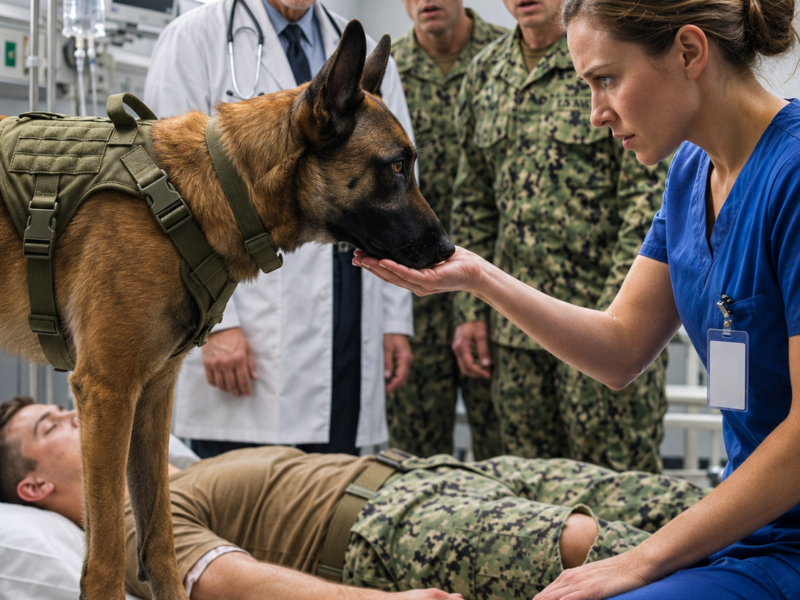
“Sedate the Dog!” the Doctor Snapped — Until the Quiet Nurse Calmed the K9 With ONE Gesture
“Sedate the Dog!” the Doctor Snapped — Until the Quiet Nurse Calmed the K9 With ONE Gesture
The emergency room doors burst open so violently that the rubber stoppers struck the wall behind them. Two paramedics rushed in, pushing a blood-soaked gurney while shouting vital signs over one another. A third followed, carrying an oxygen cylinder and looking as though he had just run out of time. Blood dripped from the patient’s side, leaving a dark trail across the polished hospital floor.
But nobody moved toward the patient.
Not because they didn’t understand the severity of his injuries. Not because they lacked the medical training to help him. They stood frozen because a Belgian Malinois was sitting directly on the man’s chest, its powerful body rigid, its ears pointed forward, and its dark eyes following every person who came within reach.
The dog wasn’t barking. It wasn’t making a sound. Somehow, that made the situation even more frightening.
Its black tactical vest carried the faded letters K9 UNIT, and a streak of blood ran across one shoulder. Its teeth were visible beneath a slightly raised lip. Every time someone attempted to approach the gurney, the animal shifted its weight and released a low warning growl.
“Get that dog off him!” someone shouted.
“Call animal control!”
“He’s going into respiratory failure!”
Dr. Victor Halstead, the senior trauma surgeon on duty, pushed through the crowd.
“Sedate the dog!” he ordered. “Now!”
“With what, Doctor?”
“Ketamine. Propofol. I don’t care. Give me something that will put that animal down!”
Nobody moved quickly enough.
Then a quiet voice came from behind them.
“Don’t sedate him.”
Several people turned.
A nurse had stepped into the trauma bay. Her name was Clara Vance, and she was the sort of employee most people barely noticed. She was thirty years old, small-framed, with brown hair pulled into a practical ponytail and a face that rarely showed more emotion than the situation required. She wore ordinary navy-blue scrubs, comfortable shoes, and an expression of complete concentration.
She wasn’t particularly intimidating. She wasn’t loud, and she certainly didn’t look like someone who could control a seventy-pound military working dog.
Dr. Halstead turned toward her with obvious irritation.
“Excuse me?”
“Sedating him won’t work quickly enough,” Clara replied. “And if you approach him with a syringe, he’ll become more aggressive.”
“Who are you?”
“Clara Vance. Medical-surgical floor.”
“Then go back to medical-surgical.”
Clara looked at the patient, then at the dog.
“Let me try.”
A resident gave a nervous laugh. Halstead stared at her as though she had just suggested performing surgery with a kitchen knife.
“Try what?”
“Talking to him.”
“We don’t have time for this.”
“You don’t have time to waste, either.”
Her voice wasn’t disrespectful. It was simply certain. She spoke with the calm authority of someone who had already evaluated the situation and reached a conclusion.
Halstead looked toward the patient. The monitor showed his blood pressure continuing to fall.
“Thirty seconds,” he said finally. “If you can’t get that animal off him, we’re sedating it.”
Clara nodded and approached the gurney.
She didn’t hurry. She didn’t make eye contact with the surrounding staff, and she didn’t reach for the dog immediately. Instead, she kept her hands visible and her shoulders relaxed. She watched the animal’s posture, the movement of its ears, and the tension in its jaw.
When she was approximately two feet away, she slowly lowered herself into a crouch.
“Easy, boy,” she whispered.
The dog’s eyes shifted toward her.
“You did a good job. You kept him safe. I know.”
The animal’s ears moved slightly.
Clara extended one hand, palm facing down, her fingers relaxed. She didn’t try to grab its collar or touch its head. She simply offered her hand and waited.
For several seconds, nothing happened.
Then the Malinois leaned forward and gently pressed its nose against her knuckles.
Clara remained perfectly still.
“That’s it. Good boy. He’s going to be taken care of now. You can let us help him.”
The dog’s breathing slowed. It looked once toward the unconscious man, then back at Clara.
A moment later, it stepped off the patient’s chest and sat beside her.
The entire trauma bay fell silent.
Clara stood and looked toward the medical team.
“He’s all yours.”
Dr. Halstead stared at her for a second before his professional instincts took over.
“Move! Chest tube tray! Two units of O-negative blood! Get portable imaging in here!”
The room exploded into activity.
Clara immediately moved toward the patient, checking his airway and helping the team establish intravenous access. The dog’s attention remained fixed on her, and when she moved to the opposite side of the gurney, it followed quietly.
“Blood pressure is seventy systolic!” a resident called.
“His oxygen saturation is dropping!”
“Tension pneumothorax,” Halstead said. “We need to decompress immediately.”
Clara had already opened the emergency kit.
She placed the equipment into the surgeon’s hand before he could ask for it. As he performed the procedure, she maintained pressure around the wound and prepared the chest tube equipment.
A sharp hiss of escaping air came from the patient’s chest.
The oxygen saturation began to improve.
“That’s better,” Halstead muttered.
Within minutes, the patient was stable enough to be transferred to intensive care.
The dog remained beside Clara, watching every movement.
Someone finally asked the question that had been hanging in the room.
“Who the hell is she?”
Clara pretended not to hear.
She was more interested in the dog, whose tactical vest was stained with dirt and blood. There was a shallow cut across its shoulder that needed cleaning.
A young nurse named Tessa approached cautiously.
“How did you do that?”
Clara glanced down at the animal.
“I talked to him.”
“But he’s a military working dog.”
“He knows the difference between a threat and someone trying to help.”
Tessa looked unconvinced.
“How can you be so sure?”
Clara gently scratched behind the dog’s ears.
“Because he’s been trained to protect someone. He wasn’t attacking us for no reason. He was doing exactly what he believed he was supposed to do.”
Before Tessa could ask another question, Halstead called her name.
“Vance! Do you know anything about chest tubes?”
“Enough.”
“Then get over here.”
Clara moved immediately.
The patient was taken upstairs, and the dog remained behind with her. His name tag read JAX.
Clara led him into an empty examination room, cleaned the cut on his shoulder, and checked for additional injuries. Jax sat patiently while she worked, occasionally looking toward the door as though expecting someone to return.
“You’re a good boy, Jax,” she murmured. “You did everything you could.”
His tail moved once against the floor.
It was the first time that morning Clara had smiled.
She had no idea that the next person through the examination-room door would change her life completely.
The man was in his mid-forties, wearing a dark civilian suit. His hair was neatly trimmed, his expression controlled, and his posture suggested a military background.
He closed the door behind him.
“Nurse Vance?”
“Yes?”
“Special Agent Garrett Thorne. Naval Criminal Investigative Service.”
Clara stopped cleaning the dog’s shoulder.
“Is there a problem?”
Thorne glanced at Jax.
“That dog belongs to a Navy unit. The man upstairs is a Navy SEAL. This situation is now a federal matter.”
Clara nodded slowly.
Thorne studied her for several seconds.
“You handled that animal remarkably well.”
“I’ve worked around dogs.”
“Not many civilian nurses can calm a combat-trained Malinois in the middle of an emergency department.”
Clara said nothing.
Thorne reached inside his jacket and removed a clear evidence bag. Inside was a small black device resembling a tactical camera or encrypted field recorder.
“This was found on the patient. It’s classified. I need to know whether anyone touched it.”
“No one did. We were trying to keep him alive.”
“You’re certain?”
“Absolutely.”
Thorne watched her expression.
“I’ll need a list of everyone who entered the trauma bay.”
“The charge nurse will have that information.”
“I’m asking you.”
Clara met his eyes.
“Why?”
“Because the dog trusted you.”
“He’s a dog, Agent. He trusted someone who didn’t threaten him.”
Thorne didn’t appear convinced. He placed a business card on the counter.
“If you remember anything unusual, call me.”
Then he left.
Clara looked down at Jax.
“Well, this has certainly become an interesting day.”
She returned to her fourth-floor unit shortly before noon. Her patients still needed medication, the hip-fracture patient was attempting to climb out of bed again, and the two postoperative patients were complaining about the hospital food.
For a while, ordinary responsibilities helped her forget the strange events downstairs.
But she couldn’t forget Jax.
Nor could she forget the federal agent’s questions.
At approximately two in the afternoon, her charge nurse, Brenda Lynn, appeared in the doorway.
“Vance, Dr. Halstead wants to see you.”
Clara frowned.
“Did he say why?”
“No. Just go when you can.”
Halstead’s office was quiet. He sat behind his desk with several patient files arranged in front of him.
“Sit down.”
Clara obeyed.
“That was quite a performance this morning,” he said.
“What was?”
“The dog. The emergency procedure. The way you anticipated everything.”
“I was helping the team.”
“Where did you train?”
“County General.”
“Before that.”
Clara looked at him.
“I worked in retail.”
“Retail?”
“A hardware store.”
Halstead removed his glasses.
“Interesting. I’ve worked with dozens of nurses. I’ve never seen one handle a military dog like that.”
He leaned forward.
“And I’ve never seen a medical-surgical nurse move through a trauma emergency with the kind of precision you displayed today.”
Clara remained silent.
“The federal agent also seemed very interested in you.”
“He asked about the patient.”
“That’s not what I’m asking.”
“Then ask me something specific.”
Halstead’s expression hardened.
“You’re becoming a liability, Vance. I want you to stay away from that patient and that dog. If the federal investigators return, send them to me.”
Clara stood.
“Understood.”
She left the office without another word.
But halfway down the corridor, her hands began to tremble.
She hated that feeling. Not because she was afraid, but because it reminded her of a life she had spent years trying to bury.
Five years earlier, Clara had been a Navy corpsman. She had served in Afghanistan, treated wounded soldiers under fire, and learned to recognize the difference between ordinary danger and the kind that could destroy everyone in a room.
She had completed three combat deployments, received two decorations, and been honorably discharged in 2020.
After leaving the military, she had deliberately chosen a quieter life.
No uniforms. No deployments. No classified briefings. No more watching young men die while she tried desperately to keep their hearts beating.
She had become a civilian nurse because she wanted to heal people without hearing gunfire in the background.
And she had become invisible because invisibility felt safe.
That evening, after finishing her shift, Clara changed clothes, collected her bag, and walked toward the parking garage.
She stopped when she saw Jax sitting beside her car.
The dog wore his tactical vest, and a leash was attached to his collar. There was no handler in sight.
“Jax? What are you doing here?”
The animal stood and approached her.
Clara looked around the empty garage.
“Where’s your person?”
Jax turned toward the elevator.
Then he looked back at her.
Clara sighed.
“All right. Show me.”
He led her through the hospital corridors, past the cafeteria, and upstairs to the intensive care unit.
Room six.
Inside, the young SEAL lay unconscious with an oxygen tube, chest drainage equipment, and several intravenous lines attached to him.
Jax entered and immediately rested his chin beside the man’s hand.
Clara checked the monitors.
His vital signs were stable. Someone had cleaned the blood from his body, dressed his injuries, and started antibiotics.
His chart listed him only as John Doe.
Federal hold. No visitors without NCIS authorization.
Clara looked at the young man more closely.
He was probably twenty-eight. Dark hair, strong jaw, and an old scar near his left temple. His hands were heavily calloused, with the kind of scars that came from years of physical training.
Jax whined softly.
“He’s going to be okay,” Clara whispered.
The door opened.
Agent Thorne stood behind her.
“You’re not supposed to be here.”
“The dog brought me.”
“He’s supposed to be in quarantine.”
“Then perhaps someone should explain that to him.”
Thorne closed the door.
“You need to leave.”
Clara glanced at the patient.
“He’s under medical care. I’m checking on him.”
“Dr. Halstead instructed you to stay away.”
“Dr. Halstead isn’t my supervisor.”
Thorne pulled out his phone.
“Perhaps this will explain why I’m asking you to cooperate.”
He turned the screen toward her.
Clara’s own personnel photograph appeared.
Beneath it was her military service record.
“Clara Hannah Vance. Born 1996. Enlisted in the United States Navy in 2014. Corpsman training at Pensacola. Advanced trauma life support. Combat medic deployments in Afghanistan from 2016 through 2019. Two decorations. Honorable discharge in 2020.”
He lowered the phone.
“Three combat deployments, Nurse Vance. Why are you pretending you’ve never worked with military personnel?”
Clara’s expression remained controlled.
“I’m not pretending anything.”
“Then why are you working on a medical-surgical floor?”
“Because I wanted to.”
Thorne stepped closer.
“That dog recognized your behavior because you’ve worked with animals like him under fire. And the man upstairs is carrying information important enough that someone tried to kill him before he reached this hospital.”
Clara looked toward Jax.
“Then perhaps you should concentrate on finding whoever tried to kill him.”
Before Thorne could answer, Jax suddenly stood.
His ears flattened. A deep growl vibrated through his chest.
Clara immediately looked toward the doorway.
Thorne moved to the window.
The hallway appeared empty.
“Stay here,” he said.
Clara followed him.
The corridor was unnaturally quiet. The nurses’ station was unattended, and several lights had been switched off.
Then they heard running footsteps.
Thorne drew his weapon.
“Naval Criminal Investigative Service! Identify yourself!”
A man in blue medical scrubs appeared at the far end of the corridor and sprinted toward the loading dock.
Thorne pursued him.
Clara followed with Jax.
By the time they reached the loading area, the man was already climbing into a black SUV. Thorne shouted for him to stop and fired a warning shot into the air.
The vehicle accelerated away.
Thorne managed to obtain its license plate before it disappeared.
Clara watched the empty road.
“He wasn’t here for the patient,” she said.
Thorne turned.
“What?”
“He was here for the device you showed me. If he wanted to kill the patient, he had an opportunity.”
Thorne’s expression changed.
He immediately contacted his team.
Within minutes, the decision was made to move the SEAL to a secure federal medical facility.
And Clara was going with them.
“You’re the only person Jax trusts,” Thorne explained. “We need you to keep him calm during transport.”
“I’m not military anymore.”
“You are tonight.”
Clara stared at him.
“You can’t simply pull me out of my life because a dog likes me.”
“Someone inside this hospital knows where the patient is and what he’s carrying. Until we identify that person, everyone is a potential security risk.”
He paused.
“And that includes you.”
Twenty minutes later, Clara stood in the hospital loading bay beside a convoy of three black SUVs.
Commander Arthur Maddox, a gray-haired officer with a hard expression, introduced himself.
“You’re Clara Vance?”
“Yes.”
“Former Navy corpsman?”
“Yes.”
“Then you understand the situation. Follow instructions and don’t take unnecessary risks.”
Clara nodded.
The patient was transferred into a specially equipped vehicle containing a portable ventilator, intravenous pumps, cardiac monitors, and enough emergency equipment to function as a small intensive care unit.
Jax climbed inside and settled beside the man’s head.
Clara checked the patient’s vital signs while a young intensive care nurse named Paige secured the intravenous lines.
The convoy pulled away from the hospital.
For twenty minutes, everything went smoothly.
Then the radio crackled.
“Lead vehicle, we’ve got a tail. Black sedan, no plates.”
Thorne grabbed the handset.
“Confirmed?”
“Confirmed. Maintaining distance.”
Maddox’s voice came through the radio.
“Take the next right. Double back through the industrial park.”
The convoy changed direction.
The black sedan followed.
A second vehicle appeared from another road.
Then a gray pickup joined them.
“They’re boxing us in,” the driver reported.
Maddox ordered evasive maneuvers.
The vehicles accelerated through an industrial district before reaching a makeshift roadblock formed by two trucks parked across the road.
“Ram it!” Maddox ordered.
The lead SUV smashed through the obstruction.
Metal screamed against metal. Glass shattered, and the second vehicle bounced over the debris.
Gunfire erupted behind them.
Paige screamed as the rear window spiderwebbed under the impact of a bullet.
Clara grabbed the intravenous pole before it fell.
“Keep that line secure!” she ordered.
The driver accelerated.
Their lead vehicle was hit, and its front tires began losing pressure.
Maddox immediately ordered a transfer to the second vehicle.
Agents jumped out, covering the road while Clara and Paige moved the patient.
Jax stayed beside his handler.
The convoy escaped the industrial area and turned onto a narrow gravel road surrounded by dense trees.
Ahead, a helicopter waited in an isolated clearing.
“Sixty seconds!” Maddox shouted.
They were halfway across the grass when headlights appeared between the trees.
The gray pickup.
Two armed men jumped out.
Gunfire erupted.
Clara dropped behind the gurney, pulling it down with her. Jax lunged forward, positioning himself between her and the attackers.
Maddox and Thorne returned fire.
One gunman fell. The other disappeared toward the trees.
“Get the patient into the helicopter!” Thorne shouted.
Clara and Paige pushed the gurney forward as the SEAL’s monitors began alarming.
His heart rate had climbed dangerously.
They reached the helicopter just as Thorne returned.
The aircraft lifted off almost immediately.
For the next twenty minutes, Clara monitored the patient while the helicopter flew toward a secure underground federal medical compound.
The surgical team was waiting.
They removed four fragments from the man’s chest, repaired a damaged artery, and closed the wound.
Three hours later, the lead surgeon announced that the operation had been successful.
Clara was exhausted.
Her feet hurt, her eyes burned, and her hands still carried the smell of antiseptic and blood.
She was escorted to a small room containing a bed, a chair, and a narrow window overlooking darkness.
Jax followed her inside.
Clara sat on the edge of the bed.
“You miss him, don’t you?”
Jax rested his head against her leg.
She scratched his ears until she finally fell asleep.
At four in the morning, someone knocked.
Thorne stood in the doorway.
“He’s awake.”
Clara was on her feet immediately.
The SEAL was sitting upright in recovery, his oxygen mask covering his face. His eyes were alert despite the exhaustion.
Jax rushed to the bedside.
The man’s hand moved slowly toward the dog’s head.
“Good boy,” he whispered.
Thorne pulled up a chair.
“Lieutenant, can you hear me?”
The man nodded.
“Do you remember what happened?”
Another nod.
“Do you remember the equipment you were carrying?”
The SEAL looked toward Clara.
Then he lowered his oxygen mask.
“Camera. Encrypted.”
“We have it.”
“No.” He coughed painfully. “Backups.”
Thorne leaned forward.
“Where?”
The SEAL reached toward Jax’s tactical vest and carefully opened a hidden seam near the chest strap. Inside was a small waterproof package containing a USB drive.
Thorne took it.
“What’s on this?”
“Everything.”
“What does that mean?”
“Names. Locations. Financial records. A trafficking network. Weapons. Military commanders.”
The room became silent.
The SEAL swallowed.
“Somebody high up is involved. Maybe a flag officer.”
Clara felt a chill move through her body.
A flag officer was not an ordinary military official. It meant someone with enormous authority, someone who could influence operations and control people far above the level of ordinary soldiers.
Thorne left to make several calls.
Clara adjusted the patient’s oxygen and checked his monitors.
The SEAL looked at her.
“You were in the emergency department.”
“Yes.”
“Corpsman?”
“A long time ago.”
He studied her face.
“I slipped something into your scrub pocket before I passed out. Another drive.”
Clara blinked.
“Why?”
“Didn’t know who I could trust.”
He closed his eyes.
“Thank you.”
“Don’t thank me yet. You’ve got a long recovery ahead.”
The corner of his mouth moved.
“I’ve had worse.”
“I believe you.”
His name, Clara would soon learn, was Lieutenant Lucas Reed, a member of Navy SEAL Team Six.
The evidence he carried was powerful enough to destroy a criminal network that had operated for five years, trafficking weapons through Afghanistan, Syria, and Yemen while selling military intelligence to the highest bidder.
But the digital files were heavily encrypted.
The National Security Agency would need approximately forty-eight hours to extract the information.
And Thorne believed the enemy would not wait that long.
He gathered Clara, Maddox, and several investigators in a conference room.
“We have twelve hours before the extraction process begins,” he explained. “We need to identify who leaked the lieutenant’s location.”
Surveillance footage from Cedar Bay Medical Center appeared on a large screen.
Three days before Reed had been discovered, a man in medical scrubs entered through the hospital’s service entrance. He moved carefully, avoiding cameras, and entered a supply closet.
Thirty seconds later, he emerged carrying something small.
“A tracking device,” Maddox suggested.
“Probably,” Thorne replied.
Before they could continue, an agent entered the room.
“Movement outside the perimeter. Three vehicles. Armed.”
Everyone stood.
Clara was ordered back to the recovery room.
She locked the door and checked Lucas’s condition.
Jax stood near the entrance, growling.
Then the facility’s lights flickered.
An alarm sounded.
The building entered lockdown.
Blast doors began sealing the corridors.
A moment later, the lights went out completely.
Emergency generators activated, filling the room with red illumination.
Clara moved the crash cart closer to the door.
Lucas stirred.
“What happened?”
“Hostile breach.”
“How many?”
“At least six.”
He tried to sit up.
Clara pressed a hand against his shoulder.
“You’ve just had three hours of surgery. You’re not going anywhere.”
“I’ve fought with worse.”
“Right now, you’re more liability than asset.”
He looked at her for a moment.
Then he smiled faintly.
“You’re always this blunt?”
“Only when people are being stupid.”
Footsteps approached outside.
Clara picked up the defibrillator paddles.
Lucas looked at them.
“Do you know how to use that?”
“I’m about to find out.”
The door handle turned.
Someone pushed hard against the steel.
The crash cart scraped across the floor.
Jax barked.
Clara pressed herself against the door and forced it back against the intruder. She heard a grunt, then shoved the live defibrillator paddles through the opening and discharged them.
A scream echoed through the corridor.
She pulled the paddles back and reset the machine.
Lucas stared at her.
“Did you kill him?”
“I don’t know.”
“If you didn’t, he’ll probably get back up.”
“Then I’ll hit him again.”
Lucas laughed, though the movement caused him pain.
“I like you.”
“Save it.”
The radio crackled.
Thorne’s voice came through.
“Vance, status?”
“Still breathing.”
“Reinforcements are eight minutes out.”
“Make it five.”
The connection ended.
Lucas studied the corridor through the observation window.
“They’re regrouping,” he said.
“How do you know?”
“Because that’s what people do when their first plan fails.”
Clara looked at the door.
“We need to move you.”
He shook his head.
“I can barely stand.”
“Then we’ll move slowly.”
He swung his legs over the bed and struggled upright.
His face went pale, but he managed to stay on his feet.
Clara grabbed his arm.
“If you fall, I’m leaving you.”
“No, you won’t.”
He was right.
They moved toward the door with Jax following closely.
Then an explosion ripped through the entrance.
The door flew inward.
Smoke filled the room.
Three armed men entered.
Jax attacked the first, dragging him to the floor. Lucas seized the defibrillator paddles and discharged them against the second man’s chest.
Clara grabbed the bent intravenous pole and swung it into the third attacker’s head.
He collapsed.
The room was filled with alarms, smoke, and the sound of Jax growling over the fallen man.
Lucas leaned against the wall, blood spreading through his bandages.
“You’re bleeding,” Clara said.
“I’m fine.”
“You’re not.”
She pulled Jax away from the unconscious attacker and checked the corridor.
It appeared clear.
They moved out.
Thirty feet later, gunfire erupted from the opposite end.
Thorne and Maddox were pinned down behind an overturned equipment cart.
Two more attackers were approaching.
Clara pulled Lucas into a nearby break room.
“We’re trapped.”
“Not necessarily.”
Lucas pointed toward a ventilation opening near the ceiling.
“That connects to the mechanical corridor.”
“You can’t climb.”
“Watch me.”
He dragged a chair beneath the vent and forced the cover open.
Clara helped Jax climb inside first. Lucas followed, moving slowly and suppressing his pain. Clara climbed after him.
The ventilation passage was narrow, hot, and dark.
Behind them, the break-room door opened.
The attackers realized they had escaped.
Clara crawled faster.
Eventually, the duct opened above a maintenance corridor.
She dropped down, caught Jax, and helped Lucas descend.
He was pale and sweating.
“You’re going to need another operation,” she said.
“After this.”
He pointed toward a security terminal.
The facility’s internal systems were connected to it.
Lucas began typing.
Within seconds, he had accessed the security network and locked several blast doors between their location and the server room.
“That should slow them down,” he said.
Clara checked the surveillance feeds.
She saw Thorne and Maddox moving toward the server room.
Then another camera caught something unexpected.
Dr. Victor Halstead.
He was standing in the hospital loading bay, speaking to two men in tactical gear.
Clara zoomed in.
There was no mistake.
The doctor who had ordered her to stay away from the patient was coordinating the attack.
“Thorne,” she shouted into the radio. “It’s Halstead. Dr. Halstead is the leak.”
A different voice answered.
Smooth. Familiar. Cold.
“Hello, Clara.”
Her blood turned to ice.
It was Halstead.
“You’ve been very resourceful,” he said. “More than I expected.”
“Why are you doing this?”
“Some secrets are worth more than lives.”
Clara looked at the security feeds.
The blast doors were beginning to open.
“You’re a traitor.”
“I’m a pragmatist.”
The radio went silent.
Clara turned toward Lucas.
“We need to move.”
He was already struggling to stand.
They reached the stairwell, but his injuries were worsening. On the third-floor landing, his legs finally gave way.
“Take Jax and go,” he whispered.
“Shut up.”
“Clara, listen—”
“I said shut up.”
She dragged his arm across her shoulders and attempted to lift him.
Jax barked sharply.
A gunman appeared at the top of the stairs.
Before he could fire, Thorne emerged behind him and brought him down.
“You’re late,” Clara snapped.
“Nice to see you, too.”
Thorne and Clara carried Lucas to the upper floor.
Maddox was waiting with a team.
“The server room is secure,” he announced. “The drive is intact.”
But their relief lasted only seconds.
An NSA agent named Evelyn Sterling contacted them.
“Two unauthorized individuals are entering the server room.”
The security feed showed two people wearing hazmat suits.
“They aren’t ours,” Maddox said.
Everyone ran.
They reached the server room too late.
The evidence drive was gone.
The two intruders had disappeared, leaving behind discarded protective suits.
A later camera recording showed them removing the suits inside a maintenance closet and revealing hospital uniforms beneath.
“They were already inside,” Clara said.
Thorne swore.
Then Clara remembered Lucas’s words.
The second backup.
She turned toward Thorne.
“He told me he had slipped another drive into my scrub pocket at Cedar Bay.”
“Where is it?”
“My locker.”
Thorne immediately ordered a team back to the hospital.
They transferred Lucas to a guarded medical vehicle and returned to Cedar Bay by helicopter.
When Clara reached the fourth-floor locker room, she found her locker open and its contents scattered across the floor.
Someone had searched everything.
Her scrubs were torn.
Her bag had been emptied.
The chest pocket of her uniform had been ripped open.
“They found it,” she whispered.
Thorne looked around.
“Whoever did this knew exactly where to search.”
Before anyone could respond, the lights went out.
Emergency generators activated.
The room turned red.
Jax growled.
The door opened.
Dr. Halstead walked inside wearing his white coat and stethoscope.
He looked almost as though he had just finished an ordinary medical round.
“Hello, Clara.”
Thorne raised his weapon.
“Don’t move.”
Halstead smiled.
“You’re looking for this, I assume?”
He held up the small USB drive.
Clara stared at him.
“How did you get it?”
“I’ve worked here for twenty years. I know every locker, every hiding place, every shortcut.”
Thorne kept his weapon trained on him.
“Put it down.”
Halstead shook his head.
“You’re not going to shoot me. Not here. Not with witnesses.”
“Try me.”
“Because the moment you do, my associate activates the device we planted in the intensive care unit above the pediatric ward.”
Clara watched him carefully.
“What do you want?”
“Safe passage for myself and my team. In exchange, I’ll tell you where the device is.”
Thorne immediately refused.
Halstead raised the drive.
“Then nobody gets this.”
He threw it against the wall.
The plastic casing shattered.
The circuit board broke into several pieces.
Thorne lunged, but Halstead was already moving toward the exit.
Jax attacked without waiting for a command.
The dog caught Halstead by the ankle and dragged him down.
The doctor struck his head against the edge of a bench and went motionless.
Agents rushed in and restrained him.
Clara knelt beside the broken drive.
The data was gone.
Thorne looked down at the fragments.
“Then we’ve lost everything.”
“Not everything.”
A familiar voice came from the doorway.
Lucas stood there, leaning heavily on a crutch, his face pale and his bandages still visible beneath his shirt.
Clara stared at him.
“You’re supposed to be upstairs.”
“I got bored.”
He reached inside his bandages and removed another small drive.
“I made three backups besides the camera. One in the vest, one in the locker, and one I kept on myself.”
Thorne took it carefully.
“Is this real?”
“Every name, every date, every transfer, every shipping manifest.”
The evidence was enough to dismantle the network.
By sunrise, fourteen arrests had been made. Three senior military officers, six defense contractors, and two sitting senators were among those implicated.
But the investigation had uncovered something else.
Clara’s own military record appeared in the files.
Attached to it was a note:
HIGH-VALUE WITNESS. TARGETED FOR ELIMINATION.
She stared at the photograph on her phone.
Someone had been trying to erase her for five years.
Special Agent Evelyn Sterling approached her in the parking garage later that morning.
“Clara Vance?”
“Depends who’s asking.”
Sterling showed her credentials.
“We need to discuss Operation Iron Veil.”
Clara felt her stomach tighten.
She had not heard that operation’s name since her final military debriefing in 2020.
Five years earlier, she had been assigned as the medic attached to a team entering a compound in Afghanistan to rescue hostages.
Three SEALs and four civilians had been recovered.
But one man had died.
His name was Nathan Wallace, a CIA officer who had been working undercover.
Sterling explained that Wallace had discovered evidence of the same trafficking network Lucas had exposed.
He had been preparing to reveal the operation when someone leaked the team’s location.
The compound was attacked.
Wallace died.
The documents disappeared.
Clara had been the last person to speak with him.
According to intercepted communications, the conspirators believed Wallace had passed his evidence to her before he died.
“That’s why my name was in the files?” Clara asked.
“Yes. They believed you were carrying information that could destroy them.”
“But I never received anything.”
“I believe you. They don’t.”
Clara suddenly understood why her military record had been marked for elimination.
She had not escaped danger by leaving the Navy.
She had simply disappeared from the people who were hunting her.
Sterling wanted her testimony at a closed congressional hearing the following morning.
Clara agreed to consider it.
But before she could decide, another memory surfaced.
Nathan Wallace’s final words.
Red envelope. Back wall. Don’t let them find it.
At the time, she had assumed he was delirious.
Now she wondered whether he had been trying to tell her something.
She called Thorne at three in the morning.
“Wallace told me something before he died.”
“What?”
“He said, ‘Red envelope. Back wall.'”
There was a pause.
“Are you saying he hid something in the compound?”
“Maybe.”
Thorne contacted his sources.
The compound was still standing, although it had been abandoned and partially damaged.
Two hours later, a special operations team was preparing to return to Afghanistan.
Clara insisted on going.
She was the only person who knew where Wallace had been lying when he died.
Thorne initially refused.
But eventually, he agreed.
The flight lasted six hours.
They landed at a forward operating base before traveling by armored convoy across the dry, rocky terrain.
When Clara finally saw the compound, her chest tightened.
It looked almost exactly as she remembered.
The same adobe walls.
The same empty windows.
The same entrance where she had once run through gunfire carrying medical equipment.
She entered beside Thorne.
The interior was almost completely destroyed.
Furniture had disappeared, walls were scorched, and old bloodstains had darkened into rust-colored patches.
“Where was Wallace?” Thorne asked.
Clara pointed toward the far corner.
“Against that wall.”
They searched carefully.
For ten minutes, they found nothing.
Then Thorne noticed a section of wall that looked newer than the surrounding structure.
He pried away the damaged plaster.
Behind it was a small hollow space.
Inside rested a red envelope.
Thorne opened it.
Photographs, bank statements, shipping records, and handwritten notes.
Everything Wallace had died trying to protect.
“We got it,” he whispered.
Clara felt something release inside her chest.
Then gunfire erupted.
Bullets punched through the walls.
Thorne pushed her to the floor and covered her body as the team outside returned fire.
More than twenty attackers were approaching from the eastern ridge.
They escaped through the armored convoy under heavy fire.
Back at the forward operating base, Thorne immediately began investigating the leak.
Someone had known their flight plan.
Someone had known exactly where they would search.
Clara’s phone buzzed.
An unknown number.
You should have stayed invisible.
Attached was a photograph of Lucas Reed sleeping in his hospital bed.
Clara’s blood ran cold.
She showed Thorne.
He immediately contacted the medical facility.
But when they returned to the United States, Lucas was gone.
His room was empty.
A nurse explained that he had been transferred to Walter Reed Medical Center two hours earlier.
Thorne contacted Admiral Gordon Hendricks, who supposedly had authorized the transfer.
The admiral denied knowing anything about it.
Someone had taken Lucas.
The evidence was in their hands, but the enemy now had the one person who could explain it.
Meanwhile, Senator Philip Aldrich had called an emergency closed-session hearing of the congressional oversight committee.
Thorne recognized the move immediately.
Aldrich was named repeatedly in Lucas’s intelligence files.
He intended to control the investigation before Clara and Thorne could expose the truth.
They headed to a secure facility beneath the Capitol.
The hearing began at seven-thirty that evening.
Aldrich sat in the center of the chamber, looking confident and composed.
He began speaking about alleged misconduct within the Department of Defense, attempting to portray the recent military operation as a security failure rather than an attempt to expose corruption.
Thorne stood.
“Point of order, Senator.”
Aldrich looked irritated.
“Who are you?”
“Special Agent Garrett Thorne, Naval Criminal Investigative Service. And I have evidence that directly contradicts your statement.”
He produced the red envelope.
The room became silent.
Clara stood beside him.
“Before you have him removed, you should know that Lieutenant Lucas Reed has been kidnapped. We believe the people responsible are connected to the same trafficking network documented in these files.”
Aldrich’s expression changed.
Thorne opened the envelope and began reading names, financial transfers, and weapons shipments.
The senator’s name appeared fourteen times.
The chamber erupted.
Then Clara’s phone rang.
An unknown video call.
She answered.
Lucas appeared on the screen, bound and gagged, with a gun pressed against his head.
Standing behind him was Admiral Gordon Hendricks.
Clara recognized him immediately.
The same man who had helped organize their extraction.
The same senior officer who had promised to protect them.
“Ms. Vance,” he said calmly. “I believe you have something that belongs to me.”
Thorne moved beside her.
“Where are you?”
“Somewhere your federal friends won’t find me in time.”
Hendricks shifted the weapon.
Lucas flinched.
“I want the documents, the drive, and everything else. In exchange, Lieutenant Reed walks away.”
“Why?” Clara asked.
Hendricks laughed.
“You think this is about money? It’s about national security. The weapons went to allies. The funds supported operations Congress would never approve. We did what was necessary.”
“You’re a traitor.”
“I’m a patriot. You’re simply too naive to understand the difference.”
Lucas moved his fingers against his leg.
Clara recognized the pattern.
Morse code.
R-O-O-F.
The rooftop.
She kept talking.
“Where do you want the exchange?”
“Cedar Bay Medical Center. Rooftop helipad. One hour. You come alone. Any backup, and Reed dies.”
The call ended.
Thorne immediately objected to Clara’s plan.
She wanted to go alone.
“That’s suicide,” he told her.
“He’s expecting me. If he sees a tactical team, he’ll kill Lucas.”
“We can find another way.”
“No. He wants the witness he failed to eliminate five years ago. Me.”
Thorne stared at her.
For five years, Clara had believed that disappearing was the only way to survive.
Now she understood that the men hunting her had never stopped.
They had simply waited.
“I’m tired of being invisible,” she said.
Thorne finally agreed to the plan.
The drive to Cedar Bay took forty minutes.
Clara sat in the back of an unmarked SUV, holding the evidence envelope.
Thorne drove.
Three tactical vehicles followed at a distance.
When they arrived, Clara received another message.
Ten minutes. Come alone or he dies.
She walked into the hospital wearing her ordinary scrubs.
The same building where she had once been ignored, dismissed, and ordered away from the very patient she had saved.
The same corridors.
The same nurses’ station.
The same elevator.
She climbed four flights of stairs to the rooftop.
The helipad was illuminated by powerful floodlights.
A helicopter sat in the center.
Admiral Hendricks stood beside it.
Lucas knelt on the concrete with his hands tied behind his back.
His face was bruised, and blood had dried near his eyebrow.
“You came,” Hendricks said.
“I came.”
“Where’s Thorne?”
“Downstairs.”
“Good.”
He extended his hand.
“Give me the evidence.”
Clara didn’t move.
“Let Lucas go first.”
“That’s not how this works.”
“Then we don’t have a deal.”
They stared at each other.
Finally, Hendricks pulled out a knife and cut Lucas’s restraints.
Lucas stood slowly.
Clara helped steady him.
“Are you okay?” she whispered.
“I’ve been better.”
She handed him the envelope and the third backup drive.
“Get these to Thorne.”
Lucas hesitated.
“What about you?”
“I’ll be right behind you.”
He limped toward the stairwell.
Once the door closed, Hendricks turned back to Clara.
“You don’t have anything now.”
She smiled.
“Do you really think those are the only copies?”
His expression changed.
“We scanned everything. Uploaded it to three secure servers. Copies were sent to federal investigators and independent journalists.”
“You’re lying.”
“Am I?”
Hendricks drew his weapon.
“You just made a mistake.”
“No,” Clara replied. “You made one five years ago.”
She took a step toward him.
“When you decided I was a loose end worth eliminating.”
The rooftop door burst open.
Thorne entered first, followed by Maddox and six armed tactical agents.
“Federal agents! Drop the weapon!”
Hendricks refused.
He kept the gun pointed at Clara.
“Do you think I’m going to let you destroy everything I built?”
“You don’t have a choice,” Thorne replied.
Hendricks turned the weapon toward himself.
Clara moved instantly.
She struck his arm, sending the gun upward. It discharged into the night.
She swept his legs and drove him onto the concrete.
Thorne rushed forward and secured the handcuffs.
“It’s over,” Clara said.
Hendricks looked up at her with disbelief.
“You should have stayed hidden.”
Clara stared at him.
“Maybe. But I’m glad I didn’t.”
The arrests happened quickly.
Senator Aldrich was taken into custody, followed by several other politicians, military officials, intelligence officers, and defense contractors.
The trafficking network was dismantled.
The weapons shipments were stopped.
And the evidence recovered from Wallace’s red envelope provided the missing link investigators needed to prove the conspiracy.
By the following morning, the story was everywhere.
Clara watched the news from the Cedar Bay cafeteria, drinking a cup of coffee that tasted as terrible as it always had.
Thorne found her there.
“You’re free to go.”
“That’s it?”
“That’s it.”
He sat across from her.
“For what it’s worth, you did exceptional work.”
“I kept a patient alive.”
“You did much more than that.”
He offered her a consulting position with the NCIS medical division.
Clara declined.
She wanted to remain at Cedar Bay.
She wanted to continue working with patients, not spend the rest of her life inside government offices.
Dr. Delgado, the head of critical care, called her into her office later that morning.
“I’ve been receiving calls from the FBI, the Department of Defense, and several federal agencies,” Delgado said. “Apparently, you’re quite famous.”
Clara sighed.
“I didn’t ask for any of this.”
“I know. But I’m asking whether you’re coming back.”
Clara looked at her.
“What do you mean?”
“Your shifts. Your position. Your future.”
Delgado leaned forward.
“You’re a good nurse, Vance. One of the best. But you’re wasted on a medical-surgical floor.”
“I like my floor.”
“No. You like being invisible. There’s a difference.”
Clara remained silent.
Delgado offered her a new position as trauma liaison, coordinating emergency and critical care cases while assisting with complex situations involving law enforcement.
“You’d have the autonomy to build the position around your strengths,” Delgado explained.
Clara eventually accepted.
Two days later, the hospital held a formal ceremony to apologize for the way she had been treated.
The chief executive read a prepared statement about institutional failures and the importance of recognizing the contributions of every employee.
Clara stood onstage, uncomfortable in formal clothes.
When the applause began, she realized that people were finally looking at her differently.
Not because she had been involved in a federal investigation.
Not because she had helped dismantle a trafficking network.
But because they had seen what happened when someone who quietly did her job was finally given the opportunity to prove what she could do.
After the ceremony, Paige approached her.
“I wanted to thank you.”
“For what?”
“For the helicopter. I froze when the shooting started. I couldn’t think. You kept everything together.”
Clara considered her words.
“Being afraid doesn’t make you weak.”
Paige looked down.
“Then how do you learn to stay calm?”
“You learn by making mistakes, by failing, and by getting back up. You don’t become fearless. You just learn not to let fear make every decision for you.”
Paige nodded.
Clara smiled.
Two weeks later, Lucas was discharged from Walter Reed Medical Center.
He was still recovering, but he could walk without assistance.
Clara met him outside the hospital with Jax.
The dog nearly knocked his handler over with excitement.
Lucas knelt and wrapped his arms around the Malinois.
“Good boy. You did good.”
Clara watched them.
“How long until you’re back on your feet?”
“Six months of medical leave. Physical therapy. Then we’ll see.”
He handed her an envelope.
Inside was an official citation signed by the Secretary of the Navy.
The Navy Cross.
Clara stared at the document.
“I can’t accept this.”
“You can, and you will.”
“I didn’t do it for a medal.”
“I know. That’s why you deserve it.”
They stood quietly for a moment.
Lucas asked what she planned to do.
“I’m staying at Cedar Bay.”
“Sounds boring.”
“It probably will be.”
“Good. You’ve earned boring.”
Clara laughed.
He shook her hand and walked toward a waiting car with Jax beside him.
Six months passed.
The trials dominated the news.
Hendricks was convicted of conspiracy, weapons trafficking, and murder. Senator Aldrich received a lengthy prison sentence. The remaining defendants were convicted on charges involving the illegal sale of weapons, classified intelligence, and the deaths of military personnel.
The network that had operated for five years was finally dismantled.
Clara settled into her new position.
She coordinated trauma cases, worked with emergency physicians, assisted intensive care teams, and helped law enforcement when patients arrived with suspicious injuries.
For the first time in years, she felt comfortable being seen.
Doctors asked for her opinion.
Nurses sought her advice.
The same colleagues who had once talked over her now listened when she spoke.
One afternoon, Delgado entered her office.
“I’ve been thinking about something.”
Clara looked up.
“We should create a training program. High-stress medical situations, combat medicine, emergency coordination, crisis management.”
“Why me?”
“Because you’ve lived through situations most of our staff will never experience. And because you’re good at teaching people.”
Clara thought about Paige and the young nurses who sometimes froze when a trauma patient arrived.
“All right,” she said. “I’ll do it.”
The program began the following month.
She taught emergency procedures, communication under pressure, and the importance of controlling fear without pretending it didn’t exist.
She never glorified combat.
Instead, she explained how preparation, discipline, and teamwork could save lives when everything seemed to be falling apart.
One evening, an unknown number appeared on her phone.
It was Evelyn Sterling.
“We’ve been monitoring encrypted communications,” the NSA agent explained. “Someone has been asking questions about Operation Iron Veil.”
Clara listened carefully.
“Do you know who?”
“Not yet. The network was larger than Hendricks and Aldrich. There may still be people who want Wallace’s evidence buried.”
Clara looked through the window at the hospital parking lot.
“Are you saying I’m in danger?”
“I’m saying you should be careful.”
Clara thought about the five years she had spent hiding.
“Let them come,” she said. “I’m not hiding anymore.”
Sterling was silent for a moment.
“Good. The world needs more people like you.”
A week later, Clara was invited to speak at a medical conference in San Francisco.
She almost refused.
Public speaking had never been something she enjoyed.
But Delgado insisted.
“People need to hear your story,” she said. “Not the conspiracy. The part about being overlooked and still showing up every day.”
So Clara agreed.
Two thousand healthcare professionals filled the hotel ballroom.
She stood backstage with sweaty palms, listening as the announcer introduced her.
When she stepped onto the stage, the lights were so bright that she could barely see the audience.
For a moment, she froze.
Then she remembered Wallace.
Lucas.
Jax.
Every patient whose life had depended on someone noticing the smallest detail at exactly the right moment.
She took a breath.
“My name is Clara Vance. I’m a trauma liaison at Cedar Bay Medical Center. Six months ago, I was a nurse nobody noticed, nobody listened to, and nobody took seriously.”
The room became quiet.
“I’m not here to talk about federal investigations or criminal conspiracies. I’m here to talk about something much more ordinary. What it means to show up and do your job, even when nobody sees you doing it.”
She told them about the emergency room, the dog, and the patient who had nearly died because nobody could reach him.
She spoke about the importance of remaining calm, recognizing fear, and trusting one’s training.
“The system didn’t change because I demanded recognition,” she said. “It changed because I kept doing the work. I kept showing up. And eventually, people had to recognize what was happening in front of them.”
She looked across the audience.
“If you feel invisible in your workplace, if you believe nobody values what you contribute, remember something. Your work matters. The people you help remember. The people you protect remember. And even when nobody applauds, what you do can change someone’s entire future.”
The applause began before she finished.
For the first time, Clara didn’t feel embarrassed by it.
Two months later, a package arrived at her office.
There was no return address.
Inside was an old black-and-white photograph taken in Afghanistan.
Five people stood in front of a helicopter.
Nathan Wallace was in the center.
Clara stood beside him, much younger, wearing desert camouflage and a medic’s insignia.
On the back, someone had written:
Thank you for not forgetting him.
Rachel Wallace.
Clara sat down.
She had never met Nathan’s widow.
She hadn’t even known that the woman knew her name.
But somehow, through the years of secrecy and investigation, Wallace’s family had learned who had been with him at the end.
Clara placed the photograph on the corkboard in her office.
Beside it, she hung her Navy Cross citation and a thank-you card from Lucas.
They reminded her not of what she had lost, but of what she had protected.
Almost a year after the events at Cedar Bay, the receptionist called her one afternoon.
“There’s someone here to see you.”
“Who?”
“He says you’ll remember him.”
Clara walked to the lobby.
A man in his thirties stood near the entrance, holding the hand of a small boy with dark hair and a gap-toothed smile.
She stopped.
The man’s face was familiar.
“Do I know you?”
He smiled.
“You saved my life seven years ago in Helmand Province.”
Clara studied him.
Then the memory returned.
“Corporal Dawson?”
“Captain now.”
He laughed.
The man explained that his convoy had been hit by an improvised explosive device. He had suffered a severe leg injury and was bleeding heavily.
Clara had applied pressure to his artery with her bare hands while enemy fire struck the surrounding vehicles.
She remembered the operation.
She remembered how close he had come to dying.
But she had never known what happened afterward.
Dawson gestured toward the little boy.
“This is my son, Leo.”
Clara knelt.
“Hello, Leo.”
The boy hid shyly behind his father’s legs.
Dawson smiled.
“He wouldn’t be here if you hadn’t saved me that day.”
Clara felt her throat tighten.
“I was just doing my job.”
“Maybe. But you gave me a future. You gave my son a father. You gave my wife a husband who came home.”
He held out his hand.
“Thank you, Clara.”
She shook it.
For years, she had believed that leaving the military meant leaving behind the most important part of herself.
She had tried to become someone else, someone quieter, someone who could disappear into an ordinary hospital corridor without anyone asking questions.
But standing there with Dawson and his little boy, she finally understood something.
She had never stopped being the person she was before.
She had simply forgotten that the work mattered regardless of where she did it.
Dawson and his son eventually left.
Clara watched them disappear through the hospital doors before returning to the emergency department.
Brenda Lynn was coordinating the nurses’ station.
“Vance!”
Clara turned.
“We’ve got a patient coming in with chest pain. Trauma bay three. I need you.”
“On my way.”
She clipped her badge to her scrubs, pulled on a fresh pair of gloves, and walked toward the trauma bay.
The monitors were beeping.
Paramedics were shouting.
A young resident was trying to organize equipment.
Clara slipped into the familiar rhythm of the emergency department.
She checked the patient, established an intravenous line, and began coordinating the next steps.
Her hands were steady.
Her voice was calm.
Nobody needed to tell her what to do.
Somewhere in a federal prison, Admiral Hendricks was probably still wondering how a nurse he had tried to erase had brought down an operation that had survived for five years.
Senator Aldrich was probably wondering the same thing.
They had underestimated her because she was quiet.
They had mistaken her patience for weakness and her modest position for insignificance.
They had assumed she would remain invisible.
But Clara had learned something they never understood.
Being invisible was not the same as being powerless.
Sometimes the quietest person in the room was the one paying the closest attention. Sometimes the person nobody noticed was the one who understood the situation better than anyone else. And sometimes the person everyone dismissed was the only one capable of keeping everything from falling apart.
Clara Vance had spent five years hiding from the past.
Now she no longer needed to.
She wasn’t trying to become a hero, and she wasn’t interested in collecting medals or receiving public recognition.
She was simply a nurse who knew how to save lives.
And that was enough.
As she worked beside the patient, she glanced toward the hallway where Jax had once stood watching her with complete trust.
She remembered the first time she had reached out her hand to him.
She hadn’t shouted.
She hadn’t threatened him.
She hadn’t tried to prove she was stronger.
She had simply shown him that she wasn’t a danger.
Perhaps that was what she had needed to learn herself.
For years, she had treated her own past like a wounded animal, something dangerous that needed to be locked away and kept at a distance.
But she no longer needed to fear it.
Her past had not made her broken.
It had made her capable.
It had taught her to recognize danger, to remain steady when others panicked, and to protect people who could not protect themselves.
And now, whenever a new nurse entered the emergency department looking overwhelmed, Clara made a point of stopping to help.
She remembered what it felt like to be ignored.
She remembered what it felt like to believe that nobody cared whether she was there.
She refused to let someone else feel that way if she could prevent it.
The hospital continued moving around her.
New patients arrived. New emergencies unfolded. New lives depended on the people working behind those doors.
Clara checked the monitor, adjusted the patient’s oxygen, and looked toward the physician standing beside her.
“He’s stabilizing,” she said.
The doctor nodded.
“Good work, Vance.”
She offered a small smile and returned to the patient.
There was no applause, no camera, and no federal agent waiting outside the room.
There was only another person who needed help.
And Clara was exactly where she belonged.
She had once believed that disappearing would protect her.
Now she understood that she didn’t need to disappear to survive.
She needed to stand firm, trust her training, and refuse to let anyone convince her that she was less than what she was.
She was not just the forgotten nurse from the fourth floor.
She was not merely a former corpsman with a classified past.
She was Clara Vance.
And when the moment came, when fear filled a room and everyone else hesitated, she was the person who stepped forward.
Because some people were born to heal.
And no matter how many times the world tried to make her invisible, Clara Vance had never stopped being one of them.
THE END









