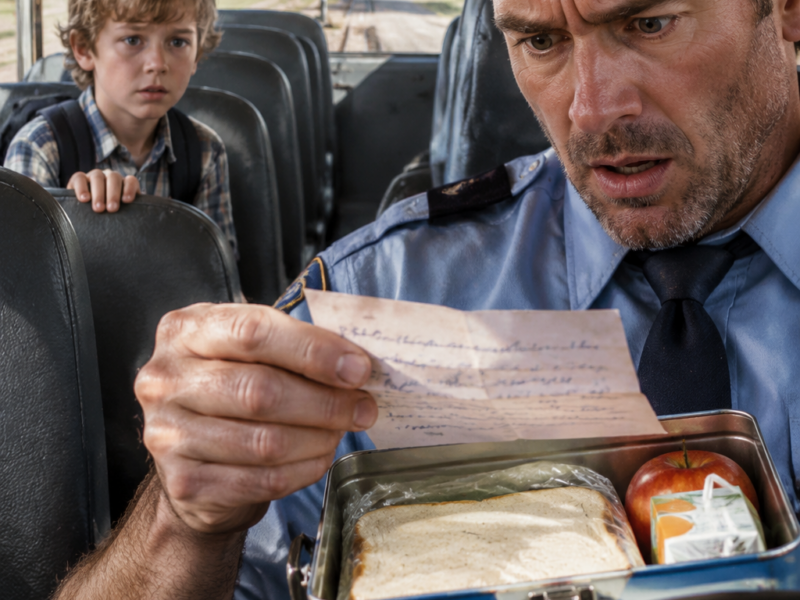
School Bus Driver My Son Handed Me His Lunchbox Don’t Open It Until We’re Past The Tracks
School Bus Driver My Son Handed Me His Lunchbox Don’t Open It Until We’re Past The Tracks
A school bus has two sets of flashing lights, and every driver knows that the order in which they come on matters. The amber lights flash first, usually a few hundred feet before the bus reaches a stop. Amber is a warning. It tells everyone nearby to slow down, pay attention, and prepare to stop. It is the polite stage, the moment when people still have time to make the right decision. Then come the red lights. When those begin flashing, there is no more room for discussion. Traffic must stop. Children are getting on or off, and nothing else matters.
After eleven years behind the wheel of a school bus, I have come to believe that families work in much the same way. Trouble rarely arrives without warning. Sometimes it begins with something so small that you almost feel foolish for noticing it. A coat that smells like a stranger’s house. A phone that suddenly stays face down on the kitchen counter. A spouse who laughs less often than before. A child who starts behaving differently but cannot explain why.
Those are the amber lights.
Most people ignore them because they do not want to believe that anything is wrong. They tell themselves that marriages have difficult seasons, that children go through strange phases, and that people sometimes need privacy. They keep driving, hoping the road ahead will eventually become familiar again.
My name is Nathan, and I want to tell you about a man named Austin Rowland, a forty-one-year-old school bus driver from a small town in Ohio. He had spent eleven years transporting children safely to school, and he believed he understood almost everything there was to know about keeping people out of danger.
But one cold Thursday morning in October, his seven-year-old son handed him a blue lunchbox and whispered five words that would change everything.
“Don’t open it until we’re past the tracks.”
Austin had no idea that the lunchbox contained a loaded revolver, hundreds of illegal pills, and evidence of a plan so carefully constructed that it could have destroyed his entire life before lunchtime.
He also had no idea that the person who had placed those things inside his son’s lunchbox was someone he had welcomed into his home.
To understand how that morning unfolded, you have to understand the little town of Alder Ridge, Ohio, and the man who drove Route 14.
Alder Ridge was the kind of place where people recognized one another’s vehicles before they recognized their faces. It had a population of roughly four thousand, although the number seemed to decrease every year. There was a hardware store on Water Street, a small diner near the courthouse, two churches, a volunteer fire department, and a railroad line that divided the eastern farmland from the older residential neighborhoods.
The Kessler and Western Railroad had passed through the town for generations. Its tracks ran beside grain elevators, abandoned farm buildings, and long stretches of land where weeds grew higher than the fences. Some residents considered the railroad a nuisance. Others depended on it for their livelihoods.
Austin had grown up around those tracks.
His grandfather, Marvin Rowland, had worked for the railroad for thirty-one years as a section hand. He had spent much of his life inspecting rails, replacing damaged ties, and listening for the subtle vibrations that indicated an approaching train.
Marvin was not a particularly talkative man, but when he spoke, people tended to listen.
One of his favorite lessons involved the Mill Lane railroad crossing. When Austin was a boy, his grandfather would take him there, kneel beside the steel rail, and instruct him to place his palm against it.
“Tell me what’s coming,” Marvin would say.
Young Austin would look down the empty tracks and shrug.
“There’s nothing coming, Grandpa.”
“Then keep your hand there.”
Sometimes they waited for several minutes. The wind moved through the grass. Birds called from the telephone wires. Nothing appeared on the horizon.
Then, eventually, Austin would feel it.
A faint vibration beneath his palm. A tiny trembling in the cold steel.
A train was approaching, although it was still miles away.
Marvin would smile.
“See? The tracks tell you what’s coming if you’re willing to listen.”
Austin remembered that lesson long after his grandfather died. When Marvin passed away, he left Austin eleven acres of neglected farmland beside the railroad, an old hay rake, and that same piece of advice.
Austin never thought the land was particularly valuable. It was low, marshy, and difficult to farm. But it belonged to his family, and that was enough.
He lived on Sutter Road with his wife, Bethany, and their son, Tanner.
Bethany was thirty-six and worked as a manager at a dental office. She had once been the sort of woman whose laughter could fill an entire restaurant. She loved decorating the house, organizing family gatherings, and taking Tanner to the county fair.
But over the previous year, something about her had changed.
Her laughter had become quieter. Her conversations with Austin had become shorter. She spent more time on her phone and increasingly preferred to keep it turned face down whenever he entered a room.
Austin noticed those things, but he did what many husbands do when they sense something uncomfortable happening inside their marriage.
He found explanations.
Bethany was tired. Work was stressful. Tanner was growing older and demanding more attention. Perhaps they simply needed a vacation.
There was always another explanation available, and Austin accepted each one because accepting the alternative would have meant admitting that his marriage might be in trouble.
Tanner was the bright spot in their household.
At seven years old, he was a second grader with a gap between his front teeth and an extraordinary fascination with dinosaurs. He could identify dozens of prehistoric creatures and frequently corrected adults who confused a Stegosaurus with a Triceratops.
He also loved school buses.
Because Austin drove one, Tanner had become something of a celebrity among the children on Route 14. He rode the same bus as his classmates, and Austin had assigned him the third seat on the right, directly behind the stairwell.
From there, Tanner could see his father in the large driver’s mirror without having to turn around.
Austin liked being able to check on him throughout the journey.
He had developed a special system for Route 14 over the years. Every child had a responsibility. The oldest students helped younger ones, and nobody was allowed to treat the bus like an ordinary playground.
Emily Sowers, an eleven-year-old girl, was the window captain. She carried a homemade clipboard and counted passengers at every stop.
A nine-year-old boy named Jonah served as the quiet keeper. He rarely spoke, but he carried a laminated card listing the bus rules and was allowed to point at it whenever someone became too noisy.
There was also a door deputy, who sat near the emergency exit and knew how to open it if something went wrong.
Austin had created the positions because he believed children behaved better when they felt trusted.
His system worked.
In eleven years, he had never filed a single disciplinary report. Parents frequently thanked him, and the school district had eventually stopped sending him to ordinary safety seminars because he had become the person other drivers asked for advice.
He loved his job.
Every morning began at approximately 6:25, when he collected the big blue school bus from the Spurlock Student Transport yard. The heater would tick as it warmed up, and the diesel engine would settle into its familiar rhythm.
Austin particularly enjoyed the first ten minutes of the route.
He called them the quiet minutes.
During that time, the children who boarded early were allowed to sit silently, lean against the windows, or finish waking up. Austin rarely played music. He liked the peaceful atmosphere.
It was a simple routine, but routines can become important when the rest of life begins changing.
And by the last Thursday in October, Austin needed that routine more than he realized.
The morning began like any other.
The sky was gray, the temperature was dropping, and a thin layer of moisture covered the roads. Austin drove through the first few stops, collecting the Brenner twins, who waved excitedly from their driveway.
At the fourth stop, Emily climbed aboard with her clipboard.
“Good morning, Captain,” Austin greeted her.
“Good morning, Mr. Austin. We have two aboard.”
“Excellent counting.”
The children laughed.
Everything seemed normal.
But when Austin reached stop nine, the Rowland house on Sutter Road, he noticed something unusual.
Bethany’s silver Tahoe was parked in the driveway.
That was not unusual by itself.
What caught his attention was the way it was positioned. The vehicle had been backed in, with its front facing the street.
Bethany almost never parked that way.
Austin noticed it as he noticed every small detail on his route. He did not immediately attach any importance to it.
Then he saw the upstairs bedroom curtain move.
For a moment, he thought someone had been standing behind it. The curtain shifted and disappeared from the window.
He looked toward the porch.
Tanner emerged wearing his red winter coat and carrying his blue Igloo lunchbox. The lunchbox had a cartoon Stegosaurus printed on the side, and his mother had bought it for him at the beginning of the school year.
But Tanner was not running.
That was the second strange thing.
Every morning, Tanner ran toward the bus as if it might disappear if he did not reach it quickly enough. Sometimes he even forgot to close the front door behind him.
Today he walked slowly.
He climbed the steps, keeping his eyes lowered. When he entered, he did not go to his usual seat.
Instead, he moved to the first seat on the right, directly behind Austin’s shoulder.
The little boy placed his lunchbox on his knees and held it with both hands.
Austin watched him in the mirror.
Something was wrong.
“Hey, bud. Front row today?”
Tanner did not answer.
His chin was trembling.
Not the kind of trembling caused by cold weather. It was the tight, controlled trembling of a child who was trying desperately not to cry.
Austin put the bus in neutral and applied the parking brake.
“Tanner, what’s going on?”
The boy slowly lifted the lunchbox.
“Dad.”
His voice was so quiet that Austin almost had to lean forward.
“Don’t open it until we’re past the railroad tracks.”
Austin stared at him.
For a moment, he thought he had misunderstood.
“What did you say?”
“Don’t open it until we’re past the tracks.”
The boy held the lunchbox out.
Austin accepted it.
It was surprisingly heavy.
Not the ordinary weight of a sandwich, fruit, and a small juice box. Something solid shifted inside when Austin tilted it slightly.
“What’s in here, buddy?”
Tanner looked toward the windshield.
“I’m not supposed to say.”
Austin felt his stomach tighten.
“Who told you that?”
The boy leaned forward and whispered directly into his father’s ear.
“They’re watching from the window.”
Austin remained motionless.
Behind him, thirty-seven other children were singing a silly song about the wheels of a bus. Emily was preparing to announce the passenger count.
In the mirror, Austin could see her raising her clipboard.
“Thirty-seven aboard, Captain,” she announced.
“Tanner makes thirty-eight,” Austin replied.
His voice sounded completely normal.
That surprised him.
He had spent eleven years learning how to remain calm in emergencies, and apparently the training had prepared him for a moment like this.
He placed the lunchbox on the floor beside his seat, where the children could not reach it.
Then he rested one hand on Tanner’s knee.
“Okay, bud. We’ll do it exactly the way you said. Past the tracks.”
Tanner looked up.
“Am I in trouble?”
Austin felt something inside his chest tighten.
“No.”
He spoke firmly enough that two children in the back stopped singing.
“You’re not in trouble, Tanner. Nobody is mad at you. Do you understand?”
The boy nodded.
Austin closed the door and released the brake.
As the bus pulled away, he glanced toward the house one more time.
Bethany was standing on the porch in her bathrobe.
She was not waving.
For the previous two years, she had waved at the bus every morning. It was a small family tradition, usually a playful two-finger gesture that Tanner had copied from his father.
But that morning, Bethany stood with her arms wrapped around herself.
She was looking at the lunchbox.
Then she looked toward the road leading to the railroad crossing.
Austin felt a cold sensation move through his body.
He turned onto Sutter Road.
Seven stops remained before the school.
The road ran alongside the Kessler and Western Railroad for nearly two miles, passing the Harmon grain elevator. The elevator had a small office attached to its concrete structure, and its second-floor window overlooked the Mill Lane crossing.
Austin had known that building since childhood.
He remembered standing beside his grandfather there on summer evenings, watching trains disappear into the distance.
Now, for the first time, he felt uncomfortable looking at it.
Tanner’s whisper kept repeating in his mind.
They’re watching from the window.
A seven-year-old did not invent a sentence like that without a reason.
He repeated something he had heard.
As the bus approached the crossing, Austin slowed down.
The crossing arms were raised.
He stopped approximately ten feet before the first rail, activated the amber warning lights, opened the passenger door, and lowered his driver’s window.
That was the procedure.
Every school bus driver in Ohio knew the rules. Stop. Open the door. Lower the window. Look both ways. Listen carefully.
Austin had performed the routine thousands of times.
The children knew it too.
Whenever the bus reached a railroad crossing, they became quiet.
He looked left.
Then right.
Then left again.
A crow called from somewhere beyond the grain elevator. The cold wind moved through the roadside weeds.
Far away, the steel rail gave off a faint humming sound.
Austin looked toward the office window.
For a brief moment, something flashed behind the glass.
It was small, bright, and quick.
The kind of reflection produced by a camera lens when someone moved it toward the light.
Austin stared at the window.
He could not see a face.
But he knew someone was watching.
He closed the bus door and raised the window.
“All clear,” he said.
A voice came from the second row.
“Is it clear, Mr. Austin?”
It was Jonah, the quiet keeper.
“All clear, Jonah.”
Austin carefully drove across the tracks.
The wheels passed over the steel rails one after another.
The lunchbox shifted slightly against the wall beside his seat.
He had done what Tanner asked.
They were past the tracks.
But the danger was not behind them.
As the road curved toward Gilead Road, Austin noticed a dark county cruiser parked at the entrance to a field lane.
The engine was running.
The driver’s window was open, and a man’s elbow rested on the sill.
Austin recognized the vehicle.
It belonged to Deputy Larry Dorsey.
Larry was forty-four years old and had served with the Kessler County Sheriff’s Office for nineteen years. He was also the older brother of the woman married to Shane Spurlock, the owner of the company that employed Austin.
Larry had attended family gatherings at Austin’s house.
He had eaten Thanksgiving dinner at their table. He had shared drinks with Austin at the Fourth of July parade and once helped repair a broken fence in the Rowland backyard.
Austin knew him.
Larry did not wave.
He simply watched the bus approach.
Austin kept driving at the posted speed of thirty-five miles per hour. As he passed the cruiser, he lifted two fingers from the steering wheel in a casual greeting.
Larry did not return it.
Instead, Austin watched through the mirror as the cruiser started moving.
Its headlights came on, and it pulled onto the road behind the bus.
There was no siren.
No flashing lights.
Larry simply followed, keeping approximately a hundred yards between them.
Austin understood something then.
The man behind him was not responding to an unexpected emergency.
He had been waiting.
And whatever was happening involved more than his son and a strange lunchbox.
Austin thought about Bethany’s behavior during the previous months.
He thought about Shane Spurlock’s increasingly frequent visits to their house.
He thought about the grain elevator window.
Then he looked at the lunchbox.
He did not know what was inside.
But he knew one thing with absolute certainty.
He would not drive another mile with thirty-eight children aboard until he understood what was happening.
Two minutes later, he spotted the gravel parking area outside Gilead Lutheran Church.
The church sat on a half-acre lot beside the road. Its white sign displayed a simple message:
“God hears the quiet prayer.”
Austin turned into the parking area and stopped the bus with its entire yellow side facing the road.
He activated the warning lights, applied the parking brake, and checked the clock.
7:34 a.m.
“Emily,” he said.
“Yes, sir?”
“I need you to do the turtle.”
Every child on Route 14 knew that command.
The turtle drill was designed to prepare them for an emergency. When Austin said the word, each child pulled their knees toward their chest, lowered their head, and covered the back of their neck with both hands.
It was supposed to be a game.
But every child knew that it was also a way to protect themselves when something dangerous happened.
“Turtle!” Emily announced.
Thirty-seven children immediately curled into their seats.
Tanner remained sitting upright.
He stared at his father.
“It’s okay, bud,” Austin said. “You too. Eyes down.”
The boy slowly folded himself into the position.
Austin reached beneath his driver’s seat and retrieved the first-aid kit. Inside was a pair of blue nitrile gloves.
He had worn similar gloves hundreds of times while treating scraped knees and bloody noses.
He pulled them on.
Then he lifted the lunchbox onto his lap.
His fingers rested on the plastic latch.
For a moment, he hesitated.
He could still hear Tanner’s whisper.
Don’t open it until we’re past the tracks.
They were past the tracks.
Austin opened the lunchbox.
On top lay a green dinosaur napkin decorated with little footprints.
It was Tanner’s favorite napkin.
Austin slowly lifted one corner.
Underneath was a revolver.
A small, blue-black .38-caliber snub-nosed revolver with a wooden grip.
A strip of white medical tape wrapped around the handle.
Beside it sat an orange plastic pill bottle without a label.
It was filled almost to the top with small white tablets.
Austin did not touch either item.
He simply stared.
The world seemed to become strangely quiet.
He could hear the ticking of the bus engine and the faint movement of children behind him.
He lowered the napkin carefully over the revolver.
Then he looked at the pill bottle again.
He understood immediately how dangerous the situation was.
If he had opened that lunchbox at the railroad crossing, someone watching from the grain elevator would have seen it.
If he had opened it while Larry Dorsey was following the bus, the deputy could have pulled him over and claimed that Austin had been carrying a weapon and illegal drugs.
If he had opened it at school, surrounded by children, the consequences would have been even worse.
The scene practically wrote itself.
A school bus driver.
A loaded handgun.
A bottle of illegal pills.
Thirty-eight children.
A deputy arriving at precisely the right moment to discover the evidence.
It would not matter what Austin said afterward.
People would see the photographs.
They would hear the accusations.
And most would believe the story told by the uniformed officer rather than the man behind the wheel.
Austin’s eyes moved toward the bottom of the lunchbox.
Something else was there.
A folded piece of white paper.
He carefully lifted it with his gloved fingers.
It was a child’s drawing.
A yellow school bus occupied most of the page. There was a stick figure behind the steering wheel, a woman wearing a red dress, and a taller man standing beside her.
The man’s head was covered in black crayon.
In the upper corner was a small window.
Two round eyes looked out from behind it.
An arrow pointed from the window toward the bus.
At the bottom, written in large, uneven purple letters, were five words.
“DAD, DON’T LET THEM.”
Austin read them once.
Then again.
Then a third time.
His son had drawn the picture.
His son had placed it inside the lunchbox.
His son had found a way to warn him without directly breaking whatever instructions someone had given him.
Suddenly, Austin understood why Tanner had been so frightened.
Someone had told the boy to carry the lunchbox.
Someone had told him not to talk.
Someone had probably told him that everything was part of a game.
And Tanner, despite being only seven years old, had understood enough to know that something terrible was about to happen.
He had hidden his warning where his father would find it.
Austin folded the drawing carefully and placed it inside his shirt, directly against his chest.
He closed the lunchbox and secured the latch.
Then he took out his personal phone.
He deliberately avoided the bus radio.
The radio connected to the Spurlock dispatch office, and Shane Spurlock controlled that office.
Austin wanted a communication channel that nobody connected to the company could monitor.
He dialed 911.
A woman’s voice answered.
“Kessler County 911. What is the address of your emergency?”
“This is Austin Rowland. I’m a driver for Kessler County Schools, Route 14, Bus 31. I’m parked at Gilead Lutheran Church on Gilead Road. I have thirty-eight children aboard.”
“All right, sir. Tell me what’s happening.”
“I’ve opened a lunchbox that was handed to me by my seven-year-old son. There is a loaded revolver inside, along with a bottle of unmarked pills. I haven’t touched either item with my bare hands. I’ve closed the box again, and I’m keeping everyone away from it.”
The dispatcher became very quiet.
Austin continued.
“I need someone here who isn’t from the Kessler County Sheriff’s Office.”
There was a pause.
“Sir, can you tell me the color of the lunchbox?”
“Blue. It’s an Igloo lunchbox with a Stegosaurus on the side.”
Another pause followed.
When the dispatcher spoke again, her voice was controlled but noticeably different.
“Mr. Rowland, I need you to stay exactly where you are. Do not hang up. Do not let anyone take that lunchbox. I’m sending the Ohio State Highway Patrol to your location.”
Austin frowned.
“Why the Highway Patrol?”
“Because you asked.”
Her voice briefly cracked.
“Please stay on the line.”
Austin looked into the mirror.
Behind the bus, Larry Dorsey had parked his cruiser on the gravel.
The driver’s door was open.
The deputy stepped out and adjusted his duty belt. His right hand rested near the pistol holstered at his waist.
At almost the same moment, a white Ford pickup appeared from the opposite direction.
It had a ladder rack and a magnetic sign on the door identifying it as a Spurlock Student Transport vehicle.
The truck braked hard and swung sideways across the church parking area, blocking the bus’s exit.
The driver stepped out.
It was Shane Spurlock.
Shane was forty-six years old, tall, well-dressed, and always careful about his appearance. His hair was beginning to gray at the temples, but he maintained the polished look of a successful businessman.
He wore a clean quilted vest and carried himself with the confidence of a man accustomed to being welcomed wherever he went.
He approached the bus with a concerned expression.
Austin remained behind the windshield.
His phone was still connected to 911.
Then Larry cupped one hand around his mouth.
“Driver! Shut the engine off and step off the bus! Hands where I can see them!”
Austin did not move.
Instead, he lowered his driver’s window approximately six inches.
“Larry, I’ve got thirty-eight children in here. My own boy is in the front seat. The door stays shut.”
Larry approached.
“Nobody’s accusing you of anything, Austin. We received a report that there’s a firearm on this bus. I just need you to step outside and let me look in that lunchbox.”
“Who called?”
“That’s not something I can discuss.”
“Then I’ll wait for the Highway Patrol.”
“They’re not necessary. This is a county matter.”
“They’re already on their way. Dispatcher Brantley is listening to this conversation right now.”
Austin held his phone near the opening in the window.
“Say hello, Larry.”
For the first time, the deputy’s expression changed.
His face lost the friendly warmth that had been there moments earlier.
“Hang up the phone, Austin.”
“No.”
“I’m giving you a lawful order.”
“And I’m responsible for thirty-eight children. Nobody takes custody of them until their parents, their principal, or the Highway Patrol is standing at this door.”
Larry stepped closer.
Austin continued speaking in the same measured voice he used when explaining bus safety procedures.
“If you want to break into a school bus full of children, you can explain that to their mothers afterward.”
The children were completely silent.
Austin could feel their fear behind him.
He knew they were listening.
He knew Tanner was listening too.
Then Shane Spurlock approached the windshield.
He raised both hands, palms open, wearing a sympathetic smile.
“Austin, buddy, open the door.”
Austin looked at him.
“Shane, I’m handling this.”
“Clearly, something’s going on. Bethany called me this morning in tears. She’s worried sick about you.”
Austin felt his stomach tighten.
“Bethany called you?”
“Of course she did. I’m family to you guys.”
“That’s interesting.”
Shane’s smile remained.
“What’s interesting?”
“My wife works at a dental office on Water Street. You’re not her boss. And I never told her I was going to open that lunchbox today.”
Shane said nothing.
Austin continued.
“I didn’t tell anyone.”
He leaned slightly toward the windshield.
“So how did you know there was a lunchbox?”
For a fraction of a second, Shane looked toward Larry.
Larry looked toward Shane.
It was a tiny movement.
But Austin saw it.
He had spent eleven years reading faces in the large mirror of a school bus. He knew how people looked when they were frightened, confused, embarrassed, or angry.
And he knew what a person looked like when they realized they had revealed something they were never supposed to know.
Larry suddenly reached for his flashlight.
He drew it and struck the folding bus door three times.
The sharp metallic cracks echoed through the church parking lot.
The children screamed.
A little girl began calling for her mother. A boy near the back started breathing rapidly. Several younger children began crying.
Tanner raised his head.
He had been silent through the entire confrontation.
That silence frightened Austin more than the shouting.
Austin stood from his seat and turned toward the children.
Thirty-eight small faces stared at him.
Some were crying. Others looked completely frozen.
Austin took a breath.
“Window captains, report.”
For a moment, nobody answered.
Then Emily stood up, gripping her clipboard against her chest.
“Captain here, sir.”
“Count.”
She turned toward the rows of seats.
Her pencil trembled as she counted each child.
“Thirty-seven and Turtle,” she said, “plus Tanner. Thirty-eight.”
“Thank you, Captain.”
“Door deputy?”
“Here.”
It was Mason, a small boy who sat near the emergency exit.
Austin looked at him and shook his head gently.
Mason understood.
The door was to remain closed.
“Quiet keeper?”
For several seconds, nobody answered.
Then Jonah stood up.
The quietest child on the bus raised his laminated card.
His voice shook, but he spoke loudly enough for everyone to hear.
“Rule one. We stay together.”
He looked at the card.
“Rule two. We listen to the driver.”
Then he lowered it.
“Rule three. Nobody’s in trouble.”
Something changed in the bus.
The children were still frightened, but their panic began to settle.
Emily started singing the familiar song about the wheels of the bus.
Her voice cracked.
A few older children joined her.
Then the younger ones began singing too.
Within seconds, all thirty-eight children were singing.
It was not a beautiful performance. Some were crying, some were out of tune, and others could barely remember the words.
But they were together.
Outside, Larry Dorsey stood with his hand near his weapon.
He had expected a frightened driver.
He had expected an argument.
He had expected to take control of the situation.
He had not expected a bus full of children to become an audience.
Then a siren sounded in the distance.
It was not a county police siren.
Austin recognized the difference immediately.
A gray Dodge Charger approached along Gilead Road, its light bar flashing. It slowed sharply, turned into the church parking lot, and stopped near Larry’s cruiser.
The driver’s door opened.
A heavyset, gray-haired man stepped out wearing a campaign hat.
It was Sergeant Homer Daley of the Ohio State Highway Patrol.
Daley was fifty-eight years old and approaching retirement. He had spent more than three decades dealing with emergencies, and he possessed the patience of someone who had learned that shouting rarely improved a dangerous situation.
He looked around the parking lot.
The school bus.
The blocked exit.
The county deputy.
The company owner.
The frightened children pressed against the windows.
Then he looked directly at Larry.
“Holster that.”
Larry straightened.
“Sergeant, we’ve got a report of a weapon on the bus.”
“I received the same report.”
“This is a county matter.”
Daley shook his head.
“I’ve got a different version of it. Holster your weapon and step away from the bus.”
Larry hesitated.
Daley’s voice remained calm.
“Rosa Brantley has been on the dispatch console for thirty-one years. She has never once requested the Highway Patrol by name. When she called me this morning, I listened.”
Larry finally returned his pistol to its holster.
Daley waited until the strap snapped closed.
Then he approached the bus.
He tapped the folding door twice.
Austin opened it.
Cold air entered the bus, carrying the smell of gravel and exhaust.
“Mr. Rowland,” Daley said. “I understand you’ve got something for me.”
“The lunchbox is on the floor beside my seat. I put on gloves before opening it. I haven’t touched the revolver or the pills with bare hands.”
“Your son brought it aboard?”
“Yes. He’s seven. I don’t believe he knew what he was carrying. Someone told him it was a game.”
Daley looked toward Tanner.
Then back at Austin.
“Who told him?”
Austin glanced across the parking lot.
He saw Shane Spurlock.
He saw Larry Dorsey.
He thought about Bethany standing on the porch that morning.
Then he answered carefully.
“I think I should speak to you with an attorney present.”
Daley raised his eyebrows slightly.
“That is the first sensible thing anyone has said on this road all morning.”
Within minutes, the situation became more organized.
A trooper arrived with evidence bags. Principal Nina Ostrander hurried into the parking area wearing a cardigan and slippers. A replacement bus was dispatched from the yard.
The children were transferred carefully, one by one.
Emily stood at the front of the line.
Jonah stayed near the back.
The younger children held hands, and nobody was allowed to leave without being counted.
When Tanner reached the steps of the replacement bus, he turned around.
He looked at his father over the heads of the other children.
He had not cried.
Not once.
Austin felt his heart breaking.
“I did good,” Tanner mouthed.
Austin raised his hand and gave him their familiar two-finger wave.
Tanner returned it.
Then Sergeant Daley approached.
“Mr. Rowland, I need you to come with me. Deputy Dorsey has submitted a statement saying he saw you holding the weapon when he arrived.”
Austin nodded.
“I understand.”
He stepped down from the bus.
As he walked past the white Ford pickup, Shane Spurlock touched his shoulder.
The gesture looked friendly.
“Go home when they release you, Austin,” Shane whispered. “Bethany’s waiting. There’s a paper on the kitchen table. Sign it, and I’ll make a phone call. By Friday, this will all be forgotten.”
Austin did not stop walking.
But he remembered every word.
And suddenly, the purpose of the entire operation became clearer.
The lunchbox was not the ultimate objective.
It was the weapon they intended to use against him.
The real objective was the paper.
At the Ohio State Highway Patrol post, Austin spent four hours answering questions.
The interview room smelled of burnt coffee and floor wax. A Styrofoam cup sat in front of him, untouched.
Sergeant Daley wrote notes on a legal pad while Austin explained the morning repeatedly.
He had received the lunchbox.
His son had warned him.
He had waited until the bus crossed the tracks.
He had opened it while wearing gloves.
He had immediately called 911.
He had refused to surrender the children or the evidence to a deputy whose behavior he considered suspicious.
He would answer additional questions with an attorney present.
At approximately 12:45 p.m., a laboratory technician entered the room and spoke quietly to Daley.
The sergeant listened, nodded, and waited until the technician left.
Then he turned toward Austin.
“The pills are oxycodone. Approximately two hundred tablets. They’re pressed, not pharmacy-issued.”
Austin said nothing.
“The revolver was reported stolen during a farmhouse burglary in Pickett County in August.”
Daley paused.
“There are no usable fingerprints on either item. Someone wiped them.”
Austin leaned back.
“Of course they did.”
Daley looked at him.
“The deputy’s report says he watched you take a handgun out of the lunchbox and hold it in your lap.”
“That’s false.”
“I know what you’re saying.”
“Do you believe me?”
Daley did not answer immediately.
“I’ve got the bus cameras to examine. Front-facing and interior recordings. The contractor says the recording system malfunctioned because of the cold last night.”
Austin almost laughed.
“That’s convenient.”
“Yes. It is.”
Daley placed his pen on the table.
“Mr. Rowland, let me ask you something. What do you own that someone else wants badly enough to go through all this trouble?”
Austin thought for a moment.
Then he answered.
“Eleven acres of land.”
Daley waited.
“My grandfather left it to me. It’s east of the Mill Lane crossing, beside the railroad. It’s mostly marsh and old hayfield.”
“Why would anyone want it?”
“Four months ago, a company called Meridian Rail Logistics started contacting me. They want to build a rail transfer yard. They’ve purchased almost every parcel around mine.”
“And yours is the last one?”
“Yes.”
“How much did they offer?”
“Two million six hundred thousand dollars.”
Daley slowly wrote the number down.
“That’s enough money to make a lot of people behave strangely.”
Austin nodded.
“The land belongs to me and Bethany. I put her name on the deed when Tanner was born. I wanted her to feel secure.”
Daley looked up.
“Did you refuse to sell?”
“Several times. I told Shane Spurlock directly that I wasn’t interested.”
“Your employer?”
“Yes.”
Daley sat back.
For the first time, his expression suggested that he understood the larger situation.
“That’ll buy you a deputy,” he said quietly.
Austin did not respond.
He was beginning to realize how much money was involved and how many people might have a reason to cooperate.
At three o’clock, the Highway Patrol released him.
He had not been charged.
The evidence was suspicious, but there was not enough to justify holding him. Daley walked him to the lobby.
“Don’t go home alone,” the sergeant advised. “If someone has paperwork waiting for you, don’t sign anything until a lawyer looks at it.”
Austin thanked him.
Then he drove home anyway.
The house was dark.
Bethany’s Tahoe was gone.
When Austin reached the front door, he noticed something immediately.
The lock had been changed.
A new brass deadbolt gleamed against the old white door.
A sheet of paper had been taped to the glass.
It was a temporary protection order issued by the Kessler County Court of Common Pleas.
Bethany Roland was listed as the petitioner.
Austin Roland was listed as the respondent.
The document claimed that Austin posed a danger to his wife and their minor child.
It ordered him to remain at least five hundred feet away from both of them until a hearing scheduled two weeks later.
Austin read the filing date.
October 29.
The same morning.
9:10 a.m.
At 9:10, Austin had been sitting in a Highway Patrol vehicle. He had not yet been formally charged with anything.
The laboratory had not confirmed the pills.
The authorities had not completed their investigation.
But Bethany’s petition had already been prepared, filed, and approved.
Which meant the paperwork had existed before Austin even left the bus yard.
He stood on the porch for several minutes.
He looked at the house he had rebuilt with his own hands.
He remembered painting the upstairs bedroom, repairing the porch railing, and installing the kitchen cabinets while Bethany and Tanner watched television in the living room.
He remembered bringing Tanner home from the hospital.
He remembered promising his wife that he would always protect their family.
And now the woman he had promised to protect had signed a document describing him as a danger to their son.
He did not break the lock.
He did not shout.
He returned to his truck and drove away.
As the sun began to disappear, he found himself heading toward the Mill Lane crossing.
He parked beyond the crossing arms and stepped out.
The air was cold.
The grain elevator stood beside the tracks, its office window glowing faintly in the darkness.
Austin walked toward the rail and knelt.
He removed one glove and placed his palm against the steel.
For a long time, he felt nothing.
Only the cold.
Only the wind.
Only the distant sounds of a town that had suddenly become unfamiliar.
He remembered his grandfather.
The old man’s voice seemed almost present beside him.
The tracks tell you what’s coming if you’re willing to listen.
Austin kept his hand against the steel.
He did not know how he would prove what had happened.
He did not know whether he would ever see Tanner again.
But he knew he could not simply disappear.
Somewhere in Alder Ridge, people were already telling stories about him.
And he had to find a way to make the truth louder.
The next few days were among the most difficult of Austin’s life.
By Friday, Spurlock Student Transport had placed him on indefinite unpaid leave.
The official explanation was that he was being investigated following a weapons incident.
On Saturday morning, the Alder Ridge Gazette published a short article on page two.
Its headline read:
“BUS DRIVER QUESTIONED IN WEAPONS INCIDENT.”
The article contained only three paragraphs.
It mentioned the recovered revolver, the illegal pills, and the fact that a deputy had reported seeing Austin holding the weapon.
It did not mention Tanner’s drawing.
It did not explain the suspicious phone call.
It did not mention Shane Spurlock.
By the time the article circulated through town, many residents had already formed an opinion.
Austin did not return to his house.
Instead, he rented a small room above the hardware store on Water Street.
The landlord, an elderly man named Walt, asked very few questions. The room had a narrow bed, a hot plate, and a window overlooking the street.
Walt charged him forty dollars a week.
Austin spent his evenings sitting by that window.
He thought about his marriage.
He thought about Tanner.
And he began remembering the things he had deliberately ignored during the previous fourteen months.
The new perfume.
The phone calls that ended when he entered the room.
The supposed dental conference in Columbus that the dental office had never heard about.
The way Bethany had started making plans without discussing them with him.
And Shane Spurlock.
Shane had become a frequent visitor.
At first, he stopped by occasionally to discuss the transport company. He sometimes brought coffee and asked Austin about the bus routes.
Then his visits became more regular.
He came on Saturdays.
He stayed for dinner.
He talked about business opportunities and future development.
Whenever the conversation turned toward the eleven acres, Shane became particularly interested.
He would mention the potential value of the land and suggest that Austin was foolish to refuse an offer worth millions.
Austin had always declined.
He had believed Shane was simply a businessman who saw an opportunity.
Now he understood that the man had been studying his life.
The real estate company, Meridian Rail Logistics, had already purchased almost every surrounding parcel.
The only obstacle was Austin’s property.
The company had offered millions.
But there was another amount Austin had not known about.
A four-hundred-thousand-dollar finder’s fee was reportedly available to whoever secured the final parcel.
Shane Spurlock was struggling financially.
His company operated eleven buses and carried three bank loans. Its contract with the school district was due for renewal in January.
He needed money.
And Bethany wanted a different life.
Austin eventually understood the arrangement.
Shane would receive the finder’s fee.
Bethany would gain access to the money from the sale.
And Austin would become the obstacle they needed to remove.
They needed to frighten him, discredit him, and separate him from Tanner.
Once the temporary protection order took effect, they could pressure him to sign the land documents.
If he refused, they could make his life increasingly difficult until he had no choice.
The lunchbox was intended to make him look like a criminal.
The deputy was supposed to provide official confirmation.
The protection order would make him appear dangerous to his own family.
And the paper Shane had mentioned on the church parking lot would complete the arrangement.
It was a horrifyingly simple plan.
But the people behind it had made one mistake.
They had underestimated a seven-year-old boy.
On the eighth day after the incident, someone knocked on Austin’s attic door.
He expected Walt.
Instead, he found a woman wearing a Carhartt coat and holding a shoebox.
Her hair was twisted into a clip, and her expression was serious.
“Mr. Rowland?”
“Yes?”
“I’m Kelly Mosley. Emily’s mother.”
Austin recognized her immediately.
Emily Sowers was the window captain on his bus.
Kelly looked down the stairs.
Several other people were standing behind her.
There were parents in work boots, women wearing medical scrubs, and men in sweatshirts with the Alder Ridge Elementary Eagle printed across the front.
Austin counted eleven people before he stopped.
“What’s going on?”
Kelly stepped inside.
“We heard you were staying here.”
She placed the shoebox on the small table.
“Walt’s wife attends our church. She told us where to find you.”
Austin looked at the box.
Kelly lifted the lid.
Inside were drawings.
Dozens of them.
Crayon pictures, marker illustrations, folded pieces of paper, and even a few decorated with glitter glue.
Almost every drawing showed a yellow school bus.
One had a smiling sun.
Another showed a row of children sitting behind a large steering wheel.
On the top sheet, someone had written:
“MR. AUSTIN IS THE BEST DRIVER. 38 OF US SAY SO.”
Beneath the sentence were thirty-eight names.
At the very bottom was a small, careful signature.
Emily Sowers, Captain.
Austin sat down on the edge of the bed.
For eight days, he had felt as though the entire town had turned against him.
He had been suspended from his job, separated from his son, and publicly accused of carrying drugs and a weapon onto a school bus.
Now, suddenly, eleven parents were standing in his little room with a box full of drawings.
Kelly pulled a chair closer.
“My daughter wakes up at night,” she said. “She keeps counting.”
Austin looked up.
“Counting what?”
“Thirty-eight. She says she counted thirty-eight children that morning, and the grown-ups still took you away.”
Kelly’s voice became emotional.
“She thinks she did something wrong. She thinks she should have done something more.”
Austin shook his head.
“Emily did everything right.”
“I know. I keep telling her that.”
Kelly wiped her cheek.
“Then I heard about the deputy’s report. I know Larry Dorsey. He once stopped my brother because of a broken taillight and treated him like a criminal. I know what that man looks like when he’s lying.”
Other parents began speaking.
One had heard that the protection order had been filed before the deputy’s report was completed.
Another had a relative who worked at the courthouse and had noticed the unusual timing.
None of them had definitive proof.
But together, their information began forming a picture.
Austin listened carefully.
Then he asked a question.
“Who took the original emergency call that morning?”
Kelly thought for a moment.
“Rosa Brantley. She was on the 911 console.”
“Do you know her?”
“Not personally. But Nina Ostrander spoke with her.”
Kelly reached into her coat and removed a folded piece of notebook paper.
“The principal gave this to me. She said Rosa couldn’t use her phone and couldn’t send anything through county email. She thought it would be safer if a mother brought it.”
Austin unfolded the paper.
One sentence was written in neat blue handwriting.
“Mill Lane Crossing, 5:00 a.m. Come alone. Bring your hand.”
Austin stared at the words.
He knew who had written them.
Rosa Brantley had been a dispatcher for thirty-one years. She had been on duty the morning of the incident, and she was the person who had answered his emergency call.
But why would she want him to meet her at the crossing?
And what did she mean by bringing his hand?
He looked at Kelly.
“I need you to keep this quiet.”
“We will.”
“Don’t tell anyone where I’m going.”
Kelly nodded.
The following morning, Austin arrived at the Mill Lane crossing shortly before five.
The town was dark.
The air smelled of damp grass and cold soil. Crickets still called from the fields, although the first frost had already arrived.
Austin parked a quarter mile away and walked toward the tracks.
A small woman stood beside the rail.
She wore a long gray coat, and both hands were tucked into her pockets.
It was Rosa Brantley.
She was fifty-eight years old, with a lined face and tired eyes. Her voice had become rough over the years from spending so many nights speaking into a dispatch microphone.
She had answered thousands of emergency calls.
She had listened to frightened parents, injured drivers, confused children, and people who had no idea what to do next.
But something about the morning of October 29 had frightened her enough to risk her career.
“Your grandfather taught me this spot,” she said without turning.
Austin stopped beside her.
“Marvin?”
She nodded.
“I was nine years old. He brought half the neighborhood here. He told us the rail would hum before a train came.”
She smiled faintly.
“I thought he was lying.”
“Did you believe him eventually?”
“Every time.”
She turned toward Austin.
“I don’t have long. They put me on administrative leave Tuesday. I’m supposed to be visiting my sister in Dayton. If anyone asks, that’s where I am.”
Austin studied her face.
“Why did you call me here?”
Rosa took a slow breath.
“Because of what you said on the phone.”
Austin frowned.
“The lunchbox?”
“The color.”
She stepped closer.
“You told me it was blue, with a Stegosaurus on the side. I asked you to describe it because I already knew what it looked like.”
Austin felt his stomach tighten.
“What do you mean?”
Rosa looked down the tracks.
“Mr. Rowland, you weren’t the first person to describe that lunchbox to me.”
For several seconds, neither of them spoke.
Then Rosa began explaining.
At 7:29 on the morning of the incident, a call had come into the Kessler County 911 system.
It was a landline call.
The dispatch screen displayed the originating number and address immediately.
The location was the Harmon Grain Office on Mill Lane.
A man had whispered into the phone.
“There is a driver on Route 14, bus 31. He’s carrying a revolver and a bottle of pills in a blue Igloo lunchbox with a dinosaur napkin on top. He’ll pull off near the Lutheran Church. Send a deputy before he hurts those kids.”
Then the caller disconnected.
Rosa had logged the information.
Within eight seconds, Larry Dorsey keyed his radio.
“I’m already rolling. Put me on it.”
He had not asked which church.
He had not asked where the bus was.
He had not even asked what the reported emergency involved.
He was already moving toward the location.
Austin felt the cold rise through his body.
He had opened the lunchbox at 7:34.
The caller had described its contents five minutes earlier.
Before Austin had opened it.
Before anyone could have seen the revolver.
Before the crime supposedly occurred.
“That’s impossible,” Austin whispered.
Rosa nodded.
“Exactly.”
The only people who could have known what was inside the lunchbox were the people who had packed it.
The caller had described the weapon, the pills, the exact color of the box, the dinosaur napkin, and even the location where Austin would stop.
He had given away the entire plan before it had happened.
“Who was the caller?” Austin asked.
Rosa’s expression became hard.
“I recognized the voice.”
“Whose?”
“Shane Spurlock.”
Austin looked toward the grain elevator.
Rosa continued.
“He has a tiny whistle on his S sounds. I’ve heard him call our dispatch office dozens of times over the years. He has a very distinctive voice.”
“Did you report it?”
“At 8:10, I went to the shift supervisor. I told him what I had heard and what I suspected.”
“What did he say?”
“He told me to log it as an anonymous, unverified caller.”
Rosa’s mouth tightened.
“Then he removed me from the console for an hour.”
Austin understood.
The supervisor was connected to the sheriff’s office.
And by Tuesday, Rosa had been placed on administrative leave.
“Why didn’t you tell the Highway Patrol?”
“I couldn’t simply take a recording out of the evidence system. If I did, they’d accuse me of tampering with it. Everything would become a question about how I obtained the file rather than what the file proved.”
She paused.
“But there’s something the sheriff doesn’t want people to remember.”
Rosa explained that Kessler County had changed its emergency recording system years earlier after a serious flood damaged the old dispatch building.
Every 911 call was automatically copied to a vendor’s server in Columbus.
The recording was time-stamped and protected by a tamper-evident seal.
The sheriff’s office did not control the original copy.
Under Ohio public records law, the recording could be requested through the appropriate public records process.
And the school district had a legitimate reason to request it because the call concerned children aboard a school bus.
“Principal Nina Ostrander filed the request Tuesday afternoon,” Rosa said. “The vendor has seventy-two hours to respond.”
“When will it arrive?”
“Friday.”
Austin looked at her.
“What happens then?”
“The school board meets Monday night. It’s an open meeting. Nina intends to play the recording before the board votes on renewing Spurlock’s contract.”
Austin was silent.
He thought about the people who had helped him.
The parents.
The children.
The principal.
And the woman standing beside him in the darkness.
For the first time since the morning of the incident, he could see a way forward.
Rosa turned toward the tracks.
“Remember what your grandfather used to say?”
Austin nodded.
“The rail tells you what’s coming.”
“Then listen.”
She walked away without another word.
Austin remained beside the crossing.
He removed his glove and placed his palm against the steel.
At first, there was nothing.
Then a tiny vibration traveled through the rail.
A train was approaching from far away.
The lesson had not changed.
The warning was already there.
You only had to be willing to recognize it.
Monday evening arrived with cold rain and a wind that swept across the parking lot of Alder Ridge High School.
Four hundred people gathered inside the gymnasium.
The folding chairs filled quickly, and parents stood along the walls. Some had come because they wanted answers about the school bus incident. Others wanted to know whether the district intended to renew the Spurlock Student Transport contract.
Shane Spurlock arrived wearing a pressed blue suit.
He sat in the second row beside Larry Dorsey.
Bethany sat nearby in a cream-colored coat and sunglasses.
She had not brought Tanner.
Austin was grateful for that.
He entered through the rear doors and sat near the last row.
Kelly Mosley sat on his left.
Sergeant Homer Daley sat on his right, dressed in civilian clothes.
Daley had told Austin he was there only to listen.
The meeting began at six.
The board president read the agenda and reviewed several routine matters.
Then Principal Nina Ostrander stood.
She was holding a small silver storage drive.
“Before the board considers any decision regarding the Spurlock transportation contract, I believe the community deserves to hear the complete emergency call record from October twenty-ninth.”
Shane immediately stood.
“Madam Principal, this is an ongoing law enforcement investigation.”
Nina looked at him.
“The recordings were obtained through a public records request.”
“They could have been tampered with.”
“The recordings were sealed by the vendor at the moment each call ended.”
Shane looked toward the board president.
“I strongly object.”
Nina did not raise her voice.
“Sit down, Mr. Spurlock. You may speak after everyone has heard the recording.”
The gym became quiet.
Nina connected the storage drive.
The speakers produced a faint hiss.
Then a familiar voice emerged.
“Kessler County 911. What’s the address of your emergency?”
A man’s whisper followed.
“There’s a driver on Route 14. Bus 31. He’s carrying a revolver and a bottle of pills in a blue Igloo lunchbox with a dinosaur napkin on top. He’ll pull off near the Lutheran church. Send a deputy before he hurts those kids.”
The recording ended.
Behind Nina, a screen displayed the call information.
The time was 7:29:14 a.m.
The originating address was Harmon Grain and Feed, Mill Lane.
Nobody moved.
A folding chair creaked somewhere near the back.
Austin watched Shane’s jaw tighten.
He watched Larry stare straight ahead.
Then Nina played the second recording.
“This is Austin Rowland. I’m a driver for Kessler County Schools, Route 14, Bus 31. I’ve just opened a lunchbox that was handed to me by my son.”
The time appeared on the screen.
7:35:02.
Five minutes and forty-eight seconds after the first call.
A woman near the front whispered.
“Five minutes.”
Another person repeated it.
The realization moved through the gym like a wave.
The caller had described the contents of the lunchbox before Austin opened it.
He had described the location where the bus would stop.
He had identified the weapon, the pills, and the dinosaur napkin.
The accusation had been prepared in advance.
And the supposed crime had never happened.
Shane stood again.
“This is a fabrication. Rosa Brantley is a disgruntled employee.”
Sergeant Daley rose from his chair.
“Mr. Spurlock.”
His voice was calm.
“I’m Sergeant Daley of the Ohio State Highway Patrol. Special Agent Ruiz from the Bureau of Criminal Investigation is standing near the east entrance with two troopers.”
Shane’s expression changed.
Daley continued.
“We received the landline carrier records this afternoon. The originating number belongs to your rented office at Harmon Grain and Feed. The revolver has been traced to a farmhouse burglary nine miles from your transport yard.”
The sergeant paused.
“I’d like you to come outside with me.”
The gym remained silent.
Four hundred people watched Shane Spurlock.
For years, he had been a respected businessman.
He had attended school events, sponsored local activities, and presented himself as a generous employer.
Now, in front of the entire community, the story he had constructed was collapsing.
Larry Dorsey slowly pushed his chair backward.
His hands were trembling.
He looked down the aisle toward Austin.
“Austin.”
His voice sounded almost unfamiliar.
“I never knew about the kid.”
Austin stared at him.
“I swear to God, I never knew they’d use the kid.”
Austin thought about Tanner sitting in the front seat of the bus.
He thought about the boy’s trembling chin.
He remembered the question.
Am I in trouble?
Then he answered.
“You knew about the bus.”
That was all he said.
Larry lowered his head.
The investigators escorted the two men toward the east entrance.
Daley did not handcuff them in the gym. He believed that a room full of parents and children deserved some dignity.
Shane walked with his head held high.
He passed Austin without looking at him.
The faint whistle in his breathing was suddenly unmistakable.
Only Bethany remained.
She had removed her sunglasses.
For thirteen days, Austin had not seen her face.
She looked smaller than he remembered.
Her eyes were tired, and her expression suggested that she had spent many nights trying to convince herself that everything would somehow work out.
She approached him slowly.
“I told Tanner it was a game.”
Austin said nothing.
“I told him you’d laugh. I told him you would probably just lose your route for a while.”
Her voice began trembling.
“I never saw the gun until that morning.”
Austin looked at her.
“Shane said nobody would get hurt.”
She swallowed.
“I believed him.”
Austin thought about the drawing.
“Did you find it?”
Bethany looked down.
“The picture Tanner drew?”
He nodded.
“I found the crayons in the trash that night. I knew what he’d done.”
Austin felt something cold settle inside him.
“You knew before the bus left the yard.”
Bethany closed her eyes.
“And you still stood on the porch.”
She nodded.
There was nothing else to say.
For once, she did not try to explain.
The investigation continued for months.
What had initially appeared to be a single conspiracy became a much larger criminal case.
Investigators traced the stolen revolver to the August farmhouse burglary. They examined the pill bottle, the communications between Shane and Larry, and the financial records connected to the proposed rail development.
The landline records confirmed that Shane had placed the call from the Harmon Grain Office.
Other evidence established that Larry had been informed about the plan before the school bus left the yard.
The investigation also uncovered the financial arrangement involving the final parcel of land.
Meridian Rail Logistics had promised a substantial finder’s fee to the person who secured the remaining property.
Shane had been struggling financially.
Bethany had been involved in conversations about the proposed sale.
And Larry had used his position as a deputy to help create the appearance of a legitimate law enforcement operation.
The evidence was no longer based on suspicion.
It was supported by recordings, financial documents, and witness testimony.
Eventually, Shane Spurlock pleaded guilty to conspiracy, child endangerment, and falsifying a report.
He was sentenced to nine years in prison.
Larry Dorsey surrendered his badge and cooperated with investigators. He was sentenced to four years.
Meridian Rail Logistics withdrew its offer without public explanation.
The eleven acres beside the Kessler and Western Railroad remained exactly where they had always been.
The marshy ground continued to collect rainwater.
The old weeds continued growing.
The hayfield remained untouched.
It was no longer worth millions to anyone who wanted to purchase it.
But to Austin, it was worth more than ever.
It was the last thing his grandfather had left him.
Bethany cooperated with investigators and pleaded guilty to child endangerment.
She received an eighteen-month sentence.
The temporary protection order was eventually dissolved.
Austin regained custody of Tanner after a lengthy family court process.
The judge reviewed the evidence, the testimony, and the circumstances surrounding the incident.
At one point, the judge spent several minutes studying Tanner’s purple crayon drawing.
The picture had become one of the most important pieces of evidence in the case.
It showed a child who had understood that something was wrong and had tried to protect the only person he believed could help him.
But winning custody did not mean everything returned to normal.
Austin’s marriage was over.
His trust had been destroyed.
And Tanner had been forced to carry a secret that no child should ever have been asked to carry.
The boy sometimes woke up at night.
Sometimes he asked questions that Austin struggled to answer.
In March, several months after the incident, Tanner sat beside his father on the porch.
The evening was quiet.
A cold breeze moved through the trees, and somewhere in the distance a freight train sounded its horn.
Tanner had been drawing with a purple crayon.
He suddenly looked up.
“Dad?”
“Yeah, buddy?”
“Was I bad?”
Austin put down his coffee.
“What?”
“Was I bad because I took the lunchbox?”
Austin stared at his son.
The question was so simple.
And yet it carried the weight of everything that had happened.
He moved closer and pulled Tanner into his arms.
“No, son. You were never bad.”
“But I didn’t tell you what was inside.”
“You were scared.”
“I thought you might get mad.”
Austin held him more tightly.
“Listen to me. You can always tell me when something scares you. You can tell me anything. You never have to carry a secret that makes you afraid.”
Tanner remained quiet.
Austin continued.
“Some grown-ups make very bad decisions. Sometimes they ask children to help them hide those decisions. But that is never the child’s responsibility.”
Tanner looked down at his drawing.
“Even if they say it’s a game?”
“Especially then.”
The boy leaned against his father.
They remained on the porch for nearly an hour.
Austin knew that one conversation would not erase what had happened.
Some memories would remain.
Some questions would return.
And there would be moments when Tanner remembered the lunchbox, the bus, and the frightened faces of his classmates.
But Austin intended to be there every time.
In April, the school district awarded the Route 14 transportation contract to another company.
After reviewing the investigation, the district asked Austin to return.
He accepted.
The first morning back, he arrived at the transport yard at 6:25.
The big blue school bus was waiting.
He climbed into the driver’s seat, adjusted the mirrors, and started the engine.
The heater began ticking.
Everything felt familiar.
But something had changed.
Austin no longer considered routine a guarantee of safety.
He understood that the most dangerous things could happen quietly, while everyone was busy believing that life was normal.
At 6:25, he pulled out of the yard.
The first few children boarded sleepily.
The Brenner twins waved.
Emily climbed aboard with her clipboard.
Jonah carried his laminated card.
The familiar voices gradually filled the bus.
“Good morning, Mr. Austin!”
“Morning, everybody.”
The children seemed happy to see him.
Some waved from their seats.
Others asked whether they could have their old jobs back.
Austin smiled.
“Nothing has changed. The window captain still has work to do.”
Emily raised her clipboard.
“Understood, sir.”
At stop nine, the Rowland house on Sutter Road, Tanner appeared on the porch.
He was wearing his red coat.
For a moment, Austin felt his heart tighten.
Then Tanner began running.
He ran down the steps, across the driveway, and toward the bus with the same excitement he had shown before that terrible Thursday morning.
Austin opened the door.
“Morning, bud.”
“Morning, Dad!”
Tanner climbed aboard and walked toward his usual seat.
The third seat on the right.
Behind the stairwell.
He placed his backpack beside him and smiled.
Austin watched him in the mirror.
For the first time in months, the boy looked like a seven-year-old again.
Not a messenger.
Not a witness.
Not someone carrying a secret.
Just a child on his way to school.
The bus continued along Sutter Road.
At the Mill Lane crossing, Austin slowed down.
He stopped ten feet before the first rail.
He activated the warning lights, opened the door, and lowered the driver’s window.
He looked left.
He looked right.
Then he listened.
The children became quiet.
Emily lowered her clipboard.
Jonah held his laminated card.
Tanner looked toward the window.
For a moment, Austin remembered the morning when his son had handed him the blue lunchbox.
He remembered the revolver.
The pills.
The drawing.
The deputy.
The man in the white pickup.
And the woman standing on the porch.
Then he remembered his grandfather.
The rail tells you what’s coming.
Austin waited.
A distant vibration moved through the steel.
He closed the door and raised the window.
“All clear.”
He drove across the tracks.
Behind him, Tanner placed his small palm against the cold glass.
He watched the railroad disappear behind the bus.
And Austin, looking at his son in the mirror, understood something he had not fully understood before.
The most important responsibility of being a father was not teaching a child to obey every adult.
It was teaching him that he could recognize danger, speak the truth, and trust that someone would listen.
There was one final lesson Austin carried from that terrible morning.
It was not really about a lunchbox.
It was not even about a stolen gun or a corrupt deputy.
It was about the way dangerous people use trust.
The plan had depended on a seven-year-old boy carrying something he did not understand. The people behind it believed that a child would obey instructions simply because an adult had given them.
They believed he would remain silent.
They believed his fear would protect their secret.
But Tanner had done something they never anticipated.
He had found a purple crayon and drawn a warning.
He had placed it inside the very object they intended to use against his father.
And in doing so, he had given Austin the chance to recognize the danger before it was too late.
The truth had also survived because of people who refused to ignore what they had seen.
Rosa Brantley had listened carefully to a phone call and remembered a voice.
Nina Ostrander had insisted on obtaining the original recording.
Sergeant Daley had questioned a suspicious situation rather than accepting the first explanation offered by a deputy.
Kelly Mosley and the other parents had refused to abandon a man they believed had protected their children.
And thirty-eight children had remained together because a bus driver had taught them that everyone had a role in keeping one another safe.
None of these people had been particularly powerful.
They were ordinary people.
A dispatcher.
A school principal.
A state trooper.
Parents.
Children.
But each of them had recognized an amber light and refused to pretend it was not there.
Austin still thought about his grandfather’s lesson whenever he approached the railroad crossing.
He thought about the patience required to feel a train before it appeared.
He thought about how easily people missed the first warning because it did not seem important enough to interrupt their day.
A marriage could begin falling apart long before anyone admitted there was a problem.
A dishonest person could reveal himself through a sentence spoken too early.
A child could communicate fear through a trembling hand, a strange question, or a drawing that adults might dismiss as childish nonsense.
And sometimes the difference between disaster and survival came down to whether someone was willing to stop and listen.
If there is one thing Austin would tell another parent, it is this:
Pay attention when a child suddenly becomes afraid of something they cannot explain.
Listen when they say an adult has asked them to keep a secret from their mother or father.
Do not dismiss a change in their behavior simply because they are too young to understand the situation.
A harmless surprise does not require a frightened child.
A birthday present may be hidden until the right moment. A gift may be wrapped in secret. But a dangerous adult often uses the language of games, promises, and special responsibilities to make a child cooperate.
The moment someone tells a child that they must hide something from the people who love them, that is a warning worth taking seriously.
And remember the two sets of lights on a school bus.
Amber comes first.
It gives you time to notice.
It gives you time to think.
It gives you time to choose.
Red comes afterward, when the danger is already close and stopping is no longer optional.
Austin had ignored many amber lights in his marriage because he wanted to believe everything was fine.
He had noticed the phone.
The perfume.
The strange visits.
The changing behavior.
But he had kept driving.
He had convinced himself that the road ahead would eventually straighten.
Until one Thursday morning, his seven-year-old son placed a blue lunchbox beside his seat and whispered a warning.
That morning, Austin finally stopped.
And because he stopped, thirty-eight children went home safely.
Because he listened, a criminal plan was exposed.
Because his son refused to remain silent, a father was given the chance to protect him.
And because a handful of ordinary people decided that the truth mattered more than their comfort, a small town finally saw what had been happening behind its familiar faces.
The next time something in your life feels slightly wrong, do not rush to explain it away.
Do not convince yourself that a warning is meaningless simply because acknowledging it would be uncomfortable.
Sometimes the smallest details are the most important ones.
Sometimes the quietest voices are the ones telling you exactly what you need to hear.
And sometimes the person who saves your life is not a police officer, a lawyer, or someone with a powerful position.
Sometimes it is a seven-year-old child holding a purple crayon, trying desperately to tell his father that something terrible is coming.
All you have to do is listen before the train arrives.









