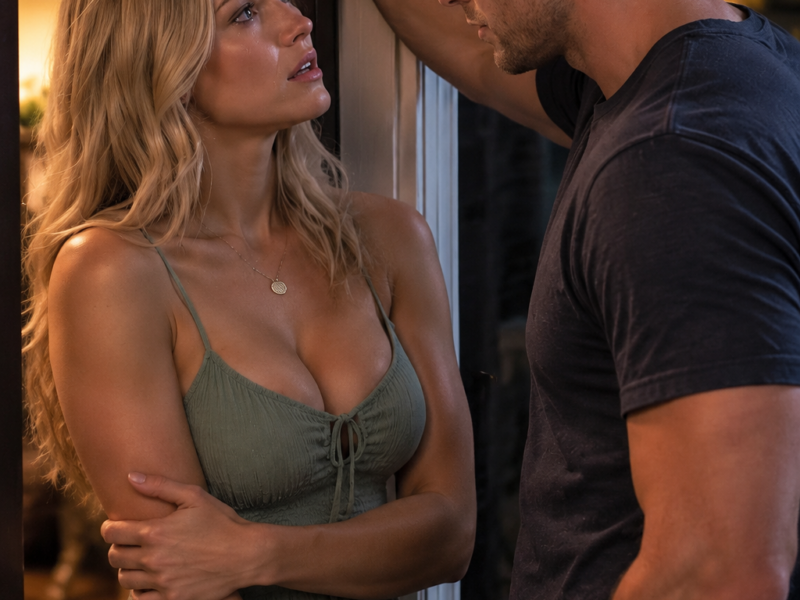
Our First Date Was Going Great Until She Said, “If You Want to Leave Because I Have Two Kids.”
Our First Date Was Going Great Until She Said, “If You Want to Leave Because I Have Two Kids.”
The first date was going so well that I was beginning to think I might actually have a chance at something good for once in my life.
We had been sitting across from each other in a little barbecue restaurant on the east side of Kansas City for almost an hour. The place wasn’t fancy. There were paper towels instead of cloth napkins, old country music playing through speakers that had probably been there since the eighties, and the smell of smoked brisket that seemed permanently embedded in the wooden walls. But the food was incredible, the conversation was effortless, and the woman sitting across from me had the kind of smile that made you forget what you were about to say.
Her name was Kelsey Ward. She was thirty-three years old, had long brown hair, warm brown eyes, and a laugh that started quietly before taking over her entire face. She wore a green sweater that evening, and every time she tucked a loose strand of hair behind her ear, I caught myself smiling like an idiot.
We had already talked about childhood memories, terrible jobs, embarrassing moments, favorite movies, and the strange things people did when they thought nobody was watching.
At one point, she told me about a man who had called emergency services because he believed his neighbor was stealing his Wi-Fi through the walls. I told her about a customer who had driven his truck into my repair shop because he thought the parking brake was supposed to stop the vehicle while it was moving.
We laughed so hard that the waitress came over twice to check whether everything was okay.
Under the table, Kelsey’s foot had been resting against mine for several minutes. Neither of us seemed particularly interested in moving away.
I was beginning to think the evening might end with a kiss.
Then she put down her fork.
The change in her expression was subtle, but I noticed it immediately. Her smile faded, and she took a deep breath while looking down at the table.
“Okay, Brett,” she said quietly. “There’s something I need to tell you.”
I leaned forward.
“What’s wrong?”
She looked directly into my eyes.
“If you want to leave because I have two kids, now’s the time. I won’t be mad. I’ll even pay for the brisket.”
For a moment, I just stared at her.
Then I started laughing.
Not a polite little chuckle, either. I laughed so hard that I had to put my glass down before I spilled my sweet tea.
Kelsey’s expression changed immediately.
“Oh,” she said, looking away. “Okay. Wow. Laughing is new.”
I tried to stop, but I couldn’t.
“Usually,” she continued, forcing a small smile, “they just get quiet, check their phones, and suddenly remember they have an early meeting.”
I finally caught my breath.
“Kelsey,” I said, still grinning, “I’ve been under your minivan four times.”
She blinked.
“What?”
And that was when I realized she had absolutely no idea what I was talking about.
My name is Brett Lawson. I’m thirty-five years old, and I own a small auto repair shop on the east side of Kansas City called Lawson Auto.
It’s not much to look at. Three service bays, two employees, a tiny waiting room with uncomfortable chairs, and a coffee machine that produces something closer to motor oil than actual coffee. The radio in the office has been stuck on classic rock for so long that nobody remembers how to change the station.
But it’s mine.
I built it from the ground up, working long hours, saving every dollar I could, and learning everything I knew from the man who raised me.
According to my younger sister, Emily, I’m a decent mechanic but an absolutely hopeless romantic.
She once told me that if I ever managed to get married, she would personally organize a parade because she couldn’t believe someone had finally agreed to put up with me.
I told her she was being dramatic.
She told me I had worn the same flannel shirt for three consecutive family gatherings because I didn’t know how to dress for women.
She wasn’t entirely wrong.
Before Kelsey, my dating life consisted mostly of awkward conversations, occasional coffee meetings, and the kind of silence that made you wish somebody would pull the fire alarm.
But then, one rainy Tuesday morning in September, Kelsey Ward drove into my shop.
I remember the day clearly because the rain had been coming down since sunrise. The parking lot was covered in puddles, and I was standing beneath the open hood of an old pickup truck when I heard a noise coming from outside.
It sounded like a dying goose trapped inside a washing machine.
A silver Honda minivan pulled into the lot.
The engine made a terrible metallic rattling sound before finally settling into an exhausted idle.
The driver stepped out wearing navy medical scrubs. Her long brown hair was tied into a messy braid, and there were faint shadows beneath her eyes. She looked like someone who had spent the last seventy-two hours trying to solve everybody else’s problems and had forgotten that she was allowed to have problems of her own.
She approached the counter.
“Please tell me it’s not the transmission.”
I wiped my hands on a rag.
“That depends. What makes you think it’s the transmission?”
“Because everything expensive seems to happen to me on Tuesdays.”
I smiled.
“That’s unfortunate. Tuesdays are usually my favorite days.”
She stared at me.
“How?”
“Because most people don’t bring their cars in on Tuesdays.”
She gave me a tired little laugh.
“Well, congratulations. You’re about to ruin your favorite day.”
I took the keys and listened to the engine.
It wasn’t the transmission.
It was a loose heat shield vibrating against the exhaust system. A relatively simple problem that took me about twenty minutes to fix.
I charged her for ten.
When I handed her the invoice, she looked at the amount, then at me.
“That’s not right.”
I glanced at the paper.
“Looks right to me.”
“You worked on it for twenty minutes.”
“Maybe I work faster than I think.”
“Your computer’s broken.”
I shrugged.
“Your computer is very generous. It’s a sweet computer.”
She laughed.
It was a tired, surprised laugh, the kind that escaped before someone had time to decide whether they wanted to laugh at all.
And for reasons I couldn’t explain, I thought about that laugh for the rest of the week.
I didn’t know her name was Kelsey Ward until she returned a few days later.
This time, she had squeaky brakes.
Then came a flat tire.
Then the check engine light.
By her fourth visit, my mechanic Hector had started making comments.
Hector was forty-eight, married, had three grown children, and possessed the irritating ability to notice things about people before they noticed them themselves.
Every time that silver Honda pulled into the parking lot, he would glance over at me.
“Hey, boss. Your minivan girlfriend is here.”
“She’s not my girlfriend.”
“Then why did you comb your hair?”
“I didn’t.”
“Exactly. You never comb it.”
I threw a shop towel at him.
He laughed so hard he nearly dropped a wrench.
The truth was, I had started looking forward to seeing her.
I knew the sound of her minivan before I saw it. I knew she usually arrived between nine and eleven in the morning. I knew she drank her coffee with two sugars and never finished it. I knew she apologized whenever she asked someone to help her, even when she had every right to ask.
And I knew she was tired.
Not ordinary tired, either.
The kind of tired that came from carrying too many responsibilities without having anyone to share them with.
During her fourth visit, while she sat in the waiting room drinking my terrible coffee, I finally decided I had nothing to lose.
I wiped my hands on a rag, walked over, and stopped beside her chair.
“Kelsey?”
She looked up.
“Yeah?”
“I think your van has a crush on me.”
She raised an eyebrow.
“Excuse me?”
“It keeps breaking down just so it can come see me. Honestly, it’s getting a little embarrassing.”
She stared at me for two seconds.
Then she laughed so hard she nearly spilled her coffee.
“Is this you asking me out, Brett Lawson?”
I rubbed the back of my neck.
“It’s me trying.”
“You’re doing terribly.”
“I know.”
“Is it working?”
I looked at her.
She looked at me.
Then she smiled.
“Friday,” she said. “Seven o’clock.”
I blinked.
“Really?”
“Yes. And you’re paying full price for my next oil change.”
I grinned.
“Deal.”
And that was how I ended up sitting across from her in that barbecue restaurant, wondering how a man who could rebuild an engine from scratch had somehow forgotten how to behave normally around a woman.
Which brings us back to the moment she told me about her children.
“I’ve been under your minivan four times,” I repeated.
Kelsey frowned.
“I still don’t understand.”
I leaned back in my chair.
“Kelsey, I’ve vacuumed enough goldfish crackers out of your cup holders to feed an entire elementary school.”
Her mouth opened slightly.
“There were two car seats in the back. One pink, one with dinosaurs. And there’s a sticker on your rear window that says, ‘My child is an honor student at West Ridge Elementary.'”
She slowly covered her mouth.
“And on your third visit, your DVD player wasn’t working. There was a handwritten note taped to it in crayon.”
I paused for dramatic effect.
“It said, ‘Please fix or I will die. Love, Tucker.’ The R in Tucker was backwards.”
Kelsey lowered her head.
I continued.
“I fixed it because I didn’t want Tucker to die.”
She started laughing, covering her face with a napkin.
“And on your fourth visit, there was a drawing taped to your dashboard. A little girl with brown braids standing beside a woman with brown braids and a man in a blue shirt holding a wrench. At the top, it said, ‘Mommy and the car man.’ Signed Mia, age nine.”
Kelsey slowly lowered the napkin.
Her eyes were already filling with tears.
“Mia drew that?”
“Yeah.”
She shook her head, smiling through her tears.
“And she gave me a mustache. I don’t actually have a mustache, but I appreciated the artistic freedom.”
For several seconds, Kelsey just looked at me.
Then she laughed again, although this time the laughter came with tears running down her cheeks.
“I’ve said that line on three first dates,” she whispered. “Every time, the guy got quiet and left. One of them pretended he had an emergency call. His phone wasn’t even ringing.”
“That guy is an idiot.”
She wiped her eyes.
“So you knew this whole time?”
“I did.”
“And you still asked me out?”
I took a breath.
“I asked you out because of it.”
Her smile disappeared.
“What do you mean?”
I hadn’t planned to tell her the story that evening. It was a personal part of my life, something I usually saved for people I trusted.
But the way she was looking at me made me realize that if I wanted to build something with her, I couldn’t let her believe she needed to apologize for the life she already had.
“My mom raised me and my little sister alone,” I began. “My biological father left when I was four. He wasn’t particularly interested in being a parent, and eventually he stopped pretending he was going to come back.”
Kelsey listened without interrupting.
“My mom worked two jobs. During the week, she cleaned offices at night. During the day, she worked at a grocery store. She drove this beat-up station wagon that broke down so often that I thought mechanics were supposed to be regular visitors at our house.”
I smiled.
“One July afternoon, when I was eight, that station wagon broke down on the side of the highway. It was about a hundred degrees outside. My little sister was crying in the back seat, my mom was trying to figure out what to do, and I was convinced we were going to spend the rest of our lives sitting beside that road.”
I could still remember the heat rising from the pavement.
The smell of gasoline.
My mother’s worried expression as she stood beside the car, trying to look calm for two frightened children.
Then a tow truck pulled over.
The driver was a big man with broad shoulders, grease beneath his fingernails, and a beard that made him look much older than he actually was.
His name was Frank.
He asked my mother what happened, took one look at the station wagon, and told her not to worry.
He towed us to his shop, fixed the car without charging her a penny, and bought my sister and me ice cream while we waited.
I remembered sitting on a metal stool, eating chocolate ice cream and watching him work beneath the hood.
He moved with a confidence I had never seen before. He knew exactly where to look, what to listen for, and which tool to reach for.
To an eight-year-old boy, he seemed almost magical.
When the car was ready, Frank walked my mother to the parking lot.
Then, with the confidence of a man who apparently had no fear of rejection, he asked her out.
My mother looked at him for a long moment.
Then she said something very similar to what Kelsey had just told me.
“I have two kids. If that’s a problem, you should know now.”
I paused.
Kelsey’s eyes softened.
“What did he say?”
I smiled.
“He looked at me and my sister sitting there with chocolate ice cream all over our faces. Then he looked at my mom and said, ‘Ma’am, that’s not a problem. That’s a bonus.'”
Kelsey pressed a hand against her chest.
“He actually said that?”
“He did.”
Frank married my mother a year later.
He never treated me or Emily like we were someone else’s responsibility. He taught me how to change oil, repair engines, rebuild transmissions, and understand that a machine usually gives you warning signs before it breaks completely.
He came to my baseball games.
He helped Emily with her science projects.
He attended school meetings, taught us how to ride bicycles, and made pancakes every Sunday morning.
When I was a teenager, he was the person I went to when I needed advice.
When I graduated, he stood in the front row.
When I opened Lawson Auto, he was the first person to walk through the door.
And when Emily got married, Frank walked her down the aisle.
He was seventy now, and he still called me every Sunday to ask how the shop was doing.
He had never once made me feel like I owed him anything for choosing us.
He simply loved us.
I looked at Kelsey.
“He’s the best man I’ve ever known. And he didn’t have to choose us. He chose us anyway.”
Her eyes were shining.
“So when you say you have two kids like it’s some kind of warning,” I continued, “I don’t hear a warning. I hear Frank.”
For a moment, neither of us spoke.
Then Kelsey reached across the table and took my hand.
Her fingers were warm and slightly sticky from barbecue sauce.
“Brett Lawson,” she whispered, her voice shaking. “Where have you been?”
I smiled.
“Under your minivan, mostly.”
She laughed and squeezed my hand.
And just like that, something changed between us.
After dinner, we walked down the street to an old-fashioned ice cream shop.
Kelsey ordered butter pecan.
I ordered chocolate in honor of Frank.
We sat together on a wooden bench beneath the streetlights, talking until the shop closed. She leaned her head against my shoulder, and I found myself wishing the evening would never end.
When we finally reached her car, she turned toward me.
“I don’t usually do this on a first date.”
“Do what?”
She grabbed the front of my jacket, pulled me closer, and kissed me.
It was soft, slow, and tasted faintly of butter pecan.
I wrapped my arms around her, and for a few seconds, the entire street seemed to disappear.
When she pulled away, she was smiling.
“Mia was right,” she whispered.
“About what?”
“You don’t have a mustache, but you’re definitely the car man.”
I laughed.
And then I kissed her again.
We took things slowly after that.
Kelsey insisted on it, and I understood why.
Her children had already experienced enough uncertainty. They had already watched one person walk out of their lives, and she wasn’t going to introduce someone new into their world unless she believed there was a real possibility he would stay.
Their biological father lived in Florida.
He called occasionally, usually on birthdays or holidays, but he wasn’t part of their everyday lives.
Tucker had been one year old when he left, so he barely remembered him.
Mia was nine now, and she remembered everything.
She remembered the arguments.
She remembered her mother crying in the laundry room.
She remembered asking when her father would come home and slowly realizing that nobody had an answer.
Kelsey told me that Mia had stopped eating properly for a week after he left. For nearly a year, the little girl had cried almost every night.
Eventually, she became protective of her mother in a way no nine-year-old should have to be.
She checked the front door locks twice every night.
She made sure Tucker had his school things ready.
She worried whenever Kelsey worked late.
Sometimes, she even tried to make dinner.
“She’s a wonderful girl,” Kelsey told me during our third date. “But sometimes I wish she would remember that she’s allowed to be a child.”
I listened.
“What about Tucker?”
Kelsey’s expression brightened immediately.
“Tucker is six, and he is obsessed with anything that has wheels. Trucks, tractors, monster trucks, garbage trucks. If it has an engine, he loves it.”
“Sounds like a good kid.”
“He wears red rain boots every single day. Even when it’s ninety degrees outside. And he sleeps with a stuffed raccoon named Gary.”
I laughed.
“Gary?”
“Don’t ask. Apparently, Gary is a very important member of the family.”
“And Mia?”
“She reads constantly. Three books a week, sometimes more. She wants to become a marine biologist. She knows more about sea turtles than I knew about anything when I was twice her age.”
“She sounds smart.”
“She is. Too smart sometimes.”
I smiled.
“They sound like you.”
Kelsey looked down at her coffee.
“That’s what I’m afraid of.”
I reached across the table and touched her hand.
“You don’t have to be afraid of them being part of your life.”
She looked at me, but she didn’t say anything.
I didn’t push.
I knew that love wasn’t something you could demand from people who had already been hurt.
Sometimes it was something you had to demonstrate, one ordinary day at a time.
Six weeks after our first date, Kelsey finally decided it was time for me to meet the children.
She called me on a Thursday evening.
“Saturday,” she said.
“Saturday what?”
“They want to see where the car man works.”
I sat up straighter.
“They do?”
“Apparently, Tucker has decided you’re either a superhero or a wizard. Mia wants to investigate.”
“Should I be worried?”
“Very.”
I spent the next two days cleaning my repair shop.
I swept the floors, organized the tools, cleaned the waiting room, and even bought a new coffee machine.
Hector watched me work for nearly an hour before finally shaking his head.
“You’re cleaning this place like the president is coming.”
“Just making sure everything looks good.”
“She’s bringing the kids, not the queen.”
“Same difference.”
He laughed.
On Saturday morning, I arrived at the shop earlier than usual.
I cleaned the workbench again, checked the bathroom, and moved a few dangerous tools out of reach.
At ten o’clock, the silver Honda pulled into the parking lot.
The passenger door opened, and Kelsey stepped out wearing jeans and a blue jacket.
Then the side door slid open.
A little boy in red rain boots and a dinosaur T-shirt practically launched himself onto the pavement.
He stopped in the middle of the parking lot and stared at the shop.
His eyes widened.
“Whoa!”
He pointed toward the hydraulic lift.
“Is that a car lift?”
“Sure is,” I said.
“Can I go on it?”
Kelsey immediately looked at me.
“Tucker.”
I knelt down so I was at his eye level.
“Hey, buddy. I’m Brett.”
He stared at me.
“You’re the guy who fixed my DVD player?”
“That’s right.”
His eyes became enormous.
“You’re the one who saved my life!”
I grinned.
“I couldn’t let you die, man.”
Without another word, he threw his little arms around my neck.
I froze for half a second before hugging him back.
Behind him, Kelsey put a hand over her heart.
Then the other door opened.
Mia climbed out.
She had two long brown braids, a purple jacket, and a library book tucked beneath her arm.
She looked at me.
Then she looked at the shop.
Then back at me.
Her expression was serious, almost investigative.
“You don’t have a mustache,” she said.
I nodded.
“I know. I’m sorry. I’m working on it.”
She didn’t smile.
Instead, she asked the question that made the entire shop go quiet.
“Are you going to leave?”
Kelsey immediately looked uncomfortable.
“Mia…”
But Mia didn’t look at her mother.
She kept staring at me.
“Everybody leaves.”
I felt something tighten in my chest.
I remembered being eight years old, sitting in the back of a broken station wagon, watching my mother try to hold herself together while wondering whether another grown-up would ever choose to stay.
I remembered Frank.
And I remembered how long it had taken before I understood that someone could love you without being obligated to.
I knelt down in front of Mia.
“Mia, that’s a fair question.”
She folded her arms.
I continued carefully.
“I can’t promise you anything today. You don’t know me very well yet, and you shouldn’t trust someone just because they say nice things. But here’s what I can promise.”
I looked directly into her eyes.
“I’ll keep showing up. You can watch me, and you can decide for yourself whether I’m someone you can trust.”
She studied my face.
For several seconds, she didn’t say anything.
Then she nodded.
“Okay.”
I smiled.
“Okay?”
“But I’m watching you.”
“That’s fair.”
“And I’m counting.”
I tilted my head.
“Counting what?”
“How many times you show up.”
Then she walked past me and entered the shop.
I looked at Kelsey.
She gave me an apologetic smile.
“She’s been through a lot.”
“I know.”
And then Tucker grabbed my hand and dragged me toward the Mustang I was restoring.
The next three hours were some of the best I’d had in a long time.
Tucker climbed into the driver’s seat of the old 1967 Mustang and spent most of the morning pretending to drive.
He honked the horn repeatedly, made engine noises, and announced that he was taking the car to the moon.
I sat beside him, pretending to operate the pedals.
Every few minutes, he asked me whether the Mustang could go faster.
“Not yet,” I told him. “I’m still fixing it.”
“Why?”
“Because old cars need a little love.”
He thought about that.
“Like Gary?”
I glanced at him.
“Gary the raccoon?”
He nodded seriously.
“Gary needs love too.”
“Well, then, Gary is a lucky raccoon.”
Meanwhile, Mia sat on a stool near my workbench.
She asked what every tool was called and what it did.
I showed her a ratchet, a socket wrench, a screwdriver, a torque wrench, and several other tools.
She had a little notebook and wrote down every answer.
“Torque wrench,” she repeated, carefully spelling the words.
“That’s right.”
“What does it do?”
“It helps tighten bolts to exactly the right amount.”
“Why does it have to be exact?”
I thought about the best way to explain it.
“Because if it’s too loose, things can fall apart. And if it’s too tight, things can break.”
She looked down at her notebook.
Then she looked up at me.
“That sounds like people.”
I stared at her for a moment.
Then I smiled.
“Yeah, kiddo. It kind of does.”
She wrote something else in her notebook.
I didn’t ask what.
Over the next three months, I did exactly what I had promised.
I showed up.
I showed up to Tucker’s T-ball games, even when they were held on Saturday mornings and I had a full schedule at the shop.
The first time he hit the ball, he was so excited that he forgot to stop at first base.
He ran all the way around the bases, waving his arms like an Olympic champion.
The other kids stared.
The coach tried to call him back.
But nobody had the heart to tell him he had done it wrong.
When he finally reached home plate, he ran straight into my arms.
“DID YOU SEE THAT?”
“I saw everything!”
“I HIT IT!”
“You sure did!”
He grinned so widely that I thought his face might split in half.
I showed up to Mia’s science fair.
Her project was about how sea turtles navigate the ocean using the Earth’s magnetic field.
She had built a miniature ocean display, complete with handmade turtles and little arrows showing their migration routes.
I spent nearly twenty minutes listening to her explain it.
She spoke with such enthusiasm that I forgot I was standing in a school gymnasium surrounded by folding tables and children holding cardboard volcanoes.
When the judges announced the results, Mia won second place.
She accepted her red ribbon quietly.
Then she turned toward the crowd.
First, she found her mother.
Then she found me.
And for one brief second, she smiled.
It was a small smile, almost shy.
But I felt as though someone had handed me something precious.
I also started showing up on Tuesday nights for spaghetti.
Kelsey usually worked long shifts as a 911 dispatcher. She handled twelve-hour shifts, answering calls from people experiencing the worst moments of their lives.
She once told me about a night when she had talked a teenage girl through delivering her baby brother on a kitchen floor while waiting for an ambulance.
I asked how she managed to stay calm.
She shrugged.
“You learn to focus on the next thing that needs to happen.”
“That sounds exhausting.”
“It is.”
“And you’re amazing at it.”
She looked at me.
“I’m tired, Brett. Those are different things.”
I reached for her hand.
“Can’t they be the same?”
She smiled.
But I noticed the exhaustion never really disappeared.
On Tuesday nights, I would bring dinner or help the kids with their homework.
Sometimes Kelsey would fall asleep on the couch around eight-thirty.
The first time it happened, Tucker quietly climbed down from his chair, grabbed a blanket, and covered her.
Mia put a finger to her lips.
“Shh. Mom’s sleeping.”
They treated it like a sacred family ritual.
I sat there watching them, feeling something settle inside me.
I hadn’t realized how much I wanted a family until I started becoming part of theirs.
And somewhere along the way, without any dramatic announcement or grand realization, I fell completely in love with all three of them.
Kelsey.
Mia.
Tucker.
Even Gary the raccoon, who seemed to have a permanent residence on the living room couch.
Every time I showed up, Mia made another little mark in her notebook.
I noticed her doing it once when I arrived for dinner.
She thought I hadn’t seen her.
I didn’t say anything.
By December, she had forty-seven marks.
I didn’t know what the number meant to her.
I just knew she was counting.
And I was happy to give her reasons to keep doing it.
Then, two weeks before Christmas, everything fell apart.
It happened on a Thursday afternoon.
I was working on a customer’s truck when my phone rang.
Kelsey’s name appeared on the screen.
I answered immediately.
“Hey, beautiful.”
But she didn’t respond.
All I heard was crying.
“Kelsey?”
She took a shaky breath.
“Are the kids okay?”
“Yes. They’re fine.”
“Then what’s wrong?”
She was quiet for a moment.
“I picked Tucker up from school today, and his teacher asked to speak with me.”
I put down the wrench.
“Okay.”
“They were making Christmas cards for their families. You know, the usual school project.”
“Yeah.”
“Tucker made one for me. One for Mia. One for Gary.”
I smiled slightly.
“Of course he did.”
Her voice broke.
“And he made one for you, Brett.”
I felt my stomach tighten.
“That’s sweet.”
“He signed it…”
She stopped.
I waited.
Then she whispered the words.
“To Brett, Dad.”
For a moment, I couldn’t speak.
I stared at the concrete floor beneath my boots.
Kelsey began crying harder.
“He’s six, Brett. He’s already calling you Dad.”
I swallowed.
“Kelsey…”
“You have to understand something. When their father left, Tucker was only one. He doesn’t really remember him. But Mia remembers everything.”
I closed my eyes.
“She stopped eating for a week. She cried every night for almost a year. I had to watch my little girl wonder what she’d done wrong, whether she wasn’t good enough for her own father to stay.”
Her breathing became uneven.
“And now Tucker is getting attached to you. He’s looking at you like you’re the person who’s going to be there forever. What happens if this doesn’t work out?”
I wanted to answer immediately.
I wanted to tell her I wasn’t going anywhere.
But she continued before I could speak.
“What happens when you leave? What happens when they start asking where you are? What happens when Mia has to explain to Tucker that another person has disappeared?”
“Kelsey, I’m not planning to leave.”
“You don’t know that.”
“I do know how I feel about you.”
“Nobody knows what the future holds, Brett!”
Her voice cracked.
“I can’t watch them get their hearts broken again. I can’t do it. I just can’t.”
I stood there holding the phone, feeling completely helpless.
“Kelsey, please. Let’s talk about this.”
“I’m sorry, Brett.”
“Don’t do this over the phone.”
“I’m so sorry.”
Then she said the words I had been dreading.
“I think we need to stop before it’s too late.”
The call ended.
I stared at my phone.
I called her back.
Voicemail.
I sent a text.
No answer.
I tried again that evening.
Nothing.
For the next week, I heard nothing from her.
I wanted to drive to her house. I wanted to stand on her front porch and tell her that she was making a terrible mistake.
But she had asked me to stay away.
And I respected that.
It was the hardest thing I’d done in a long time.
The shop kept running. Customers brought in their cars. Hector complained about suppliers. The radio played the same old songs.
But everything felt different.
Every time I heard a silver minivan approaching the parking lot, my heart reacted before my mind could remind me that it wasn’t her.
Every Tuesday evening, I found myself looking at the empty space on the couch in my living room.
I missed Kelsey’s voice.
I missed the kids.
I even missed Tucker asking me the same question seventeen times in a row.
And I missed Mia’s notebook.
I kept thinking about the forty-seven marks.
One evening, I called Frank.
He answered on the second ring, as he always did.
“Hey, kid. How’s business?”
“Fine.”
There was a pause.
“You sound terrible.”
I laughed weakly.
“Thanks.”
“What’s wrong?”
I told him everything.
I told him about Kelsey, the children, Tucker’s Christmas card, and the phone call.
I told him how afraid she was.
I told him I didn’t know what to do.
Frank listened without interrupting.
When I finished, he was quiet for several seconds.
Then he said something I wasn’t expecting.
“Your mother did the same thing to me.”
I sat up.
“What?”
“Six months after I started dating her, she broke up with me.”
I stared at the phone.
“Why didn’t you ever tell me that?”
“Never came up.”
“What happened?”
Frank chuckled softly.
“She said she couldn’t risk you and your sister getting hurt. Said she’d already been through enough, and she couldn’t let another man into your lives unless she was absolutely certain.”
I leaned back in my chair.
“What did you do?”
“Nothing.”
“Nothing?”
“That’s right. I waited.”
He continued.
“I kept the door open. I didn’t push her. I didn’t show up at her house demanding an explanation. I kept fixing her car whenever it broke down. Sent you and your sister birthday cards. Made sure she knew I was around if she ever needed anything.”
I looked down at the floor.
“How long?”
“Three weeks.”
“And then?”
“She came back.”
I smiled faintly.
“What did she say?”
Frank laughed.
“She told me she was more scared of losing me than she was of getting hurt.”
I was quiet.
Frank’s voice softened.
“Listen, son. Love isn’t always about making promises. Sometimes it’s about giving somebody enough time to believe that you’re not going to disappear.”
I swallowed.
“What if Kelsey doesn’t come back?”
“Then you’ll have done the right thing anyway.”
I didn’t answer.
He continued.
“But from what you’ve told me, that little girl has been counting for a reason.”
I thought about Mia’s notebook.
Forty-seven marks.
Frank was right.
She had been counting.
And I had no idea how much those marks meant to her.
Four days before Christmas, on a freezing Saturday morning, a tow truck pulled into my shop.
I was standing near the workbench when I heard the familiar sound of a vehicle approaching.
I glanced toward the parking lot.
On the back of the tow truck sat a silver Honda minivan.
My heart practically stopped.
The passenger door opened.
Kelsey climbed out.
She was wearing a large winter coat, and her cheeks were red from the cold.
She looked embarrassed, uncertain, and exhausted.
“I’m sorry,” she said.
I walked toward her.
“What happened?”
“It died this morning in the driveway. It won’t even turn over.”
She glanced down.
“I didn’t know where else to take it.”
I looked at the minivan.
“That’s okay. Let’s see what’s wrong.”
She nodded.
“I’ll pay full price.”
I smiled faintly.
“We’ll figure it out.”
I walked around to the front and opened the hood.
Then I froze.
There was something taped to the top of the engine.
A piece of notebook paper, sealed inside a clear plastic sandwich bag to protect it from the weather.
I leaned closer.
Beside the battery, the main fuse was missing.
Not broken.
Not damaged.
Removed cleanly.
I stared at the empty fuse slot.
Then I looked at the note.
I pulled the plastic bag free and unfolded the paper.
The handwriting was careful and deliberate, written in purple marker.
It was unmistakably Mia’s.
“Dear Mom,
I took out the fuse. Brett taught me how.
I’m sorry, but you have been crying in the laundry room every night. And Tucker keeps asking where Brett is.
He made Gary the raccoon a little wrench out of tinfoil so Gary can be a car man too.
I was counting how many times Brett showed up.
It was 47.
Dad showed up three times last year.
I did the math.
Brett is the one.
Please go fix it.
Love, Mia.”
At the bottom, in giant wobbly crayon letters, was another message.
“Tucker was here.”
The R was backwards.
I stood there in the freezing air with the minivan’s hood open.
For a moment, I couldn’t breathe.
I read the note again.
Then a third time.
My eyes blurred.
Kelsey was standing beside me.
“Brett?”
I couldn’t speak.
“What’s wrong with it?”
I turned around and handed her the note.
She took it, confused.
Then she began reading.
I watched her expression change.
First confusion.
Then surprise.
Then disbelief.
Her hand slowly rose to cover her mouth.
And finally, a sound escaped her that was somewhere between laughter and a sob.
“She sabotaged my car,” she whispered.
I nodded.
“She did a really good job.”
Kelsey looked at me through tears.
“She’s nine.”
“She’s a very talented nine-year-old.”
Kelsey read the note again.
When she reached the line about the forty-seven marks, she stopped.
“Forty-seven,” she whispered.
She looked up at me.
“She was counting?”
I nodded.
“I saw her with the notebook.”
“I didn’t even know.”
I looked toward the road, trying to collect myself.
Kelsey wiped her cheeks.
“She thinks you’re the one.”
I took a breath.
Then I stepped closer.
“Kelsey, I need you to listen to me.”
She looked at me.
“I’m not asking to replace anybody. I’m not asking to become their father overnight. I’m not asking you to pretend the past didn’t happen.”
Her eyes filled again.
“I’m just asking to be the guy who shows up every Tuesday. The guy who comes to Tucker’s T-ball games and Mia’s science fairs. The guy who helps fix the minivan when it makes a strange noise.”
I reached for her hand.
“I want to be number forty-eight. And forty-nine. And fifty. And a thousand.”
She began crying harder.
“I want to keep showing up,” I continued. “Not because I feel obligated. Not because somebody expects me to. But because I want to.”
I took another breath.
“And I’m in love with you, Kelsey. I have been since the day you told me my computer was generous.”
She laughed through her tears.
It was that same tired, surprised, beautiful laugh I had heard on the first day she walked into my shop.
Then she grabbed the front of my jacket with both hands.
She pulled me toward her and kissed me.
Right there in the freezing parking lot.
With the minivan’s hood open.
With the tow truck driver pretending not to watch.
And with Hector standing in the next service bay, pretending to work on a pickup truck while very obviously following every second of what was happening.
Kelsey kissed me like she had missed me every single day.
Because she had.
And I had missed her just as much.
When we finally pulled apart, she rested her forehead against my chest.
“I love you, too,” she whispered.
I wrapped my arms around her.
“All of us do,” she added.
I smiled.
“Even Gary?”
She laughed.
“Especially Gary. He’s got a tinfoil wrench now, Brett. He’s basically your apprentice.”
I held her tighter.
Then I glanced toward the minivan.
“So, should I put the fuse back in?”
Kelsey laughed.
“Do you have it?”
I shook my head.
“No. Apparently, your daughter has it.”
She laughed so hard that she had to lean against me.
A few minutes later, I drove her home in my truck.
The winter sun was beginning to disappear behind the houses, and the streets were covered with a thin layer of frost.
When we pulled into her driveway, I saw two small figures sitting on the front porch steps.
Mia and Tucker.
They were both wearing winter coats.
Mia was holding something small in her hand.
The fuse.
I turned off the engine.
For a moment, nobody moved.
Then Tucker spotted me.
His entire face lit up.
“BRETT, DAD!”
He jumped off the porch and ran across the frozen yard in his red rain boots.
He hit my legs so hard that I nearly lost my balance.
I laughed and bent down to hug him.
“Hey, buddy.”
He wrapped his arms around my neck.
“I knew you’d come!”
I closed my eyes for a moment.
“Of course I came.”
Mia approached more slowly.
She didn’t run.
She walked toward me, looking at my face as though she was checking whether I was really there.
Then she held out her hand.
The fuse sat in her palm.
“Forty-seven,” she said.
I looked at her.
She nodded.
“That’s how many times you showed up.”
I smiled.
“That’s a lot of times.”
She looked down at the fuse.
“Are you going to keep coming?”
I knelt in front of her.
“As long as you’ll let me.”
She studied my face for a moment.
Then she stepped forward and wrapped her arms around my waist.
It was the first time she had hugged me voluntarily.
And she held on tightly.
“Thank you for coming back,” she whispered.
I rested my chin against the top of her head.
“Thank you for breaking your mom’s car.”
She giggled.
Actually giggled.
It was the first time I’d ever heard that sound from her.
And I knew, right then, that I would remember it for the rest of my life.
Kelsey stood on the porch watching us, wiping her eyes.
Tucker was still holding onto my leg.
Mia was still hugging my waist.
And somewhere inside the house, Gary the raccoon was probably waiting with his new tinfoil wrench.
I looked at the three people standing in front of me and realized that I had spent most of my life thinking I was simply going to inherit the family I grew up in.
I hadn’t understood that sometimes life gives you the opportunity to build another one.
A year and a half passed.
A year and a half filled with ordinary mornings, school lunches, birthday parties, soccer games, forgotten backpacks, bedtime stories, and more spaghetti dinners than I could possibly count.
Tucker grew taller.
Mia became even more interested in marine biology.
Kelsey finally started sleeping better.
And I became part of the everyday rhythm of their lives.
I learned that Tucker couldn’t sleep without Gary.
I learned that Mia liked her toast slightly darker than most people considered reasonable.
I learned that Kelsey hated folding laundry but loved organizing kitchen cabinets.
And they learned that I sometimes talked to cars when they refused to start.
Our family wasn’t perfect.
There were difficult mornings, stressful evenings, and occasional arguments about homework and screen time.
But there was something I had never experienced before.
A sense of belonging that didn’t depend on anybody being related by blood.
During that time, I continued working on the 1967 Mustang.
It had been sitting in my shop for months before Kelsey entered my life, waiting for the day I would finally have enough time to finish restoring it.
I had always planned to restore it myself.
But eventually, it became a family project.
Every Saturday, Mia helped me with the engine.
She had become surprisingly knowledgeable about mechanical work, and she still carried her little notebook around.
Tucker was responsible for honking the horn.
That was his official job.
He took it very seriously.
Sometimes he would climb into the driver’s seat and honk the horn repeatedly while I worked underneath the car.
Mia would tell him to stop.
He would ignore her.
And I would laugh so hard that I sometimes had to put my tools down.
We spent months rebuilding the engine, replacing old parts, polishing chrome, and bringing the car back to life.
When it was finally finished, the Mustang was cherry red, with shining chrome bumpers and an engine that sounded like thunder.
It was beautiful.
And I had something special planned for the evening I would reveal it to Kelsey.
One warm evening in June, I called her and asked her to come to the shop.
“Why?”
“Just something I want you to see.”
“Is it another broken minivan?”
“No.”
“Because I’m not bringing that thing back there again.”
I laughed.
“Just come.”
When she arrived, I had already parked the Mustang beneath the overhead lights.
Mia and Tucker were standing beside it, grinning like they knew something she didn’t.
They did.
Kelsey walked into the garage.
Then she stopped.
Her eyes widened.
“Oh, my goodness.”
The Mustang gleamed beneath the lights.
She walked around it slowly, admiring the polished bodywork and the chrome bumpers.
“Brett, this is beautiful.”
I smiled.
“Thank you.”
She looked at the kids.
“Did you help him?”
Mia nodded proudly.
“I worked on the engine.”
Tucker raised both hands.
“I did the horn!”
Kelsey laughed.
“Of course you did.”
Then Mia stepped forward.
“Mom, pop the hood.”
Kelsey looked suspiciously at all three of us.
“What did you do?”
“Just pop the hood,” Mia repeated.
Kelsey walked to the front of the car and pulled the lever.
The hood opened.
And there, taped to the top of the engine inside a clear plastic sandwich bag, was a piece of notebook paper.
Kelsey froze.
She reached for it.
Then she carefully unfolded the paper.
The handwriting was different this time.
There were three sets of handwriting.
The first was mine.
“Kelsey, will you marry me?”
Beneath it, in purple marker, was Mia’s handwriting.
“And us. Will you marry all of us? I did the math. It works.”
Then, at the bottom, in giant crayon letters with a backwards R, was Tucker’s message.
“PLEASE SAY YES OR I WILL DIE.”
Kelsey stared at the paper.
Then she started laughing.
And crying.
Both at the same time.
She turned around.
I was already down on one knee on the shop floor.
I held a small velvet box in my hand.
Mia stood on one side of me.
Tucker stood on the other, holding Gary the raccoon.
Gary was wearing his little tinfoil wrench.
Kelsey looked at all of us.
Her hands covered her mouth.
For a moment, she couldn’t speak.
I looked up at her.
“Kelsey Ward,” I began.
She laughed through her tears.
“On our first date, you told me I could leave because you had two kids.”
I paused.
“Well, I’m still here.”
She began crying harder.
“And I’m never leaving.”
I opened the velvet box.
“Will you marry me?”
Tucker immediately interrupted.
“Will you marry all of us?”
I laughed.
“Yes. Will you marry all of us?”
Kelsey dropped to her knees on the greasy shop floor and pulled the three of us into her arms.
“Yes,” she sobbed.
She kissed my forehead.
“Yes, yes to all of you. Yes, yes, yes!”
I slipped the ring onto her finger.
Tucker celebrated by honking the Mustang’s horn.
Hector started clapping from behind a stack of tires.
I looked over at him.
He was crying.
“You’re crying, Hector?”
“No,” he said, wiping his face. “Something got in my eye.”
“Both eyes?”
“Shut up, boss.”
We all laughed.
And just like that, I became engaged to the woman I loved, with two children who had somehow managed to make my life bigger than I had ever imagined.
We got married that October.
The wedding took place in the backyard of my mother’s house, the same house where Frank had raised me and Emily.
The trees were turning golden, the weather was cool, and the backyard was decorated with white flowers and little lights.
There were folding chairs arranged in neat rows.
A small wooden arch stood near the garden.
My mother had spent weeks organizing everything, and Emily had appointed herself the official wedding coordinator despite having absolutely no experience in event planning.
Frank wore a dark suit.
He was seventy-one by then, and he still had grease beneath his fingernails.
Some things never wash off.
Kelsey looked beautiful.
She wore a simple white dress, and her brown hair fell gently over her shoulders.
Mia and Tucker walked her down the aisle together.
Tucker wore a tiny suit with his famous red rain boots.
Mia wore a blue dress and carried a small bouquet.
As they reached the front, Tucker nearly tripped over his own boots.
Mia caught his hand.
Kelsey laughed through her tears.
And I stood there trying very hard not to cry in front of everybody.
Mia read a poem she had written herself.
It was about families, promises, and people who kept showing up even when nobody asked them to.
She didn’t look at the paper very often.
She knew every word.
When she finished, she looked at me.
Then she smiled.
I smiled back.
And I realized that the little girl who had once asked whether I was going to leave had finally found enough reasons to believe I wouldn’t.
The ceremony was beautiful.
But the reception was where Frank stole the entire evening.
He stood up, raised his glass, and waited for everyone to quiet down.
He looked around at the guests.
Then he looked at my mother.
“Thirty years ago,” he began, “I met a woman on the side of the highway with two crying children in a broken-down station wagon.”
My mother immediately started laughing.
Frank smiled.
“She was having a terrible day. The car had broken down, it was hotter than a furnace, and those two kids were covered in chocolate ice cream.”
I laughed.
Emily shook her head.
Frank continued.
“After I fixed the car, I asked their mother out. And she told me she had two children, and if that was a problem, I should know right then.”
He paused.
“Now, I looked at those two kids and told her something.”
He glanced toward Kelsey.
“I told her it wasn’t a problem. It was a bonus.”
Everyone laughed.
Frank raised his glass.
“Best decision I ever made.”
Then he looked at me.
“And apparently, somebody was paying attention.”
I smiled.
Frank turned toward Kelsey and the children.
“Welcome to the family,” he said.
He lifted his glass a little higher.
“You’re the best bonus there is.”
There wasn’t a dry eye at our table.
My mother hugged Kelsey.
Emily hugged Mia and Tucker.
Hector gave me a handshake that turned into an awkward hug.
And Frank sat down with the biggest smile I’d ever seen on his face.
Later that night, after the music had started and the guests were dancing, I found Mia sitting quietly at one of the tables with her notebook.
I sat beside her.
“Hey, kiddo.”
She looked up.
“Hi, Brett.”
I glanced at the notebook.
“Still keeping records?”
She nodded.
I smiled.
“How many now?”
She turned the notebook toward me.
There were hundreds of little tally marks.
I counted them.
Five hundred.
“Five hundred?” I asked.
She nodded.
“I stopped counting after that.”
“Why?”
She thought about it for a moment.
Then she looked at me.
“Because I don’t need to anymore.”
I swallowed.
She closed the notebook.
“You’re going to keep showing up, right?”
I put an arm around her shoulders.
“Every day, if you’ll let me.”
She leaned against me.
“Okay.”
And that was enough.
These days, Mia is eleven years old.
She still loves books, still wants to become a marine biologist, and still knows more about sea turtles than most adults.
Tucker is eight.
He still wears his red rain boots whenever he can get away with it.
He still loves trucks, tractors, and anything with an engine.
Gary the raccoon is still part of the family.
His tinfoil wrench has been replaced several times because Tucker keeps making new ones whenever the old ones fall apart.
Kelsey and I still have our Tuesday spaghetti dinners whenever our schedules allow.
Sometimes she falls asleep on the couch.
Sometimes I cover her with a blanket.
Sometimes Tucker whispers, “Shh, Mom’s sleeping,” just as he did when I first started coming around.
And sometimes Mia sits beside me in the garage, asking questions about engines while I work on a customer’s car.
The silver Honda minivan is still with us.
It’s older now, and it has developed a few new noises, but it keeps running.
Every time something goes wrong with it, Tucker insists that we should bring it to my shop.
I remind him that he can simply ask me to fix it.
He says that’s not the point.
“The car likes visiting you, Dad.”
I can’t argue with that.
As for Mia’s notebook, it sits on her bookshelf.
She hasn’t written another tally mark in a long time.
She says she doesn’t need to keep track anymore because she already knows the answer.
And sometimes, when I think back to that first date, I remember Kelsey sitting across from me in that little barbecue restaurant, looking frightened as she prepared to tell me something she believed would make me leave.
I remember the way she said she had two children as though she were handing me a reason to walk away.
I remember laughing.
And I remember the look on her face when she realized I wasn’t laughing at her.
I was laughing because I had already fallen in love with the very thing she thought might scare me away.
I think about Frank, too.
About that summer afternoon when he stopped beside a broken-down station wagon.
About the little boy sitting in the back seat, watching a stranger fix his mother’s car.
About the way Frank chose to love two children who weren’t his own.
He never made a big speech about it.
He never demanded gratitude.
He simply kept showing up.
And eventually, I understood that was what being a father meant.
It wasn’t about biology.
It wasn’t about having the same last name.
It wasn’t even about being there from the beginning.
It was about choosing to stay.
Choosing to care.
Choosing to show up on the ordinary days, the difficult days, and the days when nobody notices how much effort it takes.
Because children don’t need someone who promises the world and disappears when things become complicated.
They need someone who remembers their school projects.
Someone who comes to their games.
Someone who knows the name of their stuffed raccoon.
Someone who will sit beside them when they’re frightened and remind them that they’re not alone.
Someone who keeps coming back.
And I suppose that’s what I became.
Not because I was obligated to.
Not because I thought I could replace someone else.
But because I loved them.
All of them.
So, if someone ever tells you they have two children and gives you an opportunity to walk away, remember that those children aren’t a burden attached to someone’s life.
They’re part of someone’s heart.
And sometimes, the greatest gift you can receive is the chance to become part of that heart, too.
I once thought I was simply fixing a minivan.
I had no idea I was being introduced to the family I had been waiting for my entire life.
And if you ask me whether I would do it all again, the answer is easy.
Every broken-down car.
Every goldfish cracker in the cup holders.
Every T-ball game.
Every science fair.
Every Tuesday spaghetti dinner.
Every late-night phone call.
Every moment of uncertainty.
Every single one.
Because somewhere along the way, I learned that the best things in life aren’t always the things we find.
Sometimes, they’re the people who choose us.
And sometimes, if we’re lucky, we get the chance to choose them right back.









