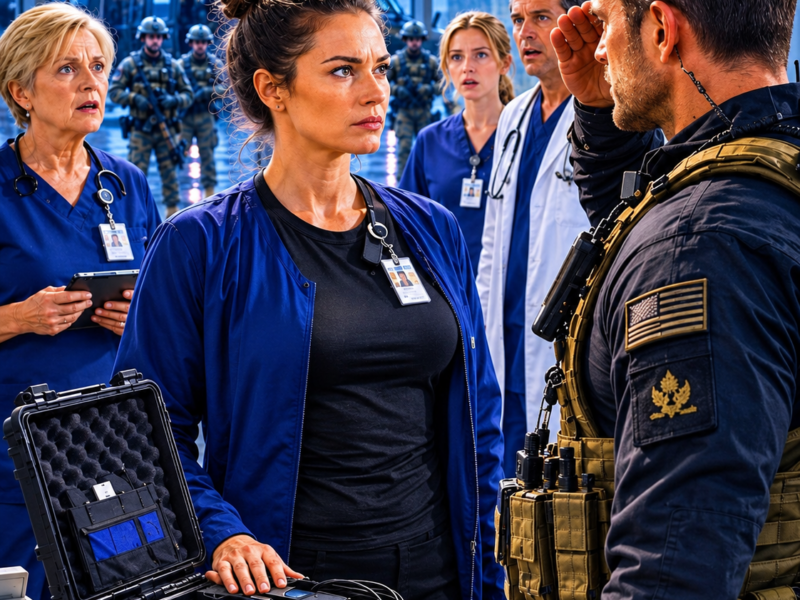
No One Noticed the Quiet New Nurse—Until a Black Hawk Landed and the Commander Saluted Her
No One Noticed the Quiet New Nurse—Until a Black Hawk Landed and the Commander Saluted Her
On the night everything changed, the rain came down so violently that it seemed determined to tear the city apart. It hammered against the windows of Riverside General Hospital, flooded the streets, and turned the parking lot into a collection of shimmering puddles beneath the pale glow of the security lights. Thunder rolled across the sky, shaking the glass doors of the emergency department, while the wind sent abandoned shopping carts scraping across the pavement. Inside, however, the storm outside was nothing compared to the chaos unfolding within the hospital.
Phones rang continuously. Monitors beeped from every direction. Nurses hurried between treatment rooms, doctors shouted instructions, and paramedics pushed stretchers through the crowded corridors. The emergency department was already operating beyond its normal capacity, and everyone on the night shift knew that the next few hours would be difficult.
Yet among all the frantic movement, one woman worked with a peculiar calmness.
Her name was Hannah Lennox.
She had been employed at Riverside General for exactly twenty-two days. Most people barely remembered her name, and some of the older staff still referred to her simply as the new nurse. She was in her early forties, with brown hair always pulled tightly into a neat bun, clear gray eyes, and a quiet expression that rarely revealed what she was thinking. She wore ordinary black scrubs beneath a navy-blue jacket, carried a small notebook in her pocket, and never seemed interested in becoming part of the conversations around the nurses’ station.
Hannah arrived early, completed her assignments, and left when her shift ended. She never complained about difficult patients, never argued over schedules, and never participated in the endless gossip that occupied much of the night shift.
To most people, she was simply a reserved woman who preferred to keep to herself.
But there was something about her that did not quite fit.
She never sat with her back to a doorway. She instinctively noticed every entrance and exit whenever she entered a room. She remembered the location of emergency equipment after seeing it only once, and she could recognize the sound of an approaching ambulance long before anyone else heard it.
Sometimes, when a patient suddenly deteriorated, Hannah would already be moving before the monitor began alarming.
Nobody thought much about these things.
At Riverside General, people were busy with their own responsibilities, and a quiet newcomer who did her job without attracting attention was generally considered a convenient addition to the staff.
Unfortunately, not everyone was willing to make her first weeks easy.
The head nurse, Brenda Walsh, had worked at Riverside for nearly thirty years. She was a formidable woman who believed that seniority entitled her to unquestioned authority. Her voice could silence an entire nurses’ station, and she had a particular dislike for employees who failed to demonstrate sufficient enthusiasm for her approval.
Brenda had developed a habit of testing newcomers.
Some survived by becoming her favorites. Others learned to avoid her altogether. A few eventually resigned.
Hannah, however, seemed completely unaffected.
On her first night, Brenda had handed her a list of duties that would ordinarily have been divided among several employees.
“You’re new here, Lennox,” she had explained, tapping the clipboard with one finger. “And I want you to understand something. This department runs on experience. You haven’t earned anyone’s trust yet, so you’ll start with the jobs nobody else wants. Understood?”
“Understood, ma’am.”
“Good. Restock the supply cabinets, check the linen room, clean up the treatment area, and make sure the basement laundry is sorted before midnight.”
Hannah had glanced at the list.
“Anything else?”
Brenda had raised an eyebrow, almost disappointed that the woman had not protested.
“Not for now.”
“All right.”
And with that, Hannah had collected the supplies and walked away.
Over the following weeks, Brenda continued assigning her the least desirable tasks. Hannah carried heavy laundry bins down two flights of stairs, cleaned equipment after particularly difficult procedures, reorganized storage rooms, and frequently stayed late to finish work that other employees had abandoned.
Whenever Brenda found an opportunity, she reminded Hannah that she was still at the bottom of the department.
“If you want to belong here, Lennox, you have to earn it,” she once remarked in front of several nurses.
Hannah simply nodded.
“Yes, ma’am.”
Brenda interpreted her silence as weakness.
She had no idea that Hannah had once commanded people who would have followed her into the most dangerous places on earth.
There was another person at Riverside who made Hannah’s life considerably more difficult.
Dr. Gregory Pierce, head of emergency medicine, was a man who had built his entire identity around professional prestige. He had graduated from a respected medical school, completed his residency at one of the country’s most famous hospitals, and made certain that everyone knew it.
His white coat was always spotless. His shoes were polished. His conversations frequently included references to his accomplishments, and he possessed an almost theatrical confidence whenever he entered a treatment room.
Pierce expected people to defer to him.
He also disliked being questioned, particularly by nurses.
Hannah’s quiet competence irritated him because she did not appear impressed by his reputation. She followed instructions, but she also paid close attention to the patients, sometimes noticing small changes that escaped everyone else.
One afternoon, she was reviewing the medication chart of an elderly patient when she noticed a potential allergy conflict.
She checked the patient’s previous records, confirmed the information, and approached Pierce while he was discussing the treatment plan.
“Doctor, excuse me. I believe there may be a problem with the medication you’ve ordered.”
Pierce continued looking at the chart.
“What problem?”
“The patient has a documented allergy to a compound in that medication. I think we should consider an alternative.”
He stopped writing.
Slowly, he lifted his eyes toward her.
“Are you questioning my prescription, Nurse Lennox?”
“I’m asking you to review the allergy record.”
A couple of nurses nearby exchanged uncomfortable glances.
Pierce closed the chart with deliberate irritation.
“Nurse Lennox, I diagnose. You deliver the pills. Do you understand the difference?”
The words were delivered loudly enough for everyone at the station to hear.
One nurse looked down to hide a smile.
Hannah remained still.
For a brief moment, something changed in her expression. It was almost imperceptible, a flicker of an emotion that seemed to come from somewhere much deeper than embarrassment.
Then it disappeared.
“Yes, doctor.”
She stepped aside.
Later that evening, the patient’s allergy was confirmed, and the medication order had to be changed.
Pierce never apologized.
Hannah never mentioned it again.
There was, however, one person who genuinely liked her.
Lily Brooks was a young nurse who had graduated from nursing school less than a year earlier. She was enthusiastic, compassionate, and occasionally overwhelmed by the emotional demands of emergency medicine. Unlike Brenda, Lily did not believe that experience gave someone permission to humiliate others.
She had noticed Hannah from the beginning.
At first, she simply appreciated the older woman’s willingness to help whenever the department became busy. Then she began noticing things that seemed increasingly unusual.
Hannah never ate for more than four minutes during her breaks. She always checked the hallway before entering the staff room. She could locate equipment in the dark, and she had a habit of scanning a room in a single glance before deciding where to stand.
Lily also noticed the way Hannah reacted to emergency sirens.
Whenever an ambulance approached, Hannah’s posture changed. Her shoulders became slightly more rigid, her eyes sharpened, and her attention moved instinctively toward the entrance.
It was not fear.
It looked more like anticipation.
One evening, Lily finally asked about it.
They were standing near the vending machines, waiting for their coffee cups to fill. The corridor was relatively quiet, and the overhead lights reflected softly against the polished floor.
“Can I ask you something?” Lily said.
“Of course.”
“Who were you before you came here?”
Hannah glanced at her.
“What do you mean?”
“I don’t know. You just seem different from everyone else.”
Hannah gave a small smile.
“Different isn’t necessarily a bad thing.”
“No, I didn’t mean it like that. It’s just that you never talk about your past. You don’t seem interested in anything outside this hospital. And sometimes I feel like you’ve seen things that the rest of us couldn’t even imagine.”
For a few seconds, Hannah said nothing.
She looked through the window at the rain beginning to gather against the glass.
Then she answered quietly.
“Someone who needed to learn how to be quiet again.”
Lily waited, hoping she would explain.
But Hannah picked up her coffee and returned to the department.
That was all she ever said.
Other clues were hidden in plain sight.
Hannah always carried a small black hard-shell case to work. It was compact enough to fit inside a locker, but its construction was unusually durable. She never left it unattended, and she secured it with a heavy combination padlock.
Beneath her scrubs, on a thin silver chain, she wore two metal dog tags.
Sometimes, when she bent forward, they slipped out from beneath her collar and caught the light.
Lily had once asked whether they belonged to someone in her family.
Hannah had simply tucked them back beneath her shirt.
“They belong to people I don’t want to forget.”
There was also the incident involving an intoxicated visitor who had attacked an orderly near the emergency entrance.
The man had been shouting for several minutes before suddenly swinging at the younger employee.
Nobody had expected Hannah to intervene.
Yet she crossed the room in a fraction of a second, moved between the two men, and redirected the attack with such precise control that the visitor found himself on the floor before anyone fully understood what had happened.
There was no unnecessary violence, no dramatic struggle, and no visible panic.
Hannah simply restrained the man until security arrived.
Brenda later reprimanded her for creating a disturbance.
“You should have waited for security,” she complained.
“He was about to injure someone.”
“That’s not your responsibility.”
Hannah looked at her calmly.
“Preventing someone from getting hurt is everyone’s responsibility.”
Brenda had no answer she particularly liked, so she walked away.
Nobody asked how the quiet nurse had managed to stop a much larger man so quickly.
And Hannah had no intention of explaining.
For twenty-two days, she had maintained the same routine. She arrived, worked, helped whoever needed assistance, and returned to her small apartment.
She had deliberately chosen Riverside General because it was an ordinary regional hospital, far from the military facilities and medical command centers that had once defined her life.
She wanted something simple.
She wanted to be a nurse.
Not a colonel. Not a commander. Not a name spoken with reverence in military briefing rooms.
Just Hannah.
She had thought that if she stayed long enough in an ordinary place, perhaps the memories would eventually become quieter.
But memories rarely obey the wishes of those who carry them.
And that night, the past was coming for her.
At 10:50 p.m., the emergency department received its first major warning.
A bridge along the river road had partially collapsed under the pressure of rising floodwater.
Several vehicles had been swept from the roadway. Others were trapped on the damaged structure, and emergency crews were struggling to reach people surrounded by rapidly rising water.
The local dispatch center began sending ambulances toward the scene.
Within minutes, Riverside General was preparing for a mass-casualty incident.
Brenda immediately took control of the nurses’ station.
“Clear the first three treatment bays! We need additional stretchers in the corridor! Lily, contact the blood bank and tell them to prepare emergency units!”
Dr. Pierce strode through the department, issuing instructions with the confidence of a man who believed that a crisis was an opportunity to demonstrate his leadership.
“Nobody moves a patient without checking with me first. I want every incoming case categorized before it reaches the treatment area.”
The staff responded quickly.
Then the emergency radio crackled.
A voice emerged through a burst of static.
“Riverside General, this is National Guard air rescue. We are transporting multiple injured personnel from the river rescue operation. Severe weather has prevented us from reaching the designated trauma center. Requesting emergency landing authorization.”
The message repeated, distorted by the storm.
Pierce looked toward the radio.
“An aircraft?”
“National Guard helicopter,” the dispatcher confirmed.
Pierce shook his head.
“At a regional hospital? That’s ridiculous. The city trauma center has a proper helipad.”
Brenda gave a dismissive laugh.
“Perhaps someone should tell them where the nearest airport is.”
But Hannah was no longer listening to their conversation.
Her right hand had moved into the pocket of her navy jacket.
Her fingers closed around the two metal dog tags hanging beneath her shirt.
She knew that sound.
Not the sound of the radio, but the distant mechanical rhythm that was beginning to emerge beneath the thunder.
A rotor.
A heavy rotor.
At first, it was faint, almost indistinguishable from the storm. Then the sound grew stronger, beating against the hospital windows like an enormous mechanical heart.
Thump.
Thump.
Thump.
The paper cups on the nurses’ station began to tremble.
A patient in the waiting room looked up from his phone.
Someone near the entrance said, “What is that?”
Lily rushed toward the window.
“Oh my God.”
Everyone turned.
Through the rain, a massive Black Hawk helicopter appeared above the parking lot. Its searchlight swept across the flooded pavement, illuminating the ambulance bay before the aircraft descended toward the open landing area.
The rotor wash sent rainwater spiraling through the air.
Its powerful lights turned the parking lot into a brilliant white scene, and within moments, the aircraft settled onto the wet ground.
The doors opened.
Several soldiers in dark tactical uniforms jumped out before the rotors had even slowed completely. They moved with the practiced urgency of people who had spent years responding to emergencies.
A second soldier carried medical equipment.
Another spoke rapidly into a communications headset.
The entire emergency department seemed to freeze.
Brenda stared through the glass.
“That’s not possible.”
Dr. Pierce adjusted his coat.
“Who authorized that landing?”
But Hannah was already moving.
She walked away from the nurses’ station, crossed the corridor, and approached her locker.
Her hands did not shake.
She entered the combination, opened the door, and removed the small black case.
Then she returned to the reception counter.
Something about her had changed.
The slight uncertainty that everyone had mistaken for shyness was gone. Her shoulders were squared, her expression had become focused, and her movements carried an authority that had never been visible during her previous three weeks at Riverside.
Lily noticed first.
“Hannah?”
Hannah did not answer.
She placed the black case on the counter and rested one hand on its lid.
The emergency entrance suddenly burst open.
A group of soldiers entered, rainwater streaming from their tactical gear. Their boots struck the floor in heavy, synchronized steps.
At the center of the group was a tall man with a broad frame, a weathered face, and an expression that seemed carved from stone.
His name was Commander Ethan Cross.
He had led air rescue missions through combat zones, disaster areas, and some of the most dangerous environments in the world. He was not a man easily impressed, and he had little patience for unnecessary conversation.
Dr. Pierce immediately stepped forward.
“This is a private medical facility,” he announced. “You cannot simply land a military aircraft in our ambulance bay. Who is your commanding officer?”
Commander Cross did not answer.
He barely seemed to notice Pierce.
His eyes moved across the room, searching the faces of the medical staff.
Then they stopped.
He saw the woman standing behind the counter.
The navy jacket.
The brown hair.
The black case.
For one long moment, Commander Cross did not move.
The soldiers behind him became completely still.
Hannah looked at him.
Neither spoke.
Then Cross began walking toward her.
His boots echoed against the hospital floor. He stopped directly in front of the counter, straightened his posture, and raised his right hand to his forehead.
The salute was sharp, precise, and unmistakably military.
Brenda Walsh instinctively stepped backward.
Lily covered her mouth.
Dr. Pierce stared at the scene, unable to understand what he was witnessing.
Commander Cross spoke in a voice that carried through the entire emergency department.
“Colonel Lennox.”
He lowered his hand only slightly.
“We need you now.”
Brenda’s coffee cup slipped from her fingers.
It struck the floor and shattered.
Pierce’s face lost its color.
Hannah returned the salute.
“Commander.”
Her voice was different.
It was calm, but it carried a level of authority that made every person in the room instinctively pay attention.
She unlatched the black case.
Inside lay a carefully arranged collection of specialized medical instruments, packed with the precision of someone who had spent years preparing for emergencies in places where there was no hospital nearby.
Beside them was a folded, faded patch.
It showed a winged red cross.
Hannah looked at Cross.
“How many are hurt?”
“Four, ma’am.”
“Mechanism of injury?”
“Flood rescue. The bridge gave way while our team was recovering civilians. Three sustained manageable injuries. The fourth is critical.”
“Name?”
“Captain Daniel Brooks.”
For the first time, something moved behind Hannah’s eyes.
“Daniel?”
Cross nodded.
“He’s asking for you.”
Hannah took a slow breath.
“Give me the full report.”
Cross stepped closer.
“Captain Brooks suffered severe chest trauma when part of the damaged bridge structure collapsed. He was pulled from the water with suspected internal bleeding and respiratory compromise. Our flight medic has been working on him continuously, but his condition is deteriorating.”
“Current vital signs?”
“Unstable. Significant blood loss. We have administered emergency fluids, but the response has been poor.”
“Where is he?”
“On the aircraft. The team is bringing him in.”
“Why didn’t you go to the city trauma center?”
“The storm closed the airspace, and the flooded roads made ground transport too dangerous. We attempted to reach the designated facility, but we couldn’t maintain the route.”
Cross paused.
Then he looked directly at her.
“Ma’am, you designed the field protocol for this exact injury. If anyone can save him, it’s you.”
Before Hannah could respond, Pierce stepped between them.
“This is absurd.”
His voice was louder now, but there was uncertainty beneath it.
“She is a nurse employed by this hospital. She has no surgical privileges here. I will not allow an unidentified military officer to walk into my emergency department and turn it into a circus.”
Commander Cross slowly turned toward him.
His expression did not change.
“Doctor, I understand your concern.”
He reached into his tactical vest and removed a folded document.
“This is an emergency authorization issued by Army Medical Command. It establishes the authority required for Colonel Lennox to assume command of the treatment response under these circumstances.”
He handed it to Pierce.
“Read the first line.”
Pierce unfolded the document.
His eyes moved across the official seal, the authorization number, and the name printed beneath it.
Colonel Hannah Marie Lennox.
For several seconds, he seemed unable to process the information.
He looked up at Hannah.
Then back at the document.
His mouth opened, but no words came out.
The emergency doors swung open before he could recover.
Two soldiers rushed inside, pushing a stretcher.
A man lay on it, his uniform soaked with river water and blood. His face was pale, his lips slightly blue, and his breathing shallow.
His name was Captain Daniel Brooks.
The flight medic moved beside him, continuing to monitor his condition.
“Male, military personnel, blunt chest trauma, suspected internal hemorrhage,” the medic reported. “Condition deteriorated during flight. He’s losing pressure.”
Hannah was at the stretcher immediately.
She leaned over the patient.
“Daniel.”
His eyelids fluttered.
For a moment, his gaze drifted across the ceiling before settling on her face.
A faint smile appeared.
“Guardian Six,” he whispered.
His voice was barely audible.
“I knew you’d come.”
Hannah placed a hand on his shoulder.
“Stay with me, Danny.”
His eyes struggled to remain open.
“Thought you were gone.”
“I’m right here.”
She leaned closer.
“And you’re not going anywhere. That’s an order.”
Then she straightened and turned toward the waiting staff.
Her voice cut through the room.
“Trauma bay one. Clear it immediately.”
Nobody moved.
For half a second, the entire department remained frozen.
Then Hannah continued.
“I need O-negative blood, a chest tray, suction, a rapid infuser, and an emergency airway setup. Get the trauma team in position. Everyone who isn’t essential, step back. Everyone who is, move now.”
Her commands were precise and unmistakable.
Lily moved first.
She pulled on a fresh pair of gloves and stepped toward the stretcher.
“Tell me what to do, Colonel.”
Hannah looked at her.
“Stay beside me. I need someone who knows this department’s equipment and can anticipate what I’ll need.”
Lily nodded.
“Yes, ma’am.”
Brenda, who had spent three weeks treating Hannah as an inexperienced newcomer, suddenly turned and ran toward the blood bank.
She moved faster than anyone had seen her move in years.
“I’ll get the blood!” she shouted.
Within seconds, the emergency department transformed.
The nurses who had previously laughed at Hannah’s quiet nature began preparing equipment. The paramedics cleared the hallway. A technician moved the necessary monitoring equipment into place.
Commander Cross remained near the entrance, watching the team work.
Pierce stood beside the counter, still holding the authorization document.
He had spent years commanding the attention of everyone in the emergency department.
Now nobody was looking at him.
And for the first time, he understood that the woman he had dismissed was the person everyone had been waiting for.
Inside trauma bay one, Hannah took her position beside Daniel.
“Let’s get him transferred.”
The team moved carefully.
Hannah checked the available information, assessed his condition, and began directing the immediate treatment.
“Cut the uniform.”
A nurse reached for the scissors.
“Monitor.”
Lily positioned herself near the equipment.
“Pressure?”
“Falling,” someone answered.
Hannah examined the injury, checked the response to the initial treatment, and began issuing a series of rapid instructions.
Her hands moved with extraordinary confidence.
She had performed emergency procedures in moving vehicles, under temporary shelters, and in field hospitals where dust covered the equipment and every passing second could mean the difference between life and death.
Riverside’s bright lights and clean floors felt almost luxurious by comparison.
But the patient in front of her was still in danger.
“Prepare the blood.”
Brenda returned with the emergency units.
“Here.”
Hannah glanced at her.
“Thank you. Stay with the blood supply and make sure we have everything ready.”
Brenda nodded without hesitation.
The monitor continued to sound.
Daniel’s condition worsened.
“Pressure is dropping again,” Lily reported.
“I see it.”
Hannah did not look away from the patient.
“Keep monitoring. Tell me immediately if anything changes.”
A few minutes passed.
Then the monitor began producing a different pattern.
The flight medic looked at Hannah.
“He’s deteriorating.”
“I know.”
The room seemed to shrink around them.
Hannah adjusted her position and continued working.
“Come on, Danny.”
Her voice was low, almost private.
“You’ve survived worse than this.”
Then the monitor emitted one long, continuous tone.
A flat line appeared across the screen.
For one terrible second, nobody moved.
Lily stared at the monitor.
“Colonel…”
Hannah did not freeze.
She stepped forward immediately and began chest compressions.
“Start the timer.”
Her voice remained steady.
“Medication. Now.”
The team responded.
“One, two, three, four…”
Her hands moved rhythmically.
“Come on, Danny. You didn’t survive the river to quit on me now.”
She continued counting.
The flight medic assisted with the resuscitation. Lily followed Hannah’s instructions, her eyes filling with tears as she tried to keep her hands steady.
Commander Cross stood at the doorway.
His fists were clenched so tightly that his knuckles had turned white.
He had seen men die before. He had seen aircraft disappear into storms and rescue teams return without everyone they had taken out.
But watching Daniel Brooks lie motionless while Hannah fought to bring him back was something different.
Daniel was more than a captain.
He was one of the few people who had remained beside Hannah after the worst night of her life.
Cross watched every movement.
“Come on,” he whispered.
Inside the room, Hannah continued.
The seconds stretched into what felt like an eternity.
Then the monitor flickered.
A weak beep sounded.
Everyone looked up.
Another beep followed.
Then another.
A faint rhythm began appearing on the screen.
Lily covered her mouth, tears streaming down her face.
Brenda let out a trembling breath.
Commander Cross closed his eyes.
For the first time since entering the hospital, his shoulders relaxed.
Hannah continued monitoring Daniel.
“Stay with us.”
The heartbeat was returning, but the danger was far from over.
The captain had survived the immediate crisis, yet his injuries still required urgent surgical intervention.
The hospital contacted the on-call surgeon.
The response was devastating.
The surgeon was stranded on the opposite side of the flooded district. Several roads had been closed, and emergency services could not guarantee when he would arrive.
Pierce was summoned to the treatment area.
He studied Daniel’s condition and reviewed the available information.
For several moments, he said nothing.
Hannah noticed his expression.
“Doctor?”
Pierce looked at the patient, then at the equipment.
“I understand the situation.”
“Can you perform the repair?”
He swallowed.
“I haven’t performed a procedure like this in years.”
Hannah waited.
Pierce looked uncomfortable.
“I’m not certain I can do it.”
For a man who had spent years presenting himself as the most capable physician in the building, those words were difficult to say.
Hannah studied him.
There was no anger in her expression.
No satisfaction.
No desire to remind him of the afternoon when he had publicly told her to deliver pills and leave the diagnosis to him.
She simply said, “Then you assist me, Doctor.”
Pierce looked up.
“I’ll lead the procedure. You know this hospital, its equipment, and its team. I need your experience.”
He seemed almost surprised.
“You’re asking me to assist you?”
“I’m asking you to help save a patient’s life.”
For several seconds, Pierce stared at her.
Then he nodded.
“All right.”
The operating room was prepared.
Hannah changed into surgical attire, secured her hair, and reviewed the available information one more time.
Before entering, she glanced at Daniel through the glass.
His face looked strangely peaceful beneath the oxygen equipment.
She remembered another night, years earlier, when she had stood beside a different stretcher under a sky filled with smoke.
She remembered shouting into a radio.
She remembered the sound of an aircraft engine failing.
And she remembered the two people who had never made it home.
She closed her eyes briefly.
Then she entered the operating room.
For the next two hours, the most experienced physician at Riverside General followed the instructions of a nurse he had mocked less than a month earlier.
Pierce was not accustomed to taking orders.
But something about Hannah’s presence made it impossible to question her judgment.
She was methodical, focused, and extraordinarily composed.
Every instruction had a purpose.
Every movement was deliberate.
She anticipated complications before they fully developed and adjusted the treatment plan when the patient’s condition changed.
When Pierce needed clarification, she explained.
When he hesitated, she gave him the next instruction.
And when the pressure increased, she never raised her voice.
“Hold there.”
“Careful.”
“Maintain that position.”
“Good. Now let’s continue.”
Pierce gradually stopped thinking about who was giving the orders.
He concentrated entirely on the patient.
For two hours, the operating room became a place where professional pride no longer mattered.
Only Daniel’s life mattered.
Outside, the storm slowly began to weaken.
The rain continued falling, but the wind had lost some of its force. Emergency vehicles arrived and departed from the hospital entrance as additional flood victims were transported inside.
Lily remained near the operating room, refusing to leave.
Brenda stood beside her.
Neither woman spoke much.
At one point, Brenda looked toward the closed doors.
“Do you think he’ll survive?”
Lily wiped her eyes.
“If Hannah says there’s a chance, I believe her.”
Brenda looked down.
“I never knew.”
Lily turned toward her.
“None of us did.”
Brenda nodded slowly.
Then she whispered something that Lily almost couldn’t hear.
“I treated her terribly.”
Lily did not answer.
There was nothing she could say that would make the previous three weeks disappear.
Finally, the operating room doors opened.
Hannah stepped into the corridor.
Her surgical mask hung loosely around her neck, and her shoulders appeared heavier than before. She had the exhausted expression of someone who had been carrying an enormous responsibility for far too long.
For a moment, she leaned against the wall.
Then she looked at the waiting staff.
“He’ll live.”
Nobody spoke.
Hannah continued.
“We managed to control the bleeding. His condition is stable for now, and he’ll need close monitoring, but the immediate danger has passed.”
A wave of relief swept through the corridor.
Lily began crying openly.
Brenda covered her face.
Commander Cross, who had been standing at the far end of the hallway, finally approached.
He stopped in front of Hannah.
For the first time that night, the commander seemed unable to find the right words.
Then his voice trembled.
“Thank you, Colonel.”
Hannah gave him a tired nod.
“He’s a stubborn man.”
Cross almost smiled.
“Always has been.”
He looked toward the operating room.
“That’s probably why he survived.”
Then he turned toward the assembled hospital staff.
There was something he needed them to understand.
“You should know who she is.”
Everyone became quiet.
Cross looked directly at Hannah.
“Colonel Hannah Lennox commanded the Army’s most decorated air medical evacuation unit. Her call sign was Guardian Six. She led rescue missions in combat zones, flew into active danger to retrieve wounded personnel, and brought home people who had no other way to survive.”
He paused.
“She developed emergency medical protocols that are still used by rescue teams today. Her decisions have saved hundreds of lives.”
Brenda stared at Hannah.
Lily looked as though she had forgotten how to breathe.
Pierce stood near the operating room doors, listening.
Cross continued.
“She was responsible for some of the most difficult medical evacuation operations our unit ever conducted. When other crews were ordered to stand down because the conditions were too dangerous, Guardian Six often found a way to bring the wounded home.”
His voice became quieter.
“But there was one mission that changed everything.”
Hannah lowered her eyes.
Cross noticed, but he continued carefully.
“Two years ago, her unit was sent into a dangerous rescue operation. The aircraft came under attack, and the crew suffered catastrophic losses. Two members of her team died.”
Nobody moved.
“Colonel Lennox survived. But she never returned to command afterward.”
Cross looked at the hospital staff.
“She resigned. She refused the ceremonies, refused the attention, and disappeared from the military medical community. She wanted to live an ordinary life. She wanted to help people without having to hear her old call sign every time someone walked into a room.”
He paused.
“We searched for her for two years.”
Hannah’s fingers moved toward the dog tags beneath her collar.
“Captain Brooks never stopped believing she would return. He kept saying that if Guardian Six was still out there, she would hear the helicopter and come.”
Cross looked at Daniel’s room.
“Tonight, he was right.”
The hallway fell completely silent.
For the first time, Brenda Walsh seemed to understand the woman she had been ordering around.
The person she had sent to carry laundry.
The person she had repeatedly humiliated in front of younger nurses.
The person whose quiet presence she had mistaken for an absence of experience.
Brenda’s eyes filled with tears.
She approached Hannah slowly.
“I…”
Her voice broke.
Hannah turned toward her.
Brenda struggled to continue.
“I made you carry laundry.”
Hannah said nothing.
“I gave you every unpleasant job in this department. I spoke to you like you were incapable of doing anything important.”
She looked down at the floor.
“You’ve saved more lives than I could ever count, and I treated you like you didn’t belong here.”
A tear slipped down her cheek.
“I’m sorry, Hannah.”
Hannah looked at the older woman for a moment.
Then she gave a small, tired smile.
“Someone had to do the laundry, Brenda.”
Brenda looked up, surprised.
Hannah continued gently.
“The laundry matters, too.”
For a moment, Brenda seemed unable to respond.
Then a small, shaky laugh escaped her.
Lily laughed through her tears.
Even Commander Cross smiled.
The tension that had filled the corridor for hours finally began to dissolve.
Pierce approached next.
He stopped a few feet away from Hannah, holding his hands together.
“Colonel Lennox.”
She turned.
He looked uncomfortable, but this time it was not arrogance.
It was shame.
“I owe you an apology.”
Hannah waited.
“I dismissed your concerns. I questioned your competence without understanding your background. I treated you as though your position meant you had nothing valuable to contribute.”
He swallowed.
“I was wrong.”
He lowered his head.
“Completely wrong.”
Hannah regarded him quietly.
“Titles don’t save people, Doctor.”
Pierce looked up.
“Attention does.”
The words were simple, but they struck him harder than any public reprimand could have.
He nodded slowly.
“I understand.”
He glanced toward the operating room.
“You saved Daniel tonight.”
“We saved him,” Hannah corrected.
Pierce looked surprised.
She continued.
“Everyone in that room played a part. Lily, Brenda, the flight medic, the blood bank, the technicians, and you. A patient doesn’t care whose name is on the door. He cares whether the people around him know what they’re doing.”
Pierce absorbed her words.
Then he said something nobody had expected.
“I’d like you to become our trauma director.”
Several nurses looked at one another.
It was a significant position, one that would give Hannah authority over emergency medical protocols and trauma training throughout the department.
But she shook her head gently.
“Thank you, Doctor. But I’d prefer to stay on nights.”
“Are you sure?”
“I am.”
“Why?”
Hannah looked toward the emergency department.
“Because this is where people come when they need someone. I don’t need an office to help them.”
Pierce nodded.
“Then perhaps you could teach us.”
Hannah considered the suggestion.
“Anyone who wants to learn is welcome.”
That was the beginning of a remarkable transformation at Riverside General.
Within a week, Hannah had begun conducting informal training sessions for nurses, physicians, and emergency technicians.
She taught them how to recognize subtle changes in a patient’s condition, how to communicate under pressure, how to organize a response when several emergencies occurred simultaneously, and how to make critical decisions without allowing fear to interfere.
She never began her classes by discussing her military achievements.
Instead, she started with the fundamentals.
“Before you touch a patient, look at the entire situation.”
She would stand in front of a group of nurses and point toward a training room.
“Notice the exits. Notice the equipment. Notice the people around you. If you don’t understand your environment, you won’t be able to help anyone effectively.”
She taught them that confidence was not the absence of fear.
It was the ability to act responsibly despite fear.
She also taught something that surprised many of the younger staff.
“Never confuse a quiet person with an inexperienced person.”
Sometimes, she would pause after saying it.
Nobody in the room needed an explanation.
Brenda changed, too.
She began treating the newer nurses differently, stopped using humiliation as a management tool, and made a point of recognizing people whose contributions had previously gone unnoticed.
The first time she saw a young nurse struggling with a difficult assignment, she approached instead of criticizing.
“Let me show you how we handle this,” she said.
It was a small change.
But for Brenda, it represented the beginning of something important.
Pierce also became a different physician.
He still maintained high standards, but he began listening more carefully to the people around him. He encouraged nurses to raise concerns and made it clear that patient safety was more important than professional hierarchy.
The department gradually became a place where people worked together rather than competing for recognition.
Word spread throughout the hospital.
Other departments requested Hannah’s training sessions.
A regional medical conference invited Riverside General to share its updated emergency response procedures.
And although Hannah continued refusing interviews and public recognition, her influence became impossible to ignore.
Several weeks passed.
Daniel Brooks remained in the hospital, recovering slowly from his injuries.
His condition improved each day.
He underwent additional monitoring, completed physical therapy sessions, and gradually regained enough strength to move around with assistance.
Commander Cross visited whenever his schedule allowed.
Sometimes he brought coffee for the medical staff.
Sometimes he simply sat beside Daniel’s bed and talked about the rescue mission.
Hannah visited him regularly.
At first, Daniel was too weak to say much.
But as his strength returned, his old personality began to emerge.
One afternoon, she entered his room carrying a medical chart.
He looked at her and smiled.
“Still wearing that navy jacket?”
Hannah raised an eyebrow.
“Still refusing to follow medical instructions?”
Daniel chuckled, then winced because his chest was still healing.
“Some things never change.”
She checked his chart.
“Your recovery is progressing well.”
“That’s good to hear.”
He looked at her for a moment.
Then his expression became more serious.
“Guardian Six.”
Hannah stopped writing.
“Don’t.”
“I’m not going to ask you about the past.”
“Good.”
“But I want you to know something.”
She looked at him.
Daniel glanced toward the window.
“When I was in that helicopter, I thought I was going to die.”
Hannah remained quiet.
“I could barely breathe. Everything was cold. I couldn’t feel my hands, and I couldn’t see much through the water in my eyes.”
He paused.
“Then I heard someone say my name.”
His eyes returned to hers.
“I knew it was you before I even opened my eyes.”
Hannah’s expression softened.
“You needed to stay awake.”
“I know.”
He gave a faint smile.
“I also knew you wouldn’t let me go.”
For a moment, neither spoke.
Then Daniel looked at the dog tags resting beneath her collar.
“Do you still carry them?”
Hannah nodded.
“Every day.”
“Good.”
She looked down.
The two metal tags were not merely reminders of her former rank or the people who had served beneath her.
They were reminders of two lives she had not been able to save.
For two years, she had carried the weight of that night.
She had questioned every decision she had made, every order she had given, and every moment when she had believed she could somehow do more.
Leaving the military had not erased those memories.
It had only given her a place where she did not have to explain them.
Daniel seemed to understand.
“You know they wouldn’t want you to spend the rest of your life punishing yourself.”
Hannah looked at him.
“I know.”
“Do you?”
She did not answer immediately.
Daniel smiled faintly.
“That’s what I thought.”
She placed the chart on the bedside table.
“Get some rest, Captain.”
“Yes, ma’am.”
He gave her a playful salute.
She shook her head, but this time she smiled.
A few days later, Riverside General prepared for Daniel’s discharge.
The morning was unusually bright.
The storm clouds had disappeared, and sunlight poured through the hospital windows, illuminating the polished floors and the chairs in the waiting area.
Daniel had regained enough strength to walk short distances with assistance.
The medical team gathered near the entrance.
Lily stood beside Brenda, holding a small bouquet of flowers.
Pierce had personally reviewed Daniel’s discharge instructions and made certain that every follow-up appointment had been arranged.
Commander Cross stood near the doors.
Hannah walked beside Daniel as he made his way down the corridor.
He moved slowly, carefully, but under his own power.
Every few steps, he paused to regain his balance.
“You doing all right?” Hannah asked.
Daniel nodded.
“Better than I expected.”
“Don’t get ahead of yourself.”
“I wouldn’t dare.”
When they reached the entrance, the staff began applauding.
Daniel looked around, surprised.
Brenda stepped forward and handed him the flowers.
“These are from everyone.”
“Thank you.”
Lily wiped her eyes.
“We’re glad you’re going home.”
Daniel looked at Hannah.
“She’s the reason I am.”
Hannah shook her head.
“You did the hard part.”
Commander Cross approached.
He stood in front of Daniel and offered a hand.
“Good to have you back, Captain.”
Daniel shook it.
“Good to be back, sir.”
Then Cross turned toward Hannah.
For a moment, the two military officers simply looked at each other.
No words were necessary.
Finally, Cross said, “The unit still has a place for you.”
Hannah’s expression remained gentle.
“I know.”
“If you ever decide…”
“I know, Ethan.”
He nodded.
“All right.”
There was no pressure in his voice.
He understood that Hannah had made her decision.
She had already given enough of her life to the uniform.
Now she was choosing a different way to serve.
Daniel began walking toward the exit again.
Before leaving, he turned.
“Guardian Six.”
Hannah looked at him.
“Thank you for coming.”
She smiled.
“Get home, Danny.”
He nodded.
Then he disappeared through the doors with Commander Cross beside him.
That afternoon, Hannah returned to her locker.
Something was taped to the metal door.
It was a small handwritten note.
She recognized Lily’s handwriting immediately.
The message was simple.
Welcome home, Colonel. Thank you for staying.
Hannah read it twice.
Then she carefully removed the note and placed it inside her locker.
Beside her black case was a worn photograph.
It showed her former crew standing together beside a military helicopter.
They were younger in the picture, smiling beneath a bright sky. Their uniforms were dusty, their faces tired, and their expressions full of the kind of confidence that came from believing they would always have one another’s backs.
Hannah touched the photograph gently.
For a long time, she had kept it hidden.
She had believed that looking at it would only reopen the wounds.
But now, for the first time in two years, she could look at those faces without feeling that the only thing connecting her to them was loss.
She remembered their laughter.
Their jokes.
The way they had argued over coffee.
The way they had supported one another after difficult missions.
She remembered that they had lived, not simply that they had died.
Beside the photograph lay another envelope.
It had arrived earlier that morning.
The handwriting on the front belonged to Daniel.
Hannah opened it carefully.
Inside was a short letter.
He had written about the helicopter ride, the cold river water, and the moments when he had been too weak to speak.
He thanked her for coming back into his life when he needed her most.
He thanked her for refusing to give up.
And near the end, he had written a sentence that made her stop reading.
You never left us.
Hannah read those four words again.
Then she folded the letter and placed it beside the photograph.
For two years, she had believed that leaving the military meant abandoning the people she had served with.
She had believed that if she could no longer command a rescue unit, perhaps she no longer deserved the name Guardian Six.
But Daniel’s letter reminded her of something she had forgotten.
Her identity had never been defined by the aircraft she flew, the rank she held, or the missions she commanded.
It had been defined by the people she refused to abandon.
And that part of her had never disappeared.
She closed the locker.
Then she tied her hair into its familiar bun, zipped up her navy jacket, and walked back onto the emergency department floor.
The hospital was busy again.
An elderly man was waiting for an examination. A young mother was trying to calm a crying child. A paramedic was speaking with a receptionist about an incoming patient.
Nothing about the scene looked extraordinary.
Hannah approached the nurses’ station.
Lily saw her first.
“Hey, Colonel.”
Hannah gave her a small smile.
“Good evening.”
Brenda looked up from a chart.
“Your assignment is ready.”
Hannah raised an eyebrow.
Brenda immediately added, “And I’ve made sure the laundry team has enough help.”
Lily laughed.
Hannah shook her head.
“Good. Let’s get to work.”
She picked up the patient chart and walked toward the treatment area.
She was just as quiet as she had been during her first night.
She still avoided unnecessary conversations.
She still preferred to listen rather than speak.
She still wore the same navy jacket and carried the same small black case.
But now, whenever she entered a room, people noticed.
Not because she demanded attention.
Not because she reminded them of her rank.
But because they had finally learned to recognize the value of the person standing in front of them.
Brenda no longer measured employees by how obediently they accepted unpleasant assignments.
Pierce no longer assumed that the loudest voice in the room belonged to the most knowledgeable person.
And Lily, who had once wondered who Hannah had been before coming to Riverside, now understood that some people did not tell their stories because they were trying to escape them.
Sometimes, they were simply waiting until they felt strong enough to live beyond them.
Months later, Riverside General became known throughout the state for its improved emergency response procedures and its unusually strong teamwork.
The hospital introduced regular trauma simulations, strengthened communication between departments, and created a training program based on the principles Hannah had taught.
Other hospitals began sending staff members to observe the program.
Yet Hannah continued working the night shift.
She never asked for a larger office.
She never requested a special parking space.
She never displayed her medals or military awards in the hospital.
The faded winged red cross patch remained inside her black case.
The photograph of her former crew remained beside it.
And the dog tags stayed beneath her shirt.
Sometimes, during a quiet moment, Lily would find Hannah standing near the window, looking out at the city.
One evening, Lily approached her.
“Do you miss it?”
Hannah turned.
“Miss what?”
“The military. Flying. Your old team.”
Hannah considered the question.
“Sometimes.”
“Do you wish you could go back?”
Hannah looked through the glass.
“I miss the people. I miss the feeling that everyone around me knew exactly what they were willing to do for one another.”
Lily nodded.
“That sounds like a special kind of trust.”
“It was.”
She paused.
“But I have something here now.”
Lily glanced toward the department.
“The hospital?”
Hannah smiled.
“The people.”
For a moment, they stood together in silence.
Then an ambulance siren sounded in the distance.
Hannah’s posture changed instinctively.
Her eyes moved toward the entrance.
Lily noticed.
“Incoming?”
Hannah listened for another second.
“Yes.”
She straightened her jacket.
“Let’s go.”
And together, they walked toward the emergency bay.
There was no dramatic music.
No military helicopter.
No commander waiting to salute her.
Just another patient who needed help, another night that demanded everything the medical team could give, and another opportunity for Hannah Lennox to do what she had always done.
Show up when it mattered.
Perhaps that was the greatest lesson of all.
People often judge others by what they can see.
A quiet employee becomes someone without ambition. A newcomer becomes someone without experience. A person who avoids attention becomes someone without confidence.
But the truth is that appearances reveal very little about the lives people have lived.
The woman carrying laundry through the basement might once have commanded hundreds of soldiers.
The young nurse who hesitates before speaking might be the person who notices the detail that saves a patient’s life.
The person sitting alone during lunch might be carrying memories that would bring someone else to their knees.
And sometimes, the person everyone overlooks is the one they will desperately need when everything begins falling apart.
At Riverside General, the staff would never forget the night a Black Hawk landed in the rain.
They would remember the soldiers rushing through the doors, the emergency authorization, the critically wounded captain, and the extraordinary operation that saved his life.
But most of all, they would remember the moment Commander Ethan Cross stood in the middle of the hospital lobby and saluted a woman they had barely bothered to know.
They would remember the shock on Brenda’s face.
The silence that followed.
The way Dr. Pierce stared at the nurse he had once dismissed.
And the calm voice that emerged from behind the reception counter.
“How many are hurt?”
Because that was Hannah Lennox.
She did not need applause to prove her worth.
She did not need a uniform to be a leader.
She did not need to tell anyone what she had done in the past.
When someone needed help, she simply stepped forward.
And perhaps that is what real courage looks like.
It is not always loud.
It does not always announce itself.
It does not demand recognition or wait for someone to notice.
Sometimes, real courage looks like a tired nurse arriving for another ordinary night shift, carrying a small black case and two old dog tags beneath her shirt.
Sometimes, it looks like a woman who has lost people she loved but still finds the strength to save someone else.
And sometimes, it looks like a person who has every reason to walk away from the world but chooses, despite everything, to keep showing up.
So the next time you meet someone quiet, someone overlooked, or someone whose story you think you already understand, remember Hannah Lennox.
You may be standing beside someone who has survived battles you cannot imagine.
Someone who has carried responsibilities you will never see.
Someone who has saved lives without ever telling anyone.
And you may not discover who they truly are until the moment the world needs them most.
Because the greatest strength rarely announces itself.
It waits quietly.
It works without recognition.
And when the moment finally comes, it steps forward without hesitation.
THE END









