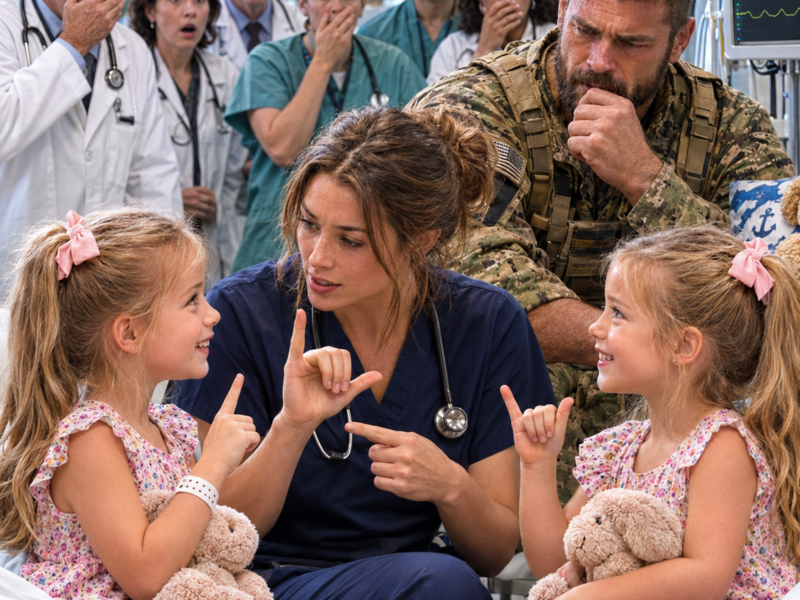
No Doctor Could Handle the SEAL Captain’s Deaf Twin Daughters—Until the Rookie Nurse Arrived!
No Doctor Could Handle the SEAL Captain’s Deaf Twin Daughters—Until the Rookie Nurse Arrived!
The first thing Nora Whitfield noticed was the little girl’s breathing.
The second was that nobody else seemed to notice how quickly she was running out of time.
Ellie Mercer lay in bed number six, her tiny fingers wrapped around a gray stuffed rabbit. Her strawberry-blonde hair had been tied into two uneven ponytails, and a pink ribbon rested against her cheek. Beside her, in the neighboring hospital bed, her identical twin sister, Josie, held another stuffed rabbit and watched every movement in the room with frightened blue eyes.
Neither child had spoken since arriving at the hospital.
They couldn’t.
Both girls were five years old and profoundly deaf. They communicated through American Sign Language, a language they had learned from their mother before she died and later continued practicing with their father. Unfortunately, the hospital staff had very little experience communicating with deaf children. Their attempts to connect through a video interpreter had repeatedly failed, leaving the twins increasingly frightened and confused.
For the past two days, they had been treated as difficult patients.
But Nora saw something different.
She saw two terrified little girls who couldn’t understand why strangers kept touching them, why needles were being brought toward their arms, or why their father seemed unable to make everything all right.
And she saw something else.
Ellie’s breathing was getting worse.
“Step back, nurse. Only doctors touch the captain’s daughters.”
The words came from Dr. Grant Hollis, the attending physician responsible for the twins’ care.
He didn’t even bother looking up from the tablet in his hands.
Nora immediately withdrew her hand.
“Yes, doctor.”
She stepped backward until her shoulders touched the wall.
At thirty-two, Nora had become remarkably good at disappearing into the background. She wore slightly oversized cobalt-blue scrubs, kept her dark brown hair pulled into a practical bun, and rarely volunteered opinions unless someone specifically asked for them.
She had worked in the pediatric ward for seven weeks.
Seven weeks was apparently long enough for everyone to know she was quiet, but not long enough for anyone to wonder why.
Nora didn’t complain about the way senior physicians spoke to her. She didn’t argue when experienced nurses dismissed her observations. She arrived early, completed her responsibilities, and went home without drawing attention to herself.
It was easier that way.
Above the twins’ beds, a painted blue whale smiled across the wall. The cheerful decoration seemed almost cruel against the atmosphere inside the room.
Captain Daniel Mercer stood beside the window.
At six feet three inches tall, with broad shoulders and the unmistakable posture of a military man, he looked like someone who could intimidate an entire room without saying a word.
His desert camouflage uniform carried the insignia of the United States Navy SEALs. A trident rested over his chest, and his dark hair was trimmed short.
He had spent years commanding men through dangerous operations in places most civilians would never visit.
He had faced gunfire, hostile territory, freezing seas, and situations where a single wrong decision could cost multiple lives.
Yet standing beside his daughters’ hospital beds, he looked completely helpless.
His hands hung awkwardly at his sides.
Every few minutes, he attempted to approach one of the girls, but each time they turned away.
He never forced them.
He simply returned to the window and watched them from a distance.
Nora noticed that his right hand repeatedly touched his breast pocket. Something small and rectangular was hidden there. Occasionally, he pressed his palm against it as though reassuring himself that it was still present.
A folded index card.
Nora would later discover what it contained.
For now, her attention remained on Ellie.
The little girl’s nostrils flared with every breath. Her chest rose too quickly, and the spaces between her ribs pulled inward beneath her hospital gown.
Nora glanced at the monitor.
Ninety-three percent.
Then ninety-one.
Her stomach tightened.
She moved closer to the nurses’ station and quietly checked the displayed respiratory rate.
Thirty-six breaths per minute.
That was far too fast for a child resting in bed.
“Doctor,” she said cautiously, “Ellie’s respiratory rate is thirty-six. Her oxygen saturation is dropping. I think we should reassess her breathing.”
Dr. Hollis finally lifted his eyes.
He was in his early fifties, impeccably dressed beneath his white coat, with silver beginning to appear around his temples. He had a reputation for being decisive and exceptionally confident.
Unfortunately, he also had a reputation for disliking anyone who questioned his decisions.
“Nurse Whitfield, did I ask for a nursing opinion?”
“No, doctor.”
“Then let’s not confuse our responsibilities.”
Nora lowered her gaze.
Across the room, Charge Nurse Marion Pruitt watched the exchange. Marion was in her late forties and had worked in pediatrics for nearly twenty years. She knew how to recognize trouble, even when it was being hidden behind professional language.
She gave Nora a small look.
Not now.
Nora understood.
But understanding didn’t make the numbers less frightening.
Two days earlier, Ellie and Josie had been playing near their family’s lakeside cabin when they somehow slipped from the wooden dock into a freezing mountain lake.
Their father had been inside the cabin, answering a military call. A neighbor heard the commotion and rushed outside. By the time he reached the water, both girls had disappeared beneath the surface.
He managed to pull them out within approximately two minutes.
The ambulance arrived quickly, and the girls were transported to the hospital.
At first, their condition appeared reassuring. They were conscious, responsive, and breathing without assistance. Their initial examinations suggested that the immediate danger had passed.
The family was told they would remain under observation.
Everyone wanted to believe the worst was over.
But Nora had learned that a frightening event didn’t always reveal its consequences immediately.
Sometimes, a patient appeared stable until something changed.
And sometimes, the most dangerous symptoms arrived after everyone had started relaxing.
Ellie coughed.
It was a shallow, wet sound.
Josie immediately turned toward her sister and stretched across the narrow space between the beds, reaching for her hand.
Ellie managed to hold on.
Nora watched the monitor.
Eighty-nine.
Then ninety.
Dr. Hollis tapped his tablet.
“All right. We’ll proceed with sedation first. Once they’re calm, we can complete the necessary procedures.”
Nora looked up.
“Sedation?”
The doctor sighed.
“Yes.”
“But doctor, she’s already having difficulty breathing.”
“She’s anxious.”
“Her oxygen saturation is dropping.”
“Children become distressed in hospitals, Nurse Whitfield. I’m familiar with the condition.”
Marion stepped forward.
“Doctor, neither girl has tolerated anyone touching their IV sites. We’ve tried the interpreter, but they keep turning away. Perhaps we should get someone with experience communicating with deaf children.”
Hollis shook his head.
“We don’t have time to organize a special communication program. They’re five years old. They’ll eventually cooperate.”
He turned toward Marion.
“Prepare two milligrams of midazolam for Ellie.”
Marion hesitated.
“Doctor, are you sure?”
“I gave you an order.”
Nora felt her heart beating faster.
Sedation could suppress respiratory drive. In a child whose breathing was already deteriorating, it could make an unstable situation considerably worse.
“Doctor,” she said, keeping her voice controlled, “I’m concerned that sedation could compromise her breathing further.”
Hollis slowly turned toward her.
“Are you questioning my treatment plan?”
“I’m asking whether we should reassess her respiratory status before administering anything.”
“That’s enough.”
The room became uncomfortable.
Captain Mercer looked toward the medical team.
“What are you giving my daughter?”
“Something to help her relax,” Hollis answered.
“Why does she need that?”
“Because she’s frightened and refusing treatment.”
Mercer looked at Ellie.
His daughter was barely able to keep her head upright.
“She looks sick.”
“Captain, I assure you that we know what we’re doing.”
Hollis gestured toward him.
“Your daughter needs an IV. You’ll have to help us hold her still.”
Mercer stared at him.
“Hold her?”
“Gently. Just keep her shoulders from moving.”
The captain crossed the room.
He approached the bed slowly, trying to make his movements less intimidating.
“Ellie, sweetheart…”
He lifted his hands.
The little girl looked up.
She saw a tall man in camouflage approaching her with his arms extended. Her frightened eyes widened.
She began struggling.
No sound came from her mouth, but her face twisted with a silent scream that seemed to tear through the room.
Her legs kicked against the sheets.
The stuffed rabbit fell to the floor.
Across the narrow gap, Josie reacted immediately. She began striking the bedrail with both hands, desperately trying to get someone’s attention.
Mercer froze.
He had seen men scream in battle. He had watched soldiers lose their composure under unimaginable pressure.
But nothing had prepared him for the expression on his daughter’s face.
He released her shoulders.
“I can’t.”
His voice cracked.
“She’s looking at me like I’m the enemy.”
Dr. Hollis approached him.
“Daniel, you’re making this harder than it needs to be.”
The captain looked at the doctor, then at his daughter.
“I don’t want to hurt her.”
“Nobody wants to hurt her. We need to complete the treatment.”
Mercer stepped away.
Nora stood against the wall, her fingers pressed tightly against her thighs.
She wanted to cross the room.
She wanted to take the syringe from Hollis’s hands.
She wanted to kneel beside Ellie and tell her that someone finally understood.
But she had made herself a promise two years earlier.
Never stand out.
Never become the person everyone turns toward when something goes wrong.
Never allow anyone to see what she used to be.
The promise had cost her confidence, friendships, and nearly everything she once loved about her profession.
It had also kept her safe.
Until that morning.
“Marion, the medication,” Hollis ordered.
The charge nurse prepared the syringe.
Her hands were visibly trembling.
She approached Ellie, but the child recoiled immediately.
“Hold still, sweetheart.”
The words were useless.
Ellie couldn’t hear them.
She saw only another stranger reaching toward her arm.
Marion stopped.
Hollis took the syringe from her.
“Honestly, this is ridiculous.”
He leaned over the child and attempted to access a vein.
He missed.
He adjusted his position and tried again.
Another failure.
The monitor began sounding more urgently.
“Eighty-six,” Marion whispered.
Ellie’s movements suddenly became weaker.
Her head sank against the pillow.
Her lips were losing their color.
Josie reached across the beds and shook her sister’s arm.
She tapped Ellie’s cheek, then looked toward the adults.
Her little hands moved desperately.
She was signing something.
Please.
Help.
Somebody.
But nobody understood.
“Eighty-three,” Marion said.
Hollis stared at the monitor.
For the first time that morning, his expression changed.
He looked at the syringe in his hand.
Then at Ellie.
“She’s anxious. She should be calming down.”
The monitor screamed.
Ellie’s chest barely moved.
Captain Mercer stepped forward.
“Somebody do something!”
His voice broke.
“Please!”
That was when Nora closed her eyes.
Only for a second.
She remembered the promise she had made.
Then she let it go.
“Put the syringe down, doctor.”
Her voice was quiet.
But everyone heard it.
Hollis turned sharply.
“What did you say?”
“Put it down.”
“Excuse me?”
“If you administer that medication now, she could stop breathing.”
“Nurse Whitfield, you are completely out of line.”
Nora was already moving.
“Marion, activate the rapid response team. Bring the oxygen equipment and the bag-valve mask. We need respiratory support immediately.”
Marion didn’t hesitate this time.
She pressed the emergency button.
Nora reached Ellie’s bedside and carefully lifted the little girl into a more upright position, supporting her head and shoulders against her own chest.
Ellie’s body felt frighteningly light.
Her skin was cool.
Her breathing was shallow and uneven.
Nora looked directly into her eyes.
Then she raised two fingers toward her own face and pointed toward Ellie.
Look at me.
The movement was simple.
But it wasn’t random.
It was a sign Nora knew intimately.
Ellie’s eyes moved weakly toward her fingers.
Then toward her face.
Nora placed both hands where the child could see them and demonstrated a slow, gentle breathing rhythm.
She didn’t speak.
She didn’t ask Ellie to listen.
She simply showed her.
In.
Out.
Again.
The little girl struggled to imitate her.
Nora repeated the movement.
“That’s it, sweetheart.”
Ellie’s chest rose weakly.
Then fell.
The room had become completely silent except for the alarms.
Marion returned with the equipment.
Nora accepted the oxygen mask and continued supporting the child while the appropriate respiratory assistance was established.
She listened carefully to Ellie’s chest.
Fine, wet crackles were audible at both lung bases.
Her expression tightened.
“Delayed pulmonary edema after submersion,” she said.
Hollis stared at her.
“What?”
“She’s not simply frightened. She’s developing respiratory complications from the lake incident. She needs immediate respiratory support and pediatric critical-care assessment.”
Nora looked toward Marion.
“What’s her saturation?”
“Eighty-one.”
“Keep the support going. Tell the team we need them now.”
Marion nodded.
Nora continued monitoring Ellie and assisting with breathing support while the rapid response team was on its way.
Across the bed, Josie had gone completely still.
She watched Nora’s hands.
Her frightened eyes moved from one movement to another.
Nora turned slightly and raised her free hand.
She signed slowly.
Your sister is going to be okay.
Then she pointed toward Josie.
Hold her hand.
Stay with me.
Josie stared at her.
For the first time since entering the hospital, someone had communicated with her in a language she understood.
The little girl reached across the gap and gripped Ellie’s fingers.
She nodded.
“Eighty-nine,” Marion announced.
Nora continued working.
“Good. Keep watching her.”
The pediatric emergency team arrived moments later.
Their leader, a senior pediatric intensivist, took one look at the monitor and immediately began coordinating the next steps.
Nora delivered a concise report.
She explained the drowning incident, the delayed deterioration, the abnormal respiratory findings, the oxygen decline, and the interventions already underway.
The team leader listened carefully.
Then she nodded.
“Good catch.”
The medical team transitioned Ellie to more appropriate advanced respiratory support and prepared her for transfer to the pediatric intensive care unit if necessary.
Over the next fifteen minutes, her oxygen saturation gradually improved.
Ninety-four.
Ninety-six.
Ninety-eight.
The terrible alarm finally stopped.
Ellie’s lips began regaining their natural color.
Her chest movements became more regular.
Nora slowly eased her back against the pillow.
Only then did she realize that her hands were shaking.
They had remained steady throughout the emergency.
Now, with the immediate danger passing, she could no longer control them.
Captain Mercer stood beside the bed.
His face was wet.
He didn’t seem aware that he was crying.
He looked at Nora for a long moment.
“Ma’am?”
She turned.
“Yes, Captain?”
“Where did you learn to do that?”
Nora pulled off her gloves and tucked her hands beneath her thighs.
“I was trained, sir.”
“Trained where?”
She looked toward Ellie.
“I received emergency medical training before coming here.”
Mercer studied her face.
Something about her movements had disturbed an old memory.
Especially the two fingers.
The way she had pointed to her eyes and then toward the child.
He had seen that gesture before.
Eight years earlier.
But before he could ask another question, Dr. Hollis finally found his voice.
And he was angry.
“That was reckless.”
Everyone turned.
The doctor had recovered enough composure to become indignant.
“You countermanded an attending physician’s order, directed a rapid response, and performed interventions outside your assigned responsibilities.”
Marion stared at him.
“She saved the child.”
“That is not the point.”
“Then what is the point, doctor?”
Hollis ignored her.
“Security!”
A young security officer appeared in the doorway.
“I need this nurse’s badge.”
Captain Mercer slowly turned.
The movement was enough to make the young officer hesitate.
Hollis continued.
“Nurse Whitfield is a new graduate. Her file indicates previous EMT experience, but she has no pediatric critical-care certification. She has no authority to make independent treatment decisions of this magnitude.”
Nora stood quietly.
“I’ll go, doctor.”
Marion immediately stepped forward.
“Nora, you don’t have to—”
“It’s all right.”
Nora turned toward the doorway.
She had spent two years learning how to leave a room without making anyone uncomfortable.
She could do it again.
But before she reached the security officer, she felt something tug at her scrub top.
She stopped.
Josie was standing beside her.
Barefoot.
Her small fingers were gripping the blue fabric with surprising strength.
The little girl looked up at Nora.
Then she began signing.
Her movements were clumsy, but the meaning was unmistakable.
Stay.
Please stay.
Nora’s expression softened.
Josie repeated the sign.
Stay.
Ellie stirred in the bed.
When she noticed Nora moving away, her eyes widened.
She began crying silently.
Her heart rate increased, and the monitor showed another decline in oxygen saturation.
Captain Mercer knelt in front of Josie.
“Sweetheart…”
He tried signing something.
But his movements were uncertain.
Josie didn’t look at him.
She continued holding Nora’s uniform.
Marion turned toward Dr. Hollis.
“Doctor, look at your patients.”
Hollis glanced at the monitors.
His jaw tightened.
“Fine. She can remain under my direct supervision.”
Nora didn’t respond.
She simply lifted Josie gently and carried her back toward the beds.
The little girl’s arms remained wrapped around her neck.
Nora sat on the edge of Ellie’s mattress and allowed Josie to hold her sister’s hand.
For a moment, everything became strangely quiet.
The hospital room faded.
The monitors became distant.
And Nora was no longer standing beside two little girls.
She was somewhere else.
Eight years earlier.
The water had been black.
The wind had been vicious.
A helicopter’s rotor wash had thrown freezing spray across her face, and the sea had swallowed every sound except the mechanical thunder above her.
A man in a damaged survival suit was slipping beneath the surface.
His eyes were open.
But he had stopped fighting.
She had reached him just as his strength disappeared.
She had grabbed his equipment, secured the rescue connection, and held on through the brutal cold.
The man’s eyes had been unfocused.
His movements were weak.
She had raised two fingers toward her own eyes.
Look at me.
He had looked.
And she had refused to let him disappear beneath the water.
Nora blinked.
The hospital room returned.
She didn’t notice Captain Mercer staring at her.
She didn’t notice the way his hand had risen to cover his mouth.
Dr. Hollis was examining the monitor again.
“High-flow oxygen is excessive,” he announced.
Marion turned toward him.
“What?”
“The child is stabilizing. We can reduce the support.”
“Doctor, she was barely breathing twenty minutes ago.”
“She was distressed. We now need to determine whether the earlier intervention was excessive.”
Nora remained seated beside the twins.
Her eyes moved toward the monitor.
Hollis approached the equipment.
“Reduce her to two liters through the nasal cannula.”
“Doctor,” Nora said.
“I am the attending physician.”
“Her condition has only recently stabilized.”
“Thank you, Nurse Whitfield. I’ll handle the treatment.”
He changed the respiratory support.
Nora watched the numbers.
Ninety-six.
Ninety-five.
Ninety-three.
Ninety.
Eighty-eight.
Ellie’s breathing became visibly labored again.
Her shoulders lifted with each effort.
A faint grunting sound returned.
Josie tightened her grip on her sister’s hand.
Nora leaned forward.
“Doctor, restore the previous support.”
Hollis didn’t turn.
“I’ll decide when that’s necessary.”
“Eighty-five,” Marion announced.
Nora looked directly at him.
“Doctor, she’s deteriorating.”
“She’s being monitored.”
“Eighty-two.”
The room seemed to shrink around them.
Hollis stared at the monitor.
His mouth opened.
Nothing came out.
For the second time that day, he seemed unable to make a decision.
And something changed in Nora.
Her shoulders straightened.
Her chin lifted.
The timid nurse who had spent seven weeks avoiding attention disappeared.
She reached up, removed the elastic from her hair, and gathered it into a tight, secure bun.
Then she stood.
“Everyone move.”
She didn’t shout.
She didn’t need to.
The command carried a strange authority that made people respond before they consciously understood why.
“Marion, restore the high-flow support. Call the pediatric intensive-care team back. Prepare the additional respiratory equipment.”
Marion immediately moved.
Nora turned toward Hollis.
“Doctor, step away from the bed.”
His face flushed.
“You cannot give me orders.”
“A child is dying. Step away.”
“Nurse Whitfield—”
“You can write me up afterward.”
Her eyes never left his.
They were calm.
Not angry.
Not frightened.
Just completely immovable.
Hollis took a step backward.
Nora removed her gloves.
For the first time, everyone saw her hands clearly.
Thick, pale scars crossed both palms.
They were not ordinary scars from kitchen accidents or everyday injuries.
They were deep, uneven lines that stretched across the skin and disappeared toward her wrists.
A second scar curved along her left forearm, pale and slightly raised.
They looked like the marks left by something that had once pulled violently against her hands.
Nora checked Ellie’s pulse and continued coordinating the emergency response.
“Heart rate one hundred sixty. Blood pressure holding. Wet lung sounds at both bases. We need positive-pressure support and immediate pediatric reassessment.”
Marion followed her instructions.
The team moved with renewed urgency.
Nora leaned toward Ellie.
She raised two fingers to her own eyes.
Then pointed toward the little girl.
Look at me.
Ellie looked.
Her eyes were frightened, but she recognized the familiar movement.
Nora repeated the gentle breathing demonstration.
Across the bed, she signed to Josie.
Hold her hand.
Count with me.
Josie nodded.
She began moving her fingers as she counted, watching the monitor and her sister’s chest.
The pediatric team arrived again.
This time, the lead physician immediately took over the advanced respiratory management while Nora provided a detailed update.
The equipment was restored.
Ellie’s oxygen saturation began climbing.
Eighty-six.
Ninety.
Ninety-three.
Ninety-seven.
Marion exhaled a trembling breath.
“She’s responding.”
Nora stepped back.
Her hands were bare now.
The scars were impossible to miss.
Captain Mercer had seen them.
And suddenly, he remembered everything.
Not just the eyes.
Not just the gesture.
The hands.
The scar tissue.
The way the woman had moved without hesitation when everyone else froze.
He had spent eight years wondering whether the person who pulled him out of the Gulf of Alaska had ever gone home safely.
Now she was standing in front of him.
And he knew.
But before he could speak, Josie did something that made the entire room turn.
She released Nora’s hand.
Then she looked directly at her father.
For the first time in two days, she met his eyes.
She raised her little hand.
Her thumb touched her forehead, and her fingers spread outward.
Daddy.
Daniel Mercer stopped breathing.
It was a simple sign.
But he had spent months trying to learn it.
He had watched videos in his truck after work. He had practiced in front of the bathroom mirror. He had copied signs onto pieces of paper and carried them everywhere.
He wanted to be able to communicate with his daughters without always depending on someone else.
But after their mother died, he had become consumed by military responsibilities and the difficult demands of raising two young children alone.
He had promised himself he would become better.
He had simply never found the courage to begin.
Josie looked at his pocket.
Then pointed toward it.
Daniel’s hand moved automatically.
He pulled out the folded index card.
It was worn at the corners and soft from being handled repeatedly.
He unfolded it.
On one side were drawings of hands.
On the other were simple phrases written in his own uneven handwriting.
Good morning.
Are you hungry?
Do you want to play?
I’m here.
And at the bottom, written in larger letters, were three words.
I love you.
Daniel had practiced that last sign more than any other.
He had never shown it to his daughters.
He was afraid of getting it wrong.
Afraid they would laugh.
Afraid they would realize how little he understood the language they used every day.
But now Josie was looking at him.
Waiting.
Daniel lifted both hands.
His fingers trembled.
He formed the sign.
It wasn’t perfect.
His thumb was slightly misplaced, and his hand shape was awkward.
But the meaning was clear.
I love you.
Josie’s face changed.
Her lower lip trembled.
Then she climbed toward him as quickly as her little legs would carry her.
Daniel caught her against his chest.
He held her carefully, burying his face in her strawberry-blonde hair.
For the first time in weeks, his daughter had reached for him without hesitation.
Nora turned her face away.
She didn’t want anyone to see her crying.
But Captain Mercer was no longer looking at his daughter.
He was looking at Nora.
His eyes moved from her hands to her face.
Then he whispered a single word.
“Kodiak.”
Nora closed her eyes.
She knew there was no point denying it.
Ellie was finally resting more comfortably, her breathing supported and her condition under close pediatric observation.
Josie remained in her father’s arms.
The medical team gradually cleared the immediate area.
Dr. Hollis stood at the foot of the bed, looking as though the room had become unfamiliar to him.
“Captain,” he said eventually, “I need to understand what just happened.”
Mercer slowly placed Josie beside her sister.
He stood.
The movement was controlled, but something about his expression made everyone straighten.
“Eight years ago,” he began, “I was involved in a maritime boarding operation in the Gulf of Alaska.”
He looked toward Nora.
“Our boat capsized in freezing water. The weather was terrible. Thirty-eight-degree water, sixty-mile-per-hour winds, and waves high enough to swallow the entire vessel.”
He paused.
“I went under.”
Nobody interrupted.
“At first, I fought. I tried to reach the surface, but the cold was taking everything from me. My equipment was damaged. I couldn’t get my bearings. I remember seeing the helicopter overhead, but I honestly believed I wasn’t going to make it.”
His eyes moved toward the scars on Nora’s hands.
“Then someone jumped into the water.”
Nora lowered her gaze.
Mercer continued.
“The rescue swimmer reached me, secured the connection, and kept me conscious long enough for the hoist. I remember her hands. I remember the way she looked at me.”
He raised two fingers toward his eyes.
“Look at me.”
His voice became quieter.
“Those were the last words I clearly remember before they pulled me aboard.”
Nora said nothing.
Mercer turned toward the others.
“She was a Coast Guard Aviation Survival Technician. Second Class. Her name was Nora Whitfield.”
The room fell silent.
A few people exchanged astonished looks.
Dr. Hollis stared at her.
“You’re saying Nurse Whitfield was the rescue swimmer?”
Mercer nodded.
“She was the reason I survived.”
Nora finally spoke.
“It was my job, sir.”
“No.”
He shook his head.
“It was more than your job. You held on when the water was trying to take both of us.”
He looked down at her hands.
“What happened?”
Nora’s expression changed.
For several seconds, she seemed to be considering whether she wanted to answer.
Then she took a breath.
“Six years after that rescue, I was involved in another operation.”
She glanced at the scars.
“Our hoist cable failed during a rescue. My swim partner didn’t come home.”
The room became painfully quiet.
Nora continued.
“I remember the water. I remember the radio calls. I remember reaching for him.”
Her voice remained steady, but her eyes had become distant.
“I couldn’t bring him back.”
She looked at Ellie.
“Afterward, I left the Coast Guard. I told myself I was finished with emergency rescue work. I didn’t want another uniform, another medal, or another ceremony. I didn’t want people asking me to tell stories about something I couldn’t bear to remember.”
She paused.
“So I came here. I thought I could help people quietly. One patient at a time. No helicopters. No freezing water. No one expecting me to be someone I wasn’t anymore.”
Captain Mercer studied her.
“That’s why you kept your head down?”
Nora nodded.
“I thought if I stayed small enough, nobody would ask me to be brave again.”
Mercer looked at the two girls.
“Today, you stepped forward anyway.”
Nora didn’t answer.
“You saved my daughter twice.”
The words made her look up.
“Captain—”
“You knew when something was wrong. You saw what the rest of us missed. And when everyone else was afraid to act, you did what needed to be done.”
He swallowed.
“I spent eight years wondering if the woman who saved me was still alive. I never imagined I’d meet her again while my own daughters were fighting for their lives.”
Nora looked away.
There were some things she had never learned how to accept.
Gratitude was one of them.
Dr. Hollis finally stepped forward.
His expression had changed completely.
“Nurse Whitfield.”
Nora turned.
He hesitated.
“I need to apologize.”
Nobody moved.
Hollis looked toward Ellie.
“I dismissed your concerns. I failed to properly reassess her condition, and I allowed my frustration to influence my decisions.”
He swallowed.
“I was more concerned with maintaining control of the room than listening to someone who had identified a serious clinical problem.”
His eyes lowered.
“I was wrong.”
Nora regarded him for a moment.
Then she spoke.
“Be better, doctor.”
Hollis looked up.
“That’s all I want.”
It wasn’t a dramatic speech.
She didn’t demand that he apologize publicly.
She didn’t humiliate him in front of the staff.
She simply returned her attention to the girls.
Marion folded her arms.
“I’ve already submitted an incident report. The chief of pediatrics will review everything tomorrow morning.”
Hollis nodded.
He didn’t argue.
The following morning, he was removed from the twins’ case pending a formal review. His decisions, including the attempted sedation and subsequent reduction of respiratory support, were examined by the hospital’s clinical leadership.
The review would take time.
But for the first time in his career, Hollis had to face the possibility that his authority had nearly cost a patient her life.
Captain Mercer remained at the hospital.
He barely slept.
He spent most of the night sitting between his daughters’ beds, holding one small hand in each of his enormous hands.
Ellie continued receiving close monitoring and respiratory treatment. Her condition gradually improved, and the pediatric team remained cautiously optimistic.
Josie refused to let Nora leave whenever she entered the room.
The first time Nora tried to return to the nurses’ station, the little girl signed something.
Friend.
Nora smiled.
“Yes, sweetheart. I’m your friend.”
Josie studied her hands and tried to copy the movement.
She got it wrong.
Nora gently corrected her.
Then Ellie joined them.
The two girls began signing together, their movements becoming more animated as they realized someone in the room could understand them.
For the first time since their accident, the hospital no longer felt like a place where strangers were constantly trying to take control of their bodies.
It felt a little safer.
Late that afternoon, Captain Mercer found Nora sitting in the hallway outside the pediatric ward.
She was drinking a cup of coffee that had long since gone cold.
He approached quietly.
“May I sit?”
Nora nodded.
Mercer lowered himself into the chair beside her.
For several seconds, neither spoke.
Then he said, “The Coast Guard would take you back in a heartbeat.”
Nora looked at him.
“So would my teams. There are people I know who would be honored to work with someone like you.”
She smiled faintly.
“That’s kind of you, sir.”
“I’m serious.”
“I know.”
“Would you ever consider returning?”
Nora looked through the glass panel toward the pediatric room.
Ellie was resting.
Josie was drawing something with a hospital crayon.
The two rabbits were sitting together on the blanket.
“No,” Nora said softly.
Mercer studied her.
“Why not?”
“Because I think I finally understand where I need to be.”
She looked down at her hands.
“I spent years believing that leaving the Coast Guard meant I had lost the part of myself that knew how to save people. I thought the only way I could matter was by doing something extraordinary.”
She turned toward him.
“But those girls didn’t need a rescue swimmer. They needed someone who could communicate with them.”
Mercer nodded slowly.
“And that’s what you want to do?”
“Yes.”
Nora looked toward the ward.
“Think about what happened here. Two deaf children came into a hospital, and almost nobody could communicate with them. They couldn’t understand the procedures. They couldn’t explain what hurt. They couldn’t even tell us what they were afraid of.”
She paused.
“How many other children go through that?”
Mercer had no answer.
“Every hospital should have staff who understand sign language. Not just one interpreter who may or may not be available. Nurses. Doctors. Technicians. Security officers. Everyone who might need to approach a deaf patient.”
Her voice grew stronger.
“I want to help create that.”
Marion appeared in the hallway.
She had clearly heard the last part.
“Then count me in.”
Nora looked up.
Marion smiled.
“I’ve worked in this hospital for twenty years. I’ve seen children terrified because nobody could explain what was happening to them. If you’re building a training program, I’ll be your first student.”
Mercer raised his hand.
“Second.”
Nora laughed softly.
“Captain, you already have a head start.”
“Then I’ll recruit forty operators from my unit. They can learn, too.”
“Forty?”
“At least.”
Marion shook her head.
“You’re going to need a bigger classroom.”
For the first time in years, Nora laughed without feeling the need to hide it.
The next several weeks brought changes that nobody in the hospital had expected.
The incident involving the Mercer twins prompted a comprehensive review of pediatric emergency procedures, communication accommodations, and escalation protocols.
The hospital administration approved a new training initiative focused on communication with deaf and hard-of-hearing patients.
Nora was invited to help design the program.
She worked alongside pediatric specialists, speech-language professionals, interpreters, and experienced nurses.
She insisted that the training include practical situations rather than simply memorizing signs.
Staff learned how to approach a deaf child without startling them, how to gain attention respectfully, how to communicate basic needs, and how to ensure patients understood procedures before they began.
Marion became one of the most enthusiastic students.
Captain Mercer arranged for several members of his unit to attend introductory sessions.
Some of the largest, toughest men Nora had ever seen found themselves sitting at small classroom tables, struggling to remember basic hand movements.
The first lesson was simple.
Look at the person.
Make sure they can see you.
Don’t assume silence means understanding.
And never mistake someone’s inability to hear you for an inability to understand.
Meanwhile, the twins continued recovering.
Ellie’s breathing gradually returned to normal. Her oxygen needs decreased, and her medical team eventually determined that she could leave intensive observation and return to the regular pediatric floor.
Josie remained her constant companion.
Whenever a nurse approached, the girls now watched for familiar signs.
Nora visited them whenever her shift allowed.
Sometimes she brought picture books.
Sometimes she taught them new signs.
Sometimes she simply sat between the beds while they drew pictures and showed her their favorite colors.
Daniel Mercer also changed.
He began practicing sign language every evening.
He used online lessons, attended the hospital’s training sessions, and asked Nora to correct him whenever he made mistakes.
At first, his hands were stiff and awkward.
He was a man accustomed to physical discipline, structured training, and commands that needed to be followed immediately.
Sign language required something different.
Patience.
Attention.
And the willingness to make mistakes in front of the people you loved.
His daughters noticed.
One evening, while Ellie was coloring, Daniel approached her bed.
He raised his hands.
“How are you feeling?”
His movements were slow, but recognizable.
Ellie looked at him.
Then she smiled.
She signed that she was feeling better.
Daniel’s face lit up.
He answered.
The grammar wasn’t perfect.
One of the signs was slightly misplaced.
But Ellie understood.
She reached toward him and touched his cheek.
Daniel closed his eyes.
He had commanded teams through dangerous missions, survived situations that had seemed impossible, and earned the respect of men who trusted him with their lives.
Yet the smallest achievement of his career was learning how to ask his daughter whether she wanted another glass of water.
A few days later, the hospital organized a small gathering to celebrate the twins’ recovery and introduce the new communication initiative.
There were no grand speeches or television cameras.
The gathering took place in the pediatric ward’s family room.
Marion arranged refreshments.
The chief of pediatrics attended.
Several nurses and doctors came to show their support.
Captain Mercer arrived in his uniform, carrying a small gift bag.
Nora almost didn’t recognize him when he walked through the door.
He looked different.
Not physically.
He still had the same broad shoulders and commanding presence.
But his expression had softened.
He no longer looked like a man fighting to keep the world from collapsing around him.
He looked like a father who had finally found his way back to his children.
The twins were dressed in matching pink sweaters.
Their strawberry-blonde ponytails were tied with fresh ribbons.
They carried their gray rabbits.
Daniel approached Nora.
“I brought something.”
He handed her a small wooden box.
Nora looked at it.
“What is it?”
“Open it.”
Inside was a photograph.
It showed a Coast Guard rescue helicopter hovering above dark water.
Beneath it, written in careful handwriting, were the words:
To the woman who refused to let me disappear.
Thank you for bringing me home eight years ago.
And thank you for bringing my daughters back to me.
Nora stared at the photograph.
For a moment, she couldn’t speak.
“I don’t know what to say.”
“You don’t have to say anything.”
He paused.
“There’s something else.”
He reached into his jacket and pulled out the old index card.
It had been laminated now, but the original drawings were still visible.
Daniel handed it to Josie.
The little girl examined it carefully.
Then she turned toward her father.
She raised her hand and made the sign he had practiced for so many nights.
I love you.
Daniel returned it.
This time, his fingers were in the correct position.
Josie threw both arms around his waist.
Ellie followed.
He knelt and gathered them against his chest.
Nora watched them.
She thought about the rescue in Alaska.
She thought about the cable failure.
She thought about the years she had spent trying to forget the water.
And she finally understood something she had never allowed herself to consider.
Her partner’s death would always be part of her story.
The scars on her hands would never disappear.
The memories would not suddenly become painless.
But none of those things meant she had to spend the rest of her life hiding.
She had believed that courage meant returning to the water.
She had been wrong.
Sometimes courage meant standing in a hospital room when everyone told you to step aside.
Sometimes it meant speaking when silence would be easier.
Sometimes it meant allowing yourself to be seen again.
A few minutes later, the chief of pediatrics invited Nora to say a few words.
She hesitated.
Public attention was still uncomfortable.
But she looked toward the twins.
Ellie and Josie were watching her.
So she stepped forward.
“I don’t think what happened here was about one person saving another,” she began.
Her voice was calm.
“It was about listening. Really listening.”
She glanced at the nurses and doctors.
“Those girls couldn’t hear us. But that didn’t mean they couldn’t tell us what they needed. We were the ones who had failed to understand.”
She paused.
“Sometimes, we become so focused on our titles, our experience, and our authority that we forget why we entered this profession in the first place.”
Her eyes moved toward Hollis, who had attended the gathering quietly.
“Every patient deserves to be treated with dignity. Every concern deserves to be considered. And every person in a room has something valuable to contribute.”
She looked toward the twins again.
“Most importantly, if someone cannot hear your language, learn theirs.”
For a moment, nobody spoke.
Then Josie raised both hands.
She made a sign.
Nora smiled.
It was the sign for thank you.
Ellie copied her.
Then Daniel.
Then Marion.
A few others followed.
The room filled with imperfect movements, smiling faces, and hands raised in a language that had once been almost entirely absent from that hospital.
Nora felt something loosen inside her chest.
She had spent years believing that the most important moment of her life was the day she pulled a dying man from freezing water.
Now she understood that it had never been about the rescue itself.
It had been about refusing to abandon someone who needed her.
And that responsibility had not ended when she left the Coast Guard.
It had simply taken a different form.
Several months later, the hospital’s sign-language training program was officially established.
New employees were required to complete introductory communication training, while existing staff were encouraged to participate in advanced sessions.
Nora continued working in pediatrics, but her responsibilities gradually expanded.
She became a coordinator for communication accessibility and emergency response education.
Marion helped organize the practical workshops.
Captain Mercer remained involved, occasionally sending groups of military personnel to participate.
Ellie and Josie became regular visitors to the hospital’s family events.
They were healthy, energetic, and increasingly confident.
The gray rabbits still accompanied them everywhere.
One afternoon, Nora was preparing medication records at the nurses’ station when she noticed two small figures standing at the entrance.
Ellie and Josie.
Their father stood behind them.
The girls ran toward her.
They each held one of her hands.
Then Josie signed something.
Friend forever.
Nora smiled.
“Friend forever.”
Ellie pointed toward Nora’s palms.
The scars were still visible.
She gently touched one with her tiny finger.
Then she looked up and signed a question.
Does it hurt?
Nora considered the question.
She signed slowly.
Sometimes.
Ellie frowned.
Then she placed her little hand over Nora’s scarred palm.
She signed again.
You are brave.
Nora felt tears gather in her eyes.
She shook her head gently.
“Not always, sweetheart.”
Then she raised her hands.
“Sometimes I’m scared, too.”
The girls looked at each other.
Josie smiled and signed something else.
We stay together.
Nora nodded.
“Yes. We stay together.”
Captain Mercer watched from the doorway.
His eyes were wet, but he was smiling.
He had once believed strength meant never allowing anyone to see fear.
He had learned otherwise.
Nora had once believed strength meant surviving the impossible and never speaking about it.
She had learned otherwise, too.
And the two little girls who had entered the hospital unable to communicate with almost anyone had taught an entire medical team something that years of professional training had failed to teach them.
A person’s silence does not mean they have nothing to say.
A quiet voice does not mean a weak mind.
And a person standing against the wall may be carrying experiences that nobody else in the room could imagine.
Dr. Hollis eventually returned to clinical duties after completing additional review and supervision. He was no longer assigned to the twins’ care, but he attended one of Nora’s introductory communication sessions.
He sat in the second row.
For the first time, he listened without interrupting.
When Nora demonstrated how to sign a simple greeting, he followed along.
His movements were stiff.
But he tried.
After the session, he approached her.
“I’ve been thinking about what you said.”
Nora waited.
“About being better.”
He looked uncomfortable.
“I don’t know whether an apology can undo what happened.”
“It can’t,” Nora replied.
He nodded.
“I understand.”
“But you can make sure it doesn’t happen again.”
Hollis looked toward the classroom.
Then he nodded once more.
“I’ll try.”
Nora accepted the answer.
She didn’t need him to become a different person overnight.
She simply wanted the next frightened child to receive better care.
That was enough.
On the anniversary of the lake accident, Captain Mercer brought the twins back to the hospital.
They visited the pediatric ward, greeted Marion, and spent nearly an hour with Nora.
Before leaving, Daniel asked if they could take a photograph together.
They stood beneath the blue whale mural.
Nora was in her cobalt-blue scrubs.
Daniel wore civilian clothes.
Ellie and Josie stood between them, each holding one of Nora’s hands.
Just before the photograph was taken, Daniel raised his hands.
He signed something.
Thank you for seeing my daughters.
Nora looked at him.
Then she signed back.
Thank you for letting me help.
The camera captured the moment.
And when Nora later saw the photograph, she noticed something she hadn’t realized while they were standing together.
For the first time in years, she was smiling without trying to hide her hands.
The scars were visible.
The past was visible.
And she was no longer ashamed of either.
She had once been the rescue swimmer who held on in freezing darkness.
She had once been the grieving partner who couldn’t save everyone.
She had become the quiet nurse nobody thought to listen to.
Now she was something else.
She was a woman who had discovered that saving lives did not always require a helicopter, a rescue cable, or a uniform.
Sometimes it required only the willingness to notice.
To listen.
To understand.
And to step forward when everyone else stepped back.
Because titles could earn respect, but they could never replace character.
Experience could make someone knowledgeable, but it could never excuse arrogance.
And the loudest person in the room was not necessarily the one who understood the situation best.
That morning, Dr. Hollis had believed the rookie nurse had nothing to offer.
Captain Mercer had believed his military strength could protect his daughters from anything.
Nora had believed her past had made her incapable of being brave again.
All three had been wrong.
The twins had not needed the most important doctor in the hospital.
They had needed someone who could see their fear, understand their language, and recognize that something was terribly wrong.
And the man who had once been rescued from the freezing waters of Alaska had finally learned that the greatest strength he could offer his daughters was not his ability to command a team of warriors.
It was his willingness to learn how to say three simple words with his hands.
I love you.
As for Nora, she never returned to the Coast Guard.
She never needed another medal.
She never asked anyone to recognize the scars on her hands.
She simply continued showing up for the people who needed her.
And whenever a frightened child entered the pediatric ward, whenever a patient struggled to explain what was wrong, or whenever someone was overlooked because they couldn’t communicate in the usual way, Nora remembered the two little girls with matching pink bows.
She remembered the silent scream.
She remembered the monitor falling to seventy-nine.
And she remembered the moment Josie had grabbed her uniform and begged her to stay.
Because sometimes the most important thing a person can do is not to speak louder.
It is to make sure the other person knows they are finally being heard.
And sometimes, the person who saves your life is not the one standing at the front of the room giving orders.
Sometimes, that person is the quiet one standing against the wall, waiting for the right moment to step forward.
Nora Whitfield had spent years believing that her greatest act of courage was behind her.
She discovered that it was still ahead of her.
And it began with two little girls who couldn’t hear a single word she said, but understood every movement of her hands.
The world had told Nora to stay small.
But two five-year-old sisters had reminded her that she was never meant to disappear.
For them, she wasn’t a rookie nurse.
She wasn’t a former Coast Guard rescue swimmer.
She wasn’t a woman with scars or a painful past.
She was simply Nora.
The person who looked into their frightened eyes and made them feel safe.
And that was more than enough.
THE END









