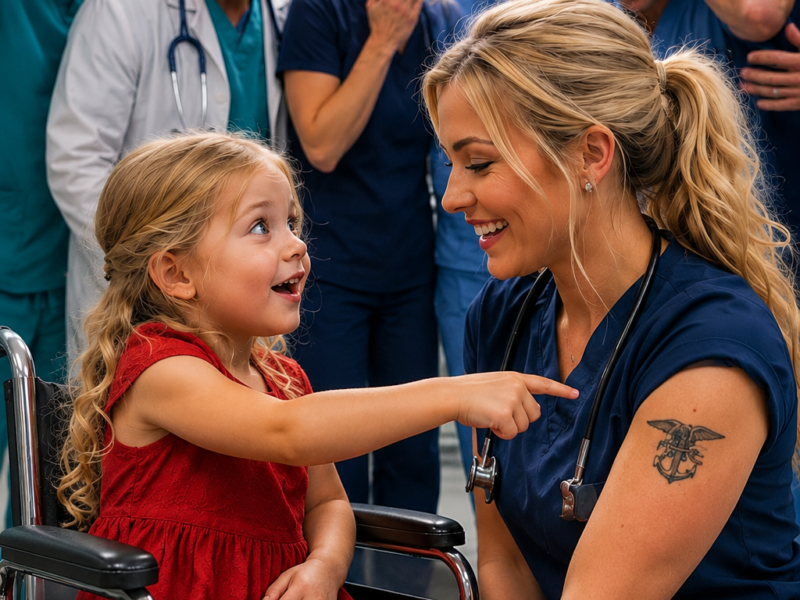
Navy SEAL’s Paralyzed Daughter Recognized Nurse’s Tattoo During Treatment — Doctors Froze Instantly
Navy SEAL’s Paralyzed Daughter Recognized Nurse’s Tattoo During Treatment — Doctors Froze Instantly
Six months ago, when Emma Hail walked through the doors of Riverside Community Hospital for the first time, nobody thought there was anything remarkable about her. She was quiet, almost painfully reserved, and seemed to make a deliberate effort to disappear into the background. Her oversized scrubs hung loosely from her shoulders, her dark hair was usually tied back in an untidy knot, and she rarely looked anyone directly in the eye for more than a second. She spoke only when necessary, followed instructions without complaint, and never volunteered information about her personal life. If someone asked where she had worked before coming to Riverside, she simply said she had moved around a little. If someone asked about her family, she changed the subject. And if anyone happened to notice the faded tattoo beneath the sleeve covering her left forearm, she made certain they never had enough time to study it.
To everyone in the emergency department, Emma was simply another nurse trying to get through a demanding job. To Dr. Gerald Ashkam, the senior attending physician who effectively controlled the department, she was an unfortunate hiring decision.
Ashkam had spent more than twenty years building his reputation. He was tall, silver-haired, and always impeccably dressed, even during the longest emergency shifts. His voice carried naturally across crowded rooms, and he possessed the kind of confidence that made hospital administrators feel reassured whenever he entered a meeting. He knew the medical terminology, understood hospital politics, and had developed an impressive ability to make complicated situations sound as though he had anticipated every possible outcome.
Unfortunately, somewhere along the way, his confidence had become arrogance.
He had little patience for people who challenged him, and even less for employees he considered incompetent. Nurses who questioned his decisions were quickly labeled difficult. Residents who made mistakes rarely received encouragement. Instead, they were reminded, often in front of their colleagues, that they still had a great deal to learn.
Emma had become one of his favorite targets.
Her first week at Riverside had been enough for him to form an opinion. During a particularly busy afternoon, she had been preparing a surgical tray when her fingers trembled slightly while opening a package of sutures. Ashkam noticed immediately.
He stopped beside her, watched her struggle with the packaging for a moment, and then made a comment loud enough for six other nurses to hear.
“Are you sure trauma medicine is the right department for you, Hail? We need people who can keep their hands steady when things get difficult.”
A few nurses exchanged uncomfortable glances. One of them looked as though she wanted to say something, but Emma simply lowered her eyes.
“Understood, doctor.”
Ashkam walked away satisfied, believing he had corrected another inexperienced employee.
What he did not know was that Emma’s hands had once remained perfectly steady while she operated on a wounded soldier in the back of a moving military vehicle, with gunfire striking the metal exterior and an enemy force closing in from less than a hundred yards away.
The trembling appeared only when she was not holding a scalpel.
It was one of the many things she had never explained.
For three years, Emma had been living under a name that was technically hers but no longer carried the history attached to it. Before Riverside Community Hospital, before the oversized scrubs and the quiet routine of emergency department shifts, she had been Petty Officer First Class Emma “Echo” Hail, a Navy SEAL operator and combat medic assigned to an exceptionally classified unit known as Task Force Nightshade.
Three years earlier, Nightshade had been sent on an operation near a remote border town called Alcarim. The mission had been intended to dismantle an international arms network operated by a man named Victor Drager, whose organization had supplied weapons, intelligence, and transportation to criminal groups operating across several countries.
The team had spent eight months gathering information, identifying supply routes, and tracing financial connections. They had discovered enough to make Drager dangerous, but not enough to bring down his entire operation.
Then someone betrayed them.
Their convoy was ambushed on a dirt road outside Alcarim. The first explosion overturned the lead vehicle. The second struck the center of the formation, throwing men into the air and filling the road with smoke, dust, and burning fuel.
Emma remembered almost every second.
She remembered the sharp metallic scream of the vehicle as its frame twisted. She remembered Doyle shouting something over the radio. She remembered Reyes trying to pull a wounded teammate away from the burning wreckage.
Most vividly, she remembered Jake Caro.
Jake had been younger than Emma when they first served together, still learning how to trust his instincts rather than his fear. She had pulled him off a rooftop during an earlier operation after a bullet tore through his shoulder. He had protested that he could still fight, and she had told him that if he wanted to keep his arm, he should stop arguing and let her work.
He had complained throughout the entire evacuation.
Emma had liked him immediately.
During the ambush, Jake was trapped near the damaged vehicle, bleeding heavily and struggling to move. Emma reached him through the smoke, dragged him toward a shallow depression beside the road, and pressed a hand against his wound.
“You’re going to make it,” she told him.
He tried to answer, but another explosion shook the ground.
Emma looked toward the road and saw the enemy closing in.
She knew they would not all get out.
She gave Jake one final instruction.
“Run. Don’t look back.”
He refused at first. He tried to grab her arm, but she pushed him away and ordered him to move. The last thing he saw was Emma turning back toward the burning vehicle.
Then the explosion came.
Jake was thrown clear. He suffered injuries but survived. Emma was badly wounded, suffering a concussion, three broken ribs, and severe burns along her side. Doyle and Reyes did not survive.
When the extraction team arrived, the official report listed three members of Nightshade as killed in action. No fourth body was recovered.
By the time Emma regained consciousness in an isolated farmhouse two days later, the military had already begun treating her as dead.
At first, she intended to contact command.
Then she overheard something that changed everything.
The men responsible for the ambush were discussing the operation in the neighboring building. They were not ordinary insurgents. They were contractors working for Drager’s organization.
And they were discussing the payment.
Someone had given them the convoy route.
Someone inside the operation had sold Nightshade out.
Emma realized that if Drager discovered she had survived, he would send people to finish the job. Worse, he would target anyone connected to the surviving members of the team.
Jake would become a target.
So would anyone else she had ever cared about.
She made a decision that would define the next three years of her life.
She would remain dead.
Using forged identification and whatever assistance she could obtain from people who did not ask unnecessary questions, Emma moved through three countries over the following eight months. She recovered slowly, learned how to live without drawing attention, and eventually found a way back into the United States.
She did not contact her old teammates.
She did not visit the memorial bearing her name.
She did not tell anyone what had happened.
She simply disappeared.
For three years, that disappearance became her entire existence.
Riverside Community Hospital offered her something she had not expected to find: anonymity. It was a busy community hospital where new employees came and went, where nobody had time to investigate someone’s past, and where an unremarkable nurse could spend twelve hours a day caring for strangers without anyone wondering why she preferred to work alone.
Emma thought she could live that way indefinitely.
She was wrong.
On the afternoon everything changed, she was cleaning a gurney near the emergency department entrance when Dr. Ashkam’s voice echoed across the treatment area.
“Hail! That gurney should have been ready ten minutes ago.”
Emma glanced at the clock.
“Yes, doctor.”
“Then perhaps you could move a little faster.”
She said nothing.
Ashkam returned to his notes, apparently satisfied with the exchange.
Twenty minutes earlier, a construction worker had arrived with a serious nail-gun injury to his hand. He was pale, sweating, and showing clear signs of a developing vasovagal episode. Ashkam had been occupied dictating notes to a resident when Emma noticed the man’s eyes rolling backward.
She caught him before he collapsed, helped lower him safely, established an intravenous line, and started fluids.
By the time the other staff members realized what had happened, the patient was already stable.
Nobody thanked her.
Emma did not expect them to.
She checked the clock again. Four hours remained in her shift.
“Hail, room two,” a younger nurse called. “Vitals for the new admission.”
Emma nodded, collected the chart, and headed toward the treatment rooms.
She had become very good at moving quietly. Her shoulders remained slightly lowered, her steps were controlled, and her eyes rarely wandered from whatever task was directly in front of her.
It was a posture she had built over three years, one careful habit at a time.
It had kept her safe.
It was about to collapse in less than eleven minutes.
In the hospital parking lot, a black SUV pulled into two spaces at an awkward angle.
The driver climbed out first.
He was in his mid-thirties, wearing civilian clothes, and had a fading tattoo running along one forearm. His movements were economical, almost mechanical, as though every step had been calculated long before he took it.
His name was Jake Caro.
He had not seen Emma Hail in three years.
As far as he knew, she was dead.
For three years, he had carried the memory of that final moment on the road outside Alcarim. He had replayed her words thousands of times. He had wondered whether he should have ignored her order, whether he could have gone back, whether he could have pulled her out of the burning vehicle.
He had attended a memorial bearing her name.
He had stood before a photograph of her in uniform and tried to accept that the woman who had saved his life was gone.
He had never succeeded.
Jake opened the rear passenger door and carefully lifted his six-year-old daughter from her seat.
Mia Caro had inherited her father’s stubborn jaw and her mother’s copper-colored curls. She was bright, observant, and far more determined than most adults. She had not walked since a car accident eighteen months earlier left her with a serious spinal cord injury.
Jake remembered that night with a different kind of pain.
The vehicle had gone off a bridge outside their old town. The brakes had failed, sending the car into the darkness below. Mia survived, but the accident changed almost everything about their lives.
The investigation later uncovered something troubling.
The brake lines had been deliberately cut.
No one could establish who had done it, and Jake had eventually been forced to accept the official explanation as an unresolved mechanical failure.
But he had never truly believed it.
He had moved with Mia several times since then, changing addresses and keeping his personal information private. He had learned to notice unfamiliar vehicles, strange faces, and people who appeared in the same place too often.
A second man climbed out of the SUV.
Owen Price looked like someone who worked in insurance or financial administration. His jacket was ordinary, his expression mild, and his appearance deliberately forgettable.
But beneath the jacket was a concealed firearm and a secure radio.
Owen was a former Navy officer who had later moved into intelligence work. He had spent the previous two weeks helping Jake and Mia remain safe, although he had not explained the full reason for the increased protection.
Jake adjusted Mia’s blanket.
“The wound hasn’t been healing properly,” he said. “It’s started looking worse, and she developed a fever this morning.”
“I know,” Owen replied. “I called ahead. They’re expecting us.”
“Did you mention my name?”
“No. Cash payment, limited information, no unnecessary records.”
Jake looked at him.
“It better be clean.”
“It will be.”
The automatic doors opened, and the two men wheeled Mia into the hospital.
At that exact moment, Emma was walking down the corridor with a chart tucked beneath her arm.
Something stirred inside her.
It was not quite recognition. It was more like the sudden sensation of being watched by a memory.
She slowed for half a second, then continued toward room four.
The charge nurse called after her.
“Hail! New pediatric admission. Possible infected pressure wound. Fever. Dr. Ashkam is handling it.”
Emma nodded.
She pushed the curtain aside and stepped into the room.
“Hello there. I’m going to take some vitals before the doctor comes in.”
She looked up.
And stopped breathing.
The man beside the wheelchair was Jake Caro.
For one impossible second, the hospital seemed to disappear.
She saw the dusty road outside Alcarim. She heard the explosions. She remembered Jake’s hand reaching for hers as she pushed him away.
He looked older than she remembered, more tired, and somehow smaller beneath the weight of three years of grief.
But it was him.
Jake stared at her.
His expression changed so quickly that Emma could almost see every thought passing through his mind.
Confusion.
Disbelief.
Recognition.
And then something close to heartbreak.
“Echo?”
The name emerged like a question.
Emma’s fingers tightened around the chart.
She had imagined this moment countless times. Sometimes she imagined meeting Jake again and explaining everything. Sometimes she imagined he would hate her. Sometimes she imagined he would never recognize her.
She had never imagined having to face him in a hospital room with his injured daughter sitting between them.
“I’m sorry,” she said quietly. “You have the wrong person.”
Jake shook his head.
“Don’t.”
“Sir—”
“Don’t you dare tell me I have the wrong person.”
His voice cracked.
“I buried you, Emma. I stood at a memorial with your name on it. I spent three years believing you were dead.”
Mia had been watching them carefully.
Her small face moved between the two adults as she tried to understand what was happening.
Then her eyes landed on Emma’s left forearm.
The sleeve of Emma’s scrub top had slipped upward slightly while she reached for the blood pressure cuff.
There, against her pale skin, was a faded tattoo.
A trident beneath an eagle.
Below it, in small block letters, were the words that Emma had spent three years hiding.
US NAVY SEAL.
Mia’s eyes widened.
“That’s Ekko!”
Emma looked down.
The little girl was smiling.
“That’s Ekko’s tattoo!”
Jake turned toward his daughter.
“Mia—”
“Daddy said Ekko saved him!” she continued excitedly. “He said you were a superhero and that you flew away!”
Jake closed his eyes briefly.
He had told Mia stories about Emma. Not the classified details, not the violence, and certainly not the way he had last seen her.
But he had told her about the woman who had saved his life.
He had even kept a photograph of Emma in his wallet, showing her standing beside him after an earlier operation. The tattoo was visible in the photograph.
Mia had seen it many times.
“Daddy keeps your picture in his wallet,” she said proudly. “He says you’re the bravest person he ever knew.”
The room became very quiet.
Behind the half-open curtain, several people had gathered.
Dr. Ashkam had been approaching with a chart when he heard the raised voices. Two residents followed him, along with a nurse from the neighboring room.
Ashkam stepped inside, already irritated.
“What’s happening here? Is there a problem?”
Then he saw Emma’s exposed arm.
His eyes fixed on the tattoo.
For several seconds, he said nothing.
“Navy SEAL?” he finally asked.
Emma did not answer.
Ashkam looked from the tattoo to her face.
“You’re a Navy SEAL?”
One of the residents glanced at the other.
Ashkam’s expression shifted.
“You told me you’d never held a firearm in your life.”
“I never told you that,” Emma replied.
The words were quiet, but there was something in them that made the room uncomfortable.
“You assumed it,” she continued. “It was easier to let you.”
Before Ashkam could respond, Owen Price stepped through the curtain.
He had been standing in the hallway, listening.
His face had gone pale.
“Petty Officer First Class Emma Hail,” he said slowly.
Emma looked at him.
“Task Force Nightshade. Listed killed in action three years ago. Border operation. No body recovered.”
Owen shook his head.
“I attended the debriefing. I signed the paperwork.”
“You signed a lie,” Emma said.
For the first time in three years, she did not try to hide the truth.
Jake was still staring at her.
“Everyone thought you were dead,” he whispered. “I thought you were dead.”
“It wasn’t your fault.”
“I spent three years thinking it was.”
“It wasn’t.”
Mia looked between them.
“Are you going to fix my foot now, Ekko?”
The innocent question broke something inside Emma.
She looked down at the little girl.
“Yes, sweetheart,” she said, her voice softening. “I’m going to fix your foot.”
She reached for the chart in Ashkam’s hand and began reading.
Her expression changed almost immediately.
Temperature elevated. Heart rate abnormal. Blood pressure trending upward. Wound infection suspected.
Something did not fit.
Ashkam cleared his throat.
“We can discuss whatever this is later. Miss Hail, please step outside while I examine my patient.”
Emma looked at the monitor.
Then she looked at Mia.
“Her blood pressure is climbing, and her heart rate is dropping.”
Ashkam frowned.
“It’s a low-grade fever from a pressure sore. I’ve already ordered antibiotics and observation.”
“That’s not a normal fever response.”
“Excuse me?”
Emma looked directly at him.
“She’s showing signs of autonomic dysreflexia.”
The residents exchanged uncertain glances.
Ashkam shook his head.
“That’s unlikely.”
“I’ve seen this presentation before.”
“Where?”
“In a field hospital. A teammate with a spinal cord injury. We had no neurologist within two thousand miles, and the first responder thought he was having a panic attack.”
Emma stepped toward the bedside.
“Mia has a T6 spinal cord injury. Below that level, her body can’t regulate certain painful or irritating stimuli normally. Something happening below the injury can trigger an uncontrolled rise in blood pressure.”
She pointed toward the monitor.
“An infected wound can do it. A full bladder can do it. A blocked catheter can do it. If we don’t identify the trigger, this can become a hypertensive crisis.”
Ashkam looked at the chart.
“Her pressure isn’t that high.”
The monitor sounded again.
Emma’s eyes moved toward the screen.
The reading had climbed dramatically.
The systolic pressure was now 194.
One of the residents swallowed.
“Doctor…”
Mia’s cheeks had turned bright red. Sweat had appeared across her forehead, and her small hands were clenched tightly against the arms of her wheelchair.
“Head hurts,” she whispered.
Emma crouched beside her.
“Where does it hurt, sweetheart?”
“My head. Really hurts.”
The monitor alarm grew louder.
“That’s a hypertensive crisis,” Emma said. “She could have a stroke. Her heart could fail. We need to act now.”
Ashkam looked increasingly uncomfortable.
“I’m the attending physician here.”
Emma turned toward him.
“Then start acting like one. Or get out of my way.”
The words landed heavily.
Jake had gone rigid beside the bed. One hand rested on Mia’s shoulder, and his face had lost almost all its color.
“Emma,” he said. “Tell me what to do.”
She looked at him.
“Get her sitting upright. Not flat. Loosen anything tight around her waist and legs. Stay close to her and keep talking.”
Jake immediately adjusted Mia’s position.
Emma moved toward the bedside equipment.
Ashkam opened his mouth, but Owen Price spoke first.
“Doctor, I’d let her work.”
There was no anger in Owen’s voice. No threat.
Just absolute certainty.
Ashkam looked at the monitor, then at the residents, and finally at Emma.
For the first time in six months, he stepped aside.
“Do whatever you need to do.”
Emma checked Mia’s catheter line, examined the dressing, and quickly assessed the possible triggers.
“Bladder,” she said after a few seconds. “The catheter line is kinked. She hasn’t been draining properly.”
She looked toward the nearest nurse.
“I need a catheter kit. Now.”
One resident hurried from the room.
Emma adjusted the line and checked the equipment again.
“Talk to me, sweetheart.”
Mia’s breathing was shallow.
“Tell me about the picture your daddy keeps in his wallet.”
Mia blinked.
“The picture of you?”
“That’s the one.”
“Daddy takes it everywhere.”
Emma smiled faintly.
“Does he?”
“He says you were the bravest person he ever knew.”
Emma glanced at Jake.
He was staring at the floor, trying desperately to keep his emotions under control.
“Your daddy exaggerates,” Emma said. “I was just doing my job.”
Mia shook her head.
“No. You’re a superhero.”
Emma felt her throat tighten.
Mia continued.
“He cries sometimes when he looks at your picture. He thinks I don’t see him.”
Jake made a small sound.
“Baby…”
“I know,” Emma whispered.
She said it to Mia, but Jake understood that she was speaking to him too.
The resident returned with the catheter kit.
Emma worked quickly, correcting the problem and relieving the pressure that had been building inside Mia’s system. She continued monitoring the girl’s blood pressure, watching for the first signs of improvement.
For several seconds, nothing changed.
Then the monitor began to settle.
162\.
140\.
128\.
The alarm stopped.
Mia’s shoulders relaxed.
She took a deeper breath and looked at Emma.
“My head hurts less.”
Emma exhaled slowly.
“That’s my girl.”
Jake lowered his head, pressing his lips together as relief washed over him.
The residents stared at the monitor.
Ashkam stood near the foot of the bed, his expression frozen.
He had spent six months believing Emma Hail was barely competent. He had criticized her in front of colleagues, questioned her judgment, and dismissed her abilities without ever considering that there might be more to her than what he saw.
And now she had recognized a rare, dangerous condition that he had missed.
Worse, she had recognized it while he was preparing to send a critically ill child home with an inadequate treatment plan.
“Autonomic dysreflexia,” he murmured.
He seemed to be speaking to himself.
“I should have caught that.”
Emma checked Mia’s pulse again.
“Most doctors don’t encounter it often outside spinal injury units. I saw it twice in the field.”
“Still,” Ashkam said quietly, “I should have known.”
Emma did not argue.
The child was stable. That was what mattered.
For the next twenty minutes, she remained beside Mia while the medical team arranged further monitoring and specialist evaluation. Only when the little girl was resting comfortably did Emma finally step into the hallway.
Owen was waiting.
Jake stood beside him.
Neither man looked as though he intended to let her disappear again.
“Start talking,” Owen said.
Emma leaned against the wall.
Her legs suddenly felt heavier than they had during the entire emergency.
Owen crossed his arms.
“The official record says you died in an ambush outside Alcarim. Three years ago. Two other members of Nightshade died with you. Your name is on a classified memorial.”
Emma nodded.
“The ambush was real. Doyle and Reyes didn’t make it. I barely survived.”
Jake looked at her.
“I remember the last thing you said to me.”
Emma lowered her eyes.
“You told me to run and not look back.”
“I know.”
“Then the vehicle exploded.”
“I was thrown clear. I had a concussion, three broken ribs, and burns along my side. By the time I woke up, the extraction team had already left.”
Owen’s expression hardened.
“Why didn’t you contact command?”
Emma was silent for a moment.
Then she began telling them about the farmhouse.
She explained how she had overheard the men responsible for the ambush discussing the payment. How she had recognized the name of Victor Drager. How she had realized that the attack had not been random.
“It was a contract,” she said. “Someone paid to have Nightshade eliminated.”
Owen’s jaw tightened.
“Drager’s Arms Network.”
Emma nodded.
“The same organization we had been investigating for eight months.”
“But the operation was never officially compromised,” Owen said.
“Because someone inside gave them the convoy route. The operation wasn’t compromised by accident. It was betrayed.”
Owen stared at her.
“Do you know who?”
“No. I still don’t.”
She looked toward the hospital room where Mia was resting.
“And I knew that if Drager learned one operator had survived, he would come after everyone connected to the operation. Jake, the families, anyone who could help identify the person responsible.”
Jake’s face tightened.
“So you let me bury you.”
Emma looked at him.
“Yes.”
“You let me believe you were dead.”
“I thought it was the only way to keep you safe.”
“You could have trusted me.”
“I trusted you enough to keep you alive.”
Jake shook his head.
“That isn’t the same thing.”
“No,” Emma said quietly. “It isn’t.”
For a moment, neither spoke.
Then Jake looked away.
Emma understood his anger. She had expected it for three years. She had simply never expected to have to face it while he was standing beside his injured daughter.
Owen finally broke the silence.
“There’s something else.”
Emma turned toward him.
“Three weeks ago, one of Drager’s intermediaries resurfaced. He started asking questions about surviving family members of former Nightshade personnel.”
Jake looked at Owen.
“That’s why you’ve been following us?”
“Yes.”
Owen explained that he had been assigned to monitor Jake and Mia after receiving intelligence suggesting that Drager’s network was attempting to identify and eliminate remaining witnesses.
The attack on Jake’s vehicle eighteen months earlier had not been an isolated incident.
The cut brake lines were now believed to have been part of the same campaign.
Jake’s expression became cold.
“So the accident…”
“Was almost certainly deliberate,” Owen replied.
Jake looked toward Mia’s room.
For eighteen months, he had told himself that the accident was something he could not explain. He had accepted uncertainty because the alternative was too frightening.
Now he knew.
Someone had tried to kill his daughter.
Emma felt the old instinct returning.
Three years of hiding had not erased it. It had only pushed it deeper.
“Drager is cleaning up loose ends,” she said. “He doesn’t know I’m alive yet.”
Owen nodded.
“But he will.”
“How?”
“A hospital admission creates records. Even if we used a cash payment and limited the information, the people monitoring Jake’s movements may have followed him here.”
Emma looked through the glass toward the emergency department lobby.
A plain gray sedan had just pulled into a visitor parking space.
A man wearing a delivery uniform climbed out.
He carried a cardboard box.
At first glance, there was nothing unusual about him.
But Emma noticed the way he walked.
His shoulders were too square. His head moved slowly from side to side. He was not looking for a reception desk or a room number.
He was studying the exits.
Emma felt her entire body change.
“Owen.”
He turned.
“Twelve o’clock. Delivery uniform.”
Owen followed her gaze.
His expression hardened.
“That’s not one of mine.”
The man stopped near the reception desk.
He glanced toward the treatment rooms, then reached casually into the box.
Emma saw something black in his hand.
A weapon.
Three years of hiding disappeared in a single breath.
“Get everyone away from the doors,” she said.
Owen reached for his radio.
“Emma—”
“Now.”
She moved before anyone could respond.
The woman who had spent six months keeping her voice low and her head down was gone.
In her place stood the operator who had survived an ambush, crossed borders under false identification, and learned to recognize danger before it became visible to anyone else.
She reached the nurses’ station and vaulted the counter in one clean movement.
A nearby resident gasped.
Emma grabbed a metal IV pole, stripped away the hanging equipment, and turned toward the lobby.
“Everybody down!”
Her voice cut through the emergency department.
“Get behind the desk! Move!”
The nurses reacted immediately.
A technician pulled a wheelchair-bound patient into a supply alcove. One of the residents helped an elderly man behind a reinforced pillar.
Even Dr. Ashkam moved without questioning her.
He grabbed two frightened family members and pulled them away from the exposed reception area.
Owen had already drawn his weapon.
He moved toward the lobby doors, speaking urgently into his concealed radio.
The delivery man saw the sudden movement.
He knew his cover was gone.
Without hesitation, he raised the compact firearm and fired.
The first burst shattered the reception glass.
Fragments exploded across the counter. A computer monitor fell to the floor. Someone screamed.
Emma was already moving.
She dropped behind a support column, then shoved an unattended crash cart hard across the polished floor.
The heavy steel frame struck the gunman’s legs.
He stumbled sideways, losing his balance.
Emma used the opening to move closer.
The man recovered quickly and fired again. A bullet struck the ceiling, sending fragments of plaster raining down.
A patient screamed somewhere behind the treatment bays.
Hospital security shouted into a radio, calling for police.
Emma heard all of it, but none of it distracted her.
Her attention had narrowed to the gunman.
She moved in three fast steps, raised the IV pole, and struck his wrist with the blunt metal end.
He screamed.
The weapon fell from his hand and skidded beneath a row of waiting room chairs.
Emma drove her shoulder into his chest and forced him onto the floor.
Before he could recover, she twisted his arm behind his back and pinned him against the tile.
“Who sent you?” she demanded.
He clenched his jaw.
“Drager?”
The man said nothing.
Owen arrived seconds later, his weapon trained on the attacker.
“Police are on the way.”
Emma tightened her grip.
“He’s not alone.”
Owen looked toward the lobby.
“What?”
“Men like this don’t work alone.”
As though the words had summoned him, a second figure appeared at the far end of the ambulance corridor.
He was moving toward the treatment rooms.
Toward room four.
Toward Jake and Mia.
Emma saw the direction immediately.
“Jake!”
Her voice echoed down the corridor.
“Get her out through the side hallway! Go!”
Jake had already positioned himself between his daughter and the doorway.
He was unarmed, but he had no intention of stepping aside.
He had spent eighteen months protecting Mia from a danger he could not identify. He was not about to let someone reach her now.
The second gunman raised his weapon.
Emma released the first attacker and sprinted down the corridor.
The gunman heard her approaching and turned.
But Emma was already committed.
She drove into him, tackling him before he could bring the weapon fully into position.
They crashed into a supply cart.
Medical equipment scattered across the floor. Boxes fell open. Saline bags burst beneath their weight.
The man struggled violently.
For a few seconds, the two fought with the brutal efficiency of people who understood exactly what the other was capable of doing.
Emma twisted away from his weapon arm, drove a knee into his ribs, and used his momentum to force him onto his back.
He tried to rise.
She pressed her forearm across his upper chest and pinned him to the tile.
“Stay down.”
He struggled once more.
Emma tightened her hold.
“Don’t make this worse.”
Owen arrived from behind.
“Police are thirty seconds out!”
“Then they’ll find him exactly where he is,” Emma replied.
She did not sound breathless.
Down the side corridor, Jake had wheeled Mia to safety.
He stood beside her, one hand resting protectively on her shoulder.
Mia was staring at Emma.
Her eyes were wide.
“Daddy?”
Jake looked down.
“Yes, baby?”
“Ekko’s a superhero.”
Jake looked back toward the corridor.
For the first time in eighteen months, despite the terror of the situation, he almost smiled.
“Yeah,” he whispered. “She is.”
The police arrived within a minute.
Their officers entered the hospital with weapons drawn, followed closely by emergency responders and additional security personnel. Owen identified himself using a federal credential that immediately changed the way the responding officers treated the situation.
Two gunmen were arrested.
Their weapons were secured, the hospital lobby was evacuated, and the emergency department was temporarily locked down.
A second group of federal vehicles arrived shortly afterward.
By then, the immediate danger had passed.
Emma stood in the middle of the corridor, surrounded by shattered glass, damaged equipment, and people who were still trying to understand what they had witnessed.
Her sleeves were pushed up.
The tattoo on her forearm was visible.
And every person who had spent six months thinking she was an ordinary, barely competent nurse was looking at her as though they were seeing a completely different person.
Dr. Ashkam approached slowly.
He stopped several feet away.
For once, he seemed unable to find the right words.
“Miss Hail…”
Emma looked at him.
“I owe you an apology.”
She said nothing.
“More than one, actually.”
Emma glanced toward the room where Mia was receiving further treatment.
“You owe Mia the apology.”
Ashkam nodded.
“I know.”
“You almost let a wrong diagnosis kill her because you were more interested in being right than being careful.”
The words were not shouted.
They did not need to be.
Ashkam looked down.
“I was wrong about the diagnosis,” he said. “And I was wrong about you.”
Emma studied him.
He looked genuinely shaken.
“I’d like the opportunity to make that right.”
“Start by learning what autonomic dysreflexia looks like before another spinal injury patient walks through your door.”
Ashkam nodded again.
“I will.”
“That will do more good than an apology.”
Owen approached from the reception area.
His phone was still in his hand.
“Both shooters are talking.”
Emma turned toward him.
“They know who hired them?”
“They’re low-level contractors. Three layers of intermediaries, but the payment trail leads directly back to Drager’s network. Same organization connected to the brake sabotage.”
Jake appeared beside them, pushing Mia’s wheelchair.
His face tightened.
“So we finally have proof.”
“Enough to move against the network directly,” Owen replied.
Emma looked toward the two arrested men.
“Then let’s finish what Nightshade started.”
Owen raised an eyebrow.
“That’s not a decision you get to make alone.”
Emma met his gaze.
“I’ve spent three years being dead. I think I’ve earned the right to have a say in what happens next.”
“You’ll need to be formally reinstated. Your status has to be reviewed, and there are classified procedures involved.”
“Then start the process.”
Owen studied her for a moment.
“You’re serious?”
“I’m done being a ghost.”
Her voice was quiet, but there was no hesitation in it.
“Ghosts can’t keep people safe. I want to return in whatever capacity allows me to finish this properly. And I want Jake and Mia protected by more than two case officers running on caffeine and instinct.”
Owen finally allowed himself a small smile.
“I can arrange that.”
Mia looked between the adults.
“Is Ekko coming with us?”
Jake glanced at Emma.
Three years of grief, anger, and unanswered questions passed between them.
He still had things to say to her. Things he might need years to fully understand.
But he also knew that she was standing there.
Alive.
And that mattered more than anything else at that moment.
“I don’t know, baby,” he said gently. “That’s up to Ekko.”
Emma crouched beside Mia’s wheelchair.
She brought herself down to the little girl’s eye level.
“Do you want me to come with you?”
Mia nodded immediately.
“Yes.”
Emma smiled.
“Then I’m not going anywhere until I know you and your daddy are safe.”
“Pinky promise?”
Mia held up her small finger.
Emma hooked her own around it.
“Pinky promise.”
Six weeks later, Emma Hail stood inside a small federal office building three states away.
A folder lay open on the desk in front of her.
Inside was a document she had never expected to see again.
Her official record had been corrected.
The status that had listed her as killed in action was being replaced with a formal acknowledgment of her survival and the circumstances surrounding her disappearance.
It was not a simple process.
Three years of false documentation, classified records, and unresolved operational details had to be examined. Investigators needed to establish exactly what had happened during the ambush, how Emma had survived, and why the original reports had failed to identify the betrayal.
But the process had begun.
And for the first time in three years, her name was no longer officially attached to a grave.
The arrests made after the Riverside attack had accelerated the investigation into Drager’s organization.
The two gunmen had provided information about the intermediaries who hired them. Those leads had produced additional arrests, and the investigation was beginning to uncover the financial structure that had protected Drager for years.
The betrayal inside Task Force Nightshade was also being investigated.
Doyle and Reyes had been killed because someone had revealed their route. Jake and Mia had been targeted because they remained connected to the surviving members of the operation.
The people responsible were finally being forced into the open.
Emma had been offered a new role.
She would work as a combat medicine consultant, helping civilian emergency departments understand and recognize conditions more commonly encountered in military trauma settings.
She would also assist with training medical teams who might one day face situations where specialist support was unavailable.
It was a position that allowed her to keep both parts of herself.
The nurse who cared for frightened patients.
And the operator who understood how to protect people when ordinary systems failed.
Riverside Community Hospital had offered her a permanent position.
Emma accepted, but only after making one condition clear.
Dr. Ashkam would attend her spinal injury emergency training sessions.
Personally.
Ashkam agreed.
During the first session, he sat in the back row with a legal pad, taking notes with the concentration of someone preparing for an examination he could not afford to fail.
He asked several questions.
Some were good.
Others revealed just how much he had overlooked.
Emma answered every one without making him feel foolish.
At the end of the session, he approached her.
“I’ve read about these conditions before,” he admitted. “I suppose I never really understood how quickly they could become life-threatening.”
“That’s why training matters,” Emma replied.
He looked down at his notes.
“I should have listened to you months ago.”
“Yes.”
He seemed surprised by the direct answer.
Emma continued.
“But you can make sure the next nurse doesn’t have to fight to be heard.”
Ashkam nodded.
He attended the second session as well.
Then the third.
Over time, the change became noticeable.
He stopped interrupting nurses during patient assessments. He began asking residents to explain their reasoning rather than simply telling them what they had done wrong. When someone made a mistake, he started treating it as an opportunity to improve the department rather than an opportunity to demonstrate his authority.
He was not transformed overnight.
But he was changing.
And Emma decided that mattered more than any apology.
Meanwhile, Jake and Mia had relocated to a quieter community nearby.
For the first time since the accident, they were no longer constantly looking over their shoulders.
Owen arranged proper protection while federal investigators continued working through the remaining threats. The surveillance that had once followed Jake everywhere gradually became less intrusive.
Mia continued physical therapy.
Her progress was slow, but her determination was extraordinary.
Some days she managed only a few minutes of exercises before becoming exhausted. Other days she surprised her therapist by completing movements that had seemed impossible the previous week.
She celebrated every improvement.
If she managed to move a little farther along the therapy bars, she demanded that everyone in the room acknowledge it.
If she completed an exercise without assistance, she expected applause.
And if someone told her that recovery took patience, she usually responded that superheroes did not have time to waste.
She had also developed a habit of introducing Emma to everyone she met.
“This is my dad’s friend Ekko,” she would say proudly. “She’s a superhero, but she’s also a nurse, which is even cooler.”
Nobody ever seemed to know how to respond.
Emma usually just smiled.
One warm evening in late spring, Emma sat on the back steps of Jake’s new house.
The yard was quiet, and the sunlight stretched across the grass in long golden bands. A gentle wooden ramp led from the patio toward the garden, built by Jake so Mia could practice moving around without needing someone to lift her wheelchair over every small obstacle.
Mia was halfway up it.
She leaned forward, gripping the wheels with both hands, concentrating intensely.
Jake had spent the previous afternoon adjusting the angle because Mia had insisted that the original ramp was too steep.
Now she was determined to conquer it.
Emma watched as the little girl pushed herself forward.
A few inches.
Then a little more.
Her arms trembled with effort, but she refused to stop.
“Come on, Mia,” Jake called gently. “You’ve got it.”
Mia gritted her teeth and pushed again.
The wheelchair moved another few inches.
Then she reached the top.
She threw both arms into the air.
“I DID IT!”
Jake laughed.
Emma clapped.
Mia looked down at them as though she had just won the most important competition in the world.
Which, to her, she probably had.
Jake settled onto the step beside Emma.
For a while, neither of them spoke.
They watched Mia turn her wheelchair around and begin making her way back down the ramp.
Eventually, Jake broke the silence.
“You didn’t have to stay.”
Emma glanced at him.
“What do you mean?”
“You could have taken an assignment anywhere. You could have gone back to the military world, worked somewhere overseas, or started over in another state.”
“I already started over.”
Jake nodded toward the yard.
“Then why here?”
Emma watched Mia carefully navigate the ramp.
“Because this time, I decided I wasn’t going to start over alone.”
Jake looked at his daughter.
For a long moment, he said nothing.
Then he spoke quietly.
“For three years, I told myself your death was the price of my life.”
Emma turned toward him.
“I thought I owed you something I could never repay. Every time I looked at Mia, I remembered that you were the reason I was still alive. And I wondered whether I should have gone back for you.”
“You couldn’t have saved me that night.”
“I could have tried.”
“You would have died.”
“Maybe.”
Emma looked at him steadily.
“But then Mia wouldn’t have had her father.”
Jake’s eyes became wet.
“That’s what I kept telling myself. That I had to survive because she needed me. But it didn’t make the guilt disappear.”
Emma reached over and placed a hand on his shoulder.
“You don’t owe me anything, Jake.”
He looked at her.
“Not even gratitude?”
She smiled faintly.
“Gratitude isn’t a debt.”
Jake nodded slowly.
“I know that now.”
He watched Mia reach the bottom of the ramp.
“But I think I’m going to spend the rest of my life being grateful anyway.”
Emma said nothing.
Jake continued.
“That’s just what it looks like when someone saves you twice.”
Mia began pushing herself back toward them.
“Daddy! Ekko! Did you see?”
Jake stood immediately.
“We saw, baby!”
“I went all the way to the top!”
“You did.”
“Tomorrow I’m going higher.”
Jake laughed.
“There’s nowhere higher on that ramp.”
“Then we’ll build another one!”
Emma smiled.
“That sounds like a very good plan.”
Mia looked between them.
“Are you going to help me?”
“Of course,” Emma replied.
“Both of you?”
“Both of us.”
Mia seemed satisfied.
She turned her wheelchair toward the house, already explaining the improvements she wanted to make to the ramp.
Jake watched her go.
Then he looked back at Emma.
“She talks about you all the time.”
“I’ve noticed.”
“She tells everyone you’re a superhero.”
Emma shook her head.
“I’m not.”
“Try telling her that.”
“I have.”
“And?”
“She doesn’t listen.”
Jake smiled.
“She gets that from me.”
For the first time in years, Emma laughed without feeling as though she needed to stop herself.
It was a small sound, almost unfamiliar.
But it was real.
Later that evening, after Mia had gone inside, Emma remained in the yard for a few minutes.
She looked down at the faded tattoo on her forearm.
The trident and eagle had once represented a life she believed she had lost. For three years, she had hidden it beneath long sleeves, convinced that being recognized would put everyone she cared about in danger.
She had thought anonymity was protection.
She had thought silence was sacrifice.
She had thought disappearing was the only way to keep people alive.
But now she understood something she had never allowed herself to consider.
Being forgotten had not protected Jake from grief. It had not prevented Mia’s accident. It had not brought Doyle and Reyes back. And it had not stopped Drager from continuing his campaign against the people connected to Nightshade.
It had only forced Emma to carry everything alone.
She still thought about Doyle and Reyes.
Sometimes she remembered the smallest things.
Doyle’s terrible jokes during long operations. Reyes’s habit of complaining about the food no matter where they were deployed. The way they had argued over music in the vehicle before the ambush.
She wondered what they would have thought about Riverside.
She imagined Doyle making fun of her oversized scrubs.
She imagined Reyes telling her that she had finally found a job where nobody could shoot at her.
Then she imagined them meeting Mia.
They would have loved her.
The thought made Emma’s chest tighten, but it no longer threatened to destroy her.
She had learned that remembering the dead did not require remaining among them.
Three years earlier, on a dirt road outside Alcarim, she had ordered Jake to run because she believed she was giving him the only chance to survive.
She had spent the years afterward believing that her survival had come at the cost of everyone else’s peace.
But that afternoon in Riverside had changed everything.
A six-year-old girl had recognized a faded tattoo.
A father had recognized the woman he had buried.
And a hospital full of people had discovered that the quiet nurse they had underestimated was someone they had never truly understood.
Emma had not been saved by a title, a rank, or a uniform.
She had been recognized because someone remembered what she had done when it mattered.
That was the part she had forgotten.
Respect was not something that belonged exclusively to people with impressive credentials. It was not determined by the authority someone carried into a room or the number of years they had spent building a reputation.
It was earned in the moments when everyone else was uncertain, when fear made people hesitate, and when someone stepped forward because another human being needed help.
Emma had done that on the road outside Alcarim.
She had done it in a field hospital thousands of miles from home.
She had done it in a crowded emergency department when a little girl’s life was slipping away.
And she had done it again when two armed men walked into Riverside believing they could kill everyone connected to an old secret.
The people who had underestimated her finally understood that the shaking hands they had mocked were not evidence of weakness.
They belonged to a woman who had survived things most of them could never imagine.
But perhaps the greatest change was not that the hospital now knew who Emma Hail really was.
It was that Emma no longer felt the need to prove it.
She could be a nurse.
She could be a soldier.
She could be a friend.
She could be the woman who sat beside a little girl’s wheelchair and celebrated every small victory as though it were the greatest achievement in the world.
She no longer had to choose between those identities.
A few minutes later, she brushed the grass from her jeans and walked toward the house.
Mia was waiting near the doorway.
“Ekko!”
Emma stopped.
“Yes, sweetheart?”
“Come here!”
“What is it?”
Mia held up a drawing.
It showed three people standing in a garden. One was a little girl in a wheelchair. Another was a man with dark hair. The third was a woman with a large tattoo on her arm.
Above them, in uneven blue letters, Mia had written a sentence.
MY SUPERHERO FAMILY.
Emma stared at it for a moment.
Then she crouched and wrapped her arms around the little girl.
“That’s beautiful.”
Mia hugged her back.
“You’re staying, right?”
Emma looked over Mia’s shoulder at Jake.
He was standing in the doorway, watching them.
For the first time in three years, there was no need to calculate an escape route, check the windows, or wonder whether someone was waiting outside.
There was only a home.
A little girl who wanted her nearby.
And a man who had finally been given the chance to stop mourning someone who was still alive.
Emma smiled.
“Yes, sweetheart. I’m staying.”
Mia beamed.
“Good. Because tomorrow we’re building a bigger ramp.”
Emma laughed.
“I heard about that.”
“And it’s going to be really high.”
“Then I suppose we’d better get started.”
Mia rolled toward the living room, already planning the next day’s adventure.
Emma followed her inside.
Behind them, the evening sunlight faded across the garden, touching the little wooden ramp that had become the center of Mia’s world.
Somewhere in a federal office, files were being corrected and evidence was being examined. Drager’s network was beginning to collapse, and the people responsible for the ambush that had destroyed Task Force Nightshade were finally being brought to account.
There was still work ahead.
There were still questions without answers.
And there were still memories Emma would carry for the rest of her life.
But she was no longer running from them.
For three years, she had believed the safest thing she could do for the people she loved was to disappear. She had accepted being forgotten because she thought her absence was a form of protection.
It had taken one small girl, one faded tattoo, and one impossible afternoon to show her how much that choice had cost.
She had lost three years of friendship.
Jake had lost three years of knowing she was alive.
Mia had grown up hearing stories about a woman she believed existed only in photographs.
And Emma had spent three years believing that the life she once knew was beyond recovery.
But some things did not disappear simply because the world stopped looking for them.
Courage did not vanish.
Loyalty did not vanish.
And neither did the people who had once mattered enough to risk everything for.
That evening, as Emma listened to Mia explaining the complicated engineering plans for her new ramp, she thought about Doyle and Reyes one final time.
She imagined telling them she had finally come home.
She imagined their laughter.
And she imagined them telling her, in their own blunt and unmistakable way, that she had waited long enough.
For the first time, she believed they would have been proud.
Not because she had returned to combat.
Not because she had exposed Drager’s network.
Not because she had proven every person who underestimated her wrong.
But because she had finally allowed herself to live.
And somewhere beneath the faded tattoo on her arm, beneath the years of silence and the weight of everything she had survived, Emma Hail was beginning to recognize the person she had always been.
She was Echo.
She was a protector.
She was a nurse.
And she was no longer a ghost.
The little girl who had recognized her in a hospital room had not known anything about classified operations, military intelligence, or the terrible price of betrayal. She had simply looked at a tattoo, remembered a story her father had told her, and recognized someone who had once saved the life of a man she loved.
Sometimes, that was all it took to bring a person back from the dead.
Not an official investigation.
Not a restored military record.
Not even the people who had spent years searching for the truth.
Just a child pointing at an old tattoo and saying the name everyone else had forgotten.
Ekko.
And this time, when someone called her name, Emma did not turn away.
She turned toward them.









