My Wife Fell Down My Son’s Basement Stairs—Then She Whispered, “Go Back to the Basement! Hurry!”
My Wife Fell Down My Son’s Basement Stairs—Then She Whispered, “Go Back to the Basement! Hurry!”
The phone began vibrating in my shirt pocket just as I was tightening the screws on our front storm door. I almost ignored it. My hands were covered in dust, and I had spent most of the afternoon trying to get the old door to sit properly in its frame. But when I glanced down and saw my son’s name glowing across the screen, I wiped my hands on my work pants and answered.
“Hey, Dad. It’s me.”
Nolan sounded strange. Too cheerful, too quick, as though he had rehearsed the first few words and was desperately hoping I wouldn’t ask what came next.
“What’s going on, son?”
“Don’t freak out, okay? Mom took a little spill at our place. She’s fine. Can you come pick her up?”
I stopped working.
“Your mother fell?”
“Yeah. Nothing serious. She slipped on the basement stairs. Her wrist is a little sore, that’s all.”
I had spent thirty-eight years working as a safety supervisor. I had investigated workplace accidents, examined damaged equipment, interviewed witnesses, and learned to recognize the difference between an honest explanation and a story someone was desperately trying to make believable.
A person who begins by telling you not to worry usually has a reason to make you worry.
“What happened exactly? Did she hit her head?”
“She just slipped.”
“Then call an ambulance.”
“No, Dad. Petra already looked at her. She’s fine.”
“Petra isn’t a doctor. Put your mother on the phone.”
“She’s lying down. She’s resting.”
“Five seconds ago, you said she was sitting up.”
There was a pause.
“What’s the difference? Dad, you’re making this into something it isn’t. Just come get her. She wants to go home.”
I looked at the clock on the porch. It was seventeen minutes after four.
“I’ll be there in eighteen minutes. Keep her sitting up. Don’t let her stand, and don’t give her anything to eat or drink until she’s been checked.”
“Seriously, Dad?”
“Nolan, listen to me. Don’t let her fall asleep. I’ll be there shortly.”
I ended the call before he could argue.
I had never hung up on my own son like that before.
When I arrived at his house, Petra’s silver SUV was parked in the driveway. The front door stood unlocked. I walked straight inside without knocking.
Nolan was standing in the living room with his arms folded across his chest.
“Dad, you didn’t have to rush.”
“Where’s your mother?”
“On the sofa. I told you she’s fine.”
I followed his gaze.
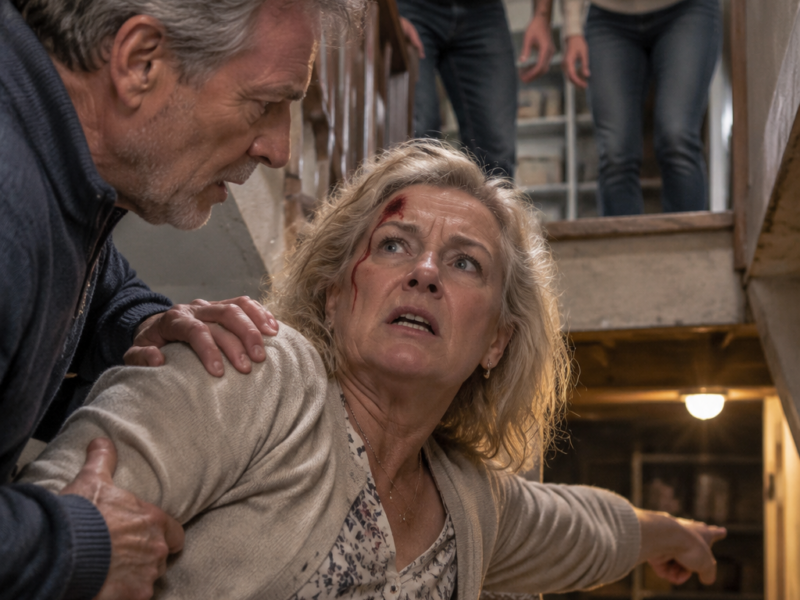
Vera was sitting at the far end of the couch, hunched forward, holding her left wrist against her chest. Her gray hair had come loose from its clip. A dark purple bruise was spreading across her left temple, and the skin around it was already beginning to swell.
She looked nothing like someone who had taken a harmless little spill.
I dropped to one knee in front of her.
“Vera, honey. Look at me.”
Her eyes found mine.
“Are you dizzy? Does your stomach feel sick?”
She shook her head carefully.
“Can you tell me what day it is?”
“Friday,” she whispered. “It’s Friday, Clifton.”
Her lips trembled.
“Please don’t leave me here.”
I took her good hand.
“I’m not going anywhere.”
Across the room, Petra stood gripping the kitchen doorway. She had not moved since I entered.
“Clifton, you must be so worried,” she said in that sweet, polished voice she used whenever she wanted people to believe she was being helpful. “Let me get you some water.”
“I don’t need water. I need to know whether anyone checked her head.”
“I did a full examination. Pupils, grip strength, everything.”
“You did?”
“I took a medical course.”
“What kind of course?”
“Eight hours online. I’m very thorough.”
I looked at Nolan.
“What was your mother doing in the basement?”
His eyes moved briefly toward his wife.
“I asked her to look for an old toolbox.”
“Then why did you tell me she went downstairs for Christmas decorations?”
Petra smiled.
“Your mother likes getting ahead of things. You know how she is.”
I looked back at Vera.
“Come on, honey. Let’s get you checked.”
When I helped her stand, she winced and gripped my sleeve.
Nolan offered to get her purse, but Petra immediately interrupted.
“Let’s not make a fuss over a purse. She’s tired. We can bring it to the hospital later.”
I noticed her eyes drop toward the pocket of Vera’s coat.
It was a brief movement, but something about it bothered me.
Outside, I helped Vera into the passenger seat. Nolan stood beside the open door, watching.
“Remember, Dad,” Petra said quietly. “Mom slipped. That’s all it was. It would be kinder to let her recover peacefully at home.”
“Kindness is a doctor’s opinion, not yours.”
She smiled.
“Of course. Drive safely.”
I reversed down the driveway.
We had barely reached the end of the street when Vera’s hand clamped around my wrist.
“Clifton.”
I turned toward her.
Her face had gone almost completely white.
“The basement,” she whispered. “Our son’s basement. You have to go back.”
“Honey, you need a hospital.”
“Our names are on the wall.”
I looked at her.
“What names?”
“Our names. With our address. Don’t let them move it. Please, hurry.”
I didn’t understand what she meant, but I knew she was frightened.
Then she pressed her hand against her forehead.
“Clifton, everything is spinning.”
I pulled over and immediately called emergency services.
I told the dispatcher my wife was sixty-one years old, had fallen down a flight of concrete stairs, suffered a possible wrist fracture, and was experiencing dizziness after striking her head.
While we waited, I glanced into the rearview mirror.
The side door of Nolan’s garage was open. It led directly down to the basement.
And there was my son, dragging a large gray plastic container across the concrete floor.
He stopped halfway, looked toward the street, and noticed my car.
The moment our eyes met, he shoved the container back through the doorway.
Then he came marching toward me.
“Why did you come back?” he demanded, knocking on my window.
“I called an ambulance.”
“I thought you were taking Mom home.”
“She needs medical attention.”
He leaned closer.
“Did she tell you anything?”
I looked at him carefully.
“She told me her head hurts. Why?”
“Nothing. Just wondering.”
Before he could ask another question, the ambulance arrived.
The paramedics examined Vera, checked her pupils, and carefully stabilized her wrist. One of them explained that she needed a CT scan immediately.
As they prepared to take her to Riverview Medical Center, Vera caught my sleeve.
“Clifton, my purse.”
“Nolan will bring it later.”
“No,” she whispered urgently. “Whatever they give you, it isn’t…”
The paramedic gently encouraged her to let go.
The ambulance doors closed before she could finish.
I turned toward Nolan.
“Show me the basement stairs.”
His expression changed.
“Why?”
“Because your mother fell down them. I want to see what happened.”
“It’s just a staircase.”
“I’ve spent thirty-eight years investigating accidents. A woman falls down concrete stairs and suffers a head injury. I document the scene.”
Petra appeared behind him.
“Clifton, you’re upset. Let Nolan handle this.”
“I’m not upset. I’m curious.”
Nolan hesitated, then reluctantly agreed.
I followed him down fourteen wooden steps.
The bottom tread had fresh gray scratches across its front edge. The marks cut through an older layer of settled dust.
I examined the staircase and the handrail.
“Where exactly did she fall?”
“Right there.”
“Which side?”
“Left, I think.”
“Then why are there drag marks on the step?”
“We moved the washing machine.”
I continued into the basement.
Near a plywood partition, I noticed a newly installed electrical subpanel. It had no inspection sticker.
“Who installed this?”
Nolan rubbed the back of his neck.
“Probably someone who skipped the paperwork.”
“You’re the installer.”
He didn’t answer.
Behind the partition was a small office. Through the partially open door, I could see a metal desk, several filing boxes, and a large whiteboard divided into columns.
I stepped closer.
The third entry contained my own home address.
Underneath it were the words:
CLIFTON DECKER.
Beside my name, underlined twice in red, was another phrase:
FINAL GUARANTOR FUNDING PENDING.
At the bottom of the board was the name Mill Creek Property Services LLC.
My stomach tightened.
“What is this?”
Nolan immediately stepped in front of the doorway and slammed it shut.
“Petra’s building a home repair program.”
“Then why does my name say guarantor?”
“Internal shorthand.”
“A guarantor is someone responsible for a debt when the borrower cannot pay. What debt are you talking about?”
“Nothing, Dad. Please.”
His voice was beginning to shake.
I stared at him.
“Who is Mill Creek Property Services?”
“Just a vendor.”
Before I could ask another question, Petra called from the top of the stairs.
“Nolan, bring him upstairs.”
He looked exhausted.
He picked up a brown leather handbag from the floor and shoved it into my hands.
“Mom’s bag. Take it. Please, Dad. Just go.”
I climbed the stairs with the purse.
At the top, I heard Petra whisper something sharply to him.
“I told you to clear that out before he got here.”
Her voice changed instantly when she noticed me.
“Give Mom our love.”
I walked away without answering.
At the hospital, doctors confirmed that Vera had suffered a concussion and a hairline fracture in her wrist. Thankfully, the CT scan showed no internal bleeding.
The physician asked how she had fallen.
Vera looked directly at him.
“It wasn’t just a fall. Someone else wanted my phone. We both had hold of it.”
She explained that Petra had asked her to retrieve an old toolbox from the basement. When she entered the room behind the plywood partition, she saw a whiteboard covered with addresses, financial figures, and names.
Our names were among them.
She immediately took photographs.
Petra appeared behind her and demanded the phone.
Vera refused.
They struggled over it, and Vera lost her footing on the stairs.
The doctor documented her statement carefully.
Then Vera told me something else.
“My phone was still downstairs. I couldn’t look away from those numbers.”
At 5:06 that afternoon, someone had sent a message from her number to our family group chat.
It read:
Slipped all by myself, so silly. Nolan and Petra are taking wonderful care of me. Please don’t fuss.
At that exact time, Vera had been riding in an ambulance.
Someone had sent that message pretending to be her.
When Nolan and Petra arrived at the hospital with flowers and her phone, Vera checked her photographs.
They were gone.
Even the recently deleted folder had been emptied.
Petra smiled sympathetically.
“A concussion can affect your memory, sweetheart. Maybe you never took those pictures.”
Vera began crying.
I stood up.
“Both of you, get out.”
Nolan tried to reach for his mother’s hand, but Petra pulled him toward the curtain.
After they left, Vera leaned against me.
“They won’t get everything,” she whispered.
She explained that although Petra knew the phone’s passcode, she did not have access to Vera’s private cloud account.
Some of the photographs might still exist.
We contacted Genevieve Alcott, the attorney who had prepared our wills years earlier.
By Saturday evening, she had uncovered something far worse than anything I had imagined.
A mortgage had been recorded against our home on September 16.
The amount was $210,000.
The lender was Crestline Ridge Capital.
The borrower was Mill Creek Property Services LLC.
And my wife and I were listed as guarantors.
Our signatures appeared on the final page.
They were forged.
Genevieve examined them carefully. My signature always began with a closed loop in the letter C. The one on the document stretched outward like a fishhook.
Vera’s signature was equally suspicious.
She had always written the final letter in her name with a distinctive flat line.
The forged version curved upward.
The document claimed that both of us had appeared before a notary named Nadette Pilcher on September 12.
But I had been in Indianapolis attending a regional safety conference.
I had hotel receipts, parking records, and a dated photograph proving my location.
Genevieve explained that Pennsylvania law required the signer to appear personally before a notary.
The mortgage was not simply questionable.
If the signatures were forged, the instrument could be void.
But there was another problem.
The mortgage included a second advance of $150,000 scheduled for October 21.
The lender intended to release that money after receiving verbal confirmation from both supposed guarantors.
Someone was planning to answer those calls pretending to be us.
We decided to cooperate with the lender’s fraud department.
On Monday morning, Vera answered the call from a sealed evidence bag.
The closing officer, Barnett Quill, asked whether she had signed the mortgage.
She answered clearly.
“No. I have never signed a mortgage with Crestline Ridge Capital. I have never heard of Nadette Pilcher.”
I confirmed that I had been in Indianapolis.
Quill immediately placed the loan on fraud hold.
The additional $150,000 would not be released.
Then Detective Regan Varney from Hamilton County Police arrived to collect Vera’s phone.
She arranged for the photographs stored in Vera’s cloud account to be examined.
Three images survived.
The first showed the whiteboard in Nolan’s basement.
The second showed shelves filled with closing documents.
The third showed a paper shredder overflowing with shredded paperwork.
The detective also noticed that the photographs had been taken at Nolan’s residence.
We finally had evidence.
But the situation was about to become much more complicated.
The following morning, my neighbor Alec Norbury approached me with his phone.
Someone had posted an email on the neighborhood social media page.
The message appeared to come from my old work account and was dated November 2020.
It instructed Nolan to use cheaper electrical breakers because nobody would check their ratings.
Below it was another sentence.
This is why Alton Croft is dead. Ask Clifton Decker.
Alton had died in a warehouse fire several years earlier.
The accusation was devastating.
I had spent nearly four decades teaching people to follow safety regulations. Now someone was presenting me as the man responsible for a fatal accident.
I knew the email was fabricated.
Genevieve contacted my former employer.
Their information technology director, Roscoe Gilman, examined the company’s archived records.
There was no email from my account to Nolan’s firm.
Not one.
More importantly, the server listed in the screenshot had been retired in 2019.
It could not possibly have generated a message in November 2020.
The newspaper preparing to publish the accusation withdrew its article after receiving Roscoe’s sworn statement.
But I was still determined to discover who had created the forgery.
That Friday, my old friend Auto Breck arrived at our kitchen table.
He had worked in electrical inspection for decades.
He looked as though he had not slept in days.
In November 2020, Auto had inspected the warehouse where Alton Croft died.
He admitted that he had only examined the front electrical panel.
The rear subpanel, which powered the cold-storage compressors, had never been inspected.
He had signed the report because Nolan told him I had already checked every circuit.
Auto trusted my name.
He also revealed something worse.
Eleven days after the fire, an invoice had arrived at his office showing that Alton Croft had supposedly purchased cheap breakers on December 6.
Alton had died on November 29.
Someone had placed a dead man’s name on the invoice to make him appear responsible for the equipment failure.
The paperwork had come from Nolan’s office.
The initials on its cover sheet were Petra’s.
I felt sick.
Auto had been too frightened to speak earlier because his certification and career were at risk.
But now he was ready to tell the truth.
I asked him to contact the fire marshal.
Then I visited Alton’s widow, Della Croft.
She welcomed me into her small brick house in Cheviot.
Her kitchen still smelled of coffee and pine cleaner.
On the windowsill sat Alton’s old mug.
She had never moved it since his death.
Della showed me his work journal.
Inside were three entries documenting that Alton had repeatedly warned Nolan about the incorrect breakers.
He had specifically requested thirty-amp breakers for the compressor circuit.
He refused to approve the installation until the equipment was replaced.
But someone overruled him.
Della had spent years wondering whether her husband had made a mistake.
Now she finally had proof that he had tried to prevent the disaster.
She gave me the journal to take to the fire marshal.
Before I left, she asked me to bring Nolan to her kitchen someday.
She wanted him to look her in the eyes and tell her the truth.
I promised I would.
Meanwhile, Nolan invited me to a family dinner.
He said everyone wanted to clear the air.
When I arrived, ten relatives were gathered in his living room.
Petra had already prepared them for my arrival.
She produced a letter supposedly written by Vera.
It claimed that my wife was confused, frightened, and unable to remember whether she had agreed to financial arrangements.
The letter was dated October 19.
But on October 19, Vera had been lying in a hospital bed at Riverview Medical Center.
I knew that because I had visited her.
I said nothing.
I had promised Genevieve that I would let the evidence speak for itself.
Then Nolan began accusing me of jealousy.
He claimed I couldn’t accept that he had built a successful company without my help.
I listened until I finally asked him one question.
“Who put my name on a $210,000 mortgage?”
The room went silent.
Petra insisted I was confused.
Tate Ballard, Petra’s cousin, made a comment about dementia running in certain families.
I looked at my son.
“Someone at this table knows who forged those signatures. I will find out, Nolan. I will not stop.”
His face changed.
He grabbed my wrist and dragged me toward the front door.
Petra began shouting that I was attacking him.
Tate raised his phone to record the scene.
Nolan pushed me outside and told me to go home.
I stood on the porch, rubbing my wrist.
Across the street, a gray-haired neighbor had witnessed everything.
Her name was Edna Kohler.
The next morning, I received a temporary protection order.
Petra had accused me of threatening her and attacking Nolan.
Genevieve immediately challenged the petition.
At the hearing, Petra testified that I had raised my fist and frightened everyone in the room.
But Genevieve had a witness.
Edna walked into the courtroom and explained that she had watched Nolan drag me outside.
She had recorded the entire incident from her porch.
The footage showed my arms hanging at my sides throughout the confrontation.
It also showed Nolan gripping my wrist.
The judge dismissed Petra’s petition and vacated the temporary order.
I thought we had finally reached the end of her legal attacks.
I was wrong.
A few days later, another envelope arrived.
This one came from Orphans’ Court.
Petra was requesting full guardianship over Vera.
She claimed my wife was confused, forgetful, disoriented, and incapable of managing her finances.
She wanted authority over Vera’s medical care, bank accounts, living arrangements, and personal decisions.
Nolan had signed a consent form supporting the petition.
I stared at his signature for a long time.
It was the same signature I had watched him practice as a boy.
Vera read the document and began crying.
For thirty years, she had managed insurance claim files. She had once helped expose a fraud ring involving $90,000.
Now someone was telling a judge she couldn’t remember her own wedding date.
Genevieve explained that Petra was attempting to obtain legal authority over Vera.
If she succeeded, a court-appointed guardian might be able to sign documents or make financial decisions on my wife’s behalf.
They didn’t need Vera to lose her mind.
They needed someone else to gain control of her life.
At the first hearing, the judge refused Petra’s request for emergency guardianship.
He ordered an independent capacity evaluation.
Vera volunteered immediately.
She wanted the court to hear directly from her.
On December 4, she stood in the courtroom wearing a brace on her wrist.
The independent neurologist, Dr. Lorette Caswell, testified that Vera had scored 29 out of 30 on the Montreal cognitive assessment.
Her clock drawing was flawless.
Her memory was excellent.
She had even corrected an arithmetic error made by the doctor.
The physician concluded that Vera possessed complete decision-making capacity.
Then Genevieve introduced the hospital records.
They showed that on October 19, Vera had been inside room 412 at Riverview Medical Center.
Yet a document in the notary’s journal claimed that she had appeared in person before Nadette Pilcher at exactly 2:00 that afternoon.
The hospital records showed that Vera had been receiving medical care throughout that period.
She had never left the building.
The notary’s records were fraudulent.
Genevieve also introduced the supposed letter Vera had written to her family.
The judge found serious indications that the documents had been fabricated.
The guardianship petition was dismissed with prejudice.
Vera covered her mouth and began crying.
“Clifton, I’m free.”
I wrapped my arms around her.
“You always were.”
But the detective soon contacted me with another request.
Nolan had called.
She wanted me to cooperate with a recorded conversation.
After receiving the necessary legal authorization, I sat in a small conference room with Detective Varney and Assistant District Attorney Adair Vestal.
Then I called my son.
He answered almost immediately.
“Dad.”
“Hello, Nolan.”
He sounded exhausted.
He asked whether his mother was all right.
I told him she was better than all right.
She had beaten the guardianship petition.
There was a long silence.
Then he admitted that Petra had told him not to attend the hearing.
He said she was afraid his presence would make things worse.
I asked him why he had supported the mortgage.
He began crying.
He admitted that he had told Petra to stop everything back in September.
He had wanted to come to us.
But Petra told him it was already too late.
She said the company would collapse, our house would be lost, and everything would be his fault.
Then someone approached his truck.
He whispered that it was Petra.
Before hanging up, he said he loved me and was sorry.
The detective explained that the conversation established something important.
Nolan knew what was happening.
He had tried to stop it.
But he had eventually chosen to participate.
A few days later, a former employee of Decker Home Renovations contacted us.
Her name was Cecile Moreau.
She had worked as the company’s controller.
She explained that she had discovered four suspicious wire transfers to Mill Creek Property Services totaling nearly $300,000.
None corresponded to legitimate work.
She had questioned Nolan three times.
Petra dismissed her concerns.
In August, Cecile was fired.
She had kept copies of her own emails and brought them to the detective.
Her information helped establish that Mill Creek was part of a larger financial scheme.
On December 16, Barnett Quill arrived at Detective Varney’s office carrying a large box of documents.
He revealed that Mill Creek had obtained financing through seven separate properties.
Seven families had unknowingly become guarantors for the same fraudulent company.
The plan was simple.
Mill Creek borrowed money against the homes.
The company would stop making payments.
Crestline Ridge would eventually have the right to foreclose on the properties.
The seven families could lose their houses while the money disappeared into shell companies.
One account, Sycamore Key Advisory LLC, had received the first $60,000 advance.
Forty-one thousand dollars remained frozen.
But the most disturbing discovery was a list of future travel arrangements.
Two one-way tickets had been purchased for March 14.
One was booked under Petra’s maiden name.
The other belonged to Tate Ballard.
She was planning to leave the country.
Before that, however, we discovered that one of the other targeted families was our church friend Odessa Finley and her husband, Bertram.
They were in their seventies and had lived in their home for forty-one years.
Vera had introduced them to Petra during a church supper.
Petra had presented her supposed senior home-repair assistance program as a generous service.
Odessa and Bertram believed they were signing a simple form for a free roof inspection.
Instead, their property had been pledged as collateral.
Worse, someone had diverted their mail so they never received the foreclosure notices.
A sheriff’s sale was scheduled for January 6.
Genevieve immediately filed an emergency motion.
Postal records revealed that a fraudulent change-of-address request had been submitted under Odessa’s name.
The court opened the judgment and stopped the sale.
Odessa collapsed into Vera’s arms, crying with relief.
That evening, we celebrated around their kitchen table with tea and peach cobbler.
But the happiness didn’t last long.
Bertram suddenly experienced severe chest pain.
I rushed him to Riverview Medical Center.
Doctors discovered a ninety-percent blockage and placed a stent.
While we waited for news, my phone rang.
It was Vera.
“Clifton, there’s someone in the house.”
She had heard the basement door open.
She had locked herself in our bedroom and called emergency services.
I told her to stay where she was.
Then I drove home as fast as I could.
Police officers arrived before me.
Vera was standing in the doorway wearing my wool coat, holding a heavy doorstop.
She was shaking.
I wrapped both arms around her.
She kept repeating that she was all right.
The officers searched the house.
Nothing had been stolen from upstairs.
But downstairs, someone had pulled open my steel filing cabinet and scattered documents across the floor.
A folder containing Vera’s medical records was missing.
The detective examined the rear door.
There were no signs of forced entry.
Someone had used a key.
I remembered the three people who had access.
Vera.
Me.
And Nolan.
Under the rear doormat, officers discovered a receipt from a mailbox rental service in Norwood.
The name on it was Tate Ballard.
The following morning, Detective Varney confirmed that Ballard had a criminal history involving home-improvement fraud.
He had also missed two probation appointments.
Police located him at a motel in Mason.
During questioning, Ballard admitted that Petra had given him a key to our house.
She had instructed him to enter while we were away and retrieve a folder containing Vera’s hospital records.
He had expected the house to be empty.
When he heard a woman upstairs, he panicked and escaped.
He also admitted that he had been responsible for diverting Odessa’s mail.
Petra had paid him to collect the court documents and deliver them to her.
He described a storage unit belonging to Mill Creek Property Services.
It was located off Beachmont Avenue, unit 118.
Inside, according to Ballard, were dozens of plastic containers filled with paperwork.
There was also a brown leather handbag.
A handbag with a little metal leaf hanging from its zipper.
Vera went completely still.
“That’s mine.”
The bag Nolan had given me at the house that first evening was not hers.
Petra had taken the real one.
Vera then revealed something she had kept hidden since October 18.
Before Petra seized her phone, she had slipped a folded piece of paper inside the lining of the handbag.
She had sewn the seam closed with blue thread.
The paper contained something written in Nolan’s handwriting.
Two lines.
She had never told me because she couldn’t bring herself to believe what they meant.
On January 11, Detective Varney invited us to the county crime laboratory after the search warrant had been executed.
The real handbag had been recovered from the storage unit.
A technician examined the lining and found the blue stitching.
He carefully opened the seam.
Inside was a small folded sheet of paper.
The first line read:
“Petra, stop. That’s Mom and Dad’s house.”
Below it, in heavier handwriting, was another sentence:
“If Dad asks, say Mom brought the papers and agreed to it.”
I read those words twice.
My knees nearly gave way.
Vera was crying.
She explained that she had discovered the paper in Nolan’s truck the previous September.
At first, she had read the first line and believed her son was trying to protect us.
Then she saw the second.
He had known.
He had recognized our address on the list.
He had told Petra to stop.
But he had also written down how to blame his mother if anyone asked questions.
For the first time, I understood that Nolan had not simply been manipulated by his wife.
He had made choices.
Some of them had been terrible.
Two weeks later, on February 22, a gray pickup stopped outside our house.
Nolan climbed out carrying a Manila envelope.
He looked thinner than I remembered.
His eyes were red.
“Dad, can I come up?”
“You can stand there and tell me why you’re here.”
He explained that his attorney had prepared a statement.
It claimed that Vera and I had discussed using our home as collateral for a business loan in August.
He wanted me to sign it.
He said it might help his case.
I looked at him.
“You came here to ask me to lie.”
“Not lie. Just say we had a conversation.”
“We never had that conversation.”
He began crying.
Then I told him about the paper hidden inside his mother’s handbag.
His face lost all color.
He sat down hard on the bottom step.
Vera came outside.
“Nolan, did you write those words?”
He nodded.
“Yes, Mom. I wrote them.”
He admitted that Petra had told him the company would collapse if he didn’t cooperate.
He had convinced himself that we would never actually lose our house.
But he knew the paperwork was wrong.
He knew the signatures were not ours.
He had also known about the plan to blame Vera.
Vera cried openly.
“I carried you for nine months. You could have asked me for help. I would have done anything for you.”
“I know, Mom.”
He covered his face.
“That’s the worst part.”
I knelt in front of him.
“I won’t sign that statement. I won’t call a lie the truth, even for you. But I will sit behind you in court. I made that promise, and I’ll keep it.”
Then I gave him one final opportunity.
“Go to Detective Varney. Tell her everything.”
He hesitated.
Then he admitted that Petra planned to leave on March 14.
She had told him she would send for him after reaching Panama.
He finally understood that she had never intended to take him with her.
He agreed to cooperate.
Over the following weeks, Nolan attended three meetings with Petra wearing a recording device. The district attorney authorized each recording beforehand.
Investigators gathered evidence of her plans, her instructions, and her intention to abandon everyone once the money was secured.
Then March 14 arrived.
At 7:49 that morning, Vera’s phone rang.
Detective Varney was calling from the airport.
“Petra Decker has been taken into custody.”
She had been arrested at the ticket counter at Cincinnati Northern Kentucky International Airport while preparing to board a flight to Panama City.
Two suitcases stood beside her.
Her boarding pass was for the 9:55 departure.
The seat beside hers was empty.
Tate Ballard had already been arrested.
Petra had apparently intended to leave him behind as well.
The charges included identity theft, tampering with records, theft by deception, conspiracy, and burglary.
Federal prosecutors were also preparing wire-fraud charges.
The detective explained that the recordings had sealed the case.
During the final meeting, Petra had laughed about how everyone would be too busy sorting out paperwork to notice her departure.
She had also discussed how she intended to avoid being followed.
Nolan had walked into the district attorney’s office with his attorney that same morning.
He was ready to confess.
When Detective Varney told us, she added one message.
Nolan wanted his mother to know he was sorry she had waited so long to hear the truth from him.
Vera lowered her head onto the kitchen table.
I held her while she cried.
It wasn’t the crying of someone who had won.
It was the crying of a mother who had finally heard her son tell the truth, even though that truth had come at an unbearable cost.
The investigation continued for several months.
Nanette Pilcher, the notary, contacted her own attorney and eventually agreed to testify.
She admitted that Petra had paid her $500 for each fraudulent document.
Seven documents.
Seven families.
Norbert Hecht, the loan officer who had altered the contact information on our mortgage application, also cooperated. Petra had paid him $8,000 to change two phone numbers and avoid scrutiny.
By summer, a judge declared all seven fraudulent mortgages void.
The Finleys received their home back.
The other families were protected.
The church organized a crew to replace the roof on Odessa and Bertram’s house.
Bertram supervised from a lawn chair, a recently placed heart stent and a plate of peach cobbler keeping him company.
In August, Petra pleaded guilty to every count rather than allow the recordings to be played in open court.
The judge sentenced her to nine to twenty years in state prison.
She never once turned around to look at us.
Nolan pleaded guilty to conspiracy and tampering.
Because he had cooperated with investigators, his sentence was eleven and a half to twenty-three months in county jail, followed by probation.
I kept my promise.
I sat directly behind him when the sentence was announced.
His shoulders jerked when he heard the number.
Vera reached forward and placed her hand against his back.
In the hallway afterward, he turned toward us.
“Eleven months. I can do eleven months.”
“You’ll write to me every Sunday,” Vera said.
Then she pulled his face down and kissed his forehead.
“Every Sunday, Nolan. Do you hear me?”
“I hear you, Mom.”
There was still one final matter to settle.
The fire marshal’s investigation into Alton Croft’s death had continued throughout the year.
In October, Della called me.
Her voice was breaking as she read the findings.
The fire had been caused by an overloaded compressor circuit protected by underrated breakers.
The investigation confirmed that the purchasing invoice had been created after the fire and falsely attributed to Alton.
It also confirmed that Alton had warned Nolan about the substitution three separate times.
He had been overruled.
For four years, his widow had carried the belief that her husband might somehow have been responsible for the tragedy.
Now the official report cleared his name.
Della told me she had never heard anyone put Alton’s name into a sentence and get it right until that day.
I promised her I would bring Nolan to her house.
On Saturday, October 4, I drove my son to Cheviot.
He sat quietly in the passenger seat, his hands folded in his lap.
“Dad, I don’t know what I’m going to say.”
“Then don’t plan it. Just be honest.”
“She’ll hate me.”
“She buried her husband. You don’t get to decide how she feels. All you can do is stand there and tell her the truth.”
Della opened the door before we had a chance to knock.
Her silver braid rested over one shoulder.
Her eyes were red.
Nolan stepped forward.
“Mrs. Croft, I’m the one who shook your hand at the funeral. I know who you are. I told you Alton was a skilled electrician and that his death was a terrible accident.”
His voice broke.
“But I knew whose name was on that invoice. I stood there and let you thank me.”
Tears ran down his face.
“I also told the inspector my father had checked every circuit himself. He hadn’t. I used Dad’s name because I knew Otto would believe it. I’m sorry. I don’t have a better word.”
Della studied him for a long moment.
Then she said something I will never forget.
“Thank you for coming here, Nolan. No one in your family ever did.”
She stepped aside and opened the door.
“Come in. I’ll put on coffee.”
I followed them into the kitchen.
The smell was exactly as I remembered.
Coffee, pine cleaner, old wood, and something warm coming from the stove.
Alton’s mug still sat upside down on its saucer on the windowsill.
Della reached over, turned it right side up, and filled it.
I stood there watching my son sit across from the widow of a man whose death he had helped conceal.
There was no applause.
No dramatic speech.
No sudden forgiveness.
Just three people in a quiet kitchen, trying to live with what had happened.
And perhaps that was the most honest ending we could have hoped for.
For a long time, I believed the worst thing that could happen to a family was losing its home.
I was wrong.
A home can be rebuilt. A mortgage can be challenged. A forged document can be exposed. Even a reputation can sometimes be restored.
But trust is different.
Trust is built over years and can disappear in a single moment.
What happened to Vera and me changed our marriage, our relationship with our son, and the way we looked at people we had once welcomed into our home.
There are things a marriage survives and things it barely survives.
Watching your child choose the wrong side is a special kind of grief. Watching that same child finally acknowledge what he has done is another kind of pain altogether.
I still love Nolan.
I don’t know if that will ever change.
But loving someone doesn’t mean protecting them from the consequences of their decisions.
Sometimes love means refusing to sign the paper they place in front of you.
Sometimes it means telling them no when every part of your heart wants to say yes.
And sometimes it means sitting behind them in a courtroom, even when they have given you every reason to walk away.
If there is one thing I learned through all of this, it is that documentation matters.
Write down dates, names, conversations, and important events while they are still fresh.
Never sign anything under pressure, even if the person asking is someone you love.
Never let someone convince you that asking for an attorney means you don’t trust your family.
And when someone you love tells you that something is wrong, listen before explaining it away.
Vera saw the warning signs before I did.
I was the one who needed time to understand what was happening.
I had spent my career identifying dangerous situations in workplaces, but I never imagined I would need those same instincts inside my own son’s home.
I learned that a person’s greatest danger doesn’t always come from a stranger.
Sometimes it comes from someone who knows where you keep your spare keys, where you store your paperwork, and exactly how much you trust them.
But I also learned something else.
The truth can take a long time to arrive.
It can come through a photograph, a forgotten receipt, a witness who finally finds the courage to speak, or two handwritten sentences hidden inside an old handbag.
It can arrive in a courtroom after months of fear and uncertainty.
And when it finally arrives, it can give people back things they thought they had lost forever.
For Della, it gave her husband’s name back.
For the Finleys, it gave them their home.
For Vera, it gave her independence.
For Nolan, it gave him one final chance to tell the truth.
And for me, it gave me the opportunity to understand that standing beside someone does not mean standing behind every decision they make.
Sometimes the hardest kind of love is the only kind that can reach someone before they lose themselves completely.
I still think about that afternoon when Nolan called and told me his mother had taken a little spill.
I remember the sound of his voice.
I remember the bruising on Vera’s face.
I remember the strange whiteboard in the basement and the words written beside our address.
And I remember the moment my wife grabbed my wrist in the car and whispered that we had to go back.
If I had ignored her, if I had taken her straight home and accepted Nolan’s explanation, I don’t know how much more they would have taken from us.
Maybe the house.
Maybe our savings.
Maybe our freedom.
Perhaps all three.
I am grateful I listened.
I am grateful Vera found the courage to take those photographs.
And I am grateful that when the truth became too heavy for one person to carry, other people finally stepped forward.
Auto told the truth despite the cost to his career.
Cecile came forward despite the fear of retaliation.
Edna shared the footage even though it meant standing against a family she had known for years.
Barnett Quill made the phone call that stopped the second advance.
And Genevieve Alcott refused to let us fight alone.
None of them could undo what had happened.
But each of them helped prevent something worse.
Today, Vera and I still live in the same house.
The storm door I was repairing that afternoon still swings a little crookedly when the wind catches it.
Sometimes I think about fixing it.
Then I remember how that small repair was interrupted by a phone call that changed everything.
Vera keeps her handbag close now.
The little metal leaf still hangs from its zipper.
Every time I see it, I remember the photographs, the missing purse, the blue thread, and the two lines Nolan wrote when he still had an opportunity to make the right choice.
I also remember the day he finally stood in front of Della and admitted what he had done.
There is no perfect ending to a story like ours.
There is only the decision to keep moving forward, to tell the truth, and to protect the people who still trust you.
And if I could leave anyone with one thought, it would be this:
Never mistake silence for peace.
Sometimes the person who asks you not to make a fuss is the very person who knows exactly why you should.
Take care of your family.
Listen when something feels wrong.
And never be afraid to ask the questions that someone else desperately hopes you will never ask.
THE END









