My Son’s Deaf Housekeeper Signed Three Words Across The Dinner Table—Ten Minutes Later, I Knew Why
My Son’s Deaf Housekeeper Signed Three Words Across The Dinner Table—Ten Minutes Later, I Knew Why
The first thing I noticed that evening was that my daughter-in-law had stopped pretending to like me.
It was a small thing, really. A change in the way she spoke, a slight tightening around her mouth, a coldness that slipped through the polished manners she had maintained for nearly twenty years. But after seventy-one years of living, I had learned that the smallest changes often revealed the largest truths. In engineering, a bridge rarely collapses without warning. Before the steel gives way, something shifts. A bolt loosens. A joint begins to vibrate. A hairline fracture appears where everything once seemed perfectly solid.
People are no different.
My name is Ambrose Holloway, and for forty years I made a living designing bridges. I built structures meant to carry thousands of tons, withstand violent winds, survive freezing winters, and remain standing long after the men who designed them were gone. I understood weight, pressure, stress, and failure better than most people understood their own families.
What I never imagined was that one day I would need every bit of that knowledge to survive an attempt on my life orchestrated by the people sitting closest to me.
It began with a phone call.
“Use the back entrance,” Lavinia said.
I was standing in my kitchen, holding the telephone against my ear, looking through the window at the pine trees beyond my property.
“The back entrance?” I repeated.
“Yes. The front door will be open because we’re expecting guests, and I don’t want you wandering around where everyone can see you arriving.”
There was a brief silence.
Then she added, “I don’t want to frighten the staff.”
I looked down at the telephone and almost laughed.
I was seventy-one years old. I had designed bridges across rivers, supervised construction projects worth millions, and spent most of my adult life earning the respect of people who knew how difficult my profession was. Yet my son’s wife was instructing me to enter her home like an unwanted delivery driver.
“Of course, Lavinia,” I replied. “Wouldn’t want to frighten anyone.”
She gave a short laugh.
“Six-thirty, Ambrose. Don’t be late.”
She hung up before I could answer.
I stood there for several minutes, listening to the refrigerator hum in the kitchen. The house was quiet. My wife, Mary, had been gone for years, and my son, Leland, had gradually become a stranger who occasionally remembered that he had a father.
Still, I had hoped things might improve.
Perhaps that was foolish. Perhaps an old man’s greatest weakness is the belief that people he loves will eventually remember how to love him back.
But I had more important things to think about that afternoon.
Thirty-one days earlier, my old friend Walt Brindle had called me with a question.
Walt had sold me my first homeowner’s insurance policy decades ago. We had played golf together for years, and he was one of the few people I trusted without needing to examine his calculations.
“Ambrose, did you recently apply for a three-million-dollar life insurance policy?”
I had laughed.
“At my age? What would I need three million dollars for?”
“I’m serious.”
Something in his voice made me stop smiling.
He explained that an application had been submitted under my name. There was also a medical records authorization carrying what appeared to be my signature. Someone had signed the documents electronically using an iPad.
I had signed neither.
The agent who submitted the application was relatively new, barely eleven weeks into the profession. He had apparently processed everything without asking too many questions.
Walt was uncomfortable.
I was more than uncomfortable.
I knew enough about insurance to understand what a three-million-dollar accidental death policy could mean to the wrong person. Someone had taken the time to arrange a substantial financial benefit payable after my death. Someone had also forged my medical authorization to make the paperwork appear legitimate.
I thanked Walt, ended the call, and spent the next several hours investigating.
Three days later, I visited my attorney.
I changed my will.
Every dollar of my estate, including my savings, investments, and property, would go to medical research. Specifically, I directed the money toward organizations working on heart disease.
It was not an impulsive decision. My wife had once received excellent treatment from a cardiologist who fought desperately to save her life. Although she eventually died from another illness, I had never forgotten the people who had given us additional years together.
I wanted my money to help someone else receive that same chance.
If somebody was planning to murder me for the insurance money, they would discover that my estate was not going to become their inheritance either.
But I was not finished.
That evening, sitting alone in my study, I began doing what engineers do when confronted with a structure that might fail.
I examined the load.
I identified the weak points.
And I began designing a response.
At four that afternoon, I called the only man I trusted completely.
“Amos,” I said when he answered, “I need you at Miller’s turnout tonight.”
Amos Ridley had driven for me for eleven years before his knees finally forced him into retirement. He was older than most people thought, stubborn as a mule, and possessed the rare ability to understand what I meant even when I deliberately avoided saying it.
“What time?”
“Eight o’clock. Engine running. Bring your thermos.”
A pause.
“Family dinner?”
“The family dinner.”
He sighed.
“All right, Ambrose.”
He didn’t ask anything else.
That was Amos.
At six-thirty, I drove toward Blackwood Pass.
My son’s house stood on a rocky ridge overlooking the valley. It was an expensive modern structure made almost entirely of glass and pale stone. The sort of house people purchased when they wanted the world to know they had succeeded.
I had helped Leland buy it. I had even installed much of its original smart-home system because he had complained that the technology was too complicated.
Back then, he had still called me whenever something stopped working.
Now, I could barely get him to return a telephone call.
The fog was beginning to gather along the ridge when I pulled into the driveway.
Lavinia opened the door before I could knock.
She wore a blood-red dress, expensive earrings, and a smile that looked as though it had been carefully rehearsed.
“Ambrose. You came.”
“Lavinia.”
I leaned forward to greet her, but she turned slightly, leaving me kissing empty air.
“The back entrance was locked,” I said.
“Unfortunately, yes.”
Her expression suggested that the inconvenience was somehow my fault.
“Well, I suppose I’ll have to survive the front entrance.”
She ignored the remark.
Inside, the living room smelled of expensive candles and polished wood. A man stood beside the fireplace holding a glass of wine.
He was somewhere in his forties, with silver beginning to show at his temples. His suit fitted perfectly, and his watch caught the firelight whenever he moved his hand.
“Barrett Gentry,” he introduced himself.
“Ambrose Holloway.”
“Leland speaks very highly of you.”
“Does he?”
Barrett smiled.
“I’m sure he does.”
Something about the man bothered me immediately.
It wasn’t his clothes or his confidence. It was his watch.
I had spent enough time around expensive equipment to recognize a fake. A genuine Rolex had a particular movement. The second hand swept smoothly across the dial.
Barrett’s watch ticked.
One second. Another. Another.
A cheap quartz movement hidden inside an expensive-looking case.
I said nothing, but I remembered it.
Leland came downstairs moments later.
“Dad!”
He smiled broadly and hurried toward me.
For a brief moment, I saw the boy I remembered. The little boy who had once run down the driveway to greet me after work.
Then the moment disappeared.
He was forty years old now, wearing an expensive shirt and looking exhausted.
“Bourbon? Wine?”
“Bourbon. Neat.”
He poured my drink. His hands shook slightly, and the bottle struck the edge of the glass.
I watched him carefully.
“How’s work, son?”
“Busy. Very busy.”
He laughed too loudly.
“End of quarter. You know how it is.”
Lavinia interrupted.
“Dinner is ready.”
We moved into the dining room.
The table was beautifully arranged. White roses stood in a crystal vase, candles illuminated the expensive china, and a young woman in a black serving uniform was quietly arranging the water glasses.
She looked about twenty.
Her dark hair was pulled tightly behind her head, and her expression was unusually serious.
When I sat down, I noticed that she looked at me twice.
Then again.
Her name, I would later learn, was Maren Ashby.
She was deaf.
Nobody at that table knew that I understood sign language.
Thirty years earlier, I had volunteered at a community center where I met several deaf children and their families. One little girl had become particularly close to me. Her father worked with a construction company, and I often helped her with mathematics.
I learned sign language because I wanted to communicate with her without forcing her to depend on someone else.
I had not used it regularly in years, but I remembered enough.
When Maren approached to refill my water glass, I instinctively brushed two fingers along the edge of the table, an old gesture I had used countless times.
Her entire body froze.
For one brief moment, she stared at me.
Then she lowered her eyes and walked away.
I knew immediately that she had recognized something.
I simply didn’t know what.
The first course was butternut squash soup.
Lavinia spent most of the meal discussing a property development project. Barrett occasionally interrupted with impressive-sounding financial terminology, while Leland kept refilling his wineglass.
Then Lavinia accidentally knocked her soup bowl.
A wave of hot liquid spilled across my right hand.
I hissed in pain.
“Oh, Ambrose! I’m terribly sorry!”
She jumped up with a napkin and began dabbing at my skin.
But her eyes weren’t examining the burn.
They were examining my wrist.
My sleeve.
My chest.
She was checking whether I was wearing a recording device.
I understood then that her concern was an act.
“It’s just soup,” I said, gently stopping her hand. “I’ll survive.”
She sat down again.
Leland stared at his plate.
Maren appeared with ice water and a clean napkin. As she leaned toward me, I noticed her fingers trembling.
I looked at her.
She looked back.
There was something urgent in her eyes.
Something she desperately wanted to communicate.
Before either of us could do anything, Lavinia spoke.
“You know what I appreciate about Maren?”
She swirled her wine.
“I specifically requested someone discreet. Someone who wouldn’t repeat private conversations.”
Barrett smiled.
“Discreet?”
“Of course. She can’t hear anything we say.”
Lavinia glanced toward the young woman.
“I can discuss business, personal matters, anything. It’s like having furniture that pours wine.”
Barrett laughed.
Leland joined him with an uncomfortable chuckle.
I put down my spoon.
“That’s an interesting way to describe another human being.”
Lavinia tilted her head.
“Oh, don’t be sensitive, Ambrose. It’s simply practical.”
“Kindness is practical, too,” I replied.
Her smile remained, but her eyes hardened.
Barrett called Maren over.
“Come here, sweetheart.”
She approached slowly.
“Where are you from?”
Maren looked toward Lavinia.
“The agency places girls from all over,” my daughter-in-law answered for her.
Barrett laughed.
“Does she always let other people speak for her?”
Maren took a small notepad from her apron and wrote two words.
Doesn’t matter.
Barrett laughed again.
“Feisty.”
Then he leaned closer.
“Can you hear anything at all?”
She shook her head.
“Are you sure?”
Her expression tightened.
I felt my fingers close around my wineglass.
“Barrett.”
He looked at me.
“Yes?”
“She’s a twenty-year-old woman doing her job. You don’t need to interrogate her.”
He raised his glass.
“Spoken like a man with nothing to hide.”
Before I could respond, a large man appeared in the doorway.
He was broad-shouldered, heavy around the middle, and wore a black polo shirt with a security badge attached to it.
His name was Grady Ketchum.
Lavinia introduced him as the family’s security manager.
“Former military,” she explained proudly.
“Which branch?” I asked.
“Oh, I don’t remember. Army, Marines. Something like that.”
Grady gave me a brief nod.
His hands were too soft for a man who had spent years in military service. His posture was closer to that of a nightclub bouncer than a trained soldier.
I remembered his face.
Then the main course arrived.
Herb-crusted lamb, roasted vegetables, and a bottle of expensive Cabernet.
Maren poured water around the table.
Leland was sweating.
Barrett spoke about a property development outside Reno, and I asked him a few questions about the engineering firm involved.
He hesitated.
I mentioned Meridian Crossing, a development I had reviewed years earlier.
The project had never been completed because its developer went bankrupt.
Barrett’s smile tightened.
“Good memory, Ambrose.”
“Engineers remember things,” I said. “Especially structures that collapse.”
Lavinia put down her glass.
“Must you interrogate our guest?”
“Just making conversation.”
Under the table, Leland’s knee bounced nervously.
Then Lavinia reached for the wine.
“Maren, open the special bottle.”
The young woman froze.
She went to the sideboard and returned with a dark bottle of 2016 Cabernet.
She poured it into my glass.
The liquid looked unusually thick.
I raised it to my nose.
Beneath the smell of oak and black cherry, there was something sharp and chemical.
I took the smallest possible sip.
Within seconds, my tongue began to feel numb.
The edges of the candlelight blurred.
Someone had drugged the wine.
I looked at Lavinia.
She was watching me.
“Lovely, isn’t it?” she asked.
“Very special.”
“Drink up, Dad.”
I smiled.
Then I deliberately knocked the glass over.
The wine spilled across the white tablecloth and soaked my trousers.
Leland jumped up, knocking his own water glass over as he rushed to help me.
Under cover of the commotion, I spat the wine into my napkin.
Lavinia watched me closely.
“Let me pour you another.”
She took the bottle herself.
A fresh glass appeared in front of me.
I lifted it, pretended to drink deeply, and used another distraction to empty its contents into the napkin.
Then I leaned back.
My head dropped.
My breathing became slow.
“Good wine,” I muttered.
Barrett laughed.
“To Ambrose, the life of the party.”
Lavinia smiled.
But she wasn’t satisfied.
She suddenly leaned forward and slapped me across the face.
The sound echoed through the dining room.
Maren gasped.
Leland made a small, frightened noise.
“Dad?” Lavinia asked sweetly. “Are you all right?”
I allowed my head to fall forward.
“Don’t feel so good.”
She leaned toward me.
“Do you remember the insurance papers you signed last month?”
I let my words become confused.
“Insurance? Papers?”
Then I began snoring.
She sat back, satisfied.
I kept my eyes almost closed and listened.
“He’s out,” Barrett said.
Lavinia’s voice came from the kitchen doorway.
“Wasn’t that easy?”
Leland spoke quietly.
“You didn’t have to hit him.”
“I had to be certain.”
Then came the words that nearly destroyed whatever remained of my love for my son.
Leland had taken out his phone.
I watched his thumbs move across the screen.
He was searching for the time it took sleeping pills to work.
Then he searched for how long an insurance payout took after death.
My own son was calculating how soon he could collect money after I died.
I wanted to stand up.
I wanted to grab him by the collar and demand an explanation.
Instead, I remained perfectly still.
The dead, I was beginning to understand, could hear things the living never expected them to hear.
Maren returned to the dining room.
As she cleared my plate, she quietly showed me her phone.
A recording application was open.
The transcription displayed the words she had captured through the pantry wall.
Lavinia’s voice was unmistakable.
“Cut the brake lines. The three million will save us all.”
Then Grady’s voice.
“When do I get paid?”
“You’ll have your advance in forty-eight hours. I swear.”
“Make it look like the road did it.”
“The fog will do the rest. Now go before he wakes up.”
I read the words twice.
The recording was almost three minutes long.
Maren had captured the murder order.
I looked at her.
She looked at me.
Under the table, I gently touched her hand and signed two words.
Thank you.
She nodded.
Then Lavinia returned.
“Dessert!”
Chocolate tort with raspberry sauce arrived.
Maren placed a plate in front of me.
She did not immediately walk away.
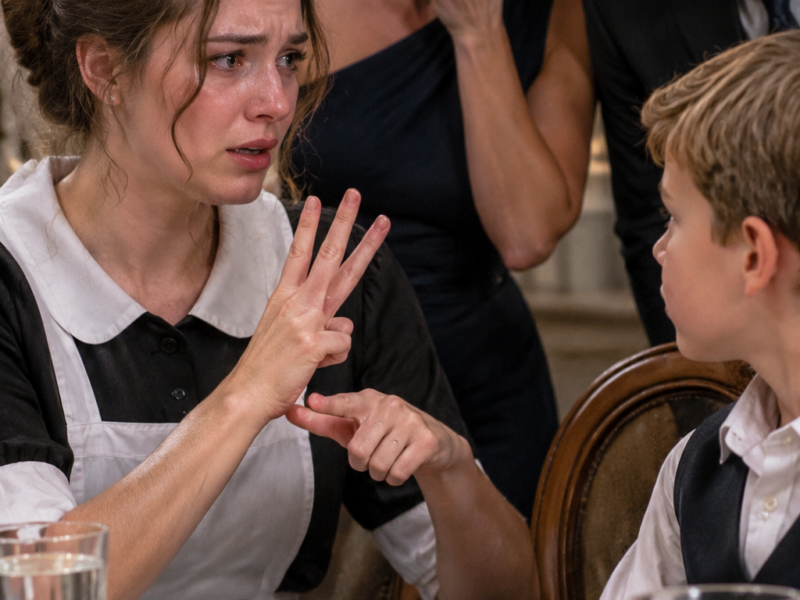
Her hands moved beneath the edge of the tray.
Three words.
They cut brakes.
My blood turned cold.
I had already suspected it, but seeing those words signed directly to me made everything real.
Grady had cut the brake lines.
My SUV was waiting in the garage.
And the road home ran along a mountain pass with a three-hundred-meter drop.
I let my fork fall against the plate.
The noise made everyone look toward me.
“Dad?”
Leland leaned forward.
I clutched my stomach.
“My stomach,” I groaned. “Something’s wrong.”
Lavinia’s expression changed.
She wanted me out of the house.
Immediately.
Leland helped me stand.
Barrett walked ahead with a flashlight, and Maren brought my coat.
At the front door, Lavinia placed one hand on my cheek.
“Drive carefully on the pass, Dad. The fog is terribly thick tonight.”
Her eyes told a different story.
She was waiting for something.
I shuffled outside.
Leland supported my arm.
When we were briefly alone, he whispered, “Dad, I’m sorry.”
I looked at him through half-closed eyes.
“Take care of yourself, son.”
He began crying.
But he did not stop me.
I walked toward the garage.
The fog swallowed the driveway, and the house behind me glowed warmly through the darkness.
My SUV stood in the middle of the garage.
I knew every inch of that vehicle. I had maintained it myself for ten years.
I switched on my phone flashlight and crouched beside the front wheel.
There it was.
A dark puddle beneath the engine compartment.
Brake fluid.
I followed the line with my fingers and found the cut.
Clean.
Diagonal.
Fresh.
Someone had used proper cutting tools.
I photographed it.
Then I noticed the oily footprints leading toward the side door.
Large work boots.
Size twelve, perhaps.
The outer edge of the right heel was worn down.
Grady.
In the corner, Cooper, the family’s elderly golden retriever, was sleeping peacefully.
The dog didn’t bark.
He knew the person who had entered the garage.
I was still examining the damage when a voice came from behind me.
“Find what you’re looking for?”
Grady stood in the doorway.
A cigarette glowed between his fingers.
I straightened slowly, pretending to be confused.
“Just looking for my keys.”
He glanced at my hand.
“They’re already in your hand, old man.”
I laughed foolishly.
He stepped closer.
“Fog’s bad tonight. You shouldn’t drive.”
“Got to get home.”
“Your boy worries about you.”
He nodded toward the SUV.
“Get in. I’ll watch you off the property.”
I understood the arrangement.
He wanted to watch me drive away.
He wanted to see the vehicle disappear into the fog.
And he wanted to make certain I never returned.
I climbed into the SUV.
The engine started normally.
I looked toward the road.
At the first bend, near the rock outcrop, I saw a cigarette ember glowing in the darkness.
Someone was waiting there.
The main road was exactly where they expected me to go.
I had another route.
Behind the garage, an old fire trail descended through the trees. The county had closed it years earlier after a washout, but local residents still used it.
I turned the wheel.
The SUV jolted onto the rough track.
My service brakes were gone, but I still had the parking brake and the engine’s lower gears.
I drove slowly, carefully, using the electronic parking brake to control the descent.
My night vision was poor, which was why Amos had agreed to wait at Miller’s turnout.
I had already planned for that.
After several minutes, I saw his truck between the trees.
The headlights were off.
The engine was running.
Amos stood beside it holding a thermos.
When he saw me, his face changed.
“Jesus Christ, Ambrose.”
“Later,” I said. “We have six minutes.”
He looked at the wine stains on my trousers and the red mark across my cheek.
“What did they do?”
I explained quickly.
The drugged wine.
The cut brake line.
Grady.
The man waiting near the outcrop.
Amos listened without interrupting.
Then he nodded.
“What do we do?”
“We give them what they expect.”
We worked quickly.
I placed a heavy brick against the accelerator and arranged the seatbelt behind the empty driver’s seat.
The old phone I had kept in the glove compartment would continue transmitting its location.
Amos checked everything twice.
Then we stepped away.
The SUV began rolling toward the edge of the old trail.
Its headlights swept across the fog.
For several seconds, I watched the vehicle I had owned for ten years move toward its destruction.
I remembered Mary sitting beside me on long road trips.
I remembered the day we bought it.
I remembered how she used to complain about the music I played.
Then the vehicle reached the broken edge.
The ground gave way.
The SUV plunged into the darkness.
It struck the rocks below, tumbling through the ravine.
Amos and I watched from the trees.
Several minutes passed.
Then an enormous flash illuminated the fog.
The vehicle had caught fire.
Orange flames climbed through the darkness, lighting the rock face.
I stood silently.
My car was gone.
But I was alive.
Down on the main road, Grady’s truck appeared.
He drove to the turnout, climbed out, and walked toward the edge.
I watched him stand there, looking down at the burning wreck.
Then he took out his phone.
“It’s done,” he said.
A pause.
“Yeah. All the way down. Fire and everything.”
He laughed.
Then he lit another cigarette and drove away.
Amos looked at me.
“Who was he calling?”
I didn’t need to answer.
We both knew.
Lavinia.
We drove to Amos’s house by the longer service road.
The following morning, the news announced that my SUV had plunged approximately three hundred meters down Blackwood Pass.
The vehicle had caught fire.
The driver had been tentatively identified as Ambrose Holloway, seventy-one, retired engineer.
My son and daughter-in-law were listed as the surviving family members.
Amos muted the television.
“Well,” he said, “you’re famous.”
I stood in his kitchen, wrapped in an old blanket.
The world believed I was dead.
And for the first time in my life, I was going to let it believe whatever I wanted.
I had spent forty years building bridges.
Now I would build a trap.
The house was talking, and I was listening.
Two years earlier, Leland had asked me to install a smart-home system in his property. I had configured the security cameras, speakers, thermostat, and several other connected devices.
He had never revoked my administrator access.
I opened the application on my phone and began examining the system.
Every device appeared online.
The living room speaker.
The hallway camera.
The front entrance.
The garage.
I selected the living room audio feed.
Lavinia’s voice came through.
“Yes, I’m calling about an accidental death policy. The policyholder was my father-in-law. Ambrose Holloway.”
She asked about the three-million-dollar benefit.
Then she asked whether an advance payment could be arranged within forty-eight hours.
The insurance representative explained that the claim required a review.
Her voice became increasingly irritated.
When the call ended, she immediately contacted someone else.
“It’s me. The money is going to be slow. There’s a review period.”
A pause.
“I know what I promised him. Just keep him calm. Tonight.”
I looked at Amos.
“Barrett,” I said.
He nodded.
The man with the fake Rolex.
The man who had been sitting at my son’s dinner table.
The man who appeared to know exactly what was happening.
The next afternoon, an unexpected visitor arrived at Amos’s house.
He wore an expensive suit and carried a leather briefcase.
He introduced himself as Corbett, an attorney handling the Holloway family’s financial affairs.
He asked whether Ambrose Holloway had any outstanding debts or insurance policies.
Amos began closing the door.
The visitor placed his foot against it.
“People come looking when a man dies owing money,” he said. “And when he dies owed money, they come looking even faster.”
I stepped into the doorway.
“You’re not a lawyer.”
His face went pale.
For several seconds, he simply stared at me.
“Jesus Christ,” he whispered.
I smiled.
“Close. Ambrose Holloway.”
He quickly recovered and showed his badge.
Special Agent Corbett.
Federal Bureau of Investigation.
Financial Crimes Division.
He explained that he had been investigating the forged insurance application and suspicious transactions involving Leland’s investment fund.
For eighteen months, money had been disappearing from retirement accounts.
The financial records were being manipulated.
The three-million-dollar policy had caught the FBI’s attention because the application appeared suspiciously convenient.
Corbett had not known about the murder plot.
I showed him the photographs of the cut brake line.
Then I played Maren’s recording.
His expression changed.
When it ended, he asked who else had the evidence.
“Nobody,” I replied.
I explained my plan.
On October twenty-fourth, Lavinia intended to attend an insurance claim meeting and collect the money.
I wanted Corbett to observe.
I wanted him to wait until she believed the entire operation had succeeded.
He was reluctant.
But after examining the evidence, he agreed to cooperate.
“Until the twenty-fourth,” he said. “I can observe. But if someone else gets hurt, everything changes.”
“Understood.”
For the next three weeks, Amos, Maren, Ellis, and I worked together.
Maren had been fired from the household after Lavinia realized she had seen too much.
Amos brought her to our safe house before anything worse could happen.
When she walked into the living room and saw me alive, she stopped completely.
Then she dropped her bag and ran toward me.
She hugged me so tightly that I could feel her shoulders shaking.
Her hands moved rapidly.
You alive? How?
I signed back slowly.
Long story.
Are you safe?
She nodded.
Then she told me something important.
After the televised press conference announcing my death, Leland had cried in front of the cameras.
But once the reporters left, his expression changed.
He wiped away his tears and smiled.
Not a sad smile.
A satisfied one.
Maren had seen it.
Nobody else had.
I looked at her and understood that she was going to be more important to this investigation than anyone had expected.
“You are safe now,” I signed.
She studied me.
Then she asked three words.
What now, boss?
I smiled.
“Now, you help me bury them.”
We were not finished gathering evidence.
One of Leland’s financial analysts, a twenty-six-year-old named Ellis Vane, suddenly disappeared.
Corbett called me one evening.
“He knows something about the missing money. He’s been involved in the accounting, and now he’s gone. My people are worried he might do something reckless.”
I thought about the mountain.
“If you believed you were responsible for a man’s death, where would you go?”
Amos was already reaching for his keys.
We found Ellis standing near the guardrail at the rock outcrop.
His car was parked nearby.
He looked exhausted.
His tie hung loosely around his neck, and his eyes were hollow.
Amos approached him carefully.
“Ellis?”
“Don’t come closer.”
Amos stopped.
“I’m not coming closer.”
Ellis laughed bitterly.
“You don’t understand. I killed him.”
“Nobody killed anybody,” Amos replied.
“I did.”
He explained that he had discovered millions missing from retirement accounts.
He had taken the information to Leland, who instructed him to keep quiet.
“Sit on it until Monday,” Leland had said.
Ellis obeyed.
For eighteen months, he manipulated financial statements and concealed missing money. Every quarter, he told himself he would stop.
Every quarter, the bonus arrived.
Then he saw the news about my death.
He believed that his silence had helped cause my murder.
“I killed a man I never even met,” he whispered.
Amos took another step toward him.
“That fire didn’t kill the man you think it killed.”
Ellis stared.
“What?”
Amos pointed toward the truck.
“Come with us.”
When Ellis entered the living room and saw me standing there, his knees nearly gave way.
“You’re alive.”
“Very much so.”
I asked him to explain everything.
He told us about the investment fund, the manipulated accounts, Leland’s signatures, Lavinia’s consulting payments, and Barrett’s suspicious withdrawals.
He had helped conceal the financial crimes.
He knew it was wrong.
But he had been frightened.
He was twenty-six, deeply in debt, and convinced nobody would believe him against a wealthy fund manager.
“I knew,” he whispered. “I knew what was happening, and I built the spreadsheets anyway.”
I looked at him.
“Being scared doesn’t make you innocent. But it doesn’t mean you’re beyond saving either.”
I told him the truth would be difficult.
There would be lawyers, questioning, public attention, and consequences.
But if he testified, he could finally stop carrying the secret.
Maren sat beside him and gently took his hand.
After a long silence, Ellis nodded.
“I’ll testify. Everything.”
I looked at the young man and thought about how close he had come to destroying himself because of something he could no longer change.
“Then you’re one of us now,” I said. “And we take care of our own.”
The evidence began accumulating.
The FBI recovered a cigarette butt Grady had left near the turnout.
His DNA matched.
Investigators traced the forged medical authorization to Leland’s home internet connection.
They recovered security footage showing Grady’s truck passing a neighbor’s house on the night of the murder attempt.
The timestamps matched the time he had spent near my garage.
Then there were the recordings.
Through the smart-home system, we captured Lavinia and Barrett arguing about the money.
“If I go down, you go down with me,” Barrett said.
“You wouldn’t dare.”
“The Cayman account is mine.”
“Try it, and I’ll tell them whose idea the brakes were.”
Their partnership was collapsing.
Barrett had already transferred nine hundred thousand dollars into an account under his own name.
He was preparing to escape.
Meanwhile, Lavinia discovered that my will left everything to medical research.
She was furious.
She had apparently spent years assuming she would eventually inherit my property.
Now she understood that the insurance money was the only substantial benefit left.
Her desperation made her careless.
She began planning to frame Leland.
The recordings captured her telling Barrett that every signature could be traced to her husband.
If the investigation uncovered the murder attempt, she intended to make him carry the blame.
Then came the discovery that changed everything.
At two in the morning, Amos was examining the network records when he noticed repeated visits to an airline booking website.
The activity came from Lavinia’s laptop.
He opened the associated family email account.
There were two one-way first-class tickets.
Destination: Buenos Aires.
Departure: October twenty-sixth.
Passenger one: Lavinia Holloway.
Passenger two: Barrett Gentry.
Seats 4A and 4B.
They planned to collect the insurance money, leave Leland behind, and disappear together.
I read the confirmation emails twice.
One message from Lavinia described how little time remained before they could begin their new life.
Another contained a sentence that made my blood run cold.
“Let him burn. We walk away clean.”
She was talking about my son.
Her husband.
The man she had spent years pretending to love.
And Leland had no idea.
Maren looked at me.
“What about Leland?” she signed.
I had no answer.
He had helped them plan my death.
He had allowed the brake lines to be cut.
But he was also the little boy I had once taught to ride a bicycle.
The conflict inside me was becoming unbearable.
Then, late one Friday night, my old home telephone rang.
Amos had arranged for calls to my number to forward to his phone.
The caller identification showed Leland.
I told Amos not to answer.
The call went to my old answering machine.
We accessed the message remotely.
My own voice played first.
“You’ve reached Ambrose Holloway. Leave a message.”
Then came silence.
And then my son began speaking.
“Dad.”
His voice was broken.
“Dad, it’s me.”
He said he knew I was dead.
He said he simply needed to hear the house.
Then he began apologizing.
He admitted that Lavinia had promised the insurance money would save them.
He admitted that the investment fund was drowning.
He confessed that Barrett had told him one insurance policy could solve everything.
He talked about the documents he had signed without reading.
He spoke about Grady.
He knew what was going to happen.
He had been in the room when Lavinia explained the plan.
And when the time came, he had said nothing.
He had allowed it to happen.
“How did I sleep, Dad?” he whispered.
Then he began crying.
“There’s no way back now, is there? I see you at the table every night. You trusted me.”
His voice became almost inaudible.
“Please forgive me.”
The message ended.
I asked Amos to play it again.
Then again.
Five times I listened to my son begging a dead man for forgiveness.
I remembered him as a child.
I remembered his first bicycle.
I remembered the day he graduated from high school and searched the crowd until he found me.
I remembered his mother holding his hand when he was frightened.
And I remembered the dinner table.
The wine.
The drug.
The cut brakes.
The five words that had destroyed everything.
Do what you have to do.
Maren came downstairs.
She had heard the message.
She stood beside me and signed slowly.
He is still your son.
I nodded.
“I know.”
Then I looked at her.
“That’s the problem.”
The following morning, we discovered something else.
Lavinia had hired a private investigator to obtain information about my will.
She had learned that the original document was stored in the office safe at Harland and Finch, my law firm.
She ordered Grady to break into the building and steal it before the insurance meeting.
Corbett was listening through the recorded line.
He arranged for agents to wait inside the building.
At 8:31, Grady entered through the service entrance.
He went directly to the second floor.
He was caught attempting to open the safe.
The original will was in his hands.
Corbett called me at 8:42.
“We got him.”
Twenty minutes later, Grady agreed to cooperate.
He admitted that Lavinia had ordered the burglary.
He confirmed that she had arranged the brake-line sabotage.
She had paid him five thousand dollars and promised to erase his gambling debts.
He also confirmed something I had feared.
Leland knew.
He had been present when Lavinia explained the plan.
He had not touched the car, but he had approved what was going to happen.
“Do what you have to do,” he had told them.
I closed my eyes.
Five words.
My son had managed to reduce forty years of fatherhood to five words.
At nine forty, Corbett sent another message.
Grady’s statement was signed.
The final pieces were ready.
I put on my charcoal suit.
Maren helped me straighten my tie.
She looked at me for a moment and signed:
You look alive.
“Feel like a ghost,” I replied.
She smiled.
“Good. Ghosts are scary.”
Amos drove us to the Meridian Insurance Building.
We arrived through the service entrance, where Corbett was waiting.
The meeting room was on the twelfth floor.
It was an elegant conference room with glass walls, a long mahogany table, and a large television mounted on the far wall.
I examined the room carefully.
The electronic doors could be controlled through the building’s security panel.
The television could display anything connected to the presentation system.
The ceiling speakers were connected to a central audio system.
The insurance company had also arranged an electronic signature pad.
Everything was ready.
With Corbett’s authorization and cooperation, we prepared the room for what was about to happen.
Maren’s recording was loaded into the audio system.
The airline confirmations were placed on the presentation screen.
The electronic locks were prepared.
The FBI had also arranged for witnesses and a notary to be present.
When Leland signed the insurance claim, the transaction would be electronically recorded.
There would be no opportunity for anyone to claim that the signature had been forged or that the document had been misunderstood.
Maren took her seat at the conference table.
She placed her folder in front of her.
It contained her written statement, the recording transcript, and the details of everything she had witnessed.
I watched through the observation-room monitor.
At nine-fifty, the elevator doors opened.
Lavinia entered first.
She wore a black dress and pearls.
Her hair was perfectly arranged.
She looked like a grieving widow.
Leland followed.
He was pale, exhausted, and carrying a leather folder.
The claims officer greeted them warmly.
Everyone took their seats.
Lavinia chose the head of the table.
Of course she did.
She wanted to control the room.
She had no idea that the room was about to control her.
At ten o’clock, the meeting began.
The claims officer explained the policy.
Three million dollars.
Accidental death.
Leland was the designated claimant.
All that remained was his signature.
He stared at the electronic pad.
His fingers trembled.
Lavinia placed her hand on his arm.
“Go on,” she whispered.
He picked up the stylus.
Then he looked toward the window.
His lips moved.
“Dad.”
I felt something tighten in my chest.
He was calling for me.
Even now, after everything, he was still calling for his father.
Lavinia leaned closer.
“Sign it,” she whispered. “For our future.”
Maren watched her lips.
She understood every word.
Then she noticed something else.
Lavinia’s mouth moved again.
Two silent words.
You fool.
She had called her own husband a fool while urging him to sign away the claim.
Leland heard it.
His expression changed slightly.
But his hand continued moving toward the signature pad.
The claims officer explained that the signature would be recorded electronically and transmitted to the company’s servers.
Leland placed the stylus against the screen.
The first letter appeared.
I watched.
The second.
Then the rest of his name.
Four seconds.
That was all it took.
The pad chimed.
The claim was submitted.
Amos’s voice came through my earpiece.
“Now.”
I touched my phone.
The conference-room doors locked.
The television came alive.
Two airline tickets appeared across the screen.
Lavinia Holloway.
Seat 4A.
Barrett Gentry.
Seat 4B.
Buenos Aires.
One way.
The room fell silent.
Then Maren’s recording began playing through the ceiling speakers.
Lavinia’s voice filled the room.
“Drive carefully on the pass, Dad. The fog’s terribly thick tonight.”
Lavinia’s head snapped upward.
Her face lost its color.
The claims officer stood halfway out of his chair.
The notary froze.
Leland stared at the television.
He read the airline tickets.
Then he looked at his wife.
“Lavinia.”
She said nothing.
“What is that?”
She tried to smile.
“My love, I can explain.”
“You’re leaving with Barrett?”
“Leland, please.”
“On Sunday?”
She reached for his arm.
“For our future.”
He laughed.
It was a terrible sound.
“You called me a fool.”
He stood so quickly that his chair fell backward.
The next few seconds were chaos.
Leland lunged across the table.
His hands reached Lavinia’s throat.
She screamed.
The agents rushed forward and pulled him away.
Her pearls scattered across the mahogany.
The perfect black dress was disheveled.
Her hair came loose.
Her carefully maintained expression disappeared.
“Leland!” Corbett shouted. “Let her go!”
The agents restrained him.
Lavinia collapsed into her chair, gasping.
Then she began shouting.
“It was his idea! The brakes were his idea!”
Leland struggled against the agents.
“You’re flying away with Barrett! You were going to leave me with everything!”
The room was frozen.
Corbett stepped forward.
“Special Agent Corbett, Federal Bureau of Investigation.”
He displayed his badge.
“Nobody moves.”
The claims officer looked as though he might faint.
“What is happening?”
Corbett explained that the FBI had been investigating financial fraud and a suspected murder conspiracy.
He also informed the room that Barrett Gentry was already under surveillance at the airport.
He had been preparing to leave the country.
The nine hundred thousand dollars transferred into his personal account had made the investigators particularly interested in his movements.
Lavinia began crying.
“He loves me,” she whispered. “He’ll come back.”
Corbett looked at her.
“Love doesn’t usually require separate bank accounts, Mrs. Holloway.”
Then Maren turned toward the observation-room camera.
Her hands moved.
It’s time.
I opened the door.
And walked into the room.
For several seconds, nobody spoke.
The claims officer stared at me.
Lavinia covered her mouth.
“No.”
She shook her head.
“No, no, no.”
Leland turned.
His face became completely white.
“Dad?”
I stood in front of them.
“Hello, son.”
He began crying.
The agents released one of his arms, and he took a step toward me.
Then another.
Finally, he fell to his knees.
“You’re alive.”
His voice broke.
“You’re alive. God, Dad, you’re alive.”
He covered his face.
“I called you last night. I called the house.”
I looked down at him.
I remembered the answering-machine message.
I remembered every word.
I placed my hand gently on his head.
“Get up, Leland.”
He slowly stood.
“You called my machine last night,” I said. “I heard everything.”
His face crumpled.
“Dad, I’m sorry.”
“We’ll talk about that later.”
Then I turned toward Lavinia.
“Do you want to know how I survived?”
She couldn’t answer.
“The brakes were cut. You’re right about that. Grady cut them exactly where you instructed him to. But I found the damage before I drove.”
I explained how I had taken the old fire trail.
How Amos had waited for me.
How we had sent the empty SUV over the ravine.
“And the seatbelt?”
Lavinia stared at me.
I smiled.
“I buckled it behind the empty driver’s seat myself.”
She looked as though she might collapse.
“The fire was real,” I continued. “The car was real. But I was never inside it.”
Leland made a choking sound.
“Dad, I didn’t touch the car.”
I looked at him.
“Grady told us.”
He lowered his head.
“You didn’t cut the brakes, son. You simply sat in the room and told them to do whatever they had to do.”
He flinched.
“Do you understand what those five words cost you?”
I paused.
“Everything.”
Corbett then read the arrest warrants.
Lavinia was charged with conspiracy to commit murder, insurance fraud, forgery, and related financial crimes.
Leland was also facing charges involving conspiracy and wire fraud.
He stood silently as the agents explained his rights.
Lavinia suddenly began protesting.
“It was all him! Leland planned it! He wanted his father dead!”
Corbett remained calm.
“Grady Ketchum has already provided a full statement. We have the recordings, the financial records, the forged documents, the photographs, and the evidence from the burglary this morning.”
He looked directly at her.
“You are out of moves.”
Lavinia searched the room for someone who might believe her.
Her eyes eventually settled on Maren.
“You!”
Her voice became vicious.
“You little…”
Maren stood.
She looked directly at the woman who had called her furniture, who had humiliated her in front of guests, and who had believed that a deaf girl could never become a witness against her.
Then Maren signed slowly.
I was furniture. You said so yourself. Furniture that pours wine.
Lavinia stared.
For the first time, she understood what she had done.
The young woman she had dismissed as insignificant had recorded the words that would destroy her.
I stepped closer.
“Arrogant people often make the mistake of believing that everyone around them is less intelligent, less capable, or less important than they are.”
Lavinia looked at me.
“You treated Maren like furniture. You treated Grady like a dog. You treated Ellis like a frightened child. You believed nobody would ever challenge you.”
I paused.
“But the quietest people were watching you the entire time.”
She began crying.
“Ambrose, please. We were family.”
I looked at her for a long moment.
“We were never family, Lavinia. You made certain of that.”
The agents moved forward.
Lavinia was handcuffed first.
Then Leland.
When the metal closed around my son’s wrists, I felt something inside me collapse.
Justice had arrived.
But it had not come without a price.
They escorted both of them out of the building shortly before noon.
The press had already gathered outside.
Cameras flashed.
Reporters shouted questions.
Lavinia tried to cover her face with a coat.
Her perfect appearance was gone.
Leland walked with his head down.
He did not look toward me.
I watched from across the street beside Amos and Maren.
Amos stood quietly for a while.
Then he said, “Justice is a hell of a photographer.”
I almost smiled.
The following weeks were filled with legal proceedings, interviews, and additional charges.
Lavinia faced conspiracy to commit murder, solicitation, insurance fraud, forgery, and financial crimes.
Leland faced conspiracy, wire fraud, and charges connected to the investment fund.
Ellis testified about the missing retirement money.
His records helped investigators reconstruct eighteen months of fraudulent transactions.
Grady cooperated with the FBI and admitted his involvement in the brake sabotage.
He also explained how Lavinia had used his gambling debts to control him.
Barrett was arrested at the airport.
He had been preparing to leave two days before his scheduled departure.
He carried cash and travel documents.
When investigators showed him Lavinia’s photograph, he reportedly asked who she was.
That detail stayed with me.
She had destroyed her marriage, endangered her family, and nearly murdered an old man for a future with a man who apparently didn’t care enough to remember her once the money disappeared.
Some people spend their entire lives chasing something that was never real.
Ellis came to visit me in November.
He stood on Amos’s porch holding his hat in both hands.
“Mr. Holloway, I wanted to apologize.”
“You came forward when it mattered,” I told him.
He nodded.
“What do I do now?”
“Start over.”
He laughed weakly.
“That’s easier said than done.”
“You’re twenty-six. You have your entire life ahead of you. And you still have a full head of hair. That’s more than most men can say.”
For the first time, he laughed genuinely.
Then he hugged me.
He eventually found work with a nonprofit organization in Portland, helping veterans with housing and financial assistance.
His salary was modest, but he told me he slept better than he ever had before.
Grady also sent a letter.
He was attending a rehabilitation program and had begun trying to rebuild his life.
He asked whether I hated him.
I told Corbett to pass along a message.
I didn’t hate him.
But he needed to stay clean and make better decisions.
He also asked about Cooper.
The old golden retriever had been adopted by a neighboring family and was doing well.
Apparently, Grady had always liked the dog.
That was another strange detail I never forgot.
A man who had been willing to murder someone had almost abandoned the entire plan because he felt uncomfortable disturbing a sleeping dog.
Human beings are complicated creatures.
Sheriff Cole Braddock visited Amos’s house the following week.
He stood in the kitchen holding his hat.
“It’s done, Ambrose. All four of them are facing the consequences. The trials will come next year, but between you and me, they’re finished.”
After he left, I sat on the porch.
The air smelled of wood smoke and approaching snow.
Maren came outside carrying two mugs of coffee.
She handed one to me and sat beside me.
For several minutes, neither of us spoke.
Then she signed a question.
Are you happy?
I thought about it.
I thought about Leland.
I thought about the dinner table, the wine, the mountain, and the fire.
“No,” I said honestly.
“But I’m finished. And right now, finished feels close enough.”
She leaned her head against my shoulder.
The sun disappeared behind the mountains.
The first stars appeared.
For the first time in weeks, I felt the world becoming quiet again.
Maren eventually moved back in with her grandmother, Ruth Ann Ashby, an eighty-three-year-old woman who had raised her after her parents died in a car accident when she was nine.
Ruth Ann had taught Maren sign language before she could write.
She had also taught her to read lips by telling stories.
I had never met the woman, and after everything Maren had done for me, I thought it was time.
One Saturday afternoon, Amos drove me to their little blue house on Alder Street.
I carried a pie from the bakery.
Ruth Ann opened the door herself.
She had white hair tied into a bun and sharp eyes that seemed capable of seeing through walls.
“You’re the dead man,” she said.
“Yes, ma’am.”
She studied me.
“You don’t look dead.”
“I’m working on it.”
She laughed and invited me inside.
Maren came running from the kitchen with flour on her hands.
She hugged me immediately.
Ruth Ann signed something to me over her shoulder.
Thank you for bringing my girl home safely.
My signing was a little rusty.
“She brought herself home. I just opened the door.”
Ruth Ann’s eyes filled with tears.
We spent the afternoon drinking coffee, eating pie, and sharing stories.
She told me about Maren as a little girl, signing entire fairy tales to her dolls.
Maren told me about her grandmother learning to send text messages so she could argue with the telephone company.
I told them about Cooper, the fire trail, and the answering machine.
Not everything.
Some memories were still too painful.
Before I left, Ruth Ann took my face gently between her hands and signed something slowly.
You have a daughter now. Don’t waste her.
I promised her I wouldn’t.
During December, Maren began visiting my house regularly.
At first, she came to help with ordinary things.
Then she started organizing my mail, managing household bills, and checking the smart-home system.
She was remarkably good at it.
Better than I had been, which annoyed me slightly.
On the second Monday of December, I called her into my study.
She entered carrying a dish towel.
I had prepared an envelope and placed it on the desk.
Inside was an employment offer.
A proper salary.
Benefits.
A permanent position as estate manager.
And a brass key to my house.
“Maren,” I said, then signed the same words, “I want to hire you officially.”
She looked at the document.
Then at the key.
Then at me.
Her hands moved.
Are you sure?
People will talk.
I smiled.
“Let them talk. I stopped worrying about what people thought when they tried to kill me.”
She laughed silently.
Then she hugged me.
She accepted.
The following day, she drove me to one of the bridges I had built nearly forty years earlier.
It was an enormous arch bridge spanning a river in the neighboring county.
I had not visited it in twenty years.
The structure was still standing.
Thousands of vehicles crossed it every day.
When we reached the overlook, I walked toward the railing and listened to the traffic.
A heavy truck crossed.
The bridge hummed.
It was a sound I knew better than music.
“This is the one I’m proudest of,” I told Maren.
She looked at the structure.
“It’s beautiful,” she signed.
“It was mostly mathematics.”
I explained the concept of a safety factor.
A bridge must be designed to withstand more weight than it is expected to carry. Engineers calculate the dead load, the live load, the wind pressure, the shifting temperatures, and countless other forces.
You never design a bridge merely to survive an ordinary day.
You prepare it for the unexpected.
“I spent forty years calculating safety factors for concrete and steel,” I said.
“And I never once calculated one for the people in my life.”
Maren watched me.
I continued.
“I trusted Lavinia without examining the foundation. I never questioned Barrett’s numbers. And Leland…”
My voice caught.
“My own son. I kept adding expectations, responsibilities, and disappointments without asking whether he could carry them.”
The wind moved through the trees beneath the bridge.
“Until everything collapsed.”
Maren touched my arm.
Her hands moved slowly.
You carried a lot, too.
I nodded.
“Yes. But you carried more than anyone should have had to carry. You were invisible to those people, and they thought that meant you were powerless.”
Her eyes filled.
Then she signed something that made me smile.
I learned it from you.
I looked at her.
“Maybe we finally learned the same lesson.”
We stood together watching the traffic.
Every vehicle crossing that bridge represented another small act of trust.
People drove across without thinking about the engineers who had calculated the loads, inspected the joints, and checked the foundations.
They trusted the structure because someone had done the work.
People should be able to trust one another in the same way.
But trust requires attention.
It requires honesty.
And it requires understanding that no relationship can survive indefinitely when one person carries all the weight.
On the drive home, Maren asked about Leland.
Would I ever visit him?
I was quiet for a long time.
“Yes,” I finally signed.
“When the trial is finished. When he’s ready.”
She nodded.
“He’s got fifteen years to figure out what kind of man he wants to become. I’ve got fifteen years to figure out how to be his father again.”
I looked at her.
“The bridge isn’t finished. It’s just under repair indefinitely.”
She smiled.
“Good answer, boss.”
Christmas arrived quietly.
We had dinner at Ruth Ann’s house on Alder Street.
There was turkey, vegetables, homemade bread, and far too much pie.
Ruth Ann pretended not to notice how often Maren and I worked together in the kitchen.
Ellis called from Portland.
Grady sent a short card.
Even Corbett sent a tin of cookies with a note telling me to try to stay alive the following year.
For the first time in a long time, I had people around me who did not want anything from me except my company.
But one thing remained unfinished.
My son’s voice.
The answering machine still held his final message.
I had kept it for weeks.
I told myself it was evidence.
I told myself the FBI might need it.
The truth was that I couldn’t bring myself to erase the last recording of my son’s voice.
On Christmas Eve, I sat alone in my kitchen.
Snow tapped softly against the window.
The refrigerator hummed.
The answering machine’s little red light was still blinking.
I pressed play.
“Dad.
Dad, it’s me.
I know you’re not there. I know. I just needed to hear the house.”
His voice broke.
“I’m sorry, Dad. God, I’m so sorry.”
He spoke about the money.
The fund.
Grady.
The things he had signed.
The things he had allowed.
Then he whispered the words I had heard so many times in my mind.
“There’s no way back for me. Forgive me, please. Forgive me.”
The message ended.
I sat quietly.
I remembered him as a little boy.
His first bicycle.
His graduation.
His mother’s smile.
And the dinner table.
I had spent weeks telling myself that I could never forgive him.
But perhaps forgiveness was not the same as pretending nothing had happened.
Perhaps it was simply the decision to stop allowing another person’s worst mistake to control the rest of your life.
I reached toward the machine.
Then I pressed delete.
The red light went dark.
“You’re forgiven, son,” I whispered.
I wasn’t certain whether I fully believed it.
I wasn’t certain whether forgiveness was something I could give or something he would have to earn over many years.
But saying it felt like setting down a weight I had carried for too long.
I put on my coat.
I picked up the good bottle of wine I had been saving.
Not the 2016 Cabernet.
Never that one.
Then I walked out into the snow toward Alder Street.
Behind me, my house stood quietly.
Ahead of me, the little blue house was glowing with warm light.
Maren was probably watching for my arrival.
Ruth Ann was probably complaining that I was late.
Amos was probably already inside eating pie.
For the first time in months, I wasn’t walking toward a trap, a wreck, or a grave.
I was simply walking toward dinner.
And somehow, that ordinary journey felt more important than anything I had accomplished in forty years of engineering.
I built my first bridge when I was twenty-nine.
It crossed a river in a county most people had never heard of. It wasn’t particularly beautiful. Two lanes, concrete piers, steel girders, and a simple design.
But I remember standing beside it on opening day.
The first truck rolled across.
The deck vibrated gently beneath its weight.
It held.
Of course it held.
I had calculated everything.
The dead load.
The live load.
The wind shear.
The safety factor.
Engineers do not build bridges by hoping they will survive.
We verify.
I built eleven more after that.
Highways, overpasses, and one beautiful arch bridge that eventually appeared in the local newspaper.
For forty years, I asked the same questions.
What can this structure carry?
Where will it fail?
How much additional strength can I build into it?
It never occurred to me to ask those questions about my family.
I never considered whether my marriage could bear the weight of grief, whether my son could carry the expectations I placed upon him, or whether the people I welcomed into my home deserved the trust I gave them.
I thought that being a good father meant providing money, stability, and opportunities.
I thought that if I built a strong enough foundation, everything else would naturally remain standing.
I was wrong.
The strongest structures are not always made from steel and concrete.
Sometimes they are made from people.
Amos, who never abandoned me.
Maren, who risked everything because she refused to let an innocent man die.
Ellis, who eventually found the courage to tell the truth.
Even Grady, who had made terrible choices but finally decided to stop running from them.
They were the people who held me up when everything else collapsed.
And then there was Leland.
My son.
I still think about him every day.
I don’t know whether I will ever completely understand how the little boy I once carried on my shoulders became the man who sat at a dinner table and allowed someone to cut his father’s brakes.
Perhaps the answer is not simple.
Perhaps people become lost one compromise at a time.
A lie becomes easier than the truth.
Silence becomes easier than courage.
Money becomes more important than family.
And eventually, a person looks into the mirror and discovers that he has become someone he never intended to be.
I cannot undo what Leland did.
I cannot erase the night of that dinner.
But I can decide what happens next.
When his trial is over, I will visit him.
I will look him in the eyes.
I will tell him that I remember the bicycle, the broken-winged bird, the graduation ceremony, and every moment that came before his terrible decision.
I will also tell him that forgiveness does not erase responsibility.
He will have to live with what he did.
And I will have to learn how to live with what he did to me.
That is the bridge we still need to build.
As for Maren, she has become more than an employee.
She is part of my life now.
She comes to breakfast most mornings, rearranges things in my workshop without asking, and occasionally reminds me that I am too stubborn to admit when my back hurts.
Ruth Ann visits often.
Amos still drives me everywhere, although he insists that his knees have improved enough for him to stop being my personal chauffeur.
They haven’t.
He simply enjoys complaining.
And sometimes, when I sit on the porch in the evening, I think about the three words Maren signed across that dinner table.
They cut brakes.
Three simple words.
They changed everything.
If she had remained silent, I might never have known.
If I had dismissed her because she was young, deaf, or employed as a housekeeper, I might have driven straight into the mountain darkness and never returned.
Lavinia believed she had surrounded herself with people who could not challenge her.
She believed Grady was too frightened to refuse her.
She believed Ellis was too young to expose her.
She believed Leland was too weak to question her.
And she believed Maren was too insignificant to matter.
That was her greatest mistake.
She never understood that people do not need to raise their voices to possess courage.
Some of the strongest people I have ever known speak with their hands.
Some of the most honest people I have met are those who have spent years being overlooked.
And some of the most dangerous people are the ones who smile across a dinner table while calculating how much your death is worth.
I spent forty years learning how to build structures that could survive enormous pressure.
But the most important lesson of my life came from a young woman who stood beside a dinner table, carrying a tray of chocolate cake, and found the courage to warn a man everyone else believed was already doomed.
Pay attention to the quiet people.
Listen when someone tries to tell you something, even if they cannot speak in the way you expect.
Do not confuse silence with weakness.
Do not mistake politeness for loyalty.
And never assume that the people standing in the background are unaware of what is happening around them.
They may be seeing everything.
They may be remembering every word.
They may be waiting for the moment when the truth finally needs to be heard.
My family nearly destroyed me.
My daughter-in-law tried to turn my death into a three-million-dollar payday.
My son allowed it to happen.
A man I once trusted as a friend helped prepare my grave.
But in the end, I survived because of the people those same criminals believed were worthless.
I lost a car, a home filled with painful memories, and the relationship I thought I had with my son.
But I gained something I had not expected.
A daughter I never knew I needed.
A friend who had never truly left.
And a second chance to understand what family actually means.
Justice matters.
But what you build after justice matters even more.
Because anyone can spend a lifetime calculating how much weight a bridge can carry.
The harder task is learning who will stand beside you when the weight becomes too heavy.
I know that now.
I am seventy-one years old.
I have built twelve bridges.
I have watched one of them carry ten thousand vehicles a day for forty years.
And I have learned that the strongest structure I will ever build is not made of concrete, steel, or mathematics.
It is made of trust, courage, loyalty, and the people who choose to stay when everything falls apart.
So, before you sit down at your next family dinner, take a moment to look around the table.
Look at the person pouring the water.
Look at the person quietly clearing the plates.
Look at the friend who always answers your calls.
Look at the people who never demand attention but are always there when you need them.
You never know how much they see.
You never know how much they carry.
And you never know when one of them might be the very person who saves your life.
I almost learned that lesson at the bottom of a three-hundred-meter ravine.
Thankfully, a young woman with a tray of dessert and three words in her hands gave me the chance to learn it while I was still alive.
THE END









