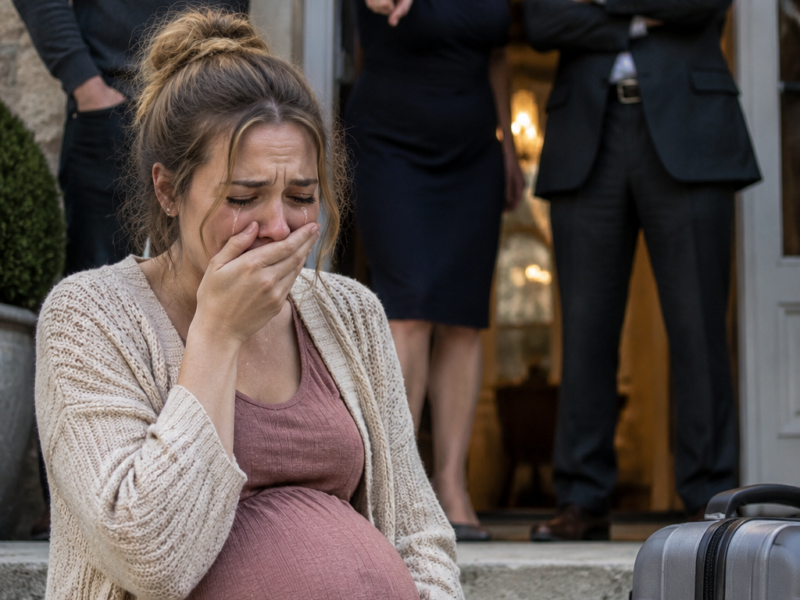
My sister’s in-laws abandoned her while she was pregnant… but they had no idea …
My sister’s in-laws abandoned her while she was pregnant… but they had no idea …
My name is Natalie Harper Prescott. I am thirty-one years old, and the night my mother-in-law abandoned me on a mountain in the middle of a Wyoming blizzard, I was thirty-three weeks pregnant with my first child.
She took my phone. She took my coat. She locked the doors of the Range Rover and drove away while I stood in the snow, one hand resting against my swollen belly, watching the red taillights disappear into the darkness.
The temperature was four degrees below zero. The wind was strong enough to knock a grown man off his feet, and the snow was falling so heavily that I could barely see the road beneath me.
I remember standing there for several seconds, waiting for the vehicle to turn around. I kept telling myself that surely this was some horrible misunderstanding. Surely Diane would realize what she had done and come back for me.
But she never did.
What she did not know was that the woman she had left to freeze on that mountain was the daughter of a powerful ranching family, the sister of a sheriff’s detective, and the chief credit officer of the largest bank in three states.
She also had no idea that the unborn child she was trying so desperately to get rid of was the legal owner of fifty-one percent of her precious family empire.
But I am getting ahead of myself.
To understand why a woman would leave her pregnant daughter-in-law to die in a snowstorm, you need to understand the Prescott family, the business they had built, and the secret that had been hidden inside a dead man’s will.
For three years, my mother-in-law, Diane Prescott, had treated me like an embarrassing mistake her son had made.
The Prescotts were practically royalty in Jackson Hole, Wyoming. Their family had owned luxury mountain resorts for four generations. Prescott Resorts operated three exclusive lodges, where wealthy guests paid thousands of dollars a night to enjoy private ski slopes, expensive restaurants, and breathtaking mountain views.
Diane was the public face of the empire. She sat on charity boards, attended political fundraisers, and appeared regularly in society magazines. Her name was printed on buildings, invitations, and donation plaques throughout the valley.
She was sixty-three years old, wealthy beyond imagination, and accustomed to getting exactly what she wanted.
I came from a completely different world.
My family owned a cattle ranch outside Pinedale. My father spent most of his life wearing the same battered boots, repairing fences, and working alongside his ranch hands. My mother canned peaches, made homemade bread, and believed that a person’s character mattered far more than the size of their bank account.
The first time Diane met me, she looked at my hands and asked whether I had ever considered getting a manicure.
When I explained that I worked outside occasionally and that calluses were simply part of ranch life, she smiled and said, “I suppose those things are regional.”
That was the closest she came to welcoming me.
Her daughter, Brooke, was even worse.
At thirty-four, Brooke had never held a job that her mother had not created for her. She spent her days shopping, attending charity events, and complaining about people who failed to recognize her family’s importance.
At my wedding reception, she raised her champagne glass and announced that Ryan had finally proven that love was blind.
Several guests laughed.
I did not.
My husband, Ryan, was nothing like the people he had grown up with. He was gentle, thoughtful, and quietly intelligent. He had spent most of his childhood trying to earn affection from a mother who treated love like a reward that could be withdrawn whenever someone disappointed her.
When we met, he told me that I was the first person who had ever liked him without expecting him to prove something.
I told him that I liked him for a hundred different reasons.
I simply did not need him to perform for me.
That was why I believed our marriage would survive his family’s disapproval.
I never imagined they would eventually try to destroy it.
The invitation came on a Thursday afternoon in late January.
I was sitting in our kitchen, reviewing some paperwork, when my phone rang. Diane’s name appeared on the screen.
I almost let it go to voicemail.
Instead, I answered.
“Natalie, darling,” she said, her voice unusually sweet. “Brooke and I have been talking, and we feel terrible about the way things have been between us.”
I remained silent.
“With the baby coming, we think it is time we started behaving like a proper family. We would love to take you to dinner on Saturday. Just the three of us. The Summit Room at Teton Pass Lodge. My treat.”
She paused before adding something that immediately caught my attention.
“I also have something special for you. Your husband’s christening gown. It belonged to Charles before Ryan wore it. I think it would be wonderful for your little girl to wear it.”
Charles Prescott had been Ryan’s father. He had died four years earlier, before Ryan and I met.
Ryan spoke about him with a tenderness I rarely heard when he discussed anyone else in his family. From everything I had learned, Charles had been a decent man trapped in a marriage with a woman whose ambition had gradually consumed everything around her.
I had never met him, but I knew how much Ryan missed him.
The thought of our daughter wearing her grandfather’s christening gown made me emotional.
So I accepted.
There was one complication. Ryan was away in Salt Lake City.
Two days earlier, Diane had insisted that he attend an emergency investor meeting. She claimed that a major business deal depended on his presence and that the company could not afford to lose the opportunity.
Ryan had not wanted to leave me. I was thirty-three weeks pregnant, and my blood pressure had been slightly elevated.
But his mother had pressured him until he finally agreed.
I told him I would be fine.
I wish I had understood how much that promise would cost me.
Saturday evening, Diane’s black Range Rover arrived at our driveway at six o’clock.
Brooke was driving. Diane sat in the passenger seat wearing a silver fox coat that probably cost more than my first car.
I climbed into the back wearing a soft maternity dress, a cardigan, and ankle boots.
I had brought my heavy winter parka, but Brooke immediately criticized it.
“You cannot wear that thing inside the Summit Room,” she said. “It looks like you’re going ice fishing.”
I hesitated, then left it in the vehicle.
Dinner began surprisingly well.
Diane asked about the nursery and complimented the name Ryan and I had chosen. She even touched my hand twice, something she had never done before.
Brooke barely spoke. She kept checking her phone and looking toward the windows, where thick snowflakes were beginning to gather against the glass.
Halfway through dessert, she suddenly held out her hand.
“Let me see your phone. I want to send you a picture of the christening gown.”
I unlocked it and handed it over.
She tapped the screen for a few seconds before slipping the phone into her purse.
“I’ll give it back in the car,” she said. “My battery is dying, and I need your hotspot.”
Something about the explanation felt strange, but I was tired and desperately wanted the evening to end well.
I let it go.
By the time we left, the storm had become dangerous.
Snow covered the parking lot, and the dashboard thermometer showed four degrees below zero. Brooke drove carefully up Teton Pass, following the narrow road as the wind pushed snow across the headlights.
Near the summit, she turned into a large gravel pullout normally used by backcountry skiers.
There was nobody else there.
No buildings, no lights, no other vehicles.
Just darkness and the sound of the wind.
Brooke stopped the Range Rover.
“Something’s wrong,” she announced. “I think we hit something. There’s a noise coming from the back.”
I listened.
I heard nothing unusual.
Diane turned toward me.
“Natalie, sweetheart, would you mind checking the tire? Brooke’s ankle is still bothering her, and I’m certainly not getting out in this weather wearing this coat.”
I looked at the snow.
Then I looked down at my belly.
“Let me get my parka.”
“It will take ten seconds,” Brooke snapped. “Just look at the rear driver’s-side tire.”
I should have refused.
I should have insisted on putting on my coat.
But some foolish part of me still wanted to believe that Diane was finally trying to accept me.
I opened the door and stepped outside.
The cold struck immediately.
I walked around the back of the vehicle and bent down as far as my belly allowed. The tire looked perfectly normal.
Then I heard a small mechanical sound.
Click.
I straightened and walked toward the passenger door.
Locked.
I pulled the handle again.
Nothing.
I knocked on the window.
It lowered a few inches, revealing Brooke’s smiling face.
It was not an embarrassed smile.
It was not a nervous smile.
She looked genuinely delighted.
“Mom thinks you need to learn what it takes to be a Prescott,” she said. “Prescotts are tough. Let’s see if you are.”
“Brooke, open the door.”
Diane stared straight ahead.
“Please,” I said. “I’m pregnant. It’s freezing.”
Brooke laughed.
“Enjoy the walk, cowgirl. Your people love the outdoors, right?”
The window closed.
The engine roared.
Snow sprayed across my legs as the Range Rover pulled away and disappeared down the mountain toward Jackson.
I stood motionless.
They had my phone, my purse, and my winter coat.
I had nothing except the clothes I was wearing.
For the first ten seconds, I genuinely believed they would return.
Then I understood.
They had abandoned me.
I placed both hands against my stomach. My daughter kicked hard beneath my palms.
“We’re going to be okay,” I whispered.
I knew the road well enough to remember a highway maintenance shed about three miles down the Jackson side of the pass.
If I could reach it, perhaps somebody would be inside.
Perhaps there would be a telephone.
Perhaps there would be heat.
Three miles.
In a blizzard.
At night.
Eight months pregnant.
I began walking.
I stayed close to the mountainside, counting the reflective posts along the road. My boots had almost no grip, and the wind kept pushing me sideways.
Within twenty minutes, I could barely feel my fingers.
My face began to go numb.
I kept counting.
Thirty-one.
Thirty-two.
Thirty-three.
Somewhere near the fortieth reflector, my foot slipped on ice hidden beneath fresh snow.
I fell hard.
At the last moment, I twisted my body, remembering something my father had taught me about falling from a horse. Instead of landing on my stomach, I struck my hip and knees.
Pain shot through my legs.
For several seconds, I could not move.
Then I felt a cramp.
It was low in my abdomen, tight and frighteningly different from anything I had experienced before.
I forced myself upright.
My knees were bleeding, and the blood was beginning to freeze against my tights.
I continued walking.
I do not remember how long it took. The doctors later estimated that I had been outside for nearly two hours.
The contractions became more frequent.
Every fifteen minutes.
Then every twelve.
When I finally saw the orange light of the maintenance shed, I began crying.
I reached the building and pounded on the steel door.
Locked.
Nobody answered.
I slid down against the wall beneath the small overhang, trying to shelter myself from the wind.
I wrapped my arms around my belly.
I talked to my daughter.
I told her about her father, about the ranch, about the horses, and about the little creek behind my parents’ house.
I told her that one day I would take her there and show her how to catch trout beneath the banks.
Eventually, something frightening happened.
I began feeling warm.
I knew that was dangerous. I had heard enough stories about hypothermia to understand that the sensation did not mean I was recovering.
But I was exhausted.
I could barely keep my eyes open.
Then I saw headlights.
Large headlights.
Amber warning lights flashing above a snow plow.
The vehicle stopped beside the shed, and a large man climbed down.
He had a gray beard, a heavy work jacket, and a headlamp strapped across his forehead.
He looked at me and immediately shouted something that I will never repeat.
His name was Hank Dolan.
He had been clearing Teton Pass for twenty-six years.
He wrapped me in his own jacket, lifted me into the cab, and turned the heater to its highest setting.
Then he grabbed his radio.
“I’ve got a pregnant woman at the maintenance shed,” he told dispatch. “She’s hypothermic and bleeding. Says somebody left her at the summit. Get an ambulance ready.”
He looked at me.
“Who did this to you, honey?”
“My mother-in-law,” I whispered.
Hank stared at me for several seconds.
Then he put the plow into gear.
“Is there anybody I can call?”
I gave him the only number I knew by heart besides Ryan’s.
“My brother. Wes Harper. He’s a detective with the Teton County Sheriff’s Office.”
Hank slowly shook his head.
“Well, somebody’s about to have a very bad night.”
The ambulance met us near Wilson.
I remember the paramedics lifting me onto a stretcher and shouting that I was thirty-three weeks pregnant and contracting.
Then everything became blurry.
When I opened my eyes again, I was in a hospital room at St. John’s Medical Center.
Heated blankets covered my body, and warm IV fluids were running into both arms. A fetal monitor was strapped across my belly.
The sound of my daughter’s heartbeat filled the room.
Fast.
Strong.
Beautiful.
A nurse named Rosa held my hand.
She explained that my core temperature had dropped to ninety-one degrees and that I was experiencing preterm labor. The doctors had administered medication to slow the contractions.
My baby appeared stable, but the next twelve hours would be critical.
“You did everything right, Mama,” Rosa told me. “You kept moving. You protected your baby when you fell. You got yourself to shelter.”
I began crying.
A few minutes later, my brother walked into the room.
Wes was five years older than me, six feet three inches tall, and built like our father. He was wearing jeans, a flannel shirt, and a canvas jacket with melting snow on the shoulders.
He had been watching a hockey game when dispatch called.
He walked straight to my bedside, looked at my bandaged knees, and then looked at the monitor.
His jaw tightened.
“Tell me exactly what happened,” he said.
I told him everything.
The dinner.
The stolen phone.
The missing coat.
The tire.
The locked doors.
Brooke’s smile.
Diane’s silence.
He wrote everything down without interrupting.
Then he asked where Ryan was.
I explained that he was in Salt Lake City for an investor meeting.
Wes took out his phone and called the hotel.
After identifying himself, he asked the front desk to connect him to Ryan’s room.
A few moments later, his expression changed.
“What do you mean there’s a do-not-disturb hold?”
He listened.
“Who requested it?”
Another pause.
“Diane Prescott?”
He repeated the name quietly.
Apparently, a family member had contacted the hotel earlier that day and instructed the staff not to transfer calls to Ryan’s room overnight.
Wes told the receptionist to wake him immediately.
Four minutes later, I heard my husband’s voice.
“Nat? Natalie?”
Wes handed me the phone.
Ryan asked whether the baby was okay.
Then he asked whether I was okay.
When I told him what his mother and sister had done, he went completely silent.
Finally, he whispered, “There was never an investor meeting.”
He explained that he had spent two hours waiting in the hotel lobby. His mother’s assistant had told him the meeting had been postponed.
He had assumed it was a scheduling problem.
It was not.
Diane had deliberately sent him away and prevented him from receiving calls.
Ryan promised to drive home immediately.
The airport was closed because of the storm, but he refused to wait.
Later that night, Dr. Feldman came into my room and explained that my contractions were slowing.
My temperature was recovering, and my injuries were not life-threatening.
Then he removed his glasses.
“I need to be honest with you, Mrs. Prescott. If that snow plow driver had arrived thirty minutes later, I don’t think we would be having this conversation.”
My brother closed his eyes.
I knew he was making a promise to himself.
At approximately one in the morning, Diane and Brooke arrived.
I heard Diane’s heels in the hallway before I saw her.
She was complaining to the nurse that she was being prevented from visiting her own daughter-in-law.
Rosa looked at me.
I nodded.
I wanted to see them.
Diane entered wearing the same silver coat. Her hair and makeup were flawless.
Brooke followed with a Starbucks cup in her hand.
Neither woman looked at the fetal monitor.
Neither looked at my bandaged knees.
Diane examined the room and sighed.
“Well, I see somebody has turned this into quite a production.”
I stared at her.
“You locked the doors,” I said. “You drove away.”
Diane gave me a patient smile.
“That was a family tradition. When my husband’s mother welcomed me into the Prescott family, she sent me outside at midnight to retrieve a saddle blanket. Prescott women are tested. It’s what we do.”
Brooke rolled her eyes.
“We only went down the road and came back. You weren’t there when we returned.”
My brother, standing in the corner, spoke quietly.
“You figured she had disappeared?”
Brooke looked at him.
“Who are you?”
“I’m her brother.”
“Oh. The cowboy.”
Wes said nothing.
He simply watched her.
Dr. Feldman entered a moment later.
He listened as Diane introduced herself and described the entire incident as a misunderstanding.
Then he told her exactly what had happened medically.
He explained that I had arrived with moderate hypothermia, bleeding injuries, and premature labor.
My daughter’s heart rate had been dangerously unstable.
I had come within half an hour of losing both my child and possibly my own life.
Diane laughed softly.
“Doctor, with respect, you don’t know this girl. She grew up wrestling calves. A little cold isn’t going to hurt her. If she can’t handle a walk in the snow, I have serious concerns about her ability to raise a Prescott.”
Dr. Feldman stared at her.
“You deliberately left a woman in her third trimester on Teton Pass during a blizzard?”
“I left her for ten minutes to prove a point.”
Brooke took another sip of coffee.
“Honestly, she should have waited where we left her. That was the whole point. She panicked. That’s on her.”
I remained silent.
Because I noticed something.
Wes was holding his phone against his leg.
A small red recording symbol glowed on the screen.
Dr. Feldman informed Diane that her statements would be documented in my medical records and that she could leave immediately or have hospital security escort her out.
Diane refused.
Instead, she opened her expensive handbag, took out a checkbook, and wrote something.
Then she dropped a check onto my blanket.
Five thousand dollars.
“For your trouble,” she said. “Buy yourself a decent coat and some proper clothes. Perhaps next time you’ll look like you belong with this family.”
She warned me not to tell stories that might damage Ryan’s reputation.
Brooke then returned my phone.
It had nine percent battery remaining.
I looked at it, then at the check.
Something suddenly occurred to me.
My phone had remained inside their vehicle throughout the night.
It had recorded its location.
I folded the check carefully and handed it to Wes.
“Would you keep this for me?”
Diane frowned.
Wes took out an evidence envelope, placed the check inside, and sealed it.
Then he reached into his jacket and placed his sheriff’s badge on the windowsill.
“Detective Sergeant Wes Harper, Teton County Sheriff’s Office.”
Diane’s expression changed.
“I would advise you both not to leave the county. We will need formal statements.”
For the first time, my mother-in-law looked uncertain.
Ryan arrived at six forty-five the next morning.
He had driven through the storm from Salt Lake City. His coat was soaked, his eyes were red, and one hand was cut from scraping ice off his windshield.
He walked straight to my bed, dropped to his knees, and placed his forehead against my belly.
The baby kicked him.
He laughed and began crying.
I held his head while he stayed there.
For several minutes, nothing else mattered.
Then Wes showed him the recording from the hospital.
Ryan listened to his mother laughing at the doctor. He heard Brooke explain that I should have waited in the snow.
He heard Diane describe abandoning me as a family tradition.
When the recording ended, he looked like someone had pulled the foundation out from beneath his entire life.
“She planned it,” he whispered.
“Yes.”
“She sent me away.”
“Yes.”
He stood and walked toward the window.
For a long time, he stared at the snow.
Then he said, “My father used to tell me that you find out who people really are when they think nobody is watching.”
He turned around.
“She didn’t think anybody was watching.”
I squeezed his hand.
“Somebody was. Hank was. And now Wes is.”
Diane retaliated within hours.
Ryan’s credit cards were frozen. His company position was suspended without pay. A lawyer representing Prescott Resorts sent him a formal notice stating that the house we lived in would be reclaimed by the company.
The locks would be changed that afternoon.
The message was unmistakable.
If Ryan wanted his life back, he needed to come to his mother privately and discuss the future of his marriage.
He read the email twice.
Then he deleted it.
“Let her have it,” he said. “The house, the job, the cards. I don’t want any of it. I want you and our daughter.”
I loved him for saying that.
But there was something he still did not know.
I had never told him the full truth about my work or my family’s financial position.
He believed I was an ordinary bank employee who reviewed commercial loan applications.
That was true, but incomplete.
Before explaining, I wanted to understand why Diane had gone so far.
The answer arrived the following morning.
An elderly man entered my hospital room carrying a leather folder.
His name was Martin Greer.
He had been Charles Prescott’s personal attorney for thirty-one years. Diane had dismissed him shortly after Charles died and replaced him with her own lawyer, Gerald Pike.
Martin looked at Ryan and apologized.
“I made your father a promise,” he said. “I have not kept it as well as I should have. I want to correct that now.”
He opened the folder and produced the original will.
Ryan had always believed that Diane inherited the company and the family estate, while he and Brooke received smaller trusts.
Martin explained that Ryan had never been given the complete document.
Diane’s lawyer had read the family a carefully prepared summary.
Martin turned to Article Seven.
“Read this aloud,” he instructed Ryan.
Ryan began reading.
Then his voice weakened.
Charles Prescott had owned fifty-one percent of Prescott Resorts.
He had not left those shares to Diane.
He had placed them in a trust for his first grandchild.
The shares would legally transfer to that trust upon the live birth of Charles’s first grandchild.
Until then, Diane served as interim trustee.
But once the child was born, her authority would end completely.
The child’s parents would become the new trustees.
Ryan looked up.
“You’re saying Natalie and I will control fifty-one percent of the company?”
Martin nodded.
“Exactly.”
He then produced a letter Charles had written specifically for his son.
In it, Charles explained that he had spent decades watching Diane treat people as possessions.
He had become increasingly frightened by the person she was turning into and worried about what she might eventually do to Ryan.
He wrote that he had failed to protect his son during childhood.
But he wanted to protect him as an adult.
One sentence broke Ryan completely.
“I am going to do the only thing a dead man can do. I am going to make sure that the day you become a father, you also become free.”
I began crying.
Suddenly, everything made sense.
Diane had not hated me simply because I came from a ranch.
She hated the fact that I was carrying the child who would take away her control.
She had known about Article Seven for years.
She knew that the moment my daughter was born, she would lose her authority over the majority of Prescott Resorts.
And she had decided that the baby must never be born.
Ryan stood and punched the wall beside the window.
His knuckles split open.
For the first time, I saw something stronger than his lifelong fear of his mother.
I saw determination.
Martin then explained that the company was in serious financial trouble.
Diane had borrowed heavily, and the lodges were struggling.
He suspected she was desperate to keep control.
That was when I finally told Ryan the truth about myself.
I worked at Granite Peak Bank and Trust.
Not as an ordinary loan officer.
I was the chief credit officer.
I approved every commercial loan exceeding ten million dollars across Wyoming, Montana, and eastern Idaho.
My grandfather had founded the bank in Pinedale in 1958. After his death, his shares passed to my father. When my father died, the controlling interest passed into the Harper family trust, which Wes and I owned.
Our family controlled sixty-two percent of Granite Peak Bank.
Ryan stared at me.
“Your father, the man who shoveled manure every morning?”
I smiled.
“Every morning for forty years. Then he put on a clean shirt and chaired the bank’s board.”
I explained that I had never wanted the Prescott family to know about my background.
The first time Diane met me, she had judged me by my clothes and my hands.
I wanted to see whether Ryan would love me without knowing anything about my family’s wealth.
He had.
That was why I had kept the truth to myself.
But now the truth mattered.
Prescott Resorts had requested another fifteen million dollars from Granite Peak. Diane had personally signed the company’s financial certification, claiming the resorts had an average occupancy rate of eighty-one percent.
Martin’s information suggested something very different.
I immediately disclosed everything I knew to Granite Peak’s general counsel and removed myself completely from the Prescott loan file.
An independent forensic accounting firm was hired.
Six days later, the results arrived.
Prescott Resorts had averaged only forty-four percent occupancy the previous year.
The company was losing nearly one million dollars every month.
Diane had been moving money between lenders, emptying reserve accounts, and falsifying financial reports to keep the business looking successful.
But the worst discovery was still ahead.
To secure the additional fifteen million dollars, she had pledged the fifty-one percent stake belonging to my unborn daughter’s trust.
She had signed a sworn document claiming she had the legal authority to use those shares as collateral.
She did not.
If the loan was approved and Prescott Resorts defaulted, the bank could seize the shares before my daughter ever received them.
Wes explained that the FBI was now investigating bank fraud and false statements to a federally insured financial institution.
It was no longer simply a family dispute.
It was a major criminal investigation.
Meanwhile, Diane had another plan.
She intended to seek legal guardianship of our daughter, claiming that Ryan and I were financially unstable and incapable of protecting the child’s inheritance.
Her attorney prepared a consent agreement that would give Diane control over the baby’s estate.
On the sixth page was a clause granting her authority to manage the inheritance and its associated financial assets.
She was trying to make herself the legal guardian of the very child whose inheritance she had attempted to steal.
Our attorney, Elena Vasquez, immediately recognized the significance.
She filed a response before Diane’s petition could even be submitted.
The filing included Charles’s original will, my medical records, Hank’s dispatch report, and evidence of the hospital incident.
It also requested a protective order and full financial discovery.
Diane’s lawyer attempted to have the documents sealed.
The judge refused.
Then someone from inside the Prescott household contacted Ryan.
Her name was Paula Ostrander.
She had worked as Diane’s executive assistant for nineteen years.
Paula had finally reached her limit.
She explained that she had overheard Diane screaming at Gerald Pike after receiving our court filing.
Diane had thrown a crystal decanter against the fireplace and demanded that the company financial records never reach a judge.
Then she said something that terrified Paula.
“That child cannot come before the twenty-second. The ball is on the twenty-second. The bank closes the new loan on the twenty-third. Find out which hospital and which doctor.”
Paula had also discovered something else.
There was a dash camera inside Brooke’s Range Rover.
It recorded the road, the interior of the vehicle, and conversations.
Diane had ordered Brooke to delete the footage.
But Brooke had secretly copied it onto a small red USB drive.
She had kept it as insurance against her mother.
When Wes learned this, he immediately contacted Lieutenant Moreno.
A search warrant was obtained.
The evidence was recovered.
And suddenly, we had something neither Diane nor Brooke could explain away.
The footage showed the entire incident.
It showed Brooke pulling into the mountain turnout.
It showed me stepping out of the vehicle.
It showed the doors locking.
And it recorded the conversation inside the car.
Diane’s voice was unmistakable.
“Go. Don’t look back. If she’s lucky, she’ll lose it out there, and then we won’t have to think about Charles’s ridiculous will again.”
The recording established exactly what we had suspected.
This had never been a prank.
It had never been a family tradition.
It had been an attempt to prevent my daughter from being born.
Two days before the Centennial Ball, my water broke.
I was thirty-six weeks pregnant.
Ryan drove me to the hospital, and Wes arrived shortly afterward.
We had already arranged for the hospital to keep my admission private.
Rosa, the nurse who had cared for me during the storm, made sure nobody could obtain information about my room.
Labor lasted less than two hours.
At 4:12 in the morning, our daughter was born.
We named her Charlotte Grace Prescott.
She weighed five pounds and eleven ounces.
She was healthy, beautiful, and loud enough to fill the entire room with her cries.
When Rosa placed her against my chest, she opened her eyes and looked directly at me.
I held her and cried.
Every painful step on that mountain had led me to that moment.
Ryan could barely hold his phone steady enough to take a photograph.
Wes stood by the window, pretending his red eyes were caused by allergies.
At six fifteen, Hank Dolan arrived carrying a small stuffed moose.
He looked embarrassed as he approached the bed.
“I hope it’s all right that I came,” he said. “I’ve been thinking about you two every day.”
I handed him Charlotte.
The huge snow plow driver looked down at the tiny baby and began crying.
Charlotte wrapped her little fingers around his finger.
Hank sat down and refused to move for several minutes.
Later that morning, Martin Greer arrived with the legal documents confirming Charlotte’s inheritance.
The fifty-one percent ownership stake had officially transferred into her trust.
Ryan and I were now its trustees.
Diane Prescott had lost control.
But she did not know it yet.
And we intended to let her discover that at the worst possible moment.
The Centennial Ball was scheduled for February twenty-second.
It marked one hundred years of Prescott Resorts.
Diane had spent two years planning the event. Governors, senators, bankers, business executives, and wealthy investors were expected to attend.
She intended to stand in the center of the ballroom and celebrate her company’s strength.
She believed the additional fifteen-million-dollar loan would be approved the following morning.
Instead, Granite Peak issued a formal notice of default after discovering the fraudulent financial statements and unauthorized collateral pledge.
The FBI and Lieutenant Moreno coordinated their investigation.
Ryan and I were advised to stay away from anything that could compromise the case.
We agreed.
On the evening of the ball, I attended with Ryan.
I was still recovering from childbirth, and Charlotte remained safely at home with my mother.
The Prescott Lodge looked magnificent.
Thousands of lights illuminated the entrance. Huge floral arrangements filled the great hall, and an enormous chandelier hung above the central staircase.
The decorations had reportedly cost ninety thousand dollars.
Diane stood near the stage wearing a midnight-blue velvet gown and an enormous diamond necklace.
She looked completely confident.
When she saw us enter, her smile disappeared for a moment.
Then she approached.
“Natalie. Ryan. How wonderful that you’ve decided to join us.”
She looked at my dress.
“I hope you’re feeling better.”
I smiled politely.
“Much better, thank you.”
She had no idea that her entire world was about to collapse.
The evening began with speeches.
Diane talked about the family’s history, the company’s achievements, and the importance of preserving a legacy for future generations.
She thanked the investors and praised the people who had helped Prescott Resorts become one of the most respected luxury hospitality businesses in the region.
Then she announced that the company had secured a major new financing arrangement.
She described it as proof of the company’s excellent financial health.
I watched her raise her champagne glass.
I knew the truth.
The bank had already issued its notice of default.
The FBI had the financial records.
And the sheriff’s department had the dash camera footage.
But Diane continued speaking as if nothing could touch her.
After her speech, Brooke approached the audiovisual table.
She had the small red USB drive.
Nobody knew exactly why she had decided to bring it.
Perhaps she wanted to embarrass her mother.
Perhaps she wanted to protect herself.
Whatever her reason, she stepped toward the microphone and announced that she had something special to show everyone.
Diane looked irritated.
“What are you doing?”
Brooke ignored her.
The large screens behind the stage flickered.
At first, the audience saw the familiar image of the Range Rover driving through falling snow.
Then the camera showed the mountain turnout.
The room grew quiet.
Everyone watched as I stepped out of the vehicle.
They watched Brooke lock the doors.
They heard her laugh.
Then they heard Diane.
“Go. Don’t look back. If she’s lucky, she’ll lose it out there, and then we won’t have to think about Charles’s ridiculous will again.”
The car pulled away.
The headlights disappeared into the snow.
The footage continued.
Nobody in the ballroom moved.
Four hundred people watched a pregnant woman being abandoned on a mountain in a blizzard.
When the screen finally went black, the silence was overwhelming.
Brooke stood beside the audiovisual table with her mouth open.
Diane looked as though someone had drained every drop of blood from her face.
Then the main doors opened.
Lieutenant Anna Moreno entered with FBI Special Agent Marcus Daniels and several other agents.
My brother stood near the entrance in his formal uniform.
He did not move.
He had promised to stay out of the investigation, and he kept that promise.
Lieutenant Moreno walked directly toward the stage.
“Diane Prescott. Brooke Prescott. Turn around and place your hands behind your backs.”
Diane whispered that she wanted her lawyer.
Gerald Pike was nowhere to be found.
He had apparently escaped through the kitchen moments earlier.
Lieutenant Moreno read the charges.
Attempted second-degree murder.
Aggravated assault.
Reckless endangerment.
Conspiracy.
Then the FBI agent explained that federal charges were also being prepared for bank fraud, wire fraud, and making false statements to a federally insured financial institution.
Brooke began crying.
She repeatedly insisted that her mother had forced her to do everything.
Diane did not cry.
She simply turned toward me as the agents placed handcuffs around her wrists.
Her eyes were filled with hatred.
“You,” she whispered.
I looked directly at her.
“The ranch girl,” I replied quietly. “The one you left in the cold.”
She was escorted through the ballroom.
Past the flowers.
Past the guests.
Past the people whose approval she had spent thirty-five years chasing.
Nobody defended her.
Outside, television cameras and reporters were waiting.
The arrest was broadcast across the region.
By midnight, footage of Brooke locking the doors and laughing had spread across social media.
Within days, millions of people had watched it.
The public reaction was enormous.
People were furious.
Snow plow drivers from across America posted photographs of themselves beside their vehicles, reminding everyone that stopping for someone in danger was simply what decent people did.
A fundraiser was created for Hank.
It raised two hundred and forty thousand dollars in four days.
Hank initially wanted to donate everything to the local search and rescue organization.
Eventually, he accepted a new truck.
The legal consequences were just as severe.
Diane’s bank accounts were frozen.
She attempted to arrange bail using the family estate, but investigators discovered that the property already carried substantial debt.
Her bail was set at two million dollars.
She could not pay it.
Brooke remained in jail for eleven days before offering to cooperate with prosecutors.
She agreed to plead guilty and testify against her mother.
In exchange, she provided investigators with years of messages, emails, and voicemails.
One text from Diane, sent three days before the dinner, read:
“Saturday, the pass. Wear boots you can drive in.”
Another voicemail instructed Brooke to repeat the lie that I had wandered away and that they had searched for an hour.
Then investigators discovered an email Diane had sent Gerald Pike the previous autumn.
The subject line was simple.
“Article 7.”
The message read:
“There has to be a way. Find it. I do not care what it costs. I am not losing this company to a baby.”
That email established her motive beyond reasonable doubt.
Gerald eventually made his own agreement with federal investigators.
He admitted that Diane had instructed him to prepare two sets of financial reports.
One contained the actual occupancy numbers and was filed with the county.
The other showed inflated figures and was submitted to lenders.
He also admitted that Diane had knowingly pledged Charlotte’s inheritance as collateral.
His testimony revealed something even more disturbing.
On the night she abandoned me, Diane had called him just six minutes after arriving home.
She had not asked whether I was alive.
She had asked what the legal consequences would be if the pregnancy did not survive.
Gerald lost his law license and received a four-year federal prison sentence.
Diane’s trial lasted several months.
The evidence was overwhelming.
The dash camera footage.
The cell phone location records.
Hank’s testimony.
Dr. Feldman’s medical records.
The recording from the hospital.
The check for five thousand dollars.
The original will.
And the financial documents.
The jury deliberated for three hours and forty minutes.
The verdict was guilty on every count.
At sentencing, Diane stood before Judge Margaret Ellison.
She had lost weight during her time in jail, and her carefully maintained blonde hair had grown almost entirely gray.
Still, she raised her chin.
“Everything I did, I did to protect my family’s legacy,” she declared.
The judge looked at her for a long moment.
Then she explained that a person’s legacy was not determined by the buildings they owned or the amount of money in their bank account.
It was determined by how they treated people who could not fight back.
Diane had left a pregnant woman to die in a blizzard because she wanted to preserve her control over a company.
That, the judge said, was her legacy.
Diane received eighteen years in state prison, followed by eleven years in federal prison for the financial crimes.
Twenty-nine years.
Brooke received seven years because of her cooperation.
On the day of sentencing, Brooke asked permission to read me a letter.
She apologized.
She said she had spent her entire life trying to become the daughter her mother wanted.
She claimed she had finally understood what that had turned her into.
I did not know whether she was sincere.
I decided that I did not need to know.
I wrote her a single sentence in response.
“I hope you use the next seven years to become somebody your niece could be proud to meet.”
She has continued writing letters to Charlotte.
I keep them in a box.
One day, when my daughter is old enough, she can decide whether she wants to read them.
The company was another challenge entirely.
When Ryan, Tom Reyes, and the new board examined the actual financial situation, they discovered that Prescott Resorts owed more than ninety million dollars to five different lenders.
The newest lodge, Elkridge, had cost sixty million dollars to build and had never made a profit.
For a while, Ryan believed the company would have to be dismantled.
He spent nights at our kitchen table reviewing spreadsheets while Charlotte slept against his chest.
One evening, he told me he was afraid his father’s company would die under his leadership.
I reminded him that I was one of the trustees controlling fifty-one percent of the business.
I also reminded him that restructuring troubled commercial debt was precisely what I had spent my career doing.
We assembled a team that included Tom Reyes and an experienced bankruptcy attorney from Denver.
I remained completely separated from Granite Peak’s lending decisions. An independent team represented the bank, ensuring that everything was handled transparently and legally.
The restructuring took nine months.
We sold Elkridge Lodge at a substantial loss.
We sold the enormous family estate, the private jet, the vintage car collection, the company’s luxury box at the rodeo, and an apartment in Aspen that Diane had never disclosed to the board.
But we saved two properties.
The historic Prescott Lodge in Jackson and the smaller Silver Fork Lodge in Big Sky.
They were the businesses that still had genuine value.
Then Ryan made a decision that would have made his father proud.
He gathered all 380 employees.
Housekeepers.
Cooks.
Front desk clerks.
Ski valets.
Bartenders.
Maintenance workers.
He stood in the great hall and explained exactly what had happened.
He did not hide the company’s financial problems.
He did not pretend everything would be easy.
He simply told them the truth.
Then he announced that ten percent of the company’s shares would be allocated to an employee ownership plan.
Anyone who had worked for Prescott Resorts for more than two years would own a portion of the business.
“My father always believed this company belonged to the valley,” Ryan told them. “It was never supposed to belong to one person. It belongs to the people who make it work every day.”
Several employees began crying.
Others applauded.
For the first time in decades, the company was being run according to the values its founder had believed in.
Two years later, Prescott Lodge recorded the best season in its hundred-year history.
Occupancy reached seventy-eight percent.
Real seventy-eight percent.
The kind that could be shown honestly to the county, the bank, and every investor.
The people who helped us through the worst period of our lives remained part of our family.
Hank retired from the highway department the following spring.
The transportation department organized a small ceremony at the maintenance shed where he had found me.
They installed a bronze plaque beside the entrance.
It read:
“In honor of Hank Dolan, who stopped.”
Charlotte attended in a tiny winter suit.
She held Hank’s finger while helping cut the ribbon.
Paula eventually became the front desk manager at Prescott Lodge.
Martin Greer came out of retirement and became the company’s general counsel.
Rosa, the nurse who had held my hand during the worst night of my life, became Charlotte’s godmother.
And Wes was promoted to lieutenant the following year.
He still visits every Friday evening with groceries and pretends he has not come specifically to hold his niece.
As for me, I returned to Granite Peak Bank when Charlotte was six months old.
I remained chief credit officer.
I continued reviewing major commercial loans across three states.
But I added one extra verification procedure to every significant loan file.
We compare the financial information borrowers submit to banks against the numbers they report to tax authorities.
It is surprising how often those figures do not match.
There was one final discovery that brought everything full circle.
About a year after the trial, Martin helped us sort through a storage unit containing Charles Prescott’s belongings.
Diane had placed everything in storage after his funeral.
There were old books, fishing equipment, photographs, and handwritten notebooks filled with poems.
At the bottom of the final box, wrapped in yellowing tissue paper, we found something small and beautiful.
A christening gown.
It was made of linen and lace, carefully hand-stitched.
A tiny label inside the collar read:
Charles Prescott, 1958.
Beneath it, another name had been sewn in newer thread.
Ryan Prescott, 1993.
The gown was real.
Diane had never intended to give it to me.
She had used it as bait to get me into that car.
It had been sitting in a storage box the entire time.
Waiting for the child who was supposed to wear it.
Charlotte was christened that summer at a small chapel near the base of the Tetons.
She wore her grandfather’s gown.
It was slightly too long, and she spent most of the ceremony kicking her little feet.
My mother cried.
Wes blamed his tears on pollen.
Hank cried openly.
Martin stood quietly at the back of the chapel with one hand over his heart.
Ryan held our daughter near the large window so she could see the mountains.
I stood beside them in the sunlight.
And I thought about the woman I had been on that January night.
The woman counting reflector posts in the darkness.
Thirty-one.
Thirty-two.
Thirty-three.
I wished I could return to that mountain and tell her that she would survive.
I would tell her that the night would be terrifying and painful, but that there was a beautiful little girl waiting for her on the other side.
I would tell her that the man who stopped his snow plow would become part of her family.
That the old lawyer would keep his promise.
That her brother would stand beside her.
And that the husband she loved would finally find the courage to walk away from the woman who had controlled his entire life.
But I cannot go back.
So I tell the story instead.
Diane Prescott spent her entire life believing that power came from money, influence, and the ability to make other people obey.
She believed a family name made her superior to a woman with calluses on her hands.
She believed that her wealth made her untouchable.
She believed that she could abandon someone in the cold and simply pay enough money to make the problem disappear.
She was wrong.
Real strength does not look like a diamond necklace or an expensive ballroom.
It looks like a snow plow driver stopping when he could have kept driving.
It looks like a nurse holding a frightened woman’s hand.
It looks like an old attorney keeping a promise for four years.
It looks like a brother refusing to let his sister’s suffering go unanswered.
And sometimes, it looks like a pregnant woman bleeding through her clothes, stumbling through a blizzard, and forcing herself to take one more step because somebody small is depending on her.
I did not defeat Diane by becoming like her.
I did not need to lie, cheat, threaten, or manipulate anyone.
I simply told the truth and allowed the evidence to speak.
She built her own downfall, one lie at a time.
And eventually, the numbers stopped matching.
So if you are facing something difficult right now, remember this.
Keep walking.
Keep counting the reflector posts.
Do not let the darkness convince you that there is nowhere left to go.
Sometimes help arrives from the most unexpected direction.
Sometimes the person who saves your life is a stranger driving a snow plow through a storm.
And sometimes the family you thought you had lost is waiting for you on the other side of the hardest night of your life.
I am Natalie Harper Prescott.
I was once the woman Diane Prescott left freezing on a mountain.
Today, I am a mother, a wife, a daughter, and a woman who knows exactly where she belongs.
And my daughter will grow up knowing that she was never a threat to anyone’s legacy.
She was the reason we finally learned what a legacy should mean.









