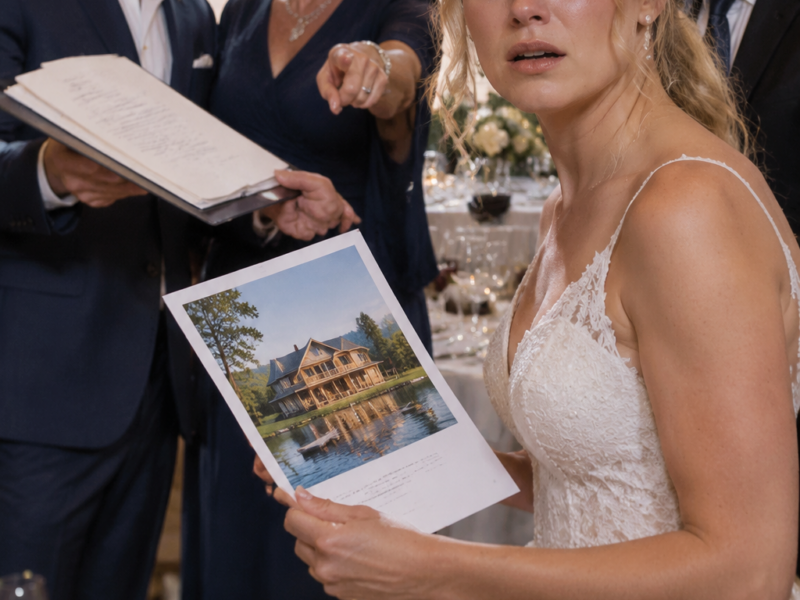
My Parents Gave My Brother MY Lake House at My Rehearsal Dinner!
My Parents Gave My Brother MY Lake House at My Rehearsal Dinner!
My father gave away my lake house at my rehearsal dinner, into a microphone, in front of forty people who actually applauded him.
It was Friday, October 3rd, in a converted barn in Sanborn, New Hampshire. The evening had started beautifully enough. Long wooden tables stretched across the room, decorated with white flowers, candles, and small arrangements of autumn leaves. The smell of roasted potatoes and wood smoke filled the air, and the warm lights hanging from the exposed beams made everything look softer than it really was.
My fiancé, Ethan, was sitting beside me. His parents, Rick and Maureen Whitby, were across the table, laughing with some relatives. My mother was quietly talking to one of the guests, and my younger brother, Wade, was enjoying his second glass of bourbon.
My father, Gordon Lindqvist, was in an especially good mood.
That should have warned me.
He had spent most of the evening moving from table to table, shaking hands, telling stories, and making sure everyone knew how much he had done to bring the family together. He was the kind of man who enjoyed being the center of attention, particularly when there was an audience willing to admire him.
At around eight o’clock, he tapped the microphone.
The conversations gradually faded. People turned toward him, expecting a sentimental speech about his daughter getting married.
Instead, he smiled broadly and announced, “As a wedding gift, our daughter is giving her brother the lake house.”
For a moment, I genuinely thought I had misunderstood him.
Then the applause started.
At the far end of the room, Gus Baudry, my father’s oldest friend and a notary public, opened a folder. He removed a printed deed and placed a pen on top of it.
My brother Wade immediately stood up. He leaned across a chair and hugged our father, smiling as if he had just received the greatest gift of his life.
My fiancé’s parents stopped chewing.
I stared at the folder.
My father continued, enjoying every second of the attention.
“She never even comes up here,” he said. “Wade keeps the place alive. It’s only right that he should have it.”
I felt something cold settle in my stomach.
This wasn’t an impulsive announcement. There was a document. There was a notary. There was a prepared deed with my name on it and my brother’s name listed as the recipient.
There was even a blank line waiting for my signature.
My father had not come up with this idea over dinner. He had arranged it beforehand, and he had chosen my rehearsal dinner because he knew exactly how difficult it would be for me to refuse him in front of everyone.
I smiled.
It was the same smile I had used for thirty years whenever I wanted a room to become easier for other people. The smile that prevented arguments, softened uncomfortable conversations, and convinced everyone that I was perfectly fine when I was anything but.
I had learned that a smile could buy approximately four seconds before anyone expected an answer.
Four seconds was enough.
I stood up, walked toward Gus, and took the folder from his hands.
Not the pen.
The folder.
Ethan touched my wrist.
“Ingrid,” he whispered.
I didn’t look at him.
My professional life involved reviewing documents, reading contracts, and noticing details other people overlooked. I had spent fourteen years working with financial and legal paperwork. I knew that the most important part of a document was often not the number printed in bold letters but the first line that explained who actually had the authority to sign.
So I read the first line.
Grantor: Ingrid Lindqvist, a single woman.
Grantee: Wade Lindqvist.
And then I understood something my father hadn’t considered.
Two weeks earlier, I had done something that might have prevented him from accomplishing exactly what he was attempting that night.
I wasn’t sure yet whether it would be enough.
To understand why that first line mattered, I need to go back three weeks, to a Friday afternoon when I drove north to close my lake house for the season.
The property was located at 14 Loon Point Road on Lake Winnipesaukee, in Gilford, New Hampshire. My grandfather, Arnie, had left it to me when he died.
It wasn’t a mansion or some extravagant vacation property. It was an old lakeside house with weathered wooden floors, a small kitchen, a porch overlooking the water, and a pantry that always smelled faintly of cedar and coffee.
But to me, it was worth more than anything else I owned.
I had grown up there.
My grandfather had bought the house decades earlier, and he had treated every spring morning as a private celebration between the two of us.
When I was little, he would wake me before six o’clock on the morning the ice finally broke apart on the lake.
He never called it the first day of spring.
He simply came to my bedroom door and said, “The lake let go.”
That was my signal to get dressed.
We would walk downstairs in our wool socks, and he would put the kettle on while I climbed onto the small wooden stool beside the pantry window.
Outside, the lake would still be covered in enormous gray plates of ice. Gradually, the wind would push them apart, creating narrow strips of dark water between them.
My grandfather watched this process as though it were the most important event in the world.
Then he would take a pencil from the drawer and write the date on the pantry door frame.
He had started doing it long before I was born.
The first few dates were written entirely in his handwriting. Then, when I turned seven, he handed me the pencil.
I remember standing on my toes, trying to reach the wood.
“Write it underneath mine,” he said.
I carefully wrote the date, pressing so hard that the pencil nearly broke.
From then on, every spring became our little tradition.
Forty-one lines eventually appeared on that frame. Some were neat and straight. Others were crooked, faded, or barely visible. His handwriting grew shakier as he aged, while mine changed as I grew older.
One morning, when I was about ten, I asked him why he bothered recording the dates.
He tapped the wood with his finger.
“You keep the dates,” he told me. “Whoever keeps the dates keeps the place.”
I didn’t understand the full meaning of those words then.
I only knew that I loved those mornings.
My brother Wade never joined us. He thought the lake was too cold in spring and the mornings were too boring. He preferred the summer, when there were boats, friends, parties, and people to impress.
The house had never meant the same thing to him.
After my grandfather died, I continued going to the lake house, but I stopped writing the dates for two springs in a row.
I would stand in the pantry, look at the pencil, and then put it back.
It felt wrong to continue the tradition without him.
The summer after his funeral, our family gathered in my parents’ living room in Belmont. My father, Gordon, was the executor of my grandfather’s estate, and he read the will aloud.
The lake house went to me.
Wade received the old Chris-Craft boat and the marina equipment that had belonged to our grandfather.
I also inherited $150,000 in cash.
Wade gave a short, irritated laugh when he heard the distribution.
My mother looked down at her hands.
My father folded the will in half and looked directly at me.
I wanted to tell him that I hadn’t asked for any of it. I hadn’t competed with Wade. I hadn’t persuaded my grandfather to leave me the house.
It had simply been his decision.
But before I could say anything, my father spoke.
“Paperwork is for strangers, Ingrid. We’re family.”
Then he added that he was the executor and would handle everything.
“You don’t have to think about it,” he assured me.
At the time, I believed him.
Fourteen months later, an envelope arrived at my condo in Concord. Inside was a copy of a fiduciary deed signed by Gordon Lindqvist, executor, transferring the lake house to me.
The document had been recorded at the registry in Laconia.
I put it in a drawer with my passport and tax returns.
I didn’t study it. I didn’t question it. I assumed my father had done exactly what he promised.
He was my father.
I had never considered that I might need to protect myself from him.
That September, however, everything began to change.
On Friday, September 12th, I drove to Gilford after work to prepare the lake house for winter.
When I reached the porch, I noticed a large shoe print on the wooden boards. It was too big to be mine.
One of the windows also had a clean square wiped into the accumulated grime, as though someone had placed both hands against the glass and leaned forward to look inside.
Then I noticed a business card wedged into the front door.
It read:
“Missed you. Please call to schedule interior access regarding Granite Lakes Bank.”
A file number had been handwritten beneath the message.
I stood there for several seconds, looking at it.
I had not scheduled an inspection.
Nobody had asked my permission to enter the property.
I called the number on the card.
The appraiser answered cheerfully, apparently assuming I was already familiar with the situation.
“Your dad said someone would be up this week,” he explained. “It’s for the Lakeshore Marine file.”
Lakeshore Marine was my brother’s boatyard.
I asked who had ordered the appraisal.
There was a brief pause.
Then he read the information from his screen.
“Client: Lakeshore Marine. Contact: Gordon Lindqvist.”
My father.
I felt my fingers tighten around the phone.
Nobody had told me anything.
I went inside, stood in the pantry, and looked at the business card between my fingers. The old pencil marks were right beside me, but I couldn’t bring myself to look at them.
I didn’t call my father.
Instead, I called Simone Okafor, my closest friend and a closing attorney in Laconia.
I explained what had happened.
Simone listened without interrupting.
When I finished, she asked one question.
“Ingrid, whose name is the deed in? Yours or still the estate’s?”
I opened my mouth.
Nothing came out.
I had never actually held my own deed in my hands and read it carefully.
My father had been keeping it for me.
That was the entire point of having a father like Gordon, or so I had always believed. He took care of complicated things. He handled the paperwork. He knew people. He understood how the world worked.
I was the responsible daughter.
I didn’t need to worry.
Simone asked me to send her a copy of the deed as soon as possible.
The next evening, I mentioned something to Ethan while we were cleaning up after dinner.
I told him I was considering transferring the lake house into a company that I would own.
It seemed like a sensible precaution.
Ethan put down the dish towel and looked at me.
“Ingrid, that’s paranoid.”
He wasn’t angry. He wasn’t trying to hurt me. He genuinely believed I was overreacting.
He said my father wasn’t the kind of man who would do something like that, and that creating a company around the house would make the entire family believe I was protecting myself from them.
I explained that the company wouldn’t be against him. It would simply establish clear legal control over the property.
He sighed.
“Fine. Just don’t make it a thing at the dinner.”
I didn’t argue.
On Monday, September 15th, I searched the county registry website and located the deed.
I copied down the book and page numbers.
Then I noticed that the property had been accessed in the registry recently. I couldn’t prove who had looked at it, but the timing made me uncomfortable.
That afternoon, I sat in Simone’s office.
She explained that I could transfer the property into a limited liability company that I owned entirely. The transfer would not involve selling the property to another person. I would remain its sole member, and the arrangement could be structured without transfer tax, provided the applicable requirements were satisfied.
Forming the company would cost $100.
But the most important part was something Simone proposed for its operating agreement.
She would serve as manager.
Any deed, mortgage, or lease longer than one year would require both her signature and mine.
Replacing her would require thirty days’ written notice.
“It’s a speed bump, not a wall,” she explained. “You’re locking yourself into a process. If somebody pressures you, you won’t be able to make a decision in thirty seconds.”
I looked at her.
“I know what I do when he hands me a pen.”
Simone didn’t ask me to explain.
She understood.
The company was formed, and the new deed was recorded on Friday, September 19th.
I named it Ice Out LLC.
It was a small name with a private meaning.
My grandfather had spent decades teaching me to notice when the lake changed. He had taught me that patience mattered, that important things happened gradually, and that you couldn’t force the ice to disappear simply because you wanted summer to arrive.
I held the recorded deed in my hands and looked at the new book and page numbers.
For the first time, I felt that the house was truly protected.
I didn’t tell Ethan the transfer had been completed.
He had already called the idea paranoid, and I wasn’t ready to have another argument about it.
I also didn’t tell my father.
A deed could lock one door, but I had no idea how many doors he might try.
On the morning of October 3rd, my phone lit up.
It was a message from Dad.
“Got a surprise for you and Wade tonight. Dress nice.”
I didn’t reply.
And that brings us back to the barn.
Twenty minutes before my father took the microphone, the room had been warm and cheerful.
Ethan’s mother, Maureen, had brought an old photo album showing Ethan as a nine-year-old holding a fish almost as big as his torso. People were passing it around and laughing.
My father had already had two bourbons.
He walked down the table and approached Ethan.
“Welcome to the family, son.”
Then he placed something in Ethan’s hand.
An old brass key.
It was the key my grandfather used to keep hanging on a nail near the back door of the lake house.
Ethan laughed awkwardly and slipped it into his jacket pocket.
I saw the exchange but didn’t think much of it.
I assumed my father was making a sentimental gesture.
Then he picked up the microphone.
After announcing that I was giving Wade the lake house, he repeated his claim that I never visited and Wade was the one who maintained the property.
He raised his glass toward Ethan.
“Ethan tells me she’ll come around. So let’s make it official tonight. For fun. Gus is here, he’s a notary. We’ll sign and go back to dessert.”
He extended the pen toward me.
Forty people watched.
I looked down at the document.
It was already typed.
The deed referenced my old ownership record, using the exact book and page numbers I had copied from the registry on September 15th.
Behind it was a printout of the old deed.
A tiny line at the bottom showed that it had been printed on September 16th.
Three days before my new deed was recorded.
There was also a state transfer form with zero already entered on the price line.
This had been planned.
My father had checked the registry, obtained the information, prepared the deed, and arranged for Gus to be present.
He had done all of that before I transferred the property.
But he hadn’t checked again afterward.
I looked up.
“Dad, this deed names the wrong owner.”
The room became quieter.
“As of two weeks ago, the house belongs to Ice Out LLC. I’m the only member. I can’t give away what I don’t hold.”
For the first time that evening, my father didn’t have an immediate answer.
Gus quietly placed his notary stamp on the table.
“I can’t notarize that, Gordon.”
My father looked at the document and then at me.
“Cute name,” he said. “Then sign as the company. You are the company.”
“The company needs two signatures,” I replied. “And one of them isn’t here tonight.”
His eyes shifted toward Ethan.
“You said she was thinking about it.”
Ethan said nothing.
Across the table, Maureen put down her fork.
My father leaned toward me and spoke quietly.
“We’ll talk Sunday. Bring the paperwork.”
Then he turned back to the room, raised his glass, and pretended the evening was continuing exactly as planned.
I placed the folder in my bag and walked toward the exit.
Ethan followed.
Outside, the parking lot was cold and covered in gravel. My breath appeared in little clouds as I stood beside the car.
Ethan came out without his coat.
I turned toward him.
“Tell me exactly what you told him.”
He looked uncomfortable.
On Sunday, September 14th, my father had called him and asked whether I seemed stressed.
Ethan had mentioned that I was thinking about transferring the lake house into a company.
He had believed that telling my father would make him gentler.
Then my father had asked him to talk to me.
And Ethan had said something else.
“Let me talk to her. She’ll come around.”
I stared at him.
“Why would you promise that for me?”
He looked down.
“I thought that’s how you keep the peace.”
Everything suddenly made sense.
My father had learned about my plan through Ethan. He had reacted by moving quickly, printing the deed, calling Gus, and organizing the rehearsal dinner ambush.
Ethan hadn’t deliberately helped him steal the house.
But he had given him the information and the reassurance that I would eventually surrender.
“I called it paranoid,” Ethan said. “I’m sorry.”
“Sorry isn’t what I need. I need to know whether you’ve promised anything else for me.”
He shook his head.
“Nothing.”
I didn’t entirely believe him.
Inside the barn, someone laughed.
The door opened and closed again.
Then Wade walked across the parking lot with an unlit cigarette in his hand.
“Nice, Ingrid,” he said. “Real nice. At your own dinner.”
His anger sounded different from my father’s.
My father was angry because he had been publicly challenged.
Wade was angry because he had been promised something and now believed I had taken it away.
I decided three things that night.
I would not cancel the wedding.
I would not fight my brother.
And whatever I did about the house, I would do without asking Ethan’s permission first.
I hadn’t lost my fiancé, I told myself.
I had lost an assumption about him.
At 11:52 that night, my phone lit up again.
Dad.
“Wade’s family is staying at the lake this week for the wedding. Don’t make it weird.”
I had never agreed to that arrangement.
I slept for approximately two hours.
By nine the next morning, I was sitting in Simone’s office.
She had opened it especially for me.
I placed three things on her desk: the business card, the deed my father had prepared, and the photograph of the file number.
My father called halfway through the meeting.
His voice was warm and reasonable, the same voice he used with customers and bankers.
“You embarrassed me, honey, but I understand. You worry. Come Sunday, bring the paperwork, and we’ll fix it like family.”
I remained silent.
“You read too many contracts to understand a family,” he continued.
“I’m not coming Sunday, Dad.”
He hung up.
I looked at the business card again.
An appraiser meant a financing application. A financing application meant a commitment letter. A commitment letter meant collateral.
And the collateral would require the owner’s signature.
I instructed Simone to contact Granite Lakes Bank immediately.
She was to inform them that the property belonged to Ice Out LLC, that neither my father nor my brother had authority over it, and that all communications concerning a mortgage or other transaction involving the property must go through her.
She sent the notice by certified mail and email.
There was no individual loan officer’s name on the original card, only an address for commercial lending regarding Lakeshore Marine.
When she finished, I wrote something in my notebook.
“If this loan is real, I may have just cost my brother his business.”
Simone looked at me.
“Wade isn’t the only one with something riding on that loan. Do you know who guaranteed it?”
I didn’t.
And that question took me back to something that had happened when I was eighteen.
My mother had baked a lemon cake to celebrate my acceptance into the University of New Hampshire.
She had written my name in frosting, but the heat had made the letters run slightly.
I was proud of that cake.
I had worked hard to get accepted, and I thought perhaps that evening would finally be about me.
Before I could cut it, my father tapped his glass.
He announced that Wade, who was twenty-one at the time, was engaged to his girlfriend.
He also announced that he had just sold his excavating company and intended to use part of the proceeds as a down payment on a boatyard for Wade.
Everyone applauded.
My mother joined in a moment late, still holding the cake knife.
Nobody touched the lemon cake.
I began clearing plates because somebody had to.
Later, I heard my father telling Wade’s girlfriend that I would be fine.
“Ingrid’s our responsible one. She’ll be fine anywhere.”
That night, he placed some paperwork from the sale of his company on the kitchen counter.
“Sign as a witness here, would you? Your handwriting’s nice.”
I signed.
I didn’t read it.
The pen belonged to his old excavating company, and the name on its barrel had nearly worn away.
That was the night I began a habit that would last another fourteen years.
I carefully read documents belonging to other people for a living.
But when my father handed me something to sign, I didn’t look.
I stayed quiet, stayed useful, and kept my place at the family table.
I was very good at it.
By the time I reached my thirties, I had stopped washing his dishes.
But I hadn’t stopped signing things.
Not until September.
On Sunday, October 5th, I drove to the lake house.
My father’s message had said Wade’s family was staying there, and I wanted to understand what that actually meant.
When I reached the front door, my key wouldn’t turn.
The lock was new.
Bright brass.
I stood on my own porch, holding the key, and felt the old reflex to apologize for arriving unexpectedly.
Before I could knock, the door opened.
Jenna, Wade’s wife, stood there.
She looked surprised to see me.
“Gordon changed the lock yesterday,” she explained. “He said the old one was sticking.”
I looked past her.
Their belongings were already spread throughout the house. A little boy in pajama pants ran down the hallway carrying a plastic boat.
My grandfather’s boxes, which had always been stored in the hall closet, were stacked on the back porch beneath a tarp.
And on the kitchen table sat a folder bearing the Granite Lakes Bank logo.
I opened it.
Inside was a commitment letter.
Six hundred and fifty thousand dollars.
The loan was for Lakeshore Marine.
The collateral was listed as 14 Loon Point Road.
A first mortgage would be executed by the owner at closing.
The commitment expired on October 15th.
Ten days.
I read the document twice.
Then I understood what my father had been attempting all along.
The lake house had never been intended as a gift to Wade.
It was supposed to secure a mortgage for his business.
My father had staged a public family celebration to make me sign away the property, while the bank was waiting for the same signature to secure its loan.
I was not being asked to give my brother a vacation house.
I was being asked to place my home at risk for his business.
I photographed every page.
My hands were remarkably steady.
Wade entered through the kitchen door and immediately took the folder from my hands.
“That’s private.”
“It has my address on it.”
He looked uncomfortable.
“Dad said you’d agreed. He said it was just paperwork.”
I looked at him carefully.
For the first time, I realized that Wade might also have been told a story.
Jenna stood in the doorway.
“Is it not his house?” she asked quietly.
Nobody answered.
I walked into the pantry.
The forty-one pencil marks were still there.
I took a photograph of the frame and left without taking anything else.
I didn’t call the police.
I didn’t call a locksmith.
There were two small children in the house, and one of them had just run past me holding a plastic boat.
My wedding was six days away.
My father would interpret any immediate confrontation as weakness or hysteria.
But the question had changed.
It wasn’t simply how I would stop the bank from obtaining my signature.
It was who would suffer if the loan failed.
On Route 3, my phone rang.
A man from Granite Lakes Bank introduced himself as Mark Pelletier.
He said the bank had received Simone’s letter and needed to verify several details.
Was I the owner of 14 Loon Point Road?
Yes, through Ice Out LLC.
Had I authorized anyone to arrange a mortgage against the property?
No.
Had I authorized anyone to represent that the property would be available as collateral?
No.
Then he asked whether Gordon Lindqvist was a member or manager of the company.
I told him my father had no role whatsoever.
He paused.
That pause told me more than his words.
My father had apparently introduced himself to the bank as someone with authority to pledge my property.
Pelletier explained that the bank would review its commitment and that further contact should go through Simone.
He couldn’t discuss another customer’s file, and he made no promises.
I asked whether anyone else had contacted the bank about the property.
“I can’t speak to that, ma’am.”
His tone suggested he understood exactly what I was asking.
I called Simone.
Two things were now clear.
The loan couldn’t close without my signature.
And somebody had already promised the bank that I would provide it.
The next morning, another problem arrived.
The manager of Hollis Pond Barn called me.
My father had contacted him and withdrawn his promise to cover the remaining wedding balance.
The outstanding amount was $14,200.
It had to be paid within seventy-two hours, or the date would be offered to someone on the waiting list.
The manager sounded genuinely uncomfortable.
He read my father’s message from a sticky note.
“Tell her the family gift is off the table until she remembers who she is.”
I thanked him.
Then I sat at my desk in Concord and opened my savings account.
There was $26,000.
That money had been set aside for repairs to the lake house roof and our honeymoon.
My father called an hour later.
He already knew the barn had contacted me.
His voice was gentle.
“Here’s what I can do. Sign a twenty-year lease for Wade. One dollar a year. I’ll pay the barn today, and at the wedding, I’ll hold the microphone and say something good about you.”
I listened until he finished.
Twenty years at one dollar annually would give Wade control over the property while leaving me responsible for everything else.
It wasn’t a gift.
It was a way of making my brother’s claim permanent without technically transferring ownership.
“I’ll call you back,” I said.
I never did.
That evening, Ethan offered to cover the entire wedding balance from his savings.
I accepted $5,000.
Not because I wanted him to buy his way back into my confidence, but because I wanted us to share the financial burden.
I paid the remaining $9,200 myself.
When the payment confirmation appeared on my screen, my hand was shaking.
Ethan asked whether I thought my father would still attend.
“Then he doesn’t come,” I answered.
I said it steadily, although I was grieving something I hadn’t wanted to admit.
I still wanted my father to stand beside me and say something kind.
I wanted him to be proud of me.
I wanted him to look at me as his daughter instead of as the responsible person who could always be counted on to surrender.
At 10:40 that night, my mother sent her first message since the rehearsal dinner.
“Come by tomorrow morning before work. Don’t tell your father. I need to show you something.”
I arrived at seven the following morning.
My father’s truck was already gone. He had left for Gilford at six.
The kitchen smelled of burnt toast.
My mother had prepared two plates but hadn’t put anything on them.
She sat across from me, holding a coffee cup with both hands.
Then she placed a stapled document on the table.
It was a guarantee for a $400,000 bridge loan to Lakeshore Marine.
The loan was due October 31st.
At the bottom were two signatures.
Gordon Lindqvist.
Carol Lindqvist.
My mother’s retirement account was listed as collateral.
I read the document twice.
“Since March,” she said.
My father had told her it was merely a formality.
In August, he had told the bank that the lake house belonged to the family and would secure the permanent financing.
“He said you’d sign,” she whispered. “He said, Ingrid always signs.”
I looked at her.
For years, I had thought my mother was simply a passive observer in my father’s decisions.
But now I understood that she was also trapped in the financial consequences of those decisions.
She had signed a guarantee.
She had placed her retirement savings at risk.
And she had allowed my father to believe that I would surrender the lake house to protect the arrangement.
“Did you know what he planned at the rehearsal dinner?” I asked.
She hesitated.
“I knew there would be Gus.”
That was all she said for a long time.
Then she told me something about my grandfather.
“He knew your father would find a way,” she said. “That’s why he wrote the will so clearly. That’s why he made Gordon the executor. He wanted Gordon to have to sign the house over to you with his own hand.”
I asked what she meant.
She couldn’t remember the exact wording.
“There was something about the dates.”
Then she pushed the guarantee toward me.
“If the big loan doesn’t close, your father wants me to sign an extension on this one. Another year. My account stays locked another year. Ingrid, please. I’ll lose everything.”
I took her hand.
It was cold and trembling.
I didn’t promise to fix it.
I couldn’t.
Her signature was her responsibility, just as mine was mine.
But I did promise myself that I would find the original will and read every word.
That afternoon, an envelope arrived at my office.
It was from a law firm in Laconia and concerned a claimed Lindquist family interest in 14 Loon Point Road.
The letter was dated October 6th, the same day my father had withdrawn the wedding payment.
It claimed that I held the property in constructive trust for the family, based on my grandfather’s clear wishes.
It demanded that I confirm Wade’s permanent right to use the property within five days.
If I refused, the firm threatened to petition to reopen the estate and record a notice against the house.
The deadline was Saturday.
My wedding day.
I read the letter carefully.
There were no supporting documents.
No statements from witnesses.
No evidence of the supposed family wishes.
Just my father’s familiar argument translated into legal language.
I hardly used the property.
Wade maintained it.
I called Simone.
She warned me that even an unsupported filing could create complications and slow down any attempt to deal with the property.
Then she made another observation.
The letter might also be damaging Wade’s loan.
My father needed me frightened more than he needed the loan to survive.
At two o’clock, he called.
“I’ll pull that letter, honey,” he said, “if you sign a family use agreement. No transfer. You keep your name. Wade uses the place the way he always has, and your mother gets to sleep.”
I asked him one question.
“Would the bank accept that as collateral?”
Silence.
Two seconds.
That was enough.
“I’ll read Grandpa’s will first,” I told him.
Then I hung up.
The two deadlines were running simultaneously.
The legal threat ended on my wedding day.
The bank commitment expired on October 15th.
I had eight days to understand what my grandfather had actually written.
I left work early and drove to Laconia.
The probate court closed at four.
When I reached the counter, it was twenty minutes before closing.
I requested certified copies of my grandfather’s will, the fiduciary deed, and the executor’s final account.
The clerk retrieved the file and began copying the documents.
I stood there watching each page emerge from the machine.
Then she stamped them.
I read the will at the counter.
Article Four.
“I give my house at 14 Loon Point Road, Guilford, to my granddaughter Ingrid Lindqvist, who kept the dates with me. This gift is hers alone.”
I read the final sentence again.
This gift is hers alone.
I hadn’t intended to read it aloud, but the words escaped before I could stop myself.
The clerk glanced up and then politely returned her attention to the computer.
I carried the remaining documents outside and sat on a stone bench.
The executor’s final account contained a line confirming that the real estate had been distributed to me.
Below it was an oath.
And beneath the oath was my father’s signature.
Gordon Lindqvist, executor.
Dated fourteen months after my grandfather’s death.
The fiduciary deed carried the same signature.
I looked at the documents side by side.
My father had sworn under oath that he had transferred the property to me.
He had certified that the distribution was complete.
Now he was claiming that my grandfather had actually intended something entirely different.
I opened my notebook and wrote three words.
Grant her.
Sworn.
Claim.
All three involved the same man.
I called Simone.
“He can’t claim Grandpa wanted something else,” I said. “He signed under oath that Grandpa wanted this.”
“Yes,” she replied.
Then she reminded me of something.
“My father still has a key to your house.”
She was right.
I had the paperwork.
My father had the physical property, my mother, my brother, and a house full of people who believed his version of events.
I decided I wouldn’t simply send the documents through his lawyer.
He had told his story publicly.
He had embarrassed me in front of forty people.
If he wanted an audience, I would give him one.
That evening, Ethan told me his parents wanted us to come to dinner.
They lived in Bow, in a yellow house with a screen porch.
Maureen had made pot roast.
Rick opened the door wearing his reading glasses pushed up onto his head.
Before we even sat down, he told me that my father had visited earlier that afternoon.
At dinner, Maureen eventually explained what Gordon had told them.
According to my father, I had transferred the lake house into a company because I didn’t trust Ethan.
He had also suggested that the stress of the wedding was making me behave irrationally.
Rick wanted reassurance that his son wasn’t walking into a marriage where his future wife concealed important financial decisions.
I looked at Ethan.
This was his opportunity.
He could have explained that he had known about the transfer before my father did.
He could have admitted that he had told my father about it.
Instead, he said, “Ingrid’s dad is being a lot, but she should have told me sooner.”
It wasn’t exactly a lie.
But it was incomplete.
And I had spent enough of my life allowing other people to tell incomplete stories about me.
“I didn’t hide it from Ethan,” I said quietly. “He knew before my father did. The rest is something Ethan can explain when he’s ready.”
Maureen looked at me.
I could tell she understood more than I had said.
Rick remained unconvinced.
Ethan stared at his plate.
In the car afterward, I told him that I had given him an opportunity to tell the truth.
He said he would speak to his parents.
“When?”
He didn’t answer.
That night, my father sent a message to the family group.
Friday.
Seven o’clock.
Lake house.
Family meeting.
He invited everyone, including Ethan’s parents, and instructed me to bring the paperwork so we could end the disagreement before the wedding.
On Wednesday morning, October 8th, Simone received a letter from Granite Lakes Bank.
The bank had withdrawn its commitment to Lakeshore Marine.
The stated reason was that a condition concerning the collateral could not be satisfied.
I read the letter twice.
I didn’t feel victorious.
My first thought was that Wade probably didn’t know.
My mother probably didn’t know.
Did my father know?
Simone explained that the bank would have sent its own notice to Wade and Gordon, although she couldn’t say whether they had received it.
She asked whether I still had the deed my father had prepared for the rehearsal dinner.
I handed it to her.
She assembled a complete document package.
The recorded deed transferring the house to Ice Out LLC.
The operating agreement.
Certified copies of the will.
The fiduciary deed.
The final estate account.
The bank’s withdrawal letter.
And the document my father had tried to make me sign.
She arranged everything neatly.
“You could send this to his lawyer,” she said. “You don’t have to attend Friday.”
I looked at the stack.
“It’s his yard, Ingrid,” she added. “He’s invited an audience.”
“If I send it through his lawyer, my father will tell everyone his version forever. I need him to hear mine in front of the people he told his story to.”
That evening, I told Ethan what I planned to do.
He asked whether he should come.
“If you have something to say to your parents, come. If you don’t, stay home.”
He didn’t answer.
At nine o’clock, Jenna sent me a message.
“Gordon is doing a cookout at the lake tomorrow afternoon for the handover. He hired a painter. I thought you should know.”
I drove to Guilford on Thursday afternoon.
I promised Simone I would only look.
Smoke was rising from my own back deck.
My father stood beside the grill wearing an apron, flipping burgers for Wade’s friends from the marina.
A dozen people were drinking beer on the steps.
My father was laughing.
“Tomorrow night the paperwork’s done, and next week Wade moves in for good.”
Then he noticed me.
He didn’t appear surprised.
Instead, he invited me to eat.
And when the others looked over, he said cheerfully, “She’ll sign. She always does.”
A few people laughed.
I went inside to get a glass of water.
The kitchen smelled of fresh paint.
I walked into the pantry.
The door frame was white.
A fresh coat of primer covered the wood.
Forty-one years of pencil marks had disappeared.
The dates my grandfather had written, the dates I had written, the little record of our mornings together, all of it was hidden beneath a layer of white paint.
A painter was standing nearby on a step ladder.
“Gordon said the kitchen’s getting redone for the daughter-in-law,” he explained.
I stood there for ten seconds.
Then I took a photograph.
Wade walked through carrying a tray of hamburger buns.
He saw the frame and stopped.
He knew what it was.
He looked at it for a moment.
Then he walked away.
I left without saying anything.
My father called after me.
“Seven tomorrow!”
I raised one hand as though I were waving.
In the car, I cried for two minutes.
Then I counted the passing cars until I could stop.
That evening, Ethan opened the door of my condo.
He looked at my face and didn’t ask what had happened.
Instead, he took something from his jacket pocket and placed it on the kitchen table.
An old brass key.
The lake house key my father had given him at the rehearsal dinner.
“I hid it from you,” he said.
I stared at it.
He explained that my father had handed it to him before the microphone announcement.
“You’ll talk sense into her, son.”
Ethan had hidden the key because he was ashamed.
He had convinced himself it was merely a sentimental gesture.
But he had known what my father intended.
He had been given a role in the plan.
Then he told me what he intended to do the following evening.
He would tell his parents, in front of my father, that he had been the person who revealed my plan to Gordon.
He would admit that he had promised I would come around.
He would take responsibility for what he had done.
I didn’t thank him.
Instead, I opened the folder and placed the documents on the table.
I showed him the deed my father had prepared.
The recorded deed into Ice Out LLC.
The operating agreement.
The will.
The fiduciary deed.
The final estate account.
The bank’s withdrawal letter.
And the photograph of the painted pantry frame.
“You called it paranoid,” I said. “Read what it is.”
I pointed to each document.
“This was printed September 16th. This was recorded September 19th. This requires two signatures. This is your future father-in-law’s oath.”
He read every page slowly.
His tea went cold.
When he reached the will, he stopped.
He read the sentence about the granddaughter who kept the dates.
Then he looked up.
I told him about the pantry window, the pencil, the mornings, and the day my grandfather handed me the pencil when I was seven.
I told him how the dates had continued for forty-one springs.
And I told him that my father had painted over them.
Ethan moved the brass key back and forth across the table.
“I’m going tomorrow,” he said.
“Not to stand beside you. To give this back.”
I looked at him.
“Tomorrow, if you’re as quiet as you were Tuesday, I’ll still marry you Saturday. But I’ll know who I’m marrying.”
He nodded.
It wasn’t a warm reconciliation.
But it was steady.
And steady was something I could work with.
We washed the two mugs in silence.
It was the first ordinary thing we had done together all week.
At 11:30, my phone buzzed again.
Jenna.
“Wade got a letter from the bank today. He hasn’t told your dad.”
Friday, October 10th.
Seven o’clock.
My grandfather’s house.
My father opened the door himself.
He had rearranged the living room.
The chairs formed a horseshoe, with mine positioned alone at the open end, directly opposite him.
Rick and Maureen sat on either side of my father.
My mother sat by the window.
Wade and Jenna occupied the couch, and their two children were asleep in the back bedroom.
Ethan sat near his parents, not beside me.
Gus wasn’t there.
Instead, a stapled document lay on the coffee table.
Family Use Agreement.
My father thanked Rick and Maureen for coming.
He explained that we were all there to heal before the wedding.
Then he began telling his version.
My grandfather had supposedly wanted the lake house to remain family property.
Wade had maintained it for years.
I had become overwhelmed by wedding stress and transferred the property into a company without telling my future husband.
My father made it sound as though he were trying to rescue the family from my unreasonable behavior.
The solution was simple.
Sign the family use agreement.
I stood and reached into my bag.
“Sit down, Ingrid,” he said.
“The adults are talking.”
Nobody laughed.
I sat.
I placed the folder on my lap and left it unopened.
Then I looked directly at him.
“Dad, who keeps the place alive?”
“Wade,” he answered immediately. “Everyone knows that.”
I let the question sit.
He pushed the agreement toward me and placed a pen beside it.
“For fun,” he said.
I opened my folder.
The first two pages came out together.
I placed them side by side on the coffee table.
“This is the deed you had printed for the rehearsal dinner,” I explained. “The small print at the bottom shows September 16th. It correctly identifies my old ownership record.”
Then I placed the second document beside it.
“This one was recorded at the registry on September 19th. Since that date, the property has belonged to Ice Out LLC.”
My father shrugged.
“Technicality.”
“Then sign again as the company,” he said. “You are the company.”
I reached into the folder and removed the operating agreement.
“Page three.”
I pointed to the relevant section.
“Any deed, mortgage, or lease longer than one year requires the written signatures of both the member and the manager. I’m the member. Simone Okafor is the manager.”
I explained that replacing her would require thirty days’ written notice.
I slid the page toward Wade.
He leaned forward to read it.
Jenna looked over his shoulder.
My father laughed.
“You see?” he said to Rick and Maureen. “She tied her own hands so she wouldn’t have to talk to me.”
Maureen looked down at the document.
“Or so nobody could rush her,” she said.
It was the first time anyone in the room had openly challenged him.
My father heard it.
He turned back toward me.
“Fine. Then let’s talk about your grandfather. He wanted this house for the whole family. I was the executor. I know better than you.”
I removed the certified probate documents.
“This is the deed that transferred the house to me,” I said. “Grantor: Gordon Lindqvist, executor.”
Then I placed the final estate account on top.
“This is the account you filed fourteen months after Grandpa died. Right here. Distribution of real estate to devisee Ingrid Lindqvist, completed.”
I turned the page so everyone could see the signature.
“Your signature is under the oath.”
The room went completely still.
“You told me paperwork was for strangers, Dad. This is your paperwork.”
My father stared at the page.
“I had to sign it,” he finally said. “It’s the law.”
“Yes,” I replied. “The law made you sign the truth, and you did.”
He had no answer.
Rick looked at the signature, then at my father.
Maureen placed her hand on his arm.
My mother had begun crying silently.
I took out the will.
I didn’t look at my father when I read it.
I looked at my mother.
“Article Four. I give my house at 14 Loon Point Road, Guilford, to my granddaughter Ingrid Lindqvist, who kept the dates with me. This gift is hers alone.”
My voice became quieter on those final words.
I placed two photographs on the table.
The first showed the pantry frame on October 5th, with all forty-one dates visible.
The second showed the same frame the previous afternoon.
White.
“You said into a microphone that I never come up here,” I told my father. “Grandpa wrote into his will that I was the one who kept the dates with him.”
I pointed at the second photograph.
“You painted them over yesterday. For Wade’s wife.”
My father looked furious.
“Your grandfather wasn’t himself at the end.”
Jenna spoke from the couch.
“Wade.”
Her voice was very quiet.
“You told me your dad owned it.”
Wade didn’t answer.
He was staring at the photograph.
He had seen the frame the previous day.
He had known what it meant.
And he had walked past it.
My father turned toward him.
“Wade, tell her the bank needs this by Wednesday.”
Wade held his phone.
“Dad…”
He stopped.
I placed the final document on the table.
“The bank needed this by October 15th,” I said. “But the bank withdrew its commitment on October 8th. Nothing I sign tonight can save that loan.”
My father stared at me.
“That’s not possible.”
I continued.
“Nothing I could have signed yesterday, including while you were grilling burgers on my deck, would have changed that.”
He turned toward Wade.
“Wade?”
My brother held up his phone.
“I got the letter yesterday,” he said. “I didn’t tell you because you said it was handled.”
He looked at our father.
“You told me Ingrid agreed back in August. You said the bank knew and was fine.”
Jenna stood up and went into the back bedroom.
She returned carrying their sleeping son.
My father looked at Wade.
“I did all of it for you.”
Wade finally answered.
“You did it because you signed the guarantee.”
Neither of them looked at me.
My mother stood.
She didn’t look at my father.
“Gordon, I’m not signing the extension. Not on the four hundred thousand. Not on anything.”
Her voice shook, but she continued.
“I’ll sell the Belmont house before I let you use her again.”
Then she crossed the room and sat in the empty chair beside me.
For the first time in years, she had chosen a side.
Then Ethan stood up.
He reached into his pocket, took out the old brass key, and placed it on the coffee table in front of my father.
“You gave me this so I’d talk her into it,” he said.
“I told you what she was planning, and you built that dinner around it.”
Then he turned toward his parents.
“Mom. Dad. What he told you at your table was a lie. The part that was true was my fault, not hers.”
He admitted that he had revealed my plan to Gordon.
He admitted that he had promised I would eventually agree.
He didn’t make excuses.
He didn’t ask anyone to forgive him immediately.
And he didn’t come back to sit beside me.
He sat beside his parents, where they could ask him whatever they needed.
The pen was still lying on my father’s side of the table.
I thought about his words on the deck the previous afternoon.
“She’ll sign. She always does.”
Nobody repeated them.
But everyone in that room understood what he had meant.
I made one final decision.
I wouldn’t read the lawyer’s letter.
I wouldn’t ask my father another question about the bank.
I wouldn’t try to force him to admit everything he had done.
He picked up the family use agreement and tore it in half.
Then he looked at me.
“Then you’re not my daughter tonight.”
He walked onto the porch.
The screen door slammed behind him.
Wade approached me with his coat over his arm.
“I didn’t know about the door frame,” he said.
“You saw it yesterday.”
He looked down.
“Yeah.”
That was all.
He went to help Jenna with the car seats.
A moment later, she returned and placed something in my hand.
The new brass key.
The one my father had used to replace the lock.
It was the first thing anyone had given back.
Through the screen door, I could see Ethan sitting on the porch steps with Rick.
My father was already walking down toward the dock.
Maureen followed me into the pantry.
We stood beneath the bare bulb, looking at the white frame.
She asked a question.
“What was the date this year? When the ice went out?”
“April 22nd,” I answered.
I knew it immediately.
I had never forgotten.
From the window, I could see my father sitting at the end of the dock.
After a while, my mother walked down and sat beside him.
I couldn’t hear their conversation.
For once, I found that I didn’t need to.
I switched off the pantry light.
The following morning, I would be married.
And my father still hadn’t said whether he intended to come.
Saturday, October 11th.
At ten past seven, I sat in a hotel room near Hollis Pond Barn.
My hair was half done, and my mother was beside me holding a cup of coffee.
I had slept badly.
I had also chosen to sleep alone.
My phone showed a voicemail from my father.
I pressed play.
His voice sounded tired.
Not angry.
Not commanding.
Tired.
“Ingrid, it’s Dad. I was wrong about the bank. I should have told you. I didn’t, and I’m sorry for that.”
He paused.
“I’ll come today. I’ll walk you in if you want me to. I won’t say a word about the house.”
For a moment, my heart lifted.
Then he continued.
“All I need from you is one thing. Let Wade use the place this summer. No paper, just a handshake. So I can keep my face in front of Rick and Maureen.”
He repeated that it was all he was asking.
I played the message again.
Then a third time.
By the third replay, I noticed that I was holding my phone the way I used to hold a pen when my father wanted me to sign something.
For a second, the old version of me stood up inside.
She wanted him in the front row.
She wanted her father to walk her down the aisle.
She wanted him to be proud.
I looked at my mother.
“He starts with ‘I was wrong,’ and he ends with a condition.”
My mother said nothing.
“A handshake is a signature without the paper.”
She continued holding her coffee.
I called my father back.
It went to voicemail.
I spoke after the beep.
“You can come to the wedding, Dad. You can’t come with a pen. I’ll always be your daughter. I’m done being your signature.”
Then I turned toward my mother.
“Will you walk me in?”
She nodded.
Her hand went to her mouth.
Then she nodded again.
I called Simone.
She listened to my instructions and agreed to handle everything.
I sent three written directions.
First, a locksmith would rekey the lake house on Monday. Ice Out LLC would pay for the work, and one spare key would remain at Simone’s office.
Second, Simone would write to my father and his attorney, requiring that all future communication about the property be made in writing and sent through her.
There would be no family use of the property unless I specifically invited someone.
Third, the barn manager would be instructed that no one from my family was permitted to make an unscheduled speech.
The microphone would be reserved for the best man and my mother.
I took the new key Jenna had returned and placed it in my mother’s palm.
“For the weekend,” I told her. “You open the door when I invite you. It’s not for keeping.”
The makeup artist told me not to cry.
I wasn’t going to.
At 1:40, the barn manager knocked on the hotel room door.
He asked whether the first seat on the left should be left empty or removed.
“Leave it,” I said.
Then I took my mother’s arm.
She walked me down the aisle.
The first seat on the left was empty.
I lost half a step when I saw it.
My mother squeezed my hand, and we kept moving.
Wade wasn’t there.
Jenna had sent flowers with a small card.
“I’m sorry.”
I didn’t know whether she meant for herself, for Wade, or for everything that had happened.
I accepted the flowers.
When it was time for the father-of-the-bride toast, Rick Whitby stood and lifted his glass.
He didn’t mention my father.
He had been asked to leave Gordon out of the speech, and he respected that.
Ethan’s vows included a line that hadn’t been in the original script.
“I called it paranoid,” he said.
“It was a smoke detector.”
He directed the words toward his parents’ table more than toward me.
I laughed in the middle of my own vows.
It was the first time I had laughed without feeling that I needed to check whether anyone else was comfortable.
The wedding continued.
People danced.
The food was good.
My mother smiled.
And the empty chair remained empty.
In the weeks that followed, things settled into a different kind of quiet.
On Monday, the locksmith changed the locks at the lake house.
Simone sent her letter.
Two days later, my father’s attorney replied with one sentence.
“His client has withdrawn the demand.”
Wade renegotiated with the bank.
He sold three boats that had been sitting in storage, and Lakeshore Marine eventually shrank to about half its former size.
My mother sold the Belmont house to settle the obligations associated with her guarantee.
She moved into a smaller rental in Laconia.
My father moved in with Wade.
Nobody called to tell me these things.
I learned about them gradually, through messages and occasional conversations with relatives.
Six weeks after the wedding, Wade sent me a text.
“Dates are gone. I’m sorry.”
I read it several times.
Then I wrote back.
“Not all of them.”
My father never texted.
I didn’t wait for him to.
Winter arrived.
The lake house was quiet.
I spent several weekends there with Ethan, making repairs and sorting through the things my grandfather had left behind.
The house no longer felt like a place where I needed to defend myself.
It was simply home.
Then April came.
One morning, a little before six, my phone lit up.
Ethan was at the lake house.
He had sent me a photograph.
Open water.
No ice.
The lake had let go.
I stared at the photograph and immediately knew what he was telling me.
The pantry door frame had been removed in November.
Ethan had taken it off the wall himself and driven it to a wood restorer in Meredith.
He hadn’t asked me first because he wanted to see whether anything could be saved.
The restoration was slow.
The painter had to remove the primer by hand, working in tiny curls so the original pencil marks wouldn’t disappear completely.
Twenty-nine of the forty-one dates came back.
They were faint.
Some looked almost like breath on glass.
Twelve were gone for good.
The night before, Ethan had hung the frame back in the pantry.
He had left it slightly crooked, with one corner sitting about a quarter inch lower than the other.
When I arrived, I noticed immediately.
I told him to leave it that way.
I stood in the pantry holding the photograph I had taken on October 5th.
It showed all forty-one dates before the paint covered them.
I carefully copied the twelve missing lines into the spaces where they belonged.
I used my own handwriting.
I didn’t try to make them look like my grandfather’s.
Beside each restored date, I wrote two small words.
“From photo.”
I wanted the truth to remain visible.
Those twelve dates had not survived in the wood.
They had survived because I had remembered to take a photograph.
From the dock, Ethan called up to the house.
“The lake let go.”
I took the pencil from the ledge.
For a moment, my body still wanted to rise onto its toes, the way it had when I was seven.
I hadn’t needed to do that for twenty years.
But some habits remain long after the reason for them disappears.
I stood in front of the restored frame.
For decades, every date I had written had appeared underneath one of my grandfather’s.
His handwriting had always come first.
Mine had followed.
This time, there was nothing above the new line.
I wrote the date.
Nobody watched.
Nobody told me where to put it.
Nobody handed me a pen and waited for me to agree.
I took a photograph and sent it to my mother, who was coming later with coffee.
I didn’t send it to my father.
I didn’t send it to Wade.
Then I put my phone face down on the counter and started making breakfast.
I didn’t wait for anyone to answer.
A little after seven, I smelled my mother’s coffee before she reached the door.
She stepped into the pantry and stood looking at the restored frame for a long time.
She didn’t say anything.
Neither did I.
One key hung on the hook beside the door.
The only key.
And for the first time in my life, I understood what my grandfather had really meant when he told me that whoever kept the dates kept the place.
He hadn’t been talking about ownership documents.
He hadn’t been talking about money, mortgages, or who could sign a deed.
He had been talking about remembering.
About showing up.
About understanding that love was not something you proved by surrendering what belonged to you.
For years, I had believed that keeping the peace meant allowing other people to decide what happened to me.
I had believed that being a good daughter meant never making my father uncomfortable.
I had believed that being a responsible sister meant helping Wade whenever he needed something, even when the help came at my expense.
And I had believed that a family stayed together because somebody was always willing to give in.
But a family built on one person’s silence isn’t necessarily a peaceful family.
Sometimes it’s simply a family where one person has learned not to speak.
I still don’t know whether my father will ever apologize without attaching a condition to it.
I don’t know whether Wade will ever understand what the house meant to me.
And I don’t know whether my mother will ever stop blaming herself for the things she signed.
Those questions no longer determine what I do next.
The lake house is still there.
The porch still overlooks the water.
The kitchen still smells like cedar and coffee.
The pantry door frame is slightly crooked, and twenty-nine of the original dates remain visible. Twelve more have been restored from a photograph, in handwriting that is unmistakably mine.
I don’t keep the dates for anyone anymore.
I keep them.
And every spring, when the ice finally breaks apart and the first open water appears, I take the pencil from the ledge and write another date.
Not because someone expects me to.
Not because I owe it to the family.
Not because I need to prove that I deserve the house.
I do it because those mornings belonged to my grandfather and me.
And they still belong to me now.
If my father had handed me that pen in front of forty people, would I have signed just to keep the peace, or would I have read the first line?
For the first time, I know exactly why I chose to read it.
Because some things are too important to surrender simply because someone you love asks you to.
And sometimes the most difficult signature you will ever refuse to give is the one that finally allows you to write your own story.
THE END









