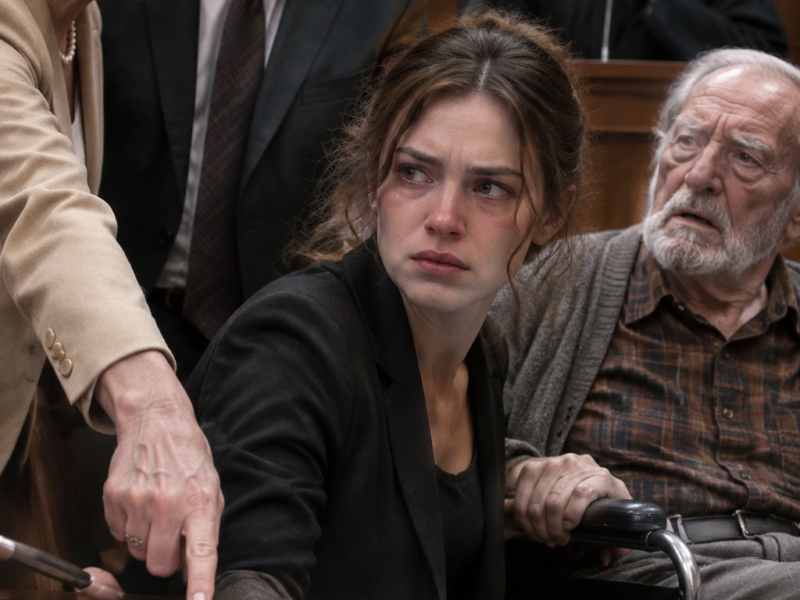
My Parents Declared My Grandpa DEAD in Court SIGN IT AND WE STAY A FAMILY — So I Drove Out and…
My Parents Declared My Grandpa DEAD in Court SIGN IT AND WE STAY A FAMILY — So I Drove Out and…
The first time my father told me my grandfather was dead, he did it while carving a brisket in front of forty people.
He didn’t look at me when he said it. He didn’t even stop cutting. His right hand held the carving knife, his left steadied the steaming meat, and his eyes remained fixed on the platter in front of him.
“Gone is gone, Vada. Thursday, a judge made it official.”
For a moment, I thought I had misunderstood him.
Behind him, the swimming pool shimmered beneath the afternoon sun. White folding tables stretched across the enormous backyard, champagne glasses sparkled in the hands of our relatives, and a brand-new banner hung between two wooden posts above the patio.
ALBRIGHT EXTERIORS — FIVE YEARS STRONG.
My brother, Brody, was pouring champagne near the outdoor kitchen. Several employees from the company stood around discussing business. My father’s friends were congratulating him on his beautiful new house, the one he had recently purchased in Poudre River Ranch. Everything looked perfect. The kind of afternoon people photograph and post online to show how successful their lives have become.
My father was preparing to make a speech about everything he had built.
And he wanted me standing beside him when he delivered it.
What he didn’t know was that I had spent the previous several days in Nebraska. He didn’t know what I had discovered there, and he certainly didn’t know who was waiting on the other side of his backyard gate, leaning on a cane and wearing a yellow rain slicker that had once belonged to the founder of our family business.
His name was Roscoe Keller.
He was my grandfather.
And forty minutes after my father declared him dead, that same man would walk through the gate and make my father’s entire world collapse in front of everyone he had invited to celebrate his success.
But before I tell you what happened that afternoon, you need to understand how we got there. Because this wasn’t a story about a missing grandfather who suddenly came home. It was about five years of lies, thousands of unanswered questions, a family business built on a man’s reputation, and a daughter who had been taught that keeping the peace was more important than demanding the truth.
My name is Vada Albright. I was thirty-five years old when everything finally came to a head. I made my living fixing roofs, just as my grandfather had taught me. I wasn’t the kind of person who spent much time talking about loyalty or family values. I believed in showing up, doing the work properly, and never promising someone something I couldn’t deliver.
My grandfather had taught me that.
Five years earlier, on a Thursday morning in August, I had been holding the bottom of a ladder while he inspected the flashing on one of our work trucks.
Roscoe Keller was seventy-four years old at the time. He had started Keller Roofing in 1979 with one old truck, a borrowed ladder, and practically nothing else. Over the years, he had built it into a respected roofing company serving Greeley and the surrounding communities in Colorado.
He knew every part of the business. He could identify a roofing problem by looking at the stains on a ceiling, and he could tell when someone had installed flashing incorrectly without even climbing onto the roof.
Every August, before hail season ended, he personally inspected the equipment. He never trusted someone else’s assurance that everything was fine.
“It’s fine, Grandpa,” I told him that morning. “Tino checked it Tuesday.”
He tapped the aluminum with one fingernail and listened.
“Tino checked it from the ground. You don’t guess where water goes, Vada. You go look.”
That was one of his favorite expressions. He used it whenever I was tempted to take someone’s word for something without checking it myself.
I didn’t realize how important those words would become.
My father, Steve Albright, had married my mother in 1988. He had spent twenty years working as general manager of my grandfather’s company. He was a capable businessman, and for a long time, I genuinely believed he had earned my grandfather’s trust.
That morning, he arrived in his truck carrying a folder.
“Roscoe, got a minute? I’ve been working on something.”
My grandfather remained on the ladder.
“What’s that?”
“Texas storm program. Two trucks, four canvassers. We follow the hail from Amarillo north. Insurance pays, and we triple the business by spring.”
My grandfather finally climbed down.
“We fix roofs, Steve. We don’t farm hail.”
My father sighed.
“Then we’ll be fixing roofs for nobody in five years. Everybody’s doing it.”
“Everybody’s doing it is how you get sued.”
My father glanced toward me, expecting me to support him. I was thirty years old then, responsible for preparing estimates and handling much of the company’s paperwork. I had seen enough questionable insurance claims to understand my grandfather’s concerns.
Still, I said nothing.
Silence had become my easiest way of avoiding arguments between the two men.
My grandfather wiped his hands on his jeans and handed me the folder without even opening it.
“I’m going up to the lake for a few days. Same as every August. Don’t let your father sell my ladders.”
Then he climbed into his blue Ford pickup and drove away.
I watched him leave the yard.
He turned east toward the interstate instead of north toward the lake.
I remember noticing it, but I didn’t think much about it. Perhaps he had forgotten something. Perhaps he was stopping somewhere before continuing to the cabin.
It was the last time I ever saw him drive.
By Sunday evening, he still hadn’t called.
That was unusual. My grandfather always called from the lake. Even if he had nothing important to say, he would phone to ask how the crews were doing or whether I had remembered to order materials.
I called the neighbor who watched his cabin, a retired trucker named Del Void.
“Have you seen Roscoe?”
“No,” Del answered. “Haven’t seen his truck, either. Porch light’s still off.”
I immediately drove to my father’s house.
He and my brother were sitting on the patio watching a Colorado Rockies game. There was a cooler between them, and neither looked particularly concerned when I walked over.
“He’s not at the lake,” I said. “He never got there.”
My father kept watching the television.
“He does this.”
“What?”
“He gets his feelings hurt and drives around. He’ll sulk back Tuesday.”
“Dad, he’s seventy-four. He doesn’t sulk. He sits down and calls.”
Brody opened another beer.
“Maybe he’s making a point about the Texas thing.”
I stared at both of them.
“I’m going to the police in the morning.”
My father finally turned toward me.
“Give it until Monday. Don’t embarrass him.”
I agreed, mostly because Monday was only eleven hours away.
At eight o’clock the following morning, I was standing at the counter of the Greeley Police Department with a photograph of my grandfather on my phone.
My father arrived ten minutes later wearing his company polo.
He walked directly toward the officer, took the clipboard from my hands, and signed the missing-person paperwork as Roscoe’s son-in-law.
Under primary contact, he wrote his own name.
Under callback number, he entered the company’s office number.
I noticed that.
I didn’t understand the significance.
He handed the clipboard back to the officer and walked out with my pen still in his hand.
In the parking lot, he stopped beside his truck.
“Vada, if he doesn’t want to be found, gone is gone.”
I stood there holding nothing but a photograph of my grandfather and an uncomfortable feeling I couldn’t explain.
I told myself my father was probably right.
I told myself Roscoe was tired and would eventually come home.
Four weeks passed.
Then my father was sitting in my grandfather’s office chair.
It creaked differently beneath him. Heavier, somehow. I noticed it every time I walked past the office.
He had the company lawyer on speakerphone, and Brody was sitting in the guest chair.
“Vada, come sit. This concerns you.”
The lawyer explained that the bank had frozen certain accounts and transactions because Roscoe’s signature was required. Forty employees depended on the company, and someone needed legal authority to keep operations running.
The court could appoint a conservator for the estate of an absent person.
My father wanted that authority.
“Then appoint two people,” I said. “Him and me.”
The lawyer paused.
“Courts generally prefer a single signature. Steve is the general manager.”
“I’m the person preparing the estimates and handling the work.”
“Vada, you’re thirty years old,” my father interrupted. “Brody and I can manage this.”
I filed my own petition anyway. I paid a lawyer four hundred dollars to prepare the paperwork and requested to be appointed co-conservator.
Three weeks later, the decision arrived.
Denied.
My father read the email over my shoulder.
“Told you.”
I didn’t give up.
I hired a private investigator from Denver. Six thousand dollars bought me three months of searching.
He found nothing useful. There were no credit card transactions, no cell phone records, and no hospital admissions under Roscoe’s name in Colorado.
My grandfather didn’t even own a cell phone.
The investigator eventually told me something that should have sounded strange.
“Your dad has already got the missing-person stuff covered. He’s the contact on everything.”
I didn’t understand what he meant.
That afternoon, my father placed a brass nameplate on the desk.
STEVE ALBRIGHT — GENERAL MANAGER.
It covered the framed photograph of my grandmother that had sat there since 1994.
He didn’t remove the photograph. He simply placed his name in front of it.
By November, the blue Ford pickup came home without its owner.
My father drove into the company yard behind a rented flatbed. Roscoe’s truck was strapped to the back, and everyone stopped working when they saw it.
He climbed down and announced that the vehicle had been found abandoned at a gas station off Interstate 80 in Nebraska.
“Sheriff over there figures he walked off toward the river,” he explained. “That’s all they’ve got.”
Tino, our foreman since 1995, removed his cap and held it in his hands.
I couldn’t take my eyes off the truck.
My father handed me a cardboard box containing a pair of sunglasses, work gloves, a green steel thermos, and a receipt from Keith County Towing.
“Which station?” I asked.
“Some Sinclair.”
“Who called it in?”
“Vada, I signed for the truck. That’s all they had.”
I looked at him.
“Did you ask who found it?”
“There’s no point going over everything again.”
The next morning, I drove 170 miles to Big Springs, Nebraska.
The Sinclair station smelled of diesel fuel and hot dogs. A young clerk told me he had started working there in October, so he hadn’t been present when my grandfather disappeared.
The manager came out and listened to my questions.
“Cameras roll over every thirty days,” he explained. “There was an old fellow here back in August, though. EMS came.”
I felt my stomach tighten.
“EMS took him where?”
“Ambulance, I’d guess. Ogallala’s closest.”
I immediately called Ogallala Community Hospital.
They couldn’t find anyone under Roscoe Keller’s name.
I called North Platte.
Same answer.
I sat in my truck and wrote the letters EMS in my notebook. I underlined them twice.
It was the only concrete piece of information anyone had given me in three months.
Then I opened the green thermos.
There was coffee inside, three months old.
I poured it onto the gravel, washed the container as best I could, and kept it.
I still have that thermos.
In January, another piece of my grandfather’s life disappeared.
A crane truck arrived at the company yard on a freezing morning. Two workers climbed into their harnesses and began removing the wooden sign that Roscoe had carved himself in 1979.
KELLER ROOFING — SINCE 1979.
A new aluminum sign waited on the flatbed.
ALBRIGHT EXTERIORS — ROOFING, SIDING, STORM RESTORATION.
I stood beside Tino, drinking coffee.
“You’re a conservator, Dad,” I told him when he came outside. “Not an owner.”
My father barely looked at me.
“It’s a DBA, Vada. Same company. Different name on the truck.”
“Then why take his name off the building?”
“Customers keep asking where he is. I don’t have an answer. Keller’s name is becoming a liability.”
“You could have an answer if anybody was still asking the questions.”
He turned toward me.
“I’m not erasing him. I’m protecting the brand.”
That was when I realized he had been speaking about my grandfather in the past tense for months.
Was, not is.
Brody was photographing the new sign for Facebook.
He captioned the picture, “New era.”
My father pointed at the old wooden sign.
“Tino, put that in the dumpster.”
Tino looked at it for a long moment.
Then he bent down, picked up one end, and nodded toward me.
I grabbed the other end.
Together, we carried it past the dumpster and placed it in the bed of my truck.
“Sign goes in your truck,” he whispered. “Not the dumpster.”
Behind us, four empty bolt holes remained in the brick wall.
Rust streaks ran down from them like tears.
For the next several years, I tried to keep my grandfather’s lessons alive, even as the company that carried his name became something I barely recognized.
The first major hailstorm of 2022 hit Evans in March.
The following morning, Brody and I visited an elderly woman named Mrs. Euler. She was eighty-one, and water was leaking into her kitchen above the sink.
Brody climbed onto the roof without properly securing his harness. He walked around for four minutes, came down, and immediately began writing an estimate.
“Full replacement. Eighteen thousand four hundred dollars. Insurance covers it.”
I had inspected the roof before he climbed up.
There were three small hail dents on the south-facing slope and a cracked rubber boot around the vent pipe.
That was where the water was entering.
Mrs. Euler looked at me.
“Do I need a whole new roof, honey?”
“No, ma’am. You need eleven shingles and a replacement pipe boot. About four hundred dollars.”
Brody stopped writing.
“Vada, that’s not how Dad’s program works. We submit the storm claim, get the adjuster to sign off, and replace the whole thing.”
I refused.
He called my father and put him on speaker.
My father’s voice came through the phone.
“Sign the estimate or go home, Vada.”
I looked at the elderly woman standing beside me. Then I looked at the clipboard.
I handed it back to Brody, walked to my truck, and peeled the magnetic Albright Exteriors sign off the door.
Brody followed me.
“You just quit Grandpa’s company.”
“No,” I told him. “I just left yours.”
Mrs. Euler came down her front steps in her slippers.
“Who do I call for those eleven shingles?”
I took the estimate from my brother, turned it over, and wrote my cell number on the back.
She became the first customer of my new business, Front Range Roof and Gutter Repair.
Four hundred dollars.
Her roof never leaked again.
I built my business slowly. I didn’t have the money to compete with large roofing companies, and I didn’t want to.
I had three employees, a used bucket truck, and a growing reputation for telling homeowners when they didn’t need an entirely new roof.
I still thought about my grandfather every day.
Every quarter, I called two sheriff’s offices in two states to ask whether anything new had been discovered.
Nothing ever came back.
By August 2025, I had been running my own business for three years.
One afternoon, I visited my grandfather’s sister, Jenny, in Eaton.
She poured coffee from a green thermos nearly identical to the one sitting in my garage. On her kitchen table was a printed card.
CELEBRATION OF LIFE FOR ROSCOE D. KELLER.
My father had ordered two hundred copies.
Jenny looked disgusted.
“He asked me to co-host.”
“What did you tell him?”
“I told him I don’t host funerals for people who aren’t dead.”
I stared at the card.
“He’s not dead, Aunt Jenny.”
“I know that. Your father knows something else.”
She explained that my father had told people at church that another year would allow him to ask a judge to declare Roscoe legally deceased.
My grandfather’s will left his estate to my mother. She had died in 2014, which meant her share would eventually be divided between her children.
Brody and I.
Half to him.
Half to me.
My father wanted the estate kept together, which meant he wanted my half transferred to my brother.
“He’ll ask nicely first,” Jenny said.
I looked down at the funeral card.
“You don’t hold a funeral for a man you didn’t look for.”
“No,” she replied. “You don’t.”
She stood, opened a drawer, and placed a Christmas card in front of me.
It was dated December 2023.
The handwriting was unmistakably my father’s.
“Roscoe would have wanted us to move on.”
I read the sentence twice.
“Two years ago,” Jenny said, “your father already knew what Roscoe wanted.”
I couldn’t answer.
That evening, I returned to my truck and sat for a long time before starting the engine.
I had spent years searching for my grandfather while everyone else seemed increasingly comfortable with his absence.
Jenny placed her hand over mine before I left.
“Your father buried him the first week, honey. He just waited five years for the paperwork.”
I didn’t know how right she was.
The next important development came in June 2026.
My father walked into my shop while I was operating the gutter seamer.
I hadn’t seen him in eight months.
My youngest employee, Dez, looked up when he entered, then quickly returned to his work.
My father placed a white envelope on the workbench.
“Two things. Read them both.”
The first document was a petition for presumption of death.
Roscoe D. Keller.
The hearing was scheduled for August 20.
The second document was called a family business continuity agreement.
It proposed that I transfer my expected inheritance to Brody in exchange for forty thousand dollars.
My father described it as generous.
“It’s more than the shares are worth on paper.”
I ignored the agreement and read the petition again.
One sentence caught my attention.
“Petitioner has had no contact with and no knowledge of the whereabouts of the absentee since August 12th, 2021.”
I looked up.
“You’re swearing to this, Dad?”
“It’s a form. Everybody signs it.”
“It’s a sworn statement.”
He shrugged.
“Sign the agreement before the hearing and we stay a family. That’s all I’m asking.”
“And if I don’t?”
He started to answer.
“Then the facility…”
He stopped.
Something changed behind his eyes.
Then he continued.
“Then the reality is he’s gone, Vada. Gone is gone. Sign it.”
He placed a blue company pen on top of the envelope and walked out.
Dez waited until the truck disappeared.
“What’s the facility?”
“I don’t know.”
But I wrote the word in my notebook.
Facility.
Four years and seven months after I had written EMS.
A few weeks later, my brother and I ended up bidding on the same church roof in Windsor.
It was the first time we had stood together on a roof in four years.
Brody had a brand-new black F-350 parked outside.
“Dad’s house is finished,” he told me. “One-point-four million. Poudre River Ranch. Pool, everything. You should come see it.”
“I’m sure it’s nice.”
“Dad’s throwing the reunion there on August twenty-second. Two days after the hearing.”
He smiled.
“Five years strong. He’s putting your name on the banner, too. Founding family.”
I looked at him.
“You’re throwing a party for the day Grandpa dies?”
“For the day we stop waiting.”
“For the day it’s finally ours,” he added.
I continued walking along the ridge, counting the roof vents.
Then I asked something that had been bothering me.
“Did you ever drive out to Nebraska?”
He looked confused.
“What?”
“The gas station. The tow yard. Did you ever go there?”
“Dad handled Nebraska.”
“You never went?”
“Why would I? He went. He got the truck. There was nothing else.”
I didn’t argue.
I simply climbed down first.
Brody remained on the roof in the afternoon sun, forty feet above the parking lot, without a harness.
My grandfather would have fired him for that before he fired him for anything else.
Two weeks later, I was working in Fort Morgan, replacing three panels of tin on a woman’s porch roof.
Her name was Mary Ann, and she was sixty years old.
She sat in a lawn chair with an AM radio playing nearby while I worked.
During a conversation, she mentioned that her eighty-eight-year-old father lived in a care center in Ogallala, Nebraska, called Prairie View.
“I visit every other Sunday,” she said. “There’s an old fellow there, a roofer. Tells the aides the north hall leaks at the flashing every time it rains. And he’s right. It does.”
I stopped drilling.
“He says he built half of Greeley. Wears a yellow slicker in the dining room like he’s about to climb a ladder.”
My hands went cold.
“Does he have a name?”
“Everybody calls him Ross. Ross something. Sharp as a tack, but slow on his feet. He’s got a cane now. Used to use a chair.”
“Ross?” I repeated.
“Or Roscoe?”
She shrugged.
I climbed down the ladder faster than I had climbed up.
I called Prairie View from her porch.
A woman answered.
“Prairie View Care Center.”
“I’m looking for a resident named Roscoe Keller. He might be listed as Ross.”
There was a pause.
“Ma’am, we can’t confirm or deny residents. I’m sorry.”
I hung up.
Mary Ann watched me over her glasses.
“You forgot a screw up there.”
She was right.
I had left a screw on the roof.
I didn’t go back up until I could hold the drill steadily.
The next morning, I visited Trish Bellamy, an attorney in Greeley who had practiced probate and elder law for twenty-six years.
She read my father’s petition carefully.
When she reached the sworn statement, she underlined it in red.
“Five years? No contact? No information?”
She leaned back.
“If nobody gives the judge evidence that he’s alive, the judge signs. That’s how the law works.”
“I want to object.”
“Then you need proof.”
I told her about the man in the yellow slicker.
She listened without interrupting.
Finally, she explained that a private care facility would not confirm a resident’s identity without proper authorization or legal process.
“No judge is going to issue a subpoena because somebody told you a story on a porch,” she said. “I’m not being cruel, Vada. I’m telling you what the wall looks like.”
“What do I do?”
“You go there.”
“If it’s him, I don’t need a subpoena. I need him.”
Then I told her about the envelope my father had brought to my shop.
The petition.
The agreement.
And the word he had started to say before stopping.
Facility.
Trish underlined the words no knowledge a second time.
“If your father knows where Roscoe is and signed this anyway, that’s a different case. Potential fraud on the court and exploitation of an at-risk elder.”
She paused.
“But I need evidence. Not suspicion.”
Then she asked a question that changed everything.
“If Roscoe was ever a patient anywhere, who did the hospital call? What number would a seventy-four-year-old man without a cell phone give a nurse?”
I opened my mouth.
Then I stopped.
“The shop.”
“What?”
“The company number. He’s had it since 1979. It’s the only number he’s ever memorized.”
Trish looked directly at me.
“And who answers that number now?”
I hadn’t called the old company line once since leaving Albright Exteriors.
That night, I went into my garage.
The wooden Keller Roofing sign was leaning against the wall beside the cardboard box containing my grandfather’s belongings.
I ran my fingers over the carved letters.
Dez appeared in the open doorway to return the bucket truck keys.
“That your grandpa’s sign?”
I nodded.
He asked what had happened, and for some reason I began telling him everything.
The missing truck.
The gas station.
The abandoned thermos.
My father’s strange behavior.
The care facility.
The five years of unanswered questions.
He listened quietly.
When I finished, he asked something so simple that I almost laughed.
“Why did your dad go get the truck alone?”
I looked at the tow yard receipt.
“Because I let him. He was the general manager. It seemed like his responsibility.”
“Did you ever call the tow yard yourself?”
I stared at the receipt.
“No.”
“Why not?”
I had no answer.
The next morning, at two minutes past seven, I sat in my truck outside a job site in West Greeley.
The engine was off.
My grandfather’s green thermos rested on the passenger seat.
I dialed the old company number from memory.
It rang twice.
“Albright Exteriors, this is Steve.”
My father.
I didn’t speak.
“Hello?”
I could barely breathe.
“Hello, this is Steve.”
Then his voice changed.
“Vada? Is this you?”
I swallowed.
“Since when does the shop line ring your cell?”
“Since we moved the office in 2022. I had it ported. What do you need?”
“Nothing. I was just checking a number.”
I hung up.
For several minutes, I sat with both hands on the steering wheel.
Suddenly, the entire mystery looked different.
Every hospital employee who had asked my grandfather for a contact number would have called the shop.
Every deputy.
Every tow yard clerk.
Every nurse.
Every person who had tried to reach his family.
And the number they had called no longer reached the company office.
It reached my father.
For five years, there had been one door through which anyone could have found my grandfather.
My father had been standing in that doorway the entire time.
Two minutes later, my phone rang.
It was him.
I answered but said nothing.
“Whatever you’re doing, Vada, stop.”
He didn’t ask what I was doing.
He didn’t ask why I had called.
He simply told me to stop.
Then he hung up.
I stared at the dashboard clock.
7:06.
The thermos sat beside me like it had been waiting for that moment.
I called Keith County Towing.
A woman named Brandy answered on the fourth ring. Her father had owned the towing business before retiring in 2024.
She explained that her father had kept detailed paper records in an old ledger.
I gave her the date.
August 12, 2021.
I could hear pages turning over the phone.
“Here it is. Blue Ford F-150. Sinclair in Big Springs. Vehicle towed after the station called. There’s a note.”
“What does it say?”
“Driver transported by Keith County EMS to Ogallala Community Hospital. Vehicle towed to yard.”
I closed my eyes.
“Is there a release?”
More pages turned.
“November 9, 2021. Release to Steve Albright, son-in-law. Presented registration and ID. Paid two hundred and forty dollars in storage.”
She paused.
“There’s another note from my dad.”
“What note?”
“It says, ‘Told him EMS took the old man to Ogallala.’”
I felt the air leave my lungs.
“Can you read that again?”
She repeated it slowly.
My father had been told exactly where the ambulance had taken my grandfather.
He had known on November 9.
The following day, he had returned to Colorado and announced to forty employees that the sheriff believed Roscoe had walked off toward a river.
He had known where the ambulance went.
And he had lied.
I asked Brandy to send me copies of the ledger pages.
When I hung up, I sat motionless in the truck.
Dez was already on the roof waiting for me.
I didn’t move.
That afternoon, I took the documents to Aunt Jenny.
She read every line carefully.
Then she placed her hand flat on the paper.
“Ogallala,” she whispered.
She picked up her phone and called the hospital.
The woman in patient records explained that she couldn’t confirm a patient’s presence to anyone who wasn’t listed as an authorized contact.
Jenny asked who that person was.
The woman refused to say.
However, she explained that when a patient arrived unidentified, the county sheriff maintained the identification record.
Jenny thanked her and hung up.
“Then I’ll call the sheriff.”
Before we left, she told me something else.
In 2019, my father had asked my grandfather for twenty percent ownership of Keller Roofing as a reward for twenty years of service.
My grandfather had refused.
He had told Steve that he would receive what my mother would have received through her children.
Not through Steve.
Through Brody and me.
Jenny tapped the table.
“That’s why he needs your name on a piece of paper, honey. He can’t get there without you.”
Then she mentioned something that made the entire situation even worse.
“Your father’s been to Nebraska more than once, Vada.”
I looked up.
“He borrows my Buick when his truck is in the shop.”
“How often?”
“Four or five times a year.”
I stared at her.
His truck was never in the shop.
The following morning, I drove to the Keith County Sheriff’s Office in Ogallala.
A deputy named Stelmack came to the records window.
I gave him the date and my grandfather’s name.
He typed slowly, using two fingers.
Then he turned the screen slightly.
August 12, 2021.
Unidentified male, approximately seventy years old. Medical emergency. Transported by EMS. No wallet on his person.
Wallet later recovered from vehicle at tow yard.
He scrolled down.
November 16, 2021.
Identified by patient self-report as Roscoe Keller, Greeley, Colorado.
Family notified.
I felt my knees weaken.
“Who was notified?”
Deputy Stelmack read the number.
It was the old company line.
“Steve Albright, son-in-law.”
He continued reading.
“Confirmed identity in person, November 19th. Signed confirmation form.”
I looked at him.
“In person?”
“Yes, ma’am. Drove out, looked at him, signed. That’s what it means.”
My father had retrieved the truck on November 9.
He had lied to us on November 10.
Then he had returned to Nebraska on November 19, stood in front of my grandfather, confirmed his identity, and signed a government document acknowledging that he was alive.
For nearly five years, he had allowed us to believe Roscoe was missing.
“Where did he go after the hospital?” I asked.
The deputy checked another note.
“Discharged to long-term care. That’s all we have.”
He slid a printed page across the counter.
“Whole county has two long-term facilities. I’d start with the one with the porch.”
“Which one?”
“Prairie View, east side. Residents sit outside after breakfast.”
I folded the paper and placed it in my shirt pocket.
I had finally found the place where my grandfather had been living.
But I wasn’t going to rush into it without thinking.
I checked into a motel along the highway and called Trish.
I read her the sheriff’s record word for word.
She was silent for several seconds.
Then she spoke.
“Your father’s petition is perjury the day he signed it. He confirmed Roscoe’s identity in person in 2021 and swore he had no knowledge of his whereabouts in 2026.”
“What do I do?”
“Nothing tonight. Don’t alert him. If he’s at Prairie View and your father becomes nervous, he could move him. Go in the morning. If you find him, call me. Don’t call anyone else.”
I tried calling my father.
His cheerful company voicemail answered.
I didn’t leave a message.
Then I called Jenny.
She picked up immediately.
“Well?”
“He was there, Aunt Jenny. My father went out in November 2021 and signed his name.”
There was a long silence.
Then she spoke in a steady voice.
“Then go get my brother.”
The next morning, I arrived at Prairie View Care Center shortly after nine.
The receptionist was polite.
But she was also firm.
“You’re not on any resident contact list, ma’am. I can’t confirm anyone by name.”
I understood.
Privacy rules existed for good reasons. I wasn’t going to demand that an employee risk her job simply because I had driven a hundred and seventy miles.
I returned to my truck and sat with both windows open.
The day was already warm.
I remembered my grandfather’s voice.
You don’t guess where water goes. You go look.
So I looked.
First, I examined the building.
I was a roofer. I couldn’t help noticing the rust streak beneath the flashing on the north side, where the wall met the low-slope section of the roof.
It was exactly the kind of problem my grandfather would have identified.
Forty minutes passed.
A woman wearing maroon scrubs came out of a side door. Her badge said LaDonna, CNA.
She walked into the shade near my truck and lit a cigarette.
I held my phone toward her.
The screen displayed a photograph of Roscoe standing on a ladder truck in 2019.
She studied it for a long time.
Then she looked away.
“I can’t say a word, ma’am. I’d lose my job.”
“I understand.”
She took another drag.
“It’s a nice morning, though. Residents like the north porch after breakfast. Gets the shade.”
I waited.
“Which side is north?”
She stepped on her cigarette.
“The side that leaks.”
Then she returned inside.
I got out of my truck.
I walked around the building toward the shaded porch.
There were six people sitting outside.
Only one wore a yellow rain slicker in the middle of an eighty-degree morning.
He sat at the far end in a plastic chair. A cane rested against the armrest.
He was thinner than I remembered.
His shoulders were smaller, and his face had changed. But the yellow slicker was unmistakable.
The words on the back were cracked and faded.
KELLER ROOFING.
I stopped at the bottom of the steps.
He looked up.
For several seconds, neither of us spoke.
Then his eyes widened.
“Vada.”
I sat down on the step because my legs could no longer hold me.
“Grandpa.”
He studied me carefully.
“Steve said you went to Oregon. Said you didn’t want to see me like this.”
I shook my head.
“I’ve been in Greeley the whole time, Grandpa. Fixing roofs.”
“With him?”
“No. I started my own company. Eleven shingles at a time.”
Something in his expression softened.
“He said you’d changed your number. Said you’d moved on.”
“I called every hospital in two states. I hired an investigator. I drove to the gas station. I’ve been searching for you for five years.”
He nodded slowly.
Then he looked at the ground.
“Then I wasn’t missing, was I?”
“No, sir.”
He thought about that for a moment.
“Nobody’s missing, Vada. Somebody just stopped looking.”
The words landed harder than anything my father had ever said.
I noticed a dark stain on the left elbow of his yellow slicker.
It was an old tar mark, shaped like a thumb.
I knew exactly where it came from.
The Maplewood Elementary re-roof in 2019. My grandfather had leaned against a hot seam to show me how the membrane should overlap.
He had been wearing that same slicker when he disappeared.
I sat beside him, trying to understand how five years of my life had been stolen while he sat less than two hundred miles away.
“He comes,” my grandfather said quietly.
“Who?”
“Steve.”
My stomach tightened.
“Every few months. Pays the lady at the desk. Brings me the Greeley newspaper. Never the business section.”
He explained that he had become ill at the gas station.
He had stopped for coffee, become dizzy at the pump, and collapsed.
When he woke in the hospital, he couldn’t remember his own name.
For three months, he struggled to recover his speech and use of his right hand.
He had eventually remembered the old company phone number.
It was the only number he had ever memorized.
When he told the hospital staff, they called it.
And my father answered.
“What did he tell you?” I asked.
My grandfather looked toward the window.
“He said the company was fine. Said you’d left. Said there was no sense dragging me back to Greeley in a chair just to sit in a corner.”
“Did you ask him to call me?”
“Every time. Every single time.”
I swallowed.
“What did he say?”
“That you’d changed your number. That you’d gone to Oregon. That I should let you have your life.”
I stared at him.
For five years, I had believed he was somewhere alone, perhaps confused, perhaps unable to find his way home.
He had been believing I had abandoned him.
We had both been waiting for someone who had never intended to bring us together.
I told him about the company.
The new name.
The storm restoration program.
The trucks.
Brody’s black F-350.
The new house.
He listened without interrupting.
Then he asked a question that almost broke me.
“Did he keep my ladders?”
“Tino kept them.”
“Good.”
We went inside to his room.
Room 12.
There was a bed, a chair, a small window overlooking the parking lot, and a newspaper on the table.
The business section had been torn out.
I understood why.
My father hadn’t simply kept my grandfather away from his family.
He had kept him away from the world.
Every newspaper.
Every visit.
Every carefully selected piece of information.
He had created a small, comfortable prison and called it protection.
I helped my grandfather meet with the facility administrator, Mrs. Kohler.
He asked to change his authorized contacts.
He wanted my name and his sister Virginia’s name on the list.
Mrs. Kohler checked his records and confirmed that he was competent to make that decision.
When she brought the paperwork, he signed it slowly with his left hand.
Roscoe D. Keller.
Every letter was deliberate.
While she was there, I asked who was paying for his care.
“Private pay,” she answered. “Monthly.”
“From whom?”
She checked the computer.
“Albright Exteriors LLC. Mr. Steve Albright is listed as the responsible party.”
My grandfather leaned forward.
“Whose money is that?”
I answered before the administrator could.
“Yours, Grandpa. That’s your company’s account.”
It turned out my father had been paying the monthly fees since January 2022, after my grandfather’s Medicare-covered days had ended.
The money came from Keller Roofing’s company accounts, now operating under the Albright name.
The payments were recorded as consulting expenses.
My grandfather stared at the administrator.
“He’s paying to keep me here with my own money?”
Mrs. Kohler looked uncomfortable.
“We had no way of knowing the circumstances.”
“You had his name on the door,” I replied. “It was on the checks.”
She didn’t answer.
Instead, she gave us copies of the payment records.
January 2022.
The same month my father had removed Keller Roofing’s wooden sign from the company building.
He had taken my grandfather’s name off the wall in Colorado while using the company’s money to keep him hidden in Nebraska.
That afternoon, my grandfather and I drove to Trish’s office.
She reviewed the records and explained exactly what would happen next.
“I can file an affidavit immediately,” she said. “The hearing scheduled for Thursday can be stopped. Your father will receive notice from the court, and I’ll contact the sheriff.”
My grandfather shook his head.
“No.”
Trish looked at him.
“Mr. Keller, with respect, your son-in-law is going to stand before a judge and swear you’re dead.”
“Let him.”
She frowned.
“Let him stand up and say it under oath,” my grandfather repeated. “Then I’ll answer.”
Trish turned toward me.
“Vada, understand what you’re agreeing to. Once this happens, your father could face criminal charges. Exploitation of an at-risk elder. Perjury. This isn’t going to be a private family disagreement anymore.”
My grandfather looked at me.
“It’s my name, Vada. I want it back in front of the people who watched him take it. Not in a courtroom. In his yard.”
I thought about the missing-person report.
The river.
The funeral cards.
The company sign.
The years of searching.
Then I nodded.
“Saturday.”
Trish picked up her red pen.
“I’ll file the report Saturday morning. Not before. That’s the most I’ll bend.”
The hearing took place on Thursday, August 20.
The courtroom was small, with enough seating for about thirty people.
My father and Brody sat at the front beside their lawyer.
I sat in the last row.
The judge reviewed the petition and asked my father a direct question.
“Mr. Albright, since August of 2021, have you had any contact with or received any information regarding the whereabouts of Roscoe Keller?”
My father stood.
He wore the gray suit he usually reserved for funerals.
“None, Your Honor. We’ve searched. Private investigators, police in two states, nothing.”
I listened to every word.
He spoke clearly.
Confidently.
Without hesitation.
The judge reviewed the documents.
“The court finds the statutory period satisfied. The petition is granted.”
Her stamp came down.
Nine minutes.
Five years of searching, and it took nine minutes to declare my grandfather legally dead.
In the hallway afterward, my father approached me.
“You could have spared yourself this. You didn’t have to sit through it.”
“I wanted to hear you say it under oath.”
He studied my face.
“It’s done, Vada. Saturday, you sign the agreement and we’re a family again.”
Brody joined us.
“Dad’s putting the old sign back up for the party. For Grandpa. Kind of a tribute.”
“Which sign?”
“The new aluminum one, with a plaque.”
My father placed his hand on my shoulder.
“Bring Jenny. Roscoe would have wanted her there.”
“I’ll bring her,” I replied.
“I’ll bring everybody who should be there.”
He smiled.
He thought I had finally accepted his arrangement.
I let him believe it for two more days.
On Friday morning, I drove back to Ogallala.
My grandfather sat in the passenger seat with his cane between his knees.
He didn’t say much during the journey except to remind me that I was following too closely.
We stopped in Eaton to pick up Jenny.
She was standing at the front door before I had even turned off the engine.
She was seventy-six years old and had known her brother all her life.
When she saw him climb out of the truck, she didn’t rush down the steps to help.
She knew he would hate that.
He made it to the bottom of the walkway and stopped.
“Jenny.”
She looked at him.
“You’re thin.”
He studied her.
“You’re old.”
She laughed and cried at the same time, then hit him lightly on the arm.
Tino came by after work.
He stood in the kitchen doorway, still wearing his work boots, holding his cap in both hands.
For several seconds, he couldn’t speak.
Finally, he managed one word.
“Boss.”
My grandfather looked him up and down.
“Are my ladders in one piece?”
“Every one. I hid the old ones behind the trusses.”
“Good man.”
That evening, my grandfather went outside to Jenny’s front gate.
He had built it himself in 1985.
He practiced walking through it with his cane.
The first time, he caught the latch.
The second time, his foot caught the threshold.
The third time, he walked through cleanly and turned around to come back.
“You don’t have to walk tomorrow,” I told him. “I can drive you right up to the gate.”
“I’ll walk.”
He rested both hands on the cane.
“He’ll want to see me walk.”
Jenny called my father from the porch to tell him she was coming to the party.
She put the phone on speaker.
“I’m bringing a guest, Steve.”
“The more the merrier, Ginny.”
“Big day.”
She hung up and looked at her brother.
“He said the more the merrier.”
My grandfather smiled faintly.
Then he closed the gate.
The same gate he had built more than forty years earlier.
Saturday afternoon arrived.
My father’s backyard looked like the final page of an expensive real estate brochure.
The kidney-shaped swimming pool was sparkling. Six folding tables stood beneath white cloths. An enormous offset smoker filled the air with the smell of brisket.
The banner stretched between the pergola posts.
ALBRIGHT EXTERIORS — FIVE YEARS STRONG.
Beside the little stage stood a brand-new aluminum sign with a brass plaque.
IN MEMORY OF ROSCOE D. KELLER, 1947–2021.
Forty people had gathered.
Jenny sat in the front row with her purse on her lap.
Tino stood near the west gate with his arms crossed.
Brody was carrying a tray of food.
At four o’clock, my father tapped his champagne glass with the carving knife.
“Five years ago, this family lost its founder. This year, we found out what we’re made of.”
He began talking about the company’s revenue.
Four-point-one million dollars the previous year.
The new trucks.
The new house.
The company’s expansion.
He waved the knife toward the house.
“And as of Thursday, my father-in-law is officially at peace, and this company is officially, legally, a family company.”
People applauded.
Jenny didn’t.
My father turned toward me.
“Vada, come up here.”
I walked across the grass.
He held up the blue pen and the agreement.
“One signature in front of everybody, and we close the book. Forty thousand dollars and a clean slate.”
I didn’t reach for the pen.
“No.”
He laughed, trying to make it sound like a joke.
“Easy. Honey, gone is gone.”
“He wasn’t gone, Dad.”
I spoke at the same volume I used when talking to someone on a roof. Loud enough to carry without shouting.
“He was in Ogallala, Nebraska. Prairie View Care Center. Room 12.”
My father’s smile disappeared.
“You’ve been paying for his room since January 2022 with his own company’s money. You’ve been visiting him four or five times a year using Aunt Jenny’s Buick.”
Nobody moved.
My father held his champagne glass in one hand.
The liquid began running down his wrist.
He didn’t notice.
I turned and walked across the grass toward the west gate.
Tino lifted the latch.
The gate swung open.
And there he was.
My grandfather stood on the other side wearing his yellow slicker.
KELLER ROOFING was written across the back.
His cane rested in his left hand.
He took the first step through on his own.
One.
Two.
Three.
He didn’t look at me.
He looked across the forty people gathered around the swimming pool.
Then he started walking.
My father’s face turned white.
Not pale.
White.
The champagne glass slipped from his fingers and landed in the grass.
Brody stared at the gate.
“Grandpa?”
His voice sounded like the voice of the nine-year-old boy I remembered.
The tray slipped from his hands. Deviled eggs rolled across the patio.
Jenny stood up.
Tino removed his cap.
Someone near the smoker whispered my father’s name.
My grandfather continued walking.
Slowly.
Steadily.
He stopped beneath the banner.
Directly in front of the aluminum sign carrying his name and the dates of his supposed death.
He looked at the plaque.
Then he read it aloud.
“1947 to 2021.”
He raised his eyes.
“Afternoon, Steve. Room 12. You know the way.”
My father’s mouth opened.
“Roscoe, we…”
My grandfather interrupted him.
“You didn’t think, Steve. You paid.”
The yard became so quiet that I could hear the pool filter humming.
I walked over and stood beside my grandfather.
My shoulder touched the yellow rubber of his slicker.
Then I repeated the words he had spoken to me on the porch in Nebraska.
“Nobody’s missing. Somebody just stopped looking.”
For the first time in five years, my father looked at me for longer than two seconds.
He looked at me as though I were the stranger who had opened the gate.
My father finally began speaking.
And when he did, the words came out all at once.
“You want to know why?”
He was talking to my grandfather, but his eyes kept moving toward the guests, counting how many people were listening.
“Thirty years. Thirty years I ran your company, and you never once said it was mine.”
He shook his head.
“Not once. I kept forty families paid. I kept the lights on while you sat in a chair in Nebraska. What was I supposed to do, Roscoe? Put the founder in a wheelchair on the website? Tell every customer in Weld County that the man on the sign couldn’t hold a spoon?”
Nobody interrupted him.
My grandfather allowed him to finish.
He had always been the kind of man who let someone complete an explanation before deciding whether it was worth believing.
Then he pointed his cane toward my father.
“You were supposed to tell her.”
My father stopped.
“Every time you came, I asked for her. You told me she’d changed her number. You told me she’d gone to Oregon.”
My grandfather’s voice remained calm.
“I asked you to call my granddaughter. Every single time.”
My father looked away.
“I visited every quarter,” he said.
He seemed to realize what he had admitted only after the words had already left his mouth.
Jenny spoke from the front row.
“You visited Steve. You didn’t tell his sister he was alive. You sent me a Christmas card about moving on.”
Brody stood behind the overturned tray.
“Dad?”
His voice was hoarse.
“Did you know the whole time?”
My father didn’t answer.
He looked at the swimming pool.
That was the answer.
Everyone in the backyard understood it at the same moment Brody did.
My brother slowly placed the empty tray on the table.
Then he walked across the patio and stood beside Tino near the gate.
He didn’t say anything to me.
He simply moved to the other side.
My grandfather waited until Brody had stopped walking.
Then he turned toward my father.
“You’re right, Steve. Gone is gone.”
He lifted his cane slightly.
“Clear out my office.”
My father stared at him.
My grandfather turned toward the assembled guests.
“The court put a man in charge of a missing man’s company. I’m standing in his backyard. It’s my company. It always was.”
He looked at Tino.
“Monday morning, the trucks go back to the yard on Eighth Avenue. All of them.”
Tino nodded.
“Yes, sir.”
My father found his voice again.
“You can’t run it. Look at you.”
My grandfather looked down at his cane.
Then he looked back at him.
“No. I can’t run it alone anymore. So I’ll hire. I’ll hire people who tell my granddaughter where I am.”
Behind him, the banner came loose at one corner and began slapping against the pergola post.
Five years strong.
Five years strong.
Until Uncle Lowell, who had been sitting near the smoker, stood up and pulled it down himself.
Twenty minutes later, a Weld County Sheriff’s vehicle was parked across the bottom of my father’s driveway.
Deputy Marquez approached with a clipboard.
“Mr. Keller, Attorney Bellamy filed a report this morning. I’ll need a statement from you when you’re ready.”
Then he turned toward my father.
“Mr. Albright, I’m going to ask you not to leave the county.”
Jenny brought a folding chair to the driveway so my grandfather could rest in the shade.
Guests began leaving in small groups.
Every one of them stopped to touch his shoulder.
Not one said goodbye to my father.
I found him beside my truck.
He had removed his jacket.
“You could have called me. Sat me down at a table. You did this in front of everyone.”
I looked at him.
“You did it in front of no one, Dad. That was the problem.”
He stared at me.
“After today, don’t come to this house.”
“This isn’t your house. You bought it with his company.”
He looked at me as though I were a stranger wearing his daughter’s face.
Then he walked back up the driveway, passed the deputy, entered the house, and closed the door.
That was the price.
I had known it was the price since Monday.
And I paid it.
Brody approached a few minutes later.
He held the keys to his black truck and turned them around in his hand.
“Is this his, too?”
“Ask him.”
He looked toward the house.
“Then ask Tino whether you’ve still got a job.”
“Do I?”
“That’s Grandpa’s call, Brody. Not mine.”
I reached into the door pocket of my truck and removed the blue pen my father had left on my workbench in June.
ALBRIGHT EXTERIORS was printed along its side.
I held it out to my brother.
He looked at it but didn’t take it.
So I placed it in Deputy Marquez’s hand, along with the financial records from Prairie View, and explained where they had come from.
That evening, my grandfather and I drove back toward Eaton.
The windows were down.
The green thermos sat between us.
For the first ten miles, neither of us spoke.
Then he looked at the road.
“You could have brought a lawyer. Sent a letter. Done it clean.”
“I sent a hundred letters, Grandpa. I made two hundred calls.”
I looked at him.
“I did everything quietly so nobody in that family ever had to look at something they didn’t want to see.”
He nodded.
“That’s what he counted on.”
“That I’d keep it quiet forever.”
“What changed?”
I thought about the parking lot at Prairie View.
The hours I had spent sitting there.
The woman in maroon scrubs.
The old man in the yellow slicker.
“I drove out and sat in a parking lot.”
My grandfather looked through the windshield.
“You go look.”
A few minutes later, we passed the feed store and the turn toward Jenny’s house.
Then he spoke again.
“Come run it with me.”
I glanced at him.
“Eighth Avenue. Your name on the door next to mine.”
“No.”
He waited.
“You run it. I fix roofs.”
He considered that.
“I’ve got eleven shingles in Evans on Monday and a widow who trusts me. Fridays, I’ll do your warranty calls.”
He thought about it for a quarter mile.
“Deal.”
At a stop sign, he picked up the thermos.
He unscrewed the lid and held it beneath his nose.
“Fresh coffee.”
“I filled it this morning.”
He closed the cap and set it back between us.
“Somebody’s washed this.”
I smiled.
“Yes, somebody has.”
And we turned in at Jenny’s gate.
The following two months were not easy.
There were court filings, financial investigations, interviews, and meetings with attorneys.
Trish filed a motion to vacate the presumption-of-death order.
On August 24, four days after the judge had granted it, the court reversed the decision.
My grandfather sat beside her in the courtroom while the judge acknowledged that Roscoe Keller was alive.
The conservatorship ended that afternoon.
The investigation into my father’s actions continued.
A forensic accountant reviewed the company’s books and discovered approximately $390,000 in private care payments and personal expenses recorded as consulting expenses.
The district attorney filed charges in September.
My father was arraigned during the first week of October.
Jenny attended the hearing and sat in the back row.
When she returned, she told us my father had explained to the judge that he had been protecting the brand.
The house at Poudre River Ranch went on the market that same week.
Its sale was expected to help repay the money taken from the company.
The aluminum sign and the brass memorial plaque were removed.
They went into the dumpster.
The same dumpster my father had once wanted to throw my grandfather’s wooden sign into.
Brody returned to roofing.
He had spent six weeks working for another company before eventually approaching my grandfather and asking for another chance.
My grandfather agreed, but only under strict conditions.
He wrote them out by hand at Jenny’s kitchen table.
Clip in.
No upsells.
Fix what’s broken.
Brody was placed on a one-year probation.
When he returned to the company, he wore a proper safety harness and carried his own tools.
One Saturday morning in October, I was standing on a ladder against the brick wall at the old Eighth Avenue shop.
The wooden Keller Roofing sign rested against my shoulder.
My grandfather stood below me, watching.
“Left screws crooked,” he called.
“It’s been crooked since 1979, Grandpa.”
“I’m putting it back the way it was.”
“The way it was was crooked.”
Tino held the bottom of the ladder and refused to take sides.
I drove the first screw into the brick.
Then the second.
The old sign went back into the same four holes where it had hung for forty-three years.
The four rust streaks were still visible.
The new screws weren’t perfectly straight, either.
My grandfather seemed satisfied.
Brody came across the gravel while I was tightening the second screw.
He had a harness clipped properly and a bag of flashing over his shoulder.
He stopped beneath the ladder.
“Where do you want me?”
He asked my grandfather, not me.
“North side,” Roscoe replied. “Check the flashing.”
Brody nodded.
“Don’t guess.”
“Yes, sir.”
He climbed up.
I watched him for a moment.
He hadn’t called me since August, and I hadn’t called him.
I wasn’t going to pretend everything was suddenly fine. Some things cannot be repaired simply because someone finally admits they were broken.
The relationship between us had changed.
My father hadn’t called either.
I didn’t expect him to.
There were still days when the thought of those five missing years sat in my chest like a stone. I wondered what might have happened if I had called the old company number sooner. If I had questioned my father harder. If I had driven to Nebraska in November 2021 instead of accepting his explanation.
But I also understood something I hadn’t understood before.
The responsibility for those lies belonged to the person who told them.
Not to the person who believed them.
Jenny came across the yard carrying two coffees and the green thermos.
My grandfather now lived with her.
He went to the shop four mornings a week, where he inspected equipment and yelled at people about harnesses.
I returned every Friday to handle warranty calls.
The rest of the week, I continued running Front Range Roof and Gutter Repair.
I still preferred repairing eleven shingles over selling someone an entire roof they didn’t need.
When I finished driving the last screw into the wooden sign, I climbed down.
Four old bolts.
Four familiar holes.
A name that had almost disappeared.
The sign hung crooked, exactly the way it had hung for forty-three years before somebody decided that the founder’s name was a liability.
My grandfather stood beside me and looked up at it.
“Keller Roofing,” he said quietly.
I followed his gaze.
“Since 1979.”
He nodded.
Then he turned toward the yard.
I used to believe that loving someone meant keeping everything running quietly until the truth eventually found its way home.
I believed that if I worked hard enough, avoided enough arguments, and kept everyone comfortable, things would somehow work themselves out.
I was wrong.
Sometimes silence doesn’t protect a family.
Sometimes it gives the person telling the lies more room to work.
For five years, I had searched for a man who was never truly lost. I had called hospitals, spoken to police officers, hired investigators, driven across state lines, and questioned people who barely remembered seeing him.
All the while, the person who knew exactly where he was had been standing in front of me, telling me to stop looking.
My father thought that if he controlled the information, he could control the story.
He thought he could replace a man’s name with his own, turn a family business into a personal empire, and eventually persuade everyone that the founder had simply disappeared.
He even believed he could persuade a judge to make that disappearance permanent.
But he forgot one thing.
My grandfather had taught me how to inspect a roof.
He had taught me to look for the places where water entered, to follow the damage back to its source, and never to accept a convenient explanation when the evidence told a different story.
I had spent five years looking in the wrong places because I trusted the wrong person.
In the end, it wasn’t a private investigator who found my grandfather.
It wasn’t a police department, a hospital, or a court.
It was a phone number.
One old shop number that rang the wrong phone.
One tow yard ledger.
One woman in maroon scrubs who knew which porch was north.
And one granddaughter who finally decided to drive out and look for herself.
My grandfather still keeps the yellow slicker.
Sometimes, when he visits the shop, he hangs it beside the office door. The tar stain is still on the left elbow, and the lettering across the back is still cracked.
He refuses to replace it.
He says there’s nothing wrong with a perfectly good jacket just because it’s old.
I suppose that’s how he feels about the wooden sign, too.
And perhaps that’s how he feels about the company.
Last Friday, I was handling warranty calls when he walked into the office carrying his cane.
He looked at the paperwork on my desk.
“Anything leaking?”
“Nothing major.”
“Any customers trying to sell you a roof they don’t need?”
“Not today.”
He nodded approvingly.
Then he looked toward the window, where the wooden Keller Roofing sign was visible above the entrance.
“You know, Vada,” he said, “a roof doesn’t have to be pretty to keep the rain out.”
I smiled.
“I know, Grandpa.”
“And a company doesn’t need a fancy truck to do good work.”
“I know that, too.”
He stood there for a moment, looking at the old sign.
Then he tapped the edge of my desk with his cane.
“Just make sure you keep looking.”
I promised him I would.
Because I finally understood the lesson he had been trying to teach me since the morning he climbed that ladder five years earlier.
You don’t guess where water goes.
You go look.
And nobody is missing just because someone tells you to stop searching.
Sometimes the people we love are still waiting somewhere, believing we have forgotten them.
Sometimes the truth is closer than we think.
And sometimes, the only way to bring someone home is to stop listening to the people who insist that they’re already gone.
THE END









