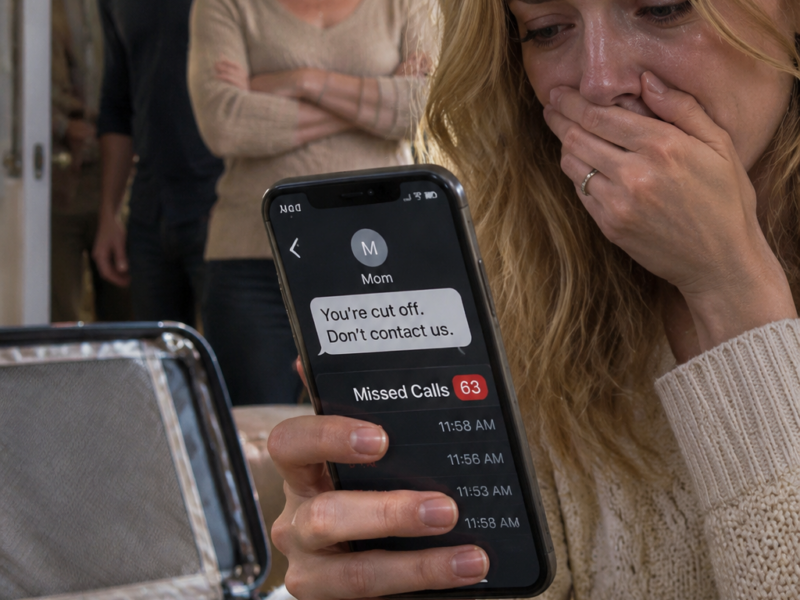
My Mom Texted, “You’re Cut Off. Don’t Contact Us.”—I Said “Okay.” By Noon: 63 Missed Calls
My Mom Texted, “You’re Cut Off. Don’t Contact Us.”—I Said “Okay.” By Noon: 63 Missed Calls
At 9:17 on a Thursday night, my mother sent me a text message that would change the course of my life.
It was only seven words.
“You’re cut off. Don’t contact us again.”
I remember sitting at my kitchen counter when the notification appeared. Outside my apartment window, Seattle was disappearing beneath a familiar blanket of rain. The streetlights reflected off the wet pavement, and somewhere in the distance, a siren sounded before fading into the night. I had been reviewing a report from work, a routine task I had brought home because the following morning was supposed to be particularly demanding.
Then I read my mother’s message.
I read it once, then again, waiting for the familiar wave of anxiety to arrive. Usually, when Charlotte Carter was angry with me, I felt compelled to respond immediately. I would search through our recent conversations, trying to identify the sentence that had offended her. I would replay the previous phone call, reconsider my tone, and eventually convince myself that I owed her an apology.
It had become an automatic reaction after thirty-two years of being her daughter.
But that night, something inside me was different.
Perhaps it was exhaustion. Perhaps it was the accumulation of years of disappointments that had finally reached a point where there was nothing left to give. Or perhaps I had simply become tired of being treated like an employee who could be dismissed whenever she questioned the person in charge.
Whatever the reason, I didn’t argue.
I didn’t call her.
I didn’t send a paragraph explaining how much she had hurt me.
I didn’t remind her of the weekends I had sacrificed, the emergencies I had handled, or the opportunities I had abandoned because she insisted the family needed me.
I simply typed one word.
“Okay.”
Then I placed my phone facedown on the counter.
My mother had always believed that I would eventually come around. She knew precisely which emotional buttons to press, which memories to mention, and which accusations would make me feel guilty enough to reconsider my decisions. She had spent years teaching me that disagreement was disrespect, independence was selfishness, and boundaries were evidence that I didn’t love my family.
She also knew something else.
For six years, I had been the person everyone called whenever the family business encountered trouble.
My parents owned a design and development company called Carter Urban Holdings. They had built it through years of property acquisitions, commercial redevelopment projects, and relationships with investors throughout the Pacific Northwest. From the outside, the company looked successful. My mother was frequently photographed at business receptions, charity events, and real estate conferences. She knew how to speak confidently about market opportunities, future developments, and the importance of building lasting partnerships.
But behind that polished image, the company’s finances were considerably more complicated.
Whenever a lender requested additional documentation, whenever an investor questioned a reserve account, or whenever a contractor threatened to suspend work because invoices remained unpaid, someone needed to make the numbers understandable.
That someone was usually me.
I worked as a senior risk manager for a maritime insurance firm in Seattle. My job involved evaluating financial exposure, identifying vulnerabilities, and determining what could happen when people assumed everything was under control without examining the underlying evidence.
It was a demanding career, and I had spent nearly a decade building my professional reputation.
Unfortunately, my family had gradually turned that reputation into another business resource.
Six years earlier, when Carter Urban Holdings encountered a credit problem, my parents asked me to help with some financial administration. They explained that the company needed someone with a clean financial record to assist with account documentation. They assured me that my involvement would be temporary.
I agreed.
At first, it seemed harmless. I became an authorized financial administrator on several accounts and helped organize documentation requested by lenders. I prepared spreadsheets, clarified financial statements, and explained transactions when outside professionals needed additional information.
I never agreed to manage the company’s risk.
I never agreed to become its financial adviser.
And I certainly never agreed to guarantee every ambitious project my parents decided to pursue.
But the distinction gradually disappeared.
My mother began describing my involvement as evidence that Carter Urban Holdings had independent financial oversight. She mentioned my professional background during meetings and occasionally introduced me to business partners as someone who helped evaluate the company’s financial exposure.
Whenever I objected, she promised to correct the language.
Then another emergency arrived, and the conversation disappeared beneath another pile of paperwork.
Three years earlier, I had been offered an opportunity that could have changed my career.
My employer wanted me to spend eighteen months in Singapore, working with an international team responsible for evaluating maritime infrastructure risks across several Asian markets. It was exactly the kind of assignment I had spent years hoping to receive.
I remember receiving the offer in my office and reading it several times before calling my best friend, Maya Brooks.
She screamed so loudly that I had to move the phone away from my ear.
Then I called my mother.
I expected congratulations.
Instead, she began crying.
Carter Urban Holdings was supposedly two weeks away from completing an important property refinancing. There were problems with the financial structure, and several lenders had requested additional assurances. My mother said she needed me nearby until everything was finalized.
“Just two weeks, Emma,” she told me. “I wouldn’t ask if it weren’t important.”
I declined the Singapore assignment.
Those two weeks became eight months.
There were missed flights, canceled weekends, late-night calls, corrected spreadsheets, and endless explanations to professionals who repeatedly asked why nobody inside my mother’s company seemed to understand where certain financial figures originated.
By the time the project finally closed, the international position had been offered to someone else.
My mother called my decision a sacrifice that families made for each other.
Nobody ever apologized.
Nobody even mentioned the opportunity again.
I had accepted that explanation for a long time because I wanted to believe that being needed meant being valued.
But that Thursday night, after reading her message, I finally understood that my mother had created a relationship in which my responsibilities were unlimited while my rights were negotiable.
She could demand my assistance whenever she wanted.
She could criticize my decisions whenever they inconvenienced her.
And if I refused, she could threaten to remove me from the family.
What she apparently hadn’t considered was that I might take her words seriously.
I opened my laptop.
The first thing I did was review the household operating account for which I was still listed as the primary authorized controller. I had maintained access because my parents occasionally needed administrative assistance with payments and financial transfers.
I removed myself from that responsibility through the appropriate banking procedures.
Next, I contacted the title company handling my parents’ planned waterfront house purchase. My financial assurance had been referenced in the documentation supporting the transaction. I informed them that I was withdrawing any authorization connected to my name and would not provide further assurances.
Then I emailed the relevant representatives at Carter Urban Holdings.
The message was brief.
I stated that I was no longer available to provide financial administration, risk oversight, liquidity assurances, or any other support for the company. I also made it clear that my professional biography and credentials could not be used in financing materials without my written permission.
Finally, I requested confirmation that all future commitments involving my name would require my direct approval.
I reread the email before sending it.
There was no anger in the wording.
No accusations.
No emotional explanation.
Just facts.
At 11:03, I closed my laptop.
For the first time in years, I went to bed without wondering which family emergency might interrupt my sleep.
I didn’t know that by the following morning, my phone would contain dozens of missed calls.
I certainly didn’t know that the number would eventually reach sixty-three.
At 7:06 Friday morning, I turned my phone back on.
Eleven missed calls.
All from family members.
The first message was from my mother.
“Emma, call home.”
Then another.
“What did you change?”
A third appeared less than a minute later.
“We need to discuss the accounts immediately.”
By 8:40, the missed calls had increased to twenty-seven.
At 10:15, there were forty-nine.
The messages became increasingly frantic.
My father asked why I was creating problems.
My younger cousin, who rarely contacted me unless he needed something, sent a message saying that everyone was worried.
Then a message arrived from Daniel Mercer, the attorney who represented Carter Urban Holdings.
“Emma, we have a serious problem. Please do not sign, cancel, withdraw, or communicate anything further until we speak.”
I stared at the screen.
By noon, there were sixty-three missed calls.
I remember looking at that number for several seconds.
Sixty-three attempts to reach me.
Not because someone wanted to know whether I was okay.
Not because my mother regretted what she had said.
But because something I had done in response to her message had disrupted a financial arrangement.
And that was when I began to understand the situation differently.
My mother hadn’t cut me off because she no longer needed me.
She had cut me off because she assumed I would continue doing everything for her, even after she told me I no longer belonged.
At 12:20, I met Maya at a small lunch counter two blocks from my office.
She was already sitting near the window when I arrived, holding a cup of coffee and looking at her phone.
Maya had been my closest friend since college. She knew about the Singapore assignment, the refinancing problems, and the countless weekends I had spent helping my parents. She had listened to me defend my mother more times than I could remember.
When I sat down, she glanced at my phone.
“How many now?”
“Sixty-seven.”
She slowly put down her coffee.
“That’s a lot of people suddenly discovering they need to talk to you.”
I almost smiled, but I was too nervous.
She asked what I had actually withdrawn.
I explained everything carefully, beginning with the accounts and ending with the waterfront property transaction.
Maya listened without interrupting.
When I finished, she leaned forward.
“Emma, did you ever agree to personally oversee their company?”
“No.”
“Did you ever promise to provide additional money if one of their projects went over budget?”
“No.”
“Did you tell your mother she could use your professional credentials in financing presentations?”
“Absolutely not. I’ve asked her to stop doing that more than once.”
Maya shook her head.
“Then why are you looking like you’ve done something wrong?”
I stared at the coffee in front of me.
“Because I know how this is going to go. They’re going to say I overreacted. They’ll say I embarrassed everyone. And if something goes wrong financially, they’ll make it sound like I caused it.”
Maya studied me.
“What are you actually afraid of?”
The question caught me off guard.
I thought about it.
I wasn’t particularly afraid of losing my mother’s approval anymore. Somewhere along the way, I had stopped understanding whether her approval and her love were even separate things.
What frightened me was my career.
In my profession, reputation was everything. People trusted risk managers because they were expected to exercise independent judgment. If someone believed I had knowingly allowed my credentials to support questionable financial transactions, the consequences could follow me for years.
“I spent ten years building my name,” I finally said. “I’m not going to let someone else spend it.”
Maya nodded.
“Then stop thinking like the daughter they’ve trained to rescue them. Think like the risk manager you actually are.”
My phone vibrated again.
This time, the message wasn’t from my mother.
It was from Daniel Mercer.
“Emma, this is Daniel. I represent Carter Urban Holdings. I need to speak with you urgently regarding several representations made in connection with company financing.”
I read the message aloud.
Maya’s expression changed.
“Representations?”
I called him immediately.
He answered on the first ring.
“Emma, before anything else, I need to ask whether you authorized your name to remain on the Harbor Point financing package.”
“No.”
There was a pause.
“Did you authorize Charlotte to tell the lender that you would provide liquidity support if the project exceeded budget?”
“Absolutely not.”
The silence lasted several seconds.
“We need to meet,” he said.
“How bad is it?”
“I don’t know yet. But your withdrawal this morning triggered an automatic review. One lender has frozen two disbursements. The title company has suspended the residential closing, and another bank has requested clarification regarding your role.”
I looked at Maya.
She had stopped drinking her coffee.
“So my mother was telling people I was supporting the company?”
“That’s what some of the documentation suggests.”
I closed my eyes briefly.
“Send me every document containing my name.”
“Emma, I need to be careful here. I represent the company, not you personally.”
“Then understand something. From this point forward, you communicate with me separately from my mother. I want every document, and I want everything in writing.”
Daniel agreed.
When I ended the call, Maya looked at me.
“Well?”
I shook my head.
“Apparently, this is bigger than a family argument.”
By Friday morning, the situation had reached my workplace.
I was reviewing a shipping loss report when my division director approached my desk.
He was a quiet man who rarely interrupted employees unless something required immediate attention.
“Emma, do you have a minute?”
I turned toward him.
“Of course.”
He lowered his voice.
“Are you involved with Carter Urban Holdings?”
My stomach tightened.
“Why?”
He showed me an article on his tablet.
A regional business newsletter had published a short report about financing delays at Harbor Point, the largest redevelopment project my mother’s company had ever attempted.
Buried near the bottom was a sentence describing me as a risk-management adviser associated with the Carter family enterprise.
I read it twice.
“I’ve never held that position,” I said. “I don’t work for that company. I have no professional role there.”
My director nodded.
“Then I suggest you correct the record quickly. Compliance may ask about it.”
That was the moment the situation became much more serious.
Until then, I had considered my mother’s behavior a family problem with financial consequences.
Now the family problem was walking into my workplace wearing my professional title.
At lunch, Maya met me outside the building.
I showed her the article.
She read it carefully before looking up.
“Still thinking about staying quiet?”
“Quiet usually protects my job from family drama.”
“No,” she replied. “Quiet protects whoever put your name there.”
I hated how easily she could identify the truth.
That evening, Carter Urban Holdings was hosting a civic business reception at a restored ferry terminal in Seattle.
The event had been planned for weeks. It was intended to introduce potential tenants, investors, and financing partners to Harbor Point, a waterfront redevelopment project that my mother described as the most important achievement of her career.
I had originally declined the invitation.
Now Maya believed I should reconsider.
“You have two choices,” she said. “You can stay home and let Charlotte explain your role to everyone in that room, or you can show up and explain it yourself.”
“I don’t want to create a public confrontation.”
“They already made you public, Emma. They put your professional title in a business article.”
I looked at the screen again.
She was right.
For years, keeping the peace had sounded mature and responsible. It had seemed like the kind of behavior expected from someone who understood the importance of family.
But every time I kept the peace, someone else decided what that peace required from me.
I remembered Singapore.
I remembered the eight months of missed opportunities.
I remembered the contractor who had threatened to walk away from one of my mother’s projects because of unpaid invoices. I had spent an entire weekend reconciling financial records and explaining the situation to his finance director.
The contractor stayed.
My mother later described the rescue as evidence of her leadership.
I had received a brief thank-you message and another request for assistance the following week.
I thought about all of it.
Then I called Daniel.
“I’ll meet you before the reception tonight.”
He sounded cautious.
“Emma, Charlotte is under enormous pressure. A public confrontation could complicate matters.”
“Then she shouldn’t have made my involvement public.”
There was another pause.
“All right. I’ll see you there.”
At 3:14 that afternoon, Daniel emailed me fourteen documents.
I opened them one at a time.
Three used my professional credentials.
Two described me as providing ongoing risk oversight.
Another contained a summary stating that I was expected to assist if certain financial reserves fell below required levels.
I had never seen those documents before.
I had never approved them.
And I had never agreed to any of those responsibilities.
I printed the three most important pages and placed them in a plain folder.
I wasn’t going to the reception to humiliate my mother.
I was going because silence had become more dangerous than speaking.
The restored ferry terminal was already crowded when Maya and I arrived that evening.
The building had enormous windows overlooking the water, and the last traces of daylight reflected off the harbor. Elegant tables had been arranged throughout the main hall. Waiters moved between groups carrying drinks and small plates of food.
Business leaders, investors, architects, and city representatives stood beneath the restored wooden beams, discussing the future of Harbor Point.
My mother was exactly where I expected her to be.
She stood beside a scale model of the development, wearing a tailored dark-blue dress and speaking to a lender whose name I recognized from Daniel’s documents.
I slowed down when I heard her voice.
“Emma’s risk background gives us another layer of oversight,” she was saying. “She’s always been deeply involved behind the scenes, even when she prefers not to be visible publicly.”
I stopped walking.
Less than twenty-four hours after telling me never to contact the family again, she was still using my involvement to reassure strangers.
Maya heard it, too.
She looked at me but said nothing.
Daniel noticed us before we reached the group.
“Emma. We need five minutes privately.”
I followed him toward a quieter corner of the room.
“Did she authorize those statements?” I asked.
His jaw tightened.
“There are inconsistencies in the financing materials. That’s why I wanted to speak with you.”
“That wasn’t my question.”
He lowered his voice.
“Your mother has represented to several parties that you remain available as a financial and risk resource. If that representation is formally challenged tonight, at least one lender may reconsider its position immediately.”
“And if I don’t challenge it?”
Daniel hesitated.
“Your silence could make separating yourself later more complicated. Particularly if someone argues that you knew how your role was being described.”
I looked toward my mother.
She was still smiling at the lender.
Daniel continued.
“There’s something else. The Harbor Point reserve account is significantly below the amount represented last quarter. A bridge lender is already asking questions. There may be other discrepancies I haven’t fully reviewed.”
I felt a cold sensation move through my stomach.
“Does my mother know?”
“Yes.”
“And she still used my name?”
He didn’t answer.
He didn’t need to.
Across the room, my mother finally noticed me.
For one brief second, surprise replaced her polished expression. Then she recovered and excused herself from the conversation.
“Emma,” she said when she reached me. “What are you doing here?”
I almost laughed.
“You invited me weeks ago.”
“Right. But I thought you weren’t coming.”
“Last night, you told me I was cut off.”
Her eyes moved toward Maya and Daniel.
“This is not the place.”
“Then why did I just hear you telling a lender that I’m deeply involved behind the scenes?”
Her expression hardened.
“You don’t understand what’s at stake.”
“Daniel explained enough.”
“No, he didn’t. You have no idea what one careless statement could do tonight.”
I studied her face.
Suddenly, I understood what she wanted.
She didn’t want reconciliation.
She didn’t want to discuss our relationship.
She wanted continued access to my silence because my silence was useful.
Behind her, two executives were waiting to resume their conversation.
My mother glanced toward them before turning back to me.
“Smile. Stay for thirty minutes. We’ll fix this privately tomorrow.”
The words were so familiar that my body almost obeyed before my mind caught up.
Smile.
Stay.
Don’t embarrass anyone.
Fix it tomorrow.
That had been the family formula for years.
Tomorrow was where every uncomfortable truth went to disappear.
“No,” I said. “We fix my name tonight.”
Her face changed.
“Emma, don’t be dramatic.”
“You used my professional title and my credentials in financing documents.”
“You’re part of this family. That should mean something.”
“It means I care about you. It doesn’t mean you can authorize obligations in my name.”
“Everything doesn’t have to become a legal technicality.”
“It became one when you put my name in documents I never approved.”
Her voice dropped.
“If you do this publicly, the lenders may panic.”
“Then tell them the truth before they have a reason to.”
For the first time that evening, I saw genuine fear in her expression.
“You’re angry. I understand that. But don’t confuse anger with judgment.”
It was one of her oldest methods.
She would make my refusal sound emotional and her demands sound reasonable.
“I’m not angry enough to lie for you,” I replied.
I opened the folder.
She stared at the papers.
“What is that?”
“The things you told people I agreed to.”
“Emma, listen to me.”
“I’ve been listening to you for thirty-two years.”
Her eyes hardened.
“If you embarrass me in this room, there will be no coming back from it.”
I looked at the lender waiting behind her.
Then I looked at Daniel.
“You sent me that same threat last night,” I said. “I already answered.”
I didn’t grab a microphone.
I didn’t demand everyone’s attention.
I didn’t make a dramatic speech about everything my mother had ever done.
Instead, I walked back toward the group she had been speaking to and waited until the lender looked at me.
My mother followed.
“Emma was just explaining how valuable your expertise has been to Harbor Point,” she said quickly.
I turned toward the man.
“Then I should clarify something.”
My mother’s hand closed around my forearm.
“Not here.”
I gently removed it.
“Especially here.”
The lender introduced himself as Robert Hale, a managing director at a regional investment bank. Beside him stood a project partner and two representatives from a commercial property fund.
I opened my folder.
“Mr. Hale, I’m not a risk adviser to Carter Urban Holdings. I did not review Harbor Point, I did not approve these financing representations, and I never agreed to provide liquidity support.”
His expression changed.
My mother immediately interrupted.
“Emma is upset about a personal disagreement. This is a family misunderstanding.”
I handed Robert the first page.
“Is this one of the documents your team received?”
He examined it.
“Yes.”
“The description of my role is inaccurate.”
My mother’s voice sharpened.
“Emma.”
I handed him the second page.
“This one says I provide ongoing oversight. I don’t.”
Robert looked toward Daniel.
“Mr. Mercer?”
Daniel chose his words carefully.
“Ms. Carter has informed me that she did not authorize those descriptions. I have advised that the issue requires immediate review.”
That sentence changed the atmosphere around us.
Nobody gasped.
Nobody dropped a glass.
The room didn’t suddenly become silent like something out of a movie.
Instead, the people around us became professionally quiet.
Robert stepped away and called someone.
One of the fund representatives closed her folder.
The project partner asked Daniel whether that evening’s presentation should continue.
Another executive slowed down as he approached, apparently realizing that something important had changed.
My mother stared at me as though I had pulled the floor out from beneath her.
“Do you understand what you’re doing?” she whispered.
“Yes. I’m correcting a statement about me.”
“You could destroy this project.”
“Then the project shouldn’t depend on something I never promised.”
“You know what Harbor Point means to this family.”
“I know what my career means to me.”
She leaned closer.
“After everything this family gave you.”
For years, that sentence would have worked instantly.
It would have triggered an inventory of birthdays, tuition payments, holidays, childhood vacations, gifts, and favors.
Every ordinary act of family life would become another debt I could never finish repaying.
This time, I simply took out my phone.
“You told me last night that I was cut off. You told me not to contact you again.”
“That was because you were being impossible.”
“I did exactly what you asked.”
“Business has nothing to do with our personal disagreement.”
I stared at her.
“Exactly. So why is my personal relationship with you being used as business collateral?”
She had no answer.
Robert returned before she could invent one.
“Charlotte, until we reconcile these representations, we’re suspending tomorrow’s credit committee review.”
My mother’s face went pale.
The fund representative spoke next.
“Our team will also pause discussions pending updated disclosures and reserve information.”
Two decisions.
Less than sixty seconds.
Months of carefully staged confidence suddenly had to survive without my name underneath it.
My mother turned toward Daniel.
“Fix this.”
Daniel didn’t move.
“I can address the documentation, Charlotte. I cannot tell Emma Carter to accept obligations she never authorized.”
That was the first real consequence.
Not embarrassment.
Not whispers.
Not a daughter finally standing up to her mother.
The lender had paused its review. An investor had stepped back. And the attorney my mother expected to control had refused to manufacture my consent.
She looked at me again.
“You wanted revenge? Congratulations.”
“No. Revenge would be lying about you. I’m telling the truth about me.”
Several nearby conversations had stopped.
People weren’t watching because I had created a scene.
They were listening because financing for a major development was suddenly uncertain.
My mother reached into her handbag and pulled out a slim silver key card.
“You want independence? Fine. Here.”
She held it toward me.
“The family apartment. The club account. Everything.”
For years, access had been one of her favorite forms of control. Invitations, accounts, memberships, guest privileges, and family properties all came with an invisible understanding that gratitude meant compliance.
I took the card, placed it beside the documents, and slid it back toward her.
“Cancel all of it. And remove my name from anything else you’ve attached it to.”
Her expression finally cracked.
She had spent years treating access as leverage.
Returning it left her with nothing obvious to threaten me with.
Robert asked Daniel for a meeting first thing the following morning.
The project partner excused himself.
One of the fund representatives began typing an email.
Two people who had been waiting to speak with my mother quietly moved toward another group.
I watched her notice each departure.
This was the price she hadn’t imagined when she sent that text.
She thought cutting me off would remove my support system.
Instead, it removed hers.
I turned to leave.
She called my name.
“If you walk away now, don’t expect us to come begging.”
My phone vibrated in my hand with another incoming call from the family office.
I looked at the screen, then back at her.
“You already called sixty-three times.”
For once, my mother had nothing to say.
Maya and I had barely reached the parking structure when Daniel called.
I almost ignored it.
After everything that had happened, I assumed he wanted to discuss the reception and the suspended financing review.
But his first sentence stopped me.
“Emma, don’t go home yet. There’s another issue.”
We met him twenty minutes later in a conference room at his law firm.
There were no family members, investors, or other executives present.
Just Daniel, Maya, me, and a spreadsheet projected onto the wall.
Daniel looked more tired than he had earlier.
“The lender review triggered a cross-default inquiry,” he explained. “And Harbor Point isn’t the only problem.”
He displayed three entities controlled by my parents.
One owned the development.
Another held several smaller commercial properties.
The third had been used to secure short-term financing.
Money had moved between them repeatedly during the previous year to cover construction overruns, delayed tenant payments, and obligations that had originally been described as temporary.
I studied the spreadsheet.
“How much exposure are we talking about?”
Daniel didn’t soften the answer.
“Approximately eight-point-four million dollars, although the final number may change after a complete review.”
I stared at him.
The amount itself was shocking, but what frightened me more was the calmness with which he delivered it.
He spoke like someone who already knew professionals were calculating which properties could be sold, which accounts could be frozen, and which obligations could be renegotiated.
“And where do I fit into this?” I asked.
He opened another document.
Years earlier, I had co-signed a limited guarantee for a small family warehouse loan.
I remembered it.
I had known about the original refinancing and had signed a release afterward.
What I hadn’t known was that my old guarantee continued appearing in internal schedules as though my financial support relationship remained active.
Daniel was careful.
He explained that whether I had any actual liability required independent legal review. He would not pretend to represent my personal interests while simultaneously representing the company.
Then he showed me something else.
The waterfront house purchase that had been suspended that morning was not simply a home my parents wanted.
My mother had planned to use proceeds from selling their existing residence as temporary liquidity for Harbor Point. The new property would then be financed through a structure that referenced family resources, including an account on which I was still listed as an authorized controller.
By withdrawing before closing, I had interrupted the chain.
Maya looked at Daniel.
“That explains the calls.”
He nodded.
“The canceled closing was inconvenient. The frozen disbursements were serious. But Emma’s withdrawal caused lenders to ask why someone presented as a key risk resource was leaving at the exact moment reserves were deteriorating.”
I looked down at my phone.
The messages were still arriving.
“Call your mother.”
“Please explain what you did.”
“We need your signature.”
“Stop making everything worse.”
Then, as the financial consequences became clearer, the language changed.
“We’re family.”
“You know we love you.”
“We can work this out.”
I scrolled through them slowly.
For years, I had assumed that being needed meant being valued.
Seeing the messages in chronological order destroyed that illusion with almost mathematical precision.
Maya watched me.
“What are you thinking?”
I swallowed.
“That I spent years treating every emergency as proof that I mattered.”
I looked at the messages again.
“And now I’m wondering how many emergencies existed because they knew I would always show up.”
Daniel closed one document and opened another.
“There’s also the question of representations made to third parties. Your independent lawyer will need to determine whether corrective notices should be issued immediately.”
“What happens now?”
“You retain independent counsel. Your lawyer should issue written notices clarifying your lack of authorization. Review every guarantee and account connected to you. Communicate directly with the lenders. Do not sign anything for the company. Do not transfer money. Do not make informal promises.”
He paused.
“And don’t agree over the phone to help temporarily. Temporary assistance is exactly how ambiguous obligations get created.”
It sounded cold.
But it also sounded safer than every emotional conversation my family had ever forced me into.
Maya turned toward me.
“Are you still tempted to rescue them?”
I thought about it before answering.
“Yes.”
She looked surprised.
“Because they’re still my family,” I continued. “That feeling doesn’t disappear just because I finally understand the pattern.”
I explained that part of me still wanted to make one phone call, sign one document, transfer one amount of money, and make everyone stop panicking.
I wanted the noise to end.
I wanted my mother to stop being angry.
I wanted the family to return to something that resembled normal.
Daniel nodded.
“That impulse is understandable. But feeling responsible and being legally responsible are very different things.”
The sentence stayed with me.
So did another thought.
Being emotionally responsible for everyone’s happiness and being actually responsible for their decisions were not the same thing.
My mother had spent years collapsing those categories until saying no to her felt like causing a crisis rather than refusing to absorb one.
I picked up my phone, ignored another call from her, and searched for the number of an attorney our company’s compliance director had once recommended.
“I’m moving forward,” I said. “But this time, nobody gets to call my sacrifice a family obligation.”
The following three days were unlike any weekend I had experienced.
My independent attorney, a woman named Rebecca Collins, approached the situation with a level of calm that I desperately needed.
She didn’t ask me whether my mother was a good person.
She didn’t ask whether I wanted to repair the relationship.
She didn’t tell me to forgive anyone.
She asked for documents.
We reviewed signatures, guarantees, account authorities, emails, financing packages, lender correspondence, and every document containing my professional title.
Some of what frightened me turned out to be less dangerous than I had feared.
My old limited guarantee had been formally released.
That meant the internal schedules referencing it did not automatically recreate an obligation.
It was the first piece of good news I had received all week.
Other problems were considerably more serious.
My professional biography had appeared in multiple financing presentations without my approval.
Several statements strongly implied that I held an ongoing advisory role.
One lender file included meeting notes stating that the Carter family’s internal risk specialist could be consulted if reserve levels deteriorated.
Nobody had ever consulted me.
Another presentation described the company’s access to family liquidity support without clearly identifying whose liquidity was being referenced.
Rebecca read everything carefully.
Then she looked at me.
“Did you know these documents existed?”
“No.”
“Did you approve the use of your professional biography?”
“No.”
“Did you ever tell anyone that you would personally guarantee additional financial support?”
“Never.”
She nodded.
“Then we correct the record. Immediately.”
She sent formal notices to the relevant parties and instructed them to communicate through her instead of contacting me directly.
The difference was immediate.
The sixty-three calls stopped.
Not because my family had suddenly calmed down, but because they could no longer pressure me privately without creating a record through counsel.
At first, the silence felt strange.
For years, emergencies had arrived through my phone like alarms only I could switch off.
When the phone stopped ringing, I realized how much of my nervous system had been trained around other people’s crises.
I had become so accustomed to anticipating my mother’s next problem that I sometimes felt guilty when nothing needed fixing.
Meanwhile, the Harbor Point situation continued deteriorating.
The lender required revised disclosures and an independent financial review.
The investment fund eventually withdrew from negotiations.
Without the expected capital, Carter Urban Holdings could no longer maintain operational control of the project.
A restructuring group appointed with the senior lenders assumed responsibility for the development.
My mother remained an owner on paper for a time, but she lost much of the authority she had spent years protecting.
The waterfront house purchase was canceled.
Their existing home was eventually listed as part of a broader effort to reduce debt and simplify the family’s obligations.
Several business partners who had previously accepted my mother’s confident assurances began requiring everything in writing.
Daniel later told Rebecca that this change, more than any public embarrassment, devastated my mother.
Her influence had always depended on people accepting the version of reality she presented.
Now they verified it.
A few weeks after the reception, my mother called me from a number I didn’t recognize.
I answered because, by then, I no longer feared the conversation.
“Are you happy?” she asked.
There was no greeting.
No apology.
No acknowledgment of what had happened.
“About what?” I asked.
“You know what. The company. The house. People treating me like I lied to them.”
I leaned back in my chair.
I could have reminded her that she had used my credentials without permission.
I could have listed every opportunity I had surrendered, every weekend I had spent solving financial emergencies, every vacation interrupted by a lender problem, and every time she had called my career a family resource when it benefited her.
Instead, I asked one question.
“Why did you tell me I was cut off?”
Silence.
For several seconds, I heard nothing except the faint sound of traffic in the background.
Finally, she answered.
“I wanted you to understand that your choices have consequences.”
I almost smiled.
“I understand that now, Mom. Your choice had consequences, too.”
Her voice softened.
“We can still fix this.”
There it was.
Not an apology.
Not an acknowledgment that she had misused my name.
Not an admission that she had asked me to carry responsibilities I had never accepted.
Just another invitation back into the machine.
“What does we mean?” I asked.
Another silence.
“The family.”
“Does that mean I transfer money?”
“That’s not fair.”
“Does it mean I reassure the lenders?”
“Emma, stop.”
“Does it mean I put my professional reputation behind the company again?”
She exhaled sharply.
“You’re making everything transactional.”
I looked out of my office window.
“No. I’m finally noticing which transactions were disguised as love.”
She said I had changed.
On that point, she was right.
But the real change hadn’t happened at the reception.
It hadn’t happened when I ignored sixty-three calls.
It had happened when I learned to hear disappointment in my mother’s voice without immediately treating it as an emergency I was required to solve.
“I’m willing to have a relationship with you,” I said. “But I will never finance it, guarantee it, lend my name to it, or trade my career for it again.”
“So you’re choosing yourself over your family.”
Years earlier, that accusation would have destroyed me.
Now I understood the trick hidden inside it.
She was presenting two things as opposites that never should have been opposites.
A healthy family shouldn’t require one person to disappear so everyone else can remain comfortable.
“I’m choosing a relationship where I’m allowed to exist as myself,” I said. “Whether you want that relationship is your choice.”
She ended the call without answering.
The months that followed were quieter than I expected.
Harbor Point survived, but not in the form my mother had imagined.
The restructuring group sold one parcel, reduced the project’s scope, replaced several executives, renegotiated construction obligations, and accepted a much slower development timeline.
My parents lost much of their control, although they weren’t left with nothing.
Reality was less cinematic than revenge stories usually promise.
Nobody vanished into financial ruin overnight.
There was no magical dinner where everyone admitted I had been right.
Some relatives blamed me.
One aunt called and said I should have handled everything quietly because family business belonged inside the family.
I asked her whether my professional title appearing in lender materials without my permission was also supposed to stay inside the family.
She changed the subject.
Others quietly admitted they had known my mother relied too heavily on me but had never wanted to become involved.
A few people stopped speaking to me altogether.
That hurt more than I expected.
It took me a while to understand that boundaries don’t guarantee applause.
Sometimes they simply reveal which relationships existed only because you had no boundaries.
At work, the compliance review eventually closed without disciplinary action.
My attorney documented that I had not authorized the company’s claims and had acted promptly once I discovered them.
My director spoke with me privately afterward.
He told me the most important thing I had done was correct the record rather than hoping the problem would disappear.
I appreciated that more than he probably realized.
For years, I had been afraid that standing up to my family would damage my professional reputation.
Instead, the decision to establish a clear boundary had helped protect it.
Six months after the original text message, another opportunity appeared at work.
It wasn’t Singapore.
That assignment was gone, and I couldn’t recover the eighteen months of international experience I had sacrificed.
But my company was creating a new marine risk team responsible for infrastructure accounts across the Pacific Northwest.
They wanted someone to lead it.
The position came with greater responsibility, better compensation, and the authority to build a team of my own.
When my director presented the opportunity, I listened carefully.
I asked a few questions.
I reviewed the responsibilities.
Then I accepted.
I didn’t call my mother.
I didn’t ask whether the timing was convenient for my family.
I didn’t check whether anyone needed me home that weekend.
I accepted the promotion before leaving the conference room.
That evening, Maya came over with dinner and a bottle of sparkling water.
She had insisted that we celebrate properly.
At some point, while we were sitting on my couch, she asked me a question.
“Do you regret replying okay?”
I thought about it.
I thought about the canceled house purchase, the restructuring, the relatives who still believed loyalty meant silence, and the relationship with my mother that remained distant and uncertain.
I thought about Singapore.
That opportunity was gone forever.
I thought about the years I had spent believing that every emergency was mine to solve.
Then I thought about the woman I had become.
I no longer checked my phone every few minutes to see whether my mother had sent another message.
I no longer felt compelled to explain every personal decision to people who had no right to approve it.
I no longer believed that someone else’s disappointment automatically meant I had done something wrong.
“I regret that it took one text for me to understand something I should have learned years ago,” I finally said.
Maya nodded.
“What?”
“That family love should never require unlimited access to your money, reputation, career, or future.”
She raised her glass.
I continued.
“Setting a boundary isn’t betrayal simply because someone benefited from you having none.”
Maya smiled.
“And sometimes what looks like selfishness from the outside is simply the moment someone stops subsidizing someone else’s selfishness.”
We sat quietly for a while.
Outside, Seattle was raining again.
It occurred to me that the weather hadn’t changed much since the night my mother sent that message.
But everything else had.
My mother had wanted that first text to teach me that I could be excluded whenever I refused to cooperate.
She had wanted me to understand that belonging to the family was conditional on my willingness to make myself useful.
Instead, her message taught me something entirely different.
Being excluded from an unhealthy arrangement can be the beginning of getting your own life back.
I didn’t win because Charlotte lost control of Harbor Point.
I didn’t win because lenders questioned her, because the house deal collapsed, or because business partners suddenly demanded written proof.
I didn’t win because sixty-three calls went unanswered.
I won because I finally understood that I didn’t need her crisis to justify my boundary.
I could care about my family without becoming collateral for their decisions.
I could forgive without volunteering to be used again.
I could answer a phone call without surrendering control of my life.
I could love people while still saying no.
And most importantly, I could stop confusing being indispensable with being loved.
There were still difficult days.
Sometimes I would see a photograph of my parents at an event and feel a sudden sadness.
Sometimes I wondered whether things might have been different if I had challenged my mother’s behavior earlier.
Sometimes I missed the idea of having a family that supported one another without keeping score.
I wasn’t proud of every decision I had made.
I wished I had accepted Singapore.
I wished I had recognized the financial warning signs sooner.
I wished I hadn’t spent so many years convincing myself that sacrificing my future was simply part of being a good daughter.
But regret couldn’t give me those years back.
All I could do was make sure I didn’t lose any more.
My relationship with my mother remained uncertain.
There were occasional messages, usually brief and carefully worded. Sometimes she asked about my work. Sometimes she mentioned a family gathering. Once, she sent me an old photograph of the two of us standing together on a beach when I was a little girl.
I looked at that photograph for a long time.
I remembered the woman in it.
I remembered being small enough to believe that my mother could fix anything.
I remembered how safe it felt to hold her hand.
And I realized that I didn’t have to hate her to acknowledge what she had done.
I didn’t have to erase every good memory to recognize the harm.
I didn’t have to turn her into a villain to protect myself from repeating the same mistakes.
But I also didn’t have to return to the role she had created for me.
If we ever rebuilt our relationship, it would have to be something different.
Something honest.
Something that didn’t depend on my willingness to sign documents, transfer money, reassure lenders, or sacrifice my professional future.
I was willing to have that relationship.
But I wasn’t willing to purchase it.
And that was the difference.
Looking back, the most important moment wasn’t when I walked into the reception and corrected my mother’s statements.
It wasn’t when the lender suspended the credit committee review.
It wasn’t when the investment fund withdrew or when the family business lost control of Harbor Point.
The most important moment happened at 9:17 on a Thursday night.
A woman sent her daughter seven words intended to make her feel unwanted, frightened, and desperate to regain her place.
And for the first time, her daughter didn’t beg.
She didn’t negotiate.
She didn’t offer another sacrifice.
She simply believed her.
“Okay.”
Sometimes a single word is all it takes to stop participating in a situation that has been hurting you for years.
If you’ve ever been forced to choose between keeping your family together and keeping yourself intact, I hope you ask yourself one question.
If preserving that family requires you to surrender your identity, your future, your reputation, and your right to say no, what exactly are you being asked to preserve?
I know my answer now.
I wasn’t born to be my family’s emergency fund.
I wasn’t obligated to spend my career repairing decisions I hadn’t made.
I wasn’t required to carry financial responsibilities simply because my mother knew how to make me feel guilty.
And I certainly wasn’t required to prove my love by allowing someone else to use my name.
For years, I thought being a good daughter meant being available whenever I was needed.
Now I understand that being a good daughter doesn’t mean abandoning the person I have worked so hard to become.
I can love my family without letting them control my future.
I can wish my parents well without becoming responsible for their debts.
I can remember the good moments without pretending the bad ones never happened.
And I can walk away from a conversation without feeling that I have destroyed something simply because I refused to surrender.
My mother once believed that she could take away my place in the family whenever I disappointed her.
What she never understood was that I had spent years giving up pieces of myself just to keep that place.
The night she told me I was cut off, I finally stopped paying for it.
And perhaps that was the greatest consequence of all.
Not that my mother lost a daughter willing to rescue her business.
But that I finally gained a life that belonged to me.
Because being needed is not the same as being loved.
Being useful is not the same as being valued.
And sometimes the bravest thing a person can do is stop proving their worth to people who have already decided to take everything they are willing to give.
That Thursday night, my mother sent me a message telling me not to contact her again.
I answered with one word.
And the following morning, when I saw sixty-three missed calls, I finally understood that the people who had spent years telling me how much they needed me had never considered what might happen when I decided I needed myself.
For the first time in my life, I didn’t rush to answer.
I let the phone ring.
I let the silence remain.
And I started building a future that didn’t require anyone else’s permission.
THE END









