My Mom Called Me A Temp At My Sister’s Charity Gala, Then The Groom’s Mother…
My Mom Called Me A Temp At My Sister’s Charity Gala, Then The Groom’s Mother…
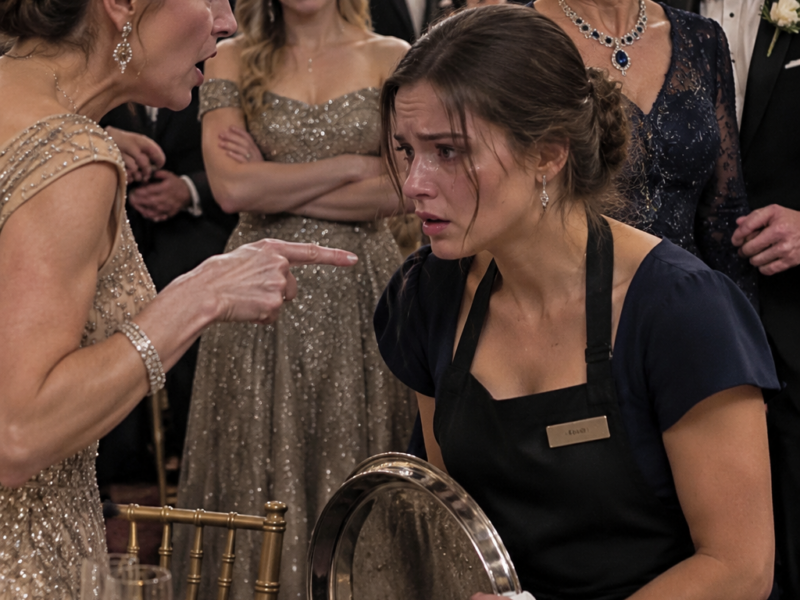
At my sister Audrey’s pre-wedding charity gala, my mother grabbed my arm and dragged me toward the groom’s family table. She wore the brightest smile I had ever seen, but her fingers dug painfully into my skin.
“This is our other daughter, Naomi,” she announced, loud enough for everyone nearby to hear. “She does temporary work whenever she can find it. We try to help her, of course, but some people simply never figure out what they want to do with their lives.”
My sister Audrey laughed softly from beside her fiancé.
My father, Richard, suddenly became fascinated by his glass of whiskey.
I stood there in my simple black silk dress, listening to the people around the table exchange uncomfortable smiles. Then the groom’s mother, Diana Sterling, slowly lowered her wineglass.
She stared at me.
For several seconds, she said nothing. Then she pushed her chair back, stood up, and dropped her silver fork onto the porcelain plate.
“Naomi?” she whispered.
My mother immediately turned toward her.
“Is something wrong, Diana?”
Diana ignored her completely. Her eyes remained fixed on me.
Then she pointed directly at my face.
“My boss.”
My mother’s smile disappeared.
Audrey’s engagement ring suddenly seemed very small beneath the chandelier.
And for the first time in fifteen years, my family finally understood that the daughter they had thrown away was not the failure they had spent their lives describing.
My name is Naomi Marsh. I was thirty-three years old, and I had spent most of my adult life learning that sharing someone’s blood did not necessarily mean sharing their values, their loyalty, or even their humanity.
Fifteen years earlier, when I was eighteen, my mother, Beverly, had thrown me out of our family home because I refused to give her my college savings.
She wanted the money for Audrey, who had decided she needed a summer backpacking through Europe with her friends.
I had worked part-time jobs for years to save that money. I had skipped vacations, bought secondhand clothes, and taken extra shifts whenever they were available. Every dollar represented a small piece of the future I wanted to build.
But my mother considered my savings family property.
When I refused to hand them over, she called me selfish, ungrateful, and impossible to love.
That night, my belongings were thrown onto the driveway. I remember standing beneath the porch light, holding a battered duffel bag while my mother told me I would never survive without her.
My father watched from the doorway.
He said nothing.
Audrey stood behind him, smiling.
I left without looking back.
For a while, survival was difficult. I slept on a friend’s couch, worked two jobs, and attended college whenever my schedule allowed. There were nights when I ate instant noodles because I needed the money for textbooks. There were mornings when I wondered whether my mother had been right about me.
But I refused to let her prediction become my future.
I studied finance, learned how wealthy families protected their assets, and eventually discovered that some of the most powerful people in America were surprisingly vulnerable when confronted with the right financial strategy.
I became very good at identifying those vulnerabilities.
By the time I was thirty-three, I had founded Apex Financial Solutions, a private crisis-management and wealth-protection firm serving billionaires, major corporations, influential politicians, and some of the most powerful families in the country.
My company managed billions in assets and handled situations that rarely appeared in newspapers. Hostile takeovers, corporate blackmail, financial sabotage, hidden liabilities, and complicated succession disputes were all part of my daily work.
I had built the company from nothing.
I had done it without inheritance, without family connections, and without anyone handing me an opportunity.
Yet my family knew none of this.
To them, I was still the daughter who had failed to establish herself. They believed I lived in a tiny apartment, drove an old car, and survived by accepting temporary office assignments.
I had deliberately allowed that misunderstanding to continue.
My older brother, Kevin, was the only person in the family who knew the truth. He and his wife, Simone, were my closest allies.
Simone was a brilliant corporate defense attorney, respected for her intelligence, discipline, and extraordinary ability to dismantle complicated legal arguments. She had become the legal backbone of Apex and one of the few people I trusted without reservation.
Unfortunately, she and Kevin were away on vacation when Audrey’s engagement gala took place.
That left me alone with the family I had spent fifteen years avoiding.
Audrey was marrying Harrison Sterling, the only son of Diana Sterling, a formidable Manhattan real estate matriarch whose family controlled an enormous property empire.
My mother considered the marriage her greatest achievement.
She had organized an extravagant charity gala at the Pierre Hotel, inviting wealthy socialites, politicians, business executives, and prominent members of Manhattan society.
The event was supposed to demonstrate the Marsh family’s prosperity and establish Audrey as a suitable addition to the Sterling dynasty.
There was only one problem.
My parents were practically bankrupt.
For years, Beverly and Richard had borrowed money to maintain their expensive lifestyle. Their credit cards were exhausted, their bank accounts were nearly empty, and they had begun relying on increasingly dangerous private lenders.
They owned beautiful things, but almost nothing was actually paid for.
The gala itself was another performance.
My mother wore an expensive-looking sequined gown, borrowed against a credit account she could barely maintain. My father carried a glass of whiskey and tried to look important. Audrey wore a designer dress and displayed an enormous engagement ring, constantly turning her hand beneath the lights so everyone could admire it.
I arrived in a simple black silk dress.
It was beautifully tailored, made from imported fabric, and considerably more expensive than anything my mother could afford without borrowing.
But there were no visible designer logos.
That was enough to disappoint her.
The moment she spotted me entering the ballroom, she marched across the marble floor.
“You actually came dressed like that?”
I looked down at my dress.
“Is there something wrong with it?”
“You look like you’re attending a funeral.”
“I thought this was a charity gala.”
She tightened her grip around my elbow.
“Please don’t embarrass us tonight. Harrison’s family is extremely important. His mother practically controls half the real estate world in Manhattan. Don’t start talking about your living situation or whatever little jobs you’re doing.”
Audrey approached, examining me from head to toe.
“Honestly, Naomi, you could have made an effort. This is an important night for me.”
“I’ll behave,” I replied.
My father looked away.
They were terrified that I would somehow expose the difference between their appearance and their reality.
They had no idea that the woman they were embarrassed to introduce was probably the only financially secure person in their immediate family.
I spent most of the evening at a small table near the kitchen entrance.
It was an intentional placement. Beverly wanted me far away from the important guests and preferably outside the photographs.
I didn’t mind.
I recognized several people in the ballroom. A technology billionaire whose company I had helped defend against a hostile acquisition. A senator whose financial affairs had required delicate crisis management. Two prominent hedge fund managers who had recently become clients.
Some noticed me and offered discreet greetings.
I returned their gestures without drawing attention.
My family saw none of it.
As dinner progressed, I began noticing something unusual about Harrison.
He was not behaving like a happy man preparing to marry the woman he loved.
He looked pale. His forehead was slightly damp, and he repeatedly checked his phone beneath the table.
Every few minutes, he glanced toward the ballroom entrance.
I wondered what he was expecting to see.
I made a mental note to have my intelligence team examine his financial circumstances.
By the time dessert was served, Beverly had finished introducing Audrey and Harrison to nearly every influential person in the room.
Then she decided I needed to be included in the evening’s entertainment.
She waved sharply at me.
I put down my napkin and walked toward the head table.
Diana Sterling sat beneath the enormous central chandelier. Her silver hair was arranged in an elegant chignon, and her emerald gown made her look even more imposing.
She was a woman accustomed to being obeyed.
Beverly practically dragged me the final few steps.
“Diana, I don’t believe you’ve formally met our eldest daughter.”
She laughed.
“This is Naomi. She does temporary work when she can find it. We try to help her, but you know how difficult the job market can be.”
Audrey smiled.
My father stared at the centerpiece.
I waited.
Diana slowly lowered her glass.
Her eyes narrowed.
She studied my face with an intensity that made the people around us uncomfortable.
Then she stood.
“My boss,” she said.
The words were quiet, but the entire table heard them.
Beverly blinked.
“I’m sorry?”
Diana pointed at me.
“Naomi Marsh is the founder and chief executive officer of Apex Financial Solutions.”
A shocked silence spread across the table.
“She is the woman currently protecting my family’s multibillion-dollar trust from a hostile takeover. Her firm saved our empire from a corporate attack that nearly cost us everything.”
Harrison choked on his wine.
Audrey’s mouth fell open.
My father finally looked directly at me.
“That can’t be possible,” Audrey whispered. “Naomi drives an old car. She lives in a tiny apartment.”
Diana turned toward her.
“Your sister manages financial portfolios larger than the annual economies of several small nations. She is one of the most capable financial strategists I have ever encountered.”
Then she looked at Beverly.
“And I would appreciate it if you stopped insulting her.”
My mother had gone completely pale.
For a brief moment, she looked as though she might collapse.
Then her expression changed.
She recognized an opportunity.
“Oh, Naomi!” she exclaimed, suddenly rushing toward me with tears forming in her eyes. “My wonderful daughter! I always knew you were destined for greatness. You were always so independent. We are incredibly proud of you.”
She opened her arms, clearly hoping the photographers would capture a beautiful family reunion.
I stepped backward.
“Don’t touch me.”
Her arms remained suspended in the air.
“Naomi, please. Not here.”
“Fifteen years ago, you threw me out of your house because I refused to give you my college savings for Audrey’s European vacation. You told me I was worthless. You said I would never become anything.”
The photographers immediately turned toward us.
I continued.
“You haven’t contacted me in years unless you wanted money or needed someone to humiliate. Don’t pretend you supported me.”
My mother looked around desperately.
Audrey suddenly exploded.
“Stop it! This is my engagement party!”
She grabbed a glass of water and threw it toward me.
I stepped aside, and the water splashed against a floral arrangement.
The photographers captured everything.
Harrison shrank into his chair.
Diana watched Audrey with absolute contempt.
“You should be ashamed of yourself,” she said.
Audrey ran from the ballroom.
Harrison followed after his mother gave him a cold look.
I collected my clutch, thanked Diana, and left.
Outside the hotel, my phone buzzed.
It was Simone.
She had received the preliminary financial intelligence I had requested about Harrison and my parents.
Her message was brief.
Harrison is in serious trouble. Your parents are drowning. Call me when you’re out of there.
I climbed into a black town car and called her.
“I’m out.”
“Good,” Simone replied. “Because we have a much bigger problem than the little performance your mother just put on.”
The next morning, I arrived at Apex headquarters shortly after seven.
Our offices occupied the upper floors of a modern building in Lower Manhattan. From my corner office, I could see the Hudson River and the distant movement of ships beneath the morning sunlight.
I had barely finished reviewing the overnight reports when my assistant called.
“Miss Marsh, two women are demanding to see you. They identify themselves as your mother and sister. They’re threatening to contact the press if we don’t let them upstairs.”
I smiled.
“Send them in.”
Three minutes later, Beverly and Audrey entered my office.
They looked exhausted, but neither appeared particularly ashamed of the previous evening.
Beverly immediately sat down in one of the leather guest chairs.
“I expect an apology.”
I continued reviewing my computer.
“You humiliated your family last night,” she said. “You made Audrey look ridiculous. You deliberately embarrassed us in front of Diana.”
I looked up.
“Is that why you’re here?”
“Since you’re apparently so wealthy, it’s time you fulfilled your obligations.”
She opened her designer handbag and removed a thick folder.
Inside were invoices for Audrey’s wedding.
“The total is two million dollars,” she announced. “Venue, flowers, catering, musicians, transportation, everything. You’re going to pay the vendors by noon.”
Audrey stepped forward.
“And I want a penthouse on the Upper East Side. Four bedrooms, a private elevator, and a view of Central Park. Put it in my name.”
I stared at them.
They had insulted me less than twelve hours earlier. Now they were demanding millions of dollars.
“Let me understand,” I said. “You want me to pay two million dollars for a wedding where you seated me beside the kitchen doors, and purchase a penthouse for the sister who called me a failure?”
Beverly leaned forward.
“You owe us.”
“For what?”
“For raising you. For giving you life. For everything we sacrificed.”
I almost laughed.
Then she revealed her real weapon.
“I spoke to a reporter last night. A very influential reporter. They’re interested in the mysterious CEO of Apex. If you refuse to help us, I’ll tell them everything.”
She paused, watching my expression.
“I’ll explain how you abandoned your aging parents. I’ll tell them you refuse to help us with our medical bills. I’ll describe how you had security guards throw your own mother out of your office.”
Her voice became colder.
“Your clients value integrity, don’t they? Imagine what happens when the public learns that the CEO of Apex is a heartless woman who hoards billions while her parents struggle to survive.”
She smiled.
“Pay the wedding expenses. Buy Audrey the penthouse. Or I destroy your reputation.”
I reached beneath my desk and pressed the security button.
Seconds later, four security officers entered.
“These women are trespassing,” I said. “Escort them out. If they resist, contact the police.”
Beverly jumped to her feet.
“You cannot do this! I’m your mother!”
The guards escorted both women toward the elevator.
Audrey screamed that Harrison would destroy me.
I didn’t respond.
When the doors closed, I checked the recording on my secondary monitor.
Every demand and every threat had been captured.
I encrypted the file and sent a copy to Simone.
My mother had just provided us with another piece of evidence.
She simply didn’t know it yet.
Two days later, Beverly made good on her threat.
She appeared on a sensationalist Manhattan society podcast called Manhattan Pulse.
The video showed her sitting in a studio wearing a modest beige cardigan. Her makeup was deliberately understated, and she held a tissue in both hands.
“I don’t know what happened to my daughter,” she said tearfully.
“We sacrificed everything to give Naomi a beautiful childhood. But once she became successful, she abandoned us.”
The host leaned forward.
“Are you saying the CEO of Apex Financial Solutions refuses to help her own parents?”
“She had us thrown out of her office. My husband and I are getting older. We have medical expenses. We only asked for a little help, but she treated us like criminals.”
The video spread rapidly.
Within hours, social media was filled with comments condemning me.
My public relations department wanted to release an aggressive statement. I refused.
“Don’t respond yet,” I instructed.
I knew Beverly. The more attention she received, the more confident she would become.
I needed to know what she was hiding.
That afternoon, Simone walked into my office carrying a massive leather-bound binder.
She had cut her vacation short.
“I spent the night reviewing everything,” she said. “Your parents are not simply irresponsible. They’re financially destroyed.”
She opened the binder.
Their bank accounts were overdrawn. Their credit cards were maxed out. Their savings had disappeared years earlier.
But the worst discovery involved an underground lending syndicate.
“Your parents owe more than four million dollars,” Simone explained. “They borrowed through private lenders after legitimate banks stopped extending credit. The interest rate is twenty percent, and the repayment deadline is approaching.”
I studied the documents.
“Why?”
“Because they wanted to preserve their lifestyle. They needed the country club, the cars, the expensive parties. They were desperate to maintain the illusion of wealth.”
I leaned back.
“And Audrey’s wedding?”
“It’s their escape plan. They believe that once Audrey marries Harrison, Diana will provide financial assistance. They’re hoping to gain access to the Sterling family’s wealth.”
Everything suddenly made sense.
My mother had been trying to force me to finance a wedding that was actually part of a financial rescue operation.
“And Harrison?” I asked.
Simone closed the binder.
“I’m still investigating him. But I suspect he’s hiding something substantial.”
I smiled.
“Then keep digging.”
A few hours later, an invitation arrived from Diana Sterling.
She was hosting Audrey’s bachelorette weekend at the Rosewood Estate, an exclusive resort in the Hudson Valley.
Her handwritten note contained one sentence that made me smile.
We need to observe the bride in her natural habitat. Consider this a tactical deployment.
I accepted.
On Saturday, I arrived at noon in my old sedan.
Audrey and her bridesmaids were already occupying the main lounge. They were drinking champagne and demanding complimentary room upgrades.
When she saw me, her smile vanished.
“What are you doing here?”
“Diana invited me.”
Audrey looked toward Beverly.
My mother was already searching for a way to remove me without offending the Sterling family.
“Fine,” Audrey snapped. “If you’re staying, make yourself useful. The bridesmaids have luggage upstairs. Take care of it.”
The women laughed.
I handed the bell captain a hundred-dollar bill and asked him to handle the luggage.
Then I went upstairs.
I had more important things to do than unpack dresses.
Using a secure connection, I established a monitoring system that would help my team identify any suspicious communications involving the people staying in the suite.
I spent the afternoon quietly observing the party.
Audrey talked endlessly about her future yacht, her honeymoon in the Maldives, and the enormous estate Diana would supposedly give the newlyweds.
Beverly drank heavily and checked her phone every few minutes.
Neither seemed particularly interested in the actual marriage.
They were interested in what it could provide.
As evening approached, I slipped away into the gardens.
That was when I heard Harrison’s voice.
He was speaking on the phone in a secluded courtyard.
“I told you I need another week! The wedding is in five days!”
I stopped behind a tall hedge.
Harrison sounded terrified.
“I have the money coming. Audrey’s family is loaded. Her mother just spent two million dollars on the wedding. They own properties all over the city. Once the marriage certificate is signed, I’ll have access to their accounts.”
I listened carefully.
Then he said something that made me almost laugh.
“I cannot ask my mother. My trust is frozen. She cut me off last year. If she discovers I owe three million dollars because of sports betting, she’ll disinherit me permanently.”
He paused.
“Just give me until next Friday. After the honeymoon, I’ll move money from Audrey’s parents’ accounts. They won’t even notice until it’s too late.”
He ended the call and sat down, burying his face in his hands.
I stepped away from the hedge.
The situation was almost unbelievable.
My parents were trying to marry Audrey into Harrison’s family because they believed the Sterlings were wealthy enough to rescue them.
Harrison was trying to marry Audrey because he believed my parents were wealthy enough to rescue him.
Both families were drowning in debt, and both were convinced they were marrying into a fortune.
I called Simone.
“You’re not going to believe this.”
When I explained Harrison’s gambling debts, she laughed.
“So this is a marriage between two financial disasters.”
“Exactly.”
“Do we tell Diana?”
“Not yet. I want to understand the entire picture first.”
The following morning, I met Simone at her law office.
She had discovered something much worse.
Ten years earlier, my parents had obtained a secondary mortgage against their family mansion.
The amount was two and a half million dollars.
But I had never signed the agreement.
Simone placed a copy in front of me.
My name appeared beneath the signature line.
Someone had forged my handwriting.
I stared at the document.
Ten years earlier, I had been twenty-two years old, already estranged from my family. My mother had somehow obtained my personal financial information and used my excellent credit history to secure the loan.
The money had financed their lifestyle.
Over the years, interest and penalties had increased the outstanding balance dramatically.
“They used your identity,” Simone said quietly. “And the bank is preparing to foreclose.”
“When?”
“Four days from now.”
I closed the folder.
For years, I had believed my mother had simply abandoned me.
Now I understood that even after throwing me out, she had continued using my name, my credit, and the future I had worked so hard to build.
I felt something inside me become very still.
“Freeze my personal credit immediately,” I instructed.
“Already done.”
“Prepare the entire identity theft dossier. I want the original documents, forensic handwriting analysis, bank transfers, and every offshore account connected to the loan.”
Simone nodded.
I then contacted Diana.
We met that afternoon at an exclusive private club on the Upper East Side.
I showed her everything.
First, I played the recording of Harrison admitting his three-million-dollar gambling debt.
Then I showed her the financial documents proving my parents’ bankruptcy and the forged mortgage agreement.
Diana listened without interrupting.
When the recording ended, she placed her teacup on the table.
“I froze Harrison’s trust fund because I wanted him to learn responsibility,” she said. “Apparently, he decided to learn fraud instead.”
She looked at me.
“Your mother is using my son, and my son is using your parents.”
“That’s correct.”
“We could stop the wedding immediately.”
“We could,” I replied. “But they’ll simply find another way to lie. They’ll blame each other, invent new stories, and look for new victims.”
Diana studied me for several seconds.
Then she smiled.
“No. We let them continue.”
We formed an agreement.
Diana would handle Harrison and protect the Sterling family’s assets.
I would handle Beverly, Richard, and the fraudulent mortgage.
We would allow the wedding to proceed until both families believed they had finally secured their financial salvation.
Then we would expose everything.
The next evening was the rehearsal dinner at the Westchester Country Club.
I arrived wearing an ivory tailored suit with a vintage diamond brooch pinned to my lapel.
Beverly was already there, smiling too brightly and drinking too quickly.
Harrison stood near the bar, repeatedly checking his phone.
Audrey was showing off her engagement ring and describing the luxurious honeymoon she expected.
I watched them all.
Eventually, Beverly approached me.
“We need to talk privately.”
She grabbed my elbow and led me into a soundproof VIP lounge.
Once the door closed, she dropped her polite expression.
She removed several documents from her handbag and threw them onto the table.
“Sign this.”
I examined the first page.
It was a wire transfer authorization for five million dollars, payable to an offshore account in the Cayman Islands.
“You’re asking for five million now?”
Beverly stepped closer.
“You think you’re untouchable, Naomi. But I know your weakness.”
I raised an eyebrow.
“Do you?”
“Simone.”
For the first time, I understood exactly where she intended to strike.
She had researched my closest ally.
She knew Simone was a respected attorney whose reputation had been built on professional integrity.
Beverly explained that she had paid two disgruntled former clients to sign false affidavits accusing Simone of bribery, witness tampering, and serious ethical violations.
She intended to send those documents to the New York State Bar Association and every major news outlet.
“Her career will be finished,” Beverly said. “And your company will be dragged into the scandal.”
She leaned toward me.
“Five million dollars. Tonight. You transfer the money, and I destroy the affidavits. Refuse, and I destroy Simone.”
I looked at the woman standing in front of me.
She had stolen my identity, destroyed my credit, and now she was threatening the person who had helped me rebuild my life.
“You’re blackmailing me to save yourself from foreclosure,” I said calmly.
Beverly scoffed.
“Say whatever you want. It’s your word against mine.”
I gently touched the diamond brooch on my jacket.
“I’m glad you mentioned that.”
She frowned.
“This brooch contains an encrypted audio transmitter. We’ve been recording everything.”
Her face changed.
“What?”
“Simone is listening. So is Diana.”
Outside the country club, Simone sat inside a secured vehicle with an encrypted recording system.
Diana was beside her.
They had heard every word.
Beverly stepped backward, her expression collapsing.
“You wouldn’t dare.”
I picked up the fraudulent contract and tore it in half.
“You brought a cheap lie to a war zone.”
Then I opened the door.
“Go back to the ballroom, Beverly. Enjoy your champagne. Tomorrow will be a very different day.”
The next morning, Diana and I entered Audrey’s bridal suite.
Audrey was sitting before a large mirror while makeup artists prepared her for the ceremony.
Beverly was pacing behind her, drinking champagne.
Diana carried a thick blue folder.
She placed it on the marble vanity.
“Sign this.”
Audrey looked confused.
“What is it? We already signed a prenuptial agreement.”
“Circumstances have changed.”
The new agreement had been drafted overnight by Simone.
It was considerably more restrictive than the original.
It established a complete separation of assets, prevented Audrey from claiming the Sterling family’s real estate or trust funds, and provided no alimony in the event of divorce.
Most importantly, one clause required Beverly and Richard to undergo a comprehensive forensic financial audit before any wedding gifts or joint financial benefits could be released.
Audrey read the pages in growing horror.
“A federal audit?”
“An independent forensic audit,” Diana corrected.
Beverly rushed forward.
“This is inappropriate! You cannot demand something like this on the morning of a wedding.”
Diana looked at her.
“You have no authority to tell me what I can demand before protecting my family’s assets.”
Audrey slammed the folder shut.
“Where is Harrison? I want him here.”
A security officer brought him into the suite.
He looked pale, exhausted, and frightened.
“Harrison, tell your mother we’re not signing this.”
He stared at the floor.
“Just sign it, Audrey.”
She looked at him as though he had slapped her.
“You’re supposed to be on my side!”
He said nothing.
Diana checked her watch.
“You have ten minutes. If this agreement is not signed and notarized, the wedding is canceled.”
Audrey realized that refusing would destroy the only opportunity she believed she had left.
After several minutes of furious hesitation, she signed.
The notary completed the paperwork.
I looked at her.
“I’ll see you at the altar.”
Then Diana and I left.
Beverly, however, still believed she could somehow salvage the situation.
She insisted that the bridal party return to the family mansion for photographs before the ceremony.
She wanted one final display of wealth.
The mansion looked beautiful beneath the morning sunlight.
The lawns were perfectly maintained, the flowers were arranged along the front steps, and the photographers were already preparing their equipment.
Audrey stood in her white wedding gown while Beverly adjusted her veil.
The photographer raised his camera.
Then the sound of approaching engines interrupted everything.
Five black government vehicles turned into the driveway.
They moved across the manicured lawn, blocking the exits.
Federal marshals stepped out, accompanied by bank representatives and forensic auditors.
The lead representative approached the marble staircase.
“Are you Beverly Marsh?”
My mother nodded.
“You are hereby served with an immediate foreclosure and eviction notice. This property has been seized due to prolonged delinquency on a two-and-a-half-million-dollar secondary mortgage.”
He handed her the documents.
“Furthermore, the signature on the original agreement is under investigation as a suspected forgery.”
Beverly stared at the papers.
“This is impossible. We have money coming. My daughter is marrying into one of the wealthiest families in New York.”
The representative remained expressionless.
“You must vacate the property immediately.”
Federal marshals entered the mansion.
The wedding photographers began packing their equipment.
The bridesmaids abandoned their champagne and rushed toward their cars.
The makeup artist demanded immediate payment.
Beverly couldn’t provide it.
Within minutes, the glamorous wedding preparation had become a disaster.
Richard disappeared the moment the government vehicles arrived.
He had left his wife and daughter behind.
Beverly stood on the lawn, trembling in her designer dress.
She finally understood that she had nowhere to go.
Then she called me.
I was sitting in the back of my armored Maybach with Simone, watching the operation through a live security feed.
I answered.
“Naomi!”
Her voice was almost unrecognizable.
“You have to help us! The bank is here. They’re taking the house. They’re putting yellow tape across the doors!”
I remained silent.
“Please, sweetheart. I know you have money. Wire the two and a half million dollars. Save the house. Save your family!”
I thought about the night she had thrown my belongings onto the driveway.
I remembered the years of humiliation, the forged mortgage, and the threats against Simone.
Then I leaned toward the phone.
“I would love to help you, Beverly. Unfortunately, I don’t have that kind of money available. I’m only a temporary worker. You know how difficult things are for people like me in the gig economy.”
She screamed my name.
I ended the call.
Then I blocked her number.
On the screen, I watched my mother collapse onto the grass.
Audrey was screaming at the marshals while the front doors of the mansion were secured with heavy padlocks.
I turned toward my driver.
“Take us to the church.”
We still had a wedding to attend.
St. Patrick’s Cathedral stood beneath the bright Manhattan sky, its enormous Gothic towers rising above Fifth Avenue.
Inside, more than four hundred guests were waiting.
The wedding was already forty-five minutes late.
Diana sat in the front row, perfectly composed.
Simone and I took seats near the back.
The bridal party had arrived in chaos.
Beverly had been forced to find alternative transportation after the limousines abandoned the family. Audrey’s beautiful white gown was stained with mud, and her elaborate hairstyle was beginning to fall apart.
Harrison was hiding in the groom’s waiting room, checking his phone repeatedly.
When Audrey found him, she grabbed his jacket.
“My parents’ mansion has been seized! Federal marshals are taking everything. You need to get your mother to release money immediately.”
Harrison stared at her.
“Your family is bankrupt?”
“They’re having temporary financial difficulties!”
“You told me they were wealthy!”
“They were supposed to be!”
He laughed bitterly.
“You thought you were marrying into my family’s fortune. I thought I was marrying into yours. We’re both broke!”
Audrey froze.
“What are you talking about?”
Harrison finally admitted everything.
His trust fund had been frozen. His mother had cut him off after discovering that he had misappropriated company funds to cover gambling losses.
He owed three million dollars to an underground betting syndicate.
“They’re going to kill me if I don’t pay them,” he whispered.
Audrey stared at him.
“You lied to me.”
“You lied to me, too!”
They stood facing each other, two people who had spent months pretending to be wealthy while secretly planning to exploit each other’s families.
For a moment, it seemed the wedding might finally be canceled.
But neither could tolerate the humiliation of walking away.
They decided to proceed with the ceremony and somehow figure out the money afterward.
The cathedral doors opened.
The bridal march began.
Audrey appeared at the entrance, holding her father’s arm.
Richard looked broken.
He walked her down the aisle without meeting her eyes.
Harrison waited at the altar, sweating beneath his expensive tuxedo.
The priest began the ceremony.
“We are gathered here today to witness the union of Audrey and Harrison. Marriage is a sacred bond built on truth, trust, and mutual respect.”
I almost smiled.
Those words had never been less appropriate.
The priest continued through the traditional introduction.
Then he reached the familiar question.
“If anyone present knows any reason why this couple should not be joined in holy matrimony, speak now or forever hold your peace.”
Diana stood.
“I object.”
Her voice echoed through the cathedral.
Every guest turned toward her.
The priest froze.
“Mrs. Sterling, this is highly irregular.”
“There is absolutely nothing sacred about what is happening here today,” Diana replied.
She stepped into the center aisle.
“This is not a marriage built on love or trust. It is a fraudulent business transaction involving two desperate families attempting to steal from each other.”
A collective gasp swept through the cathedral.
Harrison stepped backward.
“Mother, please. We can discuss this privately.”
“You lost the right to privacy when you decided to use our family name to conceal your gambling debts.”
Diana turned toward the congregation.
“Effective immediately, Harrison Sterling is permanently disinherited from our family trust. He has misappropriated company funds and accumulated three million dollars in illegal gambling debt. He attempted to marry Audrey because he believed her family possessed enough money to rescue him from his creditors.”
The guests began whispering.
Diana then turned toward Audrey.
“You and your mother believed you could marry into my family and gain access to our wealth. You were prepared to use my son as a financial instrument.”
Audrey shook her head.
“That isn’t true!”
“Your family has been living on borrowed money for years. Your mansion was seized this morning. Your parents are bankrupt.”
Beverly suddenly jumped from her pew.
“You have no right to speak to my daughter like that!”
She rushed toward the altar, pointing at Diana.
“We are a respectable family! We have wealth, property, and connections!”
Diana looked at her coldly.
“You don’t own a single property anymore, Beverly.”
My mother raised her hands as though she might physically attack Diana.
Then the cathedral doors opened again.
Simone walked down the center aisle wearing a crimson power suit.
Two senior detectives from the Financial Crimes Division accompanied her.
She carried a black leather briefcase.
The entire congregation watched her approach.
“Beverly Marsh,” Simone announced, “I strongly recommend that you lower your hands and step away from Diana.”
Beverly froze.
“What is this?”
“There is no wedding today,” Simone replied. “There is an arrest.”
She opened the briefcase and removed a stack of legal documents.
“Ten years ago, you committed identity theft and mortgage fraud. You forged your daughter’s signature to secure a two-and-a-half-million-dollar loan using her credit history.”
Beverly began shaking her head.
“That’s a lie!”
“The original documents have been examined by forensic handwriting analysts. The financial transfers have been traced to your personal accounts.”
Simone continued.
“You used the stolen money to finance luxury cars, designer clothing, country club memberships, and extravagant social events.”
Then she revealed the second charge.
“Last night, you attempted to extort five million dollars from my client. You threatened to fabricate false legal affidavits and destroy my professional reputation unless she transferred the money to an offshore account.”
Beverly’s face became completely white.
“That never happened!”
Simone looked directly at her.
“We have the recording. The district attorney has already received a copy.”
The detectives stepped forward.
“Execute the warrant,” Simone instructed.
They grabbed Beverly’s arms.
A moment later, the unmistakable metallic click of handcuffs echoed through the cathedral.
My mother screamed.
“You cannot arrest me! I’m the mother of the bride!”
She struggled, trying to pull away.
“Richard! Do something!”
My father remained seated.
He covered his face with both hands.
Beverly looked around desperately, searching for someone who might defend her.
Nobody moved.
Then her eyes found me.
I was sitting quietly in the back pew.
Her expression changed from fear to uncontrollable rage.
“You did this!”
She twisted violently, breaking free from one detective’s grip.
Before the officers could secure her again, she charged down the aisle.
“You ruined my life! You have always been jealous of Audrey!”
She screamed that she would destroy me.
But she never reached my seat.
Two of Diana’s private security officers intercepted her and forced her onto the carpet.
The detectives quickly regained control and pulled her upright.
I slowly stood.
The entire cathedral was silent.
I walked toward the altar, passing my father, who was still hiding his face.
I passed Audrey, who was kneeling beside the altar in her ruined wedding dress.
I passed Harrison, who was desperately looking toward the side exit.
Then I approached the priest.
“May I?”
He handed me the microphone.
I turned toward the congregation.
“My name is Naomi Marsh.”
My voice echoed through the enormous cathedral.
“Yesterday evening, the woman standing in handcuffs introduced me to many of you as a struggling temporary worker. She suggested that I was a disappointment and that my family had spent years trying to support me.”
I paused.
“Allow me to formally introduce myself.”
“I am the founder and chief executive officer of Apex Financial Solutions. My firm manages crisis portfolios for several people sitting in this very room. I built a multibillion-dollar financial empire without inheritance, without family money, and without anyone’s assistance.”
The guests watched in complete silence.
“When I was eighteen, Beverly and Richard threw me out of their home because I refused to surrender my college savings to fund Audrey’s European vacation. I left with a duffel bag and nothing else.”
I looked toward my sister.
“For fifteen years, they believed I would fail. They mocked my career, dismissed my achievements, and treated me as though I had no value.”
Then I turned toward Beverly.
“But abandoning me was not enough. Ten years ago, my mother stole my identity and forged my signature on a mortgage agreement. She used my credit to borrow millions of dollars and financed the lifestyle she spent years pretending she could afford.”
I explained the foreclosure.
I explained the underground loans.
I explained the wedding scheme and Harrison’s gambling debts.
Finally, I described the five-million-dollar extortion attempt and the threats against Simone.
The congregation listened.
Some guests looked disgusted.
Others had already begun recording.
I lowered the microphone slightly.
“You told everyone I was a temporary worker, Beverly.”
I looked directly at her.
“You were right. I was only here temporarily to make sure you received exactly what you deserved.”
Then I handed the microphone back to the priest.
The reaction was immediate.
One by one, the guests began standing.
A prominent hedge fund manager left first. His wife followed.
Within seconds, the entire congregation was moving toward the cathedral doors.
Four hundred guests who had come to celebrate a prestigious wedding were now abandoning the family they had once admired.
Nobody offered Beverly sympathy.
Nobody defended Audrey.
They simply walked away.
The detectives began reading Beverly her rights.
She continued screaming that she was wealthy, that she had lawyers, and that the arrest was a mistake.
Simone calmly reminded her that the mansion had been foreclosed, her accounts were frozen, and she would need legal representation.
My father finally stood.
For a moment, Beverly seemed to believe he was going to defend her.
Instead, he stepped backward.
“I didn’t sign those documents,” Richard muttered. “I knew nothing about the mortgage.”
Beverly stared at him.
“You spent that money with me! You knew everything!”
Richard refused to look at her.
The detectives led her down the aisle.
The woman who had imagined herself walking proudly into a society wedding was now being escorted out in handcuffs.
But the disaster was not over.
Audrey turned toward Harrison.
“Please,” she whispered. “We can still fix this. We can go to the courthouse. We can get married privately. Just tell your mother to help us.”
Harrison wasn’t listening.
His attention was fixed on a man standing near the side entrance.
The man wore a cheap leather jacket and had the unmistakable appearance of someone who did not belong among the wedding guests.
He was connected to the gambling syndicate.
He had come to find Harrison.
The groom’s face drained of color.
He suddenly pushed Audrey away.
Then he ran.
He disappeared through the rear exit, abandoning his bride, his family, and the ceremony.
Audrey stood alone at the altar.
Her mother had been arrested.
Her father had abandoned her.
Her groom had fled.
The guests had disappeared.
She sank onto the marble floor, her white silk gown spreading around her in a dirty heap.
Then she looked up at me.
“Fix it!”
Her voice broke.
“You have money! You own that company! You can pay the bank. You can help Mother. You can pay everything!”
I looked down at her.
For years, she had enjoyed watching me being humiliated.
She had laughed when I was introduced as a failure. She had demanded a penthouse from me. She had treated my struggles as entertainment.
Now she expected me to rescue her.
“I cannot fix it, Audrey.”
She reached toward my ankle.
I stepped backward.
“I’m just a temporary worker. I struggle to hold down a job. I certainly don’t have the disposable income to bail out convicted criminals.”
Her face twisted.
“But you’re my sister!”
“In the real world, Audrey, actions have consequences. You cannot build a life on stolen money, forged signatures, and lies. You cannot spend years treating people as though they are beneath you and then expect them to save you when everything collapses.”
I turned away.
“You wanted to marry into the real world. Welcome to it.”
Simone joined me.
Diana stood beside her.
The three of us walked down the cathedral aisle together.
Behind us, Audrey continued crying.
I never looked back.
Three months later, the consequences had become permanent.
Beverly’s trial was relatively brief.
The evidence Simone had assembled was overwhelming. The forged mortgage documents, financial records, offshore transfers, and recording of the extortion attempt left little room for a convincing defense.
Her public defender advised her to accept a plea agreement rather than risk a significantly longer sentence.
She was eventually convicted and sent to a minimum-security federal facility in upstate New York.
The woman who had once obsessed over designer labels and exclusive country clubs now wore a standard-issue khaki uniform and slept on a narrow prison mattress.
Richard moved into a cheap roadside motel in New Jersey.
He had lost the mansion, the cars, his reputation, and nearly every person who had once considered him a friend.
He spent most of his days watching television and avoiding calls from creditors.
He had spent decades allowing Beverly to make decisions while enjoying the benefits of her financial schemes.
When everything collapsed, he discovered that silence had not protected him.
It had simply left him with nothing.
Audrey’s situation was perhaps the most difficult for her to accept.
She moved into a small studio apartment in Queens and found a minimum-wage job at a department store in Manhattan.
Her days were spent folding clothes, organizing shelves, and helping customers.
Occasionally, women who had attended her parties walked into the store.
They recognized her immediately.
Some exchanged knowing smiles. Others made unpleasant comments.
The woman who had once treated retail workers as though they were invisible now had to smile politely while serving people she had previously considered beneath her.
Harrison disappeared after the wedding.
Diana froze what remained of his assets, removed his name from the family trust, and permanently severed his access to the Sterling fortune.
The gambling syndicate eventually caught up with him.
Rumors suggested he had been forced into an illegal offshore operation to repay part of his debt.
I never investigated further.
I had no reason to.
The scandal, meanwhile, produced an unexpected result for Apex.
Our clients respected the way we had handled the situation.
They saw a company capable of protecting enormous financial interests while remaining calm under extraordinary pressure.
Our client portfolio doubled within a month.
The company’s reputation grew.
But I had begun thinking about something more important than expansion.
One afternoon, Simone entered my office carrying a leather portfolio.
“The paperwork is finalized,” she said.
I looked up.
“What paperwork?”
She placed it on my desk.
“The Apex Foundation for Economic Empowerment. It’s officially registered, and the initial endowment is fully funded.”
I opened the portfolio.
The foundation would provide free legal assistance and financial protection for young women experiencing economic abuse, identity theft, financial exploitation, and extortion within their own families.
We had already received more than two hundred applications.
Some involved parents who had secretly opened credit cards in their children’s names.
Others involved relatives who had manipulated inheritance documents or stolen savings.
There were young women whose families had destroyed their credit before they were old enough to understand what credit even meant.
I read through the first few applications.
I recognized parts of my own story in nearly every one.
“We’re going to help them,” I said.
Simone nodded.
“That’s the idea.”
I signed the incorporation documents with a gold pen.
For the first time, I felt that everything I had endured might serve a purpose beyond my own survival.
Then my phone rang.
The number belonged to Queens.
I answered on speaker.
“Naomi?”
It was Audrey.
Her voice was quiet and trembling.
“I know you probably don’t want to hear from me.”
I said nothing.
“My rent is due tomorrow. My landlord is threatening to evict me. I barely make enough money to buy groceries.”
She paused.
“Could you lend me two thousand dollars? Just until I get back on my feet. I promise I’ll repay you.”
I looked at Simone.
She raised an eyebrow.
Audrey continued.
“You have billions. You wouldn’t even notice the money was gone. Please. You’re my sister.”
I leaned toward the phone.
“Do you remember what you told the groom’s family at your engagement gala?”
There was a long silence.
“You said I was a temporary worker. You said I couldn’t hold down a job.”
“Naomi, I was wrong.”
“I believe you were right about one thing, Audrey.”
“What?”
“Temporary workers often struggle financially. We don’t always have disposable income. Unfortunately, I don’t have two thousand dollars to lend to a convicted felon’s daughter.”
“Please, you’re a billionaire!”
“You destroyed your own life, Audrey. You built everything on lies, and now you’re discovering what happens when those lies disappear.”
She began crying.
I ended the call.
Then I blocked the number.
Simone stood beside my desk.
“Are you okay?”
I looked out through the enormous windows at Manhattan.
“I’m better than okay.”
She handed me a glass of aged bourbon.
“To the foundation,” she said.
I raised my glass.
“To building something that matters.”
We clinked our glasses together.
As the afternoon sunlight reflected across the skyscrapers, I thought about everything that had happened.
For most of my life, I had been taught that family was sacred.
That blood created obligations.
That children owed their parents endless gratitude, regardless of how those parents treated them.
That forgiveness was always necessary, even when the people asking for it had no intention of changing.
But I had learned something different.
Family is not a license to exploit someone.
Being a parent does not give a person ownership over a child’s future.
Being a sibling does not create an obligation to tolerate cruelty.
And sharing DNA does not automatically make someone worthy of your trust.
Sometimes, the most important thing you can do for yourself is walk away.
When you establish boundaries with toxic relatives, they may call you selfish. They may tell everyone that you abandoned them. They may cry publicly, invent stories, and attempt to make you feel responsible for the consequences of their own decisions.
Let them.
You do not have to sacrifice your future to preserve someone else’s illusion.
You do not have to surrender your money to prove that you love someone.
And you do not have to remain in a relationship simply because leaving it makes other people uncomfortable.
I had spent fifteen years trying to prove that I was not the failure my mother described.
Eventually, I realized I no longer needed to prove anything.
I had built a life that belonged entirely to me.
My mother had once thrown me out of her house believing I would never survive.
She had been wrong.
I had survived, built an empire, and turned the experience she had used to hurt me into an opportunity to protect hundreds of other women.
That was worth far more than any revenge.
Because true freedom is not watching the people who hurt you suffer.
It is reaching a point where their opinions, their demands, and even their existence no longer determine the direction of your life.
I had spent years believing I needed to defeat my family.
In the end, I discovered that the greatest victory was simply building a world in which I no longer needed them.
And for the first time in my life, I was finally home.
THE END









