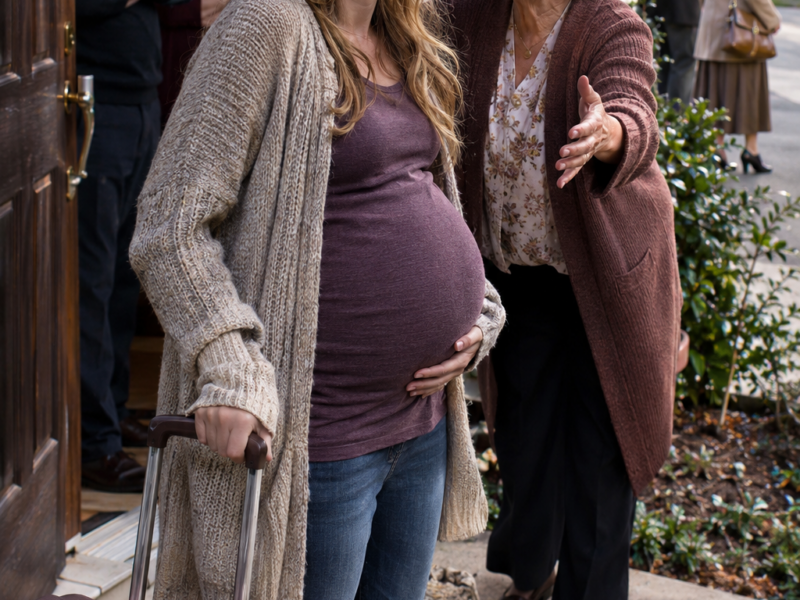
My In-Laws Threw Me Out 8 Months Pregnant, My Parents Shut the Door — Then Grandma Picked Up…
My In-Laws Threw Me Out 8 Months Pregnant, My Parents Shut the Door — Then Grandma Picked Up…
The bus station closed its doors at midnight.
I was sitting on a metal bench outside, eight months pregnant, with one suitcase beside me, no phone, no car, and exactly forty dollars in my coat pocket. The automatic doors had locked twenty minutes earlier. Half the lights inside had been switched off, and the parking lot was nearly empty. Every few minutes, a car passed on the highway, its headlights briefly illuminating the sidewalk before disappearing into the darkness.
I had nowhere to go.
At 12:40 a.m., a janitor wearing a dark blue uniform came out through a side entrance. He was a large man, probably in his early forties, with a gray beard, broad shoulders, and eyes that seemed much kinder than the circumstances deserved.
He stopped when he noticed me.
“Ma’am, are you all right?”
I nodded, although we both knew I wasn’t.
He glanced at my stomach, then at the suitcase.
“Is there somebody I can call for you?”
I looked down at my hands. There was only one number I still knew by heart. I hadn’t called it in months, but I could have written every digit without thinking.
My grandmother’s landline.
She had lived in the same farmhouse on Sand Mountain for most of her life. The number had been unchanged since 1979, back when people still memorized telephone numbers because there was no other choice.
I told him the number.
He took out his phone and dialed it on speaker.
She answered on the first ring.
“Hello?”
The janitor cleared his throat.
“Ma’am, I’m sorry to bother you this late. My name is Quinton Lomax. I’m at the bus station in Chattanooga. There’s a young pregnant woman here, and she gave me your number.”
There was a brief silence.
Then my grandmother asked a question that made the janitor straighten.
“Is this about my granddaughter?”
Quinton stared at the phone.
“Yes, ma’am. How did you know?”
“My granddaughter’s name is Corey Kincaid. Is that who you’re sitting with?”
He looked at me.
“Yes, ma’am. That’s her.”
Another silence followed. Then my grandmother spoke in a voice so calm that it made me want to cry.
“Keep her in the light, Mr. Lomax. I’m coming.”
Quinton lowered the phone slowly.
“Well,” he said, looking at me with something approaching amazement, “I guess you’ve got somebody coming.”
I didn’t know it yet, but that telephone call would change the direction of both our lives.
To understand how I ended up on that bench, you have to go back three months, to the day I buried my husband.
My name is Corey Kincaid. In the fall of 2021, I was thirty-one years old, eight years into a career as a production engineer, and living in Chattanooga, Tennessee.
I worked at Kincaid Home Fragrance, a family-owned business that manufactured candles and home fragrance products. The company shipped thousands of glass jars of scented candles to retailers across the country. It wasn’t glamorous work, but I loved it.
Eight years on a factory floor teaches you things that people in offices sometimes forget. Every product has a history. Every batch has a record. You need to know what went into it, how much was used, when it was made, what temperature it reached, and whose hands handled it.
When something goes wrong, you don’t rely on someone’s memory or a convenient explanation.
You open the batch book.
That principle would eventually save everything I had left.
I grew up in Dalton, Georgia, about thirty minutes south of Chattanooga. My parents lived in a small brick house near the carpet mill where my father worked for twenty-six years. But the place that truly felt like home was my grandmother’s farm on top of Sand Mountain in Alabama.
Every summer of my childhood, I spent weeks there.
The farm covered forty acres. There was a red barn, an old farmhouse with a wide front porch, a vegetable garden so large it looked like a small field, and a collection of goats that my grandfather loved more than his pickup truck.
My grandmother, Nola Apprentice, was a small woman with a powerful personality. She stood barely five feet one, wore rubber boots in almost every season, and believed that a person could solve most problems with hard work, prayer, and a decent meal.
She taught me how to milk a goat before I learned how to ride a bicycle.
She also taught me that generosity didn’t need an audience. If someone needed help, you helped them. You didn’t ask whether they could repay you. You didn’t calculate what you might gain.
You simply did what was right.
I met Wesley Kincaid in 2016, during my first week at the family company.
He was the owner’s son, but he wasn’t like the other executives. He walked through the production floor, asked questions, and actually listened to the people operating the machines.
Most importantly, he asked my opinion about the production line.
At the time, the company was struggling with waste and inconsistent output. I spent several months studying the process, identifying bottlenecks, and redesigning the line. Within a year, we had reduced production waste by a third.
The following year, the improved operation helped secure the company’s largest retail account.
Wesley never treated that achievement as something he had given me. He always said I had earned it.
By the end of 2017, we were dating. In 2018, we married in my grandmother’s front yard beneath a large oak tree.
There were folding chairs, homemade food, wildflowers in glass jars, and goats wandering around the edges of the celebration. My grandmother wore her favorite blue dress and cried through the entire ceremony.
Wesley loved her.
He used to tell me that marrying me meant getting an entire Alabama family along with me, and he considered that a bargain.
His father had died several years earlier, leaving the company divided among three people. Wesley owned forty percent, his mother, Patrice, owned thirty percent, and his younger brother, Rhett, owned the remaining thirty percent.
Patrice was sixty-two, elegant, controlled, and accustomed to getting her way. She rarely raised her voice. She didn’t need to. Her disapproval was usually delivered through a quiet sentence and a perfectly timed smile.
Rhett was different. He wanted authority without responsibility and recognition without doing the difficult work. He had spent years telling people that he was destined to run the company.
But the employees didn’t particularly like him.
When a machine malfunctioned, they called me. When a production target was missed, they came to me. When something needed fixing, they knew I would find a solution.
Rhett noticed that.
And he never forgot it.
Wesley and I lived in a small stone cottage behind his mother’s large house on Lookout Mountain. We were happy there. It wasn’t a huge place, but it was ours. We painted the nursery yellow in June of 2021, choosing a warm shade that Wesley insisted would make the room feel like sunshine.
We had already picked out a name for our daughter.
Nola.
Then, on Saturday, July 17, a truck crossed the median on Interstate 24.
Wesley never came home.
He was thirty-three years old.
The phone call came in the afternoon. I remember standing in the kitchen, holding a dish towel, while a stranger explained that there had been an accident. I remember asking the same question three times because my mind refused to accept the answer.
I remember the sound of the towel hitting the floor.
And I remember looking toward the yellow nursery, where a little wooden rocking chair sat beside the window.
I thought losing Wesley was the worst thing that could ever happen to me.
I was wrong.
Three months after his funeral, his mother called me to the big house.
It was Monday, October 18. I was eight months pregnant and had spent the morning organizing the baby’s clothes. I thought Patrice wanted to discuss Thanksgiving or perhaps something involving Wesley’s estate.
When I entered the dining room, I found Rhett standing beside the fireplace with his arms crossed.
A thick folder lay on the table.
Patrice motioned toward a chair.
“Corey, honey, we’ve been talking about the future of the company.”
I sat down.
“All right.”
“With Wesley gone, things have changed. We need to simplify certain arrangements. It makes sense for his share to come back into the family.”
I stared at her.
“I am the family,” I said quietly. “I’m his wife.”
Patrice smiled.
“You were his wife.”
She pushed the folder toward me.
Inside was a legal agreement stating that I would surrender any claim to Wesley’s forty-percent ownership in the company. In exchange, they would pay me twenty-five thousand dollars.
I read the first page twice.
Twenty-five thousand dollars.
That was what they thought Wesley’s share was worth. A share of a company that manufactured and sold thousands of products to retailers across the country.
I looked up.
“Did Wesley leave a will?”
Patrice didn’t blink.
“No, honey. He didn’t. He was thirty-three. People don’t usually think about these things at that age.”
I closed the folder.
“I’d like an attorney to review this.”
Rhett laughed.
It was a short, unpleasant sound.
“An attorney? Corey, don’t make this difficult.”
Patrice gave me the same expression she used when an employee misunderstood a simple instruction.
“Of course. Take all the time you need.”
But I had three days.
On Thursday, October 21, I returned home from a doctor’s appointment and found my suitcase sitting on the cottage porch.
Someone had packed it badly. The sleeve of my yellow maternity dress was caught in the zipper, and several of my belongings were missing.
I tried my key.
It didn’t work.
The lock was new, bright, and unfamiliar.
Rhett stood in the driveway beside my car.
He held out his hand.
“Keys.”
I stared at him.
“What?”
“The keys. And the phone.”
“Rhett, that’s my phone.”
“It’s a company phone.”
“And the car?”
“Company vehicle.”
I looked at the cottage.
“This is my home.”
He shrugged.
“Company property.”
He took the keys from my hand.
“You’re not company anymore.”
Patrice came down the stone path from the big house. She was wearing a cream cashmere sweater and had her arms folded.
“Wesley’s gone, Corey,” she said. “There’s nothing holding you to this family now.”
I placed one hand over my stomach.
“Your grandbaby is holding me to this family.”
She looked down at my belly.
For several seconds, she said nothing.
Then she replied, “We’ll see whose baby that is.”
I felt something inside me collapse.
I wanted to scream. I wanted to ask how a woman could look at her dead son’s pregnant wife and say something so cruel.
But I couldn’t get the words out.
I was standing in the driveway with one suitcase, no keys, and a baby moving beneath my hand.
Rhett had already arranged transportation. A company driver was waiting in a sedan.
He put my suitcase in the trunk.
“Where to?” the driver asked.
I swallowed.
“Dalton. My parents’ house.”
I still believed that if I could reach my parents, everything would somehow become manageable.
I didn’t know yet that they would close their door, too.
My parents lived in a small brick house on a dead-end street in Dalton, four blocks from the carpet mill where my father had worked for twenty-six years.
The mill had closed in May.
My father, Merrill Dobbins, had been unable to find another job. My mother was working double shifts at a Waffle House to keep the mortgage paid.
When the company car dropped me at their curb, it was almost nine o’clock.
My mother opened the door.
Her face changed immediately when she saw me.
She looked at my suitcase, then at my stomach, and tears filled her eyes.
But before she could speak, my father appeared behind her.
He was wearing an undershirt and holding a glass of water.
I explained everything.
I told them about Wesley’s death, Patrice’s offer, the new locks, and the fact that I had nowhere to go.
I told them I only needed somewhere to stay until the baby arrived. I could work. I could help around the house. I could find another job once I had recovered from childbirth.
I was standing on their porch the entire time.
Nobody invited me inside.
When I finished, my father rubbed the back of his neck.
“Corey, we can’t.”
I thought I had misunderstood.
“What?”
“We can’t take you in.”
“Daddy, it’s just until the baby comes.”
He looked exhausted.
“We’re three months behind on this house. Your mama’s working double shifts. I’ve got no job and no prospects. We can barely keep ourselves going.”
“I can help.”
“With what? You’re eight months pregnant.”
“I can figure something out.”
He shook his head.
“You married into money. I warned you about those people. You made your bed with them.”
My mother stood beside the doorway in her Waffle House apron. Tears were running down her cheeks, but she kept looking at the floor.
I waited for her to say something.
Anything.
She didn’t.
My father picked up his truck keys from the little dish beside the door.
“I’ll drive you to the bus station in Chattanooga. There’s a morning bus to Atlanta. Your cousin might take you in.”
I stared at him.
“You want me to go to Atlanta?”
“It’s the best I can do.”
I had no argument left.
Before following him down the steps, I turned toward my mother.
She suddenly wrapped her arms around me.
It was a tight hug, the kind she used to give me when I was a little girl and had fallen off my bicycle.
I felt her hand slide into the pocket of my coat.
“I’m sorry, baby,” she whispered into my hair. “I’m so sorry.”
I didn’t understand what she was doing.
I only held her for a few seconds longer before my father called from the driveway.
The drive to Chattanooga took about forty minutes.
He didn’t speak.
At the station, he bought a ticket for the 6:15 a.m. bus to Atlanta. He placed my suitcase beside a bench and looked at me.
“Take care of yourself.”
Then he got into his truck and drove away.
I stood there for a long time, watching his taillights disappear.
At midnight, the station locked its doors.
A uniformed employee turned off half the lights and secured the glass entrance. I was left outside with my suitcase.
I reached into my coat pocket.
Two twenty-dollar bills.
Forty dollars.
That was everything I had.
I sat on the bench and tried to imagine what would happen next. I could take the bus to Atlanta, but I didn’t know whether my cousin would let me stay. I had no phone to call ahead. I didn’t even know how I would get from the bus station to his house.
My daughter moved.
I placed both hands over my stomach.
“Don’t worry,” I whispered. “We’ll figure it out.”
That was when Quinton Lomax found me.
After calling my grandmother, he disappeared through the side door and returned with two folding chairs, a bottle of water, and a packet of peanut butter crackers from the vending machine.
“My wife was pregnant three times,” he said as he placed the food beside me. “She always wanted peanut butter.”
He sat down.
He didn’t leave.
For the next hour and a half, he told me about his father.
In 1998, his family had owned a small cattle farm outside Rainsville, Alabama. One spring night, lightning struck their barn. The fire spread quickly, destroying the building, their hay supply, and nine head of cattle.
Quinton had been sixteen.
He had never seen his father cry before that morning.
His father, Junior Lomax, sat among the ashes with his head in his hands.
The family had lost almost everything.
Two weeks later, there was a cattle sale in Rainsville. Junior went there only to watch because he had no money to buy another animal.
Then a woman in a straw hat approached him.
She was someone he barely knew.
She handed him a halter rope. At the other end was a beautiful young heifer.
Junior protested.
He couldn’t pay for it.
The woman simply said, “Junior, you pay me back when you can.”
Her name was Nola Apprentice.
My grandmother.
Junior never managed to repay her. Not once in twenty-three years.
But that heifer became the beginning of their new herd. The family rebuilt the farm, and the cattle business eventually supported them through several difficult years.
“My daddy talked about Miss Nola until the day he died,” Quinton told me.
I looked at him.
“That’s my grandmother.”
He nodded.
“I know. That’s why I’m not going anywhere.”
At 2:10 in the morning, an old green Ford pickup rattled into the parking lot.
Its headlights swept across the benches.
I recognized that truck immediately.
It had belonged to my grandfather. He had been dead for four years, but my grandmother still drove it because she said the old man had spent too much time fixing it for her to let it rust in a shed.
The driver’s door opened.
My grandmother climbed down.
She was eighty-one years old, wearing a barn coat over her nightgown, rubber boots, and a pair of glasses pushed up on her head.
A quilt was folded over one arm. In her other hand was a thermos of coffee.
She looked at me.
She looked at my suitcase.
Then she looked at my stomach.
She didn’t ask what happened.
She didn’t ask why I was there.
She simply walked over, wrapped the quilt around my shoulders, and kissed my forehead.
“Get in the truck, baby,” she said. “You’re going home.”
I started crying.
Not the quiet kind of crying I had done on my parents’ porch. This was something deeper. Something that had been trapped inside me since Wesley died.
My grandmother held me until I could breathe again.
Before leaving, she walked over to Quinton.
He stood up and removed his cap.
“Miss Nola,” he said. “I don’t know if you remember me. I’m Junior Lomax’s boy.”
She studied his face.
“I know who you are, Quinton. You have your daddy’s hands.”
He looked down at them.
“We never paid you back for that heifer.”
My grandmother reached up and patted his cheek.
“Honey, you just did.”
The drive to Sand Mountain took nearly two hours.
The roads were dark, winding, and narrow. My grandmother drove with both hands on the steering wheel, leaning forward slightly to see through the windshield.
She didn’t ask about Patrice.
She didn’t ask about my father.
She didn’t even ask why I hadn’t called sooner.
At one point, she reached over and placed her palm against my stomach.
The baby kicked.
Grandma laughed.
“Well, she’s got some fight in her.”
I smiled through my tears.
“She gets that from you.”
“Good. She’ll need it.”
When we reached the farm, the porch light was on. The goats began calling from the barn as soon as they heard the truck.
My grandmother helped me inside and took me to my old bedroom.
The room had a slanted ceiling, a wooden dresser, and the same quilt with little stars that I had slept beneath as a child.
I fell asleep almost immediately.
I slept for eleven hours.
When I came downstairs the following afternoon, my grandmother was sitting at the kitchen table wearing her reading glasses. A stack of mail was spread in front of her.
She tried to slide the top letter underneath the others.
She wasn’t quick enough.
I saw the words.
NOTICE OF DEFAULT AND FORECLOSURE SALE.
I picked it up.
“Grandma?”
She sighed.
“Well, I suppose you were going to find out eventually.”
My grandfather had been sick for several years before he died. His hospital bills had consumed most of their savings. In 2016, he had borrowed against the farm to cover the medical expenses.
Forty acres that had belonged to his family since 1902 had become collateral for a loan.
After his death, my grandmother continued making payments using the money she earned from selling eggs and her small Social Security check.
It wasn’t enough.
She owed thirty-eight thousand dollars.
The bank had scheduled the foreclosure auction for the first Tuesday in April, when the property would be sold on the courthouse steps in Fort Payne.
I looked at her.
“Why didn’t you tell anybody?”
She removed her glasses and folded them carefully.
“Who was I going to tell, honey?”
She glanced toward the window.
“Your daddy?”
She shook her head.
“I’ve been praying about it for a year. Asked the Lord to send me an answer.”
Then she looked at me.
Eight months pregnant. No job. No car. No phone. One suitcase.
“And I guess this morning,” she said, “He sent me a houseguest.”
I laughed.
Then I cried.
Because in four weeks, I was going to have a baby.
And in five months, the woman who had rescued me might lose the only home I had left.
My daughter was born on Friday, November 19, at the hospital in Fort Payne.
She weighed seven pounds and one ounce.
She had a full head of dark hair, exactly like her father’s.
My grandmother was the only person in the delivery room with me. She held my hand for nine hours, occasionally telling the nurses that I was stronger than I looked and that they should give me another blanket.
When the baby finally arrived, the nurse placed her against my chest.
I looked down at her tiny face.
For the first time since Wesley’s death, I felt something other than grief.
I felt hope.
My grandmother sat down heavily in the plastic chair and began crying.
I had seen her angry. I had seen her laugh. I had seen her work through injuries and illness without complaining.
But I had never seen her cry like that.
I named my daughter Nola.
The nurse asked whether it was a family name.
I looked at my grandmother.
“Yes,” I said. “It’s the most important family name I know.”
Nobody from Lookout Mountain called.
Nobody from Dalton called either.
I had given the nurses my mother’s telephone number, just in case she wanted to know when the baby arrived.
The phone never rang.
We brought Nola home to the farm on a gray Sunday afternoon.
That night, my grandmother sat beside the wood stove, rocking the baby while I walked out to the barn.
There were twelve Nubian goats inside, all with long floppy ears and loud personalities. My grandfather had loved those animals.
Three of them were producing milk.
Their names were Dolly, Reba, and Emmylou.
My grandmother had been milking them twice a day for four years. She drank what she could and poured most of the rest away because one elderly woman could only use so much milk.
I stood there looking at the buckets.
Three goats.
Nearly three gallons of milk a day.
A resource that was practically going down the drain.
And upstairs in my old bedroom, I had a degree in manufacturing engineering and eight years of experience designing production systems.
I began calculating.
I had no intention of building a large business. At first, I only wanted to find a way to generate enough income to help my grandmother keep the farm.
I remembered something I had read about goat milk soap. It was a practical product, and it could be made in small batches using ingredients that were relatively inexpensive.
The more I researched, the more interested I became.
On Saturday, January 8, 2022, I made my first batch.
I bought supplies using some of my grandmother’s egg money. I picked up lye from a hardware store in Rainsville, olive oil and coconut oil from Walmart in Fort Payne, two loaf pans from Goodwill, a thermometer, and a kitchen scale.
Before opening a single bottle, I went to Dollar General and bought a composition notebook.
On the first page, I wrote two words in large block letters.
BATCH BOOK.
Then I began recording everything.
Batch 001.
January 8, 2022.
Milk from Dolly, Reba, and Emmylou.
Milk frozen into slush before mixing to control the temperature and prevent scorching.
Every ingredient weighed to the gram.
Every temperature recorded.
Every mixing time.
Every pouring time.
I wrote down when the soap was cut and when it would be ready after curing.
My grandmother stood behind me in her apron, watching me work.
“Honey, it’s soap. It’s not the space shuttle.”
I didn’t look up.
“Every batch needs a record, Grandma.”
She shook her head.
“You were like this when you were six. You used to count the eggs and write the number on the calendar.”
Then she leaned over the notebook.
“And those goats are named after better singers than me.”
I laughed.
But I kept writing.
By March, I had produced fourteen batches.
Each one was numbered, dated, and recorded. I adjusted the process with every attempt, improving consistency and quality.
I gave bars to people at church, the feed store, and a few neighbors.
At first, they accepted them as gifts.
Then they started coming back asking for more.
People liked the soap. They liked the story behind it, too.
But fourteen batches of soap weren’t going to pay off thirty-eight thousand dollars.
The foreclosure sale was only weeks away.
I began thinking about what else I could do.
Then, on Sunday, March 13, I filmed my grandmother in the barn.
Three baby goats had been born that week. One was too weak to nurse properly, so Grandma was sitting on an upside-down bucket in her flowered housecoat, feeding it from a bottle.
She was singing an old Sunday school song.
She was completely off-key.
The other two baby goats were climbing over her legs and chewing on her hair.
At one point, the weak little goat stopped drinking, and she gently rubbed its forehead.
“Come on, sweetheart,” she whispered. “You’ve got to get strong.”
I filmed the whole thing.
I posted it before church, mostly because I wanted some of my old coworkers to see the farm and the baby goats.
I didn’t expect anything to happen.
When we returned from church, the video had two hundred thousand views.
By Monday night, it had reached four million.
People were calling my grandmother Granny Nola.
Someone made a remix of her singing. Another person added music. A morning television program in New York contacted us to ask whether she would appear on their show.
My grandmother told them she didn’t have time because she had goats to milk.
Then she hung up.
That clip reached another two million people.
But beneath almost every video, people asked the same question.
“Where can we buy the soap?”
I looked at the comments and realized something.
People weren’t just interested in my grandmother.
They wanted to support what she represented.
A hardworking elderly woman who loved her animals, sang to baby goats, and had spent her life helping others.
On Tuesday night, I created a simple website.
I used my grandmother’s picture and called the business Granny Nola’s Goat Milk Soap.
Eight dollars a bar.
I had 312 bars fully cured and ready to ship.
I put them online.
They sold out in nineteen minutes.
I stared at the order page, convinced something had gone wrong.
Then I refreshed it.
The orders kept coming.
By the end of March, we had received requests for nine thousand bars.
I calculated the ingredients, supplies, shipping, and production capacity. I knew I couldn’t simply accept every order and hope for the best.
But I also knew that if I organized the work correctly, we had a chance.
For the first time in months, I could see a way forward.
On Thursday, March 31, I drove to the bank in Fort Payne.
My grandmother sat beside me wearing her favorite church hat.
I carried a cashier’s check for thirty-eight thousand dollars.
The bank manager looked at it, looked at me, and asked whether he could verify the amount.
Grandma leaned forward.
“Count it twice, honey. That’s forty acres you’re looking at.”
He smiled and did exactly that.
The foreclosure sale was canceled.
The farm was free and clear for the first time in six years.
That evening, my grandmother stood on the front porch looking across the fields.
The sun was setting behind the trees, and the goats were beginning to settle into the barn.
She stood there for a long time.
Then she looked toward the sky.
“Eli,” she whispered, speaking to my grandfather, “you can rest now.”
I stood behind her with Nola in my arms.
I knew what those forty acres meant to her. They weren’t simply land. They were memories, family history, and every difficult year she and my grandfather had survived together.
We had saved them.
Not through a miracle, but through fourteen batches of soap, one viral video, and thousands of people who believed a small family farm deserved a chance.
Over the next three years, I built the business the only way I knew how.
One batch at a time.
Every ingredient was recorded. Every production change was documented. Every order was tracked.
We turned the old hay barn into a proper soap kitchen in 2022. By 2023, I had designed a production line with curing racks built from old tobacco frames.
By 2024, we employed twenty-two people, most of them from Sand Mountain.
Our shipping manager was a large man with a gray beard named Quinton Lomax.
He had quit his job at the bus station the day I offered him the position.
He said he had spent years sitting behind a counter watching people come and go, and he preferred helping build something that stayed.
My grandmother remained the heart of the business.
Her face appeared on every label.
She still milked goats every morning. She still wore rubber boots. She still sang off-key to the baby animals.
And she still insisted on inspecting the first bar from every new batch, even though she had no idea what my temperature charts meant.
In February 2025, Ridgeway Markets signed a contract with us.
They wanted to stock our soap and lotion in all three hundred of their grocery stores across the South.
The official launch was scheduled for Saturday, April 12, at their flagship store in Chattanooga.
It was fifteen minutes from Lookout Mountain.
For the first time in years, I would be returning to the place where my marriage had begun and where my husband’s family had thrown me out.
I didn’t know whether I was ready for that.
But I had work to do.
Meanwhile, things at Kincaid Home Fragrance had not gone well.
In 2023, they lost the major retail account that I had helped secure years earlier. Rhett had changed the wax formula to reduce costs, and the candles began cracking inside their glass jars.
Customers complained.
Retailers canceled orders.
Forty employees lost their jobs.
I heard about it from a former coworker.
I wasn’t happy about it.
Those people had families and mortgages. Some had worked there for decades. They hadn’t done anything wrong.
I felt sorry for them.
Then, on Monday, March 17, 2025, three things happened almost simultaneously.
The first was a letter from a Chattanooga law firm representing Kincaid Home Fragrance.
It accused me of stealing company trade secrets.
According to their claim, my goat milk soap formulas had been developed using the company’s equipment and resources while I was employed there.
They demanded that I stop selling immediately.
If I refused, they would seek a court order preventing the Ridgeway launch.
I read the letter twice.
I had never developed soap at Kincaid Home Fragrance. The company manufactured candles, wax, and fragrance products. It had never operated a soap production line.
My first batch had been made on my grandmother’s kitchen stove, using ingredients purchased from local stores.
I had the receipts.
I had the notebook.
And I had every record.
The second letter was a court petition filed in DeKalb County, Alabama.
Patrice Kincaid was requesting legal visitation rights with her granddaughter.
The same woman who had once questioned whether the baby was even Wesley’s.
The third event was a telephone call from Gwendolyn Bridger, the buyer at Ridgeway Markets.
“Corey, I love your product,” she said. “But we cannot put something on three hundred shelves while a lawsuit is hanging over it. If this isn’t settled by April twelfth, we’ll have to postpone the launch. Possibly for good.”
I thanked her and ended the call.
Then I sat alone in the soap kitchen.
The room was full of activity, but suddenly I couldn’t hear anything.
I thought about the farm.
The employees.
My daughter.
The thousands of people who had placed orders because they believed in us.
I had spent three years building something from nothing.
And now the people who had thrown me away were trying to take it from me.
The following morning, I was still thinking about the letters when a dusty pickup pulled into the farm driveway.
I recognized the driver immediately.
My father.
I hadn’t seen him in three and a half years.
He looked thinner and grayer than I remembered. He didn’t get out of the truck. He simply rolled down the window.
“The bank’s taking the house,” he said.
I stood beside the driveway.
He continued.
“Sixty thousand would cover it.”
I said nothing.
“You’ve got it. Everybody knows you’ve got it.”
He looked past me toward the barn, the production building, and the trucks parked beside the loading area.
Then he said something that made my stomach tighten.
“Family takes care of family, Corey.”
Before I could answer, my grandmother appeared behind me.
She was wearing her rubber boots and carrying a small basket of eggs.
“Merrill,” she said.
My father looked at her.
“You should go.”
He seemed surprised.
“I was just talking to my daughter.”
“I heard you.”
He looked back at me.
“I’ll be at that big launch. And I’ll tell every television camera there what kind of daughter turns her back on her own daddy.”
Then he drove away.
My grandmother watched the truck disappear.
“Don’t let him frighten you, honey,” she said.
I nodded.
But I was frightened.
Not because I wanted to give my father the money. I didn’t know whether I could ever trust him again.
I was frightened because I knew he wasn’t bluffing about the launch.
He intended to make a scene.
And I couldn’t afford a scene.
My attorney was named Lydia Kemp.
She had an office above a bakery in Fort Payne and a reputation for being almost impossible to intimidate.
She was the only person I knew who could argue with my grandmother and actually win.
When I showed her the letters, she read them carefully.
“They’re going to come at you in public,” she said. “All of them. In front of the store executives and the cameras.”
“What do we do?”
She looked at me.
“What do you always do?”
I thought about the factory floor.
I thought about the soap kitchen.
I thought about the notebook that had started everything.
“We open the batch book,” I said. “And we pull every record. Every single one.”
Lydia smiled.
“Good answer.”
For the next three weeks, she investigated everything connected to Kincaid Home Fragrance.
Corporate filings.
Court records.
Property records.
Estate documents.
She requested information that had been available publicly but that nobody had bothered to examine closely.
I continued running the business while she worked.
I prepared the products for the Ridgeway launch. I checked packaging, production schedules, shipping arrangements, and inventory.
At night, I sat with Nola and read her stories.
Sometimes, when she was asleep, I found myself thinking about Wesley.
I wondered what he would have said about everything.
I imagined him standing beside me in the soap kitchen, smiling at the notebook.
He would have loved what we had built.
On Wednesday, April 9, three days before the launch, Lydia called me at ten o’clock at night.
“Corey, are you sitting down?”
I was standing on the porch steps.
I sat.
“I found something.”
“What?”
“A probate case in Hamilton County, Tennessee. It was filed in August 2021. The estate of Wesley Kincaid.”
I gripped the phone.
“Okay.”
“Corey, your husband left a will.”
For several seconds, I couldn’t speak.
“What?”
“He left a will. A properly executed will, signed in April 2021, several months before the accident.”
I looked toward the farmhouse.
My grandmother was rocking Nola by the window.
Lydia continued.
“Your husband named Patrice as executor. He left his entire forty-percent ownership in Kincaid Home Fragrance to you, in trust for your daughter.”
I felt the world become very still.
“Then why did Patrice tell me there was no will?”
“That’s what we’re going to establish.”
Lydia had found the probate filing.
She had also found proof that the court had sent official notice to my address at the cottage on Lookout Mountain.
Someone had signed for it.
The signature belonged to Patrice.
She had received the notification.
She knew about the will.
And five weeks later, she had sat across from me at her dining table, told me that Wesley had left nothing, and offered me twenty-five thousand dollars to surrender the ownership that already belonged to me.
When I refused, she had changed the locks.
Lydia had one more piece of information.
“The probate hearing is going to be interesting,” she said. “But first, we need to get through Saturday.”
I looked at the old farm in the darkness.
“Then Saturday it is.”
The Ridgeway Markets flagship store on Gun Barrel Road had a stage set up near the main entrance on April 12.
A large banner displayed my grandmother’s smiling face, holding a baby goat.
There were at least two hundred people in the parking lot.
Two television crews had arrived. The president of Ridgeway Markets was there, along with Gwendolyn Bridger and several other executives.
Half our employees had driven down from Sand Mountain in a church van.
My grandmother had insisted on bringing two baby goats.
She said people came to see the goats, not the soap.
At eighty-four, she was wearing her church hat, a floral blouse, and her usual rubber boots.
She looked happier than I had seen her in years.
At ten o’clock, Gwendolyn stepped toward the microphone.
She began introducing our company.
She talked about the farm, the production process, the quality of our ingredients, and the thousands of customers who had supported us.
She had just reached the third sentence when a black SUV pulled up to the curb.
Rhett got out first.
He wore a gray suit.
Patrice followed, dressed in pearls and a tailored jacket.
A lawyer carrying a briefcase stepped out behind them.
They walked directly through the crowd toward the stage.
I felt my stomach tighten.
Then I noticed someone standing near the shopping carts.
My father.
And beside him, wearing her old Waffle House jacket, was my mother.
I hadn’t seen her in three and a half years.
My hands went cold.
Rhett reached the front of the stage and raised his voice.
“I’m sorry to interrupt, but these people deserve to know what they’re buying.”
Gwendolyn stopped speaking.
Rhett turned toward the cameras.
“That woman worked in our laboratory for eight years. Every formula she’s selling came from our company. She stole our intellectual property when she left.”
His lawyer handed a thick stack of documents to Gwendolyn.
Patrice stepped forward.
“And that little girl,” she said, pointing toward Nola, who was sitting on my hip, “is my late son’s only child. I have legal rights to my granddaughter, and I intend to exercise them.”
The crowd fell silent.
I could hear one of the baby goats making a small noise inside its crate.
My grandmother reached over and took Nola from my arms.
“Go on, honey,” she whispered. “Open the book.”
I reached into my purse.
There it was.
The old composition notebook from Dollar General.
The cover was stained with soap, and one corner had been chewed by a goat.
I walked to the microphone.
My hands were shaking, but my voice was steady.
“Rhett, you took my keys on October twenty-first, 2021.”
He frowned.
“What does that have to do with anything?”
I opened the notebook.
“Batch 001. January eighth, 2022.”
I held up the first page.
“Milk from Dolly, Reba, and Emmylou. Made on my grandmother’s kitchen stove, using two loaf pans purchased from Goodwill.”
I turned toward the cameras.
“Every ingredient is recorded. Every measurement. Every temperature. Every production date. Every batch I have ever made is documented in this book.”
Then I looked directly at Rhett.
“You took my keys on October twenty-first, 2021. This first batch was made seventy-nine days later, on my grandmother’s farm in another state.”
I paused.
“Kincaid Home Fragrance makes candles. Wax. Fragrance oils. In eight years, I never saw a single bar of soap manufactured in that building. There was never a goat milk production process. There was never a soap formula developed in your laboratory.”
I held the notebook higher.
“If you have one batch record proving otherwise, show it to these people right now.”
Rhett opened his mouth.
Nothing came out.
Gwendolyn turned toward the lawyer.
“Do you have a record like that?”
The lawyer glanced down at his briefcase.
“We would need additional time to review the materials.”
Gwendolyn looked at him.
“So, no?”
The president of Ridgeway Markets stepped forward.
He had been listening quietly from the side of the stage.
“I think that’s a fairly straightforward question,” he said.
The lawyer said nothing.
Patrice moved toward the microphone.
“Fine. Keep your soap. But you cannot keep my son’s child from me.”
I turned to her.
“Mrs. Kincaid, the last time you spoke about my child, you told me we’d see whose baby she was.”
Patrice’s expression hardened.
“I never said that.”
“You did.”
“You were grieving, Corey. You weren’t thinking clearly.”
Then another voice came from the crowd.
“Excuse me.”
Everyone turned.
My mother was walking toward the stage.
She held her phone in one trembling hand.
She stopped beside the microphone and looked directly at Patrice.
“You sent me this,” she said.
Patrice stared at her.
“What are you talking about?”
My mother raised the phone.
“This message. You sent it to me at 6:52 that evening, before Corey even arrived at our house.”
She read the words aloud.
“Corey has left our family. Please don’t send her back here. That baby isn’t our problem.”
A murmur moved through the crowd.
My mother looked at Patrice.
“I kept it.”
Her voice broke.
“I kept it for three and a half years. I didn’t know why I couldn’t delete it. I guess I knew somebody would need to see it someday.”
My father stood near the shopping carts, staring at her.
He looked as though he had never seen his wife before.
Patrice’s face had gone pale.
But she wasn’t finished.
“None of this changes anything,” she said. “My son’s share of that company belongs to his family.”
Lydia had been standing at the bottom of the stage steps, holding a manila folder.
Now she walked forward.
“Mrs. Kincaid, I’m Corey Kincaid’s attorney.”
She opened the folder.
“In April 2021, your son signed a will at a law office on Broad Street in Chattanooga. He named you as executor and left his entire forty-percent ownership in Kincaid Home Fragrance to his wife, Corey, in trust for their child.”
A sound moved through the crowd.
It was the kind of collective reaction people make when they realize that something they thought they understood has just changed completely.
Lydia continued.
“On August twentieth, 2021, the will was filed with the Hamilton County Probate Court. On September ninth, the court mailed notice to Corey at the cottage behind your house.”
She held up a small green certified-mail receipt.
“Someone signed for that notice.”
She turned the card toward the cameras.
“Patrice Kincaid.”
Rhett slowly turned toward his mother.
“Mama?”
She didn’t look at him.
“You told me Wesley never made a will,” he said.
Patrice remained silent.
Lydia continued.
“Five weeks after receiving official notice of the will, you sat at your dining table and told my client that her husband had left no will. You offered her twenty-five thousand dollars to surrender ownership of an asset that already belonged to her.”
She paused.
“And when she refused, you changed the locks and put her out of her home.”
I held the stage railing.
My knees felt weak.
All those months, I had believed Wesley had died without leaving anything to protect me.
But he had.
He had thought about our daughter.
He had made arrangements for her future.
He had trusted his mother to carry out his wishes.
And she had deliberately hidden them.
For the first time since I had known her, Patrice’s voice cracked.
“That company is all I had left of my husband,” she said. “Wesley was going to hand it to a girl from a carpet mill town.”
I looked at her.
“No, ma’am. He was going to hand it to his daughter.”
My grandmother stepped forward.
She held Nola against her hip, one hand supporting the little girl’s back.
Her church hat was perfectly straight.
She looked at Patrice for several seconds.
“Mrs. Kincaid,” she said, “you had a grandbaby coming, and you put her mother out on a porch with one suitcase.”
Her voice was quiet, but everyone heard it.
“I was eighty-one years old. I drove two hours in the dark in a dead man’s truck to pick her up off a bus station bench.”
She shifted Nola gently.
“Don’t you ever stand in front of me and talk about rights. The only right you ever had was to open the door.”
She paused.
“And you didn’t.”
Nobody spoke.
My grandmother turned toward the edge of the crowd.
My father was still standing beside the shopping carts.
“And Merrill,” she said.
He looked up.
“You drove my granddaughter to a bus station in the middle of the night and bought her a ticket to nowhere.”
Her voice became even firmer.
“Don’t you ever stand in front of a television camera and tell the world what kind of daughter she is.”
My father lowered his eyes.
He didn’t answer.
He simply turned and walked back toward his truck.
Rhett’s lawyer quietly closed his briefcase.
Patrice turned away from the stage and walked toward the SUV.
Rhett didn’t follow her immediately.
He stood there with his hands hanging at his sides, staring at the little girl on my grandmother’s hip.
His brother’s daughter.
A child he had never bothered to meet.
For several seconds, I thought he might say something.
But he didn’t.
Gwendolyn stepped back toward the microphone.
She looked at the crowd, then at me.
“Well,” she said with a smile, “I believe we have a launch.”
The crowd erupted.
My grandmother took a pair of garden shears from someone standing beside the stage.
She insisted on cutting the ribbon herself.
One of the baby goats had managed to get its head out of the crate and was chewing on her sleeve.
She didn’t even notice.
The ribbon fell.
And Granny Nola’s Goat Milk Soap officially launched in three hundred Ridgeway Markets stores across the South.
That afternoon, people bought products faster than our staff could restock the display.
The television crews filmed everything.
The story of the pregnant woman who had been thrown out, the grandmother who rescued her, and the family business built from a notebook and three goats spread far beyond what we had imagined.
But the real consequences came during the following week.
On Monday morning, Kincaid Home Fragrance withdrew its lawsuit.
By Friday, Patrice’s visitation petition had been withdrawn.
The probate judge in Hamilton County removed Patrice as executor and ordered her to pay the estate’s legal expenses.
Wesley’s forty-percent ownership was transferred into a trust for Nola, exactly as he had intended.
Rhett eventually purchased the shares back that fall at a fair price determined by an independent appraiser.
Every dollar went into Nola’s trust.
She would never have to worry about college, medical expenses, or being left without a roof over her head.
Rhett wrote me a letter.
It was four pages long, handwritten.
He said he genuinely hadn’t known about the will. He said his mother had told him Wesley died without leaving one.
He apologized for the way he had treated me.
I believed him.
I didn’t suddenly forgive him, but I believed he was sorry.
Patrice never apologized.
She sends Nola a birthday card every November.
I keep them in a box.
When my daughter is old enough, she can decide whether she wants to read them.
I won’t make that decision for her.
In June, Rhett drove up to the farm.
He parked near the gate and asked whether I would consider returning to Chattanooga to run the production plant.
The company was barely surviving.
He said the employees needed me.
I looked back toward the barn.
My grandmother was sitting on the porch with Nola in her lap. The little girl was trying to feed a cracker to one of the goats.
I thought about the yellow nursery in the cottage, the driveway where I had been thrown out, and the life I had spent years trying to build there.
Then I looked at Rhett.
“I already went home four years ago,” I said. “It was outside a bus station.”
He nodded slowly.
He understood.
I never gave my father the sixty thousand dollars.
He eventually sold the house and moved into his brother’s spare room in Chatsworth.
We don’t talk much.
Sometimes I wonder whether I should have helped him.
He worked twenty-six years at the carpet mill to help put me through school. He wasn’t always a cruel man. I remember him teaching me how to change a tire, helping me with mathematics homework, and standing in the back of my high school graduation ceremony with tears in his eyes.
But when I needed him most, he closed the door.
I don’t know whether money would have changed anything between us.
I only know that I couldn’t pretend the past hadn’t happened.
My mother was different.
In May, she drove up the mountain with two suitcases.
She stood outside the farmhouse for a long time before getting out of the car.
I walked down the porch steps.
She looked at me.
“I don’t know if you want me here.”
I thought about that night in Dalton.
I thought about the porch, my father’s words, and the way she had hugged me before I left.
Then I remembered the forty dollars.
I didn’t know the whole truth yet.
But I knew I wasn’t ready to turn her away.
She moved into the little house beside the pond.
Now she runs our packing room.
She’s good at it, too. She has a way of organizing the work that reminds me of the years she spent serving customers and managing busy restaurant shifts.
Every morning, she walks Nola down to the barn to see the goats.
Sometimes I look through the kitchen window and see them standing together in the morning light.
My mother holds my daughter’s hand.
And for a moment, the world feels like it has found its proper shape again.
Then, one Saturday in July, a stock trailer pulled into the driveway.
Quinton Lomax climbed out of the truck with his two brothers.
I walked outside.
“What are you doing here?”
Quinton smiled.
“We brought something.”
He opened the trailer.
Inside stood a beautiful red heifer calf with a white face.
She was small, healthy, and full of energy.
Quinton walked over to my grandmother.
“She’s the great-great-granddaughter of the one you gave Daddy,” he said. “We figured we were finally square.”
My grandmother looked at the calf for a long time.
Then she shook her head.
“There’s no such thing as finally square when it comes to family.”
Quinton laughed.
“Well, we brought her anyway.”
Grandma thought about it for a moment.
Then she announced that the calf would be named Paid in Full.
She said it was a good name because it reminded everyone that kindness never really disappears.
It just travels.
There is one more thing I haven’t told you.
I never spent the forty dollars my mother gave me that night.
Not one cent.
I kept the two twenty-dollar bills folded together exactly as she had placed them in my coat pocket.
When I started the business, I taped them inside the back cover of my first batch book.
I called them our first investment.
They weren’t enough to buy supplies or rent equipment. They weren’t enough to pay the bank.
But they were the first money I had that belonged to me after everything fell apart.
And somehow, that made them priceless.
One afternoon in May, Nola climbed onto a stool in the soap kitchen.
She was old enough to be curious about everything and young enough to believe that anything she could reach belonged to her.
She pulled the old batch book from the shelf.
Before I could stop her, she peeled the tape away from the back cover.
The two bills fell onto the table.
She unfolded them.
I was about to tell her to be careful when I noticed something written in faint pencil along the edge of one bill.
Six small words.
Written in my mother’s handwriting.
GO TO MAMA’S. I’LL CALL HER.
I stared at the words.
My hands began to shake.
I carried the bill out to the porch.
My grandmother was sitting in her rocking chair, watching the goats in the pasture.
I handed it to her.
She read the words.
Then she took off her glasses.
“Your mama called me that night,” she said.
I sat down beside her.
“What?”
“At eight minutes to midnight. From the Waffle House parking lot.”
She folded the bill carefully.
“She told me your daddy was taking you to the bus station. She said you were eight months pregnant and had nowhere to go.”
I stared at her.
“Then why didn’t you tell me?”
“Your mama made me promise not to.”
My grandmother looked out toward the fields.
“She said she didn’t deserve any credit. She said she should have stopped your daddy, but she didn’t know how. She was afraid of losing the house, afraid of what he’d do, afraid of everything.”
I looked at the bill again.
“That’s how you knew?”
Grandma smiled.
“I’d been sitting beside that telephone with my boots on for forty-eight minutes, honey.”
She leaned back in her chair.
“I knew you’d remember my number.”
I couldn’t speak.
All those years, I had thought my mother had simply watched me leave.
I had believed that her forty dollars was a small apology from someone who hadn’t been brave enough to do anything else.
But she had called the only person she knew could come for me.
She had given me the money and made sure I had a way to reach someone who would never let me sit alone.
It didn’t erase what happened on that porch.
It didn’t make my father innocent.
But it changed the way I understood my mother.
That evening, I walked down to the little house beside the pond.
She was sitting at the kitchen table when I entered.
I placed the twenty-dollar bill in front of her.
She looked at it.
Then she looked at me.
For a moment, neither of us said anything.
“You called Grandma,” I said.
Her face crumpled.
She covered her mouth.
“I didn’t know what else to do.”
I pulled out the chair beside her.
“Why didn’t you tell me?”
She shook her head.
“Because I didn’t do enough. I should have brought you inside. I should have stood up to your father. I should have protected you.”
Tears began running down her cheeks.
“I was scared, Corey. And I’ve regretted it every single day.”
I reached across the table.
She took my hand.
“I don’t know if I can make everything right,” she whispered.
I looked at her.
“Neither do I.”
Then I stood and walked around the table.
I hugged her.
She cried against my shoulder, and I held her the way she had held me on the porch in Dalton.
For the first time in three and a half years, I felt that we were finally beginning to find our way back to each other.
We still have difficult days.
There are things we don’t talk about easily.
But every morning, when I walk down to the barn, I see my mother with Nola.
And I think that sometimes healing doesn’t happen through one grand apology or one perfect conversation.
Sometimes it happens through small things.
A hand held.
A door left open.
A child being loved.
A person showing up the next morning and choosing to stay.
As for Patrice, I don’t hate her.
I don’t know whether that is forgiveness or simply exhaustion.
She lost her son. I understand that grief can make people behave in ways they might never have imagined.
But grief doesn’t give anyone the right to destroy another person’s life.
She had an opportunity to welcome her son’s daughter.
Instead, she tried to take away the child’s future before she was even born.
I won’t pretend that never happened.
Nola will grow up knowing that her father loved her. She will know he planned for her future. She will know that her grandmother on Sand Mountain drove through the darkness to bring her mother home.
And when she is old enough, she will decide what kind of relationship she wants with the people who failed us.
I will give her the truth.
Not bitterness.
Not revenge.
Just the truth.
Sometimes, when the farm is quiet and the evening sun falls across the pasture, I take the old batch book from the shelf.
I turn through the pages.
Batch 001.
Batch 002.
Batch 003.
Every date.
Every measurement.
Every mistake.
Every improvement.
There are hundreds of records now.
The notebook is no longer a composition book from Dollar General. We’ve filled dozens of them. The business has grown beyond anything I could have imagined while sitting at my grandmother’s kitchen table with a newborn upstairs and a foreclosure notice beside the sugar bowl.
But I still keep that first one.
I keep it because it reminds me that the beginning of something wonderful doesn’t always look wonderful.
Sometimes it looks like a woman who has lost her husband, her home, her job, and the people she thought would protect her.
Sometimes it looks like an eighty-one-year-old woman driving through the night in a truck that should probably have been retired years ago.
Sometimes it looks like a janitor sitting outside a locked bus station, sharing crackers with a stranger because he remembers what it feels like to have a family in trouble.
And sometimes it looks like three goats producing milk that nobody knows what to do with.
I used to believe that family was something you were born into.
I thought it meant the people who shared your last name, the people who attended your wedding, the people who sat around your holiday table.
Now I know better.
Family is the person who answers the telephone on the first ring.
Family is the man who stays beside you in the cold even though his shift is over.
Family is the woman who gives you her last forty dollars, even when she cannot find the courage to stop the person driving you away.
Family is the grandmother who doesn’t ask what happened before wrapping a quilt around your shoulders.
And family is the little girl who grows up believing that she has always been wanted, because the people who mattered most made sure she knew it.
I still think about my father.
Some nights, I wonder whether I was too hard on him.
He worked twenty-six years in that mill. He sacrificed plenty to raise me. He wasn’t a perfect father, but I never imagined he would leave me outside a bus station while I was carrying his granddaughter.
I sometimes wonder whether I should have given him the sixty thousand dollars.
Would it have saved his house?
Would it have given us a chance to start over?
Or would it simply have taught him that he could hurt me and still expect me to repair the damage?
I don’t know.
And I don’t know whether my daughter should ever meet the grandmother who once questioned whether she belonged to the family.
Maybe Patrice will change.
Maybe she won’t.
That decision belongs to Nola when she is old enough to make it.
For now, she has her farm, her goats, her mother, and her great-grandmother.
She has a bedroom beneath the slanted ceiling.
She has a quilt with little stars on it.
And she has a family that will never make her wonder whether she deserves a place at the table.
So I want to ask you something.
Was I wrong not to give my father the sixty thousand dollars he needed to save his house?
He helped raise me. He worked hard for years. But when I needed him, he chose to send me away.
Should I have looked past that and helped him anyway?
And what about Patrice?
Should I allow my daughter to meet the grandmother who said, “We’ll see whose baby that is,” and then tried to take her away years later?
Or is there a point when forgiveness becomes another way of allowing someone to hurt you?
I don’t have all the answers.
But I do know this.
The night I sat outside that bus station, I thought my life was over.
I thought I had lost my husband, my home, my parents, my future, and every person I had ever trusted.
I had forty dollars in my pocket and a suitcase that barely closed.
I couldn’t see beyond the next morning.
But somewhere on Sand Mountain, an eighty-one-year-old woman had already put on her boots.
She had heard that her granddaughter needed her.
And she was coming.
Today, the farm is still standing.
The red barn is still there.
The goats still call when they hear that old green Ford pickup coming up the driveway.
My grandmother still sings off-key while she feeds them.
And every year, when November nineteenth arrives, we celebrate Nola’s birthday with a cake, a few candles, and more people than can comfortably fit around our kitchen table.
My grandmother always tells the story of the night she drove to Chattanooga.
She remembers the cold, the dark roads, and the way the parking lot lights made the pavement shine.
But she never talks about how frightened she was.
I asked her once whether she had been afraid something might happen to her on that drive.
She looked at me as though I had asked the silliest question in the world.
“Of course I was afraid,” she said.
“Then why did you go?”
She gave me a little smile.
“Because you were there.”
And that, I think, is the whole story.
Not the lawsuit.
Not the company shares.
Not the three hundred stores or the thousands of bars of soap.
Not even the forty acres we managed to save.
It is the simple fact that when everyone else decided I was too much trouble to help, one person decided that I was worth a two-hour drive in the middle of the night.
I still have those two twenty-dollar bills.
They are kept in a small wooden frame in my office now, beside the first batch book.
People sometimes ask why I display them.
I tell them they were the first investment in our business.
But that isn’t the whole truth.
They were also the money that bought me a chance to get home.
And every time I look at them, I remember that the greatest things we inherit aren’t always land, money, or a family business.
Sometimes, they’re the people who show up when there is nothing left to inherit.
My grandmother gave away a heifer in 1998 because a family had lost everything.
That family rebuilt its farm.
Twenty-three years later, one of their sons found her granddaughter sitting outside a bus station and refused to leave her alone.
Years after that, he brought a calf back to the farm.
My grandmother called her Paid in Full.
But I don’t think kindness ever works that way.
You cannot really repay it.
You can only carry it forward.
And I intend to spend the rest of my life doing exactly that.
THE END









