My Husband Said My Parents Couldn’t Come to Italy—So I Sold My $2.8M House Without Telling Him AI
My Husband Said My Parents Couldn’t Come to Italy—So I Sold My $2.8M House Without Telling Him
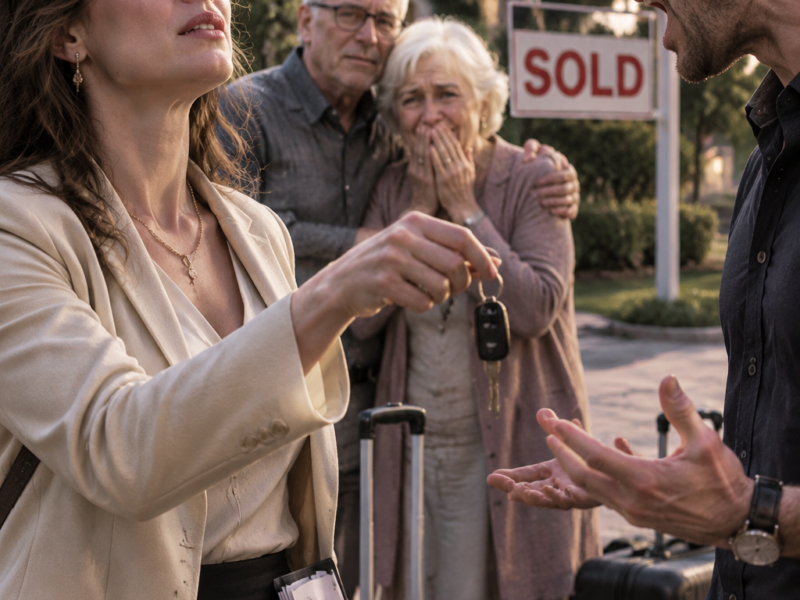
The first time my husband realized I was truly gone, he was standing on the front porch of our $2.8 million house in Bellevue, Washington, desperately trying to unlock a door that no longer belonged to him.
Behind him, his mother was dragging a rolling suitcase up the driveway, complaining about the exhausting layover in Frankfurt. His sister, Chelsea, stood nearby with her sleeping baby balanced against her shoulder, while her husband, Dylan, struggled to maneuver a stroller up the front steps.
They were sunburned, exhausted, and eager to get inside. After twelve days in Italy, all they wanted was a shower, a comfortable bed, and the familiar surroundings they had left behind.
Matthew inserted his key into the lock again.
It wouldn’t turn.
He pulled it out, examined it, and tried once more, as though the problem might somehow disappear if he repeated the same action.
“What the hell?” he muttered.
“Matthew, would you please open the door?” his mother, Sharon, complained. “I desperately need a shower.”
He knocked.
A few seconds later, the door opened.
A middle-aged man stood there holding a coffee mug. He wore a casual gray sweater and looked mildly surprised to find five exhausted travelers standing on his porch.
“Can I help you?”
Matthew stared at him.
“Who are you?”
The man took a sip of coffee before answering.
“Jeffrey Stevens. I’m the owner of this house. We closed last Tuesday.”
For several seconds, Matthew didn’t move.
His mother stopped complaining. Chelsea’s expression changed. Dylan slowly lowered the stroller onto the porch.
And Matthew, the man who had spent seven years believing that nothing in his comfortable life could ever be taken away from him, finally understood that something had happened while he was enjoying his vacation.
He pulled out his phone and called me.
It rang once before going to voicemail.
He called again.
Then again.
I wasn’t there to witness the scene, but I heard every detail later from someone who was.
At that particular moment, I was nearly two thousand miles away, sitting beside a window in a rented house in Ann Arbor, Michigan.
I was drinking coffee, watching the morning sunlight filter through a row of maple trees, and enjoying something I hadn’t experienced in years.
Peace.
Nobody was telling me what I owed them. Nobody was reminding me to accommodate their mother. Nobody was making me feel guilty for wanting my own parents to be treated with kindness.
For the first time in a very long time, I wasn’t trying to make everyone else comfortable at my own expense.
And strangely enough, it had all started with a single text message.
Three weeks earlier, I had been sitting at our kitchen island, reviewing a spreadsheet and checking the final confirmations for a family vacation.
My phone buzzed.
It was a message from my husband.
“Your parents can’t come to Italy. Mom wants it to be just family.”
I read it once.
Then I read it again.
For a moment, I genuinely wondered whether I had misunderstood him.
The itinerary was spread across the kitchen counter. Twelve days in Italy, with stops in Rome, Florence, and Venice. Eight travelers in total, including the baby. Every flight, hotel, guided tour, and restaurant reservation had already been arranged.
I had spent approximately $35,000 organizing everything.
It was supposed to be a birthday present for Matthew’s mother, Sharon, who was turning sixty-five.
But there was another reason the trip meant so much to me.
I had planned it so my parents could finally experience something they had dreamed about their entire lives.
My father, Ralph, had spent thirty-one years working as a bus mechanic for the Toledo Transit Authority. He was the kind of man who could repair almost anything with a toolbox, a little patience, and a determination that refused to accept defeat.
My mother, Joan, had worked in a school cafeteria for most of her adult life. She took extra shifts whenever someone called in sick, stayed late when the kitchen needed cleaning, and somehow managed to stretch every paycheck far enough to keep our household running.
They had never been wealthy.
They had never complained about it, either.
When their neighbors went on cruises, my parents stayed home. When relatives talked about visiting Europe, Dad would smile and say, “Maybe someday.”
For years, someday had been the family joke.
But as I grew older, I began to realize that someday was not guaranteed.
My father was approaching seventy. My mother had spent decades postponing her own dreams because there was always another bill, another responsibility, or another reason to wait.
So I decided to give them something they had never given themselves.
A trip to Italy.
When I first told them, my mother cried so hard that she had to sit down on the kitchen floor.
My father hugged me and whispered, “Sweetheart, you don’t have to do all this.”
I smiled.
“I know, Dad. That’s the whole point.”
For months, Italy became the subject of nearly every conversation.
My mother bought comfortable walking shoes and wore them around the house to break them in. She researched restaurants, watched travel videos, and repeatedly asked whether she needed to learn a few Italian phrases.
My father visited the Toledo public library and checked out travel books. He marked interesting pages with little yellow sticky notes and kept a notebook filled with places he wanted to see.
My mother had dreamed of visiting the Sistine Chapel since seventh grade, when a nun at her school showed the class a photograph of Michelangelo’s ceiling.
I had arranged a private early-morning entry so she could experience it before the crowds arrived.
On my parents’ bedroom dresser sat an old pickle jar with a strip of masking tape across the front.
Written on it in my father’s handwriting was one word.
ROME.
Inside were $412 in singles and five-dollar bills.
My father had been saving that money for nearly thirty years.
Every time he put another bill inside, he told my mother that perhaps one day they would finally use it.
I thought about that jar when I booked their tickets.
I thought about how happy they would be when they saw the confirmation emails.
And I thought about how much it would mean to them to travel with the daughter they had sacrificed so much to raise.
Then Matthew sent that message.
I immediately called him.
He answered from his office. His voice was quiet and clipped, the tone he usually adopted when he had already made up his mind and didn’t intend to reconsider.
“What do you mean my parents can’t come?”
“Exactly what I said.”
“Matthew, I paid for this entire trip. Your mother knows I paid for it. She’s going to Italy on my dime, and now she’s telling my parents they aren’t welcome?”
“It’s not like that.”
“Then what is it like?”
He sighed.
“Chelsea just had the baby. Mom wants everything to be easy. She thinks your parents might change the dynamic.”
I stared at the kitchen island.
“The dynamic?”
“Julie, don’t start.”
“I’m asking you what you mean.”
“Why do you always have to make everything about your side of the family?”
My side.
I repeated those words silently.
The people who had raised me, supported me, worked exhausting shifts to give me a decent childhood, and loved me long before Matthew knew my name were apparently considered outsiders.
I wanted to remind him that his mother had never paid for a single part of the vacation.
I wanted to tell him that my parents were more than capable of behaving appropriately at an expensive restaurant.
I wanted to ask him why the people who had sacrificed everything for me were suddenly considered an inconvenience.
Instead, I became strangely quiet.
Because something finally made sense.
For seven years, I had believed Matthew and I were building a life together.
But whenever his family was involved, I wasn’t treated like his partner.
I was treated like an employee whose responsibility was to keep everyone satisfied.
His mother made the decisions. Matthew supported them. I paid the bills, organized the arrangements, swallowed the insults, and somehow ended up apologizing whenever anyone became uncomfortable.
I had spent years confusing being accommodating with being loved.
And I was exhausted.
So I typed four words.
“Then have fun.”
I put my phone facedown.
Matthew didn’t call back.
He probably assumed I would be upset for a day, complain to my mother, and eventually get over it.
That was what I had always done.
Over the years, Sharon had developed an extraordinary ability to make herself comfortable in other people’s homes.
Once, she rearranged my entire dining room because she thought the furniture looked temporary.
She invited fourteen relatives to Thanksgiving without consulting me, then criticized the turkey I had spent two days preparing.
She referred to our house as Matthew’s place, even though she had never contributed a single dollar toward its purchase or upkeep.
Whenever I corrected her, Matthew would tell me not to take things personally.
“That’s just Mom,” he would say.
As if those four words were supposed to excuse everything.
The Thanksgiving that still hurt the most involved my parents.
They had flown from Toledo to spend the holiday with us. My mother brought her famous apple pie, the same recipe she had been perfecting for forty years.
She had spent the entire morning making it, carefully measuring the ingredients and decorating the crust by hand.
When she placed it on the kitchen counter, Sharon glanced at it and smiled.
“Oh, Joan, how sweet. We’ll put that aside for the children’s table.”
There was no children’s table.
My mother smiled anyway.
Later that evening, I found her alone in the kitchen washing dishes.
I asked why she hadn’t said anything.
She looked at me with the same gentle expression she had worn throughout my childhood.
“It’s all right, honey. We don’t need to make a fuss.”
That sentence stayed with me.
My mother had learned to make herself smaller whenever someone else wanted more room.
And somewhere along the way, I had learned to do exactly the same thing.
I had never wanted to become that kind of person.
Yet there I was, watching the people I loved most being pushed aside because I was too afraid to create an uncomfortable situation.
After Matthew’s message, I went upstairs and opened the nightstand beside my bed.
Inside was a letter from my grandmother Rita.
She had left it to me when she died, along with the house.
Her handwriting became increasingly shaky toward the bottom of the page, where her illness had begun to affect her hands.
I had read the letter countless times, but that afternoon, one particular paragraph seemed to speak directly to me.
“Julie, a house should be a place where you can breathe. Don’t stay anywhere out of fear of what leaving would cost. You can always make a new kitchen.”
I sat on the edge of the bed and read those words again.
Then I looked around the room I had shared with Matthew for seven years.
The expensive furniture. The framed wedding photographs. The carefully chosen decorations.
Everything looked beautiful.
But I couldn’t remember the last time I had felt completely comfortable in that house.
I had inherited it from my grandmother, yet somehow I had spent years feeling like a guest inside it.
That evening, I called an attorney named Brenda Roberts.
She had handled my grandmother’s estate and knew the history of the property.
“Brenda, I need to ask you something.”
“Of course, Julie. What’s going on?”
“If I decided to sell the house and start over, what would I need to know?”
There was a long pause.
“Are you sure you want to do this?”
I looked at the letter in my hand.
“No,” I admitted. “But I’m sure I can’t keep living like this.”
“Then come in tomorrow. Bring every document you have.”
The next morning, I arrived at Brenda’s office carrying a banker’s box filled with paperwork.
She cleared a space on her conference table and began examining everything.
The house had originally belonged to my grandparents.
They purchased it in 1971 for a little under $50,000, back when Bellevue was still surrounded by orchards and the local economy revolved around Boeing and the people who worked there.
My grandfather died years before my grandmother.
She remained in the house for another three decades, living quietly and spending much of her time in the kitchen.
I remembered summer afternoons sitting beside her, shelling peas into a large metal bowl while she told me stories about her childhood.
When she passed away, she left the property to me alone.
There was no mortgage, no co-owner, and no financial obligation attached to the inheritance.
Over the years, the neighborhood had transformed. New businesses appeared, technology companies expanded, and property values climbed dramatically.
By the time Brenda reviewed the most recent appraisal, the house was worth approximately $2.8 million.
Matthew’s name had never appeared on the deed.
He moved into the property after our wedding, but I had paid the property taxes, insurance, roof repairs, and furnace replacements from my own accounts.
He covered his vehicle expenses and the cable bill. Yet he frequently told people he was the one holding down the household.
Brenda carefully explained that Washington was a community property state and that inherited property was generally considered separate property when properly maintained as such.
However, she warned me that the circumstances surrounding the marriage, the treatment of any shared funds, and possible claims related to contributions would need to be examined.
She reviewed the deed, tax statements, insurance records, and contractor receipts.
She also asked whether Matthew had ever paid for major renovations or whether I had ever added his name to the title.
I told her the truth.
He hadn’t.
“I don’t want anything that isn’t mine,” I said. “I just want to understand what I’m legally allowed to do with what is.”
Brenda nodded.
“That’s the right place to start.”
She spent another hour explaining the process, the potential complications, and the importance of documenting everything properly.
Before I left, she leaned back in her chair.
“Julie, there’s something I tell everyone who comes into my office during a difficult marriage. Don’t make a decision just because you’re angry. Make a decision you can live with a year from now.”
I looked at her.
“I think I’ve spent seven years making decisions so nobody else would get angry.”
Her expression softened.
“Then perhaps this is a different kind of decision.”
That afternoon, Sharon called.
I was working on a quarterly budget for Berry Analytics, where I held a senior financial analyst position. Fortunately, my job allowed me to work remotely, something I had never fully appreciated until that moment.
“Julie, dear,” Sharon began, “I assume Matthew explained the situation about Italy.”
“He did.”
“I hope you understand. Chelsea has the baby, and we need everything to be peaceful. Your parents might be uncomfortable with the restaurants we’ve selected. We don’t want anyone feeling out of place.”
I closed my laptop.
“My parents have waited their entire lives for this trip.”
“That’s unfortunate,” she replied casually. “But we can’t accommodate every wish.”
I stared at the phone.
“Did it ever occur to you that I planned this vacation specifically so my parents could come?”
“For all of us, dear. Please don’t turn this into a question of money. You’re a sensible woman. You’ll understand.”
“I’ll understand.”
“Of course. You always do.”
The conversation ended.
I remained seated for a few seconds, staring at the blank computer screen.
Then I heard voices coming from the living room.
Matthew was talking to his mother on speakerphone.
I walked toward the hallway but stopped before entering the room.
“She’s upset,” Matthew said. “But she’ll get over it.”
Sharon laughed lightly.
“She always does.”
I stood perfectly still.
There was something devastating about hearing those words.
Not because they were cruel.
Because they were true.
They had become so accustomed to my silence that they no longer even considered it necessary to ask whether I was hurt.
They weren’t counting on my understanding.
They were counting on my surrender.
They believed I would always be there to smooth over their disagreements, pay for their celebrations, organize their holidays, and accept whatever scraps of consideration they decided to offer.
And they believed the house would always be available to them, regardless of how they treated the woman who owned it.
I returned to my home office and called Brenda.
“I want to move forward.”
“All right,” she replied. “We’ll do this carefully. Step by step.”
She introduced me to a real estate agent at Green Realty who understood the importance of handling the sale correctly.
The agent arranged an appraisal and reviewed the market.
A family relocating from California became interested almost immediately.
They wanted a quick closing and were prepared to make an all-cash offer.
The price was fair, and the timeline was unusually convenient.
I asked Brenda to review every page of the contract.
I didn’t want surprises. I didn’t want to take something that wasn’t mine, and I didn’t want to create unnecessary legal problems.
Most importantly, I wanted the entire transaction documented properly.
At one point, Brenda looked across her desk.
“Matthew will find out.”
“I know.”
“There will be difficult conversations. Selling the property doesn’t automatically settle every question connected to the marriage. If he has a legitimate claim, we’ll address it through the proper process.”
“I understand.”
She paused before continuing.
“And Julie, I’m preparing the divorce petition. If the sale closes as planned, we’ll file it immediately afterward. Are you emotionally prepared for that?”
I thought about my mother’s face when she learned she might not be allowed to go to Italy.
I remembered the pickle jar on her dresser.
I remembered Matthew telling me that his mother wanted it to be just family.
Then I thought about the seven years I had spent trying to earn a place at a table where I was expected to serve everyone else.
“Yes,” I said.
“I’m ready.”
There was one more thing I decided to do.
I called the travel agent and asked her to remove three names from the reservation.
Mine.
My mother’s.
And my father’s.
I wasn’t going to cancel the entire vacation.
Sharon had spent months looking forward to celebrating her sixty-fifth birthday in Italy. I might no longer want to share that experience with her, but I wasn’t interested in becoming someone who deliberately destroyed another person’s vacation.
The travel agent explained that I could recover approximately $11,000 after cancellation fees.
I accepted the refund and absorbed the remaining loss.
The other five reservations remained exactly as they were.
Sharon would still have her birthday trip.
Matthew would still visit Rome, Florence, and Venice.
Chelsea and Dylan would still enjoy their vacation.
But I would no longer be paying for my own exclusion.
And my parents would no longer have to wonder whether they were welcome.
The evening before they departed, Matthew was upstairs packing his suitcase.
He seemed cheerful.
He hummed while folding shirts and checked the weather forecast on his phone.
I stood in the doorway.
“I’m not going.”
He glanced up.
“What?”
“I’m not going to Italy. Have a good trip.”
He returned to folding his clothes.
“You’ll feel better once we’re gone.”
I waited.
I don’t know exactly what I expected. Perhaps a question about why I was suddenly withdrawing from a vacation I had spent months organizing.
Perhaps an apology.
Perhaps some indication that he understood how much this mattered to me.
Instead, he simply zipped his suitcase.
That was when I realized how little he had been paying attention.
He didn’t ask whether I was okay.
He didn’t ask what I planned to do during the twelve days he would be away.
He didn’t even ask whether I wanted to talk.
He assumed the house would hold my feelings the way it held everything else.
The next morning, I watched their Uber turn the corner.
Matthew sat in the passenger seat, looking at his phone.
Sharon was already talking animatedly about the trip.
Chelsea waved through the window.
I stood in the doorway until the car disappeared.
Then I closed the door.
And for the first time, I didn’t feel guilty.
By noon, the moving company had arrived.
Everything had been arranged through Brenda’s office, with proper documentation and a detailed inventory.
Matthew’s clothes, golf clubs, office equipment, and personal belongings were carefully packed.
Sharon’s boxes from the guest suite above the garage were packed separately.
Nothing was thrown away.
Nothing was damaged.
Everything was labeled by room and placed into a climate-controlled storage unit that I had prepaid for three months.
I wasn’t interested in revenge.
I simply needed a clean separation.
I kept my grandmother’s letters, her old recipe tin, my books, and the small wooden stool I had used to sit beside her kitchen table.
There were moments when the movers carried something downstairs and I suddenly remembered a happier time.
A framed photograph of Matthew and me laughing at our wedding.
A decorative bowl we had purchased during our first vacation together.
The old dining table where we had once hosted friends and stayed up until midnight playing board games.
I wasn’t going to pretend those memories had never mattered.
There had been good years.
There had been kindness, laughter, and moments when I genuinely believed Matthew and I would grow old together.
But a good memory couldn’t make an unhealthy present acceptable.
When the last box was gone, I walked through the empty house.
The rooms looked strangely large without furniture.
Sunlight poured through the windows.
I stopped in the kitchen, where I had spent countless hours cooking meals, preparing budgets, organizing family events, and trying to make everyone happy.
For a moment, I imagined my grandmother standing near the counter.
I remembered her letter.
A house should be a place where you can breathe.
I took one final photograph of the maple tree outside the front window.
Then I locked the door and drove to the airport.
Three days later, Matthew called from Rome.
I was unpacking a box in my new rental house when his name appeared on the screen.
I answered.
“Hey, sweetheart!”
His voice sounded cheerful.
“Mom found this amazing place near the Pantheon. The view is unbelievable.”
“I’m glad.”
“You should see the restaurants here. Everything is incredible.”
“Sounds wonderful.”
There was a brief pause.
“Are you still upset about the trip?”
I looked at the open box beside my feet.
“I’m not going to argue about it anymore.”
“Good, because I really don’t want this hanging over us. Mom’s been under a lot of stress lately.”
I almost laughed.
“What about the stress I’ve been under?”
He sighed.
“Julie, please. Not again.”
“No,” I said quietly. “Not again.”
I ended the call.
A minute later, a message appeared.
“I love you. Let’s put this behind us.”
I read it twice.
For years, those words would have been enough.
I would have convinced myself that his message proved he cared. I would have ignored the fact that nothing had actually changed.
But I had finally learned something important.
Love isn’t a sentence someone sends when they want an uncomfortable conversation to end.
Love is what someone does when defending you costs them something.
Matthew had never been willing to pay that price.
On the day they flew home, Brenda’s office confirmed that the sale had closed the previous Tuesday.
The divorce petition had also been filed.
A Manila envelope had been left with Jeffrey Stevens, the new owner, with instructions to hand it to Matthew if he appeared at the property.
I turned my phone back on that afternoon.
The notifications began arriving almost immediately.
Seventeen missed calls.
Twenty-three text messages.
Three voicemails.
The first message was confused.
The second was angry.
The third was different.
“Julie, it’s me. We’re home. There’s a man here saying he owns the house. I don’t know what you’ve done, but you need to call me right now.”
I listened to it twice.
Underneath the anger, I could hear something I had never heard in Matthew’s voice before.
Fear.
For seven years, he had never seriously considered the possibility that I might leave.
He had believed I would always forgive him.
He had believed I would always compromise.
He had believed that no matter how uncomfortable his family made me, I would eventually return to my usual position.
He had mistaken my patience for weakness.
I didn’t call him back.
Instead, I sent one message.
“The house has been sold. Please contact my attorney, Brenda Roberts, regarding the transaction and everything else.”
Then I put my phone down.
I knew exactly what was inside the envelope waiting for him.
I had written the note myself at Brenda’s desk.
It contained a copy of the divorce petition, the address of the storage facility, a key, and one handwritten page.
“Matthew,
The house belonged to my grandmother and then to me.
It was never ours, even though you were happy to call it ours whenever it suited you.
You told me my parents weren’t family. After seven years, I finally believed you.
Your belongings and your mother’s belongings are safe in the storage unit. The unit has been paid for three months.
Please direct everything else to Brenda.
I hope you learn what family means.
I’m not going to wait around to teach you.
Julie.”
I wasn’t there when he opened it.
But Chelsea told me what happened later.
Matthew stood on the porch reading the letter while Sharon leaned over his shoulder.
When she reached the part about the storage unit, she immediately became upset.
“Where’s my suite?” she demanded. “Where are my things?”
“Mom, they’re in a storage unit.”
“A what?”
“A storage unit.”
Sharon turned toward the new owner.
“Well, this is ridiculous. We live here.”
Jeffrey remained polite.
“I’m sorry, but I purchased the property. I have the closing documents if you’d like to see them.”
Sharon stared at him as though he had personally arranged the entire situation to inconvenience her.
Then Jeffrey explained that he needed to close the door.
And there they stood.
Five suitcases.
A stroller.
A crying baby.
An exhausted family.
And absolutely nowhere to go.
Dylan eventually found a hotel room for $289 a night.
That was where Sharon spent her first night back in Washington.
Ten months earlier, she had sold her own condominium, announcing that she wanted to simplify her life.
She had moved into our guest suite above the garage temporarily, promising that she would begin looking for another place once she settled in.
She hadn’t looked at a single property since.
Now, within a week, the hotel bill had become more than she wanted to discuss.
She eventually moved onto the pullout couch in Chelsea’s one-bedroom apartment.
Matthew checked into an extended-stay hotel near his office.
He had a microwave, a small refrigerator, and a narrow bed.
For someone who had spent years enjoying a $2.8 million house, the change was apparently difficult.
The following morning, my phone buzzed again.
It was Matthew.
“Julie, my mother is losing it. Chelsea is crying. We came home and had nowhere to go. How could you do this without even talking to me?”
I read the message carefully.
Not one word about my parents.
Not one apology for telling me they weren’t welcome.
Not one acknowledgment that his mother had spent years disrespecting me.
Only his own inconvenience.
I replied.
“You made a decision about my family without talking to me. I made a decision about my future after getting legal advice. Everything else should go through our attorneys.”
His response came almost immediately.
“You’re destroying our marriage over one vacation.”
One vacation.
I sat quietly, looking at those words.
Was that really what he believed?
That seven years of swallowed insults, ignored feelings, and unequal expectations could be reduced to a disagreement about twelve days in Italy?
I remembered the Thanksgiving pie.
The family dinners I had paid for.
The birthdays I had organized.
The holidays when Sharon criticized something and Matthew immediately expected me to apologize.
I remembered my mother washing dishes alone while everyone else enjoyed dessert.
I remembered my father carefully folding his travel brochures and putting them away after I told him there might be a problem with the vacation.
I called Matthew.
He answered almost immediately.
“Where are you?” he demanded.
“Safe.”
“That’s not an answer.”
“It’s the answer you’re getting.”
He took a sharp breath.
“Julie, I don’t understand what you’re doing. You sold the house while I was out of the country. You didn’t even give us a chance to talk.”
“I tried to talk before you left.”
“About what?”
“About your mother. About the trip. About the way you treated my parents.”
“Mom was just trying to avoid an awkward situation.”
“Did you ask my parents what they wanted?”
Silence.
“Matthew, did you ask them?”
“No, but did you ask me?”
I closed my eyes.
“That’s exactly the problem. You expected me to ask permission before inviting my own parents on a vacation I paid for. But your mother didn’t need to ask anyone before deciding they weren’t welcome.”
“That’s not fair.”
“Neither was what you did.”
He remained quiet.
I continued.
“It wasn’t fair to let your mother decide who counts as family. It wasn’t fair to assume my parents would be an inconvenience. And it wasn’t fair to expect me to accept everything because that’s what I’ve always done.”
“I didn’t think you’d take it this far.”
There it was.
Not an apology.
Not an admission that he had been wrong.
He simply hadn’t expected me to act.
I realized then that he wasn’t shocked by the fact that I had been hurt.
He was shocked that my hurt had finally become more important than his comfort.
We eventually agreed to meet at a quiet café near Brenda’s office.
The meeting took place several weeks later.
Matthew looked different.
His shirt was wrinkled, his hair was uncombed, and he kept turning his wedding ring around his finger.
For a moment, seeing him brought back memories of the man I had married.
The man who used to bring me coffee before important presentations.
The man who once drove across town during a thunderstorm because I had mentioned craving a particular kind of pie.
The man who had held my hand during my grandmother’s funeral.
I remembered those things because they had been real.
And perhaps that was what made everything so difficult.
People weren’t always entirely good or entirely bad.
Sometimes the person who had once made you feel loved became the person who made you feel invisible.
Matthew looked across the table.
“I owe you an apology.”
I waited.
“I shouldn’t have sent that message. I should have talked to you first.”
“Yes.”
“Mom was pushing me. I didn’t want another fight with her.”
I looked directly at him.
“So you picked a fight with me instead?”
He flinched.
“When you say it like that, it sounds terrible.”
“It’s what happened.”
He rubbed his forehead.
“I was trying to keep everybody happy.”
“Except me.”
“That’s not true.”
“Then tell me when you last stood up for me against your mother.”
He opened his mouth but didn’t answer.
I leaned back.
“Matthew, do you remember Thanksgiving when my mother brought her apple pie?”
He looked confused.
“What does that have to do with anything?”
“She made that pie for hours. Your mother put it aside because she thought it belonged at a children’s table. My mother didn’t say anything because she didn’t want to create a problem. I found her washing dishes alone later that night.”
He looked down.
“Your mother was only joking.”
“No, Matthew. She wasn’t. And even if she had been, you could have said something.”
He remained silent.
I continued.
“Do you remember how many birthdays I’ve organized for your family? How many holidays I’ve paid for? How many times I’ve rearranged my plans because Sharon wanted something different?”
“I know you’ve done a lot.”
“You know I’ve done a lot of things. You never stopped to ask what it cost me.”
He slowly turned his wedding ring.
“Was selling the house really necessary? We could have worked this out. I would have tried.”
I studied his face.
“Would you have told your mother she doesn’t get to decide who is welcome in my home?”
He didn’t answer.
“Would you have defended my parents the next time she insulted them?”
His eyes dropped.
And I had my answer.
“I can’t build a marriage on promises that only appear after someone loses something they took for granted.”
He began to cry.
“I love you, Julie.”
My throat tightened.
There was a time when hearing those words would have made me reach across the table and take his hand.
But I didn’t.
“I loved you, too. But I’m done sacrificing my dignity so you don’t have to disappoint your mother.”
He wiped his eyes.
“So that’s it?”
I looked at him for a long moment.
“Yes.”
Our divorce took five months.
Matthew’s attorney initially filed a claim seeking a portion of the proceeds from the sale of the house.
Brenda responded with documentation.
The original inheritance records.
The deed showing ownership in my name.
The property tax statements.
The insurance records.
The bank statements covering seven years.
The contractor invoices showing that I had paid for the major repairs and maintenance.
She also presented the financial history of the marriage and the records of what each of us had contributed.
Matthew had spent approximately $14,000 on legal fees before the mediation reached a point where his attorney advised him to reconsider.
The mediator reviewed the documents and looked across the table.
“I would strongly advise your client to reconsider the position he’s taking.”
The remaining negotiations focused on the other marital assets.
Matthew kept his car, his retirement account, and the money he had independently earned.
I didn’t contest anything that was legitimately his.
I had never wanted his money.
I wanted the freedom to stop negotiating for basic respect.
During the second mediation session, something unexpected happened.
Sharon appeared in the hallway.
She wore her good blouse and carried her purse with both hands.
She marched toward the conference room and demanded to speak with me.
“I’d like a word with my daughter-in-law.”
The mediator stood and stepped into the doorway.
“Ma’am, you’re not a party to this case. I’ll have to ask you to wait downstairs.”
Sharon looked offended.
“I’m her family.”
The mediator remained calm.
“Not for these purposes.”
Then he closed the door.
I never saw Sharon’s expression.
I only saw Matthew sitting across from me.
He stared at the table.
For once, he said nothing.
And I wondered whether he finally understood what it felt like to have someone else decide that his voice didn’t matter.
A few weeks later, Chelsea contacted me.
She asked whether we could meet.
I wasn’t particularly eager to reopen old wounds, but I agreed.
We met on a park bench near her apartment. Her baby was asleep in the stroller, and she looked more tired than I remembered.
For a while, neither of us spoke.
Then she finally said something I hadn’t expected.
“I didn’t know Mom told Matthew your parents couldn’t come until after he’d already agreed.”
I looked at her.
“What do you mean?”
“She told him she wanted the trip to be just us. She said she’d already discussed it with him.”
I felt a familiar heaviness in my chest.
Chelsea continued.
“I should have said something. I just liked being the person everyone was making a fuss over. With the baby and everything, Mom kept saying this was supposed to be a special family vacation.”
She looked down at her hands.
“I wasn’t asking to take your place.”
I shook my head.
“I know.”
“Then why did everything turn out like this?”
I watched the baby sleeping.
“Because I wasn’t asking anybody to take your place. I was asking everybody to make room for mine.”
Chelsea’s eyes filled.
“I know. We all got so used to you making everything work that nobody asked what it cost you.”
That sentence stayed with me.
It was perhaps the first time anyone in Matthew’s family had acknowledged what had happened without immediately making an excuse for it.
I accepted Chelsea’s apology.
But I didn’t promise that everything would return to the way it had been.
Trust doesn’t come back because someone finally understands what they did wrong.
It returns slowly, through consistent actions and respect.
And sometimes it never returns at all.
By the end of the summer, the divorce was finalized.
I had moved into a smaller rental house in Ann Arbor, where I could work remotely and enjoy the quiet.
The first few weeks were strange.
I had become so accustomed to managing everyone else’s schedules that I sometimes found myself looking at my calendar and wondering what I was supposed to be doing.
There were no family dinners to organize.
No birthday reservations to confirm.
No messages from Sharon asking whether I could pick something up.
No arguments with Matthew about whose relatives deserved attention.
I began cooking meals simply because I wanted to eat them.
I bought flowers for my kitchen.
I started taking morning walks.
On weekends, I visited little bookstores and coffee shops.
I even learned to make my grandmother’s apple pie recipe, although mine never quite tasted like hers.
The house was smaller than the one in Bellevue.
But every room felt like it belonged to me.
And that made all the difference.
The following May, I finally took the trip I had originally planned.
This time, it was just the three of us.
My parents and me.
We spent three days in Rome, two in Florence, and two in Venice.
There was no complicated schedule.
No one complained about the restaurants.
Nobody argued about the hotel arrangements.
We walked when we felt like walking and rested when we became tired.
We ate slowly, laughed often, and took far too many photographs.
On our first morning in Rome, I accompanied my mother to the Sistine Chapel.
I had arranged the early entry exactly as I had originally planned.
When we stepped inside, she stopped.
The enormous ceiling stretched above us.
She tilted her head backward and looked up.
For ten full minutes, she didn’t move.
My father stood beside her, holding her hand.
Neither of them said a word.
I watched my mother’s face.
She looked like a little girl who had finally found something she had dreamed about for most of her life.
After a while, she turned toward me.
Her eyes were wet.
“Julie,” she whispered.
I smiled.
“I know, Mom.”
She shook her head slowly.
“I never imagined I would actually see this.”
I reached for her hand.
“Well, you’re here.”
She hugged me.
And I realized that this was the moment I had wanted all along.
Not the expensive hotels.
Not the photographs.
Not the satisfaction of proving that I could afford an international vacation.
This.
The knowledge that two people who had spent their entire lives putting everyone else first were finally standing somewhere beautiful, enjoying something simply because they deserved it.
In Venice, my mother cried again.
We were standing near the edge of a quiet canal when the afternoon sunlight reflected across the water.
She looked at the buildings, the boats, and the little bridges connecting the narrow streets.
Dad put his arm around her.
“What’s wrong, Joan?”
She laughed through her tears.
“Nothing’s wrong. I just can’t believe we’re really here.”
My father smiled.
“Well, we’d better enjoy it. We have a lot more walking to do.”
That evening, Dad and I sat outside a small restaurant while Mom browsed a nearby shop.
The weather was pleasant, and the restaurant had placed little tables along the pavement.
My father slowly turned his wineglass between his fingers.
Then he looked at me.
“You know, your mother and I never needed you to buy us Europe.”
I smiled.
“I know, Dad.”
“We would have been happy just staying home with you.”
I nodded.
He looked toward the little shop where Mom was still examining something in the window.
“We just wanted to feel like we mattered.”
My eyes filled.
“Mom and Dad, you always mattered.”
He reached across the table and squeezed my hand.
“Then don’t forget that you matter, too, kiddo.”
I looked down.
For some reason, those words hurt more than anything Matthew had ever said.
Perhaps because they were so simple.
My father had never demanded that I choose him over someone else.
He had never asked me to spend money I couldn’t afford.
He had never expected me to prove that I loved him.
He simply wanted his daughter to remember that she was worthy of the same kindness she gave everyone else.
And I promised myself I would never forget it.
On the flight home, my mother held the old pickle jar in her lap.
The jar with the masking tape that said ROME.
She had insisted on bringing it with us.
Before we left Toledo, she had carefully cleaned it and packed it inside her carry-on.
The $412 that my father had saved for thirty years was still inside.
She had brought it along because she wanted to remember the dream that had finally come true.
I had quietly added a few hundred dollars to the jar before the trip.
She never mentioned it.
And I never told her I had done it.
Some things are better left unspoken.
A few months after returning home, I received a message from Matthew.
It was short.
He said he hoped I was doing well.
He said he had been thinking about everything that happened.
Then he added that he wished things could have turned out differently.
I read it several times.
I didn’t feel angry.
I didn’t feel the urge to explain myself again.
I simply understood that some chapters of life end without the perfect apology or the perfect final conversation.
I wished him well.
Then I returned to whatever I had been doing.
Sometimes I still miss the house in Bellevue.
I miss the enormous maple tree outside the front window.
I miss the creaking sound of the third stair.
I miss the kitchen where my grandmother once taught me how to crimp the edges of a pie crust.
I miss the summer evenings when the sunlight filled the dining room.
And occasionally, I even miss the happier memories I shared with Matthew.
But I don’t miss feeling like a guest in my own life.
I don’t miss measuring every sentence before speaking because someone might become offended.
I don’t miss watching my parents make themselves smaller to avoid upsetting people who should have welcomed them.
And I certainly don’t miss believing that keeping everyone else happy was the same thing as having a successful marriage.
The house was worth $2.8 million.
But what it taught me was worth more than that.
I used to believe family meant tolerating everything.
I believed love meant compromise, even when I was the only person compromising.
I believed being a good wife meant keeping the peace, regardless of how much of myself I had to sacrifice.
I was wrong.
Real family doesn’t ask you to erase the people who loved you before they arrived.
Real love doesn’t require you to accept humiliation in exchange for belonging.
And a healthy relationship doesn’t make one person responsible for everyone’s happiness while nobody takes responsibility for theirs.
Matthew once told me my parents couldn’t come to Italy because his mother wanted it to be just family.
For seven years, I had tried to earn a permanent seat at a table where the rules kept changing.
That day, I finally understood something.
I didn’t need to keep begging for a place at that table.
I could simply walk away.
And I did.
I went to the people who had never made me prove I deserved a seat.
The people who had saved a pickle jar for thirty years because they believed that someday they might see Rome.
The people who taught me that kindness was never supposed to mean surrendering your dignity.
And the people who reminded me, without asking for anything in return, that I mattered, too.
Because in the end, I didn’t lose a $2.8 million house.
I left behind a life in which I had slowly forgotten my own worth.
And when I finally walked away, I discovered that the most valuable thing I could ever own wasn’t a house, a bank account, or an expensive vacation.
It was the freedom to decide who deserved a place in my life.
And this time, I made sure the people sitting at my table were the ones who had always made room for me.
THE END









