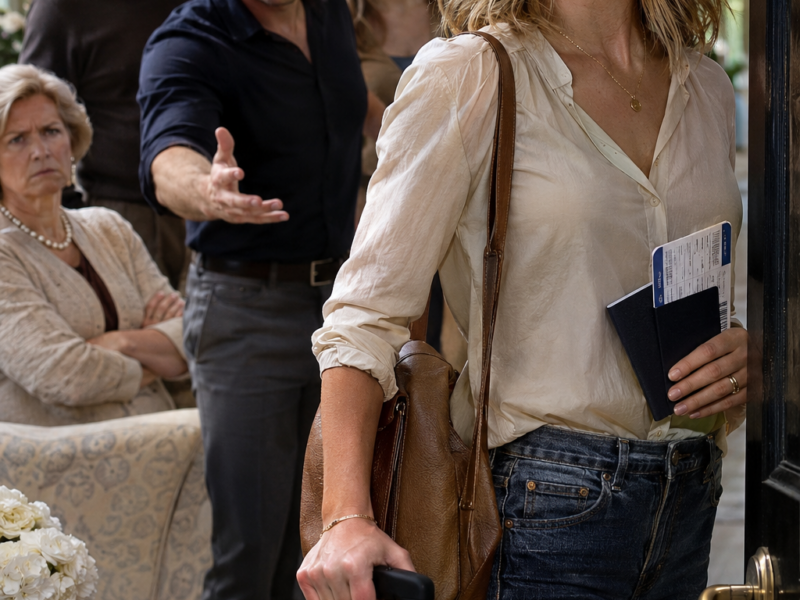
My husband said, “apologize or leave!” i bought a one-way ticket—when his family…
My husband said, “apologize or leave!” i bought a one-way ticket—when his family…
My name is Harper Lane. I was thirty-four years old the night my husband slammed his fist against his mother’s dining table, spilled a glass of expensive bourbon, and gave me an ultimatum in front of forty of Kentucky’s wealthiest people.
“Sign the agreement tonight, or get out of my house and never come back.”
He thought those words would frighten me. He thought I would cry, apologize, pick up the golden pen his family’s attorney had placed in front of me, and sign away whatever little dignity I had left.
Instead, I smiled, removed my wedding ring, placed it on top of the document, and walked out.
What my husband and his family did not understand was that I wasn’t leaving with nothing. I was leaving with the one thing that had kept their family business alive for 150 years.
Water.
And by the time they discovered who truly owned it, their bourbon empire was already beginning to crumble.
But before I tell you how everything happened, you need to understand something about the Ashford family. They were not simply wealthy people. They were the kind of people who believed wealth was proof of superiority, that a family name mattered more than character, and that anyone who had not inherited a fortune was somehow born beneath them.
For eight years, I had lived among them, hoping that one day they might finally accept me.
I was wrong.
The night everything changed was the night of the annual founders dinner at Asheford Hall, a magnificent mansion overlooking the rolling hills of Woodford County, Kentucky. That particular evening was more extravagant than usual because the family was celebrating the 150th anniversary of Asheford Hollow Bourbon, a distillery that had become one of the most prestigious names in the American whiskey industry.
The mansion looked like something from another century. White columns stretched toward the evening sky, enormous windows glowed with golden light, and magnolia garlands decorated the entrance. Valets hurried between expensive vehicles while guests in designer gowns and tailored tuxedos made their way through the enormous front doors.
Inside, crystal chandeliers illuminated a dining room that had belonged to six generations of Ashfords. A long antique table was arranged for forty guests, with silver cutlery, expensive china, and bottles of rare bourbon placed between elaborate floral arrangements.
At the head of the table sat my mother-in-law, Vivien Ashford.
She wore a silver necklace, enormous pearls, and an expression that suggested she had just discovered something unpleasant on the bottom of her shoe.
That unpleasant thing, apparently, was me.
For eight years, Vivien had made it her personal mission to remind me that I did not belong in her family.
I was a water quality consultant. My work involved testing wells, springs, rivers, and underground water sources for small farms and independent distilleries throughout central Kentucky. I spent most of my days outdoors, wearing boots, carrying testing equipment, and driving an old blue Ford pickup truck that had belonged to my grandmother.
My father had worked underground in the coal mines of Harland County for thirty-one years. He died at fifty-six from black lung disease, leaving my mother and me with very little money but more determination than most people could imagine.
My mother, Dorothy, still operated a small diner along Route 421. It wasn’t fancy, but the coffee was always hot, the food was generous, and the people who came through its doors were treated like family.
That was the world I came from.
The Ashfords considered it embarrassing.
Vivien never directly called me poor or uneducated in front of important guests. She was far too sophisticated for such obvious insults. Instead, she preferred subtle remarks that sounded polite until you understood what she really meant.
She corrected my grammar during conversations, criticized my clothes, and occasionally reminded people that Preston had married outside his usual social circle.
My husband, Preston Ashford, was thirty-seven. He was handsome, wealthy, and accustomed to getting whatever he wanted. He had inherited an executive position at Asheford Hollow from his father, Conrad, along with a collection of expensive cars and a comfortable place in Kentucky’s business community.
When I met him eight years earlier, he had seemed different from the rest of his family.
We met at the Lexington Farmers Market, where I occasionally sold honey from my grandmother’s beehives. He approached my little table wearing a blue shirt, bought six jars, and complimented my products.
He returned the following Saturday. Then he returned again.
Eventually, he invited me to dinner.
He told me he loved that I was genuine. He said he was tired of people who cared only about money and appearances. He said there was something refreshing about a woman who could spend an entire day working outside and still smile at the end of it.
I believed him.
I believed him when he proposed. I believed him when he promised that his family would eventually accept me. I believed him when he stood beside me at our wedding and promised to love me for the rest of his life.
I had no idea that the entire relationship had begun as a carefully planned business strategy.
But that truth would come later.
At the founders dinner, I was still sitting quietly at my place when Vivien tapped her crystal glass with a silver spoon.
The conversations stopped.
Forty people turned toward her.
She stood slowly, holding a bottle of Founders Reserve, the distillery’s rarest bourbon. A single bottle could sell for nearly nine hundred dollars at auction.
“One hundred and fifty years,” she began, her voice warm and polished. “One hundred and fifty years of excellence, tradition, blood, and family.”
She smiled toward her husband, Conrad Ashford, who sat beside her with a satisfied expression.
“Tomorrow, my husband will sign an agreement that will carry our family’s name into its next great century.”
The room erupted in applause.
Everyone knew what she meant. Halverson Spirits, an international beverage company, had agreed to purchase a majority stake in Asheford Hollow for approximately $310 million.
The Ashfords would retain their family name on the bottles, keep influential positions on the board, and receive an enormous financial payout.
It was supposed to be the greatest business achievement in their family’s history.
Then Vivien turned toward me.
“Of course,” she continued, smiling, “a family is only as strong as the people it allows through the door.”
Her eyes settled on mine.
“Some of us were born to this table, and some of us were simply invited.”
A few guests shifted uncomfortably.
“Harper, dear, we are so proud of how far you have come. From the coal mines to the founders dinner. Your poor father would hardly recognize you.”
A few people laughed.
I felt my face growing warm.
My father had spent thirty-one years underground so that I could attend college and build a better life. He had never worn expensive clothes, never owned a luxury vehicle, and never cared about impressing wealthy people.
But he had been a good man.
And this woman had just turned his death into entertainment.
I placed my fork on the table.
I said nothing.
Vivien apparently took my silence as permission to continue.
She nodded toward the family attorney, Thaddius Puit, who immediately stood and approached my chair carrying a thick cream-colored folder.
He placed it directly on top of my dinner plate.
“What is this?” I asked.
“A postnuptial agreement,” Vivien replied sweetly. “With tomorrow’s acquisition, the family needs to protect its assets. We simply want everything properly documented.”
I opened the folder.
The first several pages contained ordinary legal language. They explained how property, investments, and company interests would be divided in the event of a divorce.
Most of it was unsurprising.
I had never married Preston for his money, and I had never expected to inherit his family’s fortune.
But when I reached page fourteen, I stopped.
One sentence stood out.
The undersigned spouse hereby waives, releases, and assigns to Preston Conrad Ashford any and all claims to real property, mineral rights, and water rights, whether held directly, beneficially, or in trust, now or in the future.
I read it again.
Then I looked across the table at my husband.
Water rights.
Held in trust.
Why would a family that believed I owned absolutely nothing need me to surrender water rights?
I had spent twelve years reading water permits, environmental agreements, property records, and land-use documents. I knew how important a single sentence could become when it appeared inside a legal contract.
I looked at Preston.
“Why is this necessary?”
He avoided my eyes.
“It’s standard language.”
“Then you won’t mind if I have my own attorney review it.”
His expression changed immediately.
He pushed his chair backward, sending it scraping across the antique floor.
“Your own attorney?” he shouted. “With what money, Harper? You test puddles for a living!”
The dining room became completely silent.
“You have my family. You have me. And you’re embarrassing both of us in front of everyone we know.”
“Preston, look at page fourteen.”
“I know what’s on page fourteen!”
That was when I understood.
He knew exactly what the document contained.
He hadn’t even needed to read it.
He leaned toward me, his face red with anger.
“I’m done with your attitude, your boots, your pathetic little truck, and your hillbilly family. You have two choices. Sign that paper tonight, or get out of my house and don’t come back.”
Across the table, my sister-in-law Kendall was filming me with her phone. She was thirty-one, an influencer with more than 200,000 followers, and she seemed delighted by the possibility of watching me fall apart.
Vivien folded her hands.
Conrad sipped his bourbon.
Thaddius held out a gold pen.
They were waiting for me to cry.
They were waiting for me to surrender.
For eight years, I had endured their insults because I wanted my marriage to work. I had convinced myself that patience was love and that silence was maturity.
But sitting there, staring at the document, I finally understood something.
They were not trying to protect their family.
They were trying to take something from me.
And they were frightened that I might discover exactly what it was.
I closed the folder.
Then I stood up, smoothed the front of my navy dress, removed my wedding ring, and placed it gently on top of the agreement.
“You’re right, Preston,” I said quietly. “I should go.”
I turned and walked out.
Behind me, I heard Vivien laugh.
“Well, that was predictable. Let her go back to her coal hollow.”
The guests laughed with her.
Kendall giggled.
I kept walking.
Outside, the night air smelled of freshly cut grass and charred oak barrels. I passed the luxury vehicles and continued toward the far end of the driveway, where my grandmother’s old blue pickup truck sat beneath a pine tree.
Its paint was faded. One fender was dented, and the driver’s seat had a tear in the leather.
I loved that truck.
It had carried my grandmother through forty years of farming, carried my father to work, and carried me through some of the hardest years of my life.
A young valet hurried after me.
“Ma’am, are you all right? Would you like me to call you a car?”
I smiled.
“I’m better than all right. I’m going home.”
I climbed inside, turned the key, and listened as the old engine coughed into life.
As I drove down the hill, I could see the enormous warehouses of Asheford Hollow stretching across the valley.
More than eighty thousand barrels of bourbon were aging inside those buildings. The copper still house stood beyond them, illuminated by the lights surrounding the distillery.
And farther away, beyond the creek and the old sycamore trees, stood a small farmhouse with a tin roof and a crooked wooden porch.
My grandmother’s farmhouse.
Behind it was a spring that had belonged to my family for generations.
People in the county called it the Blue Hole because its water was so clear and deep that it seemed to have no bottom.
The Ashfords called it the Asheford Spring.
They printed that name on their bottles, included it in advertisements, and proudly told customers that their bourbon had been made using pure limestone water from the Asheford Spring since 1876.
But it wasn’t theirs.
It was the Lane Spring.
And my family had owned it long before the Ashfords ever built their distillery.
For ninety-nine years, the Ashfords had leased access to that spring for exactly one dollar per year.
The original lease had been signed in 1927 by my great-great-grandfather, Elijah Lane, and Augustus Ashford.
Two years earlier, when my grandmother Ruth died at ninety-one, she had left the farmhouse, the surrounding land, and the spring to a private trust.
The Lane Spring Trust.
I was its sole beneficiary and trustee.
The Ashfords knew the trust existed. They sent a one-dollar payment to the bank every year, but they had never bothered to understand who controlled it.
What they also didn’t seem to understand was that the ninety-nine-year lease was about to expire.
In eleven days.
I parked beside the farmhouse, turned off the engine, and sat quietly for a moment.
Then I took out my phone and called Gideon Marsh, the senior trust officer at Commonwealth Fidelity Bank in Louisville.
He answered almost immediately.
“Harper,” he said. “Is it time?”
“It is time.”
There was a pause.
“Send the notice tomorrow morning,” I said. “The trust will not renew the lease.”
Gideon exhaled slowly.
“You understand what that means?”
“I do.”
Without the spring, Asheford Hollow could no longer produce bourbon using the water source that had made its whiskey famous.
And the Halverson acquisition depended on those water rights.
The entire $310 million agreement was suddenly in danger.
But I had another question.
“Two years ago, someone submitted a lease renewal to the bank, supposedly signed by my grandmother. I’ve always wondered about it.”
Gideon was silent.
“I never signed that renewal,” I continued. “And after what happened tonight, I believe someone forged it.”
I explained the postnuptial agreement, the clause on page fourteen, and Preston’s reaction when I mentioned having an independent lawyer review it.
When I finished, Gideon’s voice became serious.
“If Preston knew you were the beneficiary of the trust, then that agreement wasn’t a formality. It was an attempt to obtain control of the property before the original lease expired.”
I stared through the kitchen window at the darkness outside.
“Then we need to find out how much he knows.”
“Don’t sign anything,” Gideon warned. “Don’t meet with them alone. I’ll arrange for the notice to be delivered to the distillery and Halverson’s legal department tomorrow morning.”
After we hung up, I walked onto the porch and looked toward Asheford Hall.
Somewhere inside that mansion, my husband was probably drinking bourbon with his family and laughing about the coal-country girl who had finally been thrown out.
He had no idea that he had just put his family’s entire future at risk.
I didn’t sleep that night.
Instead, I sat at my grandmother’s kitchen table with a cup of black coffee and an old shoebox filled with documents she had given me shortly before she died.
Ruth Lane was the strongest woman I had ever known.
She had buried her husband, two brothers, and her only son. She had managed the farm alone for decades, raised chickens, kept bees, and grown enough vegetables to feed half the neighborhood.
Every morning, even when she was nearly ninety, she walked down to the spring and drank from it using an old tin cup.
On her final clear afternoon, she had grabbed my wrist and pulled me close.
“Harper,” she had whispered, “that spring is the only thing the Ashfords ever wanted from this family. They took our name off it. They took our pride. Don’t let them take the rest.”
At the time, I had assumed she was speaking from old resentment.
I had loved Preston. I had believed his family could eventually change.
Now I understood.
I opened the shoebox.
On top was a photocopy of the original 1927 lease.
The document explained that Elijah Lane had leased the spring to Augustus Ashford during Prohibition. The Ashfords possessed one of the rare federal permits allowing them to produce medicinal whiskey, while my great-great-grandfather was struggling financially after several poor harvests.
He agreed to lease the spring for one dollar annually under two conditions.
The first allowed the Lane family to continue drawing water for personal use.
The second was more important.
The Ashfords were required to display the Lane family name on every bottle of whiskey produced using water from the spring.
Failure to honor that condition constituted a material breach of the lease.
I read the paragraph several times.
Then I noticed two old photographs clipped behind the document.
The first showed a bottle from the 1940s. Across the bottom of its label were the words:
Distilled from the Lane Spring.
The second photograph showed a bottle from 1962.
The words had changed.
Distilled from the Asheford Spring.
They had erased my family.
For decades, they had used our water, removed our name, and built an empire while pretending the spring had always belonged to them.
At the bottom of the shoebox was a small envelope.
My grandmother had written my name on the front.
Inside was a note.
“Harper, the water remembers who it belongs to. Do not let them make you small. Love, Grandma Ruth.”
I finally cried.
Not because Preston had abandoned me, but because I understood how long my grandmother had carried this burden.
She had trusted me to finish what she could not.
At nine the following morning, a courier delivered two official notices.
One went to Conrad Ashford.
The other went to Halverson Spirits.
The notice stated that the Lane Spring Trust would not renew the original lease when it expired on the twenty-third of the month. It also formally disputed the validity of the supposed 2019 renewal.
Within hours, the acquisition ceremony was postponed.
Preston called me at 12:14 p.m.
“What did you do?” he screamed.
I allowed him to finish before answering.
“I spoke with the trust officer.”
“Who is Gideon Marsh?”
“You know who he is, Preston.”
Silence.
“Page fourteen,” I continued. “Why would you need me to surrender water rights if you believed I owned nothing?”
“It’s standard legal language.”
“Then why did you call me screaming immediately after the bank sent the notice?”
His voice softened.
“Babe, listen. Last night got out of hand. My mother was out of line. I was stressed about the deal. Come home. We can talk about everything.”
I almost laughed.
“Your family didn’t build that business, Preston. My family’s water built it. You simply put your name on the bottle.”
His voice immediately changed.
“You ungrateful hillbilly. That renewal is legally binding. If you fight us, my father’s lawyers will bury you in legal fees.”
“Then you have nothing to worry about.”
He hung up.
That afternoon, Kendall’s video appeared online.
She had recorded the entire dinner and uploaded it with a caption mocking me for supposedly marrying above my station.
But she had made a mistake.
She hadn’t edited out Vivien’s toast.
The video showed the insult about my father, Preston’s outburst, and the moment I removed my wedding ring and walked away.
Within hours, millions of people had watched it.
The reaction was immediate.
People across Kentucky were furious. They understood what coal mining had meant to families like mine. They knew men who had died from black lung. They had fathers, brothers, and grandfathers who had spent their lives underground.
A photograph of my father from his obituary began circulating online.
He was smiling in a mining helmet, his face covered in coal dust.
The internet turned against the Ashfords.
Bars began removing their bourbon from shelves. Liquor stores announced boycotts. A country singer from Harland County posted a video pouring an expensive bottle of Founders Reserve down a sink.
Kendall lost thousands of followers and several sponsors.
Vivien found herself on the front page of the Lexington Herald.
I did not post a response.
I stayed at my grandmother’s farmhouse and waited.
Two nights later, someone arrived at my door during a heavy rainstorm.
It was Daniel Reyes, Kendall’s husband and the master distiller at Asheford Hollow.
Daniel was forty, the son of a Mexican American barrel cooper and a Kentucky schoolteacher. He had worked his way up from sweeping the distillery floors at nineteen to becoming one of the most respected bourbon makers in the country.
Despite his achievements, the Ashfords treated him like an employee who should be grateful for being allowed into their home.
He and I had always understood each other.
We were the outsiders.
Daniel stood on the porch holding a bundle wrapped in canvas.
“Harper, I need to show you something.”
I let him inside.
He placed a heavy leatherbound ledger on the kitchen table.
It was the original lease book from 1927, preserved in the distillery archives.
He opened it to the relevant page.
There were the original signatures.
Elijah Lane.
Augustus Ashford.
And the condition requiring the Lane name to appear on every bottle.
But Daniel had brought something else.
“Two years ago, Preston came down to the archive,” he explained. “He asked me to open the vault. He said his father needed some old paperwork. He spent almost an hour inside.”
“What did he take?”
“A manila folder.”
My stomach tightened.
“The renewal.”
Daniel nodded.
He then told me something even more disturbing.
The previous afternoon, he had overheard Conrad arguing with Preston.
Conrad had shouted, “You told me the old woman signed it.”
Preston had answered, “Dad, she was in memory care. She didn’t even know what day it was. Does it matter who held the pen?”
Daniel looked directly at me.
“I think your husband forged your grandmother’s signature.”
The following morning, Preston arrived at my farmhouse with a sheriff’s deputy, his lawyer, and two maintenance workers carrying bolt cutters.
He claimed that the 2019 renewal gave Asheford Hollow exclusive access to the spring and surrounding property.
He ordered me to leave.
I asked whether he had a court order.
He didn’t.
The deputy, Travis Colbert, was an old fraternity friend of Preston’s. He looked uncomfortable when I explained that a lease agreement was not an eviction order.
Meanwhile, one of the maintenance workers approached the gate and hesitated with his bolt cutters.
I recognized him.
His name was Hector. I had helped him test the water in his home the previous summer when his daughter had become sick.
He knew me.
He lowered the cutters.
“Sorry, Mr. Ashford,” he said. “I don’t think this is right.”
Preston grabbed the tools himself and cut through my padlock.
The chain fell.
He smiled triumphantly.
“Now it’s Ashford Hollow property.”
I pointed toward the security camera mounted in the sycamore tree.
“Smile, Preston. You’re being recorded.”
Gideon had arranged for security cameras to be installed after the dinner. Every second of the confrontation had been recorded and uploaded to a secure server.
I explained that he had just committed trespass and criminal mischief on property owned by a private trust.
The deputy immediately backed away.
He had not expected to become part of a federal investigation.
Preston remained standing in my yard, holding the bolt cutters.
“You think you’ve won,” he said. “You haven’t.”
He climbed into his Porsche and drove away.
I watched him disappear down the lane.
But the next attack came from somewhere I hadn’t expected.
My mother called that afternoon.
“Baby girl,” she said, “your husband is sitting in my diner.”
My stomach dropped.
Preston had driven three hours to Harland County.
He was threatening my mother.
He told her that if I didn’t sign the documents, his family would sue her, take her diner, and destroy everything she owned.
Then he offered her fifty thousand dollars to convince me to surrender.
My mother laughed.
“Son, my husband dug coal out of a mountain for thirty-one years so his daughter could go to college and never be afraid of men like you. You think I’m going to sell her out for fifty thousand dollars?”
She paused.
“I wouldn’t sell her out for fifty million.”
Preston called her stupid.
That was when the old miners sitting in the diner stood up.
Earl Gentry, a seventy-four-year-old retired miner, stepped forward.
“Mr. Ashford, Bobby Lane pulled me out of a gas pocket in 1987 when I was about to die. I think you better leave before somebody forgets they’re a Christian.”
Preston left.
My mother later told me that one of the customers had recorded the entire confrontation.
We saved the video.
Over the next several days, Gideon and I examined the supposed 2019 renewal.
The first problem was the signature.
My grandmother had suffered from severe arthritis in her right hand. Her actual signature was shaky and slanted.
The signature on the renewal was smooth and perfectly straight.
It looked traced.
The second problem was the notary seal.
The document had been notarized by a man named Earl Witcom on June 3, 2019.
I searched his name.
His obituary appeared almost immediately.
Earl Witcom had died seven months before the document was supposedly signed.
The notary seal had been used after his death.
But I needed more than suspicious paperwork.
I needed proof.
I drove to Brierwood Memory Care in Lexington, where my grandmother had spent the final years of her life.
The head nurse, Bernardet Okafor, remembered me immediately.
She pulled up the visitor records for June 3, 2019.
There was only one visitor listed.
Preston Ashford.
He had arrived at 2:10 p.m. and left twenty-five minutes later.
Bernardet remembered the visit.
She told me that Preston had entered my grandmother’s room carrying a folder. A few minutes later, she heard shouting.
She rushed down the hallway and saw Preston leaving with chocolate pudding covering the front of his expensive jacket.
My grandmother was sitting upright in bed.
“Tell your mama the answer is no, and it will always be no!”
Bernardet agreed to provide a signed statement.
Now I knew what had happened.
Preston had tried to persuade my grandmother to sign the renewal.
She had refused.
So he had gone back to the distillery, copied her signature from an old document, and used the dead notary’s seal.
But I still didn’t know how he had discovered that I would inherit the trust.
That answer arrived at one o’clock in the morning.
Someone knocked violently on my front door.
I opened it carefully and found Kendall standing in the rain.
Her mascara was running. Her hair was soaked, and one of her slippers was missing.
Her husband had filed for divorce.
Her sponsors had abandoned her.
She had lost followers, received threats, and been kicked out of Asheford Hall by her own mother.
She looked nothing like the confident woman who had filmed me at the founders dinner.
“Why are you here?” I asked.
Kendall lowered her eyes.
“Because I know why they hate you. And I know why Preston married you.”
She reached into her coat and handed me her phone.
Vivien had a private group chat with Preston and Kendall called the family council.
Kendall had saved years of messages.
I began reading.
The first messages were from April 2018, two months before Preston and I met.
Vivien had written that she had discovered my grandmother had rewritten her trust. When Ruth died, the spring would belong to me.
Preston had replied that the lease renewed automatically.
Vivien corrected him.
It did not.
It expired in 2026.
Without the spring, Asheford Hollow would lose the water necessary to produce its bourbon.
Then Kendall asked why they couldn’t simply buy the land.
Vivien explained that my grandmother had refused to sell for fifty years.
Then she wrote something that made my stomach turn.
“So we don’t buy it. We marry it.”
I kept reading.
Vivien had instructed Preston to approach me at the farmers market. She described me as lonely, poor, and hardworking.
She told him to buy my honey, be charming, and make me fall in love.
He asked how long he would have to stay married.
Vivien replied that he only needed to remain married until the spring was secured.
Then they could divorce.
She even instructed him to give me whatever I wanted until I signed.
The final message was a photograph of me standing behind my honey table.
Beneath it, Vivien had written:
“Saturday, 9:00 a.m. Wear the blue shirt. Girls like her love blue.”
I remembered that morning.
I remembered the handsome stranger who bought six jars of honey and smiled at me.
I remembered how happy I had been when he returned the following week.
I remembered believing I had finally met someone who loved me for who I was.
He had never randomly found me.
He had been sent to find me.
I put the phone down.
For eight years, I had loved a man who had approached me because his family wanted my inheritance.
I had defended him against my mother.
I had swallowed insults for him.
I had convinced myself that our marriage was real.
It had never been a marriage in the way I understood marriage.
It had been a business transaction.
Kendall began crying.
“I know I was part of it,” she whispered. “I laughed at you. I thought it was funny. But when my mother threw me out, I finally understood what we had done.”
She offered to testify.
She promised to give us everything.
I looked at her for a long moment.
Then I told her to take a hot shower.
She could sleep in my grandmother’s spare bedroom.
The following morning, we would drive to Louisville.
Because it was time to finish this.
At Commonwealth Fidelity Bank, Gideon introduced us to the bank’s general counsel and an FBI agent named Hollis.
He explained that the forged renewal was not simply a family disagreement. The document had been filed with a federally insured bank and was being used to support a $310 million acquisition.
If the Ashfords knowingly represented it as genuine, they could face federal charges for bank fraud, wire fraud, and conspiracy.
Agent Hollis examined everything.
The original lease.
The forged renewal.
The dead notary’s obituary.
The nursing home’s visitor records.
The family council messages.
The security footage.
He listened carefully, then explained what he needed.
He wanted Conrad and Preston to formally certify that the 2019 renewal was genuine and that the water rights were valid.
If they knowingly signed those statements in connection with the acquisition, the evidence would become much stronger.
There was only one person who could help make that happen.
Margaret Halverson.
She was the CEO of Halverson Spirits, the company preparing to acquire Asheford Hollow.
I expected her to invite me to a corporate office.
Instead, she requested a meeting at my mother’s diner.
She arrived at six in the morning wearing a plain wool coat and sensible shoes.
She was sixty-six years old, with short white hair and pale blue eyes.
As we sat in a cracked vinyl booth eating biscuits and sausage gravy, she told me about her childhood.
Her father had worked in the iron mines of northern Minnesota. He had died from silicosis when she was nineteen.
She had paid for college by working night shifts in a hospital laundry and eventually worked her way up to the top of the beverage industry.
She had spent decades dealing with wealthy families who believed inherited status made them better than everyone else.
“When I saw that video of Vivien mocking your father,” she told me, “I felt like I was nineteen again.”
She listened while I explained everything.
Then I handed her a folder containing the evidence.
She read every page.
When she reached the photograph of me at the farmers market and Vivien’s message about the blue shirt, she stopped.
“They married you for the water,” she said.
“Yes.”
“And then forged your grandmother’s signature to keep it.”
“Yes.”
Margaret closed the folder.
“Harper, I have spent thirty-five years in this business. I have been lied to by some very sophisticated people. But I don’t think I’ve ever wanted to see one family face consequences quite as badly as I want to see this one.”
I explained what Agent Hollis needed.
Margaret listened.
Then she smiled.
Vivien had spent months begging her to hold the official acquisition ceremony at Asheford Hall during the company’s 150th anniversary gala.
She wanted the governor, senators, reporters, and influential businesspeople present.
Margaret had always refused.
But now she changed her mind.
She would allow the Ashfords to hold the signing ceremony on the twenty-third, the very night the original lease expired.
The family would have every opportunity to certify its documents.
And the truth would be waiting for them.
There were still eleven days to go.
The Ashfords did not intend to wait quietly.
The first attack came the following morning.
My clients began cancelling their contracts.
Several farms, distilleries, and businesses suddenly decided they no longer needed my services.
Then a formal complaint arrived from the Kentucky Board of Professional Engineers and Land Surveyors.
It accused me of falsifying water quality reports for six clients over three years.
The complaint was completely fabricated.
It had been submitted by Gerald Pike, an old hunting friend of Conrad’s.
If the investigation went against me, I could lose my professional certification and my business.
Preston called shortly afterward.
“Got your mail today, babe?”
“You did this?”
“I didn’t do anything. Gerald is concerned about your work.”
He offered to make the complaint disappear if I signed the waiver.
Otherwise, he promised I would never test another drop of water in Kentucky.
I was frightened.
For twelve years, I had built my business with my own hands. Losing my certification would destroy everything.
But I remembered my grandmother’s words.
Do not let them make you small.
So I walked down to the spring.
I sat on the flat limestone rock where my grandmother used to sit every morning and drank from her old tin cup.
The water was cold and clear.
For a moment, I felt like she was sitting beside me.
That evening, Daniel arrived with troubling news.
Conrad had hired a drilling crew to construct a new well on the north side of the distillery property.
He wanted to convince Halverson that the company could replace the Lane Spring.
Daniel handed me a sample.
The water smelled strongly of rotten eggs.
It contained excessive iron and sulfur.
It was unsuitable for bourbon production.
The Ashfords needed the spring.
There was no replacement.
Worse, Conrad had instructed Daniel to falsify the laboratory report and certify that the new well contained perfect limestone water.
Daniel was furious.
He had spent eighteen years helping build the distillery’s reputation, and Conrad wanted him to put his professional credibility behind a lie.
I contacted Agent Hollis.
He asked Daniel to obtain written instructions from Conrad.
Daniel agreed to cooperate.
The next day, he entered Conrad’s office and explained that he would sign the report, but needed written confirmation of the instructions to protect his professional credentials.
Conrad was so confident and desperate that he immediately sent an email ordering Daniel to certify the north well as suitable limestone water.
Daniel forwarded the email to Agent Hollis.
Now the investigators had another piece of evidence.
Meanwhile, Preston appeared on local television.
He wore a soft cardigan, spoke gently, and pretended to be a concerned husband.
He claimed I had been suffering from mental health problems. He said I was obsessed with my grandmother’s death and had invented a story about stolen water rights.
He even cried.
“I still love my wife,” he told the reporter. “I just want her to get help.”
Some people believed him.
I did not respond.
Two days before the gala, Gideon arrived at the farmhouse with another discovery.
A bank employee named Bradford Puit, Thaddius’s nephew, had accessed the Lane Spring Trust records nine times in 2017.
He had printed the document showing that I would inherit the spring.
That was how the Ashfords had learned about me before I met Preston.
The FBI had questioned Bradford, and he had agreed to cooperate.
Everything was finally coming together.
I took out the navy dress I had worn to the founders dinner.
My mother had repaired the stained hem.
I hung it on the bedroom door and looked at it for a long time.
They had wanted to humiliate me in front of forty people.
This time, I was going to let six hundred people watch.
The anniversary gala was the most extravagant event Woodford County had ever seen.
Vivien had spent approximately $400,000 preparing for it.
A massive white tent covered the south lawn of Asheford Hall. Thousands of white roses had been flown in from Ecuador. A famous Nashville band had been hired, along with a celebrity chef and a fireworks company.
At the center of the lawn stood an enormous stone fountain built in 1880.
It was connected to the underground pipe that carried water from my grandmother’s spring.
A brass plaque proudly declared:
“The Asheford Spring, source of our legacy.”
Six hundred guests arrived.
The governor was there. So were two United States senators, bankers, journalists, celebrities, and wealthy businesspeople from across the country.
At 9:30 p.m., I arrived in my grandmother’s old blue pickup.
I parked between a Bentley and a Rolls-Royce.
I wore the navy dress with its repaired hem, my old boots, and my grandmother’s tin cup hanging from a leather cord around my neck.
People recognized me immediately.
Whispers spread through the tent.
I saw Conrad standing on the stage, sweating in his tuxedo. Vivien glittered in a silver gown. Thaddius guarded the acquisition documents.
And Preston stood beside the governor, smiling as though the past two weeks had never happened.
Then he saw me.
For a brief moment, fear crossed his face.
He quickly recovered and approached me.
“Harper, sweetheart. I’m so glad you came.”
He reached for my hand.
I stepped away.
“What are you doing here?” he whispered angrily.
“Enjoying the party.”
“If you make a scene, I’ll have you removed.”
Before I could answer, Margaret Halverson entered the tent.
She walked toward me and greeted me warmly.
“Miss Lane, I’m glad you made it.”
Preston froze.
Margaret had invited me.
And nobody at Asheford Hall could tell the CEO of an eleven-billion-dollar company that her guest was not welcome.
At ten o’clock, Conrad stepped onto the stage.
He delivered a long speech about family tradition, excellence, and the legacy of Augustus Ashford.
He thanked his wife, the governor, the senators, and everyone who had supported the company.
He did not mention the Lane family.
He did not mention the workers who had spent decades making the bourbon.
He did not mention Daniel, the master distiller responsible for the company’s awards.
Then he welcomed Margaret to the table.
The acquisition documents were arranged before them.
Cameras flashed.
Margaret picked up the first document.
“Before we sign the purchase agreement,” she announced, “I would like to confirm several representations and warranties.”
Conrad nodded.
She asked whether the 2019 renewal was genuine and whether it had been signed by Ruth Lane.
“Absolutely,” Conrad replied.
Preston smiled.
Margaret continued.
“And you both confirm that the north well report is accurate and that it provides suitable limestone water for bourbon production?”
“Confirmed,” Conrad answered.
Preston nodded.
“Absolutely.”
Margaret placed two documents in front of them.
“Please sign here. These are sworn representations. You are certifying that the information is accurate under penalty of law.”
Conrad signed.
Preston signed.
Thaddius signed as a witness.
The crowd applauded.
Vivien wiped a tear from her eye.
Then Margaret placed her pen on the table.
She did not sign the acquisition agreement.
Instead, she folded her hands.
“Before I complete this transaction, I would like to introduce someone who has a very important connection to the water we are buying tonight.”
She turned toward the crowd.
“Miss Lane, would you please join us?”
Six hundred people turned.
I walked toward the stage.
My boots echoed against the wooden floor.
Vivien’s face drained of color.
Preston half rose from his chair.
Margaret handed me the microphone.
“My name is Harper Lane,” I began. “Some of you know me as the coal miner’s daughter from the video. Others know me as Preston Ashford’s wife. But tonight, I am here because I am the sole trustee and beneficiary of the Lane Spring Trust.”
A wave of whispers moved through the tent.
Behind me, the enormous screen changed.
A photograph of the original 1927 lease appeared.
“This document was signed by my great-great-grandfather, Elijah Lane, and Augustus Ashford. It gave the Ashfords permission to use our family’s spring for ninety-nine years at one dollar per year.”
I explained the conditions.
I explained that the Lane family was required to be acknowledged on every bottle.
Then I showed the photographs from 1946 and 1962.
The original label contained our family name.
The later label did not.
“They erased us,” I said. “They took our name off the bottle and replaced it with their own.”
Vivien stood up.
“Turn that off! This is ridiculous!”
Nobody moved.
I continued.
“The lease expires tonight. The trust notified the Ashfords that it would not renew it. In response, they presented Halverson with a renewal agreement supposedly signed by my grandmother in 2019.”
The screen changed.
The forged signature appeared beside one of my grandmother’s actual signatures.
The difference was obvious.
“My grandmother suffered from severe arthritis. She could barely hold a pen. This signature was traced. And the notary who supposedly witnessed it had been dead for seven months.”
Then I showed the nursing home’s visitor log.
Preston Ashford.
June 3, 2019.
2:10 p.m.
I explained that Bernardet Okafor, the head nurse, remembered the visit and had provided a signed statement.
She remembered Preston leaving my grandmother’s room covered in chocolate pudding.
A few people laughed nervously.
Preston jumped to his feet.
“She’s lying! She’s mentally ill! Everybody knows it!”
Margaret looked at him.
“Sit down, Preston.”
He remained standing.
I continued.
“For eight years, I believed my husband’s family disliked me because I was poor. Because my father had been a coal miner. Because I drove an old truck and came from a small town.”
I paused.
“But I was wrong. They didn’t choose me despite those things. They chose me because of them. They believed I would be too poor, too embarrassed, and too powerless to question what they were doing.”
The screen changed again.
This time, it displayed the family council messages.
April 2018.
Vivien’s instructions appeared in enormous letters.
“So we don’t buy it. We marry it.”
Then the messages explaining how Preston should approach me.
Then the photograph of me selling honey at the farmers market.
And finally, the message that had destroyed whatever remained of my marriage.
“Saturday, 9:00 a.m. Wear the blue shirt. Girls like her love blue.”
The tent fell silent.
Six hundred people had just learned that my marriage had been arranged as a scheme to steal my family’s property.
Vivien stared at the screen.
Kendall stood near the side of the stage, wearing a simple black dress.
Her mother turned toward her.
“You did this! You little traitor!”
Kendall looked directly at her.
“No, Mother. You did this. I just stopped deleting it.”
Conrad tried to recover.
He approached Margaret and began offering to renegotiate.
He suggested reducing the purchase price.
Two hundred million.
Then one hundred and eighty million.
Margaret calmly reminded him that he had just signed sworn statements confirming the authenticity of a forged document and the accuracy of a report he had instructed his master distiller to falsify.
Her company could not proceed with the acquisition.
And neither could the Ashfords escape the consequences.
At that moment, the rear entrance opened.
FBI agents, Kentucky State Police officers, and representatives of the Securities and Exchange Commission entered the tent.
Agent Hollis walked toward the stage.
“Conrad Ashford, you’re under arrest for bank fraud, wire fraud, and conspiracy to commit securities fraud.”
Conrad shouted that it was his house and his land.
Agent Hollis calmly replied that he knew exactly who Conrad was.
That was why they were there.
The officers handcuffed him.
Thaddius Puit tried to leave, but an FBI agent stopped him.
“Mr. Puit, your nephew Bradford sends his regards.”
Thaddius’s leather portfolio slipped from his hands, scattering acquisition documents across the stage.
Then Agent Hollis turned toward Preston.
My husband began backing away.
He tried to blame his parents.
He said he had only followed instructions.
He offered to cooperate.
But the agents had already assembled enough evidence.
“Preston Ashford, you’re under arrest for forgery, bank fraud, wire fraud, criminal mischief, and conspiracy.”
The handcuffs closed around his wrists.
His perfect white dinner jacket tore at the shoulder as he struggled.
Then he saw me.
His expression changed.
“Harper, please.”
His voice cracked.
“Baby, tell them this is a misunderstanding. We had eight years together. We had good times. Remember our first apartment? Remember when I proposed at the spring?”
I looked at him.
“You proposed to me at the spring because you were already measuring it.”
He said nothing.
“For eight years, I was ashamed of where I came from because your family taught me to be ashamed. I was embarrassed by my boots, my truck, my mother’s diner, and my grandmother’s farmhouse.”
I touched the tin cup around my neck.
“But my grandmother never let you make her small. Not once. Even when she was ninety years old and lying in a hospital bed, she looked you in the eye and told you no.”
Preston started crying.
“Please, Harper. I’m sorry.”
“You gave me two choices. Sign or get out.”
I paused.
“I got out. Now it’s your turn.”
The officers led him away.
Vivien was the last Ashford standing on the stage.
She approached me, her silver dress glittering beneath the spotlight.
“You filthy, ungrateful little nobody,” she whispered. “Do you understand what you’ve done? One hundred and fifty years of our family, destroyed over a puddle of water!”
I looked at her.
“It was never your water.”
Then I checked my watch.
11:58 p.m.
I took out my phone and sent a message to Hector.
One word.
Now.
At the spring, Hector and Daniel were waiting beside the old pump house.
At exactly 11:59 p.m., they turned the main valve.
For ninety-nine years, water had flowed through that pipe from the Lane Spring to the Ashford property.
Now it stopped.
Under the enormous white tent, six hundred guests watched the fountain.
The tall jet of water began to weaken.
It dropped from twelve feet to six.
Then three.
Then one.
It sputtered and coughed.
Finally, it stopped.
The golden lights continued shining beneath the fountain, illuminating the still water remaining in the basin.
The last drops fell from the stone edge.
Drip.
Drip.
Drip.
The lease had expired.
The spring was no longer available to Asheford Hollow.
Vivien stared at the fountain.
Her face became completely blank.
She slowly lowered herself into Conrad’s empty chair.
For a moment, nobody spoke.
Then someone began clapping.
One person.
Then another.
Soon, dozens of people were applauding.
At the back of the tent stood a group of distillery workers, including Hector, employees from the bottling line, and several members of the warehouse crew.
My mother stood among them.
She had driven three hours from Harland County to see what happened.
When I reached her, she wrapped her arms around me.
“Your daddy would be so proud,” she whispered.
“Your grandma, too.”
I began crying.
Behind us, Margaret took the microphone.
“Halverson Spirits will not be acquiring Asheford Hollow tonight or at any time in the future.”
The crowd slowly began leaving.
The Ashford family empire had collapsed in front of six hundred witnesses.
But the consequences were only beginning.
Within weeks, the distillery stopped production.
Without the spring, the company could not produce the same bourbon.
The north well proved useless.
Daniel resigned, and much of the workforce followed him.
The banks called in approximately ninety million dollars in loans because the guarantees Conrad had signed were now part of a federal fraud investigation.
The company accounts were frozen.
Five weeks after the gala, Asheford Hollow filed for bankruptcy.
The family lost its mansion, its investments, and much of its wealth.
Conrad eventually agreed to cooperate with prosecutors.
Thaddius lost his law license.
Bradford testified about the trust records.
Kendall provided the complete family council messages.
And the complaint against my professional certification was withdrawn after Gerald Pike admitted that Conrad had asked him to submit false accusations against me.
My work had been flawless.
The Kentucky licensing board even sent me a letter acknowledging the quality of my twelve years of professional service.
My business recovered.
In fact, it grew faster than I could have imagined.
Distilleries and farms across Kentucky began contacting me for water assessments. I hired several assistants and expanded my consulting work.
The Ashfords, meanwhile, continued facing the consequences of their actions.
Conrad received four years in federal prison and was ordered to pay twenty-two million dollars in restitution.
Preston went to trial.
The prosecution presented the forged renewal, the dead notary’s seal, the original lease, the family council messages, and the email Conrad had sent Daniel instructing him to falsify the north well report.
Kendall testified against her own brother.
She read the messages aloud in court.
When the prosecutor asked why she had decided to testify, she looked toward me and said that her family had taught her cruelty was strength.
It had taken the woman they tried to destroy to show her otherwise.
I also testified.
I told the jury about my father, my grandmother, the spring, the farmers market, and the eight years I had spent believing my husband loved me.
When the prosecutor asked me to read my grandmother’s final note, my voice broke.
“The water remembers who it belongs to. Do not let them make you small.”
The jury deliberated for less than three hours.
Preston was found guilty on every count.
At sentencing, the judge described his actions as among the coldest crimes she had encountered in twenty-six years on the bench.
She said he had not simply forged a legal document.
He had forged a marriage.
He had courted a woman, exchanged vows he never intended to honor, and spent eight years waiting for her grandmother to die so that he could take what belonged to her family.
He was sentenced to eleven years in federal prison.
Vivien pleaded guilty to conspiracy and received three years of probation and five hundred hours of community service.
Her charity positions disappeared. Her country club membership was revoked. The women who had once admired her stopped returning her calls.
She eventually moved into a small apartment above a nail salon in Versailles.
Her community service was assigned to an Appalachian black lung clinic in Harland County.
Every Tuesday and Thursday, she drove three hours to help clean the facility, organize medical supplies, and assist retired miners who were suffering from the same disease that had killed my father.
One morning, she walked into my mother’s diner.
She wore a plain gray coat and no jewelry.
The whole diner went quiet.
She sat at the end of the counter.
My mother approached with the coffee pot.
“Morning. What can I get you?”
Vivien looked up.
“I came to apologize,” she said quietly. “For what I said about your husband. It was cruel. The cruelest thing I’ve ever said.”
My mother poured her coffee.
“I accept your apology on behalf of my husband,” she replied. “Bobby would have accepted it, too. He was a better person than both of us.”
Then she leaned forward.
“But I won’t tell you where my daughter is. She doesn’t owe you forgiveness. She doesn’t owe you a conversation. If she ever wants to speak with you, she’ll find you.”
Vivien nodded.
She left a five-dollar tip for a one-dollar cup of coffee and never returned.
When my mother asked whether I wanted to meet her, I said no.
Not because I hated Vivien.
I simply no longer needed anything from her.
Justice had given me something I had spent years searching for.
Peace.
And while the Ashfords were dealing with bankruptcy hearings and criminal proceedings, Margaret Halverson called me with a proposal.
She wanted Halverson Spirits to purchase the distillery assets through bankruptcy.
But she offered me something the Ashfords had never considered.
A fair royalty on every bottle produced using my family’s spring.
I would retain ownership of the water rights and receive a seat on the company’s board.
Daniel would become president and master distiller.
The workers who had been mistreated by the Ashfords would return with better salaries, health insurance, and retirement benefits.
And we would give the bourbon a new name.
Lane Bourbon.
It took six months to complete the purchase.
The company acquired the distillery for less than a fifth of the original proposed purchase price.
Hector became head of facilities.
Tama Brooks became director of operations.
Daniel became president and master distiller.
Kendall also joined the company.
She didn’t ask for a position in the boardroom or a marketing job.
Instead, she requested a position in the gift shop.
She wanted to learn how to work for a living.
For the first few months, she struggled with the cash register and spent most of her time helping tourists find souvenirs.
Eventually, she began leading distillery tours.
She told visitors the entire story, including her own role in what had happened.
She never tried to make herself look innocent.
She explained how the Ashfords had treated people, how the scheme had begun, and how a woman they considered insignificant had finally stood up for her family.
Kendall and I never became especially close.
But sometimes she visited the farmhouse on Saturday afternoons.
We sat on the porch, drank sweet tea, and talked about ordinary things.
That was enough.
One year after the fountain ran dry, we held the first official release of Lane Spring Bourbon.
There was no enormous white tent.
No imported roses.
No governor or politicians.
Instead, we arranged a long wooden table beside the spring beneath the old sycamore trees.
My mother’s diner provided the food.
There was barbecue, biscuits, sausage gravy, and six different kinds of pie.
A bluegrass band from Harland County played while the workers and their families gathered around the table.
Gideon came.
Daniel was there.
Margaret flew in from Minneapolis.
Bernardet and several nurses from Brierwood attended.
Earl Gentry, the retired miners, and the people who had stood up for my mother were there, too.
At the center of the table stood the first bottle of Lane Bourbon.
It was simple and beautiful.
The cream-colored label featured a hand-drawn picture of the Blue Hole, showing the spring bubbling out of the white limestone beneath the sycamore trees.
Across the bottom were the words:
Distilled from the Lane Spring.
And beneath them:
“In memory of Ruth Lane, who never let them make her small.”
Daniel lifted the first bottle.
“For one hundred and fifty years, people in this valley were told that this water belonged to a family who never worked a day in their lives,” he said.
“It didn’t. It belonged to the Lane family. It belonged to the farmers, the miners, and the workers who actually built this place.”
He turned toward me.
“Tonight, for the first time in sixty-four years, the right name is back on the bottle.”
He raised his glass.
“To Ruth Lane.”
Two hundred people lifted their glasses.
“To Ruth!”
I took a sip.
The bourbon tasted of caramel, oak, limestone, and something much older than anything I could describe.
It tasted like home.
My mother was crying again.
She said she was getting old.
I thought she was simply happy.
Later that night, after the music ended and the guests had gone home, I walked down to the spring alone.
The moon was full.
The water reflected the stars, and the white limestone shelves were visible beneath the clear surface.
I sat on my grandmother’s flat rock.
I took the tin cup from the leather cord around my neck and dipped it into the water.
Then I drank.
I thought about the twenty-six-year-old girl who had stood behind a folding table at the farmers market, smiling at a handsome stranger in a blue shirt.
I thought about how desperately she had wanted to be loved.
I thought about all the times she had swallowed an insult, accepted an apology that wasn’t sincere, and convinced herself that being patient would eventually make someone treat her with kindness.
I wished I could go back and tell that girl what I knew now.
I would tell her that people who truly love you will never ask you to become smaller so they can feel bigger.
I would tell her that where you come from is not something to be ashamed of.
I would tell her that a worn-out truck, a small farmhouse, a working-class family, and a father who spent his life underground are not signs of weakness.
They are part of a foundation that no amount of inherited money can replace.
Most importantly, I would tell her that she never needed the Ashfords to recognize her worth.
She had possessed it all along.
For eight years, I had tried to earn a place at their table.
I had believed that kindness would eventually overcome arrogance, that patience would soften cruelty, and that love would make a family accept someone they considered different.
But the Ashfords had never wanted me to belong.
They wanted what belonged to me.
The night Preston told me to sign or leave, he thought he was taking away my home, my marriage, and my future.
He didn’t realize that walking away was the first decision I had made in years that truly belonged to me.
I left with my grandmother’s truck, my father’s memory, and the truth.
It turned out that was everything I needed.
And every morning, when I walk down to the Blue Hole and fill my grandmother’s old tin cup, I remember the words she left me.
The water remembers who it belongs to.
So do we.









