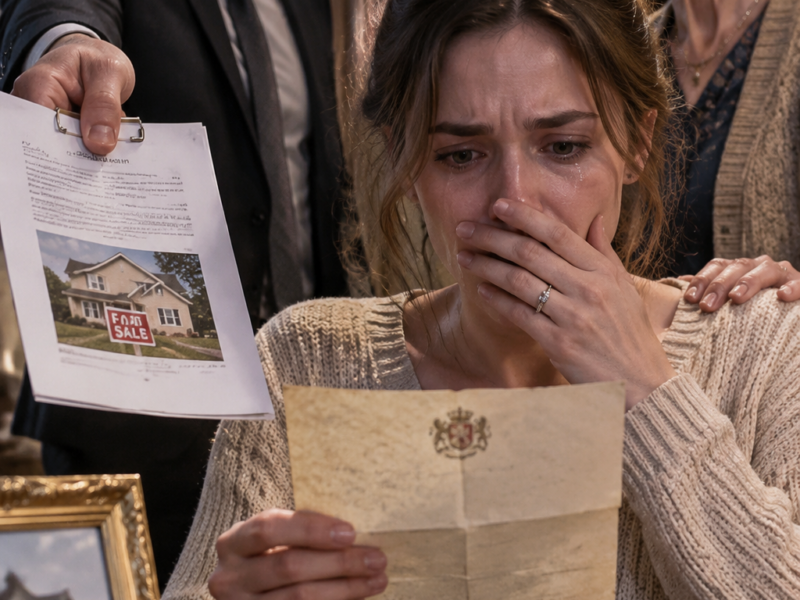
My Husband Gave Me 30 Days to Move Out. One Letter From Grandma Stopped the Sale…
My Husband Gave Me 30 Days to Move Out. One Letter From Grandma Stopped the Sale…
On Friday, October 9, 2026, I came home from work expecting nothing more exciting than a bowl of leftover chili, a comfortable chair, and an old detective show playing on television.
Instead, I found a SOLD sign planted in my front yard, my mother-in-law packing my clothes upstairs, and my husband sitting at the kitchen table with a moving box waiting for me.
He looked up when I walked through the door.
“Thirty days, Ellen.”
For a moment, I genuinely thought I had misunderstood him.
“What?”
“You have thirty days to move out.”
He said it so casually, as though he were reminding me that the trash needed to be taken to the curb.
Then he pushed a folder across the table.
“I accepted an offer on the house. Three hundred and eighteen thousand dollars. The closing is scheduled for next month.”
I stared at the papers, then at him.
“You sold our house?”
David leaned back in his chair.
“It’s my house, Ellen. I sold my property.”
Those words would stay with me for a long time. Not because they were particularly clever, but because they revealed something I had spent nineteen years refusing to see.
To understand why those words hurt so much, you need to understand what that house meant to me.
It wasn’t a mansion. It wasn’t even particularly large. It was a modest three-bedroom, two-bathroom house on a quiet residential street in Westerville, Ohio. The kind of neighborhood where people waved to one another when collecting their mail, where children rode bicycles along the sidewalks, and where everyone seemed to know whose maple tree dropped the most leaves every autumn.
Our maple tree was particularly generous.
Every October, its leaves covered the driveway, the front lawn, and sometimes the roof. I’d spent countless Saturday mornings sweeping them into enormous piles while David complained that the tree needed to be cut down.
I always defended it.
I liked that tree.
I’d watched it grow for nineteen years, just as I’d watched the house become part of my life.
I’d painted the bedrooms, chosen the curtains, replaced the kitchen flooring, planted roses along the walkway, and spent more weekends than I could count cleaning, repairing, decorating, and making that place feel like a home.
When we first bought it in 2007, David had told me that putting the property in his name was simply a matter of convenience.
He had better credit, a more established income, and a longer employment history. I was working full-time at a dental office, and he said the mortgage approval would be easier if he handled the paperwork.
“Once everything settles down, we’ll add your name,” he’d promised.
I believed him.
We were newly married, and I thought marriage meant building things together. I didn’t see any reason to question a decision that seemed practical at the time.
Later became next year.
Next year became five years.
Then ten.
Eventually, I stopped asking.
That was probably my first mistake.
But there were nineteen years between that decision and the afternoon David handed me a moving box.
Nineteen years of shared meals, household expenses, repairs, family holidays, and sacrifices that had never appeared on the deed.
And apparently, none of that mattered to him anymore.
“Why didn’t you discuss this with me?” I asked.
David sighed.
It was a familiar sound, the particular sigh he used whenever he believed he was dealing with someone who couldn’t understand a simple explanation.
“Ellen, we’ve been having problems for years. Selling the house makes sense. I found a buyer, and the offer is good.”
“You could have told me before accepting it.”
“There’s no reason to turn this into an argument.”
I looked at the folder again.
The purchase agreement was already signed.
The real estate agent’s information was attached, along with the proposed closing date and several documents I didn’t recognize.
Then I heard footsteps on the stairs.
Patricia, David’s mother, appeared carrying a cardboard box.
She was seventy-seven years old, with carefully styled silver hair, pearl earrings, and the sort of determined expression usually reserved for people who had already decided how a situation should end.
“Oh, Ellen. You’re home.”
She placed the box beside the front door.
“I started with your sweaters. Some of them really ought to be donated. You’ve accumulated far too many things over the years.”
I stared at her.
“You’re packing my clothes?”
Patricia gave me a small smile.
“I’m helping. There’s no need to be unpleasant.”
That was her favorite sentence.
She could criticize my cooking, my appearance, my spending habits, and even the way I spoke to my husband. But the moment I objected, I became the unpleasant person.
I looked inside the box.
There were several winter sweaters, two scarves, a pair of gloves, and a framed photograph.
It was a photograph of my grandmother, Margaret.
She had been standing on the front porch of that very house, smiling beside me while holding a plate of homemade cookies.
I remembered that afternoon clearly.
Grandma had brought those cookies over shortly after we moved in. She’d walked through every room, admired the kitchen, and told me that the house had good bones.
Then she’d squeezed my hand and said, “Make sure you build a life here, sweetheart. Not just a place to sleep.”
I picked up the photograph.
David cleared his throat.
“We can discuss furniture later. Right now, we need to get organized.”
I looked at him.
“Where exactly am I supposed to live?”
“You have a job.”
“A part-time job.”
“Then perhaps you should work more hours.”
I almost laughed.
Three years after we married, David’s father had become seriously ill. Patricia struggled to manage his appointments, meals, medications, and paperwork. I reduced my working hours so I could help.
After his father died, I continued helping Patricia because she insisted she couldn’t manage everything alone.
I drove her to medical appointments, picked up prescriptions, handled insurance calls, prepared meals, and spent countless afternoons sitting in her living room listening to her complain about neighbors.
David had once called me generous.
Now he was telling me I should simply work more.
“Are you asking for a divorce?” I asked.
He looked irritated.
“We’ll deal with that once you’ve moved out.”
That was the moment something inside me changed.
I finally understood that this wasn’t an impulsive decision.
He wanted me gone before I could ask questions, before I could examine the financial arrangements, and before I could understand what was happening to the home we’d shared for almost two decades.
Patricia folded her arms.
“Ellen, you should be grateful David is giving you thirty days. Some women aren’t nearly as fortunate.”
I turned toward her.
“Then perhaps you should be grateful I haven’t asked why you’re still living in a house that supposedly belongs only to him.”
Her expression tightened.
David nearly choked on his coffee.
I hadn’t planned to say it. It simply came out.
For the first time that afternoon, Patricia had nothing to say.
I picked up my purse and walked out.
I didn’t know where I was going until I found myself driving toward Linda Foster’s house.
Linda had been my friend for nearly fifteen years. She was fifty-eight, recently retired from a credit union, and possessed the kind of practical intelligence that made complicated situations seem manageable.
She opened the door, looked at my face, and immediately stepped aside.
“Come in. I’ve got coffee and leftover lasagna. One of them should help.”
I started crying before I even sat down.
I told her everything.
The sold sign. The paperwork. David’s thirty-day ultimatum. Patricia packing my clothes as though she were preparing to clear out a hotel room.
Linda listened without interrupting.
When I finished, she put down her coffee.
“He sold the marital home without telling you?”
“That’s what he says.”
“And now he thinks he can throw you out in thirty days?”
I nodded.
Linda shook her head.
“Ellen, don’t take legal advice from a man who’s trying to get rid of you.”
I stared at my hands.
“But the deed is in his name.”
“That doesn’t mean you have no rights. You need a lawyer. And you need to stop believing everything David tells you.”
She offered me her guest room, but I wasn’t ready to leave the house permanently.
I thanked her and drove home.
David was watching television when I entered.
He didn’t ask where I’d been.
He didn’t ask whether I was all right.
He simply glanced at me and returned his attention to the screen.
The box Patricia had packed remained beside the door.
I carried it upstairs and placed it in the bedroom.
That was when I remembered something my grandmother had told me during the final year of her life.
Grandma Margaret had lived in a small assisted-living apartment outside Columbus. I’d visited her almost every Sunday when I could.
She wasn’t a particularly sentimental woman. She loved crossword puzzles, strong coffee, old photographs, and keeping financial records in a way that would have impressed an accountant.
She also had a habit of saying things that seemed ordinary at the time but became important years later.
One afternoon, we’d been talking about my marriage.
She had never openly criticized David, but I knew she wasn’t particularly fond of him.
Grandma believed a person’s character was revealed by what they did when nobody was watching.
David, unfortunately, preferred an audience.
That afternoon, she took my hand and looked directly into my eyes.
“Ellen, if anybody ever tells you that you have no place in that house, look at what I left you.”
I had assumed she meant her inheritance.
When she died three years ago, I’d received some jewelry, photographs, and a small metal file box filled with documents.
I’d never gone through everything.
Now I suddenly wondered whether I’d overlooked something important.
I went into the closet and pulled out the box.
It was heavier than I remembered.
Inside were old tax returns, bank statements, insurance documents, canceled checks, birthday cards, and receipts going back decades.
Grandma saved everything.
She once kept a receipt for a toaster she’d purchased in 1989.
That toaster had outlived two presidents and at least one neighbor.
I started sorting through the papers.
Then I found a cream-colored envelope.
My name was written across the front in her careful handwriting.
Underneath were five words:
“About the Westerville house.”
My hands became strangely cold.
I opened it.
The letter was dated June 2007, the same month David and I had purchased the property.
Grandma explained that she had provided $46,000 toward the purchase.
I already knew she’d contributed money.
David had told me that years ago.
What I hadn’t known was that the money had never been intended as a gift.
Grandma wrote that the contribution had been documented as a loan secured by the property because she wanted to protect my future.
She also mentioned an agreement involving Patricia.
I read that paragraph several times.
Why would my grandmother have needed a financial agreement with my mother-in-law?
At the bottom of the letter was the name of an attorney.
Robert Mills.
I recognized the name immediately.
It appeared on the paperwork David had left on the kitchen table.
Robert’s office was involved in the pending sale.
I barely slept that night.
By Monday morning, I had called his office and requested an appointment.
At 10:15, I was sitting across from Robert Mills in his downtown Columbus office.
He was sixty-one, had thinning gray hair, and maintained a desk so organized that I immediately suspected he was the kind of man who alphabetized his grocery lists.
I explained what David had done.
Then I handed him Grandma’s letter.
He read it once.
Then he read it again.
His expression changed.
“Mrs. Parker,” he said carefully, “does your husband know you have this document?”
“No. I found it in my grandmother’s records.”
Robert stood, closed his office door, and asked his receptionist to hold his calls.
I began to worry.
“What is it?”
He returned to his desk and opened an old file.
“Your grandmother was my client nineteen years ago.”
I leaned forward.
“What does that mean?”
“It means she was considerably more careful than your husband may realize.”
He explained that he couldn’t simply disclose confidential information from Grandma’s old file without confirming who was legally authorized to receive it.
However, there was something he could show me.
A public property record.
He turned his computer toward me.
On the screen was a document dated June 2007.
It identified a mortgage securing my grandmother’s financial contribution.
Beneath the acknowledgment concerning the original transaction was another signature.
Patricia Parker.
I stared at it.
“Why would my mother-in-law sign anything involving my grandmother’s money?”
Robert studied the document.
“That’s a very good question.”
Then he said something that changed the next several months of my life.
“The house is under contract, but the sale hasn’t closed. There are matters that need to be resolved before anyone can safely proceed.”
For the first time since Friday afternoon, I felt something other than fear.
I felt curious.
And David had always hated it when I started asking questions.
Robert didn’t promise me the house. He didn’t promise that the sale would be stopped or that I would receive any particular amount of money.
He explained that the $46,000 had been documented as a loan.
There was a mortgage recorded against the property.
Whether the loan had been repaid, forgiven, or otherwise resolved would require a review of the original documents, payment records, and my grandmother’s estate records.
But the recorded mortgage couldn’t simply be ignored.
He also made it clear that because his office was involved in the pending sale, he couldn’t represent me in a dispute against David.
He recommended that I hire my own attorney immediately.
That afternoon, I contacted Susan Keller, a divorce attorney in Columbus.
She agreed to see me Tuesday.
Susan was forty-nine, wore reading glasses on a chain, and had the calm expression of someone who had heard every possible excuse a married person could invent.
I told her everything.
She listened without interrupting.
When I finished, she asked how long we’d been married.
“Nineteen years.”
“And you’ve lived in the house the entire time?”
“Yes.”
“Have you contributed financially?”
“Every month.”
She wrote something down.
Then she looked at me.
“The deed matters, Ellen. But it isn’t the only thing that matters.”
She explained that under Ohio law, a property purchased before marriage could have a separate-property component. However, the marital portion of its value, mortgage principal paid during the marriage, contributions, and other relevant financial circumstances could also matter.
There was no magical sentence that would make me rich.
There was simply a legal process that needed to be followed.
Susan advised me not to sign anything, not to move out simply because David demanded it, and to preserve financial records I could lawfully access.
Then she asked whether David had any unusual expenses.
I almost said no.
Then I remembered Patricia.
For years, David had sent his mother money every month.
He called it household assistance.
He said she needed help with groceries, medication, utilities, and other expenses.
I had never questioned it.
Patricia was a widow, and helping family seemed reasonable.
But now I wondered whether there was something else behind those payments.
That evening, I opened our joint checking account.
I went through the available statements one by one.
There it was.
A transfer of $425.
Another the following month.
And another.
The transfers were labeled household assistance.
I downloaded the available statements and added up everything I could verify.
More than $40,000.
I sat at the kitchen table staring at the total.
David arrived around seven.
He noticed the papers immediately.
“What are you doing looking at our finances?”
“Reviewing them.”
“Why?”
“Because you sold our house.”
He opened the refrigerator and took out a bottle of water.
“I thought we’d already discussed that.”
“We discussed you telling me to leave. That’s not the same thing.”
I pointed to the bank statements.
“What are these payments to Patricia?”
He shrugged.
“Mom helped us buy the house. I’ve been paying her back.”
I looked at him.
“How much did she contribute?”
“I don’t remember exactly.”
“Forty-six thousand dollars?”
His hand stopped moving.
“Where did you get that number?”
“Grandma’s records.”
His expression changed.
Not dramatically.
David wasn’t the sort of man who threw things when caught off guard. He became quieter, more careful.
“Your grandmother gave us that money.”
“She called it a loan.”
He looked at me.
“Ellen, she was old. She wrote down all kinds of things.”
I almost smiled.
My grandmother had balanced her checkbook to the penny until she was ninety.
She could remember the price of milk in 1962.
But apparently, according to David, she couldn’t distinguish between a gift and a loan.
I closed the folder.
He watched me.
“What are you planning?”
“Nothing tonight.”
That answer bothered him more than shouting would have.
The next day, I visited Linda.
I told her about the money and showed her the letter.
She frowned when I mentioned Patricia’s name.
“Wait. I remember something.”
Years earlier, during a summer cookout, Linda had been visiting when Grandma and Patricia argued near the back porch.
Linda hadn’t intended to listen, but Patricia had never been particularly interested in keeping her opinions private.
She remembered Grandma saying that the money was supposed to protect Ellen.
Patricia had replied, “You made your choice when you signed those papers.”
At the time, Linda assumed they were discussing something related to the wedding.
Now neither of us was so sure.
I returned home and searched Grandma’s file box again.
This time, I examined every document.
There were canceled checks, bank statements, and handwritten notes.
One check was payable to the title company.
Another was payable directly to Patricia Parker.
Eight thousand dollars.
The date was June 2007.
I stared at the check.
Why had Grandma paid Patricia $8,000?
And why had David spent years sending Patricia money for a debt that supposedly originated from the purchase of our house?
I sent copies of everything to Susan.
Over the following two weeks, she helped obtain additional records through appropriate requests and the beginning of the divorce process.
The picture slowly became clearer.
Patricia had claimed that she had advanced money toward the purchase before Grandma became involved.
Grandma agreed to pay Patricia $8,000 as part of settling that claim.
In return, Patricia signed an acknowledgment that she had no further right to repayment for that contribution.
The recorded mortgage secured Grandma’s separate loan.
I sat in Susan’s office while she explained the documents.
“So Patricia already received her money?”
“According to this agreement, her claim was settled.”
“Then why has David been sending her $425 every month?”
Susan looked at me.
“That’s one of the questions we’ll ask.”
I felt sick.
For years, I’d skipped vacations, postponed dental work, and bought groceries with coupons because David insisted we needed to be careful.
Meanwhile, he was sending his mother money for a debt that apparently no longer existed.
I thought about the times Patricia had criticized me for purchasing a winter coat.
“Some women don’t understand how quickly money disappears,” she’d once said.
Apparently, she understood perfectly.
She had been watching it arrive every month.
But the biggest surprise came when Susan began reviewing David’s financial disclosures.
She identified another account he hadn’t previously mentioned.
It wasn’t some secret numbered account in Switzerland.
It was an ordinary checking account at a local bank.
That almost made it worse.
David had been hiding things in the most boring way imaginable.
Some payments went to Patricia.
Others went to someone named Carol Benson.
I didn’t recognize the name.
Susan requested an explanation through David’s attorney.
His first response was vague.
His second was defensive.
David claimed the payments were personal obligations unrelated to our marriage.
Susan reminded me that we needed records, not assumptions.
That evening, I searched through old family photographs.
David had been married once before, briefly, when he was in his twenties.
He rarely discussed that marriage.
He always said his first wife, Denise, had been irresponsible with money and that their relationship had ended badly.
I found a photograph from their wedding.
David looked impossibly young.
Patricia stood beside him wearing a pale green dress.
Next to her was a woman in blue.
Someone had written three names on the back.
Patricia.
David.
Carol.
I stared at the photograph.
Then I called my husband.
He answered on the fourth ring.
“What?”
“Who’s Carol Benson?”
Silence.
Then he asked, “Where did you hear that name?”
“Answer the question.”
“She’s nobody you need to worry about.”
I looked at the photograph again.
“That’s interesting, because you’ve been sending her money.”
Another silence.
Then his voice became colder.
“Stay out of my past, Ellen.”
He hung up.
I sat there holding the phone, wondering whether the house was only the beginning.
I wish I could tell you that after discovering the financial records, everything became easier.
It didn’t.
The next few weeks were worse.
David stopped pretending we were having an ordinary disagreement.
He changed the password on the household computer.
He stopped speaking to me unless absolutely necessary.
Patricia continued visiting the house as though she were supervising a hotel checkout.
One Tuesday afternoon, I came home to find a list of apartments on the kitchen counter.
Patricia had circled three.
The cheapest was a small studio above a commercial building near a busy road.
Beside it, she’d written:
“Affordable for someone your age.”
I stared at the note for a long time.
I was fifty-two, not ninety-two, but Patricia had a remarkable talent for making a woman feel like an expired carton of milk.
I folded the paper and placed it inside my folder.
By then, I was keeping everything.
Messages.
Statements.
Receipts.
Letters.
Even Patricia’s handwritten apartment recommendations.
Not because I enjoyed paperwork, but because I was beginning to understand how easily someone could rewrite a marriage when the other person had nothing documented.
Susan had already begun the divorce process.
She’d also taken steps to protect my position concerning the house while the case was pending.
David’s attorney argued that the property belonged to him because he’d purchased it before our marriage.
Susan argued that nineteen years of mortgage payments, financial contributions, repairs, and changes in value could not simply be ignored.
Neither side had an automatic victory.
And I was terrified.
I worked part-time in medical billing.
I had some savings, but not enough to comfortably support myself through a prolonged legal battle.
Every appointment with Susan cost money.
Every letter from David’s attorney made my stomach tighten.
At night, I’d lie awake wondering whether I should simply accept whatever David offered and leave.
Then I’d remember Patricia packing my sweaters.
And I’d become angry all over again.
Meanwhile, Susan continued investigating the financial records.
Eventually, she learned that Carol Benson lived in Dayton.
Carol had been the sister of David’s first wife, Denise.
That surprised me.
David had always described Denise as someone who spent money recklessly.
He’d never mentioned owing her family anything.
With Susan’s guidance, I contacted Carol.
She was cautious when I introduced myself.
“I’m not interested in getting involved in another Parker family argument,” she said.
I almost laughed.
“Believe me, neither am I.”
I explained that I was trying to understand financial payments David had concealed during our marriage.
There was a long pause.
Then Carol said something that made my stomach drop.
“He still hasn’t told you.”
She agreed to speak with me by phone the following afternoon.
I sat in Linda’s kitchen when the call came.
Carol explained that before David’s first marriage ended, he’d borrowed money from Denise’s family.
He had been trying to start a small appliance distribution business.
The business failed.
The marriage followed shortly afterward.
David had blamed Denise for the financial problems, but according to Carol, the debt had been his.
Denise’s family had spent years trying to recover some of the money.
Eventually, David agreed to make monthly payments.
Carol helped manage the arrangement because Denise wanted no direct contact with him.
“Why didn’t he just tell me?” I asked.
Carol gave a tired laugh.
“Because David doesn’t like admitting he owes anybody anything.”
I thanked her before we hung up.
But she said something I didn’t forget.
“Ellen, my sister wasn’t perfect. Neither was David. But he told everybody she ruined him financially. He was still telling that story while he was sending her payments.”
I thought about that for days.
David had spent nineteen years describing his first wife as irresponsible.
Now he was telling people I was financially dependent on him.
It seemed he had a favorite role for women who stopped agreeing with him.
The woman who ruined everything.
I wondered how many versions of that story he planned to tell.
Susan obtained records documenting the old repayment arrangement.
The payments to Carol weren’t evidence of an affair, and they weren’t automatically improper. But they were another financial obligation David had concealed while insisting we couldn’t afford things I needed.
I was furious.
Susan warned me not to confuse anger with legal proof.
“Some of this may matter to the division of assets,” she explained. “Some of it may simply tell you what kind of husband you’ve been married to.”
“Can I put that second part in the divorce papers?”
“Not in those words.”
I laughed for the first time in weeks.
Then we returned to the numbers.
The house remained the biggest issue.
The buyer had offered $318,000, but the sale hadn’t closed.
The title company was examining Grandma’s recorded mortgage and whether it had ever been properly satisfied.
Grandma had died three years earlier.
Her estate had been handled through probate, but the loan had not been clearly resolved in the property records.
That meant the parties needed to determine who held the claim and what, if anything, remained due.
The title company wasn’t willing to ignore the issue.
The buyer’s attorney wanted answers.
David was furious.
One evening, he came home and threw a letter onto the kitchen table.
“You’ve ruined the sale.”
I picked it up.
It was from his real estate agent.
The buyer was threatening to terminate the contract if the title issues weren’t resolved before the agreed deadline.
“I didn’t record Grandma’s mortgage,” I said.
“You brought it up because you wanted to interfere with the sale.”
“You sold the house without telling me.”
“You’re doing this out of spite.”
I looked at him.
“David, if I’d wanted to ruin your plans, I’d have started with your haircut.”
He stared at me.
I hadn’t intended to say it, but his hair had been carefully arranged over the same thinning patch since 2018, and apparently my patience had finally expired.
He grabbed the letter.
“This isn’t funny.”
“No. It isn’t.”
I went upstairs, closed the bedroom door, and cried.
Not because of the argument.
Because I was exhausted.
I missed the version of my marriage I’d believed in.
I missed Sunday mornings when David made pancakes.
I missed the years when I thought we were partners.
And I hated that some part of me still wanted him to come upstairs, apologize, and tell me we’d figure things out.
He didn’t.
Instead, he sent me a text from downstairs.
“My lawyer says you’re being unreasonable.”
I didn’t answer.
The next morning, I called Linda.
She invited me over for dinner.
We sat at her kitchen table eating meatloaf and mashed potatoes.
I told her I was thinking about accepting David’s offer of $15,000.
Linda put down her fork.
“Do you want to accept it because it’s fair?”
“No.”
“Because you’re tired?”
I nodded.
She reached across the table and took my hand.
“Then don’t make a permanent decision just to escape a temporary feeling.”
I stared at my plate.
Linda told me about her own divorce fifteen years earlier.
She’d lost the family house and moved into a small rental apartment.
For months, she felt ashamed.
She thought everyone would assume she’d failed.
Then she realized something.
She no longer had to explain why she’d spent money on groceries.
She no longer had to apologize for visiting friends.
She could leave a book on the coffee table without someone complaining about clutter.
“It wasn’t the house that made me feel safe,” Linda said. “It was finally being able to live without asking permission.”
I went home and started collecting records of everything I’d contributed.
The roof replacement in 2018.
Twelve thousand four hundred dollars from my personal savings.
The kitchen renovation.
Monthly transfers toward the mortgage.
Appliances I’d purchased.
Insurance payments.
Household repairs.
It took days.
I found receipts in drawers, old emails, and bank records.
Some were missing.
Some were incomplete.
But together, they showed a marriage in which I’d contributed far more than David wanted to acknowledge.
Then Susan called with another discovery.
David had put down a deposit on a condominium in Dublin, Ohio.
He intended to purchase it using the proceeds from the house sale.
Patricia planned to move in with him.
I sat quietly while Susan explained the arrangement.
The condominium purchase depended on the Westerville sale closing.
Without those proceeds, David couldn’t complete the transaction on the terms he’d arranged.
I almost felt sorry for him.
Almost.
Then I remembered that he’d given me thirty days to find somewhere to live while arranging a new home for himself and his mother.
That cured me.
A few days later, the original buyer terminated the contract under its title-related provisions.
The house was no longer under contract.
The sold sign came down.
I happened to be home when the real estate agent arrived to remove it.
I watched from the front window as he pulled the sign out of the grass, placed it in his vehicle, and drove away.
David stood in the driveway looking miserable.
For nineteen years, I’d watched him smile whenever he got his way.
I’d never realized how much I would enjoy seeing him confronted by an ordinary piece of paperwork.
But I didn’t celebrate.
We still had a divorce to settle.
The house still had to be dealt with, and my savings were getting smaller.
Susan arranged a settlement conference with David’s attorney.
David insisted Patricia attend because she had been involved in the original purchase.
I agreed.
The night before the meeting, something unexpected happened.
Patricia called me.
That alone was unusual.
She generally preferred telling David what to tell me.
Her voice sounded different.
Less certain.
“Ellen, I think there’s something you should understand about your grandmother’s money.”
I sat down.
“I’m listening.”
She hesitated.
“David doesn’t know everything.”
That surprised me.
“What doesn’t he know?”
“I’d rather explain in person.”
I thought about the boxes, the insults, and nineteen years of being treated like an outsider in my own home.
Then I said, “Tomorrow would be a good time.”
She started to speak.
I hung up.
For once, Patricia Parker would have to wait until I was ready.
The settlement conference took place on a cold Tuesday morning in downtown Columbus.
I arrived fifteen minutes early.
Susan was already there, sitting at a conference table with a legal pad, a folder of financial records, and a cup of coffee that looked strong enough to remove paint.
“You ready?” she asked.
“No.”
“Good. Most people who think they’re ready for these meetings aren’t.”
That made me smile.
We entered a conference room with a long table and too many chairs.
David arrived with his attorney.
Patricia came behind him carrying a thick folder.
She wore her best navy coat and the pearl necklace she’d received for her seventieth birthday.
She looked prepared for a church committee meeting or an execution.
With Patricia, the difference was usually the refreshments.
David avoided looking at me.
His attorney began by explaining that David wanted to resolve the matter quickly.
He still believed the house was primarily his separate property.
He was willing to offer me $15,000 in exchange for settling my claims.
Susan listened patiently.
Then she opened her folder.
She reviewed the years of mortgage payments, household contributions, repairs, and the financial records we’d collected.
She explained that the premarital ownership issue required a proper accounting.
The house’s value at marriage, changes in equity, mortgage principal paid during the marriage, and other relevant contributions all mattered.
Then she turned to Grandma’s mortgage.
David leaned forward.
“That was a gift.”
Susan placed a copy of the recorded document on the table.
“Then why was it secured by a mortgage?”
David looked at his attorney.
His attorney looked at the paper.
Patricia spoke before either man could answer.
“Margaret was suspicious of everyone. She didn’t trust people.”
I looked at her.
“She trusted me.”
Patricia pressed her lips together.
Susan continued.
She explained that Grandma’s loan needed to be examined through the estate records and underlying documents.
The recorded mortgage created a title issue that couldn’t simply be wished away.
Then she brought up the $8,000 payment.
Patricia shifted in her chair.
Susan showed her the canceled check and the agreement settling Patricia’s asserted contribution.
“Mrs. Parker, is this your signature?”
Patricia studied the document.
“Yes.”
“And you received the $8,000?”
“Yes.”
“And you agreed that your claim relating to that contribution was settled?”
Patricia looked toward David.
He frowned.
“Mom?”
She took a breath.
“Yes.”
David stared at her.
“What do you mean, yes?”
Patricia folded her hands.
“Margaret wanted everything documented.”
“You told me she paid you because you helped arrange the purchase.”
“She did.”
“But you also told me I still owed you money.”
Patricia’s expression hardened.
“David, don’t start.”
He leaned back.
For the first time, he looked genuinely confused.
Susan asked whether Patricia had continued accepting monthly payments from David after signing the agreement.
Patricia said yes.
David turned toward her.
“You told me those were repayments.”
“They were helping me.”
“Helping you for nineteen years?”
“You didn’t start right away.”
I watched them.
Patricia had presented herself as the person who understood money better than anyone.
David had treated her advice as sacred.
Now they were arguing over payments neither had ever explained to me.
Then Patricia said something that changed the atmosphere in the room.
“You wanted Ellen kept out of the purchase discussions. You said she’d asked too many questions.”
David snapped.
“You were the one who said her name shouldn’t go on anything.”
Patricia raised her voice.
“Because you told me you weren’t sure the marriage would last!”
The room went silent.
I looked at David.
He stared at the table.
Nineteen years.
He had been uncertain enough about our marriage before it even began that he’d discussed keeping me off the property records.
But he’d been certain enough to let me spend my savings repairing the roof.
Certain enough to let me reduce my working hours to care for his parents.
Certain enough to accept every contribution I made.
Just not certain enough to give me a voice.
I felt something inside me settle.
Not break.
Settle.
Like a door finally closing properly after years of sticking.
Susan allowed the silence to continue for a moment.
Then she returned to the financial records.
The conference wasn’t a trial.
Nobody was under oath, giving dramatic testimony before a crowded courtroom.
It was a negotiation.
But there were consequences to what had just been said.
David’s attorney asked for a private discussion.
They left the room.
Patricia remained seated.
She looked at me.
“Ellen, I never wanted things to go this far.”
I considered her words.
“You packed my clothes.”
She blinked.
“I was trying to help David.”
“Yes,” I said quietly. “You’ve been doing that for nineteen years.”
She looked down.
I didn’t need her to apologize.
Not then.
An apology offered because someone has lost control doesn’t necessarily mean they’ve learned anything.
After about twenty minutes, David and his attorney returned.
The offer had changed.
They were willing to discuss a division of the home’s equity and other marital assets.
There would still be disagreements.
There would still be calculations.
But David could no longer simply insist I had no claim.
Then he turned toward me.
“Ellen, this has gotten completely out of hand.”
I looked at him.
“You sold our house without telling me.”
“I was trying to make a clean break.”
“You gave me thirty days.”
“You knew things weren’t working.”
I nodded slowly.
“Yes. I knew we were unhappy. I didn’t know you’d decided I was furniture.”
He looked irritated.
“You’re making this personal.”
I almost laughed.
“David, it’s a divorce. It would be difficult to make it less personal.”
Susan lowered her eyes.
I suspected she was hiding a smile.
David pushed his chair back.
“Fine. What do you want?”
That was the question I’d been waiting to hear.
Not because I wanted to punish him, but because for the first time, he was asking instead of telling.
“I want a fair settlement,” I said. “I want the money I contributed to be considered. I want the property handled properly, and I want you to stop pretending I spent nineteen years living here as your guest.”
He opened his mouth.
Then closed it.
We didn’t reach a final agreement that morning.
That would have been too easy.
The next four months involved appraisals, financial disclosures, attorney letters, and several conversations that made me question whether marriage should come with an instruction manual.
Susan worked with the appropriate professionals to review Grandma’s loan and estate records.
Eventually, the parties agreed on the treatment of the secured claim and the amount necessary to resolve the title issue.
The house was listed again after the legal questions were addressed.
David’s condominium purchase fell apart under the terms of that contract.
He lost his deposit.
Patricia had to abandon her plans to move into the new place with him.
She wasn’t left homeless. She still had her own home.
But the comfortable arrangement they’d planned using the sale proceeds disappeared.
As for the monthly payments David had made to her, those became part of the financial accounting.
Susan argued that certain transfers should be considered when dividing marital property.
David’s attorney disagreed about how much should count.
They negotiated.
Not every dollar came back.
Not every insult had a financial consequence.
But the final settlement recognized my marital property interests and gave me a meaningful share of the assets.
It was substantially more than David’s original $15,000 offer.
More importantly, it was enough for me to start again without feeling that one unexpected bill would destroy me.
The house eventually sold after the necessary issues were resolved.
I didn’t fight to keep it.
That surprised some people.
Linda asked me once whether I had considered buying David out.
I told her I’d thought about it.
But every room in that house held memories that had become difficult to separate from the way everything ended.
The kitchen reminded me of the arguments.
The bedroom reminded me of the nights I had lain awake wondering why my husband no longer seemed interested in speaking to me.
Even the maple tree, which I’d loved for nineteen years, had become associated with that Friday afternoon.
I didn’t want to spend the rest of my life defending a place where I’d been made to feel unwanted.
I wanted something different.
I moved into a two-bedroom apartment near my office.
It wasn’t large.
The kitchen cabinets were old, the living room window faced a parking lot, and the hallway carpet had seen better days.
But I chose it.
I signed the lease.
I decided where the furniture went.
I chose the curtains without consulting anyone.
Nobody asked whether Patricia approved of the color.
That alone made the apartment feel luxurious.
Linda helped me move.
She arrived carrying coffee, sandwiches, and the kind of determination normally reserved for storm cleanup.
When she saw the boxes Patricia had packed months earlier, she shook her head.
“Your mother-in-law really did half the moving for you.”
I looked at the labels.
Ellen’s clothes.
Ellen’s books.
Ellen’s kitchen things.
I smiled.
“It’s the most useful thing she’s done for me in nineteen years.”
Linda laughed.
We worked through the afternoon, unpacking boxes and arranging furniture.
At one point, I had to sit down because I was laughing so hard at something she said.
It felt strange.
I hadn’t laughed like that in months.
Later, I found Grandma’s photograph.
The one Patricia had placed in the first moving box.
I set it on a shelf beside the living room window.
A week later, I received a small package from the attorney who’d handled Grandma’s estate.
Inside was another photograph.
Grandma stood on the porch of our old house, wearing her favorite blue cardigan.
On the back, she’d written:
“I hope this becomes a place where Ellen always feels welcome.”
I sat on the floor holding that photograph.
And I cried.
Not because I wanted the old house back.
I missed it, certainly.
I missed the maple tree.
I missed the kitchen where I’d made Thanksgiving dinner.
I missed the little garden behind the garage, where I’d spent entire summer afternoons pulling weeds and planting flowers.
But I finally understood something.
I’d spent years confusing a familiar place with a safe one.
Grandma had wanted me to have a home.
David had wanted me to have permission to stay.
Those were very different things.
A few Sundays later, Linda came over for coffee.
I served it in two mismatched mugs.
They were the cheap ones Patricia had packed.
Linda picked hers up and examined it.
“Is this the famous moving-box collection?”
“Yes. Very exclusive. Membership costs one divorce.”
She laughed.
We sat near the window and talked about ordinary things.
My job.
Her grandchildren.
The neighbor who kept parking across two spaces.
The weather.
A television show we’d both started watching.
It felt wonderful to have a conversation that didn’t involve attorneys, bank statements, or property records.
Then Linda asked whether I’d heard from David.
I nodded.
He’d called the previous evening.
He wanted to know whether I regretted losing the house.
For a moment, I’d been tempted to list everything I’d lost because of him.
The years.
The trust.
The money.
The version of my future I’d believed in.
Instead, I’d told him something simple.
“I didn’t lose my home, David. I lost the man who thought he could throw me out of it.”
He hadn’t answered.
I’d ended the call.
Linda smiled when I repeated it.
“That’s a pretty good last word.”
“It’s the only one he needed.”
She raised her coffee mug.
“To starting over.”
I raised mine.
“To reading the paperwork.”
We laughed.
And for the first time in months, I felt completely at peace.
I sometimes think about that Friday afternoon.
October 9, 2026.
I think about the SOLD sign in the front yard, the moving box beside the door, and Patricia carrying my sweaters downstairs as though she were doing me a favor.
I think about David sitting at the kitchen table, so confident that a name on a deed gave him the right to erase nineteen years of my life.
He had expected me to panic.
He had expected me to accept whatever money he offered.
He had expected me to leave quietly because he believed I had nowhere else to turn.
He forgot something.
My grandmother had taught me long before I met him that you don’t have to shout to stand up for yourself.
Sometimes you just need to ask the right question.
And then keep asking until somebody finally tells the truth.
I was fifty-two years old.
I was divorced.
I lived in a rented apartment.
My furniture didn’t match, and my savings needed rebuilding.
I still had difficult days.
Sometimes I missed the old house so much that I’d find myself thinking about the garden or remembering the sound of rain against the kitchen window.
Sometimes I wondered how nineteen years could end with a cardboard box and a thirty-day deadline.
But I also had mornings when I woke up without wondering whether David and Patricia had made another decision about my life.
I could spend my own money.
I could invite friends over.
I could leave a book on the coffee table.
I could buy a winter coat without hearing a lecture about unnecessary expenses.
I could sit in my living room on a Sunday afternoon and watch whatever I wanted.
And when I closed my front door at night, I knew nobody inside was planning how to get rid of me.
That was worth more than the house.
A few months after the divorce was finalized, I received a handwritten envelope from Patricia.
I recognized her handwriting immediately.
For several minutes, I considered throwing it away without opening it.
But curiosity won.
The letter was short.
She wrote that things had become more complicated than she’d expected. She said she’d never intended to hurt me and that she hoped we could eventually put the past behind us.
She also wrote that David was having a difficult time adjusting.
I read it twice.
There wasn’t a single sentence acknowledging the years she’d spent criticizing me, the way she’d helped pack my belongings, or the fact that she’d accepted money while knowing the original claim had been settled.
There was no real apology.
Just an invitation to make everything comfortable again.
I folded the letter and placed it in the drawer.
I didn’t respond.
I didn’t hate Patricia.
I simply no longer believed that keeping peace with someone was more important than keeping peace with myself.
David contacted me once more after that.
He wanted to know whether I’d ever considered that perhaps things could have ended differently.
I thought about the question.
Of course, things could have ended differently.
He could have spoken to me before selling the house.
He could have told me about the financial arrangements.
He could have treated me like a partner instead of someone whose contributions were convenient but whose opinions were inconvenient.
He could have given me the respect I’d given him for nineteen years.
But he hadn’t.
And by the time he realized that a marriage couldn’t be ended by handing someone a cardboard box, I had already learned how to live without him.
I told him I hoped he was doing well.
Then I wished him goodbye.
I didn’t need another argument.
I didn’t need another explanation.
I didn’t need him to admit that he’d been wrong.
The truth was already in the documents.
Grandma’s letter had stopped the sale long enough for the facts to come to light. The canceled checks, the recorded mortgage, the old agreement, and the financial records had done what years of arguments never could.
They had given me a chance to be heard.
But the most important thing that letter gave me wasn’t money or a claim to the house.
It gave me the confidence to stop accepting someone else’s version of my life.
Sometimes I still take Grandma’s photograph from the shelf and look at the words on the back.
“I hope this becomes a place where Ellen always feels welcome.”
I used to think she was talking about the house in Westerville.
Now I think she was talking about something much bigger.
A home isn’t simply a building with your furniture inside.
It isn’t the name printed on a deed.
It isn’t the number of years you’ve spent paying bills, painting walls, or taking care of other people’s needs.
A home is where you can exist without constantly defending your right to be there.
It’s where your voice matters.
Where your decisions count.
Where you don’t have to earn the privilege of being treated with kindness.
David gave me thirty days to disappear.
It took four months to leave the marriage.
And when I finally locked the door behind me, I didn’t feel homeless.
I felt free.
If there’s one thing I learned from all of this, it’s that you should never let someone convince you that having a name missing from a piece of paper means your years of love, sacrifice, and contribution are worth nothing.
Keep your records.
Ask questions.
Read the documents.
And when someone tells you that you have no place in a home you’ve spent years helping build, don’t automatically believe them.
Sometimes the most important thing you can do is refuse to leave before you understand the truth.
I lost a house.
I lost a marriage.
I lost the future I’d imagined when I was younger.
But I didn’t lose myself.
And at fifty-two, after nineteen years of believing I had to keep everyone else comfortable, I finally had something I’d never truly possessed before.
A life that belonged to me.









