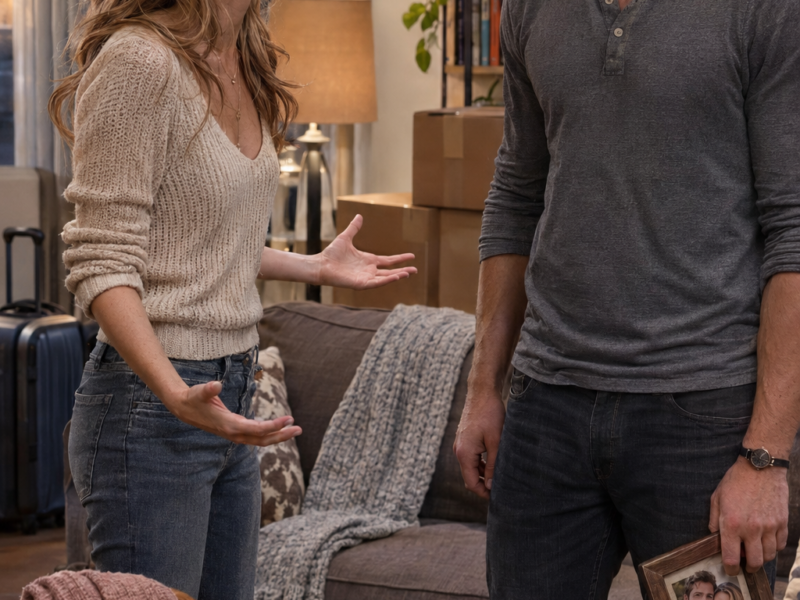
My Ex’s Best Friend Became My Roommate… “She’s Not Coming Back. And I’m Tired of Waiting.”
My Ex’s Best Friend Became My Roommate… “She’s Not Coming Back. And I’m Tired of Waiting.”
The night my ex-girlfriend’s best friend moved into my spare room, she arrived with two suitcases, a dying basil plant, and a sentence I had spent thirteen months pretending I didn’t need to hear.
“She’s not coming back, Nolan. And I’m tired of waiting for you to figure that out.”
Jenna Walsh stood on my porch in the middle of a cold November rainstorm, her blonde hair plastered against her cheeks, one hand gripping the handle of a suitcase with a broken wheel and the other holding a small clay pot containing what appeared to be a plant on its final breath.
I was thirty-two years old. I designed houses for a small architectural firm in Grand Rapids, Michigan. I owned a narrow blue bungalow with a mortgage that occasionally made me question my life choices, a sixty-pound rescue dog named Murphy, and a spare bedroom that had been empty for almost a year.
I also had an unfortunate habit of checking my phone every morning to see whether a woman who had abandoned me thirteen months earlier had finally decided to remember I existed.
My name is Nolan Price, and until that particular Friday evening, I had convinced myself that I was doing reasonably well.
I wasn’t.
Not really.
Vanessa had been my girlfriend for four years. We had met at a friend’s birthday party, moved in together after our second anniversary, and spent countless evenings discussing the house we would eventually buy, the places we wanted to travel, and whether we would ever be responsible enough to adopt another dog.
For a while, I genuinely believed we were building a life together.
Then, thirteen months before Jenna appeared on my doorstep, Vanessa packed a weekend bag and told me she needed some space.
She said she was going to stay with her cousin in Chicago for a few days.
I remember standing in the kitchen while she zipped her bag, asking whether something had happened. She kissed my cheek, told me not to overthink things, and promised she would call when she had settled down.
She never did.
At first, I assumed she was upset about something. Then I thought perhaps she needed time to work through whatever was bothering her. I sent messages, called occasionally, and tried not to sound desperate when she finally responded with increasingly short sentences.
Three weeks later, she sent me a text.
“I just can’t be what you need right now.”
That was the entire explanation.
No proper conversation. No face-to-face goodbye. No discussion about the furniture we had purchased together or the future we had spent four years planning.
She simply disappeared.
Her books remained on the shelves. Her winter coat stayed in the hallway closet. Her ridiculous ceramic rooster, which she had insisted would bring good luck to our kitchen, remained perched on top of my refrigerator.
I didn’t have the heart to move any of it.
For months, I told myself she was confused. Maybe she was overwhelmed by work. Maybe something had happened in Chicago. Maybe she would eventually come home and explain everything.
Then the truth began arriving through mutual friends.
A friend accidentally mentioned seeing Vanessa with another man. Someone else became unusually quiet when I asked whether they had spoken to her recently.
And then, one afternoon, I saw a photograph I wished I could erase from my memory.
Vanessa was standing on a beach in Florida, smiling at the camera with her arms wrapped around a man named Ryan.
She was wearing the white sundress I had bought her for our anniversary.
That photograph told me more than thirteen months of silence ever had.
You would think discovering the truth would make it easier to move on.
It didn’t.
It just made me quieter.
I continued going to work, walking Murphy, renovating the house, and pretending everything was normal. I became very good at answering questions with jokes and changing the subject whenever somebody mentioned relationships.
The only person who seemed to recognize how badly I was doing was Jenna Walsh.
Jenna had been Vanessa’s best friend since college.
She was the last person I should have developed feelings for, considering the circumstances. Yet somehow, she had become the one person who never made me feel like I was being pitied.
After Vanessa disappeared, Jenna didn’t vanish with her.
She didn’t make grand gestures or show up with dramatic speeches about how everything would be okay. She simply stayed in my life.
She continued inviting me to trivia nights with our old group. She texted when Murphy needed surgery and checked whether I had managed to get him through the first difficult night afterward.
When I caught a terrible flu and insisted I was perfectly capable of taking care of myself, she appeared at my door with chicken soup and enough medication to stock a small pharmacy.
Once, I posted a photograph of the crooked backsplash I had installed in my kitchen.
Jenna arrived twenty minutes later carrying tile spacers.
“Nolan, I’m begging you to stop making permanent decisions after ten o’clock at night.”
“I thought it looked good.”
“It looks like the tiles are trying to escape.”
“That’s called artistic expression.”
“That’s called a future insurance claim.”
She had a way of making ordinary moments feel lighter.
She worked as a project manager for a local nonprofit organization. She could coordinate complicated fundraising events, negotiate with difficult donors, and organize a room full of volunteers without losing her temper.
She had dark blonde hair that usually ended up twisted into a messy knot, sharp green eyes, and an expression that suggested she was constantly evaluating whether the people around her were making sensible decisions.
I liked that about her.
Perhaps more than I should have.
But there were boundaries a decent man was supposed to respect.
One of them was not developing romantic feelings for his vanished ex-girlfriend’s best friend.
Especially when that best friend occasionally showed up wearing his old sweatshirt because she had gotten caught in the rain.
So when Jenna called me that Friday evening, I wasn’t prepared for what she was about to ask.
“Please don’t make this weird,” she said.
I was sitting on the couch, watching Murphy sleep upside down with his legs in the air.
“That depends entirely on how weird we’re talking.”
“My landlord sold the building. The new owner wants everybody out, and the apartment I was supposed to move into fell through.”
“That’s unfortunate.”
“Extremely.”
“How unfortunate?”
There was a pause.
“Possibly medium weird.”
I laughed.
“On a scale of one to Vanessa’s ceramic rooster?”
“Nothing is that weird.”
“Then I think we’re safe.”
She took a breath.
“Would it be possible for me to stay in your spare room for a little while? Just until I find somewhere else?”
I looked toward the hallway.
The spare bedroom had been empty for months.
It had once been Vanessa’s home office. After she left, I had eventually packed away her things, repainted the walls a warm gray, bought a bed, and replaced the curtains.
I told myself I was preparing the room for guests.
I hadn’t expected the first guest to be Jenna.
“Of course,” I said.
“Really?”
“Why wouldn’t it be?”
“I don’t want to inconvenience you.”
“Jenna, the room has been sitting there doing absolutely nothing. At least now somebody can appreciate my questionable decorating decisions.”
“Your decorating decisions are questionable.”
“You’re welcome to criticize them after you move in.”
Two hours later, she was standing on my porch, soaked through, trying to keep her basil plant from falling out of its pot while dragging a suitcase with a broken wheel.
Murphy recognized her before I even opened the door completely.
My enormous mutt shoved past my legs and launched himself at her knees.
“Oh, thank God,” Jenna exclaimed, dropping the suitcase handle and immediately scratching behind his ears. “At least one Price man is excited to see me.”
“I’m excited,” I said. “I’m just less furry about it.”
She looked up.
For a moment, neither of us said anything.
Rainwater dripped from her hair onto the collar of her sweater. I suddenly became very interested in helping her with the suitcase.
“Come inside before the neighbors think I make women negotiate rent in the weather.”
“Do you?”
“Only the suspicious ones.”
“I brought references.”
“You listed Murphy twice.”
“He has excellent judgment.”
I picked up her heavier suitcase. Our fingers brushed around the handle, and although the contact lasted barely half a second, I felt something unfamiliar travel through my chest.
Jenna seemed to notice it, too.
She looked down, cleared her throat, and lifted the basil plant between us.
“This is Arthur.”
I stared at it.
“You named your basil?”
“He’s been through a lot.”
“He looks like he’s been through several wars.”
“He doesn’t appreciate judgment.”
“Then Arthur and I already have something in common.”
She laughed.
Not the polite laugh she sometimes used around people she barely knew, but the real one that softened her face and made her eyes almost disappear.
I carried her bags down the hallway.
When she reached the spare bedroom, she stopped in the doorway.
“You painted.”
“Eventually.”
“It looks good.”
“Don’t sound so surprised.”
“I’m not surprised. I’m moved.”
“You cried when the hardware store discontinued that blue paint you liked.”
“It was a complex blue.”
I placed her suitcase beside the bed.
“Stay as long as you need. We can figure out rent later.”
She looked at me seriously.
“Nolan, I don’t want to take advantage of you.”
“You’re not.”
“You say that because you’re dangerously decent.”
“I’ve been called worse.”
“I know.”
Something about the way she said those two words made me look at her.
She was standing closer than I had realized. Her damp sweater clung to her shoulders, and a few loose strands of hair rested against her neck.
For a moment, the house became unusually quiet.
Then she reached out and touched the sleeve of my shirt.
“You shouldn’t still be living like she might walk back in.”
I looked away.
“That obvious?”
“Nolan, her rooster is still on top of your refrigerator.”
“It’s load-bearing.”
“No,” she said gently. “It’s a shrine with feathers.”
Normally, I would have made another joke.
But I was tired of pretending.
“I don’t know how to be the guy who got left,” I admitted.
Her expression changed.
Not with pity, but with something closer to anger on my behalf.
“That’s not who you are.”
“You sure?”
“Absolutely.”
She said it so quickly that I almost believed her.
Then she added, “You’re the guy who stayed honest when somebody else didn’t.”
Nobody had ever described my situation that way.
I didn’t know what to say.
So we ordered Thai food because neither of us had enough dignity left to cook.
We ate at the kitchen island, sitting on mismatched stools while Murphy positioned himself between us like a hopeful chaperone.
Jenna stole one of my spring rolls.
“You saw that,” she said.
“I’m choosing peace.”
“You’re choosing cowardice.”
“I’m choosing to live with a woman who owns a plant named Arthur. I don’t know what you’re capable of.”
She laughed with her mouth full, then covered it with the back of her hand.
“Sorry. Very elegant roommate behavior.”
“Don’t worry. My expectations were lowered when you introduced me to the basil.”
She kicked my foot under the counter.
It was a tiny gesture.
A ridiculous, meaningless gesture.
Yet somehow, it made me more aware of her than I had been all evening.
Later, while she washed the plates and I dried them, her phone buzzed on the kitchen counter.
She glanced at the screen.
Then she went completely still.
I didn’t mean to look, but the illuminated display caught my attention.
Vanessa.
Just her name.
After thirteen months of silence, my ex-girlfriend was suddenly calling the woman standing in my kitchen wearing my sweatshirt.
Jenna didn’t answer.
The phone continued vibrating until the call ended.
Neither of us moved.
Then she gripped the edge of the sink.
“Nolan, there’s something I should have told you a long time ago.”
My hand tightened around the dish towel.
“What?”
She turned toward me.
Guilt was written across her face so clearly that I already knew whatever she was about to say would hurt.
“I knew about Ryan before you did,” she whispered. “And I didn’t tell you.”
For a moment, I heard everything in the kitchen with painful clarity.
The faucet dripping.
Murphy’s nails clicking against the floor.
The faint hum of the refrigerator.
Jenna breathing as though she had been holding that secret inside her lungs for an entire year.
“You knew?”
She nodded.
“How long?”
“About three weeks before she left.”
I laughed once, but there was absolutely no humor in it.
“Three weeks?”
“Nolan…”
“You knew for three weeks that she was cheating on me?”
“I saw them together. I confronted her. She told me she was ending it.”
“And you believed her?”
“No.” Her voice cracked. “I wanted to.”
That answer hurt more than I expected.
She didn’t defend herself. She didn’t explain that she had been caught between two friends or that she had been trying to protect somebody.
She simply stood there, letting me absorb what she had said.
I remembered all the conversations we had shared after Vanessa disappeared.
All those evenings when I had wondered whether I had done something wrong.
All the times I had said, “She just needs time.”
And Jenna had listened.
She had known the truth while I defended a woman who had already moved on.
“You let me look like an idiot,” I said quietly.
Her face crumpled.
“I know.”
I looked away.
“I should have told you,” she continued. “I replayed it a thousand times. I told myself it wasn’t my secret to reveal. I thought Vanessa would handle it herself. I thought if I said something and she fixed things, I’d be the person who destroyed your relationship for nothing.”
“But she didn’t fix it.”
“No.”
“She ran.”
Jenna swallowed.
“Yes.”
“And you stayed.”
Her eyes found mine.
“Yes.”
“Why?”
The question came out rougher than I intended.
She wrapped her arms around herself.
“At first, guilt. I thought if I checked on you, made sure you ate, got out of the house, and didn’t completely disappear into your own misery, maybe I could make up for being a coward.”
I didn’t interrupt.
“I kept waiting for the right moment to tell you. And then…”
She stopped.
“And then what?”
Her gaze dropped to the floor.
“And then it stopped being about guilt.”
The room changed.
Nothing physically moved, but suddenly the distance between us felt smaller.
My heartbeat became embarrassingly loud.
“Jenna…”
“I know.” She shook her head. “Bad timing. Terrible timing. Probably the worst timing ever recorded.”
“That’s not something you say and take back.”
“I can try.”
“You’re bad at lying.”
A sad smile touched her lips.
“Clearly.”
I should have stepped away.
I should have remembered every reason this was complicated.
Instead, I reached past her and turned off the faucet.
The silence afterward felt almost intimate.
“I’m angry,” I admitted.
“I know.”
“I don’t know what to do with the fact that you didn’t tell me.”
“I know that, too.”
“But I also know you stayed when you didn’t have to.”
She looked up.
“And I don’t think you stayed because you’re a coward.”
Her eyes filled.
“Nolan, please don’t make this easy on me.”
“I’m not. I’m telling you the truth.”
She exhaled shakily.
“That’s worse.”
For a second, I almost smiled.
Then her phone lit up again.
Vanessa’s name appeared on the screen.
The moment disappeared.
Jenna flinched.
I stared at the phone until the buzzing stopped.
“Are you going to answer?”
“No.”
“Why is she calling you?”
“I don’t know.”
But I could tell there was something she wasn’t saying.
She picked up the phone and turned it face down.
“Whatever she wants, she doesn’t get to walk into this house through me.”
This house.
Not my house.
Our house, at least for the moment.
I nodded toward the hallway.
“You’ve had a long day. Get some sleep.”
Her expression shifted.
“Right. Roommate boundaries.”
She started walking past me.
Without thinking, I caught her wrist.
Not tightly. Just enough to make her stop.
“I don’t want you going to bed thinking I hate you.”
She looked at my hand, then at my face.
“Do you?”
“No.”
“Do you trust me?”
That question was harder.
“I want to.”
She nodded.
“Then I’ll earn it.”
I released her wrist.
She walked to the spare room, and I remained in the kitchen long after the house became quiet.
The following morning, I found a cup of coffee waiting on the counter.
Black. No sugar.
Exactly how I liked it.
A sticky note was attached to the mug.
“I’m sorry. Also, your coffee maker is dramatic.”
I stared at the note for a long time.
Then I did something I hadn’t done in more than a year.
I took Vanessa’s ceramic rooster down from the refrigerator.
It was heavier than it looked, painted an aggressively cheerful shade of red, and somehow managed to look smug even without moving.
I carried it downstairs and placed it on a shelf between some old paint cans and a box of tax returns.
When I returned to the kitchen, Jenna was standing in the doorway wearing pajama pants and an oversized T-shirt.
She noticed the empty space above the refrigerator.
“You moved him.”
“Temporary relocation.”
“Witness protection?”
“He knows what he did.”
She smiled.
“How does it feel?”
I looked at the refrigerator, then at her.
“Better.”
Her eyes became shiny.
I raised a finger.
“If you cry over that rooster, I’m raising your rent.”
“I’m not crying over the rooster.”
“Good.”
“I’m crying because Arthur survived the night.”
I laughed.
And the sound surprised both of us.
That was how everything began.
Not cleanly. Not without complications.
But it began.
Over the next few months, Jenna gradually became part of the house in ways I hadn’t anticipated.
Her shoes appeared beside the back door.
Her cinnamon tea occupied an entire shelf in the kitchen cabinet.
Her work calls drifted down the hallway, revealing a woman who could sound perfectly calm while telling an angry donor that no, the nonprofit would not be changing its entire annual budget because he disliked the color of the invitations.
She labeled the mysterious hallway switches because, according to her, living with electrical roulette was not a personality.
I fixed the wobbly leg on her desk.
She criticized my music.
I pretended not to notice when she added songs to my playlists.
We developed routines without ever discussing them.
Wednesday grocery runs.
Friday takeout.
Sunday mornings on the porch with coffee while Murphy sprawled between us like a furry peace treaty.
Sometimes I would return from work and find Jenna sitting on the living room floor surrounded by paperwork, her hair tied up, glasses perched on her nose.
Sometimes she would come home late, kick off her shoes, and ask whether I had eaten.
I began noticing things I had never paid attention to before.
She hummed when concentrating.
She hated mushrooms but continued trying them every few months, convinced her taste buds might eventually evolve.
She called her mother every Sunday and always claimed she wasn’t stressed, even when her entire week had clearly been a disaster.
And whenever Vanessa’s name appeared in conversation, something uncomfortable crossed her expression.
Guilt had become a permanent resident behind her eyes.
I wanted to tell her she didn’t have to carry it forever.
But I wasn’t ready to pretend the truth hadn’t hurt me.
One chilly October evening, the furnace began making a noise like a dying whale.
I was inspecting the vent when Jenna appeared in the hallway wrapped in a blanket.
“If this house is haunted, I’m negotiating directly with the ghost.”
“It’s the furnace.”
“That’s what the ghost wants you to think.”
She crouched beside me, the blanket slipping from one shoulder.
Our knees touched.
Neither of us moved away.
“You’re very close,” I said.
“I’m supervising.”
“You’re in my personal space.”
“You left it unattended.”
I turned my head.
She was only inches away, smiling as though she knew exactly what she was doing.
Her hair smelled faintly of vanilla and cold air.
I could see the tiny freckles across her nose.
My eyes dropped to her mouth.
Her smile slowly disappeared.
“Nolan,” she whispered.
It wasn’t a warning.
It was a question.
I wanted to answer it with my hands, my mouth, and every part of me that had been waking up since the night she arrived.
Then the furnace clanked again.
Murphy barked from the living room, apparently offended by the machinery.
Jenna startled and laughed.
I laughed, too.
But neither of us immediately moved away.
“We should probably fix that,” she said.
“Yeah.”
“Very responsible.”
“Painfully.”
We remained crouched together for another few seconds before she stood and offered me her hand.
I took it.
This time, neither of us pretended the contact meant nothing.
By November, pretending Jenna was simply my roommate had become a full-time job.
And I was terrible at it.
Roommates didn’t memorize how the other person took coffee when tired.
Roommates didn’t recognize the sound of bare feet moving down the hallway.
Roommates didn’t stand in the laundry room holding a warm towel, completely forgetting what they were about to say because the other person smiled and remarked that their hoodie had been folded like a gift.
One evening, Jenna came home from work, dropped her bag by the door, and found me folding laundry.
She picked up her hoodie.
“You folded this beautifully.”
“It was already rectangular.”
“Romantic.”
Then we both went quiet.
That kept happening.
We would joke about something completely ordinary, and suddenly the atmosphere would change.
Her fingers would brush mine in the silverware drawer.
I would find her asleep on the couch beneath a blanket and feel an ache so sharp that I would leave the room.
She would come home exhausted, lean against the doorway, and smile at me in a way that made me want to cross the entire room and pull her into my arms.
Instead, I asked about her day.
She told me.
That was somehow worse.
Because I didn’t just want Jenna.
I knew her.
I knew how she laughed when she was genuinely happy and how she became unusually quiet when something bothered her.
I knew which books she read when she needed comfort and which songs she played when she was driving alone.
I knew she had a habit of buying books faster than she could finish them.
I knew she always left a little food on her plate because she disliked feeling completely full.
I knew she was afraid of disappointing people.
And I knew she still wondered whether her friendship with Vanessa had ended because of what had happened between us.
One Friday, our usual takeout tradition was interrupted when our favorite Thai restaurant closed temporarily for renovations.
Jenna stood in the kitchen holding her phone.
“We have been abandoned by noodles.”
“A tragedy.”
“I’m not emotionally prepared to choose another restaurant.”
“We could cook.”
She looked at me as though I had suggested building a boat.
“With ingredients?”
“That’s usually how cooking works.”
“Nolan, I have seen your refrigerator. It contains mustard, eggs, and a jar of something labeled maybe pesto.”
“It’s definitely pesto.”
“It’s brown.”
“It has history.”
She sighed.
“Fine. We cook. But if I die, Arthur gets my room.”
We decided to make breakfast for dinner.
Pancakes, scrambled eggs, bacon, and an ambitious attempt at hash browns that eventually became what Jenna called potato confetti.
Music played from my speaker.
She had added half the songs herself, which meant my old rock playlist was now regularly interrupted by bright pop music she insisted was structurally superior.
She danced while flipping pancakes.
Badly.
Joyfully.
I leaned against the counter and watched her.
“What?” she demanded.
“Nothing.”
“That’s a very loud nothing.”
“You’re getting batter on the floor.”
“I’m creating ambiance.”
“You’re creating a slip hazard.”
She pointed the spatula at me.
“You used to be more fun.”
“I used to be less afraid of pancake-related lawsuits.”
She narrowed her eyes.
Then she stepped forward and smeared a small dot of batter onto my cheek.
I froze.
She froze, too.
Neither of us had expected the gesture to become quite so intimate.
Slowly, I reached up and wiped the batter away with my thumb.
“That was bold.”
“It was deserved.”
I placed my hand on the counter beside her.
My knuckles brushed her hip.
“Was it?”
Her breath caught.
For a moment, I thought we were finally going to stop pretending.
Then her phone buzzed.
We both looked.
Vanessa.
Again.
Jenna’s expression changed immediately.
I felt the old anger rise, but it was different now.
It wasn’t longing.
It wasn’t heartbreak.
It was irritation that someone who had abandoned my life continued finding ways to interrupt the one I was trying to build.
Jenna turned the phone over.
“I can block her.”
“You don’t have to do that for me.”
Her eyes lifted.
“I’d do it for me.”
She picked up the phone, tapped twice, and placed it back on the counter.
“There.”
“Blocked?”
“Blocked.”
I nodded.
She gave me a small smile.
“Are you okay?” I asked.
“No,” she answered honestly. “But I’m lighter.”
That answer stayed with me.
We ate dinner at the kitchen island, and her knee rested against mine beneath the counter.
At first, I thought it was accidental.
Then I realized she wasn’t moving it.
Neither was I.
After dinner, we carried our mugs to the porch and wrapped ourselves in coats against the November cold.
The street was quiet. Wet leaves glistened beneath the porch light.
Jenna held her mug in both hands.
“Can I ask you something risky?”
“With you, that could mean anything from emotional honesty to moving a couch.”
She smiled faintly.
“Do you still love her?”
I knew who she meant.
A year earlier, that question would have destroyed me.
But I looked across the dark yard and searched my feelings honestly.
“No.”
Jenna didn’t move.
“I think I loved who I thought she was,” I continued. “And I think I spent a long time loving the idea that if she came back, it would somehow prove I hadn’t been so easy to leave.”
She looked at me carefully.
“But I don’t want her back.”
Her eyes met mine.
“What do you want?”
There it was.
The question we had been living inside for months.
I could have made a joke. I could have pretended I hadn’t heard her.
Instead, I placed my mug on the porch railing.
“You.”
The word came out quietly, but it didn’t shake.
Jenna stopped breathing for a moment.
“Nolan…”
“I know it’s complicated.”
“It’s more than complicated.”
“I know.”
“I was her friend.”
“You were mine, too.”
Her eyes glistened.
“I hurt you.”
“Yes.”
“I might still remind you of everything she did.”
I stepped closer.
“You’re not a reminder of what she did. You’re the person who helped me remember I could want something else.”
A tear slipped down her cheek.
She laughed once, embarrassed.
“That is a very unfairly good sentence.”
“I’ve been saving it.”
“For porch weather?”
“For when I stopped being an idiot.”
She wiped her cheek.
“And have you?”
“Mostly.”
She laughed again, softer this time.
I lifted my hand slowly, giving her every opportunity to step away.
She didn’t.
I brushed the damp tear from her cheek with my thumb.
Her skin was cold from the air, but her eyes were warm.
“I want you, too,” she whispered. “I’ve wanted you for longer than I’m proud of.”
I swallowed.
“But I don’t want to be something you fall into because you’re lonely,” she continued. “I don’t want to be revenge. And I don’t want to be second.”
“You’re not any of those things.”
She searched my face.
I leaned closer.
Her hand came up and curled around the front of my coat.
That was all the permission I needed.
I kissed her.
Not desperately. Not like a man trying to prove something.
It was a careful, aching kiss, the kind that asked a question and received an answer before either person could find the words.
Jenna made a small sound against my mouth and kissed me back.
Her fingers tightened in my coat.
My hand rested against her jaw.
For a moment, the entire world narrowed to the porch light, the cold air, and the warmth of the woman standing in front of me.
When we finally separated, she rested her forehead against my chin.
“That was a terrible idea.”
“Awful,” I agreed.
“Reckless.”
“Extremely.”
“We should probably discuss boundaries.”
“Definitely.”
Neither of us moved.
Then the front door creaked open behind us.
Murphy pushed his enormous head through the gap and stared at us like a disappointed parent.
Jenna burst out laughing against my chest.
I wrapped my arms around her.
“We tell the dog nothing,” I whispered.
“He already knows.”
“He’s judgmental.”
“He learned from you.”
I kissed her hair.
For the first time in thirteen months, the house didn’t feel like a place someone had abandoned.
It felt like somewhere somebody had chosen to be.
And she was still choosing it.
The next morning, Vanessa called from a different number.
I didn’t answer.
Jenna noticed the screen in my hand.
She looked at me, not afraid or guilty, simply waiting.
I turned off the phone and reached across the kitchen table.
She slipped her fingers between mine.
Whatever Vanessa wanted, she could wait.
Jenna was here.
Dating your roommate sounds convenient until you realize there is nowhere to hide when you’ve kissed her goodnight and then have to see her the next morning stealing your cereal.
Jenna stood in my kitchen wearing fuzzy socks and my old gray sweatshirt, holding a cereal box like she had discovered evidence of a crime.
“You bought the cinnamon kind.”
“I live here. I can buy cereal.”
“You hate cinnamon cereal.”
“I’ve evolved.”
“You bought it for me.”
“Maybe I bought it for Arthur.”
“The basil is watching its sugar.”
I leaned against the counter.
“Fine. I bought it for you.”
Her expression softened.
Then she shook the cereal box at me.
“This is basically a dowry.”
“I’ll inform my ancestors.”
She laughed.
I crossed the kitchen before I could overthink it.
“Can I kiss you good morning?”
Her teasing expression faded.
“You can ask me that every day if you want.”
“Every day?”
“Don’t get arrogant.”
I touched her waist, and she tipped her face toward mine.
The kiss was softer than the one on the porch, sleepy and sweet, tasting faintly of coffee.
Her hand rested against my chest.
When we parted, she whispered, “This is going to get messy.”
“Probably.”
“I’m serious.”
“So am I.”
Her gaze searched mine.
“If this goes wrong, I lose my room, my friend, and my safe place.”
“You won’t lose your safe place.”
“Nolan, I mean it.”
“Even if we mess this up, I won’t punish you for taking a chance on me.”
Her eyes became shiny.
I kissed her forehead before she could make another joke to hide what she was feeling.
That Friday, I took her on our first official date.
It felt important to leave the house.
The bungalow had held our grief, our secrets, and months of almost-confessions.
I wanted one evening that belonged to us intentionally.
I drove her to a small Italian restaurant downtown. It had brick walls, tiny tables, and candles that made everyone look considerably more attractive than they probably did under normal lighting.
Jenna slid into the booth across from me and narrowed her eyes.
“You made a reservation.”
“I’m familiar with restaurants.”
“You wore the blue shirt.”
“I own shirts.”
“The blue shirt means effort.”
I looked down.
“Does it?”
“Don’t play innocent. It’s your emotionally available shirt.”
I laughed.
The waiter arrived, and Jenna ordered red wine with the confidence of someone who knew exactly what she wanted.
I ordered the same because I absolutely did not.
After he left, she rested her chin on her hand.
“Are you nervous?”
“No.”
She raised an eyebrow.
“Yes.”
“Good. Me, too.”
That helped more than she probably realized.
Dinner began easily.
We talked about work, Murphy’s latest attempt to steal food from the kitchen counter, and Arthur’s continuing struggle for survival.
Then the conversation moved into childhood, family, and the lives we had imagined before adulthood complicated everything.
“I used to think love meant being chosen loudly,” Jenna said, slowly turning her wineglass by the stem.
“What do you mean?”
“Big gestures. Declarations. Someone proving they wanted you in a way nobody could misunderstand.”
“And now?”
She smiled.
“Now I think it might be someone noticing you’re out of cinnamon cereal.”
My throat tightened.
I reached across the table, palm upward.
She placed her hand in mine.
“I want to choose you loudly, too,” I said.
Her thumb brushed mine.
“Careful, Price. That sounded like a promise.”
“It was.”
After dinner, we walked along the river, bundled in our coats.
The city lights reflected on the water.
Halfway across the pedestrian bridge, Jenna stopped.
“What?” I asked.
She looked up at me.
“I’m happy.”
The words seemed to frighten her a little.
I understood.
After everything that had happened, happiness could feel suspicious.
I cupped her cheek with my gloved hand.
“Me, too.”
“This is inconvenient.”
“Extremely.”
“I had a whole plan for staying emotionally unavailable.”
“Terrible plan.”
“It had color-coded tabs.”
“I respect the organization, but I’m glad it failed.”
She laughed.
Then I kissed her beneath the bridge lights.
For the next two weeks, we were careful and ridiculous.
We made rules.
No kissing during work calls.
No using household chores as flirting leverage.
No making Murphy choose sides.
We broke the first two almost immediately.
The third was impossible because Murphy had chosen Jenna months earlier.
Then, on a Sunday afternoon, Vanessa came back.
Not with a phone call.
Not with a text.
She appeared on my porch.
Jenna and I were upstairs painting the hallway when the doorbell rang.
We were both covered in primer, arguing over whether warm white was a legitimate paint color or simply a marketing trick.
Murphy barked.
I walked downstairs and opened the door.
Vanessa stood outside wearing a camel-colored coat. Her hair was perfectly styled, and a small suitcase rested beside her.
For one strange second, I felt nothing.
No thunderclap.
No overwhelming sadness.
Just recognition.
Like seeing a street you used to live on.
“Hi, Nolan,” she said.
Behind me, Jenna went silent.
Vanessa’s eyes moved past my shoulder and found her.
“Oh,” she whispered.
“So it’s true.”
I didn’t move aside.
“What do you want?”
Her mouth tightened.
Maybe she had expected me to ask where she had been.
Maybe she had rehearsed an explanation.
Maybe, in her version of events, I was still standing beside the refrigerator waiting for her to come home.
“I wanted to talk.”
“About what?”
“Us.”
I almost laughed.
“There is no us anymore.”
She glanced toward the hallway.
“Can we talk privately?”
Before I could answer, Jenna stepped beside me.
Not behind me.
Beside me.
Her hand brushed mine.
I took it.
Vanessa saw.
The expression on her face changed.
“You’re kidding.”
“No,” Jenna said.
Her voice trembled, but she didn’t release my hand.
“We’re not.”
Vanessa looked at her as though she had just discovered something unimaginable.
“My best friend?”
Jenna flinched.
I felt it through our joined hands.
That was when I realized I couldn’t allow this conversation to become another occasion for Jenna to absorb guilt she had carried for far too long.
“Vanessa,” I said calmly, “you left. You cheated. You disappeared for more than a year. You don’t get to come back and claim a place you abandoned.”
Her eyes snapped toward me.
“I made mistakes.”
“Yes.”
“I was confused. I didn’t know what I wanted.”
“You had thirteen months to figure that out.”
She looked down.
“I missed you.”
Jenna’s hand loosened slightly, as if she was preparing to release mine for my sake.
I tightened my grip.
Vanessa noticed.
So did Jenna.
I looked at the woman who had once occupied almost every corner of my future.
And I felt something I hadn’t expected.
Peace.
Not happiness at her pain.
Not satisfaction at seeing her regret what she had done.
Just the quiet certainty that the past no longer had the power to decide my future.
“I don’t miss us,” I said.
Vanessa’s face crumpled.
For a moment, I saw the person I had once loved. She looked younger than I remembered, frightened and uncertain.
But beside me stood the woman who had stayed, even when staying was complicated.
The woman who had helped me rebuild a life I had thought was finished.
“I’m with Jenna,” I said. “Because I want to be.”
Jenna made a small sound.
Vanessa looked between us.
Then she nodded.
“I guess I deserve that.”
I didn’t answer.
Maybe she did.
Maybe she didn’t.
But Jenna didn’t deserve any more punishment.
Vanessa picked up her suitcase.
“I’ll email about the rest of my things.”
“Okay.”
She walked down the steps.
There was no dramatic collapse, no desperate attempt to stop her, and no sudden realization that I had made the wrong choice.
There was simply a woman leaving, finally, while the woman I loved stood beside me covered in paint.
I closed the door.
Jenna released my hand and walked into the living room.
My stomach dropped.
“Jen?”
She turned.
Her eyes were wet.
“I need to ask you something.”
“Anything.”
“If she had come back six months ago…”
She stopped.
I knew exactly what she meant.
“You know what I’m asking.”
“Yes.”
“I need the whole answer, Nolan. Not the answer you think will make me feel better.”
I crossed the room and stopped in front of her.
“Six months ago, I was already falling for you.”
She looked at me.
“I was just too scared and too loyal to a ghost to admit it. I was still trying to understand what happened with Vanessa. I was still convincing myself that if she returned, maybe everything would somehow make sense.”
I took a breath.
“If Vanessa had come back six months ago, I might have been confused. I might have needed time to understand what I was feeling. But I know where I would have ended up.”
“Where?”
“Here.”
“With me?”
“With you.”
Her face changed.
Relief and fear seemed to collide in her expression.
Then she stepped forward.
I wrapped my arms around her, and she pressed her forehead against my chest.
“I hated hearing her call me that,” she whispered.
“Call you what?”
“Her best friend. Like that’s all I was ever allowed to be.”
I kissed the top of her head.
“You’re not hers anymore.”
She lifted her face.
“No?”
“No.”
I brushed a small streak of primer from her cheek.
“You’re yours. And if I’m lucky, you’re mine, too.”
Her mouth trembled into a smile.
“That was dangerously smooth.”
“I’m growing.”
“You’re covered in primer.”
“You like it.”
She laughed and kissed me.
This time, the kiss was messy, relieved, and fierce.
And when she pulled back, she didn’t look guilty.
She looked chosen.
For the next three days, Jenna seemed to be waiting for something terrible to happen.
I noticed it in the way she paused before entering a room where I was sitting.
I noticed it when my phone buzzed and her eyes instinctively moved toward it.
I noticed it when she laughed, then suddenly became quiet, as though she was afraid happiness might attract trouble.
I understood why.
She had spent months believing that the truth about Vanessa made her responsible for everything that followed.
She had been afraid of hurting two people she cared about.
And even after choosing honesty, she still worried that her happiness had been built on somebody else’s pain.
So, on Wednesday evening, I handed her a screwdriver.
She stared at it.
“Is this a threat or foreplay?”
“Depends on how well you follow instructions.”
“Nolan Price, that was almost confident.”
“I’ve had a big week.”
We were standing in the spare bedroom, which was still technically Jenna’s room.
A flat-packed bookshelf lay across the floor.
I had bought it because she owned far too many books for the two sad storage crates she had been living out of.
I wanted her things on the walls.
I wanted the room to look like somebody belonged there.
More importantly, I wanted Jenna to stop looking as though she was preparing to leave.
She crouched beside me and studied the assembly instructions.
“This diagram is offensive.”
“It’s a bookshelf.”
“It’s a test of character.”
“You manage nonprofit budgets.”
“Exactly. I know evil when I see it.”
We worked shoulder-to-shoulder, passing screws and wooden pegs back and forth.
At one point, she leaned across me to reach a piece of wood, and her hair brushed my jaw.
I turned my head and kissed her temple.
She went still.
“What?” I asked.
“Nothing.”
Her voice softened.
“You just do that now.”
“Kiss you?”
“Like it’s allowed.”
I put down the screwdriver.
“It is allowed.”
Her eyes met mine.
“I’m still getting used to that.”
“Then I’ll keep practicing.”
She smiled.
When the bookshelf was finally standing, slightly crooked but morally sound, Jenna began unpacking her books.
Novels.
Cookbooks she rarely used.
A battered collection of poetry.
Several notebooks with color-coded tabs.
She arranged them carefully, then picked up Arthur the basil plant from the windowsill and placed him on the top shelf.
“Bold choice,” I said.
“He’s earned a penthouse.”
“He’s mostly twigs.”
“He’s in a transitional season.”
I stepped behind her and wrapped my arms around her waist.
She leaned back against me without hesitation.
For a moment, we stood together looking at the little bookshelf.
Then she spoke.
“That’s what this is, isn’t it?”
“What?”
“A transitional season.”
I rested my chin near her shoulder.
“I hope it’s more like a beginning.”
She turned in my arms.
There were still shadows in her eyes, but they no longer occupied the entire room.
“I love you,” she said.
I had imagined hearing those words from her more times than I could count.
In the kitchen.
On the porch.
While we were laughing.
While we were arguing over paint colors.
But the real moment was quieter than my imagination.
And somehow, it meant more.
I touched her cheek.
“I love you, too.”
Her breath trembled.
Then she kissed me as though she finally believed I meant it.
Not completely.
Not without reservations.
But enough for that night.
Enough to stay.
By Christmas, Jenna’s cinnamon tea had taken over an entire kitchen cabinet.
Murphy had officially abandoned my side of the couch in favor of hers, and the spare bedroom was no longer really called the spare bedroom.
Sometimes it was Jenna’s room when she needed quiet.
Sometimes it was our room when she didn’t.
We didn’t rush everything.
Some days were easy.
Other days were complicated.
Sometimes guilt returned unexpectedly, and sometimes the memories of Vanessa’s betrayal still found me at inconvenient moments.
But we learned how to talk about those things.
Jenna learned that she could tell me when she was afraid without worrying that I would interpret her fear as rejection.
I learned that I could admit when something hurt without pretending I was completely fine.
We stopped trying to make our relationship perfect.
Instead, we tried to make it honest.
That turned out to be much more valuable.
On Christmas Eve, Jenna insisted we decorate the living room.
I had always considered Christmas decorations an unnecessary annual expense, but she approached the project with the determination of a woman organizing a national fundraiser.
She brought home a box of ornaments, several strings of lights, and a wreath that was almost too large for the front door.
Murphy attempted to eat a decorative ribbon.
Arthur received a small red bow.
And I discovered that Jenna had secretly placed a tiny ceramic rooster ornament near the bottom of the tree.
I stared at it.
“Absolutely not.”
She looked innocent.
“What?”
“Is that…”
“An ornament.”
“It looks familiar.”
“Perhaps you have excellent taste.”
I picked it up.
It was a small red rooster.
I looked at her.
She burst out laughing.
“Relax. It’s not Vanessa’s.”
“That doesn’t make it better.”
“It’s a different rooster.”
“That’s exactly what someone with a rooster agenda would say.”
She laughed so hard she had to sit down.
I watched her for a moment.
The lights reflected in her eyes, and her cheeks were flushed from laughing.
I realized that I hadn’t thought about the photograph from Florida in weeks.
I hadn’t checked Vanessa’s social media.
I hadn’t wondered whether she regretted leaving.
I hadn’t even thought about the empty space above the refrigerator.
The house was full of new things now.
New routines.
New memories.
New reasons to look forward to coming home.
And for the first time, I wasn’t trying to rebuild the life I had lost.
I was building something different.
Something better.
By the following spring, the bungalow looked less like a renovation project and more like a home.
Jenna planted herbs in wooden boxes along the porch railing.
Murphy dug up two of them and was briefly placed under investigation.
Arthur, against all reasonable expectations, produced three new leaves.
I began to suspect that Jenna’s ability to keep that plant alive was the greatest achievement of our household.
We hosted Sunday dinners for our friends.
Nobody mentioned Vanessa.
Not because her name was forbidden, but because there were better things to discuss.
Jenna burned the garlic bread.
I overcooked the pasta.
Our friends ate everything anyway.
After the guests left and the dishes were washed, I found Jenna on the porch.
She was barefoot, wearing a cardigan, and looking at the little herb boxes as the evening light settled over the street.
I stepped beside her.
“You okay?”
She nodded.
“I was just thinking about the night I moved in.”
“With two suitcases and a dying plant?”
“And a lot of guilt.”
“And medium weirdness.”
She smiled.
“Very medium.”
I leaned against the railing.
“I was thinking about that night, too.”
“What part?”
“The part where you told me she wasn’t coming back.”
Jenna looked at me.
I reached for her hand.
“You were right.”
She smiled faintly.
“But you left out the important part.”
“What was that?”
I turned toward her.
“That I didn’t need her to.”
Her expression softened.
I pulled her closer.
Across the street, porch lights began glowing one by one.
Inside the house, Murphy barked at something invisible, probably a dust particle with bad intentions.
The kitchen window shone warmly behind us.
And on the top shelf in Jenna’s room, Arthur leaned stubbornly toward the sunlight.
Jenna rested her head against my chest.
I kissed her hair and held her there.
I thought about how she had arrived that rainy evening with two suitcases, a broken suitcase wheel, and a plant that looked like it was preparing to die.
I thought about the secret she had carried.
The truth she had finally told me.
The nights we had spent pretending we were only roommates.
The almost-kisses, the awkward conversations, the first real date, and the moment Vanessa returned only to discover that the life she had abandoned no longer belonged to her.
Most of all, I thought about the difference between being left and being chosen.
For thirteen months, I had believed my story was defined by the woman who walked out of my life.
I had measured my worth by whether she might someday regret leaving.
I had mistaken waiting for loyalty and silence for hope.
But Jenna had shown me something I hadn’t understood before.
Sometimes the person who changes your life isn’t the person who promises to stay forever.
Sometimes it’s the person who shows up on your doorstep when you have stopped believing anything good can happen, carrying a dying plant and telling you the truth you are too afraid to face.
The woman who disappeared had ended one chapter of my life.
The woman who stayed helped me build another.
And this time, nobody in that house was waiting for someone to come back.
We were exactly where we wanted to be.
Together.
THE END









