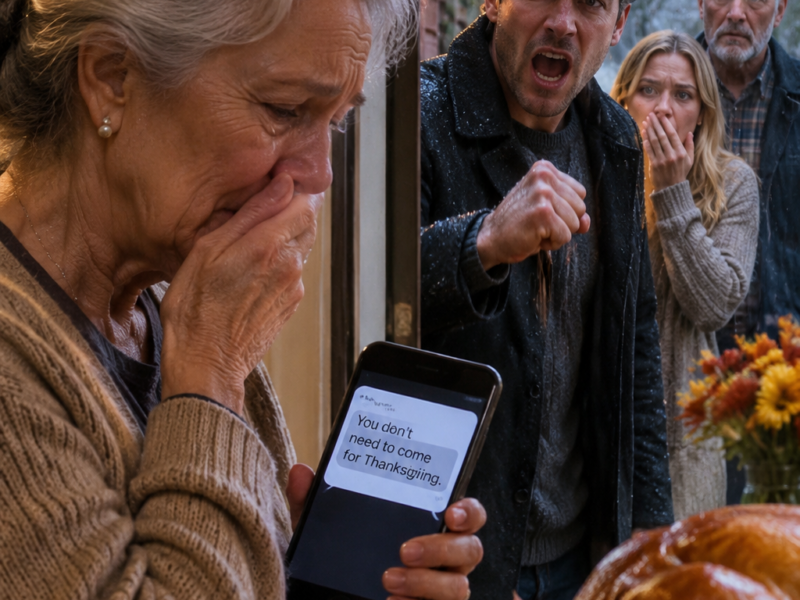
My DIL Said “You Don’t Need to Come for Thanksgiving”—The Next Morning, He Pounded…
My DIL Said “You Don’t Need to Come for Thanksgiving”—The Next Morning, He Pounded…
At sixty-eight years old, I had finally learned that the people who hurt you most are not always strangers. Sometimes, they are the very people you spent your entire life protecting. I discovered that truth on Thanksgiving Eve, when my daughter-in-law sent me a message telling me I was too old to be seen at the dinner I had just paid $4,500 to organize. She thought she was humiliating an elderly woman who would quietly accept the insult. She had no idea that the woman she was dismissing had spent thirty-five years managing multimillion-dollar supply chains, negotiating contracts, identifying financial fraud, and shutting down businesses that failed to honor their agreements. And she certainly had no idea that by the following morning, her carefully constructed world of luxury would begin collapsing around her.
My name is Barbara. I am sixty-eight years old, a widow, a retired corporate supply chain manager, and, until recently, a mother who believed that no matter how old her children became, they would always understand the meaning of family.
I spent thirty-five years working for a major national retailer, overseeing complicated logistics operations across several states. My responsibilities included negotiating vendor agreements, monitoring transportation costs, managing distribution networks, and identifying financial irregularities before they became expensive disasters. I had dealt with dishonest suppliers, demanding executives, delayed shipments, and contractual disputes involving millions of dollars.
I knew how to recognize a bad deal.
Unfortunately, I had never imagined that one day I would have to apply those same skills to my own family.
My only son, David, was forty-two. He worked as a manager at a corporate firm and had always been unusually concerned about appearances. Even as a teenager, he cared about wearing the right clothes, driving a respectable car, and being accepted by people he considered important.
After his first marriage ended in a difficult divorce, I did everything I could to help him rebuild his life. His son, Sam, was sixteen, and I wanted to make sure the boy never suffered because of the mistakes made by the adults around him.
I had lost my husband several years earlier, and helping David and Sam gave me a sense of purpose during the loneliness of retirement.
Five years ago, when David was struggling to find somewhere suitable to live after his divorce, I purchased a beautiful four-bedroom suburban house on Willow Creek Drive. I paid for it entirely in cash. There was no mortgage, no outstanding loan, and no financial obligation attached to the property.
The house had a spacious kitchen, a comfortable living room, a small garden, and a large backyard where Sam could spend time with his friends.
I put the deed entirely in my name, but I allowed David and Sam to move in.
I never asked them to pay rent.
My intention was simple. I wanted my grandson to have stability, a good school district, and a permanent place he could call home.
When David married Khloe two years later, she moved into the house as well.
Khloe was thirty-five, attractive, fashionable, and extremely conscious of her social position. She enjoyed expensive restaurants, designer handbags, exclusive fitness clubs, and gatherings with people who had impressive job titles.
At first, I tried to build a relationship with her.
I invited her to lunch, remembered her birthday, bought her thoughtful gifts, and made an effort to include her in family celebrations.
But I gradually noticed that she treated me differently depending on whether she needed something.
When she wanted financial assistance, she called me Barbara in a sweet, affectionate voice and insisted that I was the most generous woman she had ever known.
When she did not need anything, I became an inconvenient reminder that her comfortable lifestyle depended on someone else’s money.
David rarely challenged her behavior.
He usually remained silent whenever Khloe made a disrespectful remark, later explaining that she was stressed, that I should not take things personally, or that marriage required compromise.
I accepted those explanations for far too long.
Then came Thanksgiving.
Three weeks before the holiday, David called me and explained that he was organizing a very important dinner at the Willow Creek house.
He said his boss would be attending, along with several wealthy real estate investors from out of state. According to him, the gathering could determine whether he received a major promotion.
He sounded anxious.
He explained that his salary had been affected by corporate restructuring and that he could not afford the kind of dinner his wife wanted to organize.
He asked whether I could help.
I initially suggested something modest. A traditional turkey dinner, some homemade desserts, a few bottles of wine, and enough food for the guests.
Khloe apparently had a different vision.
She wanted an elaborate VIP experience.
There would be imported cheeses, premium wines, truffle appetizers, professionally prepared roasted meats, and four private servers. She also wanted expensive modern furniture rented for the occasion because, according to her, their existing dining room furniture looked outdated.
The guest list eventually reached fifty people.
The final catering invoice from Sterling Events and Catering came to $4,500.
I thought the amount was excessive, but David repeatedly assured me that this dinner could change his career.
So I agreed to sponsor it.
There was one important detail, however.
I did not simply give David my credit card.
I registered the catering account in my own name, signed the master service agreement, and paid the entire amount through my personal account.
I understood contracts. I knew exactly what I was agreeing to.
The caterers would prepare the food, arrange the delivery, provide the staff, and coordinate the event according to the instructions of the primary account holder.
That account holder was me.
I did not mind paying for a beautiful Thanksgiving celebration. I was happy to help my son.
What I expected in return was something much more valuable than money.
I expected to be included.
During the weeks leading up to the event, I even baked a traditional pumpkin pie from scratch. I wanted to bring something homemade to the table, something that reminded everyone of the Thanksgiving dinners my late husband and I used to organize.
On Wednesday evening, I sat at my dining room table reviewing the final catering invoice.
The house was quiet. A cup of chamomile tea sat beside my laptop, and the grandfather clock in the living room had just struck nine.
My phone vibrated.
It was a message from Khloe.
I opened it, expecting another question about the delivery schedule.
Instead, I read something that made me stop breathing for a moment.
“Hey, Barbara. David and I were just talking, and we realized tomorrow is going to be incredibly fast-paced and focused on business. You don’t need to come for Thanksgiving. It’s a VIP networking event now. Honestly, an older woman sitting around would just ruin the modern aesthetic we’re going for with the investors. Have a nice frozen turkey at home. We’ll catch up by Christmas.”
I read the message twice.
Then I read it again.
She was telling me not to attend a Thanksgiving dinner that I had paid for.
She was using my age as a reason to exclude me from my own family’s celebration.
And she had delivered the insult casually, as if she were changing the seating arrangements at a restaurant.
For several minutes, I simply stared at the screen.
I thought about my late husband. I thought about the sacrifices we had made while raising David. I remembered the years when I worked long shifts, missed family gatherings, and saved every possible dollar because I wanted our son to have opportunities we had never enjoyed.
I thought about the $4,500 I had willingly spent because I believed I was helping him succeed.
Apparently, my presence was embarrassing, but my money was perfectly acceptable.
I picked up the phone and typed a short reply.
“Fine, then pay for your own dinner.”
I pressed send.
Less than a minute later, another message appeared.
Khloe had replied with a laughing emoji.
“Too late, Barbara. The food is already paid for and scheduled for morning delivery. The caterers are arriving at 7 a.m. sharp. Thanks for sponsoring the event, though. Sleep well.”
I looked at that laughing emoji for a long time.
She was confident that she had already won.
In her mind, the money was gone, the food was guaranteed, and she could enjoy her expensive dinner without having to tolerate the presence of the elderly woman who had financed it.
She had forgotten one important detail.
I was still the primary account holder.
I opened the Sterling Events vendor portal and located the master service agreement.
After several minutes of reading, I found the cancellation provision.
Because the event was less than twenty-four hours away, I would lose the deposit and potentially be charged for perishable ingredients already prepared.
I understood that.
I also understood that the catering company had employees who had done nothing wrong. They deserved to be paid for the work they had already completed.
I had no intention of making innocent workers suffer because my daughter-in-law had behaved disgracefully.
I located the after-hours emergency number and called.
A tired woman answered.
“Sterling Events, this is Maria. How can I help you?”
I introduced myself and provided the invoice number.
She quickly located my account.
“Yes, Mrs. Barbara. The VIP Thanksgiving package for fifty guests. Is there a problem with the delivery instructions?”
“There is no problem with the address,” I replied. “I am calling to cancel the entire order.”
The woman went silent.
“Ma’am, are you certain? The delivery is scheduled for seven tomorrow morning. Our preparation teams have already started working.”
“I understand. I accept the cancellation penalties. I want all food and services stopped. Nothing is to be delivered to that address.”
Maria explained the financial consequences once more.
I confirmed that I understood.
She then informed me that the food already prepared would be donated to a local shelter rather than wasted.
“That’s perfectly acceptable,” I told her. “Please make sure the drivers receive the cancellation notice.”
Within minutes, the order was officially canceled.
I received written confirmation by email.
I saved the document and closed my laptop.
Then I went into the kitchen, covered my pumpkin pie, and placed it in the refrigerator.
I was going to enjoy it myself.
For the first time in years, I went to bed without worrying about what Khloe might think of me the following morning.
I slept peacefully.
At seven o’clock on Thanksgiving morning, I was already awake.
I made coffee and stood beside the kitchen window, looking at the frost covering the branches of the oak tree in my front yard.
I imagined the scene unfolding at Willow Creek Drive.
Khloe would probably be standing near the entrance in an expensive outfit, waiting to supervise the catering staff.
David would be checking his phone, preparing to welcome his boss and the investors.
Then the trucks would arrive.
The drivers would check their delivery manifests, see the cancellation notice, and leave without unloading anything.
I did not have to wait long to learn what happened.
At approximately 7:20, a silver sedan came racing into my driveway.
David practically threw himself out of the driver’s seat.
He was wearing a heavy coat over a wrinkled shirt. His hair was disheveled, his face red, and his expression furious.
Before he even reached the front steps, he began pounding on my door.
“Mom! Open the door! Right now!”
I placed my coffee mug on the kitchen counter and walked calmly toward the entrance.
I unlocked the main door but kept the metal screen door locked between us.
David was breathing heavily.
“What did you do?” he demanded.
“Good morning, David.”
“Don’t good morning me! What did you do to the catering order?”
“I did exactly what your wife suggested. I stayed home.”
His face tightened.
“The trucks came this morning! Two vans from Sterling Events! Khloe went outside to tell them where to unload, and the driver showed her a cancellation notice. He said the order had been canceled by the account holder. They just turned around and left!”
I looked at him calmly.
“That sounds unfortunate.”
“Unfortunate?” he shouted. “Mom, I have fifty VIP guests arriving at two this afternoon! My boss is coming! Three major investors are coming! We don’t have anything! We don’t even have a turkey!”
I took a moment before answering.
“You should probably get to the grocery store before they sell out of the frozen birds.”
David stared at me.
For most of his life, I had been the person who fixed his problems.
If he forgot something important, I helped him.
If he overspent, I covered the difference.
If he needed money, I found a way to provide it.
He had become accustomed to believing that my help was permanent.
“You need to call them back,” he ordered.
“Excuse me?”
“Call Sterling Events. Tell them there was a mistake. Tell them your card was stolen or something. I don’t care what you say. Just get those trucks back!”
“No.”
One word.
That was all I said.
He grabbed the screen door and shook it.
“What do you mean, no? You promised to sponsor this dinner!”
“I agreed to sponsor a family Thanksgiving dinner. I did not agree to finance a business networking event after being told I was too old to attend.”
“Khloe was stressed! She didn’t mean it!”
I looked directly at him.
“She told me that my age would ruin her modern aesthetic. She told me to eat a frozen turkey. Then she laughed because she thought I had no way to stop the delivery. Which part of that was a misunderstanding?”
David looked away.
For a moment, I thought he might finally admit that what his wife had done was wrong.
Instead, he began defending her.
“These investors are young, Mom. They’re very particular about appearances. Khloe just wanted everything to look perfect. She was trying to help me land an important opportunity.”
“So you agreed that your mother was too embarrassing to sit at the table?”
He did not answer immediately.
That silence told me everything.
“Mom, please,” he finally said. “My promotion is riding on this. If those people arrive and find an empty house, my career could be over. You’re ruining everything.”
I felt a strange sadness.
He was still blaming me.
Not once had he asked whether I was hurt.
Not once had he apologized for allowing his wife to insult me.
He was concerned only about the consequences of losing the money.
“David, you ruined this yourself,” I told him. “You allowed your wife to treat your mother like an unwanted bank account. You accepted my generosity while agreeing that I should disappear when important people arrived.”
His anger returned.
“You’re doing this to punish me!”
“I’m withdrawing my money and my patience. Those are two different things.”
He stared at me, waiting for the familiar moment when I would soften.
It never came.
Finally, his voice dropped.
“What am I supposed to do? They’re coming at two.”
I looked at my son and delivered the sentence I knew he would remember.
“If I am not welcome at your table, my money is not welcome either. You have until two o’clock to figure out how to feed fifty people. Handle it.”
Then I closed the door.
I heard him curse outside.
A moment later, his footsteps retreated down the walkway.
I returned to my kitchen, picked up my coffee, and looked through the window as his car disappeared around the corner.
I knew the confrontation was not over.
People who believe they are entitled to your resources rarely accept losing access without searching for another way to get them.
So I opened my laptop again.
I needed to examine every financial connection between David, Khloe, and me.
The first thing I reviewed was the property deed for the house on Willow Creek Drive.
The house was entirely mine.
I had purchased it five years earlier, paid the taxes, covered the insurance, handled the maintenance, and financed every major repair.
David and Khloe lived there without paying rent.
They had no ownership interest.
I looked at the document for several minutes.
Then I remembered something my grandson had told me a few weeks earlier.
Two years before, David had come to me claiming that his financial situation was deteriorating. He said he had suffered a thirty-percent salary reduction during corporate restructuring and was struggling to cover basic household expenses.
I had believed him.
I had paid the property taxes, homeowners association fees, and insurance because I wanted him to use his remaining income to take care of Sam.
When the air-conditioning system failed, I paid $8,000 for a replacement.
When the roof needed repairs, I paid the contractor.
I had never questioned those expenses because I thought my son was genuinely struggling.
But I had also asked him to provide copies of his tax returns when I co-signed an automobile loan.
Those documents were still stored in my home office safe.
I went upstairs, opened the safe, and removed the files.
Under the warm light of my brass desk lamp, I placed David’s tax returns side by side.
I began reviewing the numbers.
The first year he claimed to have lost thirty percent of his salary, his adjusted gross income had actually increased.
His base salary had risen.
He had also received a substantial performance bonus.
I examined the following year’s documents.
His income had increased again.
Over the three years during which I had been paying his property expenses, his annual earnings had nearly doubled.
I removed my glasses, cleaned them, and looked again.
The figures had not changed.
David had not been drowning financially.
He had been earning more money than ever before.
He had simply discovered that if he convinced his widowed mother he was struggling, he could preserve his own income for the lifestyle he and Khloe wanted.
I felt something inside me break.
For years, I had blamed Khloe for his selfishness.
I had told myself that my son was simply weak, that he was being manipulated by a woman obsessed with wealth and status.
But the tax returns told another story.
David was not an innocent victim.
He was an active participant.
I sat quietly for several minutes before turning my attention to another account.
Two years earlier, David had asked me to help protect Sam’s education.
He claimed he was struggling with tuition payments and feared that his son would have to leave the private preparatory school he had attended since kindergarten.
I had opened a high-limit rewards credit card specifically for that purpose.
I added David as an authorized user.
We had a clear agreement: the card could only be used for Sam’s tuition, school supplies, uniforms, and essential extracurricular activities.
I paid the balance automatically every month.
Because I trusted my son, I rarely examined the itemized statements.
Now I downloaded the previous twenty-four months of transactions.
I searched for the name of Sam’s school.
Zero results appeared.
I tried again.
Nothing.
My heart began beating faster.
I filtered the transactions by merchant and category.
Then I started recognizing the charges.
Oakwood Valley Country Club.
Designer boutiques.
Luxury day spas.
Cosmetic subscription services.
Expensive restaurants.
Thousands of dollars had been spent on things that had absolutely nothing to do with Sam’s education.
Not a single payment had gone to his preparatory school through the card I had specifically created for that purpose.
I did not know from those statements whether his tuition had been paid through another source. But I knew that the account intended to protect his future had been used to finance Khloe’s luxury lifestyle.
The betrayal was no longer just about me.
It involved a sixteen-year-old boy whose father had used his education as an excuse to obtain money.
I printed the statements and highlighted the most significant transactions.
Then I placed them inside a manila envelope.
I also printed David’s tax returns.
There would be no emotional arguments without evidence.
The following morning was Black Friday.
While thousands of people were rushing through shopping malls, I dressed in a charcoal wool blazer, a white silk blouse, and polished black shoes.
I placed my documents inside a leather tote bag and drove to my bank.
My branch manager, Arthur, had known me for more than twenty years.
He stood when I entered his office.
After I declined his offer of coffee, I explained that I needed an immediate review of my financial accounts.
First, I asked him to freeze the rewards credit card and permanently remove David as an authorized user.
Arthur asked whether the card had been stolen.
I explained that the activity had violated the personal agreement under which I had issued it.
He understood.
Next, I instructed him to close the accounts through which David had previously enjoyed limited access to my emergency savings.
I wanted every dollar transferred into accounts under my exclusive ownership.
I requested new account numbers, stronger identity verification, and dual-factor authentication tied directly to my personal phone.
I reviewed every document before signing.
I did not rush.
I read the terms, checked the authorization details, and verified that no one else retained access.
By the time I left the bank, the financial arrangements that had supported David and Khloe’s lifestyle were gone.
I sat in my car for a few minutes, holding the steering wheel.
It was strange how quiet everything felt.
I had spent years believing that protecting my family meant making sure they never experienced financial hardship.
Now I understood that protecting myself sometimes meant refusing to finance someone else’s irresponsibility.
But there was still one major vulnerability.
The house.
And I knew exactly why Khloe wanted it.
I drove directly to the offices of my real estate attorney, Charles Arrington.
Charles had handled the purchase of Willow Creek Drive and had helped me update my estate documents after my husband died.
I placed the original property deed on his desk, followed by the tax receipts, insurance records, and repair invoices.
“I need to reclaim possession of my property,” I told him.
Charles studied the documents.
He asked whether David and Khloe had ever signed a lease or paid rent.
“No,” I answered. “They have lived there through my permission. I purchased the house and have paid every expense.”
He explained that they were tenants at will under the applicable legal rules in our jurisdiction. I could terminate their permission to remain, but I needed to follow the proper procedure.
I then explained what Sam had told me.
My grandson had overheard Khloe discussing her plans with a friend named Rachel.
Khloe wanted to launch a high-end boutique consulting firm.
She had been speaking with investors who required substantial collateral before considering a commercial loan.
The house on Willow Creek Drive was the perfect asset because it was fully paid off.
But David and Khloe did not own it.
According to Sam, Khloe had devised a way around that problem.
She intended to bring me a large stack of Medicare supplemental insurance forms and secretly place a durable power of attorney document among them.
She believed I would become overwhelmed by the medical terminology and small print.
She had even joked that I was old, half blind, and would sign anything placed in front of me.
Charles became visibly concerned.
He explained that a durable financial power of attorney could grant someone extensive authority to act on another person’s behalf, depending on its wording and applicable law.
If I signed the document without understanding it, David could potentially use that authority to attempt to mortgage or otherwise encumber my property.
Even if the arrangement were later challenged, the resulting legal complications could be expensive and difficult to resolve.
I listened carefully.
Then I told Charles that simply refusing to sign the document was not enough.
I wanted David and Khloe removed from the property.
He prepared a formal thirty-day notice to quit and surrender possession.
The document identified me as the sole owner and named David and Khloe as the occupants whose permission to remain was being terminated.
It gave them thirty days to remove themselves and their belongings.
If they refused, Charles would begin the appropriate legal proceedings.
He warned me not to change the locks or remove their belongings without following the legal process.
I agreed.
I had no intention of allowing my anger to create another problem.
Before leaving, I asked Charles to prepare the paperwork carefully and make sure the delivery could be documented.
I placed the notice inside my bag.
My next move required patience.
I needed David and Khloe to bring the fraudulent document to my house.
I wanted to see exactly what they intended to make me sign.
Over the weekend, I received several calls from unknown numbers.
I ignored them.
On Monday morning, I sat at my dining room table and thought about the next step.
I picked up my phone and called David.
When he answered, I deliberately changed my voice.
“Hello, David. I am just tired.”
He sounded cautious.
“Mom, are you okay?”
“I haven’t been sleeping well. I’ve been trying to understand some medical paperwork, but the small print is becoming difficult. Everything is so confusing.”
I heard a brief whisper on his end.
Khloe was apparently listening.
David’s tone immediately became softer.
“Mom, you shouldn’t have to deal with all that alone. Khloe is very good with administrative things. We can help you.”
I pretended to hesitate.
“Didn’t Khloe mention something about updating my Medicare supplemental insurance?”
“Yes!” he answered quickly. “She has all the paperwork ready. It’s a big stack, but she’s already highlighted the places you need to sign.”
“That would be wonderful,” I replied. “Could you both come over sometime this week?”
He offered to visit immediately.
I told him I was too tired and suggested Friday afternoon at two.
He agreed enthusiastically.
“We’ll take care of everything, Mom. Just rest.”
I ended the call.
Then I sat up straight and returned to my normal posture.
The performance was over.
They believed I was confused.
They believed I was ready to sign.
And they had no idea that three sealed envelopes were waiting in my home office.
The first contained the evidence of the money they had stolen from Sam’s education account.
The second contained David’s tax returns and the bank’s confirmation that his financial access had been terminated.
The third contained their formal thirty-day notice to vacate my property.
Friday arrived.
At precisely two o’clock, the doorbell rang.
I was sitting in my living room wearing a simple beige cardigan and a comfortable blouse.
The gold pen rested on my glass coffee table.
I had deliberately arranged the furniture so that I could see the entrance and observe everyone who entered.
When I opened the door, David and Khloe greeted me with enormous smiles.
“Hi, Mom!”
David stepped forward and hugged me.
His embrace felt stiff and unnatural.
Khloe followed.
“Barbara, it’s so wonderful to see you. We’ve been so worried about you.”
I thanked them and invited them inside.
They sat together on the sofa opposite my armchair.
Khloe wore an expensive cashmere coat and a silk scarf. Her designer handbag rested beside her.
She looked exactly like the wealthy socialite she wanted everyone to believe she was.
For several minutes, they performed the role of a loving family.
Khloe apologized for Thanksgiving.
She said she had been stressed, that the message had been poorly worded, and that she had never intended to hurt my feelings.
David nodded along.
“We just want to put everything behind us, Mom.”
I gave them a small smile.
“Of course. Holidays can be stressful.”
Khloe looked relieved.
Then she reached into her handbag.
She removed a thick stack of documents secured with a black binder clip and placed them on the coffee table.
“I brought all the new Medicare supplemental options,” she explained. “The insurance companies make everything so complicated. David and I reviewed the different plans, and we found one that should save you money.”
She began discussing deductibles, prescription coverage, specialist referrals, and annual payment limits.
Her voice moved quickly.
She wanted to overwhelm me with information.
David joined in.
“You don’t need to worry about reading all that, Mom. Khloe highlighted the important places.”
Khloe removed the binder clip and turned several pages.
Then she pointed to a yellow highlighted signature line.
“If you sign here and initial at the bottom, we can send everything to the insurance broker today.”
I reached for my reading glasses.
I unfolded them slowly and placed them on my face.
David shifted impatiently.
Khloe smiled.
I picked up the gold pen and uncapped it.
The tip hovered above the highlighted line.
For a moment, I could almost feel their anticipation.
They believed they had finally succeeded.
But I did not sign.
Instead, I placed the pen back on the table.
“Is something wrong?” Khloe asked.
“No. I just want to read what I’m signing.”
She gave a small laugh.
“Of course, Barbara. But it’s really just standard paperwork.”
I gently pulled the stack toward myself.
The first page was a legitimate insurance enrollment form.
The second contained ordinary prescription coverage information.
The third included standard medical disclosures and the signature line Khloe had highlighted.
I turned the third page.
Then I reached page four.
The title was printed in bold letters.
DURABLE POWER OF ATTORNEY FOR FINANCES AND REAL ESTATE.
I felt an extraordinary stillness settle over me.
There it was.
The document Sam had warned me about.
I read the opening paragraph aloud.
It appointed David as my lawful attorney-in-fact and granted him authority to act on my behalf in financial and real estate transactions.
I continued reading.
The document specifically authorized him to buy, sell, exchange, mortgage, or otherwise encumber property that I owned.
My house.
My savings.
My financial future.
All of it could potentially be placed under his control if I signed.
I stopped reading.
The room was silent.
David’s breathing became shallow.
Khloe’s smile disappeared.
I slowly removed my glasses and folded them.
Then I looked directly at my daughter-in-law.
“Did you really think that a woman who spent thirty-five years auditing corporate contracts would not read a contract?”
Khloe’s face went pale.
David leaned forward.
“Mom, wait. Let me explain.”
“Explain what?”
“It’s just a safety measure. We were trying to make sure your finances were protected in case you ever became incapacitated.”
I stared at him.
“A document that gives you authority to mortgage my property is a medical safety measure?”
Khloe quickly joined the conversation.
“Barbara, you don’t understand. We were only trying to make things easier for you. These forms are complicated. We thought it would be better if David could help.”
I leaned forward.
“Did you think I would blindly sign a document giving you control over my house?”
Neither answered.
I continued.
“You brought this into my home because you wanted to use my property as collateral for Khloe’s business loan. The investors need an asset you do not own, and you thought you could obtain control over it by hiding this document among my insurance forms.”
David’s mouth fell open.
“How do you know that?”
I did not answer.
I had no intention of exposing Sam as the person who had warned me.
Instead, I reached toward the small wooden table beside my chair and opened the drawer.
I removed the three manila envelopes.
I placed them neatly on the glass coffee table.
David stared at them.
“What’s that?”
“Open the first one.”
His hands were already trembling when he pulled out the documents.
I explained that the papers were the itemized statements for the credit card I had opened two years earlier to protect Sam’s education.
I pointed to the highlighted charges.
“Over twenty-four months, you have not made a single payment to Sam’s preparatory school using this account. Not one.”
David looked down.
The statements showed the country club charges, designer purchases, spa visits, and luxury subscriptions.
“The money I gave you for your son’s education was used to finance your wife’s lifestyle.”
“Mom, please,” he whispered. “Things got tight. I was going to pay it back.”
“You were never going to pay it back.”
I slid the second envelope toward him.
“Open that one.”
Inside were his tax returns.
I pointed to the adjusted gross income figures.
“For three years, you told me your salary had been reduced by thirty percent. You cried in my living room and told me you could not afford the expenses of your own home. I believed you. I paid the taxes, insurance, repairs, and maintenance.”
I tapped the documents.
“Your salary did not decrease. It increased. You received substantial performance bonuses. Your annual income nearly doubled.”
David stared at the figures.
His face was completely drained of color.
“You deliberately lied about your financial situation so I would continue paying your expenses while you used your own salary to fund your lifestyle.”
He began crying.
“Mom, I needed help. The pressure at work was enormous. Khloe wanted us to maintain a certain standard. I made some mistakes.”
I looked at him for a long moment.
“You didn’t make one mistake, David. You made a series of decisions. Every time you asked me for money, you knew what you were doing.”
I pointed to the bank notices inside the second envelope.
“As of this morning, your authorized access to my accounts has been permanently revoked. The credit card is frozen. My emergency savings have been transferred into accounts that only I control.”
Khloe suddenly stood up.
“You cannot do that!”
I looked at her.
“Actually, I can.”
“Our automated payments are connected to that card! Our car lease, the country club, our memberships! Everything will bounce!”
“Then you will have to pay for those things yourselves.”
She began pacing.
“You ruined Thanksgiving! Do you have any idea what happened when those investors arrived? We had fifty people coming to our house, and there was absolutely nothing prepared. We had to order cheap pizzas! David’s boss looked at us like we were complete frauds!”
I remained silent.
Khloe continued, her voice becoming increasingly frantic.
“Those investors were already skeptical. They agreed to another meeting only because David promised them we had a valuable property to use as collateral. We need the Willow Creek house for the loan!”
There it was.
She had admitted everything.
She needed my house to finance her business venture.
She wanted to risk my property to support a company that she had not even launched.
Then she looked directly at me.
“You’re old, Barbara. You don’t need a four-bedroom house. You should let us use it. We’re building a future here!”
I slowly reached for the third envelope.
“Speaking of the house, Khloe, I have something for you.”
I opened it and removed the formal notice prepared by Charles Arrington.
I placed it in front of David.
“This is a thirty-day notice to quit and surrender possession of my property.”
He looked at the first paragraph.
Then he looked at me.
“What?”
“I am the sole legal owner of Willow Creek Drive. I purchased it. I paid for it. I maintained it. You and Khloe have been living there with my permission. That permission has now been terminated.”
David’s hands began shaking.
“Mom, you can’t evict us!”
“I can terminate your permission to occupy my property through the legal process. You have thirty days to leave.”
“Where are we supposed to go?”
“You have a substantial income, David. You can find an affordable apartment.”
Khloe sank onto the sofa.
Without the house, she had no collateral.
Without collateral, her business loan was unlikely to happen.
Without my credit card, her lifestyle was no longer sustainable.
She had walked into my living room expecting to obtain control over a valuable property.
Instead, she was leaving with a financial cutoff and a legal notice.
I stood up.
“You have thirty days. If you refuse to leave by the deadline, my attorney will begin the appropriate legal proceedings.”
David reached toward me.
“Mom, please. I’m your son.”
I looked at his hand but did not take it.
“And I was your mother when you allowed your wife to tell me I was too old to sit at your table.”
He lowered his head.
“Please don’t do this.”
“I have spent years helping you. I gave you a house, paid your expenses, and trusted you with money intended for your son. You repaid that generosity by attempting to take control of everything I owned.”
My voice remained calm.
“I am finished.”
I instructed them to leave.
David gathered the papers from the coffee table. His hands shook so violently that he dropped the fraudulent power of attorney twice.
Khloe clutched her handbag against her chest.
Neither attempted another apology.
They walked toward the front door in silence.
I remained standing in the living room and listened as the door closed behind them.
For the first time in years, my house felt completely peaceful.
The weeks that followed were difficult, but I did not regret my decision.
I spent my mornings reading, tending to my plants, and reviewing my newly secured financial accounts.
The first of December brought a series of automated notifications.
The frozen credit card had been used for several recurring payments.
The first decline came from the leasing company responsible for Khloe’s expensive imported SUV.
Ten minutes later, another notification appeared from Oakwood Valley Country Club.
Then came the fitness memberships, cosmetic subscriptions, designer clothing services, and premium entertainment accounts.
Every payment was declined.
I did not celebrate their embarrassment.
I simply recognized what was happening.
Their lifestyle had depended on a financial arrangement they had mistaken for permanent wealth.
Now that arrangement was gone.
A few days later, Sam called me from his school library.
He wanted to make sure I was doing well.
I asked him how things were going at home.
He hesitated.
“They fight all the time, Grandma.”
“About what?”
“Everything. Dad says Khloe ruined Thanksgiving. Khloe says Dad was too weak to get you to sign the paperwork. They blame each other for the money problems.”
I closed my eyes.
I hated knowing that my grandson had to listen to those arguments.
“How are you holding up?”
“I’m staying in my room most of the time. I just focus on school.”
“Are you safe?”
“Yes, Grandma. I’m okay.”
I told him that if he ever felt threatened or uncomfortable, he could call me immediately.
He knew he had somewhere safe to go.
Meanwhile, the investors conducted their due diligence on the property David had promised as collateral.
Their legal team performed a title search.
The results were straightforward.
The house belonged entirely to Barbara.
David’s name appeared nowhere on the deed.
He had no ownership interest to offer.
The investors discovered that he had attempted to present a property he did not own as security for their proposed loan.
They withdrew from the venture.
According to Sam, David returned home after a disciplinary meeting at work looking completely exhausted.
His boss had personally introduced him to those investors, expecting him to handle the opportunity professionally.
Instead, the investors complained about his misrepresentation.
David was stripped of several important accounts.
The promotion he had been pursuing for years went to a younger colleague.
He was moved into a less important administrative position.
His professional reputation had suffered serious damage.
Khloe’s consulting business never launched.
Without the loan, without the house, and without access to my money, she could no longer maintain the image she had worked so hard to create.
Their marriage began deteriorating.
They argued about every bill.
They fought over groceries, utility deposits, transportation costs, and the expensive possessions they could no longer afford.
The thirty-day notice remained in effect.
I did not change the locks while they occupied the property. I did not remove their belongings. I allowed the legal process to proceed exactly as Charles had explained.
By the middle of December, Sam told me they had begun looking for another place to live.
They could no longer afford a luxury townhouse or a gated community.
They eventually found a small two-bedroom apartment in an older complex on the other side of the city.
Khloe hated it.
There was no private security gate, no elegant lobby, no country club nearby, and no impressive address to mention at social gatherings.
But they had very few alternatives.
As the deadline approached, they packed their belongings into cardboard boxes.
Sam kept me updated.
He told me his father had become quieter, while Khloe remained angry and blamed everyone except herself.
I reminded him that none of this was his fault.
He had not created their financial problems.
He had simply been brave enough to tell the truth.
In the final days of December, the neighborhood security patrol informed me that the moving truck had departed from Willow Creek Drive.
David and Khloe had surrendered possession before the deadline.
No lawsuit was necessary.
No deputy had to remove them.
They had left voluntarily.
I drove to the property the following week.
Walking through the empty rooms was an emotional experience.
I remembered buying the house after my husband died.
I remembered David standing in the kitchen with Sam, promising that he would rebuild his life.
I remembered believing that I was giving my family a foundation.
But the rooms were empty now.
Their furniture was gone. The closets were cleared. The walls showed a few marks where pictures had once hung.
I hired a professional cleaning company and arranged for the property to be staged for sale.
I did not want to keep a house that had become the center of so much deception.
Within a few days, it was listed.
The market was strong, and I received an attractive all-cash offer above the asking price.
I reviewed every document with Charles.
The closing process was completed properly, the title transferred to the new family, and the proceeds were deposited into my protected account.
I had converted the property into something I could use for a better purpose.
For several days, I considered what to do with the money.
I could have added it to my retirement portfolio.
I could have purchased another property.
I could have traveled or simply kept it untouched for the rest of my life.
But every time I considered those options, I thought about Sam.
He was sixteen.
He had spent years watching his father prioritize expensive possessions and social approval over his own responsibilities.
He had also risked his comfort by warning me about the plan to steal my house.
I did not want him to grow up believing that money was something people used to control one another.
I wanted him to understand that financial security could also be an expression of love.
The first week after the winter school break, I drove to Sam’s high school.
The sky was gray, and the temperature had dropped considerably.
I waited in the pickup lane until I saw him walking out of the building.
He spotted my car and smiled.
He climbed into the passenger seat, dropped his backpack onto the floor, and began telling me about his classes.
His grades were good.
He had managed to stay focused despite everything happening at home.
I listened carefully.
After several minutes, I took a different exit from the one that led to his apartment.
He looked out the window.
“Grandma, where are we going?”
“We have a little appointment first.”
“What kind of appointment?”
“Something important.”
He nodded.
I drove downtown to the offices of Arrington and Associates.
Charles was waiting for us.
He greeted Sam respectfully and invited us into his office.
On his desk was a thick legal folder.
Sam looked confused when we sat down.
Charles explained that I had instructed his firm to prepare a special financial arrangement for my grandson.
I had taken the proceeds from the sale of Willow Creek Drive and combined them with a significant portion of my personal retirement savings.
Together, those assets had been placed into an irrevocable educational trust.
The trust was established specifically for Sam.
Its purpose was to protect his future education and provide financial stability when he entered adulthood.
The funds were designated for university tuition, college housing, and a financial foundation for his life after graduation.
Charles explained the arrangement carefully.
He made sure Sam understood that the trust was not a loan.
He did not owe me repayment.
It was not a reward that required him to take sides in a family dispute.
It was a gift intended to protect his future.
I also made sure that David and Khloe had no authority to manage or redirect the trust assets under its terms.
Charles and his firm would administer the arrangement.
Neither of his parents would have access to the money simply because they were his parents.
Sam stared at the document.
He slowly looked up at me.
“Grandma, what is this?”
I took his hand.
“Do you remember the day you called me from the garage?”
He nodded.
I told him that he had done something incredibly brave that afternoon.
He had heard adults discussing a plan that frightened him, and he had chosen to warn someone he loved rather than remain silent.
I reminded him that he was not responsible for the decisions his father and stepmother had made.
He had nothing to feel guilty about.
Then I pointed toward the folder.
“I sold the house on Willow Creek Drive. The money from that sale is now protected for your education and your future.”
His eyes widened.
“All of it?”
“A substantial portion of my assets, yes. I want you to have the opportunity to attend the university you choose. I want you to be able to study, find your own direction, and build a life without worrying that someone else’s financial decisions will destroy your opportunities.”
Sam looked down at the papers again.
His fingers trembled slightly as he touched the page bearing his name.
For several seconds, he did not say anything.
Then his eyes filled with tears.
He tried to wipe them away quickly, probably embarrassed that he was crying in front of an attorney.
But the tears kept coming.
He leaned forward and covered his face with both hands.
I stood up, walked around the desk, and wrapped my arms around him.
He leaned against me and began crying.
Not the quiet tears of a boy who was trying to hide his emotions, but the deep, exhausted sobs of someone who had spent too long worrying about what would happen next.
I held him tightly.
“You’re safe, sweetheart,” I whispered. “Your future is protected. You don’t have to carry this burden anymore.”
He thanked me repeatedly.
I told him that he did not need to thank me for loving him.
Charles gave us a few minutes before explaining the final paperwork.
He invited Sam to sign a simple acknowledgment confirming that the trust’s purpose and terms had been explained to him in language he understood.
The trust itself had already been legally established through the documents I had executed and the assets placed under its terms.
Sam accepted the pen.
His signature was shaky, but he signed carefully.
When everything was finished, we left the office together.
We rode the elevator down to the parking garage and climbed into my car.
I turned on the heater and began driving toward a restaurant where we could have dinner.
The winter evening was settling over the city.
Streetlights flickered on one by one, reflecting against the windows of the buildings.
Sam sat beside me, looking out at the passing traffic with a quiet smile.
I thought about David.
I thought about Khloe.
I knew they were probably sitting in their cramped apartment, arguing about bills and blaming each other for everything that had happened.
I did not feel the same anger I had experienced during those first few weeks.
The anger had gradually disappeared, leaving behind a sadness that I knew would probably remain for the rest of my life.
David was still my son.
No amount of financial protection could change that fact.
But being his mother did not mean I had to surrender my dignity, my property, or my future.
I had spent decades building a life through hard work, careful decisions, and sacrifices that nobody else could fully understand.
I had allowed family love to convince me that protecting someone meant giving them unlimited access to everything I owned.
I had confused generosity with obligation.
I had believed that asking questions about money would make me a bad mother.
Now I understood that refusing to ask those questions had allowed dishonesty to grow.
The house on Willow Creek Drive was gone.
The money had been redirected.
The credit cards were closed.
The fraudulent power of attorney had never been signed.
David and Khloe had lost the financial support they had taken for granted, and Sam had gained something far more valuable than an expensive house.
He had gained a protected future.
I glanced toward the passenger seat.
My grandson was still looking out the window, his expression peaceful.
I realized that I had lost something during those difficult weeks.
I had lost the illusion that my son would always appreciate what I did for him.
That was painful, and I would never pretend otherwise.
But I had also gained something.
I had regained control over my own life.
At sixty-eight, I was no longer willing to allow guilt, family expectations, or emotional manipulation to determine what happened to the resources I had spent thirty-five years building.
I had learned that love without boundaries can become an invitation to exploitation.
I had learned that kindness does not require blindness.
And most importantly, I had learned that sometimes protecting the people you truly love means refusing to protect them from the consequences of their own choices.
I had not destroyed David’s life.
I had stopped financing the version of his life that depended on my sacrifice.
I had not ruined Khloe’s dream.
I had simply refused to mortgage my future to support hers.
And I had not abandoned Sam.
I had finally done what I should have done from the beginning: placed his future somewhere that no one could casually take it away.
As I drove through the winter evening, I thought about the Thanksgiving message that had started everything.
An older woman would ruin the modern aesthetic.
Those words had been intended to make me feel small.
Instead, they had forced me to examine the relationships I had spent years maintaining at my own expense.
I no longer needed an invitation to prove that I belonged somewhere.
I no longer needed to pay for a seat at a table where my presence was unwanted.
And I certainly did not need to spend another dollar proving my worth to people who measured love by what they could take.
My wealth was protected.
My dignity was intact.
My grandson’s education was secure.
And, for the first time in a very long time, my peace belonged entirely to me.
I had lost a son to greed, but I had helped save a grandson from inheriting the same mistakes.
That evening, as we approached the restaurant, Sam turned toward me.
“Grandma?”
“Yes, sweetheart?”
“Thank you for everything.”
I smiled and reached over to squeeze his hand.
“Just promise me one thing.”
“What’s that?”
“Never allow anyone to convince you that your value depends on how much money you have, what car you drive, or how impressive your house looks. Build a life you can be proud of. Treat people honestly. And never mistake someone else’s generosity for something you are entitled to.”
He nodded.
“I promise.”
I pulled into the parking lot and switched off the engine.
For thirty-five years, I had managed supply chains, protected corporate assets, and made sure valuable resources reached the places where they were supposed to go.
Now, I had finally done the same thing with my own life.
I had identified the people who were exploiting my generosity, closed the channels through which they were taking advantage of me, and redirected what remained toward someone who understood its true value.
I was sixty-eight years old.
I was not helpless.
I was not confused.
And I was certainly not finished living.
Sometimes the hardest lesson in life is realizing that the people you love are not always the people you should trust with everything you have.
But another lesson is just as important.
You are never too old to recognize betrayal, establish boundaries, protect your future, and begin again.
And no matter how many years you have spent putting everyone else first, you are still allowed to choose yourself.
THE END









