My Daughter Cried In The Bathroom With A Hidden Tape: “Promise You Won’t Hurt Anyone, Dad”
My Daughter Cried In The Bathroom With A Hidden Tape: “Promise You Won’t Hurt Anyone, Dad”
Turn on the exhaust fan in your bathroom, close the door, and sit on the floor with your back against the bathtub. Listen carefully for a moment. That low, steady rushing sound is one of the strangest noises in a house. It is loud enough to cover almost anything, yet ordinary enough that nobody pays attention to it. It can hide a whisper, conceal the sound of someone crying, and even disguise the small click of a recording device being switched on.
Most adults hear a bathroom fan and think about a hot shower or a little privacy. But for a nine-year-old girl named Lily Winslow, that sound became something much more important. It was the only noise she could trust. It was the only place where she felt safe enough to tell the truth.
And on one particular Sunday evening, while her father was downstairs preparing dinner, Lily sat on the cold bathroom floor with a tiny black recorder in her hand. Her cheeks were wet, her fingers were trembling, and she was preparing to tell the man she loved most something that would change both their lives.
Before she handed him the recorder, however, she made him promise something.
“Promise you won’t hurt anyone, Daddy.”
It was a strange request from a child who had been frightened for weeks. But the reason behind it would eventually reveal just how carefully she had been watching the adults around her.
Her father, Jared Winslow, was a forty-year-old guitar repairman who had spent most of his life learning how to listen.
His workshop occupied a converted feed store on Mill Street in the small Ohio town of Toliver’s Run. The building was old, with wooden floors that creaked under every step, narrow windows that let afternoon sunlight fall across the workbenches, and a faint smell of spruce, cedar, glue, and varnish that seemed to have settled permanently into the walls.
People traveled considerable distances to bring their damaged instruments to Jared. Some arrived with expensive acoustic guitars that had been dropped during performances. Others carried old family instruments that had belonged to fathers or grandfathers. A few brought guitars that had been neglected for decades, hoping Jared could somehow restore the sound they remembered from childhood.
He was good at what he did because he understood that repairing a guitar required more than technical knowledge.
It required patience.
He would hold a cracked wooden top carefully by its edges and tap it with one knuckle near the bridge. Then he would move closer to the rim and tap again. Finally, he would listen near the sound hole.
Every location produced a slightly different note.
After forty years of working with instruments, Jared could recognize the sound of wood that had been dropped, exposed to moisture, or simply left unattended for too long. He could detect damage that another repairman might overlook.
Unfortunately, he had not recognized the damage happening inside his own home.
His daughter, Lily, was nine years old, and until recently, she had been the loudest person in the workshop.
She had a crooked front tooth, bright eyes, and an endless supply of questions. She narrated everything she did, from eating breakfast to feeding the cat. When she sat on an overturned bucket beside Jared’s workbench, she hummed along to whatever guitar he happened to be repairing.
She was never particularly accurate with the melodies. Most of the time, she sang about half a step flat.
Jared loved it.
He used to joke that the workshop had two sounds: the gentle tapping of his knuckles against wooden instruments and Lily’s constant humming.
He often told her he could never decide which sound he would miss more if he ever lost one.
Their family had changed the previous winter when Jared and his wife, Kristen, finalized their divorce.
It had not been an especially dramatic separation. They had not screamed at each other in front of Lily, thrown furniture, or fought through endless legal battles. Their marriage had simply deteriorated over time.
Kristen had gradually stopped laughing at Jared’s jokes. Jared had gradually stopped noticing. Their conversations became shorter, their evenings quieter, and eventually they reached the uncomfortable conclusion that they were no longer making each other happy.
After twelve years together, they separated with surprisingly little conflict.
Their lawyers arranged a parenting schedule that seemed reasonable to everyone involved. Lily would live with Jared during the week because his workshop was close to her elementary school. Kristen worked long hours at a title office in the county seat, so she would have Lily from Friday afternoon until Sunday evening.
Jared remembered signing the agreement at his workbench.
He had used a cork-backed ruler as a makeshift desk and tried to act as though the paperwork meant very little.
“Fair,” he had said.
“Reasonable.”
But after Kristen left, he went into the finishing room and stood alone until the shaking in his hands stopped.
He loved his daughter more than anything, and although he knew she would still have both parents, he could not help feeling that something important had been taken away.
For several months, they found a routine.
Lily attended school during the week, spent afternoons in the workshop, and visited her mother on weekends. Jared cooked dinner, helped with homework, and listened to the stories she invented while sitting beside him.
Then Kristen met Philip Carson.
Philip was forty-seven years old, with silver hair at his temples and a voice so gentle that people often leaned closer when he spoke.
He operated Carson Family Mediation from a restored brick bank on Court Street. The building had once been an actual financial institution, and the old vault door still stood inside the office, permanently propped open and used as a coat closet.
Philip was a respected figure throughout Haskell County.
He served on the County Family Court Advisory Panel, chaired its Ethics Committee, and regularly gave presentations at the public library. Every autumn, he hosted a talk called Keeping the Children First.
He spoke about protecting children during difficult family transitions and helping parents put aside personal disagreements for the sake of their families.
People admired him.
Lawyers knew him. Counselors respected him. Judges trusted his judgment.
When someone in the county had a question about family mediation, Philip Carson was often the person they called.
He had previously been married, although he rarely discussed that part of his life.
Kristen and Philip became engaged within five months and married four months after that in his garden, surrounded by flowers and a string quartet.
Jared met Philip only once before the wedding.
They happened to cross paths in the elementary school parking lot. Philip approached him with a warm smile and shook his hand using both of his own.
“I want you to know I have no intention of replacing anyone,” Philip told him. “Lily is lucky to have a father who works with his hands. We all say we want that for our children, and then nobody actually does.”
Jared appreciated the compliment.
He drove home thinking that Philip seemed like a decent man.
But several days later, he realized something uncomfortable. He had been repeating the conversation to himself because he wanted so badly to believe it.
The first weekend after the wedding, Lily returned home exactly at six o’clock.
Her hair was neatly braided, her backpack rested on both shoulders, and she seemed unusually organized.
She said hello, ate dinner, and asked whether she could go to bed early.
Jared assumed she was tired.
There was a new house, a new routine, and a new man in her mother’s life. It was understandable that she might need time to adjust.
The second weekend, she was quieter.
The third weekend, something happened that Jared could not quite explain. While sitting beside him in the workshop, Lily began humming the opening phrase of a lullaby he had played for her when she was a baby.
Then she stopped abruptly.
It was as though she had suddenly remembered something she was not supposed to do.
Jared looked at her.
She stared at the floor.
He asked whether anything was wrong.
“Nothing.”
He accepted the answer, although he did not like it.
By the end of the second month, he had developed a private habit of counting the changes in his daughter.
She spoke fewer words every Sunday evening.
She took longer to answer simple questions.
On Monday mornings, she began asking him to walk her all the way to her classroom door, something she had not needed since she was six.
Her teacher, a kind but somewhat exhausted woman named Faye Draper, noticed the change too.
One morning in May, she stopped Jared in the hallway.
“Lily is still a good listener,” she said, “but she has stopped raising her hand. She used to participate all the time. Is everything all right at home?”
Jared hesitated.
“She splits her time between two houses now. I think it’s a lot for her.”
Mrs. Draper nodded, but she continued watching him for a moment.
“Of course. Just keep an eye on her. Some children go quiet in one place but not in another. When it’s only happening in one place, that’s usually information.”
The sentence followed Jared throughout the day.
That evening, he tried talking to Lily while she sat beside him at the workbench pretending to read a book.
He asked about her mother.
“Fine.”
He asked about the new house.
“Fine.”
Finally, he asked about Philip.
She turned a page without looking at it.
“Philip says I shouldn’t talk about what happens at their house because it’s private family stuff.”
Jared stopped polishing the guitar.
“Private from whom?”
Lily shrugged.
It was an ordinary movement, but something about it disturbed him.
It did not look like the casual shrug of a nine-year-old who did not know an answer. It looked practiced, almost automatic, like she had learned exactly how to respond when an adult asked a question she was not supposed to answer.
That night, Jared called Kristen.
He remained polite and tried not to sound suspicious.
Kristen told him Lily was adjusting well. Philip was wonderful with her. He had even created a little reading corner and bought Lily a journal and a tiny digital recorder so she could dictate stories.
Apparently, Philip had read that recording stories could help children develop their writing skills.
“Isn’t that sweet?” Kristen asked.
Jared said it was.
After ending the call, he stood alone in the dark workshop, listening to the compressor tick as it cooled.
He wondered whether he was simply becoming a bitter ex-husband.
Perhaps Philip was genuinely trying to be a good stepfather. Perhaps Jared was interpreting ordinary kindness as interference because he had not completely accepted the divorce.
He decided to be fair.
He made himself a sandwich, went upstairs, and went to bed.
For several more weeks, he tried not to think about it.
Then came the Sunday evening in June.
It was unusually warm, and Jared had left the workshop door open. The smell of freshly cut spruce drifted onto Mill Street, and the fading sunlight illuminated the dust floating above the workbench.
Kristen dropped Lily off at six o’clock.
Jared noticed that she did not walk Lily to the door as she usually did. Her car disappeared around the corner before he had even finished saying goodbye.
Lily went upstairs without speaking.
Jared continued sweeping the workshop, then started boiling water for noodles. They were Lily’s favorite, and he thought a familiar dinner might make the evening feel normal again.
He called upstairs.
“Dinner in fifteen minutes!”
No answer.
He listened for the usual sounds from her bedroom: the creaking bed, the little radio she liked, perhaps the sound of a drawer opening.
There was nothing.
Then he noticed another sound.
A steady rushing hum came from the bathroom at the end of the hallway.
The exhaust fan was running.
Jared frowned.
Nobody was taking a shower.
He walked upstairs and knocked.
“Lily?”
The fan continued roaring.
He waited, then opened the door.
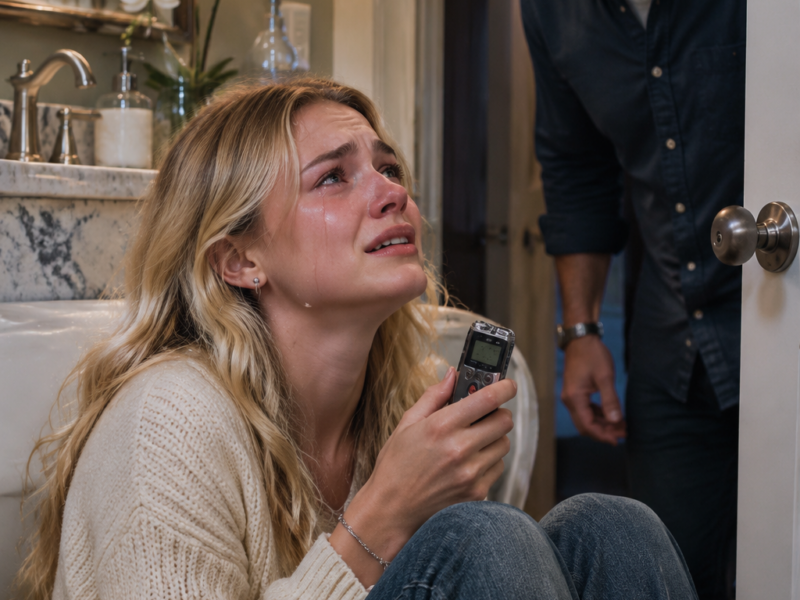
His daughter was sitting on the tiled floor between the bathtub and the toilet. Her knees were pulled tightly against her chest, and her back rested against the cold porcelain.
Her face was wet.
Not the way it looked after a few quick tears, but the way a face looks after someone has been crying silently for a very long time.
In her right hand was a small black digital recorder, barely larger than a pack of gum.
Her fingers gripped it so tightly that her knuckles had turned white.
Jared immediately felt something inside him shift.
“Lily?”
She looked up.
For the first time in weeks, she did not look frightened of him.
She looked exhausted.
She looked like someone who had carried something far too heavy for far too long and had finally reached the person who might help her put it down.
“Daddy,” she whispered.
Her voice was cracked and almost unrecognizable.
“I taped them for you.”
Jared lowered himself onto the bathroom floor.
“Taped who, sweetheart?”
She held out the recorder, then pulled it back toward her chest.
“But you have to promise something first.”
“What is it?”
“You have to promise not to hurt anyone.”
Jared stared at her.
“Promise, Daddy.”
The exhaust fan continued its steady roar.
He looked at her trembling fingers and understood that whatever was on that recorder had frightened her enough to make her worry about what he might do after hearing it.
“I promise,” he said.
He did not know what he was promising.
He would discover that over the next several weeks.
Lily finally placed the recorder in his palm.
It was warm from being held.
Jared found the small triangular playback button and pressed it.
At first, he heard a clock ticking.
Then a chair scraped across the floor.
A man’s voice entered the recording.
It was Philip’s voice.
Calm. Patient. Almost affectionate.
“Again, Lily. From the top.”
Jared stopped breathing.
“Dr. Logan is going to ask what happens when you cry at your dad’s house. What do you tell her?”
A small voice answered.
“Nothing.”
The clock continued ticking.
Then Philip spoke again.
“Chris, she’s tired.”
Kristen’s voice sounded distant.
“Tired is fine. Tired is what the story needs.”
Jared’s fingers tightened around the recorder.
“Now, Lily,” Philip continued, “Daddy puts me in the finishing room and shuts the door. It’s dark, it smells like chemicals, and I can’t get out. Say it.”
Jared felt his entire body go rigid.
The finishing room.
His finishing room.
It was a small space attached to the workshop where he sprayed lacquer onto guitars. It had a steel door, an extractor fan, and a stool. Lily had occasionally sat on that stool while he worked, but he had never locked her inside.
The door was always open.
She had never been trapped there.
“Say it, sweetheart,” Philip repeated.
The recording fell silent.
Twenty seconds passed.
Then thirty.
Jared could hear the faint hum of a refrigerator in the background.
“You don’t have to say it perfectly,” Philip finally explained. “You only have to not say it isn’t true. That’s all. Nobody is asking you to lie. We’re asking you to stay quiet about the part that doesn’t help.”
Kristen spoke again, and this time her voice cracked.
“Philip, she hasn’t said a word to either of us in three weeks. Not a word. Look at her.”
Philip remained calm.
“Then we let the silence work. Think about it. A nine-year-old who won’t speak in front of a court psychologist reads as a traumatized nine-year-old. Dr. Logan will write exactly what we need without Lily saying one sentence.”
He gave a short laugh.
“Honestly, Chris, this might be better than the script.”
Kristen began crying.
It was not a quiet, controlled sound. It was the unmistakable crying of someone who had reached the end of her emotional strength.
Philip softened his voice.
“Hey. Hey. This is for her. We’re in Tampa by Christmas. The firm there is already holding my office. Lily gets a house with a pool and a father figure who isn’t going to raise her in a shop full of varnish fumes and a leaking roof.”
He continued explaining their plan.
The legal motion would be filed on the twelfth.
The evaluation was scheduled for the twenty-seventh.
By the New Year, Jared Winslow would be reduced to supervised visits on Sundays.
Then Kristen asked a question.
“And if somebody finds out?”
Philip laughed.
It was a short, genuinely amused laugh.
“Finds out what? Who sits on the panel that decides what counts as coaching? I do. I wrote Standard Nine myself. It’s a rule for other people’s mistakes.”
The recording continued for several seconds before clicking.
A different room came through the speaker.
Jared immediately recognized the rushing background noise.
It was the bathroom fan.
Then he heard his daughter’s whisper.
“Daddy, it’s me. I’m in your bathroom. This is Sunday. I’m going to say the true part now because I can’t say it in front of them.”
Jared closed his eyes.
“You never put me in the finishing room. I get to sit on the stool, and you let me smell the lacquer. You said not to tell Mom because she’d say it’s bad for me.”
A small, wet breath followed.
“I want to tell the lady, Dr. Logan, but when I try, my voice goes away. It just goes away. Like when you hold your breath under the bathtub water.”
She paused.
“And if I say it loudly, Mom gets in trouble. I don’t want Mom to get in trouble. And I don’t want you to get mad and hurt Philip and then you get in trouble.”
Jared felt tears gathering in his eyes.
“So I’m going to give you this, and you’re going to be careful. Okay? That’s all. Bye.”
The recording stopped.
For a long moment, Jared could not move.
He sat in the doorway of his own bathroom, holding a little black recorder, while the exhaust fan continued roaring above him.
He had spent his entire adult life listening to small differences in sound.
Now he understood that the most important thing he had ever heard was the voice of his own daughter asking him not to become the person someone else expected him to be.
Lily watched his face.
She had been studying him throughout the entire recording, waiting for his reaction.
“Are you mad?” she whispered.
“No.”
The answer came out unevenly.
“No, sweetheart. I’m not mad.”
He opened his arms.
“Come here.”
Lily crawled into his lap.
She was nine years old, but in that moment she seemed much younger. She buried her wet face against his chest, and Jared wrapped one arm around her while keeping the recorder in his other hand.
“I’m proud of you,” he whispered. “I’m so proud of you.”
“I’m sorry.”
“Don’t ever apologize for telling me the truth.”
He held her tighter.
“And I’m going to fix this.”
“But you promised.”
“I know.”
He closed his eyes.
“Even if I want to hurt him, I won’t. Especially if I want to.”
That night, Jared did not call the police or confront Philip.
He made the noodles.
He and Lily ate together on the workshop floor, sitting beside the workbench. He put her to bed afterward and remained beside her until her breathing became slow and steady.
Only then did he go downstairs.
He stood in the darkness, staring at the steel door of the finishing room.
He thought about Philip’s office on Court Street.
He knew exactly how long it would take to drive there.
Nineteen minutes.
But he remembered his daughter’s trembling voice.
Promise, Daddy.
At six the following morning, he called Evelyn Stamper, the only family lawyer in Haskell County he believed might be able to help.
Evelyn was fifty-eight, with iron-gray hair and a reputation for being difficult to intimidate. Her office was located above a hardware store on Main Street. It smelled of old coffee and carpet glue, and the furniture had clearly been purchased with practicality rather than appearance in mind.
She listened to the recording without interrupting.
When it ended, she played it again.
Then she made notes with a fountain pen.
Finally, she leaned back in her chair.
“Ohio is a one-party consent state,” she said. “Lily was a participant in the conversation. The recording is lawful.”
Jared felt a small amount of relief.
But Evelyn immediately continued.
“Now let me explain why that isn’t enough.”
She told him that Philip would almost certainly challenge the recording. He could claim Jared had deliberately placed the recorder in his daughter’s hands. He could argue that Lily had been coached. He could even claim that her whispered explanation at the end sounded rehearsed.
And there was another problem.
The magistrate who would likely hear the argument was Walter Crandall, a man who had played golf with Philip on the first Saturday of every month for nine years.
“Are you telling me we do nothing?” Jared asked.
“I’m telling you we don’t walk into Crandall’s office waving a recording and expecting justice to happen automatically.”
Evelyn tapped her pen against her teeth.
“A recording can tell a judge what happened. It doesn’t necessarily tell him whom to believe. In this county, Philip is the person people believe.”
Jared looked down at his hands.
“My daughter hasn’t spoken in front of her mother for three weeks.”
“I know. I heard.”
Evelyn’s expression softened.
“And there’s something else. The moment you do what you want to do, you give Philip exactly the story he needs. The angry, unstable father. The man who cannot control himself. You must not give him that.”
Jared looked up.
“I promised Lily I wouldn’t hurt anyone.”
For the first time that morning, Evelyn looked at him as though she was seeing something beyond the legal problem.
“Then you’ve already made the hardest decision.”
She asked him to read Standard Nine.
It was a two-page regulation Philip had personally written in 2019 after a counselor in a neighboring county had been caught coaching a child before a custody hearing.
Jared found it online and read it standing in the parking lot outside the hardware store.
The language was straightforward.
No member of the advisory panel could prepare, instruct, rehearse, or coach a minor before a court-ordered evaluation, whether directly or through another person.
If the evaluating professional determined that coaching had occurred, that finding would be conclusive.
The panel member responsible would be permanently barred from the panel, and every recommendation previously issued in a matter involving a minor who had been coached would become void.
Jared read the final paragraph several times.
It stated that any parent affected by a voided recommendation could request that the matter be reopened as a right.
Not as a possibility.
Not as a favor.
As a right.
He immediately called Evelyn.
“Does that apply to earlier cases?”
“Yes,” she answered. “If the necessary finding is made.”
Then she gave him another name.
Vera Baldwin.
Philip’s first wife.
She still lived in the county and operated a small bakery on Cutler Road.
Jared drove there that afternoon.
The bakery stood between a feed supplier and an abandoned video rental store. Its yellow exterior was faded, and flour dust had collected along the window sills.
A handwritten sign announced that the bread usually sold out by noon.
Jared arrived shortly after one.
The woman behind the counter was small and thin, with dark hair tucked beneath a net. Flour marked her forearms and the part in her hair.
She was packing the last two loaves of sourdough.
“We’re closed after the rush,” she said. “Day-olds are in the basket by the door.”
“Mrs. Baldwin? My name is Jared Winslow.”
Her hands stopped moving.
For several seconds, she did not look up.
Then her shoulders lowered.
“Winslow,” she said. “You’re Kristen’s. The guitar man.”
She remembered Philip mentioning him once.
Jared explained that he wanted to buy a loaf of bread.
Vera looked at him carefully.
“Then you’ll be buying it from a woman who is going to ask why you came here.”
She turned the sign to closed and brought him a cup of coffee.
Jared told her about Lily.
He explained that his daughter had become silent after visiting her mother’s new husband. He told her about the upcoming evaluation and the accusations Philip was preparing.
He did not mention the recorder.
That belonged to Lily, and Jared had already decided nobody would hear it without her permission.
When he finished, Vera sat quietly.
“How old is she?”
“Nine.”
Vera stared into her coffee.
“Tyler was twelve.”
Tyler was her son.
She had been married to Philip for thirteen years.
Then she began telling Jared what had happened.
It had started with a recorder.
Philip had once given Tyler a small silver recording device while organizing a school program for children. He had explained that the boy could use it to dictate stories.
Vera had thought it was a wonderful gift.
She had even bought batteries for it.
But Philip had used the recorder as something else entirely.
“He doesn’t hit people,” Vera explained. “I want you to understand that. People look for bruises when they hear a story like mine. They expect violence. They don’t find any, so they decide the mother is exaggerating.”
She shook her head.
“Philip is far too intelligent for that. What he does is talk.”
He talked gently.
He talked patiently.
Sometimes he talked for hours.
He gave children sentences and then gave them reasons to repeat those sentences. The reasons always sounded loving and reasonable.
By the time he finished, the child believed that cooperating was a moral responsibility.
Tyler had eventually come to believe he needed to tell the court that his mother drank excessively and left him alone at night.
Vera had never been a drinker.
But the court psychologist believed Tyler.
The evaluator trusted Philip’s professional judgment, and Philip’s position on the advisory panel gave him enormous influence.
Vera lost primary custody in a hearing that lasted forty minutes.
She received alternate Saturdays.
Then Tyler stopped speaking.
Not just to his mother.
To almost everyone.
For five months, he barely spoke at all, except occasionally to the family dog.
Philip called it a phase.
The school called it grief.
When Tyler was seventeen, he finally approached a caseworker on his own and admitted that the things he had said about his mother were untrue.
The caseworker documented his statement and sent it to the county.
The county forwarded it to the advisory panel.
The panel acknowledged the information and filed it away.
Nothing happened.
Nobody was disciplined.
Nobody reopened the case.
Vera had spent years believing that the truth would eventually matter.
Instead, it had disappeared into a file.
Jared listened carefully.
Then he mentioned Standard Nine.
Vera almost laughed.
“He wrote that rule because he wanted everyone to think he had fixed the problem. He was very good at making himself look like the solution.”
She explained that Philip had assumed nobody would ever challenge him using his own regulation.
Then she mentioned something important.
The evaluator assigned to Lily’s case was Dr. Dorothy Logan.
Philip had sponsored her appointment to the county evaluation list because she was relatively new and he believed she would be grateful for his support.
But Philip had overlooked something.
Years earlier, Dr. Logan had worked as a young clinician in another county. She had been involved in investigating a case involving a boy who had been coached before a custody evaluation.
Her report had been so convincing that several senior officials had reportedly left the room after reading it.
Philip did not know she had written that report.
He had never bothered to read the footnotes.
Before Jared could ask another question, the bakery’s back door opened.
A tall, thin young man entered carrying a duffel bag.
He had Vera’s dark eyes and an unusually careful way of walking, as though he had spent much of his life trying not to attract attention.
His name was Tyler Baldwin.
He was twenty-two and worked as an audio technician at a hospital in Columbus.
When he saw Jared, he stopped.
“Does she have it?” he asked.
Jared looked at him.
“The recorder?”
Tyler understood the silence.
He set his bag down.
“Then there’s something you need to know. Philip checks.”
Every Sunday evening, when Tyler returned from visiting his mother, Philip would inspect his backpack.
He would smile and ask about his day while running his fingers along the seams.
He called it making sure nothing had been lost.
But Tyler knew what he was looking for.
“If a kid has a recorder,” he said, “Philip knows exactly where it is. And he knows the moment it disappears.”
At that instant, Jared’s phone vibrated.
A message from Kristen appeared.
Philip says the recorder he gave Lily is missing. He wants it back tonight. Please check her bag.
Jared read the message twice.
Then he thanked Vera and Tyler and drove home.
He had no time to waste.
On the way, he stopped at a large electronics store on Route 9 and purchased an identical recorder.
It cost fourteen dollars.
Then he visited Evelyn’s office.
Together, they copied Lily’s original recording onto a secure drive. Evelyn sealed the drive inside an envelope, signed across the flap, and placed it in a fireproof safe behind her desk.
The original would remain untouched.
Nobody would erase it.
Nobody would play it without Lily’s permission.
When Jared returned home, he found his daughter sitting on her familiar bucket beside the workbench.
A guitar top was clamped in front of her.
She was staring at it without touching it.
“Philip wants his recorder back,” Jared said.
Lily looked up.
“Mom told me.”
“I know. He’s probably going to check. So I bought a new one.”
He placed the package on the workbench.
“The one you used is safe with Evelyn. Nobody can erase it, and nobody is going to take it away from you.”
Lily looked at the package.
“But it’s empty.”
“That’s the point.”
Jared sat beside her.
“Philip gave you that recorder to dictate stories, right? So we’re going to put a story on this one. An ordinary story. Something so boring he won’t want to listen to the whole thing.”
For the first time in weeks, the corner of Lily’s mouth moved slightly.
It was barely a smile.
But Jared noticed.
He had missed that expression more than he could explain.
He also noticed that she struggled to speak when he looked directly at her.
She opened her mouth several times, then closed it.
Her eyes filled with tears.
So Jared did something simple.
He turned his chair away.
He picked up an old 1968 dreadnought guitar whose owner had accidentally cracked its wooden top by leaving it inside a hot car.
Jared began tapping the instrument.
Near the bridge.
Near the rim.
Then near the sound hole.
He hummed softly.
It was the same habit he had maintained throughout Lily’s childhood.
Behind him, a small sound appeared.
One note.
Half a step flat.
He did not turn around.
He tapped again.
Lily answered.
He changed the note.
She matched it.
They continued for several minutes, communicating through little sounds that did not require words.
Eventually, Lily spoke.
“It sounds sad.”
Jared kept his eyes on the guitar.
“Which part?”
“Here.”
A small finger appeared over his shoulder and pointed toward the sound hole.
“It’s wrong. It’s tired. Like it’s been told something it doesn’t want to know.”
Jared swallowed.
“Yeah,” he said softly. “That’s about right.”
That evening, Lily recorded a story.
It was about a bear who lived inside a guitar and ate only the quiet notes.
The bear became trapped inside the sound hole and needed help from a little girl with a very small hand.
The story lasted six minutes.
It mentioned nothing about Philip, the kitchen, the finishing room, or the secret recording.
Jared sat at the opposite end of the workshop, pretending to clean a tuning peg.
He did not trust his face to hide how much it meant to hear his daughter speaking again.
That same evening, Philip called.
His voice was warm and familiar.
“Jared, I hope I’m not interrupting. I just wanted to say I’m glad the recorder was only left behind. Kristen had a bit of a scare. It was in her bag, apparently. No harm done.”
He explained that he would be passing through the neighborhood the following morning and could collect it.
At ten o’clock the next day, Philip arrived.
He brought two cups of coffee and placed one on the counter in front of Jared.
Then he slowly looked around the workshop.
He admired the instruments, the clamps, the tools, and the half-repaired guitars.
He asked about the steel door.
“Finishing room,” Jared explained.
“Ah, the varnish.”
Philip smiled.
“I’d worry about the fumes if it were my house.”
Then he asked whether Lily ever went inside.
Jared understood immediately that this was not an innocent question.
Philip was looking for a sentence he could use later.
“She sits on the stool beside the open door sometimes,” Jared replied. “She likes the smell. The safety information is taped to the wall if you’d like to read it.”
Philip smiled.
“Oh, I trust you. I just like knowing where a child spends her day.”
Jared handed him the replacement recorder.
Philip turned it over, pressed play, and held the speaker near his ear.
The little bear began speaking in Lily’s careful, slightly sleepy voice.
Jared watched Philip’s expression.
For several seconds, nothing changed.
Then his face relaxed.
It was not relief exactly.
It was disappointment.
“She sounds well,” Philip said.
He put the recorder into his coat.
“Funny. She’s so silent at our place. I suppose children surprise you.”
He finished his coffee and left.
Jared watched his car disappear.
The weekend passed.
Lily returned from her mother’s on Sunday evening, quiet again.
On Monday morning, an emergency motion arrived by courier.
It requested an immediate modification of parenting time and an expedited psychological evaluation.
The document claimed Lily was displaying severe selective mutism consistent with trauma. It also described Jared’s residence as an unsafe environment because his workshop contained hazardous industrial solvents.
The motion requested that Lily be placed with Kristen until the evaluation was completed.
Walter Crandall had signed it.
The evaluation had been moved forward to Thursday at ten o’clock.
Worse, Lily was ordered to spend Wednesday night at her mother’s house so she could arrive at the evaluation rested.
Jared stared at the calendar.
Today was Monday.
He had only two days.
“A full night with her,” he said quietly.
Evelyn understood what he meant.
She did not answer.
Behind them, Lily sat beside the cracked guitar top.
She had been listening.
When she realized the adults were discussing Wednesday night, her body became completely still.
That evening, Jared called his father.
Stan Winslow was seventy-two, a retired machinist who had spent thirty-eight years working at a gear plant outside Marlow.
He had hands like cured leather and a straightforward understanding of injustice.
If something was wrong, he believed you should walk directly toward it and confront it.
Jared explained what had happened.
He told his father about the false accusations, the recording, and Philip’s influence over the county.
He did not mention the promise Lily had made him extract.
Stan listened without interrupting.
Then he walked to his truck and picked up a tire iron.
“I know where the bank is,” he said.
“Dad.”
“You’re telling me this man is trying to take your daughter.”
“Dad, put it down.”
Stan tested the weight of the iron.
Jared stepped between him and the truck.
“She’s nine years old, and she asked me to promise something. She asked me not to hurt anyone. I gave her my word.”
Stan looked at him.
“She’ll never know.”
“I will.”
The old man remained silent.
Then he slowly returned the tire iron to the truck bed.
His eyes had become wet.
“Then tell me what to do with my hands,” he said.
Jared asked him to perform a simple task.
On Thursday morning, Stan would put on his best jacket, drive to the Children’s Annex, buy a coffee from the lobby machine, and sit in the waiting room with a newspaper.
He was not to speak to anyone.
He was simply to watch.
Evelyn had another plan.
On Wednesday morning, she sent a short letter to Dr. Dorothy Logan.
It was not an accusation.
It did not demand a particular conclusion.
It simply identified two people who might possess relevant historical information about the household involved in Lily’s evaluation.
Their names were Vera Baldwin and Tyler Baldwin.
The letter also referenced Standard Nine.
Evelyn explained her reasoning.
“I’m not telling Dr. Logan what to see. A good psychologist hates being told what to see. I’m just showing her where the doors are. She can decide whether to open them.”
Meanwhile, Jared spent Wednesday afternoon with Lily.
He took an old steel tuning fork from his toolbox.
It had belonged to his grandfather and produced a precise A note at 440 cycles per second.
He showed Lily how to strike it gently against her knee and hold the stem against the bone behind her ear.
The vibration traveled through her skull, making the note seem as though it existed inside her head.
“Do you hear that?” Jared asked.
Lily nodded.
“It’s yours. Nobody else needs to hear it.”
She tried again.
“It sounds like humming without having to.”
“Exactly.”
Jared explained that if her voice disappeared during the evaluation, she could use the tuning fork to calm herself.
She did not have to speak.
She did not have to answer questions she was uncomfortable answering.
And nobody was allowed to be angry with her for remaining silent.
He slipped the tuning fork into the inside pocket of her denim jacket.
“Philip checks backpacks,” he said. “I don’t think he checks pockets sewn into the lining.”
Lily looked down.
“Daddy, what if I say something and it makes Mom sad?”
Jared considered his answer carefully.
“Then she’ll be sad. And eventually she’ll be okay. People can get through true things, sweetheart. It’s the other kind that never seems to go away.”
That evening, Kristen arrived to collect Lily.
She looked tired and thinner than Jared remembered.
As Lily walked toward the car with her overnight bag, Jared spoke quietly to Kristen.
“She likes the smell of the lacquer. She sits on the stool beside the open door when I’m working. That’s the whole story of that room.”
Kristen’s hand stopped beside her ear.
“I know,” she whispered.
Jared looked at her.
There was a great deal contained in those two words.
He remembered the recording. He remembered hearing her say that Lily had not spoken in three weeks.
He remembered hearing her cry while Philip continued coaching their daughter.
Whatever happened that evening, Kristen had to understand that Lily was only nine years old.
“She’s a child, Kristen,” Jared said quietly. “Please remember that.”
Kristen looked away.
Then she got into the car and drove off.
Jared barely slept that night.
At eleven o’clock, his phone received a message from an unfamiliar number.
It was Tyler.
He explained that he and his mother would be at the Children’s Annex the following morning. Dr. Logan’s office had contacted them that afternoon.
Jared read the message twice.
For the first time in two days, he felt he could breathe.
Thursday morning arrived.
At nine o’clock, Jared stood across the street from the Haskell County Children’s Annex.
It was a low brown building with carefully maintained grass and a playground that seemed almost unused.
Stan was already inside, sitting in a corner chair with his newspaper raised in front of his face.
Vera and Tyler arrived shortly afterward.
Vera carried a small handbag, and Tyler wore a wrinkled blue shirt.
Then a silver sedan entered the parking lot.
Philip stepped out wearing a perfectly fitted gray suit.
He walked around to open the rear door for Lily.
She climbed out wearing her denim jacket.
Philip crouched in front of her and spoke softly.
Jared could not hear the words.
But he could see his daughter’s face.
It changed gradually.
Her expression became blank, her shoulders tightened, and her eyes dropped toward the ground.
It was the same expression she had worn after returning from her mother’s house for weeks.
Inside the building, the waiting room had been designed to make children comfortable.
There were colorful rugs, low bookshelves, picture books, and a large window looking into Dr. Logan’s intake office.
Dr. Logan used that window to observe how children behaved when entering the building.
She believed a child’s arrival could reveal things that an ordinary interview might never uncover.
Jared entered through the side door and sat beside his father.
Stan kept his newspaper raised.
“Gray suit,” he murmured. “He’s been talking to her since the parking lot.”
Jared nodded.
Two seats away, Vera sat beside Tyler.
Neither spoke.
Then the doors opened.
Philip entered with Lily by the hand.
Kristen followed a few steps behind, looking pale and nervous.
Philip approached the reception desk and signed the guest book.
“Philip Carson,” he announced pleasantly. “I’m the stepfather and a member of the advisory panel. I’m just escorting the family. Dr. Logan knows me well.”
The receptionist wrote down his name.
Philip guided Lily toward a bench beneath the picture books.
He sat beside her and leaned closer.
“Remember, sweetheart,” he whispered.
His voice was gentle, but loud enough for the people nearby to hear.
“When Dr. Logan asks about the finishing room, you don’t have to say anything. Just nod. Let your head do it. Can you do that for Mommy?”
Lily stared at the rug.
Her fingers moved toward the small snap inside her jacket.
Philip continued.
“Nod once for yes.”
At that moment, the door to the intake office opened.
Dr. Dorothy Logan stepped into the waiting room.
She was fifty-three, tall and angular, with a long gray braid falling over one shoulder. She wore a simple cardigan and held a clipboard against her chest.
She approached the bench.
“Mr. Carson.”
Philip stood immediately.
“Dorothy. I hope I’m not early.”
“You’re a member of the advisory panel.”
“Of course. I thought my presence might comfort her. Her father has been—”
“Then you know I can’t have you in this building this morning.”
Philip’s smile remained in place.
Dr. Logan continued in an ordinary conversational tone.
“Standard Nine prohibits a panel member from instructing or preparing a minor before an evaluation. That includes the waiting room. It includes the car.”
Philip looked surprised.
“I’m not preparing anyone. I’m her stepfather. I’m not even a party to the case.”
Dr. Logan looked directly at him.
“As of thirty seconds ago, you’re a witness.”
She turned toward the opposite side of the waiting room.
“Mrs. Baldwin. Mr. Baldwin. Thank you for coming. I’d like to speak with you both after the child.”
The color drained from Philip’s face.
For the first time, he seemed unable to find an appropriate response.
“Vera?”
Vera did not answer.
She had waited ten years to hear that man say her name again, and she had no intention of making it easier for him.
Then Tyler lifted his head.
He looked directly at his former stepfather.
“Philip.”
It was a single word.
His voice was rough and quiet, but steady.
He did not stand.
He did not shout.
He simply looked at the man who had once controlled so much of his childhood.
Philip looked away first.
Dr. Logan crouched in front of Lily.
“Hello, sweetheart. My name is Dorothy. I’m going to spend some time with you this morning, but you don’t have to talk about anything unless you want to.”
She pointed toward the office.
“There are crayons inside. Would you like to come with me?”
Lily slid off the bench.
She did not look at Philip.
She did not look at Kristen.
She simply followed Dr. Logan into the office.
The door closed behind them.
What happened inside was never fully known to anyone except Lily and the psychologist.
But afterward, details emerged through Dr. Logan’s report and the conversations that followed.
For the first twenty minutes, the psychologist did not ask Lily a single question.
She sat on the floor and drew a horse.
She allowed the silence to exist without trying to fill it.
Lily remained seated with her hands in her lap.
Eventually, she reached into her jacket and removed the tuning fork.
She tapped it against her knee and held it behind her ear.
“That’s an A,” Dr. Logan observed. “Four hundred and forty cycles. Where did you get it?”
“My dad’s grandpa.”
“It makes the humming not have to come from me,” Lily explained.
Dr. Logan smiled gently.
“That’s a very good trick.”
Another long silence followed.
Then Lily began speaking.
“My voice goes away at their house. I don’t know why. It just goes.”
She looked down at the crayons.
“It came back because my dad tapped a guitar.”
Dr. Logan did not interrupt.
Lily took a breath.
“I have to tell you the true part. But I have a tape, and it isn’t mine to play unless I say. And I’m saying.”
She looked toward the door.
“Can somebody get my dad?”
Dr. Logan later admitted that she had never done something like that during her twenty-six years of professional work.
She opened the office door and asked Jared to come inside.
She did so because Lily had requested him.
Jared crossed the waiting room.
He did not look at Philip.
He did not need to.
Lily was sitting beside the low table when he entered.
Dr. Logan asked whether she wanted to show them the recording.
Lily nodded.
Jared placed the small black recorder on the table.
Then Evelyn arrived with the sealed envelope containing the backup copy.
The two women exchanged a brief look of professional understanding.
Lily picked up the original recorder herself and placed it in Dr. Logan’s hand.
Jared sat in a chair near the corner.
The psychologist pressed play.
The clock began ticking.
The refrigerator hummed.
Philip’s voice entered the room.
Again, Lily. From the top.
Dr. Logan listened without moving.
She heard the false story about the finishing room.
She heard Philip instructing Lily to repeat it.
She heard Kristen expressing concern.
She heard Philip explain how the child’s silence could be interpreted as trauma.
And finally, she heard the sentence that changed everything.
“I wrote Standard Nine myself. It’s a rule for other people’s mistakes.”
Dr. Logan stopped writing.
She pressed pause and sat silently for several seconds.
Then she picked up her pen again.
From her bag, she removed a printed certification form.
She wrote four lines and signed her name.
Lily looked at the paper.
“What’s that?”
“It’s a certification, sweetheart. It says that I find someone prepared you for this evaluation.”
Dr. Logan turned toward Jared.
“Standard Nine says that an evaluator’s finding is conclusive.”
She paused.
“Mr. Carson wrote that word himself. He insisted on it. He specifically said that panel members should not be allowed to protect one another.”
Her expression hardened.
“He said a rule that could be argued with wasn’t a rule.”
The certification was entered into the advisory panel’s file shortly after noon.
From that moment, events moved quickly.
Standard Nine did exactly what Philip had designed it to do.
The evaluator had made the required finding.
Philip Carson was permanently barred from the advisory panel.
Every recommendation he had issued involving a coached minor was now subject to being voided.
He had handled more than eight hundred divorce mediations in the county.
The consequences were enormous.
Evelyn spent the following week answering calls from people who had never previously considered challenging the decisions made in their family court cases.
Vera Baldwin’s case was reopened through a simple motion.
Walter Crandall, who had signed the emergency order against Jared, read Dr. Logan’s certification at his desk with his tie loosened.
By two o’clock that afternoon, he had recused himself from every case involving Philip Carson.
A magistrate from a neighboring county vacated the emergency order that had required Lily to stay with her mother.
The relocation motion was withdrawn.
The law firm in Tampa that had been preparing to offer Philip a new office learned about the situation through a state association bulletin.
It held the position for another week out of courtesy.
Then it sent him a short letter.
Three sentences.
The professional reputation Philip had spent years constructing was collapsing.
Yet nobody struck him.
Nobody threatened him.
Nobody came to his house with a weapon.
The man who had manipulated children, misused his professional authority, and attempted to destroy a father’s relationship with his daughter was defeated by the very regulation he had written to demonstrate his own superiority.
Two pages.
One signature.
And one word he had insisted upon.
Conclusive.
Jared later heard that Philip spent much of a gray Tuesday afternoon sitting inside his car outside the old brick bank on Court Street.
The vault door remained propped open behind him.
Nobody entered.
Nobody came to hurt him.
And that was exactly how Jared wanted it.
He had promised his daughter.
He intended to keep that promise.
But the legal victory did not immediately repair everything.
Kristen did not return to the workshop that week.
She did not call.
The following Friday, she left Philip with two suitcases and a cardboard box containing Lily’s winter coats.
She moved into her sister’s house in Marlow.
The next Saturday, she stood outside Jared’s workshop for nearly fifteen minutes before finally knocking.
When he opened the door, she looked different.
She seemed older, thinner, and emotionally exhausted.
“Evelyn played the recording for me,” she said.
Jared stepped aside.
Kristen entered the workshop.
She looked around at the instruments and the familiar workbenches.
Then she lowered her head.
“My part,” she whispered.
She pressed the heel of her hand against one eye.
“I heard myself saying that Lily hadn’t spoken in three weeks. And then I heard myself saying nothing else.”
Her voice broke.
“I stood in that kitchen, Jared. I heard him telling our daughter what to say to a stranger, and I did nothing.”
She looked up.
“You can hate me. I would understand.”
Jared had imagined this conversation many times.
He had thought about the anger he would express, the accusations he would make, and the questions he would demand answers to.
But when Kristen finally stood in front of him, he could not remember a single word of the speech he had prepared.
“I don’t hate you,” he said.
Then he paused.
“I tried. But I can’t make it stick.”
Kristen began crying.
Jared continued.
“I’m not going to tell you it was okay. It wasn’t. You let someone put words into our daughter’s mouth, and you stood there.”
He looked toward the staircase.
“But Lily needs you. If you want to repair this, you’ll have to become someone she can trust again. And that won’t happen in one afternoon. It might not happen in a year.”
“What do I do?”
Jared looked toward the finishing room.
“Come here on Saturdays. Sit on the stool by the door. Keep the door open. If Lily lets you.”
He paused.
“And you have to ask her. You have to be able to accept it if she says no.”
Kristen nodded.
Three days later, she signed an agreed parenting order.
The arrangement restored equal parenting time under the original schedule. There would be no relocation.
Kristen herself requested supervised exchanges at first.
Evelyn later told Jared she had rarely seen a mother voluntarily request additional supervision of her own conduct.
But Kristen understood that trust could not simply be demanded.
It had to be earned.
Meanwhile, Vera Baldwin finally received something she had waited ten years to see.
Her custody case was reopened.
Tyler was twenty-two, so the practical implications of the order were limited. Nevertheless, the county clerk entered a formal finding that the original recommendation had violated Standard Nine and was therefore void.
Vera received a copy of the document on a Saturday in July.
She stood inside her bakery holding the paper in her flour-covered hands.
For a long time, she said nothing.
Then she turned the sign to closed.
Tyler sat beside her at the steel preparation table.
He lowered his head onto his mother’s shoulder.
They remained that way for several minutes.
Three days later, Tyler visited Jared’s workshop carrying several cables and a small speaker.
He offered to install a hearing loop throughout the building.
It was part of his work at the hospital, and he knew exactly what equipment would help people who struggled to hear.
He refused payment.
“The place is too quiet for someone who makes guitars,” he joked.
Jared laughed.
That autumn, business at the workshop increased considerably.
People who had read about the case in the county bulletin began bringing their old instruments to him.
Some wanted repairs.
Others simply wanted to meet the man who had managed to protect his daughter without resorting to violence.
But Jared rarely discussed the details.
He had no interest in becoming a local hero.
He was more concerned with restoring something that mattered much more than his reputation.
His daughter was beginning to find her voice again.
The real change came slowly.
At first, Lily hummed more often.
Then she began asking questions.
She started telling stories while Jared worked, although sometimes she would stop halfway through a sentence and look at him as if checking whether it was safe to continue.
He never rushed her.
He never demanded explanations.
He simply kept listening.
Kristen began visiting the workshop on Saturdays.
At first, she sat several feet away from Lily, careful not to interrupt.
Sometimes Lily ignored her completely.
Sometimes she answered a question with a single word.
Kristen accepted it.
She learned to sit quietly.
She learned not to ask Lily to reassure her that everything was forgiven.
And slowly, the distance between them began to shrink.
By October, Lily was ten years old.
One afternoon, she sat on her familiar bucket beside the workbench, watching Jared repair the old 1968 dreadnought that had been damaged months earlier.
He had replaced the broken brace, repaired the cracked top, and carefully restored the instrument’s structure.
Now he was preparing to string it.
He closed the final clamp and waited for the glue to settle.
Then he lifted the guitar and tapped the spruce near the sound hole.
The sound was clear.
Round.
Open.
It was the sound of wood that had been repaired properly, not merely covered up.
Jared listened carefully.
Behind him, Lily began humming.
She was still half a step flat.
She always had been.
And Jared smiled.
He had once believed the greatest skill a repairman could possess was the ability to hear damage before anyone else noticed it.
But that afternoon, he understood something different.
Sometimes the most important thing was not hearing the crack.
It was recognizing the sound of something beginning to heal.
Lily still kept the old tuning fork in the inside pocket of her denim jacket.
She said she had not needed it since that summer.
But she liked knowing it was there.
Jared never asked her to throw it away.
He understood why she wanted to keep it.
It reminded her that when her voice disappeared, she had not disappeared with it.
It reminded her that silence did not mean she had nothing to say.
And most importantly, it reminded her that she had once found the courage to tell the truth when every adult around her had made that truth feel dangerous.
There was another lesson Jared carried with him.
He had spent weeks interpreting Lily’s silence as a mood, an adjustment, or a temporary reaction to the divorce.
Her teacher had noticed the difference before he did.
A child who becomes quiet in only one place is telling the adults something.
The question is whether anyone is willing to listen.
Kristen’s silence had been different.
She had heard Philip manipulating their daughter.
She had recognized that something was wrong.
But she had remained quiet because confronting him would have meant challenging the life she had chosen.
That silence had consequences too.
And Jared knew that forgiving her did not mean pretending nothing had happened.
It meant allowing her the opportunity to become a better mother while protecting Lily from having to carry the burden of making that happen.
As for Philip, his downfall had been entirely different from the violent confrontation Jared once imagined.
There had been no shouting match in the street.
No broken windows.
No tire iron.
No physical revenge.
Jared had come close to losing control, and his father had been ready to do something he might never have been able to undo.
But a little girl sitting on a bathroom floor had asked for something much harder than revenge.
She had asked her father to remain the person she believed he was.
And he had done it.
He allowed the evidence to speak.
He trusted the process, even when the process seemed controlled by the very people who had wronged him.
He found the people who had suffered before his daughter and gave them an opportunity to be heard.
And eventually, the man who believed himself untouchable was brought down by the standards he had written himself.
The most important moment, however, had happened long before any judge signed an order.
It happened in a bathroom on a warm Sunday evening.
A nine-year-old girl sat beneath the sound of an exhaust fan, holding a recorder with trembling fingers.
She had been told what to say.
She had been told what not to say.
She had been made to believe that telling the truth could hurt her mother and make her father do something terrible.
Yet she found a way to speak.
Not loudly.
Not confidently.
Not in the way adults expected children to speak when they were asked to explain something frightening.
She spoke in a whisper.
And that whisper was enough.
Sometimes we spend so much time listening to the people who speak confidently that we forget to notice the ones who have stopped speaking altogether.
A quiet child can look obedient.
A silent child can appear well-adjusted.
A child who no longer asks questions may seem mature beyond her years.
But sometimes that silence is not peace.
Sometimes it is fear.
Sometimes it is a decision made by someone too young to understand why the adults around her have become unsafe.
And sometimes, as Lily’s story reminds us, the most courageous person in a room is the smallest one.
Jared never forgot the promise he made that night.
He had promised not to hurt anyone.
Keeping that promise did not mean allowing Philip to escape responsibility. It meant refusing to let Philip decide what kind of man Jared would become.
The difference mattered.
Because Lily had not simply needed her father to defeat the man who was frightening her.
She needed him to remain someone she could run toward without being afraid.
And in the end, that was exactly what he did.
Years later, people in Toliver’s Run would still remember the story of the guitar repairman, the respected family mediator, and the recording that exposed a carefully constructed lie.
But Jared remembered something much smaller.
He remembered the little black recorder resting in his palm.
He remembered Lily asking whether he was angry.
He remembered her trembling fingers and the sound of the bathroom fan.
And he remembered the first note she hummed in the workshop after weeks of silence.
It was only one note.
Half a step flat.
But to Jared Winslow, it was the most beautiful sound in the world.
THE END









