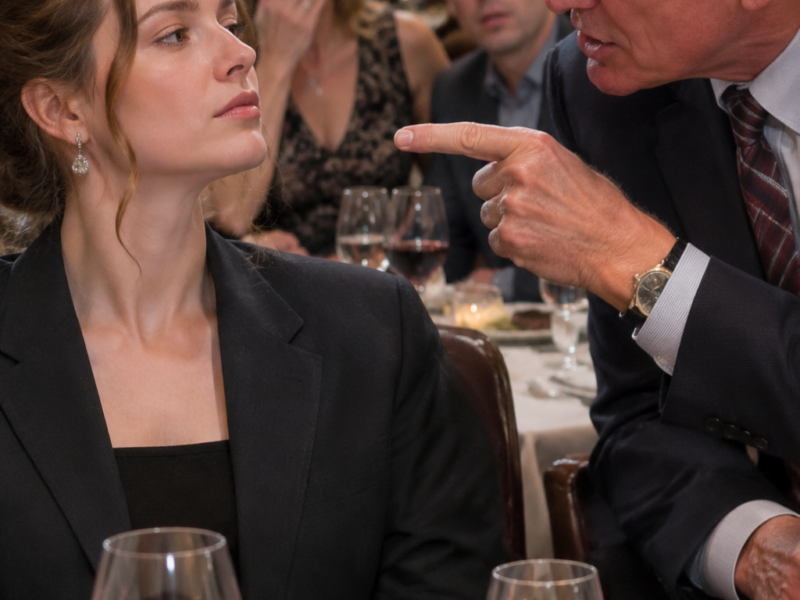
My Dad Told Me To Get “Real Work” Over Steak — By Monday Morning, He Was The One Asking Me Questions
My Dad Told Me To Get “Real Work” Over Steak — By Monday Morning, He Was The One Asking Me Questions
My father slid a job application across the white tablecloth as casually as if he were passing me the salt. The paper stopped beside my plate, its edges perfectly aligned with the silverware, and for a moment, I simply stared at it. At the top was the familiar blue flame that had represented Townsend Heating and Air for nearly four decades. My father had drawn that little flame on a napkin in 1988, back when the company was nothing more than a used service truck, a borrowed toolbox, and a dream he was determined to make real.
I knew every curve of that logo. I had watched him paint it on the first truck when I was a little girl. I remembered sitting on the garage floor while he worked, watching blue paint collect beneath his fingernails. I remembered how proud he had been when the first customer called and asked for Townsend Heating by name.
But now that same logo sat above a line that read, “Position Desired.”
And beneath it, in my father’s unmistakable blocky handwriting, was one word.
Receptionist.
“Your brother needs someone at the front desk,” Dad said, cutting into his steak. “His receptionist quit in August. It’s time you found some real work.”
Across the table, my brother Kyle laughed into his bourbon.
My mother reached over and patted my hand. She gave me the same sympathetic smile she had used since I was a teenager whenever my father said something that hurt but that she didn’t know how to challenge.
I was thirty-four years old.
I owned a mechanical contracting company, employed eleven people, signed payroll every Friday, and had spent the previous four years building a business from the ground up.
And my father had just offered me a receptionist position at a company I was about to purchase.
What he didn’t know was that by Monday morning, the company he believed belonged to his son would belong to me.
What he also didn’t know was that my brother’s phone, lying face down beside his steak knife, contained an email that could destroy everything he had spent years pretending was successful.
And when Kyle finally turned that phone over, he would discover that the person buying Townsend Heating and Air was not some distant corporation from another state.
It was me.
But before that Friday evening, before the application and the steak and the terrible things said around a family dinner table, there had been a very different kind of work waiting for me on a school rooftop in Kettering, Ohio.
Four hours earlier, I had been kneeling beside a dismantled compressor with cold wind cutting through my jacket. The elementary school building stood beneath a gray November sky, and the last of the afternoon light was disappearing behind the rooftops across the street.
Louise held a flashlight while I finished brazing the final joint.
He had worked with me for three years, and by then he knew better than to interrupt me when I was checking a system.
“Pressure’s holding,” he said, looking at the gauges.
“Give it another minute.”
“It’s been holding for two.”
“Pressure always holds until you start trusting it.”
He smiled and moved the flashlight slightly.
My old blue and red gauges sat on the roof beside us. My father had given them to me when I was fifteen, although he had never imagined I would eventually use them to build a career. Back then, he had thought they were simply something to keep me occupied while my brother learned the business.
The needles trembled slightly in the wind before settling into place.
Three hundred children would return to that building on Monday morning. The heating system would be running, the classrooms would be warm, and nobody would have to think about the woman who had spent her Friday afternoon repairing it.
That was the nature of the work.
When it was done properly, nobody noticed.
My phone vibrated inside my chest pocket.
Mom.
I pulled off one glove with my teeth and answered.
“Hi, Mom.”
“Honey, are you outside? You sound like you’re standing in a wind tunnel.”
“I’m on a roof.”
“Well, come down from there. Your father wants to take you to dinner tonight. The Iron Gate. Seven o’clock.”
I looked at the gauges.
“What’s the occasion?”
There was a pause.
“He wants to talk about your future.”
She said it in a tone that made the words sound less like an invitation and more like a medical diagnosis.
“Okay.”
“And wear something nice. Your brother and Brooke will be there.”
“All right.”
“And Audrey, are you eating properly? Your father worries about you living over that shop.”
“I’m eating, Mom.”
She sighed.
“Seven o’clock. Don’t be late.”
Then she hung up before I could ask what exactly my father wanted to discuss.
Louise was suddenly very interested in the compressor’s data plate.
“Your future?” he said.
“Apparently.”
“Sounds serious.”
“Everything sounds serious when my mother says it like that.”
He switched off the flashlight.
“Are you telling them Monday?”
I looked down at the gauges. The needles had stopped shaking.
“After it closes. Not one minute before.”
Louise nodded.
He knew enough about my family to understand why I wanted it that way.
“Then tonight,” he said, picking up the flashlight, “you just eat the steak.”
I laughed, although I had no idea how accurate his prediction would turn out to be.
By five o’clock, I was back at my shop on the east side of Dayton.
Kestrel Mechanical occupied a modest commercial building with four service bays and a small office upstairs where I lived. Four white vans sat inside, each with a blue falcon painted on the doors. The company was only four years old, but it had grown faster than I had ever expected.
Eleven people were on the payroll. We handled commercial heating, air conditioning, rooftop systems, emergency repairs, and maintenance contracts throughout the Miami Valley.
Every Friday, I signed the checks myself.
Not one employee had ever received a late paycheck.
I had built that record carefully, sometimes painfully, because I knew what it meant to depend on someone else’s promise that the money would arrive.
My phone rang while I was removing my jacket.
Denise Hollins, my banker.
I answered and dropped into my office chair.
“Tell me you’ve got good news.”
“I’ve got paperwork news,” she replied. “Which is usually better.”
I smiled.
“Go ahead.”
“Your equity wire cleared this morning. The proceeds from the house sale are exactly where they need to be.”
I glanced toward the window.
The house had been sold in April. It was a modest two-bedroom place with a maple tree in the yard and a small kitchen where I used to eat dinner after twelve-hour shifts. It had been the first property I had ever owned. Every payment had come from my own work, every repair from my own hands.
Selling it had hurt more than I admitted.
But it was worth almost exactly ten percent of the money I needed to purchase Townsend Heating and Air.
Denise continued.
“Closing is Monday at ten. Marcy Fields’ office in Marlow. The seller signs, you sign, I release the funds, and the landlord signs the new lease at the table. Ten-year term. No lease, no loan.”
“He’ll sign.”
“Does he know who the new tenant is?”
I looked at the contractor’s license hanging on my office wall.
It was in a slightly crooked frame, and I had straightened it so many times that I had almost stopped noticing it.
“Not yet.”
“Does he need to?”
“He will on Monday.”
Denise was quiet.
“Audrey, I’m your banker, not your therapist, but Monday will go a lot better if nobody at that table is surprised.”
“Nobody’s ever surprised by me, Denise. That’s sort of the problem.”
She sighed.
“Just make sure you know what you’re walking into.”
After we hung up, I stood and straightened the frame.
Then I went upstairs, took my only decent blazer from its hanger, and prepared to have dinner with my family.
The Iron Gate Steakhouse sat on Route 41 in Marlow, Ohio. The carpet had not changed since I was baptized, and the booths were upholstered in dark red leather that had begun cracking around the edges.
I arrived at seven fifteen.
My father had already ordered for everyone.
“We got you the chicken,” he said, half rising from his chair.
“You always liked the chicken.”
I hadn’t eaten the chicken there since I was twelve, but I thanked him and sat down.
Mom kissed my cheek. Brooke, Kyle’s wife, offered me a small smile. It was the kind of smile people give someone they aren’t sure how to approach.
Kyle didn’t look up.
His phone lay face down beside his bread plate. Every few seconds, he touched the edge of it, as though checking that it was still there.
Dad raised his glass.
His wedding ring tapped against the side, producing the familiar little sound that always came before one of his speeches.
“To Kyle,” he said. “Six new trucks this year. That’s a business.”
Everyone raised their glasses.
Kyle smiled down at the tablecloth.
I took a sip of water.
“So, Audrey,” Mom said, turning toward me. “How’s your little apartment?”
“It’s fine. It’s above the shop. I can walk to work in my socks.”
“Above a shop?” Dad repeated.
He made the words sound like I had told him I was living above a bar.
“Yes.”
“What happened to the house?”
“I sold it.”
Brooke lowered her eyes toward her salad.
Dad stopped cutting his steak.
“Nobody sells a house on purpose, Audrey.”
“Some people do.”
“People who don’t have to?”
I looked at him.
“I wanted to.”
He shook his head.
“Your mother lost sleep over that house.”
“I didn’t lose sleep,” Mom said quietly. “I just worried.”
“Same thing in this family,” Dad replied.
Kyle laughed.
I didn’t.
The waiter brought my brother a porterhouse steak that was nearly the size of a hubcap. Dad watched him cut into it with the same pride a man might feel watching his son sign his first major contract.
Then Dad reached inside his jacket.
He pulled out a folded sheet of paper, smoothed it against the tablecloth, and slid it toward me.
The blue flame stared up at me.
Townsend Heating and Air.
Employment Application.
Position Desired: Receptionist.
“Your brother needs someone at the front desk,” Dad said. “His last girl quit in August. It’s time you found real work.”
The waiter chose that moment to refill my water.
I thanked him.
“It’s a good job, honey,” Mom added, patting my hand. “Benefits. You’d be in and out of the cold.”
“I have work, Dad.”
“You have a van.”
He said it gently, which somehow made it worse.
“You drive around fixing other people’s furnaces. That’s a job, Audrey. It isn’t a life.”
Across the table, Kyle laughed through his nose.
“She’d be great on the phones. She never talks.”
Brooke kicked him beneath the table.
I knew because the water glasses shook.
I looked down at the application.
There was a space for my name, my address, and my previous employer. A long empty line waited beneath the last heading.
I was thirty-four years old, and my father had brought me a form asking who I used to work for.
For a moment, I considered telling him everything.
I could have told him about the commercial contracts I had won, the school systems that trusted my company, the four vans in my shop, and the eleven employees who depended on me.
I could have told him that the company he was celebrating had been struggling for months.
I could have told him that I had already spent six weeks examining its books.
Instead, I folded the application in half, then in half again, and slipped it into the inside pocket of my blazer.
“I’ll think about it,” I said.
Dad nodded, satisfied.
He thought he had won.
That was when Kyle’s phone lit up.
It was still face down, but the glow escaped around its edges. The vibration moved it almost two inches across the table until it bumped against his steak knife.
He turned it over without thinking.
I was sitting directly across from him.
The subject line was written in capital letters.
FINAL CLOSING PACKAGE — TOWNSEND HEATING AND AIR ASSET SALE.
Monday, 10:00 a.m.
Kyle began scrolling.
Purchase agreement.
Bill of sale.
Assignment of contracts.
Then his thumb stopped.
I knew exactly which page he had reached.
The bank required a personal guarantee from anyone owning twenty percent or more of the purchasing company.
Kestrel Mechanical was entirely mine.
The document displayed my full name.
Personal Guarantee of Audrey M. Townsend.
Kyle looked at me.
Then at his phone.
Then back at me.
The color drained from his face.
“Something wrong, son?” Dad asked, still working on his steak.
Kyle flipped the phone face down so quickly that it clacked against the table.
“Just a supplier.”
I looked at him.
A supplier.
On Monday morning, my brother was scheduled to sell the company our father had built with his own hands.
And our father was sitting eighteen inches away, eating a ribeye, completely unaware.
Suddenly, I understood why Dad had arranged this dinner.
He believed Townsend Heating and Air was the most successful thing our family had ever produced. He believed Kyle was continuing the legacy, expanding the business, and proving that he had made the right choice when he handed his son the company.
He had brought me there to offer me a receptionist position at a business he believed would remain under his family’s control forever.
He had no idea that its future was already written into a purchase agreement bearing my signature.
Kyle pushed his chair back.
“Audrey. Outside. Now.”
His steak knife remained crossed over his napkin.
The parking lot was cold enough that our breath hung visibly between us.
Above the restaurant entrance, the neon sign buzzed. The K in Steak House had burned out years earlier, and nobody in Marlow had ever bothered to repair it.
Kyle didn’t waste time.
“Kestrel is you?”
“Since the letter of intent.”
“You went behind my back.”
“I went through your broker. You told Phil Grady you didn’t want to meet buyers. You told him to get you a number. He got you a number.”
He ran both hands through his hair.
“How did you even know it was for sale?”
“The listing said residential heating and air, Miami Valley, established 1988, fourteen employees.”
I looked at him.
“Kyle, I can do math.”
I didn’t tell him about the supply house in Dayton that had placed Townsend Heating on cash-only terms in July.
I didn’t tell him about the man behind the counter who had mentioned it because he thought I might want to know.
I didn’t tell him that I had sat in my van for nearly an hour after hearing the news, staring at the steering wheel and wondering how a company that had once paid for our family vacations had reached that point.
“You can’t run Dad’s company,” Kyle said. “It’s my name too.”
“Then you should have thought about that before you put it up for sale.”
His expression hardened.
“Dad doesn’t know.”
“I know.”
“If you say one word to him in there, I’ll tell him you stole it. I’ll tell him you took advantage of me when I was having a rough year.”
“A rough year?”
He looked away.
“Back out, Audrey.”
“The purchase agreement is signed. Closing is Monday. Every one of your people keeps their job.”
“My people?” He laughed.
But it came out wrong.
The restaurant door opened behind us, spilling warm air and piano music across the asphalt.
“What’s going on out here?” Dad asked.
Kyle turned around with a smile already prepared.
He had been doing that since he was nine years old.
“Just talking, Dad. Brother and sister stuff.”
Dad looked at me, then Kyle, then me again.
“Your brother has a family to feed,” he said.
He didn’t ask what we were discussing.
He didn’t ask why Kyle looked frightened.
He simply assumed that I was somehow creating trouble.
“Whatever money problems you’ve gotten yourself into with that house, don’t drag him into them.”
I could have told him everything.
I could have explained how much money was involved, how the company was struggling, and how I had spent weeks arranging a deal that would protect the employees.
But I had signed a confidentiality agreement.
And there was something older than that agreement.
For most of my life, I had fixed things quietly and left before anybody needed to thank me.
Explaining myself to my father had always felt like begging.
“I’m not in money trouble, Dad,” I said.
“Good.”
He nodded.
“Then you’ll think about the job.”
I drove back to Dayton with the heater roaring and the vents smelling like hot dust.
At a red light on Wayne Avenue, I took the application from my blazer and tucked it into the sun visor.
I didn’t know why.
Maybe I simply didn’t want it touching me anymore.
My phone lit up on the passenger seat.
Kyle.
Don’t come Monday.
I typed a reply.
I’ll be there at ten.
Then I deleted it.
I sat through a green light until a truck behind me honked.
I typed the message again.
This time, I sent it.
At six fifty Saturday morning, my phone rang while I was standing in my kitchen in wool socks, waiting for the coffee maker to finish.
Ray Kowalski.
I hadn’t heard his voice in three years.
“Morning, kid.”
A crack sounded through the phone.
Ray had eaten sunflower seeds during nearly every conversation since 1991.
“You up?”
“I’m up. What’s wrong?”
“Your brother called a shop meeting. Eight o’clock this morning. Whole crew.”
I put my coffee mug down.
“He never calls Saturday meetings.”
“Exactly. He phoned me last night after ten. Said the company’s being sold to some outfit from Dayton. Commercial guys. Said they’re going to cut half of us by Christmas.”
“Did he say that?”
“Sure did.”
Another crack.
“He called it Kestrel something. Like the bird. You live in Dayton, don’t you? Know anything about a Kestrel?”
I closed my eyes.
Ray had taught me how to read a heat exchanger when I was fifteen. He had let me crawl under houses in January when my father insisted that attics and crawl spaces were no place for girls.
He had never asked me to become anything other than useful.
And until Monday at ten, I wasn’t allowed to tell him what was happening to his own job.
“Ray,” I said carefully, “go to the meeting.”
“That’s not an answer.”
“I know.”
“Then what is it?”
“I’ll be there.”
There was a long silence.
“Well,” he finally said, “that’s something, I guess.”
I arrived at the shop on Harmon Street at 8:04.
The overhead door of Bay Two was open, and the smell hit me immediately.
Cutting oil, wet cardboard, burnt coffee.
Nothing had changed.
Thirteen men and one woman stood in a loose half circle beneath the fluorescent lights. Kyle was in the middle holding a clipboard he wasn’t reading.
“I’m not going to lie to you,” he was saying. “These Dayton guys do commercial work. Rooftops. Schools. They don’t know residential. They’re going to look at the numbers and start cutting.”
Then he saw me.
Every head turned.
“Well,” Kyle said, spreading his arms, “there she is.”
He looked like a man introducing an unpleasant surprise at a birthday party.
“Everybody, this is my sister. She bought you.”
Nobody spoke.
The old sign was painted on the brick behind him.
Townsend Heating and Air, Established 1988.
The ampersand had been peeling since I was in high school.
Tanner, one of the youngest technicians, stared at me.
“You’re Kestrel?”
“I’m Kestrel.”
I looked around the room.
“Until Monday, I’m limited in what I can say. But I can tell you this. Every one of you has an offer letter. Same pay. Same benefits. It’s written into the purchase agreement. Nobody gets cut.”
Kyle shook his head.
“She’s never run a residential shop in her life.”
“I ran calls out of this bay when I was fifteen.”
“Riding along with Ray isn’t running a business.”
I looked toward the parts counter.
Ray was leaning against it, cracking another sunflower seed.
He didn’t say anything.
Kyle lifted his phone.
“Dad, you need to come down to the shop right now.”
He lived five minutes away.
It took him four.
His pickup came around the corner too quickly and slid across the gravel. He was out of the cab before the engine had stopped shaking.
His keys jingled in his hand as he entered the building.
“What is this? Kyle, what is this?”
Kyle opened his mouth, then closed it.
Dad looked around at the crew, the clipboard, and finally me.
“Somebody tell me what’s going on in my shop.”
“Dad,” Kyle said, “I’m selling the company.”
For a second, my father looked like a man who had stepped off a curb that wasn’t where he expected it to be.
“You’re selling my company?”
“It’s my company. You gave it to me.”
“I gave it to you to keep.”
“I’m selling it Monday.”
Kyle pointed at me.
“To her.”
Dad turned.
I watched him put the pieces together.
The house I had sold.
The apartment above a shop.
The way I had folded the application and put it away without arguing.
All the things he had seen but never understood.
“You,” he said.
“You’re buying it out from under him?”
“Dad, he put it up for sale. I said yes.”
“Out.”
He didn’t shout.
He simply said it to the room.
The crew began leaving. Tanner nearly ran. A few others followed, looking uncomfortable.
Ray was the last to go.
He paused at the overhead door and looked back at me for a long moment.
Then he disappeared into the cold.
Dad’s keys stopped jingling.
“My office. Both of you.”
We followed him.
The office had not changed since he handed Kyle the keys. The oak desk still had a cigarette burn in the corner. The carpet still carried the faint smell of old tobacco, despite my father’s repeated attempts to quit smoking.
A calendar from November 1988 hung on the wall. My mother’s handwriting was visible in one square.
First truck payment.
Dad didn’t sit.
“Why?”
He asked Kyle.
Kyle shrugged.
“The market’s tough. Interest rates. It’s time.”
“It’s time,” Dad repeated. “That’s it?”
“Ask Kyle why he’s selling,” I said. “Ask him the whole reason.”
Dad turned toward me.
“I’m asking you why you’d take your brother’s living away from him.”
“I’m not taking anything. He’s selling it. I’m buying it.”
“Then say no.”
“If I say no, someone else says yes. Probably one of those big companies that buys family shops and gets rid of everyone over fifty.”
“Don’t lecture me about Ray.”
“Then don’t pretend this is about saving the company if you’re not willing to protect the people who built it.”
Dad pointed toward the floor.
“Townsend Heating needs a Townsend running it.”
“It will.”
He didn’t seem to hear me.
“For years I’ve watched you bounce around, crawling through attics for strangers, selling your house. It’s time you found real work.”
I looked at him.
“It’s my name too.”
He stopped.
For a moment, he looked as though he might say something.
Instead, he picked up his keys.
“We’ll see about Monday.”
Then he walked out.
Sunday morning, at nine o’clock, someone knocked on the door of my shop.
Two sharp knocks, followed by the handle rattling.
It was my father.
In four years, he had never once visited my business.
I let him inside.
He walked past the front counter, past my contractor’s license, and past the four white vans with the little falcons painted on their doors.
He didn’t look at any of it.
Instead, he stopped beside the red Craftsman toolbox near my workbench.
“Nice box,” he said.
“They don’t make them like this anymore.”
“No,” I replied. “They don’t.”
He had given me that toolbox for my fifteenth birthday.
I wasn’t sure he remembered.
“When I was nineteen,” he began, “my father gave the farm to my brother Dale. Two hundred acres. Called us both into the kitchen and said Dale gets the land. Glenn will be fine.”
He tapped the toolbox.
“That’s what I got. A used pickup and a set of gauges I bought on credit at Sears.”
I said nothing.
I had never heard this story.
Not once in thirty-four years.
“I swore my son would never hear that sentence,” he continued. “Never. Not from me.”
He finally looked up.
For a moment, I could see the nineteen-year-old boy he had been, standing in a farmhouse kitchen and watching his father hand his future to somebody else.
I understood something then.
But understanding where someone’s pain came from didn’t mean accepting what they did with it.
“What about your daughter?” I asked.
His mouth opened.
Then closed.
His eyes returned to the toolbox.
He never answered.
Instead, he reached into his jacket and pulled out a stapled document.
I recognized it immediately.
The proposed ten-year lease for the Harmon Street building.
He placed it on my desk.
“I own the building,” he said.
“I know.”
“I read this twice last night. Your bank needs my name on it, or there’s no loan.”
He tapped the signature line.
“I won’t sign it.”
I had a pen in my hand. I didn’t remember picking it up.
He gently took it from me and laid it across the document.
“No lease, no loan. You understand how this works. I ran a business for thirty years.”
“I know you did.”
“Then you know how this ends. You call your bank tomorrow morning. You tell them you’re out. Your brother keeps his company.”
He zipped his jacket.
“And the desk job is still available. I talked to Kyle. He’ll take you.”
“Dad.”
“One more thing.”
He stood in the doorway.
“If you go through with this, don’t come to Thanksgiving. Your mother is setting the table for five this year, not six.”
Then he left.
I stood by the window and watched his pickup disappear.
On my desk, the lease remained unsigned.
At eleven, I called Denise.
She answered with a football game roaring in the background and a child shouting about a touchdown.
“Give me one second.”
A door closed.
“Talk.”
“Landlord won’t sign. Building.”
She was quiet.
Then I heard the familiar sound of her thinking.
“The rule is that the lease must run as long as the loan. Ten years at closing. There’s an exception if the location isn’t critical to the business and equal space is available at equal rent.”
I looked across my shop.
Three empty bays.
One of them had been vacant since the previous spring.
“I have three empty bays.”
“Where?”
“Dayton. My facility.”
“You’re suggesting moving Townsend Heating?”
“If I have to.”
“Audrey, think about what you’re saying. You’re moving fourteen employees twenty-five minutes down the road. Some won’t come. Customers in Marlow will watch the trucks leave town. And we’d have to restructure the collateral.”
“What would that involve?”
“Your equipment. Your vans. Your savings.”
“How much of my savings?”
“All of it.”
I looked at the empty bay.
There was a circular oil stain in the middle of the concrete, left by whoever had rented the space before me.
I thought about the brick wall on Harmon Street.
The old lettering.
The peeling ampersand.
The place where I had learned to braze copper.
If I moved the company, I would be buying everything except the place where it had all begun.
“Can you get it approved by Monday morning?”
“I can try. The credit committee owes me one.”
“Then try.”
“You’d be guaranteeing a lot more than a loan.”
“I know.”
That afternoon, I drove back to Marlow and found Ray on his front porch coiling his garden hose for winter.
Water dripped from the end and ran over his boots.
He didn’t seem to notice.
“Figured you’d come,” he said.
I sat beside him.
“Can I ask you something?”
“You can ask.”
“If the company moves to Dayton, would the crew drive?”
He stopped coiling the hose.
“That’s what this is? Your dad won’t play ball?”
I didn’t answer.
He nodded.
“That’s an answer.”
We sat quietly for a while.
Then he pulled a bag of sunflower seeds from his jacket and held it out.
I took one.
“Your dad gave me a job in 1991 when nobody else would,” he said. “I had just gotten out of the Navy. Couldn’t keep a job to save my life. He took me anyway.”
He cracked a seed.
“He also paid me late three times this year. That wasn’t him. That was your brother.”
“I know.”
“You remember the Hendrick house? January. Nine below zero. Crawl space with the possum?”
I smiled.
“I remember.”
“You went under that house when your dad said it wasn’t a place for a girl. Came out with a running furnace and a possum bite on your glove.”
He shook his head.
“Your dad never even saw it. He was at the supply house.”
I looked down at my hands.
“I’ll drive,” Ray said.
“Some won’t.”
“That’s fair.”
He cracked another seed.
“You ever tell your dad what you built over there?”
“No.”
“Why not?”
“He never asked.”
Ray studied me.
“That’s not the same thing, kid.”
Later that afternoon, Mom called and asked me to stop by.
Dad’s pickup was in the driveway. I could hear his table saw running in the garage.
He didn’t come out.
Mom sat at the kitchen table surrounded by old green ledgers. An apple pie cooled on the stovetop, and the whole house smelled of cinnamon and worry.
“I found these in the basement,” she said. “Thirty-one years of books. Your father wanted them for the sale.”
“Mom, you know about the sale?”
“Since yesterday morning. Same as your father.”
She closed one ledger and smoothed its cover.
“Honey, just let your brother have this.”
“He doesn’t want it, Mom. He’s selling it.”
“Your father can’t take another thing.”
She said it too quickly.
“What other thing?”
She glanced toward the garage.
The saw continued whining.
“He called the bank this morning,” she said quietly. “About the house. A loan against it to tide Kyle over.”
I sat down slowly.
“He’s putting the house up for Kyle?”
“He says it’s a rough patch.”
“Mom, how much does Kyle owe?”
“Your father says it’s a rough patch.”
I understood then that she didn’t know.
Which probably meant Dad didn’t know either.
I pulled one of the ledgers toward me.
My mother’s handwriting filled every page. Small, slanted, and perfect.
Under expenses, there was a line marked Phones, Patty.
In the wage column beside it, the space was empty.
Every year.
All thirty-one years.
I turned several pages.
The same thing appeared again and again.
My mother had answered the company’s phones, scheduled appointments, managed customer complaints, handled invoices, and maintained the books while my father and brother went out to work.
But her name never appeared in the payroll column.
“We all have our place, honey,” she said.
“Mine was the phone.”
The table saw stopped in the garage.
Neither of us moved until it started again.
At eight o’clock Sunday evening, my brother knocked on my shop door.
I almost didn’t open it.
Then I saw his face through the glass.
He looked like a man who had been driving around with nowhere to go.
I let him in.
He sat across from my desk and turned his high school class ring around his finger.
“The bank’s forbearance runs out tomorrow,” he said. “Five o’clock.”
I already knew.
“If the sale doesn’t close, they call the line. They take the trucks.”
“I know.”
“How do you know?”
“Kyle, I’ve been through your books for six weeks.”
He laughed.
It was short and ugly.
“Dad says he’ll put the house up. He says we’ll ride it out together.”
“That won’t work.”
“Just back out, Audrey.”
I looked at him.
“Back out?”
“Then Dad’s happy. Mom’s happy. Nobody has to look at anybody at Thanksgiving.”
“Dad’s happy until the bank takes his house.”
“That’s not going to happen.”
“How much do you owe?”
He looked at the floor.
“Say the number.”
“You know the number.”
“I want to hear you say it.”
His ring kept turning.
“One point one million,” he finally said. “Give or take.”
I leaned back.
“Dad’s house is worth about four hundred and twenty thousand. The most any bank will lend against it is maybe three hundred thousand. That doesn’t cover even a third.”
“He doesn’t know that.”
“No. Because you never told him.”
Kyle put his face in his hands.
For a long time, he didn’t speak.
When he finally lifted his head, his eyes were red, although he wasn’t crying.
“Want to know something funny?”
I waited.
“I never even wanted the company.”
“What?”
“I wanted to teach eighth-grade science. I had the paperwork filled out my senior year at Wright State. Dad found it on the counter.”
He gave a small, humorless laugh.
“He looked at it like I’d told him I wanted to become an astronaut. Then he handed me the keys to a service truck.”
I stared at him.
“I didn’t know that.”
“I know.”
He turned the ring around again.
“He looks at me like I’m him. Like I’m the thing he built. And he looks at you like you’re…”
“Help?”
He didn’t deny it.
For the first time, I wondered whether Kyle had been as trapped by our father’s expectations as I had been by his assumptions.
But being trapped didn’t excuse what he had done.
“Tomorrow,” I said, “you tell him the number.”
“I can’t.”
“You can.”
“He won’t listen to me.”
“He needs to hear it from you.”
He stood.
“Aren’t you afraid?”
“Of what?”
“Of losing everything. Your business. Your money. Your house.”
I looked around my office.
I had spent four years building Kestrel. I had sold my home, pledged my savings, and signed documents that made my future depend on a business that had once belonged to my father.
Of course I was afraid.
“Yes,” I said. “I’m afraid. But I’m doing it anyway.”
Kyle stood beneath the motion light outside my bay.
He was perfectly still.
The light timed out and clicked off, leaving us in darkness.
“Ten o’clock,” he finally said.
“I’ll be there.”
He didn’t apologize.
I didn’t ask him to.
At ten forty that night, Denise’s email arrived.
Revised package.
Alternate premises.
Conditional approval.
The credit committee had approved the new structure pending a final review at seven the following morning.
I opened every document.
The revised agreement transferred operations to my Dayton facility and required an additional pledge of collateral.
My vans.
My tools.
My equipment.
Every dollar I had left in savings.
If Townsend Heating failed under my ownership, I wouldn’t just lose my father’s company.
I would lose the company I had built myself.
The radiator beneath my apartment window ticked as the heat came on.
A yellow box waited on the first page.
Sign here.
I signed.
Then the next page.
And the next.
When I reached the final signature, I stared at the screen for a long time.
I thought about the roof in Kettering.
The children who would walk into warm classrooms on Monday.
Ray standing beside the parts counter.
My mother sitting at the kitchen table with thirty-one years of unpaid work in front of her.
And my father, who had once promised himself that no child of his would ever hear the words Glenn will be fine.
I signed the final page and pressed submit.
There was no clean way back.
Then I did something I had never done in thirty-four years.
I went downstairs, took the folded receptionist application out of the sun visor, carried it upstairs, and placed it on my desk.
I picked up my phone and texted my father.
Closing is at 10:00 tomorrow. Marcy Fields’ office on Main Street. With your building or without it. I’d like you there.
I watched the screen.
Nothing happened for several minutes.
Then three little dots appeared.
Disappeared.
Appeared again.
Finally, one word arrived.
Fine.
At six Monday morning, Louise was already inside my shop with a pallet jack, moving copper fittings out of Bay Three.
The steel wheels screamed across the concrete.
Two other employees were sweeping. Someone had made coffee strong enough to strip paint.
“What are you doing?” I asked.
“Making room,” Louise replied.
“Just in case.”
“I didn’t ask you to do that.”
“You didn’t have to.”
He leaned against the handle and looked me over.
The blazer.
The good boots.
The nervous expression I was trying to hide.
“You sure about this, boss?”
“No.”
He grinned.
“Doing it anyway?”
“Doing it anyway.”
“Most honest thing anybody’s said in this building all year.”
My phone rang.
Mom.
I stepped outside.
“Honey,” she said, her voice unusually small. “Your father’s going. He’s getting dressed now. He’s wearing his funeral suit.”
“Okay.”
“He’s bringing papers from the bank for the house.”
I closed my eyes.
“Mom.”
“I need you to come, too.”
“Why?”
“Because you’ve been in every room where that company got decided for thirty-one years, and nobody ever offered you a chair.”
I didn’t answer.
“I’m offering you one.”
For a moment, the cold air seemed to disappear around me.
Then she said, “I’ll ride with him.”
And hung up.
I went back upstairs, took the application from my desk, and slipped it into the inside pocket of my blazer.
Marcy Fields’ office was on Main Street in Marlow, above the hardware store.
The conference room had a long walnut table that looked as though it had been built for reading wills.
I arrived at nine forty.
By nine fifty, everyone was seated.
Phil Grady, the broker, sat near the window with a cup of gas station coffee.
Marcy was at the head of the table, reading through the documents.
Denise sat beside me with a banker’s box.
Kyle sat across from me. His tie was crooked, and his class ring kept moving around his finger.
At nine fifty-two, the door opened.
My parents walked in.
Dad wore his navy funeral suit. He held a thick bank envelope against his chest like a hymnal.
Mom followed in her church coat and sat at the far end of the table without removing it.
Yellow flags stuck out of the documents in front of every chair.
Sign here.
Sign here.
Sign here.
Marcy adjusted her glasses.
“Before we begin, Ms. Hollins needs to read the borrower verification into the record.”
Denise opened a folder.
She didn’t look at my father.
To her, he was simply the landlord.
“Borrower is Kestrel Mechanical LLC. Managing member and personal guarantor, Audrey M. Townsend. Licensed Ohio heating and air contractor for seven years. Kestrel has operated for four years with eleven full-time employees. In those four years, the company has not had a single late payroll.”
Dad looked at Denise.
“Eleven employees?”
“Eleven,” I said.
He turned toward me.
“Twenty-five by lunch,” I added.
Mom was staring at me from the end of the table.
I don’t think she blinked once during Denise’s reading.
Marcy turned the page.
“Item six. Landlord lease, ten-year term. Mr. Glenn Townsend as landlord signs at the table.”
Everyone looked at my father.
He placed the bank envelope on his knee.
“I’m not signing it.”
Phil made a small sound into his coffee.
Marcy removed her glasses.
Denise turned to another section of the folder.
“Then we close on alternate premises. Ms. Townsend’s facility in Dayton. Credit approved the restructure at seven twelve this morning. The business relocates. The loan funds today either way.”
Dad stared at her.
Then he turned toward Kyle.
“Don’t sign, son. You don’t have to sign anything. I’ve got the papers right here. I’ll put the house up. We’ll ride it out.”
Kyle didn’t move.
“Kyle,” I said.
He looked at me.
“Tell him the number.”
His eyes shifted toward our father.
For a long moment, the only sound in the room was the ceiling vent.
“One point one million, Dad.”
My father’s expression didn’t change.
I don’t think it knew how.
“The supply house cut me off in July,” Kyle continued. “The bank is calling the line at five today. I’ve made payroll late three times this year.”
He swallowed.
“Ray’s check bounced in August.”
Mom’s hand moved toward her mouth.
Kyle looked directly at Dad.
“Your house won’t cover a third of what I owe.”
The bank envelope slid from Dad’s knee and landed on the carpet.
Nobody picked it up.
“Why didn’t you tell me?” Dad asked.
His voice sounded different.
Smaller.
Kyle’s ring stopped turning.
“Because you’d look at me the way you look at her.”
Dad stared at him.
“I don’t know how long we sat there.
Long enough for Phil to finish his coffee.
Long enough for me to notice that the vent above us made a whining sound every time it cycled on.
I knew exactly what was wrong with it.
A worn blower belt.
I’d have charged Marcy ninety dollars to fix it.
Then Dad stood.
He placed both hands on the walnut table. His wedding ring clicked against the wood.
“Audrey.”
I looked up.
“I’m going to say this once, in front of all these people, so nobody can claim they misunderstood.”
He took a breath.
“If you sign those papers today, you’re not welcome at my table. Not Thanksgiving. Not Christmas. Not until you make this right.”
“Glenn,” Mom said.
It was the first word she had spoken since entering the room.
He didn’t look at her.
He was looking at me.
And I knew exactly what he was waiting for.
He was waiting for the girl who had folded the application and quietly promised to think about it.
He was waiting for the daughter who always lowered her eyes, reached for her coat, and drove home without making a scene.
For thirty-four years, that girl had appeared whenever he needed her.
I could feel her somewhere inside me, reaching for the familiar comfort of silence.
I thought about the turkey Mom carried into the dining room every Thanksgiving on her blue platter.
I thought about the chair by the window that had been mine since I was little.
I thought about not sitting in it this year.
Then I looked at my father.
“Then I’ll miss it, Dad.”
I said it quietly.
I didn’t lower my eyes.
Instead, I pulled my chair closer to the table.
Dad remained standing.
I opened my bag and took out three things.
My contractor’s license, still in its crooked frame.
My payroll register, open to the previous Friday.
And the settlement statement from the sale of my house.
I placed them in front of him.
“You’ve never seen these,” I said. “That’s my fault as much as yours. I never showed you.”
He looked down.
He didn’t touch them.
“Twelve years ago, I moved to Dayton and took a job with Hamlin Mechanical. I crawled across school rooftops for nineteen dollars an hour. I did it for five years because Ohio requires five years of experience before you can sit for the contractor’s exam.”
I pushed the license toward him.
“I passed it the first time.”
Nobody moved.
“Four years ago, I started Kestrel with one van and a line of credit. Today, I have eleven employees. Every Friday, I sign their checks. Not one of them has ever been paid late.”
I pointed to the payroll register.
My signature sat at the bottom of the last page.
“In April, I sold my house because the bank needed ten percent to buy your company. That wasn’t money trouble, Dad. That was a down payment.”
The room was completely silent.
“Friday night, you looked across that table and told me it was time to find real work.”
I took a breath.
“I found it twelve years ago. You never asked.”
Dad opened his mouth.
My mother reached across the table and placed her hand over his.
He closed it again.
For twenty years, I had waited for my father to notice what I could do with my hands.
It turned out all I had to do was say it out loud in a room where he couldn’t change the subject.
I turned toward Marcy.
“May I see the lease?”
She slid it across the table.
The paper whispered against the polished wood.
I placed it in front of my father’s empty chair.
“Here’s what I’m going to do. I’m closing today. That part isn’t up for discussion anymore. I signed the papers last night, and the bank has approved the loan.”
Dad remained standing.
“The only question left is where the company lives.”
I pointed to the lease.
“If you sign this, Townsend Heating stays on Harmon Street for ten years. Same rent Kyle pays you now. Forty-two hundred dollars a month, on the first of every month, on time. I’ll put that in writing.”
I paused.
“If you don’t sign it, the trucks leave Harmon Street tomorrow morning at six thirty. Ray has already agreed to drive. The building will be empty by Friday, and your rent stops.”
“You wouldn’t,” Dad said.
“I’d rather not.”
I looked at the old documents in front of him.
“I learned how to braze copper in that building. But I would.”
“Glenn.”
Mom’s voice was soft and clear.
“That rent is our groceries. That rent is our retirement. You know that.”
He turned toward her as though he had forgotten she was there.
For a long moment, nobody spoke.
Then he slowly sat down.
He looked at the lease.
Then at my license.
Then at the payroll register.
Finally, he looked at me.
“What happens to Ray?”
It was the first question my father had ever asked me about my business.
He asked it the way you ask someone who is actually in charge.
“Ray keeps his truck. Everybody keeps their job. Same pay. That was in my offer before any of you sat down at this table.”
Dad reached into his suit pocket and pulled out his reading glasses.
He unfolded them slowly and placed them on his nose.
Then he pulled the lease toward himself.
He began reading.
Not skimming.
Reading.
Every line.
The way he used to read a supplier’s invoice with one finger moving beneath the words.
Nobody interrupted him.
At the bottom of the final page was the tenant information.
Kestrel Mechanical LLC, doing business as Townsend Heating and Air, by Audrey M. Townsend, Managing Member.
Underneath was a blank line for the landlord.
Marcy held out a pen.
Dad took it.
He placed the tip against the paper, then stopped.
I watched his eyes move over my name.
A small dot of ink began spreading into the paper in the middle of the word Audrey.
“Townsend Heating needs a Townsend,” he said quietly.
It sounded like something he had repeated so many times that the words had worn a groove in his mind.
“It’s my name too,” I replied.
He looked up at me over his glasses.
For a long moment, he studied my face the way he used to study a furnace he couldn’t diagnose.
Then he looked down.
Moved the pen to his own signature line.
And signed.
Glenn R. Townsend.
Landlord.
Kyle released a breath that seemed to come from the bottom of his shoes.
Phil put down his coffee.
“Well,” he said.
And nothing else.
Denise slid the lease into her box as though she were afraid it might change its mind.
Marcy turned toward my brother.
“Mr. Townsend, we have the purchase agreement, bill of sale, and transition services agreement.”
Kyle signed every yellow flag.
When he reached the final page, he looked up.
“Ninety days,” he said. “Do I report to you?”
“For ninety days, six thirty at Harmon Street. Don’t be late.”
He laughed.
It wasn’t the quick, cruel laugh from the steakhouse.
It was tired, surprised, and almost relieved.
For a moment, it sounded like the brother I remembered from when we were eight years old.
Denise’s phone buzzed.
“Wires are out,” she said. “It’s done.”
Then she looked at me.
“Congratulations, Ms. Townsend.”
People began standing.
Phil shook my hand. Marcy collected the paperwork. Kyle adjusted his tie.
I reached into the inside pocket of my blazer and removed the folded application.
The paper was creased from being folded in half and then in half again.
I smoothed it across the walnut table.
Townsend Heating and Air.
The blue flame.
Position Desired: Receptionist.
My father’s handwriting.
“Kyle was right about one thing on Friday,” I said.
Everyone looked at me.
“The company does need a receptionist. His last one quit in August.”
I walked to the far end of the table and placed the application in front of my mother.
She looked at it.
Then she looked at me.
“Mom answered that phone for thirty-one years,” I said. “She kept the books at the kitchen table. She scheduled the calls, handled the customers, and wrote her own name in the expense column every year. The wage column was blank every single time.”
Mom’s hand went to her mouth.
“The job pays nineteen dollars an hour. Benefits. You’d be in and out of the cold.”
For a moment, she didn’t move.
Then my mother, sixty-four years old and still wearing her church coat, picked up Marcy’s pen.
She filled in her name.
Under previous employers, she wrote:
Townsend Heating and Air, 31 years.
Then she added one more word.
Unpaid.
She underlined it twice.
Dad stood at the other end of the table.
He watched his wife fill out an application for his daughter’s company.
For a moment, he looked at the paper.
Then he said something I hadn’t expected.
“It was real work.”
His voice was low.
“All of it.”
I don’t think he was talking only about my mother.
He took his coat from the back of his chair and picked up the bank envelope from the carpet.
At the door, he turned around.
“Thanksgiving stands,” he said.
Then he left.
I didn’t call after him.
The following morning, at six thirty, I walked into Bay Two on Harmon Street.
The crew stood in the same loose half circle as they had on Saturday.
All fourteen of them were there.
Tanner had returned.
Ray walked over from the parts counter holding a ring of keys as thick as my wrist.
“Master set,” he said.
“Your dad handed these to your brother in this same spot. Figured it ought to happen the same way.”
I took them.
They were heavier than I expected.
I turned toward the crew.
For thirty-four years, I had been accustomed to being the person standing behind someone else, holding the flashlight, carrying the tools, checking the pressure, and making sure the work was done correctly.
I had never stood in front of a room full of people and introduced myself as the person in charge.
So I did it.
“Good morning. My name is Audrey Townsend. I own the company.”
Nobody clapped.
Thank goodness.
Ray cracked a sunflower seed.
From Ray, that was a standing ovation.
At six twenty-eight, Kyle came through the overhead door wearing a work shirt with Townsend stitched above the pocket. He carried a thermos beneath one arm.
He nodded at me.
I nodded back.
At six thirty-five, the phone rang at the front desk.
My mother sat behind it wearing a brand-new headset.
She adjusted the microphone and answered.
“Townsend Heating and Air, this is Patty.”
I stopped walking.
She sounded nervous for the first few seconds, then gradually settled into the familiar rhythm of a woman who had been doing the job for thirty-one years.
“Yes, ma’am. We can have a truck out there by ten.”
She wrote something on a notepad and looked toward me.
I gave her a thumbs-up.
Across Harmon Street, a pickup sat idling at the curb.
White exhaust drifted into the cold morning air.
My father’s truck.
He stayed inside the cab.
He watched as the service vans pulled out of the bays one after another.
The same trucks he had once driven.
The same company name painted on the doors.
Townsend Heating and Air.
His name.
My name.
When the last van turned the corner, he put the truck into gear and drove away.
I didn’t go to my father’s table on Thanksgiving.
Instead, I set up two folding tables in Bay Two for the crew members who were on call over the holiday.
Louise drove up from Dayton carrying his mother’s homemade tamales. Ray brought a smoked turkey breast and spent nearly an hour explaining why nobody else knew how to smoke one properly.
At one o’clock, my mother walked through the door carrying half an apple pie.
Exactly half.
The cut went straight down the middle.
“Where’s the other half?” I asked.
“With your father.”
She placed the pie on the table.
“He’s at the house. Sitting at the table alone with it.”
I looked at her.
She didn’t say anything else.
I didn’t ask.
At two, Kyle arrived with Brooke and my niece Maddie.
Maddie was ten years old and had never once in her life managed to remain seated for an entire meal.
She wandered through the shop, examining everything.
Eventually, she found my old gauges on the workbench.
The same blue and red set my father had given me when I was fifteen.
She picked them up and held them like a trophy.
“Aunt Audrey, what do these do?”
“They tell you what’s happening inside a system you can’t see.”
“How?”
I carried them to the training unit in the corner and connected them.
Then I switched on the system.
“Watch the needle.”
She leaned closer.
The needle climbed slowly and steadily until it settled exactly where it was supposed to.
Her entire face lit up.
“That’s so cool!”
I smiled.
“It is.”
She held the gauges again, looking at them from different angles.
Then she asked a question that seemed to stop the whole room.
“Aunt Audrey, can girls do this?”
Across the room, my brother turned toward his daughter.
Brooke stopped pouring coffee.
My mother looked up from the pie.
I knelt beside Maddie.
“This one does,” I told her.
She smiled.
Then she asked if I could show her how to use the gauges.
I spent the next twenty minutes explaining pressure, temperature, and the reason a heating system sometimes stopped working when people needed it most.
She listened to every word.
For the first time, I wondered what might have happened if someone had given me that kind of encouragement when I was her age.
Maybe I would have started sooner.
Maybe I wouldn’t have spent so many years believing I had to prove I deserved to stand in a room where decisions were being made.
Or maybe the journey had to happen exactly as it did.
I couldn’t change the past.
But I could make sure Maddie didn’t inherit the same limitations.
Above us, the old painted sign remained on the brick wall.
Townsend Heating and Air, Established 1988.
The ampersand was still peeling.
I had considered repainting the whole thing after the purchase, but eventually decided to leave it alone.
Some things deserved to show their age.
Some things were reminders of where you came from, even when the people who built them had made mistakes along the way.
My father had taught me how to use a wrench, even if he hadn’t intended to teach me a trade.
He had given me the gauges, even if he hadn’t imagined I would become a contractor.
He had built a company that I would eventually have to save from the very expectations that had shaped it.
And perhaps the hardest part of taking ownership wasn’t the loan, the paperwork, or the responsibility for fourteen employees.
It was realizing that I could love my family without agreeing with the way they had treated me.
I could understand my father’s history without allowing it to dictate my future.
I could give my brother another opportunity without pretending he hadn’t hurt me.
And I could finally recognize my mother’s work without waiting for my father to recognize it first.
A few weeks after Thanksgiving, I found the old receptionist application in my desk drawer.
The folds were still visible.
The little blue flame looked exactly as it had the night my father slid the paper across the table.
I didn’t throw it away.
I kept it.
Not because I wanted to remember the insult, but because I wanted to remember the moment I stopped accepting somebody else’s definition of my life.
I also kept the first payroll register from after the purchase.
Fourteen names.
Fourteen checks.
Every one signed and delivered on time.
Ray still worked out of Bay Two. Kyle completed his ninety-day transition period, then stayed on as a service manager after we discussed what he actually wanted from his life. He eventually enrolled in a teaching certification program, taking evening classes while continuing to work.
I never asked him to become my father.
I only asked him to become honest about who he was.
My mother took over the front office. The nineteen dollars an hour became the first paycheck she had ever received for work she had performed for more than three decades.
The first time I handed it to her, she stared at the envelope for several seconds.
Then she laughed.
“I should have done this years ago,” she said.
“Yes,” I replied. “You should have.”
She hugged me.
It wasn’t a dramatic moment.
There were no speeches, no music, and no audience.
Just a mother and daughter standing beside a filing cabinet in a small office, finally acknowledging something that should have been acknowledged long ago.
My father took longer.
He didn’t apologize immediately.
For a while, he kept his distance. Occasionally, his pickup would appear across the street, and he would sit inside for a few minutes before driving away.
Sometimes I saw him watching the trucks.
Sometimes I pretended not to notice.
Then, one afternoon, he came inside.
He stood near the front counter while Mom was scheduling a service call.
“Where’s Audrey?” he asked.
I came out of my office.
“Here.”
He looked around.
“How’s the new compressor in Bay Three?”
“Running fine.”
“Pressure?”
“Stable.”
He nodded.
Then his eyes moved toward the wall.
The old company sign was visible through the open bay door.
He studied the peeling ampersand.
“Needs repainting,” he said.
“Probably.”
He stood there for another moment.
Then he looked at me.
“Good job keeping the place going.”
It wasn’t the apology I had once imagined.
It wasn’t a long conversation about everything he had said or failed to notice.
But it was the first time he had walked into my business and spoken to me as someone who had built something.
I nodded.
“Thanks, Dad.”
He left a few minutes later.
I didn’t chase him.
I had learned that not every repair could be completed in one visit.
Some systems needed time to stabilize.
Some required a different approach.
And some people had to decide for themselves whether they were willing to change.
I still think about that Friday night at the Iron Gate sometimes.
I remember the white tablecloth, the porterhouse steak, the bourbon, and the little blue flame at the top of the application.
I remember how my brother laughed when Dad called my work a job rather than a life.
I remember how easily everyone assumed I had failed simply because I wasn’t living the kind of life they recognized.
And I remember the strange feeling of sitting there with a secret that could change the future of the entire family, knowing that I had no obligation to explain myself to people who had never bothered to ask.
For years, I thought being underestimated meant I had to work harder until somebody finally noticed.
I thought that if I repaired enough furnaces, won enough contracts, hired enough employees, and proved myself enough times, my father would eventually look at me and see what I had become.
But the truth was more complicated.
Some people don’t notice what you build because they have already decided what you are supposed to be.
And sometimes, no amount of evidence changes their minds.
You can spend your entire life standing in front of them, holding the tools, showing them the results, and waiting for approval that may never come.
Eventually, you have to put the tools down, pick up the pen, and sign your own name.
That was what I did.
I signed a guarantee.
I signed a purchase agreement.
I signed a ten-year lease.
And I signed a future that belonged to me.
My father had once told me that Townsend Heating needed a Townsend running it.
He had been right about one thing.
It did need a Townsend.
He had simply been wrong about which one.
And perhaps that was the lesson I wanted Maddie to remember when she grew older.
You don’t need someone to give you permission to become capable.
You don’t need a family name to make your work valuable.
And you certainly don’t need to wait for somebody else’s approval before deciding that your life is worth something.
Because the people who build the strongest things are not always the people standing in the spotlight.
Sometimes they are the ones on the roof in November, holding a flashlight in one hand and a wrench in the other, making sure that three hundred children will have a warm classroom on Monday morning.
Sometimes they are the people who answer the phones for thirty-one years without ever receiving a paycheck.
Sometimes they are the quiet employees who show up on a Saturday morning because they believe in the person who has always treated them fairly.
And sometimes they are the daughters who sit across from their fathers at a steakhouse, receive a receptionist application, fold it carefully, and decide that they will no longer allow anyone to mistake their silence for surrender.
I still have my old gauges.
The blue and red needles still work.
Every now and then, I take them out of the drawer and look at them.
I remember being fifteen, standing in my father’s shop, believing that if I worked hard enough, he would eventually hand me the same opportunities he gave my brother.
He did hand me something, though.
A toolbox.
A set of gauges.
And, without realizing it, the beginning of a life I would build entirely on my own.
The company now has more employees than it did when I first purchased it. We have new service contracts, additional commercial accounts, and enough work to keep every van moving through the winter.
My mother answers the phone.
Ray still eats sunflower seeds.
Louise still complains about the quality of coffee.
Kyle sometimes brings Maddie into the shop, and she has already learned how to read the pressure on a training system.
Last month, she asked me if she could come to work with me during summer vacation.
I told her she could.
She asked if she would have to answer phones.
I laughed.
“Only if you want to.”
She thought about that for a moment.
Then she said she wanted to learn how to fix air conditioners.
I told her we’d start with the gauges.
Because that was where it had started for me.
A blue needle.
A red needle.
A cold afternoon.
And a girl who simply wanted to know how things worked.
I don’t know whether my father will ever fully understand what happened that Monday morning. I don’t know whether he will ever apologize for the years he spent overlooking me or whether he will ever recognize how much my mother sacrificed to keep his dream alive.
Perhaps one day he will.
Perhaps he won’t.
But I no longer measure the value of my work by whether he notices it.
When I walk through Bay Two in the morning and see the crew preparing their trucks, I know exactly what I have built.
When I look at the payroll register and see fourteen names, I know exactly who depends on me.
When my mother answers the phone and confidently schedules another service call, I know that a small part of the world has finally become fairer.
And when I see the old blue flame on the company sign, I remember that a name can belong to more than one person.
My father created the company.
My brother inherited it.
But I chose to save it.
And I chose to make sure that the people who had spent their lives building it would not be discarded simply because someone else had failed to manage it.
That is what real work looks like to me.
It isn’t a title on a business card.
It isn’t the number of trucks parked outside your building.
It isn’t the size of the steak you order at a restaurant or the applause you receive when someone announces your achievements.
Real work is responsibility.
It is keeping promises when nobody is watching.
It is making sure the people who depend on you are paid on time.
It is getting up before sunrise because someone needs heat, even when the wind is cutting through your jacket.
And sometimes, real work is finally refusing to shrink yourself just to make someone else comfortable.
My father once slid a receptionist application across a table and told me it was time to find a real job.
By Monday morning, he was sitting across from me asking what would happen to Ray, whether the employees would keep their jobs, and whether the company would remain on Harmon Street.
For the first time in my life, he was asking me questions about a business he had spent thirty-eight years believing belonged to him.
And I answered every one of them.
Not because I needed to prove that I was his equal.
But because I finally understood that I had never been less than that.
The application is still in my desk drawer.
The little blue flame is still at the top.
And every time I see it, I remember the woman I was that Friday night, sitting quietly at a steakhouse table while her family explained her own life to her.
I wish I could go back and tell that woman something.
I would tell her that the house she sold was not a sign of failure.
That the van she drove was not a sign of failure.
That the apartment above her shop was not a sign of failure.
And that the people who laughed at her would one day be asking her for answers.
Most importantly, I would tell her that she didn’t have to wait until Monday.
She had already become everything she needed to be.
She simply hadn’t given herself permission to say it out loud.
Now, when I unlock the shop every morning, I use the same heavy ring of keys Ray handed me that Tuesday.
The first key opens Bay Two.
The second opens the office.
The third opens the little storage room where we keep the old tools.
And the fourth opens the front entrance, where my mother sits with her headset and a cup of coffee, ready to answer the first call of the day.
Sometimes, before the crew arrives, I stand in the middle of the shop and listen.
The compressor starts.
The air moves through the ducts.
The lights hum overhead.
And somewhere in the office, my mother’s voice rises above the sound of the equipment.
“Townsend Heating and Air. This is Patty. How can we help you?”
I smile every time I hear it.
Because this time, when she answers the phone, her work has a name, her name is on the payroll, and nobody can pretend she was never part of the company.
Neither can anyone pretend that I was.
I built my own business.
I bought my father’s.
I protected the people who had worked for him.
And I finally learned that the most important signature on any document is not the one someone else asks you to provide.
It is the one you write when you decide who you are going to be.
Nobody hands you your name.
Nobody gets to decide whether your work is real.
And nobody should have to spend their whole life waiting for a seat at a table where their contributions have already paid for the meal.
Sometimes you have to stand up, pull your chair closer, and make room for yourself.
That Monday morning, I did exactly that.
THE END









