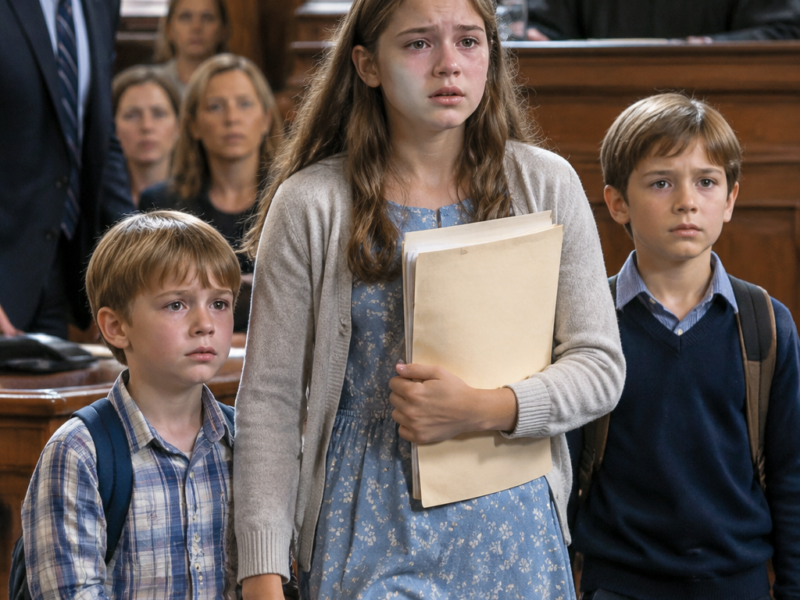
MY 12 YEAR OLD DAUGHTER WALKED INTO A COURTHOUSE WITH HER 2 LITTLE BROTHERS THEN THE JUDGE
MY 12 YEAR OLD DAUGHTER WALKED INTO A COURTHOUSE WITH HER 2 LITTLE BROTHERS THEN THE JUDGE
The first thing the twelve-year-old girl said when she walked into the Tilden County Courthouse was, “I’m sorry.”
Not hello. Not please help me. Not even a frightened question about where to find the judge.
She looked down at the polished marble floor beneath her sneakers, noticed the dark, sticky footprints she had left behind, and quietly apologized for making a mess.
“I’m sorry about the floor,” she repeated.
Behind her stood two little boys, one eight years old and the other barely five. Their shirts, which had been clean and white when the previous morning began, were now stained with something that no child should ever have to carry into a public building.
Blood.
There was dried blood on their sleeves, across their hands, and even on their faces. The youngest boy was wearing dinosaur pajamas beneath a jacket that was much too big for him. His little fingers were stained red, and he seemed too exhausted to understand why the adults around him had suddenly stopped talking.
The girl was twelve-year-old Katie Benton.
She had walked nearly three miles with her brothers, carrying a sealed envelope beneath her sweatshirt. Inside that envelope was evidence that could destroy a powerful man, expose a criminal operation, and overturn dozens of lives that had been ruined by a lie.
But Katie wasn’t thinking about any of that.
She had one instruction from her grandfather, one promise she had made while kneeling beside him on a blood-covered kitchen floor, and one destination.
She needed to find Judge Homer Fenwick.
And she needed to place that envelope directly into his hands.
What happened after that would expose a terrible truth about a small Nebraska county, a respected laboratory, and a man who had spent years convincing people that his lies were scientific facts.
But before we get to that courthouse hallway, we need to understand how an ordinary railroad worker named Vincent Benton lost his children, his marriage, and almost his entire life because of a laboratory report that should never have existed.
Vincent Benton was forty years old and had spent most of his adult life making sure that railroad crossing signals worked exactly as they were supposed to.
He was a signal maintainer, responsible for approximately 140 miles of single track running through the Nebraska Sandhills. His territory extended out from the railroad yard in Harlan Bend, a modest county seat where everybody seemed to know everybody else.
Vince knew every crossing along those tracks.
He knew which electrical relay sometimes stuck during freezing weather, which crossing the school bus passed twice each morning, and which one had nearly become the site of a fatal accident when a teenager once tried to race an approaching train.
His job demanded patience, precision, and an almost obsessive respect for details.
A railroad signal could not be trusted simply because it had worked yesterday. Every connection had to be checked. Every circuit had to be tested. Every warning light had to do exactly what it was designed to do.
There was one principle he had learned early in his career that he never forgot.
When a signal system failed, it had to fail safely.
A broken wire should never cause a warning light to turn green. A malfunction should send the system toward danger prevention, not toward convenience.
If something went wrong, the crossing needed to become more cautious, not less.
It was a principle that Vince believed applied to life as much as it applied to railroad equipment.
He had been married to Becky for fourteen years. She worked in the front office of a dental practice on Main Street and had once been the funniest person in every room she entered. Their home was usually filled with the ordinary noise of family life: arguments over television programs, missing shoes, unfinished homework, and children asking questions that seemed to have no end.
Their daughter, Katie, was twelve. She was quiet, serious, and unusually responsible for her age. She returned library books on time, kept her school supplies organized, and often noticed things that adults overlooked.
Their middle child, Emmett, was eight. He was energetic, curious, and rarely silent for more than a few minutes.
Their youngest, Danny, was five. He believed his father personally controlled every train in Nebraska and frequently asked Vince to make the locomotives go faster whenever they passed the house.
Vince loved his family more than anything.
And on the Tuesday when everything began to collapse, he was 118 miles away from home.
He was working at a crossing called Cedar Hollow, outside the small community of Brule. The railroad was replacing an aging signal house with a newer system, and the crew had been working since dawn.
There were five people on the job, including Leroy Edwards, an older railroad maintainer who had trained Vince nearly twenty years earlier.
Leroy was gray-haired, stubborn, and deeply suspicious of anyone who suggested that electrical work could be rushed. He treated every signal cutover as though a mistake might personally offend him.
The work required the crew to transfer a functioning railroad crossing from its old electrical equipment to a new system. During the process, road traffic had to be controlled by flaggers while the railroad workers checked every wire and connection.
It was not the kind of work that allowed distractions.
At two o’clock that afternoon, Vince was standing in a gravel ditch with a testing instrument in his hand. He watched the new gate arm descend, checked the warning lights, and waited for the system to complete another cycle.
Everything worked perfectly.
At ten minutes past two, he was still standing beside Leroy, holding the other end of a wire while they checked the circuit.
He had no idea that someone was preparing to destroy his family.
At quarter to five, the crossing was back in service. The crew began loading its equipment into the trucks.
That was when a sheriff’s deputy approached.
Vince didn’t recognize him.
The deputy was polite and professional. He asked whether Vince was Vincent Benton and then handed him a thick packet of papers.
“Sir, you’ve been served.”
Vince accepted the documents and began reading.
At first, the words seemed disconnected from reality. He read them once, stopped, and then started again.
It was an emergency family court order signed that very morning.
The order granted Becky temporary custody of all three children. It prohibited Vince from having unsupervised contact with them and instructed him to stay away from the home of his father-in-law, Fred Ames, where Becky and the children were supposedly staying.
Behind the order was a petition containing several disturbing allegations.
Becky claimed she had discovered loose white tablets in the glove compartment of Vince’s truck. She alleged that he had been seen falling asleep behind the wheel while transporting the children.
Most damaging of all, the petition included the results of a court-ordered hair test supposedly collected that Tuesday afternoon at the Family Bridge Center in Harlan Bend.
The laboratory responsible for the test was Buckner Analytical.
According to its report, Vince had tested positive for oxycodone at a concentration the laboratory described as consistent with chronic heavy use.
Vince slowly looked up at the deputy.
“I haven’t taken a pill in my life,” he said. “I get a headache, and I drink water.”
The deputy explained that he was only delivering the papers.
Leroy had stepped closer and was reading the document over Vince’s shoulder.
Suddenly, the older man stopped.
“Vince,” he said.
“What?”
“It says your specimen was collected Tuesday at 10:02 in the morning.”
Vince stared at him.
“Yes.”
Leroy pointed toward the paperwork.
“At 10:02, you were standing in that ditch next to me. I was holding the other end of your wire.”
For several seconds, neither man spoke.
A freight train approached on the main line, its hundred coal cars producing a tremendous metallic roar as it passed.
They waited until the last car disappeared.
That should have been enough to stop everything.
A reliable witness could confirm exactly where Vince had been at the precise time his supposed specimen had been collected. The railroad had work records. The crew had equipment logs. There were photographs and testing records.
But the court order had already been signed.
The laboratory result had already been accepted.
And the system that was supposed to protect children had already decided that Vince was dangerous.
That evening, Vince drove the 118 miles home with Leroy following in another truck.
When he reached the driveway, the house was dark.
Becky’s car was gone.
The children’s coats had disappeared from their usual hooks. Their shoes were missing. Even the little backpacks they normally left near the kitchen door were gone.
On the counter was a handwritten note.
“I’m sorry it has to be like this. I’ll let you know when it’s safe to talk.”
Vince read it several times.
Safe for whom?
He called Becky, but the phone went straight to voicemail. He tried the landline at Fred Ames’s farmhouse on Mill Road, but the recorded message said the number was not accepting calls.
Then he called Fred’s cellphone.
It rang six times.
A text message arrived shortly afterward.
It was strange because Fred was sixty-eight years old and had never been particularly comfortable with technology. Most of his messages were filled with spelling mistakes or missing punctuation.
This one was different.
“Wait. Don’t come out here. Hold your temper till Friday.”
Vince stood in the dark kitchen, still wearing his work boots.
He had known Fred for nineteen years. The older man had always been dependable, patient, and straightforward.
Fred had worked as a chemist for the state crime laboratory for thirty-six years. He was a lean, quiet man who wore plaid flannel shirts in every season and believed that scientific results should always be checked twice.
He had once spent an entire Thanksgiving dinner explaining to Vince why a trustworthy laboratory result was one that could withstand being repeated by another scientist.
He had walked Becky down the aisle.
He had taught Katie how to bait a fishing hook.
He had always answered his telephone.
And now he was telling Vince to wait.
Friday was three days away.
Vince couldn’t afford to wait without understanding what was happening, so at six the following morning, he called the only attorney in town whose name he knew.
Her name was Maria Fitch.
She had once helped his mother resolve a property boundary dispute, and he remembered her as a direct woman who didn’t waste time pretending that bad news was good news.
He left a message explaining that his children had been taken from him because of a laboratory report he knew was false.
Maria called back before seven.
By eight o’clock, Vince and Leroy were sitting across from her in the back room of her office. The room smelled of old coffee, printer toner, and paper files.
Maria placed the laboratory report on the table.
It was only one page.
At the top was the blue circular logo of Buckner Analytical, with a stylized double helix inside it.
Below were Vince’s personal details, the specimen number, the collection date, and a table listing several drug categories.
Beside oxycodone was a numerical result with a decimal point.
At the bottom were two signatures.
One belonged to Terry Wagner, the specimen collector.
The other belonged to Jason Buckner, the laboratory director.
Maria read the report carefully.
Then she looked at Vince.
“Where were you at 10:02 on Tuesday morning?”
Vince explained everything.
He described the crossing, the electrical work, the testing equipment, and Leroy standing beside him.
Maria listened without interrupting.
When he finished, she leaned back.
“Here’s the problem,” she said. “Judge Homer Fenwick is a decent man. He’s been sitting in that courtroom for twenty-six years. But for the last several years, almost every drug and alcohol test in family court and the county probation system has come from one laboratory.”
She tapped the report.
“Buckner Analytical.”
It was the only accredited toxicology laboratory within a hundred miles.
The county contracted with it. Its director testified as an expert witness. Its certificates were accepted by judges, probation officers, and attorneys.
Jason Buckner had spent years building a reputation as a reliable professional.
Maria explained that in a small county, institutional trust could become more powerful than individual testimony.
A father could insist that he had never taken drugs. A coworker could swear that he had been standing beside him a hundred miles away.
But if a laboratory report carried an official signature and an accreditation certificate, people would naturally assume that the science was correct.
Vince looked down at the paper.
“So they’re going to call it a clerical error?”
“That’s what they’ll call it if you’re lucky.”
“And if I’m not?”
“They’ll say your railroad records are self-serving.”
Vince pressed his palms against the table.
He asked about the children.
Maria explained that they would remain with Becky until Friday, and that Vince would be permitted supervised visits through a nonprofit organization called the Family Bridge Center.
There was another detail.
The center occupied the second floor of the same building where the laboratory collected specimens.
It also received partial funding from Buckner Analytical.
Vince began to understand that the situation was more complicated than a simple false report.
One building handled the drug tests.
Another part of the same organization handled supervised family visits.
And behind both operations stood a man who seemed to have made himself indispensable.
His first supervised visit was scheduled for Wednesday afternoon.
The Family Bridge Center occupied a converted insurance office on the north side of Harlan Bend.
The carpet was beige. A collection of broken toys sat in a plastic storage bin. The walls were decorated with cheerful pictures that looked as though they had been chosen by someone who had never spent much time around children.
Vince was given a visitor badge and shown into a small room containing a round table and a one-way observation window.
He sat alone for several minutes.
In his jacket pocket was a little yellow plastic train Danny had left on the porch before the family disappeared.
Vince had picked it up on Tuesday night and carried it everywhere since.
He held it in his palm as the door opened.
Danny ran toward him first, colliding with his knees.
Emmett followed, talking almost immediately about a fish, a bicycle, and something that had happened at school.
Katie entered last.
She didn’t run.
Her hair was pulled tightly back, and her expression was unusually serious.
She walked straight toward her father and wrapped both arms around his waist.
Vince felt her trembling.
He held her close, trying not to show how badly he wanted to take all three children home.
For a few minutes, the room felt almost normal.
Then the door opened again.
A man walked in without knocking.
He appeared to be in his early forties, with gray eyes, a pleasant expression, and an easy manner. He wore a quarter-zip pullover with a small blue circular logo stitched onto the chest.
In one hand, he carried a bag of sour gummy worms.
Vince recognized him immediately.
Jason Buckner.
Jason smiled warmly.
“Mr. Benton. I’m Jason. I want you to know I’ve got nothing but respect for you. I know this has been a difficult week.”
Vince didn’t shake his hand.
“You signed a report saying I was in your building Tuesday afternoon.”
Jason’s smile remained unchanged.
He explained that laboratories could only report the specimens submitted by their collectors. Sometimes mistakes happened. Collection errors were possible, and if there had been one, the appropriate review process would eventually discover it.
His voice was calm and sympathetic.
It was the kind of performance that made an ordinary person feel unreasonable for questioning him.
Then Jason turned toward the children.
He offered Emmett the gummy worms.
The boy accepted them happily.
Jason spoke gently, asking how school was going and whether Danny had been behaving himself.
Then he looked toward Vince.
“Kids, give your dad a hug. Our time’s about up.”
Danny walked toward Jason and took his hand.
Vince watched closely.
His youngest son was comfortable with this man.
Too comfortable.
A small, uncomfortable suspicion began forming in Vince’s mind.
Then he noticed someone standing in the doorway.
Becky.
She wore a nice coat and held her car keys in one hand. She looked thinner than Vince remembered, and she avoided his eyes.
For a brief moment, she rested her fingers against Jason’s lower back.
It was a small gesture.
Less than a second.
But Vince had been married to Becky for fourteen years. He knew the difference between a casual touch and the familiar movement of a woman who had touched a man many times before.
He knew immediately.
Becky quietly said they should leave.
As the children began moving toward the door, Emmett stopped to tie his shoe.
Then he leaned toward his father.
His voice was barely audible.
“Dad, Grandpa isn’t mad at you. He’s mad at Jason. He says Jason can’t count.”
Vince looked down.
“What?”
But Emmett was already moving.
Becky’s voice snapped across the room.
“Emmett, now!”
The boy hurried away.
The door closed.
Vince stood motionless.
He couldn’t stop thinking about the sentence.
Grandpa says Jason can’t count.
What did that mean?
He immediately took out his phone and messaged Maria.
He asked her to request the raw laboratory data from his supposed specimen.
Not the printed report.
The data underneath it.
Her response arrived almost immediately.
“Subpoena.”
Vince understood.
The laboratory wouldn’t simply hand over the information because he asked.
They would have to be forced.
But there was another person who might know exactly what was happening.
Fred Ames.
At five o’clock Thursday morning, Vince drove toward Mill Road.
The family court order prohibited him from going to Fred’s house, but it did not prohibit him from standing on a public road.
He parked a quarter mile beyond the mailbox, turned off his headlights, and waited.
The farmhouse stood behind a long gravel driveway lined with cottonwood trees.
It was the same white farmhouse where Becky had grown up.
After several minutes, a figure appeared near the house.
Vince recognized the walk immediately.
Fred was heading toward the mailbox to collect his newspaper.
He moved slowly, one hand tucked into the pocket of his flannel jacket.
Vince stepped out of his truck.
Fred stopped when he saw him.
“You shouldn’t be here.”
“I’m on a public road.”
Fred almost smiled.
Then his expression changed.
He glanced toward the farmhouse.
“Becky is a light sleeper now,” he whispered. “There’s a camera on the garage that wasn’t there a month ago. I don’t think it’s for the barn cats.”
Vince asked why Fred wasn’t answering his calls.
He asked why the old man was allowing Jason Buckner to destroy his family.
Fred didn’t answer directly.
Instead, he opened the mailbox, removed the newspaper, and held it against his chest.
“I need until Friday morning.”
“Why?”
“I’m putting something together.”
“Then tell me what’s happening.”
Fred shook his head.
“I can’t tell you. If I do, you’ll act. And whatever you do, they’ll call it a crime. The report will already be waiting to explain why.”
Vince stared at him.
“I’m not going to hurt anyone. I just want to know what’s wrong with the numbers.”
Fred looked toward the road.
Then he said something that Vince would remember for the rest of his life.
“He doesn’t read them, Vince. He writes them.”
Vince felt his stomach tighten.
“What does that mean?”
Fred closed his eyes.
Thirteen years earlier, he explained, he had discovered something troubling about a young chemist working under his supervision at the state crime laboratory.
The chemist was Jason Buckner.
Jason had been talented, charming, and unusually confident. But one winter, a supervisor noticed that several of his laboratory results were suspiciously consistent.
When someone requested the underlying instrument data, there was nothing.
There were results.
There were signatures.
But there was no scientific evidence showing that the tests had actually been performed.
Fred had confronted Jason.
Jason had admitted wrongdoing and apologized.
And Fred had made a decision.
He allowed Jason to resign quietly instead of reporting him to the licensing board or pursuing a formal disciplinary hearing.
He had convinced himself that the young man deserved another chance.
He thought he was showing mercy.
Now he understood what that mercy had cost.
“I let a man go once,” Fred said. “I thought mercy was cheap. I thought I could tell him to never do it again, and nobody would get hurt.”
He looked down at the newspaper.
“It wasn’t cheap. It was only a loan. And now it has come due.”
Before returning to the farmhouse, Fred gave Vince one final instruction.
“If I can’t tell you on Friday, ask for Noreen Howard.”
“Who is she?”
But Fred was already walking away.
By nine that morning, Vince had learned that Noreen Howard was fifty-eight years old and worked as the senior analyst at Buckner Analytical.
She had spent thirty-eight years working in laboratories, including nine years under Fred at the state crime laboratory.
Leroy managed to find out more through a friend in the state’s chemistry department.
Jason Buckner had once worked at the state laboratory too.
He had resigned after the incident Fred described.
There had been no public hearing.
No formal licensing complaint.
No official warning.
Instead, Jason opened his own laboratory south of the railroad tracks in Harlan Bend and gradually became the county’s preferred toxicology provider.
The second discovery was more painful.
Leroy had heard that Becky was involved with Jason.
Vince already knew.
He had seen the way she touched him in the visitation room.
But hearing it confirmed made the betrayal real in a different way.
He thought about the evenings Becky had spent supposedly working late at the dental practice.
He remembered how she had borrowed his truck two weeks earlier because her own car was being repaired.
He remembered the white tablets supposedly found in the glove compartment.
Suddenly, he understood how they could have gotten there.
He sat on the tailgate of his truck, staring at the parking lot.
The laboratory report had not simply appeared out of nowhere.
Someone had constructed an entire story around him.
And the person helping to construct it was the woman he had trusted with his life.
At ten o’clock, Vince drove to Noreen Howard’s home.
It was a tidy ranch-style house on the east side of town, with a wheelchair ramp covering the front steps and a plastic deer standing on the lawn.
He rang the bell.
After a few moments, the door opened a few inches.
A woman with short gray hair and tired eyes looked through the gap.
“Mrs. Howard? My name is Vincent Benton. Fred Ames told me to ask for you.”
Something changed in her expression.
Fear.
Not confusion.
Not surprise.
Fear.
“I don’t know you,” she said. “Please leave.”
Vince explained that a laboratory report bearing his name was false and that he believed she knew something about it.
She closed the door.
He heard the deadbolt slide into place.
Behind the door, a man’s weak voice asked who had been there.
“Nobody, Gerald,” she answered. “It was nobody.”
Vince returned to his truck.
His phone rang before he reached it.
His railroad supervisor informed him that the company was placing him on administrative leave with pay because of the pending court order.
Vince accepted the decision without arguing.
That evening, he received another message from Fred.
“Courthouse steps. 8:30. I’m bringing something for Homer Fenwick. Come alone and say nothing to anyone.”
Vince replied that he would be there.
He waited for another message.
Nothing came.
He sat at the kitchen table for hours, holding Danny’s little yellow train while the clock moved past midnight.
He didn’t know that, only a few miles away, the people responsible for his suffering were preparing to make an even greater mistake.
Katie Benton was awake that night.
She had become a light sleeper since the family moved to her grandfather’s farmhouse.
She no longer felt safe in the bedroom she shared with Emmett and Danny.
She had started keeping her shoes close to the bed.
She hadn’t consciously decided to do it.
She simply wanted to be able to leave quickly if something happened.
A little after eleven, she heard car doors outside.
Then she heard her mother’s voice.
And another voice.
Jason Buckner.
Katie quietly got out of bed and moved toward the staircase.
The kitchen light was on.
From the top step, she could see her grandfather standing in the middle of the room wearing his undershirt and flannel pants.
Jason stood opposite him.
Becky was near the sink, still wearing her coat and holding her arms tightly against her body.
Jason spoke first.
“I had a phone call tonight, Fred. Noreen called me crying. She said Vince Benton showed up at her house this morning and told her you sent him.”
Fred said he had no idea what Jason was talking about.
Jason gave a small, humorless smile.
“Don’t. I’ve known you since I was twenty-six. You’re a terrible liar.”
Then he asked where the draft was.
Katie didn’t understand what draft he meant.
But she understood that Jason was angry.
Her mother stepped forward.
“Dad, please. You haven’t been well. You’ve been so upset. Jason’s only trying to help.”
Fred turned toward her.
For several seconds, he simply looked at his daughter.
Then he spoke.
“Rebecca, I am the only person in this room who has been well in a year.”
Jason stepped closer.
“Fred, I’m going to ask you one more time. Where is it?”
“Get out of my house.”
What happened next lasted only a couple of seconds.
Jason reached for Fred’s undershirt.
He wasn’t punching him. He seemed to be trying to grab him and turn him, as though moving an uncooperative child out of the way.
Fred pulled backward.
His heel caught the edge of a braided rug.
He lost his balance.
His body fell backward, and the back of his head struck the iron corner of the old kitchen stove.
The sound was terrible.
Katie felt it in her teeth.
Fred landed on the floor.
For a moment, nobody moved.
Then Becky screamed.
Jason dropped to one knee.
“Jesus, Fred.”
Blood began spreading beneath the old man’s head.
Jason looked frightened.
But his next words were not an instruction to call an ambulance.
“He’s breathing. He’s breathing, Becky. He tripped. You saw him trip.”
Becky stared at the blood.
“We need an ambulance.”
Jason spoke quickly.
He said that calling the authorities would bring a deputy into the kitchen within an hour. He said his name would appear beside the blood. He reminded Becky that the next morning was Friday.
If the envelope reached Judge Fenwick, everything they had worked for would be destroyed.
The custody arrangement.
The false drug report.
The entire plan.
Jason told her that he had a trauma kit in his truck.
He had been a laboratory chemist, not a doctor, but he knew enough to keep Fred comfortable.
“Give me twenty minutes,” he said. “Then we call. We say he fell off a ladder while getting a jar down.”
Becky stood completely still.
Then she whispered something that would haunt her daughter for years.
“All right.”
Jason hurried outside.
Becky knelt beside her father and placed a dish towel beneath his head.
The white fabric quickly turned dark.
She looked up toward the staircase.
Katie flattened herself against the wall and crawled backward along the hallway.
She returned to the bedroom.
Her heart was pounding so hard that she could barely breathe.
For a moment, she considered waking her brothers and calling for help immediately.
But she remembered Jason’s voice.
She remembered her mother’s agreement.
And she understood that the situation was dangerous.
The bedroom door opened.
Katie closed her eyes and pretended to be asleep.
The light fell across her face.
After a moment, the door closed again.
Katie sat up.
She put on her shoes, shook Emmett awake, and placed her hand over his mouth.
“You have to be really quiet,” she whispered. “You have to help me. And if you cry, I will never forgive you.”
Emmett had never heard his sister speak that way.
He nodded.
Danny woke by himself.
He looked at Katie, climbed out of bed in his dinosaur pajamas, and took her hand.
The three children descended the stairs together.
The kitchen was horrifying.
Fred lay on his side on the floor.
His eyes were open.
There was blood in his white hair, on the towel beneath his head, and across the red tile.
His face was pale.
Katie knelt beside him.
“Grandpa?”
His eyes moved toward her.
His voice was barely audible.
“Katie.”
“I’m here.”
He tried to move his hand.
She took it.
Then he whispered something that changed everything.
“In the mudroom. My barn coat. Left pocket. There’s an envelope.”
Katie looked toward the mudroom.
“Okay.”
“It’s for Homer Fenwick. The judge.”
She nodded.
“Say it back,” Fred whispered.
“Homer Fenwick.”
“By name. Ask for him by his name. Give it to him, and nobody else.”
Fred struggled to breathe.
“Not the deputies. Not the nurses. Not your mother. Not Jason.”
He paused.
“Not even your father.”
Katie stared at him.
She didn’t understand why her father couldn’t be trusted with the envelope.
Fred explained as much as he could.
Her father was a good man. But he would open the envelope in front of everyone, and the wrong people might see his reaction before the right person had read the evidence.
She had to give it directly to the judge.
“Do you promise?”
Katie swallowed.
“I promise.”
Fred closed his eyes.
“You are the bravest person I know.”
Then he opened them again.
“Tell Vince I’m sorry I was so late.”
Katie began crying, but she tried not to make a sound.
Emmett was kneeling beside his grandfather.
Danny had taken the dish towel and was pressing it against Fred’s head with both hands.
He had once been taught how to hold a bandage against an injured dog, and now he was trying to do the same thing for his grandfather.
Emmett joined him.
Their small hands became covered in blood.
Katie didn’t stop them.
She stood and ran toward the mudroom.
The barn coat hung from its usual hook.
She searched the left pocket and found a thick envelope pressed against the canvas lining.
The front bore a single name printed in black capital letters.
HOMER FENWICK.
She held it against her chest.
Then she returned to the kitchen, picked up the wall telephone, and dialed 911.
The dispatcher answered.
Katie spoke as clearly as she could.
“My grandfather fell and hit his head. He’s bleeding, and he isn’t getting up. We’re at 1187 Mill Road. Please come fast.”
The dispatcher asked for her name.
Katie hesitated.
Then she added one more request.
“Please don’t use the siren on the road because my mother is outside.”
Before the dispatcher could ask anything else, Katie hung up.
She carefully returned the telephone receiver to its place.
Outside, the voices had stopped.
Footsteps approached the porch.
Katie grabbed Danny beneath the arms and motioned to Emmett.
“Now.”
They went through the pantry, down the cellar steps, and into the cold stone basement.
From there, they climbed through the old storm door and emerged into the darkness behind the house.
They crossed the yard, keeping low along the fence.
Behind them, the screen door slammed.
Becky began screaming.
“Dad! Oh God, Dad!”
Jason’s voice followed.
“I told you twenty minutes. I told you!”
The barn stood approximately fifty yards away.
Katie helped Danny climb the ladder.
Emmett followed.
Then she climbed up herself, keeping the envelope pressed beneath her sweatshirt.
They reached the hayloft and lay flat against the wooden boards.
Through a narrow gap, they could see the farmhouse.
The ambulance arrived with flashing red and blue lights.
Its siren was silent.
The paramedics entered the house, and eventually the ambulance pulled away with Fred inside.
Katie watched Jason remain in the yard.
He took out his phone and began walking in circles.
Then he entered the house.
Lights appeared upstairs.
He searched the bedrooms.
He came back down.
Finally, he walked onto the porch and called into the darkness.
“Katie?”
No answer.
“Emmett? Danny?”
Katie pressed her hand over Danny’s mouth.
Emmett buried his face against her sleeve.
Jason walked toward the barn.
His flashlight swept across the fence.
Then the beam moved toward the ladder.
It stopped.
Katie felt her entire body become rigid.
Jason stood at the foot of the ladder.
He remained there for what seemed like an eternity.
Then a car horn sounded somewhere on the highway.
The flashlight moved away.
Jason returned to his truck, started the engine, and drove toward town.
The children stayed in the hayloft until the sky began turning gray.
Danny eventually fell asleep with his head resting on Katie’s arm.
Emmett stayed awake.
Toward morning, he whispered a question.
“Is Grandpa dead?”
Katie didn’t know.
“I don’t know.”
“Did we hurt him by pressing the towel?”
“No,” she whispered. “You saved him. You held it exactly right.”
At twenty past five, Katie woke them.
She checked the envelope.
The seal was still intact.
She buttoned Danny’s jacket over his dinosaur pajamas and gave Emmett her own gloves.
Then they climbed down from the hayloft.
The courthouse was 2.7 miles away.
Katie knew the route because her grandfather had driven her past it many times.
As they walked along Mill Road, she practiced the sentence she intended to say.
“I would like to see Judge Homer Fenwick, please.”
Again.
“I would like to see Judge Homer Fenwick, please.”
She repeated it until the words felt familiar.
Danny held her hand.
Emmett walked beside them.
Their clothes were stained with blood, and the sealed envelope rested against Katie’s chest.
None of them knew whether their grandfather would survive.
None of them knew what would happen when they reached the courthouse.
But Katie had made a promise.
And she intended to keep it.
At twenty past eight, Vince Benton was waiting outside the courthouse.
He had arrived early because he was afraid Fred might come and leave before he noticed him.
The Tilden County Courthouse was an old brick building with a clock tower. It stood beside a town square containing a bandstand and an old Civil War cannon.
On an ordinary morning, Vince would have passed it without paying much attention.
That morning, he watched every vehicle entering the square.
At twenty minutes to nine, Maria Fitch arrived carrying her briefcase.
She took one look at him.
“What’s wrong?”
Vince told her about Fred’s message.
Maria listened.
Then she explained that they couldn’t simply stand outside waiting indefinitely.
They had evidence.
They had Leroy’s testimony.
They had the railroad records.
They had a legitimate argument against the laboratory report.
Whatever Fred was bringing might help, but they couldn’t depend on it.
“Come inside,” she said.
They passed through the metal detector, crossed the marble lobby, and climbed the wide staircase to the second-floor courtroom.
Outside Courtroom Two, Vince saw Becky.
She was sitting on a wooden bench wearing the dark blue dress she had worn to her mother’s funeral.
Her eyes were swollen.
She looked exhausted.
Beside her stood Anthony Rucker, her attorney, a tall man in a gray suit.
Jason Buckner stood several steps away with his back against the wall.
Terry Wagner, the laboratory collector whose signature appeared on Vince’s report, sat at the far end of the bench.
She looked sick.
Jason appeared different from the confident man Vince had encountered at the Family Bridge Center.
His hair was flattened on one side, his collar was open, and there was a long gray smear across one knee of his trousers.
When he saw Vince, something flickered across his face.
It wasn’t warmth.
It was calculation.
Becky was speaking quietly.
“He’s still in surgery. They won’t tell me anything. I shouldn’t even be here.”
Vince stopped.
“Becky, who’s in surgery?”
She looked up.
For one second, he saw the woman he had married.
The woman who had once sung off-key for two hundred miles to keep him awake during a long drive.
Then Jason moved between them.
“Mr. Benton, this is not the place.”
“Is it Fred?”
Nobody answered.
Becky began crying again.
“Jason, where are the kids? You said they were with Mrs. Kessler. You said you’d bring them. Did you bring them?”
Jason’s expression remained controlled.
“They’re fine, Becky.”
But Vince noticed something.
The man was frightened.
Vince had spent his life identifying tiny signs of failure in electrical systems that appeared to be working normally.
A warning light flickering for half a second.
A relay making a sound it shouldn’t make.
A circuit holding together when it was about to fail.
Jason Buckner’s face looked exactly like that.
Then came a noise from the staircase.
Voices.
A deep male voice belonging to the courthouse bailiff.
“Whoa. Hold on there. You can’t just come in here.”
A girl’s voice answered.
Footsteps followed.
Three sets.
One heavy and two light.
The bailiff, Kurt Reed, appeared first. He was fifty years old, broad-shouldered, and had served in the courthouse for nineteen years.
He was walking backward up the staircase with one hand extended.
Behind him came three children.
At first, Vince didn’t recognize them.
His mind seemed to refuse what his eyes were seeing.
Then he noticed the dinosaur pajamas.
The yellow jacket.
The familiar braid.
Katie.
His daughter was covered in blood.
Her jeans were dark and stiff around the knees. Her sweatshirt was stained brown and red. Both hands were dirty to the wrists, and there were streaks across her face where she had pushed her hair away.
Emmett followed, holding Danny’s hand.
Danny’s little pajamas were soaked down the front.
His fingers were red.
All three children were covered in blood.
They reached the top of the stairs.
The hallway fell silent.
Adults stared at them.
Nobody seemed capable of understanding what they were seeing.
Becky stood up.
A terrible sound escaped her throat.
“Oh my God. Katie.”
She took a step toward her daughter.
Katie looked at her.
It was not an angry expression.
It was worse.
It was a quiet, exhausted look that made Becky stop as though she had walked into an invisible wall.
Then Katie looked down.
She noticed the dark footprints her sneakers had left on the courthouse floor.
“I’m sorry about the floor,” she said.
She repeated it softly.
Then she lifted her chin.
“I would like to see Judge Homer Fenwick, please.”
Kurt Reed crouched slightly.
“Honey, the judge is about to go on the bench. You’re hurt. We need to get you to the nurse.”
He looked at the blood on her clothes.
“Whose blood is this?”
“It isn’t ours.”
Nobody moved.
Katie continued.
“My grandfather said I have to ask for him by name. I have to put something in his hand. Nobody else’s.”
She held the envelope against her chest.
“I’m not allowed to give it to anybody but him.”
At that moment, a door at the end of the hallway opened.
It was the door leading to the judge’s chambers.
Judge Homer Fenwick stepped out wearing his black robe.
He was sixty-one, tall, heavyset, and white-haired, with a weathered face that gave him the appearance of a man who had spent decades carrying responsibilities other people preferred to avoid.
He held a cup of coffee in one hand and a case file in the other.
He took several steps.
Then he stopped.
“Katie Benton?”
She walked toward him.
She passed her mother.
She passed her father.
Vince stood motionless, unable to understand what had happened to his children or why they were covered in blood.
Katie reached the judge and held out the envelope with both hands.
On the front, in black capital letters, was his name.
HOMER FENWICK.
The judge recognized the handwriting immediately.
Vince saw the color slowly leave his face.
He placed his coffee on the windowsill and accepted the envelope.
Then, standing in the middle of the courthouse hallway, he broke the seal.
Inside were three typed pages and a handwritten note clipped to the top.
He read the note first.
Then he began reading the pages.
His eyes moved down the lines.
Then back to the beginning.
Then down again.
He read more slowly the second time.
The letter had been written by Fred Ames.
It began with an apology for not delivering the evidence himself.
Fred explained that he had discovered Jason Buckner falsifying laboratory results in the winter of 2013.
At the time, Jason had been a young chemist working under his supervision at the state crime laboratory.
Fred had confronted him and accepted his resignation rather than reporting him.
He had believed that Jason was genuinely sorry.
He had believed that giving a young man another chance was the right thing to do.
But Jason had opened his own laboratory, and over the following years, the county had become his most important customer.
Fred admitted that he had watched warning signs appear and disappear without taking action.
He had allowed his former employee to build an entire business around the same dishonest practices that had nearly ended his career.
Then the letter turned to Vince.
Fred explained that the report accusing his son-in-law of oxycodone use contained a numerical result that was scientifically impossible for the hair segment nearest the scalp.
He also pointed out that the specimen was recorded as having been collected in a building Vince could not possibly have reached because he was 118 miles away.
The railroad could confirm his location.
But there was something even more serious.
Fred had spoken to Noreen Howard.
She had discovered that, for nearly three years, some laboratory results had been deliberately fabricated.
The results were not accidental mistakes.
They were prepared to produce particular outcomes.
The laboratory log marked these manipulated cases with a small green dot.
There were sixty-two cases in total.
Twenty-nine of them had already been used in proceedings before Judge Fenwick.
One involved a man named Daryl Hatch, who was currently serving time in the state prison at Lincoln for a probation violation that had never happened.
Fred also explained where the original specimens were supposed to be stored.
The retained hair samples had been divided into separate portions and kept in the laboratory freezer.
He instructed the judge to examine rack six along the back wall of the freezer room.
But the most painful part of the letter concerned Becky.
Fred wrote that his daughter was involved.
He admitted that he loved her and had failed to stop what was happening.
He also warned the judge that if he was injured before Friday, it should not automatically be treated as an accident.
The final line contained a desperate instruction.
Do not believe it.
Look at who is standing beside you.
When Judge Fenwick reached the end, he slowly folded the pages.
Then he did something nobody in that hallway had ever seen him do.
He sat down on the floor.
Not because he had fallen.
He deliberately lowered himself onto the cold marble, leaned against the wall beneath the framed portraits of the county’s founders, and covered his eyes with one hand.
The hallway remained silent.
Kurt Reed looked toward him.
“Judge?”
Fenwick removed his hand.
His voice was quiet, but every person in the corridor heard him.
“Kurt, nobody leaves this floor.”
He looked toward Jason Buckner.
Then Terry Wagner.
Then Becky.
“Arrest them. All of them.”
Kurt Reed moved immediately.
Within a minute, Jason, Terry, and Becky were in handcuffs.
Jason remained strangely calm.
As the bailiff approached him, he said quietly, “Your Honor, you’re making a mistake you can’t take back.”
Becky said nothing.
She looked over her shoulder toward Katie.
Her daughter looked down at the floor.
Vince had both boys in his arms, with Katie pressed against his side.
He held them as though the world might try to take them away again.
Judge Fenwick remained on the floor while he made the first telephone call himself.
He called the hospital.
Fred Ames was alive.
He was in surgery for bleeding inside his skull.
The doctors could not promise he would survive the morning.
The judge listened with his eyes closed.
Then he signed an emergency order returning all three children to Vince immediately.
He also ordered a paramedic to come upstairs and examine the children.
For the first time in several days, Vince could breathe.
But the relief did not last.
By two o’clock that afternoon, Jason Buckner was sitting in his own kitchen.
His bail had been posted by a family trust nobody could immediately identify.
The county attorney, Ivan Spurlock, had been a longtime golfing partner of Jason’s.
He issued a statement saying that his office saw no clear basis for an assault charge.
According to the statement, Fred Ames had suffered a fall.
His own daughter had supposedly witnessed the accident.
The letter was being questioned because it had been written by an elderly man who had suffered a serious head injury.
The county attorney also announced that any review of Buckner Analytical’s work would begin with an internal examination of the laboratory’s own records.
Becky was released that afternoon on her own signature.
She went to the hospital.
Terry Wagner went home.
Maria Fitch turned off her telephone that night after learning how quickly the case was beginning to unravel.
Judge Fenwick recognized that he could not continue handling matters connected to the laboratory.
He formally recused himself and contacted a visiting judge from a neighboring county.
That judge signed a search warrant.
The deputies arrived at Buckner Analytical that evening.
It was past seven o’clock when they reached the freezer room.
They cut the padlock on the back wall and opened rack six.
It was empty.
A clean, white square of shelving stood where sixty-two sets of retained hair samples should have been.
The freezer log showed a power fluctuation at 3:15 that afternoon.
Not a single specimen remained.
Jason had known about the letter.
He had known exactly what Fred had told the judge.
And somehow, he had managed to remove the evidence before the authorities could secure it.
For a while, it appeared that he might escape again.
But Jason had made one mistake.
He had underestimated Noreen Howard.
On Saturday morning, Vince was sitting at his kitchen table.
His three children were asleep in the next room.
He had barely slept himself.
The house was quiet, but it was no longer the peaceful kind of quiet he remembered from before Tuesday.
Every sound seemed to carry a memory.
Then the doorbell rang.
Vince opened the door.
Noreen Howard stood on the porch.
Behind her was her husband, Gerald, sitting in a wheelchair with an oxygen tube in his nose.
Noreen looked uncomfortable.
“Mr. Benton,” she said, “I owe you an apology.”
Vince stared at her.
She explained that she had shut the door on him when he visited her earlier in the week.
She had been frightened.
Jason had threatened her professional license three years earlier after she made a calibration mistake.
It had been a genuine mistake, and she had reported it herself.
Jason told her that he could report the error to the licensing authorities and potentially end her career.
Then he offered her a choice.
Stay quiet.
Keep working.
And he might decide not to report it.
For three years, she had lived under that threat.
She had continued operating the equipment and had watched Jason manipulate the results.
She knew what the green dots meant.
Gerald had finally convinced her that she could no longer remain silent.
He had told her that a woman who could close her door on a child who had walked into a courthouse covered in blood did not deserve to keep her pension.
Noreen’s hands tightened around the wheelchair handles.
“I’ve run that machine to the dot for three years,” she said. “I know exactly what he did.”
Vince told her that the freezer was empty.
She nodded.
“Rack six was a decoy.”
Vince looked at her.
“What?”
“Fred only knew what I told him. And I told him what Jason believed.”
For the first time, she smiled.
“I moved the real samples in April. I knew somebody would eventually need them.”
She explained that the actual retained specimens were stored in a chest freezer in the basement of the Lutheran church on Elm Street.
They were inside boxes labeled Hamloaf Fund.
Vince stared at her.
Then he began laughing.
It was the first genuine laugh he had managed since Tuesday.
He laughed until he had to lower his head onto his arms.
Gerald Howard began laughing too, although the effort made him cough.
For the first time, Jason’s careful planning had encountered something he hadn’t anticipated.
A frightened woman had quietly preserved the evidence.
The following day, the visiting judge signed another search warrant.
The state patrol was scheduled to collect the specimens early Monday morning.
But Jason had not finished trying to protect himself.
At half past two on Sunday night, Noreen received a telephone call from the pastor’s wife.
She had been awake because she suffered from insomnia.
Earlier that evening, a man wearing a quarter-zip pullover had stopped by the church.
He had politely asked about the kitchen key.
The pastor’s wife had found the question strange enough to remember.
Vince was already moving.
He understood exactly where Jason would have to go.
The laboratory and Fred’s farmhouse were on the south side of the railroad tracks.
The church was on the north side.
The bridge on Fourth Street was closed for repairs until spring.
The only other route across the tracks was the grade crossing at Elm Street.
It was a crossing Vince had maintained for nine years.
The system had been installed by Leroy Edwards.
And every night at 3:07, a coal train carrying 110 cars passed through at twenty miles per hour.
Vince drove toward the crossing.
He did not touch a wire.
He didn’t need to.
He parked beside the gate, turned off his headlights, and called Kurt Reed.
Kurt contacted the state patrol.
Two patrol cars positioned themselves behind the church and waited.
At three minutes past three, the crossing bell began ringing.
The red warning lights flashed.
The gate arms descended.
A set of headlights approached from the south.
A pickup truck came toward the crossing at speed, then slowed sharply when it encountered the lowered gates.
Jason Buckner sat behind the steering wheel.
He looked at the lights.
He looked at the gate.
He looked toward the darkness on either side of the tracks.
Then the train appeared.
One hundred and ten coal cars passed in front of him.
The engine’s horn sounded.
Metal wheels thundered across the rails.
Jason couldn’t move forward.
He couldn’t reverse without exposing himself to the patrol cars waiting behind him.
He simply sat there while the train passed.
Vince watched from the side of the road.
He had spent his working life maintaining those warning systems.
They were ordinary machines.
Lights, bells, wires, and mechanical gates.
But they had one responsibility.
Tell the truth.
Warn people when danger was approaching.
And that night, they did exactly what they were supposed to do.
Jason had spent years manipulating numbers, signatures, and scientific reports.
He had convinced judges to trust him.
He had convinced families to doubt one another.
He had used official documents to turn innocent people into criminals.
But he could not convince a railroad crossing to lie for him.
When the last coal car passed, the gates rose.
The warning lights went dark.
The bell stopped.
Two patrol cruisers moved into position behind Jason’s truck.
He was arrested without incident.
For the first time in years, he had nowhere left to hide.
The boxes labeled Hamloaf Fund were collected at dawn and transported to the state laboratory in Lincoln.
A state trooper sat beside them during the journey as though he were guarding something priceless.
The retesting process took six days.
Vince’s own retained specimen was among the first examined.
The result came back.
No oxycodone.
Not a trace.
Not a decimal.
Nothing.
The same was true of fifty-one of the other sixty-one samples.
Some of the remaining specimens had deteriorated over time.
Others had never actually been tested in the first place.
The green dots meant exactly what Fred Ames had described.
They identified cases in which results had been manipulated to produce predetermined outcomes.
The consequences were enormous.
On the following Wednesday, Judge Homer Fenwick returned to the courtroom.
The building was packed.
People stood along the back wall.
Families who had lost custody of their children sat beside people who had been sent to prison because of laboratory results that were now known to be false.
Some had driven several hours to attend.
Others had spent years wondering why their lives had fallen apart.
Judge Fenwick began reading case numbers.
One after another.
Twenty-nine of his previous orders were vacated.
He read each number himself.
He did not ask the clerk to do it.
When he reached the case of Daryl Hatch, the man who had spent nine months in the state prison at Lincoln for a probation violation that had never happened, the judge stopped.
He removed his glasses.
He looked toward the man sitting in the courtroom.
“I put you there, sir, and I am sorry.”
It was not an eloquent speech.
It was not a carefully prepared apology.
It was simply the truth.
And perhaps that was the first time in a long while that Daryl Hatch had heard a person in authority speak to him without hiding behind paperwork.
Jason Buckner hired an attorney from Omaha.
For five weeks, his lawyer advised him to remain silent.
But Jason had one weakness.
He believed he was smarter than everyone else.
When state investigators questioned him, they asked how a laboratory director who claimed to be conducting honest scientific work could have a fifty-seven percent positive rate in certain categories.
Jason couldn’t resist correcting them.
He leaned forward.
He began explaining that laboratory results were not simply measurements.
They were judgments.
A machine could provide a number, he said, but a good chemist understood what that number meant.
He explained that the purpose of a result was not merely to describe what had happened.
It was to help produce the correct outcome.
He insisted that the families he had helped were better served by his decisions.
Then he began talking about Vince.
He described him as a man who needed to be managed.
He spoke with confidence and even a little pride.
He explained how he had selected outcomes and adjusted the reports to support them.
He spoke for an hour and ten minutes.
The entire conversation was recorded.
The investigators didn’t need much more.
In the spring, Jason pleaded guilty to seventeen counts of tampering and to assault in the first degree.
He was sentenced to nineteen years in prison.
Buckner Analytical was padlocked.
The blue circular logo that had appeared on official reports throughout the county was removed from the building.
A truck carried it away on a Tuesday afternoon.
For the first time in years, the county no longer had a laboratory director who could decide what the truth was supposed to be.
But there was still one part of the story that couldn’t be settled by a court order.
Becky.
She had pleaded guilty to obstruction and signing a false affidavit.
She had cooperated with investigators and testified about her involvement.
Because of that cooperation, she avoided prison.
But she would have to live with what she had done.
One gray evening in March, she came to Vince’s house.
She wore the same dark blue dress she had worn to the courthouse.
She sat across from him on the porch, her hands folded between her knees.
For several minutes, neither of them spoke.
Then she said, “I thought twenty minutes. I really thought twenty minutes and he’d be fine.”
Vince looked at her.
She continued.
“I thought Jason knew what he was doing. I thought we could fix it. I thought if we waited until morning, everything would be different.”
Her voice broke.
“I’m so sorry. I’m sorrier than I’ve ever been about anything.”
Vince believed her.
That was perhaps the strangest part.
He believed that she was genuinely sorry.
He believed she regretted what had happened.
He believed that she wished she could return to the beginning and make a different decision.
But believing her apology didn’t restore what she had destroyed.
He looked toward the yard.
Then he spoke.
“You can be sorry and still be gone, Becky. Both things are true.”
She looked down.
“I’ll never keep the children from you,” he continued. “But I’ll never be your husband again.”
Becky nodded.
She remained seated for another moment.
Then she stood and walked down the porch steps.
Danny watched her through the window, pressing one small hand against the glass.
The divorce became final in June.
Fred Ames woke up on the ninth day after his surgery.
He was in a hospital room in Harlan Bend.
The back of his head had been shaved around the surgical wound, and an intravenous line ran into his arm.
His first question was about the weather.
His second was about Katie.
She arrived after school wearing her yellow rain jacket and carrying a library book.
She stood beside his bed with her hands folded neatly in front of her.
Fred looked at her for a long time.
Then he asked the question he had been waiting to ask.
“Katie. Did you say it?”
She knew exactly what he meant.
“By name, Grandpa.”
She paused.
“Into his hand.”
Fred closed his eyes.
His mouth trembled.
“I was thirteen years late,” he whispered. “You were on time.”
Katie shook her head.
“I don’t think that’s how it works.”
She explained that she had simply promised to deliver the envelope.
She hadn’t done anything special.
She had just done what her grandfather had asked.
Fred began laughing.
Then he started crying.
Eventually, the effort exhausted him, and he fell asleep again.
When he woke, Vince was sitting beside the bed.
The old man looked at his son-in-law for a long moment.
“I told you I was sorry,” he said. “I think. I’m not sure I got to say it.”
Vince took his hand.
“You said it to Katie.”
Fred looked toward the ceiling.
“That wasn’t the same.”
“It never is,” Vince replied.
He placed his hand over Fred’s thin fingers and left it there.
The family needed time to recover.
The children returned to school.
Vince eventually went back to work on the railroad.
There were still difficult nights.
Danny sometimes woke from dreams about the farmhouse.
Emmett became unusually quiet whenever adults argued.
Katie continued to keep her shoes near the bed for several months.
But little by little, the ordinary things began returning.
Breakfast became noisy again.
The boys started arguing over television programs.
Vince repaired Danny’s toy train when one of its wheels came loose.
And Katie began visiting the library again.
That brings us to one final Monday afternoon, two weeks after the courthouse incident.
At four o’clock, Katie walked into the Harlan Bend Public Library.
She carried a mystery novel she had borrowed a week and a half earlier.
The book had been due on the Thursday of the night at the farmhouse.
She placed it on the counter.
“I’m sorry it’s late,” she told the librarian.
The librarian was an elderly woman with a pencil tucked into her hair.
She looked at the girl.
She noticed the careful braid, the neatly arranged hands, and the serious expression.
Then she stamped the book.
“Honey, I don’t charge fines to children in the circumstances.”
She paused.
Then she said something Katie would remember.
“In the whole county that week, you’re the only person I can think of who was ever on time.”
Katie reached into her pocket and took out a dollar.
She placed it on the counter anyway.
The librarian didn’t argue.
Katie turned and walked toward the door.
Outside, her father was waiting in the pickup truck.
The two boys were asleep in the backseat.
A small yellow plastic train hung from the rearview mirror, tied there with a piece of string.
Vince had kept it because it reminded him of the days when his youngest son believed his father controlled every train in Nebraska.
Now it reminded him of something else.
It reminded him that sometimes the smallest things were the ones worth protecting.
And whenever I think about this story, I keep returning to the courthouse floor.
I think about a twelve-year-old girl standing in a hallway with her grandfather’s blood covering her clothes.
She had carried a dying man’s final instructions across nearly three miles.
She had kept two younger children moving when they were frightened and exhausted.
She had hidden from a man who was searching for them.
She had walked into a building full of adults who were supposed to know how to protect people.
And the first thing she did was apologize for the floor.
There is something deeply painful about that.
Children are supposed to believe that adults can fix things.
They are supposed to trust that when something goes wrong, someone older and wiser will know what to do.
But in Katie’s world, the adults had failed.
Her mother had betrayed her father.
A respected laboratory director had manipulated scientific evidence.
A county attorney had protected a powerful friend.
And her grandfather, a man who had spent his entire career understanding the importance of truth, had waited thirteen years too long to confront a wrongdoing he already knew existed.
Katie had inherited the consequences of every one of those decisions.
She was the one who had to act when the adults around her could no longer be trusted.
Fred Ames had been right about Jason Buckner thirteen years earlier.
He had seen the warning signs.
He had known the results were false.
He had known that Jason was capable of turning scientific authority into a weapon.
But Fred had believed that mercy would solve the problem.
He thought a quiet resignation was enough.
He thought he was protecting a young man from a mistake that could ruin his future.
He never imagined that his decision would eventually cost innocent people their freedom, their families, and their dignity.
The truth is that mercy without accountability can become another form of injustice.
Fred had not intended to hurt anyone.
But good intentions did not erase the damage.
The people who paid for his silence included a father in Harlan Bend, a man named Daryl Hatch in a state prison, and three children who had to walk through the darkness carrying blood on their clothes.
Jason Buckner had built his power on numbers.
Numbers printed on official letterhead.
Numbers accompanied by signatures.
Numbers carrying the authority of a laboratory that people had trusted for years.
He understood something important about human nature.
People often believe documents before they believe people.
A frightened mother can be questioned.
An innocent father can be doubted.
A child can be told that she doesn’t understand what she saw.
But a laboratory result with a decimal point looks convincing.
It looks objective.
It looks final.
And that is why the most dangerous lies are sometimes the ones presented in the language of science, law, and authority.
The problem was never simply that Jason had falsified results.
It was that everyone around him had become so accustomed to trusting the institution that they had stopped asking whether the institution deserved that trust.
A court accepted his reports.
A nonprofit depended on his funding.
A county attorney played golf with him.
And families were left to defend themselves against conclusions that had been manufactured before they ever entered a courtroom.
But the most important part of the story was not the arrest, the investigation, or even the nineteen-year prison sentence.
It was the moment Katie placed the envelope into Judge Fenwick’s hands.
Because that was the moment the truth finally reached someone who had the power to act.
Not through a laboratory.
Not through an official report.
Not through an attorney’s argument.
It arrived in the hands of a twelve-year-old girl who had made a promise to her grandfather.
And perhaps the most troubling question this story leaves behind is not why Jason Buckner lied.
We already know why.
Power.
Control.
The belief that he could decide what happened to other people and that nobody would ever discover the truth.
The more difficult question is why so many people needed a child covered in blood to finally understand that something was wrong.
Why did Vince need a false report to be exposed before anyone believed him?
Why did Fred have to be nearly killed before his warning became urgent?
Why did Noreen have to risk losing everything before she felt safe enough to speak?
Why did Daryl Hatch have to spend nine months in prison before anyone questioned the evidence that had put him there?
And why did Katie have to walk into a courthouse carrying the consequences of decisions made by people three times her age?
We often say that people deserve to be heard.
But listening is not the same as waiting for someone to produce perfect evidence.
Sometimes the first warning is a quiet sentence from someone who has no authority, no influence, and no document to prove what they are saying.
Sometimes the truth arrives before the paperwork.
Sometimes the person who understands what is happening is the person everyone else has decided is too young, too frightened, too emotional, or too insignificant to believe.
Fred Ames understood the truth about Jason Buckner.
He simply waited too long to act on it.
Katie understood the importance of her grandfather’s final request.
And she did not wait.
She walked through the darkness.
She protected her brothers.
She carried the envelope.
She reached the courthouse.
And when she finally stood in front of the judge, she did exactly what she had promised.
She gave it to him by name.
Into his hand.
That is why I keep thinking about the floor.
Not because the bloodstains were important, but because of what they represented.
A child had been forced to carry the consequences of an entire community’s failure.
And still, she was worried about leaving marks on the floor.
Perhaps that is what happens when children grow up surrounded by adults who make mistakes too large for them to understand.
They learn to apologize for the mess.
They learn to clean up whatever small part they can reach.
They learn to be brave when they should be allowed to be frightened.
And sometimes, they become the only people willing to do what everyone else should have done long before.
I’m Nathan.
And if there is one thing I hope you remember from this story, it is this:
When someone quietly tells you that something is wrong, don’t automatically wait for a stamped document, a laboratory result, or a person with an impressive title to confirm it.
Listen first.
Ask questions.
Look carefully.
Because sometimes the most important truth in the room belongs to the person who has the least power to make anyone believe it.
And sometimes, by the time the evidence finally arrives, the people who needed your help have already paid the price.
THE END









