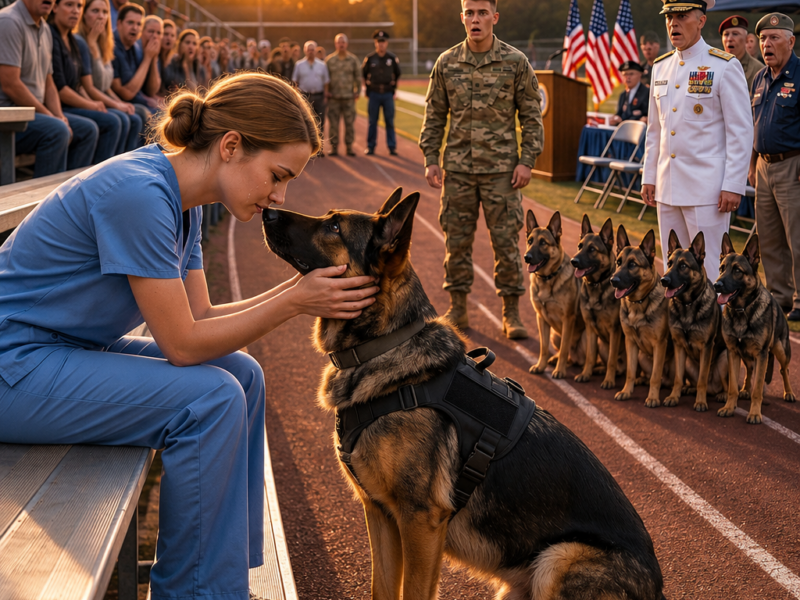
“Move Her to the Back,” They Ordered the Nurse — Then Every Military K9 Chose Her Instead
“Move Her to the Back,” They Ordered the Nurse — Then Every Military K9 Chose Her Instead
The autumn wind swept across the parade grounds of Fort Calder Veterans Memorial Park, carrying the smell of damp grass, cold earth, and the faint metallic scent of rain that had not yet begun to fall. Hundreds of people had gathered that afternoon, filling the bleachers and lining the edges of the ceremonial field. Three hundred soldiers stood in perfect formation beneath the American flags, their uniforms pressed, their boots polished, and their expressions solemn. It was supposed to be a day of honor, a day of recognition, and a day of celebration for a man who had given thirty years of his life to the United States Army.
But before the ceremony could begin, a woman in a faded gray jacket was told to leave.
She was not wearing a military uniform. She had no visible medals, no decorations pinned to her chest, and no family members standing beside her. Her jacket was old, its zipper broken halfway down, and its sleeves hung slightly past her wrists. Her dark hair was pulled back into a simple knot, and she held a paper cup of gas station coffee that had long since gone cold.
To the people watching, she looked like an ordinary civilian who had wandered into an event where she did not belong.
A volunteer coordinator named Denise Cardy approached her with a clipboard pressed against her chest. Denise was in her mid-fifties, with neatly styled hair, a carefully maintained appearance, and the confident manner of someone accustomed to enforcing rules without expecting questions.
“Ma’am, I’m sorry, but you’re going to have to move.”
The woman looked up.
“Is there a problem?”
“This section is reserved.”
“Reserved for whom?”
“Military families. Spouses, parents, children of active-duty or retired service members. Do you have identification showing your relationship to someone attending today’s ceremony?”
The woman considered the question for a moment.
“No,” she replied. “I came on my own.”
Denise gave her a polite but unmistakably dismissive smile.
“Then you’ll need to use the general public seating. It’s beyond the rope line, in the second set of bleachers.”
There was no argument. No raised voice. No attempt to explain herself.
The woman simply picked up her coffee, stood, and began walking toward the designated area.
A few people turned to watch. Someone muttered that the reserved section was not meant for strangers. Another person whispered that perhaps she had come for the free refreshments.
The woman heard them, but she did not react.
Her name was Rachel Bennett. She was thirty-one years old, unmarried, and lived alone in a modest one-bedroom apartment six blocks from Iron Ridge Veterans Medical Center, where she worked twelve-hour shifts as a civilian nurse. She had been there for two years, and most of her colleagues knew her as a quiet, dependable woman who rarely discussed her personal life.
She arrived early, never complained about difficult assignments, and had a habit of volunteering for the patients nobody else wanted to handle.
When new residents asked where she had trained, she usually gave a vague answer and changed the subject.
When someone asked whether she had ever served in the military, she smiled politely and said that her life had taken a different direction.
It was not exactly a lie.
It was simply the version of the truth she had learned to live with.
Five years earlier, Rachel Bennett had been a decorated combat medic serving in an environment where hesitation could mean death. She had treated soldiers under fire, stabilized wounded personnel in moving vehicles, and carried injured men through terrain where every exposed second invited another round of gunfire.
She had also watched the person closest to her die.
And somewhere between that terrible day and the end of her military career, the institution she had trusted had quietly decided that her service was something better left unmentioned.
She had spent five years learning how to live without the recognition she had once earned. She did not attend military gatherings. She avoided reunions. She rarely watched military ceremonies on television.
Yet when she read in the local newspaper that Colonel Michael Hargrove would be retiring from his final command at Fort Calder, something inside her had made her pause.
She had never met the colonel personally, but she had known men like him. She had served alongside officers who believed that the uniform meant something beyond rank, salary, and authority.
Perhaps she wanted to remember that part of her life.
Perhaps she simply wanted to stand among people who understood what it meant to serve.
She had not expected anything more than an hour of quiet reflection.
She certainly had not expected the events that were about to unfold.
Approximately forty feet from the reserved seating area, seven military working dogs entered the parade ground.
They were German Shepherds and Belgian Malinois, selected for their intelligence, discipline, and exceptional ability to work under pressure. Each dog walked beside an experienced handler, moving in perfect formation as part of the ceremonial procession.
The lead dog was an older German Shepherd named Ranger.
His handler, Staff Sergeant Devon Puit, had worked with him for nearly three years. Ranger had a reputation for being exceptionally disciplined, even by military standards. He responded to commands instantly, rarely became distracted, and had completed countless demonstrations without the slightest deviation from protocol.
The other six dogs were equally well trained.
They had spent years learning to follow their handlers through complicated exercises, noisy environments, and situations designed to test their concentration.
That afternoon, they were expected to walk across the field, take their positions near the stage, and remain there until the ceremony ended.
Everything was going according to plan.
Until Ranger stopped.
His handler felt the sudden resistance in the lead and looked down.
“Ranger. Heel.”
The dog did not move.
His ears shifted backward. His nose lifted slightly, and his body became rigid.
Puit tightened his grip.
“Ranger, heel.”
Nothing.
The German Shepherd was staring across the field.
Puit followed his gaze and saw a woman in a gray jacket walking toward the public seating area.
He had no idea why his dog was interested in her.
Then Ranger pulled.
It happened so suddenly that Puit nearly lost his balance. The dog surged forward with tremendous force, slipping free of the handler’s grasp and racing across the grass.
“Ranger!”
Puit shouted and immediately ran after him.
But the other dogs had already noticed something.
One after another, they broke formation.
Six additional military working dogs abandoned their positions and followed Ranger across the parade ground.
Their handlers shouted commands. Leashes snapped tight. Soldiers turned in confusion.
“Control your animals!”
“Get them back!”
“Ranger, stop!”
The dogs ignored everything.
Three hundred people rose from their seats as the animals raced toward the woman in the gray jacket.
A child began crying. Someone screamed. Two military police officers moved quickly away from the stage, their hands instinctively reaching toward their equipment.
Rachel heard the commotion behind her.
She turned.
Ranger was already less than ten feet away.
For one terrible instant, she saw the panic in the faces of the people around her. She understood what they were expecting. Seven large military dogs were charging directly toward a civilian woman, and nobody appeared capable of stopping them.
But Rachel did not run.
She did not raise her hands or attempt to protect her face.
Instead, she stood completely still.
Ranger reached her and slammed his body against her legs.
There was no aggression in the movement.
The dog pressed his head against her stomach, whining so loudly that several people in the front row could hear him. His tail moved violently, his entire body trembling with excitement.
Rachel stared down at him.
Then her expression changed.
She recognized the scar beneath his left foreleg.
She recognized the shape of his ears, the uneven patch of fur near his neck, and the way he leaned his weight against her whenever he wanted reassurance.
Her coffee cup slipped from her fingers and fell into the grass.
“Oh, my God,” she whispered.
Her hand moved automatically to the top of his head.
“Hey, boy. Easy.”
The other six dogs arrived seconds later.
Instead of attacking or surrounding her aggressively, they began pressing against her legs, pawing at her boots, and whining as though they had discovered someone they had been waiting years to see.
One sat directly in front of her.
Another lowered its head against her knee.
The remaining dogs circled her, their tails moving, their eyes fixed on her face.
Their handlers arrived breathless and bewildered.
“Get her away from those animals!” one security officer shouted.
He began moving toward her, but Rachel’s voice stopped him.
“Don’t.”
The officer hesitated.
“Ma’am, step away from the dogs.”
“Don’t pull them. You’ll frighten them, and somebody’s going to get bitten.”
Her voice was calm, but it carried an authority that did not seem to belong to an ordinary civilian.
The officer stopped.
Staff Sergeant Puit reached Ranger and stared at the scene.
He had worked with the dog for nine years in total, including his earlier service history, and had never seen him behave this way.
“Ranger?” he said uncertainly.
The dog did not even turn his head.
Puit looked at Rachel.
“Ma’am, I don’t understand. He’s never done anything like this. None of them have. They don’t break formation. Not during training, not during deployment, not ever.”
Rachel slowly crouched.
She placed both hands on Ranger’s face, studying him with the expression of someone looking at an old photograph that had suddenly come alive.
There was a scar beneath his left foreleg.
A scar she remembered.
A scar she had once cleaned with shaking hands while gunfire echoed across a ruined road.
She leaned toward his ear and whispered four words.
“Easy, Doc. I’m here.”
The effect was immediate.
Ranger’s trembling stopped.
His tail slowed. His breathing became steady, and he lowered himself into a sitting position directly in front of her.
The other dogs followed.
One after another, they settled onto the grass.
The handlers stood frozen.
The crowd fell silent.
It was as if someone had suddenly switched off every sound across the parade ground.
Colonel Michael Hargrove, who had been sitting on the stage preparing for his retirement address, stood up.
He was sixty-one years old, broad-shouldered, and carried the unmistakable presence of a man who had spent three decades giving orders in places where people did not have the luxury of ignoring them.
He walked toward the scene with two military police officers behind him.
“What in God’s name is happening?”
Staff Sergeant Puit turned.
“Sir, I can’t explain it. All seven dogs broke formation and came directly to this woman.”
Hargrove looked at Rachel.
She was still crouching, one hand resting on Ranger’s head.
“What did you say to them?”
Rachel looked up.
“Nothing important, Colonel.”
“Your name?”
“Rachel Bennett.”
“Do you have a prior connection to any of these animals?”
She hesitated.
The hesitation lasted less than a second, but Hargrove noticed it.
“I knew this dog years ago,” she said. “Before he was assigned here.”
“Where?”
“I’d rather not discuss that in front of an audience.”
Before Hargrove could respond, Denise Cardy stepped forward.
Her face was flushed, and she seemed more concerned about the disruption than the extraordinary event taking place in front of her.
“Colonel, with respect, this woman was not on the family registry. She was not authorized to sit in the reserved section, and now she’s interrupted the entire ceremony. I believe she should be escorted off the premises.”
Hargrove turned his head slowly.
“Denise, do you understand what you just witnessed?”
“I understand that the dogs have caused a disturbance.”
“Seven trained military working dogs have just abandoned a formation they have performed flawlessly for years. They didn’t do that because they saw a stranger.”
He turned back to Rachel.
“Miss Bennett, I want you to answer one question. The words you used with that dog. What did they mean?”
Rachel looked down at Ranger.
“It’s a call sign.”
“Whose?”
She swallowed.
“Captain Elena Vasquez. Combat medic. She went by Doc during deployment.”
Hargrove’s expression changed.
“Was she connected to this animal?”
“Yes.”
“Where is she now?”
Rachel’s hand remained on Ranger’s head.
“She’s dead, Colonel. She died five years ago during a classified extraction operation. I was there.”
A murmur moved through the crowd.
Hargrove stared at her for several seconds.
“Miss Bennett, are you telling me you served in the military?”
“I served.”
“In what capacity?”
Rachel’s expression became distant.
“Combat Medical Corps. My deployment details are classified.”
The colonel looked toward Major Daniel Lynfield, who had been standing near the administration building.
“Major, I want Ranger’s full deployment record. Every previous assignment, every handler, every transfer.”
“Yes, sir.”
“And contact the records office. I want access to classified extraction operations from five years ago.”
Denise attempted to interrupt.
“Colonel, surely this can wait until after the ceremony.”
Hargrove turned toward her.
“No, it cannot.”
His voice was quiet, but the authority behind it silenced her.
“Three hundred people just watched my K9 unit do something that has never happened in the history of this installation. And the woman they came to see has just identified a deceased combat medic whose name may be connected to their deployment history. The ceremony can wait.”
He faced Rachel again.
“Miss Bennett, I would appreciate it if you stayed with us.”
“Am I being detained?”
“No. You’re being asked to help me understand what just happened.”
Rachel stood slowly.
Ranger immediately pressed against her leg.
“You should know something, Colonel,” she said.
“What is that?”
“Whatever you find in those records, you probably aren’t going to like it.”
Hargrove narrowed his eyes.
“Why?”
“Because something was made to disappear five years ago. And judging by the way that dog remembers me, it looks like you just found it.”
The colonel said nothing.
He simply gestured toward the administration building.
Rachel began walking, with Ranger at her side.
When Puit tried to reattach the dog’s lead, Ranger moved closer to Rachel and refused to cooperate.
The other six dogs behaved similarly.
Their handlers exchanged confused looks.
“Sir, they’re not responding,” Puit said.
Hargrove glanced at the dogs.
“Then let them walk with her.”
A few nervous laughs came from the crowd.
But most of the people standing in the bleachers remained silent.
Less than fifteen minutes earlier, they had watched a woman being sent away because she did not appear to belong among military families.
Now seven elite military working dogs were escorting her toward the administration building as if she were the most important person on the field.
Denise Cardy stood beside the rope line, her clipboard hanging uselessly at her side.
For the first time that afternoon, she seemed uncertain about what to say.
Rachel passed her without looking in her direction.
The silence between them was more powerful than any argument could have been.
The administration building stood at the far edge of the parade grounds. It was an old brick structure with narrow windows, faded signs, and hallways that smelled of printer toner and burnt coffee.
Rachel was taken to a conference room with a long table and a large wall map showing military operational zones.
Ranger settled beneath her chair without being instructed.
The other six dogs were eventually taken to a nearby holding area, although two continued barking until Puit positioned them where they could see Rachel through a window.
She sat quietly for eleven minutes.
She did not pace.
She did not ask for water.
She simply folded her hands and waited.
It was a habit developed during years of military service. In difficult situations, waiting without revealing anxiety could be just as important as knowing when to move.
But the memories were returning.
The smell of dust.
The sound of gunfire.
The weight of a wounded dog against her chest.
And Elena.
Rachel closed her eyes briefly.
When the door opened, Colonel Hargrove entered with Major Lynfield and a civilian woman wearing an Inspector General’s Office identification badge.
Her name was Carla Whitfield.
She was in her mid-thirties, sharp-eyed, professional, and known for investigating irregularities in military records.
“Miss Bennett,” Hargrove said, taking the seat opposite her. “This is Major Lynfield, our records officer, and Ms. Carla Whitfield from the Inspector General’s Office. She was conducting an unrelated audit here today. Given what happened, I’ve asked her to join us.”
Rachel glanced at the three people.
“That’s a considerable amount of attention for a seating misunderstanding.”
Hargrove almost smiled.
“This stopped being about seating fifteen minutes ago.”
He nodded toward Lynfield.
“Major, show us what you found.”
Lynfield placed a thick manila folder on the table.
He did not immediately open it.
Instead, he looked directly at Rachel.
“Lieutenant Bennett, have you ever served under the designation Combat Medical Corps with an affiliation to Operation Threshold Gate?”
Rachel’s eyes narrowed.
“Where did you get that operation name?”
“It’s stamped on your file.”
He opened the folder.
The first few pages contained heavily redacted personnel information. Large black sections covered names, dates, and operational details.
But one line remained visible.
Lieutenant Rachel Bennett.
Combat Medical Corps.
Service number partially obscured.
The file had been sealed under an unusual classification authorization.
Lynfield explained that the seal did not follow the normal chain of command. Someone with authority had used a special administrative mechanism to remove the file from ordinary review.
Whitfield leaned forward.
“I’ve investigated military recordkeeping irregularities for eleven years. I’ve encountered this type of authorization only twice. Both cases involved records that someone considered inconvenient.”
She paused.
“Was your service inconvenient for someone, Lieutenant?”
Rachel looked down at Ranger.
“I don’t know what was written in that file. I haven’t seen it in five years. What I know is what happened. And I don’t particularly enjoy explaining it in a conference room.”
Hargrove nodded.
“Then tell us what happened.”
Rachel took a slow breath.
“Five years ago, I was attached to a forward surgical team operating near the eastern corridor. The official record probably describes the mission as a routine humanitarian extraction.”
“It wasn’t?” Whitfield asked.
“No. We were extracting two compromised intelligence assets and their families before hostile forces overran the region. It was a classified operation. There were civilians involved, wounded personnel, and very little room for mistakes.”
She looked at Ranger.
“My partner was Captain Elena Vasquez. She was a combat medic, too. We worked together for nearly two years. She was the kind of person who could walk into a terrible situation and somehow make everyone around her believe things were going to be all right.”
A faint smile appeared on Rachel’s face.
“She had a habit of calling everyone by their worst nickname. She called me trouble. I called her Doc. On the radio, that became her call sign.”
Whitfield listened without interrupting.
“We were about forty minutes from the extraction point when the convoy came under coordinated fire. It wasn’t random. Someone had positioned hostile forces along multiple points of the route. They knew exactly where we were going.”
“What happened to Captain Vasquez?” Hargrove asked.
“She was hit while helping a wounded K9 handler get out of a damaged vehicle.”
Rachel stopped.
Her eyes remained fixed on the table.
“I reached her. I tried everything I knew. I tried everything I had. But the injuries were too severe.”
She swallowed.
“She died in my arms.”
Nobody spoke.
Ranger shifted beneath the table and pressed his head against her boot.
Rachel continued.
“There was also a military working dog attached to the security element. His handler had been killed. The dog was badly wounded, bleeding, and unable to stand properly.”
“Ranger?” Puit asked from the doorway.
Rachel nodded.
“Yes. His name was different then.”
“Standard procedure in an active extraction would have been to leave the animal,” Whitfield said carefully.
“I know.”
“Command wouldn’t ordinarily authorize additional personnel risk for an injured K9 during an active firefight.”
“I know that, too.”
Rachel looked at her.
“But I couldn’t leave him.”
She described how she had wrapped the dog’s wounds as quickly as possible, secured him against her body, and carried him toward the extraction point.
The distance was approximately 1,100 meters.
She had been under sustained fire for much of the journey.
Her equipment was heavy. Her legs were exhausted. The dog was large enough that every step required enormous effort.
But she kept moving.
“I had just watched Elena die,” she said. “I couldn’t save her. I couldn’t change what had happened. But that dog was still alive, and I could still do something for him.”
She paused.
“I think I decided that I wasn’t going to lose anything else that day.”
She eventually reached the extraction point.
Ranger survived.
Rachel survived.
The two intelligence assets and their families were successfully evacuated.
By every ordinary measure, the operation should have been considered a successful extraction complicated by a combat casualty.
But it was not.
Because Rachel’s decision to carry Ranger had taken her away from her assigned position during an active engagement without explicit authorization.
A formal review should have followed.
Instead, something far more troubling happened.
“During the review, certain people decided it would be easier if the entire operation disappeared from the official record,” Rachel explained. “No questions about why the convoy had entered that corridor. No explanation for the casualties. No investigation into the intelligence failure. And no need to justify why I had left my assigned position to save the dog.”
“Who made that decision?” Whitfield asked.
“I don’t know. I was a lieutenant. Those decisions were made several pay grades above me.”
Rachel’s hands tightened.
“Elena’s family received a folded flag and a story about a training accident. She never received the recognition she deserved for the way she died.”
She looked directly at Hargrove.
“And I spent the next eight months being quietly pushed out of active service. Medical reassessments. Fitness reviews. Administrative delays. Every inquiry I submitted came back with some variation of the same answer: information unavailable, matter classified, review pending.”
“Eventually, you accepted an honorable discharge?” Lynfield asked.
“Yes.”
“Why?”
Rachel looked down.
“Because I was exhausted. I had already lost the person I trusted most. I couldn’t keep fighting an institution that had more money, more authority, and more lawyers than I could ever afford.”
She paused.
“And somewhere along the way, the dog I had carried out of that firefight was reassigned, rehabilitated, and given a new name. Nobody ever told me he was still alive.”
The room became completely silent.
Major Lynfield slowly closed the folder.
Puit stood in the doorway, his expression difficult to read.
“His current name is Ranger,” he said. “He was assigned to Fort Calder three years ago. His original handler information is classified.”
Rachel looked at the dog beneath the table.
“That explains why I never found him.”
Hargrove leaned back.
For a moment, the colonel looked considerably older than he had on the parade ground.
“Ms. Whitfield,” he said, “I want a complete review of Operation Threshold Gate. Every original report, casualty document, administrative action, and classification authorization.”
Whitfield nodded.
“If what Lieutenant Bennett is telling us is accurate, this is not merely an irregularity. It may be the deliberate concealment of a combat death and the destruction of evidence connected to an intelligence failure.”
“Then we investigate it properly,” Hargrove replied.
Rachel looked at him.
“I didn’t come here today expecting any of this.”
“I believe you.”
“I came to watch a retirement ceremony.”
“And now you’re here.”
He stood.
“Major, find Captain Vasquez’s family contact information. They deserve to know what happened to their daughter.”
Rachel looked away.
For five years, she had imagined that conversation.
She had imagined calling Elena’s mother and explaining that the story she had been given was false. She had imagined trying to describe the final moments of her daughter’s life without making the pain worse.
But she had never possessed the evidence to support the truth.
Now, perhaps, that was about to change.
By late afternoon, Fort Calder had become a place of hurried phone calls and locked office doors.
The retirement ceremony had been postponed indefinitely.
Personnel moved through the corridors carrying folders and secure documents. Major Lynfield worked through archived files while Whitfield coordinated with investigators.
Rachel was given a small office where she could wait.
Ranger refused to leave her side.
Staff Sergeant Puit visited twice.
During his second visit, he leaned against the doorframe and watched the old German Shepherd sleeping beside Rachel’s chair.
“Can I ask you something?”
“Go ahead.”
“I’ve handled military working dogs for nine years. I’ve seen them reunite with handlers after long deployments. I’ve seen them recognize people they haven’t encountered in years.”
He looked down at Ranger.
“But I’ve never seen anything like what happened today. He didn’t just recognize you. He acted like he’d been waiting for you.”
Rachel gently scratched behind the dog’s ear.
“Maybe he was.”
Puit considered that.
“How did you know he’d respond to that phrase?”
Rachel smiled faintly.
“Because Elena used to say it to him.”
“Elena?”
“She was his first partner during that deployment. I worked with both of them. When he became frightened or overwhelmed, she’d kneel beside him and tell him to relax.”
Rachel looked at Ranger.
“After she died, I kept using the same words.”
Puit nodded slowly.
“That explains a lot.”
“Does it?”
“I think so. Dogs remember things people forget.”
Rachel ran her fingers along Ranger’s scar.
“People forget who saved them. Dogs don’t.”
Puit had no answer.
He left quietly.
That evening, Major Lynfield discovered something unusual in the original classification records.
The seal on Operation Threshold Gate had been authorized using credentials belonging to Lieutenant Colonel Howard Reyes.
Reyes had served at Fort Calder before transferring to the Pentagon.
He was now a senior intelligence officer with an impressive record, several commendations, and a career that appeared to be moving steadily toward senior command.
According to the access logs, his credentials had been used to seal the file eight months after the operation.
That was approximately the same period during which Rachel’s discharge process had begun.
But the discovery did not end there.
Lynfield cross-referenced the operation date with the original incident report.
He found Reyes’s name listed as the officer responsible for approving the intelligence package that had routed Rachel’s convoy through the eastern corridor.
The same corridor where the ambush had occurred.
Lynfield immediately called Hargrove.
“Sir, I think you need to sit down.”
Hargrove was in his office, his jacket hanging over a chair.
“Go ahead.”
“The classification authorization on Bennett’s file traces back to Lieutenant Colonel Howard Reyes.”
Hargrove went still.
“Reyes?”
“Yes, sir. He left this command four years ago. He’s currently at the Pentagon.”
“What else?”
“The original incident report lists him as the officer who approved the intelligence package for the extraction route.”
Hargrove stared at the wall.
“You’re telling me the man who buried this file may be the same man whose intelligence decision sent the convoy into that ambush?”
“That’s what the records suggest.”
For several seconds, neither spoke.
Then Hargrove picked up his phone.
“Get Whitfield back in here. And Major, I want to know whether Reyes has been notified.”
“Not yet, sir.”
“Keep it that way until we have the complete evidence.”
At the Pentagon, Howard Reyes received a call at 6:42 that evening.
He was preparing to leave his office. His dinner reservation was approaching, and his wife was waiting downstairs.
When he saw the Fort Calder exchange on his phone, he almost ignored it.
Then something made him answer.
“Reyes.”
“Colonel, this is Major Lynfield from Fort Calder records.”
Reyes recognized the name.
“Yes, Major?”
“I’m calling because your name has appeared in connection with a file review we’re conducting. Operation Threshold Gate.”
The room seemed to become colder.
Reyes remained silent for two seconds.
“That operation was closed five years ago.”
“Yes, sir. However, Lieutenant Rachel Bennett was identified at a ceremony today. She was previously attached to the operation. There was also an unusual incident involving a military working dog she reportedly extracted during the original deployment.”
Reyes tightened his grip on the phone.
“I see.”
“Colonel Hargrove has ordered a full records review.”
“I understand. I’ll cooperate with whatever is necessary.”
He ended the call.
For several minutes, he sat motionless at his desk.
Five years.
Five years of promotions, carefully managed relationships, professional recognition, and the gradual construction of a life that seemed completely removed from the operation.
And now everything was unraveling because of a dog.
Reyes picked up another phone and dialed a number he had not used in more than four years.
A man answered.
“This line shouldn’t be active.”
“It’s active because we have a problem.”
“What happened?”
“Bennett surfaced today. At Fort Calder.”
There was a pause.
“The medic?”
“Yes. The dog recognized her in front of hundreds of witnesses. Hargrove has the Inspector General’s Office involved, and they’re pulling the records.”
“The seal was clean.”
“The seal has my credentials on it,” Reyes replied. “That means it’s clean only until someone asks why I had authority to bury a casualty report connected to a combat medical operation.”
The man remained silent.
Reyes continued.
“The original casualty report included the routing information. That information would have shown the corridor had been flagged three times for hostile activity in the six weeks before the operation.”
“You reviewed those reports.”
“I did.”
“And?”
“I decided not to reroute the convoy.”
“Why?”
Reyes rubbed his forehead.
“Because rerouting would have delayed the extraction by eleven hours. The operation had a timeline. There were people waiting. And I didn’t want to be the officer who delayed everything because of intelligence reports that might have been exaggerated.”
The other man said nothing.
“Vasquez died because I wanted clean numbers on a timeline,” Reyes continued. “Bennett was pushed out because she knew too much. Now somebody is looking at the records.”
“Then you need to make sure the annex doesn’t get released.”
The conversation ended.
Back at Fort Calder, Whitfield was beginning to understand that the case was more complicated than anyone had initially suspected.
She returned to Rachel’s office carrying two cups of coffee.
“You’re free to leave whenever you want,” she said, placing one cup on the table.
Rachel glanced at her.
“But you want me to stay.”
“I do. I think we’re close to finding out who authorized the classification seal.”
Whitfield sat opposite her.
“Can I ask something personal?”
“Go ahead.”
“Why didn’t you fight harder when they started pushing you out?”
Rachel looked down at Ranger.
“I did. For two months, I filed inquiries and contacted everyone I could reach. I asked for copies of the operational reports. I requested clarification on my fitness reviews. Every time, I received the same response.”
She paused.
“After a while, you start to understand that the people controlling the information are also controlling the process you’re supposed to use to challenge them.”
Whitfield nodded.
“And Elena’s family?”
Rachel’s expression became still.
“I called her mother once. About a year after the operation.”
“What did she say?”
“She thanked me for calling. She told me the Army had explained everything. She said Elena had died in a training accident and that the family was proud of her service.”
Rachel stared at her coffee.
“I couldn’t bring myself to tell her otherwise. I had no proof. I wasn’t going to walk into a grieving mother’s life and tell her that the Army had lied about her daughter’s death without being able to prove it.”
Whitfield looked at her for a long moment.
“You have proof now.”
“Do I?”
Rachel glanced toward Ranger.
“I have a dog who remembers me and a file that’s mostly blacked out. That’s not enough.”
Whitfield was about to respond when her phone vibrated.
She looked at the screen.
Her expression changed.
“Major Lynfield just received a denial on the request for the unredacted annex.”
“Already?”
“Someone at the regional classification office has placed the request on hold.”
Rachel frowned.
“How quickly?”
“Far too quickly.”
Whitfield stood.
“Somebody knew we were asking for it.”
In the records office, Hargrove was reading the denial notice over Lynfield’s shoulder.
“Who can override this?”
“Someone with authority within the originating intelligence command structure.”
“Which means?”
“Potentially someone at the Pentagon.”
Hargrove looked at the screen.
“Reyes.”
“I can’t confirm that, sir.”
“We contacted him at 6:42. The hold appeared at 7:03.”
The colonel straightened.
“Get General Diane Marsh on the secure line.”
It took nearly an hour to reach her.
General Marsh had served for decades and had little patience for unnecessary drama. But when Hargrove explained the sequence of events, she listened carefully.
She was particularly interested in the timing of the classification hold.
“Colonel, you’re telling me that a casualty record may have been concealed to protect an intelligence decision, and that someone placed an administrative hold on the evidence shortly after the officer connected to that decision was notified?”
“Yes, General.”
“Do you have supporting documentation?”
“We do.”
There was a pause.
“Authorize the emergency release. Effective immediately. The Inspector General’s representative receives the unredacted annex.”
“Understood.”
“And Colonel?”
“Yes, ma’am?”
“If this is what it appears to be, we are going to find out exactly how it happened.”
At 9:14 p.m., the unredacted annex arrived.
Whitfield printed the documents in the records office under Lynfield’s supervision.
Page after page emerged from the printer.
This time, the names were visible.
The dates were visible.
The decisions were visible.
Whitfield read through the intelligence assessments carefully.
Then she stopped.
“Here.”
She placed three documents side by side.
All three had been submitted before Operation Threshold Gate.
All three warned of hostile activity along the eastern extraction corridor.
They had been received eleven, twenty-four, and forty-one days before the operation.
All three had been reviewed by Howard Reyes.
All three had been marked as requiring no further action.
Whitfield looked up.
“He had the warnings.”
Hargrove leaned closer.
“Are you certain?”
“The reports are signed. The dates are clear. And the original casualty report identifies the route selection as a primary contributing factor in the ambush.”
She turned another page.
“The classification authorization is also his.”
The room became silent.
Rachel stood near the doorway.
Ranger pressed against her leg.
For five years, she had wondered whether she had misunderstood something, whether the failure had been unavoidable, whether there was a reason the convoy had been sent through that corridor.
Now she was looking at the evidence.
“He knew,” she whispered.
Whitfield did not soften her answer.
“It appears that he knew about the threat assessments.”
“He sent us through anyway.”
“Yes.”
Rachel looked at the document.
“And then he buried Elena’s death.”
Whitfield nodded.
The anger Rachel felt was different from the anger she had experienced five years earlier.
Back then, it had been mixed with grief, confusion, and helplessness.
Now it was cold and clear.
She finally understood why every inquiry had failed.
She finally understood why her discharge process had been accelerated.
And she finally understood why Elena’s family had been told a story that never happened.
Hargrove placed the documents on the table.
“This is going to require a formal investigation. There may be criminal proceedings. It won’t be resolved overnight.”
“I know,” Rachel replied.
“I want you to understand that there will be legal procedures, hearings, and delays.”
“I’ve waited five years for someone to ask the right questions, Colonel. I can wait a little longer as long as somebody is actually asking them.”
Then a warning flashed across Lynfield’s computer screen.
An external access attempt had been detected.
Someone was trying to enter the records database from outside the base.
Lynfield moved quickly.
“Colonel, we have a problem.”
He examined the access logs.
“The connection is targeting the Threshold Gate directory.”
“Can you identify it?”
“I’m trying.”
Whitfield immediately contacted the Inspector General’s Office.
“Emergency lockdown. All access connected to Operation Threshold Gate. I need every record protected, including backup locations.”
Lynfield continued examining the intrusion.
“They’re not browsing the files. They’re looking for deletion logs and backup directories.”
Rachel understood immediately.
“He’s trying to erase it.”
Hargrove turned toward her.
“Who?”
“Reyes. He’s trying to make Elena disappear a second time.”
The intrusion was eventually interrupted.
The attacker had accessed a partial directory listing, but there was no evidence that the complete files had been downloaded or destroyed.
However, the discovery created another problem.
The records were stored in multiple locations, including an off-site archive managed by a civilian records company.
Whitfield examined the access permissions.
“Who can authorize destruction of archived material?”
Lynfield checked the database.
His expression changed.
“Director-level Pentagon intelligence credentials, combined with a service contract authorization code.”
Hargrove looked at him.
“Reyes has both.”
Whitfield immediately contacted the archive company’s compliance office.
Nearly an hour later, she received an answer that made her face harden.
Someone using Reyes’s credentials had submitted a request to permanently purge three archived files associated with Operation Threshold Gate.
The request had been submitted forty minutes earlier.
The files were scheduled for destruction after a mandatory seventy-two-hour review period.
But Whitfield had already placed the documents under an official investigative hold.
The purge request was now frozen.
“He’s made a mistake,” she said.
Hargrove looked at her.
“Explain.”
“Attempting to destroy records after receiving notice of an investigation is a separate act of obstruction. Even if someone tried to challenge the original casualty report, this request creates an additional problem.”
Rachel slowly lowered herself into a chair.
The exhaustion was finally catching up with her.
Ranger rested his head against her knee.
“What happens now?” she asked.
Whitfield answered honestly.
“Tomorrow, the formal investigation begins. Reyes’s clearance will likely be suspended. His access to relevant records will be restricted. Depending on the findings, he could face court-martial proceedings and criminal charges.”
“Will Elena’s family be told?”
“Yes.”
Rachel closed her eyes.
That was the only answer she had wanted.
By midnight, Hargrove finally insisted that she go home.
A military vehicle was arranged to take her back to her apartment.
Puit appeared in the doorway as she prepared to leave.
“Ranger is still officially assigned here,” he explained.
Rachel looked down at the dog.
“But unofficially?”
Puit sighed.
“Unofficially, he refuses to stay in the kennel. He growled at me twice when I tried to take him away from your office.”
Rachel smiled.
“He’s always been stubborn.”
“We’re going to discuss his assignment tomorrow.”
“All right.”
Puit looked at Ranger.
Then he looked at Rachel.
“I think he already knows where he wants to be.”
That night, Rachel returned to her small apartment.
Half-unpacked boxes remained against one wall. A few photographs sat on a shelf. The kitchen light flickered occasionally, and the heating system made a low rattling sound whenever it started.
It was an ordinary apartment.
A quiet place where nobody knew much about the life she had lived before becoming a civilian nurse.
She sat on the edge of her bed without turning on the light.
She thought about the parade ground.
The woman in the gray jacket being sent away.
The seven dogs breaking formation.
The moment Ranger pressed his head against her.
And the documents bearing Reyes’s signature.
She did not cry.
She had cried for Elena years earlier, in hospital corridors, in empty parking lots, and during sleepless nights when memories became impossible to control.
What she felt now was different.
For the first time in five years, someone had found the truth without asking her to prove that she was worth listening to first.
At six the following morning, her phone rang.
The caller was General Diane Marsh.
“Lieutenant Bennett, this is General Marsh. I apologize for calling so early, but I wanted to speak with you personally.”
Rachel sat upright.
“Good morning, General.”
“I reviewed the unredacted records last night. I also reviewed your personnel file.”
A pause followed.
“What happened to you and Captain Vasquez should never have happened. The fact that it took a military working dog breaking formation at a retirement ceremony for anyone to examine the records properly is an institutional failure.”
Rachel remained quiet.
“Effective immediately, Colonel Reyes’s security clearance is suspended. He has been placed on administrative leave pending investigation. The Inspector General’s Office is opening a formal inquiry into the intelligence failure and the subsequent concealment of the casualty records.”
“What about my service record?”
“That is being reviewed for correction. Your actual role in Operation Threshold Gate will be restored to the official record, and your actions in saving that military working dog will be formally recognized.”
Rachel closed her eyes.
“Thank you, General.”
“Don’t thank me yet. There is still a great deal of work to do. And I want you to understand that Reyes is unlikely to accept this quietly.”
“I understand.”
“He has spent years building his reputation. People like that rarely surrender without a fight.”
Rachel looked toward the window.
“I’ve been preparing for a fight for five years, General. I just didn’t know who I was fighting.”
Marsh paused.
Then she said something Rachel did not expect.
“I believe you, Lieutenant.”
The first sign of Reyes’s retaliation appeared before midday.
A defense industry blog published an article questioning Rachel’s credibility.
It described her as a former service member whose account of Operation Threshold Gate remained unverified. It also referenced a psychological evaluation from her discharge process, suggesting that concerns about her mental fitness might affect the reliability of her testimony.
The article did not mention the three intelligence reports.
It did not mention Reyes’s authorization.
It did not mention the attempted destruction of archived records.
Instead, it focused on Rachel.
Whitfield called within an hour.
“Someone has leaked part of your personnel file.”
Rachel sat quietly as she listened.
“Was there a psychological evaluation?”
“Yes. A standard post-deployment screening following a combat casualty. Every combat medic involved in an incident like yours goes through one. It wasn’t a diagnosis.”
“And now they’re presenting it as evidence that I can’t be trusted.”
“Exactly.”
Rachel looked through the window at the street below.
She had expected something like this.
She knew that when the truth became inconvenient, people sometimes attacked the person telling it.
But she also understood something else.
For five years, she had remained silent because she believed speaking out would only give the institution another reason to push her away.
That silence had protected no one.
It had protected the people responsible.
“Can you arrange a meeting with General Marsh?” she asked.
“Why?”
“I want permission to speak publicly.”
Whitfield was silent.
“Rachel, are you sure?”
“I am.”
“Once you go public, you won’t control what people say about you.”
“I know.”
“Your statements could be examined during the eventual court-martial.”
“I know that, too.”
Rachel’s voice became firmer.
“But I’ve spent five years allowing other people to control the story. Elena deserves better than that.”
Three hours later, Rachel was sitting across from General Marsh in a secure conference room.
Hargrove and Whitfield were beside her.
Marsh appeared on a large video screen.
“I’ve seen the article,” the general said. “The Army did not authorize the release of your personnel information. That leak is being investigated separately.”
“I appreciate that, General. But a correction next week won’t undo what people have already read today.”
“What are you proposing?”
“I want to tell the truth publicly. Not anonymously. Not through someone else’s interpretation. I want to explain what happened during Operation Threshold Gate and what happened afterward.”
Marsh considered the request.
“There are risks. Your words may be examined by the defense. People may challenge your recollection. Your decisions may be scrutinized.”
Rachel nodded.
“I understand.”
“Then why do you want to do this?”
“Because silence is what allowed this to happen in the first place.”
Marsh studied her for a moment.
Then she nodded.
“All right. The Inspector General’s Office will review the statement to ensure it doesn’t compromise the investigation. But the words will be yours.”
The interview was recorded two days later.
It was conducted by a respected military affairs journalist who had spent two decades covering combat medicine and military operations.
Rachel wore a simple dark sweater.
There were no medals, no dramatic background, and no attempt to create an emotional spectacle.
She simply sat at a table and told her story.
She described the extraction operation, the ambush, Elena’s death, and the decision to carry Ranger through the gunfire.
She explained the administrative process that followed and the years she had spent trying to discover what happened to her service record.
The journalist asked several difficult questions.
Rachel answered each one carefully.
Near the end, she looked directly into the camera.
“I want people to understand something. This story isn’t really about a dog recognizing someone at a ceremony. That’s the part that attracted attention, and I understand why. But the important part is that a woman named Elena Vasquez died doing exactly what she had been trained to do.”
Her voice remained steady.
“Her family was told she died in a training accident. That never happened. She died during a combat extraction operation after the convoy was sent through a corridor that had already been identified as dangerous.”
She paused.
“For five years, her family remembered a lie. If this story accomplishes anything, I want it to give them the truth they deserved from the beginning.”
The interview aired that evening.
It spread quickly.
Within hours, thousands of people had watched it.
The response was immediate and overwhelming.
But something even more important happened.
Three additional former service members contacted the Inspector General’s Office.
All three had served under Reyes’s intelligence assessments during other operations.
Each described instances in which warnings had been ignored, reports had disappeared, or operational decisions had been altered after something went wrong.
Their accounts were independent.
They had not coordinated with Rachel.
They had not known one another was coming forward.
Whitfield called Rachel that evening.
“Three corroborating witnesses in six hours.”
Rachel listened quietly.
“This is becoming bigger than Operation Threshold Gate,” Whitfield continued. “We’re looking at a possible pattern.”
Two days later, Reyes’s lawyers issued a statement denying wrongdoing.
They described the situation as a media-driven distortion of standard classification procedures.
But the statement did little to change the direction of the investigation.
Eleven days after the original ceremony, a preliminary military hearing convened at a regional legal facility.
Rachel testified for nearly three hours.
She described the operation in detail.
The timeline.
The convoy.
The radio communications.
The moment Elena was wounded.
The decision to leave her assigned position and carry Ranger to the extraction point.
She explained how she had tried to challenge her discharge and why she had eventually accepted it.
Across the room, Howard Reyes sat between two attorneys.
His face was carefully controlled.
He listened as Rachel described the events that had destroyed her military career.
But when she spoke about Elena, something changed.
For a brief moment, the composure disappeared.
The investigating officer eventually questioned Reyes directly.
“Colonel Reyes, did you review the three intelligence assessments identifying hostile activity along the eastern extraction corridor before Operation Threshold Gate?”
Reyes looked at his attorney.
After a brief exchange, he answered.
“Yes.”
“Did you determine that the threat level required the convoy to be rerouted?”
“No. I determined that the available intelligence did not justify delaying the operation.”
“And after the ambush, when Captain Elena Vasquez was killed, did you revise the original intelligence assessment?”
“No.”
“Did you authorize the sealing of the casualty report?”
A long pause followed.
“Yes.”
“Why?”
Reyes looked down.
For the first time, his voice sounded less controlled.
“Because acknowledging that the route decision contributed to the casualty would have meant admitting that I had made the wrong call.”
The investigating officer waited.
“And Lieutenant Bennett’s subsequent discharge?”
Reyes shifted in his chair.
“She was the only person outside the intelligence chain who knew the complete sequence of events.”
“Was her removal connected to the desire to keep the operation from receiving additional scrutiny?”
Another pause.
“Yes.”
The room remained silent.
The investigating officer asked one final question.
“Was it easier to remove Lieutenant Bennett than to explain what happened?”
Reyes did not answer immediately.
Then he said, quietly, “At the time, I believed it was the cleaner solution.”
There was nothing clean about it.
The investigating officer recommended proceeding to a general court-martial, citing sufficient evidence of dereliction of duty, obstruction, and conduct unbecoming an officer.
Further review would determine whether the original intelligence failure warranted additional criminal charges.
Reyes was escorted from the building that evening.
His security clearance had been revoked, and the process to separate him from military service had begun.
The career he had spent decades building had collapsed in less than two weeks.
And it had started with a German Shepherd refusing to obey a command.
Rachel received the news from Whitfield in the parking lot.
Ranger was waiting in the back seat of her car.
He had accompanied her to the hearing despite Puit’s suggestion that the dog probably did not need to attend a legal proceeding.
Whitfield stood beside the driver’s door.
“It’s not over,” she said. “There will be further proceedings, appeals, and legal arguments. It may take months.”
Rachel nodded.
“But he’s not walking away from this.”
“No.”
“And Elena’s family?”
“General Marsh is overseeing the notification process. They’ll receive the corrected casualty record and a formal explanation. A posthumous commendation is also being processed.”
Rachel looked toward Ranger.
“What about my record?”
Whitfield reached into her jacket and produced a folded document.
“Your discharge correction came through this morning.”
Rachel took it.
She unfolded the paper carefully.
There it was.
Her name.
Her actual assignment.
Her service history.
The operation that had been erased.
And, finally, the official recognition of the actions she had taken under fire.
Her hands trembled slightly.
For five years, she had carried the memory of that day without knowing whether anyone would ever acknowledge what had happened.
Now the truth was written down.
She folded the document and held it against her chest.
“There’s something else,” Whitfield said.
Rachel looked up.
“General Marsh has approved a formal ceremony at Fort Calder. You will be recognized publicly, and Captain Vasquez will receive her posthumous commendation. Colonel Hargrove specifically requested that it take place on the same parade ground where everything began.”
Rachel looked toward the car.
Ranger had his nose pressed against the window.
For the first time in a long time, she felt something inside her begin to loosen.
It was not complete relief.
Five years of grief could not disappear because a document had been corrected.
But something had changed.
She no longer had to wonder whether the truth would survive.
There was, however, one more discovery.
During the evidence review, investigators had examined Reyes’s communications from the night of the attempted file purge.
They found a call placed to an external number shortly before the destruction request was submitted.
The number belonged to a civilian contractor working inside the same regional classification office that had originally blocked the annex request.
Someone inside that office had apparently helped Reyes slow the investigation.
Whitfield explained that investigators were now examining whether he had acted alone.
Rachel listened carefully.
She had learned not to assume that one discovery marked the end of a complicated story.
Three days later, another letter arrived.
It was handwritten and addressed to Rachel Bennett through Fort Calder’s administrative office.
The sender was Walter Briggs, a retired master sergeant who had served in the same regional command as Reyes more than a decade earlier.
He explained that he had watched Rachel’s interview.
Something about her account had reminded him of an incident he had never fully understood.
Eleven years earlier, a supply convoy had disappeared under suspicious circumstances. Two soldiers connected to the incident had been quietly discharged. Their records had been difficult to locate, and the official explanation had never seemed convincing.
Briggs had kept some paperwork from that period.
He wanted Rachel to know that he believed there might be another story worth investigating.
She read the letter twice at her kitchen table.
Ranger rested his head against her knee.
She felt no excitement.
Only the familiar recognition that one buried truth rarely existed in isolation.
She called Whitfield.
“I think there’s another one.”
Whitfield did not sound surprised.
“There’s always another one, Rachel. That’s the part people don’t like admitting when they describe something as an isolated incident.”
“I have a letter from a retired master sergeant.”
“Send it to me. We’ll review it properly.”
Rachel hesitated.
“I don’t want to spend the rest of my life chasing every missing file.”
“You don’t have to.”
Whitfield’s voice softened.
“You opened a door. You don’t have to walk through every room behind it.”
Rachel looked at Ranger.
“I know.”
“Let other people carry some of the weight now. That’s what the system is supposed to do.”
The following morning, she forwarded the letter.
Then she made herself step away from it.
For five years, she had believed that if she stopped watching, everything would disappear again.
Now she was learning that trusting other people did not necessarily mean surrendering control.
It could also mean allowing justice to become something larger than one person’s struggle.
As winter approached, another unexpected opportunity appeared.
Margaret Oduya, a longtime volunteer coordinator at Fort Calder, contacted Rachel.
Margaret had witnessed the original seating incident and had been deeply troubled by what happened afterward.
She explained that the ceremony program had received eleven previous complaints over the years from veterans and former service members who had been turned away from reserved areas because they lacked obvious identification.
Each incident had been dismissed as a misunderstanding.
Rachel’s case had finally forced the organization to examine the pattern.
Margaret asked whether Rachel would consider helping train volunteers for future military ceremonies.
“I don’t want to do this just so people feel better about what happened to me,” Rachel replied.
“That’s not why I’m asking,” Margaret said. “I want them to understand something they clearly haven’t understood before.”
Rachel thought about it for several days.
Eventually, she agreed.
Her first training session took place in February.
It was held in a small room with folding chairs, weak coffee, and a projector that refused to work properly.
There were twelve volunteers in attendance.
Some had worked at military ceremonies for years. Others were students completing community service hours.
Rachel stood in front of them wearing a simple sweater.
She did not lecture.
She told them about the morning of the ceremony.
She described arriving early, sitting quietly with a cup of coffee, and being told that she did not belong.
She explained that she had not argued because she had spent years learning to keep her emotions under control.
Then she told them what happened when the dogs arrived.
When she finished, the room remained quiet.
“I’m not telling you this so you feel guilty,” she said. “Guilt doesn’t fix anything by itself. I’m telling you because the next person you turn away might not have seven dogs willing to break formation on their behalf.”
A young volunteer raised her hand.
“How are we supposed to know whether someone actually served if they don’t have identification?”
Rachel considered the question.
It was reasonable.
And she wanted the volunteers to understand that compassion did not mean abandoning every procedure.
“You don’t always know,” she replied. “That’s the uncomfortable truth. But you can ask questions without making assumptions. You can say, ‘I’d be happy to help you find the correct seating. Can you tell me who you’re attending with?'”
She paused.
“The difference is that one approach treats someone like a problem before you know anything about them. The other treats them like a person who deserves respect while you work out the details.”
The training sessions became part of the volunteer onboarding process across three regional ceremony programs.
Rachel never became particularly fond of public speaking.
But she found satisfaction in watching people leave those sessions a little more thoughtful than when they had arrived.
She had spent years believing that meaningful change required a dramatic moment.
Now she understood that much of it happened quietly.
A better question.
A more careful decision.
A person choosing not to humiliate someone simply because they had the authority to do so.
Meanwhile, her life at Iron Ridge Veterans Medical Center began to change.
For two years, her colleagues had known her as a dependable nurse who rarely discussed her past.
After the interview, they began looking at her differently.
Some approached her with awkward expressions of admiration.
Others asked questions.
A trauma nurse named Sophia Marchetti, who had worked alongside Rachel for eighteen months, finally approached her in the breakroom.
“Can I ask you something?”
“Of course.”
“Why didn’t you ever tell us?”
Rachel stirred her coffee.
“Tell you what?”
“About the military. About everything that happened.”
Rachel thought carefully.
“Because for five years, every time I told someone, it cost me something.”
Sophia listened.
“People either didn’t believe me, or they believed me and didn’t know what to do with the information. Sometimes they started treating me differently, like I was fragile.”
She looked down.
“It was easier to let people know the version of me who showed up for work, did her job, and went home.”
“And now?”
Rachel smiled faintly.
“Now I think hiding everything cost me more than telling the truth would have.”
Sophia nodded.
“You know, some of us have been waiting eighteen months for you to trust us with something real.”
Rachel laughed quietly.
“I’m not very good at that part.”
“Then practice.”
It was a simple conversation.
Nothing dramatic happened.
But Rachel began staying for coffee after shifts.
She started accepting invitations to lunch.
She allowed people to ask questions without immediately changing the subject.
For the first time in years, she began building relationships that did not depend on pretending her past had never existed.
In April, General Marsh’s office contacted her again.
The Inspector General’s Office was developing new procedures to prevent the type of records concealment that had occurred during Operation Threshold Gate.
They wanted Rachel to participate as a consultant.
She accepted.
At the Pentagon, she sat around a conference table with senior policy officers, legal advisers, and military administrators.
They discussed classification procedures, independent review, access authorization, and accountability.
Eventually, one of the senior officers asked what she believed had gone wrong.
Rachel did not hesitate.
“The problem wasn’t that the system lacked rules.”
The room became quiet.
“The problem was that the rules assumed the person holding the authority would act in good faith.”
She continued.
“Reyes didn’t need to destroy the system. He used it exactly as it was designed to be used. He had the correct credentials. He had the authority. And he understood how to make the records disappear without triggering an immediate review.”
She looked around the table.
“Any system you build now needs to assume that eventually someone with the right credentials and the wrong motives will be the person making the decision.”
A senior attorney leaned forward.
“That’s a rather cynical view of military leadership.”
Rachel shook her head.
“It’s experience.”
She paused.
“I still believe in the people I served with. I believe in Colonel Hargrove. I believe in General Marsh. I believe in the soldiers and medics who risk their lives for people they’ll never meet again.”
Her voice remained steady.
“But believing in good people is not a substitute for building systems that can withstand bad ones.”
The new procedures eventually required casualty records connected to operational decisions to undergo at least two independent reviews outside the original chain of command.
The Inspector General’s Office would receive mandatory notification within thirty days of any unusual classification seal.
No single officer could quietly bury a combat death without leaving a trail that another independent authority could examine.
The reforms were not perfect.
No system was.
But they made it considerably harder for another Operation Threshold Gate to disappear unnoticed.
Rachel found comfort in knowing that something lasting had emerged from Elena’s death.
Something that would work quietly in the background, protecting people who might never know why it existed.
That autumn, Ranger began slowing down.
His hips became stiff in cold weather. He no longer jumped into vehicles as easily as he once had. Some mornings, he needed help climbing the stairs.
Rachel noticed every change.
She adjusted her work schedule, arranged more frequent veterinary visits, and eventually moved into a ground-floor apartment in the same building.
The base veterinarian, Dr. Patel, examined Ranger and explained that his body was beginning to show the effects of age and years of military service.
“How much time does he have?” Rachel asked.
Dr. Patel looked at the old German Shepherd.
“Could be a year. Could be three. Dogs don’t follow a schedule. He’s got good days ahead of him. Focus on those.”
Rachel took that advice seriously.
She began making sure Ranger experienced as many good days as possible.
She took him on slow walks through quiet parks.
She bought him a comfortable bed.
She learned which foods he liked and which treats upset his stomach.
She stopped worrying about whether he was becoming less useful as a working dog.
He no longer needed to prove anything.
He had already done enough.
One October afternoon, she drove him to a beach two hours from her apartment.
The weather was cool, but the sky was clear.
Ranger stepped onto the sand slowly, sniffing the air.
For a moment, he looked almost like the dog he had been five years earlier.
Then a small wave rolled toward him.
He backed away, startled, before turning toward Rachel with an expression that seemed almost offended.
She laughed.
He approached the water again.
This time, he stood there, allowing the foam to wash over his paws.
Rachel sat on the sand and watched him.
Eventually, Ranger returned and lowered himself beside her.
His head rested against her leg.
She ran a hand over his gray muzzle.
“You gave me back more than anyone else did,” she whispered.
The dog looked at her.
“I hope you know that.”
She looked out at the water.
“Whatever happens next, you’re the reason any of this got fixed.”
Her eyes filled with tears.
This time, she did not try to stop them.
She cried because she was grateful.
Because she had survived.
Because Elena’s family finally knew the truth.
Because an old dog had remembered her when almost everyone else had forgotten.
And because, after years of keeping everything at a distance, she had finally allowed herself to care about someone again.
The second anniversary of the original ceremony was marked with a small remembrance gathering at Fort Calder.
There was no elaborate parade.
No large audience.
Just a few people gathered near the memorial outside the base hospital.
Flowers were placed beside Elena Vasquez’s plaque.
Colonel Hargrove attended in civilian clothes.
He had officially retired by then, and the Pentagon position he had once expected to take had never materialized in the way he had imagined.
Instead, he had spent much of his remaining service advocating for the classification reforms that grew out of Rachel’s case.
He looked lighter than he had on the afternoon of the original ceremony.
He stood beside Rachel as Ranger slowly explored the grass.
“I think about that day quite often,” he said.
Rachel glanced at him.
“Which part?”
“The moment the dogs broke formation.”
He smiled faintly.
“But not because of the spectacle. I think about how close I came to treating it as a training malfunction.”
Rachel remained quiet.
“If Puit hadn’t explained what you said, if you hadn’t mentioned Doc, I might have ordered security to pull the dogs away and continued the ceremony.”
He looked toward Elena’s plaque.
“Imagine how much could have remained buried.”
Rachel nodded.
“It didn’t happen that way.”
“No. It didn’t.”
Hargrove watched Ranger sniff around the memorial.
“I think about how thin the line can be between justice and another quiet failure. Sometimes the difference is simply whether someone asks one more question.”
Rachel looked at him.
“You asked more than one.”
“And so did you.”
He paused.
“You had far more reasons to walk away than I did.”
Rachel shook her head.
“I didn’t do it alone, Colonel. You could have stopped investigating when the classification office blocked the request. You could have decided that the ceremony was more important than a records dispute.”
Hargrove looked at her.
“I suppose we both learned something that day.”
They stood together for several minutes.
Neither felt the need to fill the silence.
Ranger moved slowly around the base of the memorial, taking his time.
He was no longer required to maintain a perfect military posture.
He no longer had to sprint across fields or follow commands under pressure.
He could walk wherever he wanted, stop whenever he wanted, and rest whenever his old body demanded it.
Rachel watched him and thought about everything that had happened.
It had begun with a small act of casual cruelty.
A woman with a clipboard deciding that another woman did not belong somewhere.
A faded jacket.
An absence of identification.
A quick judgment made without asking a single meaningful question.
That moment had nearly become just another forgotten incident.
But the dogs had refused to let it end that way.
Ranger had recognized her.
The others had followed.
And because of that extraordinary moment, a buried operation had been reopened, a combat death had been corrected, and a decorated medic had finally received the recognition that had been denied to her.
Yet Rachel understood that the dogs were only the beginning.
The real work had been done afterward.
By Hargrove, who refused to ignore the evidence.
By Lynfield, who kept searching through records.
By Whitfield, who recognized the significance of an irregular classification seal.
By General Marsh, who authorized the release of information that powerful people wanted hidden.
And by the witnesses who came forward when they realized that someone had finally opened the door.
Justice had not arrived in a single dramatic moment.
It had required persistence.
It had required people willing to ask uncomfortable questions.
It had required the courage to keep looking even when the answers became inconvenient.
Rachel thought about Elena.
She imagined what her partner might have said if she could have seen everything that had happened.
Elena would probably have laughed at the ceremony.
She would have made some sarcastic remark about the colonel’s expression.
She might even have teased Rachel about the fact that seven military working dogs had apparently decided she was more important than the entire command structure.
Rachel smiled at the thought.
But beneath the smile was the memory of the day Elena died.
She remembered the sound of the convoy taking fire.
She remembered dropping beside her friend.
She remembered the helplessness of knowing that all her training could not save someone she loved.
For five years, that memory had been accompanied by another terrible feeling: the suspicion that the institution they had served had decided Elena’s death was easier to explain away than to investigate.
That feeling was finally gone.
Elena’s family had received the corrected report.
They had been told about the intelligence warnings.
They had learned that their daughter had died in combat while protecting another wounded service member.
They had received the formal apology and the posthumous commendation.
Rachel had eventually spoken with Elena’s mother again.
This time, she had not needed to explain the truth alone.
The Army had already acknowledged it.
Elena’s mother had listened quietly before thanking Rachel for remembering her daughter.
She had also told Rachel something that stayed with her.
For five years, she had wondered whether Elena had been frightened when she died.
Rachel had answered honestly.
“She was brave. She was doing what she believed was right. And she wasn’t alone.”
It was not enough to erase the grief.
But it was enough to give a grieving family something they had been denied.
The truth.
As the afternoon light faded across Fort Calder, Rachel walked toward the memorial.
Ranger followed slowly.
His steps were uneven now, and his muzzle had turned almost completely gray.
She knelt beside him and rested her hand against his face.
The same dog who had once been carried through 1,100 meters of gunfire now leaned gently against her palm.
She thought about the woman she had been two years earlier, sitting alone in the cold with a paper cup of coffee.
That woman had believed her military life was over.
She had believed the safest thing she could do was remain invisible.
She had believed that the people who erased her record had also erased the part of her that mattered.
But she had been wrong.
She had not become less of a soldier because someone removed her name from a database.
She had not become less courageous because her medals were no longer displayed.
And she had not become less deserving of respect because she arrived at a ceremony wearing an old gray jacket instead of a uniform.
The truth had never depended on the people who were willing to acknowledge it.
It had existed all along.
Rachel looked across the parade ground.
The flags moved gently in the evening wind.
She remembered Denise Cardy’s voice telling her to move to the back row.
She remembered the hundreds of people who had watched without knowing who she was.
And she remembered the moment Ranger came running.
He had not asked for identification.
He had not checked a family registry.
He had not needed a certificate proving that she belonged.
He simply remembered.
She lowered her forehead briefly against his.
“We did good, Doc,” she whispered.
Ranger’s ears moved slightly.
He leaned into her hand.
For the first time in five years, Rachel felt completely at peace with the memory of that terrible operation.
Not because the pain had disappeared.
Not because every injustice had been repaired.
But because Elena Vasquez was no longer remembered as the victim of a fictional training accident.
She was remembered as a combat medic who had given her life protecting others.
And Rachel Bennett was no longer an anonymous civilian nurse whose past had been quietly erased.
She was Lieutenant Rachel Bennett, a combat medic, a Silver Star recipient, and a woman whose courage had been tested long before anyone at Fort Calder knew her name.
She was also the person who had carried a wounded military working dog through enemy fire when leaving him behind would have been easier.
And Ranger, the old German Shepherd who had once been separated from her for three years, was finally where he belonged.
Beside her.
The story had begun with a woman being told she did not belong in the front row.
It ended with an entire military installation understanding that belonging had never been something a clipboard could grant or take away.
Sometimes the people who deserve the greatest respect are the ones who arrive quietly, wearing ordinary clothes, carrying memories they have spent years trying to survive.
Sometimes they never tell anyone what they have done.
Sometimes they do not even expect to be recognized.
But that does not make their sacrifices any smaller.
And sometimes, when people have forgotten what matters, it takes the loyalty of a dog to remind them.
Ranger had spent years remembering the woman who refused to leave him behind.
He had remembered her voice, her touch, and the words she had whispered beside him when the world was falling apart.
And when he finally saw her again, he did not hesitate.
He broke formation.
He ignored every command.
He crossed an entire parade ground because, to him, the most important person there was not the colonel on the stage, the officers standing in formation, or the hundreds of people watching from the bleachers.
It was the woman who had once carried him to safety.
The woman who had never forgotten him.
And the woman who, despite everything that had happened, had never stopped deserving to be believed.
For Ranger, there had never been any question about where he belonged.
He had found his way home.
And this time, nobody was going to send her to the back row again.









