“Make My Son Speak Again, I’ll Give You Everything” — Then the Ex SEAL Nurse Did
“Make My Son Speak Again, I’ll Give You Everything” — Then the Ex SEAL Nurse Did
The ballroom of the Belmont Grand glittered beneath enormous crystal chandeliers, its marble floors reflecting the golden light as if the entire building had been polished for royalty. Hundreds of guests filled the room, dressed in expensive gowns and perfectly tailored tuxedos. Military officers stood among politicians, hospital executives, wealthy donors, and influential families. Champagne glasses chimed softly, conversations flowed from one table to another, and a string quartet played elegant music near the grand staircase. It was supposed to be an unforgettable evening, a celebration of generosity, service, and the people who had dedicated their lives to helping others.
But nobody in that ballroom knew that before the evening ended, a woman in worn blue hospital scrubs would become the center of a story that would leave four hundred people speechless.
Her name was Kate Ellison.
And when she walked through the ballroom doors, she was already exhausted.
She had spent the previous twelve hours working on the pediatric floor of a busy hospital. Three emergency admissions had arrived during the final hour of her shift, one after another, leaving her with barely enough time to drink a glass of water. She had helped calm a frightened little girl who had fallen from a staircase, monitored a premature infant whose breathing had become unstable, and stayed beside a young patient whose parents were too terrified to stop crying.
By the time she finally clocked out, her feet hurt, her shoulders ached, and her dark hair was barely holding together in the loose bun she had twisted it into that morning.
She had planned to go straight home.
A hot shower, something simple to eat, and perhaps six uninterrupted hours of sleep sounded like paradise.
But her closest friend, Priya Sharma, had insisted that she attend the hospital’s annual charity gala. Priya was an emergency physician and one of the few people who could persuade Kate to do something outside her carefully controlled routine.
“You promised me ten minutes,” Priya had said earlier that afternoon. “Ten minutes. You don’t even have to stay for dinner.”
Kate had laughed tiredly.
“You’re making this sound like a military operation.”
“With you, everything requires a mission briefing.”
That was how Kate had ended up standing near the entrance of one of the most expensive hotels in the city, wearing cobalt-blue scrubs, practical sneakers, and a hospital identification badge still clipped to her chest.
She looked completely out of place.
Almost immediately, she noticed the glances.
A physician in a formal black suit looked at her clothing, raised an eyebrow, and returned to his conversation. Two women wearing elegant evening dresses exchanged a brief smile. A uniformed officer glanced at her shoes before looking away.
Kate noticed all of it.
She simply didn’t care.
Or at least, she had learned not to show when she did.
Years earlier, she had learned that a person’s opinion of her rarely mattered when someone else’s life was depending on what she did next. She had walked through situations far more intimidating than a ballroom filled with wealthy strangers.
She scanned the room until she spotted Priya standing near a table with several hospital board members. Priya was wearing a beautiful navy dress, her dark hair falling neatly over one shoulder. She looked perfectly comfortable among the guests.
When she noticed Kate, her face immediately brightened.
“You actually came!”
Kate lifted one hand.
“I said I would.”
Priya approached and gave her a quick hug.
“You look exhausted.”
“I feel worse.”
“Have you eaten?”
“Does half a protein bar count?”
Priya sighed.
“One day, I’m going to teach you how to take care of yourself.”
“Get in line.”
They laughed, and Kate began moving toward the bar with her friend.
She had no intention of staying longer than the ten minutes she had promised.
Then she heard a man’s voice.
“That’s the one they let in?”
The comment was quiet, but not quiet enough.
Kate slowed slightly.
The man continued, speaking to the woman standing beside him.
“Still in her scrubs. Some tired nurse must have wandered off her floor.”
His wife said nothing.
Kate turned her head just enough to see the speaker.
He was tall, broad-shouldered, and silver-haired, wearing a dark military dress uniform decorated with rows of ribbons and medals. Four stars gleamed on his shoulderboards.
Admiral Richard Sterling.
Kate recognized his face from photographs she had occasionally seen in hospital newsletters and military publications. He was a highly respected senior naval commander, a man whose name carried considerable influence.
His wife, Diane, stood beside him in an elegant emerald-green gown. She held a wineglass in one hand, but she hadn’t taken a sip.
Several officers surrounded them, listening attentively to whatever the admiral was saying.
Kate could have ignored the insult.
She had dealt with arrogant people before, and she had no desire to spend her evening arguing with a man who believed that the world should arrange itself around his uniform.
But then she noticed the little boy sitting at the table beside the admiral.
He looked about seven years old.
He was small for his age, with dark hair neatly combed and a miniature navy dress cap resting in his lap. A plate of untouched cake sat in front of him.
While the other children nearby laughed and played with their parents’ phones, he sat perfectly still.
His eyes moved around the ballroom, studying the exits, the windows, and the people passing between the tables.
He looked less like a child attending a celebration and more like someone waiting for something terrible to happen.
Kate knew that expression.
She had seen it in emergency rooms, in children pulled from overturned vehicles, and in young survivors who had experienced things their minds were not yet capable of understanding.
It was the expression of someone whose body had forgotten how to feel safe.
“Kate?”
Priya touched her arm.
“Are you all right?”
Kate nodded, but her attention remained on the boy.
“What happened to him?”
Priya followed her gaze.
“Oh. That’s Toby Sterling.”
“Is he sick?”
“Not exactly. Apparently, he hasn’t spoken in three years. His older brother died in an accident, and Toby was there. Since then, he’s barely communicated with anyone.”
Kate looked at the boy again.
“Three years?”
“Yes. His parents have taken him to practically every specialist they could find. Speech therapists, psychologists, neurologists. They even brought in a specialist from Bethesda. Nothing has worked.”
“Does he have a diagnosis?”
“Selective mutism, according to what I’ve heard. But honestly, I don’t know all the details.”
Kate watched Toby carefully.
He was holding the little cap in his lap with both hands, rubbing one thumb over its gold insignia.
Something about his posture bothered her.
He seemed to be constantly bracing for an impact that never came.
“I should probably leave him alone,” Priya said. “His parents are extremely protective.”
Kate nodded.
Then a server dropped a tray.
The sound exploded across the ballroom.
Silverware struck the marble floor, followed by the sharp crash of several glasses.
Most people flinched and laughed.
Toby did not.
His entire body stiffened.
His fingers clamped around the edge of the tablecloth until his knuckles turned white. His eyes became distant, no longer seeing the ballroom around him. His breathing turned shallow and rapid.
Kate recognized the signs immediately.
He wasn’t simply frightened by the noise.
He was reliving something.
His mother was speaking with another officer’s wife and hadn’t noticed. His father was turned toward a group of senior officials, discussing military appropriations.
Nobody at the table saw what was happening.
Kate set down her glass.
“Kate,” Priya said cautiously.
“I just want to check on him.”
“He’s the admiral’s son.”
“I know.”
“Maybe you should ask his parents first.”
But Kate was already walking.
She approached the table from the side rather than directly in front of Toby. Then she slowly lowered herself onto her knees so that her eyes were level with his.
Her scrubs gathered around her legs, and the cold marble pressed against her knees.
She didn’t care.
“Hey, sweetheart.”
Toby didn’t respond.
“You’re okay. That was just a tray falling. Nothing is coming toward you.”
His breathing remained uneven.
Kate kept her voice soft.
“I’m going to breathe with you, all right? You don’t have to say anything. You don’t even have to look at me.”
She placed one hand over her chest.
“Just follow my breathing.”
She inhaled slowly through her nose.
“One, two, three, four.”
Then she held the breath briefly and exhaled.
“One, two, three, four.”
Again.
And again.
She had used the same calm rhythm countless times with frightened children in the emergency department. She knew that demanding an explanation from a child in the middle of a panic response could make everything worse.
For several seconds, Toby remained rigid.
Then his shoulders lowered slightly.
His grip on the tablecloth loosened.
Kate continued breathing slowly.
“That’s it. You’re doing well.”
Behind her, a chair scraped against the floor.
“Excuse me. What exactly are you doing with my son?”
The voice belonged to Admiral Sterling.
Kate didn’t turn immediately.
She kept her attention on Toby.
“I’m helping him calm down, Admiral.”
“Who gave you permission to approach him?”
The admiral stepped closer.
Kate could hear the anger in his voice, but she also recognized something beneath it.
Fear.
He was frightened for his son, and the fear had come out sounding like authority.
Before she could answer, Toby’s eyes slowly focused on her face.
His lips parted.
A faint whisper escaped his mouth.
“Robin.”
Kate stopped breathing.
For a moment, the ballroom disappeared.
The chandeliers, the conversations, the marble floor, the expensive dresses, and the military uniforms all seemed to dissolve into a distant blur.
She knew that word.
She knew it better than she knew the sound of her own name.
Three years had passed since she had last heard it spoken.
Behind her, Admiral Sterling went completely still.
“What did he say?”
His voice had changed.
Kate looked at Toby.
The boy was staring directly at her now, his eyes filled with a mixture of recognition and uncertainty.
“Robin,” he whispered again.
The admiral looked between his son and the woman kneeling in front of him.
“That’s impossible. Toby hasn’t spoken in three years.”
Kate swallowed.
She knew exactly why he had spoken.
She had heard that voice before, only once, in a completely different world.
Three years earlier, she had not been a pediatric nurse.
She had been Petty Officer First Class Katherine Ellison, a United States Coast Guard aviation survival technician assigned to a rescue helicopter crew operating out of Air Station Atoria.
She had been a rescue swimmer.
Her job had been to enter the water when everyone else was trying to escape it.
The work demanded extraordinary physical strength, endurance, technical ability, and the willingness to enter environments that could kill a person within minutes.
Kate had spent years preparing for that responsibility.
She had trained in freezing water, rough seas, darkness, and violent weather. She had learned how to control her breathing when panic threatened to overwhelm her, how to assess a situation in seconds, and how to make decisions when every available option carried the possibility of death.
Her fellow crew members had given her the call sign Robin.
It had started as a joke.
One of the mechanics had pointed out that she was unusually small compared with the other rescue swimmers and joked that she looked more like a bird than someone who regularly jumped from helicopters into dangerous seas.
The name stuck.
It was painted on the side of her helmet.
To Kate, it had never been particularly meaningful.
Until one terrible night changed everything.
Three years earlier, a family had gone sailing along the Washington coast aboard a forty-two-foot sailboat.
The weather had deteriorated far more quickly than expected. A violent squall rolled across the water, creating waves that battered the vessel from every direction.
There were two children aboard.
The younger boy was five-year-old Toby Sterling.
His older brother, Jack, was ten.
Their mother had suffered a broken wrist while trying to secure herself against the boat’s railing. Water was pouring into the vessel, and the pumps could no longer keep up.
The emergency call reached the Coast Guard shortly before midnight.
Kate’s helicopter crew was dispatched immediately.
By the time they reached the location, the storm had turned the ocean into a vast black wilderness. Searchlights cut through the rain, illuminating fragments of white foam and the occasional glimpse of the damaged sailboat.
The helicopter hovered above the waves.
The pilot struggled to maintain position as the wind pushed the aircraft sideways.
Kate secured her harness, checked her equipment, and waited for the signal.
Then she went down.
The hoist cable lowered her into the darkness.
Cold water struck her like a physical blow.
She surfaced beneath the helicopter’s searchlight and immediately began searching.
The first child was Toby.
He was barely keeping his head above the water. His life jacket was riding awkwardly against his small body, and his eyes were half closed from exhaustion and cold.
Kate reached him just as another wave lifted them both.
She wrapped an arm across his chest, secured him against her, and brought her face close to his ear.
“Robin’s got you. Hang on, sweetheart. Robin’s got you.”
She repeated the words while fighting the waves.
Toby had been crying, but by then he was too exhausted to make much noise.
He clung to her.
Kate signaled the helicopter crew and secured the child for extraction.
Within minutes, he was lifted out of the water.
But the rescue was not over.
There was still his mother.
And Jack.
Kate went back down.
She located the mother and helped bring her toward the rescue line. The woman was barely conscious, and the broken wrist made it difficult for her to hold on.
Kate stayed beside her until the crew pulled them both clear.
Then she turned back toward the water.
Jack was still missing.
The searchlight moved across the waves, but the storm made visibility almost nonexistent.
Kate searched through the darkness, calling out whenever she believed she saw something.
She knew that every passing minute reduced the chances of finding the boy alive.
Finally, eleven minutes after she had first reached Toby, she found Jack.
He was floating face down approximately forty yards from the location where the sailboat had disappeared beneath the waves.
Kate reached him, turned him over, and began the rescue procedure.
He was unresponsive.
She secured him and fought to get him back to the Coast Guard cutter.
Once aboard, she began CPR.
Twenty-six minutes.
Twenty-six minutes of compressions, rescue breaths, and repeated attempts to bring a ten-year-old boy back from the edge of death.
Rain ran down her face.
Her hands became numb.
A corpsman worked beside her, trying to assist while the child’s mother screamed his name behind them.
Kate did not stop.
Not when her shoulders began burning.
Not when her fingers struggled to maintain pressure.
Not when exhaustion threatened to overwhelm her.
She continued until the ship’s doctor finally told her there was nothing more they could do.
Jack Sterling was dead.
The family had lost one child and nearly lost another.
Kate had saved Toby and his mother, but the rescue had ended with a boy’s body lying beneath a rain-soaked emergency blanket.
She had carried that night with her ever since.
Eight months later, she left the Coast Guard.
She told everyone it was burnout.
She said she needed a change of career and wanted to do something quieter.
Eventually, she became a pediatric nurse.
She learned to measure her days in medication schedules, patient charts, and hospital admissions instead of flight hours and rescue operations.
But she never truly escaped the ocean.
At night, she still remembered the waves.
And every time she closed her eyes, eleven minutes seemed to count themselves out again.
Now, standing in a luxurious ballroom, she was looking at the little boy she had once pulled from those waves.
Toby was alive.
He was looking at her.
And he remembered.
“Robin,” he whispered a third time.
The admiral stared at Kate.
“Who are you?”
Before she could answer, another man stepped forward.
He was wearing a tuxedo and carrying a stethoscope in his jacket pocket.
“I’m Dr. Whitfield, chief of medicine at Bethesda Naval. I’ll take it from here.”
Kate recognized the urgency in his expression.
She also recognized the danger of someone acting too quickly.
“He’s not in medical distress,” she said. “He had a panic response to the noise. He’s beginning to recover.”
Whitfield barely glanced at her.
“I’ll make that determination.”
He reached for Toby’s wrist.
The boy immediately recoiled.
His breathing became sharp and strained again.
“Don’t grab him like that,” Kate said.
Whitfield frowned.
“I don’t need medical instructions from a nurse who wandered in off the street.”
He turned toward a nearby server who had been holding a first-aid kit.
“Get me an EpiPen. Now. His heart rate is elevated, his breathing is compromised, and I can hear stridor.”
Kate looked carefully at Toby.
She noticed the absence of facial swelling. His skin color remained stable. His symptoms had appeared immediately after the panic response and had worsened when the doctor touched him.
She had seen a similar presentation before.
Not during her Coast Guard years.
On the pediatric floor.
A young survivor of a serious car accident had experienced a sudden episode in which the vocal folds moved abnormally, making breathing difficult. The child had appeared to be choking, but the problem had not been an allergic reaction.
Kate suspected Toby was experiencing paradoxical vocal fold motion triggered by extreme stress.
Giving him epinephrine without evidence of anaphylaxis could introduce unnecessary risk.
“That’s not anaphylaxis,” she said firmly. “This looks like paradoxical vocal fold motion.”
Whitfield turned toward her.
“Excuse me?”
“His symptoms started after the panic response. There’s no visible swelling, no obvious allergic trigger, and his color is stable. You’re about to treat the wrong problem.”
“I have thirty years of experience.”
“And I’m asking you to look at the child instead of the possibility that someone important might sue you.”
A murmur moved through the people surrounding the table.
Whitfield’s expression hardened.
“Step aside.”
Kate looked at Toby.
His eyes were wide, and his small hands were trembling.
He was struggling to breathe.
The boy was looking at her as though he were begging her not to leave.
Kate stepped between Whitfield and Toby.
“Give me thirty seconds.”
“Move.”
“Thirty seconds before you put anything into that boy’s system.”
Whitfield looked toward the admiral.
“Admiral, I strongly recommend that you allow me to handle this.”
Kate turned to Richard Sterling.
“Admiral, trust me for thirty seconds. That’s all I’m asking.”
The admiral stared at her.
He had spent decades commanding thousands of people. He was accustomed to issuing orders and expecting immediate compliance.
But something about Kate’s voice made him pause.
It wasn’t loud.
It wasn’t dramatic.
It carried the calm certainty of someone who had faced emergencies in which hesitation could mean the difference between life and death.
“Thirty seconds,” he said.
Kate knelt in front of Toby again.
She placed her hands gently against the sides of his face, avoiding unnecessary pressure.
“Toby, look at me.”
His eyes found hers.
“That’s right. Just me.”
She spoke slowly.
“I know your throat feels strange. I know it feels like something is closing. But I want you to listen carefully. Your body is frightened right now. Sometimes the muscles around your voice box react when you’re extremely scared. It can make breathing feel difficult.”
Toby’s eyes remained fixed on her.
“You’re not alone. I’m right here.”
She placed one hand against her own chest.
“Watch my hand.”
She inhaled slowly through her nose.
Then she exhaled through pursed lips, as if gently cooling a spoonful of hot soup.
“Follow me.”
The first attempt was uneven.
Toby struggled.
“That’s okay,” Kate whispered. “We don’t need perfect. We just need the next breath.”
She repeated the movement.
His eyes followed her hand.
His chest rose.
He tried again.
“Good. That’s it.”
Whitfield stood behind her, visibly frustrated.
“His oxygen saturation—”
“Look at his color,” Kate replied without turning. “Watch his breathing. Give him space.”
She kept her attention on Toby.
“You’re doing this. One breath at a time.”
The third breath was slower.
The fourth was deeper.
The strange whistling sound began to fade.
Toby’s shoulders lowered.
His fingers loosened around Kate’s sleeve.
The panic that had seized him slowly began to release its grip.
A few seconds later, he was breathing normally again.
Kate smiled.
“There you go.”
She gently brushed a tear from his cheek.
“You did that yourself.”
The ballroom had become completely silent.
Four hundred people stood watching a woman in blue scrubs kneeling on the marble floor beside a little boy.
The admiral’s wife had both hands pressed against her mouth.
Whitfield stood motionless, the unused EpiPen still in his hand.
Then Toby spoke.
His voice was rough, weak, and unfamiliar from years of disuse.
But the words were unmistakable.
“You found me in the water.”
Kate’s eyes filled instantly.
Toby swallowed.
“You said you wouldn’t let go.”
Admiral Sterling made a sound that seemed to come from somewhere deep inside him.
“Toby?”
The boy turned.
“Dad?”
That single word broke something open in the admiral.
He dropped to his knees.
His expensive uniform pressed against the marble, but he seemed completely unaware of it.
He pulled his son into his arms.
“Toby. Oh, my God. Toby.”
Diane rushed forward, crying openly now. She wrapped both arms around her son and kissed the top of his head.
For three years, she had dreamed of hearing his voice again.
For three years, she had listened to specialists explain why progress was difficult, why patience was necessary, and why no one could promise that he would speak.
And now, in the middle of a charity gala, her son had spoken to a woman in hospital scrubs.
Kate slowly rose to her feet.
Her knees hurt.
Her hands were trembling.
She was suddenly aware that every person in the ballroom was staring at her.
The admiral looked up.
“How do you know my son?”
Kate hesitated.
Then she answered quietly.
“Three years ago, your sailboat went down off the Washington coast. There was a rescue operation during a storm.”
Richard’s expression changed.
He stared at her.
“You were there?”
“I was the rescue swimmer.”
The admiral’s face went pale.
For several seconds, he said nothing.
Then he looked toward the officers standing behind him.
One of them, a Navy captain in formal dress whites, pushed through the crowd.
“Petty Officer Ellison?”
Kate turned.
The captain studied her face.
“I know that name.”
He looked toward the admiral.
“Sir, this is the Coast Guard swimmer from your sons’ rescue.”
Whitfield frowned.
“That can’t be right.”
The captain continued.
“I read the after-action report during a training review. Aviation survival technician Katherine Ellison. Night rescue. Severe weather. Multiple recoveries.”
He looked directly at Kate.
“You’re the woman who brought Toby home.”
Kate nodded once.
The admiral’s hand remained wrapped around his son’s shoulder.
“You saved my son,” he whispered.
“I did what I was trained to do.”
“You saved my son, and I never even knew your name.”
Kate looked at Toby.
The little boy was still holding his father’s hand.
Then Richard spoke again.
“What about Jack?”
The name seemed to change the atmosphere in the room.
The guests who had been whispering fell silent.
Kate felt the familiar pressure return to her chest.
“Your older son,” she said.
Richard nodded.
“Jack.”
“I remember him.”
The admiral slowly stood.
His face was no longer filled with gratitude alone.
There was something else there.
Something that had been buried for three years.
“Eleven minutes,” he said.
Kate went still.
“What?”
“The after-action report said you reached Toby within four minutes. It said you didn’t find Jack until eleven minutes later.”
Diane touched her husband’s arm.
“Richard, please.”
But he continued.
“I’ve read that report a hundred times. Eleven minutes. You were fifty yards away from where he was floating. Eleven minutes between saving one son and finding the other.”
His voice became sharper.
“Do you understand what I’ve spent three years thinking about?”
Kate held his gaze.
“Yes, Admiral.”
“No, I don’t think you do.”
“I know what happened.”
“Then tell me why.”
The words came out almost like an accusation.
“Why did you find Toby first? Why didn’t you search for Jack? Why was it eleven minutes?”
The officers around them exchanged uncomfortable looks.
Some were beginning to step back, sensing that the celebration had become something far more personal.
Kate didn’t move.
She had imagined this conversation countless times.
Sometimes she had imagined the admiral thanking her.
Sometimes she had imagined him blaming her.
Sometimes she had imagined explaining everything to a grieving father who had never been there.
But she had never expected to do it beneath crystal chandeliers with hundreds of strangers listening.
“I made a choice in the water,” she said.
Richard stared at her.
“Toby was the first child I found. He was barely conscious. He had already gone under more than once. His life jacket was keeping him above the surface, but he was slipping away.”
“And Jack?”
“I couldn’t see him.”
“You knew there were two boys.”
“Yes.”
“Then why didn’t you go looking for him first?”
Kate took a slow breath.
“Because I had one child in my arms, Admiral. One child who needed to be secured and lifted out of the water. If I had left him there to search for Jack in those conditions, I might have lost both of them.”
Richard looked away.
Kate continued.
“The waves were enormous. Visibility was almost nonexistent. The searchlight covered only a small section of the water. I couldn’t see the entire area at once. Every movement had to be deliberate.”
“You don’t know that Jack wouldn’t have survived if you’d gone to him first.”
“No,” Kate replied. “I don’t.”
Her answer was quiet.
It carried no defensiveness.
It was simply the truth.
“I don’t know. Nobody knows. That’s the terrible part of rescue work. You don’t get to see every possible outcome. You don’t get to try the same moment twice. You make the decision you believe gives the greatest chance of survival, and then you live with whatever happens.”
The admiral’s jaw tightened.
Kate’s eyes began to shine.
“I found Jack eleven minutes later. I performed CPR for twenty-six minutes on the deck of the cutter. I didn’t stop when my hands went numb. I didn’t stop when my shoulders started failing. I didn’t stop when his mother was screaming his name behind me.”
Diane closed her eyes.
“Kate…”
“But he didn’t come back.”
The room seemed to grow colder.
Kate looked directly at Richard.
“I am sorry. I am so sorry about your son. I have thought about Jack every single day since that night. I remember his face. I remember the water running off his hair. I remember trying to bring him back.”
Her voice trembled slightly.
“But I cannot tell you that there was a faster way. I cannot tell you that a different decision would have saved him. I can only tell you that I did everything I could.”
Richard looked at her for a long time.
Then he spoke again.
“I wasn’t there.”
The anger had begun to fade from his voice.
“I was six thousand miles away on deployment. I was in a command center when someone told me my son was dead. My wife was in a hospital. My younger boy was alive, but he wasn’t speaking. I couldn’t get on a plane and change anything. I couldn’t hold either of them.”
His eyes filled.
“I spent three years wondering whether I should have been there. Whether I should have canceled the deployment. Whether I should have taken them sailing myself. Whether Jack would still be alive if I had been a different kind of father.”
He looked down at Toby.
“Sometimes I blamed the weather. Sometimes I blamed the boat. Sometimes I blamed the people who organized the rescue.”
He paused.
“And eventually, I blamed the woman whose name I didn’t know.”
Kate listened.
She didn’t interrupt.
Richard’s voice dropped.
“I hated you for three years.”
The confession seemed to cost him more than anything else he had said.
“I built an entire story around you in my head. I imagined that you had made the wrong choice. That you had hesitated. That one more minute might have changed everything.”
He wiped his eyes.
“And I never considered that you might have been carrying the same night with you.”
Kate looked at him.
“I left the service eight months later.”
“Why?”
“I told everyone I was burned out.”
She gave a small, humorless smile.
“That was easier than explaining the truth. Every time I looked at a rescue helicopter, I heard the eleven minutes. Every time I saw a child in trouble, I remembered Jack. I couldn’t put on the harness without thinking about what had happened.”
She paused.
“I became a nurse because I wanted to keep helping people, but I needed to do it somewhere quieter. Somewhere I wouldn’t have to listen to the ocean every time I closed my eyes.”
Richard looked at her with a new expression.
He was no longer looking at an unknown nurse who had approached his family without permission.
He was looking at someone who had spent three years living with a loss he had assumed belonged only to him.
“Our grief wears different uniforms,” Kate said. “But neither of us needs to prove whose is heavier.”
Something in the admiral finally broke.
Not dramatically.
He simply lowered his head and covered his eyes with one hand.
For a moment, he looked less like a powerful military commander and more like a father who had been trying to hold himself together for far too long.
Diane stepped beside him.
She placed one hand on his shoulder.
Then Toby spoke again.
“I remember something.”
Everyone turned toward him.
His small voice sounded uncertain, but he was no longer whispering.
“What is it, sweetheart?” Diane asked.
Toby looked at Kate.
“You sang.”
Kate blinked.
“Did I?”
“In the water. You were singing something.”
His eyes moved toward the ceiling as he tried to remember.
“I couldn’t see much. Everything was dark. But you kept talking. You kept saying I was okay.”
Kate felt tears gathering again.
“I don’t remember what I sang.”
“You did.”
“Maybe I was just trying to keep you calm.”
Toby shook his head.
“You sang even when the waves came.”
A tiny smile appeared on his face.
“You sounded funny.”
For the first time that evening, Kate laughed.
It was a small, surprised laugh, but it was real.
“Well, I was freezing. I probably sounded terrible.”
Toby laughed too.
The sound was so unexpected that Diane covered her mouth again.
It was the first time she had heard her son laugh freely in years.
Richard pulled Toby close.
“That’s my boy.”
Toby leaned against his father.
For three years, the family had organized their lives around his silence. Every appointment, every conversation, and every decision had been shaped by the hope that he would eventually speak.
Now, he was beginning to speak again.
Not because someone had forced him.
Not because someone had demanded that he remember.
But because he had finally encountered the person his frightened mind had been waiting to find.
Kate looked at Diane.
“He wasn’t a stranger to me,” she said gently.
Diane nodded through her tears.
“I know.”
“To Toby, I was the last person who told him he was safe that night. I think he kept that memory somewhere inside himself.”
Diane reached for Kate’s hand.
“Thank you.”
Kate squeezed it.
“You don’t have to thank me.”
Richard looked at her.
“I think I do.”
Before he could continue, Dr. Whitfield cleared his throat.
He had been standing near the table, holding the unused EpiPen.
“Regardless of what has happened here, I would like to point out that this woman made a clinical judgment without reviewing the patient’s medical history or verifying her credentials.”
The words were delivered with the stiff formality of someone trying to recover his professional authority.
The captain in dress whites turned toward him.
“Doctor, with respect, perhaps you should understand her background before making that statement.”
Whitfield frowned.
“What background?”
The captain looked at Kate.
“Petty Officer Ellison was an aviation survival technician and rescue swimmer. The training pipeline includes combat diving, helicopter rescue operations, emergency medical training, and advanced trauma response.”
He paused.
“She completed it. She served operationally. Her rescue report from the Sterling incident became a training case study.”
Whitfield looked surprised.
The captain continued.
“That night involved forty-knot winds, night operations, and multiple recoveries. She entered the water alone and brought back two survivors while the helicopter crew maintained position in extremely dangerous conditions.”
A second officer stepped forward.
“I remember the report. It was discussed during our rescue operations review. The conditions were among the worst recorded in that region that season.”
Whitfield looked at Kate again.
His expression had changed.
The woman he had dismissed as an inexperienced nurse was apparently someone whose training and experience exceeded what he had imagined.
“An aviation survival technician…” he began.
“Yes,” Kate replied.
“I wasn’t aware.”
“That’s understandable.”
She looked at him steadily.
“But you didn’t need to know my entire history to listen when I told you to stop grabbing a frightened child.”
Whitfield said nothing.
Kate continued, without raising her voice.
“You looked at my scrubs and decided I couldn’t possibly understand what was happening. You didn’t ask what I was seeing. You didn’t consider that the person standing closest to the patient might have noticed something important.”
The captain nodded slightly.
“She’s right.”
Kate looked back at Whitfield.
“Next time, Doctor, listen before deciding that someone’s uniform tells you everything about their ability.”
Whitfield lowered his eyes.
After a moment, he nodded.
“You’re right. I should have listened.”
It was not a perfect apology, but Kate accepted it.
Richard approached her.
“I owe you an apology too.”
Kate looked at him.
“For what?”
“For the way I spoke about you when you entered this room. I called you a tired nurse who had wandered off her floor. I made assumptions about you without knowing anything about your life.”
He glanced toward his wife.
“I think I was uncomfortable seeing someone approach my family. I have spent so many years making sure people respect my position that I forgot respect is supposed to begin with how we treat others.”
He shook his head.
“That is no excuse.”
Kate gave him a small nod.
“I didn’t come here looking for an apology, Admiral.”
“I know.”
“I came because my friend invited me. Then I saw a little boy who looked frightened.”
Richard looked down at Toby.
“Twice now you’ve noticed what the rest of us missed.”
Kate didn’t answer.
She had no interest in becoming the center of attention.
But Toby suddenly stepped away from his father.
He walked slowly across the marble floor until he stood directly in front of her.
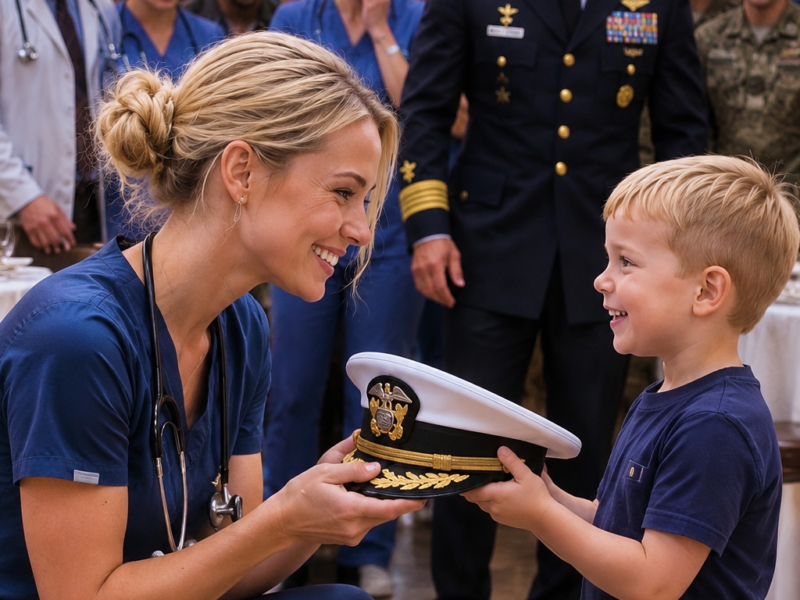
His small hands were holding the navy cap he had carried all evening.
“Robin?”
Kate lowered herself to his eye level.
“Yes, sweetheart?”
Toby held out the cap.
“This is my dad’s old cover.”
Kate looked at it.
The gold braid caught the light from the chandelier. A small eagle insignia sat at the front, its edges worn smooth from years of handling.
“He gave it to me for my birthday,” Toby explained. “I always liked it.”
Kate smiled.
“It’s beautiful.”
“I think you should have it.”
Her expression changed.
“Oh, Toby. I can’t take your father’s cap.”
The boy looked confused.
“But you found me.”
Kate swallowed.
“That doesn’t mean I should take something important from your family.”
He shook his head.
“You didn’t let go.”
His voice was still weak, but the words were becoming clearer.
“You found me in the water. You told me you wouldn’t let go. I think you should have something that means you’re part of us.”
Kate looked toward Richard.
The admiral’s eyes were wet.
He nodded slowly.
“Please accept it.”
Kate looked back at Toby.
“Are you sure?”
“Yes.”
She reached out and accepted the cap carefully.
For a moment, she held it against her chest.
It was an unusual gift.
She had received commendations during her years of service. She had been praised for difficult operations and recognized for her work in dangerous conditions.
But none of those honors had ever meant as much as the small cap a seven-year-old boy had just placed in her hands.
“Thank you,” she whispered.
Toby smiled.
The applause began quietly.
One person near the back started clapping, followed by another.
Within seconds, the sound spread through the ballroom.
Four hundred guests stood applauding.
Some were crying.
The captain in dress whites instinctively came to attention. Priya stood near the bar, tears running down her cheeks as she watched her friend.
Kate felt uncomfortable.
She had never been someone who enjoyed standing in front of crowds.
But this time, she didn’t turn away.
She held the cap against her chest and allowed herself to remain there.
For three years, she had carried the memory of that rescue alone.
Now someone else knew.
Not just the admiral.
Not just the family.
Everyone in that room had seen the person behind the uniform, behind the scrubs, behind the tired expression and the worn sneakers.
They had seen what she had carried.
And for the first time in a long while, Kate felt that the weight was no longer entirely hers.
The captain approached after the applause faded.
“Petty Officer Ellison, I hope someone has told you what you accomplished that night.”
Kate shook her head.
“Not really.”
He looked at her with quiet respect.
“There are very few people who could have performed that recovery under those conditions. You should know that your actions were studied by later rescue crews because there was so much to learn from what you did.”
Kate looked down.
“I was just doing my job.”
“Sometimes doing your job means something extraordinary.”
She smiled faintly.
“Thank you.”
Whitfield approached a moment later.
“That breathing technique you used,” he said. “The controlled exhalation. I’d like to learn more about it.”
Kate looked at him.
“Of course.”
“I’d also like to review the clinical circumstances with you.”
“That’s fine. I’ll put together some notes for the pediatric team.”
Whitfield nodded.
“I would appreciate that.”
Kate didn’t hold his earlier behavior against him.
She knew that people could be wrong and still have the opportunity to learn.
Later that night, she drove home with the admiral’s cap resting on the passenger seat.
Streetlights passed across its gold braid, creating brief flashes of light inside the car.
For the first few miles, she didn’t turn on the radio.
She simply drove.
Then, three miles from the hospital, she pulled into a quiet parking lot.
She looked at the cap.
And finally, she cried.
She cried for Jack.
She cried for the little boy whose life had ended on the deck of a Coast Guard cutter while she had fought desperately to bring him back.
She cried for his mother, who had screamed his name in the rain.
She cried for Toby, who had spent three years trapped inside a memory of cold water and darkness.
And she cried for herself.
For the woman who had left the service believing that walking away would somehow make the past easier to carry.
For the nurse who had spent countless nights helping other children while silently wondering whether she had failed one child three years earlier.
She cried because the admiral had finally heard her.
Because Toby remembered.
Because Jack’s name had finally been spoken in a room where someone understood what had happened.
And because she no longer felt completely alone.
The following week, the story began spreading through the military community.
People at the base heard about the charity gala. Hospital staff heard about the little boy who had spoken after three years of silence. Officers who had once read the original rescue report began discussing the circumstances of the operation.
Some versions of the story became exaggerated.
People claimed Kate had entered the ocean without hesitation, that she had rescued an entire family single-handedly, or that she had somehow recognized Toby immediately.
Kate ignored most of it.
She wasn’t interested in correcting every detail.
The truth was already remarkable enough.
On Thursday morning, Admiral Sterling arrived at the hospital.
He wasn’t wearing his uniform.
Instead, he had on a simple gray sweater and dark trousers. Without the ribbons, medals, and four stars, he looked like an ordinary father.
Kate was finishing her morning rounds when she saw him waiting outside the pediatric unit.
“Admiral?”
He smiled.
“Richard is fine.”
Kate returned the smile.
“All right. What brings you here?”
He held up a small manila folder.
“I wanted to tell you something.”
They stepped into a quiet section of the hallway.
“Toby is talking more every day.”
Kate’s face brightened.
“That’s wonderful.”
“Not constantly. His therapists say we shouldn’t rush him. But he’s beginning to ask questions. He talks to Diane during breakfast. He tells me what he wants for dinner. Yesterday, he told his teacher that he wanted to draw a helicopter.”
Kate smiled.
“That’s a good sign.”
“He also asked me something I didn’t know how to answer.”
“What was that?”
“He wanted to know whether rescue swimmers get scared.”
Kate laughed softly.
“What did you tell him?”
“I told him I assumed they were brave.”
She shook her head.
“Every single one gets scared. Anyone who tells you otherwise has probably never been in the water.”
Richard smiled.
“I thought you might say that.”
He opened the folder.
“I also looked into your service record.”
Kate raised an eyebrow.
“You did?”
“I hope you don’t mind. I wanted to understand what happened after the rescue.”
He removed several documents.
“Your commendation review was started but never completed. You left the service before the paperwork went through.”
Kate glanced at the documents.
“I remember.”
“Why didn’t you follow up?”
She shrugged.
“At the time, it didn’t seem important.”
Richard looked at her.
“You brought my children out of a storm. I would have thought recognition mattered.”
Kate considered the question.
“Maybe it did once. But after Jack died, a medal didn’t seem like much of an answer.”
Richard nodded slowly.
“I understand.”
He closed the folder.
“I’d like to reopen the review.”
Kate looked at him.
“Why?”
“Because Jack deserves the truth to be recorded. And because the people who read that report should know who was in the water that night.”
He paused.
“For three years, I hated a name I didn’t know. I’d like the official record to carry that name for the right reasons.”
Kate remained quiet.
She thought about the rescue.
She thought about the other Coast Guard members who had worked through the storm, the helicopter crew that had kept the aircraft in position, and the corpsman who had helped her perform CPR.
She thought about all the rescue swimmers who entered dangerous water and returned home carrying memories that nobody could see.
“All right,” she said finally.
Richard smiled.
“Thank you.”
“But not for a medal.”
“Then why?”
“For Jack. And for the people who do that work. The ones who come home and don’t always know what to do with everything they’ve seen.”
Richard nodded.
“I think that’s a very good reason.”
A few weeks later, another opportunity appeared.
The chief of pediatric trauma at Kate’s hospital, Dr. Anand, asked her to meet for coffee.
Dr. Anand was a quiet, thoughtful woman who had spent most of her career studying the effects of traumatic experiences on children.
She had heard about the gala, but she was more interested in something she had personally observed.
“Kate, I’ve watched you work,” she began. “I’ve seen how you approach frightened children. You don’t rush them. You don’t demand explanations. You notice the things other people miss.”
Kate stirred her coffee.
“It’s part of the job.”
“It should be part of everyone’s job. Unfortunately, it isn’t.”
Dr. Anand explained that the hospital was developing a pediatric crisis-response program.
The program would focus on helping children with trauma histories during medical emergencies. It would train nurses, doctors, and other healthcare professionals to recognize signs of panic, understand how previous experiences could influence a child’s behavior, and respond without making the situation worse.
“I’d like you to help design the training,” Dr. Anand said.
Kate looked surprised.
“Me?”
“Yes.”
“I’m not a psychologist.”
“I know.”
“And I’m not a physician.”
“I know that too.”
Dr. Anand smiled.
“But you have something valuable. You understand what it means to read a frightened person’s behavior when they can’t explain what they’re experiencing. You’ve done it in the water, and you do it here every day.”
Kate looked out through the staff lounge window.
She thought about Toby.
She thought about his eyes across the ballroom.
She thought about all the children she had encountered who had been labeled difficult, uncooperative, or withdrawn when they were actually terrified.
“Would I still be working on the floor?”
“Absolutely. I don’t want you to stop being a nurse. I want you to help other nurses become better at what they do.”
Kate smiled.
“I’d like that.”
Dr. Anand leaned forward.
“Good. Because I think we need more people who understand that a child’s silence is not always an absence of communication.”
Kate nodded.
“Sometimes it’s the loudest thing in the room.”
The program began several months later.
Kate helped develop training sessions based on situations she had encountered during her years in emergency medicine and rescue work.
She taught staff how to approach frightened children without overwhelming them, how to recognize the physical signs of panic, and how to use calm, clear communication during moments of distress.
She never presented herself as someone who had all the answers.
Instead, she shared the lessons she had learned through experience.
She talked about Toby.
She talked about the night at sea.
And, eventually, she talked about Jack.
It was difficult at first.
But each time she spoke about him, the memory became slightly easier to carry.
The admiral’s commendation review also moved forward.
The Coast Guard and Navy exchanged records, and the original after-action report was reviewed in greater detail.
The report described the extreme weather conditions, the multiple recoveries, the limited visibility, and the rescue swimmer’s decisions under pressure.
It recorded the survival of Toby and his mother.
It also recorded the recovery of Jack and the unsuccessful resuscitation attempt.
For the first time, the document included the full name of the woman who had entered the water.
Katherine Ellison.
Kate didn’t ask for a ceremony.
She didn’t request publicity.
She simply wanted the truth preserved.
The admiral understood.
He visited the hospital several more times, usually bringing updates about Toby.
Sometimes he brought photographs.
There was one of Toby standing beside a school project about the Coast Guard. Another showed him holding a toy helicopter. In one picture, he was laughing with his mother in the backyard.
Each time Kate saw him, he seemed a little more like the child he had been before the accident.
His speech was returning gradually.
There were difficult days, and sometimes he became quiet again.
But the family had learned not to panic.
They no longer treated every silence as a failure.
They had begun to understand that recovery was not a straight line.
One afternoon, Richard brought Kate a small framed photograph.
It showed the family before the accident.
Jack stood behind Toby, one hand resting on his younger brother’s shoulder. Toby was laughing at something outside the frame. Diane stood beside them, smiling, while Richard had one arm around both boys.
Kate studied the photograph for a long time.
“Jack looks like he was a wonderful big brother.”
Richard nodded.
“He was.”
“He would have been proud of Toby.”
The admiral looked down.
“I think so too.”
He paused.
“I used to avoid looking at pictures of them together. It hurt too much.”
Kate gently placed the photograph on the table.
“Sometimes remembering is painful because it means we loved someone.”
Richard nodded.
“I think I’m beginning to understand that.”
Six months after the gala, Kate received an invitation from Diane.
It wasn’t for another formal event.
It was a simple message asking whether she would like to join them for a Saturday morning at the beach.
Kate almost declined.
She hadn’t been near the ocean recreationally since leaving the Coast Guard.
She still remembered the smell of saltwater and the sound of waves striking the helicopter’s metal frame.
But something made her accept.
That Saturday morning, the sky was bright and clear.
The beach was quiet, with families walking along the shoreline and children running through the shallow water.
Kate arrived wearing ordinary clothes.
No uniform.
No hospital badge.
No rescue equipment.
Just a simple jacket, jeans, and sneakers.
Diane spotted her first and waved.
Richard stood beside her, holding a paper cup of coffee.
And Toby was running along the wet sand.
He looked different.
He was still small, but his posture had changed. He no longer watched every movement with the same fearful intensity. His shoulders were relaxed, and his laughter came easily.
When he noticed Kate, he stopped.
For a moment, he simply stared.
Then his face lit up.
“Robin!”
He ran toward her.
Kate crouched just in time to catch him in a hug.
“Hey, sweetheart.”
Toby wrapped both arms around her neck.
“I knew you would come!”
“I promised, didn’t I?”
He nodded enthusiastically.
“Look what I can do!”
He pulled away and ran toward the water, stopping just before the waves reached his shoes.
Then he turned around.
“Can I go closer?”
Diane looked at Kate.
Kate looked at Toby.
“Only if your mom says it’s okay.”
Diane smiled.
“Just to the shallow part.”
Toby ran toward her, laughing.
A small wave rolled across the sand and touched his feet.
He jumped back, then laughed again.
Richard stood beside Kate.
For several minutes, neither of them spoke.
They simply watched the boy enjoying the morning.
Finally, the admiral said, “I’ve been thinking about what you told me at the gala.”
“Which part?”
“That neither of us needed to prove whose grief was heavier.”
Kate nodded.
“I remember.”
“I spent so long trying to find someone to blame that I almost forgot what I still had.”
He watched Toby chase another wave.
“I can’t bring Jack back. Nothing will change that. But I can make sure Toby grows up knowing that his brother mattered. And that the woman who saved him was never his enemy.”
Kate felt her throat tighten.
“Jack mattered,” she said.
“I know.”
“And he always will.”
Richard nodded.
Then he looked at her.
“I also wanted to tell you something. Toby has started talking about what happened that night. Not every detail. Just little things. He remembers your voice. He remembers holding on to your arm. He remembers you telling him that Robin had him.”
Kate looked toward the water.
“He remembered all that?”
“Yes. His therapist says those memories are important to him. They’re no longer just something frightening. They’re becoming part of a story he can understand.”
Kate smiled.
“That’s wonderful.”
Richard hesitated.
“He’s been asking whether he can call you Robin.”
Kate laughed softly.
“He can call me whatever he likes.”
Richard smiled.
“I thought you’d say that.”
A few minutes later, Toby returned, his shoes damp and his cheeks flushed from running.
He stood in front of Kate.
“Robin?”
“Yes?”
“Are you still a rescue swimmer?”
Kate shook her head.
“Not anymore. Now I’m a nurse.”
“Do you still save people?”
She looked at him.
“Every day, I try.”
Toby thought about that.
Then he nodded as though the answer made perfect sense.
“Good.”
He reached for her hand.
“Because you’re good at it.”
Kate smiled and squeezed his fingers.
The three of them walked along the shoreline together.
The sun reflected across the water, turning the waves silver.
For the first time in three years, Kate stood beside the ocean without feeling that it was pulling her backward into the past.
She could remember the storm.
She could remember Jack.
She could remember the terrible cold and the eleven minutes that had followed her through every night.
But she could also hear Toby laughing.
She could see the boy who had survived.
And she could understand something she had not understood before.
Some rescues did not end when a person was lifted out of the water.
Sometimes they continued for years, through memories, nightmares, silence, and the difficult work of learning how to feel safe again.
Sometimes the person who saved a life needed saving too.
Not from the ocean, but from the weight of believing they had to carry everything alone.
Kate had entered that ballroom expecting nothing more than ten minutes with a friend.
She had expected to be judged for her worn scrubs, her tired face, and her lack of formal clothing.
She had not expected to encounter the family she had once pulled from a storm.
She had not expected a little boy to remember her call sign.
And she certainly had not expected the man who had dismissed her as an ordinary nurse to become the person who would help her finally confront the past.
Yet that was exactly what happened.
The admiral had learned that a uniform did not tell him everything about the person wearing it.
Dr. Whitfield had learned that experience could exist beyond the titles and credentials he recognized.
Diane had learned that her son’s silence had never meant his memories were gone.
Toby had learned that the person who found him in the darkness had not forgotten him.
And Kate had learned that surviving a terrible night did not mean she had to spend the rest of her life punishing herself for everything she could not control.
The navy cap remained on a shelf in her apartment.
She placed it near the kitchen window, where the morning sunlight caught the gold braid and made the small eagle insignia shine.
She never put it away in a drawer.
It was not a trophy.
It was not a symbol of rank or authority.
It was a reminder.
A reminder of Jack, whose life had ended too soon.
A reminder of Toby, who had found his voice again.
A reminder of a family that had finally begun to heal.
And a reminder that sometimes the most extraordinary people are the ones who never ask anyone to notice them.
Kate continued working on the pediatric floor.
She still arrived early.
She still drank too little water.
She still wore practical sneakers and tied her hair into a loose bun before beginning her shift.
She still knelt beside frightened children and spoke to them as though they were the most important people in the world.
But something had changed.
She no longer felt that she had to hide the years she had spent in the Coast Guard.
When new nurses asked about her experience, she told them.
When someone wanted to understand how to approach a frightened child, she shared what she had learned.
And when a difficult night reminded her of the past, she allowed herself to remember Jack without immediately searching for something she might have done differently.
She had saved Toby.
She had tried to save Jack.
Both truths belonged to the same night.
Neither erased the other.
And perhaps that was the most important lesson of all.
A person could do everything within their power and still experience a heartbreaking loss. A person could make the best decision available and still spend years questioning it. And a person could carry enormous pain while continuing to show kindness to others.
The world might never know what someone had survived simply by looking at them.
The woman in worn scrubs might once have entered a violent ocean to rescue a child.
The quiet nurse in the corner might have faced situations that would overwhelm people who considered themselves brave.
The person everyone overlooked might be the very person who could change everything when the moment arrived.
Admiral Richard Sterling had spent three years believing that the stranger who rescued his son had taken something from him.
Instead, he discovered that she had spent those same three years carrying the memory of his family, including the child she had been unable to save.
And when he finally learned her name, he discovered that the person he had blamed was also the person who had never stopped remembering Jack.
There had been no perfect ending to that night at sea.
There never could be.
Jack was still gone.
The storm had still taken him.
No apology, commendation, or reunion could change that.
But Toby was alive.
His voice had returned.
His family was beginning to heal.
And Kate was finally allowing herself to live beyond the eleven minutes that had once defined her.
One afternoon, several months after the beach visit, Toby sent Kate a drawing through his mother.
It showed a helicopter above a dark blue ocean.
A tiny figure stood in the water beside a child wearing a yellow life jacket.
Above them, in uneven handwriting, Toby had written:
“ROBIN FOUND ME.”
Kate placed the drawing beside the admiral’s cap.
She looked at it for a long time.
Then she smiled.
Because the little boy had remembered.
And this time, the memory no longer belonged only to the darkness.
It belonged to the morning that came afterward.
Some heroes are recognized through medals, ceremonies, and speeches delivered beneath bright lights. Others are recognized through the quiet gratitude of a child who remembers the voice that told him he was safe when the entire world seemed to be falling apart.
Kate Ellison had never needed a ballroom full of strangers to prove what she was capable of.
She had known what she had done in the water.
She had known what she had lost.
But what she had not known was how much she needed someone else to finally understand.
And perhaps that was why Toby’s whisper had meant so much.
He had not simply recognized a woman from a frightening memory.
He had remembered the person who had refused to let go.
Three years earlier, she had entered the ocean believing her only responsibility was to save whoever she could find.
Three years later, she had walked into a ballroom believing she was simply a tired nurse who needed to keep a promise to a friend.
Between those two moments lay a story of courage, grief, misunderstanding, and forgiveness.
And in the end, the most important thing she carried home was not the gold braid of an admiral’s cap or the recognition of four hundred strangers.
It was the knowledge that the little boy she had once held against the violent waves could now stand in the sunlight, laugh without fear, and call her name.
“Robin.”
A name that had once been painted on a rescue helmet.
A name spoken by a frightened child in the darkness.
And a name that, after three long years, had finally become a symbol of something other than survival.
It had become a symbol of coming home.









