I Told My DIL I Had an Early Flight. At Midnight, My Door Slowly Opened…
I Told My DIL I Had an Early Flight. At Midnight, My Door Slowly Opened…
My name is Harleen Eakins, and I am seventy-one years old. I have spent most of my adult life believing that the truth has a way of finding its way back to the surface, no matter how carefully someone tries to bury it. I spent thirty-five years working as a museum registrar, documenting priceless objects, preserving their histories, and making certain that nothing disappeared without leaving a record behind. I learned early that people could lie, memories could fail, and even the most trustworthy individuals could disappoint you. But paper, photographs, dates, and carefully maintained records had a way of telling the truth when everyone else refused to.
What I never expected was that one day I would have to use everything I had learned to protect myself from someone living under my own roof.
It happened on a Saturday night in September. I had told my daughter-in-law, Krista, that I had an early flight the following morning. My sister, Neva, was turning seventy-five, and I had booked a flight from Columbus to Tucson for her birthday celebration. I told everyone I would be leaving before sunrise, packed my navy-blue carry-on, and went to bed at twenty minutes before ten.
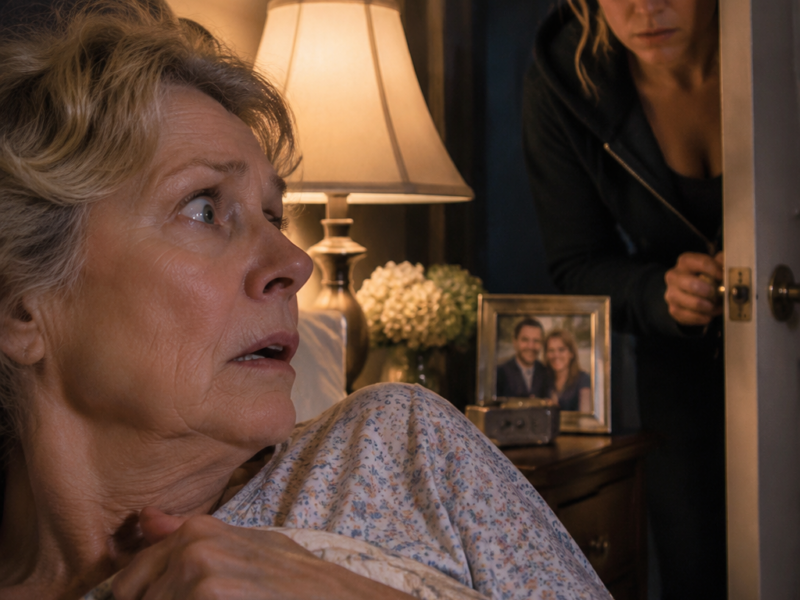
At exactly two minutes before midnight, I heard the brass doorknob of my bedroom slowly turn.
I did not open my eyes.
The door creaked just enough to let a narrow strip of hallway light fall across the bedroom carpet. Someone stepped inside, moving carefully, trying not to make the old floorboards complain. I recognized the soft footsteps almost immediately.
It was Krista.
I kept my breathing steady and pretended to be asleep. Through my nearly closed eyelids, I watched her cross the room toward the luggage rack where my suitcase was sitting.
She knelt beside it.
First came the sound of the main zipper opening. Then I heard the smaller zipper of the inner pocket. She paused for a moment, as if checking whether I had moved, and then something heavy was placed inside.
She zipped everything shut.
A few seconds later, she stood in the doorway with her phone pressed against her ear.
Her voice was barely above a whisper.
“It’s in her carry-on. Tip off airport security at six.”
She listened.
“Not before six. She has to get through security first.”
Another pause.
“Use the shop phone. Say it came from the museum.”
Then she lowered her voice even further.
“I know. Me too.”
The door closed.
I lay perfectly still, staring at the darkness in front of me. I counted my breaths until I reached four hundred. I had no idea what she had put in my suitcase, but I knew one thing with absolute certainty.
My daughter-in-law had just arranged for me to be accused of something at an airport.
And whoever was helping her had a shop.
Before I explain what happened that morning, you need to understand how I ended up living in a house with a woman who would do something like that.
I was born in Ohio and spent nearly my entire life in the same small county. My house on Fourth Street was built in 1924, with narrow hallways, wooden floors, brass doorknobs, and windows that rattled whenever the wind came from the north. It was never a particularly grand house, but it was mine. Every corner contained some memory, and every room had a story attached to it.
My husband, Lenny, left me in 1986 when our son, Garrick, was only two years old. He took the family car, the good skillet, and most of the money in our joint checking account. He left behind a toddler, a stack of unpaid bills, and a woman who suddenly had to figure out how to become two parents at once.
I never remarried.
Instead, I worked.
In 1983, when I was twenty-eight, I started as a part-time typist at the Tolbert County Historical Museum in Quarrels Mill, Ohio. My job involved typing catalog cards on an old electric typewriter that seemed to jam whenever I was in a hurry. The pay was just over four dollars an hour, but I liked the work.
I liked knowing that a century-old teacup had a name, a history, and a proper place. I liked the quiet order of the collection rooms and the feeling that I was helping preserve things that might otherwise disappear.
After Lenny left, I began taking night classes. For five years, I studied after work, often sitting at the kitchen table while Garrick slept on the couch beside my textbooks. I completed my degree in 1991.
By then, I had already become the museum’s registrar.
The woman who held the position before me retired, and nobody else in the building knew the collection well enough to take over. I accepted the responsibility, and over the next thirty-five years, I learned every drawer, every cabinet, every accession number, and nearly every story attached to the objects in our care.
A registrar is not simply someone who keeps a list.
A registrar knows where an object belongs, what it is, when it arrived, who donated it, how it was handled, and whether anyone has permission to move it. Every important detail must be documented. If something disappears, there must be a record of when it was last seen and who was responsible for it.
I retired in June 2022, at sixty-seven, although I never completely stopped working. I still volunteered at the museum on Tuesdays and Thursdays. Old habits are difficult to abandon, particularly when those habits have been the foundation of your entire life.
My son Garrick grew into a good man, or at least I believed he had. He worked as a maintenance supervisor at a large distribution center near the interstate. He married Krista, and together they had two children, Kaylee and Chase.
Kaylee was nine. Chase was six.
In January 2025, the four of them moved into my house. They told me they needed somewhere inexpensive to live while they saved enough money for a down payment on their own home. The arrangement was supposed to last one year.
I agreed because I loved my grandchildren, and because I remembered how difficult it had been to raise Garrick alone.
My quiet old house became a noisy family home almost overnight. Toys appeared in the living room, cereal boxes multiplied in the kitchen, and someone was always asking where the television remote had gone.
I didn’t mind.
I enjoyed hearing children running through the hallway again.
Krista also worked at the museum. She had been hired as a collections assistant in February 2024, after telling me that her small business was struggling and that she desperately needed something stable.
She had come to me one afternoon with tears in her eyes.
“Nobody’s ever trusted me with anything real,” she had said.
I believed her.
I personally recommended her to the museum director, Elwood Farrell, and helped her get the position. I taught her how to handle delicate objects, how to prepare storage materials, and how to document the movement of historical pieces.
She was intelligent and patient. She had steady hands, and I genuinely believed she could become very good at the work.
I had no idea I was training someone who would eventually steal from the very collection I had spent decades protecting.
The trouble began with a drawer.
On Thursday, September 10, a researcher from Dayton contacted the museum requesting photographs of an old sewing kit from the 1860s. I went down to the basement to retrieve it.
I always carried a pair of white cotton gloves in my purse. I had done so for thirty-five years. Human skin contains oils and salts that can slowly damage old metal, paper, and other delicate materials. Wearing gloves had become second nature to me.
Drawer fourteen contained small objects from the 1860s. Each item had its own precisely cut cavity in a sheet of gray archival foam.
When an object was in its proper place, the foam seemed ordinary. But when something was missing, the empty cavity became a perfect silhouette of whatever had once rested there.
That afternoon, I opened the drawer and immediately noticed three empty spaces.
One was curved at one end. Another was circular. The third was long and narrow, with squared corners.
I knew all three objects.
I checked the location records twice. None had been signed out, placed on display, or sent to a conservator.
I searched the nearby cabinets and checked the temporary storage shelves.
Nothing.
Missing did not automatically mean stolen. In a museum, missing simply meant there was a question that needed an answer.
I had spent my career answering such questions. Most of the time, the explanation was ordinary. Someone had returned an object to the wrong drawer, forgotten to update a record, or moved something temporarily without completing the paperwork.
At 3:05, I found Krista upstairs.
“Three pieces are missing from drawer fourteen,” I told her.
Her coffee cup stopped halfway to her mouth.
“Which ones?”
I gave her the descriptions.
“I’ll inform Elwood,” she said. “That’s the policy.”
She was right. Any suspected loss had to be reported to the museum director before anyone else was notified.
Elwood Farrell had been the director since January 2024. He was fifty-eight, careful, professional, and genuinely interested in preserving the collection. I trusted him.
I emailed him the list at 4:12.
His response arrived just after five.
He said he wanted a full inventory of the study collection on Monday, September 21.
I remember finding it slightly unusual that Krista had asked which objects were missing, considering she worked with the collection every day.
But I dismissed the thought.
People forget things. People get distracted. I had no reason to suspect her.
The following evening, Krista’s mother came to dinner.
Her name was Twila Truax, and she was sixty-four years old. She had spent twenty years selling antiques from a small shop in her converted garage, from a white van, and from a booth at the county’s annual fall antique show.
Twila and I had never been particularly friendly.
Our disagreement went back to May 2021, when she offered the museum a Civil War cavalry sword for six thousand dollars.
I examined it carefully.
The brass hilt had a manufacturing seam that had been filed down but not completely removed. The blade had machine-etched markings. It was not a Civil War weapon at all. It was a souvenir reproduction made during the 1960s for the centennial commemorations.
The museum declined the offer.
Unfortunately, someone on the board mentioned the incident to a member of the local Legion Auxiliary, and within a few weeks, half the county knew that Twila had tried to sell a gift-shop reproduction as an authentic historical sword.
One of her regular customers stopped buying from her.
She blamed me.
I never apologized for identifying the sword correctly.
At dinner that Friday, Twila arrived carrying a store-bought pie. She kept her coat on for the first ten minutes, as she often did in my house.
She smiled at me with her mouth but not her eyes.
“Still the expert, Harleen?” she asked.
“Still retired, Twila,” I replied.
Then she asked about my trip.
It struck me as unusual because Twila had never shown much interest in my personal life.
I told her I was flying from Columbus to Phoenix early Sunday morning, then continuing to Tucson, where Neva would collect me.
“Six-fifty?” she asked.
“That’s right.”
“Carry-on only?”
“Yes. At my age, I’ve learned not to bring more than I need.”
She nodded thoughtfully.
“Smart.”
Krista was unusually attentive throughout dinner. She offered to drive me to the airport at four in the morning, but I told her I intended to park in the long-term lot.
Garrick ate two servings of pot roast and fell asleep in the recliner before dessert.
When Twila finally put on her coat, she looked directly at me.
“Some of us sell honest things, Harleen.”
I understood the insult.
I also understood that arguing with her would accomplish nothing.
On Saturday, I packed my suitcase.
It was a navy-blue carry-on with four wheels, a birthday present from Neva in 2019. She had bought it after deciding I was too old to keep wrestling heavy duffel bags through airports.
It had a large main compartment and a smaller inner pocket with its own zipper. That pocket was intended for a passport, although I rarely used it. My identification and boarding pass were always kept in my purse.
Around six that evening, Krista appeared in my bedroom doorway.
“Which bag are you taking, Harleen?”
“The navy one.”
“Just checking. In case you need help carrying it tomorrow.”
I thanked her.
At 9:30, Garrick left for his night shift. He worked Saturday nights because the distribution center paid an additional dollar fifty an hour for that shift.
Before leaving, he kissed the top of my head.
He had done that since he was nine years old.
At 9:40, I stood in the kitchen doorway and told Krista I was going to bed.
“I have an early flight.”
“Sleep tight, Harleen.”
I went upstairs, set my alarm for 3:30, and turned off the lamp.
I did not sleep well.
Old houses make noises throughout the night. My furnace ticked, the pipes shifted, and the wooden floors occasionally creaked as the temperature changed.
Around eleven, I heard Krista speaking quietly on the telephone in the kitchen. I couldn’t understand her words, but her voice sounded worried.
Then, at 11:58, the bedroom doorknob turned.
What happened next was the moment everything changed.
I heard her open my suitcase, place something inside, and make that phone call.
When the door finally closed, I remained still until I was certain she had returned to her bedroom.
At 12:50, I sat up.
I turned on the small reading lamp, pointing it toward the floor so that the light would not shine underneath the door.
Then I took my white cotton gloves from my purse and put them on.
I opened the inner pocket.
Inside was a gray man’s work sock.
Two letters had been written on the cuff in black laundry marker.
G.E.
Those were my son’s initials.
I labeled the work socks in our house so they would always return to the correct drawer after washing.
I stared at the sock for several seconds before carefully examining what was inside.
It was a small antique pocket pistol, approximately four and a half inches long, with a walnut grip and a brass frame darkened by age.
It was a two-shot firearm, manufactured around 1866.
I knew it immediately.
The pistol belonged to the museum.
It was the small curved object missing from drawer fourteen.
There was supposed to be an accession number painted in white on the bottom of the grip. Someone had sanded that area down to bare wood.
That alone told me something important.
The number had not disappeared through ordinary wear. Someone had deliberately removed it.
But there was another marking.
Inside the curve of the trigger guard, in a place where nobody would normally think to look, were three tiny red characters.
44.2.
My handwriting.
I had written those characters myself in 1988.
I did not pick up the pistol. I did not touch its mechanism. I placed a small sewing ruler beside it for scale and took six photographs with my phone.
The first photograph was timestamped 12:58 a.m.
Then I sat on the bedroom rug and thought.
Krista had placed a stolen museum firearm in my suitcase. Someone was planning to call airport security at six in the morning. The caller would apparently claim the weapon came from the museum.
The plan was painfully obvious.
A seventy-one-year-old woman would arrive at the airport carrying an unregistered firearm that had been reported missing from a historical museum. The police would discover it, and the evidence would appear to point directly at me.
Meanwhile, the museum’s full inventory was scheduled for September 21.
By then, the three missing objects from drawer fourteen would have become part of a much larger investigation.
And because I had worked there for thirty-five years, people would naturally ask whether I had used my access to steal them.
I considered calling emergency services immediately.
But Kaylee and Chase were sleeping across the hallway. I did not want to wake them with shouting, police officers, and a confrontation at one in the morning.
There was also the possibility that Krista might return and remove the pistol before anyone arrived.
I had spent thirty-five years learning how to preserve evidence.
The rule was simple.
Do not disturb an object unnecessarily. Document what you see. Preserve its condition. Deliver it to the proper authorities.
So I closed the pocket, left the suitcase where it was, and waited for my alarm.
At four in the morning, I rolled the suitcase down the hallway.
There was a line of light underneath Krista’s bedroom door.
I did not stop.
I drove toward Columbus but turned north instead, heading to Haskett, the county seat, about twenty-two minutes from my home.
The sheriff’s office maintained an overnight lobby behind a thick glass partition.
At 4:41, I approached the desk and spoke to a young deputy named Garrison.
He had a short haircut and a coffee mug that read World’s Okayest Uncle.
“There’s a firearm in my suitcase that isn’t mine,” I told him. “It belongs to the museum.”
He stared at me for a moment.
Then he looked at the suitcase.
He came around through the side door wearing gloves, which immediately improved my opinion of him.
He placed the suitcase on a bench under the bright lobby lights and opened the inner pocket.
When he removed the gray sock, the room seemed to become very quiet.
“Where did you find this, ma’am?”
“In my suitcase. At 12:50 this morning.”
“You touched it?”
“No. I photographed it, but I didn’t handle the firearm. I’d like that included in the report.”
I showed him the six photographs.
Then I explained everything.
The bedroom door. The zipper. The whisper. The phone call. The instruction to contact airport security at six.
I filled out the statement form in block capitals, the way I used to complete museum loan agreements.
At the top, I wrote the pistol’s complete accession number.
1979.44.2.
Deputy Garrison gave me a case number.
Before he finished, I mentioned one additional detail.
“Someone is going to call the airport police at six.”
He looked at me.
“How do you know that?”
“Because I heard her say it.”
I bought a coffee from the vending machine and sat in the lobby.
I did not drink it.
At 6:31, Deputy Garrison returned.
His expression had changed.
“The airport police just contacted us,” he said.
At 6:04, someone had called the Columbus airport police and reported that an older woman traveling on the 6:50 flight to Phoenix was carrying a stolen firearm from the county museum.
The caller claimed the woman was leaving the state with it.
Airport security checked the passenger information.
No such passenger had checked in.
Because the report specifically mentioned our county, the airport police contacted the sheriff’s office.
I looked at the deputy.
“It’s almost exactly what I told you.”
He glanced at the clock.
“Your report was filed at 4:41.”
“That’s eighty-three minutes before the call.”
He nodded.
“Yes, ma’am.”
“My flight was supposed to leave at 6:50.”
It left without me.
I called my sister, Neva, and told her I would not be arriving that morning.
She was quiet for a moment.
“Oh, Harley. Are you safe?”
I told her I was.
At 7:15, Detective Sergeant Mercy Havercamp arrived.
She was forty-six, wore reading glasses on a beaded cord, and had the kind of handshake that made you believe she could repair a tractor if necessary.
She read my statement twice and studied every photograph.
Then she asked me for one favor.
“Don’t speak to your family about this today. Not one word.”
I agreed.
At 9:02, my phone buzzed.
It was a message from Krista.
“Did you make your flight?”
She had added a little yellow heart.
I did not respond.
Instead, I drove to the farmhouse of my oldest friend, Velma Shoop.
Velma had taught fourth grade for thirty-four years. We had been friends since 1986, when Lenny left and she brought over a casserole. She stayed that evening until Garrick fell asleep.
She opened her front door before I could knock.
She was wearing her robe, and her old beagle immediately placed his chin on my shoe.
Velma did not ask unnecessary questions.
She put the kettle on, made tea, and allowed me to sit quietly at her kitchen table.
For the first time that morning, I felt exhausted.
I kept thinking about February 2024, when Krista had come to me crying about her failing business.
I had believed her.
I had personally introduced her to Elwood, recommended her for the museum position, and taught her everything I knew about handling the collection.
I had shown her how to cut foam so an object would fit securely into its storage cavity. I had taught her to use archival materials and keep accurate records.
I had trained the hands that emptied my drawers.
That was the thought I couldn’t escape.
At 11:40, Detective Havercamp called.
“Your museum director has something you need to hear. Can you be somewhere at one?”
“I’m at Velma’s kitchen.”
“Good. Stay there.”
Elwood arrived at 12:58, wearing a bow tie because he had come directly from church.
He sat at Velma’s table and folded his hands.
Detective Havercamp asked him to explain.
“At 7:30 this morning, the sergeant called me at home,” he began. “She read me an accession number. 1979.44.2.”
“That’s ours,” I said.
“That’s what I told her.”
He explained that the detective had asked him not to discuss the matter with anyone.
He had agreed.
Then, at 8:34, Krista called his personal phone.
Elwood had never received a weekend call from her during the entire time she had worked at the museum.
He had been so concerned about the conversation that he emailed the detective seven minutes after hanging up.
He read the message aloud.
“Elwood, I’m so sorry. Harleen got caught at the airport with the little pistol from drawer fourteen.”
Velma slowly placed the mustard jar on the table.
Nobody spoke.
I looked at Elwood.
“She said that?”
He nodded.
“Exactly.”
The problem was that nobody had told Krista about the pistol.
The sheriff’s office had informed Elwood that a museum firearm had been recovered. They had not told him anything about an airport arrest because there had been no arrest.
They had not mentioned drawer fourteen.
And they certainly had not told him that the weapon was small.
Only someone who knew what had been placed inside my suitcase could have supplied those details.
Detective Havercamp removed her glasses.
“Guilty people sometimes get ahead of the story,” she said.
That afternoon, my phone continued buzzing.
At 2:15, Krista messaged me again.
“Haven’t heard from you. Everything okay?”
At 4:40, another message arrived.
“Garrick’s worried. Please call us.”
At six, Garrick finally called himself.
His voice was tired. He had slept most of the day after his shift.
“Mom, where are you?”
“At Velma’s. I’m fine.”
“Why aren’t you at the airport?”
“I didn’t fly.”
“Why not?”
“I’ll explain tomorrow, honey. I promise.”
He sighed.
“Krista’s been crying all day. She thought you got arrested.”
I watched Velma’s dog chasing something in his sleep.
“Why would she think that?”
There was a long silence.
“She said she had a feeling.”
I nearly laughed, but I stopped myself.
Feelings do not know which drawer a pistol came from.
I told him I loved him and promised to see him soon.
That night, I slept in Velma’s spare bedroom.
The following morning was Neva’s seventy-fifth birthday. I had already missed the celebration, but I refused to miss the phone call.
At ten, Detective Havercamp went to the museum to speak with Krista.
At one, she called me.
Krista had given her an explanation.
It was tidy, rehearsed, and almost convincing.
According to Krista, she had seen me place something wrapped in a sock inside my suitcase on Saturday evening. She said she thought nothing of it at the time.
Then, shortly before midnight, she supposedly became worried.
She checked my suitcase and discovered the pistol.
Rather than wake me, she panicked and contacted her mother. Twila, she claimed, had then contacted airport security because she wanted to protect the museum.
Krista also explained that her call to Elwood was simply an attempt to make certain he heard the news from someone in the family.
She claimed she had known the object was a pistol because she had seen it herself.
The detective listened to the entire story.
Then she looked at me.
“She says she was frightened.”
I thought about the quiet way Krista had entered my bedroom. I remembered her carefully opening the inner pocket and placing the sock inside.
“She had plenty of opportunities to tell me,” I said.
“I know.”
“She could have called the police herself.”
“Yes.”
“But she waited until the exact moment I was supposed to be at the airport.”
The detective nodded.
“Her story is tidy. Tidy doesn’t mean true. Right now, it’s your word against hers, and she’s still working at the museum.”
I knew then that the investigation was going to be more complicated than I had hoped.
I returned home that evening because I had promised Garrick an explanation.
All three of them were sitting at my kitchen table when I entered.
Garrick.
Krista.
And Twila, who still had her coat on.
Krista stood immediately.
“I covered for you for months,” she said.
I put my purse on the counter.
“Told them what?”
She stared at me.
“You know what.”
Twila leaned back in her chair.
“Like the sword, Harleen. You always know what’s real, except when it’s you.”
I did not argue.
Instead, I explained everything to Garrick in four sentences.
Krista had entered my bedroom at midnight.
She had placed the pistol in my suitcase.
I had reported it to the sheriff at 4:41.
Someone had called airport security at 6:04.
Garrick looked at his wife.
Krista began crying quietly.
He looked back at me.
I watched him make a decision.
He had two children upstairs, a frightened wife at the table, and an elderly mother standing in the kitchen.
It took him about three seconds.
Those were the longest three seconds of my life.
“Mom,” he said finally, “they’ll probably go easy on you. You’re seventy-one. You’ve never been in trouble.”
I stared at him.
“Just say you took it, Mom.”
I could hear Chase upstairs asking Kaylee whether they could watch another television show.
“I didn’t take it, Garrick. And I’m not going to say I did.”
He looked down at the table.
“Then we can’t stay here.”
I understood what he meant.
They packed for two hours.
I helped carry the children’s backpacks to the car. Kaylee held her stuffed rabbit by one ear, and Chase asked me whether Grandma was going to jail.
“No, sweetheart. Grandma is going to bed.”
Before Garrick got into the driver’s seat, I placed a hand on his arm.
“I’ll love you through anything,” I told him. “But I won’t lie for you.”
He did not answer.
He drove them to Twila’s house.
The following Tuesday, Elwood called me.
He sounded like a man reading from an official policy document.
Until the investigation was complete, both Krista and I would be placed on paid leave. My volunteer access, keys, and museum badge would be suspended.
I understood the decision.
I drove to the museum and handed over my key ring.
Nine keys.
I had carried some version of that ring for thirty-nine years.
That evening, I sat alone at my kitchen table, thinking about the pistol’s sanded grip.
Someone had removed its original identifying number because they intended to sell it.
I knew Twila was an antique dealer. I also knew dealers increasingly used online marketplaces to advertise their merchandise.
So, shortly before midnight, I opened my laptop.
I searched for antique pocket pistols from Ohio.
I scrolled through reproductions, modern replicas, and several questionable listings.
Then I found it.
The seller’s name was Twila’s Back Porch.
The description read:
“Estate fresh. Ohio farm find. Two-shot pocket pistol, circa 1866, walnut grip, lovely patina.”
The asking price was $1,450.
The listing had originally been posted on August 8.
It had ended on September 11 at 10:14 in the morning.
The day after I discovered the empty spaces in drawer fourteen.
There were six photographs.
I enlarged the fourth one.
The pistol was lying on its side, with the trigger guard facing the camera.
Inside the curve, barely visible, was a tiny red mark.
Three characters.
I recognized them immediately.
Twila had been trying to sell that pistol for more than a month before I even realized it was missing.
She had not simply helped Krista frame me after the theft.
She had been part of the theft itself.
I saved every photograph, printed the listing, and counted the other advertisements on her shop page.
There were sixty-three.
I did not sleep that night.
The next morning, I took the printouts to Detective Havercamp.
She studied the photographs carefully.
“That’s a red number,” she said.
“Yes.”
“Tell me how it got there.”
I explained the system I had created in 1988.
That year, the museum moved its entire collection into new steel cabinets. I personally rehoused all 6,412 objects over eleven exhausting months.
Every object already had an accession number, usually painted somewhere visible. But paint could be scratched away. Paper labels could fall off. And dishonest people could deliberately remove identifying marks.
So I developed a second identification system.
For every object, I wrote a tiny secondary number in red ink, hidden somewhere unlikely to be noticed.
I also recorded the exact location of each mark in the registrar’s location file.
The file had remained in the registrar’s office for decades.
“Who knows where those second numbers are?” the detective asked.
“Me and the file.”
“Not Krista?”
“No. I taught her the visible accession numbers. I never showed her the hidden markings.”
“Why not?”
I looked at her.
“A registrar plans for the day someone she trusts turns out to be wrong.”
Detective Havercamp requested preservation of the marketplace records before the seller could delete them.
By three that afternoon, she called again.
Twila’s Back Porch had disappeared from the marketplace.
The entire shop was no longer active.
They were cleaning up.
Unfortunately for them, the records had already been preserved.
The next few days were difficult.
Small towns have their own way of punishing people before the facts are established.
Twila began telling her version of events at the Legion Auxiliary lunch, then repeated it at the local hair salon.
According to her, I had been stealing museum objects for years and Krista had finally discovered the truth.
People who had known me for decades began avoiding me.
My hairdresser canceled my regular appointment, claiming she was overbooked.
A woman from my church crossed the street rather than walk past me.
Someone told my choir friend that I had always been a little too interested in the valuable objects at the museum.
I did not respond.
I did not write letters to the newspaper or confront anyone at the post office.
Twila was spending her words.
I was saving mine.
On Friday evening, Kaylee sent me a message.
She was nine years old and had not yet mastered punctuation.
“Grandma did you steal the gun”
I read it several times before answering.
“No, sweetheart. I found it in my bag. I gave it to the police.”
Three little dots appeared on the screen.
Then disappeared.
Then appeared again.
“Okay I miss you”
I held the tablet in my lap until the screen went dark.
The museum inventory took place on Monday, September 21.
Elwood arranged for two board members and a registrar from another county museum to participate. I was not allowed inside the building.
I spent the day at home cleaning an oven that was already clean.
At 5:40, Elwood called.
“Harleen, we found nineteen missing objects.”
I sat down.
Nineteen.
Three had come from drawer fourteen, including the pistol. Sixteen more were missing from other parts of the study collection.
None had been properly signed out.
The board members were concerned.
One of them, a retired banker who had always called me “our Harleen,” looked at the empty spaces and remarked that I had possessed museum keys for thirty-nine years.
The other board member did not disagree.
The insurance company wanted a copy of the police report and a separate interview with me.
I understood.
Then Elwood said something unexpected.
“I need you to look at the inventory list.”
“Why?”
“Not as a suspect. As a registrar.”
I hesitated.
“Elwood, the board thinks—”
“I know what they think. Nobody alive knows that collection like you do.”
He emailed the list.
There were nineteen lines, each containing an accession number, object description, storage drawer, and date last handled.
I read it once as a woman whose reputation had been destroyed.
Then I read it again as a registrar.
Something immediately stood out.
Every missing object was small enough to fit inside a coat pocket.
Every object was valuable.
There was a mourning brooch, a silver pocket watch, a spectacle case, a powder horn, a tintype photograph in a leather case, a child’s pewter cup, and even a cast-iron toy fire engine that had been missing one wheel since 1912.
Nothing was large.
Nothing was difficult to transport.
And every single object came from drawers nine through sixteen.
I remembered the spring of 2025.
The museum had rehoused those eight drawers in new archival foam over a five-month period.
I had been particularly proud of the project because I believed Krista had done excellent work.
I called Elwood the next morning.
“Who was assigned to rehouse drawers nine through sixteen between March and July of 2025?”
He checked the project records.
The silence on the phone lasted several seconds.
“Krista,” he finally said.
“Anyone else?”
“No. She worked on them alone.”
She had spent five months handling every object in those eight drawers.
She had cut the new foam, measured each cavity, documented the storage positions, and learned exactly which pieces were missing.
She knew which objects would not be noticed until the next complete inventory.
The thefts had not been random.
They had been planned.
And I knew where the stolen objects were likely going.
Twila had operated a booth at the county fall antique show for twenty years.
Booth forty-one.
It was located near the kettle corn stand.
I checked the dates on the flyers posted at the hardware store.
The show was scheduled for Saturday, September 26.
Five days away.
I called Detective Havercamp and told her what I suspected.
“Then we’ll need someone who knows exactly what belongs to the museum,” she said.
I understood what she meant.
On Wednesday afternoon, Garrick came to the house with Krista.
They were collecting the remainder of their belongings.
He carried boxes upstairs and downstairs without looking at me. He made eleven trips and spoke only six words, three of which were asking where the packing tape was.
Krista found me in the garage.
I was pretending to sort Christmas lights, even though it was September.
“You’ll be charged by Friday,” she said.
“Is that so?”
“Mom knows someone at the courthouse.”
“Then I’ll see you Friday.”
She crossed her arms.
For a moment, something changed in her expression.
Her chin trembled in exactly the way Kaylee’s did whenever she was about to cry.
“Do you know what forty-one thousand dollars means to people like us?”
I said nothing.
She told me about the boutique she and Twila had opened in April 2023.
It was called Second Story Vintage and occupied the old shoe store on Main Street.
The business had closed in May 2024, but they were still responsible for the remainder of the lease.
In September 2024, a judge had awarded their landlord $41,500.
Krista had never told Garrick.
That was the real reason they had moved into my house.
They had not moved in simply to save money for a down payment.
They had moved in because Krista was afraid Garrick would discover the judgment when payments began coming out of her paycheck.
“Every two weeks,” she said. “He would have seen.”
For one brief moment, I felt sorry for her.
She was a frightened woman who had made a terrible financial decision and then allowed that decision to grow into something much worse.
But sympathy could not excuse what she had done.
“Forty-one thousand dollars is a lot of money,” I said.
She wiped her eyes.
“You’ll never prove anything. You’re just a volunteer now. Nobody listens to volunteers.”
I looked at her.
“Then I suppose we’ll see.”
She walked away.
On Thursday morning, the marketplace responded to the preservation request and court order.
Twila’s online shop might have been closed, but the sales records remained.
Detective Havercamp arranged for me to examine the photographs and transaction information at the sheriff’s office.
She gave me a borrowed desk, a stack of printed records, and a pot of coffee so terrible that I wondered whether it had been sitting there since the previous winter.
Since April 2025, Twila’s Back Porch had sold eleven objects from the museum.
The total amount paid into Twila’s checking account was $14,860.
There were 312 listing photographs.
I examined every one.
For most objects, I did not even need the hidden red numbers.
I knew the dent in our brass sleigh bell as well as I knew a scar on my own child’s knee.
I recognized the silver match safe, the carved bone needle case, the old spectacle case, and several other pieces.
But whenever possible, I identified the secondary number.
In one photograph, the red ink was visible near the hinge of a match safe.
In another, it appeared as a faint pink mark beneath the lid of the carved bone needle case.
Twila’s camera had accidentally preserved details she probably did not even know existed.
By three in the afternoon, I had matched all eleven objects.
Each one received its own identification sheet.
On the left, I placed the museum’s original catalog photograph.
On the right, I placed Twila’s marketplace photograph.
I circled the hidden red number.
The detective stood behind my chair and counted the pages.
“Eleven sold,” I said. “One in your evidence room.”
“Seven left to find.”
I nodded.
“Somewhere near the kettle corn.”
That evening, the detective informed me that Twila had been seen at her storage unit loading boxes marked for the antique show.
The next phone call came from Garrick.
It was 10:15 Thursday night, and he was on a break at the distribution center.
I could hear forklifts reversing in the background.
“Mom, I’ve got ten minutes.”
“I’m listening.”
“Krista talked to her mother’s friend. If you confess, the museum won’t press charges.”
His voice cracked.
“Just say you took it, Mom. Please. For the kids.”
I closed my eyes.
I had waited eleven days for my son to ask me one simple question.
He still had not asked whether I had actually stolen anything.
So I asked him something instead.
“Garrick, what was the pistol wrapped in?”
“What?”
“A gray work sock. Men’s size. Two letters on the cuff. G.E.”
He went silent.
“I wrote those letters, honey. I wash your socks. I don’t hide pistols in them.”
Somewhere behind him, a man shouted about a pallet.
“Anybody could have taken a sock,” he finally said.
“Anybody could have,” I replied.
He hung up.
I sat in my dark kitchen for a long time.
There is a particular kind of heartbreak that comes from realizing your own child would rather believe a comfortable lie than ask an uncomfortable question.
I had raised Garrick alone. I had worked through nights, skipped vacations, and saved every extra dollar I could so he would have opportunities I never had.
And now he was asking me to confess to a crime I had reported myself.
I reminded myself of something I used to tell young museum employees.
When an object arrives damaged, you do not repair the damage by pretending it never happened.
You document what you see.
You let the evidence tell its own story.
My son was one of the pieces now.
I had to let him find his own way back.
The next evening, Detective Havercamp called.
A judge had signed the necessary warrant.
On Friday, September 25, Twila loaded her van at the storage unit. A deputy followed her to the fairgrounds.
At 6:10 that evening, the judge approved a search warrant for booth forty-one and the white van.
But the detective told me something important.
“We need you there tomorrow.”
“Why?”
“A warrant allows us to search. It doesn’t teach us what we’re looking at.”
She explained that an ordinary deputy could recognize a valuable antique, but identifying a particular museum object was different.
A powder horn might look like hundreds of other powder horns.
A mourning brooch could have dozens of similar examples.
Even the museum’s location file could not establish every detail without someone who understood the collection.
“When this gets to court,” she said, “the judge will want the person who wrote those numbers.”
I understood.
At seven that evening, Elwood came to my house.
He carried an official letter on museum letterhead, asking me to serve as the museum’s identifying witness.
He also brought a photocopy of the final page of my 1989 rehousing report.
He read one sentence aloud.
“Six thousand four hundred and twelve objects, each numbered twice.”
I stared at the page.
I had almost forgotten writing it.
Nobody else had remembered.
That was the point.
The detective had three conditions.
I was to identify objects only, wear gloves, and say nothing to Twila or Krista.
“I haven’t spoken to either of them in two days,” I said. “I can manage one more.”
That night, I arranged my things on the kitchen table.
A fresh pair of white cotton gloves.
A brass-rimmed magnifying glass inherited from the registrar before me.
A small pen flashlight.
And nineteen photocopied pages from the location file, each containing a drawing showing where the hidden number could be found.
I did not need the pages.
I knew most of the markings by heart.
But I brought them anyway.
A registrar never trusts memory alone when accuracy matters.
Paper is what you hand to someone who does not believe you.
At nine, I called Neva.
I had finally told her everything.
“Seventy-five,” I said. “How does it feel?”
“Like seventy-four with more cake.”
We both laughed.
Then she asked whether I was sleeping.
“Some.”
“Harley, you’ve always been the one who stayed awake worrying for both of us.”
“Somebody had to. You kept losing your shoes.”
She laughed again, but this time the laughter faded.
“Is it tomorrow?”
“It’s tomorrow.”
After we hung up, I read Kaylee’s message again.
“Okay I miss you.”
I read it several times.
Then I slept for four hours and dreamed about empty foam cavities.
At 7:45 on Saturday morning, I parked behind the merchants building at the Talbert County Fairgrounds.
I was wearing my navy blazer and best white blouse.
The building was a long metal structure with a concrete floor. Every year, on the last Saturday of September, it housed eighty-six antique dealers.
It smelled of old furniture polish, aged paper, dust, and kettle corn from the stand near the north entrance.
Detective Havercamp and Elwood were already waiting by the side door.
Bud Kinnaman, the seventy-year-old show manager, let us inside.
He had organized the antique show for thirty-one years and wore a canvas apron with dealer badges tucked into the front pocket.
He explained that the hall had been locked at nine the previous evening.
Only members of the fair board possessed the keys.
He also showed the detective the dealer contract.
Paragraph six required every dealer to guarantee that they had clear title to everything they sold.
Paragraph seven gave the show manager authority to close any booth at any time.
Bud had added that rule in 2015, after a dealer tried to sell a church its own candlesticks.
Booth forty-one was already arranged.
Green velvet covered the tables.
White price tags hung from objects on thin strings.
The detective wanted Twila present when the search began so there would be no later argument that something had been added or removed.
At 8:52, the side door opened.
Twila entered first, carrying a zippered cash bag.
Krista followed with a box.
Garrick came last, carrying two more boxes.
At nine, Bud opened the main doors, and the first shoppers began wandering through the building.
Twila placed her cash bag on the table and unzipped it.
The sound reminded me of the suitcase.
Then Krista looked up.
She saw me standing near the kettle corn stand.
The box in her arms stopped moving.
She did not say anything.
Detective Havercamp approached booth forty-one and showed Twila the warrant.
I could not hear every word, but Twila’s response carried across the aisle.
“This is harassment. She’s the thief!”
She pointed directly at me.
Heads turned.
A man selling fishing lures stood up. Two women carrying matching shopping bags stopped beside a butter churn. A teenager holding a funnel cake moved closer.
Within a minute, nearly forty people had gathered around the booth.
The detective nodded toward me.
I crossed the aisle.
Krista immediately spoke.
“Don’t let her touch anything. She’ll plant something!”
I did not answer.
I took the new gloves from my blazer pocket and put them on slowly, one finger at a time.
The crowd grew quiet.
At the near end of the table sat an old powder horn.
It had been polished to the color of honey, with a brass collar and wooden plug.
Its price tag read $680.
The description claimed it was an Ohio example from around 1840.
There had once been a painted accession number on its side.
1931.6.8.
Someone had scraped it away.
I knew exactly where the second number was hidden.
I looked at the detective.
“Inside the brass collar,” I said. “On the inner rim facing the plug. A red six, a dot, and an eight.”
I said it loudly enough for everyone to hear.
Then I stepped back.
The deputy approached the table wearing his own gloves. He lifted the horn and directed his flashlight toward the collar.
He turned it slowly.
Then he stopped.
“Six point eight,” he said. “In red.”
A murmur passed through the crowd.
The detective photographed the marking, the price tag, and my page from the location file.
The page had been created in 1988.
Its faded ink still showed the arrow pointing toward the exact place where the hidden number had been written.
Twila laughed.
It was not a pleasant sound.
“Coincidence,” she said. “There are a hundred horns like that in Ohio.”
“Then the next one will be a coincidence too,” I replied.
“You marked it yourself just now!”
“I haven’t touched it. Ask the deputy.”
The deputy continued examining the horn.
“She hasn’t touched anything.”
An elderly man wearing a VFW cap spoke from behind me.
“I’ve been watching her hands. She hasn’t touched a thing.”
Twila’s face turned red.
She grabbed the next object from the table and held it toward me.
“Then do this one, Miss Expert.”
It was a mourning brooch.
Black oval enamel, gold setting, and a small lock of braided brown hair beneath glass.
I recognized it.
“The back of the pin hinge,” I said. “Very small. Sixty-two point one.”
The deputy turned it over.
“There it is.”
The crowd grew louder.
I moved slowly along the table.
The brass spectacle case had its number inside the left hinge.
The silver pocket watch had a tiny mark inside the case back, near a dent beside the crown.
The tintype photograph showed a young soldier standing beside a chair. Its secondary number was beneath the corner of the velvet pad inside the leather case.
Krista was still holding the box from which the tintype had been taken.
The deputy gently removed it from her arms.
There it was.
The child’s pewter cup had its marking beneath the handle.
The cast-iron toy fire engine, missing one wheel, had its number inside the ladder bracket.
One after another, the objects matched.
Seven objects.
Seven hidden numbers.
Seven price tags totaling $3,240.
Twila was shaking now.
She grabbed another brooch and pushed it across the green velvet.
“And this one? Is this yours too?”
I examined it without touching it.
“No,” I said.
“That one isn’t ours.”
A man behind me laughed.
“She just cleared one for you, Twila!”
It was perhaps the most important thing I said that morning.
I had no interest in claiming every object on the table.
I wanted only the truth.
A liar might claim everything in sight.
I had spent my life distinguishing one object from another, and I was not about to abandon that principle because someone wanted to make me look dishonest.
That was when Krista finally lost control.
“She knows where the marks are because she put them there!”
Her voice rose sharply.
“She’s been in our house! She could have done it anytime!”
Bud took his reading glasses from his apron and put them on.
“Young lady, this hall was locked at nine last night. Fair board keys only. Nobody came in.”
“Then she did it before!” Krista shouted.
“At home! She was supposed to be at the airport! She was supposed to be—”
She stopped.
The entire building seemed to hold its breath.
I had not spoken to Krista in three days.
Now I looked directly at her.
“Krista, on Sunday, September thirteenth, at 8:34 in the morning, you called Elwood and told him I had been caught at the airport.”
She stared at me.
“Nobody was caught. Nobody told you about a pistol. Who told you it was a pistol?”
“I saw—”
“You told the detective you saw me packing it at nine the previous evening. But at midnight, you were standing in my bedroom doorway.”
Her mouth tightened.
“I was awake, Krista. I heard every word.”
I paused.
Then I repeated the sentence I had heard her whisper into the telephone.
“It’s in her carry-on.”
Krista’s face went completely still.
Detective Havercamp stepped forward and placed a printed page on the table.
It was the photograph of the online listing.
Twila’s Back Porch.
Two-shot pocket pistol.
Circa 1866.
One thousand four hundred and fifty dollars.
Posted August 8.
Ended September 11 at 10:14 in the morning.
The photograph showed the same pistol that had been placed in my suitcase.
It also showed the same green velvet tablecloth beneath it.
The detective looked at Twila.
“You were advertising this weapon in August, before anyone reported it missing.”
Twila did not turn toward the detective.
She turned toward me.
“You ruined me over a sword!” she shouted.
“A sword!”
“People laughed at me for five years!”
“It was a reproduction, Twila,” I said quietly. “I only said what it was.”
She pointed at me.
“You always have to be right!”
I looked at her.
“I have to be accurate. There’s a difference.”
Then Twila turned toward Krista.
Her voice dropped.
“You brought it back to me. You promised she’d never look in that pocket.”
Krista’s expression changed.
“You told me to put it in her bag!”
“You were supposed to do it properly!”
“Calling the airport was your idea! You wanted her in handcuffs!”
“Shut up!”
“You said they’d find a gun for sure!”
They were standing barely a foot apart, shouting at each other in front of forty witnesses.
Mother and daughter.
Both of them exposing the plan they had spent weeks trying to conceal.
I stood quietly with my gloved hands folded in front of me.
There was nothing left for me to say.
They were telling the truth for me.
Then I noticed Garrick standing near the back corner of the booth.
He was still holding one of the boxes.
Nobody had paid much attention to him.
He looked at Krista.
“Krista.”
His voice was quiet, but she turned immediately.
“You wrapped it in my sock.”
She opened her mouth.
Then closed it.
For several seconds, she seemed unable to find an answer.
Finally, she said something that destroyed whatever hope remained.
“You weren’t supposed to know.”
Garrick placed the box carefully on the concrete floor.
I watched him lower it with the same careful movement I had taught him when he was six years old and helping me carry glass negatives down the museum stairs.
He stood up and looked at me.
His expression reminded me of the little boy he had been when his father left. Back then, he used to stand at the front window waiting for a car that never came back.
“I asked you to say you took it,” he said.
I did not answer.
“You did.”
That was all.
He nodded once and walked away.
He passed the fishing lures, the butter churn, and the kettle corn stand.
Krista called after him.
“Garrick!”
He did not stop.
“Wait!”
He kept walking.
Every part of me wanted to follow him.
But I stayed where I was.
He needed to leave that building on his own, and I needed to finish the work I had come to do.
Bud Kinnaman walked to the microphone near the entrance.
He tapped it twice.
“Attention, dealers and guests. Booth forty-one is closed for the remainder of the show. Thank you.”
Then he returned to the booth and held out his hand.
“Your badge, Twila.”
“I’ve had this booth for twenty years!”
“Paragraph seven,” he replied. “And you won’t be receiving an invitation next year.”
Twila ripped the badge from her lanyard and threw it onto the floor.
Bud picked it up and placed it in his apron pocket.
The deputy carefully wrapped the seven recovered objects in tissue and listed each one on an evidence sheet.
Detective Havercamp photographed the van, the boxes, the listing, and the booth.
Then she informed Twila and Krista that neither would be leaving in handcuffs that morning, but both would be hearing from the prosecutor.
At that moment, Elwood stepped out from behind the coffee urn.
He walked directly toward me.
He reached into his jacket pocket and removed something.
My key ring.
Nine keys.
My old museum badge with the photograph taken in 2009, when I had looked startled by the camera.
He placed it in my hands.
“These are yours, Harleen. They should never have left you.”
A few people began clapping.
The applause spread through the crowd, but I gently shook my head.
I did not want applause.
I had not come to perform.
I had simply done my job, the same job I had started forty-three years earlier at a second-hand typewriter for four dollars and ten cents an hour.
I removed my gloves, one finger at a time, and folded them neatly.
As I walked toward the north entrance, Krista hurried after me.
She grabbed my blazer sleeve.
“Harleen, please.”
Her mascara had run down both cheeks.
“The kids.”
I looked at her hand until she released my sleeve.
“Think about the kids,” she repeated.
“I always think about the kids,” I replied.
“That’s why I drove to the sheriff’s office instead of the airport.”
She stared at me.
“If I had confronted you at one in the morning, they would have woken up to shouting. If I had put that pistol in your bag, I would have become exactly the kind of person you were trying to make me look like.”
She said nothing.
“So I did the only thing I could do. I took the evidence to the people whose job it is to investigate.”
She looked at me with an expression I could not quite describe.
“What happens to me now?” she asked.
“I don’t know, Krista.”
Then I walked out.
Behind me, I could hear Twila shouting at Bud, the detective, and anyone who would listen.
But once the door closed, her voice disappeared.
Outside, the September sun was bright, and the parking lot was full of pickup trucks.
For the first time in nearly two weeks, I felt that I could breathe.
The following Monday, September 28, the museum formally dismissed Krista.
Elwood reinstated my volunteer access and returned my keys. He sent a letter explaining that the suspension had been a precautionary measure and that the investigation had established I had acted properly.
I had the letter framed.
Mostly because I wanted to embarrass him whenever he visited.
The retired banker who had suggested I might have stolen the objects sent me a handwritten apology.
It read, “Our Harleen, forgive an old fool.”
I am still working on that.
On Thursday, October 1, my suitcase was returned from the sheriff’s office.
An evidence tag was still attached to the handle.
I decided to leave it there.
The following day, the county prosecutor filed formal charges.
Krista was charged with theft, tampering with evidence, and making a false report.
Twila was charged with receiving stolen property and making a false report. Telephone records confirmed that the 6:04 call to airport security had originated from her shop line.
The forty-one-thousand-five-hundred-dollar judgment against Krista was also confirmed.
It was the only part of her story that had been entirely true.
Of the eleven objects sold online, eight buyers voluntarily returned their purchases after a detective explained where the items had originated.
Some sent apologetic notes.
One sent cookies.
With the pistol and the seven objects recovered from booth forty-one, sixteen of the nineteen missing objects had been located.
Fifteen empty spaces in the museum’s gray foam were full again.
Three objects remained missing.
I checked their records every Tuesday.
Elwood also changed the museum’s procedures.
No employee was permitted to work alone in the study collection anymore. Every movement of an object required two people and two signatures.
He asked me to write the new procedure.
I completed it in one afternoon, using the same block capitals I had used on my first catalog cards.
Bud Kinnaman sent me a complimentary dealer badge for the following year’s antique show.
His note said I had earned a table.
I do not sell antiques, and I have no intention of starting.
But I might go for the kettle corn.
The insurance company offered me a recovery reward.
I declined.
My pension covered my expenses. My house had been paid off since 2011, and I had never been interested in making money from the incident.
What I wanted was for the collection to be restored.
Krista went to live with her mother.
Garrick rented a two-bedroom apartment near the distribution center, and the children began staying there on school nights.
For several days, I heard nothing from him.
Then, on the evening of October 2, he came to my door alone.
He stood on the porch with his hands in his jacket pockets.
He did not immediately come inside.
“I should have asked what it was wrapped in,” he said.
I looked at him.
“Yes. You should have.”
He lowered his eyes toward his boots.
“Can the kids still come over?”
I felt something soften inside me.
“Every Tuesday that isn’t a reward, honey. They’re my grandchildren. That’s just true.”
He nodded.
Then he walked down the steps.
At the bottom, he turned around.
“Night, Mom.”
He said it exactly the way he used to when he was a little boy.
It was not forgiveness.
Not yet.
But it was a door that was no longer locked.
The next day, I finally boarded a plane to Tucson.
I was three weeks late for Neva’s birthday, but she had saved a slice of cake in her freezer.
When I arrived, she hugged me for a long time.
She did not ask why I had missed the original flight. She already knew.
We spent the weekend talking, laughing, and remembering the years when we were young enough to believe that the hardest things in life would eventually become easier.
On Sunday evening, she brought out the birthday cake.
“Seventy-five,” she said.
“You’re getting old.”
She laughed.
“So are you.”
I told her that seventy-one was not old.
Then I told her about the suitcase.
She listened without interrupting.
When I finished, she took my hand.
“You know what I think, Harley?”
“What?”
“I think you’ve spent your whole life making sure everyone else has a place to put things. Maybe it’s time you make sure you have a place to put yourself.”
I thought about that for a long time.
I returned home on Monday night.
The following Tuesday, Garrick dropped Kaylee and Chase at my front door at four in the afternoon.
Kaylee ran inside before he had even finished saying goodbye.
She hugged me so tightly that I nearly lost my balance.
I gave her a small pair of white cotton gloves.
She put them on immediately and spent the entire evening pretending to be a museum curator.
Chase wanted to know whether the gloves came with an official badge.
I told him that he would have to earn one.
We ate dinner together.
For a little while, my old house sounded the way it used to before everything happened.
Children laughing.
Plates moving across the table.
Someone asking for another glass of water.
Someone else complaining about vegetables.
It was ordinary, and I was grateful for it.
Garrick did not stay long that evening.
He still had a great deal to think about, and so did I.
Our relationship would take time to repair.
I knew that.
But I also knew something else.
Nobody lived in my house rent-free anymore.
Not my son.
Not his wife.
And not guilt.
I still volunteer at the museum on Tuesdays and Thursdays. The three missing objects have not all been recovered, but the investigation continues.
The pistol remains part of the legal proceedings.
The museum has new security procedures, new inventory requirements, and a much stricter system for handling its collections.
Sometimes, when I walk past drawer fourteen, I stop and look at the gray foam.
The cavities are almost all full again.
I remember the night I first discovered the pistol in my suitcase. I remember the feeling of lying in bed while someone I trusted placed a stolen object inside my belongings. I remember the cold fear of realizing that the person who had helped me raise my grandchildren was attempting to destroy my reputation.
But I also remember the deputy who wore gloves, the detective who listened carefully, the director who eventually stood beside me, and the elderly man at the antique show who watched my hands and told everyone I had touched nothing.
Most importantly, I remember the difference between protecting someone and helping them escape responsibility.
I spent years believing that keeping a family together meant being patient, forgiving mistakes, and making sacrifices.
I still believe in patience.
I still believe in forgiveness.
But I no longer believe that love requires you to carry someone else’s dishonesty.
If someone puts their guilt inside your suitcase, you do not have to carry it to the airport.
You do not have to pretend you never noticed the extra weight.
And you certainly do not have to confess to something you did not do simply because the person who betrayed you is crying.
You document what happened.
You preserve the evidence.
And you hand the truth to the people whose job it is to examine it.
I have spent thirty-five years making sure that objects in a museum never lose their history.
That September, I learned that the same principle applies to people.
A person can lie about you.
A person can steal from you.
A person can even convince the people you love to doubt you.
But the truth does not disappear simply because someone has hidden it.
Sometimes it survives in a photograph timestamped at 12:58 in the morning.
Sometimes it survives in a tiny red number written thirty-eight years earlier by a woman who understood that records matter.
And sometimes it survives in a little gray work sock with two letters written on the cuff.
G.E.
I still own that navy-blue suitcase.
I use it whenever I travel.
Before leaving home, I always check the inner pocket.
I checked it twice before my trip to Tucson.
There was nothing inside.
Just the empty lining and a zipper that worked perfectly.
And for the first time in weeks, that emptiness made me smile.
My granddaughter still wears her little white cotton gloves when she visits the museum with me.
She likes to stand beside the display cases and ask questions about every object.
Sometimes I tell her about the sewing kit from the 1860s.
Sometimes I show her a photograph of an old powder horn.
I have not told her everything yet.
She is only nine.
There will be time when she is older to explain that history is not just about the things people leave behind. It is also about the decisions they make, the promises they keep, and the courage it takes to tell the truth when telling it costs you something.
My son is slowly finding his way back.
He comes by on Tuesdays, sometimes for coffee, sometimes to pick up the children, and sometimes simply to sit at the kitchen table without saying very much.
We are not where we were before.
Perhaps we never will be.
But when he leaves, he says goodbye.
And sometimes he calls me Mom in the same gentle voice he used when he was a little boy.
I am learning to accept that small things can be the beginning of something better.
I am seventy-one years old.
I have gray hair, a house built in 1924, nine museum keys, and a pair of white cotton gloves in my purse.
I have learned that being quiet does not mean being weak, that being kind does not mean being foolish, and that being someone’s mother does not mean you must sacrifice your own integrity to protect them.
I once believed that the most important thing I could leave behind was a collection of carefully documented objects.
Now I think it might be something simpler.
A record of the truth.
Because people may forget what you said.
They may misunderstand what you did.
They may even turn away when someone tells them a story that is easier to believe than yours.
But if you have lived honestly, if you have kept your records, and if you have refused to become the person who hurt you, then you still have something no one can take away.
Your name.
And I intend to keep mine.
THE END









