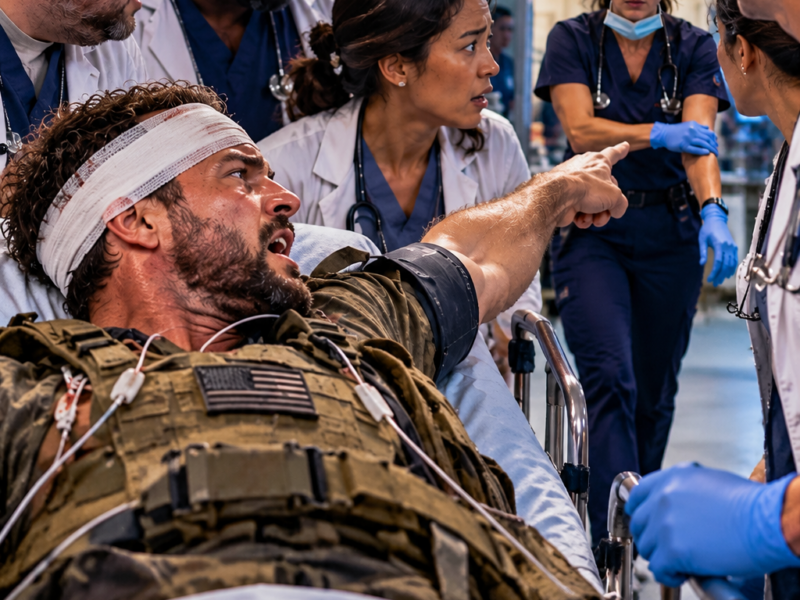
“I Only Want the Elite Surgeon!” — The Wounded SEAL Demanded, Pointing at the Nurse Who Arrived
“I Only Want the Elite Surgeon!” — The Wounded SEAL Demanded, Pointing at the Nurse Who Arrived
The first thing Harper Quinn noticed when the ambulance doors burst open was the blood.
Not the shouting. Not the frantic footsteps of the paramedics. Not even the monitor screaming as it announced that another human being was slipping dangerously close to death. It was the blood that caught her attention, spreading beneath the wounded man’s tactical vest, soaking through the torn fabric around his chest and disappearing into the folds of the stretcher beneath him.
The second thing she noticed was the way he was fighting.
Even with his face pale from blood loss and his breathing reduced to shallow, desperate gasps, the man refused to surrender. His shoulders strained against the paramedics holding him down. His fingers repeatedly reached toward his chest, as if he could somehow force his body to remain intact through sheer determination. His eyes moved constantly, searching every face in the emergency department.
He wasn’t simply afraid of dying.
He was looking for someone.
Harper understood that immediately, although she had no idea why.
Three years of working at Ridgeview Regional Trauma Center had taught her how to recognize the different kinds of fear that arrived through the emergency department doors. She had seen frightened children, desperate parents, intoxicated men, exhausted firefighters, and soldiers whose bodies had survived things their minds could barely comprehend.
But this man’s expression was different.
There was something familiar in it. Something that belonged to another world, a world of dust-filled buildings, broken concrete, gunfire, and people who learned to measure time by the number of seconds remaining before someone stopped breathing.
Harper stood beside a supply cart, wearing ordinary navy-blue nursing scrubs. Her dark hair was tied tightly behind her head, and a small white scar crossed her left eyebrow. Another faint mark disappeared beneath the hairline along her jaw.
To most people in the hospital, she was simply Harper Quinn, a quiet nurse who rarely complained and never seemed interested in recognition.
She was good at her job, but nobody considered her extraordinary.
At least, nobody had bothered to look closely enough to find out.
“Quinn!”
The voice belonged to Dr. Foster Callahan, the hospital’s chief of trauma.
He was standing near the nurses’ station, staring at a tablet with the expression of a man who believed the entire medical profession existed to interrupt his schedule.
“Bay four needs restocking. Gauze, saline, chest tubes. And make sure the instruments are arranged properly this time.”
Harper looked toward him.
“They’re already arranged, Doctor.”
Callahan finally lifted his eyes.
“Then check them again.”
He returned to his tablet before she could respond.
Harper said nothing.
She had learned that silence was often the easiest way to survive a workplace where certain people believed that authority and intelligence were the same thing.
Callahan was a talented administrator, at least according to the hospital’s promotional materials. He appeared frequently in local news reports, particularly whenever Ridgeview treated a dramatic trauma case that could be turned into a photograph of him standing beside a patient.
He enjoyed interviews, public recognition, and the occasional award ceremony.
What he enjoyed less was being questioned.
And he rarely remembered the names of nurses unless he needed something from them.
Harper had worked under him for three years. In that time, he had criticized her handwriting, questioned her efficiency, and once made her rewrite an entire patient care report because he thought her notes looked rushed.
He had never asked why her hands moved so quickly when an emergency began.
He had never wondered why she could prepare a trauma bay without looking twice at the equipment.
And he had certainly never asked about the scar beneath her hairline.
Harper preferred it that way.
There were things about her past that she had no intention of discussing.
Some nights, when she returned to her small apartment and the world became quiet, she would sit on the edge of her bed and stare at her hands.
Sometimes they trembled.
The shaking began somewhere deep in her chest and slowly traveled outward, settling in her fingers. When it happened, she would close her eyes and breathe slowly.
Four seconds in.
Four seconds out.
Again and again until the trembling passed.
She never told anyone.
At Ridgeview, she was simply a nurse who arrived on time, performed her duties, and went home without attracting attention.
That was exactly what she wanted.
Three years earlier, she had been someone else.
A different name had been written across her military identification. Different insignia had rested on her uniform. Different people had trusted her with their lives.
And then one operation had changed everything.
She had spent the years since trying to forget it.
“You’re humming again.”
Harper turned.
Priya, the charge nurse, was passing behind her with a stack of patient charts.
Harper hadn’t realized she was making a sound.
“What?”
“That little tune you always hum when things are about to get busy.”
Harper gave a faint smile.
“Maybe I just like the song.”
Priya raised an eyebrow.
“Funny. You never hum when it’s quiet.”
Before Harper could answer, the emergency radio crackled.
“Incoming trauma. Gunshot wound to the chest. Male, approximately thirty-four years old. Combative. Unstable vital signs. ETA four minutes.”
The atmosphere changed instantly.
Callahan straightened.
He placed his tablet on the counter and adjusted his coat, already preparing to take command of the incoming case.
“Let’s get trauma team ready,” he announced. “I want everyone in position before the ambulance arrives.”
Harper’s fingers stopped moving.
Something about the report had disturbed her.
A gunshot wound to the chest was serious, but that wasn’t what caused the sudden tightening in her stomach.
It was the word combative.
Unstable.
Male, approximately thirty-four.
For reasons she couldn’t explain, those details felt like pieces of a memory she had spent years trying to bury.
She looked toward the ambulance entrance.
Four minutes later, the doors slammed open.
The stretcher came through so quickly that its wheels rattled violently against the tiled floor. Two paramedics struggled to keep the wounded man from sitting up.
His tactical clothing was torn and stained with blood. A bandage wrapped crookedly around his head, and a dark patch on his vest hung loose from the fabric by a single thread.
One of his wrists was covered in gray athletic tape.
Harper recognized that immediately.
It was the kind of tape frequently used by special operations personnel to support old injuries during training.
“Move! Move!” one paramedic shouted.
“He’s been fighting us since the scene,” the second explained. “He keeps trying to get up. We nearly lost him twice during transport.”
“Blood pressure?”
“Eighty over palpation. Oxygen saturation dropping. He’s deteriorating rapidly.”
Callahan stepped toward the stretcher.
“I’m Dr. Callahan, chief of trauma. You’re at Ridgeview Regional. We need you to lie back and let us examine you.”
The wounded man barely looked at him.
Instead, he shoved the doctor’s arm away with surprising strength.
“Where is she?”
Callahan frowned.
“Sir, you need to calm down.”
“Where is she?”
His voice was weak, but there was an unmistakable urgency behind it.
His eyes swept across the room.
Doctors.
Nurses.
Residents.
Security personnel.
Then they stopped.
Harper was standing three feet away, holding a tray of supplies.
For one long moment, the wounded man stared at her as if he had just discovered something he had been searching for across an impossible distance.
His expression changed.
The desperation remained, but something else appeared beneath it.
Relief.
He raised one trembling hand and pointed directly at her.
“I only want her.”
Callahan looked confused.
“Excuse me?”
The wounded man swallowed painfully.
“I only want the elite surgeon.”
His finger remained fixed on Harper.
“Nobody else touches me.”
A strange silence spread through the hallway.
Callahan glanced at Harper, then back at the patient.
“Sir, that’s a registered nurse. I’m the attending physician.”
“I don’t want you.”
“You’re confused.”
“I want her!”
The man’s voice cracked.
Harper felt the room tilt slightly.
She knew that voice.
She knew the way the man held his shoulders despite the injury. She recognized the gray tape around his wrist, the stubborn angle of his chin, and the familiar determination in his eyes.
But she had not seen him in three years.
Not since the operation.
Not since the day everything had fallen apart.
The wounded man looked directly at her.
“She pulled a length of rebar out of my chest with her bare hands under fire,” he rasped. “She’s not just a nurse.”
His breathing became more difficult.
“She’s Ghost Actual.”
Harper felt the blood drain from her face.
The name had not been spoken aloud in a civilian hospital for years.
Nobody in that hallway understood what it meant.
She understood perfectly.
The wounded man’s name was Marcus Boyd.
His military call sign was Anvil.
And he was supposed to be dead.
“Sir, blood loss can cause confusion,” Callahan began. “We need to—”
“Check his pupils before you diagnose confusion.”
The words came from Harper.
They were quiet, but something in her voice made everyone turn.
It was not the voice of the woman who had spent three years accepting criticism without argument.
It was a command voice.
Controlled.
Cold.
Completely certain.
Harper stepped closer.
“Anvil,” she whispered.
Marcus’s eyes widened.
She looked at him carefully.
“Marcus Boyd.”
His body seemed to relax.
For the first time since entering the hospital, he stopped fighting the paramedics.
“You’re supposed to be dead,” he whispered.
Harper swallowed.
“Not yet.”
She leaned closer.
“Let’s keep it that way.”
Something changed in her posture.
Her shoulders straightened. Her chin lifted. Her movements became precise and deliberate.
For three years, she had walked through the hospital as though she wanted the walls to swallow her.
Now, standing beside that stretcher, she looked like someone who had finally remembered where she belonged.
Callahan moved in front of her.
“Quinn, I don’t know what this is, but you’re not touching my patient.”
Harper glanced at the monitor.
The oxygen saturation was falling.
Sixty-eight percent.
The patient’s breathing was becoming increasingly ineffective.
His lips were turning gray.
“He’s developing a tension pneumothorax,” she said.
Callahan frowned.
“We need imaging first.”
“No.”
“Excuse me?”
“Second intercostal space, midclavicular line. He needs immediate decompression.”
Callahan looked at the monitor again.
“We haven’t confirmed—”
“You have less than ninety seconds before he arrests.”
She reached for a fourteen-gauge catheter on the emergency tray.
Callahan caught her wrist.
“You’re a nurse. You are not authorized to perform that procedure.”
Harper looked down at his hand.
Then she looked into his eyes.
“Move.”
There was no anger in her voice.
That somehow made the word more powerful.
The memory came rushing back.
Three years earlier, Harper had crawled through a narrow opening in a collapsed building with a headlamp clenched between her teeth.
Dust filled the air.
Smoke rolled through broken windows.
Gunfire cracked somewhere beyond the damaged walls.
The building had been struck during an operation that was never supposed to involve an air attack.
The structure had partially collapsed, trapping several members of a special operations team beneath concrete and twisted steel.
Harper had heard a man struggling to breathe.
She followed the sound.
Behind a fallen support beam, she found Marcus Boyd.
A long piece of rebar had penetrated his shoulder and upper chest. One of his teammates was pressing both hands against the wound, but blood continued to escape between his fingers.
Marcus was conscious.
Barely.
He tried to speak, but every breath sounded wrong.
Harper remembered the weight of the beam.
She remembered the effort required to shift it enough for the others to pull him free.
She remembered the terrifying moment when the pressure around his chest changed and his already compromised lung collapsed further.
She remembered the gunfire chewing through the walls less than twenty feet away.
Most of all, she remembered how quickly her training had taken over.
Fear had become irrelevant.
There was only the patient.
The injury.
The next decision.
She had worked with whatever equipment was available, improvising under conditions that would have been unthinkable in a civilian operating room.
She had saved Marcus.
And afterward, she had been punished for something she hadn’t done.
The memory vanished as Harper’s hand returned to the present.
She moved around Callahan, placed the catheter at the correct landmark, and performed the emergency decompression.
A sharp hiss of escaping air filled the trauma bay.
For a moment, everyone froze.
Then the oxygen saturation began climbing.
Sixty-eight.
Seventy-two.
Seventy-eight.
The patient’s chest rose more effectively.
The monitor’s alarm changed.
Harper kept two fingers against Marcus’s wrist, counting his pulse.
“Get me a chest tube tray,” she ordered. “Two units of type-specific blood. Surgical team on standby. I want vascular notified immediately.”
Nobody moved for a second.
Then the entire room came alive.
Nurses rushed toward the supply cabinets. A resident grabbed the ultrasound machine. Another nurse began preparing blood products.
For the first time since Harper had joined Ridgeview, people were responding to her voice without questioning whether she had the authority to give an instruction.
Callahan stood beside the stretcher, his expression somewhere between disbelief and humiliation.
“Who exactly are you?” he demanded.
Harper didn’t answer.
“Room four,” she said. “Now.”
The stretcher began moving.
And for the first time in three years, Harper Quinn walked through a hospital hallway without making herself smaller.
The emergency room seemed different now.
The same walls.
The same fluorescent lights.
The same people.
But something fundamental had changed.
In room four, the air smelled of antiseptic, blood, and the metallic tension that seemed to accompany every life-or-death decision.
Marcus lay beneath the bright surgical lights.
His breathing had improved, but his condition remained critical.
Harper checked the catheter site and examined the entry wound near his collarbone.
“Talk to me, Anvil.”
Marcus opened one eye.
“Training exercise.”
Harper didn’t look impressed.
“Try again.”
“Live-fire drill. Something went wrong. Round deflected off a support strut.”
“How did you end up here?”
“Bad luck.”
“That’s not an answer.”
He attempted a smile but immediately winced.
Harper adjusted the equipment.
“You came here deliberately.”
Marcus looked at her.
She continued working.
“You drove three states to find this hospital, didn’t you?”
He remained silent for several seconds.
Then he nodded.
“Two years ago, I heard a rumor.”
“What rumor?”
“Someone told me there was a nurse at a civilian trauma center in this state who moved like a combat surgeon during a mass casualty drill.”
Harper’s hands paused briefly.
Marcus continued.
“I didn’t believe it at first. Then I heard the description. Dark hair. Scar over the eyebrow. Didn’t say much. Always humming before an emergency.”
Harper exhaled.
“You could have called.”
“Would you have answered?”
She had no response.
Both of them knew the truth.
Marcus had been one of the eleven men she had helped save during the operation that ended her military career.
He had been one of the few people who knew what she had done.
And he had never forgotten.
“Wasn’t taking chances twice,” he whispered.
Harper turned away to check his monitor.
She didn’t want him to see the expression on her face.
A resident named Dana entered carrying the ultrasound equipment.
She was young, intelligent, and clearly overwhelmed by the situation.
“Doctor, I need his medical history,” Dana said, looking between Harper and Marcus. “Allergies, prior surgeries, medications, anything relevant.”
“Classified,” Marcus managed.
Dana blinked.
“I’m sorry?”
“Don’t worry about that,” Harper said. “Focus on the monitor. Tell me what his blood pressure is doing.”
Dana checked the screen.
“It’s dropping again.”
“Good. Keep watching it.”
Dana looked nervous.
Harper noticed her fingers trembling.
“Listen to me,” she said calmly. “Your hands are steady enough. Your training is good enough. Don’t let the noise around you distract you. Keep your eyes on the numbers and tell me what changes.”
Dana nodded.
Her shoulders relaxed slightly.
Harper had seen that reaction before.
Sometimes, all a frightened young medic needed was someone to remind them that they were capable of doing the job.
Marcus watched them.
“She knows,” he whispered.
Dana looked confused.
“Knows what?”
“Who she is.”
Harper ignored him.
“Chest tube kit. And get his temperature.”
Before Dana could move, the door opened.
Callahan entered with a security guard behind him.
“I’ve called the on-call trauma surgeon,” he announced. “Dr. Reyes is twenty minutes away.”
Harper looked at the monitor.
“Twenty minutes is too long.”
“Until he arrives, I remain the ranking physician in this hospital.”
Marcus shifted weakly.
Harper turned back toward the patient.
“His condition is deteriorating.”
“Then we stabilize him.”
“He’s bleeding internally.”
Callahan’s expression hardened.
“We don’t know that.”
Harper pointed toward the ultrasound machine.
“Then look.”
She positioned the probe and swept it across Marcus’s chest and upper abdomen.
The image appeared.
Fluid was accumulating around the heart.
Harper studied it for several seconds.
“Pericardial effusion,” she said. “He’s developing cardiac tamponade.”
Dana looked at the screen.
Her eyes widened.
“That’s blood?”
“Most likely.”
Callahan stepped closer.
“That’s a surgical emergency.”
“Yes,” Harper replied. “And he doesn’t have time to wait.”
“We need an operating room and a qualified surgeon.”
“We need to stop the bleeding.”
“Dr. Reyes is twenty minutes away.”
“He’ll be dead before he gets here.”
Callahan opened his mouth.
But before he could respond, a voice crackled through the security guard’s radio.
It was clipped, official, and unmistakably authoritative.
“This is the Naval Criminal Investigative Service. We have received a report concerning an unauthorized special operations patient at your facility. All personnel are instructed to remain on site. Nobody is to speak to the press or interfere with the patient until our agents arrive.”
The room went silent.
Harper felt a different kind of cold settle inside her.
Not fear of the patient dying.
Fear of what the arrival of federal investigators might mean.
They had found her.
She had spent three years building a life that contained no military identification, no classified assignments, and no questions about the past.
Now, that life was about to disappear.
Eleven minutes later, two federal agents entered the trauma bay.
The taller man displayed his credentials.
“Agent Reyes, NCIS.”
Callahan immediately straightened.
“Doctor Callahan. I’m the chief of trauma here.”
“We’re looking for Petty Officer Marcus Boyd.”
“He’s our patient.”
“Who’s treating him?”
“I am.”
Marcus slowly lifted one hand.
His finger pointed past Callahan.
“She is.”
The agent followed his gaze.
Harper stood beside the bed, one hand resting on the ultrasound machine.
“Commander Quinn,” Marcus whispered. “That’s Commander Harper Quinn.”
The room seemed to become smaller.
Agent Reyes studied her face.
For several seconds, he said nothing.
Then something changed in his expression.
Recognition.
“Commander Harper Quinn,” he said carefully.
Harper’s jaw tightened.
“Former commander.”
“Not according to the records I have.”
Callahan looked from the agent to Harper.
“Commander?”
Reyes continued.
“United States Navy Medical Corps. Trauma surgery. Attached to special operations medical support for four years. Call sign Ghost Actual.”
Harper looked away.
“That was a long time ago.”
“Three confirmed field surgeries under hostile fire,” Reyes continued. “Numerous emergency interventions during classified deployments. One operation in particular resulted in your active assignment being terminated.”
Harper’s fingers tightened around the edge of the equipment.
Callahan seemed unable to understand what he was hearing.
“She’s a nurse.”
“She is a decorated combat surgeon who disappeared from the military system after an operation went wrong,” Reyes replied.
Harper finally looked at him.
“Why are you here?”
“We’ve been trying to locate you for eight months.”
“You could have called.”
“We did.”
“No, you didn’t.”
“We used every emergency contact and address available in your discharge records. You made yourself extremely difficult to find.”
“That was the point.”
Agent Reyes glanced toward Marcus.
“We need to discuss the operation three years ago.”
Harper’s stomach tightened.
She knew exactly which operation he meant.
The collapsed compound.
The air strike.
The eleven men.
And the report that had followed.
For three years, she had believed that the disaster was her fault.
She had believed that she had somehow failed the people who trusted her.
She had carried that guilt into every shift at Ridgeview, every quiet evening, and every sleepless night.
She had never told anyone.
Not even Priya.
Reyes lowered his voice.
“Commander, the investigation is complete.”
Harper stared at him.
“What investigation?”
“The communications breach.”
Her expression changed.
Reyes continued.
“Eleven months ago, investigators confirmed that the coordinates transmitted to the air-support unit had been altered before they reached the operational team.”
Harper felt her throat tighten.
“That’s impossible.”
“The original transmission was compromised.”
“I checked the coordinates.”
“You checked the information you received. The alteration occurred several levels above your clearance.”
Harper shook her head slowly.
“You’re saying someone changed the coordinates?”
“Yes.”
“And the strike?”
“Was directed toward the wrong location.”
She looked toward the floor.
The memory returned in fragments.
The explosion.
The collapsing walls.
The screaming.
The men trapped beneath concrete.
The moment she had realized that the building had been hit because someone had provided the wrong information.
For three years, she had believed that her decisions had contributed to the disaster.
Now Reyes was telling her something different.
“You didn’t leak the coordinates,” he said.
Harper’s lips parted.
No sound came out.
“The communications channel was compromised by someone operating above your clearance. Command knew there was a serious breach, but instead of admitting what had happened, certain officials allowed the investigation to focus on your assignment.”
“Why?”
“Because you survived the operation. Because you were the senior medical officer on the ground. Because it was easier to remove one surgeon from the system than explain how a communications failure had endangered an entire team.”
Harper stared at him.
“Three years.”
Her voice was barely audible.
“Three years, I’ve been thinking I caused it.”
“No, Commander.”
“I thought I made the wrong call.”
“You didn’t.”
“I thought those men were trapped because I failed to understand the situation.”
“You saved eleven people.”
Reyes’s expression softened.
“You saved eleven men in a collapsed building with limited equipment while under hostile fire. You did everything you could.”
Harper looked toward Marcus.
His eyes were partially open.
He had heard enough.
“You saved us,” he whispered.
Harper’s hands began to tremble.
Not because she was afraid of the investigation.
Because something she had carried for three years was finally beginning to loosen.
She wanted to ask a thousand questions.
She wanted to know who had altered the coordinates, who had known, and why nobody had told her sooner.
But the monitor suddenly began screaming.
The sound cut through the room.
Marcus’s blood pressure was collapsing again.
Harper turned immediately.
“Tamponade is progressing.”
Dana looked at the monitor.
“He’s crashing.”
“We need to open his chest.”
Callahan stared at the numbers.
“We need an operating room.”
“There isn’t time.”
Harper examined the ultrasound again.
The accumulation of blood around the heart was increasing.
Marcus was running out of time.
Dana looked toward the doorway.
“Doctor, he’ll arrest before we get him to the elevator.”
For the first time since the ambulance arrived, Callahan appeared genuinely uncertain.
His eyes moved from Harper to the patient.
Then he looked at the agent.
“Can we get authorization?”
Reyes answered immediately.
“Save him.”
Callahan swallowed.
He looked at Harper.
“Do it.”
She studied him for a moment.
The same man who had criticized her handwriting.
The same man who had dismissed her experience.
The same man who had nearly ordered security to remove her from the room.
Now he was standing in front of her, asking her to take control of a situation he could no longer manage.
Harper didn’t smile.
“Scrub in,” she said. “And do exactly what I tell you.”
Callahan nodded.
The room transformed.
Supplies were opened.
Instruments were prepared.
Dana moved to Harper’s side, her expression tense but determined.
The surgical team began working.
Harper stood over Marcus.
For one brief moment, she closed her eyes.
She was no longer in Ridgeview.
She was back in the compound.
The dust.
The smoke.
The gunfire.
The men waiting for her to save them.
But this time, she was not going to allow the memory to control her.
“Scalpel.”
Dana placed it in her hand.
Harper began the procedure.
Her movements were controlled and precise.
She opened the chest wall, working quickly while maintaining the discipline that had been drilled into her through years of military medical training.
Blood appeared immediately.
“Retractor.”
Dana passed it forward.
“Hold it there. Don’t move.”
Harper worked through the layers of tissue, following the anatomy with the certainty of someone who understood exactly what she was looking for.
Callahan stood opposite her, assisting with the second retractor.
His forehead was covered in sweat.
He was no longer thinking about his title.
He was no longer thinking about the hospital’s reputation.
He was watching a man’s life disappear one heartbeat at a time.
“Pericardium,” Harper said.
She located the tense sac surrounding the heart.
The pressure inside was enormous.
She made a controlled opening.
Nearly two hundred milliliters of dark blood escaped.
“Release the pressure. Suction.”
Dana moved immediately.
The heart was finally able to expand again.
Harper examined the area carefully.
“Watch the phrenic nerve. Keep your hands steady.”
Dana nodded.
“Yes.”
“Don’t rush.”
Callahan maintained his position.
For several seconds, nothing changed.
The monitor continued its desperate alarm.
Then the rhythm shifted.
One beat.
Another.
A third.
The flat, terrifying line that everyone had feared began to break into a ragged pattern.
“Sinus rhythm!” Dana shouted.
She stared at the monitor.
“We have a rhythm!”
Nobody celebrated.
Not yet.
Harper continued working.
“Control the bleeding. I need suction. Prepare sutures.”
The team moved around her.
Callahan followed every instruction without question.
For the first time, he understood that authority did not always come from the person wearing the most expensive coat or holding the highest position.
Sometimes, it came from the person whose hands knew exactly what to do when everyone else had run out of answers.
Marcus’s blood pressure began to rise.
Slowly.
Stubbornly.
But it rose.
Harper glanced at his face.
His lips were still pale, but the color was beginning to return.
“Stay with me, Anvil,” she whispered.
His fingers moved slightly.
She felt something touch her wrist.
A weak squeeze.
She looked down.
Marcus’s hand was still alive.
And so was he.
Two hours later, Marcus Boyd was stable in the intensive care unit.
His chest had been closed, the bleeding controlled, and his vital signs had improved enough for the doctors to believe he would survive.
Harper stood outside his room.
Her scrubs were stained dark along one sleeve.
Her hair had begun to loosen, and exhaustion had settled into her shoulders.
Through the glass, she watched Marcus sleeping.
His chest rose and fell steadily.
For the first time that night, she allowed herself to breathe without counting.
Agent Reyes approached quietly.
“He’s going to make it.”
Harper nodded.
“Good.”
Reyes stood beside her.
“Command wants to speak with you.”
She didn’t turn.
“About what?”
“A position.”
“What position?”
“A joint trauma unit supporting special operations personnel. Military and civilian medical coordination. Advanced trauma response. The same work you were doing before your assignment ended.”
Harper remained silent.
“We can restore your previous standing, subject to the necessary administrative review,” Reyes explained. “The investigation has cleared your name. Your record is being corrected.”
She looked through the glass again.
Three years ago, she had imagined receiving that kind of news.
She had imagined someone finally admitting that the operation had not been her fault.
She had imagined returning to the work she loved.
But those dreams had gradually become painful, so she had buried them beneath ordinary routines and quiet expectations.
Now the opportunity was standing beside her.
And she didn’t know whether she wanted it.
“What if I say no?” she asked.
Reyes considered the question.
“Then you continue your life here.”
“That’s all?”
“That’s all. Nobody is going to force you back.”
She nodded.
“I need time.”
“Take it.”
A few moments later, Callahan approached.
He looked different.
His tablet was gone.
His usual confident expression had disappeared, replaced by something resembling embarrassment.
“Harper.”
She turned.
He hesitated.
“I owe you an apology.”
She said nothing.
“Actually, several apologies.”
“Probably.”
Callahan nodded.
“I judged you from the moment you started working here. I assumed you were inexperienced. I treated you like someone who needed constant supervision.”
Harper watched him.
“I never asked about your background. I never bothered to understand why you worked the way you did. And today, when a patient asked for you, I tried to push you out of the room.”
He looked toward Marcus’s door.
“I’ve never seen anyone work like that. Not in this hospital.”
Harper folded her arms.
“He’s alive.”
“Because of you.”
“Because the team did its job.”
Callahan lowered his eyes.
“I filed three separate complaints about your documentation this year.”
Harper remembered every one of them.
“I remember.”
“I never filed a single report recognizing your work.”
He paused.
“I intend to change that.”
Harper studied his face.
There was no camera.
No public relations officer.
No hospital administrator waiting to photograph the moment.
For once, Callahan appeared to be speaking because he genuinely understood that he had been wrong.
“Whatever the military offers you,” he said, “this department would be lucky to have you. Even if you decide to remain here.”
Harper looked at him.
“There’s no ‘even’ in that sentence, Doctor.”
He blinked.
She continued.
“There’s no shame in being a nurse. There’s no shame in the work I’ve been doing here. You don’t have to compare it to something else to make it valuable.”
Callahan nodded slowly.
“You’re right.”
Harper turned back toward Marcus’s room.
“Then remember that the next time you speak to someone wearing scrubs.”
He accepted the words without argument.
Inside the ICU, Marcus began to stir.
His eyes opened slowly.
At first, he seemed disoriented.
Then he spotted Harper through the glass.
One corner of his mouth lifted.
She pushed the door open and stepped inside.
“Look who’s awake.”
Marcus swallowed.
“Ghost Actual.”
Harper smiled faintly.
“Still alive.”
“Still stubborn.”
“That’s what kept you alive.”
He tried to laugh, but his chest reminded him that he had recently undergone major surgery.
Harper checked his lines and examined the monitor.
“Don’t make me regret saving you.”
“Wouldn’t dream of it.”
For several seconds, they remained quiet.
Then Marcus spoke again.
“Do you remember the three minutes?”
Harper looked at him.
“Which three minutes?”
“When the beam pinned me down.”
She remembered.
Every second.
“Tell me,” she said.
Marcus stared at the ceiling.
“I remember hearing the building collapse. I remember the dust. I remember somebody shouting that we needed to move. Then I felt something hit my chest.”
He paused.
“I couldn’t breathe. I thought that was it.”
Harper continued checking his pulse.
“Then I heard your voice,” he said.
She looked up.
“You were telling someone to keep pressure on the wound. You were telling me to stay awake.”
He swallowed.
“I couldn’t see your face. Just the light from your headlamp.”
His eyes moved toward her.
“I remember thinking that whoever pulled me out was going to be somebody I’d never get the chance to thank properly.”
Harper felt her throat tighten.
“Marcus.”
“I thought I’d died and just hadn’t noticed yet.”
He managed a weak smile.
“Guess I got another chance.”
Harper looked away for a moment.
“You already thanked me three years ago.”
“Not properly.”
“Trust me. Nobody needs to hear that conversation in a civilian hospital.”
Marcus laughed quietly.
Then his expression became serious.
“They’re offering you your old life back, aren’t they?”
Harper didn’t answer immediately.
“Something like it.”
“Are you going to take it?”
She looked through the window.
Outside, the sky was turning pale gray.
The night had finally begun to disappear.
She thought about the three years she had spent at Ridgeview.
The small apartment.
The quiet routines.
The endless effort required to avoid questions.
She thought about all the times she had watched an emergency unfold and felt something inside her awaken, only to force herself back into the role of an ordinary nurse.
She thought about the operation.
The men she had saved.
The guilt she had carried.
And the truth she had finally heard.
“I don’t know yet,” she said.
Marcus nodded.
“You don’t have to decide today.”
Harper smiled faintly.
“That’s the first sensible thing you’ve said since arriving.”
“Must be the medication.”
She checked his monitor one final time.
Then she adjusted his blanket.
“Get some sleep, Anvil.”
His eyes began to close.
“Hey, Harper?”
She paused.
“Yes?”
“Don’t disappear again.”
The words were quiet.
But they followed her long after she left the room.
An hour later, Harper found Priya standing beside the vending machines.
The charge nurse was holding two cups of terrible hospital coffee.
She handed one to Harper without saying anything.
Harper accepted it.
They stood together for a moment, listening to the distant sounds of the hospital beginning another day.
Finally, Priya spoke.
“So.”
Harper took a sip.
The coffee was awful.
“So?”
“Commander Quinn?”
Harper closed her eyes.
“Please don’t.”
“United States Navy medical officer. Special operations trauma surgeon. Ghost Actual.”
Priya shook her head slowly.
“I leave you alone for one night, and suddenly you’re a completely different person.”
Harper laughed softly.
It was the first genuine laugh she could remember having at work.
“I’m still the same person.”
“Are you?”
Harper looked down at her coffee.
For three years, she had believed that surviving meant learning how to become invisible.
She had believed that if she stopped talking about the past, stopped acknowledging her abilities, and stopped allowing herself to remember who she had been, the pain would eventually disappear.
But it hadn’t.
It had simply followed her.
Into every hospital shift.
Every quiet evening.
Every moment when she heard a monitor alarm and felt her body respond before her mind could catch up.
Priya studied her.
“You know,” she said, “I’ve always wondered why you never seemed surprised during emergencies.”
Harper looked at her.
“What do you mean?”
“Everyone else panics a little. Even experienced nurses. But you always seem to know what needs to happen before anyone gives an instruction.”
Harper looked toward the ICU.
“I used to do this under much worse conditions.”
Priya nodded.
“I figured.”
“Why didn’t you ask?”
“Because I thought you’d tell me when you were ready.”
Harper looked at her for a long moment.
That simple answer meant more than Priya probably realized.
For three years, people had demanded explanations from her.
They had questioned her work, criticized her habits, and assumed that her silence meant she had nothing worth saying.
Priya had simply waited.
“Are you going back?” Priya asked.
Harper looked toward the hospital entrance.
Agent Reyes was waiting downstairs with a folder of paperwork.
Somewhere inside that folder was the beginning of a different life.
A life she had once thought she would never be allowed to have again.
“I think so.”
Priya smiled.
“Then I suppose I’ll have to find someone else to restock bay four.”
Harper laughed again.
“Don’t worry. I’ll show them where everything goes.”
Priya raised her coffee.
“To Ghost Actual.”
Harper shook her head.
“To nurses who know what they’re doing.”
They touched their cups together.
And for a moment, the hospital felt like a place where she belonged rather than somewhere she was hiding.
Later that morning, Harper returned to the ICU.
Marcus was awake again.
He looked considerably better, although his voice remained weak.
“Morning, Commander.”
“Morning, troublemaker.”
He smiled.
“Agent Reyes told me they’re offering you a position.”
“He talks too much.”
“Military habit.”
Harper pulled a chair beside his bed.
“I haven’t signed anything.”
“But you’re thinking about it.”
“Yes.”
Marcus watched her carefully.
“Can I tell you something?”
“Go ahead.”
“That day, three years ago, when you pulled us out, I thought you were the strongest person I’d ever met.”
Harper lowered her eyes.
“I was doing my job.”
“No. You were doing more than that.”
He paused.
“You were terrified. I could see it. Your hands were covered in blood, the building was falling apart, and there was gunfire everywhere. But you kept moving.”
Harper remembered the moment.
She remembered being afraid.
She remembered the possibility that the next explosion might bury them all.
She remembered thinking that if she failed, eleven men would die.
Marcus continued.
“After they removed you from the team, nobody understood why. We were told there had been an administrative issue. Then we heard you were gone.”
Harper looked at him.
“I didn’t want anyone looking for me.”
“I know.”
“Then why did you?”
“Because I owed you my life.”
Harper shook her head.
“You didn’t owe me anything.”
“Maybe not. But I wanted to know you were still out there.”
He smiled faintly.
“And when I heard about a nurse who hummed before emergencies, I knew it had to be you.”
Harper looked down at her hands.
They were steady now.
Not because the memories had disappeared.
Not because the past had suddenly become painless.
But because she no longer felt compelled to pretend those memories belonged to someone else.
“I spent a long time thinking that I had failed you,” she said quietly.
Marcus shook his head.
“You never failed us.”
Harper looked into his eyes.
“Thank you.”
He nodded.
“Now go do what you’re supposed to do.”
“Which is?”
“Stop hiding.”
She smiled.
“I’ll consider it.”
When Harper finally left the ICU, she walked through the emergency department one last time before meeting Agent Reyes.
The hospital was already busy.
A paramedic was bringing in an elderly patient.
A young nurse was struggling to organize a stack of charts.
Someone was asking where the extra saline bags had been stored.
Callahan was standing near the nurses’ station, speaking with a resident.
When he saw Harper, he stopped.
“Commander Quinn.”
She raised an eyebrow.
“Harper is fine.”
He nodded.
“Harper.”
For a moment, neither said anything.
Then he stepped aside, allowing her to pass.
It was a small gesture.
But Harper noticed it.
Three years earlier, she would have walked around him without making eye contact.
Today, she walked straight ahead.
She no longer needed to shrink herself to make other people comfortable.
At the end of the corridor, she stopped beside the supply room.
The shelves were arranged exactly as she had arranged them that morning.
Gauze.
Saline.
Chest tubes.
Everything in its proper place.
She remembered Callahan’s instruction to restock the bay.
She remembered how she had accepted the order without argument.
She remembered the way people had looked at her when Marcus pointed at her and called her the elite surgeon.
It would have been easy to feel bitter.
To resent the three years she had spent being underestimated.
To demand that everyone acknowledge what she had done.
But as she stood there, she realized something important.
The people who had failed to recognize her abilities had never determined what those abilities were worth.
Their ignorance had not made her less capable.
Their criticism had not erased her training.
And their lack of respect had never changed the lives of the people she had saved.
She had been a surgeon before she became a nurse.
She had been a nurse while carrying the experience of a surgeon.
And whatever position she chose next, she would remain the same person.
Someone who knew what it meant to stand between another human being and death.
Someone who understood that the most important moment in medicine was not the moment when a title was announced or a camera appeared.
It was the moment when a patient stopped breathing properly, the room filled with alarms, and someone had to make a decision.
Harper had made that decision.
She had made it under fire.
She had made it beneath collapsing concrete.
And she had made it again in a civilian trauma bay while an entire room of people questioned whether she had the right to stand beside the patient.
She had never needed anyone to tell her what she was capable of.
She had simply needed to stop believing that she had to hide it.
Agent Reyes was waiting near the hospital entrance.
He held a folder beneath one arm.
“Commander.”
Harper approached.
“Agent.”
He extended the folder.
“Your reinstatement documents. There’s also a preliminary assignment proposal for the joint trauma unit.”
She accepted it.
“How long do I have to decide?”
“As long as you need.”
She looked down at the paperwork.
For years, she had imagined that seeing her military identification again would hurt.
Instead, she felt something close to peace.
“There’s one condition,” she said.
Reyes waited.
“I don’t want to return because someone suddenly decided I’m useful again. I want to know that the people responsible for what happened three years ago will be held accountable.”
Reyes nodded.
“The investigation is ongoing. The evidence has been forwarded to the appropriate authorities. Several individuals are already facing administrative and criminal review.”
“Good.”
“And the men from your former unit have been informed that your name has been cleared.”
Harper looked up.
“All of them?”
“Everyone who needed to know.”
She stood silently for several seconds.
Then she looked back toward the hospital.
Through the glass doors, she could see Priya walking toward the nurses’ station.
Somewhere upstairs, Marcus was sleeping.
Dana was probably still working through the details of the procedure, trying to understand how quickly an ordinary shift had turned into something she would remember for the rest of her career.
Callahan was probably explaining to hospital administrators why the quiet nurse he had repeatedly underestimated had saved a patient’s life.
Harper smiled.
“Send me the final paperwork.”
Reyes nodded.
“Does that mean you’re accepting?”
“It means I’m ready to consider coming back.”
He smiled slightly.
“That’s a start.”
Harper tucked the folder beneath her arm.
Then she stepped outside.
The morning air was cool.
Traffic moved along the street, and sunlight was beginning to spill across the buildings.
For three years, she had lived as though her life had ended somewhere inside a collapsed military compound.
She had believed that the woman who had once operated under fire had disappeared with the men who were buried beneath the rubble.
But she had been wrong.
That woman had never left.
She had simply been waiting for Harper to remember her.
Behind her, the hospital doors opened.
Priya called her name.
“Harper!”
She turned.
Priya held up a paper bag.
“You forgot your breakfast.”
Harper laughed.
“Thank you.”
“And don’t think you’re escaping without saying goodbye properly.”
Harper walked back toward her.
For the first time in years, she did not feel the need to rush away.
She hugged Priya, thanked her, and promised to return once she had made her decision.
Then she looked toward the hospital one final time.
Ridgeview Regional had been the place where she had hidden.
It had also become the place where she had rediscovered herself.
She thought about Marcus’s words.
Don’t disappear again.
She thought about the eleven men from the operation.
She thought about the countless patients she had helped during her three years as a nurse.
And she finally understood that none of those experiences had been wasted.
Every life she had touched mattered.
Every patient she had cared for deserved respect.
Every person who had trusted her with their most vulnerable moments had given her another reason to keep going.
Her military career might have been interrupted.
Her reputation might have been damaged.
Her confidence might have been buried beneath three years of silence.
But her purpose had never disappeared.
Harper straightened her shoulders.
The same way she used to before deployments.
The same way she had stood beside Marcus’s stretcher when he called her Ghost Actual.
The same way she had stood over him when his heart was barely beating.
And then she walked forward.
Not as an invisible nurse.
Not as a disgraced officer.
Not as a woman waiting for permission to become herself again.
She walked as Harper Quinn.
A woman who had survived a war, endured betrayal, carried guilt that never belonged to her, and found the strength to stand up when someone else’s life depended on it.
People at Ridgeview would remember the night a wounded Navy SEAL arrived screaming for an elite surgeon.
They would remember how he rejected the chief of trauma, ignored the doctors, and pointed directly at a quiet nurse standing near the supply cart.
They would remember the strange name he used.
Ghost Actual.
They would remember how the nurse performed an emergency procedure, how she took command of the trauma bay, and how she saved a man who had been moments away from death.
But the most important part of that night would never be the title she once held.
It would be the moment she finally stopped hiding from it.
Because respect is not created by the words printed on a uniform.
It is not measured by the number of people who recognize your name.
And it certainly cannot be granted by someone who judges your worth without knowing what you have survived.
True ability reveals itself when circumstances become impossible, when the pressure is overwhelming, and when the people around you have no idea what to do next.
That is when character speaks.
That is when experience matters.
And that is when someone who has spent years being overlooked can remind an entire room of people why they should never confuse silence with weakness.
Harper Quinn had spent three years allowing the world to believe she was ordinary.
But the moment Marcus Boyd pointed at her and called her the elite surgeon, the truth finally had nowhere left to hide.
She had never stopped being extraordinary.
She had simply forgotten that she was allowed to be seen.









