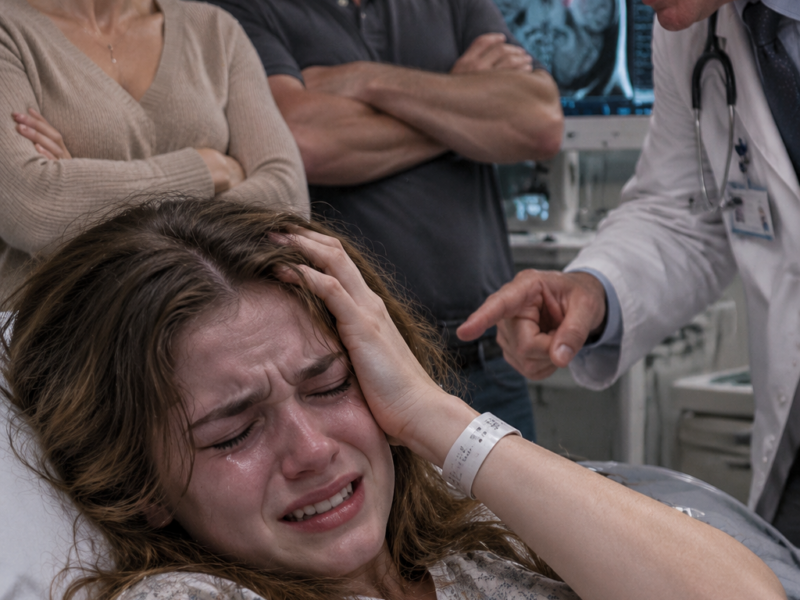
I Had A Pounding Headache For 5 Days—Parents Mocked Me,“Stop Overreacting”. Until The Doctor Yelled…
I Had A Pounding Headache For 5 Days—Parents Mocked Me,“Stop Overreacting”. Until The Doctor Yelled…
My name is Sarah Davis. I’m thirty-five years old, and for five days, I begged the people closest to me to believe that something was seriously wrong with my health.
For five days, I endured a pounding headache that seemed to grow stronger with every passing hour. The pain was unlike anything I had experienced before. It started as a dull pressure behind my forehead, then gradually spread toward the back of my skull. Eventually, even looking at a computer screen became difficult.
But whenever I told my husband, Mark, that I needed medical attention, he barely looked up from his phone.
His parents were even worse.
His mother, Linda, laughed when I mentioned going to the hospital. She looked at me with an expression that suggested I was being ridiculous.
“Stop overreacting, Sarah. You’re fine. Everyone gets headaches.”
His father, Robert, nodded in agreement.
“You’ve been working too much. You just need to rest instead of worrying everyone.”
And Mark, the man who had promised to stand beside me through sickness and health, said nothing to defend me.
I never imagined that the same people who dismissed my pain would soon be standing outside a hospital room, desperately trying to convince doctors that I had no right to make decisions about my own life.
But that was exactly what happened.
By the fifth morning, my vision had become so blurry that I could barely read the numbers on my computer screen. A strange pressure had developed behind my eyes, and concentrating on even the simplest task required tremendous effort.
I walked into the kitchen, where Mark was drinking coffee and scrolling through his phone.
“Mark, I need you to take me to the hospital. Something isn’t right.”
He glanced at his watch.
“Sarah, not again. I have an important meeting this morning.”
“I’m serious. I can barely see properly.”
He sighed as though I had interrupted something incredibly important.
“Then call your doctor. I’m not missing a meeting because you have a headache.”
I stared at him, waiting for some indication that he might reconsider.
There was none.
So I picked up my phone, opened a taxi application, and entered the address of the nearest emergency department.
As I walked out of the house, Mark called after me.
“Don’t make this into another family embarrassment.”
I didn’t answer.
I simply closed the door.
At that moment, I had no idea that my headache was only one part of a much larger problem. I also didn’t know that while I was traveling to the hospital, someone had already begun submitting documents that could potentially give my husband control over decisions I had never authorized him to make.
To understand how everything reached that point, I need to explain what my marriage had become long before that Friday morning.
Mark and I had been married for eight years.
When we first met, he was charming, ambitious, and full of enthusiasm. He had a small marketing business that he dreamed of expanding into a successful company. I worked as a financial operations manager, and although our salaries were different, we built a comfortable life together.
I genuinely believed we were partners.
I handled most of our household finances, insurance paperwork, tax documents, and administrative responsibilities. Mark focused on growing his business, meeting clients, and pursuing new opportunities.
I never complained about the arrangement because I thought marriage meant supporting each other’s ambitions.
Unfortunately, over time, something changed.
My responsibilities became expectations, while Mark’s ambitions became emergencies that everyone was expected to accommodate.
If his business needed money, we discussed it immediately.
If he had an important meeting, the entire household adjusted its schedule.
If his parents needed something, I was expected to help.
But whenever I needed support, somehow there was always something more important.
His mother, Linda, played a significant role in that environment.
She believed her son could do very little wrong. Whenever Mark made a questionable decision, she found a way to explain it. Whenever I disagreed with him, she treated my objections as evidence that I wasn’t supportive enough.
Robert rarely challenged her.
He was a quieter man who preferred avoiding arguments. Even when Linda said something unfair, he would simply tell me not to take it personally.
I used to consider them my second parents.
That was why their behavior during those five days hurt so much.
The headache began on Monday morning.
At first, I thought I had slept badly. I drank water, took a break from my computer, and tried to continue with my usual routine.
By the afternoon, the pain had become more noticeable.
I mentioned it to Mark while we were preparing dinner.
He barely listened.
“You’ve been staring at spreadsheets all day. That’s probably it.”
His explanation sounded reasonable, so I accepted it.
On Tuesday, however, the headache became considerably worse.
During a video meeting at work, the letters on my screen occasionally blurred. I found myself losing track of sentences and struggling to concentrate on information I would normally process without difficulty.
My supervisor noticed.
“Sarah, you don’t look well. Why don’t you take the afternoon off?”
I thanked her and told her I might need to see a doctor.
When I mentioned it to Mark that evening, he frowned.
“You can’t keep disappearing from work every time you feel uncomfortable.”
I looked at him.
“I almost never miss work.”
“I’m just saying you need to manage your time better.”
His words stayed with me.
For eight years, I had managed almost everything in our household. I remembered insurance renewal dates, paid bills before deadlines, organized tax documents, and kept track of appointments.
I was the person Mark called whenever something needed fixing.
Apparently, being dependable meant I wasn’t allowed to need help myself.
Wednesday evening was when the situation became particularly uncomfortable.
Linda and Robert had invited us to dinner. I didn’t feel well enough to attend, but Mark insisted that his parents wanted to discuss something important concerning his business.
I agreed to go because I didn’t want another argument.
We arrived shortly after seven.
Linda had prepared a large dinner, and Robert was sitting at the dining table discussing the financial difficulties Mark’s company had recently experienced.
Halfway through the meal, Linda placed a folder beside my plate.
“Sarah, we need you to look at something.”
I opened it.
Inside were documents relating to a commercial loan Mark wanted to obtain.
His company had recently lost two major clients. Without additional financing, he believed he wouldn’t be able to expand into another market or maintain the growth he had promised his business partners.
The lender wanted stronger security before approving the application.
Mark intended to use a rental property I had inherited from my grandmother as collateral.
The property was entirely mine.
My grandmother had left it to me several years earlier, and I had deliberately kept it separate from our shared finances. It generated rental income and represented something important to me: financial independence.
It was also one of the few things I had that wasn’t connected to Mark’s business or his family’s expectations.
I closed the folder.
“I’m not comfortable doing this.”
Mark immediately leaned forward.
“Sarah, we already discussed this.”
“No, we discussed the possibility. I never agreed to it.”
Linda gave a small laugh.
“It’s amazing how quickly you forget that we’re family whenever Mark needs something.”
I tried to remain calm.
“I’m not refusing to help him. I’m saying I need to understand the risks before putting my property at risk.”
Robert shook his head.
“Families are supposed to help each other.”
“I understand that. But this is a significant financial commitment.”
Mark pushed the folder closer.
“It’s temporary. Once the business expands, we’ll refinance everything.”
“What happens if the business doesn’t expand?”
He looked irritated.
“Why do you always assume the worst?”
I felt the pressure behind my eyes intensifying.
“Because it’s my property, Mark. I need time to review the documents with an attorney.”
Linda leaned back in her chair.
“There she goes again, turning everything into a crisis.”
I tried explaining that my headache was becoming unbearable and asked whether someone could take me to urgent care.
Linda exchanged a look with Robert.
“Stop overreacting, Sarah. You’re fine. You just don’t want to have this conversation.”
Mark didn’t defend me.
Instead, he pushed the folder closer and pointed to a preliminary authorization.
“Just sign this so we can move forward.”
I refused.
The atmosphere around the table changed immediately.
Nobody spoke for several seconds.
On the drive home, Mark was furious.
“You embarrassed me in front of my parents.”
I looked out the window.
“I was asking for time to review a financial agreement.”
“You made it sound like I was trying to steal from you.”
“I never said that.”
“Everything becomes about you whenever I need your support.”
I wanted to argue, but the pain in my head was becoming unbearable.
When we arrived home, I went directly to bed.
That night, while lying awake, I remembered something that had happened two months earlier.
Mark had offered to manage our shared insurance account. He said he wanted to simplify the paperwork and make sure we never missed a payment.
I had allowed him access to the online portal for billing purposes.
At the time, it seemed harmless.
But I had never given him permission to make medical decisions for me.
I had never authorized him to sign documents on my behalf.
And I had certainly never agreed to surrender control over my financial affairs.
On Thursday morning, I decided to schedule a medical appointment.
I logged into my healthcare portal, selected an available appointment, and completed the booking.
I felt relieved.
At least I would finally have someone examine me.
But when I checked the portal later that afternoon, the appointment had disappeared.
At first, I assumed there had been a technical problem.
I called the clinic, explained what had happened, and was told that the appointment had been canceled through my online account.
The earliest available replacement was several days away.
I was frustrated, but I still didn’t understand what had happened.
Later that day, my best friend Emma called.
She had known me for years and could usually recognize when something was wrong simply by listening to my voice.
“You sound terrible. Sarah, what’s going on?”
I explained the headache, the blurred vision, and the fact that I had been struggling to concentrate.
Unlike my husband and his parents, Emma didn’t tell me to relax.
She immediately became concerned.
“You need to get checked out. I’ll come and pick you up if you want.”
I hesitated.
“It’s probably nothing.”
“Then let a doctor tell you that. Don’t make that decision yourself.”
I thanked her, but told her I would arrange something.
I still believed Mark would eventually understand.
I still thought that if I explained how much pain I was experiencing, he would realize I wasn’t exaggerating.
Friday morning destroyed that remaining hope.
I woke up with the worst headache yet.
My vision blurred several times, and I felt an uncomfortable pressure behind my eyes.
I went downstairs and found Mark getting ready for an important meeting with a potential investor.
“Please take me to the emergency department.”
He glanced at his watch.
“I can’t. I have a meeting.”
“Mark, I can’t see properly.”
“You need to stop panicking.”
Before I could respond, his mother called.
Linda wanted to know whether Mark had managed to resolve the business paperwork.
When she heard that I was still complaining about my headache, she became irritated.
“Sarah, you are distracting him from something very important. He has employees depending on him.”
Robert, who was apparently listening nearby, added that I should rest and stop worrying everyone.
I ended the conversation.
For the first time in eight years, I stopped trying to persuade my husband to care.
I ordered a taxi.
As the car pulled away, my phone vibrated.
Mark had sent a message.
“Don’t make this into another family embarrassment.”
I read it once, then locked my screen.
I would deal with everything else later.
Right now, I needed medical help.
When I arrived at the emergency department, a nurse immediately noticed that I was having trouble concentrating.
She asked how long the headache had lasted and whether I had experienced any changes in my vision.
I explained everything.
Within minutes, she arranged for me to be examined.
A doctor named James introduced himself and listened carefully as I described the symptoms.
He asked when the headache began, how quickly it had developed, and whether I had experienced anything similar before.
He checked my reflexes, examined my eyes, and asked questions about my medical history.
Unlike my husband, he didn’t interrupt me.
Unlike Linda, he didn’t laugh.
When I explained that the headache had become progressively worse over five days, his expression grew serious.
“Sarah, I don’t want to make assumptions. But these symptoms need urgent investigation.”
He ordered medical imaging.
Before the MRI, a nurse asked whether I wanted someone contacted.
Out of habit, I almost gave her Mark’s number.
Then I remembered the message he had sent.
I changed my mind.
“Not yet. Please don’t contact anyone until I ask.”
The MRI was uncomfortable.
I had to remain still inside the machine while the headache continued pounding behind my eyes.
I concentrated on the technician’s instructions and reminded myself that coming to the hospital had been the right decision.
When the scan was finished, I returned to the examination area.
I expected Dr. James to explain the results and perhaps recommend additional tests.
Instead, he entered the room holding a tablet, glanced at the screen, and suddenly stopped speaking.
He scrolled through my electronic chart.
Then he checked another page.
His expression changed.
He called for a nurse.
I initially assumed he had discovered something alarming in the MRI.
There were indeed concerns in the images, but that wasn’t the only thing that had caught his attention.
An electronic notice had appeared in my medical record.
It stated that I had refused additional evaluation and authorized my husband to arrange my discharge.
Attached was a document claiming that Mark held medical decision-making authority over me.
The document had been submitted electronically while I was inside the MRI scanner.
Another entry claimed that my family wanted me transferred into their care because I was supposedly confused and unable to make responsible decisions.
Dr. James looked toward the nurse.
“Who submitted this information?”
She checked the submission details.
It had arrived through a family representative at registration.
The documents had been flagged for verification, but someone was already requesting my release.
Dr. James turned toward me.
“Sarah, did you sign an authorization allowing your husband to make medical decisions for you?”
“No.”
“Did you ask him to arrange your discharge?”
“Absolutely not.”
He turned the screen so I could see the document.
My full name was printed across the top.
Below it was a signature that looked vaguely similar to mine.
But the final letters were different.
I stared at it.
I had never signed that document.
A second page claimed to give Mark extensive authority over my financial affairs.
I felt my stomach tighten.
Then the nurse received a call from reception.
Mark and Linda had arrived.
They were insisting that I leave with them immediately.
According to the receptionist, Mark claimed that I had become emotionally unstable and could no longer make decisions for myself.
Linda was demanding access to my medical information.
Dr. James checked the submission time against the MRI schedule.
The supposed authorization had been submitted while I was undergoing imaging and could not have been personally approved by me.
He looked at the nurse.
“Call the police. Now.”
His voice was so sharp that everyone outside the examination room seemed to fall silent.
He instructed the staff to contact hospital security and make sure nobody interfered with my medical care.
I sat motionless.
For five days, my husband had told me I was exaggerating.
Now he was telling an entire hospital that I was incapable of making decisions.
Dr. James pulled a chair closer.
“Sarah, I need you to understand something. Your husband cannot simply override your decisions because he presents paperwork. You’re alert, you’re communicating clearly, and you have the right to participate in your own care.”
I nodded, although I was struggling to process everything.
He continued.
“Your imaging also shows an abnormal area near the back of your skull. There’s swelling and a small lesion. We don’t yet know what it represents. A neurologist will need to review the findings, and we may need additional testing.”
My heart began beating faster.
“Are you saying I have a tumor?”
“I’m saying we found something that needs investigation. A lesion or mass does not automatically mean cancer. We need more information before drawing conclusions.”
I tried to absorb his words.
Then my phone vibrated.
It was Mark.
“I’m downstairs.”
Another message arrived.
“Don’t tell them anything else.”
Then another.
“Mom brought the documents.”
And finally:
“We can fix this if you cooperate.”
I read the messages three times.
The people who had spent five days insisting nothing was wrong were suddenly desperate to control what the hospital knew.
I was beginning to understand that their concern had very little to do with protecting me.
The first police officer arrived shortly afterward.
A hospital security supervisor accompanied her and explained that Mark and Linda had been asked to remain in the public waiting area.
Nobody had been arrested.
The immediate priority was making sure I was safe and that my medical treatment could continue without interference.
The officer introduced herself and asked me to explain what had happened.
I started with Wednesday’s dinner.
I described the business loan, the inherited rental property, and my refusal to sign the preliminary authorization.
Then I showed her Mark’s messages.
I explained that he had access to the insurance portal for billing purposes but had never been granted authority to make medical or financial decisions for me.
The officer listened carefully.
Dr. James arranged for the hospital to preserve the relevant electronic submission information through its established procedures.
The officer explained that suspected forgery and identity misuse would require investigation.
She advised me to preserve every message and avoid deleting anything related to the disputed paperwork.
For the first time that day, I wasn’t worried about whether someone believed me.
I was speaking to people who took the facts seriously.
About twenty minutes later, Emma arrived.
She had been trying to reach me after I stopped responding to her messages.
When she entered the room, she immediately noticed my expression.
“What happened?”
I told her everything.
She didn’t interrupt.
She didn’t tell me I was being dramatic.
She didn’t ask why I was making things difficult for Mark.
When I finished, she simply pulled a chair beside my bed.
“What do you need right now?”
I looked at her.
“I need someone beside me who respects my decisions.”
She took my hand.
“Then I’m staying.”
With Emma’s help, I contacted the bank that handled the financial records for my inherited rental property.
I explained that someone might have submitted a forged authorization involving the property.
After verifying my identity, a fraud specialist confirmed that a commercial loan application using my property as proposed security had been submitted earlier that week.
It contained an authorization bearing my name.
The loan hadn’t been funded.
However, the bank had requested additional verification because certain details in the documents raised concerns.
I asked them to flag the disputed paperwork and explain how I could file a formal written complaint.
The application remained suspended pending review.
When I ended the call, everything suddenly connected.
On Wednesday, Mark had pressured me to sign the loan documents.
On Thursday, my medical appointment had disappeared.
On Friday, someone submitted paperwork claiming I couldn’t make decisions for myself.
These weren’t isolated misunderstandings anymore.
They looked like parts of a plan that changed whenever I refused to cooperate.
I still didn’t know exactly who had prepared every document or who had submitted each authorization.
And I certainly wasn’t accusing Mark of causing my medical condition. There was no evidence of that.
But he appeared to be using my illness as an opportunity to challenge my independence.
Later, hospital security confirmed that Mark and Linda had been told they could not obtain my records or direct my treatment without proper legal authority.
They were also informed that I did not wish to see them.
Mark responded by calling relatives.
He told them the hospital had misunderstood a family disagreement.
Linda posted a message in our extended family group chat, claiming I was experiencing a medical crisis and had become confused about ordinary paperwork.
Robert added that everyone should trust Mark’s judgment.
Several relatives immediately expressed sympathy for my husband.
One cousin suggested that husbands sometimes had to make difficult decisions when their wives weren’t thinking clearly.
Another said Linda was probably only trying to help.
My medical condition had become their explanation for everything I refused to sign.
Emma asked whether I wanted to correct the accusations.
I shook my head.
“Not yet.”
Arguing without presenting evidence would only give Linda another opportunity to portray me as irrational.
Instead, I saved the messages and requested information about obtaining the hospital records relevant to the disputed documents.
That evening, a neurologist named Dr. Daniel Harris came to speak with me.
He explained that the MRI had identified an abnormal area requiring further investigation.
Additional CT imaging showed swelling near a small mass.
He emphasized that the findings did not establish whether the mass was cancerous or non-cancerous.
There were several possible explanations.
The medical team wanted to conduct further evaluation before deciding what treatment might be appropriate.
I asked questions.
I requested written explanations.
I wanted to understand the risks, the alternatives, and the next steps.
Dr. Harris answered patiently.
For the first time in days, I felt as though I was participating in my own life rather than being treated as an inconvenience.
I remained under observation while the doctors managed my symptoms and arranged follow-up care.
Later that evening, Emma handed me my phone.
Mark had sent another long message.
He claimed that everything he had done was intended to protect our future.
He said his business was under pressure, that he was trying to prevent financial problems, and that I had made the situation unnecessarily complicated.
Near the end was one sentence I couldn’t forget.
“If you had just signed the papers, none of this would have happened.”
I stared at those words.
He wasn’t asking whether I was frightened.
He wasn’t asking whether the medical findings were serious.
He was still thinking about the loan.
And that was when I understood that I could no longer allow him to define what had happened.
I spent the following day under medical observation.
Eventually, the doctors discharged me with a treatment plan, instructions about warning signs requiring urgent attention, and appointments with specialists.
I still needed further testing.
My medical situation wasn’t resolved, but I finally knew what the next steps would be.
What I didn’t have was any desire to return home to Mark.
Emma offered me her spare bedroom.
I accepted.
That evening, while sitting at her kitchen table, I opened a notebook and wrote three priorities.
Protect my health.
Protect my property.
Discover exactly what happened.
The next morning, I started working through them.
I contacted the clinic where my Thursday appointment had been canceled.
The office confirmed that the cancellation had been made through my online account.
They couldn’t identify who had physically used the device, but they provided the date and time.
I checked my messages.
Around that same time, Mark had texted me complaining that the appointment conflicted with an important meeting.
I sent him a simple question.
“Did you cancel my medical appointment?”
For fifteen minutes, there was no response.
Then his reply appeared.
“I canceled it because you were making everything worse. We had important decisions to make.”
I read it aloud to Emma.
She looked at me.
“Save that message.”
I did.
I wasn’t celebrating having evidence against my husband.
I was realizing how easily someone I trusted had interfered with my ability to seek medical help.
The following morning, I met with an attorney named Rebecca Collins.
She specialized in family law and property disputes.
I brought the available hospital documents, the bank’s fraud report, and Mark’s messages.
Rebecca examined the disputed financial authorization carefully.
She noticed several inconsistencies.
The document claimed to have been notarized on a day I had spent entirely at work.
My address was outdated.
The signature didn’t match the way I normally signed legal documents.
Rebecca explained that these details needed proper investigation. She didn’t want me making accusations before the relevant evidence had been examined.
She helped me submit a written dispute to the bank.
We also took steps to secure my financial accounts, protect the inherited property from unauthorized transactions, and ensure that medical communications came directly to me.
Two days later, the bank contacted us.
Its review process had been unable to validate the notarial information.
The loan application remained suspended.
Mark’s business expansion was now in serious jeopardy.
That afternoon, Linda called from an unfamiliar number.
Her voice sounded unusually gentle.
“Sarah, sweetheart, we need to talk.”
I said nothing.
She continued.
“Everyone is worried about your health. I think outsiders are turning a simple family misunderstanding into something much bigger than it needs to be.”
I recognized the direction of the conversation immediately.
Then she asked whether I had spoken to the bank.
I answered carefully.
“My financial matters are being handled through my attorney. I’m not discussing them with you.”
Her tone changed almost instantly.
She accused Emma of manipulating me.
She claimed Mark had been humiliated in front of business contacts.
Then she said something that made my decision even easier.
“You’re destroying this family over paperwork.”
I ended the call.
Rebecca advised me to document the conversation.
I did.
A week after my hospital visit, I met with Dr. Thompson, an oncologist to whom Dr. Harris had referred me.
He explained that the abnormal area could have several causes, including non-cancerous conditions.
After discussing my case with the other specialists, the team recommended additional testing and a carefully planned biopsy of an accessible area.
He explained the potential benefits, uncertainties, and risks without suggesting that a diagnosis had already been established.
I asked every question in my notebook.
Emma sat beside me, taking notes.
When we left the appointment, I felt frightened, but I also felt informed.
I knew what was happening.
I understood what the doctors were investigating.
And nobody was making those decisions for me.
That evening, Rebecca called with another development.
Mark had been telling relatives that I had voluntarily signed the loan documents and later changed my mind because I was upset about my medical diagnosis.
He also suggested that the police had become involved because I was confused at the hospital.
It was a carefully constructed story.
He wanted people to believe that he was a devoted husband trying to protect an unstable wife.
Linda was helping him spread it.
Then she posted an invitation in our extended family group chat.
She was organizing a Sunday dinner to discuss restoring family harmony.
Everyone was invited, including me.
Her message said that misunderstandings should be resolved privately before they damaged the family’s reputation.
I knew exactly what she expected.
She thought I would arrive exhausted, apologize for causing trouble, and agree to stop challenging Mark.
For years, that was how things had worked.
But I wasn’t the same woman who had sat silently at her dinner table while she pushed a folder toward me.
I discussed the invitation with Rebecca.
She warned me against making unsupported accusations or interfering with the ongoing investigation.
Together, we identified the verified facts I could share without revealing confidential medical information.
I wasn’t planning to turn my diagnosis into a spectacle.
I wanted the people who had mocked me to stop using my illness as an excuse for their behavior.
So I accepted the invitation.
My reply was simple.
“I’ll be there. And Emma is coming with me.”
Linda responded almost immediately.
“Good. Maybe we can finally have a sensible conversation.”
I looked at Emma and smiled.
Linda was right about one thing.
We were finally going to have a sensible conversation.
It simply wasn’t going to follow her plan.
On Sunday evening, Emma and I arrived at Linda’s house shortly before dinner.
Nearly twenty people were gathered in the dining room and living room.
Mark’s aunts, uncles, cousins, and several close family friends had been invited.
Conversation slowed when I entered.
Some relatives smiled sympathetically.
Others avoided looking at me.
Linda approached with exaggerated warmth.
She hugged me briefly and announced how delighted she was that I had decided to put family first.
Mark stood beside the dining table.
He looked uncomfortable.
Robert greeted me quietly and asked how I was feeling.
I told him I was receiving appropriate medical care and preferred to keep the details private.
Dinner began with ordinary conversation.
People discussed work, upcoming holidays, and neighborhood events.
But everyone was waiting for the real reason they had been invited.
After dessert, Linda stood and tapped her glass.
She announced that the family had experienced a difficult misunderstanding involving my health and Mark’s business.
She described Mark as a devoted husband who had been unfairly criticized for making decisions during a stressful situation.
Several relatives nodded.
Then she turned toward me.
“I hope Sarah is ready to acknowledge how much trouble her overreaction has caused.”
I placed my napkin beside my plate.
“Before I respond, I’d like to correct a few things.”
Linda smiled as though she had generously granted permission.
I began calmly.
“For five days, I experienced a severe and worsening headache. My vision became blurry, and I struggled to concentrate. I repeatedly asked my family for help.”
I looked toward Linda.
“You told me to stop overreacting.”
Then I looked at Robert.
“You agreed with her.”
Robert lowered his eyes.
Mark interrupted.
“Nobody could have known what was wrong with you.”
I nodded.
“That’s true. None of us could have known the diagnosis. That isn’t my complaint.”
I paused.
“My complaint is that I asked for medical attention and was mocked for it. Then, when I finally went to the hospital, someone attempted to use documents I had never authorized to make decisions on my behalf.”
Linda immediately objected.
“Mark was only trying to protect his wife.”
I opened the folder Rebecca had helped me prepare.
Inside were redacted copies of the disputed authorizations, the hospital’s submission timeline, and confirmation that the bank had suspended the loan application.
I placed the first document on the table.
“This was submitted to the hospital while I was undergoing an MRI.”
Several relatives leaned forward.
I explained that the document claimed I had authorized Mark to make medical decisions for me.
I had never signed it.
The submission time was recorded in the hospital’s records.
I showed them the relevant timeline without revealing private details about my medical condition.
An aunt picked up the document and examined the signature.
“Did you sign this?”
“No.”
Mark leaned forward.
“It was only a precaution.”
I looked directly at him.
“Why would a precaution require a signature I never provided?”
He didn’t answer.
He looked toward his mother.
For the first time that evening, Linda stopped smiling.
I placed the second document on the table.
“This one supposedly authorized Mark to use my inherited property as security for his business loan.”
I explained that the property belonged solely to me and that I had never approved the transaction.
The bank had flagged the application, and I had formally disputed the authorization.
I was careful to explain that no court had determined who was responsible for the disputed signatures.
But one fact was certain.
I had never approved the loan.
Mark’s uncle, who had worked in commercial lending for many years, leaned forward.
“Has the bank released any money?”
“No. The application remains suspended.”
He looked at Mark.
“Then you know this is serious. You can’t use another person’s property without proper authorization, regardless of whether you’re married.”
Linda interrupted.
“You’re all misunderstanding what happened. These documents were part of an arrangement Sarah knew about.”
I turned toward her.
“Then why did I refuse to sign them?”
She opened her mouth, but no answer came.
Then she made the mistake that changed the entire room.
“I helped prepare that paperwork because you weren’t thinking clearly,” she said. “Someone had to make sure things were handled.”
Silence fell.
Mark turned sharply toward her.
Linda seemed to realize what she had admitted.
“I only meant routine administrative paperwork,” she added quickly.
But several relatives had already heard her.
Robert looked at her.
“What exactly did you prepare?”
Linda became defensive.
“Don’t start questioning me now. You agreed that Sarah was being unreasonable.”
Robert shook his head.
“I agreed that she was being unreasonable about the business discussion. I didn’t agree to anyone signing documents for her.”
Mark stood up.
“My business was struggling. I had employees depending on me. I couldn’t just let everything collapse because of one disagreement.”
One of his aunts looked at him.
“Why didn’t you accept her refusal and find another source of financing?”
Mark remained silent.
I watched him.
For eight years, I had believed that supporting him meant making sacrifices without asking too many questions.
But there was a difference between helping someone and surrendering control over everything I had worked for.
Then Robert spoke.
“Sarah.”
I turned toward him.
He looked older than I remembered.
“I was wrong to laugh when you asked for help. I was wrong to assume Mark knew best.”
He paused.
“And I was wrong to let Linda dismiss you.”
His apology was quiet, but it meant something.
Linda looked furious.
She attempted to dismiss the entire discussion as an effort to embarrass her family.
Then she turned toward Emma.
“And you. You’ve been manipulating her from the beginning.”
Emma remained calm.
“I haven’t made any decisions for Sarah. I’ve helped her get medical attention, contact the bank, and find professional advice. Every decision has been hers.”
I looked around the room.
The relatives who had defended Mark were no longer united.
Some looked visibly upset.
Others wanted more information before deciding what to believe.
A cousin finally spoke.
“We need to stop discussing Sarah’s medical condition as though it proves she can’t manage her own life.”
Another relative turned toward Mark.
“Why did you cancel her medical appointment?”
Mark looked uncomfortable.
“I wanted to reduce unnecessary stress.”
I picked up my phone.
“I have the message where you explained why you canceled it.”
I read his words aloud.
“I canceled it because you were making everything worse. We had important decisions to make.”
Robert pushed his chair away from the table.
“Using someone’s medical appointment as leverage in a financial disagreement is unacceptable.”
Nobody spoke.
Linda looked around the room, apparently realizing that the conversation was no longer under her control.
The dinner ended without the reconciliation she had promised.
Several relatives approached me privately and apologized for repeating accusations they hadn’t verified.
Others left quietly, unwilling to take sides before the investigation concluded.
Emma and I walked toward the car.
Before we reached it, someone had already shared a short recording of the discussion in the extended family chat.
By the following morning, the story had spread among relatives, family friends, and parts of Mark’s professional circle.
People argued about family loyalty, financial pressure, and whether marriage gave someone the right to make decisions for another adult.
I asked that recordings containing private details be removed.
I didn’t want my medical information circulating through family conversations.
But the central facts were no longer hidden behind Linda’s version.
Mark had wanted nearly twenty witnesses to my apology.
Instead, they had watched his explanation fall apart.
As Emma drove me home, messages flooded my phone.
Some offered support.
Others demanded additional details.
I turned off notifications.
I hadn’t gone to that dinner to win a popularity contest.
I had gone because my reputation had been damaged by people claiming I couldn’t speak for myself.
That night, everyone learned that I could.
The consequences for Mark and Linda were only beginning.
The following months changed my life in ways I couldn’t have imagined during those first five days of headaches.
Some changes happened quickly.
Others required patience, professional support, and difficult decisions.
My medical treatment remained my highest priority.
The specialists completed the recommended testing, and the biopsy results eventually showed that the sampled lesion was non-cancerous.
I remember sitting across from Dr. Thompson when he explained the findings.
For several seconds, I couldn’t speak.
The relief was enormous.
He reminded me that a non-cancerous result didn’t mean my symptoms should be ignored. The medical team still needed to monitor the condition and follow the treatment plan.
My headaches gradually became more manageable.
I attended follow-up appointments and learned when I needed rest or further medical attention.
Most importantly, I stopped apologizing for taking my health seriously.
Meanwhile, the financial investigation continued.
The bank permanently rejected the disputed loan application.
My inherited rental property remained protected, and the proposed transaction never went through.
Investigators reviewed records and communications while Rebecca helped me address the civil consequences of the disputed documents.
I provided the evidence and allowed the authorities to determine whether criminal charges were warranted.
I didn’t need to claim an outcome that hadn’t happened.
There were already real consequences.
Without the expected financing, Mark’s planned business expansion collapsed.
Robert, who had supported several of Mark’s previous ventures, withdrew his personal guarantee from future proposals and required an independent review of their financial dealings.
Mark also lost an important contract connected to his father’s business after Robert refused to continue their arrangement.
The professional reputation Mark had spent years building became increasingly difficult to maintain.
People who had once trusted his explanations began asking questions.
Linda faced consequences of her own.
Several relatives who had always accepted her version of family disputes began distancing themselves.
She had served on the finance committee of a neighborhood charitable organization, but questions about her involvement in the disputed paperwork led her to step down.
The woman who once controlled every family gathering discovered that people were no longer willing to accept her judgment without asking questions.
Robert contacted me privately a few weeks after the dinner.
He said he had spent years avoiding conflict by agreeing with Linda, even when he knew she was being unfair.
He acknowledged that his silence had helped create an environment where Mark believed he could pressure people without consequences.
He apologized again.
This time, there was no audience.
I appreciated his words, but I didn’t pretend one conversation erased years of behavior.
“Rebuilding trust requires consistency, Robert. Not promises.”
He accepted that.
Linda eventually sent me a message saying she regretted how everything had unfolded.
She still described herself as someone who had only wanted what was best for her family.
I thanked her for reaching out, but declined further discussion.
I had learned something important.
An apology without accountability didn’t obligate me to reconcile.
My marriage to Mark ended as well.
Through our attorneys, we negotiated the financial issues surrounding our separation, including the costs incurred while protecting my property and addressing the disputed documents.
The separation was finalized under an agreement that preserved my independent assets and resolved our remaining marital financial obligations.
Mark tried contacting me several times.
At first, his messages were angry.
Then they became defensive.
Eventually, they turned into explanations and expressions of regret.
In one of his final messages, he admitted that he had become so focused on rescuing his business that he had stopped treating my decisions as equally important.
He said he had assumed I would eventually forgive him because we were married.
That assumption explained much of what had gone wrong.
He had confused being my husband with having authority over me.
When I finally responded, I told him that I hoped he would learn from the experience.
But I wasn’t returning to a relationship where my independence depended on his approval.
I moved into a smaller apartment closer to work.
I continued managing the rental property my grandmother had left me.
Emma helped me settle in, although I insisted on carrying some of the boxes myself.
She laughed.
“You know, accepting help doesn’t make you weak.”
I smiled.
She was right.
For years, I had believed that being independent meant handling everything without inconveniencing anyone.
I had confused strength with silence.
This experience taught me the difference between healthy independence and isolation.
There was nothing wrong with asking for help.
There was nothing wrong with relying on people who genuinely cared.
And there was certainly nothing wrong with refusing to surrender my judgment simply to keep someone else comfortable.
One evening, several months after the hospital visit, I opened the original family group chat on my phone.
I scrolled back to Linda’s message accusing me of being dramatic.
Below it were comments from relatives who had repeated her assumptions without knowing the facts.
I remembered how deeply those words had affected me.
At the time, I had felt humiliated.
I had wondered whether I was somehow asking for too much.
Now, those messages seemed strangely distant.
I didn’t need to send another explanation.
I didn’t need to defend myself again.
The truth had already changed the relationships that mattered.
I closed the conversation and put my phone away.
Sometimes people expect stories like mine to end with a spectacular confrontation, a dramatic confession, or someone being publicly punished.
Mine ended differently.
Mark lost the financing and trust he had tried to secure through my signature.
Linda lost much of the influence she had used to silence others.
Robert finally confronted the consequences of remaining passive.
And I gained something far more valuable than any of them could have given me.
I gained the freedom to make decisions without needing anyone’s approval.
I also learned that love without respect cannot create a healthy family.
Family loyalty should never require sacrificing dignity, honesty, or personal freedom.
I still remember the moment Dr. James stared at the computer screen and shouted for someone to call the police.
At the time, I thought my life was falling apart.
I had arrived at the hospital frightened, exhausted, and uncertain about what was happening inside my own head.
I never expected to discover that someone had attempted to use my medical condition to challenge my independence.
Looking back, however, that was the moment I began reclaiming control over my life.
The headache brought me to the hospital.
The truth revealed there changed everything afterward.
Today, I have a medical team that listens to my concerns, a career I enjoy, friends who respect my decisions, and a future that belongs to me.
I don’t know whether Mark and Linda will ever fully understand what they did.
Perhaps they will.
Perhaps they won’t.
But their understanding is no longer necessary for me to move forward.
Their choices had consequences, and those consequences were not mine to prevent.
I still think about those five days sometimes.
I think about the first morning when I mentioned the pain.
I think about the dinner table where Linda laughed at me.
I think about the medical appointment that disappeared from my calendar.
And I think about the taxi ride to the emergency department, when I finally stopped asking someone else for permission to protect myself.
If there is one thing I wish I had understood earlier, it is this:
You do not have to convince everyone that your pain is real before seeking help.
You do not have to prove that you deserve medical attention.
You do not have to sacrifice your financial security to demonstrate your love.
And being married to someone does not mean surrendering your right to make decisions about your own body, health, or future.
I learned to ask questions.
I learned to maintain boundaries.
I learned to protect important documents and seek qualified advice when something didn’t feel right.
Most importantly, I learned that the people who genuinely care about you won’t demand that you ignore your own needs to protect their comfort.
My name is Sarah Davis.
I spent five days being told I was overreacting.
I went to the hospital alone because nobody at home would listen.
I discovered a medical problem that required careful treatment, and I uncovered a series of disputed documents that threatened my independence.
But I walked away with something far more valuable than my family’s approval.
I walked away knowing that my voice mattered.
My health mattered.
My property mattered.
And my future belonged to me.
Sometimes forgiveness is possible, but reconciliation is not.
Those two things don’t have to travel together.
You can release resentment without allowing someone back into your life.
You can wish someone well while maintaining the distance necessary to protect yourself.
And you can love the idea of family without accepting behavior that repeatedly hurts you.
If you were in my position, would you rebuild relationships with family members who dismissed your medical concerns and attempted to make decisions without your consent?
Or would you choose distance, even if they eventually apologized?
I would genuinely like to know what you think.
Because no family relationship should require someone to surrender their dignity just to keep the peace.









