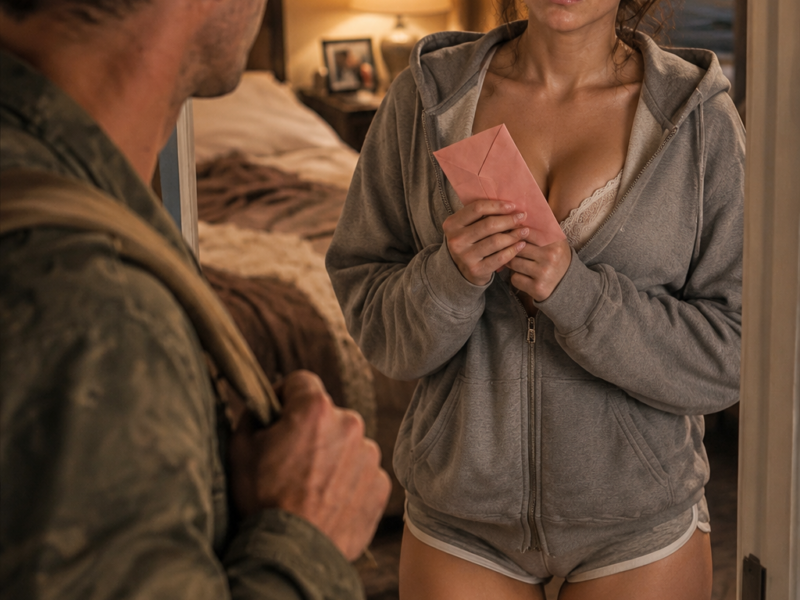
I Got Back From Deployment Early… My Roommate Froze and Said, “You Weren’t Supposed to See This”
I Got Back From Deployment Early… My Roommate Froze and Said, “You Weren’t Supposed to See This”
I got back from deployment nineteen days earlier than anyone expected, and at 11:43 on a Tuesday night, I walked into my apartment carrying a duffel bag over one shoulder, desert dust still clinging to the seams of my boots, and one ridiculous hope in my chest: that for once, I might be the one who surprised someone instead of being the person caught off guard.
I had spent the last eight months in a place where surprises were rarely good. I had learned to recognize danger in the smallest details, to notice when a conversation stopped too abruptly, when a shadow moved where it shouldn’t, and when silence felt just a little too deliberate. As an Army combat medic, those instincts had become part of me. Even after leaving the deployment zone, my body hadn’t quite figured out that it was allowed to relax.
My name is Ethan Ward. I was twenty-nine years old, and I had just returned from eight months of deployment that had been longer, harder, and considerably more exhausting than I had ever admitted to anyone back home.
The apartment was dark except for the kitchen light.
That wasn’t unusual. My roommate, Tessa Collins, worked night shifts at a hospital emergency department, and she had a habit of leaving one light on whenever she expected to come home late. What was unusual was that my bedroom door stood wide open.
I stopped in the hallway.
Then I heard a voice.
“No, no, no. This looks insane.”
It was a woman’s voice, quiet and unmistakably familiar.
Tessa.
I should have announced myself immediately. A reasonable person would have called out, dropped the bag, and said something cheerful about being home early.
Instead, I stood there listening.
There was a soft rustling sound, followed by a frustrated sigh.
“Honestly, Tessa, what were you thinking?”
I raised an eyebrow.
Apparently, my roommate was having a private argument with herself in my bedroom.
I moved down the hallway slowly, trying not to make the floorboards creak. It wasn’t that I suspected anything dangerous. It was simply difficult to switch off habits that had kept me alive for months.
When I reached the doorway, I stopped again.
My bedroom looked nothing like the way I had left it.
The bed was neatly made with fresh navy-blue sheets. The small lamp on my nightstand was switched on, casting a warm golden glow across the room. My old baseball cap sat on the dresser, carefully positioned beside a framed photograph I had taken before deployment. Someone had even cleaned the dust from the shelves.
And scattered across the comforter was a collection of envelopes.
Dozens of them.
Each one had a date written across the front.
May 9. May 17. June 2. June 14.
There were letters from nearly every week of the eight months I had been gone.
Standing in the middle of the room was Tessa.
She was wearing my gray Army hoodie, the one I had practically destroyed during training exercises but refused to throw away. Her brown hair was twisted into a messy knot, and one sock had slipped halfway off her heel. She held a folded letter in one hand while the other covered her mouth.
She looked completely absorbed in whatever she was doing.
I leaned against the doorframe.
“Please tell me you’re not selling my identity.”
Tessa spun around so quickly that her hip struck the dresser.
The letter slipped from her fingers.
Her eyes widened.
For several seconds, neither of us moved.
Then she whispered, “You weren’t supposed to see this.”
I stared at her.
I had heard those words in plenty of uncomfortable situations. Usually, they involved missing medical supplies, questionable decisions made by officers, or someone explaining why an animal had somehow ended up inside a military vehicle.
But hearing them from Tessa, standing in my bedroom and wearing my hoodie, was an entirely different experience.
I lowered my duffel bag to the floor.
“Well, I certainly wasn’t expecting to find you conducting a secret operation in my room.”
She glanced down at the hoodie.
Then she looked back at me.
“It’s cold.”
I glanced toward the window.
“It’s July.”
“The air conditioning is aggressive.”
“Tessa.”
“Ethan.”
For a moment, we simply stared at each other.
Then she looked at the bag near my feet.
“You’re home.”
“That is generally what people mean when they walk through the front door.”
“You weren’t supposed to be home for another nineteen days.”
“I’ve been told.”
She blinked.
“Why didn’t you call?”
“I wanted to surprise you.”
Her gaze moved around the room, taking in the freshly made bed, the envelopes, and the lamp.
“Congratulations,” she said weakly. “You succeeded.”
I couldn’t help smiling.
It was good to see her.
That was the first thought that settled into my mind, and it was stronger than anything else. After months of military tents, unfamiliar surroundings, and video calls interrupted by poor connections, there she was. Real. Close enough to touch.
Tessa Collins was twenty-eight years old, an emergency room nurse, and one of the most stubborn people I had ever met.
She had a quick tongue, an extraordinary ability to detect when someone was lying, and a habit of treating every minor inconvenience as if it were a personal attack on civilization.
She was also the person I had missed most.
I had spent a year and a half sharing an apartment with her in Richmond. Our arrangement had started for entirely practical reasons. Rent was expensive, a friend of mine knew someone who knew her cousin, and neither of us particularly wanted to live alone.
At first, we were polite strangers.
We divided refrigerator space, negotiated bathroom schedules, and occasionally argued over whose turn it was to buy dish soap.
Then little things began happening.
She learned that I burned toast whenever I was tired. I discovered that she cried whenever she watched videos of elderly dogs being adopted, although she insisted her eyes were simply reacting to dust.
She left notes beside the coffee maker reminding me that my creamer had expired.
I repaired her bathroom door at midnight because the squeaking noise had become so irritating that she threatened to name it after me.
We developed traditions without ever agreeing that they were traditions.
Friday movie nights. Sunday grocery shopping. Coffee before her shifts. Late-night conversations in the kitchen when neither of us could sleep.
Somewhere along the way, the apartment stopped feeling like a place where I happened to live.
It became home.
And Tessa became the reason I wanted to return.
That was precisely why I had spent so much time pretending my feelings were nothing more than friendship.
The last woman I had loved had ended our relationship while I was overseas. There had been no dramatic argument, no angry phone calls, and no final confrontation.
Just a small padded envelope containing the engagement ring I had given her and a note explaining that she couldn’t keep waiting for a life that stopped every time the Army needed me.
I understood her decision.
I had never blamed her.
But something inside me had changed after that. I became careful about promises. I stopped imagining futures with people who might not want to share them. I learned to keep my feelings contained because wanting something too much made losing it considerably harder.
Then Tessa happened.
And suddenly, eight months away felt longer than it had any right to.
I looked at the envelopes on my bed.
“What are those?”
“Nothing.”
I looked at her.
“That’s a suspicious amount of nothing.”
“Personal paperwork.”
“With dates written on it?”
“Very organized personal paperwork.”
“Tessa, there are approximately thirty envelopes on my comforter.”
“Perhaps I enjoy stationery.”
I took a step into the room.
She gathered the letters quickly, pressing them against her chest.
“Don’t.”
I stopped.
Her expression had changed. The embarrassment was still there, but beneath it was something much more vulnerable.
“Are you writing to me?” I asked.
She looked down at the envelopes.
“Technically.”
“Technically?”
“Yes.”
“With a pen?”
“Usually.”
“And words?”
“Occasionally.”
I smiled faintly.
“You never sent them.”
“No.”
“Why?”
She let out a small breath and looked at me.
“Because I’m not your girlfriend, Ethan.”
The sentence landed harder than I expected.
I looked at her standing there in my hoodie, holding months of unsent letters against her chest.
“No,” I said quietly. “You’re not.”
Her shoulders dropped slightly.
I could see the disappointment she was trying to hide, and for one terrible second, I wondered whether I had just missed the opportunity to say something important.
So I continued.
“But I thought about you every day.”
Her head lifted.
I hadn’t planned to say it. I wasn’t even certain I had fully admitted it to myself before that moment.
But the truth was already there.
I had thought about her in April when the nights were particularly cold. I had thought about her in May when a video call ended abruptly and I spent twenty minutes staring at my phone, hoping she would call back.
I had thought about her in June when someone made a terrible joke that she would have appreciated.
And in July, I had started counting the days until I could see her again.
Tessa stared at me.
“Don’t say that just because you got home and everything feels emotional.”
“It felt emotional in April.”
She blinked.
“And May.”
“Ethan.”
“June was pretty bad, too.”
A faint smile appeared.
“What about August?”
“August was nothing special.”
She narrowed her eyes.
“You’re lying.”
“I was trying to maintain a reputation.”
She laughed softly.
It was the first real laugh I had heard from her in eight months, and I felt something inside my chest loosen.
I wanted to walk across the room and pull her into my arms.
Instead, I stayed where I was.
She looked down at the letters.
“I was going to put them away before you came back.”
“Why?”
“Because I wanted everything to look normal.”
“Normal?”
“I was going to make dinner. Something casual. Something that communicated, ‘Welcome home, completely platonic roommate.'”
I raised an eyebrow.
“What was dinner?”
“Lasagna.”
“That’s not particularly casual.”
“It was frozen.”
“Still intimate.”
She rolled her eyes.
“You think pasta is intimate?”
“I’ve been eating packaged tuna and crackers for months. At this point, a warm carbohydrate feels like a serious commitment.”
That made her smile again.
I loved that smile.
I had missed it more than I knew how to explain.
My eyes returned to the letters.
“Can I read one?”
Her expression immediately changed.
“No.”
I nodded.
“Okay.”
She looked surprised.
“Okay?”
“Yes. They’re yours.”
“But they’re about you.”
“That doesn’t make them mine.”
Something softened in her face.
She placed the envelopes carefully on the bed.
“You always do that.”
“Do what?”
“Make it difficult to keep my distance.”
I didn’t know what to say.
Before I could answer, one of the envelopes slid off the edge of the comforter and landed beside my boots.
It was pale blue.
My name was written across the front in Tessa’s familiar handwriting.
But underneath it, in smaller letters, was a sentence that made my heart stop.
Open this if Ethan comes home and still looks at me like I’m only his roommate.
I stared at it.
Then I looked at her.
Tessa made a small sound of panic and bent down to retrieve it.
I reached for it at the same time.
Our fingers met around the envelope.
Then her other hand closed around my wrist.
“Don’t,” she whispered.
I looked up.
She was close enough that I could see the faint shadows beneath her eyes. There was a loose strand of hair against her cheek, and the lavender scent of her detergent reminded me of countless ordinary mornings before I left.
“I won’t open it,” I said.
Her grip loosened.
But she didn’t release my wrist.
“You read the outside.”
“I did.”
“That’s already too much.”
She closed her eyes.
“Please don’t be nice right now.”
That sentence hurt more than I expected.
I carefully placed the envelope on the dresser.
Then I turned my hand beneath hers until my palm rested against hers.
She looked down.
We had touched thousands of times before.
Our shoulders brushed in the kitchen. Her cold feet occasionally found their way beneath my leg during movie nights. I had placed a hand against her back while passing through narrow spaces. She had brushed my fingers whenever she handed me coffee.
But this was different.
This time, neither of us could pretend it meant nothing.
“Tessa,” I said.
She looked up.
“I don’t look at you like you’re only my roommate.”
Her breath caught.
I moved a little closer, giving her plenty of time to step away.
She didn’t.
“If I did, I wouldn’t have watched that ridiculous video you sent me of you assembling a bookshelf thirteen times.”
Her mouth twitched.
“Thirteen?”
“Possibly twelve.”
“You watched me struggle with an instruction manual?”
“It was a very entertaining instruction manual.”
“It was condescending.”
“It was a piece of paper.”
“It had an attitude.”
I laughed.
She shook her head.
“You’re embarrassing.”
“I know.”
I looked at her for a moment.
Then I said the words I had been carrying for months.
“I missed you, Tessa.”
Her fingers slipped between mine.
“Not the apartment. Not the coffee machine. Not the basil plant I somehow managed to kill before leaving.”
“That plant was already struggling.”
“It died because of neglect.”
“It died because you watered it like you were preparing it for a flood.”
I smiled.
“I missed you.”
Her teasing expression disappeared.
“I missed you, too.”
It was barely louder than a whisper, but it filled the room.
Then she glanced toward the bed.
“I need to explain something before you decide I’m completely unhinged.”
“I’m a combat medic. My standards for unhinged are fairly high.”
She laughed nervously and crossed her arms, allowing the sleeves of my hoodie to fall over her hands.
“When you left, I told myself I would just write down things I wanted to tell you.”
“Things like what?”
“Ordinary things. Things that didn’t need to become messages. Sometimes you were asleep when I thought of them, or I didn’t want to bother you.”
She glanced at the envelopes.
“Then the things became less ordinary.”
I waited.
“Sometimes I wrote about how much I missed talking to you. Sometimes I wrote about things that happened at work. Sometimes I wrote about wanting you to be here.”
Her voice softened.
“And sometimes I wrote things I was afraid you would never want to hear.”
I understood.
She had fallen in love with me while I was away, or perhaps she had fallen in love with me long before either of us had recognized it.
And she had spent months trying to convince herself that the safest thing to do was keep it private.
I sat on the edge of the bed, leaving a little space beside me.
“Tell me one thing from a letter.”
She stared at me.
“Absolutely not.”
“One sentence.”
“No.”
“One word.”
“Ethan.”
“I just confessed to watching your bookshelf video thirteen times. Meet me halfway.”
She looked toward the ceiling as if asking the universe for patience.
Finally, she sat beside me.
The mattress dipped beneath her weight.
She picked up an envelope dated May 9.
“This one,” she said, “was written after you called me at three in the morning.”
“I remember that call.”
“You said you couldn’t sleep.”
“I couldn’t.”
“You asked me about my day.”
“That sounds like something I would do.”
She smiled faintly.
“I told you about Mrs. Alvarez in room twelve. She was trying to set me up with her grandson, even though he lived in Phoenix and apparently had a complicated ferret situation.”
I laughed.
“I remember the ferret.”
“She was very determined.”
“I gathered that.”
Tessa looked down at the envelope.
“You sounded exhausted that night. But you laughed when I told you about him.”
I remembered the call more clearly now.
I had been sitting on a narrow cot, surrounded by equipment and the distant sounds of people moving through the base. I had barely slept for two days. My mind wouldn’t stop replaying everything that had happened during the previous shift.
I had called Tessa because hearing her voice seemed easier than trying to sleep.
She had talked about her hospital shift, her sister, the ridiculous ferret, and the coffee machine that had broken again.
For a little while, I had forgotten where I was.
After we hung up, I had stared at the screen for several minutes.
Tessa swallowed.
“After that call, I wrote that I wished I could climb through the phone and sit beside you until you fell asleep.”
My chest tightened.
She looked embarrassed.
“I didn’t send it.”
“I wish you had.”
Her eyes flicked toward mine.
I held my hand between us, palm upward.
An invitation.
Nothing more.
After a moment, she placed her hand in mine.
Her fingers were steady.
“You should know something,” she said.
“Okay.”
“If we do this, I don’t want to be your almost.”
I turned toward her.
“I don’t want to be the girl you kiss because you came home lonely. I don’t want to be a temporary solution to a difficult eight months.”
Her voice trembled slightly.
“I want to know that you actually want me. Even when things are ordinary. Even when you’re back to your normal life.”
I brushed my thumb across her knuckles.
“You’re not a temporary solution.”
“You don’t know that yet.”
“I know what loneliness feels like. I know what it feels like to miss home. And I know what it feels like to miss someone.”
She watched my face carefully.
“This isn’t just loneliness.”
“Then what is it?”
I thought about the question.
For months, I had imagined coming home. I had imagined the familiar streets, my own bed, the smell of coffee in the kitchen, and the comfort of sleeping without boots beside me.
But every time I pictured that moment, Tessa was there.
I had imagined her opening the door.
I had imagined her smile.
I had imagined hearing her complain about something insignificant.
And now that I was standing in front of her, I finally understood.
“It’s coming home,” I said quietly. “And realizing I was aiming for you the whole time.”
Her expression changed.
For a moment, she looked as though she might cry.
Then she leaned closer.
“Can I?”
My heart slammed against my ribs.
“Yes.”
Tessa kissed me first.
It was soft and careful, almost hesitant. Her lips touched mine as though she was testing whether the moment was real.
I lifted my hand to her cheek.
She made a tiny sound against my mouth, and suddenly the careful distance between us disappeared.
She kissed me again, deeper this time, her fingers curling into the front of my shirt.
I turned toward her and drew her closer.
I had imagined kissing her in the desert. I had imagined it during long nights, during quiet moments, and during video calls when I wanted to say something more than goodnight.
I had never imagined how warm her hands would feel against my neck.
Or how much my heart would race.
Or how she would taste faintly of mint tea.
When she finally pulled back, she rested her forehead against mine.
“You’re home,” she whispered.
“For tonight.”
“Tomorrow?”
“Tomorrow I’ll figure out the rest.”
She smiled.
“That sounds terrifyingly reasonable.”
“I’m growing.”
“Don’t overdo it.”
I laughed.
For a few minutes, we stayed there, our hands intertwined, the envelopes scattered around us, and the lamplight falling softly across the room.
Then her phone buzzed.
Once.
Twice.
She ignored it.
I kissed her temple.
“You can check it.”
“I don’t want to.”
“That’s possibly the most romantic thing anyone has ever said to me.”
She groaned and reached for the phone.
“If it’s the hospital, I’m blaming you.”
But as soon as she looked at the screen, her smile disappeared.
I noticed immediately.
“What happened?”
She turned the phone slightly away from me, then seemed to realize what she was doing and stopped.
An unknown number had sent a message.
You should have told him before he came home.
Tessa went completely still.
Something cold moved through my chest.
My training sharpened my attention immediately. I looked at the message, then at her face.
“Do you know who sent that?”
She didn’t answer.
Instead, she reached for my hand.
“Ethan,” she said quietly.
“There’s one letter I really do need you to read.”
The letter she handed me wasn’t blue.
It was white, plain, and slightly wrinkled around the edges. It looked as though she had carried it around for a long time, taking it out and putting it away whenever she couldn’t decide whether she was brave enough to give it to me.
My name was written across the front.
Nothing else.
No date.
No joke.
No little drawing in the corner.
Tessa sat beside me, close enough that our shoulders touched.
“Before you read it, I need you to know something.”
I looked at her.
“I wasn’t trying to trap you into anything.”
I smiled faintly.
“Tessa, you just kissed me in my bedroom while wearing my hoodie. If this is a trap, the bait selection was excellent.”
Her mouth twitched, but the fear remained.
I squeezed her hand.
“Okay. Tell me what I need to know.”
She nodded toward the letter.
“Just read it.”
I opened the envelope.
Her handwriting was neat at first, but the sentences became increasingly uneven toward the bottom.
It began:
Ethan, if I’m brave enough to give you this, it means you came home and I finally failed at pretending.
There is something I should have told you before you deployed, but you already had enough to carry, and I convinced myself it didn’t matter.
Then it mattered every single day.
I stopped reading.
Tessa looked at me nervously.
I continued.
After your farewell party, when everyone had finally gone home and you fell asleep on the couch, Mara told me she thought I was in love with you.
I told her she was being ridiculous.
She said, “Maybe, but he looks at you like he’s memorizing a map.”
I looked up.
“Mara?”
Tessa’s expression tightened.
“My sister.”
I knew about Mara Collins. She was two years older than Tessa, worked in real estate, and had a remarkable ability to offer unsolicited advice with the confidence of someone delivering an official weather forecast.
“Was she the one who sent that message?”
“I don’t know.”
I looked back at the letter.
I laughed because that’s what I do when someone gets too close to the truth.
Then you woke up and asked me if I would be okay while you were gone.
Not whether the apartment would be okay. Not whether the plants would survive. You asked whether I would be okay.
And I wanted to say no.
I wanted to tell you that I had already started recognizing the sound of your keys before you reached the door. That I knew exactly how you took your coffee. That I liked when you stood in the kitchen wearing those ridiculous old sweatpants and drank orange juice straight from the carton, even though it was disgusting.
I wanted to tell you that when you hugged me goodbye, I almost asked you to stay.
But you couldn’t stay.
And I didn’t want my feelings to become another burden you had to carry.
I swallowed.
The letter continued.
So I wrote them down instead.
If you’re reading this because I finally gave it to you, please understand something.
I don’t need you to fix anything.
I don’t need promises you aren’t ready to make.
I only need the truth.
If you feel even a little of what I feel, please don’t walk around it anymore.
I lowered the paper.
For several seconds, neither of us spoke.
Tessa was staring at our hands.
Her fingers had become slightly tense, and I could feel the uncertainty running through her.
“You should have told me,” I said.
She nodded.
“I know.”
“No. I mean, I wish you had. Because I would have had something real to hold on to.”
She looked up.
I continued before either of us could retreat behind another joke.
“I spent months telling myself that missing you was just missing home. But then someone else would message me, and I wouldn’t think about it again. You would send me a picture of something stupid, and I’d carry that message around all day.”
Her eyes softened.
“You never said anything.”
“I thought it would be selfish.”
She laughed quietly.
“Look at us. Two noble morons.”
“Speak for yourself. I’m at least decorated.”
She shook her head.
A tear slipped down her cheek.
I brushed it away with my thumb.
“Tessa, I don’t want almost either.”
Her breathing trembled.
“I don’t know every answer. My schedule is still going to be complicated. I don’t know exactly what comes next with the Army. And I’m still figuring out how to be a person who doesn’t spend every day scanning rooftops and counting casualties.”
I paused.
“But I know I want you. Not as a maybe. Not as a deployment fantasy. Not because I came home and needed someone to make the apartment feel familiar.”
I held her gaze.
“You.”
She leaned into my hand.
“I want you, too.”
“Even though I drink orange juice from the carton?”
“Especially because I have finally accepted that some people cannot be saved.”
I laughed.
“That’s a terrible thing to say to a medic.”
“Your medical training has failed you.”
I smiled.
“Relationship?”
Her eyes widened slightly.
It was as though the word had escaped before she had decided whether she was ready to say it.
I held very still.
“Is that what we’re calling this?”
She took a breath.
Then she lifted her chin.
“Yes. If you want to.”
I didn’t need to think.
“Yes.”
Her smile appeared slowly, spreading across her face until the fear in her eyes finally gave way to relief.
I kissed her again.
This time, there was no hesitation.
Her hand moved up my chest, and mine settled at her waist. She shifted closer until one knee pressed against my thigh.
When we finally separated, she laughed softly.
“We’re sitting on eight months of my emotional instability.”
“I’m honored.”
“You should be alarmed.”
“I’ll try to look concerned.”
She rested her head against my shoulder.
For a moment, everything felt wonderfully simple.
Then she sighed.
“I should call Mara.”
I kissed her hair.
“Do you want me here?”
“Yes.”
There was no hesitation.
Then she added, more quietly, “Not because I’m scared. Because I don’t want to let go of your hand yet.”
I gave her my hand.
“Then don’t.”
She picked up her phone and called her sister.
It rang five times.
Voicemail.
Tessa frowned and tried again.
“She always answers me.”
“Maybe she’s asleep.”
“Then why send a mysterious message at midnight?”
“Some people are committed to their hobbies.”
She elbowed me gently.
Then her phone buzzed again.
This time, it was a photograph.
The image showed our apartment building from across the street.
My bedroom window was clearly visible, and the light was still on.
Beneath it was another message.
Tell Ethan to look in the bottom drawer.
Tessa’s fingers went cold.
I looked toward my dresser.
“The bottom drawer?”
She nodded slowly.
“My bottom drawer. The one where I keep old notebooks, spare medals, socks, and things I haven’t touched since before deployment.”
I stood.
Tessa stood with me, still holding my hand.
“Wait.”
I turned.
She stepped closer, rose onto her toes, and kissed me once.
It was firm and deliberate.
When she lowered herself, her expression was frightened, but there was something else there too.
Determination.
“Whatever this is,” she said, “we don’t let it steal what we just said.”
I cupped her face.
“No chance.”
“Promise?”
“I promise.”
She nodded toward the dresser.
Together, we walked over.
I opened the bottom drawer.
Inside was a shoebox I didn’t recognize.
It had a white lid, a red ribbon, and a sticky note attached to the top.
The handwriting was Tessa’s.
For when he comes home.
Tessa made a strangled noise.
I looked at her.
“Please tell me this isn’t a bomb.”
“It’s worse.”
“Worse than a bomb?”
“Sentimental.”
I stared at the box.
“You hid sentimental contraband in my sock drawer?”
“I was going to move it.”
“You keep saying that as though I didn’t catch you committing emotional burglary in my bedroom.”
Her cheeks turned pink.
Despite the strange messages and the photograph, I found myself smiling.
“Do I get to open it?”
She bit her lip.
“Yes. But if you laugh, I’m leaving the country.”
“I’ll miss you terribly in Canada.”
“I was thinking Portugal.”
“Ambitious.”
I lifted the lid.
Inside were several small things.
Nothing expensive.
Nothing extravagant.
Just a collection of objects that somehow told me more about the past eight months than any of the letters could have.
There was a packet of my favorite instant coffee.
A tiny keychain shaped like an ambulance.
A photograph from last Christmas, showing me holding a burnt pie while Tessa laughed so hard that her eyes were closed.
There was a folded list titled Things Ethan Has to Eat When He Stops Pretending Field Rations Are Fine.
I unfolded it.
The list included homemade soup, proper sandwiches, pancakes, steak, and something called a medically supervised amount of vegetables.
I laughed.
“Medically supervised?”
“You have terrible nutritional judgment.”
“I survived eight months on military food.”
“Exactly. You need rehabilitation.”
Beneath the list were two baseball tickets.
They were for a minor league game scheduled for the following Friday.
I picked them up.
“You hate baseball.”
“I don’t hate baseball.”
“You once described it as nine innings of men adjusting gloves and spitting.”
“That remains a valid observation.”
I looked at the tickets again.
“You bought these for us?”
She swallowed.
“If you wanted to go.”
I looked at her.
“You planned a date?”
“I planned a welcome-home outing with romantic undertones.”
“That’s a date.”
She crossed her arms.
“Fine. I planned a date.”
The word sounded different coming from her now.
Warmer.
Braver.
I placed the tickets carefully on the dresser.
Then I turned toward her.
“Tessa Collins, are you asking me out?”
She looked terrified for approximately one second.
Then she lifted her chin.
“Yes, Ethan Ward. Will you go on a baseball date with me and explain the rules only if I request clarification?”
“I will.”
“And will you refrain from calling it America’s pastime more than once?”
“I can’t promise miracles.”
“Then we’ll negotiate.”
I stepped closer.
“I like negotiating with you.”
“You like arguing with me.”
“Same thing, but with eye contact.”
She laughed.
I kissed her again.
The shoebox had undone me in a way no expensive gift ever could.
She had spent months collecting little things she thought might make my return easier. She had remembered my coffee, kept our photographs, planned an outing, and made a list of foods she wanted me to eat.
She had built a small museum of wanting me home.
And she had done it without knowing whether I would ever feel the same.
I pulled her into my arms.
For a moment, I felt her heartbeat against mine.
Then my phone buzzed.
I broke the kiss reluctantly and reached into my pocket.
Another unknown number.
Ask her why she never sent the letter about Mara.
I looked at the screen.
Tessa saw the message.
Her face went pale.
“There’s a letter about Mara?”
She nodded.
“Is it bad?”
“No.”
She rubbed her forehead.
“It’s complicated.”
I stared at her for a moment.
“That’s a very concerning answer.”
“I’m trying to explain.”
“Okay. I’m listening.”
She looked at the phones on the dresser.
Then she looked at me.
“I don’t want to hide anything from you.”
“Good.”
“But I also don’t want whoever is sending these messages to control what happens tonight.”
I understood what she meant.
Whoever was behind the messages wanted us frightened. They wanted us questioning each other, jumping to conclusions, and treating every little detail as evidence of some terrible secret.
I had spent enough time in situations where panic made everything worse.
I wasn’t going to let an unknown number decide what happened between us.
I turned both phones face down.
“No more messages for five minutes.”
Tessa raised an eyebrow.
“Five?”
“I’m being generous.”
“What are we supposed to do?”
“Eat dinner.”
She glanced toward the kitchen.
“The lasagna?”
“Unless it’s classified.”
A small smile appeared.
“Date zero?”
“Date zero.”
We left the letters on the bed and walked into the kitchen.
It should have felt ridiculous.
I had been home less than an hour. Someone was sending strange messages about my roommate. A photograph of our bedroom window had appeared on her phone. And I had just become her boyfriend.
Yet as Tessa stood barefoot in the kitchen, carefully cutting holes into the plastic covering a frozen lasagna, I felt more peaceful than I had in months.
She handed me two forks.
“We’re eating straight from the tray.”
“Classy.”
“You get plates after the third date.”
“What happens after the second?”
“I let you choose a movie without vetoing it because of emotional damage.”
“That’s a significant commitment.”
“I’m a generous woman.”
The microwave began humming.
I leaned against the counter and watched her.
She was still wearing my hoodie.
The sleeves covered half her hands, and the hood rested loosely against her shoulders.
“You know I’m going to keep staring at you in that, right?”
She glanced down.
“Possession is nine-tenths of roommate law.”
“Relationship law may differ.”
She turned toward me.
“Relationship.”
There it was again.
The word.
I moved closer until our socks nearly touched.
“Yes. If you still want that when there isn’t adrenaline and mysterious texting involved.”
She looked at me for a long moment.
“I wanted it when you were seven time zones away. I wanted it when all I had were bad video calls and your ugly baseball cap sitting on the dresser.”
“Vintage.”
“Tragic.”
“It has character.”
“It has stains with their own military history.”
I laughed.
She reached up and brushed her thumb along my jaw.
The teasing faded.
“I want this,” she said. “I’m scared, but I want it.”
I covered her hand with mine.
“I’m scared, too.”
“You don’t look scared.”
“That’s because I have one face for most emotions.”
“The mildly constipated soldier face?”
“Exactly.”
She laughed.
Then she stepped into me and rested her forehead against my chest.
I wrapped my arms around her.
For a while, we simply stood there.
No heroic declarations.
No promises that nothing would ever go wrong.
Just two people holding each other in a kitchen while a microwave slowly heated dinner.
After a moment, Tessa spoke.
“The letter about Mara isn’t some dark secret.”
I kissed the top of her head.
“Okay.”
“She knew before I did. She kept telling me to stop being a coward.”
“Sounds like an older sister.”
“We argued about it the night before you left.”
I waited.
Tessa looked down.
“She told me that if I let you go without saying anything, I would regret it. I told her you had enough pressure already. She said maybe I was making decisions for you because I was afraid of rejection.”
I thought about that.
“Older sisters are medically known to be annoying and occasionally correct.”
Tessa laughed.
“She’s going to love hearing you say that.”
“Maybe don’t mention it until she stops sending mysterious thriller-villain messages.”
Tessa pulled back.
“That’s the thing.”
“What?”
“This doesn’t sound like her.”
Before I could answer, the apartment intercom buzzed.
Once.
Long and harsh.
We both froze.
Then my phone lit up again.
Another message.
Come downstairs alone, Ethan. Or she finds out what Mara really did.
I read it twice.
Then I looked at Tessa.
“No,” she said immediately.
I hadn’t moved.
“You’ve got that face.”
“What face?”
“The one where you decide to do something noble and stupid.”
I put the phone down.
“I’m not going downstairs alone.”
She narrowed her eyes.
“Good.”
“Good?”
“Because if you had, I was going to follow you with a fork.”
I raised an eyebrow.
“A tactical fork?”
“The lasagna fork. Very serious weapon.”
I reached for her hand.
“We go together.”
She locked her fingers around mine.
The intercom buzzed again.
We left the apartment and headed downstairs.
We took the stairs instead of the elevator. It was an old habit, and neither of us mentioned it.
Tessa stayed beside me.
Not behind me.
Beside me.
She was still wearing my hoodie, and she had an expression that suggested she was fully prepared to confront whatever waited downstairs.
When we reached the lobby, I saw someone standing outside the glass entrance.
A woman.
Both hands raised.
Tessa stopped walking.
“Mara?”
The woman looked exactly like someone who had attempted a midnight emotional operation and lost control of the mission.
Her dark hair was tied into a crooked ponytail. Her coat was buttoned incorrectly, and she was clutching a manila envelope against her chest.
Tessa yanked the door open.
“Are you insane?”
Mara winced.
“That depends on how much you know.”
“Creepy texts? Photographs of our building? Threats written in third person? Mara, what is wrong with you?”
“I panicked.”
“You panicked like a serial killer.”
Mara looked at me.
“You must be Ethan.”
I stared at her.
“I am extremely confused.”
“Fair.”
Tessa crossed her arms.
“Start talking.”
Mara exhaled and held out the envelope.
“Eight months ago, I mailed him one of your letters.”
Tessa went completely still.
I felt her hand tighten around mine.
“You what?” she whispered.
“The May one,” Mara said quickly. “The one you wrote after he called you at three in the morning.”
Tessa stared at her sister.
Mara continued.
“You were miserable, Tess. You kept pretending everything was fine, but you were writing those letters and hiding them like feelings were contraband. I thought if he knew, maybe he would say something. Maybe you would both stop torturing yourselves.”
Tessa’s face had gone pale.
“That wasn’t your choice.”
“I know.”
Mara’s voice cracked.
“I know that now.”
I looked between them.
“Wait. You mailed one of the letters?”
Mara nodded.
“I thought it would help.”
Tessa looked as though she wanted to disappear.
“It was private.”
“I know.”
“You had no right.”
“I know.”
“Then why would you do it?”
Mara lowered her eyes.
“Because I watched you spend months pretending you weren’t in love with him. I watched you write letters you never intended to send. I watched you look at your phone every time it lit up, hoping it was him.”
She swallowed.
“And I knew you were going to regret never telling him.”
Tessa shook her head.
“You don’t get to decide what I regret.”
Mara nodded.
“You’re right.”
I looked at the envelope in her hands.
“What happened to the letter?”
“It was returned two weeks ago because the unit address changed. I was going to tell Tessa, but then Ethan came home early.”
I stared at her.
“And you decided to send mysterious messages?”
Mara winced.
“I panicked again.”
“That’s becoming a pattern.”
“I know.”
“Why the unknown number?”
“My phone died. I used a texting app on my tablet.”
Tessa covered her face with one hand.
“I cannot believe we share DNA.”
Mara looked miserable.
“I’m sorry.”
For a moment, nobody spoke.
The lobby smelled of rain and old carpet.
Somewhere upstairs, our microwave lasagna was probably turning into a solid block of molten cheese.
I still held Tessa’s hand.
I could feel the tension in her fingers.
I turned toward her.
“Hey.”
She looked up.
“This part is yours.”
Her eyebrows drew together.
“Not mine,” I continued. “You get to be angry. You get to forgive her or not. You get to decide what happens next. Nobody gets to make that decision for you.”
Her expression changed.
Some of the hurt loosened.
She took a breath.
“I’m angry.”
Mara nodded.
“Really angry.”
“I understand.”
“No, I don’t think you do.”
Tessa’s voice became firmer.
“You took something private and decided you knew better than I did. You made a decision about my feelings and sent them to someone without asking me.”
Mara’s eyes filled with tears.
“I know.”
“And then you sent creepy messages to my boyfriend.”
Mara blinked.
I almost smiled.
Boyfriend.
She had said it without hesitation.
“If you ever use a mysterious texting app on me again,” Tessa continued, “I will put you in a group chat with every hospital administrator I know.”
Mara gave a watery laugh.
“That’s fair.”
Tessa took the envelope from her.
For a moment, she held it without speaking.
Then she stepped closer to me.
“For the record, we were honest before your horror show reached its third act.”
Mara blinked.
“You were?”
Tessa looked up at me.
Even in the lobby, with her sister standing there and the entire night threatening to become a story none of us would ever forget, she smiled.
“Yeah,” she said. “We were.”
I squeezed her hand.
“She asked me to baseball.”
Mara gasped.
“Tessa hates baseball.”
“I know,” I said. “It’s serious.”
Tessa elbowed me.
“Don’t encourage her.”
Mara wiped her cheeks.
“So, you two are…”
She looked between us.
Tessa glanced at me.
There was a question in her eyes, but this time it wasn’t fear.
It was a choice.
I answered it.
“Together.”
Tessa’s smile softened.
“Together,” she repeated.
Mara pressed both hands against her chest.
“I love this.”
“You’re still in trouble,” Tessa said.
“I can love it from trouble.”
We eventually convinced Mara to go home.
Before she left, Tessa made her promise to call when she arrived.
Mara hugged her sister, apologized again, and gave me an awkward handshake that somehow managed to communicate both congratulations and a warning.
Then she disappeared into the rainy night.
Tessa and I stood in the lobby for another moment.
“Well,” I said.
She looked at me.
“Well.”
“That was an interesting welcome-home experience.”
She laughed.
“You’re never allowed to come home early again.”
“That’s going to be difficult to arrange.”
We walked upstairs together.
When we returned to the apartment, everything looked different.
The letters were still scattered across my bed. The shoebox remained open. The phones were still on the dresser.
But the mystery had shrunk.
It was no longer some enormous shadow hanging over us.
It was simply a mess caused by an overly enthusiastic older sister, a collection of unsent letters, and two people who had finally decided to stop pretending.
In the kitchen, the lasagna had cooled into something resembling a dense red brick.
Tessa poked it with her fork.
“Date zero may need medical attention.”
I examined the tray.
“I’m a medic. I can save people, not this.”
She laughed.
We abandoned the lasagna and decided to eat cereal instead.
We stood barefoot at the counter, sharing one bowl because Tessa claimed the other dishes were emotionally unavailable inside the dishwasher.
She took a spoonful and held it toward me.
I leaned forward and ate.
Then I took the spoon from her and offered her a bite.
She accepted it.
When I kissed the corner of her mouth, where a tiny drop of milk had landed, her eyes fluttered closed.
“That was smooth,” she whispered.
“I’ve been practicing on zero women for eight months.”
“Impressive discipline.”
“I was waiting for someone.”
She opened her eyes.
The teasing disappeared.
“For me?” she asked.
I set the bowl down and gently pulled her into my arms.
“For you.”
She rested her hands against my chest.
“I’m still scared.”
“Me too.”
“You might get sent away again.”
“I might.”
“I’ll hate it.”
“I’ll hate it more.”
She looked up at me.
“Will you still drink orange juice from the carton?”
“Almost certainly.”
She laughed, but her eyes were shining.
I brushed a loose strand of hair away from her face.
“But I won’t make you guess where you stand with me. Not after tonight.”
Her fingers curled into my shirt.
“Then I won’t hide letters in your room instead of saying what I mean.”
“That seems healthier.”
“Less mysterious.”
“I’ve had enough mysterious for one evening.”
She rose onto her toes and kissed me.
It was slow and certain.
And for the first time in eight months, I didn’t feel as though I was waiting for something to happen.
I was exactly where I wanted to be.
The following morning, I woke up to the smell of coffee.
For a few seconds, I didn’t know where I was.
The unfamiliar quiet of home felt strange after months of waking to distant machinery, footsteps, and voices.
Then I heard someone moving around in the kitchen.
I turned my head.
Tessa was standing in the doorway, still wearing my gray hoodie.
She held two cups of coffee.
“Good morning, soldier.”
I smiled.
“Good morning.”
She handed me one of the cups.
Then she looked at the bed.
“Your letters are still everywhere.”
“I noticed.”
“We should probably organize them.”
“Do we have to?”
“Yes. They’re taking over your bedroom.”
I took a sip of coffee.
“Technically, they’re evidence.”
“Evidence of what?”
“Eight months of emotional crimes.”
She rolled her eyes.
Then she climbed onto the bed beside me.
For a while, we drank coffee in silence.
Eventually, she leaned her head against my shoulder.
“Do you regret anything about last night?”
I looked at her.
“No.”
“Not even the lasagna?”
“The lasagna and I have a complicated history.”
She smiled.
“Seriously.”
I put my cup down.
“No, Tessa. I don’t regret it.”
She looked relieved.
“Good.”
I brushed my fingers through her hair.
“Do you?”
She shook her head.
“Not a single second.”
Then she glanced at the pile of envelopes.
“Although I may regret allowing you to discover my secret archive before I had properly prepared it.”
“Was there supposed to be a presentation?”
“Possibly.”
“PowerPoint?”
“With charts.”
“Interesting.”
“One chart showing the decline in my emotional stability over eight months.”
“Another showing the increasing frequency of your thoughts about me?”
She narrowed her eyes.
“Don’t get arrogant.”
“Too late.”
She laughed and pushed my shoulder.
I caught her hand and kissed her knuckles.
That morning, we started talking about the future.
Not the kind of future people promise each other when they’re caught up in a beautiful moment.
The practical kind.
My military schedule.
Her hospital shifts.
The possibility of another deployment.
The things we would need to learn about each other now that we were no longer pretending to be ordinary roommates.
There were no guarantees.
I couldn’t promise her that I would never have to leave again. I couldn’t promise that our lives would always be easy or that distance would never become a problem.
But I could promise that I wouldn’t disappear emotionally just because circumstances became difficult.
And she promised she wouldn’t hide her feelings behind jokes and unsent letters.
We agreed to take things one day at a time.
It was not a perfect plan.
But it was ours.
The following Friday, we went to the baseball game.
Tessa complained about the parking, the price of the hot dogs, the noise, and the fact that the mascot seemed to be following her.
She asked exactly two questions about the rules.
The first was why the players kept adjusting their gloves.
The second was why everyone seemed so excited when a man ran around the field after hitting a ball.
I attempted to explain.
She listened for approximately fifteen seconds before announcing that she understood enough to enjoy the snacks.
At one point, the stadium camera found an elderly couple sitting a few rows ahead of us.
They appeared on the kiss cam.
The man leaned toward his wife, kissed her gently, and then pulled her closer while she laughed.
Tessa watched them.
Her eyes filled with tears.
I looked at her.
“Are you crying?”
“No.”
“Your eyes are suspiciously shiny.”
“There’s something in the air.”
“Stadium air?”
“Very emotional air.”
I laughed and put my arm around her shoulders.
She leaned into me.
After the game, she admitted that baseball was tolerable with the right person.
I considered that a championship victory.
Over the next several months, our relationship settled into something that felt surprisingly natural.
We still argued about groceries.
She still left sarcastic notes beside the coffee machine.
I still burned toast.
She still insisted that my old baseball cap should be donated to science because it had become a public health concern.
But there were new things, too.
Good morning kisses.
Late-night phone calls when one of us was working and the other couldn’t sleep.
Her hand finding mine whenever we walked through a crowded place.
My arm around her waist while she stood at the kitchen counter.
And, occasionally, a letter.
The letters became part of our relationship.
At first, Tessa was embarrassed by them. She insisted that the things she had written during deployment were private and that I had already read enough.
But eventually, she started sharing them.
Sometimes she would pull one from the red-ribbon box and read a paragraph aloud.
Sometimes I would sit beside her and listen without interrupting.
There were funny letters about her patients, her sister, and the ridiculous things I used to do around the apartment.
There were sad ones about missing me.
There were others that were so honest that I sometimes had to look away.
I began writing letters of my own.
I wrote about the nights I couldn’t sleep.
I wrote about the small things that reminded me of home.
I wrote about the first time I realized that her voice had become the one sound I could recognize even when everything else felt unfamiliar.
And I wrote about the moment I understood that I wasn’t simply waiting to return to Richmond.
I was waiting to return to her.
A year after that Tuesday night, Tessa still had my gray hoodie.
She claimed it had legally transferred ownership through a process known as emotional squatters’ rights.
I didn’t argue.
I had learned to choose my battles.
Besides, she looked better in it.
We were no longer simply roommates who happened to share a kitchen and an address.
We were a couple.
Our lives had become intertwined in ways that felt both ordinary and extraordinary.
We had two toothbrushes beside the bathroom sink.
Two coffee cups on the kitchen counter.
A shared grocery list that somehow always included more snacks than actual food.
The letters, once hidden and tied with a red ribbon, now sat openly in a box on our shelf.
They were no longer evidence of feelings neither of us knew how to express.
They were reminders of how close we had come to missing something important.
Sometimes, when I had a difficult day, Tessa would take one of the letters and read it to me.
Sometimes I would find one she had written and leave a reply beside her coffee cup.
And sometimes, on quiet mornings, I would wake up and find her standing in the kitchen, wearing my hoodie and making coffee while sunlight streamed through the window.
Whenever that happened, I felt the same thing I had felt the night I came home nineteen days early.
A strange sense of disbelief.
As though I had walked into a room I wasn’t supposed to see and discovered something I had spent my entire life looking for.
There were still difficult days.
The Army remained the Army.
My schedule wasn’t always predictable, and there were moments when old memories followed me home more stubbornly than I wanted to admit.
Tessa had her own difficult shifts at the hospital. There were nights when she returned exhausted, carrying the weight of things she couldn’t always talk about.
But we learned.
We learned that love wasn’t simply the feeling of missing someone.
It was also remembering to leave coffee ready before an early shift.
It was listening when the other person needed silence.
It was knowing when to make a joke and when to put your arms around someone without saying anything.
It was answering the phone.
It was telling the truth.
And perhaps most importantly, it was choosing not to let fear make decisions that belonged to the two of us.
One evening, almost exactly a year after my unexpected return, I found Tessa sitting on the bed with the red-ribbon box in her lap.
She was reading the pale-blue letter again.
The one with the sentence written beneath my name.
Open this if Ethan comes home and still looks at me like I’m only his roommate.
I sat beside her.
“Still reading that one?”
She nodded.
“Sometimes.”
“Why?”
She looked at me.
“Because I remember how terrified I was.”
I took the envelope from her and placed it on the bed.
“You know you could have just told me.”
She gave me a look.
“Yes, Ethan. I have become painfully aware of that.”
I laughed.
She leaned against my shoulder.
“Do you ever think about what would have happened if you hadn’t come home early?”
I considered the question.
Maybe she would have hidden the letters.
Maybe we would have continued our ordinary roommate conversations for another nineteen days.
Maybe she would eventually have given me the letter.
Or perhaps fear would have convinced both of us to remain silent.
I didn’t know.
And I didn’t particularly want to find out.
“I think we would have found a way,” I said.
She lifted her head.
“Really?”
“Yes.”
“That’s confident.”
“I’ve got a girlfriend who spent eight months writing letters about me. I’m allowed to be confident.”
She laughed.
Then she kissed my cheek.
“You’re impossible.”
“Yet you asked me to baseball.”
“My greatest mistake.”
“Your greatest romantic achievement.”
She rolled her eyes.
But she was smiling.
I looked around the room.
The navy sheets were still on the bed. My old baseball cap was still on the dresser. The small lamp still cast a warm glow across the room.
The apartment hadn’t changed much.
But everything that mattered had.
Tessa reached for my hand.
I squeezed it.
And as she settled beside me, I thought about that night again.
The night I had walked through the front door unexpectedly.
The night I had heard her whispering to herself.
The night I had found dozens of letters scattered across my bed.
The night she looked at me with frightened eyes and said I wasn’t supposed to see them.
At the time, I thought I had interrupted a secret.
I hadn’t understood that I was being given an opportunity.
An opportunity to stop pretending.
To stop treating love like a risk that could be avoided by refusing to acknowledge it.
To stop confusing emotional distance with strength.
I had spent eight months learning how to survive in a place where every decision mattered.
But coming home taught me something different.
Sometimes the most important decision isn’t about survival.
Sometimes it’s about allowing yourself to be loved.
Tessa rested her head against my chest.
“What’s going through your mind?” she asked.
I looked down at her.
“Nothing important.”
“You’re a terrible liar.”
I smiled.
“I was just thinking about how lucky I am that you stole my hoodie.”
She laughed.
“I didn’t steal it.”
“Evidence suggests otherwise.”
“Emotional squatters’ rights.”
“Right. I remember.”
She lifted her face and kissed me.
Then she settled against me again.
And for once, I didn’t have to imagine what coming home would feel like.
I was already there.
With the woman who had written me dozens of letters, hidden them beneath a secret red ribbon, planned a date she was afraid I might reject, and somehow managed to turn an ordinary Tuesday night into the beginning of the rest of our lives.
Sometimes I still wonder what would have happened if I had arrived at the apartment nineteen days later.
But whenever that thought crosses my mind, Tessa usually notices me staring at her.
She raises an eyebrow and asks what I’m thinking about.
And I always give her the same answer.
“I’m thinking I should have come home early more often.”
She rolls her eyes, tells me I’m ridiculous, and steals another sip of my coffee.
Then she kisses me.
And I remember that some surprises are worth every bit of the trouble they bring.
Because the night I returned from deployment, I thought I was walking into my apartment.
I didn’t know I was walking into a confession.
I didn’t know that the woman wearing my hoodie had spent eight months writing down everything she was too afraid to say.
And I certainly didn’t know that the best part of coming home would be discovering that someone had been waiting for me in ways I had never allowed myself to imagine.
But she had.
And this time, I wasn’t going anywhere without making sure she knew exactly how much she meant to me.









