I Checked Into My Own Hotel. The Clerk Charged Me $1,400 and Said: “Grandpa, Sleep in Your Truck”
I Checked Into My Own Hotel. The Clerk Charged Me $1,400 and Said: “Grandpa, Sleep in Your Truck”
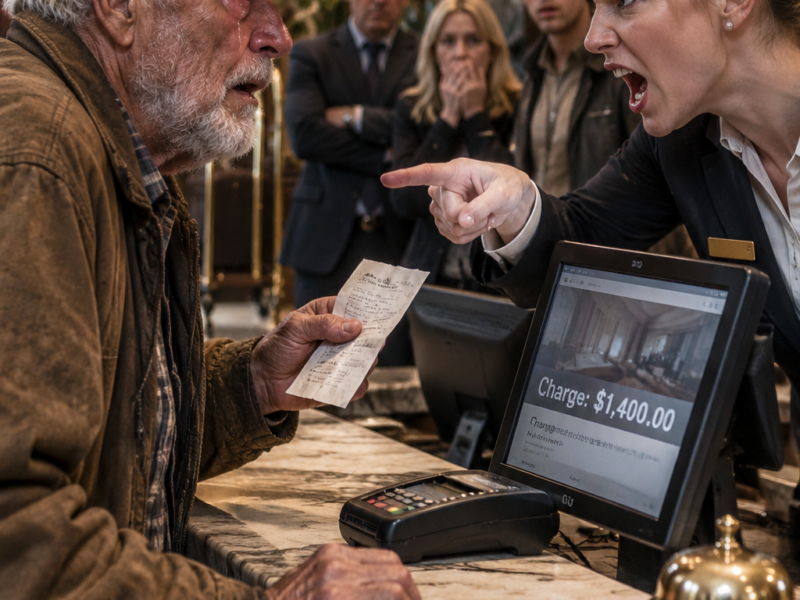
At a quarter to eleven on a Thursday night in October, with rain hammering against the windows and a mountain storm sweeping across western North Carolina, a young woman behind the front desk of the Lark Spur Hotel looked at me, smiled, and said something I would remember for the rest of my life.
“Grandpa, if you can’t afford it, sleep in your truck.”
She said it loudly enough for everyone in the lobby to hear. A young couple standing behind me laughed. The woman covered her mouth, but I could still see the amusement in her eyes.
I was sixty-eight years old. My beard was gray, my hands were rough from decades of roofing work, and my boots were covered in mud from driving through four hours of heavy rain. I wore an old canvas work coat that had probably seen more winters than the young woman behind the counter had been alive.
My name is Wade Toiver.
And that night, I had come to the Lark Spur for something that money could never buy.
I wanted to spend one night in Room 312.
It was the room where my wife and I had spent our wedding night. It was also where she had watched her final sunrise three years earlier.
I had driven up the mountain intending to honor a promise I had made to her before she died. I wanted to sit on that balcony, drink a cup of coffee, and remember the woman who had given me thirty-nine wonderful years of marriage.
I never imagined that I would end up sleeping in my pickup truck in the parking lot of a hotel I owned.
When I first walked through the front doors, the lobby looked almost exactly as I remembered it. The enormous stone fireplace stood beneath the three-story ceiling. Dark chestnut beams crossed overhead, and the grand staircase curved gracefully along the far wall. A black grand piano sat beneath a brass lamp in the corner.
The place had been built in 1913, and every stone seemed to carry a memory.
I approached the front desk and asked for Room 312.
The young clerk glanced at me briefly.
Her name tag read Kendall.
“Room 312 is unavailable,” she said. “It’s reserved for premium guests.”
I asked whether there was another room available.
She typed something into her computer and assigned me Room 418, a room at the end of the fourth-floor hallway, beside the ice machine.
Then she ran my card and slid a printed bill across the marble counter.
I put on my reading glasses and examined it carefully.
The sign beside her keyboard clearly advertised a standard king room for $180 per night.
But the paper in front of me showed a total of $1,400.
I read through every line.
The room itself cost $180.
Then came a mountain experience fee of $295, a heritage preservation search charge of $240, a premium location fee of $190, a late arrival fee of $150, a non-refundable security deposit of $250, and a service charge of $95.
I looked up.
“Ma’am, could you explain what a mountain experience fee is?”
“Those are our standard charges, sir.”
“And the non-refundable deposit?”
She sighed.
“It’s a deposit you don’t get back.”
I nodded slowly.
“So it’s a price with a nicer name.”
She didn’t answer.
I pointed toward the brass sign beside her.
“I’m just trying to understand why the room is advertised at $180, but you’re asking me to pay $1,400.”
Before she could respond, I glanced toward the couple waiting behind me.
Five minutes earlier, I had heard her quote them exactly $180 for the same type of room.
No mountain experience fee. No heritage preservation charge. No late arrival penalty.
Just $180 plus tax.
I turned back toward Kendall.
“Why are these charges being applied to my reservation but not theirs?”
Her expression changed.
She looked at my boots, my coat, my old cap, and then through the glass doors toward my dented 2004 Chevrolet pickup.
That was when she delivered her little speech about sleeping in my truck.
I took off my glasses, folded them, and placed them in my shirt pocket.
I had been spoken to roughly by drill instructors, union bosses, and even a federal judge during my lifetime. One thing experience had taught me was that when another person raises his voice, the best response is often to lower yours.
“Please call the manager,” I said.
Kendall rolled her eyes and picked up the telephone.
A few minutes later, a slim man in a gray suit crossed the lobby.
His name tag identified him as Sterling Vain, general manager.
He was perhaps thirty-five years old, with carefully combed hair and an expensive cologne that seemed completely out of place in a mountain hotel.
He didn’t greet me.
He didn’t ask what had happened.
He simply glanced at Kendall, listened to her explanation, and turned toward me.
“Sir, these are our published rates. You agreed to them when you presented your card.”
“Where are they published?”
I pointed toward the sign.
“Because that says $180.”
He barely looked at it.
“We’ve experienced problems with people coming in off the highway during bad weather. This is a luxury property, and we have policies designed to protect our guests.”
“I didn’t come in off the highway,” I replied. “I came through your front door. I’m a guest.”
“Not anymore.”
He raised his phone and called security.
A moment later, a large young man in a black security jacket approached us.
His name was Mason.
He looked uncomfortable before he even opened his mouth.
“Sir, I’m sorry, but I’m going to have to ask you to leave.”
I looked at him.
“Son, you don’t need to put your hands on me. I know the way out.”
I picked up my duffel bag.
As I walked toward the entrance, I stopped beside a large potted fern near the front doors. I moved it a few inches to the side, uncovering a small brass plaque set into the stone wall.
It was something I had known since I was fifteen years old.
The words were simple.
Every guest is somebody.
Ellsworth Crane.
1951\.
I looked at those words for a moment, then stepped outside.
The rain was coming down so hard that the gutters sounded like a river in flood. I crossed the parking terrace and climbed into my old Chevrolet.
I removed my wet coat, laid it across the dashboard, and pulled an old field jacket from behind the seat.
Then I sat there in the darkness, looking up at the golden windows of the hotel.
Room 312 was dark.
I had spent my wedding night there.
My wife had spent her final night there.
And now, the manager of that hotel had just thrown me out because he thought I couldn’t afford a room.
There was one important detail Sterling Vain didn’t know.
I owned the Lark Spur Hotel.
I had owned it for twenty-eight years.
I also owned eleven other hotels and mountain lodges throughout North Carolina and the surrounding region. All of them operated under Toiver Hospitality.
I could have taken out my phone, called the corporate office, and ordered Sterling fired before midnight.
I could have walked back inside, shown him the deed, and watched his expression change.
But I didn’t.
My mother had once told me that a person who had to announce his wealth or position before others would treat him decently had already lost something important.
I didn’t want to know how they would treat Wade Toiver, the owner.
I wanted to know how they treated everyone else.
So I stayed in my truck.
At 2:10 in the morning, someone knocked on my driver’s window.
I expected to see Mason.
Instead, I found a middle-aged woman standing in the rain.
She wore a gray housekeeping uniform beneath a cheap plastic poncho. Her hair was tucked beneath a net, and she held a thermos, a folded wool blanket, and a small package wrapped in aluminum foil.
I lowered the window.
“Sir,” she said, “they told us a drunk old man got thrown out and was sleeping in the parking lot.”
She studied my face.
“You don’t look drunk. You look like my father.”
Her name was Marisol Reyes.
She asked whether she could get inside because her poncho had a hole in it.
I opened the passenger door.
She climbed in and placed the blanket across my knees.
Then she handed me the foil package.
“It’s a breakfast burrito. Beans and eggs. I made it for my lunch, but I’m not hungry.”
She was lying.
I knew that kind of lie. My wife had used it for thirty-nine years whenever she wanted to give me the last piece of something.
I hadn’t eaten since noon, so I opened the package and began eating.
Marisol poured coffee into the thermos lid. It was strong, sweet, and flavored with cinnamon.
For several minutes, we sat quietly.
Then she noticed the tattoo on my right forearm.
An eagle, a globe, and an anchor.
She touched it gently.
“My son was a Marine,” she said.
I turned toward her.
“Where did he serve?”
“Afghanistan. He died in 2010. Lance Corporal Joaquin Reyes. He was twenty years old.”
She stared through the windshield as rain ran down the glass.
“His son was born four months later. Nico. He’s sixteen now. I’m raising him.”
She told me how much the boy resembled his father. Some nights, she said, she watched him studying at the kitchen table and had to sit down because the sight of him brought back memories she wasn’t prepared to face.
I removed my cap.
“Semper Fidelis,” I said quietly.
She nodded.
Then she told me something that changed the direction of my entire life.
“Don’t let them make you feel small tonight. It isn’t you. They do it to all the old ones now.”
I looked at her.
“What do you mean?”
She hesitated.
Then she told me about a little laminated card kept beneath the front desk.
The employees called it Code Gray.
It contained a list of characteristics that identified certain guests as particularly profitable targets.
Anyone over sixty-five.
Anyone traveling alone.
Anyone paying with cash or a debit card.
Anyone driving an older vehicle.
Anyone without a corporate account or rewards membership.
Anyone arriving late or during bad weather.
If a guest matched three or more categories, the front desk was instructed to apply the full package of additional fees.
The employees were told not to explain the charges unless a guest specifically demanded an itemized bill twice.
And the clerk who collected the fees received ten percent as a bonus.
I sat motionless.
“How long has this been happening?”
“About eighteen months.”
She told me about an eighty-one-year-old widow from Kentucky who had returned to the hotel because she and her late husband had spent their honeymoon there in 1963.
She had wanted to see the mountain view one more time.
Instead, they charged her $1,600 for a single night.
She cried at the front desk when she realized she had spent almost her entire monthly income.
The general manager had walked past her without even looking up from his phone.
Then Marisol told me about Rufus Merryweather.
I hadn’t heard that name in years.
Rufus had once been the head bellman at the Lark Spur. He was the man who had taught me how to carry luggage, how to stand straight, and how to treat every guest with equal respect.
According to Marisol, Rufus was still working at the hotel.
But he was no longer in the lobby.
Sterling Vain had transferred him to the security booth at the bottom of the driveway.
At seventy-four years old, Rufus was working overnight shifts in a tiny glass box with a space heater.
His crime?
He had warned an elderly couple from Ohio to examine their bill before signing it.
They had discovered the extra charges and complained.
The next day, Rufus had been moved out of the lobby.
Marisol looked at me.
“Rufus always says that as long as Mr. Toiver walks these halls, nobody in this building will ever be treated like dirt.”
I looked away.
She continued.
“He says the owner will come back one day and make things right. I told him the owner lives on a farm somewhere and probably doesn’t care about us anymore.”
I couldn’t answer.
For three years, I had been sitting on my farm, grieving my wife and convincing myself that the company was doing well without me.
Meanwhile, the people who had once trusted me were being humiliated in my name.
Marisol returned the blanket before the shift change.
Before she left, I thanked her.
She looked at the tattoo on my arm again.
“Marines don’t leave Marines in the rain,” she said. “I figured that goes for their mothers, too.”
Then she disappeared into the darkness.
A little after five, I walked down to the security booth.
A figure sat inside, holding a cup of coffee with both hands.
Even through the fogged glass, I recognized that straight back.
Rufus Merryweather.
He was older, thinner, and his hair had turned completely white. But beneath his black raincoat, he was still wearing the maroon uniform he had once pressed so carefully every evening.
I knocked.
He turned, slid open the window, and studied me.
Then he smiled.
“Took you long enough, Belle.”
That was the nickname he had given me when I was fifteen.
I couldn’t speak for a moment.
“Rufus.”
He opened the door and invited me inside.
The booth was barely large enough for two people. A small space heater ticked beside our boots.
He told me he had seen my truck arrive the previous evening. He had also watched me being escorted out.
“I knew it was you from the way you walk,” he said. “You still favor that left knee.”
I told him about Marisol and the Code Gray card.
He nodded.
“She is a good woman. They’ll fire her if they find out she talked to you.”
I told him they wouldn’t.
Rufus looked at me over his glasses.
“There’s a camera covering every inch of that service entrance. They installed them last year. Said it was to prevent theft. It’s really to watch us.”
Then I asked whether my son Luke knew anything about what was happening.
Rufus went quiet.
He told me he had written Luke a four-page letter in April. He had explained the fees, the elderly guests, and the way the employees were being pressured.
He had mailed it directly to Luke’s office in Charlotte.
He never received a response.
I felt something heavy settle in my stomach.
Luke was my son. I had raised him to respect people. He had spent his childhood in the very hotel where Rufus had taught me those lessons.
And now Rufus was sitting in a freezing security booth because he had tried to protect the people my company was supposed to serve.
“That’s on me,” I said. “My name is on the deed. I stepped away and let this happen.”
Rufus didn’t comfort me.
He simply nodded.
Then he asked the question I had been avoiding.
“Well, Belle, you’re back now. What are you going to do about it?”
I looked toward the eastern ridge.
The sky was beginning to turn pink.
“I’m going to find out how deep it goes.”
I returned to the hotel around seven that morning.
Near the service entrance, I saw Sterling Vain standing with a tablet in his hand.
Marisol was beside him.
She held her purse and a canvas lunch bag in front of her.
Sterling was showing her footage from the security cameras.
“This is you leaving at 2:11 a.m. with a blanket from the linen room. And this is you returning at 4:40.”
“He was cold,” Marisol replied. “He was an old man sleeping in his truck in the rain.”
“You gave hotel property to someone who had been removed for disorderly conduct.”
“He needed a blanket and something to eat.”
“Policy is policy. You’re terminated, effective immediately.”
Nineteen years of service ended with those words.
Sterling even told her the price of the blanket would be deducted from her final paycheck.
I approached them.
He looked at me with irritation.
“You again? I thought we were clear last night.”
I didn’t answer him.
Instead, I walked over to Marisol, gently took her bags, and asked whether I could escort her to her car.
She nodded.
We walked down the parking terrace together.
Her car was an old gray Toyota with a cracked bumper. A Marine Corps sticker covered part of the rear window, accompanied by a small gold-star decal.
I placed her belongings in the back seat.
“I’m sorry,” I told her.
She shook her head.
“This happened because of him. Don’t take what belongs to him, sir. That’s how men like him get away with things. Good people always pick up the blame for bad people.”
I handed her a small piece of paper with my telephone number.
“Give me two weeks. Don’t accept another job just yet.”
She studied me.
“Two weeks for what?”
“If I’m wrong, I’ll drive you to another hotel myself and tell them they’d be fools not to hire you.”
She laughed softly.
“Who are you, really?”
“A man who owes you a burrito.”
That was the first time I had seen her smile.
After she drove away, I went to a diner in Asheville and called an old Marine Corps friend named Hank Dobbins.
Hank had spent twenty-six years investigating financial crimes for the IRS. He was retired now, but he still understood money better than most people understood their own families.
I told him everything.
He listened without interrupting.
When I finished, he said something that made my stomach tighten.
“Wade, if somebody has created a complicated fee system like this, there’s a good chance the money isn’t staying where it should.”
He asked for access to the company records.
I gave him authorization.
He warned me not to tell anyone, especially Luke.
“If there’s a thief involved, the first thing he’ll do when he senses trouble is destroy the evidence.”
I agreed.
But I wasn’t going to spend ten days sitting on my farm waiting for Hank to finish his investigation.
I decided to return to the hotel.
Not as the owner.
As an employee.
I knew the building better than almost anyone. I had installed its boiler, repaired its roof, and worked on its plumbing and electrical systems.
A local staffing agency had posted an advertisement for an overnight maintenance technician.
I shaved off my beard, cut my gray hair short, bought a pair of cheap reading glasses, and applied under my mother’s maiden name.
Wade Beck.
The interviewer asked whether a sixty-eight-year-old man could handle overnight maintenance work.
I told her I had handled worse.
The following afternoon, I was hired.
That night, I walked through the service entrance wearing a navy-blue work shirt with the name Beck stitched above the pocket.
Nobody recognized me.
I punched the time clock and went downstairs to the basement.
The boiler room smelled exactly as I remembered it.
An old hook still protruded from the stone wall where Rufus used to hang his maroon uniform while pressing it with a flat iron.
I stood in front of the cracked mirror above the utility sink.
“Well, Mama,” I whispered. “I’m back.”
For the next nine nights, I worked from ten in the evening until seven in the morning.
And I saw things I wished I had never seen.
On the first night, the boiler nearly failed.
I could hear the circulation pump knocking as soon as I entered the basement. The company had replaced its experienced maintenance staff with an outside contractor who visited once a month.
They had been using cheap replacement parts and patching equipment that should have been properly repaired.
At one in the morning, the pump seized.
The radiators in the entire north wing went cold.
Guests began calling the front desk.
The night clerk, a nervous young man named Trey, came downstairs and asked whether I could fix it.
I told him I could.
I dismantled the pump, cleaned the shaft, and replaced the damaged bearing with a spare part I found on an old shelf.
By three in the morning, the heating system was working again.
Trey looked at me as though I had performed a miracle.
“How did you know where that part was?”
“Lucky guess,” I told him.
The second night showed me exactly how the Code Gray system worked.
An elderly couple arrived shortly before midnight.
The man wore a faded Vietnam veteran cap and a tan windbreaker. His wife was a tiny woman with white hair and a pink cardigan.
She carried a white cake box.
Their names were Leland and Opal Grubs.
They explained to Kendall that they were celebrating their sixtieth wedding anniversary.
They had first visited the Lark Spur six decades earlier for their honeymoon. They couldn’t afford to stay at the time, so they had eaten dinner, admired the lobby, and driven home.
They had promised themselves they would return one day.
It had taken them sixty years to save enough money.
I was standing on a ladder in the lobby, replacing a chandelier bulb, close enough to hear everything.
Kendall smiled politely.
Then I watched her eyes move toward the old man’s clothing, his wallet, and the debit card he placed on the counter.
Her fingers moved across the keyboard.
Room: $180.
Mountain experience fee.
Heritage preservation charge.
Premium location fee.
Late arrival fee.
Celebration fee.
Non-refundable deposit.
Service charge.
The total came to $1,620.
The old man put on his reading glasses.
I watched his face change as he read the paper.
His wife was looking at the fireplace, smiling like a young bride.
He glanced at her, then reached into his jacket and pulled out a worn white envelope.
Written across the front in pencil was one word.
Anniversary.
Inside were carefully saved bills.
He counted the money on the counter. Twenty-dollar bills, tens, and fives.
When he finished, he was still short.
So he handed over his debit card.
His wife never noticed.
She was too busy admiring the hotel where she had dreamed of spending one proper anniversary night for sixty years.
I wanted to walk across that lobby and take the money back.
But I knew that if I interfered, Sterling would fire me, and I would lose the opportunity to uncover the entire operation.
So I stood there holding a burned-out light bulb while the old couple went upstairs.
The following morning, I withdrew $2,000 from my bank and placed it in another plain white envelope.
I drove back to the hotel and handed it to Rufus.
“There’s an elderly couple from Greenville. A tan Buick with a Vietnam veteran plate. When they leave, stop them at the gate and give them this. Tell them the hotel made a mistake.”
Rufus looked at the envelope.
Then he looked at me.
“That’s not making it right, Belle. That’s just making yourself feel better.”
“I know.”
He accepted the money anyway.
Later that morning, I watched from my truck as their Buick stopped at the gate.
Rufus walked out in his pressed uniform and leaned toward the driver’s window.
Opal covered her face with both hands.
Leland reached out and held Rufus’s hand for a long time.
I sat in my truck and watched them drive away.
The third night, I discovered that Mason wasn’t the heartless security guard Sterling wanted everyone to believe he was.
I found him sitting alone on an overturned milk crate near the loading dock, his head buried in his hands.
I sat beside him.
He explained that he had been ordered to escort an elderly man out of the hotel earlier that evening.
The man’s wife was in the cardiac unit at Mission Hospital. Every motel near the hospital was full, and he had driven up the mountain looking for somewhere to sleep.
Sterling had refused to remove the additional fees.
When the man said he couldn’t afford the room, Mason had walked him outside.
Then he followed him to his car and secretly gave him eighty dollars from his own wallet.
He had also told him about a church shelter near Biltmore.
It was the third time that month he had done something similar.
“Why do you stay here?” I asked.
“My grandmother needs medicine. It costs four hundred dollars a month. This job pays eighteen dollars an hour.”
He looked down at his hands.
“And if I quit, they’ll hire somebody who doesn’t give those old men money.”
I understood him.
Sometimes people remain in difficult situations not because they approve of what is happening, but because they know someone else might suffer even more if they leave.
On the fifth night, I learned something unexpected about Kendall.
It was after one in the morning when Brett Conincaid, a wealthy property developer, came stumbling across the lobby.
He wanted Room 312.
Kendall politely explained that it was reserved.
He became aggressive.
“I’m friends with Damon Sloan. I’ve stayed in that room before. Give me the key.”
She refused.
He reached across the counter and grabbed her wrist.
She gasped.
Her key card fell onto the marble floor.
I crossed the lobby before I had time to think.
I took his wrist and applied just enough pressure to make him release her.
“Now, you’re going to walk to that elevator,” I said quietly. “You’re going to go to your room, and you’re going to sleep. Tomorrow morning, you’re going to be ashamed of yourself.”
He looked at my maintenance uniform.
“Who the hell are you?”
“Maintenance.”
He laughed nervously.
I escorted him to the elevator.
When I returned, Kendall was standing behind the desk with her hand pressed against her chest.
“Go take a break,” I told her.
“I can’t leave the desk.”
“You can. I’ve watched more desks than you’ve had birthdays.”
She disappeared into the stairwell.
A few minutes later, I heard her crying.
I found her sitting on a step with mascara running down her cheeks.
“I’m sorry,” she whispered.
I sat one step below her.
“You don’t even know me.”
“I know enough.”
She shook her head.
“I’m a horrible person.”
I looked at her for a moment.
“People who are completely comfortable with being horrible don’t usually cry about it.”
She told me she was twenty-three, from Black Mountain, and the oldest of four children.
Her father had suffered a back injury while driving trucks. Her mother cleaned houses.
Kendall was studying nursing at a community college and had accumulated nearly $38,000 in student loans.
The hotel job paid better than anything else she could find and allowed her to attend classes.
When Sterling introduced Code Gray, he told the employees that it was corporate policy.
Those who refused to apply the fees would receive disciplinary warnings.
Those who collected them successfully would receive ten percent.
At first, Kendall convinced herself that hotels simply charged extra fees.
But eventually, she noticed the pattern.
It was always elderly people.
People in old cars.
People who traveled alone.
People who were too tired or embarrassed to argue.
She admitted that she had known what was happening.
She had even repeated Sterling’s cruel words to me that first night because she was afraid of losing her job.
Then she showed me a photograph of the laminated card on her phone.
It contained every instruction Marisol had described.
At the bottom, in small letters, were the words:
Desk incentive: 10%.
I asked her to send me the photograph.
Then I asked who Room 312 was actually being reserved for.
She hesitated.
Finally, she admitted that the room was being blocked for Damon Sloan, the company’s chief operating officer.
He and his friends used it whenever they came to Asheville.
It was reserved for them almost every weekend, whether they arrived or not.
I looked at the photograph on my phone.
That was the room where Norah and I had spent our wedding night.
The room where she had watched her last sunrise.
And for eighteen months, it had been treated as a private playground for a man who was helping steal money from elderly guests.
I stood up.
“Go wash your face. Then return to that desk. From now on, charge every guest exactly what the sign says. One hundred and eighty dollars.”
She stared at me.
“You can’t tell me what to do. You’re maintenance.”
“I know.”
I walked away.
On Saturday, I drove to a small town called Leicester.
I had remembered something Marisol mentioned during our conversation in the truck. Her house had a leaking roof.
I arrived with shingles, tar paper, flashing, and two ladders.
Marisol opened the door wearing an apron.
She didn’t recognize me immediately without my beard.
Then she did.
“Dios mío! What happened to your face?”
“Long story. I heard your roof needed fixing.”
Her grandson Nico appeared behind her.
He was sixteen, tall, and lean, with the same dark eyes his father had possessed.
He looked suspiciously at me.
I asked whether he wanted to learn how to repair a roof.
He agreed.
We spent seven hours replacing the damaged section above the bathroom.
At first, Nico was nervous about climbing the ladder.
I guided him slowly, one step at a time.
By lunchtime, he was walking across the roof confidently.
We sat together on the ridge eating tamales Marisol had prepared.
He asked about the Marines.
He had been considering enlisting when he turned eighteen, but his grandmother didn’t want him to.
I told him the truth.
It would be difficult. It would take things from him he would never get back. It would also teach him things he might never learn anywhere else.
But he should never enlist simply because he wanted to become his father.
He needed to become himself.
He looked toward the valley.
“Nobody talks to me about him without crying,” he said.
“Your grandmother told me your father used to say Marines don’t leave Marines in the rain.”
I looked at him.
“That’s a man worth being proud of. But you don’t have to be him. You only have to be worthy of him.”
He didn’t answer immediately.
But I could tell he was thinking about it.
That evening, I drove back toward Asheville.
Hank called while I was parked at a gas station.
His investigation had uncovered something much worse than we had imagined.
Across all twelve hotels, the company had collected approximately $6.8 million in additional fees over eighteen months.
But only forty percent of that money had remained within Toiver Hospitality.
The other sixty percent had gone to a company called Ridgerest Guest Services LLC.
The company was registered in Delaware and supposedly provided guest-experience optimization and fee-administration services.
It had one office address, which turned out to be a mailbox at a shipping store in Plano, Texas.
It had no identifiable employees.
Its owner was a trust managed by a man named Grady Lell.
Grady was married to Damon Sloan’s sister.
More than $4.1 million had been transferred to that company.
The arrangement had been approved by Damon.
But the contract had also been signed by my son, Luke, who was the chief executive officer.
Hank explained that the sixty-percent commission was buried on page twenty-nine of a sixty-page contract.
Luke had signed the agreement on page forty-one.
“Did he know?” I asked.
“I can’t tell you that yet,” Hank replied. “He may have been deceived. But we need proof.”
I sat in my truck for a long time after that call.
I thought about Luke.
He was forty years old, educated, intelligent, and capable.
He had grown up watching his mother play the piano in that lobby and watching Rufus carry luggage.
How could he have allowed something like this to happen?
I called him that evening.
He sounded cheerful.
He told me the company was having its best year in history and invited me to the annual management conference the following Friday.
Damon would be presenting the results.
Sterling Vain was going to receive the General Manager of the Year award.
I told him I would attend.
Then I spent the next several days preparing.
I retrieved the original deed, shareholder agreement, and management contract from a fireproof box at the bank.
For the first time in years, I read every page.
I discovered that I still owned seventy percent of Toiver Hospitality.
I also had the authority to call an immediate board meeting and remove any company officer for cause.
I had included that clause in the agreement years earlier.
I simply never imagined I would need it.
I contacted Rufus and asked him to attend the conference.
He worried that Sterling would fire him for leaving the security booth.
“Let them try,” I said.
Then I visited Marisol again and told her the truth.
I explained that I was Wade Toiver, the owner of the hotel, and that I had disguised myself because I needed to understand what was happening without everyone changing their behavior around me.
She listened silently.
When I finished, she went inside and returned with a wooden spoon.
For one frightening second, I thought she intended to hit me.
Instead, she pointed it directly at my chest.
“Nineteen years,” she said. “I cleaned your hotel for nineteen years, and you sat in my truck eating my lunch without telling me who you were.”
I lowered my head.
“Yes, ma’am.”
She studied me.
“Why?”
“Because I needed to hear the truth from somebody who didn’t know who I was.”
She lowered the spoon.
Then she asked what she should wear on Friday.
“Whatever you’d wear to church,” I replied.
On Wednesday night, I found Kendall in the stairwell.
I removed my cheap glasses and asked her to look carefully at my face.
At first, she didn’t understand.
Then recognition slowly appeared.
Her hand covered her mouth.
“You’re the old man from the rain.”
“Yes.”
“Mr. Toiver?”
I nodded.
She began crying.
She apologized repeatedly and even offered to resign.
I stopped her.
“I didn’t come here to fire you. I came to ask you to do something difficult.”
I explained that I needed her to read the Code Gray card aloud at the conference.
In front of every manager.
She looked terrified.
“If I do that, I’ll never work in a hotel again.”
“If you do that, you’ll be able to look at yourself in the mirror for the rest of your life.”
She sat quietly for several minutes.
Then she nodded.
On Thursday night, Mason found me in the boiler room.
He had heard about my identity.
“Are you going to tell Mr. Vain?”
“No.”
He looked at me carefully.
“What do you need?”
“Friday at two o’clock. When they ask you to remove me from the ballroom, I need you to remember what you saw that first night.”
Mason nodded.
“I’ll be there.”
Friday arrived clear and cold.
I put on the same navy-blue maintenance shirt with Beck stitched above the pocket.
I wanted them to see the same man they had ignored all week.
The conference was being held in the grand ballroom.
Eighty managers and senior employees from all twelve properties had gathered.
At the front table sat my son, Luke, wearing an expensive navy suit.
Beside him was Damon Sloan.
Sterling Vain sat nearby with a glass award in a velvet box.
I entered through the service door, pushing a maintenance cart.
Nobody noticed.
At two o’clock, Damon walked to the podium.
He was an excellent speaker.
He presented charts showing revenue growth, increased profits, and improved performance across the company.
The Lark Spur had supposedly increased revenue by forty-one percent.
He praised Luke for having the courage to modernize the company.
Everyone applauded.
Then Damon announced the General Manager of the Year award.
Sterling walked to the podium.
He shook Damon’s hand and accepted the glass trophy.
He smiled for the photographer.
Then he leaned toward the microphone.
“At the Lark Spur, we believe in one thing. Every guest receives exactly the experience they pay for.”
That was when I started walking.
I moved slowly down the center aisle.
Sterling noticed me first.
He frowned.
“Can we get maintenance out of here? We’re in the middle of something.”
I continued walking.
Then he recognized my face.
The old man in the rain.
The man he had thrown out of his hotel.
His expression changed.
“Security! Mason, get this man out of here!”
Mason was standing near the rear entrance.
He didn’t move.
“No, sir.”
Sterling stared at him.
“I said get him out!”
“No, sir. Not this one.”
The room became silent.
I reached the podium.
My son was halfway out of his chair.
“Dad?”
His face had gone pale.
“Dad, what happened to your beard? Why are you dressed like that?”
“Sit down, son,” I said quietly. “I’ll explain everything. But first, there’s a bill I need to settle.”
I unfolded the $1,400 receipt from my shirt pocket and placed it on the podium.
Then I looked at Sterling.
“Thirteen nights ago, an old man drove four hours through a mountain storm to this hotel. He had been coming here since he was fifteen years old. He asked for one room. The front desk charged him $1,400 for a room advertised at $180.”
I paused.
“When he questioned the charges, the clerk told him, ‘Grandpa, if you can’t afford it, sleep in your truck.’”
Nobody moved.
“The old man asked for the manager. The manager had him removed from the property.”
I turned toward Sterling.
“Isn’t that right?”
He couldn’t answer.
“That old man slept in his truck in the rain. At two in the morning, a housekeeper who had worked in this building for nineteen years brought him coffee, a blanket, and her own lunch.”
I looked toward the audience.
“The following morning, the manager fired her and deducted the price of the blanket from her final paycheck.”
I straightened my shoulders.
“My name is Wade Toiver. I started working here in 1973 carrying luggage for one dollar a bag. I repaired the roof above your heads with my own hands. I own this hotel, and I own the eleven other hotels you came from.”
The room was completely silent.
“I’ve spent the last nine nights working here as a maintenance technician. I repaired your boiler. I changed your lights. I watched your front desk. And I discovered something that every one of you deserves to know.”
I turned toward the side entrance.
“Kendall, would you come up here, please?”
She entered the ballroom.
Her hands were trembling.
But she walked straight to the podium.
She held up her phone and opened the photograph of the Code Gray card.
Then she began reading.
Guests over sixty-five.
Guests traveling alone.
Guests paying with cash or debit cards.
Guests driving older vehicles.
Guests without corporate accounts.
Guests arriving late or during bad weather.
Apply the full fee package.
Do not itemize unless requested twice.
Desk incentive: ten percent.
Her voice broke as she reached the final line.
She took a breath.
“I’m the person who told Mr. Toiver to sleep in his truck,” she said. “Mr. Vain told us to say things like that. He watches the front desk cameras. If we don’t follow the instructions, he writes us up. I did it for fourteen months. I’m sorry.”
She looked at me.
“I’m so sorry, Mr. Toiver.”
I placed a hand on her shoulder.
“Thank you, Kendall. That took more courage than most people in this room have shown in a year.”
Damon Sloan finally stepped forward.
He smiled and spread his hands.
“Everyone, let’s take a breath. Mr. Toiver has been through a difficult period since his wife’s death. Grief affects people. This is a misunderstanding about a standard industry fee structure.”
He turned toward Luke.
“Perhaps we should take your father somewhere quiet.”
“Hank,” I said.
A man in a brown tweed jacket stood up from the back of the room.
Hank Dobbins.
He walked toward the front carrying a thick accordion folder.
He placed it on the table in front of my son.
“Ridgerest Guest Services LLC,” he announced. “Registered in Delaware. One mailbox in Plano, Texas. No employees. It collected $4.1 million from Toiver Hospitality over eighteen months.”
He turned toward Damon.
“The company is owned by a trust managed by Grady Lell. Your brother-in-law, Mr. Sloan.”
Damon’s smile disappeared.
“It’s an outsourced administrative vendor. The arrangement is legal.”
Hank opened the folder.
“The company collected sixty percent of the additional fees. Those fees were primarily charged to elderly guests. The total amount collected across the twelve properties was $6.8 million.”
He pointed toward the contract.
“Your signature is here, Mr. Sloan. And this is the signature of the chief executive.”
Every eye turned toward Luke.
My son opened the folder.
He began flipping through the pages.
Then he stopped at page twenty-nine.
I watched his eyes move down the paragraph.
He read it once.
Then again.
Finally, he looked up at Damon.
“Sixty percent?”
His voice was barely audible.
“You told me Ridgerest was a software provider. You said the fee was eight percent.”
Damon remained calm.
“It’s in the contract, Luke. You signed it.”
“I trusted you.”
“You should have read what you signed.”
Luke stared at the page.
Then he stood.
“Damon Sloan, you’re fired. Effective immediately.”
He turned toward Mason.
“Please escort him to his car.”
Mason walked forward.
“With pleasure, sir.”
Damon looked around the room, searching for someone willing to defend him.
Nobody did.
He left with Mason behind him.
Then there was Sterling Vain.
He was still standing beside the podium, holding the glass award.
“Mr. Toiver,” he began, “I was following corporate policy. Those instructions came from Dallas. I didn’t know who you were.”
I looked directly at him.
“If you’d known who I was, would you have treated me differently?”
He said nothing.
“That’s the problem, son. You shouldn’t have needed to know who I was.”
I pointed toward the front entrance.
“That plaque outside says every guest is somebody. It doesn’t say every rich man is somebody. It doesn’t say every owner is somebody. It says every guest.”
I took the award from his hand.
“You threw an old man into the rain because of his boots. You fired a mother for giving him coffee. You made a young woman say cruel things to people because you wanted ten percent of the money.”
I placed the award on the podium.
“You asked me that night whether I could afford your hotel. I want you to think carefully about whether you can afford to keep calling yourself a decent man.”
Sterling looked around the ballroom.
Then he removed his name tag and placed it beside the trophy.
He walked out.
I turned toward the back of the room.
“Rufus. Marisol. Come on up here.”
The double doors opened.
Rufus entered wearing his old maroon bellman’s uniform.
Marisol walked beside him in a navy-blue church dress, holding his arm.
Something unexpected happened.
The managers who had worked at the hotel during my early years began standing.
One by one, they rose until the entire ballroom was on its feet.
Nobody had instructed them to do it.
Rufus walked toward the podium with his back perfectly straight.
When he reached Luke, he stopped.
“Little Bell,” he said softly.
Luke’s face crumpled.
“Mr. Merryweather.”
My son told him that he had received the letter in April.
Damon’s assistant had placed it on his desk with a note identifying Rufus as a disgruntled employee whose complaint was being handled by legal.
Luke had believed it.
He had put the letter in a drawer and never investigated.
“I should have read it,” Luke whispered. “I’m sorry.”
Rufus placed one thin hand on his shoulder.
“You’re reading it now. That’s what counts.”
I stepped away from the podium.
I wanted them to have that moment.
Then I addressed the room.
I made one thing clear.
What had happened wasn’t simply the fault of Damon Sloan.
Kendall had participated, but she had been pressured and manipulated.
Mason had followed orders, but he had also tried to protect vulnerable guests.
Marisol had done the right thing and lost her job for it.
Rufus had been punished for standing up for people.
And Luke had failed to supervise the company he was responsible for leading.
But the greatest responsibility belonged to me.
My name was on the deed.
My name was on the company.
Three years earlier, after Norah died, I had stopped walking the halls.
I had told myself I had earned a rest.
I had convinced myself that my son and his team could handle everything.
And while I sat on my porch, the people who depended on that company were being mistreated.
“When the person responsible for watching a place stops watching,” I said, “the halls go dark. And the people who get hurt in the dark are always the ones who can’t fight back.”
I announced that every fee on the Code Gray card was canceled immediately.
Not just at the Lark Spur.
At all twelve hotels.
I also ordered a full refund for every guest who had paid those charges during the previous eighteen months.
Every dollar.
With interest.
I didn’t care what it cost.
If necessary, I would sell my farm.
The ballroom erupted in applause.
But I wasn’t thinking about the applause.
I was looking at Marisol.
She stood beside Rufus with her hands folded in front of her, just as my mother had stood beside the brass plaque decades earlier.
She nodded once.
And I knew I had finally begun to make things right.
The weeks that followed were difficult.
Hank and his team spent nineteen days examining financial records.
Damon Sloan was indicted eleven weeks later on charges of wire fraud and embezzlement.
Grady Lell cooperated with investigators and provided details about the arrangement.
The money in Ridgerest was frozen.
Most of the stolen funds were eventually recovered.
Some had already been spent on a lake house and a luxury boat named Second Wind.
The boat was sold at auction.
I didn’t attend.
I wasn’t interested in watching another man lose everything.
I wanted the people he had robbed to get their money back.
Sterling Vain never returned to the Lark Spur.
He cleaned out his office on a Sunday morning when most of the staff was off duty.
I happened to be working my final week as Wade Beck.
I had promised the maintenance supervisor I would finish the two weeks I had agreed to work.
So when Sterling walked through the service corridor carrying a cardboard box, I was standing on a ladder replacing a broken light.
He stopped.
I stopped.
After a moment, he asked whether I wanted an apology.
“No,” I said. “I want you to go somewhere and do better. That’s all.”
He looked at me as though he couldn’t understand why I wasn’t interested in punishing him.
Then he left.
I climbed back up the ladder and finished changing the light.
It had been broken for six days.
Housekeepers had been pushing their carts through that dark hallway every night.
That was something else I had come back to fix.
The refunds took months.
More than eleven thousand guests received checks and handwritten letters.
I wrote the original letter myself.
It explained that people had been charged for services they never received.
I admitted that the wrongdoing had happened under my name.
I apologized and promised that the advertised price would be the actual price from that day forward.
At the bottom, I added one sentence.
I’m sorry.
Some people advised me not to include it.
They worried it could create legal problems.
I told them that if a man couldn’t admit he had done something wrong because he was afraid of a lawyer, he wasn’t much of a man.
I personally delivered several of the refunds.
One was for Bernadette Holloway, the eighty-one-year-old widow from Kentucky.
I drove to her small brick house outside Corbin and knocked on the door.
She answered wearing an apron.
I introduced myself and explained what had happened.
Then I handed her the envelope.
She opened it, read the check, and looked at me.
“I didn’t go there for money, you know.”
I waited.
“My husband Clyde and I spent our honeymoon at the Lark Spur in 1963. We stayed in Room 208. He died in March. I just wanted to see that window one more time.”
Her eyes filled.
“They put me in a room beside the ice machine. It looked out at the parking lot. Then they charged me sixteen hundred dollars.”
I felt the weight of every word.
I couldn’t give her back that night.
But I could offer something else.
“Mrs. Holloway, Room 208 is yours for any weekend you choose. I’ll drive you there myself and bring you home.”
She studied my face.
Then she smiled.
“You drive like you talk?”
“Slow and careful, ma’am.”
“Then I’ll go.”
Three weeks later, I carried her suitcase upstairs to Room 208.
She sat beside the window for three hours without saying much.
When I brought her dinner, she looked toward the mountains.
“Clyde would have liked you,” she said. “He didn’t like many people.”
I carried that compliment home like a medal.
I also visited Leland and Opal Grubs.
They had received the money Rufus had delivered at the gate, and Leland had initially tried to return it.
He wrote that they didn’t accept charity.
I called him and explained that it wasn’t charity.
It was their money.
Then I asked whether they would allow me to give them their sixtieth anniversary celebration again.
This time, properly.
They agreed.
I reserved Room 312 for them.
The same room where Norah and I had spent our wedding night.
The same room Damon had been keeping for his own private weekends.
Marisol prepared the room herself. She placed fresh flowers on the dresser and brought a quilt from her own home.
Rufus carried their luggage upstairs.
When Leland entered the room and saw the balcony overlooking the valley, he removed his cap and held it against his chest.
Opal sat on the bed and gently touched the quilt.
Then Leland turned toward me.
“Why did you come back?” he asked. “You could have just fired a few people from an office.”
I thought about my mother cleaning those rooms.
I thought about Rufus teaching me how to stand straight.
I thought about Norah playing the piano.
“Because if I can’t come back here and set things right with my own hands, then I don’t deserve to own this place.”
Leland nodded.
“That’s what I figured. I just wanted to hear you say it.”
Kendall kept her job.
Some people thought I was being too forgiving.
I disagreed.
She had stood in front of eighty managers, admitted what she had done, and helped expose the entire operation.
She finished nursing school two years later.
The company paid off her remaining student loans.
Before leaving for a hospital position in Asheville, she trained every new front-desk employee.
She made them stand in front of the brass plaque and read its words aloud.
Then she told them about the old man in the rain.
She never tried to make herself look innocent in that story.
She told them exactly what she had said and why she regretted it.
Mason became head of security for all twelve properties.
He initially refused the promotion.
He told me he was the person who had escorted me out on that first night.
I reminded him that he had apologized, walked me slowly to my truck, and later refused to remove me from the ballroom.
“A man who says no when it counts is exactly the kind of man I want protecting our guests,” I told him.
He stood a little taller after that.
Marisol became director of housekeeping for Toiver Hospitality.
All twelve hotels and more than four hundred employees eventually came under her supervision.
She didn’t want the position at first.
She said she was a housekeeper, not an executive.
I told her that anyone willing to bring a stranger coffee, food, and a blanket in the middle of a storm deserved a chance to lead.
She learned the administrative side of the job quickly.
Her first decision was to visit every hotel and work an overnight shift with the housekeeping staff.
Her second was to repair every broken light in every service corridor.
Her third was to put a sign in every employee break room.
It read:
If you see a guest who is cold, hungry, or alone, help them.
If anyone gives you trouble for doing so, call me.
She added her personal telephone number beneath the message.
Nobody ever disciplined an employee for helping a guest again.
Nico graduated from high school and enlisted in the Marine Corps.
Before making his decision, he called me.
“Mr. Wade, do you think I’m doing the right thing?”
I told him that he should do it only if he understood why he wanted to serve.
If he was trying to become his father, he would never succeed.
But if he wanted to stand for something greater than himself, then he should go.
He told me that was exactly what he wanted.
I attended his graduation at Parris Island.
Marisol sat on one side of me, and Rufus sat on the other.
When the young Marines marched onto the parade ground, she grabbed my arm so tightly that I could feel her fingers through my sleeve.
When Nico was dismissed, he ran toward his grandmother.
He came to attention, saluted her, removed his cover, and wrapped his arms around her.
I thought about Lance Corporal Joaquin Reyes.
A young man who had never lived long enough to see his son grow up.
I came to attention without even realizing I was doing it.
Rufus stood beside me.
He had never served in the military, but he stood as straight as any Marine on that parade ground.
Later, I brought Rufus back into the Lark Spur lobby.
I returned his old maroon jacket and his position as head bellman.
He stood beside the brass stand near the entrance.
Guests who had known him for decades began greeting him.
A retired judge from Raleigh wrapped his arms around the seventy-four-year-old bellman.
“Where in the world have you been, Rufus?”
Rufus smiled.
“Out by the gate, Your Honor. Waiting for somebody to remember.”
He worked another eight months before retiring on his own terms.
I placed a brass nameplate beside the old plaque, and Room 312 was reserved for him one night every year on his birthday.
My son Luke also came to understand what he had done.
A week after the conference, he drove to my farm.
He sat beside me on the porch.
For a long time, neither of us spoke.
Then he said something I hadn’t expected.
“Dad, I want to work nights at the Lark Spur.”
I looked at him.
“Doing what?”
“Whatever Rufus tells me.”
He explained that he had signed the contract without properly reading it.
He had trusted Damon.
He had ignored Rufus’s letter.
He had spent years managing the company from an office without understanding what happened inside the hotels.
“I can’t run this company if I don’t know what the work costs,” he said.
I looked at him for a long moment.
Then I nodded.
Luke worked thirty nights as a bellman.
Rufus trained him personally.
And Rufus was not gentle.
He made Luke stand at the brass stand for hours without leaning.
He made him learn every guest’s name.
He made him carry luggage up the stairs instead of using the elevator.
He told my son that a man should understand what a job costs a person’s body before deciding what that person should be paid.
On the third night, Luke came home with blisters on both feet.
On the tenth, he helped an elderly guest who had fallen in the parking lot.
He stayed beside the man until the ambulance arrived.
On the twentieth night, a woman arrived alone in an old car, carrying a debit card.
She matched every characteristic on the old Code Gray list.
But the young clerk charged her exactly $180.
She received a beautiful room overlooking the valley, and a bellman carried her luggage upstairs.
Luke told me later that he had to go outside afterward because he couldn’t stop thinking about how easily he had allowed people to be treated differently.
On his thirtieth night, Rufus removed the brass name tag from his own jacket.
He pinned it to Luke’s chest.
“You’ll do, little Belle,” he said.
A few months later, something happened that I will never forget.
It was a Friday evening.
The lobby was busy, the fireplace was burning, and guests were coming and going.
I was standing near the dining room when I noticed Luke approaching the old piano.
It was the same piano Norah had played when I first met her.
Nobody had played it in three years.
I had continued having it tuned every six months, even though I couldn’t explain why.
Luke sat on the bench.
He had taken piano lessons from his mother as a child, although he had hated every minute of them.
He hadn’t touched the instrument since he was twelve.
He placed his hands on the keys.
Then he began playing “I’ll Fly Away.”
He missed several notes.
He stopped, started again, and stumbled through parts of the melody.
But he kept going.
The entire lobby became quiet.
Marisol stopped at the front desk.
Rufus looked up from his chair near the fireplace.
Kendall, who had come to visit after her shift at the hospital, stood beside the staircase.
I was in the doorway holding a cup of coffee.
When Luke finished, he didn’t turn around.
He simply sat there with his hands resting on his knees.
I walked over and placed a hand on his shoulder.
Neither of us spoke.
We didn’t need to.
For the first time in three years, I felt that my family was beginning to find its way back to itself.
Then came the anniversary morning.
The anniversary of the day Norah had died.
The promise I had broken for three years.
I had told her I would return to Room 312 every year and watch the sunrise from the balcony.
That morning, at five o’clock, someone knocked on the door.
It was Luke carrying two cups of coffee.
Behind him stood Rufus in his old braided jacket.
Marisol followed with her thermos of cinnamon coffee and a paper bag filled with breakfast burritos.
And behind her was Nico, home on leave and wearing his Marine dress blues.
I stood in the doorway looking at them.
Rufus smiled.
“Took you long enough, Belle.”
We walked onto the balcony together.
The mountain air was cold.
The valley below was still covered in darkness.
Marisol poured the coffee, and nobody said much.
Then the sun began to rise.
A soft orange light appeared beyond the Blue Ridge Mountains.
Slowly, the darkness gave way to gold.
I took Norah’s old hymnal from my coat pocket.
Inside, she had written our wedding date in pencil.
Beneath it were two simple words.
Room 312.
Always.
I read them aloud.
Luke placed his arm around my shoulders.
Rufus stood straight beside the railing.
Nico removed his Marine cover and held it against his chest.
Marisol whispered a prayer in Spanish.
I didn’t understand every word.
But I understood the love behind them.
And for the first time since Norah died, I felt that I had finally kept my promise.
I have returned to that balcony every year since.
And I have never watched the sunrise alone again.
There was one final thing I did at the Lark Spur.
A few weeks after the conference, I went to the front desk late one evening.
I reached beneath the counter, where the Code Gray card had once been kept.
I removed the plastic sleeve and replaced it with a new card.
We called it Code Gold.
The instructions were simple.
If a guest is over sixty-five, traveling alone, paying with cash or a debit card, driving an older vehicle, arriving late, or coming in during bad weather, give that person the best available room at the advertised price.
Send someone to help with the luggage.
Make sure the guest has everything needed.
And if the person looks as though they’ve had a difficult day, take a moment to ask whether they’re all right.
It was the same list of characteristics that had once been used to identify people who could be cheated.
We simply changed what we did when we saw them.
And that, I eventually learned, was the most important part of the entire story.
People often make the mistake of judging someone by the clothes they wear, the car they drive, or the money they appear to have.
Kendall looked at my muddy boots and old pickup and decided I was a poor old man who didn’t belong in her hotel.
Sterling looked at my worn coat and assumed I was someone he could throw out without consequences.
Neither of them knew that I owned the building.
But that wasn’t what made their behavior wrong.
It would have been just as wrong if I had been a homeless man with nowhere else to sleep.
The woman in the housekeeping uniform who brought me coffee was worth more than all the expensive suits in that ballroom.
The young security guard who gave away eighty dollars of his own money understood something that the executives had forgotten.
And Rufus Merryweather, sitting in a freezing glass booth at seventy-four years old, had more dignity than the men who had pushed him out of the lobby.
I also learned that a business is not measured by its profits alone.
You can fill every room, increase every revenue figure, and win every industry award.
But if the people who work for you are afraid to show kindness, and the people who trust you are being cheated, then your business has already lost its purpose.
I had spent three years grieving my wife and convincing myself that stepping away was the same as letting my son grow.
I was wrong.
There is a difference between allowing someone to lead and abandoning the responsibility to pay attention.
A man must walk the halls of whatever he is responsible for.
His business.
His home.
His family.
His community.
He must look at what happens when nobody important is watching.
Because that is where the truth lives.
And I learned one more thing from Rufus.
A real man doesn’t have to be loud.
He doesn’t need to make people afraid of him.
He doesn’t need to announce how much money he has or how important his name is.
A real man knows when to stand up, when to remain quiet, when to accept responsibility, and when to make something right.
He doesn’t carry someone else’s blame, but he never runs away from his own.
That night, when Sterling told me to sleep in my truck, I could have ended his career with one telephone call.
Instead, I stayed in that truck.
And because I stayed, I met Marisol.
Because I met Marisol, I found Rufus.
Because I found Rufus, I learned what had happened to my hotel.
And because I listened to the people who had been ignored, I discovered how badly the company I loved had lost its way.
Sometimes the most important thing a person can do is simply stop, listen, and look carefully at the people standing right in front of him.
The old man in the waiting room might have built the building.
The woman pushing the housekeeping cart might be the bravest person you will meet all year.
The young man standing at the door might be struggling to support the grandmother who raised him.
And the person who looks like they have nothing might be the one who understands what truly matters.
So treat people well.
Not because they might be wealthy.
Not because they might own the place.
Not because you might need something from them someday.
Treat them well because they are human beings.
And because the way you treat someone who cannot do anything for you says more about your character than the way you treat someone who can.
I still drive my old Chevrolet pickup.
I still wear my work boots.
And whenever I visit the Lark Spur, I stop beside the front entrance and look at the little brass plaque.
Every guest is somebody.
I used to think those words were a promise made by a hotel owner to his customers.
Now I understand they are a promise we all owe one another.
And if you ever see an old man in muddy boots walking into a beautiful hotel on a rainy night, don’t judge him by his truck.
Hold the door for him.
Offer him a warm cup of coffee.
Make sure he has somewhere comfortable to sleep.
Because you never know what someone has been through.
You never know how much kindness might mean to them.
And, as I learned that October night, you never know whose hotel it is.
THE END









