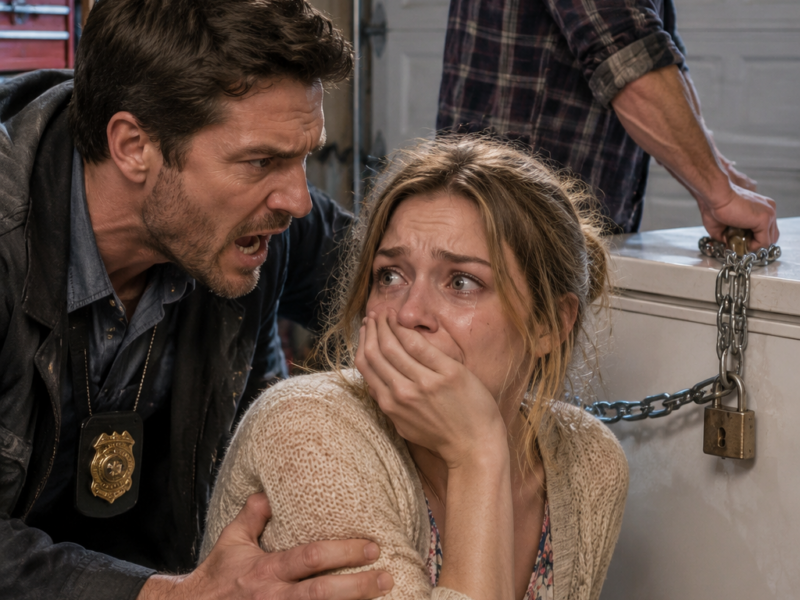
Husband Padlocked Our Garage Freezer Daily—My Detective Brother Screamed, “Run!”
Husband Padlocked Our Garage Freezer Daily—My Detective Brother Screamed, “Run!”
My brother Mike dropped his wrench onto the concrete floor, and the sound echoed through the garage like a gunshot.
It was such a small, ordinary sound, the kind of noise that usually disappeared beneath the humming of appliances and the distant traffic outside. But that afternoon, something about the way Mike reacted made the hair on the back of my neck stand up.
He didn’t bend down to pick up the wrench. He didn’t even look at it.
Instead, he stood completely still, his flashlight fixed on the large white chest freezer sitting in the far corner of my garage.
My husband, Todd, was supposed to be four hours north, somewhere in the Wisconsin woods, enjoying his annual hunting weekend with his friends. He had left Friday morning with his camouflage jacket, hunting rifle, and a canvas duffel bag, promising to return sometime Monday evening.
The freezer, however, was very much at home.
For six months, it had occupied that corner of our garage, humming steadily behind an industrial brass Master Lock that Todd had personally installed. According to him, the lock was necessary to protect the expensive venison he and his hunting buddies had purchased together.
I had never particularly liked the arrangement, but I had learned that questioning Todd about things he considered his personal business usually resulted in an exhausting conversation about trust, boundaries, and how difficult it was to live with someone who needed to supervise every little thing.
So I had stopped asking.
That Saturday afternoon, the main electrical breaker had suddenly tripped, shutting off power to part of the house. Since Mike had retired from the Milwaukee Police Department several years earlier, I had asked him to stop by and help me inspect the electrical panel.
I expected him to spend twenty minutes checking the wiring, perhaps replace a faulty breaker, and then join me upstairs for coffee.
I certainly didn’t expect him to discover something that would eventually destroy my twenty-two-year marriage.
Mike stepped closer to the freezer.
He lowered his flashlight toward the small ventilation opening near the bottom of the unit and leaned forward.
Then he inhaled.
His shoulders stiffened immediately.
He took another breath, coughed violently, and spun around so quickly that the flashlight beam swept across the garage walls.
Before I could ask what was wrong, he grabbed the collar of my sweater and pushed me toward the open driveway.
“Outside. Now!”
His voice was so sharp that I stumbled backward.
“Mike, what—”
“Don’t breathe that air! Get outside and call nine-one-one!”
There was something in his expression I had never seen before.
I had known my brother my entire life. I had watched him handle violent suspects, investigate murders, and return home after long shifts carrying the exhaustion of a man who had seen too much of the world.
Mike rarely panicked.
But he was frightened now.
I hurried outside, nearly slipping on the damp concrete as I crossed the garage threshold. The November wind hit my face, cold enough to make my eyes water.
Behind me, Mike emerged a few seconds later, coughing into his sleeve.
He walked toward the curb, pulled out his phone, and called emergency services.
I stood beside my car, wrapping my arms around myself while he gave the dispatcher our address.
My mind was racing.
Had something caught fire?
Was there a gas leak?
Had Todd stored something dangerous in the freezer?
I looked back toward the garage, but the open doorway revealed nothing except the familiar shelves, workbench, and the dark corner where the freezer stood.
I couldn’t reconcile the chemical sting in my throat with the explanation Todd had given me for six months.
It had started in May.
I remembered the day because it was unusually warm for a Tuesday evening, and I had been sitting at the kitchen table finishing the quarterly accounts for my small accounting firm when I heard the unmistakable sound of a truck backing into the driveway.
Todd’s Ford F-150 stopped directly in front of the garage.
He climbed out, followed by his friend Gary Miller.
The two men walked around to the back of the truck, where an enormous white chest freezer sat strapped against the tailgate.
It was a twenty-four-cubic-foot model, considerably larger than anything we needed for our household.
I stepped outside and watched them struggle to lower it.
“What exactly are you two moving in here?” I asked.
Todd wiped his forehead with the back of his hand.
“New freezer.”
“I can see that.”
He laughed, although there wasn’t anything particularly funny about the exchange.
“Half an elk, Natalia. Gary, Dan, and I split one. Premium cuts. We’re going to have meat for months.”
That explanation sounded reasonable enough.
Todd worked as a regional sales manager for a veterinary pharmaceutical company. His weekdays involved driving between veterinary clinics, meeting purchasing managers, discussing product lines, and maintaining relationships with distributors.
On weekends, he enjoyed hunting and fishing.
A large freezer for storing meat wasn’t unusual for someone with his hobbies.
What I hadn’t anticipated was what happened the following morning.
I came downstairs with a mug of coffee and found Todd kneeling beside the freezer.
He was drilling into the thick plastic casing.
Metal shavings covered the concrete.
“What are you doing?” I asked.
“Installing a lock.”
I watched him attach a heavy steel hasp to the lid.
Then he took a brass Master Lock from his toolbox and secured it through the metal loop.
It was the kind of lock I associated with construction equipment, storage facilities, and commercial shipping containers.
I stared at it.
“Do we have a problem with people stealing elk meat in this neighborhood?”
Todd didn’t laugh.
He wiped his hands on a rag and looked up at me with the tired expression he often used when he wanted to make me feel unreasonable.
“Gary and I spent over two thousand dollars on that meat. I don’t want the neighborhood kids opening the lid, leaving it cracked, and ruining everything.”
“Wouldn’t a normal freezer lock work?”
“Natalia.”
He said my name slowly, as though he were addressing a particularly difficult customer.
“I work fifty hours a week. I pay my share of the mortgage. I don’t complain about your accounting files covering half the dining room. I am asking for four square feet in the garage for something I enjoy. Is that too much?”
I looked at him.
There was no shouting, no dramatic argument, just that familiar performance of exhausted patience.
The problem with being married to a man who makes his living selling things is that he eventually learns how to sell you the idea that your own concerns are unreasonable.
I was tired.
I ran a small accounting firm and spent most of my days dealing with other people’s financial disasters. I handled tax filings, payroll issues, audits, and enough complicated bookkeeping to make my eyes ache by evening.
The last thing I wanted was an argument about a freezer.
“Fine,” I said. “Keep the key somewhere safe.”
Todd smiled, apparently satisfied.
And that was the end of the conversation.
Or so I thought.
Looking back, the warning signs were everywhere.
In July, our We Energies bill arrived, and I noticed something unusual.
Our electricity consumption had increased dramatically.
The total was approximately one hundred and forty dollars higher than our normal summer bill.
I checked the meter readings and compared them with previous months. The increase was substantial.
I carried the statement into the living room, where Todd was working on his laptop.
“Your freezer is using quite a bit of electricity.”
He barely looked up.
“Compressor probably works harder during the summer.”
“That much harder?”
“I’ll check the seals this weekend.”
He returned to his laptop.
I placed the bill on the coffee table and walked away.
It seemed like a small issue.
Then came September.
I was doing laundry one Sunday afternoon when I found a receipt in the pocket of Todd’s fleece jacket.
It was from a specialty supply warehouse in West Allis.
The amount was eighty-six dollars.
The description of the purchase caught my attention immediately.
Medical-grade dry ice.
I carried the receipt into the kitchen.
Todd was making himself a turkey sandwich.
“What’s this?”
He glanced at the paper.
“Oh, that.”
I waited.
“Gary had to transport some of the steaks down to Illinois. Regular ice melts too quickly. We split the cost.”
It was a perfectly reasonable explanation.
Todd knew people in the pharmaceutical business. He understood temperature-controlled shipping. He had access to suppliers I would never have known existed.
I nodded and threw the receipt away.
At the time, I was preparing for the quarterly tax deadline. My desk was buried under client statements, and I had several returns that needed correcting.
I didn’t have the energy to investigate a receipt for eighty-six dollars.
Now, standing in my driveway while emergency vehicles approached, I understood how foolish that decision had been.
Venison didn’t require medical-grade dry ice.
And it certainly didn’t explain the chemical odor that had frightened a retired detective.
The first fire engine arrived within twelve minutes.
A second followed, accompanied by a specialized Hazmat unit.
Red and white lights flashed across the neighboring houses. The street, normally quiet on Saturday afternoons, quickly filled with curious residents.
A woman walking her golden retriever stopped near the sidewalk.
Two neighbors stood beside their driveway, whispering.
Someone across the street had already taken out a phone.
I felt an uncomfortable flush of embarrassment.
Even during a potentially life-threatening emergency, part of me worried about what the neighbors would think.
Mike, however, was entirely focused on the firefighters.
He stood near the driveway holding his retired detective’s identification, speaking with the fire captain.
His voice was low and controlled.
The captain listened carefully before directing two Hazmat technicians toward the garage.
They were wearing protective equipment and breathing apparatuses.
One carried a gas monitor.
The other brought a circular saw.
When I realized they intended to cut through Todd’s lock, my stomach tightened.
The sound of the saw was deafening.
Sparks flew across the concrete as the blade cut through the brass lock and hardened steel hasp.
It took several minutes.
When the lock finally broke, one firefighter lifted the freezer lid only a fraction of an inch.
A technician inserted a monitoring wand into the opening.
Everyone waited.
I could hear my own heartbeat.
I had watched enough crime documentaries to know that people sometimes used chest freezers for things they never intended anyone else to discover.
My imagination began producing increasingly horrible possibilities.
I looked at Mike.
His expression was unreadable.
Finally, the Hazmat technician glanced at his monitor and gave the captain a thumbs-up.
The lid opened completely.
The firefighter looked inside.
He didn’t recoil.
He didn’t shout.
Instead, he reached down and carefully removed a small cardboard box.
The captain motioned for Mike and me to approach.
I stepped into the garage.
The chemical odor was still present, although the ventilation had reduced its intensity.
I looked into the freezer.
There was no elk meat.
There were no packages of venison.
There was no hunting equipment.
Instead, the entire interior was filled with neatly stacked cardboard boxes wrapped in plastic.
I recognized the logos almost immediately.
Ozempic.
Mounjaro.
Wegovy.
On the opposite side were hundreds of packages containing Gonal-f and Follistim, expensive fertility medications that required carefully controlled storage.
I stared at them.
“What is this?”
Mike picked up a damp package of Mounjaro.
The Hazmat technician pointed toward the refrigeration equipment.
He explained that the freezer had been extensively modified.
Todd had apparently altered the original thermostat and installed an additional commercial cooling system using copper tubing and an external compressor.
The arrangement was intended to maintain a highly stable temperature.
Unfortunately, the workmanship was poor.
A solder joint had failed, causing refrigerant to leak.
The leaked Freon had mixed with fumes from the dry ice Todd had placed inside as a temperature buffer, along with an ammonia-based coolant used in the external cooling lines.
The resulting chemical cloud had accumulated inside the garage.
The technician explained that the situation could have been much worse.
A spark from the failing compressor had created an additional danger.
“It is fortunate the equipment didn’t ignite,” the captain said.
I barely heard him.
My eyes were fixed on the medication boxes.
There were hundreds of them.
Some were already damaged by the rising temperature. Others had been soaked by condensation and chemical residue.
The captain explained that the freezer had warmed significantly after the electrical breaker tripped.
The inventory was ruined.
But I wasn’t thinking about the freezer anymore.
I was thinking about money.
I was an accountant.
Numbers were the language I understood better than almost anything else.
One box of Ozempic or Mounjaro could cost around a thousand dollars without insurance. Some fertility medications were even more expensive.
I estimated the inventory at somewhere between three hundred thousand and half a million dollars.
My husband was a salaried regional manager.
We had comfortable lives, but we did not have that kind of disposable capital.
We certainly didn’t have hundreds of thousands of dollars available for a private pharmaceutical operation.
I looked at the freezer again.
Then I remembered the lock.
The electricity bill.
The dry ice.
The hunting trips.
Suddenly, everything looked different.
Todd wasn’t protecting venison.
He was protecting an illegal inventory.
And if that inventory was worth several hundred thousand dollars, the next question was obvious.
Where had he obtained the money?
A firefighter working near the bottom of the freezer suddenly called for assistance.
He was moving a collapsed plastic crate when he discovered two gray waterproof Sentry Safe boxes hidden beneath the customized cooling coils.
They were heavily frosted and covered in condensation.
He carried them out and placed them on the concrete.
“These were underneath the equipment,” he said.
Mike crouched beside the first one.
He examined the small lock, then opened his tool bag.
Within moments, he had broken the mechanism.
The lid lifted.
Inside were several shipping invoices from a wholesale medical distributor in Florida.
Beneath them sat a thick manila envelope bearing the logo of Chase Bank.
I reached for it.
The first document was a Home Equity Line of Credit agreement.
The principal amount was $150,000.
I read the property address.
Then I read it again.
It was my house.
The four-bedroom brick colonial in which I had lived for more than a decade.
The house I had purchased before marrying Todd.
The house I had funded through years of saving, long before he entered my life.
My name appeared on the agreement.
My signature was at the bottom.
Except I had never signed it.
I knew my handwriting better than anyone.
I signed hundreds of documents every year. Tax returns, financial statements, contracts, client authorizations, and banking forms.
The signature on that agreement looked similar enough to deceive someone who wasn’t familiar with my writing.
But it wasn’t mine.
Someone had practiced.
The upper curve of the first letter was too aggressive. The final stroke was too heavy.
It was a forgery.
Beside it was a Wisconsin notary stamp.
I rubbed my thumb over the embossed seal.
The name was Gary Miller.
Todd’s hunting buddy.
The same Gary who had supposedly helped purchase the elk.
The same Gary who had stood in my garage while Todd installed the industrial freezer.
I suddenly remembered that Gary owned a small insurance agency and held an active notary commission.
He had been inside my home countless times.
He had watched Packers games on my couch, eaten food at my table, and shared drinks with my husband.
He had known exactly what he was doing.
Mike leaned over my shoulder.
“Identity theft,” he muttered. “Bank fraud. Mortgage fraud.”
His jaw tightened.
“I know someone in the Financial Crimes Unit. I’m calling him.”
He reached for his phone.
I grabbed his wrist.
“Wait.”
He stared at me.
“Natalia, he forged your name on a hundred-and-fifty-thousand-dollar loan.”
“I know.”
“He used your house to fund this operation.”
“I know, Mike.”
“Then let me make the call.”
I looked down at the documents.
My brother wanted justice.
I wanted something more immediate.
I wanted my house.
If the authorities became involved before we understood the full financial arrangement, federal investigators could seize the inventory, freeze accounts, and begin investigating every transaction connected to the operation.
Chase Bank would still have a fraudulent lien against my property.
The commercial landlord could still pursue the business guarantee Todd had apparently created.
I could spend years proving that I had never authorized the loans.
Legal innocence did not automatically remove financial liability.
“Put the phone away,” I said.
Mike looked genuinely confused.
“What?”
“I don’t need a detective right now. I need a lawyer.”
I pulled my phone from my pocket and found Brenda’s number.
Brenda was a senior partner at a downtown Milwaukee family law firm.
She charged four hundred fifty dollars an hour and had a reputation for being extraordinarily thorough.
She was not the kind of attorney who wasted time offering comforting words.
She preferred documents, evidence, and results.
When she answered, I didn’t bother with introductions.
“Brenda, my husband has mortgaged my house to finance an illegal pharmaceutical operation.”
There was a brief silence.
Then she asked, “Are you safe?”
“Yes.”
“Is anyone else involved?”
“Apparently his hunting partner. I also found the loan agreement.”
“Do you have the original documents?”
“Yes.”
“Don’t confront him. Don’t destroy anything. Photograph everything, secure copies, and come to my office first thing Monday.”
I looked at the ruined medication boxes.
“One more thing,” I said.
“Go ahead.”
“I want to know how we force him to carry the debt while I keep my house.”
Brenda paused.
Then her voice changed.
“Good. That’s the right question.”
By Monday morning, I had already begun treating the entire situation like a forensic audit.
I arrived at the Chase branch on Wisconsin Avenue shortly before nine.
The sky was gray, and dirty snow had begun accumulating along the sidewalks.
I walked into the bank carrying my identification and a copy of the forged loan agreement.
A young representative named Kevin greeted me.
I explained that I needed the complete transaction history for the home equity line.
He typed my information into the computer.
A few minutes later, he confirmed that the entire $150,000 had been withdrawn on August second.
I requested the outbound transfer details.
He printed several pages.
I thanked him and left.
I didn’t examine the documents in the parking lot.
I drove directly to my accounting office, walked past the receptionist, entered my private room, and closed the door.
Then I poured myself a cup of black coffee.
I placed the statements beneath the desk lamp.
In moments of extreme stress, some people turn to religion.
Others drink.
I turn to double-entry bookkeeping.
Numbers don’t flatter you.
They don’t manipulate your emotions.
They don’t tell you that you’re being unreasonable because you noticed an unexplained transaction.
Numbers simply show where the money went.
I picked up a yellow highlighter.
The first transfer was exactly what I expected.
Seventy-six thousand dollars had gone to an LLC registered in Boca Raton, Florida.
A quick review of the company records showed that it was connected to a gray-market wholesale medical distributor.
That explained the medication inventory.
The remaining $74,000 was more interesting.
On August fifth, an ACH transfer of $20,000 had been sent to a local credit union.
The recipient was Helen Bennett.
Todd’s mother.
The memo line read, “Repayment.”
I stared at the screen.
Todd and I had never borrowed money from Helen.
In fact, she had spent the previous month complaining about the cost of replacing the roof on her condominium in Waukesha.
At a family dinner, she had announced that she had needed to withdraw money from her retirement savings to cover the contractor.
Apparently, that had been unnecessary.
She had received $20,000 from the fraudulent equity loan.
I leaned back in my chair.
Helen had eaten dinner at my table while sitting on stolen money.
She had accepted the proceeds of a crime committed against her daughter-in-law and said nothing.
I highlighted the transaction.
Then I continued.
August twelfth.
A wire transfer for $50,000.
The recipient was Colliers Commercial Escrow.
I searched the associated business records.
The commercial lease was registered to a newly created entity called Sarah Wellness LLC.
I knew that name.
Sarah was twenty-six years old.
She worked as a junior sales representative in Todd’s territory.
I had met her at the company barbecue in July.
She had blonde hair, an expensive-looking watch, and an enthusiasm that seemed almost rehearsed.
She had talked about wanting to open a boutique wellness and weight-loss clinic.
I remembered her complaining about the cost of commercial property.
I also remembered Todd standing beside her for most of the afternoon.
At the time, I hadn’t thought anything of it.
Now I looked at the $50,000 lease deposit and understood.
The drugs in my garage were not a private investment for Todd and his hunting friends.
They were the initial inventory for Sarah’s clinic.
The $50,000 was the commercial deposit.
The $76,000 was the pharmaceutical stock.
The remaining money had likely been distributed through other accounts.
Todd was not simply having an affair.
He was using the equity in my home to build a business for another woman.
I opened a blank spreadsheet.
I named it Asset Recovery.
The first column contained Todd’s name.
The second contained Helen’s.
The third contained Sarah’s.
I entered every transaction I could verify.
Then I saved the file to an encrypted drive.
I was not going to confront them emotionally.
I was going to understand exactly what they had done.
Todd returned home Monday evening at 6:15.
I heard his truck before I saw him.
The engine rumbled through the driveway, and a moment later the mudroom door opened.
He entered wearing camouflage clothing and an orange hunting vest.
He dropped a heavy duffel bag onto the tile.
“Traffic was terrible,” he complained.
I sat at the kitchen island holding a mug of chamomile tea.
“That happens.”
He opened the refrigerator.
“Did you make dinner?”
“No.”
He looked over his shoulder.
“Why not?”
“We had an issue on Saturday.”
He paused.
“What kind of issue?”
“The garage breaker tripped. Mike came over to check it.”
The change in his expression was immediate.
His hand stopped halfway toward the refrigerator shelf.
“What?”
“Mike was checking the electrical panel.”
Todd turned toward the garage door.
“Where’s the key?”
I watched him.
He hadn’t asked whether I was safe.
He hadn’t asked whether anything had caught fire.
He wanted to know about the freezer.
He opened the garage door and walked inside.
I followed a few steps behind.
The scene had not changed much since the Hazmat team left.
The freezer lid remained open.
The lock had been destroyed.
The medication inventory had been removed and secured for disposal.
Only a small amount of chemical residue remained at the bottom.
Todd stopped.
For several seconds, he didn’t move.
I watched his face lose its color.
He looked into the empty freezer, then at the broken lock.
His expression was almost impossible to describe.
It was the face of a man watching his entire financial operation collapse in front of him.
Then he turned toward me.
“What the hell did you do?”
His voice echoed through the garage.
I lowered my shoulders.
“The compressor sparked. There was a terrible smell.”
“Who opened this?”
“Mike.”
“You let your brother destroy my property?”
“There was a chemical leak.”
Todd threw his hands into the air.
“Jesus Christ, Natalia! Do you have any idea what you’ve done?”
I looked down.
“The firefighters said it was dangerous.”
He paced across the concrete.
“Those were valuable products!”
I waited.
He seemed to realize that he had revealed too much.
Then he changed direction.
“It was an investment,” he announced.
I looked at him.
“What?”
“High-yield pharmaceutical liquidation. I was setting up a secondary income stream for our retirement.”
I stared at him.
He continued without hesitation.
“I have contacts in the supply chain. We purchased surplus inventory at a massive discount and planned to distribute it to independent clinics.”
“Is that legal?”
“Of course it’s legal!”
His answer came too quickly.
“Do you think I would risk our future on something illegal?”
I almost laughed.
He was standing in front of a ruined freezer containing hundreds of boxes of prescription medications, and he was asking me whether I thought he would do something illegal.
“You destroyed everything,” he continued.
“You and Mike. You just ruined our chance to get ahead.”
I let my eyes widen slightly.
“I’m sorry.”
He stopped pacing.
“I told you this was important.”
“I didn’t know.”
“You never listen.”
He shook his head, his expression full of theatrical disappointment.
“Stay out of the garage from now on. I’ll have to call my partners and figure out how we recover from this.”
Then he walked upstairs.
I remained in the garage.
The broken lock lay beside my shoes.
Todd believed he had successfully manipulated me into feeling guilty.
He thought I would spend the evening apologizing.
He had no idea that I had already traced the money to his mother and his mistress.
And he certainly didn’t know that I had an attorney preparing to dismantle the entire operation.
On Wednesday evening, the doorbell rang.
Todd hurried to answer it.
A woman’s voice floated through the entryway.
A moment later, he appeared in the kitchen with Sarah.
She looked exactly as I remembered her from the company barbecue.
Her blonde hair was pulled back neatly, and she wore a tailored wool coat over a beige turtleneck.
She carried a leather portfolio.
“Natalia, you remember Sarah?”
“Of course.”
“Sarah specializes in medical supply chain liquidation,” Todd explained.
“She’s helping me evaluate the remaining inventory and negotiate with the Florida wholesalers.”
I looked at her.
She smiled warmly.
“Nice to see you again.”
“You too.”
She placed her portfolio on my kitchen counter.
“I understand this has been a stressful situation,” she said.
“These things happen in business.”
I wondered whether she had rehearsed that sentence.
Todd stood beside her with his hands on his hips.
“Sarah is going to help us recover some of the losses.”
I smiled.
“That’s very generous.”
Sarah stepped closer and placed her manicured hand on my forearm.
“Please don’t worry too much, Natalia. We women can become emotional when unexpected financial risks appear.”
I looked at her hand.
She continued.
“Sometimes we just have to trust the people who understand the bigger picture. Todd is a visionary. He takes risks because he wants to create a secure future.”
For a moment, I thought I might actually laugh.
She was standing in my kitchen, in the house my husband had secretly mortgaged, offering me advice about trusting his business decisions.
She was also the woman whose clinic had been funded by the stolen money.
Yet she looked at me as though I were a nervous housewife who needed reassurance.
I forced myself to smile.
“You’re right, Sarah. I probably let my anxiety get the better of me.”
Todd exhaled.
“See? That’s what I’ve been telling you.”
Sarah nodded sympathetically.
I offered them both coffee.
They declined.
Then Todd led her toward the garage.
I watched him place his hand against the small of her back as she walked through the doorway.
The sight confirmed what the documents had already told me.
There was no reason to confront them.
Not yet.
I returned to my office and sent Brenda an email.
The subject line was simple.
Additional Evidence.
By Thursday morning, Brenda had assembled a forensic accountant named Arthur.
He was in his late fifties, wore wire-rimmed glasses, and had the calm expression of someone who had spent decades examining financial disasters.
We met in Brenda’s conference room overlooking Lake Michigan.
Arthur placed a thick folder on the table.
“I’ve mapped the capital flow,” he said.
“Your husband is careless.”
I opened the folder.
The first pages documented the $150,000 loan.
The next pages contained the commercial lease for Sarah Wellness LLC.
I scanned the document.
Then I stopped.
The guarantor section listed Bennett & Associates.
My accounting firm.
I looked up.
“Why is my business listed here?”
Arthur adjusted his glasses.
“Your husband submitted fabricated profit-and-loss statements using your firm’s letterhead. The leasing company accepted the corporate guarantee.”
I felt something cold settle in my stomach.
He had used my house.
Now he had used my business.
He had taken the company I had spent ten years building and dragged it into his scheme.
“How much liability are we talking about?”
Arthur explained the exposure.
The commercial landlord could attempt to enforce the guarantee, depending on the contract and the fraudulent representations involved.
Brenda closed the folder.
“We’ll challenge it.”
Mike entered the conference room carrying two coffees.
He sat beside me.
“Alright. We have mortgage fraud, identity theft, a forged notary acknowledgment, and corporate fraud.”
He looked at Brenda.
“I can have someone at Todd’s office by lunchtime.”
Brenda didn’t respond immediately.
Mike leaned forward.
“We take him out in handcuffs in front of his entire sales team.”
I admit the image was satisfying.
I imagined Todd being escorted past Sarah’s desk while his colleagues watched.
But Brenda had a different perspective.
“If we report everything immediately, his assets may be frozen before we recover anything,” she said.
Mike frowned.
“He’s committed crimes.”
“Yes. And Natalia has financial exposure.”
Brenda explained the problem.
Chase Bank still held the $150,000 lien against my property.
The commercial landlord might pursue the corporate guarantee.
If Todd were arrested and his assets frozen, I could spend years fighting institutions that had little interest in the details of our marriage.
The bank wanted repayment.
The landlord wanted its contractual obligations honored.
Neither would automatically forgive a debt because my husband had committed fraud.
Justice did not automatically clear property titles.
And it certainly did not pay legal bills.
Brenda leaned forward.
“We need to protect Natalia’s financial position first.”
I looked at her.
“What do you recommend?”
“We use the criminal evidence as leverage in a comprehensive separation agreement.”
She proposed that Todd assume full responsibility for the fraudulent loan.
He would liquidate his retirement accounts, stock portfolio, vehicle, and available savings to satisfy the debt.
The corporate guarantee would be challenged on the basis of fraudulent authorization.
His personal liability for the commercial arrangement would be documented.
If he refused, Brenda would turn the evidence over to the appropriate authorities.
Mike looked disappointed.
But I understood.
I had spent my adult life protecting financial records and understanding contractual obligations.
I knew that emotional satisfaction and financial security were not always the same thing.
“Prepare the agreement,” I said.
Brenda nodded.
“Make it airtight.”
“He doesn’t get to walk away with the money. He gets to pay for the privilege of staying out of prison.”
We scheduled the meeting for Sunday afternoon.
I chose the dining room.
The table was large enough for everyone, and the chairs were uncomfortable enough to discourage unnecessary conversation.
I prepared coffee.
I bought a package of ordinary shortbread cookies.
I arranged three chairs opposite mine.
Todd arrived first.
Helen came with him, wearing a beige cardigan and carrying her usual expression of disappointment.
Sarah followed, dressed in a navy blazer with her leather portfolio.
They entered my home as though they were attending a corporate meeting.
Helen sat in the middle.
Todd took the chair beside her.
Sarah placed her portfolio on the table.
I sat at the opposite end.
“I appreciate everyone coming,” I began.
Helen adjusted her cardigan.
“Todd said you were having difficulty processing everything. I thought it would be best if family were here.”
“That’s thoughtful.”
Todd leaned back.
“Let’s get this over with, Natalia.”
I lowered my eyes toward the table.
“I’ve been looking at the numbers. The bank contacted me about the equity line, and I’m worried we might lose the house.”
Todd sighed.
“We aren’t going to lose anything.”
He spoke with the confidence of a man explaining a minor accounting discrepancy.
“It’s a temporary cash-flow problem. Sarah is negotiating with the distributor. We just need to bridge the gap.”
“How?”
“You have operating capital in your business accounts. If you authorize a temporary transfer to cover the payments for the next two quarters, we can stabilize everything.”
I stared at him.
He had stolen money from my house, invested it in an illegal pharmaceutical operation, and now wanted me to drain my own business to cover the resulting debt.
Helen reached over and patted his arm.
“Todd has always been ambitious,” she said.
“Men sometimes take risks because they want to provide for their families. You have to know when to support them.”
I looked at her.
I thought about the $20,000 sitting in her credit union account.
I thought about her new roof.
I thought about the way she had accepted the money without asking questions.
“A house is just drywall and wood,” she continued. “A marriage is about supporting each other.”
I picked up my coffee.
“I want to make sure I understand everything correctly.”
Todd looked impatient.
“Go ahead.”
“The $150,000 was a joint investment?”
“Absolutely.”
“For our retirement?”
“One hundred percent.”
“And every dollar went toward the pharmaceutical inventory?”
He nodded.
“Obviously.”
I turned toward Sarah.
“And you’re simply helping with logistics?”
She smiled.
“That’s right. I’m only consulting. Todd asked me to help negotiate with the wholesalers.”
“You have no financial interest?”
“None beyond my professional involvement.”
I nodded.
Then I reached for the manila envelope beside me.
“That clarifies everything.”
I removed three stacks of documents.
The first was the home equity agreement.
I placed it in front of Todd.
“This is the $150,000 loan secured against my house.”
He glanced at it.
The second document was the commercial lease.
I slid it toward Sarah.
“This is the lease for Sarah Wellness LLC. The $50,000 deposit was paid on August twelfth.”
Sarah’s expression changed.
Her smile disappeared.
The third document was the ACH confirmation.
I placed it in front of Helen.
“And this is the $20,000 transfer to your credit union account, Helen. The memo line says repayment.”
Helen looked down.
Her fingers tightened around the edge of the paper.
Todd pushed his chair backward.
“What is this supposed to be?”
I looked directly at him.
“You used my house to fund a clinic for your mistress. You used the stolen money to pay your mother.”
Helen immediately began shaking her head.
“Natalia, I didn’t know. Todd told me it was a performance bonus.”
“You accepted twenty thousand dollars from a man with an ordinary regional sales salary, and you never wondered where it came from?”
She looked away.
Sarah pushed her chair backward.
“I didn’t know about the mortgage.”
Her voice was suddenly much smaller.
“Todd told me he had an investor.”
Todd turned toward her.
“Sarah, shut up.”
She flinched.
I watched them.
For the first time, the people who had been so comfortable manipulating me were beginning to understand that I knew exactly what they had done.
Todd placed both hands on the table.
“You think you’re clever because you printed some bank statements?”
He leaned toward me.
“We’re married. It’s marital debt. You can’t prove anything about that signature.”
The kitchen door opened.
Mike walked into the dining room.
He wore ordinary jeans and a gray sweater, but his presence changed the atmosphere immediately.
He placed a clear plastic folder on the table.
Inside was a ten-page forensic handwriting report.
“Certified handwriting analysis,” he said.
“The examiner compared the signature on the loan agreement with seven years of Natalia’s verified tax returns and financial documents.”
Todd stared at the report.
“The conclusion is that the signature is a trace forgery.”
Mike continued.
“The notary, Gary Miller, is also identified as a potential participant in the fraudulent acknowledgment.”
Todd swallowed.
I removed the final stack of papers.
“This is the separation agreement.”
I placed it in front of him.
“It requires you to assume full responsibility for the $150,000 loan. You will liquidate your retirement account, stock portfolio, vehicle, and personal savings to satisfy the debt and clear the title to my house.”
Todd stared at the document.
“You can’t be serious.”
“I am.”
“You’re taking everything.”
“No. I’m protecting what was mine before you decided to steal it.”
He stood.
I remained seated.
“If you refuse to sign, Mike will provide the handwriting report and the financial evidence to the Financial Crimes Unit. Brenda will turn over the bank records, the fabricated business documents, and the evidence connecting the pharmaceutical inventory to the Florida distributor.”
I paused.
“The FBI and other federal authorities can investigate the mortgage fraud and the pharmaceutical operation.”
Todd looked at Mike.
My brother said nothing.
He didn’t need to.
The report sat between them.
Todd’s face changed.
The arrogance disappeared gradually, replaced by something much closer to fear.
He looked at Helen.
She stared at the table.
He looked at Sarah.
She had moved her chair farther away from him.
Finally, he looked at me.
For the first time in twenty-two years, he seemed unable to find the right words.
He reached into his pocket and removed a silver pen.
Then he sat down.
He read the agreement.
He turned to the signature page.
And he signed.
There were no apologies.
No tears.
No dramatic confession.
He simply signed away his retirement savings, his stock portfolio, and whatever remaining assets were necessary to cover the debt.
Then he stood and walked toward the front door.
Helen followed him.
Sarah remained seated.
She looked down at the lease agreement.
“What happens to the clinic?”
I looked at her.
“Brenda will challenge the corporate guarantee. The lease was funded through fraudulent transactions, and the landlord will be notified.”
“But the deposit…”
“The money was obtained through the fraudulent equity loan. Whatever remains will be subject to the financial recovery process.”
She looked genuinely frightened now.
I continued.
“You told me you were merely consulting. I suggest you speak to your own attorney.”
Sarah picked up her portfolio.
She left without saying goodbye.
The weeks that followed were not dramatic.
There were no courtroom speeches or television cameras.
There were emails.
Certified letters.
Bank forms.
Notary records.
Asset disclosures.
And endless meetings with attorneys.
Brenda was relentless.
She handled the separation agreement, the debt assumption, the property documentation, and the challenge to the corporate guarantee.
Todd was required to leave my house by the end of the month.
He rented a small one-bedroom apartment near the airport.
His financial situation deteriorated quickly.
The early withdrawal of his retirement savings created substantial tax consequences.
His stock portfolio was liquidated.
His vehicle was sold.
The commercial arrangement became a legal problem rather than the beginning of a promising business.
Sarah did not remain with him.
Word eventually reached me through a mutual acquaintance that she had resigned from Todd’s territory team.
The clinic never opened.
The commercial deposit became part of the financial dispute.
Without the promised capital, Sarah apparently decided that a relationship with a financially devastated, soon-to-be-divorced man was considerably less attractive than one with a successful regional manager.
Todd tried contacting me several times.
His first voicemail sounded angry.
His second sounded desperate.
By the third, he had adopted the tone of a man who believed he deserved another chance.
“Natalia, it’s Todd. Look, I know I made mistakes. I was under a lot of pressure. I wanted to provide for us. We can fix this. Please call me.”
I saved every message.
Then I forwarded them to Brenda.
I never returned his calls.
Eventually, Chase processed the payoff.
The fraudulent home equity lien was removed from my property title.
When the confirmation letter arrived, I stood in the kitchen and read it twice.
The account was closed.
The debt had been satisfied.
For the first time in months, I could breathe without wondering whether the house I had worked so hard to purchase would disappear beneath someone else’s financial crimes.
The divorce was finalized in April.
There was no dramatic courtroom confrontation.
There was simply a mountain of paperwork documenting the end of a twenty-two-year marriage.
I had spent the winter dismantling a life I once believed was permanent.
And I was exhausted.
Not physically exhausted in the way I had been after the emergency at the garage.
This was something deeper.
It was the exhaustion of realizing that the person who had shared your bed, your meals, your holidays, and your ordinary daily routines had quietly treated your entire life as a resource he was entitled to exploit.
I thought about Todd often during those months.
Not because I missed him.
But because I kept trying to understand how someone could be so ordinary and so dangerous at the same time.
He had never looked like a villain.
He wore fleece pullovers.
He complained about traffic.
He helped rake leaves.
He kissed my forehead before leaving for work.
He remembered birthdays and occasionally brought home flowers.
He was the man who sat beside me at family dinners and talked about retirement.
That was what made everything so disturbing.
The danger had not arrived wearing a mask.
It had arrived carrying a chest freezer.
Six months after the emergency, I stood in my garage on a mild May morning.
A contractor was repainting the wall near the workbench.
The ruined freezer had been removed by a specialized disposal crew.
The concrete beneath it still carried a dark stain, an uneven shadow left by the chemical leak.
The sharp smell of ammonia and refrigerant was gone.
In its place were familiar scents of motor oil, damp earth, and fresh paint.
I held a mug of coffee and watched the contractor finish the trim.
The garage was finally becoming ordinary again.
I had changed the lock on the access door.
I had removed the old keypad and installed a heavy-duty Schlage deadbolt.
It wasn’t because I feared burglars.
Our neighborhood was perfectly safe.
I installed it because I wanted a reminder.
A reminder that the boundaries of my life belonged to me.
I had spent twenty-two years believing that marriage meant building something together.
A home.
A business.
A future.
But Todd had viewed the security I created as capital he could borrow without permission.
He had taken my signature, my property, my company, and my financial reputation and used them to build a secret life.
The freezer had been locked because he didn’t want anyone discovering what was inside.
The same way he had locked away the truth about the money.
The affair.
The forged documents.
The business he was financing for another woman.
I walked toward the corner where the freezer had once stood.
For months, I had passed that spot without thinking.
Now it was empty.
There was something deeply satisfying about that emptiness.
The house was mine again.
My business was mine again.
My financial future was mine again.
And, most importantly, I no longer had to explain to anyone why I wanted to know what was happening inside my own home.
I had learned something during that terrible winter.
Betrayal does not always announce itself with shouting, arguments, or obvious cruelty.
Sometimes it arrives disguised as a reasonable explanation.
Sometimes it wears the face of a trusted friend.
Sometimes it sits across your kitchen table, eats your food, and tells you that you’re being too emotional.
And sometimes it stands in your garage, installing an industrial padlock on a freezer, insisting that all it contains is expensive venison.
The warning signs are rarely invisible.
They are simply easy to dismiss when the person creating them is someone you love.
I took another sip of coffee.
The contractor packed his tools into his truck and waved goodbye.
I waved back.
Then I stood alone in the garage for another minute, listening to the quiet hum of the refrigerator inside the house.
There was no strange chemical smell.
No suspicious machinery.
No locked freezer.
Just an ordinary morning.
And after everything I had survived, ordinary felt like the greatest luxury in the world.
I had not destroyed Todd’s life.
He had done that himself.
I had simply refused to let him destroy mine along with it.
And if there was one thing I wanted other women to understand, it was this:
When someone you trust begins treating your questions as crimes, your independence as an inconvenience, and your property as something they can use without your permission, pay attention.
You do not have to wait until a firefighter cuts through a padlock to investigate what is happening in your own home.
Sometimes the most important thing you can do is stop accepting explanations that never quite add up.
Because the truth is, the most dangerous thing inside that freezer was never the chemical leak.
It was the six months of lies that had allowed it to remain there.
And by the time I finally understood what Todd had been hiding, the thing that had been quietly rotting all along wasn’t the meat.
It was my marriage.
THE END









