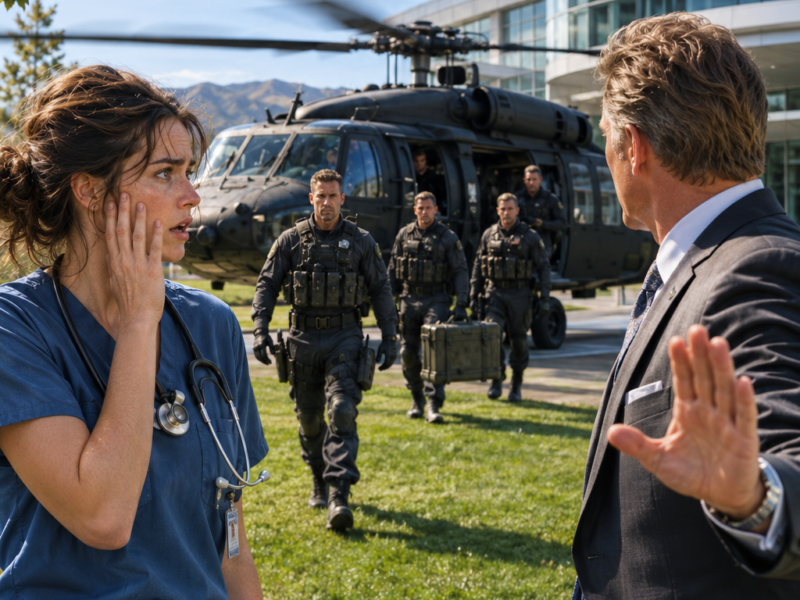
Hospital CEO Slapped the Silent Nurse — Minutes Later, a Black Ops Bird Landed For Her
Hospital CEO Slapped the Silent Nurse — Minutes Later, a Black Ops Bird Landed For Her
The fluorescent lights above the emergency department at St. Jude Medical Center hummed relentlessly, casting a cold, pale glow over the rows of empty beds and polished countertops. It was a sound Sarah Jenkins had grown accustomed to over the past three years, although she had never particularly liked it. The faint electrical vibration seemed to settle somewhere behind her eyes, becoming another small irritation in a life filled with things she had learned to tolerate without complaint.
She sat behind the triage desk, staring at the digital patient records on her monitor. Her fingers moved steadily across the keyboard, entering vital signs, updating medical histories, and completing the endless documentation that came with working in a busy emergency department. There was nothing remarkable about the scene. A television played quietly in the waiting room, a nurse pushed a medication cart down the corridor, and somewhere behind the double doors, a patient coughed repeatedly.
It was an ordinary night.
At least, that was what everyone believed.
Sarah was eleven hours into a twelve-hour shift. Her green scrubs were slightly wrinkled, her dark hair was pulled tightly into a practical bun, and the shadows beneath her eyes suggested that she had not enjoyed a proper night’s sleep in quite some time. Her left shoulder ached whenever she moved it too quickly, an old injury that occasionally reminded her of a life she rarely allowed herself to remember.
To the people around her, Sarah Jenkins was simply a quiet, dependable registered nurse. She arrived on time, completed her assignments, treated patients with patience, and rarely participated in workplace gossip. She did not complain about difficult shifts, did not challenge doctors in front of other staff members, and never seemed interested in recognition or promotion.
She was polite, reserved, and almost painfully ordinary.
That was exactly how she wanted people to see her.
Because before Sarah had become a civilian nurse, before she had learned to appreciate the relative peace of hospital corridors and the comforting routine of medication rounds, she had served in places where a mistake could mean the deaths of an entire team.
She had worked in deserts where the temperature could kill a wounded man before the enemy ever found him. She had treated soldiers beneath collapsing buildings, performed emergency procedures in abandoned compounds, and dragged injured teammates through gunfire while knowing that the next bullet might be meant for her.
She had been trained to remain functional when everyone else was losing control.
Her former life had been built around violence, discipline, and impossible decisions. It was a life she had deliberately walked away from, not because she had forgotten how to fight, but because she had finally grown tired of living as though every second might be her last.
She wanted something quieter.
She wanted to wake up in the morning without checking the windows for signs of movement. She wanted to drink coffee without listening for distant explosions. She wanted to spend her days helping people without wondering whether the next patient would be someone whose name she would remember for the rest of her life.
Most importantly, she wanted to be Sarah Jenkins rather than the woman whose military records were buried beneath layers of classification.
Unfortunately, the civilian world had its own battlefield.
And some of the most difficult enemies Sarah had encountered did not carry weapons.
They wore expensive suits, held impressive titles, and believed that authority was something automatically granted by the position printed on their office doors.
One of those men was Dr. Richard Vance.
Vance was the hospital’s chief of surgery and its acting chief executive officer. He was a successful surgeon by conventional standards, an accomplished administrator, and a man who took considerable pride in his professional reputation.
He also had a habit of treating nurses as though they were little more than extensions of his own hands.
His white coat was always immaculate. His shoes were expensive Italian leather, his watch cost more than most employees earned in several months, and his voice carried the practiced confidence of someone accustomed to having the final word.
Sarah had learned to recognize his footsteps long before he entered a room.
That night, she heard them approaching from behind.
She continued typing.
Dr. Vance stopped beside her desk and placed one hand on the countertop. His expensive cologne reached her before he spoke.
“Jenkins.”
Sarah finished entering the information on her screen before turning around.
“Yes, Doctor?”
Vance held up a small plastic package containing an intravenous catheter. He examined it with exaggerated disappointment before moving it into her line of sight.
“Would you care to explain this?”
Sarah glanced at the package.
She already knew.
Two hours earlier, an ambulance had brought in a severely injured motor vehicle accident victim. The patient had been pale, confused, and dangerously hypotensive. His condition suggested significant internal bleeding, and Sarah had immediately prepared large-bore intravenous access equipment.
She had understood what the patient needed.
Vance, however, had intervened.
He insisted that an ordinary eighteen-gauge catheter was sufficient and argued that the patient’s fragile veins made a larger catheter unnecessarily aggressive. Sarah had attempted to explain that the situation was rapidly deteriorating, but Vance had dismissed her concerns and instructed her to follow his preferred approach.
She had complied with the immediate instruction, although she had kept the larger catheter ready.
When the patient’s condition worsened, the medical team lost valuable time attempting alternative access.
Now Vance was standing in front of her, holding the very equipment she had originally prepared.
“Why are you taking large-bore supplies for routine cases?” he asked.
Sarah looked at him calmly.
“It was for the trauma patient earlier, Doctor.”
“That patient did not require this.”
“He was becoming increasingly unstable.”
Vance gave a humorless laugh.
“And you determined that independently?”
Sarah remained silent.
He continued, his voice growing more condescending with every sentence.
“Let me remind you of something, Nurse Jenkins. You are not the physician. You do not determine treatment protocols, and you do not make independent decisions about procedures simply because you happen to believe you know better.”
Sarah lowered her eyes slightly.
“I understand.”
“I don’t think you do.”
He placed the package on her keyboard.
“This hospital operates according to established procedures. We have protocols for a reason. We have a chain of command. We have financial responsibilities. We cannot have every nurse deciding that she wants to use expensive specialized equipment whenever she feels like it.”
Sarah listened without interrupting.
Inside, however, her thoughts were elsewhere.
She remembered a dusty military compound where a wounded soldier had lost nearly half his blood while a radio operator struggled to establish communication with the evacuation team. She remembered making decisions with seconds available and no guarantee that anyone would arrive to help.
She remembered the weight of a dying man against her arms.
She remembered the sound of mortar fire.
And she remembered that nobody in those places had ever cared about the price of a catheter when a human life was slipping away.
Vance finished his lecture by reminding her that her annual performance evaluation was approaching.
“I expect greater compliance from senior staff,” he said. “Is that understood?”
“Yes, Doctor.”
“Good.”
He turned and walked away, his shoes clicking confidently against the polished floor.
Sarah watched him disappear before returning her attention to the computer.
A moment later, Helen Carter emerged from the medication room.
Helen had worked at St. Jude for nearly twenty-five years. Her hair had gradually turned gray, her hands carried the small marks of decades spent working in medicine, and her eyes possessed the quiet understanding of someone who had seen enough human suffering to recognize genuine character.
She had watched the exchange.
Without saying anything, Helen picked up the discarded catheter package and examined it.
“He’s getting worse,” she murmured.
Sarah continued working.
“He’s just doing his job.”
Helen looked at her.
“That’s a generous description.”
Sarah offered a faint smile.
Helen had noticed things about Sarah that other people overlooked. She had noticed how Sarah instinctively positioned herself where she could see every entrance. She had noticed that Sarah never startled when alarms sounded and that she could recognize a patient’s deterioration before the monitors began screaming.
During one particularly difficult shift, Helen had seen Sarah stabilize a confused patient with such extraordinary speed and confidence that the attending physician had later asked who had taught her.
Sarah had simply said she had previous experience.
Helen suspected that explanation was only a small part of the truth.
She placed the catheter package in her pocket.
“Don’t let him get inside your head,” Helen said.
Sarah nodded.
“I won’t.”
The hours continued.
By two in the morning, the emergency department had settled into the deceptive quiet of the graveyard shift. The waiting room contained only a handful of people. A man slept awkwardly in a plastic chair, another patient complained about a persistent headache, and a young mother waited for her child to finish a medical examination.
Sarah organized paperwork and checked the status of several patients.
She was thinking about going home.
Her apartment was small, clean, and almost entirely devoid of unnecessary possessions. She preferred it that way. There were no photographs from her military deployments, no medals displayed on the walls, and no reminders of the people she had lost.
She kept a kettle on the kitchen counter, a few books beside her bed, and a comfortable chair near the window.
It was not an exciting life.
But it was peaceful.
And peace, Sarah had discovered, was something worth protecting.
She was halfway through reviewing an insurance form when something changed.
It was subtle at first.
A strange pressure seemed to settle over the emergency department. The air felt heavier. The distant mechanical sounds became suddenly noticeable, and the small hairs along Sarah’s forearms began to rise.
Her fingers stopped moving.
Her eyes lifted from the screen.
She listened.
Most people would have noticed nothing. The hospital continued operating, the fluorescent lights remained steady, and nobody had yet raised an alarm.
But Sarah recognized the feeling.
It was the same instinctive awareness that had once kept her alive in hostile territory.
Something was coming.
Her body responded before her conscious mind finished processing the possibility. Her breathing slowed, her posture changed, and the dull ache in her shoulder seemed to disappear beneath a sudden wave of adrenaline.
The civilian nurse who had spent the previous eleven hours completing paperwork vanished.
In her place stood the woman who had once operated in environments where hesitation was measured in body bags.
Then the alarm sounded.
A harsh disaster claxon erupted throughout the hospital.
Red emergency lights began flashing along the ceiling, painting the white corridors in alternating shadows. Staff members rushed out of the break room, technicians abandoned their paperwork, and nurses hurried toward the central station.
The overhead announcement system activated.
“Code Triage Level One. Mass casualty incident. Estimated arrival two minutes.”
For a moment, several people simply stared at one another.
Then the emergency department exploded into motion.
Sarah was already moving.
She stood, pushed her chair backward, and headed directly toward the disaster supply closet.
She did not waste time gathering ordinary equipment. She collected specialized trauma kits, additional tourniquets, chest seals, heavy-duty shears, large-bore intravenous supplies, and emergency airway equipment.
She moved through the room with a precision that made her actions seem almost rehearsed.
Because they were.
She began preparing the first trauma bay, then moved to the second. She identified the areas where stretchers would likely become congested and instructed a technician to clear the central corridor.
Helen watched her closely.
“Sarah?”
“Prepare additional blood products,” Sarah answered. “We need the massive transfusion team notified immediately. Clear the airway equipment and get another trauma cart ready.”
Helen blinked.
The words were delivered so naturally, so decisively, that she did not think to question them.
She simply moved.
Dr. Vance came rushing through the double doors moments later.
“What is happening?”
A nurse answered that a military helicopter had reportedly crashed nearby.
Vance’s face changed.
“A helicopter?”
“Yes, Doctor. Multiple casualties.”
He immediately began shouting instructions.
“Get the standard monitoring equipment ready! I want the ultrasound machine in position. Prepare the documentation stations and make sure all patient records are entered correctly.”
Sarah was already setting up another trauma bay.
“Doctor, we’re going to need airway equipment immediately,” she said.
Vance turned toward her.
“Jenkins, I told you to stay at triage. You are not authorized to take control of the emergency response.”
Sarah continued walking.
“They’re coming in hot.”
“Excuse me?”
She stopped for half a second.
“Severe blast and blunt-force injuries. We need the trauma bays ready.”
Vance opened his mouth to respond.
Before he could speak, the ambulance bay doors burst open.
The first wave of casualties arrived.
The smell hit before the stretchers did.
Burnt plastic, jet fuel, smoke, blood, and the unmistakable metallic odor of severe injuries overwhelmed the familiar scent of disinfectant.
Paramedics pushed through the entrance, shouting reports over one another.
“Military helicopter crash!”
“Multiple injured!”
“Possible engine failure!”
“Need trauma teams immediately!”
A Black Hawk helicopter had suffered a catastrophic mechanical failure and crashed onto a civilian parking structure only a few meters from the hospital. The impact had destroyed much of the aircraft and scattered debris across the surrounding area.
The first patient was a large man in the remains of tactical equipment.
His uniform was torn and blackened. His left leg had sustained catastrophic injuries, and a field tourniquet was already soaked with blood. His chest was bruised, his breathing shallow, and his vital signs dangerously unstable.
“Pressure is dropping!” one paramedic shouted. “Possible tension pneumothorax! Airway is compromised!”
The stretcher slammed into trauma bay one.
Vance approached the bed.
Then he stopped.
For the first time that night, the acting chief executive officer seemed to understand that he was facing something beyond the comfortable boundaries of his experience.
He looked at the patient’s injuries, then at the monitor.
“Get an X-ray,” he said.
A paramedic stared at him.
“Doctor, he’s losing his airway!”
“Where is anesthesia? We need someone to manage this.”
Sarah was already at the patient’s head.
She examined his face, his neck, and his breathing. The swelling around his airway was severe. Conventional intubation was unlikely to succeed, and the patient’s condition was deteriorating by the second.
There was no time for another discussion.
She reached for the emergency airway equipment.
Vance stepped toward her.
“Jenkins, what are you doing?”
Sarah did not answer.
She had recognized the immediate threat and moved into action under the emergency team’s established procedures. The airway had to be secured before the patient lost the ability to breathe.
Within moments, the patient had a functioning emergency airway.
The monitor continued beeping.
His chest rose with each assisted breath.
The paramedic beside the bed stared at Sarah.
The patient was still alive.
Vance, however, was furious.
“Who authorized you to do that?”
Sarah looked at him briefly.
“Doctor, we have more casualties coming.”
“Step away from the patient!”
He reached for her shoulder and grabbed the fabric of her scrubs.
Sarah turned.
Her expression had changed.
There was no visible anger. No panic. No fear.
There was only an extraordinary stillness that seemed completely out of place amid the chaos.
Vance began shouting.
“You have no authority to perform procedures independently! Do you understand what you’ve just done? You’re risking your license!”
Sarah looked directly into his eyes.
“Get your hand off me.”
Instead of listening, Vance tightened his grip.
Then, in a moment of complete professional and personal failure, he raised his hand and slapped her across the face.
The sound cracked through the trauma bay.
For an instant, everything seemed to stop.
A paramedic froze with a bag of medical supplies in his hands. Helen gasped. A young intern stared in disbelief.
Sarah’s head had turned slightly from the force of the blow.
A red mark began forming across her cheek.
She did not touch it.
She did not step backward.
Slowly, she turned her head and looked at Vance again.
He seemed almost surprised by his own actions.
Perhaps he had expected her to cry. Perhaps he had expected her to apologize or retreat, as so many employees had done before.
Instead, he found himself staring into the eyes of a woman who had faced armed men in places where nobody was coming to rescue her.
Sarah spoke quietly.
“Get the hell out of my bay.”
There was no shouting.
No dramatic gesture.
Just four words delivered with such absolute certainty that even the paramedics seemed to straighten.
Vance opened his mouth.
Nothing came out.
Helen stepped forward.
“You heard her,” she announced, her voice cutting through the silence. “This bay is hers. Jenkins is in command. If you can’t help these patients, get out of the way.”
The young intern immediately moved toward Sarah.
A paramedic followed.
Then another nurse.
The decision was almost instantaneous.
Nobody needed a formal announcement. The people in that room had just witnessed the difference between someone who wanted authority and someone who knew what to do with it.
Sarah turned away from Vance.
The confrontation was over.
There were lives to save.
“Fourteen-gauge access where appropriate. Prepare emergency blood products. I need additional airway supplies in bay two. Keep the central corridor clear.”
Her voice became the organizing force of the room.
Helen coordinated the nursing staff. The paramedics began transferring information. The intern who had previously been standing in the corner now moved with renewed purpose.
Sarah assigned tasks, monitored the incoming patients, and ensured that no one was forgotten in the confusion.
More stretchers arrived.
Some patients were conscious and screaming. Others were unconscious, their bodies covered in soot and blood. One had a severe shoulder injury. Another showed signs of major chest trauma. Several had fractures and injuries consistent with the violent impact of the helicopter crash.
The next forty-five minutes became a relentless sequence of decisions.
Sarah moved between the trauma bays, assessing each patient and directing the appropriate team.
She recognized the signs of a life-threatening chest injury in one operator and immediately coordinated emergency intervention. She helped control severe bleeding in another, using the specialized techniques she had learned through years of military trauma training.
She directed the preparation of blood products and worked alongside physicians who had finally arrived from the upper floors.
They quickly realized that something unusual was happening.
The quiet nurse who had previously been treated as an ordinary member of the emergency department was coordinating the response with an understanding of trauma medicine that exceeded anything they expected.
She did not waste words.
She did not repeat instructions unnecessarily.
She did not become distracted by the shouting, the alarms, or the blood.
She simply identified the next problem and addressed it.
A young physician approached her with a question about one patient’s deteriorating condition.
Sarah looked at the monitor, reviewed the available information, and gave him a concise answer.
He nodded and followed her direction.
Another surgeon arrived and asked for a status report.
Sarah provided it immediately.
Within minutes, the room had developed an unmistakable rhythm.
People were working together.
Patients were being stabilized.
The chaos was gradually becoming manageable.
And Sarah was at the center of it.
In trauma bay three, she encountered a patient who was still conscious despite suffering severe injuries.
He was a chief petty officer, a broad-shouldered man whose right arm had been badly damaged. His breathing was labored, but his eyes remained unusually alert.
Sarah approached him and began assessing his injuries.
He watched her carefully.
She checked his position, assessed the affected arm, and prepared the necessary support.
Her movements were different from those of an ordinary hospital nurse.
Not better in every possible sense, but unmistakably shaped by another environment.
She checked the room’s entrances without appearing to look at them. She positioned herself where she could reach the necessary equipment. She communicated with the staff without allowing her attention to drift from the patient.
The chief petty officer noticed.
As Sarah adjusted the support around his arm, he reached out with his uninjured hand and caught her wrist.
“Hey,” he whispered.
Sarah looked at him.
“Stay still. You’re going to be okay.”
He swallowed painfully.
“Where did you serve, Doc?”
Sarah paused.
For a fraction of a second, the emergency department seemed to disappear.
She saw a different place.
A dusty landscape. A damaged vehicle. The orange glow of distant fires. Men shouting into radios. A young soldier with a frightened expression asking whether he would ever see his family again.
She returned her attention to the man in front of her.
“Somewhere you don’t want to go back to,” she said quietly.
The chief studied her face.
He recognized something familiar.
It was not merely confidence. It was the particular calm of someone who had spent years making decisions under conditions that would overwhelm most people.
He leaned slightly closer.
“That wasn’t what I asked.”
Sarah finished securing the support.
Then she leaned toward his ear and whispered a classified unit designation.
The man’s eyes widened.
He looked at her again, this time with unmistakable respect.
He gave a small nod.
“Well,” he murmured, “I guess we’re in good hands.”
Sarah allowed the faintest smile.
“You are. Now save your strength.”
She moved to the next patient.
The chief petty officer watched her leave, understanding that the quiet woman who had been working in that hospital was someone very different from the person the administration believed her to be.
But the most difficult patient had not yet arrived.
The final stretcher came through the doors after the majority of the surviving operators had been transferred into the emergency department.
The man on it was the helicopter’s pilot.
He had sustained catastrophic internal injuries during the crash. His body was pale, his clothing was soaked with blood, and the monitor displayed a continuous flatline.
The medical team worked urgently, attempting to assess whether any meaningful circulation remained.
The attending trauma surgeon looked at the monitor and then at the patient.
He shook his head.
“We’re losing him.”
He reviewed the circumstances and made a triage decision.
“Stop. We need to concentrate on the patients we can still save.”
The room became quieter.
Several nurses looked down.
The pilot had brought the helicopter’s crew into danger, and now he was lying motionless on a hospital bed while the people around him struggled to accept that he might already be gone.
Sarah approached.
She looked at the monitor.
Then at the patient’s chest.
Then at the available clinical information.
Something did not fit.
The tracing was not entirely as simple as it appeared. There were subtle electrical signals that required further assessment, and the possibility of a reversible cause could not be dismissed without a careful evaluation.
She had seen a similar presentation years earlier.
A soldier had been trapped beneath a collapsed structure, suffering severe chest trauma. His heart had been unable to pump effectively because blood had accumulated around it, placing dangerous pressure on the organ.
It was a condition that could become fatal with extraordinary speed.
Sarah remembered the case vividly.
She remembered the feeling of helplessness in the air, the exhausted medical team, and the realization that the patient was not necessarily beyond saving.
She looked at the surgeon.
“I need you to reassess him.”
The surgeon turned.
“Jenkins, he’s gone.”
“There’s a possibility of a reversible cause.”
“We’ve already made the triage decision.”
Sarah looked back at the patient.
She was not willing to accept an assumption when a potentially treatable condition remained.
The surgeon stepped forward.
“Do not touch that patient.”
Helen moved closer to Sarah.
“Give her a moment,” she said.
The surgeon looked at her in disbelief.
“Excuse me?”
Helen did not move.
Sarah continued assessing the situation, drawing on her experience and the resources available to the trauma team. She insisted that the patient receive immediate reassessment by the appropriate specialists rather than being abandoned based solely on the initial appearance.
The room became tense.
Every second mattered.
The surgeon began to protest, but the monitor suddenly registered another faint electrical signal.
Sarah pointed toward it.
“Look.”
The surgeon turned.
His expression changed.
The possibility that the patient’s condition was reversible could no longer be dismissed.
The team immediately resumed their efforts, bringing in the equipment and expertise needed to identify and address the underlying problem.
Further assessment revealed a life-threatening accumulation of blood around the heart, a condition that was preventing effective pumping.
The diagnosis changed everything.
The trauma surgeon took over the definitive emergency treatment while Sarah coordinated the available support and helped ensure that the team had everything necessary.
For several agonizing moments, nobody knew whether their efforts would be enough.
Then the monitor changed.
A faint electrical rhythm appeared.
One beep.
A pause.
Another beep.
The room seemed to hold its breath.
A weak but measurable pulse returned.
The pilot’s chest rose.
The surgeon stared at the monitor.
“He’s got a pulse.”
A nurse looked at Sarah.
Then another.
The pilot was alive.
The team immediately prepared him for definitive surgical treatment. His condition remained critical, but the immediate crisis had been overcome.
Sarah stepped back, allowing the physicians to take responsibility for the next stage of care.
She did not smile triumphantly.
She did not ask anyone to acknowledge what had happened.
She simply looked at the patient one more time before turning toward the next assignment.
The emergency department had become something entirely different from the place where she had started her shift.
It was a battlefield of human suffering, exhaustion, and desperate decisions.
And for the first time in years, Sarah had stopped pretending that she did not know how to function in one.
An hour later, the final critical patient had been transferred to surgery or intensive care.
The trauma bays were covered in discarded packaging, used medical supplies, and bloodstained sheets. The floors needed cleaning, the equipment required restocking, and the documentation had barely begun.
Sarah stood at a stainless-steel sink, washing her forearms.
Water ran over her skin, carrying away the dried blood that had accumulated during the emergency.
Her hands trembled slightly.
The adrenaline was fading.
The familiar ache in her left shoulder returned, followed by the heavy exhaustion she had been suppressing for hours.
She looked at herself in the reflection of the stainless-steel surface.
The red mark on her cheek was still visible.
She touched it lightly.
For a moment, she remembered the slap.
Not because it had frightened her.
Because she could not believe that a man responsible for leading a hospital had chosen to strike an employee during a mass casualty event while that employee was trying to save lives.
She dried her hands.
The other nurses had become unusually quiet around her.
Some looked at her with admiration. Others seemed uncertain how to approach her. The intern who had followed her instructions during the disaster kept glancing in her direction as though he wanted to ask a hundred questions but could not decide where to begin.
Helen approached.
“You all right?”
Sarah nodded.
“Just tired.”
Helen looked at the mark on her cheek.
“That man should never be allowed near another patient.”
Sarah gave a small shrug.
“It doesn’t matter right now.”
“It matters to me.”
Sarah looked at her.
Helen’s expression was firm.
“I’ve worked here a long time, Sarah. I’ve watched people with titles make decisions that other people have to clean up. I’ve watched nurses get blamed for things they had no control over. But I’ve never seen anything quite like tonight.”
Sarah lowered her eyes.
“We had patients to take care of.”
“And you took care of them.”
Before Sarah could answer, the familiar sound of expensive shoes echoed through the corridor.
Dr. Vance had returned.
This time, he was not alone.
The hospital’s chief administrator walked beside him, accompanied by two men in dark suits who appeared to be legal representatives. Two hospital security guards followed behind them.
Vance’s expression had changed.
The panic and humiliation from earlier had been replaced by a carefully reconstructed appearance of authority.
He looked at Sarah as though he had been waiting for this moment.
“Jenkins.”
Sarah turned off the faucet.
“Doctor?”
Vance stepped forward.
“Effective immediately, you are relieved of duty.”
The room became silent.
He continued.
“You are being dismissed for gross insubordination, unauthorized medical intervention, reckless endangerment, and conduct that represents a serious threat to patient safety.”
Sarah listened without reacting.
Vance pointed toward the security guards.
“I want her escorted from the premises. Her access credentials are to be revoked immediately. We will also be contacting the state nursing board and the appropriate authorities.”
The chief administrator shifted uncomfortably.
“Richard, perhaps we should discuss this privately.”
“No,” Vance snapped. “This is a matter of hospital safety. She has demonstrated an unacceptable disregard for authority and established procedures.”
Sarah looked at him.
It was almost impressive.
A dozen people had witnessed her working to save the lives of the helicopter crew. Several physicians had relied on her experience, and the patient who had been considered beyond help was now alive and receiving surgical care.
Yet Vance was standing there attempting to rewrite the entire night.
He wanted to make her the problem.
He wanted the hospital to remember a disobedient nurse rather than an administrator who had lost control during a disaster.
He wanted to erase the slap.
Most importantly, he wanted to protect himself.
Sarah placed the paper towel on the counter.
“You can file whatever report you believe is appropriate,” she said.
Vance seemed momentarily surprised by her calm response.
“Do not tell me how to conduct hospital business.”
“I wasn’t.”
“Then cooperate with security.”
The guards stepped forward.
Helen moved closer to Sarah.
“You’re making a serious mistake,” she said.
Vance ignored her.
The chief administrator looked increasingly uncomfortable.
He glanced toward the lawyers, then at the medical staff, several of whom had stopped cleaning to watch the confrontation.
Nobody appeared eager to support Vance.
But he was still speaking.
He was still threatening.
And he was still convinced that his title would protect him.
Then another sound began.
At first, it was distant.
A low rhythmic thumping that seemed to come from somewhere beyond the hospital walls.
Sarah lifted her head.
Her expression changed almost imperceptibly.
She recognized the sound.
It was not a civilian medical helicopter.
It was heavier, deeper, and more powerful.
The vibrations grew stronger.
The reinforced glass doors began to rattle. A few loose objects on the counter shifted slightly. Outside, people began shouting as a military helicopter descended toward the ambulance bay.
Vance stopped speaking.
“What is that?”
Nobody answered.
The helicopter landed directly in the ambulance area.
Its powerful rotor wash scattered loose debris across the concrete. Several paramedics outside moved away from the landing zone while hospital security personnel hurried toward the doors.
The engine noise filled the entire entrance.
Then the doors opened.
Four men entered first.
They wore full tactical equipment, carried suppressed rifles, and moved with the coordinated precision of highly trained military personnel.
Their eyes scanned the room.
One secured the entrance. Another moved toward the corridor. The remaining two positioned themselves near the central area, watching the surrounding environment.
The hospital security guards immediately stepped backward.
These were not ordinary police officers.
They were military operators.
And they had not come to investigate a hospital complaint.
Behind them walked an older man wearing an immaculate Navy uniform.
He was tall, broad-shouldered, and carried himself with the unmistakable confidence of someone accustomed to commanding people whose decisions could affect national security.
The silver stars on his collar identified him as a rear admiral.
His name was Thomas Sterling.
He had spent decades in military service, working in positions where operational decisions were made far from public view. His uniform carried rows of decorations, and a gold trident rested among them.
He entered the emergency department without looking at Vance.
His attention was fixed on Sarah.
The room seemed to become completely still.
Sarah stood beside the sink, her hands resting at her sides.
For the first time that night, something resembling genuine emotion crossed her face.
Not fear.
Not anger.
Recognition.
Admiral Sterling walked directly toward her.
He stopped a few feet away.
Then he straightened his posture and raised his right hand.
He saluted.
It was a slow, precise, unmistakably respectful military salute.
The entire emergency department froze.
Vance stared.
The chief administrator looked from the admiral to Sarah and then back again, as though his mind was struggling to connect two completely different realities.
Sarah straightened.
Her shoulders settled into perfect alignment. Her chin lifted slightly, and her right hand rose with the precision of someone who had performed the movement thousands of times.
She returned the salute.
Her form was flawless.
The admiral lowered his hand.
A warm smile appeared on his weathered face.
“Good to see you again, Chief Jenkins.”
The words seemed to echo through the room.
Chief Jenkins.
Helen stared at Sarah.
The young intern’s mouth fell open.
Vance looked as though someone had suddenly removed the floor beneath his feet.
Sarah lowered her hand.
“Admiral Sterling.”
The admiral studied her face.
His eyes moved toward the red mark on her cheek.
The smile disappeared.
He looked at the bloodstained scrubs, the exhausted expression, and the unmistakable signs of a woman who had just spent hours fighting to keep others alive.
“What happened here?”
Nobody answered immediately.
Vance attempted to recover.
“Admiral, sir, I’m Dr. Richard Vance. I’m the acting chief executive officer of this hospital. We were just handling an internal disciplinary matter involving an employee who has—”
Sterling raised one hand.
Vance stopped speaking.
The admiral looked toward the triage desk.
“Get that file.”
One of the operators approached carrying a thick manila folder.
Its cover was marked with several classification warnings. Much of the information inside had been blacked out.
Sterling placed it on the desk.
The sound was sharp enough to make the chief administrator flinch.
He opened the folder.
“Before anyone makes another decision concerning Chief Jenkins, I suggest everyone in this room understands exactly who she is.”
Vance swallowed.
The admiral began reading.
“Chief Sarah Elizabeth Jenkins. United States Navy. Special Operations Independent Duty Corpsman.”
The words seemed to hang in the air.
Sarah looked down.
She had spent years trying to keep that part of her identity buried beneath ordinary clothing, routine responsibilities, and a carefully constructed civilian life.
Now it was being read aloud in front of the people who had never bothered to ask who she really was.
Sterling continued.
He described her deployments, her specialized medical training, and her service in operational environments that most civilians would never hear about.
He mentioned classified missions in hostile regions, emergency medical operations at remote facilities, and multiple occasions when she had provided life-saving treatment under direct enemy fire.
He described a mission in which she had helped evacuate three wounded operators while exposed to heavy machine-gun fire.
He mentioned the Silver Star awarded for her extraordinary actions.
Then he turned another page.
He discussed a separate operation in which Sarah had performed an emergency field amputation to free a trapped Marine whose injuries threatened his life.
Her actions had earned her the Navy Cross.
Several doctors exchanged astonished looks.
Helen’s eyes filled with tears.
The intern looked at Sarah as though he were seeing her for the first time.
Sterling closed the folder halfway.
“Her medical training includes advanced trauma care, emergency surgical procedures, prolonged field care, and operational medicine under conditions that would be considered impossible by most civilian institutions.”
He looked toward the trauma bays.
“Tonight, she recognized the severity of the injuries, organized your response, and helped save the lives of several military personnel. One of those patients was the helicopter pilot. I have already received confirmation from the surgical team that his condition has stabilized sufficiently for definitive treatment.”
He paused.
Then he looked directly at Vance.
“And you decided to strike her?”
Vance’s face lost its color.
“Admiral, there has been a misunderstanding.”
Sterling’s expression remained cold.
“A misunderstanding?”
“She was performing procedures without proper authorization. I was attempting to maintain hospital protocols.”
The admiral stared at him.
“She was trying to save lives.”
“Sir, I was responsible for maintaining order in the department.”
Sterling stepped closer.
“Then perhaps you should have spent less time trying to control the people saving those lives and more time understanding the emergency unfolding in front of you.”
Vance opened his mouth.
The admiral did not allow him to continue.
He pointed toward Sarah’s cheek.
“That mark was made by your hand, correct?”
Vance looked down.
“I was under considerable pressure.”
“So was she.”
The room remained silent.
Sterling’s voice became quieter.
That made it considerably more intimidating.
“Chief Jenkins has served this country in environments where medical personnel are deliberately targeted, where evacuation is not guaranteed, and where a single mistake can result in the loss of an entire team. She has carried wounded men through gunfire. She has treated patients while buildings collapsed around her. She has made decisions under conditions you could not begin to imagine.”
He leaned slightly closer.
“And you decided to humiliate her because she refused to stand by while a man was dying.”
Vance’s lips moved, but no words emerged.
The admiral continued.
“If you file disciplinary action against her based on tonight’s events, I will personally request a formal review of this hospital’s handling of a military mass casualty incident. Every decision, every delay, every instruction, and every witness statement will be examined.”
He glanced toward the legal representatives.
“I suspect your legal department will have a considerable amount of work ahead of it.”
The two lawyers exchanged uncomfortable looks.
Sterling turned back toward Vance.
“And I would strongly advise you never to raise your hand against another decorated service member again.”
There was no need to explain what he meant.
Vance finally understood the scale of his mistake.
The title he had used as a weapon only moments earlier suddenly seemed meaningless.
He had believed he was dealing with a subordinate nurse who could be dismissed, intimidated, and replaced.
Instead, he had assaulted a decorated military officer whose reputation and record were known to some of the most powerful people in the armed forces.
Worse, he had done so in front of dozens of witnesses.
The chief administrator stepped forward.
“Admiral Sterling, I sincerely apologize for this incident. I was not aware of what had taken place, and I can assure you that the hospital takes these matters very seriously.”
Sterling looked at him.
“Then you should start by removing the person responsible.”
The administrator nodded immediately.
He turned toward Vance.
“Richard, your acting chief executive authority is suspended effective immediately. You will surrender your administrative credentials pending a full investigation.”
Vance stared at him.
“You can’t be serious.”
“I am.”
“This is my hospital.”
“No,” the administrator replied. “It is not.”
He gestured toward the lawyers and security personnel.
“Please escort Dr. Vance out of the department.”
For the first time in years, Vance had no one rushing to defend him.
The lawyers avoided his eyes.
The security guards approached.
He looked around the room, searching for someone who might support him.
He found Helen Carter staring at him with open contempt.
He found the intern standing beside Sarah.
He found the paramedics who had witnessed the slap.
He found the physicians who had followed Sarah’s instructions during the emergency.
Nobody moved to help him.
His shoulders dropped.
Without another word, he turned and walked away.
The man who had entered the emergency department with the confidence of a king left it looking like someone who had finally discovered that his kingdom had never belonged to him.
The admiral watched him disappear.
Then he turned back toward Sarah.
His expression softened.
“Are you all right, Chief?”
Sarah looked at him.
“I’m fine.”
He raised an eyebrow.
“That wasn’t what I asked.”
She glanced at the sink.
“I’m tired.”
Sterling nodded.
“I can see that.”
For a moment, neither spoke.
Then the admiral looked around the emergency department.
“I heard what you did tonight. The chief petty officer in surgery managed to get a message out. He was rather enthusiastic about informing us that one of our most valuable medical assets was working in a civilian hospital.”
Sarah sighed.
“That sounds like him.”
“He also mentioned that you saved the pilot.”
Sarah looked away.
“The team did the work.”
Sterling smiled slightly.
“Of course. You always did have a talent for giving everyone else the credit.”
Helen approached cautiously.
“Admiral?”
Sterling turned.
“Yes, ma’am?”
“I’m Helen Carter. I’ve worked with Sarah for several years.”
The admiral nodded respectfully.
“Then I owe you my thanks.”
Helen looked surprised.
“Why?”
“Because someone had to recognize that woman before the rest of us arrived.”
Helen glanced toward Sarah.
“She’s been doing the same thing every night. Helping people. Staying late. Taking care of patients. Most of us had no idea.”
Sterling’s expression softened.
“That’s usually how the best ones operate.”
He returned his attention to Sarah.
“I have something I’d like to discuss with you.”
Sarah waited.
“The Navy is establishing a new medical liaison unit. The objective is to bring the experience of special operations trauma personnel into civilian disaster response systems. We want to improve coordination between military medical teams, emergency departments, and civilian trauma centers.”
He paused.
“We need someone who understands both worlds.”
Sarah crossed her arms.
“And you think that’s me?”
“I know it is.”
He explained that the proposed unit would involve highly trained medical specialists capable of coordinating emergency responses, advising civilian institutions, and providing advanced support during complex disasters.
It would be a senior position.
It would come with significant authority, a substantial salary increase, and the opportunity to help shape a program that could save countless lives.
Most importantly, she would no longer need to pretend that her experience was something to be ashamed of.
“You’ve spent years hiding what you can do,” Sterling said. “I understand why. But the country needs people who can bridge the gap between operational medicine and civilian emergency response.”
Sarah listened carefully.
She looked around the room.
Helen was watching her with a proud smile.
The young intern was still standing nearby, looking as though his entire understanding of medicine had changed in a single evening.
The paramedics were speaking quietly with one another.
Beyond the glass doors, the military helicopter remained outside, its presence a reminder that the world Sarah had tried to leave had never completely disappeared.
She looked down at her hands.
They were clean now, but she could still feel the weight of the night.
She remembered the first patient.
The injured operator whose airway had been failing.
The pilot whose heartbeat had returned.
The chief petty officer who had recognized her.
And she remembered the reason she had left the military in the first place.
She had not left because she hated helping people.
She had left because she could no longer bear the constant expectation that every day would involve another emergency, another mission, another person she might not be able to save.
She had wanted to become someone who could live without carrying the weight of the battlefield.
But tonight had shown her something she had been avoiding.
Her past was not simply a collection of painful memories.
It was also a source of knowledge, experience, and ability that could make a difference in the lives of others.
She did not need to return to the person she had been.
She only needed to stop pretending that person had never existed.
Sterling waited.
He did not pressure her.
He understood that people like Sarah did not make important decisions simply because someone with a higher rank asked them to.
Finally, she looked at him.
“I’ll consider it.”
The admiral smiled.
“That’s all I’m asking.”
He reached into his jacket and handed her a folder containing preliminary information about the position.
“Take your time. Review everything. We can discuss the details whenever you’re ready.”
Sarah accepted it.
Then she glanced toward the trauma bays.
“I still have a shift to finish.”
Sterling looked at the clock.
“Chief, you’ve been working through a mass casualty incident for hours.”
“I know.”
“You’ve earned some rest.”
Sarah gave him a faint smile.
“Maybe. But there are still patients to monitor, equipment to restock, and documentation to complete.”
The admiral laughed softly.
“Some things never change.”
He stepped back and offered her another respectful nod.
“I’ll be in touch.”
Before leaving, he turned toward Helen.
“Please make sure she gets some rest.”
Helen smiled.
“Believe me, Admiral. I’ve been trying to get her to take a break for years.”
Sterling nodded.
Then he walked toward the entrance, accompanied by the operators.
The helicopter remained outside, its presence drawing curious looks from people in the hospital parking area.
Inside, the emergency department slowly began returning to normal.
But nothing was quite the same.
The staff looked at Sarah differently now.
Some were curious about her military history. Others wanted to ask about her training. A few seemed embarrassed by the way they had previously underestimated her.
Sarah did not encourage the attention.
She returned to the trauma bays, checked the remaining patients, and began helping with the necessary documentation.
The young intern finally approached her.
“Sarah?”
She looked up.
“Yes?”
He hesitated.
“I just wanted to say… what you did tonight was incredible.”
Sarah continued organizing the supplies.
“Everyone did their part.”
“But you knew exactly what to do.”
She looked at him.
“Knowing what to do isn’t enough. You have to know when to ask for help, when to listen, and when to act. And you have to remember that the person in the bed is more important than your pride.”
The intern nodded slowly.
“I’ll remember that.”
Sarah placed the last item on the cart.
“Good. Now help Helen prepare the next bay.”
He hurried away.
Helen approached a few moments later.
She stood beside Sarah, looking at the empty trauma bay where the first operator had arrived.
“You know,” Helen said, “I always wondered what you were running from.”
Sarah looked at her.
“Was it that obvious?”
“Not to everyone.”
Sarah smiled faintly.
Helen continued.
“I used to think you were simply shy. Then I noticed that you never seemed surprised by anything. Not even the worst things.”
Sarah looked down at her hands.
“Surprises are easier to handle when you’ve seen enough of them.”
Helen was quiet for a moment.
“Are you going to take the admiral’s offer?”
“I don’t know.”
“You should.”
Sarah glanced at her.
“Why?”
“Because tonight, you weren’t pretending to be someone else. You were simply doing what you knew how to do. And you were good at it.”
Sarah considered the words.
For years, she had believed that the safest way to move forward was to keep the past at a distance.
She had built a life around routine, silence, and invisibility.
But perhaps there was a difference between leaving the battlefield behind and abandoning the person she had become because of it.
She did not need to carry a weapon to be a warrior.
She did not need to wear a uniform to serve others.
And she certainly did not need a title to prove that she deserved respect.
What mattered was what she chose to do with the experience she had earned.
The hospital gradually returned to its usual rhythm.
The red emergency lights stopped flashing. The disaster announcement system went silent. The waiting room television continued playing its late-night program as though nothing extraordinary had happened.
Sarah checked the final patient chart.
She reviewed the monitoring instructions for the operator in intensive care and confirmed that the pilot had been transferred to the operating room.
Then she looked at the clock.
Her shift was officially over.
She removed her identification badge, placed it in her locker, and collected her belongings.
The small red mark on her cheek was still visible.
Helen noticed it as Sarah prepared to leave.
“Are you going to report him?”
Sarah paused.
“Yes.”
“Good.”
“Not because I need revenge.”
Helen nodded.
“I know.”
“Because nobody should be treated that way. Not a nurse, not a technician, not anyone.”
Helen smiled.
“That’s the Sarah I know.”
Sarah put on her jacket.
For the first time that night, she allowed herself to feel tired.
Not the kind of tiredness that came from suppressing memories or fighting to remain invisible.
It was the honest exhaustion of someone who had worked hard and accomplished something meaningful.
She stepped into the corridor.
The fluorescent lights continued humming overhead, but the sound no longer seemed as irritating as it had earlier.
She thought about the admiral’s offer.
She thought about the people she had helped.
She thought about the future.
Outside, the early morning air was cool. The military helicopter had departed, leaving only a few scattered pieces of debris and a handful of curious hospital employees standing near the entrance.
Sarah walked toward the parking lot.
Her left shoulder ached.
The old injury was still there, a permanent reminder of the years she had spent in places that had changed her forever.
But the pain felt different now.
It was no longer something she needed to hide.
It was simply part of her story.
She stopped beside her car and looked back at the hospital.
Somewhere inside, Helen was probably arguing with the night staff about restocking the trauma supplies. The young intern was likely telling someone about the extraordinary nurse who had coordinated the response. The patients she had helped were beginning the long process of recovery.
And Dr. Vance was probably discovering that the consequences of his actions were only beginning.
Sarah smiled slightly.
She had not planned any of this.
She had not intended to reveal her military identity, command a trauma response, or attract the attention of a rear admiral.
She had only wanted to finish another ordinary shift.
But sometimes life had a way of bringing people back to the moments they thought they had escaped.
And sometimes the greatest test was not whether someone could survive the battlefield.
It was whether they could find the courage to use what they had learned after returning home.
Sarah opened her car door, placed the admiral’s folder on the passenger seat, and sat behind the steering wheel.
She did not open it.
Not yet.
There would be time to read it after some sleep.
For now, she wanted a quiet drive home, a cup of tea, and a few hours without alarms.
But something inside her had changed.
For years, she had treated her military past like a locked room. She had convinced herself that the person who had served in those dangerous places belonged to another lifetime.
Tonight, that door had opened.
And standing on the other side was not a stranger.
It was Sarah Jenkins.
The woman who had carried wounded soldiers through gunfire.
The woman who had refused to abandon a dying pilot.
The woman who had endured humiliation without allowing it to distract her from saving lives.
The woman who had spent years quietly helping patients while hiding an extraordinary history.
She was still a nurse.
Still a healer.
Still a woman who wanted peace.
But she was no longer afraid of being recognized for what she had once been.
And perhaps that was the greatest victory of all.
Several hours later, as the sun began rising over the city, Sarah finally arrived home.
She placed her keys on the kitchen counter, hung her jacket beside the door, and looked at the folder again.
The envelope bore the Navy insignia.
She opened it.
Inside were preliminary documents describing the proposed medical liaison command, its objectives, its responsibilities, and the authority attached to the position.
She read slowly.
The program would establish partnerships between military medical specialists and civilian emergency response organizations. It would create training opportunities, improve disaster preparedness, and develop coordinated medical response systems capable of operating during large-scale emergencies.
It was exactly the kind of work she had spent her career preparing to do.
Only now, she would be able to approach it from a different direction.
She reached the final page and found a handwritten note from Sterling.
Some people spend their lives waiting for the right moment to make a difference. Others have already spent their lives doing it. The only question is whether they are willing to continue.
Sarah read the sentence twice.
Then she placed the papers on the table.
She walked to the kitchen, filled the kettle, and turned it on.
For a few moments, she stood quietly, listening to the familiar sound of water heating.
No gunfire.
No alarms.
No urgent radio transmissions.
Just the gentle rhythm of an ordinary morning.
She made her tea and sat beside the window.
The city was beginning to wake.
Cars moved along the streets, people hurried toward their workplaces, and somewhere in the distance, an ambulance siren briefly rose above the traffic before fading away.
Sarah held the warm cup between her hands.
She knew that accepting Sterling’s offer would not be easy. It would mean returning to a world she had deliberately left behind. There would be responsibilities, difficult decisions, and memories she had spent years trying to manage.
But there would also be purpose.
And she understood something now that she had not fully understood when she first left the military.
Peace did not necessarily mean becoming someone different.
Sometimes peace meant finally being able to accept every part of yourself without allowing the painful parts to define you.
She looked at the red mark on her cheek, now faintly visible in the morning light.
It would fade.
The humiliation would become another memory.
But she would remember the night the emergency department filled with wounded soldiers, the night a hospital administrator mistook quietness for weakness, and the night an entire room discovered that the most powerful person in the building had been sitting behind the triage desk all along.
She would remember Helen standing beside her.
She would remember the young intern learning that real authority came from responsibility rather than position.
And she would remember Admiral Sterling walking into the emergency department and saluting her in front of everyone.
Not because she needed the recognition.
But because, for the first time in years, she had been seen without having to explain herself.
Her phone vibrated on the table.
A message had arrived from an unfamiliar number.
It was from Sterling.
The pilot is out of surgery. Stable for now. The chief petty officer asked me to tell you that he owes you a drink when he’s recovered. I told him he owes you considerably more than that.
Sarah laughed softly.
She typed a short response.
Tell him to focus on recovering. That’s payment enough.
She put the phone down.
Then she looked toward the folder.
She did not know exactly what the next chapter of her life would look like.
But she knew she would not spend it hiding.
The woman who had once believed that the only way to leave the battlefield behind was to bury every reminder of it had finally discovered another possibility.
She could carry the lessons without carrying the fear.
She could honor the people she had lost by helping those who still needed her.
And she could remain the quiet, thoughtful person she had always wanted to be without pretending that she was incapable of extraordinary things.
At St. Jude Medical Center, the fluorescent lights would continue humming. The emergency department would continue receiving patients. Doctors would argue, nurses would work long shifts, and administrators would continue worrying about budgets and procedures.
But something had changed.
The staff had learned that the quietest person in the room might possess the greatest experience.
They had learned that a title did not automatically make someone a leader.
And they had learned that true authority was not measured by the volume of a person’s voice, the cost of their clothing, or the number of people who obeyed them out of fear.
It was measured by what they did when everything fell apart.
Dr. Richard Vance had believed that power meant being able to make others afraid.
Sarah Jenkins understood that power meant being able to remain calm when everyone else was afraid.
He had used his position to protect his ego.
She had used her experience to protect human lives.
And when the helicopter landed outside the hospital, it did not arrive to rescue a helpless nurse.
It arrived to recognize a warrior who had never stopped being one.
Sarah finished her tea, stood, and walked toward the bedroom.
The admiral’s folder remained on the kitchen table, waiting for her decision.
For once, she did not feel the need to rush.
She had spent enough years fighting against time.
There was no enemy outside her window, no mission waiting in a distant valley, and no wounded soldier calling for help.
There was only the beginning of a new morning.
And somewhere inside her, beneath the exhaustion and the memories, the same steady determination that had carried her through the worst moments of her life remained perfectly intact.
Sarah Jenkins was no longer trying to disappear.
She was finally ready to decide what came next.









