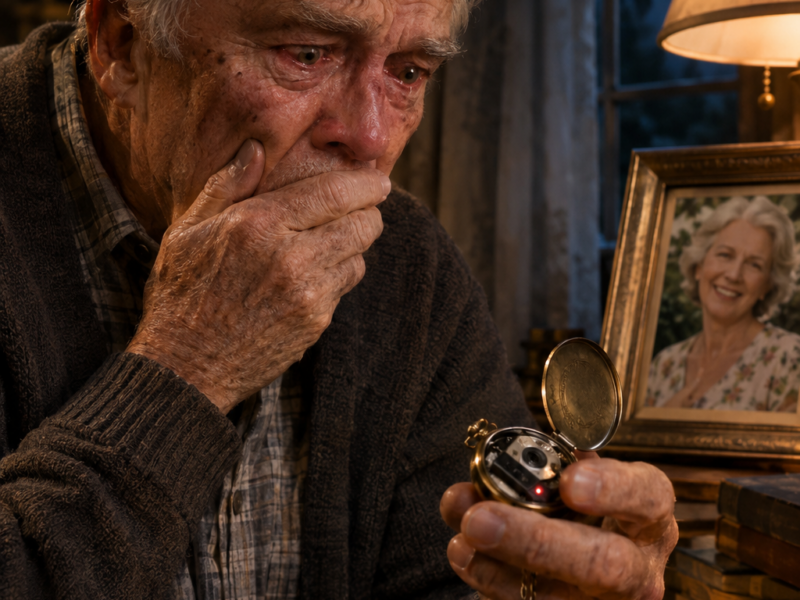
“Grandpa, My Watch Talks At Night…” I Opened It And Heard My Wife’s Voice From Three Years Ago
“Grandpa, My Watch Talks At Night…” I Opened It And Heard My Wife’s Voice From Three Years Ago
The first thing I ever loved was a gear.
Not a person, not a place, not even the smell of rain on dry pavement. A gear. Specifically, a twenty-four-tooth steel spur gear that my father pressed into my palm when I was six years old. It was still warm from the lathe, and its edges carried tiny imperfections that caught the morning light. He closed my fingers around it and said something I would remember for the rest of my life.
“Feel the edges, Gideon. Real work always leaves a mark.”
I stood in his garage that morning, rolling the little gear between my fingers, studying every tooth, every scratch, every uneven surface. I did not understand everything he meant at the time, but I understood that the object mattered. It had been made by someone, shaped by someone’s hands, and the marks left behind were proof that it was real.
That was 1958.
Sixty-six years later, I was still thinking about those words, although I had no idea how important they would become.
My name is Gideon Blackwood. I am seventy-two years old, a retired mechanical engineer, and for forty years I designed precision machinery for aerospace and medical manufacturing companies. My work required patience, accuracy, and an almost unreasonable attention to detail. A mistake of one-thousandth of an inch could send a satellite off course or cause a surgical machine to make a movement it was never supposed to make.
I retired at sixty-four and returned to the property my father had left me, a sprawling stretch of timberland, creeks, and rolling hills in Lane County, Oregon. The property covered more than two hundred acres, with a converted barn at the far end serving as my workshop. I had built its reinforced concrete floor myself in 1991, shortly before my son was born.
The workshop was the one place where everything made sense. Every tool had a position. Every machine had a purpose. Every problem had a cause, even if discovering that cause sometimes took weeks.
I lived in the main house with my son, Evander, his wife, Blythe, and their seven-year-old boy, Corbin.
To anyone looking from the outside, we were an ordinary family living an unusually quiet life in the countryside. We shared meals, celebrated birthdays, exchanged Christmas gifts, and worried about the weather. There were disagreements, naturally, but nothing that appeared serious enough to threaten the foundation of our household.
At least, that was what I believed.
The first sign that something was wrong appeared on a Tuesday morning in October.
It was 6:15, and I was sitting at my workbench recalibrating a micrometer when the workshop door suddenly flew open. A pair of small boots struck the concrete floor, followed by the familiar sound of someone running without any intention of slowing down.
“Grandpa!”
Corbin came around the workbench with his dark hair sticking up in every direction. His flannel shirt was buttoned incorrectly, and one side of his collar was folded beneath itself. He stopped beside my stool, grabbed the edge of the bench, and rose onto his toes to see what I was doing.
He had always been curious. More curious than most children, in fact. He wanted to know why things worked, how they were constructed, and what happened when one part failed.
“What does that do?” he asked, pointing at the micrometer.
“It measures things that are very small.”
“How small?”
“Smaller than you can see with your eyes.”
He considered that carefully.
“Can it measure my hair?”
“It certainly can.”
I pulled a single strand from the top of his head and placed it beneath the instrument. He yelped dramatically, although I barely touched him, and then watched the digital display with complete fascination.
“Zero point zero zero two eight inches,” I told him.
He stared at the number.
“That’s actually real?”
“Every bit of it.”
His expression changed from skepticism to delight. Those twenty minutes in the workshop were often the best part of my day. He asked questions without embarrassment and never pretended to understand something simply because an adult had explained it.
I recognized something of myself in him.
His father, Evander, often said Corbin had inherited my curiosity. Blythe rarely commented when we discussed such things.
At 6:37, she appeared in the doorway.
“Corbin. Breakfast is ready.”
Her voice was pleasant, but there was something underneath it that made me look up.
“Five more minutes,” Corbin said, still studying the micrometer.
“Now, please.”
He immediately climbed down.
That was something I had begun noticing. Corbin was a bright, energetic child, but around his mother he seemed to become smaller. He knew when to speak and when to remain silent. He understood the difference between her ordinary requests and the requests that carried consequences.
Blythe stepped aside as he passed.
She was thirty-four, with light brown hair usually arranged in a neat braid over one shoulder. She dressed carefully, kept the house spotless, and remembered the smallest details about everyone. She knew which medication I took with food, which coffee I preferred, and when my hearing aids needed charging.
She had been unfailingly considerate toward me for eight years.
And yet, something about her had always made me uneasy.
I could never explain it. She smiled frequently, spoke gently, and rarely raised her voice. But her warmth seemed practiced, as though she had studied how a caring person was supposed to behave and had become very good at reproducing the appearance.
I told myself I was being unfair.
Three weeks before that October morning, my neighbor Margaret Hollis had stopped me near the driveway.
Margaret was seventy, sharp-minded, and incapable of keeping an observation to herself.
She told me she had noticed a dark pickup truck parked near the forest turnoff behind my property at approximately two in the morning. It had appeared on two separate nights, with its lights switched off.
I thanked her and filed the information away.
At the time, I considered it ordinary neighborhood curiosity.
Three days after that morning in the workshop, Corbin celebrated his seventh birthday.
Evander came home early from his architecture firm in Eugene, carrying a rectangular present wrapped in paper decorated with cartoon rockets. He was thirty-eight, tall, and carried the same quiet determination I remembered from his childhood.
He had been tired lately. I noticed it in the way he rubbed his forehead when he thought nobody was watching and how his coffee sometimes went untouched beside his architectural drawings.
But he never complained.
Dinner was warm and noisy. Blythe had prepared pot roast, rosemary potatoes, and a chocolate cake decorated with seven candles. Corbin spent most of the meal impatiently calculating how long remained before dessert.
Afterward, Blythe disappeared into the hallway.
When she returned, she carried a small dark-blue box tied with a white ribbon.
“This one is from me,” she announced.
Corbin opened it carefully.
Inside, resting on navy velvet, was an antique-looking wristwatch. It had a thick steel case and a leather strap that appeared worn and soft, as though it had belonged to someone for decades.
“Wow,” Corbin whispered.
Blythe crouched beside his chair and fastened it around his wrist.
“You need to wear this all the time, sweetheart. Even when you sleep. Even when you take a bath.”
Evander raised an eyebrow.
“Even in the bath?”
“It’s waterproof,” she answered quickly.
Corbin turned his wrist, watching the kitchen light move across the steel surface.
“It doesn’t tick,” he observed.
“Some watches are different,” Blythe replied.
I asked to examine it.
The moment I held it, something felt wrong.
I could not identify the problem immediately, but my hands had spent forty years examining mechanical objects. I knew the difference between the weight of solid steel and the weight of something containing an unusually dense component.
The watch was too heavy for its size.
More importantly, when I tilted it, nothing moved inside.
No subtle mechanical resistance. No faint movement of gears. Nothing.
I handed it back, smiled, and said it was beautiful.
That night, I lay awake thinking about its weight.
Three days later, I learned why.
It was 6:12 in the morning when Corbin appeared in the kitchen doorway. He looked exhausted, his face pale, his shoulders stiff. His left wrist was bare.
Blythe was preparing coffee.
The moment she noticed his missing watch, her expression changed.
“Where is it?”
Corbin said nothing.
She crossed the kitchen in four quick steps, grabbed his arm, and pulled it toward her.
“Put it on. Right now.”
Her fingers tightened around his wrist.
“I won’t say it again.”
Corbin began to cry. He pulled away, stumbled sideways, and ran toward me. He grabbed the back of my flannel shirt with both hands and buried his face against my shoulder.
His whole body was trembling.
I placed my hand over his.
“What happened, buddy?”
He struggled to speak.
“Grandpa, every night the watch makes voices.”
I looked down at him.
“Voices?”
He nodded.
“I’m scared.”
Blythe immediately softened her expression.
“Sweetheart, it’s just a watch. Sometimes mechanical devices make little noises.”
“It’s not a little noise,” Corbin whispered. “It talks to me.”
I looked at Blythe.
She was watching me with an expression that seemed to ask me to agree with her. She wanted me to dismiss the child’s fear as imagination.
Instead, I picked up the watch.
“Let me keep this today. I’ll examine it.”
She hesitated.
Then she smiled.
“Of course. But tomorrow he needs to wear it again.”
I promised nothing.
After Corbin left the kitchen, I waited until three in the morning before taking the watch to my workshop.
The October air was freezing. I crossed the yard beneath a clear sky, unlocked the barn, and switched on the green-shaded lamp above my workbench.
I placed the watch beneath my magnification headset and opened my precision screwdriver set.
Six tiny screws held the back cover in place.
I removed them one at a time.
The moment the cover lifted, my stomach tightened.
There was no watch mechanism inside.
No gears, no mainspring, no balance wheel, no conventional movement of any kind.
Instead, I found a miniature circuit board, a lithium battery, a small cellular SIM card, a MEMS microphone, and a tiny speaker.
It was a surveillance device.
Someone had disguised a two-way listening and communication system as a child’s birthday watch.
I was still examining the components when the speaker suddenly vibrated.
A woman’s voice emerged from the little steel case.
“Corbin, sweetheart. It’s Grandma. Are you awake?”
My fingers tightened around the metal cover.
I knew that voice.
I had heard it at Thanksgiving dinners, during bedtime stories, and in our kitchen for twelve years.
It was the voice of my wife, Lenore Blackwood.
My wife, who had supposedly drowned in Crater Lake three years earlier.
For several seconds, I could not move.
I remembered the November afternoon when she had left the house, telling me she was going out on the lake and would return before dark. I remembered the telephone call that followed, the search, the authorities, and the weeks of grief that came afterward.
I remembered sitting alone at the boat launch on the first anniversary of her death.
And now I was hearing her voice coming from a device hidden inside my grandson’s birthday present.
A man’s voice interrupted.
“Is he answering?”
“He’s asleep,” Lenore replied. “Or he’s taken it off again. We don’t have time for this.”
“Then make the kid understand. One task. Unlock the back door. That’s it.”
“The trust window closes in seventy-two hours, Vaughn. After that, the lawyers conduct their quarterly review, and we lose the opening.”
“I know the timeline,” the man snapped. “Just make the boy cooperate.”
“I will handle it.”
The connection remained open for several seconds.
Then it disconnected.
I stood beneath the green lamp, staring at the watch.
My wife was alive.
Someone was using my seven-year-old grandson as part of a plan involving a family trust.
And whoever Vaughn was, he expected a child to unlock the back door of my house in the middle of the night.
I looked at the clock.
I had seventy-two hours.
I needed to understand everything before the next attempt.
The first person I examined was Blythe.
The following morning, she appeared in the kitchen at 7:45. As usual, she prepared my hearing aids before setting them beside my coffee.
It was a ritual she had performed for years.
She cleaned the devices, checked their batteries, and adjusted their controls.
This time, I watched her hands carefully.
She spent several seconds longer holding the left hearing aid. Her thumb moved across its volume control before she placed it on the table.
I waited until she turned away.
Then I used a small signal analyzer from my workshop to examine its frequency output.
The high-frequency amplification had been reduced by approximately thirty percent.
The adjustment was deliberate.
It was enough to make conversations harder to understand, particularly when several people were speaking. Over time, it could make me appear forgetful, inattentive, and increasingly confused.
I restored the original setting.
Suddenly, my house sounded different.
I could hear the refrigerator compressor, the clock above the stove, and footsteps upstairs that I had not clearly heard for months.
Then I heard Blythe speaking quietly on her phone.
I could not make out every word, but I heard enough to know that she was reporting something.
A few minutes later, she returned with a bottle of vitamins.
“Doctor Hayes recommended these for your memory,” she said.
I thanked her.
After she left, I took the capsules to my workshop.
I had spent decades studying metals, alloys, and industrial chemicals. My testing equipment was not designed to identify every pharmaceutical compound, but I knew enough to recognize when something deserved immediate medical attention.
The initial tests raised serious concerns about a sedative-type substance.
I contacted my physician, Dr. Raymond Hayes.
He checked my medical records and confirmed that he had never prescribed or recommended the supplement Blythe had given me.
He also told me my cognitive function had been entirely normal at my most recent examination.
“Gideon, what exactly are you taking?”
“I haven’t determined everything yet,” I replied.
His voice became serious.
“You need to stop taking it and get medical assistance.”
“I understand.”
I ended the call and sat quietly beneath the green lamp.
Someone had been manipulating my hearing and giving me an unidentified substance while presenting it as a harmless supplement.
The plan was not simply to steal money.
It was to make me appear incapable of protecting myself and my family.
I placed the capsules in a secure container and began searching for more evidence.
Later that morning, my groundskeeper, Hector Villanueva, sent me a short message.
Three words.
“She’s gone. Drive.”
Blythe had left the property.
I went directly to the upstairs bedroom she shared with Evander.
Her laptop was on the writing desk beneath the east-facing window. I opened it and entered a password based on Corbin’s birthday.
It worked.
I had less than forty minutes before she might return.
The first document I found was a copy of the Blackwood family trust, originally drafted in 2019 with my estate attorney, Nora Finch.
One section had been highlighted.
It stated that the principal assets could be distributed when the primary beneficiary reached seven years of age, provided that a legal guardian and the trustee signed the authorization.
Corbin had turned seven only four days earlier.
The next discovery was worse.
An email account contained fourteen months of correspondence between Blythe and an unidentified contact.
The messages discussed my hearing impairment, the supplement regimen, and the progress of a plan to make me physically and mentally incapable of managing my affairs.
One message described me as the primary obstacle.
Another instructed Blythe to remain on schedule.
Then I found a photograph.
It showed a woman sitting outside a coffee shop in Ashland, Oregon. She wore a dark green jacket and sunglasses, and her hair had been cut short and dyed silver-blonde.
She was laughing.
I knew that laugh.
I knew the way she held her coffee cup with both hands. I knew the slight forward movement of her shoulders when something amused her.
It was Lenore.
The photograph had been taken on March 14 of the previous year.
That date was the anniversary of her supposed death.
I had spent that afternoon sitting alone beside Crater Lake, grieving for a woman who had apparently been drinking coffee in Ashland, laughing in the sunshine.
My right hand began trembling.
I pressed it against the desk and forced myself to breathe.
Then I closed the laptop, preserving the evidence, and went to find my son.
Evander was in his home office, studying architectural drawings.
He looked up when I entered.
“Dad? What’s wrong?”
“Come to the workshop.”
He followed me without asking questions.
Inside, I showed him the photograph, the trust document, and the email correspondence.
He read everything carefully.
At first, his expression was confused.
Then his jaw tightened.
Finally, he sat down heavily on the stool.
“That’s Ashland,” he whispered.
“Yes.”
“She’s alive?”
“Yes.”
He stared at the photograph for a long time.
“Eight years, Dad.”
His voice broke slightly.
For eight years, Evander had shared his life with Blythe. He had trusted her, built a home with her, and raised a child beside her.
Now he was discovering that the woman he had married might have been part of a conspiracy involving his own family.
He stood suddenly, his hands clenched.
I knew what he wanted to do.
He wanted to confront her immediately.
I stopped him.
“She has cameras in the house. She’s been planning this for years. If she realizes we know, she’ll take Corbin and disappear.”
He looked at me.
“Corbin.”
That was all he needed to say.
We both understood that the boy was the center of everything.
I told Evander we would proceed carefully, collect evidence, and involve the authorities before making any move.
He nodded.
“I’ll do whatever you need.”
I spent the next several hours organizing the evidence.
At four in the afternoon, I contacted Deputy Marlene Oaks of the Lane County Sheriff’s Office.
She remembered the investigation into Lenore’s disappearance three years earlier.
When I told her Lenore was alive, the silence on the other end of the telephone lasted several seconds.
Then she said, “Tell me everything.”
I explained the watch, the recording, the photograph, the trust document, and the suspected poisoning.
Deputy Oaks arrived less than an hour later in an unmarked vehicle.
She examined the device and listened to the recording.
Her expression became increasingly serious.
She told me she had questioned the circumstances of Lenore’s disappearance at the time. The water temperature, the lack of witnesses, and the limited physical evidence had always bothered her.
Now she had something concrete to investigate.
She began arranging the necessary warrants and additional personnel.
The next stage was dangerous.
We needed to protect Corbin, preserve the evidence, and ensure that nobody could escape before the authorities understood the entire conspiracy.
Meanwhile, I discovered another disturbing detail.
The watch was not the only communication device involved.
Hidden surveillance equipment had been connected to the household network. Blythe had been monitoring the property and communicating with people outside the house.
I also discovered that the stuffed bear on Corbin’s bookshelf had recently been opened and resewn.
Inside it was a cheap prepaid phone.
Three messages were stored on the device.
The most recent read:
“2:00 a.m. Back door. Boy opens it. In and out in twenty minutes.”
I photographed the messages and carefully returned the device to its hiding place.
The plan was becoming clear.
Someone intended to enter the house through the back door while Corbin was awake enough to cooperate.
The boy was not simply being frightened by his mother’s strange behavior.
He was being manipulated into helping strangers enter his own home.
I spent the rest of the afternoon coordinating with Deputy Oaks and preparing for the coming night.
By evening, I had completed my list of eighteen tasks.
Evander and I ate dinner with Corbin as normally as possible.
Blythe was pleasant, attentive, and completely unaware that we knew what she had been doing.
She asked about Evander’s work, refilled my water glass, and reminded Corbin to finish his vegetables.
Watching her perform the ordinary rituals of family life was almost unbearable.
I had spent eight years sharing a table with this woman.
She had smiled at us while secretly dismantling everything we believed about our home.
After dinner, Corbin went upstairs.
I followed him a few minutes later.
He was sitting on his bed in his pajamas, his hands folded in his lap. His lighthouse nightlight cast a slow amber glow across the wall.
“You’re still awake,” I said.
“I was waiting for you.”
I sat beside him.
There were things I could not tell him. He did not need to know about every piece of evidence or every legal detail. He did not need to understand the chemicals, the surveillance system, or the people waiting outside the property.
But he deserved the truth about what was happening to him.
I explained that someone might come to the house that night. I told him that his father and I were protecting him and that he would not be alone.
Then I asked him to do one thing.
He listened carefully.
When I finished, he remained quiet.
Finally, he said, “She thinks I still do what she says.”
“Yes,” I answered.
“And if I talk to her, she won’t change the plan?”
“That’s right.”
He looked down at his hands.
“Okay.”
I placed a pair of industrial ear defenders on his nightstand and prepared a movie on his tablet.
“When you hear something frightening, put these on. Watch your movie. When I come back, I’ll knock three times before opening the door.”
He picked up the ear defenders and examined them.
“Grandpa?”
“Yes?”
“Will you stay with Dad?”
“I will.”
He nodded.
I left him with the lighthouse light glowing beside his bed.
At 1:15 in the morning, I returned.
I knocked three times.
Corbin was already sitting on the edge of his bed. The movie had ended, and the tablet screen had gone dark.
He stood without being asked.
I walked beside him down the hallway, one hand resting gently on his shoulder.
Evander was waiting in the mudroom.
When he saw his son, something changed in his expression. He crouched down and looked directly into Corbin’s eyes.
“Hey, buddy.”
His voice was rough but steady.
“You don’t have to do this. Grandpa and I have another way.”
Corbin shook his head.
“She knows my voice. If she doesn’t hear me, she’ll know something’s wrong.”
Evander swallowed.
“I know.”
Corbin placed a small hand against his father’s arm.
“It’s okay, Dad.”
For a seven-year-old boy, he seemed impossibly serious.
We moved into position.
At approximately two in the morning, the communication device activated.
The first voice was Blythe’s.
“Corbin, sweetheart. Are you awake?”
Corbin looked toward me.
I nodded.
He answered in his usual sleepy voice.
“Mommy?”
“That’s right, baby. I need you to do something for me.”
“What?”
“Go downstairs and open the back door.”
Corbin paused.
“Why?”
“Someone needs to come inside.”
“Who?”
“Don’t worry about that. Just open the door.”
I watched his small hands tighten around the edge of his pajamas.
Then he asked the question that changed everything.
“Is Dad coming too?”
There was a brief silence.
“No, sweetheart. This is just between us.”
Corbin looked at me again.
Then he said, very quietly, “I don’t want to.”
Blythe’s voice sharpened.
“Corbin, don’t make this difficult.”
The connection ended.
We waited.
At 2:07, the first emergency call was placed to dispatch.
Deputy Oaks and her team were already nearby.
Several minutes passed.
Then came the sound of a vehicle outside.
Footsteps crossed the yard.
Someone tried the back door.
The lock resisted.
A second attempt followed.
Then a man’s voice came through the darkness.
“Blythe?”
There was no answer.
A metallic sound followed.
The door opened.
Two men entered the mudroom.
One carried a flashlight. The other held something in his right hand that caught the faint light.
They moved toward the cellar entrance.
I recognized one of them from the photograph and correspondence: Vaughn Mercer.
The other was unfamiliar.
They descended the cellar stairs.
The door closed behind them.
Then I heard Blythe’s voice from the darkness.
“You’re late.”
Vaughn answered angrily.
“The road was blocked.”
“Did you bring it?”
“Yes.”
“What about the boy?”
“Where is he?”
“Upstairs.”
I waited until the three of them were inside.
Then I heard the cellar door lock.
A moment later, Vaughn began shouting.
“What is this?”
Blythe demanded to know why the door would not open.
I remained outside with Evander, listening.
They were trapped, but I was not finished.
I had one final piece of evidence to deliver.
Through a narrow ventilation opening, I passed a photograph of the flight reservation I had discovered earlier.
It showed a one-way ticket to Lisbon, Portugal, scheduled to depart from Portland International Airport at 6:15 that morning.
Two passengers.
Blythe Mercer and Corbin Mercer.
Vaughn looked at the paper.
“What is this?”
Blythe’s voice changed.
“Where did you get that?”
The silence that followed was unmistakable.
“You were going to leave?” Vaughn demanded.
“It’s not what you think.”
“A one-way ticket to Lisbon with the boy’s name on it? What exactly am I supposed to think?”
Then another voice spoke.
“Vaughn, please.”
Lenore.
She was there.
My wife was somewhere inside that cellar, only a few feet beneath me.
For three years, I had believed she was dead.
For three years, I had carried her memory into every quiet morning, every holiday, and every difficult moment.
Now I was listening to her argue with the people who had destroyed my family.
The confrontation grew louder.
Vaughn accused Blythe of keeping information from him. Blythe insisted that the plan had always been temporary. Lenore tried to regain control of the conversation.
Then Vaughn said something that made my blood run cold.
“He’s not even your son.”
Silence.
Blythe began to answer, but stopped.
Lenore spoke first.
“This is not the time.”
I looked at Evander.
He was standing perfectly still.
The truth was beginning to emerge.
The woman he had believed to be his mother had concealed an entire part of her life from him. The man in the cellar, Vaughn, was apparently connected to a secret that reached back long before Blythe entered our family.
There were more betrayals here than I had imagined.
Deputy Oaks gave the signal.
The authorities entered the property.
Within minutes, the cellar was surrounded.
I called down through the ventilation opening.
“Lenore.”
Everything became quiet.
Then her voice returned.
“Gideon?”
“Yes.”
A long silence followed.
Finally, she said my name again.
I could hear her breathing.
“Gideon, please.”
I closed my eyes for a moment.
I remembered the woman who had once sat beside me on the porch, laughing at something I had said. I remembered her hands, her voice, and the life we had built.
Then I remembered the photograph from Ashland.
I remembered the watch.
I remembered Corbin crying against my shoulder.
“Lenore,” I said, “I called emergency services at 2:07. Everything said in that room has been recorded.”
She said nothing.
“The warrant has been signed. Deputy Oaks is outside. Every piece of evidence is in the hands of the authorities.”
Another silence.
Then I heard her whisper.
“Oh God.”
The cellar door opened.
Deputy Oaks and her officers moved in.
The arrests were carried out without further violence.
Vaughn was taken first. Blythe followed. Lenore came last.
When she emerged into the cold October air, she looked older than I remembered. Her hair was silver-blonde, and the dark green jacket she wore was the same one from the photograph.
For a moment, our eyes met.
I had imagined this moment countless times without knowing it.
I had imagined what I would say if I ever discovered that my wife had not drowned.
But when the moment finally arrived, I had nothing to say.
She looked toward the house.
“Where is Corbin?”
I did not answer.
Evander stepped forward.
“You don’t get to ask about him.”
Lenore looked at her son.
Something moved across her face, but I could not tell whether it was regret, fear, or simply the shock of being confronted by the consequences of her decisions.
Deputy Oaks led her away.
The sky above the eastern ridge was beginning to lighten.
For the first time in three weeks, Corbin was safe.
The investigation that followed uncovered the full extent of the conspiracy.
Blythe had been working with Lenore and Vaughn for more than a year. The birthday watch was intended to monitor the household and communicate with Corbin remotely.
The stuffed bear contained a second phone.
The surveillance devices allowed them to observe the property and track the family’s movements.
The supposed vitamins had been part of a scheme to weaken me and create the appearance of cognitive decline.
The hearing aid adjustments were intended to reinforce that impression.
The family trust was the financial objective.
Corbin’s seventh birthday had activated a clause that allowed certain assets to become eligible for distribution, provided the proper guardianship authorization was obtained.
The plan depended on making me incapable of managing my responsibilities and using the child to facilitate access to the property.
The investigation also uncovered evidence connected to Lenore’s disappearance.
Her death had been staged.
She had disappeared from the lake, leaving behind circumstances that led authorities to believe she had drowned. In reality, she had escaped to a private cabin on the northern shore before moving elsewhere.
The supposed tragedy had given her a new identity and a way to remain hidden.
For three years, I had mourned a woman who was alive.
And during that time, she had continued communicating with people who were planning to steal from my family.
The most painful discovery concerned Vaughn.
He was Lenore’s biological son, born before she married me. She had kept his existence secret from our family.
The trust, however, was not his inheritance to claim.
Corbin was the primary beneficiary.
And that was why the child had become so important to the conspiracy.
Eleven months passed before the trial concluded.
Those months were difficult in ways I had not anticipated.
There were depositions, court hearings, legal arguments, and endless paperwork. Nora Finch handled our legal matters with the same precision she had used when drafting the trust.
Evander struggled with the emotional aftermath.
He had spent eight years married to Blythe, and every memory of those years now carried a question.
Had she ever loved him?
Had any of their ordinary family moments been genuine?
Had she looked at Corbin as a son or merely as the key to a financial opportunity?
I had no answers for him.
What I could do was remain present.
We made sure Corbin had a stable routine. He returned to school, spent time in the workshop, and gradually began sleeping through the night.
Sometimes he asked about his mother.
Sometimes he asked about Lenore.
We never lied to him.
We explained what we could in language appropriate for his age, always making sure he understood that none of what had happened was his fault.
The trial finally ended in the Lane County Courthouse in Eugene.
Vaughn Mercer received twelve years in prison.
Blythe received nine years.
Lenore received fourteen years for her role in the fraud, conspiracy, and endangerment of a minor.
When the sentences were announced, I sat beside Evander with Corbin on my other side.
The boy wore a navy suit that was slightly too large in the sleeves. He had grown considerably since the night of the arrests.
He listened carefully throughout the proceedings.
When Blythe’s sentence was read, he remained still.
When Lenore’s sentence was announced, he reached over and placed his hand on mine.
I turned my palm upward and held his little hand.
He was not asking me to comfort him.
He was checking whether I was all right.
That small gesture nearly broke my heart.
After the hearing, Nora approached us in the courthouse corridor.
She had prepared the necessary documents to establish permanent guardianship and begin the adoption process.
Evander looked at Corbin.
“What happens now?”
Nora explained the remaining legal steps.
There would be interviews, a court-appointed advocate, and a final hearing. It would take several months.
Corbin listened.
Then he asked, “Does that mean Dad gets to be my dad officially?”
Evander knelt beside him.
“I’ve always been your dad.”
“I know.”
Corbin looked at Nora.
“But the paperwork will say it too?”
She smiled.
“Yes, sweetheart. The paperwork will say it too.”
Eight months and eleven days after the arrests, we returned to court.
The adoption hearing took place in a smaller courtroom on the second floor.
Judge Hargrove reviewed the petition, asked Evander several questions, and then turned toward Corbin.
“Do you understand what adoption means?”
Corbin nodded.
“Can you explain it in your own words?”
The boy thought for a moment.
“It means we’re already a family, and now the paperwork says so too.”
The judge looked at him over his reading glasses.
Then he smiled slightly and signed the document.
Evander had officially become Corbin’s father in every legal sense.
And I had become something I had never expected to become again.
A grandfather with a grandson who was unquestionably, permanently, and completely part of his family.
That evening, I returned to my workshop.
I had not spent much time there during the legal proceedings. The room had remained untouched, with its green lamp, steel workbench, and familiar smell of cutting oil and oak sawdust.
I opened the bottom drawer.
Beneath a set of calipers and an old blueprint, I found the gear my father had given me in 1958.
I took it out and held it in my palm.
The metal had darkened slightly over the decades, but the teeth were still intact.
Real work always leaves a mark.
The following morning, I arrived at the workshop at six.
The eastern window allowed the first sunlight to enter, turning the steel bench gold for a few minutes.
I placed the gear on the work surface and sat quietly.
At 6:17, I heard Evander’s footsteps outside.
He entered carrying a thermos of coffee and sat on the stool opposite me.
Neither of us spoke immediately.
He looked at the gear.
“That’s Grandpa Harry’s.”
“Yes.”
“You never take it out.”
“I know.”
He poured himself some coffee.
“Corbin’s going to come in soon.”
“He usually does.”
At 6:23, the side door opened.
Small boots struck the concrete floor.
Corbin came around the workbench at full speed, his hair sticking up in four directions. He had a small scrape on his chin from a bicycle accident two days earlier and was already preparing to ask a question.
He stopped beside my stool.
His eyes immediately found the gear.
“What’s that?”
I picked it up and held it out.
“Something my father gave me when I was your age.”
Corbin accepted it with both hands.
He turned it over, examined the teeth, and ran his thumb along the rough edges.
He held it beneath the morning light.
“It’s real,” he said.
“How do you know?”
He looked up at me.
“Because the edges aren’t perfect. They’re a little rough, like something actually cut them.”
I smiled.
“That’s right.”
He placed the gear carefully on the workbench.
Then he looked at the micrometer.
“Can I use that?”
I laughed.
“Of course.”
He climbed onto the second rung of the footrest, and I handed him the instrument.
Evander refilled his coffee.
The sunlight moved slowly across the workshop floor.
Outside, the creek was running below the field, and birds were moving through the fir trees.
For the first time in a very long time, the house felt peaceful.
I looked at my son, then at my grandson.
Corbin had no blood relation to me whatsoever, yet he was mine in every way that mattered. He had inherited none of my family’s name through biology, but he had inherited something more important through the life we had chosen to share.
He had learned that honesty mattered.
He had learned that courage did not always look like shouting or fighting.
Sometimes courage meant telling the truth when every adult around you wanted silence.
I thought about the watch, the white ribbon, the hidden microphone, and the voice that had come from inside that little steel case.
I thought about how easily trust could become a weapon when someone understood exactly how to imitate love.
For twelve years, I had shared my home with people whose intentions I did not understand.
I had mistaken politeness for kindness, routine for loyalty, and silence for peace.
The greatest damage had not been the money they attempted to steal or the years of my life they had tried to take away.
It was what they had placed on the shoulders of a seven-year-old boy.
Corbin had carried the truth for weeks because he believed that telling someone might destroy his family.
He had been afraid, but he had still found the courage to speak.
And that was the part I would never forget.
Every family carries secrets. Every family experiences disappointment, conflict, and moments when trust is tested. But there is a difference between an imperfect family and a family built on deception.
The truth does not always arrive gently.
Sometimes it comes from a frightened child standing in a kitchen, holding an empty wrist, whispering that something is speaking to him in the dark.
Sometimes it comes from a tiny speaker hidden inside a birthday present.
And sometimes it comes from a photograph of someone you buried in your heart three years earlier, sitting in the sunshine as though nothing had ever happened.
But however painful the truth may be, silence can be far more dangerous.
I looked at Corbin as he carefully adjusted the micrometer.
He was concentrating, his eyebrows drawn together, his small fingers moving with the seriousness of someone handling an important instrument.
“Grandpa?”
“Yes?”
“How small can this thing measure?”
I smiled.
“Very small.”
He looked at the display.
“Smaller than a hair?”
“Much smaller.”
He considered that for a moment.
Then he nodded with complete satisfaction and returned to his work.
The morning continued.
There was no dramatic announcement, no music, and no grand celebration. Just sunlight through a workshop window, coffee cooling on a steel bench, and a boy learning how the world worked.
I finally understood something my father had tried to teach me all those years ago.
Real things are not always perfect.
Real families are not always simple.
Real love is not measured by promises, expensive gifts, or the appearance of a beautiful home.
It is measured by the things people do when nobody is watching, by the truth they are willing to tell, and by the people they refuse to abandon when life becomes difficult.
My father had given me a small steel gear in 1958.
More than six decades later, I had passed it into the hands of a boy who had taught me something far greater than anything I could have taught him.
He had reminded me that the most important things in life are not always the things we inherit.
Sometimes they are the things we choose to protect.
And sometimes, when everything else has been taken away, the only thing that remains is the simple, powerful decision to stand beside someone and say:
“You are safe. I am here. And you will never have to carry this alone again.”









