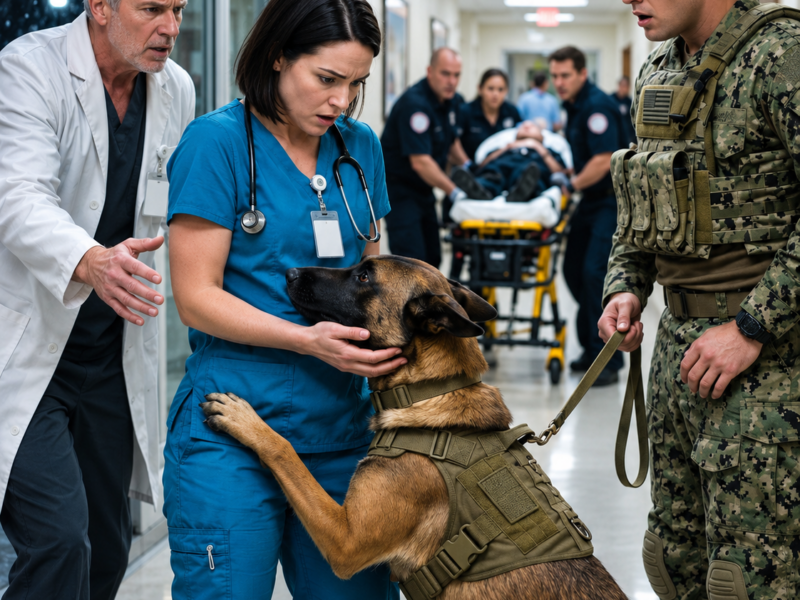
“Get Out of My Trauma Bay!” The Surgeon Ordered — Until the SEAL’s Military K9 Chose ONLY Her
“Get Out of My Trauma Bay!” The Surgeon Ordered — Until the SEAL’s Military K9 Chose ONLY Her
At 2:47 in the morning, the emergency room doors at Pine Ridge Military Hospital slammed open, and a blast of freezing air swept through the trauma department like another emergency arriving ahead of the patient. Outside, a violent winter storm was burying the roads beneath heavy snow. Inside, backup generators hummed unevenly, fluorescent lights flickered overhead, and exhausted medical staff struggled to keep up with a night that had already pushed them beyond their limits.
A group of paramedics rushed through the ambulance entrance, pushing a gurney at a speed that made everyone instinctively step aside. On it lay a heavily built man in his mid-thirties, unconscious, pale, and bleeding through multiple pressure dressings. His left shoulder was wrapped in blood-soaked gauze, and his right forearm was secured beneath another makeshift bandage. The monitor beside him displayed a series of increasingly alarming numbers.
Behind the gurney came a military officer holding the leash of a large Belgian Malinois wearing a tactical vest. The dog pulled hard toward the wounded man, its ears upright and its amber eyes fixed on the stretcher. It was not barking or panicking. It was simply watching, intensely and almost intelligently, as if it understood that something terrible was happening to the man lying in front of it.
At the nurses’ station stood Norah Kellen, a thirty-two-year-old registered nurse who had been working at Pine Ridge for three years.
Her identification badge read STAFF NURSE LEVEL TWO.
Nothing about the badge suggested the kind of experience she had accumulated during the six years before she entered civilian nursing. Nothing indicated the number of wounded soldiers she had treated, the evacuations she had coordinated, or the nights she had spent working under conditions that made this freezing hospital seem almost comfortable.
Norah had been on duty since seven the previous morning. Her shift was supposed to have ended at three in the afternoon, but the nurse scheduled to replace her had called in sick. Nobody from the float pool could reach the hospital through the storm, and Arthur Novak, the charge nurse, had given her two choices: stay or find someone willing to cover.
She had stayed.
By the time the ambulance arrived, she had already completed nineteen hours of work. Her eyes ached, her stomach was empty, and she had eaten only half an oatmeal bar during a brief break in the supply hallway. Still, her hands remained steady, and her attention never wandered from the patients who needed her.
She had started intravenous lines, administered medication, documented several charts, and caught a potentially dangerous dosage error earlier that night. Now, as the military patient entered the emergency department, she immediately noticed something wrong.
The man’s breathing was uneven. His oxygen saturation was falling, and the sounds coming from his left lung were significantly diminished.
Norah stepped closer to the gurney.
“Trauma bay one,” someone called.
Within seconds, the hospital’s chief surgeon, Dr. Victor Sterling, arrived. At fifty-three, Sterling had silver hair, an expensive-looking watch, and the confidence of a man accustomed to having the final word in every room he entered. He had worked at Pine Ridge for nine years and enjoyed considerable professional prestige. His research on military trauma protocols had earned him invitations to conferences and recognition from hospital administrators.
He was also extremely protective of his authority.
“Clear the bay,” he ordered. “I need Mercer and Santos in here. Respiratory on standby.”
Norah glanced at the patient again.
“The breath sounds on the left are diminished,” she said.
Sterling turned toward her with visible irritation.
“I am aware of how to assess a patient, Nurse Kellen.”
“I understand. I just thought—”
“This is beyond your scope. Return to your station.”
His voice was quiet, but the message was unmistakable.
Norah stepped back.
She had learned that arguing with certain physicians rarely improved a situation. Nevertheless, she remained near the trauma bay curtain, watching through the narrow opening.
Something about the dog caught her attention.
The Malinois, whose name was Rex, was not behaving like an ordinary working dog accompanying an injured handler. He remained focused on the gurney, occasionally shifting his weight but never losing sight of the patient. When his military companion moved him several feet away to clear the entrance, Rex turned his head and looked directly at Norah.
Their eyes met.
For several seconds, neither moved.
Norah could not explain the strange feeling that passed through her. She had seen military working dogs before, particularly during a brief rotation at a veterans’ medical facility, but this animal seemed different. His attention was deliberate, almost familiar.
Inside the trauma bay, the medical team began working.
Sterling issued orders while Dr. Mercer examined the patient’s injuries. A respiratory technician prepared the intubation equipment. The monitor briefly stabilized, then began showing another decline.
Norah watched the numbers.
She recognized the pattern.
The patient’s left-sided breath sounds, combined with the location and trajectory of the shoulder wound, strongly suggested a developing tension pneumothorax. Air was accumulating in the pleural space, compressing the lung and placing increasing pressure on the structures responsible for maintaining circulation.
If the pressure continued building, the patient could deteriorate rapidly.
Sterling was preparing to intubate him.
Norah felt her stomach tighten.
If they intubated before relieving the pressure, positive-pressure ventilation could make the situation dramatically worse.
She stepped through the curtain.
“Dr. Sterling, there’s air accumulating in the left pleural space. The wound trajectory isn’t just soft tissue. You need to decompress before intubating.”
The room became silent.
Sterling stared at her.
“Remove her.”
Arthur Novak appeared near the entrance and gently touched Norah’s arm.
“Come on, Norah.”
She looked once more at the monitor.
The oxygen saturation continued falling.
She allowed Arthur to guide her outside.
For forty seconds, she stood beyond the curtain, listening to the increasingly urgent voices inside.
Then the alarm sounded.
It was the unmistakable tone of a patient beginning to crash.
Norah did not hesitate.
She stepped back through the curtain.
This time, nobody tried to stop her.
“Needle decompression kit,” she called.
Brenda Tagert, a nurse who had worked alongside Norah for two years, looked at her with alarm. For a moment, Brenda seemed uncertain whether she should intervene or trust the younger nurse’s judgment.
Then she handed over the equipment.
Norah approached the patient.
Her mind became quiet.
She identified the anatomical landmarks, positioned her hands, and performed the emergency decompression.
A brief hiss escaped as the trapped air was released.
The monitor did not suddenly transform into a perfect sequence of reassuring numbers. Real medicine rarely worked that way. Instead, one reading began to improve, followed by another. The oxygen saturation slowly climbed.
Dr. Mercer stared at the screen.
“She’s coming up,” the respiratory technician murmured.
Norah stepped aside.
“Intubate now. He’s stable enough. Do it now.”
Mercer moved immediately.
Within moments, the breathing tube was secured, and the patient’s numbers continued improving.
The alarm stopped.
Norah removed her gloves and stepped back.
The wounded man was alive.
Sterling turned toward her.
There was no gratitude in his expression. No acknowledgment that her intervention had prevented a potentially fatal complication.
Instead, his eyes reflected something much colder.
“Get out of my trauma bay.”
Norah looked at him briefly, then walked away.
Outside, Rex was waiting.
The dog stepped toward her, his leash held by the military officer who had accompanied the patient. When the officer loosened his grip, Rex approached Norah and gently pressed the crown of his head against her palm.
It was not the usual excited greeting of an affectionate animal.
It was deliberate.
The military officer watched the interaction with visible surprise.
“He doesn’t do that,” he said.
Norah looked up.
“Sometimes dogs are unpredictable.”
The man shook his head.
“Not this one. I’ve been around him for years. He doesn’t approach strangers like that.”
Norah slowly withdrew her hand.
The officer introduced himself as Lieutenant Grant Wilder. The wounded sailor was Petty Officer First Class Cole Maddox, a Navy SEAL who had sustained serious injuries during an operation.
The dog was Rex, Maddox’s military working partner.
Norah nodded, then returned to the nurses’ station.
She finished documenting her previous patient before adding a factual note about Maddox’s condition and the intervention she had performed. Her handwriting remained precise.
Thirty minutes later, Arthur approached.
“Sterling wants a meeting.”
“Tonight?”
“Tomorrow morning. Eight o’clock.”
Norah glanced at the clock.
She had already worked nearly twenty hours.
“I’ll be there.”
Arthur hesitated.
“You probably should have let them handle it.”
Norah looked at him.
“He would have died, Arthur.”
The charge nurse nodded slowly.
“I know.”
He walked away without saying anything else.
At 4:15, Grant Wilder found Norah in the supply hallway and offered her a cup of coffee. She accepted it, although the coffee tasted as if it had been sitting in the machine since the previous evening.
“How long have you been a nurse?” he asked.
“Three years here.”
“Before that?”
Norah looked at him over the rim of the cup.
“Another job.”
“What kind?”
“Thank you for the coffee, Lieutenant.”
She walked away before he could ask anything else.
But Wilder was not a man who easily abandoned unanswered questions.
At 6:30, Cole Maddox was transferred to the surgical intensive care unit. His condition had stabilized, and the medical team was cautiously optimistic.
Shortly afterward, Brenda mentioned that a senior military officer had visited the unit asking specifically about the nurse who had intervened in the trauma bay.
Norah continued writing her shift notes.
Then she noticed movement through the intensive care window.
Maddox had opened his eyes.
Although heavily sedated, he slowly turned his head toward the nurses’ station. His gaze found Norah through the glass.
His lips moved beneath the intubation tape.
Norah could not hear him, but she knew how to read lips.
The words were unmistakable.
“You were there before.”
Her pen stopped.
For several seconds, she simply stared at him.
Then his eyes closed again, and the sedation carried him back into unconsciousness.
Norah finished her documentation without mentioning what she had seen.
At 7:04, she handed over her patients and went to the locker room. She had less than an hour before Sterling’s meeting, so she bought another cup of coffee and sat in the empty waiting area outside radiology.
She had almost finished it when Brenda joined her.
“Sterling has already contacted administration,” Brenda said.
Norah looked up.
“About what?”
“He filed a formal complaint against you at six this morning.”
Norah had expected it.
“What does it say?”
“That you practiced outside your scope in a restricted trauma bay.”
“That’s accurate.”
Brenda frowned.
“He’s describing it as patient endangerment.”
Norah slowly lowered her coffee.
“The patient’s oxygen saturation went from eighty-two to ninety-seven percent in four minutes.”
“I know. I was there.”
“Then what exactly is the problem?”
Brenda folded her hands.
“I’m telling you what the meeting will look like. Sterling is saying an unauthorized nurse performed an invasive procedure on a critical military patient and compromised the treatment environment.”
Norah looked toward the corridor.
“Is Lieutenant Wilder going to be there?”
“I don’t know.”
Brenda stood.
“Just be careful.”
Norah nodded.
At eight o’clock, she entered Sterling’s office.
The chief surgeon sat at one side of a conference table beside Raymond Gable, the hospital director. Arthur Novak was also present, looking uncomfortable.
A fourth man sat quietly near the far end of the table. He appeared to be in his fifties, dressed in ordinary civilian clothes, but his posture suggested military or federal experience.
Nobody introduced him.
Sterling began by discussing hospital protocol. He repeated the word several times, emphasizing the importance of established procedures and professional boundaries.
Gable followed with a discussion of liability exposure and scope of practice.
Neither man mentioned the fact that Cole Maddox was alive.
Finally, Norah spoke.
“Mr. Maddox is alive.”
Gable looked at her.
“That isn’t the point of this conversation.”
“With respect, sir, it should be.”
Sterling leaned forward.
“Nurse Kellen, we have established procedures for these situations. They exist to protect patients and staff.”
Norah maintained eye contact.
“Did you assess him for tension pneumothorax before preparing to intubate?”
Sterling’s expression barely changed.
“We were conducting a full trauma assessment.”
“His oxygen saturation was falling approximately four points per minute. There was a very limited window before irreversible hypoxic injury became a serious possibility.”
Gable shifted in his chair.
“You are not disputing that you violated protocol?”
“No. I am explaining why I did it.”
The administrator glanced at Sterling.
Then he announced that Norah would be suspended for two weeks with pay, pending a formal review of her conduct and continued employment.
Norah listened without interruption.
“Understood.”
She was preparing to leave when the unidentified man finally spoke.
“Miss Kellen, I have one question.”
Sterling immediately looked irritated.
“That question isn’t necessary.”
The man ignored him.
“What is your assessment of Mr. Maddox’s prognosis?”
Norah sat back down.
“If there is no secondary bleeding, his chances are good. His lung needs close monitoring for the next seventy-two hours. The shoulder repair may be complicated, depending on the extent of the damage, but his response after decompression and intubation was encouraging.”
The man nodded.
“Thank you.”
Norah left.
Outside the office, Grant Wilder was waiting with Rex.
“Did they suspend you?” he asked.
“Pending review.”
He nodded.
“The man in there. Did he introduce himself?”
“No.”
“His name is Julian Frost. He’s a federal medical oversight liaison.”
Norah looked at him.
“Why is he here?”
“Because Cole Maddox isn’t an ordinary patient. He’s part of an active classified program. His emergency transport to a civilian contracted hospital triggered a federal review.”
Wilder paused.
“And Frost has been investigating something connected to that program for two years.”
Norah felt the conversation moving toward territory she had spent three years avoiding.
“What does that have to do with me?”
Wilder looked directly at her.
“That’s what I want to understand. Rex recognized you. Maddox recognized you. And your name appeared on the hospital roster just as this investigation reached a critical stage.”
Norah looked down at the dog.
“Rex is mistaken.”
“Maybe. But I don’t think so.”
She rubbed her forehead.
“I need something to eat.”
Wilder nodded toward the exit.
“There’s a diner two blocks away.”
The three of them walked through the fading snow toward a small restaurant called Harbor Light.
The place had cracked vinyl booths, a low ceiling, and windows clouded by the winter weather. The waitress brought Rex a bowl of water without being asked.
Norah ordered scrambled eggs and rye toast.
For a few minutes, she said nothing.
Then she finally spoke.
“I wasn’t always a nurse.”
Wilder waited.
“I was a combat trauma medic attached to an emergency rescue and evacuation unit. We went into forward positions, stabilized critically wounded personnel, and extracted them when standard evacuation couldn’t reach them.”
“How long?”
“Six years.”
She stared at her coffee.
“My final deployment was three years ago.”
Wilder did not interrupt.
“We lost people during that cycle. Not just ordinary combat losses. There were circumstances surrounding several deaths that never made sense.”
She paused.
“I saw things in the field that didn’t match the official reports. I raised questions. Two weeks later, I was separated from the military, and my service record was sealed.”
Wilder studied her.
“Your record contains twelve operational support cycles across three theaters. Forty-one personnel stabilized or extracted.”
Norah looked up sharply.
“How do you know that?”
“I checked your file.”
“My file is sealed.”
“Apparently not to everyone.”
He explained that Maddox might have been one of the personnel Norah had treated during her deployments. It was possible she had encountered him without seeing his face clearly.
Then he told her something else.
Before Rex became Maddox’s working partner, the dog had belonged to another handler named Marco.
Marco had been killed in the same operational theater where Norah’s unit conducted its final active cycle.
Norah’s fingers tightened around her coffee cup.
“Was Marco killed during that deployment?”
Wilder nodded.
She looked toward the window.
She remembered the cold, the dust, the noise of evacuation helicopters, and the face of a young soldier lying motionless beneath a medical tarp.
She remembered Marco.
And suddenly, the dog’s behavior made more sense.
Wilder continued.
“Julian Frost has been investigating three deaths connected to that operational sector. Preliminary findings suggest they may not have resulted from enemy action.”
Norah looked at him.
“What do you mean?”
Wilder reached into his jacket and placed a folded document on the table.
Norah unfolded it.
The classification header was far above anything she had expected to see in an ordinary diner.
The document described an investigation into personnel losses that might have resulted from deliberate information suppression.
She read the first lines twice.
The deaths she had spent three years trying not to remember might have been connected.
“How long have you known?” she asked.
“Three months. Frost has been working on it for two years.”
Norah slowly folded the paper.
“I’ll talk to him.”
Before Wilder could respond, her phone rang.
It was Brenda.
“Norah, you need to come back to the hospital.”
“What happened?”
“Sterling has placed a formal notation in Maddox’s chart claiming your intervention may have caused complications. He’s trying to transfer him to another facility.”
Norah stood.
“He can’t do that without military medical authorization.”
“Someone in Gable’s office submitted the paperwork at seven forty-five.”
Norah felt the pieces connecting.
“He’s trying to move Maddox before Frost can review the chart.”
There was silence.
Then Brenda answered quietly.
“That’s exactly what I think.”
Norah ended the call.
Wilder was already standing.
“Let’s go.”
They hurried back through the snow.
The time was 8:47.
The transfer was scheduled for 9:15.
Norah and Wilder entered the hospital at a run and took the stairs to the third floor. Rex followed with remarkable discipline, his nails clicking against the concrete steps.
When they reached the intensive care unit, Norah immediately noticed the transport gurney positioned outside Maddox’s room.
An administrator was speaking to the charge nurse.
“Where is Frost?” Norah asked.
“Conference room B,” the nurse replied.
“Has the transfer been authorized?”
The administrator glanced at her badge.
“You’re suspended. You shouldn’t be here.”
Norah ignored him.
“Has it been signed?”
The charge nurse hesitated.
“Transport is scheduled for nine fifteen.”
Norah turned toward Wilder.
“Find Frost.”
She looked through the glass at Maddox.
His oxygen levels were stable, but he remained intubated, and his lung required close monitoring. Moving him before his condition was fully assessed created unnecessary risks.
This was not an ordinary transfer.
It was an attempt to remove a patient before the federal review could begin.
Norah headed downstairs.
Julian Frost was in conference room B, speaking on the phone when she entered.
He ended the call immediately.
“Sterling is moving Maddox at nine fifteen,” she said.
“I know.”
“Was the authorization legitimate?”
Frost lowered his laptop screen.
“The regional authority granted it. The official who approved the transfer had the necessary signature authority. The question is whether they received accurate information about the patient’s condition.”
“They didn’t. His lung is still within a seventy-two-hour monitoring window. His shoulder hasn’t been repaired. Moving him now creates unnecessary clinical risk.”
Frost studied her.
“I need that in writing.”
“I’m suspended.”
“I can designate you as a federal medical consultation resource under the same authority that brought me here.”
He typed several commands.
“Done. Your suspension is superseded for this consultation.”
Norah sat down and prepared a formal clinical assessment.
She documented the original presentation, the declining oxygen saturation, the decompression, the patient’s response, and the medical risks associated with an early transfer.
She included exact observations and avoided speculation.
Six minutes later, she handed the document back.
Frost read it.
“This is excellent.”
He picked up his phone.
For the next eighteen minutes, he made a series of calls. His voice never rose, but each conversation seemed to reach someone with greater authority.
At 9:09, the transfer team was ordered to stand down.
The regional authorization was placed on hold pending federal medical review.
Norah leaned back in her chair.
The immediate danger had passed.
But the larger problem was only beginning.
Wilder entered the room and sat opposite her.
“Frost is going to need the full story.”
Norah stared at her hands.
“There were three deaths during the final forty-eight hours of my deployment.”
Wilder remained silent.
“Two were recorded as hostile action. The third was listed as a training accident. I was first on the scene for that one.”
“What did you see?”
“Evidence that didn’t match the report.”
She described the position of the body, the physical injuries, and the circumstances surrounding the incident. She had submitted an informal query through her chain of command.
Two weeks later, she was separated.
Her record was sealed.
“Why didn’t you push harder?” Wilder asked.
Norah considered the question.
“Because I was twenty-nine, exhausted, and frightened. I didn’t know who was protecting whom. And one of the people who might have helped me understand what happened was already dead.”
She looked at him.
“I’m not going to pretend I was braver than I was.”
Wilder nodded.
“Frost needs to hear all of that.”
At 9:32, Frost returned.
He announced that the transfer had been permanently blocked pending completion of the federal review.
Then he placed a digital recorder on the table.
“Start from the beginning.”
Norah spoke for forty minutes.
She described the final deployment cycle, the three deaths, the unofficial questions she had raised, and the sudden termination of her military career.
Frost listened without interrupting.
When she finished, he turned off the recorder.
“What I’m about to tell you is based on evidence we’ve collected over the past two years.”
He explained that the three deaths appeared to be part of a deliberate pattern of information suppression. Each of the victims had become aware of irregularities surrounding an operational decision made above their command level.
Norah’s query had become the fourth instance.
Her separation and sealed record had followed the same pattern.
“Someone wanted the questions to disappear,” she whispered.
“Yes.”
“Who?”
“We’re close.”
Frost explained that Maddox’s operational file crossed directly into the same program. He might possess documents that could confirm what happened.
Six weeks earlier, Maddox had quietly contacted a federal source and provided information.
Someone had apparently discovered the contact.
That was why his emergency transport had been arranged so quickly and why Sterling had attempted to move him before federal oversight could take control.
Norah looked at Wilder.
“Someone told Sterling about the classified information.”
Wilder nodded.
“Someone who knew what Maddox might be carrying.”
She stood.
“I need to see him.”
Maddox was still sedated, but Norah wanted to be nearby.
As she walked through the intensive care corridor, another alarm sounded.
It came from Bay 7.
A recovering military contractor was experiencing intermittent ventricular tachycardia.
The nurse assigned to him was already checking the monitor.
“What’s happening?” Norah asked.
“Intermittent ventricular tachycardia. He was stable for two days.”
Norah scanned the medication chart.
Within seconds, she noticed a dosage problem.
An antiarrhythmic medication had remained at its admission dose despite a significant decline in the patient’s kidney function. The medication was accumulating in his bloodstream, creating a dangerous cardiac risk.
“Get Dr. Mercer.”
“Sterling is covering the unit.”
“Get Mercer. Tell him we have a medication accumulation issue.”
The younger nurse hurried away.
Norah remained beside the patient, monitoring his rhythm and keeping him calm.
Mercer arrived four minutes later.
He examined the chart and immediately understood.
“Good catch,” he said.
“The overnight reconciliation process needs review. This should not have made it to the morning shift.”
Mercer adjusted the medication order.
The patient’s rhythm gradually returned to normal.
Norah stepped into the corridor.
Wilder was waiting with Rex.
“You’re not supposed to be practicing,” he said.
“I’m consulting.”
He almost smiled.
Then the elevator doors opened.
Victor Sterling stepped into the corridor.
His eyes immediately found Norah.
“Miss Kellen,” he said carefully. “I wasn’t aware you still had access to this unit.”
“Federal consultation designation.”
His jaw tightened.
“I’ll need to discuss the limits of that designation with Mr. Frost.”
“He’s downstairs. He’s expecting you.”
Sterling studied her for a moment.
Norah continued.
“The patient in Bay 7 had a medication reconciliation error. Dr. Mercer has already corrected it. It needs to be included in the department’s quality review.”
“I am aware of what happens inside my own unit.”
“Of course. The error appears to be related to the reconciliation workflow rather than individual clinical judgment.”
Sterling walked away without answering.
Wilder watched him disappear.
“What was that about?”
“He came to find out what I know.”
“And now?”
“Now he’s going to find out what Frost knows.”
Twelve minutes later, Frost returned.
He had spoken with Sterling.
“Something he said confirmed a connection we were looking for,” Frost announced.
“What did he say?” Norah asked.
“During our discussion about the transfer, he referenced specific details from Maddox’s classified operational file. Those details were never included in the hospital chart.”
Norah stared at him.
“Someone gave him the information.”
“Exactly.”
Frost explained that Sterling’s knowledge could only have come through an unauthorized channel connected to the classified program.
The surgeon was not simply protecting his reputation.
He was involved in something much larger.
Then Frost received another message.
Maddox’s sedation was being reduced.
He had begun trying to communicate by tracing letters on the back of his hand.
The nurses had finally recognized the name.
KELLEN.
Norah immediately entered his room.
Maddox lay beneath the hospital blankets, his right hand resting on top of them. The letters were smudged but still visible.
She pulled a chair beside his bed.
“Maddox, I’m here.”
His brow tightened.
“Don’t fight too hard. You can rest.”
Nine minutes later, his eyes opened.
He looked toward her.
It took him two attempts to form words around the breathing tube.
“You came back.”
“I was here all night.”
He gave a small movement of his head.
Norah understood that he meant something else.
She leaned closer.
“I need to ask you a few questions. Blink once for yes and twice for no.”
He blinked once.
She asked whether someone had approached him before deployment, requesting information about the operational program.
One blink.
Had he handed over information?
Another blink.
Was it connected to the deaths during the final deployment cycle?
One blink.
Norah felt her pulse quicken.
“Did someone connected to Dr. Sterling contact you before you were brought here?”
One blink.
“Do you know who?”
Maddox slowly raised his right hand.
Norah gave him a pen and held out her forearm.
With considerable effort, he wrote a surname.
She stared at the letters.
She had never heard the name before.
Then the door opened.
Frost entered.
“The investigators are here.”
He noticed the writing on Norah’s arm.
His expression changed.
“Where did he get that name?”
“Maddox wrote it.”
Frost read the letters.
“Conrad Vain.”
He looked toward the doorway.
“Not here. We need to talk.”
In the family waiting room, two federal investigators introduced themselves. One was Agent Elena Cross. Her colleague remained quiet, taking notes.
Frost explained that Conrad Vain was a senior program director at a defense contracting firm that had held military medical contracts for eleven years.
He was also the person whose signature appeared on three internal recommendations for fast-tracked separation of personnel who had raised concerns during Norah’s deployment cycle.
Vain had not personally issued Norah’s separation order, but he had recommended it and secured the necessary approval from military medical command.
Norah felt the room grow colder.
“He sealed my record?”
“He recommended it,” Frost replied. “The final authorization came from military command.”
Then he revealed another connection.
Vain and Sterling served together on the board of a medical research foundation. That foundation received funding from Vain’s contracting firm.
The relationship explained how Sterling had obtained classified information about Maddox.
Vain had provided it.
Cross explained that Maddox had transferred documents to a federal contact six weeks earlier. If Sterling had succeeded in moving him before the federal review, the evidence could have become entangled in jurisdictional disputes and chain-of-custody challenges.
The delay might have lasted months.
It had been a calculated attempt to prevent the truth from emerging.
“What happens now?” Norah asked.
“Sterling is in the parking structure,” Cross said. “We’ve obtained his phone records. The call he placed after leaving conference room B went to a number connected to a shell company belonging to Vain’s firm.”
Norah looked down at the name on her arm.
“And the three deaths?”
“The criminal investigation is moving forward. Your statement and Maddox’s records are important pieces of evidence.”
Frost also informed her that the federal team had initiated a broader review of Sterling’s nine years at Pine Ridge.
Several patient cases had already been flagged.
Norah immediately thought about the medication error in Bay 7.
“How many?”
“We don’t know yet.”
She thought about the years Sterling had spent moving through the hospital with unquestioned authority. How many times had someone noticed an error and remained silent? How many patients had suffered because preserving a reputation mattered more than admitting a mistake?
Frost then addressed her own record.
Once the investigation established that Vain’s recommendation had been improper, the legal basis for keeping her service file sealed would collapse.
Her six years of military service could be restored, including four combat commendations she had never been allowed to see.
Norah did not know what to say.
She had spent three years believing that part of her life was gone.
Now, suddenly, it was being returned.
Frost told her to get some sleep.
She had been awake for approximately twenty-seven hours.
Norah found an empty call room on the second floor and fell asleep almost immediately.
Two hours later, her phone rang.
Brenda was calling.
“Are you still in the building?”
“Yes. What happened?”
“Sterling came back from the parking garage. There are two federal agents outside his office.”
Norah sat up.
“Is Frost there?”
“Yes. But there’s something else.”
Brenda explained that Sterling had walked through the emergency department and stopped at the nurses’ station. In front of approximately fifteen staff members, he had announced that any clinical decisions made outside standard protocol during the previous twenty-four hours were the direct result of interference by a suspended employee.
He had promised to document the harm caused.
Norah understood immediately.
Sterling was attempting to establish a version of events before investigators interviewed the staff.
He wanted people to remember him as the physician who had warned everyone about an unauthorized nurse.
“He’s scared,” Norah said.
“He looks it,” Brenda replied.
Norah left the call room and found Frost outside Sterling’s office.
“Why did he come back?” she asked.
“His lawyer advised him that leaving the property could be interpreted as flight. He also hoped to retrieve documents before we secured his records.”
“Did you secure them?”
“His network access was revoked at 10:43. By the time he reached his office, he couldn’t open anything.”
The office door opened.
Sterling emerged beside his lawyer.
His expression was carefully controlled, but Norah could see the strain beneath it.
The attorney announced that his client was prepared to answer questions voluntarily.
Agent Cross acknowledged the offer and arranged an interview.
Sterling walked down the corridor without looking at Norah.
For the first time since she had worked at Pine Ridge, he seemed unable to meet her eyes.
Shortly afterward, Frost explained that the wider criminal investigation would take longer than the hospital review.
Vain’s activities were being referred to federal prosecutors and the Justice Department.
Sterling’s actions, however, were already attracting serious scrutiny.
At 12:47, Raymond Gable approached the nurses’ station.
He looked exhausted.
“Nurse Kellen, I’ve been advised that your suspension is administratively nullified pending completion of the federal inquiry.”
He glanced at his phone.
“Your clinical duties are reinstated effective eleven fifty-nine this morning.”
Norah nodded.
“Thank you.”
Gable walked away.
Brenda stood beside her.
“Administratively nullified. That’s quite a phrase.”
“It means the suspension is wiped from the file.”
“I know. I just wanted to hear it said.”
At 3:14 that afternoon, Cole Maddox was finally extubated.
Norah stood in the back of the room while the pulmonologist removed the breathing tube.
Maddox coughed, grimaced, and struggled through his first independent breaths. They were shallow and rough at first, but gradually became more regular.
His eyes opened fully.
He looked directly at Norah.
“Hey,” he rasped.
“Hey.”
“You look terrible.”
She almost laughed.
“I’ve been awake a long time.”
“Me too.”
He touched the tape marks on his cheek and examined the monitor leads attached to his chest.
Then he noticed the ink on his hand.
“Did you read that?”
“I did.”
He looked at her.
“Frost has Vain’s name.”
Something in his expression relaxed.
He explained that he had known she worked at Pine Ridge for several months. When he first contacted the federal source, her name appeared on the regional medical roster.
He had remembered her from the final operational cycle.
He had known she was the medic who had been first on the scene during the incident officially classified as a training accident.
Norah nodded.
“It wasn’t an accident.”
“No,” Maddox said quietly. “It wasn’t.”
He explained that he had been carrying information about the same events for years. He had finally decided to contact federal investigators because he believed the truth would never emerge otherwise.
Then he looked toward the doorway.
Grant Wilder stood there with Rex.
The dog immediately recognized his handler.
Maddox’s face softened.
“Hey, buddy.”
Rex approached the bed, his tail moving slightly. He rested his chin beside Maddox’s fingers.
Norah watched them for a moment.
Then she stepped toward the door.
“I’ll give you two some time.”
“Mention one thing before you go, Kellen.”
She turned.
“During that final cycle, I was on the ground for two of the extractions you handled. I know what you did. I know what it cost you.”
He paused.
“And I know what happened to you afterward because you asked an honest question.”
Norah stood silently.
“You didn’t deserve any of it.”
She nodded once and left the room.
At 4:51, Victor Sterling was placed on formal administrative leave by federal order.
At 5:17, Gable sent a hospital-wide email announcing the suspension of Sterling’s surgical privileges pending further investigation.
By evening, the entire hospital knew that the chief surgeon’s authority had effectively disappeared.
Norah read the announcement at the nurses’ station with Brenda beside her.
“Nine years,” Brenda said quietly.
Norah nodded.
“Nine years.”
At 6:40, Julian Frost returned with a tablet.
“Your service record,” he said. “The classification seal was lifted at four this afternoon.”
Norah accepted the device.
For the first time in three years, she could see her complete military history.
Six years of service.
Twelve operational support cycles.
Four combat commendations.
She read each citation slowly.
The official language was formal and restrained, but behind every sentence she remembered a night, a wounded soldier, an extraction under fire, or a decision made with seconds remaining.
She had never known all four commendations existed.
For three years, she had believed that the institution had erased everything she had accomplished.
Now the evidence was right there in front of her.
Frost told her there was one more issue.
During Sterling’s interview, investigators had discovered that Vain’s representatives had prepared a strategy to discredit Norah if she testified.
They planned to argue that her original informal query had itself been a security violation.
The allegation was fabricated, but it could have created enough legal pressure to frighten her into silence.
The strategy had been designed around two assumptions: Maddox would be transferred out of federal reach, and Norah would remain a suspended nurse with a sealed military record.
Both assumptions had failed.
“Who coordinated it?” she asked.
“Vain directed it. Sterling carried it out inside this hospital.”
Frost added that two other associates were being investigated and that arrest warrants were being prepared.
Norah looked toward the windows.
The snow had stopped.
For three years, she had tried to make herself smaller. She had chosen a civilian nursing job because she wanted to continue helping people without returning to the memories of her military career.
But the truth had followed her anyway.
Someone had assumed that a woman wearing a level-two nurse’s badge could be easily dismissed.
They had forgotten what she had done before she ever entered Pine Ridge.
And they had underestimated what she was willing to do when another person’s life depended on her.
That evening, while she was working at the nurses’ station, her phone rang.
The caller introduced himself as Deputy Surgeon General Abbott.
He had reviewed her restored service record and the events at Pine Ridge.
He wanted to offer her a specialized position within the Military Medical Command.
The role had remained vacant for eight months because they had not found a candidate with the required combination of operational and clinical experience.
Norah listened carefully.
It was a regional trauma coordination position, responsible for improving emergency medical handoffs between active military units and contracted civilian hospitals.
The work would involve building safeguards that had not previously existed.
It would be demanding, complicated, and often frustrating.
But it addressed precisely the problems that had contributed to the crisis at Pine Ridge.
“I’ll need some time to think about it,” she said.
“Of course,” Abbott replied.
Then his voice became less formal.
“I also read your complete service record. What happened to your file should never have happened. On behalf of this command, I owe you an apology.”
Norah looked out the window.
“I appreciate hearing that.”
Abbott promised to send the formal offer.
After the call, Brenda looked at her.
“What was that?”
Norah glanced down at the patient chart in front of her.
“I’m not sure yet.”
But deep down, she already knew.
Three weeks later, federal investigators executed arrest warrants against Conrad Vain and two senior associates from his contracting firm.
Vain was taken into custody at his home at 6:47 in the morning.
The charges included contract fraud, obstruction of justice, and unlawful suppression of official military medical records.
Norah received the news from Frost while standing in her kitchen, eating sourdough toast over the sink.
It was an old habit from years of eating between assignments.
She listened as Frost explained that Sterling had signed a cooperation agreement four days earlier.
His legal team had negotiated a deal in exchange for records, financial documents, emails, and information linking the research foundation to Vain’s company.
His medical license and clinical privileges had been permanently revoked.
He would never perform surgery again.
The investigation into the three military deaths remained active.
Frost warned her that the criminal proceedings would take time, but the preliminary findings had now become a formal referral to federal prosecutors.
Norah looked out the kitchen window.
For the first time in years, she allowed herself to remember the three people she had lost.
Not as names in a sealed report.
Not as questions she had been forbidden to ask.
As people.
She remembered their voices, their faces, and the ordinary conversations they had shared before everything went wrong.
The grief hurt.
But it was finally allowed to be grief.
Frost also informed her that the audit of Sterling’s nine years at Pine Ridge had identified seven separate patient cases requiring further review.
Two were being referred to the state medical licensing board.
Raymond Gable had submitted his resignation, which the hospital board had accepted.
The institution that had protected Sterling for nearly a decade was finally being forced to examine itself.
“How are you holding up?” Frost asked.
Norah considered the question.
“I’m okay.”
She paused.
“I think I’m actually okay.”
That afternoon, she called Deputy Surgeon General Abbott.
She accepted the position.
The formal offer arrived the following evening.
Norah would become part of a newly established regional trauma coordination office within the Military Medical Command. Her responsibility would be to build a system ensuring that injured military personnel received appropriate care regardless of whether they were transported to a military installation or a civilian contracted hospital.
It was work that required someone who understood both worlds.
Someone who knew what happened when a patient crossed the invisible boundary between two systems and nobody took responsibility for the gap.
Norah understood that gap better than anyone.
She had lived inside one for three years.
She submitted four weeks’ notice to Pine Ridge.
Even though her new position had already been approved, she refused to leave before completing her patients’ care transitions.
The work still mattered.
On her final Friday, Brenda organized a small farewell gathering in the staff breakroom.
There was a vanilla sheet cake from a bakery down the street, several cups of terrible machine coffee, and a group of nurses trying to express genuine affection without becoming overly sentimental.
Bowen handed Norah a farewell card signed by everyone on the floor.
She waited until she was sitting in her car to read it.
Some messages were brief. Others were awkward and emotional.
One nurse thanked her for teaching her to trust her clinical judgment.
Another wrote that working beside Norah had changed the way she understood patient advocacy.
Norah sat behind the steering wheel longer than she intended.
Cole Maddox had continued recovering.
After his extubation, he had moved from intensive care to a step-down unit and gradually regained his strength. His shoulder still caused significant discomfort, but he was walking with assistance and following a demanding rehabilitation schedule.
Norah visited him twice.
During the second visit, they spoke for nearly an hour.
Maddox explained how he had contacted the federal investigators six weeks before the blizzard. He had spent months collecting records, copying documents, and trying to establish a secure route through which the information could reach someone capable of acting on it.
He had been worried that the evidence would disappear before anyone could examine it.
Then he spoke about Marco.
“Marco and I trained together,” he said.
Norah listened.
“He was the first person I’d have called if I took a hit. If things had happened differently, he would have been the one treating me.”
He looked toward the window.
“Instead, you were there.”
Norah remained quiet.
“In another version of this story, maybe Marco saves me. In this one, you did.”
She looked at him.
“Maybe.”
He gave a small smile.
“Given how things turned out, I’m not complaining.”
They spoke about the new position Abbott had offered.
“You’re taking it?” Maddox asked.
“Yes.”
“Good.”
“You don’t even know exactly what the job involves.”
“I know enough.”
He adjusted his position carefully, protecting his injured shoulder.
“You’re bigger than one hospital, Kellen. What you know how to do operates on a scale that one emergency department can’t fully use.”
Norah looked toward the lake beyond the window.
His words meant more than she expected.
Not because she needed someone to tell her she was capable, but because he understood the cost of having that capability ignored.
She had spent three years working inside a system that needed her hands but did not want to acknowledge where she had learned to use them.
Her vindication did not erase those years.
It did not bring back the people who had died or remove the fear she had carried after her separation.
But it gave her a way forward.
The formal public report from the Federal Medical Oversight Office was released on a Thursday, six days before Norah’s final shift.
It described a pattern of deliberate information suppression within a military medical contracting network, the improper separation of personnel who had raised concerns, the concealment of circumstances surrounding three military deaths, and a coordinated effort to obstruct the federal review at Pine Ridge.
The report also confirmed that corrective orders were being implemented to restore affected personnel records.
Norah’s name appeared in an appendix listing corrected military service records.
Her six years of service were formally restored.
Her four combat commendations were included.
She read the appendix three times at her kitchen table.
The public announcement did not contain every answer. Vain’s trial was scheduled for the following spring, and his lawyers were already preparing challenges to several of the charges.
Sterling’s cooperation had helped investigators, but his career was finished. His surgical license was gone, and the hospital’s quality audit continued.
Some questions would take years to resolve.
Some might never receive complete answers.
Norah had finally learned that justice did not always arrive as one perfect moment when every wrong was corrected.
Sometimes it came through a reopened investigation, a restored record, a witness willing to speak, and a system that could no longer pretend nothing had happened.
The cover-up had been broken.
The people responsible were facing legal consequences.
And the three deaths were finally being examined honestly.
That was enough to begin rebuilding.
On the morning of her final shift, Norah arrived at Pine Ridge at 6:50.
Fresh snow was falling.
It was the first significant snowfall since the blizzard three weeks earlier.
She stood outside the entrance for a moment, remembering the ambulance doors opening at 2:47 that morning and the freezing air rushing into the emergency department.
Then she walked inside.
The shift was ordinary.
A child with an asthma flare. A wrist fracture. Two medication consultations. An older man who arrived complaining of chest tightness but was eventually cleared of any cardiac emergency.
His name was Walter.
He had recently retired after forty years in the insurance business, and he admitted that he was struggling with the silence of mornings without a work schedule.
Norah sat beside him for twenty minutes.
She explained that losing a daily structure could be more difficult than people expected and encouraged him to speak with someone who could help him adjust.
He nodded thoughtfully.
There was no dramatic revelation.
No miraculous transformation.
Just a nurse giving a frightened older man the attention he needed.
At noon, Grant Wilder arrived.
He was wearing civilian clothes, the first time Norah had seen him without a military uniform or tactical equipment.
Rex was not with him.
The dog was at an outpatient rehabilitation center with Maddox.
“Last day,” Wilder said.
“Last day.”
“Ready?”
Norah considered the question.
“Yes.”
She was nervous about the future, but she no longer confused uncertainty with weakness.
At 2:15, Brenda found her and handed her a Manila envelope.
“From the night crew. They couldn’t make it to the farewell gathering.”
Inside was a card and a glossy photograph.
It had been taken from the ambulance bay security camera.
The timestamp read 2:47 A.M.
The image showed the ambulance doors wide open, the gurney rushing into the trauma department, and several members of the medical team moving toward the patient.
At the edge of the frame stood Norah.
Her level-two badge was visible.
She studied her own posture.
She remembered stepping back against the wall when Sterling ordered her away.
But the photograph showed something different.
Even before the crisis fully unfolded, her body was already leaning forward.
She was watching the patient.
Already preparing to move.
Brenda stood beside her.
“We thought you should have it.”
Norah slipped the photograph back into the envelope.
She thought about the woman in the picture.
That woman had no idea what the next twenty-seven hours would bring.
She had no idea that a military dog would recognize her, that a wounded SEAL would remember her from a deployment years earlier, or that a federal investigation would uncover a conspiracy that had shaped the final years of her military career.
She had only seen a patient who needed help.
And she had stepped forward.
At three o’clock, Norah completed her final handoff.
The incoming nurse was a young woman named Talia, who had been working on the floor for only three months.
Norah walked her through each patient, reviewed the treatment plans, and explained the outstanding tasks.
When they finished, she mentioned the pediatric asthma case in Bay 2.
“Your assessment was correct before I came over to confirm it.”
Talia looked surprised.
“How could you tell?”
“You hesitated before calling for assistance, but your clinical read was already right. The hesitation wasn’t about the patient’s condition. It was about asking permission.”
Talia listened carefully.
“Before long, you’ll learn the difference.”
Norah smiled.
Then she unclipped her badge.
For three years, that small plastic card had represented a life she had deliberately chosen to make smaller.
She placed it on the counter.
Then she walked out of the emergency department, crossed the lobby, and stepped into the cold afternoon.
Outside, Rex was waiting.
Cole Maddox stood beside him, leaning on a cane. Grant Wilder was on his other side.
Maddox looked healthier than he had three weeks earlier, although his shoulder still limited his movement.
“Aren’t you supposed to be at outpatient rehabilitation?” Norah asked.
“Afternoon sessions are optional,” he replied.
“Technically,” Wilder added.
“We wanted to see you off.”
Rex approached her immediately.
Norah crouched and placed her palm against the crown of his head.
“Good boy.”
The dog leaned into her hand.
She remembered saying those same words in the corridor at three in the morning, when everything had begun.
“He’s going to miss you,” Wilder said.
“He’ll be fine.”
She stood and looked at both men.
“You’ll all be fine.”
Maddox shifted his weight.
“Abbott sent me your new job description.”
Norah raised an eyebrow.
“Why?”
“He asked me to consult on the field side of the program once my medical clearance comes through.”
She looked at him.
“You’re joining the project?”
“Looks that way.”
“Part of my office will coordinate trauma handoffs with active military units.”
“That’s my area.”
For a moment, neither said anything.
Then Norah smiled slightly.
“So we’re going to be working together.”
“Looks like it.”
She still had a three-hour drive ahead of her.
Her new office was located at a regional command center farther down the highway. She had packed her apartment over the previous two days and discovered that almost everything she owned fit into the back of her car.
Three years of living carefully had left her with remarkably little.
She said goodbye to Wilder, who shook her hand and held it for a moment longer than professional courtesy required.
Then she turned to Maddox.
“Don’t push that shoulder before the six-week mark.”
“I know.”
“I mean it.”
“You aren’t my doctor.”
“I’m the nurse who decompressed your chest at three in the morning. That earns me an opinion.”
He gave her the faintest smile.
Norah climbed into her car and rested both hands on the steering wheel.
Through the windshield, she looked back at Pine Ridge Military Hospital.
It was not an impressive building.
It was a practical structure designed around ambulance access, patient rooms, and emergency services. The entrance doors continued sliding open and closed as staff arrived for the next shift and others headed home.
Three years earlier, she had entered those doors at twenty-nine with a fresh nursing degree and a carefully constructed plan.
She wanted to use her medical skills without becoming involved in the parts of her military career that had cost her so much.
She had believed that proximity without involvement would be enough.
But the past had never really disappeared.
It had simply waited.
A blizzard had rolled off the lake, the ambulance doors had opened, and a wounded man had arrived with a dog who remembered someone she had once been.
The woman Sterling had ordered out of his trauma bay was the same woman who had spent six years treating the wounded under fire.
The difference was never her ability.
It was only the uniform, the badge, and the willingness of other people to recognize what stood in front of them.
Norah had spent three years trying to fit herself into the narrow space the hospital had assigned her.
Now she understood that she had been trying to solve the wrong problem.
The gap between military medicine and civilian emergency care was not something to hide from.
It was the very place where her experience mattered most.
She turned the key.
On the passenger seat lay a temporary federal credential sent by Abbott’s office. It displayed her full name and her new position within the Military Medical Command.
She did not need to look at it to know what it said.
She had always known who she was.
A combat medic.
A trauma nurse.
A woman who understood what happened when systems failed and someone had to make a decision before it was too late.
Sterling had believed that ordering her away would make her powerless.
Vain had believed that sealing her record would make her disappear.
They had both misunderstood something fundamental.
A person’s ability does not vanish because an institution refuses to acknowledge it.
Norah had been standing in that emergency room long before anyone decided what her badge should say.
She had been there in the field, in evacuation helicopters, in temporary medical stations, and beside wounded soldiers whose names she would remember for the rest of her life.
And when the monitors began to fail at Pine Ridge, she had done exactly what she had always done.
She had moved toward the person who needed help.
The highway stretched ahead as she pulled out of the parking lot.
Behind her were three difficult years, a sealed military record, a hospital that had finally been forced to confront its failures, and a group of people who had learned that protecting an institution was never more important than protecting a human life.
Ahead was a new position, a new city, and work that would require everything she had learned.
She thought about Maddox, recovering beside Rex.
She thought about Marco and the other two people whose deaths were finally being investigated.
She thought about the four commendations restored to her name.
For a long time, she had believed that the most painful part of what happened to her was losing the career she had built.
Now she understood that the greater loss had been the years she spent believing she needed permission to be the person she already was.
The badge in her passenger seat represented a new beginning, but it did not create her worth.
Neither did the federal investigation, the restored record, or the apologies from people who had finally recognized what had been done.
Those things mattered.
They mattered enormously.
But the steady hands that had saved Cole Maddox’s life belonged to the same woman who had been standing against the wall when Sterling ordered her out.
Nothing about that woman had changed.
The snow began falling lightly across the windshield.
Norah pressed the accelerator and watched Pine Ridge disappear in her rearview mirror.
For the first time in three years, she was not driving away from something she was afraid to remember.
She was driving toward something she had finally allowed herself to become.
And somewhere behind her, in a hospital that would never be quite the same again, the people who had once underestimated Nurse Norah Kellen were beginning to understand a truth they should have recognized from the beginning.
A badge could define someone’s position.
A title could define their authority.
But neither could measure what a person was capable of doing when another human life depended on them.
At 2:47 that morning, Sterling had ordered Norah to leave his trauma bay.
Eleven minutes later, she had walked back through the curtain and saved a dying man’s life.
The distance between those two moments had been only a few steps.
Yet those steps had uncovered a conspiracy, restored a stolen military career, exposed years of institutional corruption, and opened the door to a future she had never imagined for herself.
Norah kept her eyes on the road.
She was no longer waiting for someone to recognize her.
She had work to do.
THE END









