“Get Me A Surgeon, Not A Nurse.” The General Ordered—Then He Recognized Her From The Kandahar Blast
“Get Me A Surgeon, Not A Nurse.” The General Ordered—Then He Recognized Her From The Kandahar Blast
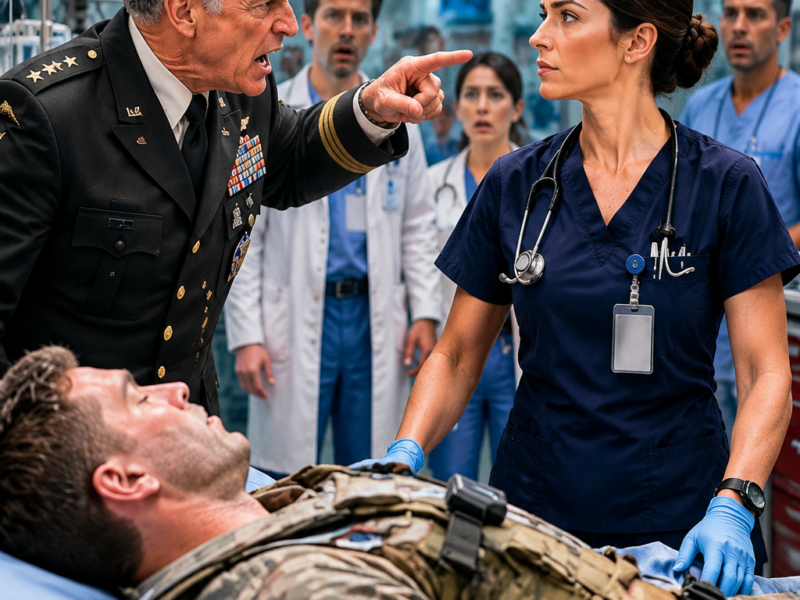
The first thing General Raymond Stall demanded when he entered the emergency wing of Brooke Army Medical Center was not an explanation. It was a surgeon.
His son was lying somewhere behind the double doors of Trauma Bay 3, fighting for his life, and the general had already decided that nobody in that hospital was going to waste another second telling him what could or could not be done. He had spent nearly four decades giving orders in places where hesitation could get men killed. He had commanded soldiers under artillery fire, watched aircraft disappear into hostile skies, and made decisions that would follow him for the rest of his life. But nothing in his military career had prepared him for the sight of his only son being wheeled into an emergency room with blood soaking through his uniform.
“Get me the best trauma surgeon in San Antonio,” he demanded, his voice echoing against the gray hospital walls. “I want Dr. Okafor. Right now.”
The nurse standing near the reception desk looked up from her computer. She seemed accustomed to dealing with frightened families, angry officers, and people who believed that the volume of their voices could somehow change the outcome of a medical emergency. She remained professional.
“Dr. Okafor is currently in surgery, sir.”
“Then get him out.”
“I’m afraid that’s not possible. He’s performing an emergency procedure on another patient.”
General Stall tightened his jaw. “My son is a captain in the United States Army. He’s special forces. He was brought here by military medical transport. I don’t care what procedure Dr. Okafor is performing. I want him in Trauma Bay 3.”
Before the nurse could respond, another voice came from the hallway.
“Dr. Okafor won’t be available for at least another hour. If you need someone to take care of your son right now, you’ll have to work with me.”
The general turned.
A woman in dark navy scrubs was walking toward them. She appeared to be in her mid-thirties, with dark hair pulled into a tight bun and an expression that was neither hurried nor particularly welcoming. Her boots made almost no sound against the hospital floor. She carried a tablet in one hand and was already pulling on a pair of gloves with the other.
General Stall looked at her uniform, then at her face.
“Who are you?”
“Daniela Cavalo. Chief Trauma Nurse Practitioner.”
“Where is the surgeon?”
“I’ve already told you. He’s operating.”
“Then get me the second surgeon.”
She stopped beside the trauma bay doors.
“That would be me.”
For a moment, the general appeared unable to process what she had said.
“You?”
“Yes, sir.”
“You’re telling me you’re the second-in-command?”
“I’m telling you that I’m responsible for this trauma team until Dr. Okafor arrives. Your son is inside, and from the preliminary report, he needs immediate attention. I suggest we spend the next few minutes doing something useful.”
General Stall stared at her as though she had personally insulted him.
“She’s a nurse,” he said, turning toward his aides. “I asked for a surgeon.”
The woman did not argue. She simply pushed open the doors.
“Then you can keep asking for one while I work on keeping your son alive.”
Inside the trauma bay, the atmosphere was already tense. Two residents stood beside the gurney, a respiratory therapist adjusted the oxygen equipment, and a young nurse was attempting to establish another intravenous line. A monitor displayed a collection of increasingly alarming numbers.
Captain Elliot Stall, twenty-nine years old, lay motionless beneath a thin hospital sheet.
His face had turned an unnatural shade of gray. Blood covered the left side of his uniform, and his breathing came in short, uneven movements that looked more like desperate attempts to draw air than anything resembling normal respiration.
He had been injured during a training exercise at Fort Cavazos. According to the preliminary report, a breaching charge had detonated approximately six feet outside the designated perimeter. The blast had thrown him backward and sent fragments of debris into his chest. One piece had penetrated the left side of his torso, and the concussive force had apparently caused additional internal injuries.
He had been conscious when the first responders reached him. By the time the helicopter arrived, he had begun losing consciousness.
Now his father was standing in the doorway, watching a woman he had never met approach his son.
“Move,” Daniela said to one of the residents. “I need access to his left side.”
She placed two fingers against Elliot’s neck, checked his pulse, and listened to his chest.
Three seconds passed.
Then her expression changed.
“His breath sounds are absent on the left. He’s developing a tension pneumothorax. His blood pressure?”
“Eighties over sixties,” the resident answered.
“Falling?”
“Yes.”
“Get me a fourteen-gauge catheter. Now.”
General Stall stepped closer.
“What is she doing?”
Nobody answered him.
Daniela continued her assessment, her eyes moving between the patient, the monitor, and the equipment surrounding the bed.
“He’s losing the ability to expand his left lung. The pressure is building inside his chest. If we don’t relieve it, his heart will begin shifting, his circulation will collapse, and we will lose him.”
The general looked at the resident.
“Why isn’t a doctor doing this?”
Daniela finally looked up.
“Because I’m the person standing here who knows what needs to happen.”
“You’re a nurse.”
Her expression remained controlled, but something in her voice became colder.
“Sir, I need you to understand something. Your son doesn’t have the luxury of waiting for your preferred job title to arrive. I need you to take three steps backward and let me work.”
The general opened his mouth, but before he could speak, Daniela had taken the catheter from the nurse.
She located the appropriate space between Elliot’s ribs, steadied her hand, and inserted the needle.
There was a sharp mechanical movement.
Then came a sudden, unmistakable rush of escaping air.
For one brief second, the entire room seemed to stop.
The monitor continued its rhythmic beeping. The respiratory therapist looked up. One of the residents exhaled as though he had been holding his breath.
Daniela immediately reassessed Elliot.
“Good. His chest is decompressing. Keep the oxygen flowing. I want another set of vitals in thirty seconds.”
General Stall did not move.
He was staring at her hands.
Something about the way she had performed the procedure unsettled him. It wasn’t merely her confidence or her technical ability. It was the complete absence of hesitation, the economy of her movements, and the strange stillness in her eyes.
He had seen that before.
Not in a hospital.
Not under clean fluorescent lights with equipment neatly arranged on metal carts.
He had seen it nine years earlier in Afghanistan, in a place where the medical tent smelled of dust, blood, and burning electrical cables.
And suddenly, the memory returned with such force that it seemed to knock the air from his lungs.
Kandahar.
A forward operating base on a Tuesday morning in March.
Indirect fire had struck the base shortly after sunrise. The first explosion had damaged a communications building, while a second had hit close to the vehicle maintenance area. Within fifteen minutes, the medical facility was overwhelmed.
Soldiers were arriving faster than the available personnel could treat them. Some were walking wounded, others were unconscious, and several were bleeding heavily enough that the medics had begun running out of supplies.
The base surgeon had sustained shrapnel injuries to his right hand. He was conscious but unable to operate. Two junior medics were trying to manage more casualties than they had ever seen in their training.
Raymond Stall had been there.
At the time, he had been a colonel serving in a senior command position. He remembered the chaos, the dust floating through the air, and the sound of men shouting for help.
Then a young combat nurse had entered the medical tent.
Her name had been Daniela.
He remembered the name tape on her uniform. He remembered her dark hair and the seriousness of her expression. Most of all, he remembered how she had looked at the wounded soldiers and immediately begun organizing the room.
She did not ask who was in charge.
She did not wait for somebody to tell her what to do.
She assessed the situation, assigned tasks, and started treating the men who needed immediate intervention.
At one point, a young corporal had suffered a catastrophic injury to his femoral artery. Daniela had placed both hands against the wound and maintained pressure for twenty-two minutes while waiting for a surgical team to arrive from Bagram.
Twenty-two minutes.
Stall remembered checking the clock twice.
He remembered watching her arms tremble from exhaustion while she refused to release the pressure. He remembered a medic asking whether she needed someone to take over, and her answering that he should help the next patient instead.
By the end of that week, eleven soldiers who might otherwise have died were alive because of her decisions.
Stall had shaken her hand before she rotated out.
He remembered telling her that the Army needed people like her.
He had also remembered thinking she looked far too young to have witnessed so much suffering.
But there was another memory, one he had spent years avoiding.
Eight months after returning home, he had received a medical review report concerning Nurse Daniela Cavalo.
The document alleged that she had exceeded her authorized scope of practice during the Kandahar mass-casualty incident. It mentioned the administration of blood products without direct physician authorization, an emergency needle thoracostomy, and several other decisions that should supposedly have been made by a medical officer.
The report had been presented as a procedural matter.
There were forms, recommendations, and official language describing professional boundaries and command responsibility.
Stall had been busy at the time. He was deeply involved in a political appointment process and had several important decisions waiting on his desk. The medical review had arrived through his staff with a summary attached.
He had not read the full investigation.
He had trusted the people who prepared it.
And he had endorsed the recommendation.
The review board had technically cleared Daniela of misconduct, but the endorsement had effectively closed the doors to several military medical career paths. Six months later, she had resigned her commission.
He had never followed up.
He had never asked what happened to her.
He had never even wondered whether the woman who had saved eleven soldiers had eventually found somewhere else to practice medicine.
Until now.
“You’re the nurse from Kandahar,” he whispered.
Daniela glanced at him.
Recognition moved across her face, but only briefly.
“General, I need you to keep your voice down.”
“Daniela Cavalo.”
“Your son’s oxygen level is improving, but he isn’t stable yet.”
“You’re the one who—”
“General.”
She held his gaze.
“I’m the nurse practitioner keeping your son from going into cardiac arrest. I need fifteen more minutes of your trust. Can you give me that?”
The general could not find an answer.
For the first time in years, he had no command to issue and no authority that could make the situation easier.
He nodded.
Daniela turned back toward the patient.
What Stall did not know was that she had recognized his name before entering the trauma bay.
She had read the intake information in the hallway approximately twenty minutes earlier. The moment she saw General Raymond Stall listed as the patient’s father, the past had come rushing back.
She had stood outside the doors for thirty seconds, breathing slowly and forcing herself to separate the man from the patient.
She had considered asking another provider to take over.
Then she had looked at the preliminary medical report.
Elliot Stall was twenty-nine. Special forces. Severe penetrating chest trauma. Hemodynamic instability.
Whatever had happened nine years earlier, the young man lying behind those doors had done nothing to deserve being caught in the middle of it.
He was a patient.
That was the only calculation that mattered.
The monitor suddenly emitted a sharper alarm.
“His pressure is dropping!” the resident shouted.
Daniela turned immediately.
“Read it.”
“Seventy-four over fifty. Still falling.”
She moved to Elliot’s left side and examined the chest again.
“He’s developing a hemothorax.”
The resident looked confused.
“Already?”
“He’s bleeding into the chest cavity. Get the ultrasound.”
A nurse handed her the portable probe. Daniela placed it against Elliot’s chest and watched the image appear on the small screen.
Gray shapes shifted beneath the surface. She adjusted the angle, examined the view, and held the probe steady.
Two seconds later, she knew.
“There it is. Significant fluid.”
“How much?” the resident asked.
“Enough to explain the deterioration. We need a chest tube immediately.”
The resident hesitated.
“Should we wait for Dr. Okafor?”
“No.”
“Who authorizes the procedure?”
Daniela held out her hand.
“The standing orders for hemodynamically unstable penetrating chest trauma authorize it. Get the thoracostomy kit. Now.”
The general stepped closer again.
“What’s happening?”
Daniela did not look away from the patient.
“He’s bleeding inside his chest. Blood is collecting around the lung and preventing it from expanding. I need to drain it.”
“Is he going to die?”
It was the first time Stall had asked a question without sounding like a general.
Daniela looked at him.
“He’s in serious condition. But he is still fighting. We are going to give him every chance we can.”
The chest tube kit arrived.
Daniela prepared the area while another nurse administered the necessary medication and monitored the patient’s condition. She made the incision, carefully worked through the layers of tissue, and advanced the tube into the chest cavity.
Her movements were deliberate and precise.
There was no dramatic announcement, no unnecessary explanation, and no visible attempt to impress anyone.
She had done this before.
Not in a modern trauma bay, surrounded by specialists and sophisticated equipment, but in military medical tents where the lights flickered, the floor shook with distant explosions, and the nearest surgical team might be hours away.
The tube was positioned.
Almost immediately, dark blood began moving through the drainage system.
“Four hundred cubic centimeters already,” she reported.
One of the aides turned away at the sight of the collection chamber.
Daniela watched the tubing and the monitor.
“His lung is beginning to reexpand. Pressure?”
“Coming up. Eighty-eight over sixty.”
“Good. Keep watching it. Prepare the blood products. I want the blood bank on the line.”
She leaned closer to Elliot.
“Come on, Captain. Stay with me.”
For the next forty minutes, Daniela controlled the room.
She coordinated the blood transfusion, monitored Elliot’s respiratory response, and made sure the residents understood the sequence of events. She spoke with the blood bank, requested additional supplies, and contacted Dr. Okafor by phone to explain the patient’s condition.
At one point, the resident began to panic when another set of readings came back lower than expected.
Daniela noticed immediately.
“Look at me,” she said.
The young doctor turned.
“You’re watching the numbers, but you’re forgetting the patient. Tell me what you see.”
“He’s unstable.”
“Yes. And what are we doing about it?”
“We’re controlling the bleeding and supporting his circulation.”
“Exactly. So keep doing that. I need you thinking clearly, not imagining the worst possible outcome.”
The resident took a breath and returned to work.
General Stall watched the entire exchange.
He had seen officers perform under pressure. He had watched combat medics work in difficult conditions. He understood discipline, courage, and the importance of keeping people focused when everything around them seemed to be falling apart.
But Daniela’s authority was different.
She did not need to raise her voice.
She did not need to remind anyone of her position.
People listened because they understood that she knew what she was doing.
When Dr. Okafor finally arrived, he entered the room already pulling on his surgical gown.
He examined Elliot’s condition, reviewed the ultrasound findings, and looked over the documentation Daniela had completed.
“How much blood has he lost?”
“Four hundred milliliters initially through the chest tube, with ongoing drainage. Two units of packed red blood cells are running. His pressure has improved, but he’s still unstable.”
“Source?”
“Likely left lower-lobe laceration, with possible intercostal vessel involvement.”
Okafor studied the monitor again.
Then he looked at Daniela.
“You know what you did here?”
It was not a question.
“I know what needed doing.”
He nodded.
“Good. I’ll take him from here.”
Daniela began handing over the case, explaining the procedures and the patient’s response. There was no defensiveness in her voice, no attempt to claim more credit than she deserved.
She simply provided the information the surgical team needed.
Okafor turned toward the general.
“Your son is going to surgery now.”
Stall looked at him.
“Is he going to survive?”
“He’s got a real chance. He has significant injuries, but the immediate problems have been addressed. Draining the chest and stabilizing his breathing bought us valuable time.”
The surgeon paused.
“Chief Cavalo kept him alive long enough for us to operate. You should thank her.”
The words seemed to strike Stall harder than anything else that had happened that day.
He looked toward Daniela.
She was already checking the intravenous lines and confirming that the surgical team had everything necessary.
“Let’s move,” Okafor ordered.
The gurney began rolling toward the operating room.
Stall followed for several steps, then stopped as the doors closed behind his son.
He stood in the hallway watching the place where Elliot had disappeared.
For the first time since the helicopter had landed, there was nothing he could do.
No decision to make.
No order to give.
No problem that could be solved by calling the right person.
His son was somewhere behind those doors, and the only thing left was to wait.
Eventually, he turned back toward Trauma Bay 3.
Daniela was at the sink, removing her gloves.
There was blood on the front of her scrubs. Her expression had returned to the same professional neutrality she had worn when she first entered the room.
The general approached her.
“How long did you know it was me?”
She dried her hands.
“Since I read the intake form. About twenty minutes before I came in.”
“You knew who I was before you treated him?”
“Yes.”
“And you treated him anyway.”
She looked at him as though the question was difficult to understand.
“Of course.”
“After what happened in Kandahar?”
“Your son is a patient, General. That isn’t a complicated calculation.”
He looked down.
There was something about her answer that made it impossible for him to defend himself.
She had not hesitated because of their history. She had not used his son’s emergency as an opportunity to settle an old grievance. She had not even mentioned the review board while Elliot was fighting to breathe.
She had simply done her job.
Stall walked toward the chairs along the wall and lowered himself into one of them.
His uniform was still perfectly arranged. The stars on his collar were polished, and the ribbons across his chest remained neatly aligned.
But he no longer felt like the man who had entered the hospital an hour earlier.
“I signed the endorsement,” he said.
Daniela leaned against the counter.
“I know.”
“Your review board file. I signed it.”
“I know that too.”
“I didn’t read the whole report.”
She said nothing.
“I was told that Major Prime died because decisions were made outside the authorized scope of practice. I was told the investigation had found serious procedural problems. My staff prepared a summary, and I endorsed it.”
Daniela folded her arms.
For several seconds, she studied him.
Then she spoke.
“Major Prime arrived with a sixty-four percent mortality probability, even with full surgical support. He had a traumatic brain injury and extensive internal bleeding. His condition was already critical when he reached us.”
Stall stared at her.
“The eleven enlisted soldiers who arrived with him had significantly better survival probabilities. Most had injuries that could be treated if we intervened quickly. Their combined chance of survival was somewhere between eighty and ninety percent with immediate care.”
She paused.
“I had limited blood products, one functioning surgical light, and two medics who were barely out of training. I had more patients than I had hands. There wasn’t enough time or equipment to save everyone.”
The general looked at the floor.
“What did you do?”
“I made a triage decision.”
“And you chose the eleven?”
“I chose the patients most likely to survive with the resources available.”
She spoke without anger.
That was what made the words so difficult to hear.
“I documented the decision. I followed the available triage guidance. I administered the treatments I was authorized to administer under the emergency conditions. And I did what I believed gave the greatest number of people a chance to live.”
She looked directly at him.
“Major Prime died. I am sorry he died. I was sorry that morning, and I’m sorry now. But I did not kill him by saving the others.”
Stall swallowed.
“His family was told there had been mistakes.”
“I know.”
“His daughter was seven years old.”
“I know that too.”
The general rubbed his hands together.
“I attended the memorial.”
Daniela nodded.
“I read about it afterward.”
The room became quiet.
For years, she had replayed that day in her mind. She remembered the medical tent, the wounded men, the dwindling supplies, and the impossible choices. She remembered Major Prime’s face when they brought him in. She remembered how one of the junior medics had asked whether they should stop treating the enlisted soldiers and concentrate on the officer.
She remembered saying no.
She had not forgotten the decision.
She had not forgotten the eleven men who survived.
And she had certainly not forgotten the consequences.
“I made the best decision I could with what I had,” she said. “And I would make it again.”
Stall raised his eyes.
“Even knowing what it cost you?”
“Especially knowing what it cost.”
She allowed a moment to pass.
“Because the men who survived mattered too. Their families mattered. Their children mattered. Their futures mattered. I couldn’t save everyone, General. But I could save the people who had a reasonable chance, and I wasn’t going to let them die because somebody thought an officer’s rank made his life more valuable.”
Stall sat motionless.
He remembered the eleven soldiers only as numbers in the original incident report. Eleven survivors. One officer deceased. An unfortunate casualty event.
The paperwork had reduced the entire tragedy to a collection of official statements and procedural questions.
He had never considered what those eleven men had gone on to do.
He had never considered that one might still be serving, another might have returned home to raise a family, and another might have lived long enough to become a father himself.
He had never considered that the young nurse who made the decision had been forced to leave the military because of a report he had endorsed without reading.
“I should have read the file,” he said.
“Yes.”
Her answer came immediately.
“You should have.”
There was no accusation in it.
There was no satisfaction.
Only a fact that neither of them could change.
The general looked toward the empty gurney.
“What happened to you after you left the Army?”
Daniela took a breath.
“I worked in civilian hospitals. It wasn’t easy at first. Some institutions were uncomfortable with my military background. Others were concerned about the review. It took time to find a place where people judged my work by what I could actually do.”
“Did you ever try to appeal?”
“Once.”
“What happened?”
“The paperwork went nowhere. The people who could have helped me had already accepted the original assessment. After a while, I stopped trying to convince an institution that had decided I was a problem.”
She glanced around the trauma bay.
“I found another way to practice. I trained further, completed my advanced clinical education, and eventually came here.”
Stall followed her gaze.
The equipment, the monitors, the clean white walls, and the carefully organized emergency supplies suddenly looked different to him.
She had rebuilt her career here.
She had taken the skills the Army had once relied upon and found a place where she could use them without asking for permission from people who had never understood what happened in Kandahar.
“The military system was closed to me,” she continued. “The VA system was difficult to navigate. Several military-affiliated hospitals wouldn’t consider my application for years. But I kept working.”
She looked at him.
“I didn’t have the luxury of spending the rest of my life being angry.”
Stall felt the words settle somewhere deep inside him.
He had spent his entire career believing that accountability was one of the foundations of command. Soldiers were expected to accept responsibility for their actions. Officers were expected to make decisions and stand behind them.
Yet here he was, confronted with the consequences of a decision he had made without understanding it.
He had demanded accountability from a young nurse while failing to exercise the most basic responsibility of his own position.
He had signed a document that affected a person’s entire future without reading the evidence.
And now that same person had saved his son.
“Do you hate me?” he asked.
Daniela considered the question.
“I don’t know you well enough to hate you.”
The general almost smiled, but the expression disappeared before it could fully form.
“That’s fair.”
“I know what you signed. I know what happened afterward. I also know that you didn’t personally write the report.”
“That doesn’t excuse it.”
“No. It doesn’t.”
She turned toward the counter and began organizing the remaining equipment.
“I lost a career I had worked for. I lost opportunities. I spent years wondering whether I should have chosen a different profession. But eventually, I understood that I couldn’t spend the rest of my life trying to get an apology from people who weren’t even sure what they had done.”
Stall looked at her.
“I am sorry.”
She stopped moving.
For the first time, the general’s voice sounded completely unguarded.
“I know those words don’t repair anything. They don’t give you back the years. They don’t undo what happened. But I am sorry, Daniela.”
She nodded slowly.
“Thank you.”
Then she returned to work.
There was no dramatic reconciliation. No sudden embrace. No declaration that the past had been forgiven.
There were simply two people standing in a hospital room, both aware that something irreversible had happened between them.
Four hours later, Elliot was out of surgery.
Dr. Okafor found General Stall in the waiting area and delivered the update personally.
The laceration in Elliot’s left lower lung had been repaired. The surgical team had addressed the bleeding, and his condition had stabilized. He would need intensive monitoring, a long recovery, and considerable rehabilitation, but his prognosis was good.
The words seemed almost unreal.
Your son is going to live.
Stall sat down and covered his face with both hands.
For several moments, he could not speak.
When he finally entered the intensive care unit, Elliot was lying beneath a thin white blanket. Tubes and monitoring leads surrounded him, and a bandage covered part of his chest.
His breathing was assisted, but the monitor displayed a steady rhythm.
The general pulled a chair close to the bed.
He took his son’s hand.
“You’re going to be all right, son.”
Elliot did not respond.
Stall sat there for nearly an hour, watching the rise and fall of his son’s chest.
He thought about the training exercise, the explosion, and the frantic phone call that had brought him to the hospital.
He thought about the moment Daniela had inserted the needle.
He thought about the blood filling the collection chamber.
And he thought about Kandahar.
Eleven men.
One officer.
One young nurse.
One report.
One signature.
For the first time in nine years, he allowed himself to examine the entire chain of events rather than the convenient version he had been given.
The truth was not complicated.
He had trusted a summary instead of reading the evidence. He had endorsed a recommendation without asking whether the investigation had been fair. He had allowed the institution to turn a difficult emergency decision into a convenient explanation for a death that nobody wanted to examine too closely.
And a woman had paid the price.
At approximately eleven that night, after checking on Elliot again, Stall found Daniela at the nurses’ station.
She was completing documentation.
Her posture suggested exhaustion, but her hands continued moving across the keyboard with the same steady precision he had observed earlier.
He approached quietly.
“Chief Cavalo.”
She looked up.
“General.”
“I made some calls while your surgeon was operating.”
She waited.
“I have a contact in the Army Surgeon General’s office. I also know the director of the Department of Defense credentialing board. I explained what happened today, and I asked them to review your old case.”
Daniela’s expression did not change.
Stall placed a business card on the desk.
“I’m not going to pretend that a phone call fixes what my endorsement did. It doesn’t. But I can make sure the right people look at the original file again. I can request a formal review. I can ask them to examine the circumstances in Kandahar, including the available resources, the triage decisions, and the medical documentation.”
She looked down at the card.
“If you want to return to military medicine, I will use whatever influence I still have to help you get a fair hearing.”
She did not immediately pick it up.
“Why?” she asked.
Stall looked at her.
“Because you saved my son.”
She waited.
“And because I took something from you that you had earned. I did it without even reading the full report.”
He paused.
“Those are two different debts, and I owe you on both of them.”
Daniela finally picked up the card.
She turned it over once, reading the contact information, then placed it beside her keyboard.
“I’ll think about it.”
“I understand.”
“I’m not sure I want to go back.”
Stall nodded.
“I wouldn’t expect you to.”
“I’ve built something here. I have a team. I have patients. I have a career that doesn’t depend on somebody in an office deciding whether I deserve to practice.”
“Then I won’t ask you to give that up.”
She studied him.
He continued.
“But if there’s something that needs to be corrected, something that could make the system better for the next person who finds themselves in a situation like yours, tell me. Whatever is within my reach, I’ll do it.”
For a moment, Daniela seemed to consider whether she believed him.
Then she said, “Get some sleep, General. Your son is going to need you functional tomorrow.”
He nodded.
He started toward the elevator, but stopped with one hand resting against the doorframe.
“There’s something else.”
She looked up.
“The men you saved that week in Kandahar.”
Daniela became still.
“I looked up their unit after I left the hospital.”
She said nothing.
“Four of them are still serving.”
Her eyes remained fixed on him.
“One of them made Sergeant Major last year.”
The general paused.
“I thought you should know the math on what you did.”
For several seconds, Daniela did not move.
She had not expected that.
She had never received a message from the Army telling her what had happened to those men. She had never received an official acknowledgment of their survival or any recognition that her decisions had made their futures possible.
The last time she had heard about Kandahar, it had been through the medical review board.
A report.
A recommendation.
A signature.
A career ending.
Now, after nine years, someone was finally telling her that the eleven men had not simply become numbers in an incident summary.
They had lived.
They had returned to their families.
They had continued serving.
One had risen to the highest enlisted leadership position in his unit.
Daniela opened her mouth, but no words came immediately.
Stall did not wait for an answer.
He walked out.
She remained seated at the nurses’ station long after he disappeared.
The hospital was quiet in the way hospitals become quiet late at night. It was never completely silent. Somewhere, a monitor continued beeping. A nurse spoke softly near the medication room. An ambulance arrived outside, its siren fading as the vehicle entered the emergency department.
Daniela thought about the medical tent in Kandahar.
She remembered the bad lighting, the dust, and the two frightened medics who had looked to her for instructions.
She remembered the eleven wounded soldiers.
She remembered Major Prime.
Most of all, she remembered the moment when she had realized there was no decision that would leave everyone alive.
She had been young, but she had understood the mathematics.
There were limited supplies. There was limited time. There were more people needing help than the medical team could possibly treat.
Someone had to make a decision.
She had made it.
For years, she had wondered whether the cost had been worth it.
Not because she believed the decision was wrong, but because the consequences had followed her into every new job, every interview, and every professional opportunity.
She had sometimes imagined what her life might have looked like if the review board had never existed.
Would she have remained in the Army? Would she have become a senior military medical officer? Would she have returned to Afghanistan or served in another theater? Would she have continued teaching young combat medics?
She would never know.
But she knew something else now.
Four of the men she had saved were still alive and serving.
One had become Sergeant Major.
The numbers were no longer abstract.
They were people.
Daniela looked at the business card beside her keyboard.
For a long time, she did nothing.
Then she picked up her pen and returned to her documentation.
There would be another shift in the morning. There would be another emergency, another patient, another family waiting for news that might change their lives forever.
She had learned long ago that the world did not stop simply because one person needed time to think.
Three weeks passed.
Elliot remained in the hospital for several days before being transferred to a rehabilitation unit. His recovery was expected to be long, but the surgical team was optimistic. His father visited every day, sometimes staying for hours, sometimes sitting quietly beside the bed without saying anything.
On the third day after surgery, Elliot finally woke enough to have a conversation.
His voice was weak, and he struggled to understand what had happened.
“How bad was it?” he asked.
Stall looked at him.
“Bad enough.”
Elliot tried to shift, then grimaced.
“Did I lose a lung?”
“No. They repaired the damage.”
“Who?”
“Dr. Okafor performed the surgery.”
Elliot nodded slightly.
“Okay.”
His father hesitated.
“But there was someone else.”
Elliot looked at him.
“A nurse practitioner named Daniela Cavalo. She was the one who treated you when you arrived. She decompressed your chest, placed the chest tube, stabilized you, and kept you alive until the surgeon could operate.”
Elliot’s eyes moved toward his father.
“She saved me?”
“Yes.”
Stall paused.
“She did.”
For a moment, neither spoke.
Then Elliot asked, “Did you thank her?”
The question caught the general off guard.
He looked toward the window.
“Not properly.”
“Then you should.”
Stall gave a small nod.
“I intend to.”
He did not tell his son the entire story immediately. Elliot was still recovering, and there would be time for the rest later. But he began to understand something important about the woman who had saved him.
She had not merely been a medical professional doing her job.
She had been someone who had once saved soldiers under his command, someone whose career he had helped destroy through his own negligence.
And she had still chosen to save his son.
The letter arrived at the hospital’s administrative office three weeks after the incident.
It carried the official Department of Defense seal.
Daniela recognized the envelope immediately.
She had seen enough government correspondence during her military years to know the difference between an ordinary administrative notice and something that had passed through multiple levels of review.
She opened it during a quiet moment between cases.
Inside was a formal acknowledgment from the Army Surgeon General’s office. The letter confirmed that her former medical review had been referred for further examination. It requested that she contact the appropriate credentialing office to discuss her eligibility for reinstatement and the possibility of reviewing the circumstances surrounding her departure from military service.
It was not an apology.
It was not a declaration that the original decision had been wrong.
It did not erase the nine years that had passed.
But it was the first official indication that somebody was finally willing to look at the case again.
Daniela read the letter twice.
Then she placed it on her desk.
For several minutes, she simply stared at it.
A colleague passing by noticed the envelope.
“Everything okay?”
Daniela folded the letter carefully.
“Yes.”
“Good news?”
She considered the question.
“Maybe.”
She placed the document inside a folder she kept for things she was not ready to decide.
Then she returned to her work.
The next few weeks were busy. Elliot continued his recovery, and his father made several visits to the trauma department. The general never again demanded that a surgeon be brought in simply because of his rank. When he encountered Daniela, he greeted her respectfully, asked how the department was doing, and occasionally checked whether she had received any updates from the credentialing office.
He did not pressure her.
He understood that the decision belonged to her.
One afternoon, he found her reviewing a patient’s chart.
“I spoke with the office again,” he said.
Daniela looked up.
“About the review?”
“Yes. They’ve received the original documentation from Kandahar. The request is moving forward.”
“Thank you.”
“They want to speak with you directly. They’re asking for a statement about the incident.”
“I expected that.”
“They also asked whether you would consider returning to military medicine if the review clears your record.”
She leaned back slightly.
“I haven’t decided.”
“That’s all right.”
The general looked around the room.
“Your team seems to respect you.”
“They do.”
“You’ve built a good department.”
“We have.”
He nodded.
“Whatever you decide, I hope you know that your work here matters.”
Daniela looked at him for a moment.
“General, I never needed someone to tell me I was good at my job.”
“I know.”
“What I needed was for somebody to read the evidence before deciding what kind of person I was.”
He lowered his eyes.
“I understand that now.”
She returned to the chart.
There was nothing else to say.
Several days later, Elliot was discharged from the hospital.
His father helped him into a wheelchair and accompanied him through the main entrance. He was still weak, and the road ahead would involve months of recovery, physical therapy, and follow-up appointments.
But he was alive.
At the entrance, he stopped and looked back toward the emergency department.
“Is she working today?”
Stall followed his gaze.
“Who?”
“Daniela. The nurse who treated me.”
“I believe she’s on duty.”
Elliot nodded.
“I want to thank her.”
His father hesitated.
“You’re not supposed to be walking around yet.”
“I’m in a wheelchair, Dad.”
Stall almost laughed.
They went inside.
Daniela was standing near the trauma desk, discussing a patient’s transfer with another member of the team. When she noticed them, she excused herself and approached.
“Captain Stall. You’re looking better.”
“Feeling better too.”
“That’s good. Keep following the rehabilitation plan. Don’t try to prove anything by doing too much too quickly.”
Elliot smiled weakly.
“Yes, ma’am.”
He held out his hand.
“I wanted to thank you.”
Daniela took it.
“You don’t need to thank me.”
“I think I do.”
He looked at her seriously.
“My dad told me what happened. He said you kept me alive until the surgeon arrived.”
She glanced briefly at the general.
“Your body did a lot of the work. We just helped it along.”
“That’s not what I heard.”
A faint smile appeared on her face.
“Your father has a habit of making things sound more dramatic than they are.”
For the first time in weeks, the general laughed.
Elliot continued.
“I don’t remember much from that day. Just the explosion, the helicopter, and waking up here. But I know I wouldn’t be going home without you.”
Daniela squeezed his hand once.
“Then make sure you take the recovery seriously. That’s the best way to repay everyone who worked on you.”
“I will.”
As the father and son prepared to leave, Stall turned back.
“Chief Cavalo.”
She looked at him.
“Thank you.”
This time, the words carried no rank, no authority, and no expectation that she would respond in a particular way.
Daniela nodded.
“Take care of him.”
“I will.”
They left together.
Daniela watched them disappear through the entrance doors before turning back toward the trauma department.
For years, she had believed that her story with the Army had ended in a review board office, beneath a stack of paperwork she had been unable to challenge.
She had believed that the institution had made its decision, that the people responsible had moved on, and that nothing she did would ever change the official version of what happened in Kandahar.
But something had changed.
Not because General Stall had suddenly become a different man, and not because one phone call could repair nine years of professional damage.
It had changed because the original record was finally being examined.
And because the man who had signed the endorsement was now willing to admit that he had been wrong.
That mattered.
Not enough to erase the past.
But enough to make the future look different.
A month later, Daniela received another letter.
This one contained a formal appointment for an interview with the credentialing review panel. The panel intended to examine her medical documentation from Kandahar, the circumstances surrounding the mass-casualty event, and the decisions made under the emergency conditions.
She placed the letter beside the first one.
Then she opened the folder.
Inside were documents she had kept for years. Copies of her original deployment records, medical certifications, training evaluations, and the correspondence surrounding her resignation.
She had not looked at most of them in a long time.
As she turned the pages, memories returned.
She remembered the young corporal whose artery she had held shut for twenty-two minutes.
She remembered the eleven soldiers.
She remembered Major Prime.
And she remembered the review board.
For the first time, however, she did not feel the same weight in her chest.
She no longer needed to prove to herself that she had made the right decision.
She knew what had happened.
She knew what resources had been available.
She knew what the survival probabilities had been.
And she knew that if the same situation occurred again, she would make the same triage decision.
What she wanted now was not revenge.
She wanted the record corrected.
She wanted the next combat nurse who faced an impossible decision to know that doing the right thing under extraordinary circumstances would not automatically turn them into a convenient target when the paperwork reached headquarters.
She wanted the people who wrote policies to understand that emergencies did not always unfold according to the clean diagrams in training manuals.
Sometimes the surgeon was injured.
Sometimes the lights failed.
Sometimes the medical supplies ran out.
Sometimes eleven people needed help at the exact moment one person needed more than the entire team could give.
And sometimes the person forced to make that decision was a young nurse with two frightened medics standing beside her.
Daniela closed the folder.
She placed the two letters on top of the documents and looked at them for a long moment.
Then she put everything away.
The next morning, she arrived at work before sunrise.
The hospital was still quiet. The emergency department had not yet reached the intensity of the daytime shift, and the fluorescent lights cast a pale glow across the empty corridor.
She entered the trauma bay, checked the equipment, reviewed the supplies, and spoke with the night-shift nurse about the patients who remained under observation.
A new resident arrived shortly afterward.
He was young, perhaps twenty-six, and looked nervous as he reviewed the patient assignments.
Daniela noticed him studying the emergency procedure board.
“First week?” she asked.
“Yes, ma’am.”
“How are you feeling?”
“Honestly?”
“That’s usually the most useful answer.”
He smiled awkwardly.
“Overwhelmed.”
She nodded.
“That’s normal. Just remember that you don’t have to know everything immediately. You do have to pay attention, ask questions, and recognize when someone needs help.”
He looked relieved.
“Yes, ma’am.”
Daniela pointed toward the trauma equipment.
“Come on. I’ll show you where everything is.”
As they walked through the room, she explained the procedures, the protocols, and the importance of preparation.
She did not tell him about Kandahar.
She did not tell him about the review board.
She did not tell him that the general who had once signed away her military career had recently helped reopen her file.
There would be time for those stories if they ever became relevant.
For now, there was a young doctor who needed to learn how to work under pressure, and there was a department that needed to be ready for whatever came through the doors.
Daniela had learned something over the years.
A person’s career could be interrupted. Their reputation could be questioned. Their future could be redirected by decisions made in offices far away from the places where the real work happened.
But the ability to care for another human being did not disappear because somebody signed a form.
It remained in the hands.
In the judgment.
In the willingness to step forward when everyone else was waiting for someone else to act.
At 8:17 that morning, the emergency department received another trauma alert.
A vehicle collision on the highway.
Multiple injuries.
One patient critical.
Daniela looked toward the entrance as the team began preparing the room.
“All right,” she said calmly. “Let’s get ready.”
The doors opened.
And once again, she moved toward the emergency without hesitation.
Somewhere in the administrative offices of the Department of Defense, her old case was waiting to be reviewed. Somewhere, a panel of officers and medical professionals would eventually examine the documents, reconstruct the events in Kandahar, and decide what should have happened nine years earlier.
Daniela would attend the interview when the time came.
She would bring her records.
She would explain her decisions.
She would answer every question.
But she would not wait for their approval before continuing to do the work she had spent her life learning how to do.
Because the truth was that she had never stopped being the person who entered that medical tent in Kandahar.
She had never stopped being the young nurse who placed both hands against a wounded corporal’s artery and refused to let go.
She had never stopped being the woman who understood that sometimes the difference between life and death was a decision made in a handful of seconds.
And she had never stopped believing that every life mattered, regardless of rank, title, uniform, or the number of stars displayed on someone’s collar.
General Raymond Stall had spent four decades believing that leadership meant having the authority to make difficult decisions.
Now he understood something he should have learned much earlier.
Authority did not make a decision right.
Rank did not make a person infallible.
And signing a document without understanding the truth behind it could destroy a life just as surely as an order given on a battlefield.
His son was alive because a woman he had once failed to protect had refused to let their history interfere with her duty.
Four soldiers were still alive because she had made an impossible decision in Kandahar.
One of them had become Sergeant Major.
And perhaps, somewhere in the years ahead, another young military nurse would face a situation in which there were too many wounded soldiers, too little time, and no perfect answer.
If that happened, Daniela wanted that nurse to know something she had learned the hardest possible way.
Doing the right thing would not always make people happy.
Sometimes it would cost you recognition.
Sometimes it would cost you opportunities.
Sometimes it would cost you the career you had spent years building.
But the lives you saved would still matter.
The people who returned home would still matter.
The children who grew up because their parents survived would still matter.
And no official report, no careless signature, and no judgment made by someone who had never stood in your position could change that truth.
Late that evening, after the emergency department had settled into another uncertain night, Daniela returned to her office.
She opened the drawer and took out the folder containing the two letters from the Department of Defense.
She read the first one again, then the second.
She considered the possibility of returning to military medicine. She imagined what it might mean to work with the next generation of combat medics, to help improve emergency protocols, and to ensure that the lessons of Kandahar were not lost beneath another stack of paperwork.
Then she thought about the hospital she had built her life around.
The colleagues who trusted her.
The patients who came through the doors.
The young professionals who looked to her for guidance.
She did not know which future she would choose.
And for the first time in nine years, she did not feel that she had to decide immediately.
She placed the letters back in the folder and closed the drawer.
Outside her office, a monitor began sounding an alert.
Daniela stood.
She straightened her dark navy scrubs, checked the identification badge clipped to her pocket, and walked toward the trauma bay.
There was another patient.
Another family waiting.
Another life that needed someone to care enough to act.
And Daniela Cavalo was exactly where she needed to be.









