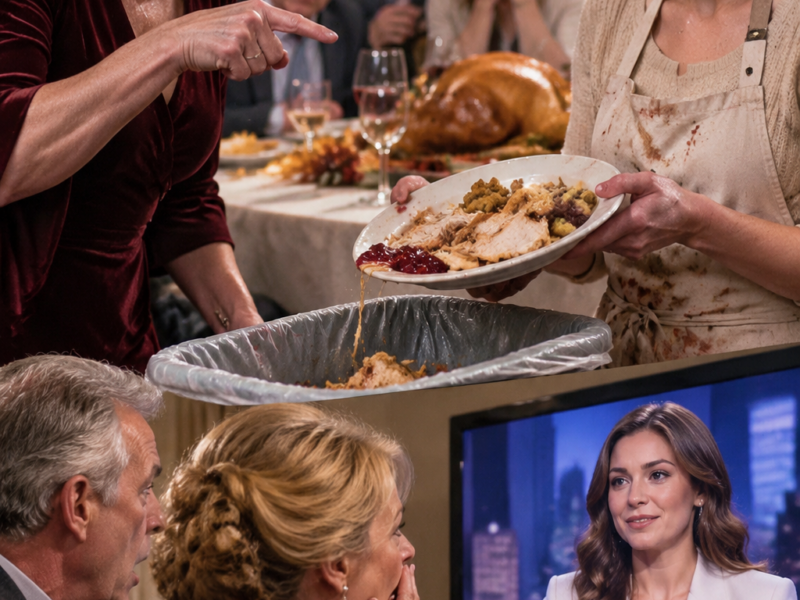
“Eat the Leftovers!” My MIL Humiliated Me at Thanksgiving. Two Days Later, She Saw Me on TV
“Eat the Leftovers!” My MIL Humiliated Me at Thanksgiving. Two Days Later, She Saw Me on TV
“Important people eat here. You get the leftovers.”
My mother-in-law pointed toward the kitchen as she said those words, her expression perfectly calm, as though she were simply assigning seats at an ordinary family gathering. I stood there holding a bowl of mashed potatoes, staring at her while fourteen people sat around the beautifully decorated dining room table.
For eight years, I had prepared Thanksgiving dinner for her family. Eight years of shopping, cooking, cleaning, planning, and making sure everyone had enough to eat. And now, apparently, I wasn’t important enough to sit with them.
“Excuse me, Dorothy?” I asked, hoping I had misunderstood.
“You can eat in the kitchen, Evelyn. Somebody needs to keep an eye on things.”
I looked around the room. My husband, Richard, sat near the head of the table. His younger sister, Melissa, was helping her two boys settle into their chairs. Beside Dorothy sat Helen and George Whitman, a retired couple from her church who had been invited as special guests.
Nobody said anything.
Well, almost nobody.
“There’s room if we move another chair,” my father-in-law, Frank, offered quietly.
Dorothy immediately waved him off.
“Frank, please. Not now.”
I turned toward Richard.
“Are you hearing this?”
He glanced at his mother, then back at me. He picked up his napkin and unfolded it.
“Just go along with it, Evelyn. It’s one meal.”
One meal.
Those two words stayed in my mind.
One meal, according to my husband, was apparently a reasonable price for six hours of cooking, not to mention the days of shopping, preparation, and cleaning that had gone into making his mother’s Thanksgiving celebration possible.
I could have argued. I could have reminded everyone that the turkey in the oven had been purchased with my money, that the stuffing was made from my mother’s recipe, and that I had spent the entire morning preparing the food while Dorothy entertained her guests.
But I didn’t.
Instead, something inside me became strangely quiet.
My name is Evelyn Parker. I was forty-seven years old that Thanksgiving, and Richard and I had been married for nineteen years.
We lived in Westerville, Ohio, in a comfortable three-bedroom house with a mortgage, a garage full of things we rarely used, and a guest bedroom that mostly collected laundry.
I worked as an administrator at a medical office outside Columbus. Richard supervised insurance claims. We had no children, something we had made peace with years earlier, although certain members of his family apparently never had.
For eight consecutive years, I had cooked Thanksgiving dinner at Dorothy’s house.
The first year, she had asked me to bring stuffing. The second year, she complimented my turkey and said it was better than hers. By the fourth year, I was preparing nearly the entire meal. By the eighth, even the cranberry sauce had somehow become my responsibility.
I never minded cooking.
My mother had taught me how to roast a turkey when I was sixteen. She believed in plenty of butter, fresh herbs, and never trusting a recipe that described six different ingredients as optional.
After she died, I kept her handwritten gravy recipe in a plastic sleeve. Making Thanksgiving dinner had become one of the few traditions that still made me feel close to her.
For a long time, I thought I was doing something meaningful for the family.
I didn’t notice how my kindness had gradually become an obligation.
That particular Thanksgiving morning, I arrived at Dorothy’s house shortly before seven.
Richard carried in two bags of groceries, which he seemed to consider his annual contribution to the entire holiday. Once the bags were inside, he settled onto the sofa to watch football.
I spent the next several hours moving between the kitchen and dining room.
The twenty-pound turkey needed attention. The potatoes had to be peeled. The green beans needed trimming. The stuffing was still missing a few ingredients, and Dorothy wanted the dining room decorations rearranged because she thought the candles looked uneven.
Around eleven, Richard wandered into the kitchen.
“How much did all this cost?” he asked.
“More than last year.”
“Everything costs more.”
“That’s generally what inflation means, Richard.”
He didn’t smile.
“Just send me the Kroger receipts. I’ll put them with the household expenses.”
He had been asking for those receipts for years. I assumed he was simply keeping track of our holiday spending, so I told him they were in my purse.
Around noon, Helen and George Whitman arrived.
They were generous supporters of Dorothy’s church holiday outreach committee, which she chaired. Dorothy had spent the entire previous week reminding everyone how important their visit was.
When Helen complimented the wonderful smell coming from the kitchen, Dorothy smiled proudly.
“I’ve been up since four this morning. Thanksgiving doesn’t prepare itself.”
I was standing directly behind her with a tray of green beans.
For a moment, I considered correcting her.
Richard caught my eye and gave me a small shake of his head.
So I said nothing.
It wasn’t the first time Dorothy had taken credit for something I had done. I had learned that challenging her usually resulted in an uncomfortable conversation, followed by Richard asking me why I couldn’t simply let things go.
I told myself it wasn’t worth ruining the holiday.
Then came the moment at the dining room table.
And suddenly, I realized how many holidays I had already ruined for myself by keeping everyone else comfortable.
I carried the mashed potatoes back into the kitchen.
I removed my apron, folded it neatly, and placed it beside the stove.
Then I picked up the covered roasting pan.
The turkey was still whole. Frank had planned to carve it at the table.
Dorothy appeared in the kitchen doorway.
“What are you doing?”
“Taking my turkey.”
She stared at me.
“You can’t take Thanksgiving dinner.”
“You’re right. I’m only taking the turkey.”
“Evelyn!”
I glanced toward the oven.
“You’ve got that ham you made yesterday. Nobody’s going hungry.”
Richard appeared behind her.
“You’re embarrassing me.”
I looked directly at him.
“I know. It’s an uncomfortable feeling.”
For once, he had nothing to say.
I carried the roasting pan outside, secured it inside the insulated carrier I had brought, and placed it carefully in the back of my Honda CR-V.
Getting a twenty-pound turkey into the car without spilling anything was probably the most physically demanding act of rebellion I had ever attempted.
But I managed it.
Then I got behind the steering wheel and drove away.
At the first long traffic light, I started crying.
Not because Dorothy had insulted me. I had heard worse from her over the years.
I cried because Richard hadn’t even hesitated.
He had looked at his mother, looked at his wife, and decided that protecting his mother’s comfort was more important than protecting my dignity.
My phone rang twice before a text message appeared.
“Mom has guests. You made everything awkward.”
I turned the phone face down.
Halfway home, I passed the community center on the edge of town. A large sign outside announced that a Thanksgiving community meal was being served, and everyone was welcome.
I had donated canned food there before.
I pulled into the parking lot, took out my phone, and called the number printed on the sign.
A woman named Ruth Bennett answered.
I explained that I had a freshly roasted turkey, still properly covered and warm, and asked whether they could use it.
She asked several questions about how it had been prepared, how long it had been out of refrigeration, and how I had transported it.
After confirming that the turkey could be accepted under their food-handling procedures, she said something that nearly made me cry again.
“Bring it over. We’re still serving.”
Twenty minutes later, Ruth helped me carry the turkey into their commercial kitchen.
She was sixty-eight, with short silver hair and the cheerful efficiency of someone who had spent a lifetime helping other people.
“Do you cook?” she asked, looking at the enormous roasting pan.
I laughed.
“Apparently, that’s my entire personality.”
She laughed with me.
“Well, we could use another pair of hands.”
She handed me an apron.
I almost refused it. After the morning I had experienced, the thought of putting on another apron was exhausting.
But then I looked around.
There were volunteers preparing plates, washing dishes, arranging food, and helping elderly visitors find seats.
Nobody was ordering me around.
Nobody was taking credit for my work.
And when I finished helping carve the turkey, Ruth placed a plate in front of me.
“Sit down, Evelyn. You need to eat too.”
I sat.
The food was warm. The room was noisy. An older woman beside me told an extremely detailed story about her grandson’s new puppy.
For the first time that day, I relaxed.
A few minutes later, two people entered carrying television equipment.
Ruth leaned toward me.
“Local news. They’re doing a holiday volunteer story.”
I nodded, assuming they had nothing to do with me.
A little while later, Ruth returned.
“The reporter wants to talk to the woman who brought the turkey. Would you mind?”
My first instinct was to say no.
Then I remembered Richard’s message.
You made everything awkward.
I looked at Ruth.
“Sure. Why not?”
The reporter was a young woman named Kelly. She wore a winter coat over a bright red sweater and introduced herself with a friendly smile.
She asked my name and wanted to know why I had brought a Thanksgiving turkey to the community center.
I could have told her everything.
I could have described Dorothy pointing toward the kitchen while my husband sat silently at the dining table.
But there were people eating around us, and I didn’t want their holiday meal to become a story about my miserable afternoon.
So I simply said, “I had a turkey and nowhere I particularly wanted to serve it anymore.”
Kelly laughed.
“Well, it certainly found a good home.”
I smiled.
“My mother always said food tastes better when everybody feels welcome.”
She asked one more question about volunteering, thanked me, and moved on.
That was it.
No dramatic confession. No tearful interview. No public accusation.
Just a few ordinary words spoken in a community kitchen.
I spent another hour helping Ruth and the other volunteers clean up.
An older widow named Margaret sat beside me while we ate. She told me that her children lived in Arizona and North Carolina.
“They call,” she said. “They’re good kids.”
She looked down at her plate.
“But a phone isn’t much company at the dinner table.”
I understood her better than I expected to.
When I finally arrived home, Richard wasn’t there.
The house felt strangely empty.
I put my purse on the counter, took off my shoes, and sat in the living room without turning on the television.
Usually, after Thanksgiving, I was exhausted from cooking and cleaning.
That evening, I was exhausted from something I couldn’t quite name.
Richard arrived shortly after nine.
He dropped his keys onto the counter.
“Mom had to serve ham.”
“Was it edible?”
He ignored the question.
“Do you know how embarrassing that was?”
“The Whitmans were there. I remember.”
“Mom had to explain why you walked out.”
“Did she explain why?”
Richard rubbed his forehead.
“Evelyn, you’re making a big deal out of one stupid comment.”
“She told me I wasn’t important enough to eat at her table.”
“That’s not what she meant.”
“Then what did she mean?”
He didn’t answer.
I waited.
Finally, he said the familiar words.
“You know how Mom is.”
Yes.
I knew exactly how his mother was.
And I knew exactly how my husband was when she behaved that way.
There had been a time when those words might have ended the conversation. This time, they didn’t.
I went upstairs, collected my pajamas and a few things from the bathroom, and moved into the guest bedroom.
Richard watched me from the hallway.
“What are you doing now?”
“I’d like some space.”
“You’re sleeping in there over Thanksgiving?”
“No, Richard. I’m sleeping in there because I don’t want to sleep next to you tonight.”
He stared at me as though I had spoken another language.
I closed the door.
I didn’t sleep particularly well.
I kept remembering the early years of our marriage, when Richard would rub my shoulders while I washed dishes or bring me coffee without asking.
He hadn’t always been the man who shrugged at the dinner table.
At least, I didn’t think he had.
Friday was quiet.
We moved around each other carefully, discussing the thermostat, the mail, and ordinary household matters. Neither of us mentioned what had happened.
Then, on Saturday evening, my coworker Linda sent me a message.
“Evelyn, you’re on Channel 6!”
She included a link.
I opened it.
There I was, wearing Ruth’s apron and holding a serving spoon. The segment was about local volunteers providing Thanksgiving meals to people in the community.
My contribution lasted less than twenty seconds.
My hair was coming loose, I looked tired, and my glasses had slipped down my nose.
Naturally, it was the first television appearance of my life.
I showed Richard.
He watched without smiling.
“Did you tell them about Mom?”
“No.”
“Are you sure?”
“You can hear every word I said.”
He seemed relieved.
Then he asked something that made me look at him more carefully.
“Did anybody mention Mom’s holiday fund?”
I frowned.
“Why would they?”
“Just asking.”
He walked away.
That was the first thing that bothered me.
The second came about ten minutes later when my phone rang.
Dorothy.
I answered.
“Hello.”
“Why are you on the news?”
I moved the phone slightly away from my ear.
“Apparently, they were short on celebrities.”
“Don’t be smart with me. Why did you take that turkey to Ruth Bennett’s program?”
“Because they were feeding people.”
“Did you tell them where it came from?”
“Kroger, mostly.”
“Evelyn.”
“What?”
“Did you tell anyone about our Thanksgiving dinner?”
“No.”
“Did anybody ask you about the church fund?”
I sat up straighter.
“What church fund?”
There was a pause.
Then Dorothy said, “You know perfectly well what I mean.”
“No, actually, I don’t.”
She hung up.
I stared at my phone.
A few seconds later, Richard appeared in the doorway.
“What did Mom want?”
“She wanted to know why I was on the news.”
He looked worried.
“Why did you have to take the turkey to that particular place?”
“Because it was open.”
“Evelyn, I’m serious.”
“So am I. I didn’t conduct a background check before donating poultry.”
He didn’t laugh.
That bothered me more than Dorothy’s call.
The following morning, Ruth sent me a message.
She explained that a woman named Helen Whitman had contacted the community center asking about its relationship with Dorothy’s holiday outreach committee.
Ruth clarified that the community center occasionally participated in the same community events as the church, but there was no formal fundraising partnership.
Then she sent me a photograph.
It was a church fundraising flyer.
Across the top were the words:
“Helping Our Community, One Holiday Meal at a Time.”
Below them was a photograph of an elaborate Thanksgiving dinner.
I recognized the white tablecloth immediately.
It had embroidered green leaves around the edges and had belonged to my mother.
I also recognized the serving platter. It had been a wedding gift from my aunt.
And sitting in the center of the photograph was a turkey I had roasted two years earlier.
I enlarged the picture.
The caption described the dinner as an example of holiday meals supported by Dorothy Parker’s outreach committee.
I remembered that Thanksgiving clearly.
Fourteen relatives had eaten at my house.
Not one guest had come from a charitable meal program.
It had been an ordinary family gathering.
I called Ruth.
“Where did Helen get this flyer?”
Ruth explained that Dorothy had distributed it during a fundraising event.
“Ruth, that’s my dining room.”
She became quiet.
Then she said something I hadn’t expected.
“Evelyn, I think you should talk to the committee treasurer.”
I looked at the photograph again.
For eight years, Dorothy had treated me like kitchen help.
Apparently, she had also been using my kitchen to advertise her generosity.
And suddenly, I began wondering what else she had been using.
On Monday morning, I went to work and processed insurance paperwork for three hours without absorbing much of it.
My supervisor eventually asked whether I was feeling all right.
I told her I’d had a difficult holiday.
She gave me the sympathetic expression people reserve for Thanksgiving, when half the country seems to discover that it has relatives.
At lunch, I called Ruth.
She gave me the name of the committee treasurer, Janice Miller.
Janice was a retired bookkeeper in her early sixties. She spoke slowly, asked careful questions, and didn’t seem particularly interested in gossip.
I explained the flyer and the photograph.
“I don’t know that anything improper happened,” I told her. “But the caption isn’t accurate.”
Janice didn’t immediately defend Dorothy.
She also didn’t accuse her of anything.
Instead, she asked whether I would be willing to show her the original photograph and any records identifying the meal.
I agreed.
We met the following afternoon at a coffee shop in Westerville.
Janice brought a small notebook. I brought my laptop.
I showed her the photograph from my phone, the original picture with its date, and several other images from that Thanksgiving.
One showed Richard holding a carving knife.
Another showed Melissa’s boys making faces behind Frank.
Janice studied them carefully.
“That certainly looks like a family dinner.”
“It was, unless Aunt Carol became a charitable organization without telling me.”
Janice almost smiled.
She explained that Dorothy chaired a small holiday outreach fund through the church. Donations were used to reimburse approved expenses for community meals, holiday food deliveries, and volunteer cooking projects.
Some volunteers purchased ingredients themselves and later submitted receipts for reimbursement.
“Does Dorothy do that?” I asked.
“Yes.”
I thought about Richard asking for the Kroger receipts every Thanksgiving.
“Could somebody submit a receipt that belonged to someone else?”
Janice closed her notebook.
“That would depend on the circumstances and whether the expense was authorized. But if you’re concerned, we can have the finance officers review specific claims.”
She couldn’t simply hand me confidential committee records, and I understood that.
I’d spent fifteen years handling medical billing and insurance information. I knew the difference between wanting answers and having a right to someone else’s paperwork.
So I went home and started with my own records.
I had a folder on my laptop labeled Holiday Expenses.
Richard used to tease me about my filing system. But keeping receipts wasn’t a hobby. It was a survival skill I had developed through years of working with insurance claims.
I found grocery transactions, photographs, and several receipts I’d scanned before sending them to Richard.
There were purchases from Kroger, a local butcher, and a bakery that made the rolls Dorothy liked.
I organized everything by year.
Then I wrote Janice a detailed statement identifying which meals had been private family gatherings.
Over the next few days, Janice and the authorized finance reviewers compared my documents with reimbursement requests submitted to the fund.
When she called again, her voice sounded different.
“We’ve identified some claims we need to examine more closely.”
She asked permission to use copies of my records during the review.
I agreed.
One request described food purchased for a Thanksgiving outreach dinner.
The date matched a meal at my house.
I had the grocery transaction, photographs, and even a text message from Melissa asking whether she could bring an extra guest.
No outreach dinner had taken place.
Other claims appeared to follow the same pattern.
Not every claim was questionable. Dorothy had done genuine charitable work over the years. I knew that. I had seen her deliver food to elderly neighbors and organize holiday collections.
But several reimbursements involved meals I had purchased and prepared exclusively for our family.
Then Janice asked me a question.
“Did your husband ever assist Dorothy with committee paperwork?”
“Richard? He sometimes helps her with computer things. Why?”
“We found email confirmations attached to some reimbursement requests.”
She couldn’t share every document freely, but the committee’s reviewers arranged for me to see the portions specifically referring to my purchases and the alleged approval.
One message was from Richard.
“Evelyn handled the cooking, Mom handled the charitable arrangements. Evelyn knows about the reimbursements.”
I read it three times.
Another message included scans of receipts I had given him.
A third identified Dorothy as the lead volunteer cook for a holiday meal that had actually been held at our house.
I remembered that dinner.
Dorothy had complained because I bought rolls instead of baking them from scratch.
Apparently, she hadn’t been too particular about claiming she had prepared everything else.
But the situation stopped being funny when I thought about Richard.
He had watched me worry about grocery costs.
He had complained when butter became more expensive.
He had asked me to cut back on certain ingredients because holiday expenses were getting out of hand.
And all that time, he had been forwarding my receipts to his mother.
That evening, I waited until he came home.
I was sitting at the kitchen table with copies of my records and the relevant email excerpts provided through the review.
He took one look at the papers and stopped.
“What’s this?”
“Why did you send Mom my grocery receipts?”
He put down his briefcase.
“Evelyn, don’t start.”
“Why?”
“She needed them for the church.”
“The groceries were for our family.”
He pulled out a chair.
“Mom organized the holidays. Some of the expenses got reimbursed.”
“To whom?”
“To Mom.”
“And you knew.”
He sighed.
“It wasn’t some big secret.”
“It was a secret from me.”
Richard stared at the table.
I pushed one email toward him.
“You told the committee I knew about the reimbursements.”
He didn’t touch the paper.
“Mom said it was all part of the holiday program.”
“You were at those dinners. You knew who ate the food.”
“You’re making this sound worse than it was.”
“Did you get any of the money?”
“No.”
I believed him about that.
But it didn’t improve anything.
“You watched me worry about the cost of those dinners. You complained when butter went up, and all that time your mother was getting money back for groceries I’d purchased for our family.”
He rubbed his face.
“She worked hard for that church.”
“So did I, apparently. I just didn’t know it.”
“Evelyn, why didn’t you tell me?”
He looked genuinely confused.
“I didn’t think it would matter.”
For a moment, I couldn’t speak.
That was worse than hearing he had deliberately planned to deceive me.
He hadn’t considered my opinion important enough to ask.
I gathered the papers.
“Where are you going with this?” he asked.
“I’ve given Janice what she needs to check the claims.”
His expression hardened.
“Mom says you’re accusing her of stealing.”
“I’m asking where the money went.”
“If you keep going after her, don’t expect me to protect you.”
I looked at my husband of nineteen years.
“Richard, that’s what you said at Thanksgiving. Just with more words.”
I went upstairs.
He didn’t follow.
That night, I finally admitted something I had been avoiding.
The issue wasn’t whether I could forgive Dorothy.
It was whether I could continue trusting Richard.
By Friday, Dorothy had apparently called half the family.
Melissa phoned during my lunch break.
“Mom says you’re trying to ruin her reputation.”
“I’m asking about some financial records.”
“She spent forty years helping people.”
“I know.”
“Then why are you doing this?”
“Because some of the expenses she claimed were mine.”
Melissa made an impatient noise.
“You’ve always been touchy about Thanksgiving.”
That almost made me laugh.
Touchy?
I had cooked dinner for fourteen people and been assigned to the leftovers.
“Mom didn’t mean it that way.”
“She pointed at the kitchen, Melissa. There wasn’t much room for interpretation.”
Melissa accused me of being dramatic.
Then she said something I hadn’t expected.
“You don’t have children. You don’t understand what real family sacrifice looks like.”
I ended the call.
Not because I couldn’t think of anything to say. I could think of plenty.
I’d picked up her boys from school when her babysitter quit. I’d taken them to dental appointments, helped with science projects, and kept them overnight when she needed a break.
I had never considered those things sacrifices.
They were simply things I did because I cared about them.
I didn’t want to turn them into an invoice afterward.
At home, things became increasingly difficult.
Richard stopped pretending we were having a normal disagreement.
He wanted me to withdraw my cooperation with Janice.
“Mom’s seventy-four,” he said one evening. “Do you know what this is doing to her? She’s being asked to explain reimbursements. She’s embarrassed.”
“So was I.”
“Are you seriously comparing a dinner table argument to accusing my mother of financial misconduct?”
“No. I’m saying one led me to discover the other.”
He walked toward the window.
“If you take this any further, we’re done.”
That frightened me.
I wish I could tell you I immediately felt strong and independent.
I didn’t.
Richard and I had been married for nineteen years. He had driven my mother to medical appointments when she became sick. He had sat beside me at her funeral and held my hand throughout the entire service.
There were good memories.
There were still days when I looked at him and wanted the old Richard back.
I didn’t know whether that man had disappeared or whether I had spent years making excuses for the parts of him I didn’t want to see.
On Monday, I met with a family law attorney named Andrea Mills.
She had a small office near downtown Westerville, with a ficus plant that looked as though it was barely surviving the legal profession.
I told her I wasn’t ready to divorce.
“I just want to know where I stand.”
She asked about our home, accounts, and incomes. She explained that gathering information didn’t mean I had to file anything.
We discussed how to handle shared expenses if Richard and I lived apart without assuming I could simply lock him out of a jointly owned house.
When I left, I felt a little steadier.
I still didn’t know what I wanted to do, but at least I understood that I had choices.
Meanwhile, the committee’s review was becoming complicated.
Dorothy claimed I had voluntarily donated groceries to the church outreach program.
Richard supported her.
Janice explained that proving I had purchased the groceries was only part of the issue. The committee also needed to establish whether the meals were eligible for reimbursement.
Some receipts covered legitimate charitable events. Others were unclear.
The reviewers had to separate them.
I was frustrated.
I wanted someone to look at the paperwork and immediately say Dorothy was wrong.
Instead, there were meetings, questions, and requests for additional documentation.
Dorothy had spent years operating in a system where people trusted her. Nobody had kept especially detailed records of who attended every holiday meal.
Then Frank called.
I almost didn’t answer.
“Hello, Evelyn.”
“Hi, Frank.”
He cleared his throat.
“I wanted to apologize for Thanksgiving.”
I sat down.
“You didn’t send me into the kitchen.”
“No, but I sat there and let it happen.”
I didn’t rush to comfort him.
He continued.
“I should have moved that chair.”
“You should have.”
There was a pause.
“I remember some of those dinners Dorothy put in the church reports,” he said. “They were family meals.”
“Your house?”
“Sometimes yours. Nobody from the outreach program was there.”
“Would you be willing to tell the committee?”
He took a breath.
“Yes.”
“Dorothy won’t like that.”
“She has been angry with me before.”
“Have you ever told her no?”
He didn’t answer immediately.
“Not enough,” he admitted.
Two days later, Janice confirmed that Frank had provided a written statement describing the gatherings he had attended.
It didn’t prove where the money had gone, but it helped establish that several claimed events had actually been private family dinners.
By mid-December, the authorized reviewers had identified approximately $2,840 in reimbursements Dorothy hadn’t adequately supported as charitable expenses.
They excluded legitimate claims and those that couldn’t fairly be challenged.
The committee requested final explanations from Dorothy and Richard.
Dorothy continued insisting that everything was a misunderstanding.
Then the governing officers arranged a meeting for the following Thursday.
Dorothy called me that night.
“You have no idea what I’ve done for that church.”
“I know you’ve helped people, Dorothy.”
“And this is how you repay me?”
“I’m not asking you to repay me. I’m asking you to account for the money.”
Her voice rose.
“If you’ve got something to say about me, you can say it to my face.”
I looked at the meeting invitation Janice had sent.
“All right,” I said. “I will.”
After I hung up, I sat at the kitchen table for a long time.
I’d spent years keeping quiet so Richard wouldn’t have to choose between his mother and his wife.
Now he had made his choice.
I was finally making mine.
The meeting took place on Thursday evening, December eighteenth, in a church fellowship hall.
There were folding chairs, coffee urns, and a plate of store-bought cookies.
I noticed the cookies because Dorothy usually brought homemade ones to church functions.
Apparently, she’d decided the evening didn’t deserve the effort.
The meeting wasn’t open to the entire congregation. The church’s finance officers, committee representatives, a few principal donors, and the people directly involved had been invited.
Ruth was there to clarify the community center’s relationship with the church committee.
Helen Whitman sat near the front.
Richard was beside his mother.
Frank sat one chair away from them.
That small gap caught my attention.
Janice greeted me at the entrance.
“Are you doing all right?”
“Ask me when it’s over.”
She gave me a sympathetic smile.
I sat toward the back with my folder on my lap.
Dorothy was wearing her pearls. She had worn the same necklace at her seventieth birthday party when she made a speech about how proud she was of her family.
I remembered spending that afternoon washing dishes.
The meeting began with a calm man named Robert Ellis explaining why the financial review had been conducted.
He emphasized that the purpose was to protect donated funds and ensure fair procedures.
Dorothy waited until he finished.
Then she stood.
“I’ve given decades of my life to this church. I’ve organized dinners, raised money, and delivered food when nobody else wanted to go out in the cold.”
She looked around the room.
“Now a private family disagreement has turned into an attack on my character.”
A few people shifted uncomfortably.
“My daughter-in-law became upset at Thanksgiving, apparently. That was enough to question everything I’ve ever done.”
For one brief moment, I wanted to stand up and tell everyone exactly what had happened.
But Janice spoke first.
“This review isn’t about Thanksgiving seating arrangements, Dorothy.”
She opened her folder.
“It’s about reimbursement requests submitted to the holiday outreach fund.”
Janice carefully explained the findings.
Several grocery purchases had been recorded as expenses for approved community meals.
The available records, including the original purchaser’s documentation and witness statements, showed that those particular meals had been private family gatherings.
The reviewers had excluded legitimate purchases and claims they couldn’t substantiate either way.
The remaining unsupported amount was approximately $2,840.
Dorothy interrupted.
“That money supported my work.”
Robert answered calmly.
“The fund reimburses approved charitable expenses. It doesn’t reimburse personal entertaining simply because the person hosting also volunteers.”
Dorothy folded her arms.
“The rules were never that clear.”
“That’s one reason we’re changing the procedures,” Robert replied.
“But the purpose stated on these requests was clear,” Janice added.
Then Helen Whitman raised her hand.
“I’d like to ask something.”
Robert nodded.
Helen turned toward Dorothy.
“At Thanksgiving, you told George and me you’d been cooking since four in the morning.”
Dorothy stiffened.
Helen glanced at me.
“I thought Evelyn was just helping you cook.”
I stood.
My hands were cold, and I had to make myself speak slowly.
“No, Mrs. Whitman. I was cooking. Dorothy was hosting.”
Nobody interrupted.
I explained that I had prepared the family’s Thanksgiving dinners for eight years. I had purchased the groceries, planned the menus, and done the cooking.
I wasn’t complaining about the work.
I had done it because I loved cooking and wanted everyone to enjoy the holidays.
But I had never agreed to have those private expenses submitted for reimbursement from a charitable fund.
I looked directly at Dorothy.
“And I certainly never agreed to have anyone tell the committee that I knew about it.”
Dorothy shook her head.
“You’re making it sound deliberate.”
“Then tell us what happened,” I replied.
She looked toward Richard.
Robert followed her glance.
“Richard, we need to clarify the email confirmations.”
Richard shifted in his chair.
Robert asked whether he had forwarded the receipts.
“Yes.”
“Did you certify that those expenses were connected to the approved outreach activities?”
Richard swallowed.
“Yes. Mom said they were part of the program.”
“And did Evelyn know about the reimbursements, as you stated in your emails?”
Richard was silent.
I watched him.
I knew that expression. He was searching for a sentence that would make everyone happy.
Finally, he said, “No.”
Robert waited.
Richard added, “I thought it was harmless. Mom was doing so much for the church.”
I spoke before I could talk myself out of it.
“Richard, you review insurance claims for a living. You know what a false certification means.”
He looked at me.
“I was trying to help my mother.”
“You could have helped her with your own money.”
The room went quiet.
I sat down.
I hadn’t planned that sentence, but I didn’t regret it.
Dorothy began crying.
Not loudly. She took a tissue from her purse and pressed it against her eyes.
“Forty years,” she said. “Forty years of service. And now this is what people will remember.”
I believed she was frightened.
I also believed she had helped plenty of people over the years.
Both things could be true.
“Dorothy,” I said, “the good things you did don’t disappear because of this.”
She looked up.
“But neither does this.”
Robert then explained the committee’s decision.
Dorothy would step down as chair of the holiday outreach fund. She would be required to repay the unsupported reimbursements through a written arrangement.
Richard would no longer be permitted to certify expenses for the committee.
Future reimbursements would require independent approval and proper documentation.
Any additional findings would be handled through the church’s established procedures.
Nobody applauded.
It wasn’t that kind of meeting.
People looked disappointed. Some looked embarrassed.
And Dorothy, who had entered wearing her pearls and carrying herself like the person who controlled the room, sat quietly while someone else explained what would happen next.
When the meeting ended, I gathered my folder.
Frank approached me.
“Thank you for listening when I called,” he said.
“Thank you for telling the truth.”
He nodded.
Then Dorothy appeared.
“I hope you’re satisfied.”
I didn’t answer immediately.
She looked tired. Her eyes were red, and she was holding her purse so tightly that the leather had folded.
“All this,” she said, “over a turkey.”
I looked at her.
“No, Dorothy. The turkey was just the first thing I took back.”
She had no answer.
I walked outside.
Richard caught up with me near my car.
“Evelyn, please.”
I stopped.
“Can we talk? We’ve been talking for three weeks. I know I made mistakes.”
“Richard, you didn’t accidentally send those emails.”
He looked down.
“I was trying to keep Mom happy.”
“And what did you think would happen to me?”
He said nothing.
Then he asked the question I had been expecting.
“Are you really going to throw away nineteen years of marriage?”
It hurt.
Because a part of me still wanted to go home with him and pretend we could repair everything over breakfast.
But I couldn’t do that anymore.
“I didn’t throw those years away,” I said. “I spent most of them trying to make things work.”
He looked at my car.
“Can we still fix this?”
“I don’t know.”
“Then what happens now?”
“I need some time apart. I’d like you to stay with your parents while we work out the practical arrangements.”
He looked unhappy, but after a moment, he nodded.
“I can do that.”
I got into my car.
On the drive home, I expected to feel victorious.
Instead, I felt sad.
My marriage was in trouble. My mother-in-law had lost her position. My husband’s family was divided.
Nothing about it felt simple.
But underneath the sadness was something I hadn’t felt in years.
Relief.
I had finally stopped carrying a responsibility that was never supposed to be mine alone.
Richard moved a few things to his parents’ house that weekend.
We agreed to continue handling the mortgage and shared bills as usual while we sorted out our finances properly. I didn’t change the locks or empty our accounts, and I didn’t make any promises about when he would come home.
After talking through the arrangements with Andrea, I told Richard I wanted approximately three months apart.
Not as a punishment.
I needed to understand whether I missed my husband or simply missed the man I had believed he was.
A few days later, Richard sent me an apology.
It was longer than his usual text messages.
He admitted that he had known about the reimbursement arrangement. He acknowledged that he had lied when he told the committee I knew. He also admitted that he had repeatedly expected me to tolerate his mother’s behavior because confronting her made him uncomfortable.
For once, he didn’t add that Dorothy meant well.
I appreciated that.
But an apology was a beginning, not a repaired marriage.
Dorothy’s consequences were less dramatic than the ones people usually imagine when they hear the word revenge.
She wasn’t arrested. She didn’t lose her home. Nobody stood outside her house shouting accusations.
She agreed to repay the unsupported money from her savings.
Under the committee’s written arrangement, the church continued its holiday outreach program under new leadership.
Janice told me they were creating clearer purchasing rules so no single person could submit and approve the same expenses.
That seemed sensible.
Dorothy still had friends.
Some were disappointed in her. Others defended her, pointing to all the years she had volunteered.
I understood both reactions.
People aren’t always one thing.
Dorothy had helped people.
She had also used charitable money improperly and treated me as though my work didn’t matter.
One truth didn’t cancel the other.
Melissa called the following Monday.
Her voice sounded uncomfortable.
“I didn’t know about the money.”
“Neither did I.”
She was quiet for a moment.
Then she said, “I shouldn’t have said what I said about you not having children.”
“No, you shouldn’t have.”
“I’m sorry.”
I believed she meant it, but I wasn’t ready to pretend everything was normal.
“Thank you, Melissa.”
We talked for a few more minutes.
It wasn’t a wonderful reconciliation. There was no crying or promise to start over.
But she listened.
And that was more than she had done before.
Two days before Christmas, Frank came to my house holding a small envelope.
“I found something you left at our place.”
Inside was my mother’s handwritten gravy recipe.
I had forgotten it on Dorothy’s kitchen counter after Thanksgiving.
The plastic sleeve was slightly stained, just as it had been for years.
I ran my finger along the edge.
Frank watched me.
“Your mother had beautiful handwriting.”
“She did.”
“Good cook, too, from what you’ve told me.”
“Better than I am.”
Frank shook his head.
“I wouldn’t go that far.”
I laughed.
It surprised both of us.
He sat down at my kitchen table, and for a while we talked about ordinary things: his neighbor’s new dog, the church Christmas concert, and how Melissa’s youngest boy had decided he wanted a drum set, an ambition Frank hoped would disappear before Christmas morning.
Then he became serious.
“I should have spoken up years ago.”
I didn’t rush to tell him everything was all right, because it hadn’t been.
But I could see that he was trying to change.
“You spoke up when it mattered,” I said.
“Later than I should have.”
“Yes.”
He nodded.
Before leaving, he asked whether I would be coming to the family Christmas dinner.
“No.”
He didn’t argue.
“Well, I hope you have a good Christmas.”
“You too, Frank.”
That evening, I called Ruth.
She had invited me to the community center’s Christmas lunch.
“I’d love to help,” I told her. “But I’m bringing one dish. That’s it.”
“What dish?”
“Cranberry orange bread.”
“Perfect.”
“And I’m not cooking the whole meal.”
Ruth laughed.
“Honey, we already have enough people who think they can save the world with a casserole.”
Christmas Day was cold and clear.
I arrived at the community center shortly before eleven, carrying two loaves of cranberry orange bread.
Someone had hung paper snowflakes in the windows. There were red tablecloths, mismatched decorations, and a small Christmas tree beside the entrance.
Nothing looked expensive.
Everything looked cared for.
I helped set plates, poured coffee, and carried a few trays.
Then Ruth came into the kitchen.
“Evelyn.”
“Yes?”
“Go sit down.”
“I can finish these.”
“Somebody else can finish them.”
I looked around.
Another volunteer was already reaching for the tray.
So I went into the dining room.
I sat beside Margaret, the widow I had met on Thanksgiving.
She remembered me immediately.
“You’re the turkey lady.”
Apparently, that title had followed me.
I laughed.
A volunteer came by with ham, potatoes, and green beans.
“Would you like another slice?”
“Yes, please.”
I accepted it.
That might sound like a small thing.
It was.
But after years of making sure everyone else had enough food before I sat down, it felt wonderful to eat while everything was still warm.
We talked about Christmases from years ago.
Margaret told me about the bicycle she had received when she was nine. Ruth came by and sat with us for a few minutes.
Someone made a joke about the coffee being strong enough to remove paint.
For an hour or two, nobody expected me to manage anything.
I was just Evelyn.
When I got home that evening, there was a Christmas card from Richard.
Inside, he had written that he had arranged an initial counseling appointment for himself.
He said he hoped we would eventually attend a session together, if I wanted to.
There was no request for an immediate answer.
I read the card twice.
Then I placed it on the kitchen counter.
I wasn’t ready to decide what it meant.
I made tea and cut myself a slice of cranberry orange bread.
Then I sat at my dining table.
The house was quiet, but it wasn’t the angry silence of the days after Thanksgiving.
It was simply quiet.
I thought about how frightened I had been when I carried that turkey to my car.
At the time, I wondered if I was making a terrible mistake.
Maybe I should have stayed.
Maybe I should have eaten in the kitchen.
Maybe I should have laughed it off, the way Richard always wanted.
But then I remembered the emails.
The reimbursements.
The way he had looked at me and said he didn’t think it would matter.
That Thanksgiving wasn’t the beginning of our problems.
It was simply the day I stopped pretending they weren’t there.
I didn’t know whether Richard and I would stay married.
I didn’t know whether Dorothy would ever apologize.
I couldn’t control either of those things.
What I could control was whether I continued accepting the same treatment.
For eight years, I had thought keeping the peace meant making sure everyone else had a full plate.
I cooked, cleaned, remembered birthdays, arranged holidays, and smiled through comments I should have challenged.
Somewhere along the way, I had started believing that being needed was the same as being appreciated.
It isn’t.
I had spent so much time trying to earn a place at Dorothy’s table that I had forgotten I was allowed to choose where I wanted to sit.
I had thought that if I worked hard enough, cooked well enough, and made enough sacrifices, eventually someone would recognize my effort.
But appreciation isn’t something you should have to beg for.
And respect shouldn’t be a reward for doing enough chores.
That Thanksgiving, I drove away with a turkey in the back of my car.
At first, I thought I was taking dinner away from people who didn’t appreciate it.
Looking back, I was taking something else home.
My time.
My work.
My dignity.
My right to decide where I belonged.
Dorothy used to believe that important people belonged in the dining room, while everyone else could eat in the kitchen.
I spent years trying to earn a place at her table.
That Christmas, I sat at a table where nobody had to prove they mattered.
And for the first time in a very long while, I wasn’t waiting for someone to tell me where to sit.
I still don’t know what the future holds for my marriage. Richard and I may find a way to rebuild what we lost, or we may discover that nineteen years together weren’t enough to overcome the things we allowed to happen.
Either way, I know one thing now.
I will never again confuse keeping the peace with making myself smaller.
If you’ve ever had to choose between keeping the peace and keeping your self-respect, I hope you eventually find the courage to choose yourself.
Sometimes the hardest thing isn’t walking away.
It’s finally believing you deserved better in the first place.









