Disowned By My Family Of Doctors, I Met Them 9 Years Later At My Brother’s Wedding. My Dad Mocked…
Disowned By My Family Of Doctors, I Met Them 9 Years Later At My Brother’s Wedding. My Dad Mocked…
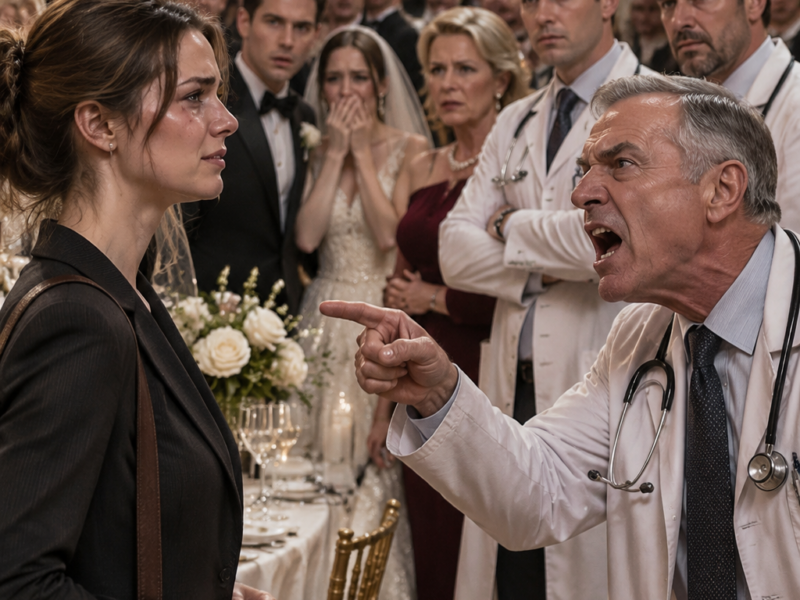
“Why is this trash here?”
My father said it loudly enough for the woman checking invitations to stop smiling.
For a moment, I thought he was talking about something behind me. Perhaps a misplaced box, a discarded decoration, or a piece of rubbish someone had forgotten near the reception entrance.
Then his eyes met mine.
Nine years.
Nine years since I had last stood in the same room as my family. Nine years since my father had told me that choosing a different career meant choosing to abandon everything we shared. Nine years since I had packed my belongings into cardboard boxes and left the house where I had grown up, carrying little more than a suitcase, an engineering degree, and an old radio that belonged to my grandmother.
And now, standing beneath the enormous crystal chandeliers of an elegant waterfront hotel in Boston, those were the first words my father had for me.
My younger brother, Ethan, stood beside him in an immaculate black tuxedo. Today was his wedding day, and he looked every bit the successful surgeon our father had always wanted him to become.
He glanced at me, then turned toward the hotel security guard.
“Security, remove him.”
The guard began walking in my direction.
Across the entrance, my sister Lily stood holding a cream-colored envelope against her dress. Her face had gone pale. She looked at our father, then at me, silently asking whether I was going to leave.
Six weeks earlier, she had sent me photographs of that envelope’s contents. It was a settlement agreement our father wanted her to sign before the wedding. Buried among its legal language was a statement claiming that I had already received my entire inheritance from our grandmother.
That statement was false.
I had never received the money. I had never signed the document. And I had the financial records proving both things inside my jacket.
I could have turned around and walked away.
For most of my adult life, walking away had been my answer to everything involving my family.
But Lily had called me that morning, crying quietly so nobody in the house could hear her.
“He says if I don’t sign today, he’ll stop paying my expenses,” she had whispered. “He says I’ll end up just like you.”
I had promised her I wouldn’t let her face him alone again.
So when the security guard approached, I stayed where I was.
My name is Adrian Bennett, and this is the story of how I spent nine years believing I had been rejected by my family for choosing the wrong career, only to discover that the real reason my father wanted me gone was much more complicated.
It began long before that wedding.
In the Bennett household, a career was never something you chose.
It was something you inherited.
My father, Richard Bennett, was a respected cardiothoracic surgeon. His name appeared on hospital publications, medical conference programs, and professional awards displayed throughout our house. He had spent decades building a reputation for excellence, and he expected his children to continue that legacy.
My mother, Caroline Bennett, was a dermatologist. She was equally accomplished, with a successful private practice and a calendar that seemed permanently filled with appointments, conferences, and professional obligations.
Growing up, I understood that my parents worked hard. I saw my father return home after exhausting surgeries, sometimes still wearing the exhaustion on his face. I watched my mother review patient files at the kitchen counter long after dinner.
I respected them.
What I didn’t understand was why their professions seemed to matter more than anything else about us.
At family gatherings, conversations revolved around medical school applications, hospital appointments, surgical techniques, and professional achievements.
When my younger brother Ethan received his acceptance letter from medical school, my father had it framed.
He placed it beside his own medical diploma in the hallway.
I remember standing there, looking at the two documents displayed side by side, while my mother took photographs of Ethan holding his letter.
My father was so proud that he called several colleagues to share the news.
When I graduated with a degree in biomedical engineering, he congratulated me, shook my hand, and asked whether I had finished preparing my medical school applications.
I had.
In fact, I had already submitted several.
At the time, I believed becoming a physician was the only way to earn the kind of approval I had watched Ethan receive.
I wasn’t particularly unhappy with the idea of medicine. I wanted to help people. I wanted to work in healthcare. I simply didn’t feel drawn to spending my life examining patients or performing surgeries.
What fascinated me was the technology behind modern medicine.
I was interested in monitoring systems, medical devices, diagnostic equipment, and the software that connected everything inside a hospital.
I wanted to understand why a machine could sometimes provide conflicting readings, why important information was scattered across different systems, and why nurses often had to spend precious minutes searching multiple screens before understanding what was happening to a patient.
I wanted to build something that made their work easier.
The only person in my family who genuinely encouraged my curiosity was my grandmother.
She lived in a small house outside the city, where the kitchen always smelled of tea and freshly baked bread.
Unlike my parents, she never began a conversation by asking about grades, applications, or achievements.
She asked what I was interested in.
When I was younger, she would let me sit beside her at the kitchen table and repair small household appliances. One afternoon, I spent nearly three hours trying to fix an old radio that had belonged to her husband.
The tuning knob was loose, and the sound disappeared whenever someone moved the device.
My grandmother patiently watched me remove the back panel, organize tiny screws, and examine the wiring.
She kept her teacup away from my tools so I wouldn’t accidentally drop anything inside it.
When I finally managed to make the radio work again, she smiled as though I had accomplished something extraordinary.
“You have a good mind for understanding how things fit together,” she told me.
I shrugged.
“It’s just a radio.”
“No,” she replied. “It’s a problem you didn’t give up on.”
She was the first person who made me feel that my interests had value even when they didn’t lead to a prestigious title.
Sometimes, when I was frustrated with my parents, she would remind me that a person’s worth wasn’t determined by the name printed on a professional badge.
“Keep your conscience clear, even when others make your name dirty,” she often said.
At the time, I thought she was simply teaching me to avoid arguments.
It took years to understand that sometimes keeping your conscience clear meant refusing to remain silent.
My grandmother died when I was twenty-four.
Her death left a hole in my life that I didn’t know how to fill.
She had been one of the few people who made me feel understood, and after she was gone, the house seemed colder.
She had prepared an estate plan that divided her assets among her grandchildren. The trust allowed educational expenses to be paid before the final distributions were made when each beneficiary turned thirty.
My father was appointed trustee.
My mother helped manage the family correspondence and collected mail whenever someone was away.
I didn’t question the arrangement.
These were my parents. I had no reason to believe they would mishandle something my grandmother had created specifically for her grandchildren.
I trusted them completely.
That trust began to disappear during my third year of medical school.
By then, I had spent enough time around hospitals to recognize that the work I truly wanted to do was happening behind the scenes.
I was fascinated by the equipment used in intensive care units, particularly the systems responsible for monitoring patients whose conditions could change within seconds.
During one clinical observation, I watched a nurse move between several monitors, manually comparing readings because the information wasn’t being displayed together.
She wasn’t careless. She wasn’t inexperienced.
She was doing the best she could with systems that made a difficult job even harder.
I couldn’t stop thinking about it.
I began researching software integration, device communication, and patient monitoring interfaces.
The more I learned, the more certain I became that I wanted to return to engineering.
I knew my father wouldn’t be pleased.
Still, I convinced myself that if I explained everything carefully, he would eventually understand.
One evening, I brought it up during dinner.
“I’ve been thinking about changing direction,” I said.
My father continued cutting his food.
“What direction?”
“I want to work in biomedical technology. More specifically, medical monitoring systems and software.”
His knife stopped moving.
My mother looked up from her plate.
Ethan continued eating, although I noticed he was listening.
“I’ve been researching some opportunities,” I continued. “I think I could contribute more by developing the technology hospitals use rather than becoming another physician.”
My father slowly placed his fork down.
“Are you telling me you want to leave medical school?”
“I want to finish my engineering training and work in healthcare technology.”
“That isn’t what I asked.”
I took a breath.
“Yes. I want to leave.”
He stared at me.
“Do you have any idea what I have invested in your future?”
“I know you’ve supported me.”
“Supported you?” His voice rose. “I’ve spent my entire life building a reputation that opened doors for you. Do you think opportunities simply appear?”
“I’m not asking you to open doors. I’m asking you to understand what I want to do.”
“You’re asking me to support failure.”
The words landed harder than I expected.
I looked toward my mother.
She touched the necklace around her neck, then lowered her eyes.
Ethan continued eating.
I waited for someone to say something.
Nobody did.
My younger sister, Lily, was still in high school at the time. She sat quietly near the end of the table, looking at her plate.
I could tell she wanted to speak, but she didn’t.
I told myself my father was simply angry. Perhaps he needed time.
I had already arranged my withdrawal from medical school, but I hadn’t finalized everything because I wanted to have one more conversation with him.
Instead, he called me home for what he described as a family discussion.
When I arrived, there was a folder beside his dinner plate.
He didn’t offer me a seat immediately.
He simply opened the folder and slid a printed list of expenses across the table.
“Your grandmother’s money has covered your education and your choices,” he said. “There is nothing left.”
I looked down at the papers.
There were numbers, descriptions of expenses, and several totals.
But there were no dates, no account numbers, no bank statements, and no supporting documents.
“Where are the trust statements?” I asked.
He frowned.
“What?”
“I want to see the account records.”
He leaned back.
“You think everything is supposed to be handed to you?”
“No. I think I should be allowed to see the accounts belonging to me.”
My father closed the folder.
“Your education wasn’t free, Adrian.”
“I understand that. But you told me my tuition was a gift.”
He looked irritated.
“I paid for your education. I paid for your apartment. I supported you while you studied.”
I remembered the letter he had written when he made the tuition payments. He had described the money as a graduation gift from my parents.
I had also seen the tuition payments appear directly on my student account.
I couldn’t understand how those payments could suddenly be treated as withdrawals from my grandmother’s trust.
“Can you show me the transactions?” I asked again.
He stared at me for several seconds.
Then he said something that changed my life.
“If you walk away from medicine, you walk away from this family.”
My mother shifted in her chair.
“Perhaps you need some time to reconsider,” she said softly.
I looked at her.
I wasn’t asking her to fight with my father. I wasn’t asking her to choose sides.
I simply wanted her to ask him to open the folder.
She didn’t.
Within weeks, my father stopped contributing to my apartment rent.
I couldn’t afford the lease without his support. I had some savings, but not enough to maintain the apartment while finishing my remaining engineering coursework and searching for work.
Within a month, I was packing everything I owned into cardboard boxes.
Ethan came downstairs to help me carry one.
He was already preparing for his next medical school semester.
For a few minutes, we worked in silence.
Finally, I asked him whether he had ever seen the trust statements.
He looked uncomfortable.
“Dad knows what he’s doing.”
“I’m not asking whether he knows what he’s doing. I’m asking whether you’ve seen the accounts.”
He lifted another box.
“Don’t make this uglier than it needs to be.”
I wanted to tell him that asking for financial records wasn’t making anything ugly.
But I was tired.
I was losing my home, my family, and the future I had spent years trying to build.
So I carried my boxes downstairs.
That spring, my father opened a new practice annex.
I remembered Ethan mentioning that the financing had been difficult. He had spoken about it briefly one afternoon before changing the subject when our father entered the room.
At the time, I didn’t connect it to anything.
I was too busy trying to find somewhere affordable to live.
Lily came to my car shortly before I left.
She had something wrapped in a towel.
It was our grandmother’s old radio.
“Mom was going to get rid of it,” she whispered. “I thought you should have it.”
I took it carefully.
“Thank you.”
She looked toward the house.
“Will you come back?”
I didn’t know how to answer.
“I’ll call you.”
She nodded.
Then she hugged me.
It was the last time I saw her in person for nine years.
At first, I called regularly.
But my father began checking her phone and questioning her whenever she spoke to me.
Eventually, I realized that every conversation was creating trouble for her.
I thought distance would protect her.
That was one of the biggest mistakes I ever made.
When a cousin eventually sent me a message saying it was unfortunate that I had wasted my grandmother’s inheritance, I typed three different explanations.
I deleted all of them.
I didn’t want to involve relatives in a family dispute.
I didn’t want to make my sister’s life more difficult.
I thought the truth would eventually become obvious.
Instead, my silence became evidence for people who had already decided what happened.
My family told everyone that I had wasted my inheritance and abandoned them.
And because I wasn’t there to defend myself, the story became part of our family history.
I started over outside Boston.
My first job was with a medical equipment service company.
Despite having an engineering degree, I wasn’t offered anything impressive.
I checked serial numbers, cleaned returned equipment, inspected damaged components, and assisted experienced technicians with repairs.
Some mornings, I unloaded deliveries before taking a bus to an evening contract job documenting software faults.
It wasn’t glamorous.
I lived in a rented room with a narrow bed, a small desk, and a kitchen I shared with two other tenants.
The old radio sat on a folding table beside my bed.
It worked, but only when I held the tuning knob at a particular angle.
Sometimes, after a difficult day, I would sit beside it and listen to whatever station came through.
It reminded me of my grandmother.
It also reminded me that I still had something worth protecting.
At work, I kept noticing the same problems.
Medical professionals were constantly moving between different systems to understand what was happening to their patients.
Information existed, but it wasn’t always organized in a way that made it easy to use.
I began sketching ideas for software that could bring existing patient monitoring information together into a clearer interface.
I didn’t want to replace medical judgment.
I wanted to make the information available to the people who needed it.
The first version looked promising on my laptop.
Then I tested it in a simulated hospital environment.
It failed.
When several devices transmitted data simultaneously, the display stopped updating.
I stared at the frozen screen while a nurse waited for information that never arrived.
Fortunately, we weren’t using the system for actual patient care, and nobody was harmed.
But the experience shook me.
I had spent eighteen months saving money for that test.
I had convinced myself that hard work and determination would be enough.
They weren’t.
The failure taught me something important.
In healthcare, a product couldn’t simply look impressive.
It had to be dependable.
A beautiful demonstration meant nothing if the system failed when a nurse needed it most.
I went home that evening feeling as though I had wasted years of my life.
A few days later, Maya Brooks found me sitting in a diner, staring at overdue bills.
Maya and I had known each other since college.
She had become a forensic accountant, and she understood financial problems in a way I never would.
She bought two coffees and sat across from me.
“Show me what you owe,” she said.
I tried to laugh.
“It’s not that bad.”
She looked at the stack of papers.
“Then you won’t mind showing me.”
I handed them over.
She spent nearly an hour organizing my expenses, separating business costs from personal spending, and identifying the contracts that were keeping me financially afloat.
Then she pointed to my notebook.
“You’re funding a company with your personal checking account.”
“It’s not really a company yet.”
“That’s not an excuse.”
She helped me establish a realistic budget.
She also refused to treat unpaid labor as profit, something I had been doing because I desperately wanted the project to succeed.
I took another contract.
I reduced the scope of the software.
I paid an experienced developer to help identify the problems I couldn’t solve alone.
We tested again.
And again.
Sometimes the system worked beautifully.
Sometimes a minor update created a problem somewhere else.
There were weeks when I barely slept.
But gradually, the software became more stable.
At twenty-nine, I founded Meridian Patient Systems.
For the first two years, the company barely generated enough revenue to cover contractors.
I continued earning my living elsewhere.
A hospital evaluation went well, but the purchasing department delayed its decision for eight months.
One early collaborator left for a more stable job.
I couldn’t blame him.
Eventually, we secured several small contracts.
We worked closely with hospital teams, conducted independent testing, and deployed the software carefully.
We didn’t promise miracles.
We promised reliability, transparency, and a willingness to fix problems when they appeared.
That approach slowly earned people’s trust.
I hired my first full-time employees.
Then I hired more.
I began paying myself a regular salary.
Our software was being used by several hospital teams, and support calls sometimes reached me during dinner.
It wasn’t the kind of success my father would have recognized when I was twenty-five.
There were no medical diplomas hanging on a wall.
But I had built something useful.
I had created jobs.
And I was helping healthcare professionals spend less time searching for information and more time caring for patients.
When our first major installation renewed its contract, I printed the confirmation letter.
For several minutes, I considered sending it to my father.
I even addressed an envelope.
I imagined him reading the document and realizing that I hadn’t thrown my future away.
Perhaps he would call.
Perhaps he would ask about the company.
Perhaps he would finally say he was proud of me.
I never mailed it.
Even after everything, part of me was still trying to earn an invitation back into a family that had made it clear I wasn’t welcome.
Meanwhile, Lily had grown up.
Through an old email account, she occasionally contacted me.
She eventually entered medical school and became a pediatric resident.
I was proud of her, although I rarely said so because I didn’t want our correspondence to create problems.
One evening, she wrote something that stayed with me.
“They say you took your share and disappeared.”
I stared at the message for a long time.
Then I replied.
“That’s not what happened.”
I wanted to explain everything.
I wanted to send her every memory, every document, and every question I had asked our father.
But I didn’t have proof.
I had no trust statements.
I had no bank records.
I had only my recollection of a conversation and a folder containing unexplained figures.
So I said very little.
Again, I believed restraint was protecting her.
Again, I was wrong.
Everything changed six weeks before Ethan’s wedding.
Lily sent me a photograph of a settlement agreement.
Our father wanted her to sign an authorization allowing him to close the remaining trust accounts and transfer her balance into the family medical practice as a loan.
He described the arrangement as necessary refinancing.
According to the agreement, the transfer would protect the practice’s future and preserve the family’s financial interests.
But there was another section.
It released our father from previous claims involving the administration of the trust.
And as an example of an earlier distribution, the document referred to my supposed acknowledgment that I had received my entire inheritance.
The signature on the release looked remarkably similar to mine.
The address printed beneath it was our parents’ house.
I hadn’t lived there for years.
I read the document twice.
Then I called Maya.
She came to my apartment the following evening.
We sat at my kitchen table while she examined every page.
She didn’t immediately accuse anyone of fraud.
That was one of the reasons I trusted her.
She separated what we knew from what we suspected.
“Do you recognize this signature?” she asked.
“No.”
“Did you receive the money?”
“No.”
“Did you authorize anyone to receive it on your behalf?”
“No.”
“Then we need the underlying records.”
She introduced us to an independent estate attorney.
Lily requested a certified copy of the trust.
Through the attorney, we contacted the bookkeeping firm that had administered the accounts.
Fortunately, the firm still retained archived digital records.
A former bookkeeper helped locate the relevant files.
Over the next several weeks, we received bank statements, transfer instructions, correspondence, and accounting schedules.
I remember opening the first statement.
There were two transfers.
Together, they totaled $360,000.
Both had gone from my trust share into the family medical practice account.
Neither had gone into my personal account.
The release described the entire amount as money paid to me.
I sat motionless.
For nine years, I had believed my father had cut me off because I disappointed him.
Now I was looking at records showing that my inheritance had been used to finance the very practice he had accused me of abandoning.
Maya examined the dates.
She traced the receiving account.
The annex financing appeared in the same archive.
There was also an email thread involving the former bookkeeper.
One message came from Ethan.
He had asked why the release stated that I had received the money when the transfer records showed it going into the practice.
His later reply directed the bookkeeper to send further correspondence to our father’s address.
I read the emails several times.
Ethan had known enough to ask questions.
He had also known enough to redirect the correspondence.
I didn’t know what he understood at the time.
I didn’t know whether he had been frightened, pressured, or simply unwilling to challenge our father.
But I knew he hadn’t been completely unaware.
Maya traced the transactions carefully.
Our attorney explained that recovering the money would require more than presenting copies and demanding an explanation.
We needed a formal accounting.
We needed to establish the chain of transactions and give the other side an opportunity to respond through the appropriate legal process.
I kept suggesting that perhaps my father had intended to replace the money.
Perhaps the practice had been struggling.
Perhaps he had believed he was protecting the family.
Maya finally put down her pen.
“Would you accept that explanation from a stranger who managed your money?”
I didn’t answer.
“Adrian, you wouldn’t. You’d demand records. So why are you asking yourself to accept less because this is your father?”
She was right.
But accepting that truth was harder than understanding the numbers.
A few days later, I received an unexpected invitation.
It came from Olivia Hayes, the woman Ethan was about to marry.
She was a physician, and she had heard that there had been tension between me and the family.
Her message was polite.
She hoped I could attend the wedding.
She also mentioned that she and Ethan were considering a significant investment in the family medical practice.
I responded by congratulating them.
Then I suggested that any investment involving the family trust should be reviewed by an independent financial adviser.
She replied that my father had assured her there were no outstanding trust obligations.
That answer concerned me.
Lily was also worried.
Our father wanted her signature before the couple left for their honeymoon.
He had refused repeated requests for a private meeting.
“Let me get through the wedding,” he had told her.
Lily called me that evening.
“He says if I don’t sign today, I can pay for everything myself,” she said. “He says I’m being ungrateful. He says I’ll end up just like you.”
I closed my eyes.
I could hear how frightened she was.
“Don’t sign anything.”
“He keeps telling me I’m ruining Ethan’s wedding.”
“You aren’t responsible for protecting him from questions about his own finances.”
She was silent.
Then she asked, “Will you come?”
“Yes.”
That was how I found myself standing outside the ballroom on the morning of Ethan’s wedding.
I had agreed to attend as Olivia’s guest.
My plan was simple.
I would congratulate the couple.
I would stay close to Lily.
I would help her leave if our father pressured her.
The legal dispute would be handled afterward through our attorney.
I had no intention of making a public scene.
But my father apparently had other plans.
Now, as the security guard approached, I watched him glance toward Ethan.
My brother stood with one hand resting against the guard’s sleeve.
“He’s not supposed to be here,” Ethan repeated.
Before the guard could reach me, Olivia appeared behind him.
She was wearing an elegant wedding dress, and her expression changed immediately when she saw what was happening.
“I invited him,” she said.
My father turned toward her.
“Olivia, there’s history you don’t understand.”
He used the same pleasant, controlled expression I remembered from childhood. It was the expression he used when speaking to difficult colleagues or explaining something he didn’t want questioned.
Olivia didn’t move.
“I know he’s Ethan’s brother.”
“That’s not the point.”
A man wearing a groomsman’s boutonniere stepped out from a group of guests nearby.
His name was Marcus.
He worked at a hospital that used Meridian Patient Systems.
He looked directly at me, then at my father.
“Wait. This is Adrian Bennett, the founder of Meridian Patient Systems.”
The room seemed to grow quieter.
Marcus approached with a surprised smile.
“I’ve worked with his team. Your monitoring software has made a real difference for our department.”
I shook his hand.
“I’m glad it’s been useful.”
“We had an integration problem last year. Your engineers worked directly with our clinical team until it was resolved. I remember you joining one of the calls yourself.”
My father stared at us.
Marcus continued speaking about the software, explaining how his hospital team used it and how our support staff had helped resolve an issue.
My father eventually interrupted.
“Does that make him a doctor?”
I looked at him.
“No,” I replied. “It makes me an engineer. That’s what I told you I wanted to be.”
For a brief moment, nobody spoke.
The invitation clerk returned my card.
The security guard stepped away after Olivia confirmed that I was welcome.
I could feel several guests watching us.
Part of me wanted to explain everything right there.
I wanted to tell them about the trust, the $360,000, the false release, and the years of accusations.
But then Lily walked toward me.
“He wants the envelope,” she whispered.
My father immediately reached for it.
Lily moved it behind her back.
“No,” she said. “I’m keeping my copies.”
It was the first time I had heard her refuse him without immediately explaining herself.
I looked at Olivia.
“Is there somewhere private we can talk?”
She glanced toward the adjoining lounge.
“Yes. I’ll come with you.”
Ethan objected.
“We have a reception.”
Olivia turned toward him.
“Then this should have been settled before it.”
Marcus remained near the entrance.
He had corrected a false claim about my professional life.
The rest of the matter belonged to us.
We entered the lounge.
My father remained standing.
Lily sat beside me, holding the envelope in her lap.
I took out the release and placed it on the coffee table.
“Tell me when you gave me this money.”
My father looked at the document.
Then he looked at Olivia.
“You benefited from your education.”
I had expected him to deny everything.
Instead, he was repeating the same argument he had used nine years earlier.
I placed another document beside the release.
It was the letter he had written when he paid my medical school tuition.
It described the tuition as a gift from my parents.
Then I placed the student account statements beside it.
“These payments came directly from your personal account,” I said. “They weren’t transfers from my grandmother’s trust.”
He glanced at them.
“You think education is free?”
“No. I think a gift and an inheritance are two different things.”
Lily opened the certified trust copy.
She had marked the provision governing our individual shares.
“You told me Adrian had used his share,” she said. “You told me there was nothing left.”
My father exhaled.
“You’re reading complicated documents without understanding the obligations attached to them.”
“We have an attorney,” I replied. “And an independent accountant. They can discuss those obligations with yours.”
Ethan reached toward the release.
I placed two fingers on the paper.
“These are copies. Our attorney already has the records.”
I had spent nine years imagining what it would feel like to confront my father.
I thought I would feel powerful.
Instead, I felt exhausted.
But I also felt something I hadn’t felt in a long time.
I wasn’t afraid of him anymore.
I arranged the statements beside the transfer instructions.
The dates matched.
The amounts matched.
The receiving account belonged to the family practice.
The archived correspondence explained the accounting.
The practice annex had been approaching a financing deadline.
Our father had instructed the bookkeeper to record the transfers as my distribution.
The release then made a payment to the practice appear to be money I had personally received.
I looked at him.
“You needed the practice funded.”
He said nothing.
“Calling me irresponsible kept everyone from asking why I was broke. You told people I had wasted my inheritance while the money was sitting in the practice account.”
His expression hardened.
“The expansion supported employees and patients. It was an investment in the future of this family.”
“I understand what you wanted to build. But you didn’t have permission to use my money.”
“I expected to replace it when revenue improved.”
“Then why tell everyone I had spent it?”
He looked toward my mother.
She had been sitting quietly beside him.
Her eyes were fixed on the address printed beneath the disputed signature.
I turned toward Ethan.
“There is something else.”
I opened the archived email thread.
“Ethan, you asked why the release said I had received the money when the transfers went to the practice.”
He looked down.
“I was in medical school.”
“That doesn’t answer my question.”
“I wasn’t managing the trust.”
“I didn’t say you were.”
I kept my voice low.
“You knew enough to ask why the document was wrong. You also knew enough to send the questions back to Dad.”
He swallowed.
“I didn’t know what to do.”
I remembered the day he had helped me carry boxes down the stairs.
I remembered asking him whether he had seen the trust figures.
I remembered his answer.
Dad knows what he’s doing.
There was another accounting schedule in the archive.
It showed that practice funds had covered part of Ethan’s tuition. Later entries credited an ownership contribution to him.
Our attorney would still need to determine exactly how those transactions connected.
But the records made one thing clear.
Ethan had benefited from money that had been moved through the practice.
I looked at him.
“You carried a box for me.”
He looked up.
“You could have told me then.”
He sat down.
For several seconds, he didn’t speak.
I wondered whether he remembered that afternoon as clearly as I did.
Perhaps he remembered how heavy the box had been.
Perhaps he remembered my apartment being almost empty.
Perhaps he remembered that I had been leaving without knowing where my life would go.
Whatever he remembered, he didn’t answer.
Olivia picked up the release.
She read the acknowledgment again.
Then she looked at Ethan.
“Did you know this was in the financial records?”
Ethan hesitated.
Our father interrupted.
“This is a family misunderstanding.”
Olivia ignored him.
“Did the investment materials disclose these potential obligations?”
My father shifted in his chair.
“The practice has been operating successfully for years.”
“That wasn’t my question.”
She placed the document back on the table.
“My investment is on hold. My financial adviser needs to review these records.”
For the first time that evening, my father spoke to me as though we were negotiating a business arrangement.
“Come to the office Monday. We’ll arrange something. There’s no reason to involve strangers.”
I shook my head.
“I already have independent advice.”
He looked genuinely offended.
“You would damage your own family over money?”
I glanced at Lily.
She was holding the unsigned settlement agreement.
Then I looked back at him.
“My name isn’t yours to spend.”
He opened his mouth.
I continued.
“You don’t get to take money from my trust, record it as a payment to me, and then tell everyone I wasted it. You don’t get to use my sister’s signature to make the records disappear. And you don’t get to decide that asking questions is disrespectful.”
Lily placed the agreement back inside its envelope.
“I’ll decide after my lawyer reviews it,” she said. “And I’m moving my mail.”
My mother finally spoke.
“Richard, stop asking them to trust you instead of answering.”
I turned toward her.
For nine years, I had imagined my mother saying something like that.
I had imagined her standing beside me, admitting that what happened had been wrong.
But hearing it now didn’t erase the past.
She looked at me.
“I should have called you.”
I waited.
She continued.
“I saw some of the correspondence about the trust. Your father told me you wanted nothing more to do with us. I believed him.”
“You could have called.”
Her eyes filled.
“I know.”
“Yes,” I said quietly. “You could have.”
My father stood up.
“Are you planning to make an announcement outside?”
“No.”
I gathered the documents.
“I’m going to let the attorney do her job.”
I hadn’t come to destroy Ethan’s wedding.
I hadn’t come to embarrass my parents.
But I also wasn’t going to leave those records behind as another argument everyone could agree to forget.
Lily and I left the lounge before dinner.
Olivia returned to the reception.
Ethan remained with our parents.
Outside the hotel, Lily stopped near the entrance.
“Did I ruin his day?”
I looked at her.
“No. You refused to sign a document.”
“But everyone knows something happened.”
“That’s because something happened.”
She looked down.
For a moment, she seemed younger than her years.
Then she asked whether I thought Ethan would forgive her.
I shook my head.
“This isn’t something you need forgiveness for.”
We walked toward the parking area.
The evening air was cold, and the waterfront lights reflected across the dark surface of the harbor.
For the first time in nine years, my sister was walking beside me without looking over her shoulder to see whether our father was watching.
The legal process took ten months.
It wasn’t dramatic.
There were formal accountings, disputed records, meetings with attorneys, and negotiations that made me wish I never had to look at another spreadsheet.
An independent financial review confirmed that the money had been diverted from my trust share.
It also found no supporting record showing that I had authorized the transfers or received the proceeds.
Our father eventually agreed to a settlement.
There was an initial repayment followed by secured installments.
I recovered most of my inheritance.
Not every dollar.
And certainly not the years I had spent believing I had somehow deserved what happened.
Lily’s remaining trust funds were transferred to an independent trustee.
Our father was no longer responsible for managing her money.
When his monthly financial support stopped, Lily faced a difficult adjustment.
She was still completing her medical training, and her income wasn’t enough to maintain the lifestyle she had become accustomed to.
She stayed in my spare room while we worked through her budget.
I helped her identify an affordable apartment.
I helped her carry furniture.
But I didn’t take over her financial decisions.
She needed to learn that she could build a life without depending on our father’s approval.
Eventually, she rented a smaller apartment close to the hospital.
She was nervous about living alone at first.
Then she discovered that she liked choosing her own furniture, buying groceries without explaining every purchase, and coming home without worrying about whether someone would inspect her mail.
One evening, she called me laughing because she had accidentally bought enough groceries for an entire week of night shifts.
It was a small thing.
But hearing her laugh freely was worth more to me than any settlement payment.
Olivia eventually told me that she had canceled her investment in the practice.
She and Ethan were attending counseling.
I didn’t ask what happened during their private conversations.
Their marriage was theirs to decide.
I hoped they would find a way forward, but I also understood that trust wasn’t something that could be restored simply because the wedding had taken place.
Ethan sent me an apology several weeks later.
He wrote that he had been young, frightened, and overwhelmed by our father’s expectations.
He said he hadn’t understood the full extent of the financial arrangement.
He also said he regretted not protecting me when I left.
I read the message several times.
Then I replied.
“We can talk when you can tell me exactly what you knew and what you helped conceal.”
He didn’t answer immediately.
I wasn’t surprised.
My mother began calling me occasionally.
At first, the conversations were awkward.
She would ask about the company, my employees, and whether I was eating properly.
Sometimes she cried.
Sometimes she tried to explain that she had been caught between two people she loved.
I listened.
But I stopped reassuring her that everything was fine.
For years, I had been responsible for making everyone else comfortable.
I wasn’t going to continue doing that at the expense of my own peace.
I needed consistency more than tears.
I needed honest answers more than apologies.
My father and I barely communicated.
Through the attorneys, he completed the agreed repayments.
But I didn’t rush to rebuild a relationship with him.
The settlement resolved a financial dispute.
It didn’t automatically repair the emotional damage.
I also contacted several relatives who had repeated the story that I had wasted my grandmother’s money.
I didn’t insult them.
I didn’t demand that they apologize.
I simply sent them a summary of the independent financial review and explained what the records had established.
Some apologized immediately.
Others said they hadn’t known the full story.
A few never answered.
That was fine.
This time, I had given them the truth.
What they chose to do with it was their responsibility.
As Meridian Patient Systems continued growing, I began thinking about my grandmother more often.
I remembered her kitchen table.
The little screws she had swept away from her teacup.
The old radio that only worked when the tuning knob was held at the right angle.
I remembered her telling me that a person’s conscience mattered more than the opinions of people who wanted to control them.
One afternoon, I discussed an idea with Maya.
I wanted to establish a small scholarship in my grandmother’s name.
It would support an engineering student who wanted to work in healthcare technology but needed financial assistance to finish their degree.
Maya helped me structure it properly.
I made sure the scholarship wasn’t funded through the company and that it wouldn’t interfere with my employees’ salaries or business obligations.
I waited until my household finances were secure.
Then we began with one student.
The first recipient was a young engineering student who had been working part-time while caring for a family member.
When I read the application, I recognized something familiar.
The student wasn’t asking for recognition.
They simply wanted an opportunity to build something useful.
I thought my grandmother would have liked that.
Lily came over the evening we selected the recipient.
She brought groceries and complained about a difficult hospital shift.
She also noticed the old radio sitting on the shelf.
“Why haven’t you fixed that tuning knob yet?” she asked.
I smiled.
“I’ve been busy.”
“You’ve been saying that for years.”
She put the groceries on the counter.
“Move over. I’ll help.”
We spent the evening cooking dinner.
The radio played softly in the background, occasionally losing its signal when someone moved too close to it.
Lily laughed whenever I adjusted the knob.
At one point, she asked whether I regretted leaving medical school.
I thought about it.
I thought about the difficult years, the unpaid bills, the failed software tests, and the nights when I wondered whether I had made the wrong decision.
Then I thought about the nurses who used our software.
I thought about the hospital teams who had trusted us with their systems.
I thought about the employees who depended on Meridian for their livelihoods.
“No,” I finally said. “I regret believing that someone else had the right to decide what my life should look like.”
She nodded.
Then she handed me a plate.
Before we ate, I looked around the table.
There were no medical diplomas on the walls.
There were no professional awards or expensive decorations.
Just two siblings, a simple meal, an old radio, and the quiet comfort of being able to speak without fear.
I bowed my head and quietly thanked God for the people at my table.
Lily reached for another plate.
She stayed for dinner.
Sometimes, even now, I catch myself wanting to send my father a company milestone.
When Meridian signs a new hospital contract or completes a successful installation, there is still a small part of me that imagines his reaction.
I picture him reading the announcement.
I imagine him asking questions.
I imagine him saying he is proud.
Then I stop.
I ask myself whose approval I am trying to buy.
For a long time, I believed that if I became successful enough, my family would finally accept me.
I thought a bigger company, a larger salary, or an impressive achievement would make my father reconsider his judgment.
But the wedding taught me something I should have understood much earlier.
I didn’t need to become successful to prove that I deserved respect.
I deserved respect when I was twenty-five, packing boxes into a borrowed car.
I deserved respect when I was sitting in a rented room trying to repair a broken radio.
I deserved respect when my first software test failed.
I deserved respect when I had no company, no impressive title, and no one applauding my decisions.
My worth had never depended on my father’s opinion.
My parents now understand what any future relationship with me requires.
Honest answers.
Completed restitution.
Respect for my boundaries.
And no more demands that I prove my love by surrendering my independence.
I haven’t completely closed the door.
But I no longer stand outside it waiting for someone to invite me in.
I still grieve the family I thought I had.
I sometimes miss the version of my father who taught me to ride a bicycle, attended my school events, and once stayed up late helping me study for an examination.
I miss my mother making tea in the kitchen.
I even miss the ordinary arguments between siblings, the ones that happen when nobody is afraid of losing their place in the family.
But missing those memories doesn’t mean I have to pretend the later years never happened.
Forgiveness, if it comes, will have to exist alongside the truth.
And reconciliation, if it ever becomes possible, will have to be built through actions rather than promises.
My grandmother used to tell me to keep my conscience clear, even when others made my name dirty.
For nine years, I misunderstood that advice.
I thought keeping my conscience clear meant staying quiet.
Now I understand that sometimes the only way to protect your name is to tell the truth, even when the people hearing it are the ones who gave you that name.
I went to my brother’s wedding expecting another rejection.
Instead, I found the courage to stop asking for acceptance from people who had made a habit of withholding it.
And perhaps that was the most valuable thing I recovered from my grandmother’s inheritance.
Not the money.
Not the documents.
Not even the truth about what had happened.
It was the understanding that I could build a meaningful life without becoming the person my father wanted me to be.
I could love my family without allowing them to control me.
I could help my sister without making her dependent on me.
I could remember my parents’ good moments without excusing their worst decisions.
And I could finally sit at a dinner table without wondering whether I had earned the right to be there.
The old radio still sits beside my kitchen window.
I eventually repaired the tuning knob.
Sometimes, when the evening is quiet, I turn it on and listen to the music drifting through the room.
It reminds me of my grandmother, of the person I was before everything became complicated, and of the lesson she tried to teach me.
A family should be a place where you are allowed to become yourself.
Not a place where love is offered only when you obey.
I don’t know whether my father will ever fully understand that.
I don’t know whether Ethan and I will ever become the brothers we might have been.
And I don’t know whether my mother will find the courage to acknowledge everything she chose not to question.
But I know where I stand now.
My name is Adrian Bennett.
I am an engineer, a business owner, a brother, and a grandson who still remembers the woman who believed in him when almost nobody else did.
I am no longer the twenty-five-year-old man who left his childhood home believing he had lost everything.
I have built a life.
I have reclaimed most of what was taken.
And I have learned that sometimes walking away from the people who refuse to respect you is not abandoning your family.
It is finally refusing to abandon yourself.









