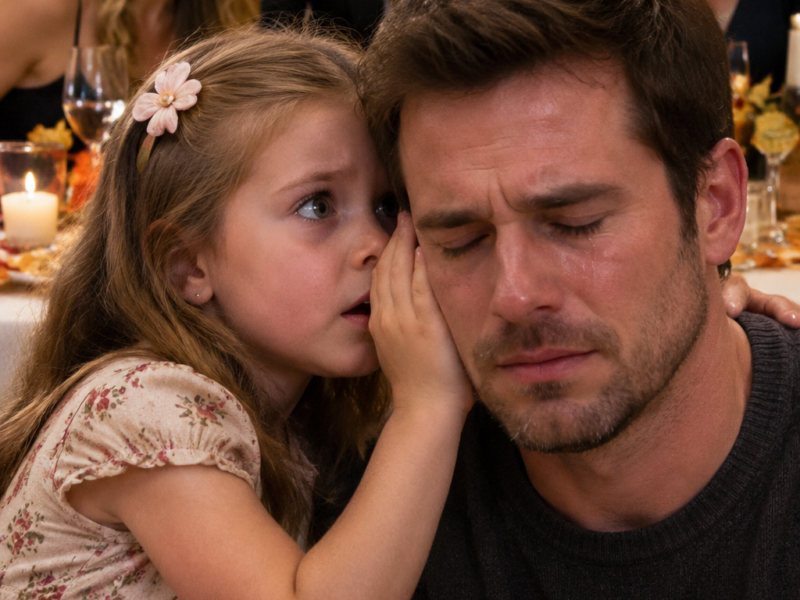
At Thanksgiving Grace My 5 Year Old Whispered “Daddy, Don’t Close Your Eyes” — What I Saw
At Thanksgiving Grace My 5 Year Old Whispered “Daddy, Don’t Close Your Eyes” — What I Saw
There was one thing Logan Reed had learned after nearly twenty years of working as an auctioneer: never watch the merchandise when the bidding began. Watch the people instead.
A chair was only a chair. A porcelain vase was only a vase. Even an old tractor, no matter how much history it carried, could not tell him who wanted it most. But the people standing around the auction floor told him everything. A man might keep his hands buried in his pockets, pretending to be uninterested, while his right thumb rubbed against his wedding ring. A woman might stare at the floor, seemingly distracted, while her eyes kept returning to the antique cabinet she had been waiting months to buy. Someone would shift their weight, swallow nervously, or glance toward another bidder just long enough to reveal what they were thinking.
Logan had become an expert at noticing those things.
His father, Ray Reed, had taught him that an auctioneer’s greatest talent wasn’t the ability to speak quickly. Anyone with a strong voice and enough practice could learn the familiar rhythm of the chant. What separated a good auctioneer from a great one was the ability to read a room before anyone realized they were being read.
“You watch their hands, son,” Ray used to tell him. “Watch their eyes. People can control what comes out of their mouths, but their bodies have a terrible habit of telling the truth.”
Logan had carried that lesson into every part of his life. He noticed the smallest changes in people’s expressions, the pauses in conversations, the smiles that appeared a fraction of a second too late. Sometimes it made him seem unusually perceptive. Other times, it made him look suspicious when there was nothing to be suspicious about.
His wife, Chelsea, used to laugh about it.
“You could probably tell what someone had for breakfast just by looking at their eyebrows,” she would say.
Logan would grin and kiss her forehead, telling her that she had no idea how much he knew.
He never imagined that one day the same habit would save his life.
Logan was thirty-eight years old and ran Reed Auction and Estate, a family business that had operated out of an old pole barn on Route 9, just outside Cotton Fork, Ohio, since 1981. His father had started it with a battered pickup truck, a secondhand microphone, and the belief that almost anything could find a new owner if it was presented to the right crowd.
Over the years, the business had sold everything imaginable. Farm equipment, antique furniture, church pews, collections of old coins, wedding china, dusty boxes of photographs, and the contents of entire houses belonging to people who had passed away.
Logan sometimes joked that his profession involved selling other people’s memories by the pound.
He loved the work, though. There was something satisfying about taking objects that had been forgotten in garages and barns and watching strangers suddenly recognize their value.
His father had died three years earlier after a long battle with liver disease. During those final weeks, Chelsea had practically lived at the hospital with Logan. She sat beside him through endless nights, brought him coffee, kept track of his father’s medication, and made sure the business continued operating even when Logan could barely bring himself to answer the phone.
Chelsea had an accounting degree and a mind that seemed naturally organized. While Logan was comfortable standing in front of hundreds of people and persuading them to bid on things they hadn’t planned to buy, Chelsea preferred spreadsheets, invoices, and numbers that added up correctly.
Together, they had built something good.
They had bought a modest brick ranch on Alder Street, raised their daughter, and enjoyed the kind of marriage that made other couples believe lasting happiness was possible.
Their daughter, Emma, was five years old.
She was a quiet child with enormous gray eyes, two small braids that never stayed neat for long, and an extraordinary attachment to a stuffed rabbit named Mr. Gravy. She wasn’t particularly interested in being the center of attention. She preferred watching people, drawing pictures, and asking questions that occasionally left adults struggling to find suitable answers.
Logan adored her.
If he had one complaint about fatherhood, it was that Emma was growing up too quickly. He sometimes wished he could stop time whenever she climbed into his lap or fell asleep against his shoulder.
For a long time, he believed he had everything he needed.
Then, sometime in the spring, little things began changing.
The first thing he noticed was Chelsea’s phone.
She had never been particularly protective of it. She left it charging on the kitchen counter, forgot it on the couch, and occasionally asked Logan to answer calls when she was busy cooking.
But now she carried it everywhere.
She took calls outside on the porch. She stepped into the bathroom when messages arrived. If Logan entered a room while she was reading something, she would turn the screen away or place the phone facedown.
Whenever he asked who had called, she gave him an ordinary answer.
“Just Becky.”
Or, “Someone from work.”
Or, “Nothing important.”
He didn’t push.
The second change involved her older sister’s husband, Philip Hargrove.
Philip was forty-one, tall, confident, and the sort of man who seemed to know everybody. He sold commercial insurance from an office above the bank in Cotton Fork. He remembered birthdays, picked up restaurant checks, and had a talent for making people feel as though they were the most interesting person in the room.
He was married to Chelsea’s older sister, Becky, and they had a ten-year-old son named Zachary.
Logan had known Philip for fifteen years. They had attended family gatherings together, watched football games, and shared countless drinks before Logan stopped drinking following his father’s death.
Philip had even handled the insurance arrangements for Reed Auction and Estate.
Two years earlier, he had helped establish a key-person policy that would provide the business with $900,000 if Logan died unexpectedly.
At the time, Logan had thought it was a sensible business decision. Philip had explained the coverage, brought the paperwork to the auction barn, and joked that he was making sure the family would never be left struggling.
“That’s what family is for,” Philip had said, placing a hand on Logan’s shoulder.
Now, looking back, Logan would remember that conversation with a feeling he could never quite describe.
During the summer, Philip began appearing wherever Chelsea happened to be.
If she went to the farmhouse to help her mother, Philip sometimes stopped by. If she attended a school event, he seemed to have a reason to be there. If Logan arrived at a family gathering, Philip was often already standing beside Chelsea, laughing about something she had said.
Nothing about it was openly suspicious.
That was precisely what made it difficult to explain.
Logan noticed the way Philip looked at his wife. He noticed the way Chelsea sometimes glanced toward him before answering a question. He noticed that Philip had begun calling her “kiddo” more frequently, even though he had used the nickname for years.
There was no single moment that proved anything.
There was simply a growing collection of small details.
An auctioneer might call it a ghost bid. Someone was pushing the price higher without ever showing a paddle. You could feel the bidding changing, but you couldn’t identify the person responsible.
Logan decided to wait.
His father had taught him never to reveal what he suspected until he understood exactly what he was looking at.
Then September brought an incident that would eventually take on a much darker meaning.
Philip’s mother, Joanne Hargrove, had died after spending her final weeks receiving hospice care at her home on Mill Street.
Following the funeral, Philip hired Reed Auction and Estate to clear the house.
It was a routine assignment. Logan arrived with two employees, a flatbed truck, and several stacks of packing boxes.
While sorting through the bedroom furniture, he opened a nightstand drawer and discovered a white plastic hospice medication container.
It had a hinged lid and foam inserts designed to hold several small bottles.
Two bottles remained in their slots.
Four were missing.
Logan recognized the container immediately. His father had received a similar one during the final days of his life.
He knew that hospice medication was carefully tracked and that unused supplies were supposed to be returned.
Philip appeared in the doorway before Logan could say anything.
“Found the comfort kit?” he asked.
He was carrying two cups of coffee.
Logan nodded toward the open container.
“Looks like a few bottles are missing.”
Philip walked over and took it from him.
“Hospice will collect it. I’ll take care of everything.”
He closed the lid and tucked it under his arm.
“Don’t worry about it, buddy. You’ve got enough to do.”
Logan accepted the explanation and returned to packing.
He had no reason to think that an ordinary hospice container would become important later.
The next incident happened in October, during Walter Swanson’s sixty-sixth birthday dinner.
Walter was Chelsea’s father, a respected deacon at Cotton Fork Methodist Church and a man who believed that certain family traditions should never be changed.
He wore the same style of brown shoes, attended church every Sunday, and insisted on saying grace before every family meal.
His prayers were famously long.
The family had even turned their length into a running joke.
At Thanksgiving, they sometimes timed them with a phone stopwatch. Walter’s average was thirty-eight seconds, and everyone knew it.
That October evening, Logan arrived with Chelsea and Emma. They ate ham, green beans, mashed potatoes, and a store-bought birthday cake.
Logan had stopped drinking alcohol years earlier, so he poured himself a large glass of iced tea.
He finished it while everyone talked.
About forty minutes later, something strange happened.
His arms became heavy. His thoughts slowed. The room seemed to move slightly, as though the entire house had been placed on a boat.
He remembered standing to help Dorothy, Chelsea’s mother, clear the dishes.
He remembered Chelsea placing a hand on his elbow.
Then everything disappeared.
When he regained consciousness, he was lying on the bathroom floor.
The cold tiles pressed against his cheek. A bright light shone above him. Chelsea was sitting beside the bathtub, still wearing her good blue dress.
She looked down at him.
For a moment, he expected her to appear frightened.
Instead, her expression resembled someone waiting for a kettle to boil.
“You scared everyone,” she said quietly.
“What happened?”
“You fell asleep at the table.”
Logan tried to sit up.
“I didn’t feel well.”
“You’ve been under a lot of stress.”
“I only had tea.”
Chelsea patted his knee.
“Let’s not argue about it now.”
The following morning, she told Becky that Logan had been drinking.
She told Dorothy that he was exhausted.
Later, she even mentioned to someone at his doctor’s office that she was worried about his behavior.
She said he wasn’t himself anymore.
By the beginning of November, the story had spread throughout the family.
Logan Reed, the dependable auctioneer who had never been known to drink excessively, apparently had a problem he was unwilling to admit.
Chelsea, meanwhile, had become the concerned wife trying to protect him.
Logan found the situation embarrassing, but he still couldn’t identify what had happened.
He began wondering whether he had suffered some kind of medical episode.
He also began watching Chelsea more carefully.
Then, two days before Thanksgiving, Emma gave him the information that changed everything.
He found her sitting on the upstairs staircase with Mr. Gravy pressed against her chest.
She was crying softly.
Logan sat beside her.
“What’s wrong, sweetheart?”
Emma wiped her nose with the back of her hand.
“Daddy, if I tell you a secret, do you promise not to get mad at Mommy?”
The question immediately made him uncomfortable.
He turned toward her.
“Why would I get mad at you?”
“Not at me. At Mommy.”
Logan took her small hand.
“I promise I’ll listen.”
Emma looked down at the rabbit.
Then she began explaining.
She told him that on the night of Grandpa Walter’s birthday, she had gone downstairs because she was thirsty.
The kitchen lights were off, except for the glow coming from the refrigerator.
Her mother had been standing near the counter, holding a large glass pitcher of iced tea.
In her other hand was a little brown bottle with a black rubber top.
Emma recognized the type because she had seen similar bottles used for medicine when she was sick.
Philip had been standing near the dining room doorway.
He wasn’t looking at Chelsea.
He was watching the hallway.
Emma had called out to her mother.
“Mommy?”
Chelsea had turned quickly.
For a second, her face had looked frightened. Then she smiled.
Not her normal smile, Emma explained, but a different one.
The kind she used when she wanted someone to stop asking questions.
She told Emma that the bottle contained special medicine for Daddy.
It helped him sleep, but he was embarrassed about needing it.
Therefore, Emma was not supposed to tell anyone.
“Uncle Phil gave me a cookie,” Emma continued. “He said I was a good girl because I didn’t tell.”
Logan felt something cold settle inside his chest.
He kept his expression calm.
“What happened after that?”
Emma’s eyes filled with tears.
“I ate the cookie.”
“That’s okay, baby.”
“I didn’t want to, but I ate it.”
“You didn’t do anything wrong.”
She leaned against him.
Then she told him something else.
Earlier that afternoon, she had been hiding beneath a folding table in the laundry room. She liked making little tents with sheets and blankets.
Her mother had entered the room with the cordless phone and closed the door.
Emma had remained quiet.
She heard Chelsea speaking to Philip.
“Thursday at grace,” Chelsea had said. “It’s the only time nobody looks.”
Philip answered that thirty-eight seconds was more than enough.
Walter never shortened his prayers.
Then Chelsea mentioned something about Logan having the keys.
Philip said they would use Quarry Road, near the water treatment facility, because nobody traveled there on Thanksgiving.
Emma didn’t understand what they were discussing.
She remembered hearing her mother cry.
Not the sad kind of crying, she explained. It sounded angry.
Chelsea had said she couldn’t watch Logan go through what happened in the bathroom again.
Philip answered that they would do it once and do it properly.
Then Emma heard her mother say something that made her especially frightened.
“I don’t want to ride home without you.”
Logan sat motionless.
He could hear the heating system humming downstairs.
He could hear a car passing outside.
His five-year-old daughter was still talking, but he was struggling to understand how the life he had known could have become something so dangerous.
He held her tightly.
For several minutes, neither of them spoke.
Then Logan asked himself the question that mattered most.
Who would believe him?
Chelsea had spent weeks quietly building a story about his instability. She had told everyone about his supposed drinking problem and the strange incident at Walter’s birthday.
If Logan went to the sheriff and explained that his daughter had overheard a conversation, what would happen?
They might believe him.
But they might also think he was suffering from paranoia.
There was no bottle, no recording, no photograph.
Only the testimony of a frightened little girl.
And the people he suspected were preparing to gather around the same Thanksgiving table as him in two days.
Logan knew he had to be careful.
His father had once explained how to catch someone making a false bid.
“You don’t shout at him when you think he’s cheating,” Ray had said. “You wait until he commits himself. Watch him. Let him believe the room belongs to him. Then you show everyone what he was doing.”
Logan decided he would attend Thanksgiving.
He would behave normally.
And he would keep his eyes open.
On Thursday morning, he found Emma in the upstairs hallway while Chelsea was taking a shower.
He crouched until they were face-to-face.
“Today, I’m going to do what you asked me to do.”
Emma looked at him.
“You’re going to watch Mommy?”
“I’m going to watch everybody.”
He gently adjusted one of her braids.
“But I need you to help me. When Grandpa starts praying, hold my hand under the table. If you get scared, squeeze it.”
“Okay.”
“And whatever happens, don’t say anything. Just stay with me.”
Emma hugged Mr. Gravy.
“What are you going to do?”
Logan swallowed.
“I don’t know yet. I need to see what happens.”
She thought about that for a moment.
Then she asked the question that would stay with him long after Thanksgiving was over.
“What if you close your eyes by accident?”
Logan almost smiled.
“Then you squeeze harder.”
He kissed her forehead.
“And I’ll open them.”
The Swanson farmhouse stood at the end of a gravel lane on County Road 14.
It was a beautiful old white house with a wraparound porch, a large barn, and a dining room that always smelled of roasted turkey, butter, and sage on Thanksgiving.
When Logan arrived, Walter greeted him warmly.
Dorothy kissed Emma on the head and immediately noticed that her boots were on the wrong feet.
Inside, Philip was waiting in the living room.
He approached Logan with his familiar open smile.
“There he is! The man who can sell a dead man’s teeth.”
Logan laughed politely.
“Happy Thanksgiving, Phil.”
“Happy Thanksgiving, buddy.”
Philip crouched in front of Emma and produced a coin from behind her ear.
She accepted it.
“Thank you, Uncle Phil.”
Then she quietly wiped her palm against her dress.
Logan noticed.
He noticed everything.
The family eventually gathered around the dining room table.
There were eight living family members and one additional place setting for Joanne Hargrove, Philip’s mother, who had died three months earlier.
Dorothy had insisted on keeping an empty chair for her.
A glass of cider sat beside the untouched plate.
Logan took his usual seat near the window.
His goblet was the familiar cut-glass one with a small chip in the rim. Walter always joked that Logan got the imperfect glass because an auctioneer should know how to recognize flaws.
Chelsea sat beside him.
Emma climbed into the chair on his other side.
Under the tablecloth, her little hand found his.
At the head of the table, Walter stood.
“Let us pray.”
Logan lowered his head.
But he did not close his eyes.
For thirty-eight years, he had followed the same habit whenever someone began praying. He lowered his chin, relaxed his face, and shut his eyes.
Now he had to imitate the behavior without actually doing it.
He lowered his eyelids until they were almost closed.
Through the narrow opening, he could see the table.
Walter stood with his hands raised.
Dorothy had her eyes closed.
Becky sat beside her son, Zachary, with her phone in her lap. She was apparently timing the prayer again.
Philip stood with his hands clasped.
Chelsea had folded her hands neatly in front of her.
The prayer began.
“Heavenly Father, we come before you this day with grateful hearts…”
Logan watched.
The first few seconds passed normally.
He could hear Walter’s familiar voice and the soft rustling of clothing.
Then, around the seventh second, Philip lifted his chin.
It was a small movement.
Almost nothing.
But Logan saw it.
Philip’s eyes moved across the table.
He checked Walter.
He checked Dorothy.
He glanced at Becky and Zachary.
Then his gaze settled on Logan.
Logan kept his expression relaxed.
He allowed his jaw to loosen slightly and maintained the appearance of a man absorbed in prayer.
Philip studied him for a moment.
Then he nodded almost imperceptibly.
It was a signal.
And Chelsea responded.
At approximately fourteen seconds into the prayer, she slowly unfolded one hand.
A small brown bottle appeared in her palm.
It was exactly the kind Emma had described.
A black rubber bulb sat at one end.
Logan felt his daughter’s grip tighten beneath the table.
He wanted to move.
He wanted to grab Chelsea’s wrist and shout for someone to call the police.
But he remained still.
He watched her.
She moved her hand toward his goblet as though adjusting a napkin.
Then she turned the bottle upside down.
A clear drop fell into the cider.
Then another.
Then another.
Logan counted.
One.
Two.
Three.
She paused.
Then squeezed again.
Four.
Five.
Five drops.
She slipped the bottle into her sleeve and carefully adjusted the glass.
That was when Logan noticed something even more disturbing.
His goblet had a small chip near the rim.
He always positioned it at approximately ten o’clock.
Chelsea had quietly rotated the glass before the prayer so that the chipped section would face the same direction it always did.
She knew exactly how he liked it.
She had studied his habits so thoroughly that she could make a poisoned drink look untouched.
She knew how he would recognize his own glass.
She knew he would never suspect that someone had changed anything.
The prayer continued.
Walter spoke about family.
He thanked God for the food and for the hands that had prepared it.
Logan could feel Emma’s fingers trembling.
Then, around the thirtieth second, Chelsea turned slightly toward him.
Her eyes were wet.
She was crying.
Not pretending to cry.
Actually crying.
She leaned closer and kissed his temple.
It was the same gentle kiss she had given him thousands of times during their marriage.
A kiss of affection.
A kiss that, under ordinary circumstances, would have meant nothing more than love.
But now Logan understood what was happening.
She was saying goodbye.
And somehow, that hurt almost as much as the poison.
“In your name we pray,” Walter concluded.
“Amen,” the family answered.
Becky’s phone sounded.
“Thirty-eight seconds, Dad. Perfect timing!”
Everyone laughed.
Dorothy began removing the foil from the turkey.
Zachary complained that he had lost his bet.
And Chelsea reached for Logan’s goblet.
“Drink something, honey,” she said softly. “You look pale.”
Logan looked at the glass.
Then he looked at his wife.
For one brief moment, he considered exposing everything immediately.
But he had no idea how Philip would react.
He had no idea whether the family would believe him.
And he had no idea what might happen if he allowed the situation to turn into a confrontation inside a crowded dining room.
So he made a decision.
He stood.
“Emma’s stomach hurts,” he said.
He lifted his daughter into his arms.
“I’m going to take her outside for some air.”
Dorothy looked concerned.
“Oh, sweetheart. Is she feeling sick?”
“She’s fine.”
Chelsea stood immediately.
“Logan, she’s probably just tired. Sit down. Your father-in-law hasn’t even carved the turkey.”
Her voice was gentle.
Her expression was concerned.
She placed one hand on his forearm and used the other to nudge the goblet toward him.
“Have a little drink first.”
Logan smiled.
“I’ll be right back. Save me a drumstick.”
He walked out.
The distance from the dining room to the front door was twenty-two steps.
He had walked that distance countless times over the years.
This time, he counted every one.
At the entrance, he collected his phone from the wicker basket where everyone had been required to leave their devices.
He grabbed his coat and Emma’s blue jacket.
He heard a chair move behind him.
Then Chelsea called his name.
A moment later, he heard Philip’s voice.
“Let him go. Let him cool off.”
Logan opened the door.
Cold November air struck his face.
He walked to his truck, placed Emma in the passenger seat, and locked the doors.
Only when he reached for the ignition did he realize his hands were shaking violently.
The key slipped between his fingers.
He tried again.
It missed the ignition.
“Daddy?”
Emma’s voice was barely audible.
Logan looked at her.
“It’s okay,” she whispered. “You kept your eyes open.”
Something broke inside him.
He let out a short, unsteady laugh and rested his forehead against the steering wheel.
For a few seconds, he couldn’t breathe properly.
Then he sat up, took his phone, and dialed 911.
The dispatcher answered.
“Marlo County emergency services. What’s the address of your emergency?”
“My name is Logan Reed. I’m at 1260 County Road 14, the Swanson farm.”
He forced himself to speak slowly.
“My wife just put something in my drink at the dinner table. I watched her do it. I haven’t touched it. I have my five-year-old daughter with me, and we’re sitting in my truck outside.”
The dispatcher paused.
“Is anyone injured?”
“Not yet. But I believe someone is trying to poison me.”
He gave her the names of the people inside and explained that nobody should eat or drink anything until officers arrived.
The dispatcher, a woman named Ivonne Cotton, told him that help was on the way.
“Stay in the vehicle. Keep your doors locked. I’ll remain on the line with you.”
Nine minutes later, a county patrol car turned into the driveway.
An ambulance followed.
The deputy was a man named Omar Walker, in his early thirties, with a calm expression and a deliberate manner.
A paramedic named Reggie Keane approached the truck and checked Logan and Emma.
Both appeared physically fine.
Their vital signs were normal.
Logan felt a brief sense of relief.
Then Deputy Walker walked toward the farmhouse.
Chelsea came out onto the porch.
She was wearing her good blue dress and holding a dish towel.
She looked frightened.
Not angry.
Not aggressive.
Just like a wife whose husband had suddenly taken their daughter outside in the middle of Thanksgiving dinner.
She approached the deputy with her hands open.
Logan watched through the windshield.
He could not hear their conversation, but he could read their expressions.
Chelsea was explaining something.
She touched her face.
She shook her head.
Then she covered her mouth as though struggling to hold back tears.
Walker took out his notebook.
When he returned, his expression had changed.
“Mr. Reed, can you step out of the truck?”
Logan opened the door and helped Emma down.
The deputy spoke quietly.
“Your wife tells me you’ve been under considerable stress. She says there was an incident last month when you became disoriented after drinking.”
“I wasn’t drinking.”
“She also says you’ve been acting unusually suspicious recently.”
“She poisoned my drink.”
“Where is the drink now?”
“In the dining room.”
“Can you show me?”
“Philip took it.”
“Who?”
“My brother-in-law. Philip Hargrove. He picked up the glass after I left and said he was going to wash it.”
Walker looked toward the house.
“Mr. Reed, I want you to understand something. Right now, I have no physical evidence of a poisoning. Your wife is upset, your daughter appears fine, and the paramedic says you’re both medically stable.”
“I watched her put five drops into my glass.”
“I hear you.”
“She used a brown bottle with a black rubber top.”
The deputy looked at him carefully.
“Do you have that bottle?”
“No. She hid it.”
“Then help me understand why I should believe this happened.”
Logan felt his stomach tighten.
He knew this moment would come.
Chelsea had prepared for it.
She had spent weeks convincing everyone that he was becoming unstable.
And now the deputy was standing in front of him with no reason to believe the man who was making the accusation.
Logan looked toward the farmhouse.
Then he remembered something.
The auctioneer never watched the merchandise.
He watched the room.
“Deputy, I want you to come back inside with me.”
Walker hesitated.
“Why?”
“Because nobody in that house knows I’m coming back. I need you to watch their hands.”
The deputy studied him.
“Two minutes.”
Logan nodded.
He first made sure Emma was comfortable with the paramedic.
Reggie gave her a juice box and a little firetruck sticker.
Then Logan returned to the farmhouse with Walker.
They entered through the kitchen.
Walter was standing near the counter.
A glass sat beside him.
He looked up when Logan entered.
For a moment, neither man spoke.
Then Walter’s expression changed.
He looked ashamed.
“Son,” he said quietly. “I don’t know what’s happened in my house.”
Logan glanced at the glass.
“Is that the one?”
Walter nodded.
“Philip brought it in here. He was trying to wash it.”
“What happened?”
“I stopped him.”
Logan looked at him.
Walter’s eyes were tired.
“I didn’t know why he wanted to wash it. I just knew something wasn’t right.”
“Thank you.”
The old man looked down.
“I should have said something sooner.”
“You did say something.”
They walked into the dining room.
Everyone turned toward them.
Chelsea stood beside Logan’s chair.
Becky was holding her phone.
Zachary sat quietly, looking from one adult to another.
Philip leaned against the sideboard with his hands in his pockets.
He smiled when he saw Logan.
“Buddy, what’s going on?”
Logan didn’t answer.
He walked to the foot of the table.
For most of his adult life, he had stood in front of crowds to sell objects.
He knew how to command attention without raising his voice.
He knew how to make people stop talking simply by waiting for them to look at him.
He placed both hands on the back of a chair.
“Deputy Walker, I want you to watch something.”
Walker folded his arms.
“Go ahead.”
Logan turned toward the family.
“At an auction, when someone is hiding something, I don’t ask them what they’re looking at. I watch where their eyes go.”
Philip’s smile remained.
“What is this supposed to mean?”
Logan didn’t answer.
Instead, he watched Becky.
She had looked toward the same place three times since he entered.
Each time, her eyes moved quickly.
Almost involuntarily.
Logan followed her gaze.
It was the empty place setting for Joanne Hargrove.
The glass of cider sat beside the plate.
Philip’s mother had been dead for three months.
The glass had remained untouched throughout dinner.
Logan looked at Philip.
Philip had straightened.
His hands were no longer in his pockets.
“Hey,” he said. “Let’s not drag my mother into whatever this is.”
Walker stepped toward the table.
“I’d like to inspect the glass.”
“It’s just cider.”
“Then it shouldn’t be a problem.”
Philip shook his head.
“That was my mother’s glass. It’s part of the memorial.”
“Mr. Hargrove, please step aside.”
Philip moved slightly, but his smile had disappeared.
Walker picked up the glass.
He examined it carefully.
At first, there appeared to be nothing unusual.
Then the deputy tilted it toward the light.
Something small and brown was resting near the bottom.
A little bottle.
It had a black rubber bulb.
A thin trail of liquid was still coming from its tip.
Walker stared at it.
“Well,” he said quietly. “That isn’t supposed to be there.”
Philip’s face changed.
“Somebody planted that.”
Nobody moved.
“He’s trying to frame me,” Philip continued. “Chelsea has been telling everybody that Logan isn’t himself. He could have brought that in.”
Walker held up the glass.
“Would you be willing to explain why this bottle is in the cider?”
“It’s not my bottle.”
“Then you won’t mind if we have it tested.”
Philip looked toward Chelsea.
For the first time, Logan saw genuine panic in his face.
The warm, confident man who had spent years charming everyone in Cotton Fork was suddenly struggling to find words.
Walker looked at him.
“You said it was just cider, correct?”
Philip said nothing.
“Then why are you so concerned?”
The room became painfully quiet.
Logan heard his own voice before he realized he was speaking.
“Going once.”
Everyone looked at him.
It was an old auctioneer’s reflex.
“Going twice.”
Philip turned toward him.
“Shut up.”
Logan stopped smiling.
Philip stepped forward.
“Shut your mouth!”
Chelsea suddenly spoke.
“Phil, drink it.”
Her voice was strange.
Almost emotionless.
Philip stared at her.
“What?”
“You said it was harmless. You said it was only something to help him sleep. If it’s nothing, drink it.”
“Chels, don’t.”
“You told me nobody would get hurt.”
Philip’s expression hardened.
“Shut up.”
Chelsea’s eyes filled with tears.
“You said Logan would sleep for a while. You said he would wake up somewhere else. You said Emma and I would be home before he even knew what happened.”
Philip looked around the room.
Then his expression changed completely.
The charming insurance salesman disappeared.
What remained was a tired, angry man who had finally realized that his carefully constructed plan was falling apart.
“I told you the kid was a problem,” he snapped.
The words struck Chelsea like a physical blow.
“Mr. Hargrove,” Walker said, reaching toward his belt. “I need you to remain where you are.”
Philip laughed.
It was a short, nervous sound.
“Do you understand how simple this was supposed to be?”
Nobody answered.
“Thirty-eight seconds. That’s all we needed.”
He pointed toward Walter.
“Walt never shortens his prayers. Not once in twenty-six years. Everyone closes their eyes, everyone bows their heads, and nobody watches.”
His voice grew louder.
“Logan was going to drink the stuff. Then he was going to get behind the wheel, just like we planned. We had the route. We had the timing. We had everything.”
Becky covered her mouth.
Philip continued.
“The quarry road is empty on Thanksgiving. Nobody would have seen anything. He would have ended up in the water, and everyone would have thought he lost control of the truck.”
Logan felt Emma’s small hand in his imagination.
He pictured the farmhouse staircase.
He remembered her question.
What if you close your eyes by accident?
Philip looked at Walter.
“And the insurance would have taken care of the rest. Nine hundred thousand dollars. The business survives, Chelsea gets her share, and everybody moves on.”
Becky began crying.
She looked at her husband as though she were seeing him for the first time.
“I held your hand at your mother’s funeral,” she whispered.
Philip turned toward her.
“Becky…”
“I held your hand while you buried your mother.”
She pointed toward the bottle.
“And you were planning this?”
Philip tried to speak.
She shook her head.
“I watched you.”
Her voice trembled.
“When Logan left the table, I opened my eyes. I saw your hand near that glass. I thought I was imagining things. I kept looking at it because I didn’t want to believe what I was seeing.”
She wiped her cheeks.
“I didn’t want it to be true.”
Walter stood in the doorway.
His face had become pale.
He looked at Chelsea.
Then Philip.
Then the empty chair that had been set for a woman who had never known what her son had become.
For a moment, he seemed unable to stand.
Dorothy caught his arm and guided him into a chair.
Deputy Walker spoke into his radio.
Then he turned toward Philip.
“Sir, turn around and place your hands behind your back.”
Philip looked at Chelsea.
“She poured it,” he said quickly. “I never touched Logan’s glass. She did everything. Ask anyone. I was across the table.”
Chelsea stared at him.
The realization on her face was devastating.
She had helped plan the destruction of her own husband, believing that she and Philip would somehow share a future.
And now Philip was trying to save himself by sacrificing her.
Walker placed handcuffs around his wrists.
Philip was led out of the farmhouse.
The turkey was never carved.
For the next several hours, the house filled with police officers, investigators, and medical personnel.
The brown bottle was sealed as evidence.
Both goblets were collected.
The cider was sent for laboratory testing.
Investigators also searched the kitchen and discovered another bottle hidden in a drawer beneath a stack of dish towels.
It had been wrapped inside a clean sock.
The pharmacy label had been removed.
The substance inside was a powerful sedative mixture.
Later testing revealed that it was similar to medication commonly used in hospice care, where carefully measured doses were administered to patients near the end of life.
The amount Chelsea had placed in Logan’s drink was far greater than a normal therapeutic dose.
It could have left him deeply unconscious.
Combined with the plan to get him behind the wheel, the consequences could easily have been fatal.
Philip had been stealing medication from his mother’s hospice supply.
The missing bottles Logan had noticed months earlier were part of the same pattern.
Investigators eventually uncovered the financial motive.
Philip had accumulated more than $263,000 in gambling debts.
He had been betting on football for years, then gradually moved into other forms of gambling.
He borrowed money from private lenders.
He misused funds connected to his insurance business.
He had begun using money that did not belong to him.
Eventually, he became desperate.
The $900,000 key-person policy on Logan offered an opportunity.
Philip knew exactly how the policy worked because he had written it himself.
He also knew that Chelsea had an ownership interest in the auction business.
Together, the insurance money and the company’s assets represented a way out of his financial disaster.
Chelsea had agreed to help him.
Their plan was to sedate Logan during Walter’s Thanksgiving prayer, make it appear that he had been drinking, and get him to drive toward the isolated quarry road.
They intended to stage a fatal accident.
The family would believe Logan had lost control of his vehicle.
His previous episode at Walter’s birthday dinner had been a test run.
They had already begun building the story that he was unstable, exhausted, and possibly struggling with alcohol.
They wanted the accident to appear believable.
The Thanksgiving dinner was supposed to be the final step.
But they had made one mistake.
They had forgotten about Emma.
And they had underestimated the man who spent his life noticing what other people tried to hide.
Chelsea was arrested later that afternoon.
She did not resist.
When officers approached her, she simply turned around and held out her wrists.
At the bottom of the porch steps, she stopped.
She looked across the yard toward Logan.
He stood beside the truck with a blanket around his shoulders.
“Is Emma okay?” she asked.
“She’s safe.”
“Did she tell you?”
“Yes.”
Chelsea nodded.
For several seconds, she appeared to be searching for something to say.
Then she spoke.
“She was supposed to be asleep. She wasn’t supposed to hear any of it.”
Logan looked at her.
“You kissed me at the table.”
Chelsea lowered her eyes.
“I know.”
“Was that real?”
She remained silent for a long time.
Finally, she looked up.
“I don’t know how to answer that.”
Her voice cracked.
“I think that’s the worst thing about me.”
Logan said nothing.
There were a thousand questions he wanted to ask.
How long had it been going on?
When had she stopped loving him?
Had their entire marriage been a lie?
What had she been thinking when she watched him sleep beside her every night?
But none of those questions mattered at that moment.
The woman standing in front of him was someone he had once trusted with everything.
And he could not find a single word that would make sense of what she had done.
The deputy gently touched her elbow.
Chelsea turned and walked toward the patrol car.
Logan watched until the door closed.
Then he turned away.
The legal proceedings took months.
Philip was charged with multiple offenses connected to the attempted poisoning, conspiracy, fraud, and the financial misconduct investigators uncovered.
Chelsea pleaded guilty to conspiracy and attempted assault.
She was sentenced to nine years in prison, with the possibility of release after serving a little more than five.
Philip went to trial the following August.
The evidence was overwhelming.
Laboratory results confirmed the presence of the sedative in the recovered drink.
The bottle found in the farmhouse contained the same substance.
Financial records revealed the gambling debts.
Insurance documents showed the potential payout.
The prosecution also presented testimony from investigators who reconstructed the events surrounding Walter’s birthday dinner.
Philip was convicted on every major count.
During closing arguments, the prosecutor described the plan in one sentence that later appeared in the local newspaper.
“He chose thirty-eight seconds because he knew that a family at prayer was a family that had agreed not to look.”
Becky filed for divorce during the first week of December.
She moved with Zachary into the farmhouse, where Walter and Dorothy helped her begin rebuilding her life.
She testified during both proceedings.
When Philip’s attorney questioned her about why she had initially hesitated to tell investigators what she had seen, Becky answered honestly.
“I was sure,” she said. “I just didn’t want to be.”
Walter struggled with what had happened.
For years, he had believed that his family was held together by tradition, faith, and the simple act of gathering around the same table.
Now he couldn’t bring himself to say grace.
He resigned his position as a deacon in January.
The pastor visited him and tried to persuade him to reconsider.
Walter listened quietly.
Then he said something that the pastor never forgot.
“I’ve been praying with my eyes closed for sixty years, Reverend. And I’m told I was the only one in the room who did.”
For a long time, Walter stayed away from Logan.
He was ashamed.
He felt that he had failed his daughter, his grandchildren, and the man he had once called his son.
But in January, he finally drove forty miles to Alder Street.
Logan answered the door.
The two men stood on the porch in the cold.
Walter looked older than Logan remembered.
His shoulders had slumped, and his hands seemed unusually large against the sides of his cardigan.
“I don’t know what to say,” Walter began.
Logan stepped aside.
“Come in, sir.”
Walter looked down.
“I’m sorry.”
“I know.”
“I should have noticed something.”
Logan remained quiet.
After a moment, Walter asked whether Emma might still want to see him.
“I’d like her to know her grandfather, if that’s all right with you.”
Logan looked at the old man.
Then he opened the door wider.
“She’s inside.”
Emma was sitting on the living room carpet, building a fort out of couch cushions.
Mr. Gravy was sitting beside her.
When she saw Walter, she immediately smiled.
“Grandpa!”
Walter crouched carefully.
“Hello, sweetheart.”
“Do you want to see where Mr. Gravy sleeps?”
Walter’s face crumpled.
He reached out and hugged her.
For several moments, he couldn’t speak.
Logan stood in the doorway watching them.
He realized that the road ahead would be long.
Emma would need time.
He would need time.
And the family would never be exactly what it had been before.
But perhaps something could still be saved.
The following Saturday, Logan returned to the auction barn.
He had considered staying home.
For weeks, the thought of entering a crowded room had made him uncomfortable. Every movement seemed suspicious. Every quiet conversation reminded him of the farmhouse.
He worried that his instincts, the very instincts that had protected him, would become something he could never switch off.
But when he stepped onto the wooden riser and looked out across the crowd, something familiar returned.
The barn smelled of old wood, coffee, and cold metal.
People were seated in folding chairs.
An elderly woman in the fourth row was studying a set of antique dishes.
A contractor stood near the back with his arms folded, waiting for a collection of tools.
Logan recognized the expressions.
He recognized the small gestures.
He recognized the excitement of people who had come hoping to find something valuable.
For the first time in weeks, he felt like himself.
He adjusted his microphone.
“All right, folks. Let’s get started.”
The first lot was a box of mismatched hand tools.
Bidding began at five dollars.
A man raised his finger.
Someone else nodded.
Logan started his chant.
And the auction went on.
He realized then that the habit had not become a curse.
It had simply reminded him how much he had always valued paying attention.
The following Thanksgiving, nobody knew whether the family would gather.
The farmhouse still carried too many memories.
Becky was living there with Zachary, but she didn’t want to host a large dinner.
Eventually, she called Logan.
“I have a turkey,” she said. “And a pie. I just don’t know where everyone is supposed to go.”
Logan looked around his small house.
He had a dining table that comfortably seated six.
“We can make it work,” he told her.
He borrowed two chairs from a neighbor.
Walter brought a casserole dish.
Dorothy arrived wearing her pearls, although she took them off before entering the house.
Becky and Zachary carried the pie.
Emma was already excited.
She had spent the morning helping Logan prepare the table and had insisted that Mr. Gravy receive his own special seat.
There were seven people gathered that afternoon.
One chair remained empty.
Nobody mentioned whose place it might have been.
The meal was simple.
The turkey wasn’t particularly large.
The house was warm.
And for the first time in a year, everyone seemed able to breathe.
When dinner was ready, Walter stood at the end of the table.
He cleared his throat.
For a moment, he said nothing.
Then he looked at Logan.
“May I say grace?”
“Of course.”
Walter placed both hands on the table.
“I’d like to do something different this year.”
He looked around at the family.
“If anyone would like to keep their eyes open, I’d be glad of it.”
Nobody laughed.
Nobody objected.
Emma reached beneath the tablecloth and took Logan’s hand.
In her other hand, she held a little plastic egg timer shaped like a tomato.
She had been given permission to use it.
She twisted the dial and placed it in the middle of the table.
It began ticking.
Walter took a breath.
“Heavenly Father…”
This time, he kept his head raised.
He looked at Dorothy.
He looked at Becky.
He looked at Zachary.
Then he looked at Logan and Emma.
One by one, the others lifted their heads.
For the first time in many years, the family prayed while looking at one another.
The timer rang after nine seconds.
Emma smiled.
“Amen!”
Her voice was louder than everyone else’s.
And for the first time since the previous Thanksgiving, the room filled with genuine laughter.
Later that evening, after everyone had left, Logan sat beside Emma on the couch.
She was wearing her pajamas and holding Mr. Gravy.
The house was quiet.
Outside, a cold wind moved through the trees along Alder Street.
“Daddy?”
“Yeah, baby?”
“Did you know Mommy was going to do that?”
Logan thought carefully before answering.
“No. I didn’t know exactly what was going to happen.”
“But you watched.”
“Yes.”
She looked at him.
“Because I told you?”
He kissed the top of her head.
“Because you told me something important, and I listened.”
Emma considered that.
Then she rested her cheek against his shoulder.
“Are you scared of Thanksgiving now?”
Logan looked toward the dining room.
He remembered the old farmhouse.
The cut-glass goblet.
The thirty-eight seconds.
The small brown bottle.
And the feeling of watching someone he loved attempt to end his life while pretending to pray.
“Sometimes,” he admitted.
Emma nodded.
“Me too.”
He held her closer.
“But we’re safe now.”
She looked down at Mr. Gravy.
Then she asked one final question.
“Daddy, why did Mommy do it?”
Logan felt his throat tighten.
There was no easy answer.
He could have told her about money, gambling debts, selfishness, or betrayal.
He could have explained that adults sometimes made terrible decisions and hurt the people who trusted them most.
But Emma was five.
She deserved an answer that didn’t make the world seem more frightening than it already had.
“Sometimes people make choices that hurt others,” he said gently. “And sometimes they keep making those choices until they forget how to stop. But that doesn’t mean you did anything wrong.”
Emma nodded slowly.
“Okay.”
Then she closed her eyes.
Within minutes, she was asleep.
Logan remained on the couch, listening to the quiet rhythm of her breathing.
He thought about the lesson his father had taught him years earlier.
Watch the hands.
Watch the eyes.
Pay attention to what people do when they think nobody is looking.
For most of his life, he had believed that the ability to read people was simply a useful professional skill.
Now he understood that it was something more complicated.
Sometimes the people closest to us are the ones we least expect to hurt us.
Sometimes a familiar smile hides an intention we cannot imagine.
And sometimes the person who notices the truth first is the smallest person in the room.
Emma had been frightened.
She had been confused.
She had been told to keep a secret by two adults she was supposed to trust.
Yet she had found the courage to tell her father what she knew.
She had remembered the details.
She had recognized the bottle.
She had listened to a conversation she couldn’t fully understand and somehow realized that something terrible was going to happen.
She had done what no one else had done.
She had refused to remain silent.
Logan looked down at her sleeping face.
He knew that he would spend the rest of his life being grateful for that little voice on the staircase.
“Daddy, don’t close your eyes.”
It was such a simple sentence.
A sentence that could easily have been mistaken for the ordinary worry of a child.
But it had changed everything.
And perhaps that was the most important part of the story.
Thanksgiving grace had always been a moment of trust.
For thirty-eight seconds, everyone around the table agreed to lower their heads, close their eyes, and believe that the people sitting beside them meant no harm.
There was something beautiful about that tradition.
It represented family, gratitude, and the belief that a home should be a place where people felt safe enough to stop watching the world.
Philip and Chelsea had chosen that moment because they understood how powerful that trust was.
They had mistaken it for weakness.
They believed that a room full of people with closed eyes was a room where anything could happen.
They were wrong.
Because one person kept watching.
A father who had spent his life studying people noticed a movement that nobody else saw.
A little girl who had been told to keep a secret found the courage to tell the truth.
And an old man who had spent sixty years praying with his eyes closed finally learned that faith did not require him to stop looking at the people he loved.
The next time Logan stood at the auction barn, he noticed the usual things.
The woman in the fourth row pretending not to want the antique dishes.
The contractor waiting for the old tools.
The young couple quietly competing over a wooden cabinet.
He saw all of them.
But he no longer believed that his ability to read a room meant he had to distrust everyone in it.
He understood something his father had never quite explained.
Paying attention wasn’t the same as expecting betrayal.
And keeping your eyes open didn’t mean you had to spend your life searching for danger.
It simply meant being present.
Being willing to notice when someone needed help.
Being willing to listen when a small voice asked you to stop for a moment.
And sometimes, when the people around you are looking down, being the one person brave enough to look up.
Because on that Thanksgiving afternoon, the person who saved Logan Reed wasn’t a police officer, an investigator, or even the deputy who eventually arrested the man responsible.
It was a five-year-old girl holding a stuffed rabbit.
She had no understanding of insurance policies, gambling debts, criminal conspiracies, or the complicated reasons adults sometimes betrayed one another.
She only knew that her father was in danger.
And she knew that she couldn’t let him close his eyes.
That was enough.
And because he listened, she still had her father.
THE END









